US makes fresh push for World Bank to back nuclear power

New administration wants Washington-based multilateral lender to help the west
compete with China and Russia.
The World Bank is facing renewed calls from
its biggest shareholder to drop a decades-old ban on funding nuclear power
to help the west compete with China and Russia in atomic diplomacy. French
Hill, chair of the House Financial Services Committee, has signalled that
the new US administration will continue to support the push to fund nuclear
projects just months ahead of a crucial decision on the contentious ban.
FT 9th March 2025
https://www.ft.com/content/e5e497a3-0c61-46a2-9a50-91757e7f1a61
How many nuclear weapons does the United States have in 2025?
10 Mar 2025
Since 1987, the Bulletin of the Atomic Scientists has published the Nuclear Notebook, an authoritative accounting of world nuclear arsenals compiled by top experts from the Federation of American Scientists.
Today, it is prepared by Hans M. Kristensen, Matt Korda, Eliana Johns, and Mackenzie Knight of FAS.
This video explores the United States’ nuclear arsenal, which is currently undergoing a broad modernization effort to replace every nuclear delivery system over the next decade. You can read more from the Nuclear Notebook about other nuclear arsenals here: https://thebulletin.org/nuclear-noteb… https://www.youtube.com/watch?v=3vsNKk9vkIE
US Threatens Possible Military Response After Tehran Rejects Nuclear Outreach
The White House again warned Tehran that it can be dealt with either through military means or by reaching a deal over its nuclear program, remarks that came hours after Iran’s Supreme Leader Ayatollah Ali Khamenei rejected a US proposal for negotiations between the two bitter rivals.
“We hope the Iran Regime puts its people and best interests ahead of terror,” White House National Security Council spokesman Brian Hughes said in a statement on March 9 while reiterating remarks by President Donald Trump that “if we have to go in militarily, it’s going to be a terrible thing.”
In an interview with Fox Business recorded on March 6, Trump said, “There are two ways Iran can be handled: militarily, or you make a deal” to prevent Tehran from acquiring nuclear weapons.
“I’ve written them a letter saying, ‘I hope you’re going to negotiate because if we have to go in militarily, it’s going to be a terrible thing,'” Trump said.
“I would rather negotiate a deal. I’m not sure that everybody agrees with me, but we can make a deal that would be just as good as if you won militarily,” Trump added.
“But the time is happening now. The time is coming up. Something’s going to happen one way or the other.”
Snippets of the interview were aired on March 7, but the full sit-down will be broadcast on March 9, Fox said.
In separate comments to reporters, Trump said: “We have a situation with Iran that, something’s going to happen very soon. Very, very soon.”
Ali Khamenei, speaking on March 8 to a group of Iranian officials — without specifically mentioning Trump or the United States — said, “Their talks are not aimed at solving problems.”
“It is for…’Let’s talk to impose what we want on the other party that is sitting on the opposite side of the table.'”
“The insistence of some bullying governments on negotiations is not to resolve issues…. Talks for them is a pathway to have new demands; it is not only about Iran’s nuclear issue…. Iran will definitely not accept their expectations,” Khamenei was quoted by state media as saying.
Iranian Foreign Minister Abbas Araghchi on March 8 said Tehran had not yet received a letter from Trump……………………………… more https://www.rferl.org/a/iran-trump-nuclear-khamenei-negotiations/33341412.html
Canada Unveils $490-Million Push Towards Nuclear Energy

Energy
10 Mar 25,
A massive push towards nuclear in Canada is set after several investments have been announced by Minister of Energy and Natural Resources Jonathan Wilkinson. Wilkinson is pushing what the government describes as “crucial steps towards clean, affordable, and homegrown nuclear technology.”
Central to Canada’s nuclear revival is a $304 million joint investment with engineering firm AtkinsRéalis to advance the next generation of Canada’s signature CANDU reactor. The initiative aims to refine the standard design of this Canadian-developed reactor technology.
Also key to Canada’s nuclear expansion involves small modular reactors, which provide scalable and versatile solutions for regional power needs. Ontario Power Generation received $55 million through the Future Electricity Fund to develop pre-construction activities for three SMRs at its Darlington facility.
Saskatchewan also received a substantial $80 million investment for SMR predevelopment. Managed by SaskPower through Saskatchewan’s Crown Investments Corporation, the project will focus on technical, regulatory, and community engagement tasks.
In Alberta, Capital Power Limited Partnership secured $13 million to evaluate potential SMR locations in the province, alongside a notable $8.3 million investment in the Peace Region for preliminary work on a large-scale nuclear facility with a potential capacity of 4,800 MW.
Western University in London, Ontario, received nearly $5 million to study advanced nuclear fuels, specifically the TRi-structural ISOtropic or TRISO fuel type. Canadian Nuclear Laboratories, situated in Chalk River, Ontario, was awarded over $3.5 million to establish new standards and strategies for SMR deployment across Canada, aiming to optimize waste management.
Additionally, the Saskatchewan Industrial and Mining Suppliers Association received approximately $2.8 million to assess and enhance the province’s nuclear supply chain readiness, explicitly incorporating Indigenous businesses.
Complementary to nuclear advancements, the Alberta Electric System Operator secured $18.5 million to develop IT infrastructure capable of managing increased complexity arising from clean electricity generation. Alberta is also investing $1.3 million in the Tent Mountain Pumped Hydro Energy Storage Project near Coleman for advancing integrated clean energy storage solutions alongside nuclear development.
Families sickened by radiation exposure want Congress to revive this key compensation program.
7 Mar 2025
The Radiation Exposure Compensation Act or RECA, first enacted in 1990, created a compensation program to process claims from people exposed to radiation leftover from nuclear testing done by the U.S. government.
After the latest expansion of the bill expired in June 2024, communities across the country, including Missouri and the Navajo Nation say they are waiting for the legislation to not only be taken up again, but also to include communities like theirs that were never originally included. https://www.youtube.com/watch?v=0icfLF6AVEQ
How the Media Walked us into Autocracy (w/ Ralph Nader) | The Chris Hedges Report
They’re abusing them for the profits they want to make from advertising, which of course begins to replace journalists and editors who want to do the right thing with journalists and editors who got their finger to the wind and are worried about the money before reporting the truth in an equitable fashion. It even gets worse. The Times created Trump. They kept giving him more and more publicity. They created JD Vance. Whoever heard of JD Vance? They kept writing about his book.
By Chris Hedges / The Chris Hedges Report, 9 Mar 25
This interview is also available on podcast platforms and Rumble.
The American corporate coup d’état is almost complete as the first weeks of the Trump administration exemplify. If there has been one person who saw this coming, and has taken courageous action over the years to prevent it, it would be Ralph Nader. The former presidential candidate, consumer advocate and corporate critic joins host Chris Hedges on this episode of The Chris Hedges Report to chronicle his life’s work battling the corporate takeover of the country and how Americans can still fight back today despite the growing repression from the White House.
“The sign of a decaying democracy is that when the forces of plutocracy, oligarchy, multinational corporations increase their power, in all sectors of our society, the resistance gets weaker,” Nader tells Hedges.
Nader asks people to look around them and witness the decay through the ordinary parts of their lives. “If you just look at the countervailing forces that hold up a society—civilized norms, due process of law and democratic traditions—they’re all either AWOL [absent without official leave] or collapsing,” he said. Civic groups are outnumbered by corporate lobbyists, the media barely pays attention to any grassroots organizing and the protests that do occur, such as the encampments at universities, are brutally suppressed.
It’s not an impossible task, Nader says, recalling the precedent of organizing in the U.S. He says the fundamental basics are supported by a majority of people regardless of their political labels.
Chris Hedges
The New York Times published a lead column on January 18th, 2025, titled, “Are We Sleepwalking Into Autocracy?” The columnist’s answer is yes, unless, and I quote, “defenders of democracy have to stay united, focusing on ensuring that checks and balances remain intact and that crucial democratic watchdog institutions elude capture.” What is absent from the Times article is the complicity of the media, and especially the New York Times, in shutting down coverage of the fight by unions, grassroots movements, whistleblowers, and civic organizations, often led by the consumer advocate and former presidential candidate Ralph Nader, to placate their advertisers. This decision, made by newspapers such as the New York Times four decades ago, essentially erased these popular initiatives from public consciousness.
This erasure—done to placate wealthy corporations and oligarchs and boost revenue—bolstered the power of corporations and the government to dominate and shape public discourse and in the process saw them become ever more secretive and ever more autocratic. As Ralph Nader notes, the regular reporting about what activists were doing in the 1960s and 1970s made possible the consumer, environmental, labor, and freedom of information laws. Similar efforts now cannot gather momentum with media invisibility. Legislative hearings, prosecutions, and regulatory actions cannot get jump-started just by the people insistent on a just and democratic society. How often do you see op-eds from civic labor advocates, Ralph asks. How often do you read reviews of their books? How often do you see profiles of them?
How often have the groundbreaking studies by Public Citizen, Common Cause, Center for Science in the Public Interest, Veterans for Peace, Union of Concerned Scientists, etc. received coverage? This erasure stands in stark contrast to the coverage given over to those on the far right and corporations. Figures like Donald Trump, Marjorie Taylor Greene, and Elon Musk get plenty of press. The media landscape is siloed. Media outlets, both the legacy media and the digital media, cater to well-defined demographics. But the power of the legacy media, should it decide to use its power, is to help set the agenda through its reporting. Most digital sites feed off of the reporting of the establishment media spinning it left or right. And what it does not cover often does not get covered. Legions of reporters, 500 full-time reporters cover the Congress, hundreds more sit at the feet of the titans of commerce and Wall Street, spit back to the public official communiques, and fawning interviews with the powerful, the famous, and the rich. Unless they are deployed outside the halls of Congress and the centers of power, what is left of our democracy, and not much of it is left, will wither and die.
Joining me to discuss our march towards tyranny, the complicity of institutions such as the media and the liberal class, including the Democratic Party, and what we must do to wrest back power is Ralph Nader, who has been fighting corporate power longer more effectively and with more integrity than any other American. Ralph, let’s go back to where we were because where we are now is a reaction to what you, you were at the epicenter of it, built. We can begin with your groundbreaking book, “Unsafe at Any Speed,” which should be taught in every journalism school. It is a masterful piece of investigative reporting. But let’s go back to what we had and then how they organized to take it away.

Ralph Nader
Yeah, thank you, Chris. It’s very well documented, the whole history of it. When I wrote the book, “Unsafe at Any Speed,” a reporter for Science Magazine picked it up and then the New York Times picked it up off of Science Magazine and it made page one. And so that was a good start.
Chris Hedges
Ralph, just want to interrupt for people who don’t know, these were cars made by GM that were not safe…………………………………………………………………………………………………………………………………….
Chris Hedges
Let me just stop you because Ralph, let’s not bypass the fact that GM mounted a pretty intense and dirty campaign against you.
Ralph Nader
Yes, they hired a private detective with several former FBI people. That’s what happened to a lot of FBI agents when they retired, they go to work for these large corporations to follow me around the country, try to get dirt on me, to discredit my testimony before Congress. ……………………………………………………………………………………………………………………………………
……………………………………………………………………………………….. Ralph Nader
Yes, and at the same time the companies hired a firm called Wilmer, Cutler and Pickering and Lloyd Cutler would go and have meetings with editors of the New York Times and Post and saying, what are you guys doing giving this guy so much print? Don’t you know he’s bad for business? And the inference was that they were going to lose advertising if they didn’t shut us out. Once the Times started scaling down, then the Washington Post took note because they were of the same mindset and both of them were about to go public and sell stock on the stock exchange, which gave them even more vulnerability to suppression. And then that dried up more and more of the evening news. We used to get on the network news.
It’s almost impossible to get on the network evening news now. And the same with radio. At the same time, there emerged public radio and public broadcasting, and they were scared from the get-go that the companies would go after their funding on Capitol Hill and crimp their style. And so they covered us very little as well.
……………………………………………………….the cycle starts again against the whole set of new injustices. But all these forces I’ve just mentioned started shutting us down. We were saved for a short period by the Jimmy Carter administration. He appointed very good people to the regulatory agencies, the auto safety agency, the job safety agency, the EPA, and so on. But that was just a four-year reprieve and they were still counter-attacking. More lobbyists, more political action committees, more indignant calls to reporters and editors and publishers to shut us down. So, you know, that was their golden age, the mass media, what we call now the corporate media. And it’s completely changed now. And I say to reporters or editors, or publishers that I can manage to reach. It’s not easy. What are you ashamed of your golden age for? Look what you did for the country, just exercising your duty and professional responsibilities for newsworthiness. And now you don’t do it.
………………………………………………………………………………………………………………………………………………………………………………………………………………………….. we’re paying the price now in wars of empire, in the domination of corporate supremacists over everything.
They’re raising our children with that iPhone five, seven hours a day, undermining parental authority, separating these children from family, community, nature, harming their health with junk food and sedentary living, with very little kids playing outside anymore. There isn’t anything that corporate commercialism now has not invaded. They’ve commercialized the churches. They’ve commercialized the academic world. They’ve commercialized almost everything outside the marketplace they see as a profit center. So they want to corporatize the post office. They want to take over public drinking water departments and corporatize them. They want to corporatize the public school system. One way or another, they want to corporatize the public lands or take the public lands. And they’ve never been more aggressive, never been more successful. And the civic community, which used to be relied on to resist, can’t get any media. And we have tried. Last year, we made a major effort to turn Labor Day into a real workers day with events all over the country. We got the unions behind us……………………………………………………………….
………………………………………………………….. . So basically when you shut out the civic community, Chris, you shut down democracy. And I placed the responsibility not just on the Democratic Party, but first and foremost on the mass media.
…………………………………………… the independent press is not such a hot shot either. The magazines like In These Times, Washington Monthly, Progressive Magazine, The Nation, they don’t cover civic community activities. They just pontificate. They do have some good articles, and they have their columnists, many of whom are getting very tired and repetitive. They don’t cover what Public Citizen, Common Cause, Pension Rights Center, Center for Science in the Public Interest, Union of Concerned Scientists, Veterans for Peace especially gets completely blacked out regardless of their demonstrations and non-violent civil disobedience all over the country against the military machine, the empire, the weaponization of the genocide in Gaza. They haven’t had a single article, they had to put out all kinds of great material people go to veteransforpeace.org and see for yourself.
These are veterans who’ve known wars and they can’t even get any coverage. And you can’t get any coverage of the lack of coverage. You can’t get the journalism publications to do any coverage of the censorship. So this is the ultimate censorship, the shutdown of the First Amendment. When the press, which is given a cachet in the First Amendment, there’s no other industry mentioned by name in the Constitution, are abusing their privileges for a mess of prodigies.
They’re abusing them for the profits they want to make from advertising, which of course begins to replace journalists and editors who want to do the right thing with journalists and editors who got their finger to the wind and are worried about the money before reporting the truth in an equitable fashion. It even gets worse. The Times created Trump. They kept giving him more and more publicity. They created JD Vance. Whoever heard of JD Vance? They kept writing about his book. They kept writing about his Senate race more than the opponent, Tim Ryan, and the US Senate race in Ohio………………………………………………………………………….
…………………………………………………………………………………………………………………………………………………………… Ralph Nader
In a broader sense, all it comes down to are two things. Trump will self-destruct because he knows no boundaries. So his greatest enemy is Trump. And you will see the unraveling of Trump in the succeeding weeks. I would not be surprised that if he continues his bull in the China shop, illegal, wild, flailing, affecting tens of millions of people in terms of their dire necessities of life in favor of his corporate supremacist, that he will be impeached and convicted in the U.S. Senate. His own party will turn against him because when they see the polls, which are already dropping since January 20th, by the way, when they see the polls and they realize it’s either them or Trump, they will always take their own political survival.
………………………………………………………………………………………………………………………. more https://scheerpost.com/2025/03/08/how-the-media-walked-us-into-autocracy-w-ralph-nader-the-chris-hedges-report/
Trump plans to make Ukraine a US economic colony, exploiting its critical minerals

COMMENT. The USA has played Zelensky for a sucker, all along. Now Ukraine is faced with trying to make the least worst deal to end the war. That is still better than annihilation and the very grave gamble with nuclear war.
Former US Defense Secretary Lloyd Austin stated clearly that Washington was using Ukraine to “weaken” Russia.
Trump also revealed that the United States plans to use Ukraine’s critical minerals to create “weaponry that we’re going to use in many locations”.
GeoPolitical Economy, By Ben Norton, 2 Mar 2025
Donald Trump’s fight with Ukrainian leader Volodymyr Zelensky in the White House reflected how the US treats Ukraine as a colony. Trump demands control of the country’s rare earths and critical minerals, to weaken China, re-industrialize, and build tech products. Trump wants to be paid $350 billion, roughly twice Ukraine’s GDP.
The fight that broke out in the White House between US President Donald Trump and Ukraine’s leader, Volodymyr Zelensky, on February 28 was a stark symbol of the colonial relationship between the two countries.
“You’re in no position to dictate”, Trump yelled at Zelensky in the Oval Office. “You don’t have the cards right now. With us, you start having cards”.
The Trump administration has sought to impose an exploitative deal that will “make Ukraine a US economic colony”, in the words of the conservative British newspaper The Telegraph.
Trump is demanding control over Ukraine’s minerals, and plans to use revenue from the sale of its natural resources to pay the United States hundreds of billions of dollars, equivalent to roughly twice Ukraine’s GDP.
The US government believes that Ukraine could have trillions of dollars worth of rare earth elements and other critical minerals, which are needed for advanced technologies.
Trump wants to re-industrialize the United States, and he is offering corporations access to Ukraine’s resources to make their products.
This is part of Washington’s attempt to remove China from the supply chain for critical minerals, which has been a top priority of the Pentagon and the US House select committee on the Communist Party of China.
The Telegraph reported that Ukraine’s resources could be worth $15 trillion, writing that its “minerals offer a tantalising promise: the ability for the US to break its dependence on Chinese supplies of critical minerals that go into everything from wind turbines to iPhones and stealth fighter jets”.
Trump has stated that he wants to “un-unite” Russia and China, and his efforts to end the war in Ukraine also aim at splitting Moscow from Beijing.
Trump demands Ukraine pay the US twice its GDP
The US government pushed Ukraine into war with Russia, after expanding NATO up to Russia’s borders and backing a coup d’etat that overthrow Ukraine’s democratically elected, geopolitically neutral government in 2014. This set off a violent conflict that escalated into a massive proxy war between NATO and Russia in 2022.
Former US Defense Secretary Lloyd Austin stated clearly that Washington was using Ukraine to “weaken” Russia.
At different times, Trump has falsely claimed that the United States gave Ukraine $350 billion or $500 billion in aid. This is not true.
Independent analysts have calculated that the United States spent $119.7 billion on Ukraine-related “aid” since 2022.
According to the US Department of Defense, $182.8 billion was appropriated for military operations related to Ukraine from the end of 2021 to the end of 2024. The BBC noted that this figure includes military training in Europe and US weapons supplies.
Much of this “aid” consisted of US government contracts with private, for-profit weapons corporations, which produced the arms and ammunition that were sent to Ukraine.
In other words, the US military-industrial complex made a killing off of Ukraine “aid”.
Regardless, Trump is demanding that Ukraine pay the United States at least $350 billion, which is nearly two times the size of the country’s entire economy.
Ukraine’s GDP in 2024 was reported by the IMF to be $184.1 billion — although this figure is questionable, given the war.
The US wants Ukraine’s critical minerals
Republican Senator Lindsey Graham, a close Trump ally, has repeatedly said that the United States wants to exploit Ukraine’s critical minerals.
In a June 2024 interview on CBS, Graham stated:
What did Trump do to get the weapons flowing [to Ukraine during his first term]? He created a loan system.
They’re sitting on $10 to $12 trillion of critical minerals in Ukraine. They could be the richest country in all of Europe. I don’t want to give that money and those assets to Putin, to share with China.
If we help Ukraine now, they can become the best business partner we ever dreamed of. That $10 to $12 trillion of critical mineral assets could be used by Ukraine and the West, not given to Putin and China. This is a very big deal, how Ukraine ends.
In an interview on Fox News, just two weeks after Trump won the presidential election in November 2024, Graham argued that “the war is about money”, and he promised that Trump would impose a deal to “enrich ourselves with rare earth minerals”:………………
It is not known if Ukraine actually has these large reserves of rare earths. This claim has been called into question.
Nevertheless, the Trump administration believes there could be trillions of dollars worth of untapped minerals, and it wants to carry out exploration operations.
In the disastrous White House press conference with Zelensky on February 28, Trump was asked if his plan would provide security for Ukraine, and he replied: “We have security in a different form. We’ll have workers there, digging, digging, digging, taking the raw earth [sic], so that we can create a lot of great product in this country”.
Trump also revealed that the United States plans to use Ukraine’s critical minerals to create “weaponry that we’re going to use in many locations”.
“This is an incredible agreement for Ukraine, because we have a big investment in their country now”, he said in the meeting with Zelensky. “And what they have, very few people have. And we’re able to really go forward with very, very high-tech things, and many other things, including weaponry — weaponry that we’re going to use in many locations, but that we need for our country”.
Throughout the press conference, Trump repeatedly referred to rare earth elements as “raw earth”.
A journalist asked Trump how exactly Ukraine will benefit from his one-sided deal. Trump responded by enthusiastically explaining how it will help the United States. The following is a partial transcript:
REPORTER: How does this provide long-term security for Ukraine?
DONALD TRUMP: Well, we don’t know exactly how much, because we’re going to be putting some money in a fund, that we’re going to get from the raw earth, that we’re going to be taking, and sharing, in terms of revenue. So it’s going to be a lot of money will be made from the sale, and from the use of raw earth……………………………………………….
Trump’s remarks criticizing US environmentalists over their opposition to the mining of rare earths was an implicit acknowledgment that the process is toxic.
In a peer-reviewed article published in 2024, scientific experts warned that the “long-term, large-scale mining and utilization of rare earths has caused serious environmental pollution and constitutes a global health issue, which has raised concerns regarding the safety of human health”.
The US government has apparently made the assessment that it would be better to pollute Ukraine by exploiting rare earths there, where Americans won’t suffer from the environmental impact.
Trump boasts of arming Ukraine
Trump’s discourse on Ukraine has been utterly contradictory. He has alternated between blaming Democratic Presidents Joe Biden and Barack Obama for the war, while simultaneously boasting of supplying Kiev with weapons that Obama had initially refused to send.
Trump has repeatedly demanded credit for, during his first term, arming Ukraine with Javelin anti-tank missile systems, which were used to fight against Russian-backed forces in the eastern Donbas region.
In a press conference at the White House on February 25, a journalist asked Trump about the minerals deal. The following is a transcript of his response:
REPORTER: What does Ukraine get in return, Mr. President?
DONALD TRUMP: Uhh, $350 billion, and lots of equipment, and military equipment, and the right to fight on, and, originally, the right to fight.
Look, Ukraine, I will say, they’re very brave, and they’re good soldiers, but without the United States, and its money, and its military equipment, this war would have been over in a very short period of time.
In fact, I was the one that gave the Javelins. You remember the famous Javelins? That was me. That wasn’t Obama; it wasn’t Biden; it wasn’t anybody else; it was me. And they wiped out a lot of tanks with those Javelins.
And the expression was that Obama gave sheets, and I gave the Javelins. That was a big deal, at the time. It wiped out — that was the beginning, when people said, “Wow, that’s something”.
Well, that was American equipment. Without American equipment, this war would have been over very quickly. And American money, too. I mean, a lot of money.
During his fight with Zelensky on February 28, the US president made similar comments.
Trump blamed the Ukraine war on Biden, whom he called “stupid”. At the same time, however, although he denied responsibility for the war, Trump could not help but brag about sending weapons to Ukraine during his first term, which exacerbated the war that was already ongoing at the time, before it massively escalated in 2022.
“We gave you military equipment, and your men are brave, but they had to use our military equipment”, Trump yelled at Zelensky. “If you didn’t have our military equipment, this war would have been over in two weeks”.
USA will control Ukraine’s reconstruction fund
The text of the agreement that Trump has sought to impose on Ukraine has not been publicly released.
The conservative British newspaper The Telegraph obtained the early draft of the deal, which the media outlet said would “amount to the US economic colonisation of Ukraine, in legal perpetuity”.
This draft stated that the United States would get control over Ukraine’s “mineral resources, oil and gas resources, ports, other infrastructure (as agreed)”. It is based not on Ukrainian law, but rather New York law.
The Telegraph wrote:
The US will take 50pc of recurring revenues received by Ukraine from extraction of resources, and 50pc of the financial value of “all new licences issued to third parties” for the future monetisation of resources. There will be “a lien on such revenues” in favour of the US. “That clause means ‘pay us first, and then feed your children’,” said one source close to the negotiations.
It states that “for all future licences, the US will have a right of first refusal for the purchase of exportable minerals”. Washington will have sovereign immunity and acquire near total control over most of Ukraine’s commodity and resource economy. The fund “shall have the exclusive right to establish the method, selection criteria, terms, and conditions” of all future licences and projects. And so forth, in this vein. It seems to have been written by private lawyers, not the US departments of state or commerce.
This leaked draft caused international outrage, given how explicitly colonial it was.
To try to save face, US Treasury Secretary Scott Bessent published an op-ed in the Financial Times on February 22 explaining the Trump administration’s plans for Ukraine.
Bessent is a billionaire hedge fund manager who previously worked for the billionaire oligarch George Soros, who is ironically a bugbear of Western conservatives.
Bessent traveled to Ukraine in February to negotiate the agreement with Zelensky.
In his FT article, Bessent explained that, under the deal, the United States will oversee a joint fund with the Ukrainian government. He wrote:
The terms of our partnership propose that revenue received by the government of Ukraine from natural resources, infrastructure and other assets is allocated to a fund focused on the long-term reconstruction and development of Ukraine where the US will have economic and governance rights in those future investments.
The Treasury secretary strongly implied that US corporations will benefit from these investments, writing, “When I was in Kyiv, I met with many American companies that have been on the ground in Ukraine for years”.
Bessent stressed that the “terms of this partnership will mobilise American talent, capital, and high standards”.
In a separate, accompanying article, the Financial Times noted that, in his op-ed, Bessent had conveniently left out how much of Ukraine’s export revenue will be paid to the US.
A draft of the deal obtained by the FT stated that Ukraine’s fund will be set up “with the encumbrance (legal claim) of such revenues in favour of the United States”. The text made it clear that Washington will be given power over reconstruction projects in Ukraine.
This framework is reminiscent of the colonial arrangement that the United States imposed on Iraq, after invading the country in an illegal war of aggression in 2003 and overthrowing its government. The US central bank, the Federal Reserve, administers the money that Iraq receives from selling its crude oil.
Ukraine’s Prime Minister Denys Shmyhal stated that his country had agreed to Trump’s mineral deal, two days before Zelensky’s meeting at the White House. It is unclear if the fight changed the status of the agreement.
The other major revelation in Bessent’s FT article was that Zelensky himself had visited Trump Tower in September, just a few weeks before the presidential election. There, in Bessent’s words, “Zelenskyy proposed giving the US a stake in Ukraine’s rare earths elements and critical minerals”.
This was the biggest irony of all: Zelensky had long showed himself to be an obedient vassal of the United States, and he offered Trump some of Ukraine’s natural resources as an incentive to continue arms shipments.
Trump apparently loved the idea, but he wanted total control, not just a little. Now, Trump is demanding to be paid roughly twice the GDP of the country.
The colonial deal that the Trump administration is imposing on Ukraine recalls an infamous quote from the late US imperial strategist Henry Kissinger, who said in the context of Washington’s puppet regime in South Vietnam, “It may be dangerous to be America’s enemy, but to be America’s friend is fatal”.
The people of Ukraine have learned this lesson the hard way. https://geopoliticaleconomy.com/2025/03/02/trump-ukraine-us-economic-colony-minerals/
American companies profit from Canada’s radioactive waste
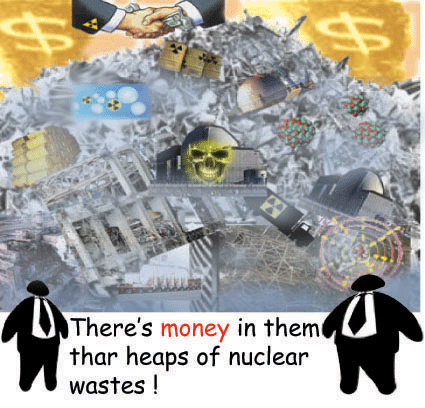
Toxic radioactive waste is expensive to clean up. Canada’s contract to clean up itslegacy waste is worth billions for a three-company consortium: Canada’s AtkinsRéalisand Texas-based Fluor and Jacobs. The two American companies run nuclear weaponsfacilities in the U.S. and U.K. in addition to their Canadian nuclear interests.
Parliament’s payment to the consortium last year was $1.3 billion. The annual payments have risen each year of the 10-year contract that will end in September 2025.
The consortium operates “Canadian Nuclear Laboratories” (CNL) in a “Government-owned, Contractor-operated” (GoCo) arrangement with Atomic Energy of Canada Limited (AECL).
The U.K. abandoned GoCo contracts because of exorbitant costs and poor value for money. Under Canada’s GoCo contract, AECL owns lands, buildings, and radioactive waste, and the three-company consortium operates AECL’s sites.
When the Harper government issued the 10-year GoCo contract during the 2015 federal election period, they said AECL lacked the ability to clean up Canada’s multi-billion radioactive waste liability dating to World War II and needed “private sector rigour. From their billion-dollar annual payout, the three partner corporations take $237 million for “contractual expenses.” The salaries of 44 senior CNL managers, mostly Americans, average over $500,000 each.
Canada’s liability includes radioactive contamination in Port Hope, Ontario where uranium was refined for the U.S. nuclear weapons industry, radioactive contamination at the Chalk River nuclear laboratory site from producing plutonium for U.S. nuclear weapons, and radioactive contamination from AECL’s shutdown “prototype” CANDU reactors and its Whiteshell research lab in Manitoba.
The radioactive clean-up cost has grown each contract year, as have the consortium’s ambitions. The focus has shifted to “revitalizing” the Chalk River facility, where Parliament has allocated additional funds to build an “Advanced Nuclear Materials Research Centre.”
The Centre will conduct SMR research including research on plutonium fuels. Both American companies have interests in SMRs. The new Centre did not undergo a licensing process or environmental assessment under the Canadian Nuclear Safety.
AECL is expected to soon announce the awarding of a new 10-year Go-Co contract. Before the contract is signed, MPs should consider whether the arrangement benefits Canada, and whether these billions should be in the hands of American managers and corporations.
Commission.
Air Force Activates Key Unit for Nuclear Modernization at VSFB

COMMENT. Well, they conned a woman into this killer industry, coddled and “educated” her into this top military job.
The nuclear lobby made keen to promote their pretence that nuclear weapons are good for women!
Most women would not like being part of this.
March 7, 2025, By Jennifer Green-Lanchoney
VANDENBERG SPACE FORCE BASE, Calif. —
In a ceremony marking a new chapter in America’s nuclear deterrence strategy, U.S. Air Force Lt. Col. Suzanne Lamar assumed command of the newly activated Site Activation Task Force (SATAF) Detachment 9 at Vandenberg Space Force Base, March 6.
The activation of SATAF Detachment 9 represents a crucial step in modernizing the nation’s Intercontinental Ballistic Missile (ICBM) capabilities, as the Air Force prepares to replace the aging Minuteman III system with the new LGM-35A Sentinel.
Vandenberg SFB’s Western Range serves as the primary testing ground for the Air Force Global Strike Command’s ICBM deterrent architecture. The Sentinel program represents a significant update to U.S. nuclear deterrent capabilities.
“Space superiority and nuclear deterrence start here at Vandenberg,” said U.S. Air Force Lt. Gen. Michael Lutton, Air Force Global Strike Command deputy commander. “Seventy years ago, Vandenberg hosted the dawn of ICBM testing, and we carry that forward here as we bring this new capability to the joint force.”……………………………….
The SATAF detachments, including Detachment 9 at Vandenberg, are crucial components of AFGSC’s strategy to maintain a “continuously viable, secure, and effective land-based nuclear deterrent.” Similar detachments are scheduled for activation at F.E. Warren AFB, Wyoming (April 3); Malmstrom AFB, Montana (April 4); and Minot AFB, North Dakota (summer 2025)……………………………………………………… https://www.afgsc.af.mil/News/Article-Display/Article/4112894/air-force-activates-key-unit-for-nuclear-modernization-at-vsfb/
Does the Deep State really exist, and if so, is it being dismantled?
March 9, 2025, https://theaimn.net/does-the-deep-state-really-exist-and-if-so-is-it-being-dismantled/ .
What is the Deep State? Does it really exist?
These questions are hard to answer. I had heard the term Deep State over many years, and I connected it with all sorts of conspiracies – not just about U.S. politics and intelligence systems, but with wild ideas about satanism, reptilian shapeshifters, the antichrist, child-trafficking, blood harvesting – and all connected with extreme right-wing and pro- Trump propaganda. So I just dismissed and ignored them – there was no such thing as the Deep State !
It is not that simple.
Indeed, it is very complex.
If you start delving, the term Deep State takes you back to Turkey, over 100 years ago, where the concept of a “shadow government” a “secret state within the state” was a real thing. In more modern times the Deep State is defined as:
“The deep state conspiracy theory in the United States is an American political conspiracy theory that posits the existence of the deep state, a clandestine network of members of the federal government (especially within the FBI and CIA). The theory argues that there exist networks of collaborators within the leadership of the high-level financial and industrial entities, which exercise power alongside or within the elected United States government” – Wikipedia
So, OK it’s still just a theory – a conspiracy theory pushed by Donald Trump’s supporters in order to discredit USA’s Biden Democrat administration? And various extreme religious and other wacky groups tacked the more sinister stuff onto it.
The trouble is, as with many problems, there is some truth in it. Over the decades since World War 2, successive U.S. Presidents have turned to secret discussions with unelected officials from the CIA in particular, but also from other agencies and business circles, relying on their advice to make decisions. The decisions were then pretty much rubber-stamped by a complacent and oblivious Congress.
The following (annoying advertisement-afflicted) video from early 2024, is unmistakably a propaganda piece for the Trump campaign. But it does contain some telling information. Even from its first example, we see that J.F. Kennedy, in the Cuban missile crisis, went not to his advisors, but to a social group of very secret members of the CIA to decide what to do. The development of the very powerful, very secretive CIA, in partnership with military leaders, rocket scientists from Germany, media and business leaders, produced an information network on which Presidents relied for decision-making. The CIA’s spying powers that were appropriate in war against the enemy are now directed also against the American public, even in peacetime. Huge well-funded resources went to secret activities that included misinformation and disinformation against civil rights and peace activists. Congress accepts these secret programmes in the name of security.
That video – however pro-Trump it might be, does not mention satanism, etc. If you separate that wacky stuff from the Deep State story – it is all remarkably convincing. To an American public, fed up with the secrecy, the endless expensive pointless wars – Vietnam, Iraq Afghanistan …, Donald Trump’s promise of change, and of dismantling the Deep State sounded attractive.
And hey – presto ! Trump is doing it! He’s sacking those unelected officials, thousands and thousands of them. He’s purging law enforcement and intelligence agencies, and plans to cut 70 percent of staff from various government agencies — freezing of billions of dollars in funding,
Ain’t that great!
Actually, no.
We might welcome the disruption of a Deep State system based on militarism, with the USA forever fomenting trouble overseas, and spending unknown $squillions on military gimmickry. A phrase springs to mind – “Throwing the baby out with the bath-water” . That’s a very corny metaphor. But what is really happening is this:
Trump’s aim is nothing to do with the “Deep State” . Trump’s goal and methodology was set out, detailed in Project 2025, the Center for Renewing America and the America First Policy Institute. The goal is the destruction of democracy – removing or rendering useless the laws, regulations, protocols and rules that prevent autocratic power. No more compromise, limited power, checks and balances and accountability. He made a good start in getting control over the Supreme Court
And I don’t know if everybody noticed two salient points in Trump’s “defeat of the Deep State”
- the power and unaccountable funding of the Pentagon will continue.
- Trump’s getting rid of “unelected officials” – but apparently taking orders from unelected Elon Musk.
The end goal is the dictatorship of Donald Trump. It would be funny if it were not so deadly serious. The first step – the “Trump’s Birthday and Flag Day Holiday Establishment Act” gives a clue as to what will follow.

The President Trump phenomenon will end eventually, for sure in chaos. Western World leadership is in the hands of a powerful, but unhinged , dictator, who is taking the advice of another powerful unelected unhinged billionaire, Elon Musk.
The whole process is far too much to pay for the destruction of the Deep State. Yes, it is welcome that the secretive decision-making by unelected officials and business leaders – taking the USA into endless wars – has been stopped. But its replacement is a terrifying fascism.
And at the end of it all, after the chaos, what will emerge? If we’re lucky enough to avoid catastrophes of global heating, and war, will we again get a government of men that are happy to have decisions made by macho men in bureaucracy and industry, who are itching for war – another Deep State in the name of “security”?
Supreme Court wrestles with nation’s frustrating search for nuclear waste storage

Justice Sonia Sotomayor, looking ahead to the United States’ 250th anniversary next year, said, “I hope that we make it another 250, but if it takes 40 or 80 years for a solution to come, it would still be temporary, correct?”
By ASSOCIATED PRESS, 6 March 2025 ,
https://www.dailymail.co.uk/wires/ap/article-14464455/The-Supreme-Court-confronts-national-headache-What-growing-pile-nuclear-waste.html
WASHINGTON (AP) – The Supreme Court on Wednesday wrestled with whether to restart plans to temporarily store nuclear waste at sites in rural Texas and New Mexico even as some justices worried about safety issues and the lack of progress toward a permanent solution.
The justices heard arguments in a case that reflects the complicated politics of the nation´s so far futile quest for a permanent underground storage facility. A plan to build a national storage facility northwest of Las Vegas at Yucca Mountain has been mothballed because of staunch opposition from most Nevada residents and officials.
The court took up a challenge by the Nuclear Regulatory Commission and a private company with a license for the Texas facility to an appellate ruling that found the commission had no authority to grant the license. The outcome of the case will affect plans for a similar facility in New Mexico roughly 40 miles (65 kilometers) away.
The licenses would allow the companies to operate the facilities for 40 years, with the possibility of a 40-year renewal.
“That doesn’t sound very interim to me,” Justice Neil Gorsuch said, while also questioning the advisability of storing spent nuclear fuel “on a concrete platform in the Permian Basis, where we get all our oil and gas from.”
Justices Samuel Alito and Clarence Thomas joined Gorsuch in asking questions suggesting they were the most likely to uphold the ruling from the 5th U.S. Circuit Court of Appeals.
Roughly 100,000 tons (90,000 metric tons) of spent fuel, some of it dating from the 1980s, is piling up at current and former nuclear plant sites nationwide and growing by more than 2,000 tons (1,800 metric tons) a year. The waste was meant to be kept there temporarily before being deposited deep underground.
The NRC has said that the temporary storage sites are needed because existing nuclear plants are running out of room. The presence of the spent fuel also complicates plans to decommission some plants, the Justice Department said in court papers.
Justice Sonia Sotomayor, looking ahead to the United States’ 250th anniversary next year, said, “I hope that we make it another 250, but if it takes 40 or 80 years for a solution to come, it would still be temporary, correct?”
Justice Department lawyer Malcolm Stewart agreed, noting that the spent fuel has to be kept somewhere, whether at operating and decommissioned plants or elsewhere.
Security also is cheaper with the waste in one or two locations, Stewart said, relying on arguments made by Interim Storage Partners LLC, the company with the Texas license.
Sotomayor, along with Justices Ketanji Brown Jackson, Elena Kagan and Brett Kavanaugh, seemed most inclined to reverse the 5th circuit. Chief Justice John Roberts and Justice Amy Coney Barrett said little or nothing to reveal where they stand.
The NRC’s appeal was filed by the Biden administration and maintained by the new Trump administration. Texas Gov. Greg Abbott,. a Republican, and New Mexico Gov. Michelle Lujan Grisham, a Democrat, are leading bipartisan opposition to the facilities in their states.
The justices will consider whether, as the NRC and Interim Storage Partners argues, the states and a private energy company forfeited their right to object to the licensing decisions because they declined to join in the commission´s proceedings.
Two other federal appeals courts, in Denver and Washington, that weighed the same issue ruled for the agency. Only the 5th Circuit allowed the cases to proceed.
The second issue is whether federal law allows the commission to license temporary storage sites. Opponents are relying on a 2022 Supreme Court decision that held that Congress must act with specificity when it wants to give an agency the authority to regulate on an issue of major national significance. In ruling for Texas, the 5th Circuit agreed that what to do with the nation´s nuclear waste is the sort of “major question” that Congress must speak to directly.
But the Justice Department has argued that the commission has long-standing authority to deal with nuclear waste reaching back to the 1954 Atomic Energy Act.
The NRC granted the Texas license to Interim Storage for a facility that could take up to 5,000 metric tons of spent nuclear fuel rods from power plants and 231 million tons of other radioactive waste. The facility would be built next to an existing dump site in Andrews County for low-level waste such as protective clothing and other material that has been exposed to radioactivity. The Andrews County site is about 350 miles (560 kilometers) west of Dallas, near the Texas-New Mexico state line.
The New Mexico facility would be in Lea County, in the southeastern part of the state near Carlsbad. The NRC gave a license for the site to Holtec International.
Alito, who said the interim sites could remove the incentive to find a permanent solution, asked Brad Fagg, a lawyer for Interim Storage Partners, for a prediction of when a permanent site would open.
“I’ve been in this stew for a lot of years,” Fagg said. “I would be kidding myself and this court if I said I had a date.”
A decision is expected by late June.
Doug Ford: Rip up the GE-Hitachi US nuclear contract

Ontario Clean Air Alliance 6 Mar 25
Premier Ford says he will tear up Ontario’s expensive contract for Elon Musk’s Starlink satellite service in the wake of Donald Trump’s unhinged attacks on our economy. And thanks to Doug Ford, American wine and bourbon is gone from our liquor stores.
He has also ordered the Ontario Public Service to go through the province’s contracts “with a fine tooth comb” to find other U.S. contracts that can be axed. According to Premier Ford: “We won’t award contracts to people who enable and encourage economic attacks on our province and our country.”
That’s why it’s time for the Ford Government to tell Ontario Power Generation to rip up its contract with GE-Hitachi for 4 new nuclear reactors at Darlington, east of Oshawa. These expensive and first-of-their-kind proposed new U.S. reactors would come with a lot of energy security and financial risks, including the need to import enriched uranium from the U.S.
As Bob Walker, National Director of the Canadian Nuclear Workers’ Council told the Globe and Mail: “Developing a dependence on another country for our nuclear fuel has always been a concern and recent events have proven those concerns are justified.”
A much lower cost and more secure way to keep our lights on is to invest in Made-in-Canada wind and solar energy plus storage.
It is time for Doug Ford to lift his political moratorium on Great Lakes offshore wind power and work with Premier Legault to expand our east-west electricity grid. As a first step the Ontario-Quebec electricity interconnection capability at Ottawa should be increased by 2,000 megawatts.
Please tell Premier Ford that to Protect Ontario we need to invest in Made-in-Canada wind and solar energy and storage, and work with Quebec to expand our east-west electricity grid.
Surface tension: could the promised Aukus nuclear submarines simply never be handed over to Australia?

Guardian, Ben Dohert, 7 Mar 25
The multi-billion dollar deal was heralded as ensuring the security of the Indo-Pacific. But with America an increasingly unreliable ally, doubts are rising above the waves.
Maybe Australia’s boats just never turn up.
To fanfare and flags, the Aukus deal was presented as a sure bet, papering over an uncertainty that such an ambitious deal could ever be delivered.
It was assured, three publics across two oceans were told – signed, sealed and to-be-delivered: Australia would buy from its great ally, the US, its own conventionally armed nuclear-powered attack submarines before it began building its own.
But there is an emerging disquiet on the promise of Aukus pillar one: it may be the promised US-built nuclear-powered submarines simply never arrive under Australian sovereign control.
Instead, those nuclear submarines, stationed in Australia, could bear US flags, carry US weapons, commanded and crewed by American officers and sailors.
Australia, unswerving ally, reduced instead to a forward operating garrison – in the words of the chair of US Congress’s house foreign affairs committee, nothing more than “a central base of operations from which to project power”.
Reliable ally no longer
Officially at least, Aukus remains on course, centrepiece of a storied security alliance.
Pillar one of the Australia-UK-US agreement involves, first, Australia buying between three and five Virginia-Class nuclear-powered submarines from the US – the first of these in 2032.
Then, by the “late 2030s”, according to Australia’s submarine industry strategy, the UK will deliver the first specifically designed and built Aukus submarine. The first Australian-built version will be in the water “in the early 2040s”. Aukus is forecast to cost up to $368bn to the mid-2050s.
But in both Washington and Canberra, there is growing concern over the very first step: America’s capacity to build the boats it has promised Australia, and – even if it had the wherewithal to build the subs – whether it would relinquish them into Australian control.
The gnawing anxiety over Aukus sits within a broader context of a rewritten rulebook for relations between America and its allies. Amid the Sturm und Drang of the first weeks of Trump’s second administration, there is growing concern that the reliable ally is no longer that…………………….
‘The cheque did clear’
On 8 February, Australia paid $US500m ($AUD790m) to the US, the first instalment in a total of $US3bn pledged in order to support America’s shipbuilding industry. Aukus was, Australia’s defence minister Richard Marles said, “a powerful symbol of our two countries working together in the Indo-Pacific”.

“It represents a very significant increase of the American footprint on the Australian continent … it represents an increase in Australian capability, through the acquisition of a nuclear‑powered submarine capability … it also represents an increase in Australian defence spending”.
………….. just three days after Australia’s cheque cleared, the Congressional Research Service quietly issued a paper saying while the nuclear-powered attack submarines (known as SSNs) intended for Australia might be built, the US could decide to never hand them over.
It said the post-pandemic shipbuilding rate in the US was so anaemic that it could not service the needs of the US Navy alone, let alone build submarines for another country’s navy…………………………………………………………………………………………………..
‘Almost inevitable’
Clinton Fernandes, professor of international and political Studies at the University of New South Wales and a former Australian Army intelligence analyst, says the Aukus deal only makes sense when the “real” goal of the agreement is sorted from the “declared”.
“The real rather than declared goal is to demonstrate Australia’s relevance to US global supremacy,” he tells the Guardian.
“The ‘declared goal’ is that we’re going to become a nuclear navy. The ‘real goal’ is we are going to assist the United States and demonstrate our relevance to it as it tries to preserve an American-dominated east Asia.”
Fernandes, author of Sub-Imperial Power, says Australia will join South Korea and Japan as the US’s “sentinel states in order to hold Chinese naval assets at risk in its own semi-enclosed seas”.
“That’s the real goal. We are demonstrating our relevance to American global dominance. The government is understandably uneasy about telling the public this, but in fact, it has been Australia’s goal all along to preserve a great power that is friendly to us in our region.”
Fernandes says the Aukus pillar one agreement “was always an article of faith” based on a premise that the US could produce enough submarines for itself, as well as for Australia.
“And the Congressional Research Service study argues that … they will not have enough capacity to build boats for both themselves and us.”
He argues the rotation of US nuclear-powered submarines through Australian bases – particularly HMAS Stirling in Perth – needs to be understood as unrelated to Aukus and to Australia developing its own nuclear-powered submarine capability.
“Submarine Rotational Force-West (SRF-W) is presented by the spin doctors as an ‘optimal pathway’ for Aukus. In fact, it is the forward operational deployment of the United States Navy, completely independent of Aukus. It has no connection to Aukus.”
The retired rear admiral and past president of the Submarine Institute of Australia, Peter Briggs, argues the US refusing to sell Virginia-class submarines to Australia was “almost inevitable”, because the US’s boat-building program was slipping too far behind.
“It’s a flawed plan, and it’s heading in the wrong direction,” he tells the Guardian.
Before any boat can be sold to Australia, the US commander-in-chief – the president of the day – must certify that America relinquishing a submarine will not diminish the US Navy’s undersea capability.
“The chance of meeting that condition is vanishingly small,” Briggs says.
It now takes the US more than five years to build a single submarine (it was between three and 3.5 years before the pandemic devastated the workforce). By 2031, when the US is set to sell its first submarine to Australia, it could be facing a shortfall of up to 40% of the expected fleet size, Briggs says.
Australia, he argues, will be left with no submarines to cover the retirement from service of the current Collins-class fleet, weakened by an unwise reliance on the US.
The nuclear-powered submarines Australia wants to buy and then build “are both too big, too expensive to own and we can’t afford enough of them to make a difference”.
He argues Australia must be clear-eyed about the systemic challenges facing Aukus and should look elsewhere. He nominates going back to France to contemplate ordering Suffren-class boats – a design currently in production, smaller and requiring fewer crew, “a better fit for Australia’s requirements”……. https://www.theguardian.com/world/2025/mar/07/surface-tension-could-the-promised-aukus-nuclear-submarines-simply-never-be-handed-over-to-australia
Nuclear waste at Chalk River: opponents defeated in court.

By Nelly Albérola, Radio-Canada, ICI Ottawa-Gatineau, March 6, 2025
https://ici.radio-canada.ca/nouvelle/2145786/rejet-decision-nucleaire-chalk-river-dechet [en français]
The Federal Court has dismissed an application for judicial review by citizens’ groups and scientists opposed to the Chalk River radioactive waste disposal site in Deep River, Ontario.
The ruling has gone almost unnoticed. In the wake of the Kebaowek First Nation’s victory over Canadian Nuclear Laboratories (CNL), the Federal Court has handed down another decision concerning the proposed Chalk River nuclear waste disposal site.
Please note: This victory will require the CCNS to have meaningful consultations with the Algonquins on whose traditional lands the radioactive waste dump is intended to be built. Neither the Algonquins nor the citizens of Ontario or Quebec were ever consulted about the choice of site for the dump, located one kilometre from the Ottawa River which borders Quebec and flows into the St. Lawrence River at Montreal. – G. Edwards
On February 20, the federal judge dismissed the application for judicial review brought before the court by three citizens’ groups: Concerned Citizens of Renfrew County and Area, the Canadian Coalition for Nuclear Responsibility, and the Ralliement contre la pollution radioactive.
A justified decision, according to the court
These groups include a number of retired scientists. They consider the decision of the
Canadian Nuclear Safety Commission (CNSC) to be unreasonable. authorize, in January 2024, the construction of a near-surface disposal facility (NSDF) for about one million tons of “low-level” radioactive waste.
“When read as a whole and taking into account the experience and technical expertise of the Commission, the decision is justified, intelligible and transparent. Consequently, the present application will be rejected,” reads the Federal Court’s decision.
“We’re certainly disappointed,” says Ginette Charbonneau, spokesperson for the Ralliement contre la pollution radioactive. “We’ve been working for six years and more to tighten up this project, to make it better.”
“Our chances of success were virtually nil,” admits another spokesman for the Ralliement, Gilles Provost. “The judge couldn’t change the Commission’s decision, but had to judge whether the decision was unreasonable: that’s an extremely heavy burden of proof.”
A view shared by the three groups’ lawyer, Nicholas Pope. “In the end, the court did not say that the decision was correct, only that it did not meet the high standard of unreasonableness,” he points out in a written response.
Murky administrative law, say opponents
Beyond their disappointment, the groups deplore the fact that the court took into account only the CNSC’s opinion, without considering the observations of other professionals who are nevertheless recognized in the nuclear industry.
“We rely heavily on scientific experts such as James R. Walker. Unfortunately, both the CNSC and the judge rejected his arguments,” laments Ole Hendrickson, a researcher and member of the Concerned Citizens group. “I was surprised that the judge said that the Commission can choose whatever it wants, rather than paying attention to all the arguments.”
For the president of the Canadian Coalition for Nuclear Responsibility, Gordon Edwards, the legal system is simply not well equipped to deal with these situations.
“Administrative law is murky: magistrates are in a difficult position when they have to judge these cases,” says the former nuclear consultant for governmental and non-governmental agencies. “The law gives the CNSC the power to make decisions on nuclear matters. The judge therefore does not feel empowered to overturn the decision of the agency that has been given the authority to make that decision.”
An unprecedented project
The physicist reminds us that the permanent installation of a nuclear waste disposal site is unprecedented in Canadian history.
“We’ll never take it away again. This is where it will go and stay forever,” he insists.
“That’s why it’s so important to do it right, to make sure that all the safety measures have been taken and that they can be sustained over time,” he adds.
“The waste is going to stay in the landfill until it’s disintegrated. And that can take anywhere from a few years to millions of years, so you see the problem,” worries physicist by training Ginette Charbonneau. “You can [wear] a mask and say that legally, everything’s okay, but when you’re talking about radioactive waste, that’s not good enough.”
Supreme Court steps into debate over where to store nuclear waste
CBS, By Melissa Quin, March 5, 2025
Washington — The Supreme Court on Wednesday jumped into the decades-long dispute over what to do with thousands of metric tons of nuclear waste, as it considered a plan to store it above one of the world’s most productive oil fields, the Permian Basin in Texas.
The U.S. Nuclear Regulatory Commission and the company Interim Storage Partners are facing off against the state of Texas and Fasken Land and Minerals Ltd., which owns land in the Permian Basin, in the fight over what to do with the spent fuel generated at nuclear reactor sites. The waste can remain radioactive and pose health risks for thousands of years, according to the U.S. Energy Information Administration.
How to address the problem of nuclear waste has been complicated by politics since the advent of nuclear power last century. In 1982, Congress enacted a federal law that required the government to establish a permanent facility to house spent fuel, later determined to be Yucca Mountain in Nevada. But the site has yet to be established amid pushback from the state, and funding from Congress dried up years ago. The project was halted during the Obama administration.
The issue of where to store the growing amount of spent fuel remains. Roughly 91,000 metric tons of nuclear waste from commercial power plants are currently in private storage, both at or away from nuclear reactor sites, according to the U.S. government. And with nearly 20% of the nation’s electricity supplied by nuclear energy, plants are generating an additional 2,000 metric tons of spent fuel each year, the Energy Department estimates.
The Supreme Court agreed to take up the case in October and is considering two issues. The first is whether Texas and the landowners could challenge the commission’s decision to issue the license to Interim Storage Partners. The second is whether federal law allows the Nuclear Regulatory Commission to license private companies to temporarily house spent fuel away from nuclear-reactor sites.
Oral arguments
During arguments at the court on Wednesday, three liberal justices appeared the most skeptical of the argument from Texas that it could seek review of the commission’s licensing decision in a federal appeals court……………………………
The legal fight
The legal battle before the justices Wednesday involves a license the Nuclear Regulatory Commission issued in September 2021 to a company called Interim Storage Partners allowing it to house 5,000 metric tons — and up to 40,000 metric tons — of spent fuel in dry-cask, above-ground storage for up to 40 years. ………………………………………………………………………………………….
https://www.cbsnews.com/news/supreme-court-nuclear-waste-disposal-yucca-mountain/
1 This Month

of the week– Nuclear Reactor Information Task Force

14 May – online event From Bombs to Data Centres: the Face of Nuclear Colonialism
To see nuclear-related stories in greater depth and intensity – go to https://nuclearinformation.wordpress.com
-
Archives
- May 2026 (102)
- April 2026 (356)
- March 2026 (251)
- February 2026 (268)
- January 2026 (308)
- December 2025 (358)
- November 2025 (359)
- October 2025 (376)
- September 2025 (257)
- August 2025 (319)
- July 2025 (230)
- June 2025 (348)
-
Categories
- 1
- 1 NUCLEAR ISSUES
- business and costs
- climate change
- culture and arts
- ENERGY
- environment
- health
- history
- indigenous issues
- Legal
- marketing of nuclear
- media
- opposition to nuclear
- PERSONAL STORIES
- politics
- politics international
- Religion and ethics
- safety
- secrets,lies and civil liberties
- spinbuster
- technology
- Uranium
- wastes
- weapons and war
- Women
- 2 WORLD
- ACTION
- AFRICA
- Atrocities
- AUSTRALIA
- Christina's notes
- Christina's themes
- culture and arts
- Events
- Fuk 2022
- Fuk 2023
- Fukushima 2017
- Fukushima 2018
- fukushima 2019
- Fukushima 2020
- Fukushima 2021
- general
- global warming
- Humour (God we need it)
- Nuclear
- RARE EARTHS
- Reference
- resources – print
- Resources -audiovicual
- Weekly Newsletter
- World
- World Nuclear
- YouTube
-
RSS
Entries RSS
Comments RSS
 nuclear-news