These Are The Six Times The USA Lost Nuclear Weapons
The US military has had at least 32 “Broken Arrow” incidents.
Tom Hale, Senior Journalist, FL Science 17th Jan 2025, https://www.iflscience.com/these-are-the-six-times-the-usa-lost-nuclear-weapons-77661
Keys, phones, headphones, socks, thermonuclear weapons – some things just always seem to go missing. Believe it or not, there were at least six instances when the US lost atomic bombs or weapons-grade nuclear material during the Cold War.
Not only that, but the US is responsible for at least 32 documented instances of a nuclear weapons accident, known as a “Broken Arrow” in military lingo. These atomic-grade mishaps can involve an accidental launching or detonation, theft, or loss – yep loss – of a nuclear weapon.
February 13, 1950
The first of these unlikely instances occurred in 1950, less than five years after the first atomic bomb was detonated. In a mock nuclear strike against the Soviet Union, a US B-36 bomber en route from Alaska to Texas began to experience engine trouble. An icy landing and stuttering engine meant the landing was going to be near-impossible, so the crew jettisoned the plane’s Mark 4 nuclear bomb over the Pacific. The crew witnessed a flash, a bang, and a sound wave.
The military claims the mock-up bomb was filled with “just” uranium and TNT but no plutonium core, meaning it wasn’t capable of a conventional nuclear explosion. Nevertheless, the uranium and the weapon have reportedly never been recovered.
March 10, 1956
On March 10, a Boeing B-47 Stratojet set off from MacDill Air Force Base Florida for a non-stop flight to Morocco with “two nuclear capsules” onboard. The jet was scheduled for its second mid-flight refueling over the Mediterranean Sea, but it never made contact. No trace of the jet was ever found.
February 5, 1958
In the early hours of February 5, 1958, a B-47 bomber with a 3,400-kilogram (7,500-pound) Mark 15 nuclear bomb on board accidentally collided with an F-86 aircraft during a simulated combat mission. The battered and bruised bomber attempted to land numerous times, but to no avail. Eventually, they made the decision to jettison the bomb into the mouth of the Savannah River near Savannah, Georgia, to make the landing possible. Luckily for them, the plane successfully landed and the bomb did not detonate. However, it has remained “irretrievably lost” to this day.
January 24, 1961
On January 24, 1961, the wing of a B-52 bomber split apart while on an alert mission above Goldsboro, North Carolina. Onboard were two nuclear bombs. One of these successfully deployed its emergency parachute, while the other fell and crashed to the ground. It’s believed the unexploded bomb smashed into farmland around the town, but it has never been recovered. In 2012, North Carolina put up a sign near the supposed crash site to commemorate the incident
December 5, 1965
An A-4E Skyhawk aircraft loaded with a nuclear weapon rolled off the back of an aircraft carrier, USS Ticonderoga, stationed in the Philippine Sea near Japan. The plane, pilot, and nuclear bomb have never been found.
In 1989, the US eventually admitted their bomb was still sitting on the seabed around 128 kilometers (80 miles) from a small Japanese island. Needless to say, the Japanese government and environmental groups were pretty annoyed about it.
Spring, 1968
At some point during the Spring of 1968, the US military lost some kind of nuclear weapon. The Pentagon still keeps information about the incident tightly under wraps. However, some have speculated that the incident refers to the nuclear-powered Scorpion submarine. In May 1968, the attack submarine went missing along with its 99-strong crew in the Atlantic Ocean after being sent on a secret mission to spy on the Soviet Navy. This, however, remains conjecture.
California wildfires: a warning to Nuclear Regulatory Commission on climate change

January 16, 2025, https://beyondnuclear.org/ca-wildfires-are-a-warning-to-nrc-on-climate-change/
US Government Accountability Office warnings to Nuclear Regulatory Commission go unheeded
For nuclear power plants, fire is considered a very significant contributor to the overall reactor core damage frequency (CDF), or the risk of a meltdown. Fire at a nuclear power station can be initiated by both external and/or internal events. It can start with the most vulnerable external link to the safe operation of nuclear power plants; the Loss Of Offsite Power (LOOP) from the electric grid. It is considered a serious initiating event to nuclear accident frequency. Because of that risk, US reactors won’t operate without external offsite power from the electric grid.
The still largely uncontained wildfires burning in and around Los Angeles and Ventura Counties in southern California “are sure to rank among America’s most expensive.” The ongoing firestorms have now extended into a fourth period of “extremely critical fire weather” conditions and burned for more than a week an area the size of Washington, D.C., nearly 63 square miles. The estimated number is still being tallied for the thousands of homes and structures destroyed, the loss of life, the evacuation of communities indefinitely dislocated and the threats to and impacts on critical infrastructure including electrical power .
There is no scientific doubt that global warming is primarily caused by the unquenchable burning of fossil fuels though politically motivated denial is entrenched in the US Congress. The increased frequency and severity of these wildfires—leading to suburban and even urban firestorms— are but one consequence of a climate crisis along with a range of other global natural disasters including sea level rise, hurricanes, more severe storms generally, extreme precipitation events, floods and droughts. This more broadly adversely impacts natural resources and critical infrastructures to include inherently dangerous nuclear power stations.
At this particular time, it is important to reflect upon the April 2, 2024, report to Congress issued by its investigative arm, the United States Government Accountability Office (GAO), “Nuclear Power Plants: NRC Should Take Actions to Fully Consider the Potential Effects of Climate Change,” (GAO 24-106326).
The GAO warns that the US Nuclear Regulatory Commission (NRC) needs to start taking actions to address the increased risk of severe nuclear power plant accidents attributable to human caused climate change.
The NRC’s actions to address the risks from natural hazards do not fully consider potential climate change effects on severe nuclear accident risks. “For example, NRC primarily uses historical data in its licensing and oversight processes rather than climate projections data,” the GAO report said.
Beyond Nuclear has uncovered similar findings during our challenges to the NRC’s extreme relicensing process for extending reactor operating licenses, now out to the extreme of 60 to 80 years and talk of 100 years. We found that the agency’s staff believes and stubbornly insists that an environmental review for climate change impacts (sea level rise, increasingly severe hurricanes, extreme flooding, etc.) on reactor safety and reliability is “out of scope” for the license extensions hearing process.
The GAO report points out to the NRC that wildfires, specifically, can dangerously impact US nuclear power stations operations and public safety with potential consequences that extend far beyond the initiating natural disaster. These consequences can include loss of life, large scale and indefinite population dislocation and uninsurable economic damage from the radiological
consequences:
“Wildfire. According to the NCA (National Climate Assessment), increased heat and drought contribute to increases in wildfire frequency, and climate change has contributed to unprecedented wildfire events in the Southwest. The NCA projects increased heatwaves, drought risk, and more frequent and larger wildfires. Wildfires pose several risks to nuclear power plants, including increasing the potential for onsite fires that could damage plant infrastructure, damaging transmission lines that deliver electricity to plants, and causing a loss of power that could require plants to shut down. Wildfires and the smoke they produce could also hinder or prevent nuclear power plant personnel and supplies from getting to a plant.”
Loss of offsite electrical power (LOOP) to nuclear power stations is a leading contributor to increasing the risk of a severe nuclear power accident. The availability of alternating current (AC) power is essential for safe operation and accident recovery at commercial nuclear power plants. Offsite fires destroying electrical power transmission lines to commercial reactors therefore increase the probability and severity of nuclear accidents.
For US nuclear power plants, 100% of the electrical power supply to all reactor safety systems is initially provided through the offsite power grid. If the offsite electrical grid is disturbed or destroyed, the reactors are designed to automatically shut down or “SCRAM”. Onsite emergency backup power generators are then expected to automatically or manually start up to provide
power to designated high priority reactor safety systems needed to safely shut the reactors down and provide continuous reactor cooling, pressure monitoring, but to a diminished number of the reactors’ credited safety systems. Reliable offsite power is therefore a key factor to minimizing the probability of severe nuclear accidents.
The GAO identifies a number of US nuclear power plant sites that are vulnerable to the possible outbreak of wildfires where they are located. “According to our analysis of U.S. Forest Service and NRC data, about 20 percent of nuclear power plants (16 of 75) are located in areas with a high or very high potential for wildfire,” the GAO report states. “More specifically, more than
one-third of nuclear power plants in the South (nine of 25) and West (three of eight) are located in areas with a high or very high potential for wildfire.” The GAO goes on to identify “Of the 16 plants with high or very high potential for wildfire, 12 are operating and four are shutdown.”
To analyze exposure to the wildfire hazard potential, the GAO used 2023 data from the U.S. Forest Service’s Wildfire Hazard Potential Map. “High/very high” refers to plants in areas with high or very high wildfire hazard potential. Those nuclear power stations described by GAO as “high / very high” exposure to wildfires and their locations are excerpted from GAO Appendix III: Nuclear Power Plant Exposure to Selected Natural Hazards.
Table 1: Potential High Exposure to “Wildfires” at Operating Nuclear Power Plants
–AZ / SAFER, one of two mobile nuclear emergency equipment supply units in the nation, “HIGH / VERY HIGH”
–CA / Diablo Canyon Units 1 & 2 nuclear power station, “HIGH / VERY HIGH”
–FL / Turkey Point Units 3 & 4 nuclear power station, “HIGH / VERY HIGH”
–GA / Edwin I. Hatch Units 1 & 2 nuclear power station, “HIGH / VERY HIGH”
–GA / Vogtle Units Units 1, 2, 3 & 4, nuclear power station, “HIGH / VERY HIGH”
–NC / Brunswick Units 1 & 2 nuclear power station, “HIGH / VERY HIGH”
–NC / McGuire Units 1 & 2 nuclear power station, “HIGH / VERY HIGH”
–NC / Shearon Harris Units 1 & 2 nuclear power station, “HIGH /VERY HIGH”
–NB / Cooper nuclear power station, “HIGH / VERY HIGH”
–SC / Catawba Units 1 & 2 nuclear power station, “HIGH / VERY HIGH”
–SC / H. B. Robinson Units 1 & 2 nuclear power station, “HIGH / VERY HIGH”
–WA / Columbia nuclear power station, “HIGH / VERY HIGH”
Table 2: Potential High Exposure to “Wildfires” at Shutdown Nuclear Power Plants
–CA / San Onofre Units 1 & 2, “HIGH / VERY HIGH”
–FL / Crystal River, “HIGH / VERY HIGH”
–NJ / Oyster Creek, “HIGH / VERY HIGH”
–NY / Indian Point Units 1, 2 & 3, “HIGH / VERY HIGH”
Wildfires can transport radioactive contamination from nuclear facilities
A historical review of wildfires that occur around nuclear facilities (research, military and commercial power) identifies that these events are also a very effective transport mechanism of radioactivity previously generated at these sites and subsequently released into the environment by accident, spills and leaks, and careless dumping. The radioactivity is resuspended by wildfires that occur years, even decades later. The fires carry the radioactivity on smoke particles downwind, thus expanding the zone of contamination further and further with each succeeding fire. The dispersed radionuclides can have very long half-lives meaning they remain biologically hazardous in the environment for decades, centuries and longer.
Here are a few examples of how wildfires increasing in frequency and intensity are also threatening to spread radioactive contamination farther away the original source of generation.
The Chornobyl nuclear catastrophe and recurring wildfires
The Chornobyl nuclear disaster that originally occurred on April 26,1986, initially spread harmful levels of radioactive fallout concentrated around the destroyed Chornobyl Unit 4 in northern Ukraine. The radioactive fallout was transported high into the atmosphere by the accidental reactor explosion. The days long fire and smoke transported extreme radioactivity from the expelled
burning nuclear fuel and its graphite moderator. Radioactive fallout then spread far afield in shifting winds, precipitated with rainfall and was terrestrially deposited in its highest concentrations largely in northern Ukraine, Belarus and Southern Russia.
Additional atmospheric distributions of radioactive contamination fell across much of Europe, persisting in numerous hot spots, including in Scandinavia, and the United Kingdom, where it remains as a persistent toxin.
The Chornobyl ‘Exclusion Zone’ to restrict long term human habitation was established in the immediate aftermath in 1986 as an arbitrary 1,ooo square miles within an 18 mile radius around the exploded reactor in Ukraine and remains in place today nearly 39 years later. The Bulletin of Atomic Scientists reports that seasonal wildfires continue to occur within the Chornobyl Exclusion Zone, routinely burning across already contaminated land and resuspending radioactivity via the smoke into the atmosphere. The radioactive smoke is borne on the wind, carrying the radioactive fallout farther out and increasing the size of what can be measured as potentially an expanding Exclusion Zone.
Contrary to claims, wildfires can threaten US nuclear facilities
The Los Angeles Times headlined in May 2024 “Sites with radioactive material more vulnerable as climate change increases wildfire, flood risks.”
The LA Times did a look back at several wildfires surrounding the government radiological laboratories and government nuclear weapons manufacturing sites including the 2018 Woolsey wildfire at the old Santa Susana Field Laboratory (SSFL). This facility specifically housed 10 nuclear reactors and plutonium and uranium fuel fabrication facilities located in the Los Angeles suburbs. SSFL was used for early testing of rockets and nuclear reactors for energy. But decades of carelessness during experiments resulted in one of the first nuclear reactor meltdowns in 1959, leaving acres of soil, burn pits and water radioactively and chemically contaminated. Boeing is the current operator of SSFL now obligated to conduct the cleanup of the SSFL site.
“A 2018 fire in California started at the Santa Susana Field Laboratory, a former nuclear research and rocket-engine testing site, and burned within several hundred feet of contaminated buildings and soil, and near where a nuclear reactor core partially melted down 65 years ago,” reported the LA Times.
Over the years, NBC news has broadcast continuing coverage of the massive 2018 Woolsey fire at SSFL and the radioactive contamination from this event, found in several Los Angeles suburbs miles away.
Despite these events, federal authorities continue to issue vapid safety assurances that climate changes, including more frequent wildfires, will not increase the risks to public health and safety from contaminated commercial, military and national laboratory facilities and that there is no need to include environmental reviews that account for the impacts of climate change in the
regulatory environmental review process.
A recent example of the NRC resistance to factor in reasonable assurance for protecting the public’s health and safety from climate change risk and its potential impacts that increase the risk of a severe nuclear accident, including wildfire, into its oversight and environmental reviews for licensing and relicensing is Chairman Christopher Hanson’s September 27, 2024 response to the GAO report:
“…the NRC does not agree with the [GAO] conclusion that the agency does not address the impacts of climate change. In effect, the layers of conservatism, safety margins, and defense in depth incorporated into the NRC’s regulations and processes provide reasonable assurance of adequate protection of public health and safety, to promote the common defense and security, and to protect the environment.”
Commission Chairman Hanson’s outright dismissal of the GAO report and its finding that the agency needs to take action runs contrary to one of agency’s own, Atomic Safety Licensing Board Judge Michael Gibson’s dissenting opinion to the similar blanket dismissal by the NRC to take a “hard look” climate change impacts under the National Environmental Policy Act (NEPA) on extreme reactor relicensing. In this case, the Judge Gibson supported Beyond Nuclear’s legal challenge to the Commission’s second 20 year license extension of its operating license of its commercially reactors and dissented from the licensing board’s majority denial of our hearing request on climate change’s contribution to the risk and consequences of severe nuclear accidents.
In Judge Gibson’s 23 page dissent of his colleagues’ decision to extend the nuclear plant’s operating license out to 2060 without a pubic hearing on climate change impacts on nuclear power plants, he went on the record,
“That is hardly the reception climate change should be given. As CEQ (the President’s Council on Environmental Quality), the federal government’s chief source for assessing the importance of climate change in environmental analyses under NEPA, has made clear, ‘The United States faces a profound climate crisis and there is little time left to avoid a dangerous—potentially catastrophic—climate trajectory. Climate change is a fundamental environmental issue, and its effects on the human environment fall squarely within NEPA’s purview.’ Sadly, the majority and the NRC Staff have failed to heed this warning.”
Are AI defense firms about to eat the Pentagon?

Competitors are becoming collaborators in the industry’s hottest segment.
Defense One, Patrick Tucker, 15 Dec 24
In an unprecedented wave of collaboration, leading AI firms are teaming up—sometimes with rivals—to serve a Pentagon and Congress determined to put AI to military use. Their growing alignment may herald an era in which software firms seize the influence now held by old-line defense contractors.
“There’s an old saying that software eats the world,” Byron Callan, managing director at Capital Alpha Partners, told Investors Business Daily on Wednesday. “It’s going to eat the military too.”
Over the last week, Palantir, Anduril, Shield AI, OpenAI, Booz Allen, and Oracle announced various partnerships to develop products tailored to defense needs. Meanwhile, the House passed the 2025 National Defense Authorization Act with provisions that push the Defense Department to work more closely with tech firms on AI, and DOD announced yet another office intended to foster AI adoption.
Perhaps the most significant partnership is between Palantir and Anduril, two companies that offer somewhat competing capabilities related to battlefield data integration. Palantir holds the contract for the Maven program, the seminal Defense Department AI effort to derive intelligence from vast amounts of data provided by satellites, drones, and other sensors. Anduril offers a mesh-networking product called Lattice for rapid collection and analysis of battlefield data for drone swarming and other operations. …………………………………………………………………
Congress gets behind AI firms
On Wednesday, the House approved a 2025 defense authorization bill that includes several provisions intended to spur military adoption of AI. The bill puts a big emphasis on building out data and cloud computing resources to enable much faster adoption of AI and AI-enabled weapons, areas where companies like Anduril, Palantir, Booz Allen, and Shield AI excel.
One of the most ambitious is Section 1532, which mandates the expansion of secure, high-performance computing infrastructure to support AI training and development.
This infrastructure, which will include partnerships with commercial and hybrid cloud providers, is critical for developing scalable AI models capable of adapting to evolving mission requirements………………………………………………………………………………………………………… more https://www.defenseone.com/technology/2024/12/are-ai-defense-firms-about-eat-pentagon/401673/?oref=d1-author-river
Virginia, we have a problem

14 Jan 2025, |Peter Briggs, https://www.aspistrategist.org.au/virginia-we-have-a-problem/
Australia’s plan to acquire Virginia-class submarines from the United State is looking increasingly improbable. The US building program is slipping too badly.
This heightens the need for Australia to begin looking at other options, including acquiring Suffren-class nuclear attack submarines (SSNs) from France.
The Covid-19 pandemic dramatically disrupted work at the two shipyards that build Virginias, General Dynamics Electric Boat at Groton, Connecticut, and Huntington Ingalls Industries’ yard at Newport News, Virginia. It badly hindered output at many companies in the supply chain, too. With too few workers, the industry has built up a backlog, and yards are filling with incomplete submarines.
Within six years, the US must decide whether to proceed with sale of the first of at least three and possibly five Virginias to Australia, a boat that will be transferred from the US Navy’s fleet.
Nine months before the transfer goes ahead, the president of the day must certify that it will not diminish USN undersea capability. This certification is unlikely if the industry has not by then cleared its backlog and achieved a production rate of 2.3 a year—the long-term building rate of two a year for the USN plus about one every three years to cover Australia’s requirement.
The chance of meeting that condition is vanishingly small.
The situation in the shipyards is stark. The industry laid down only one SSN in 2021. It delivered none from April 2020 to May 2022. The USN has requested funding for only one Virginia in fiscal year 2025, breaking the two-a-year drumbeat, ‘due to limits on Navy’s budget topline and the growing Virginia class production backlog’.
As of January 2025, five of 10 Block IV Virginias ordered are in the yards, as are five of 12 Block Vs for which acquisition has been announced. (Work has not begun on the other seven Block Vs.)
The building time from laying down until delivery has increased from between 3 and 3.5 years before the pandemic to more than 5 years. The tempo is still slowing: the next Virginia, USS Iowa, is due to be delivered on 5 April 2025, 5.8 years after it was laid down.
On the original, pre-pandemic schedule, all the Block IVs could probably have been delivered to the USN by now. This is a gap that cannot be recovered in a few years, despite all the expensive manpower training and retention programs in hand.
Exacerbating the problem for the yards, the Block V submarines are 30 percent larger, and more complex to build, making a return to shorter build times unlikely. Speaking to their shareholders in October, the chief executives of Huntington Ingalls and General Dynamics blamed their slowing delivery tempo on supply chain and workforce issues. HII says it is renegotiating contracts for 17 Block IV and Block V Virginias.
Furthermore, Electric Boat has diverted its most experienced workers to avoid further slippage in building the first two ballistic missile submarines of the Columbia class, the USN’s highest priority shipbuilding program, in which the Newport News yard also participates.
It gets worse. Many USN SSNs that have joined the US fleet over the past few decades are unavailable for service, awaiting maintenance. The pandemic similarly disrupted shipyards that maintain the SSNs of the Los Angeles and Virginia classes. In September 2022, 18 of the 50 SSNs in commission were awaiting maintenance. The Congressional Budget Office reports lack of spending on spare parts is also forcing cannibalisation and impacting the availability of Virginia class SSNs.
Australia’s SSN plan must worsen the US’s challenge in recovering from this situation, adding to the congestion in shipyards and further over loading supply chains already struggling to deliver SSNs to the USN.
A US decision not to sell SSNs to Australia is inevitable, and on current planning we will have no stopgap to cover withdrawal of our six diesel submarines of the Collins class, the oldest of which has already served for 28 years.
In the end, Australia’s unwise reliance on the US will have weakened the combined capability of the alliance. And Australia’s independent capacity for deterrence will be weakened, too.
As I wrote in December, it is time to look for another solution. One is ordering SSNs of the French Suffren class. The design is in production, with three of six planned boats delivered. It is optimised for anti-submarine warfare, with good anti-surface, land-strike, special-forces and mining capability. It is a smaller design, less capable than the Virginia, but should be cheaper and is a better fit for Australia’s requirements.
Importantly, it requires only half the crew of a Virginia, and we should be able to afford and crew the minimum viable force of 12 SSNs.
Let’s build on the good progress in training, industry and facility preparations for supporting US and British SSNs in Australia, all of which should continue, and find a way to add to the alliance’s overall submarine capability, not reduce it.
Last Energy, Texas, Utah allege NRC overstepping in SMR regulation

Nuclear Newswire 13th Jan 2025
Advanced nuclear reactor company Last Energy joined with two Republican state attorneys general in a lawsuit against the Nuclear Regulatory Commission, arguing that some microreactors should not require the commission’s approval.
Utah and Texas are the states involved in the lawsuit, which was filed December 30 in federal court in Texas. The parties’ goal is to accelerate the pace of micro- and small modular reactor deployment in the United States by exempting some new technologies from the traditional licensing process.
According to a Last Energy spokesperson, “This case will determine the threshold at which a nuclear reactor is so safe that it is below concern for federal licensing. There’s no doubt that robust shielding can eliminate exposure to, and the hazards from, nuclear radiation. Congress and former NRC executive director Victor Stello Jr. have both argued for a de minimus standard, and our intent is for the courts to enforce that recommendation.”
An NRC spokesperson said the agency will respond through its filings with the district court.
Background: The nuclear power industry is experiencing a surge of support as Americans are using more energy through the electrification of the economy. The biggest customers in the playing field are large tech companies trying to build additional data centers and support artificial intelligence growth, both power-hungry endeavors…………………………………………………… https://www.ans.org/news/2025-01-13/article-6680/last-energy-texas-utah-allege-nrc-overstepping-in-smr-regulation/
Becoming a responsible ancestor – about America’s nuclear wastes.

This country, with the world’s largest inventory of high-activity radioactive waste, has not fashioned even a shadow of a strategy for the material’s permanent disposition.
in any case, the burdens would fall on future generations.
Bulletin, By Daniel Metlay | January 13, 2025
After more than four decades of intense struggle, the United States found itself in an unenviable and awkward position by 2015: It no longer had even the barest blueprint of how to dispose of its growing inventory of high-activity radioactive waste.[1] Under the leadership of Rodney Ewing, former chairman of the Nuclear Waste Technical Review Board, and Allison MacFarlane, former chairman of the Nuclear Regulatory Commission, a steering committee composed of a dozen specialists set out to prepare the so-called “reset” report on how to reconstruct that enterprise.[2] In the study’s words: “Reset is an effort to untangle the technical, administrative, and public concerns in such a way that important issues can be identified, understood, and addressed (Steering Committee 2018, 2).”
One of its key recommendations was that a non-profit, single-purpose organization should be established by the owners of the country’s nuclear powerplants to replace the Department of Energy as the implementor of a fresh waste-disposal undertaking.[3]
To appreciate these suggestions, one must first understand how the United States found itself in its current predicament.
How did the United States get here
The roots of the United States’ waste-disposition program can be found in a study prepared by a panel working under the auspices of the National Academy of Sciences (National Research Council 1957). The group’s principal advice was that high-activity waste should be entombed in conventionally mined, deep-geologic repositories such as salt mines.
Early attempts to find a site for the facility met with unanticipated technical difficulties and unflinching opposition from state officials (Carter 1989). President Jimmy Carter appointed an Interagency Review Group to suggest a pathway to unsnarl the Gordian Knot (IRG 1978). Among other things, it counseled the president that a new waste-management program should be established within the Department of Energy. It should investigate multiple potential locations in a variety of geologic formations and choose the one bearing the soundest technical characteristics for development of a repository.
President Ronald Reagan signed the Nuclear Waste Policy Act in January, 1983 (NWPA 1982). The legislation captured the consensus that had emerged around the lion’s share of the Interagency Review Group’s ideas. In particular, the law contained four strategic bargains that were requisite to its passage:
Two repositories would be built, the first in the west and a second in the east, to ensure geographic equity and geologic diversity.- Site-selection would be a technically driven process in which several different hydrogeologic formations would be evaluated against pre-established guidelines.
- States would be given a substantial voice in the choice of sites.
- Upon payment of a fee, the Department of Energy would contract with the owners of nuclear powerplants to accept their waste for disposal starting in January 1998.
By the time Congress enacted the Nuclear Waste Policy Amendments Act a mere five years later, all the bargains had been breached in one way or another (NWPAA 1987; Colglazier and Langum 1988).
Derisively labeled the “Screw Nevada” bill, the new law confined site-selection to Yucca Mountain, located both on and adjacent to the weapons-testing area. Hardly surprisingly, the state mounted an implacable and sustained challenge to the actions of the Department of Energy, including investigations to evaluate the technical suitability of Yucca Mountain and opposition to the license application that the department submitted to the Nuclear Regulatory Commission (Adams 2010).
…………………………………………………………………………………… President Obama directed the new secretary of the Energy Department, Steven Chu, to empanel the Blue Ribbon Commission on America’s Nuclear Future (BRC 2012). Ostensibly not a “siting commission,” it nonetheless proposed a “consent-based” process that was dramatically at odds with the method used to choose the Yucca Mountain site. In addition, the new leadership sought, unsuccessfully as it turns out, to withdraw the license application before the Nuclear Regulatory Commission. Ultimately, funding for the project ran out even during President Donald Trump’s administration, and the Yucca Mountain Project faded into history.
Left in its wake is the current state of affairs. This country, with the world’s largest inventory of high-activity radioactive waste, has not fashioned even a shadow of a strategy for the material’s permanent disposition.
The Department of Energy detailed the consequences of the absence of a policy with its analysis of the No-Action Alternative in the Environmental Impact Statement for Yucca Mountain (DOE 2002, S-79).[4] Under this scenario, the adverse outcomes are seemingly modest—but the calculations exclude effects due to human intrusion as well as sabotage, precisely the rationales for the disposal imperative.
At best, the nation has been left with the regulator’s vague assurance that the owners of the waste can safely extend its storage on the surface for roughly 100 years (NRC 2014). This abdication of accountability—kicking the burden down the road—transforms our generation into irresponsible ancestors.
Why has the United States gotten there
Many independent and reinforcing factors have led to this nation’s precarious moral circumstances. Five of them are worthy of note.
First, striking a balance between protecting the national interest in the disposition of the waste versus state and local interest in warding off a possible calculated risk has proven to be a constant struggle. The Interagency Review Group proposed the nebulous notion of “consultation and concurrence” to suggest that a host state must provide its consent before the repository-development process could proceed to the next step.
Congress morphed that idea into the much weaker “consultation and cooperation” when it passed the Nuclear Waste Policy Amendments Act. But it did authorize the host-state to raise an objection to the president’s selection of the site. That dissent could, however, be overridden by a majority vote in each chamber. As the Yucca Mountain case illustrated, once intensive investigations at a proposed repository location gained momentum and the prospect of restarting site selection lurked in the future, sustaining a protest was only an abstract possibility.
Second, the regulatory regime for approving a repository system was plagued by controversy. In the mid-1980s, the Environmental Protection Agency promulgated radionuclide release standards, and the Nuclear Regulatory Commission issued licensing rules for a generic repository. Directed by Congress in 1992, both agencies later released Yucca Mountain-specific regulations. These protocols proved to be methodologically contested and subject to criticism for changing the “rules of the game.”
Third, the Department of Energy has failed to merit public trust and confidence. A survey conducted by the Secretary of Energy Advisory Board at the height of the Yucca Mountain controversy conclusively demonstrated this reality: None of the interested and affected parties believe that the Department of Energy is very trustworthy. See Figure 1.[on original]
Nor did that deficit of trust and confidence shrink in the coming years. The Blue Ribbon Commission’s and Reset reports underscored this endemic problem. The Department of Energy’s recent initiative to craft a consent-based procedure for siting a federal consolidated interim storage facility positioned restoring public trust at the core of its activities.
Fourth, the Department of Energy’s execution of a stepwise approach to constructing a disposal facility was practically and conceptually flawed. Its license application composed a narrative about how it would meet the Nuclear Regulatory Commission’s regulation mandating that the material be able to be retrieved from an open repository once it was emplaced. That account did not detail the conditions under which the waste might be removed; it did not suggest where it might go; nor did it indicate what might be done if the repository proved to be unworkable. Like extended storage, retrievability of the waste would somehow take place if and when necessary. But, in any case, the burdens would fall on future generations.
Fifth, the Department of Energy encountered difficulties persuasively resolving technical uncertainties. Its license application rested on the premise that the corrosion-resistant Alloy-22 waste packages and the titanium alloy drip shields, which might divert water from the packages, would function to limit the release of radionuclides into the environment. Whether those engineered structures would perform as anticipated in a hot and humid repository may still be an open question. ………………………………….
What should be done
It would be unfair to reproach the Department of Energy alone for all the difficulties that the US waste-disposition program has confronted over the years; sometimes it just was dealt a poor hand by others. Nonetheless, in this writer’s view, reviving that effort demands, among other transformations, a modification in the organization that will execute it in the future.
Indeed, institutional design in the United States is hardly a novel concern. Included in the Nuclear Waste Policy Act was a provision directing the secretary of the Department of Energy to “undertake a study with respect to alternative approaches to managing the construction and operation of all civilian radioactive waste management facilities, including the feasibility of establishing a private corporation for such purposes (NWPA 1992).” That analysis advocated a Tennessee Valley Authority-like corporation, which was labeled “FEDCORP,” to take on the responsibility of constructing and operating a repository (AMFM 1995).
The Blue Ribbon Commission also concluded that:
A new [single-purpose] organization will be in a better position to develop a strong culture of safety, transparency, consultation, and collaboration. And by signaling a clear break with the often troubled history of the U.S. waste management program it can begin repairing the legacy of distrust left by decades of missed deadlines and failed commitments (BRC 2012, 61).
It, too, advised that a FEDCORP should replace the Department of Energy.
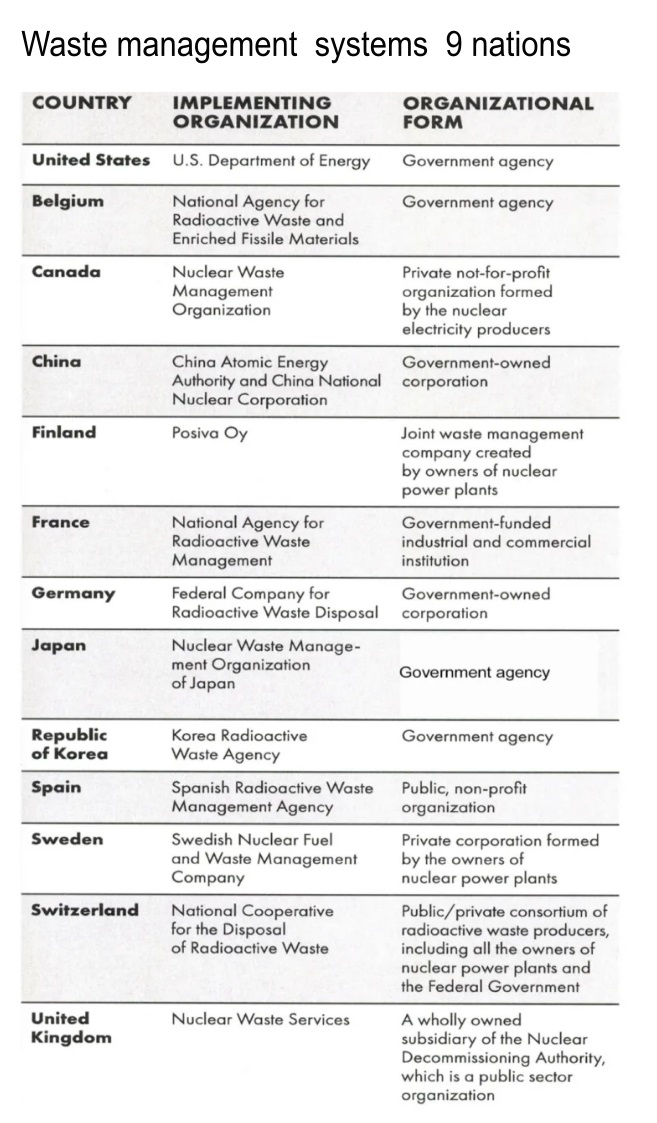
An examination of national waste-disposal undertakings indicates that countries do have several options for structuring their missions. See Figure 2 below [on original].
That multiplicity of alternatives led the majority of the Reset Steering Committee, after intense discussion and consideration, to decide that a more radical approach ought to be adopted. As the group observed: “The track record of nuclear utility-owned implementors abroad…makes at least a prima facie case for considering the creation of a not-for-profit, nuclear utility-owned implementing organization (NUCO) (Steering Committee 2018, 35).”
Of the four nations relying on nuclear utility-owned implementing organizations, three—including Finland, Sweden, and Switzerland—have selected repository sites, and another, Canada, may be on the cusp of doing so. In pointed contrast, only one of the nine countries employing other organizational designs have launched a determined set of site investigations, let along definitely and unequivocally chosen a location to build a repository.
Removing disposal authority from the Department of Energy and passing it on to a nuclear utility-owned implementing organization also permits the full integration of the nuclear fuel cycle. With the exception of disposition, every element is the responsibility of some industrial firm: uranium exploration and conversion, fuel manufacture and configuration, enrichment, reactor design and construction, spent fuel reprocessing (if permitted by law or regulation and if deemed economical), and temporary storage of spent fuel on and off reactor sites.
……………………………………………By creating a nuclear utility-owned implementing organizations, reactor owners can more easily negotiate adjustments with their industrial partners.
But transitioning from the Department of Energy to a nuclear utility-owned implementing organization is unlikely to be a frictionless process. Policymakers in government and industry will have to resolve many particulars. For instance, of central importance is the question of who should pay for the reconstructed program. Since the Nuclear Waste Policy Act’s passage four decades ago, utilities have paid a fee of $0.001 (one mil) per kilowatt of electricity produced. In addition, Congress has periodically appropriated funds to dispose of weapons-origin high-activity waste. Those resources have all been deposited in the Nuclear Waste Fund with the expectation they would pay the full life-cycle costs of the disposition effort.
At the end of Fiscal Year 2024, the Nuclear Waste Fund balance was $52.2 billion dollars (DOE 2024).[5] f a nuclear utility-owned implementing organization were established, one possibility would be to transfer the body of the fund to the new organization. However, the nuclear utility-owned implementing organization might be limited to spending for disposition only the amount of interest that the waste fund generates. In Fiscal Year 2024, that amount was roughly $1.9 billion a year. Notably that income was approximately four times what the Department of Energy spent during the last full year of the Yucca Mountain Project (Consolidated Appropriations Act 2008). Consequently, the new implementor should have sufficient resources to sustain a robust effort. (Under this approach, nuclear utilities would continue to be responsible for storing their spent fuel.)
Another question that would have to be determined is the fate of weapons-origin high-activity radioactive waste. Conceivably the Federal Government might resurrect its own repository effort, perhaps at Yucca Mountain or through a contemporary siting project. Alternatively, the most cost-effective option might be to pay the nuclear utility-owned implementing organizations a disposition fee through congressional appropriations.
Finally, given the weight to its additional responsibilities, the nuclear utility-owned implementing organization must demonstrate that it will be a trustworthy implementor……………………………………………………………….
But for this arrangement to be most effective, the Nuclear Regulatory Commission itself must be viewed more widely as trustworthy…………………………………………………………………………………
Other reforms beyond switching the implementor will urgently be necessary, such as improving the technical credibility of studies to determine the suitability of a potential repository site and structuring a sound step-by-step developmental process. Without the full slate of improvements, this generation will be stuck in the role of irresponsible ancestors. So, the reader should consider this essay as a broader call to action, if only for our children and grandchildren’s sake. https://thebulletin.org/premium/2025-01/becoming-a-responsible-ancestor/?utm_source=ActiveCampaign&utm_medium=email&utm_content=Radioactive%20fallout%20in%20Tokyo%20after%20Fukushima&utm_campaign=20250113%20Monday%20Newsletter
Patrick Lawrence: The Nihilism of Antony Blinken

It is not, or not only, the extent of Blinken’s incompetence, which even this carefully staged presentation cannot obscure. We knew he was not up to the job Biden gave him from his first months on the seventh floor at State. It is his, Blinken’s, moral vacancy that must disturb us most. He is one of those hollow men Eliot described in his famous poem of this name. This is a man who professes “values”—“our values,” as he puts it—but has none, who stands for nothing other than the rank opportunity uniquely available with access to power. I have never heretofore thought of Antony Blinken as at heart a nihilist. But on his way out the door, this seems the most truthful way to understand him.
Blinken’s approval of Israel’s mass murder in Gaza, couched in the cotton-wool language to which Blinken always resorts when he wants to turn night into day, failure into success.
January 13, 2025 By Patrick Lawrence , ScheerPost
Readers write from time to time thanking me for keeping up with The New York Times so they don’t have to do so themselves. I understand the thought, and they are most welcome in all cases. But we have now the case of The Times’s lengthy interview with Antony Blinken, published in the Sunday Magazine dated Jan. 5. Yes, I have read it. And this time I propose others do the same. This is one of those occasions when it is important to know what Americans are supposed to think — or, better put, the extent to which Americans are not supposed to think.
It is sendoff time for the outgoing regime. You can imagine without my help what kind of piffle this is engendering, if you have not already noticed.
USA Today’s Washington bureau chief, Susan Page, threw President Biden a seven-inning game’s worth of softballs this week, producing a Q & A all about “legacy” and “inflection points,” the glories of American hegemony (“Who leads the world if we don’t?”) and how Joe could have defeated Donald Trump last November but was, after all, “talking about passing the baton” even when everything we read indicated he had no intention of doing so.
……………………. Journalism with American characteristics, no other way to name it. Not a single question about the Gaza crisis, genocide, Ukraine, China. Not even a mention of Russia. And what in hell, now that I think of it, will fill the shelves in a Joseph R. Biden, Jr., Presidential Library? This is really my question.
O.K., USA Today is a comic book—“McPaper,” we used to call it—and it is folly to expect anything more than fatuous pitter-patter out of Joe Biden (or anyone interviewing him) at this late stage in the proceedings. But The Times is not a comic book, its day-to-day unseriousness notwithstanding, and Blinken purports to gravitas and authority. Herein lies the problem. In his lengthy exchange with Lulu García–Navarro, Biden’s secretary of state renders a sober-sounding account of the world as the retiring regime now leaves it that is so shockingly far from reality as to be frightening.
“Today as I sit with you, I think we hand over an America in a much, much stronger position, having changed much for the better our position around the world,” Blinken asserts at the outset of this interview. “Most Americans,” he adds a short time later, “want to make sure that we stay out of wars, that we avoid conflict, which is exactly what we’ve done.” Go ahead, let your jaw drop. Blinken’s 50 minutes with The Times are an assault on reason, on truth. And as such they are an incitement to ignorance, precisely the condition that lands this nation in the incalculable trouble Blinken proposes we pretend is not there.
It is not, or not only, the extent of Blinken’s incompetence, which even this carefully staged presentation cannot obscure. We knew he was not up to the job Biden gave him from his first months on the seventh floor at State. It is his, Blinken’s, moral vacancy that must disturb us most. He is one of those hollow men Eliot described in his famous poem of this name. This is a man who professes “values”—“our values,” as he puts it—but has none, who stands for nothing other than the rank opportunity uniquely available with access to power. I have never heretofore thought of Antony Blinken as at heart a nihilist. But on his way out the door, this seems the most truthful way to understand him.
This is the man who swiftly made an utter mess of U.S.–China relations when, two months after taking office, his first encounters with senior Chinese officials blew up in his face during talks in an Anchorage hotel conference room. Sino–American ties have been one or another degree of hostile ever since. This is the man who, a year later, led the way as Biden provoked Russia’s self-protecting intervention in Ukraine. He, Blinken, has ever since refused negotiations. This is the man who, a year after that, began his continuing defense of Israel’s genocide in Gaza. It has been Blinken and Nod in action in each case.
This is the man who—a couple of notable moments here—celebrated World Press Freedom Day in London in May 2021, while Julian Assange was in a maximum-security prison a few miles away. “Freedom of expression and access to factual and accurate information provided by independent media are foundational to prosperous and secure democratic societies,” Blinken had the nerve to declare, citing the Universal Declaration of Human Rights as he did so. This is the man who perjured himself last May, when, under oath, he told Congress the State Department had found no evidence that Israel was blocking humanitarian aid to Gaza. (I take this occasion to praise Brett Murphy once again for breaking this story in ProPublica.)
Now we can settle in and listen to Blinken converse with his interlocutor from The Times.
Blinken on relations with China:
“We were really on the decline when it came to dealing with China diplomatically and economically. We’ve reversed that…. And I know it’s succeeding because every time I meet with my Chinese counterpart, Wang Yi, the foreign minister, he inevitably spends 30 or 40 minutes, 60 minutes complaining about everything we’ve done to align other countries to build this convergence in dealing with things that we don’t like that China is pursuing. So to me, that is the proof point that we’re much better off through diplomacy.“
This account of the regress of the U.S.–China relationship on Blinken’s watch is beyond bent. First, there is no record of Wang Yi, China’s distinguished foreign minister, ever complaining to Blinken or any other U.S. official about Washington’s alliances in East Asia. China’s complaints have primarily (but not only) to do with the Biden regime’s incessant assertion of American hegemony in the Pacific, its provocative conduct on the Taiwan and South China Sea questions, and its efforts to subvert an economy with which the U.S. can no longer compete.
Second, not even Japan, South Korea, and the Philippines, with which Washington has indeed strengthened military ties, are now “aligned” against China. They, along with all other East Asians, can read maps, believe it or not. And the whole of the Pacific region will favor balanced ties with the U.S. and China as long as you and I are alive. Drawing East Asians together in some kind of Sinophobic “convergence” is a long dream from which the Washington policy cliques simply cannot awaken.
Finally and most obviously, if antagonizing another major power is a measure of diplomatic success, the nation such a diplomat purports to represent is in the kind of trouble to which I alluded earlier.
Footnote: It has been a sad spectacle these past three years as a parade of Biden regime officials, Blinken chief among them, has marched to Beijing and failed one by one to repair the damage done in Anchorage. In their dealings with Blinken, Wang and Xi Jinping, China’s president, have treated Biden’s top diplomat as if he were a junior high school student who flunked geography.
Blinken on Russia and Ukraine:
“So first, if you look at the trajectory of the conflict, because we saw it coming, we were able to make sure that not only were we prepared and allies and partners were prepared, but that Ukraine was prepared. We made sure that well before the Russian aggression happened, starting in September and then again December, we quietly got a lot of weapons to Ukraine to make sure that they had in hand what they needed to defend themselves, things like Stingers, Javelins that were instrumental in preventing Russia from taking Kyiv, from rolling over the country, erasing it from the map, and indeed pushing the Russians back….
In terms of diplomacy: We’ve exerted extraordinary diplomacy in bringing and keeping together more than 50 countries, not only in Europe, but well beyond, in support of Ukraine and in defense of these principles that Russia also attacked back in February of that year. I worked very hard in the lead up to the war, including meetings with my Russian counterpart, Sergey Lavrov, in Geneva a couple of months before the war, trying to find a way to see if we could prevent it, trying to test the proposition whether this was really about Russia’s concerns for its security, concerns somehow about Ukraine and the threat that it posed, or NATO and the threat that it posed, or whether this was about what it in fact it is about, which is Putin’s imperial ambitions and the desire to recreate a greater Russia, to subsume Ukraine back into Russia. But we had to test that proposition. And we were intensely engaged diplomatically with Russia. Since then, had there been any opportunity to engage diplomatically in a way that could end the war on just and durable terms, we would have been the first to seize them. “
Where to begin? Give me a sec to catch my breath.
Blinken and his colleagues anticipated Russia’s invasion before it started in February 2022 because the Biden regime provoked it to the point Moscow had no other choice. Washington spent the autumn of 2021 arming Kiev, just as Blinken recounts, but Blinken makes no mention of the two draft treaties the Kremlin sent Westward that December—one to Washington, one to NATO in Brussels—as the proposed basis for negotiating a durable new security settlement between Russia and the Atlantic alliance. This was dismissed out of hand as a “non-starter,” the British-ism the Biden regime favored at the time. Blinken skips over this opportunity to develop productive diplomatic channels like a mosquito across a pond.
His idea of diplomacy, indeed, was limited to gathering one of those coalitions of the willing (or coerced) the American imperium has long favored, in this case to back the proxy war to come. There was not then and has not been since any serious effort to negotiate a settlement in Ukraine. Blinken seems actually to believe (or he pretends to believe) that there was never any question of Moscow’s legitimate security concerns: It was all about the Kremlin’s plan to “erase” Ukraine in the cause of the Russia’s neo-imperial ambitions. Somehow this proposition was tested and proved out, and I would love to know how.
I am reminded once again of that moment, a few months into the war, when Blinken pulled aside Sergei Lavrov for a private exchange after formal talks at the Kremlin. As I wrote subsequently, when he asked Moscow’s long-serving foreign minister if it was true Russia wanted to reconstruct the Czarist empire, Lavrov stared, turned, and left the room—no reply, no handshake, no farewell, just an abrupt exit. How could a diplomat of Lavrov’s caliber possibly entertain such a question? We are left with two alternatives, readers. Either Tony Blinken is extremely dim-witted to misinterpret Russia’s position this badly, or Tony Blinken is a very formidable liar.
My conclusion: He is both.
Footnote: Blinken has not spoken to Lavrov since that pitiful occasion in mid–2022 — or to any other senior Russian official so far as we know. And the Biden regime has on two occasions, most famously in Istanbul a month after the Russian invasion began, actively scuttled talks between Kiev and Moscow that could have ended the war.
We come to Blinken on Israel, Gaza, and the Palestinians.
Blinken spent a great deal of his time with García–Navarro explaining his views of the Gaza crisis. And for the most part he stayed with the tedious boilerplate with which we are already familiar. The Biden regime supports Israel’s right to defend itself. He has dedicated himself to making sure the Palestinians of Gaza “had what they needed to get by.” The impediments to a ceasefire and a return of hostages are all on Hamas, not the Netanyahu regime.
Has Israel committed war crimes? Do we witness a genocide? Have the Israelis blocked food aid? You can’t expect straight answers out of Blinken on these kinds of questions, and García–Navarro got none. What she got was Blinken’s approval of Israel’s mass murder in Gaza, couched in the cotton-wool language to which Blinken always resorts when he wants to turn night into day, failure into success. Yes, he allowed, the Netanyahu regime could have made some minor adjustments at the margin and the slaughter would have looked better. But there is no erasing Blinken’s ratification of Israeli terrorism, his judgment that it has been a success — or García–Navarro’s failure to call him on this, a topic to which I will shortly return.
There is one remark Blinken made in this sendoff Q & A that has stayed with me ever since I watched the video of it and then read the transcript. It concerns the Gaza crisis, but it expands in the mind like one of those sponges that grow large when wetted. “When it comes to making sure that Oct. 7 can’t happen again,” Blinken said, “I think we’re in a good place.”
I can hardly fathom the implications of this extravagantly thoughtless assertion. There is no understanding of the human spirit in it. It takes no account of the enduring aspirations of the Palestinians people, I mean to say, and so displays the shallowest understanding of the events of Oct. 7, 2023. It presumes, above all, that the totalized violence of uncontrolled power is some kind of net-positive and can prevail in some lasting way, and that there is no need to trouble about what is just, or what it ethical, or what is irreducibly decent, or a commonly shared morality, or, at the horizon, the human cause as against (in this case) the Zionist cause.
This sentence takes us straight to Antony Blinken’s nihilism. As he leaves office he mounts not only an assault on reason, as I argued above, or our faculties of discernment, but altogether an assault on meaning. The working assumption is that he or she who controls the microphones and megaphones is free to say whatever it is of use to say. It does not require any relationship to reality, only to expedience. This is what I mean by nihilism.
“I don’t do politics,” Blinken flippantly tells García–Navarro early in their time together. “I do policy.” García–Navarro lets this go, as she does so much else. It is prima facie ridiculous, a hiding place in which García–Navarro allows Blinken to take shelter. Policy is politics: They are inseparable, no exceptions. In this case, Blinken cannot possibly expect the world beyond America’s shores to take seriously his assessment of the world as the Biden White House leaves it. This interview is all politics all the time: It is strictly for domestic consumption, intended not only to salvage a reputation — one beyond salvaging in my view — but to continue the grinding business of manufacturing consent. ……………………………………………………………………………………………………………………………..
Watch the video of Lourdes “Lulu” Garcia-Navarro’s time with Blinken. As is easily detected, she reads from a script and remains resolutely faithful to it regardless of what Blinken says. She purports to be otherwise, but she is a supplicant. She pretends to challenge Blinken on this or that question, but it is all faux, pose. None of Blinken’s lies, misrepresentations, and plain disinformation come in for serious scrutiny. It is merely on-to-the-next-question.
This is not journalism. It is spectacle, a theatrical reenactment of journalism — another case of journalism with American characteristics. It is not the creation of meaning, either: It is the destruction of meaning. I have already noted my term for this. ………………………………………………………………………………………………………………………………….
The saving grace of García–Navarro’s encounter with Tony Blinken, and a little to my surprise, lies in the comment thread appended to the published piece. There are 943 comments at this writing. And there are some voices of approval, certainly.
But my goodness are the critics many. Here are a few straight off the top of the thread:
Jorden, California.
Blinken has tarnished the office of Secretary of State. Silly is not the word, not even irresponsible but diabolical. Just bad on so many levels…. The Biden administration will mark the sudden decline of American hegemony …. U.S. foreign policy needs a much needed injection of realist logic now.
From “Rockin’ in the Free World,” Wisconsin:
For readers who want to further marvel at the creature that is Tony Blinken, watch his performance of “Rockin’ in the Free World” from last winter in Ukraine. It is truly cinematic in its irony as he facilitates U.S.–backed genocide. Could not write it better. That’s when I realized how much I viscerally hate this guy, how pathological his lack of self-awareness is[.]
And from David in Florida:
Yes, it’s called being delusional or incompetent or utterly negligent! Good job Blinkin! You and Biden undermined the final support of the Democratic Party. Sure you and your overlords will be fine with I’ll[sic] gotten gains. The rest of us won’t.
……………………………………….more https://scheerpost.com/2025/01/13/patrick-lawrence-the-nihilism-of-antony-blinken/
CBS’ 60 Minutes Exposes the Biden Administration’s Complicity in Gaza Genocide, Interviews the Whistleblowers
Here is the segment on YouTube:
Biden policy on Israel-Gaza sparks warnings, dissent, resignations | 60 Minutes
Juan Cole, 01/13/2025 Ann Arbor (Informed Comment) https://www.juancole.com/2025/01/administrations-complicity-whistleblowers.html
– The amazingly brave Cecilia Vega at CBS’ 60 Minutes did a groundbreaking segment on Sunday in which she interviewed US government officials involved with the Israeli war on Gaza, who resigned in protest either explicitly or implicitly. She also screened the sort of horrific footage of the aftermath of Israeli attacks in Gaza, with the gory parts left in. Here is the transcript.
American television news has almost completely ignored Israeli (and US) war crimes in Gaza, which have been taking place daily, but are not apparently deemed “news” at CNN, MSNBC, Fox, CBS, ABC, etc.
Here let me just excerpt some statements by the former US government officials:
Hala Rharrit was an American diplomat working on human rights: “What is happening in Gaza would not be able to happen without U.S. arms. That’s without a doubt.”
“I would show the complicity that was indisputable. Fragments of U.S. bombs next to massacres of– of ch– mostly children. And that’s the devastation. It’s been overwhelmingly children.” (Emphasis added.)
“I would show images of children that were starved to death. In one incident, I was basically berated, “Don’t put that image in there. We don’t wanna see it. We don’t wanna see that the children are starving to death.”
Hala Rharrit: The level of anger throughout the Arab world, and I– I’ll say beyond the Arab world– is palpable. Protests began erupting in the Arab world, which I was also documenting, with people burning American flags. This is very significant because we worked so hard after the war on terror to strengthen ties with the Arab world.
[Cecilia Vega: You believe that this has put a target on America’s back, you’ve said.]
Hala Rharrit: 100%.
Hala Rharrit: Yes. I don’t say them lightly. And I say it as someone that myself has survived two terrorist attacks. My first assignment was in the U.S. Embassy in Yemen. I survived a mortar attack. I say it as someone who has worked intensely on these issues and has intensely monitored the region for two decades.
After three months of the Gaza War in 2023, she was told her reports were no longer needed.
Josh Paul spent 11 years as a director in the State Department’s Bureau of Political – Military Affairs.
Josh Paul: Most of the bombs come from America. Most of the technology comes from America. And all of the fighter jets, all of Israel’s fixed-wing fleet– comes from America.
Josh Paul: There is a linkage between every single bomb that is dropped in Gaza and the U.S. because every single bomb that is dropped is dropped from an American-made plane.
Josh Paul: After October 7th, there was no space for debate or discussion. I was part of email chains where there were very clear directions saying, “Here are the latest requests from Israel. These need to be approved by 3:00 p.m.”
Josh Paul: “This came from the president, from the secretary and from those around them.”
Josh Paul: I would argue exactly the opposite. I think the moment of October 7th was a moment of incredible worldwide solidarity with Israel. And had Israel leveraged that moment to press for a real, just and lasting peace, I think we would be in a very different place now in which Israel would not be facing this increasing isolation around the world and in which its hostages would be free.
Andrew Miller was the deputy assistant secretary of state for Israeli-Palestinian affairs.
Andrew Miller: The Israelis were using those bombs in some instances to target one or two individuals in densely packed areas. And in enough instances, we saw that was in question, how Israel was using it. And those weapons were suspended.
Andrew Miller: There were conversations from the earliest days about U.S. desires and expectations for what Israel would do. But they weren’t defined as a red line.
Andrew Miller: I’m unaware of any red lines being imposed beyond the normal language about complying with international law, international humanitarian law, the law of armed conflict.
Andrew Miller: I believe the message that Prime Minister Netanyahu received is that he was the one in the driver’s seat, and he was controlling this, and U.S. support was going to be there, and he could take it for granted.
Andrew Miller: There is a danger– that if the U.S. was not providing support to Israel, Hezbollah, Hamas, Iran would see that as an opportunity to go after Israel. However, we could have said, we are taking this step because we believe this class of weapons– is being used inappropriately. But if you use this moment to accelerate your attacks against Israel, then we are going to immediately lift our prohibition.
Andrew Miller: Yes. I think it’s fair to say Israel does get the benefit of the doubt. There is a deference to Israeli accounts of what’s taken place.
Here is the segment on YouTube:
Biden policy on Israel-Gaza sparks warnings, dissent, resignations | 60 Minutes
U.S. nuclear spent fuel liability jumps to $44.5 billion

Nov 27, 2024, https://www.ans.org/news/article-6587/us-spent-fuel-liability-jumps-to-445-billion/
The Department of Energy’s estimated overall liability for failing to dispose of the country’s commercial spent nuclear fuel jumped as much as 10 percent this year, from a range of $34.1 billion to $41 billion in 2023 to a range of $37.6 billion to $44.5 billion in 2024, according to a financial audit of the DOE’s Nuclear Waste Fund (NWF) for fiscal year 2024.
The estimated liability excludes $11.1 billion already paid out to nuclear power plant owners and utilities for the DOE’s breach of the standard contract for the disposal of spent fuel (10 CFR Part 961), which required the DOE to begin taking title of spent nuclear fuel for disposal by January 1998. Owners of spent fuel routinely sue the federal government for the continued cost of managing the fuel. The recovered costs are paid out from the Treasury Department’s Judgement Fund and not from the DOE.
According to the audit, conducted by the independent public accounting firm of KPMG, the liability estimate “reflects a range of possible scenarios” regarding the operating life of the current fleet of nuclear power reactors. The estimate is also based on when the DOE thinks it may begin taking spent fuel. In May, the DOE received initial approval (Critical Decision-0) for a consolidated interim storage facility for spent fuel that, if constructed, would be operational by 2046.
The Department of Energy Nuclear Waste Fund’s Fiscal Year 2024 Financial Statement Audit was released by the DOE Office of Inspector General on November 14.
The fund: The NWF, which was intended to finance the DOE’s disposal of spent fuel, had a balance of $52.2 billion as of September, according to the KPMG audit.
The NWF was funded through annual fees—initially, $0.001 for every kilowatt hour provided by a nuclear power plant—levied by the DOE on owners and generators of spent fuel. The DOE stopped collecting annual NWF fees, however, in 2014 following an order by the U.S. Court of Appeals for the District of Columbia Circuit, which found that the DOE failed to justify the continued imposition of the fee following the suspension of the Yucca Mountain repository project.
While Los Angeles burns, AI fans the flames

Artificial intelligence is a water-guzzling industry hastening future climate crises from California’s own backyard.
By Schuyler Mitchell , Truthout, January 11, 2025
“………………………………………………. Trump’s latest smear campaign is little more than political football. But the renewed attention on California’s water does highlight ongoing tensions over the conservation and management of this finite resource. As the climate crisis worsens, it’s expected to exacerbate heat waves and droughts, bringing water shortages and increasingly devastating fires like those currently scorching southern California. The situation in Los Angeles is already a catastrophe. Climate change-induced water shortages will make imminent disasters even worse.
In the face of this grim reality, it’s worth revisiting one of the major water-guzzling industries that’s hastening future crises from California’s own backyard: artificial intelligence (AI).
Silicon Valley is the epicenter of the global AI boom, and hundreds of Bay Area tech companies are investing in AI development. Meanwhile, in the southern region of the state, real estate developers are rushing to build new data centers to accommodate expanded cloud computing and AI technologies. The Los Angeles Times reported in September that data center construction in Los Angeles County had reached “extraordinary levels,” increasing more than sevenfold in two years.
This technology’s environmental footprint is tremendous. AI requires massive amounts of electrical power to support its activities and millions of gallons of water to cool its data centers. One study predicts that, within the next five years, AI-driven data centers could produce enough air pollution to surpass the emissions of all cars in California.
Data centers on their own are water-intensive; California is home to at least 239. One study shows that a large data center can consume up to 5 million gallons of water per day, or as much as a town of 50,000 people. In The Dalles, Oregon, a local paper found that a Google data center used over a quarter of the city’s water. Artificial intelligence is even more thirsty: Reporting by The Washington Post found that Meta used 22 million liters of water simply training its open source AI model, and UC Riverside researchers have calculated that, in just two years, global AI use could require four to six times as much water as the entire nation of Denmark.
Many U.S. data centers are based in the western portion of the country, including California, where wind and solar power is more plentiful — and where water is already scarce. In 2022, a researcher at Virginia Tech estimated that about one-fifth of data centers in the U.S. draw water from “moderately to highly stressed watersheds.”
According to the Fifth National Climate Assessment, the U.S. government’s leading report on climate change, California is among the top five states suffering economic impacts from climate crisis-induced natural disaster. California already is dealing with the effects of one water-heavy industry; the Central Valley, which feeds the whole country, is one of the world’s most productive agricultural regions, and the Central Valley aquifer ranks as one of the most stressed aquifers in the world. ClimateCheck, a website that uses climate models to predict properties’ natural disaster threat levels, says that California ranks number two in the country for drought risk.
In August 2021, the U.S. Bureau of Reclamation declared the first-ever water shortage on the Colorado River, which supplies water to California — including roughly a third of southern California’s urban water supply — as well as six other states, 30 tribal nations and Mexico. The Colorado River water allotments have been highly contested for more than a century, but the worsening climate crisis has thrown the fraught agreements into sharp relief. Last year, California, Nevada and Arizona agreed to long-term cuts to their shares of the river’s water supply.
Despite the precarity of the water supply, southern California’s Imperial Valley, which holds the rights to 3.1 million acres of Colorado River water, is actively seeking to recruit data centers to the region.
“Imperial Valley is a relatively untapped opportunity for the data center industry,” states a page on the Imperial Valley Economic Development Corporation’s website. “With the lowest energy rates in the state, abundant and inexpensive Colorado River water resources, low-cost land, fiber connectivity and low risk for natural disasters, the Imperial Valley is assuredly an ideal location.” A company called CalEthos is currently building a 315 acre data center in the Imperial Valley, which it says will be powered by clean energy and an “efficient” cooling system that will use partially recirculated water. In the bordering state of Arizona, Meta’s Mesa data center also draws from the dwindling Colorado River.
The climate crisis is here, but organizers are not succumbing to nihilism. Across the country, community groups have fought back against big tech companies and their data centers, citing the devastating environmental impacts. And there’s evidence that local pushback can work. In the small towns of Peculiar, Missouri, and Chesterton, Indiana, community campaigns have halted companies’ data center plans.
“The data center industry is in growth mode,” Jon Reigel, who was involved in the Chesterton fight, told The Washington Post in October. “And every place they try to put one, there’s probably going to be resistance. The more places they put them the more resistance will spread.” https://truthout.org/articles/while-los-angeles-burns-ai-fans-the-flames/?utm_source=Truthout&utm_campaign=3634e1951f-EMAIL_CAMPAIGN_2025_01_11_08_34&utm_medium=email&utm_term=0_bbb541a1db-3634e1951f-650192793
Now By Fire, Next by Quake, then by Apocalyptic Radiation: Will Gavin Newsom’s Diablo Canyon Atomic Folly Kill Us All?

Los Angeles is now being destroyed by fire.
by Harvey “Sluggo” Wasserman, January 11, 2025, more https://freepress.org/article/now-fire-next-quake-then-apocalyptic-radiation-will-gavin-newsoms-atomic-folly-kill-us-all-0
Los Angeles is now being destroyed by fire.
Next will be the “Big One” earthquake everyone knows is coming.
And then—unless we take immediate action—Diablo Canyon’s radioactive cloud will make this region a radioactive dead zone.
My family is now besieged by four fires raging less than four miles away. We don’t know how long our luck will hold.
We are eternally grateful to the brave fire-fighters and public servants who are doing their selfless best to save us all.
We are NOT grateful that Gavin Newsom has recklessly endangered us by forcing continued operation at two unsafe, decrepit nuclear power plants perched on active earthquake faults, set to pour radioactive clouds on us from just four hours north of here.
The Nuclear Regulatory Commission’s resident site inspector—Dr. Michael Peck—after five years at Diablo warned that it cannot withstand the earthquakes we all know are coming.
In 2006 the NRC confirmed that Unit One was already seriously embrittled. Its fragile core makes a melt-down virtually certain to cause a catastrophic explosion, shooting a lethal apocalyptic cloud right at us…and then across the state and continent.
These wildfires make clear that these city, state and federal governments—maybe NO government ANYWHERE—can begin to cope with these kinds of mega-crises.
Imagine watching our public servants trying to cope while dressed in radiation suits, knowing everything around us has been permanently contaminated.
Imagine leaving all you own forever behind while racing to get yourself and your family out of here under the universal evacuation order demanded by radioactive clouds like those that decimated the downwind regions from Chernobyl and Fukushima, not to mention Santa Susanna and Three Mile Island, Windscale and Kyshtym.
Pre-empting such a catastrophe was a major motivation for the 2018 plan to phase out the two Diablo nukes in 2024 and 2025,
That landmark blueprint was crafted over a two-year period with hundreds of meetings, scores of hearings involving the best and brightest in energy, the economy, the ecology and the hard engineering realities of aging atomic power reactors.
It was signed by the then-Governor (Jerry Brown), Lieutenant Governor (Gavin Newsom), state legislature, state regulatory agencies, the Nuclear Regulatory Commission, plant owner (PG&E), labor unions, local governments, environmental groups and many more, .
The economic and energy security goals of this plan have been far exceeded by advances in renewable generation and battery storage. California now regularly gets 100% of its electricity from solar, wind and geothermal. Battery back-up capabilities exceed Diablo’s capacity by a factor of four or more. Its inflexible baseload productions unfortunately interferes with far cheaper renewables filling our grid.
The grid’s most serious blackout threats now come from disruptive malfunctions and potential disasters at Diablo Canyon.
All this has been well known since 2018, when Newsom signed the Diablo agreement.
The phase-out proceeded smoothly for four years, largely exceeding expectations.
But in 2022, Newsom strongarmed the legislature into trashing the phase-out plan. His Public Utilities Commission decimated the statewide rate structure, costing our solar industry, billions in revenues and at least 17,000 jobs.
Instead Newsom fed PG&E about $1.4 billion in public subsidies and $11 billion in over-market charges to keep Diablo running through 2030.
Neither the NRC nor state nor PG&E have done the necessary tests to guarantee Diablo’s safety, refusing to re-test for embrittlement even though such defects forced the NRC to shut the Yankee Rowe reactor in 1991.
Diablo has no private liability insurance. Should it irradiate Los Angeles, NONE of us can expect compensation.
So as we shudder amidst the horrors of this firestorm, we know that our loss of life, health and property will be orders of magnitude—literally, infinitely—more devastating when, by quake or error, the reactors at Diablo Canyon melt and explode.
Responsibility for this needless, unconscionable threat lies strictly with Gavin Newsom. There is no sane economic, electric supply or common sense reason for him to impose this gamble on us.
Governor Newsom: NOTHING can make public sense of this radioactive throw of the dice.
We respectfully beg, request, demand, beseech that you honor the sacred word you gave in 2018 to phase out the Diablo Canyon atomic reactors.
As we see the devastation engulfing us, and the inability of government to make it right, there is zero mystery as to why these nukes must shut.
NOW!!!
Are Blinken and Biden’s Gaza genocide denials any different than Nazi WWII genocide denials?
Walt Zlotow, West Suburban Peace Coalition, Glen Ellyn IL , 12 Jan 25.
Secretary of State Antony Blinken told the NY Times he’s not worried about history judging him as a genocide enabler.
When asked he replied, “No. It’s not (genocide), first of all. Second, as to how the world sees it, I can’t fully answer to that.”
Blinken will deny to his death his $22 billion in weapons that Israel has used to utterly destroy sustainable life for 2,300,000 Palestinians in Gaza’s 139 square miles is genocide. But the entire world aside from the Biden administration is correct in viewing it as genocide
It isn’t that Blinken “Can’t answer to that” (the world viewing it as genocide). He simply won’t answer to what is the most monstrous crime a national leader can commit. From Day 1 in the genocide Israel embarked upon in response to the October 7, 2023 Hamas attacks, Blinken and his boss Biden have been calling the genocide their weapons enable ‘self-defense.’
Denying genocide is what the Nazi war criminals did to a man at the Nuremberg War Crime Trials after WWII.
There will be no war crime trials for Blinken and Biden for the genocide that could not take place their tens of billions in weapons, vetoes of ceasefire resolutions in the US Security Council, public support and their endless ‘self-defense’ refrain.
In a bitter irony for humanity, it was the US which helped establish the International Criminal Court (ICC) in 1998 to ferret out and prosecute war criminals. But with criminal US wars devastating Afghanistan and Iraq, the US has turned on the ICC in fear of becoming ICC war crime targets. The US has abstained from membership and has blasted the ICC indicting Israeli Prime Minister Benjamin Netanyahu for his Gaza genocide. President Biden called the indictment “outrageous” and declared “We will always stand with Israel.”
Is that any different from denying, even condoning WWII Nazi genocide?
Blinken and Biden, barreling toward historical infamy with their blank check enabling Israeli genocide in Gaza.
Lawsuit challenges NRC on SMR regulation
Friday, 10 January 2025, https://www.world-nuclear-news.org/articles/lawsuit-challenges-nrc-on-smr-regulation
The States of Texas and Utah and microreactor developer Last Energy Inc are challenging the US regulator over its application of a rule it adopted in 1956 to small modular reactors and research and test reactors.
Under the US Nuclear Regulatory Commission (NRC) Utilization Facility Rule, all US reactors are required to obtain NRC construction and operating licences regardless of their size, the amount of nuclear material they use or the risks associated with their operation. The plaintiffs say this imposes “complicated, costly, and time-intensive requirements that even the smallest and safest SMRs and microreactors – down to those not strong enough to power an LED lightbulb” must satisfy to secure the necessary licences. This does not only affect microreactors: existing research and test reactors such as those at the universities in both Texas and Utah face “significant costs” to maintain their NRC operating licences, the plaintiffs say.
In the filing, Last Energy – developer of the PWR-20 microreactor – says it has invested “tens of millions of dollars” in developing small nuclear reactor technology, including USD2 million on manufacturing efforts in Texas alone, and has agreements to develop more than 50 nuclear reactor facilities across Europe. But although it has a “preference” to build in the USA, “Last Energy nonetheless has concluded it is only feasible to develop its projects abroad in order to access alternative regulatory frameworks that incorporate a de minimis standard for nuclear power permitting”.
Noting that only three new commercial reactors have been built in the USA over the past 28 years, the plaintiffs say building a new commercial reactor of any size in the country has become “virtually impossible” due to the rule, which it says is a “misreading” of the NRC’s own scope of authority.
They are asking the court to set aside the rule, “at least as applied to certain small, non-hazardous reactors”, and exempt their research reactors and Last Energy’s small modular reactors (SMRs) from the commission’s licensing requirements.
Houston, Texas-based law firm King & Spalding said the lawsuit, if it is successful, would “mark a turning point” in the US nuclear regulatory framework – but warns that it could also create greater uncertainty as advanced nuclear technologies get closer to commercial readiness.
“Regardless the outcome, the Plaintiffs’ lawsuit highlights the challenges in applying the Utilization Facility Rule to the advanced nuclear reactors now under development in the US,” the company said in in analysis released on 9 January.
But the NRC is already addressing the issue: in 2023, it began the rulemaking process to establish an optional technology-inclusive regulatory framework for new commercial advanced nuclear reactors, which would include risk-informed and performance-based methods “flexible and practicable for application to a variety of advanced reactor technologies”. SECY-23-0021: Proposed Rule: Risk-Informed, Technology-Inclusive Regulatory Framework for Advanced Reactors is currently open for public comment until 28 February, and the NRC has said it expects to issue a final rule “no later than the end of 2027”.
The lawsuit has been filed with the US District Court in the Eastern District of Texas.
China Is Not Our Enemy
So I coordinate our CODEPINK’s China is our enemy campaign, and the campaign was created in response to this rise in recent years of anti-China sentiments and the actions that our government has been taking to accelerate the new Cold War offensive against Beijing, and that includes spending billions of dollars militarizing Asia Pacific region, utilizing military economic coercion to push US interests outright labeling China an enemy, demonizing essentially anything China does, and all of which has led to a rise in Asian American hate around the country.
So the campaign seeks to do two things. The first is to educate the public how their minds are being shaped for war. And we do this by teaching our audience about China, dismantling the lies being told by the media, by politicians, and then also informing on all the tax dollars being spent preparing for war with China. And the second thing that we try to do is redirect all that energy into a push for peace. And that’s why we emphasize the need for friendship and cooperation with China for working together on climate justice, nuclear disarmament and other extremely important issues today.
SCHEERPOST, 10 Jan 25, Robert Scheer interviews Megan Russell, a writer, academic and CODEPINK’s China is Not Our Enemy Campaign Coordinator.
…………………………………………………………………………………………………………………………………. in the past 50 or so years, you know, China has accomplished an incredible amount of progress, something they don’t talk about enough, in my opinion, is how China managed to eradicate extreme poverty. And that’s not just a minimum income level. It also means access to food, to clothes, health care, clean housing, free education, you know, means infrastructure, means functioning systems and and through the past half a century, you know, through market reforms, rural collectivization and other poverty alleviation programs, China was ultimately successful in its in its mission. And by 2021, I believe the last 100 million people were taken out of extreme poverty, which was nearly 900 million people total. And many UN officials call it the greatest anti-poverty achievement in history, which it is. That’s 1.4 billion people without extreme poverty. That’s about the entire continent of Africa or the US and Europe combined.
…………………………………………….This turn toward China, and this new narrative that China is some sort of existential threat to us, even though China has never threatened war or even invaded or intervened in a nation for 50 years, which is a sharp contrast to US history, which is very heavily involved in overseas conflicts. But, you know, China’s been focused on its internal growth and accomplishing its own goals. And non interventionism, of course, is one of its foundational policy pillars.
The American saber-rattling against China has been increasing almost as fast as China’s own development in the past few years. China’s economic prosperity and international influence is undeniable yet American politicians continue to treat their rise as a threat to their global hegemony. Joining host Robert Scheer on this episode of Scheer Intelligence is Megan Russell, a writer, academic and CODEPINK’s China is Not Our Enemy Campaign Coordinator.
Scheer is quick to point out the intergenerational dynamic between his own work on China as a fellow in the Center for Chinese Studies at the University of California, Berkeley in the 1960s and Russell’s recent experience living in China and studying in Shanghai. Both witnessed and experienced the American perspective of China and how it has continued to undermine it. Scheer and Russell focus on her latest article, which calls out New York Times columnist Thomas Friedman for his portrayal of China and how his deficient op-ed mirrors the broader perception of China in the United States. While many may think that China is an authoritarian country with people living under the heel of Xi Jinping, the actual material conditions of its population are often left out.
“Something [people] don’t talk about enough, in my opinion, is how China managed to eradicate extreme poverty. And that’s not just a minimum income level, it also means access to food, to clothes, healthcare, clean housing, free education. It means infrastructure, means functioning systems,” Russell says.
People also point to working conditions and the outsourcing of American jobs to China as a means of attacking them. To this, Russell explains, “All China has done is use the system in place to develop and try to provide opportunities to its incredibly vast population, while still maintaining its proto-socialist policies. It’s us that has exported the production of all our goods to make a few more dollars.”
In the end, the US stands to lose, not only in a trade war, but also in the climate aspect, since China has also made great strides towards combatting the climate crisis. Russell cites their plan of reaching carbon neutrality by 2060 and tells Scheer, “China has really undergone this internal green energy revolution, doing far more than any other country to combat climate change.”
………………………………………………………………………………………………………………………………………….. Megan Russell
…………………………………………………………………………………..Megan Russell
Yeah, you know, a lot of times the first thing people ask me when they hear that I lived in China was that was “Was it scary?” Did I feel threatened and watched? Someone actually just asked me that yesterday, and it’s very real to them, though it always sounds a little silly to me, because I actually felt very safe in China more than I felt in most other countries, I would say, maybe all of them. And that’s, you know, my honest answer. You know, crime rates are very low in China. I never had any safety issues. I lived there a year. I traveled extensively by myself to many provinces on all sides of the country. I never felt unsafe. I never worried about pickpockets. I never worried about being robbed. I never felt the discomfort of being a woman alone. You know, everyone has a different experience, but this was my experience,
……………………………………………………………………………………………………… the success of China is, you know, very triggering to this idea of Western exceptionalism. You know that any form of socialism could actually improve the lives of the people, could actually obtain any measure of success. And this exceptional exceptionalism is based on ideals, right on this imagined perfection of free markets and democracy, yes, but also on colonial racist doctrines. And that’s really, you know, at the root of it, a lot of this negativity as well. Unfortunately, though, it’s, you know, often disguised or dressed up like something else. It’s at the root of it, a dehumanization of China and Chinese people that they are worth less, that they aren’t deserving of of jobs or opportunities or of success. And I think this manifests itself very easily into a global system that is, you know, inherently based on a division of humanity that we have been forced to accept as normal and and that doesn’t just go for China, of course, but the entire Global South……………………………………………………………………………..
Robert Scheer…………………………………………………………………… you know, we need to manufacture consent for militarization, for war, because it’s far easier with public support, and it helps maintain internal stability here as well. And this is why you’ve seen, you know, this steady rise of anti-China messaging and and fear mongering. You know, just last fall, the House passed a bill to fund $1.6 billion to anti-China propaganda around the world. You know, that’s $1.6 billion of going to information warfare. Because, you know, in order to pursue this agenda, you need to convince the rest of the world that, or at least the United States, that China is a threat and and many people aren’t, you know, convinced enough. And also, along with that, you know, there was a whole China week where they passed 25 anti China bills, including the propaganda Bill, you know, all with the end goal of countering the influence of the Communist Party of China………………………………………………………………………………………………………………………………………………………………… more https://scheerpost.com/2025/01/10/china-is-not-our-enemy/
U.S. politicians want transparency about the radiation risks of the fire afflicted Santa Susana nuclear site.

 Public Risks from the Woolsey Fire and the Santa Susana Field Laboratory: A Letter to DTSC https://www.indybay.org/newsitems/2018/11/20/18819268.php, by Bradley Allen Nov 20th, 2018
1 This Month

of the week – Shut Down Drone Warfare!


Tell the Ukrainian Government to Drop Prosecution of Peace Activist Yurii Sheliazhenko

Petition to revoke the licensing of the Near Surface Nuclear Disposal Facility (NSDF) at Chalk River. https://www.ourcommons.ca/petitions/en/Petition/Details?Petition=e-7247
To see nuclear-related stories in greater depth and intensity – go to https://nuclearinformation.wordpress.com
-
Archives
- April 2026 (69)
- March 2026 (251)
- February 2026 (268)
- January 2026 (308)
- December 2025 (358)
- November 2025 (359)
- October 2025 (376)
- September 2025 (257)
- August 2025 (319)
- July 2025 (230)
- June 2025 (348)
- May 2025 (261)
-
Categories
- 1
- 1 NUCLEAR ISSUES
- business and costs
- climate change
- culture and arts
- ENERGY
- environment
- health
- history
- indigenous issues
- Legal
- marketing of nuclear
- media
- opposition to nuclear
- PERSONAL STORIES
- politics
- politics international
- Religion and ethics
- safety
- secrets,lies and civil liberties
- spinbuster
- technology
- Uranium
- wastes
- weapons and war
- Women
- 2 WORLD
- ACTION
- AFRICA
- Atrocities
- AUSTRALIA
- Christina's notes
- Christina's themes
- culture and arts
- Events
- Fuk 2022
- Fuk 2023
- Fukushima 2017
- Fukushima 2018
- fukushima 2019
- Fukushima 2020
- Fukushima 2021
- general
- global warming
- Humour (God we need it)
- Nuclear
- RARE EARTHS
- Reference
- resources – print
- Resources -audiovicual
- Weekly Newsletter
- World
- World Nuclear
- YouTube
-
RSS
Entries RSS
Comments RSS
 nuclear-news