Wait, isn’t this the plot to the “Terminator” movies?
“There was a nuclear war,” a character explains. “Defense network computers. New… powerful… hooked into everything, trusted to run it all. They say it got smart, a new order of intelligence. Then it saw all people as a threat, not just the ones on the other side. Decided our fate in a microsecond: extermination.”
It seems like either the execs at OpenAI have never seen it or they’re working overtime to make that premise a reality.
Don’t believe us? OpenAI has announced that the US National Laboratories will use its deeply flawed AI models to help with a “comprehensive program in nuclear security.”
As CNBC reports, up to 15,000 scientists working at the institutions will get access to OpenAI’s latest o1 series of AI models — the ones that Chinese startup DeepSeek embarrassed on the world stage earlier this month.
According to OpenAI CEO Sam Altman, who announced the partnership at an event in Washington, DC, the tech will be “focused on reducing the risk of nuclear war and securing nuclear materials and weapons worldwide,” as quoted by CNBC.
OpenAI’s been making a huge push into government. Earlier this week, the Sam Altman-led company released ChatGPT Gov, a platform specifically designed for US government use that focuses on security.
But whether the company can deliver on some sky-high expectations — while also ensuring that its frequently lying AI chatbots won’t leak the nuclear codes or trigger the next nuclear war — is anyone’s guess.
The news comes after the Wall Street Journal reported that OpenAI is in early talks for a new round of funding that would value it at a gargantuan $340 billion, double its previous valuation last year.
OpenAI also signed onto Trump’s $500 billion AI infrastructure deal, dubbed Stargate, with the plan of contributing tens of billions of dollars within the next year.
Whether the company’s o1 reasoning models will prove useful in any meaningful way to the researchers at the US National Laboratories remains to be seen.
But given the widespread dismantling of regulations under the Trump administration, it also feels like an unbelievably precarious moment to be handing over any amount of control over nuclear weapons to a busted AI system.
Washington | US President Donald Trump said he was willing to immediately start working on a new nuclear deal with Iran that allows the country to “peacefully grow and prosper”, seemingly softening his stance on the Islamic Republic.
“Reports that the United States, working in conjunction with Israel, is going to blow Iran into smithereens, ARE GREATLY EXAGGERATED,” Mr Trump said in a post on his social networking site Truth Social on Wednesday (Thursday AEDT).
He didn’t give details on what such an agreement would entail, and Iranian officials haven’t yet responded to the post.
The US has long accused Tehran of using a decades-old civilian nuclear program to disguise ambitions to develop weapons, a claim repeatedly denied by Iran. The latest comments contrast with Mr Trump’s attitude in his first term, when he ordered a fatal strike on Iran’s most senior military general and prompted fears that the US would be drawn into war.
Mr Trump posted the Truth Social statement hours after signing a directive that calls for tough enforcement of existing sanctions. The move effectively revives his first-term “maximum pressure” strategy, including unilaterally quitting a landmark 2015 agreement that limited Iran’s nuclear program in exchange for sanctions relief.
Those measures weakened Iran’s economy but failed to thwart the country’s regional ambitions and instead triggered a security crisis in the oil-rich Persian Gulf that embroiled neighbouring Saudi Arabia and sent jitters through global energy markets.
Earlier, Iranian Foreign Minister Abbas Araghchi said Mr Trump’s maximum pressure strategy would continue to fail. “If the main issue is ensuring that Iran doesn’t pursue nuclear weapons, that’s already a firm commitment, Iran’s position is clear,” Mr Araghchi said in comments aired on state TV.
Oil prices fell as traders weighed concerns that a trade war between the US and China will hurt global growth against the possibility of further economic pressure on OPEC member Iran.
Withstanding the pressure
Mr Araghchi said Iran was already party to the treaty on the non-proliferation of nuclear weapons – a post-war international agreement seeking to prevent the spread of atomic bombs – and the country’s supreme leader, Ayatollah Ali Khamenei, had years earlier issued an Islamic ruling forbidding them.
However, the world’s top nuclear regulator said last month Iran’s stockpile of near-bomb-grade enriched uranium continued to grow. France, Germany and the UK asked inspectors with the International Atomic Energy Agency to prepare a special report in the first half of 2025 about Iran’s nuclear activities.
Clearly, a first-use nuclear strike carried out by the United States would constitute the ultimate act of war and a first-use nuclear strike conducted absent a declaration of war by Congress would violate the Constitution. And yet, as the law currently stands, a US president can launch a first strike of nuclear weapons in, as it were, a sacred vacuum where only he — and unfortunately it is still a he — is making that choice.
President Trump once again has sole authority to make a decision to launch the U.S. nuclear arsenal. He can do so unilaterally, without consulting, getting permission from or even informing his defense secretary or Congress.
We are back on very thin atomic ice.
Not that anyone should ever launch nuclear weapons, whether they are allowed to or not, and no matter who approves it. Under what circumstances would there by any point in doing so? If it’s in retaliation, it’s already too late. If it’s a first strike, our own extinction is 15 minutes away.
But a trigger happy US president, whether literal or metaphorical, does not instill confidence that in a moment of who knows what kind of impulsive petulance, the nuclear button won’t get pushed. Despite Trump’s pronouncements in Davos last month that he wants to work with the leaders of Russia and China to “see if we can denuclearize,” something Trump says he thinks is “very possible,” there is no reason to be confident that a man who lied more than 30,000 times last time he was US president, really means what he says.
Anticipating that chaos is more likely to be Trump’s preferred modus operandi, Senator Ed Markey of Massachusetts and his fellow Democrat in the House, Ted Lieu of California, wrote to then president Joe Biden last December 12, to urge him to make the change himself and mandate that a president must obtain authorization from Congress before initiating a nuclear first strike. No one individual, including the US president, should be able to start a nuclear war without congressional approval they said. They described current U.S. nuclear launch policy as “terrifying, dangerous, and unconstitutional”.
”As Donald Trump prepares to return to the Oval Office, it is more important than ever to take the power to start a nuclear war out of the hands of a single individual and ensure that Congress’s constitutional role is respected and fulfilled,” wrote Markey and Lieu in their letter to Biden. But Biden did not act.
Accordingly, two days after Trump’s inauguration, the pair put out a similar warning. “As Trump returns to the White House, we cannot let the power to start a nuclear war rest in the hands of a single individual,” they wrote, at the same time announcing the reintroduction of their The Restricting First Use of Nuclear Weapons Act.
The bill, if enacted, would restrict the first-use strike of nuclear weapons. The Constitution already gives Congress the sole power to declare war. Why then does the US president have the sole power to start what would be the most deadly and final war of all?
As the Markey-Lieu bill states, “The framers of the Constitution understood that the monumental decision to go to war, which can result in massive death and the destruction of civilized society, must be made by the representatives of the people and not by a single person.”
Given the hateful rhetoric and destructive decision-making already coming out of the Trump White House, passing this legislation has never been more imperative. As the statement from Markey and Lieu reads: “We must put guardrails on presidential authority to start nuclear war. We must never again entrust the fate of the world to just one fallible human.”
Clearly, a first-use nuclear strike carried out by the United States would constitute the ultimate act of war and a first-use nuclear strike conducted absent a declaration of war by Congress would violate the Constitution. And yet, as the law currently stands, a US president can launch a first strike of nuclear weapons in, as it were, a sacred vacuum where only he — and unfortunately it is still a he — is making that choice. (This last comment is not meant as an endorsement of Kamala Harris’s candidacy for US president but rather a mournful observation that it is high time the US felt able to elect a woman to that highest of offices.)
U.S. nuclear launch policy may indeed be “terrifying, dangerous, and unconstitutional”, but ANY nuclear launch policy is “terrifying and dangerous”, even if it is constitutional.
Despite the good intentions of this bill, to make us just a tiny bit safer and reduce the likelihood of a nuclear launch, it keeps us within a mindset that we COULD launch nuclear weapons and that under certain circumstances this might actually be a good idea.
Until we accept that using nuclear weapons under any circumstances would be an act of omnicide, gaining nothing for either side while resulting in a global catastrophe beyond imagining, we will always be one bad decision away from such an outcome, whether caused by a single mad despot or with the approval of a compliant cabinet and Congress.
Linda Pentz Gunter is the international specialist at Beyond Nuclear and writes for and edits Beyond Nuclear International. Views are her own. Her forthcoming book, Hot Stories. Reflections from a Radioactive World, will be published later this year.
In a surprise mid-January announcement, the U.S. Department of Energy’s National Nuclear Security Administration (NNSA) revealed it proposes to significantly increase the quantities of nuclear-grade plutonium to be stored at its Lawrence Livermore National Laboratory in Livermore, Calif., and to be trucked in and out of the lab on area roads and freeways such as nearby I-580. NNSA’s proposal would also allow riskier activities with plutonium than those currently authorized, and could allow increases of other nuclear materials at the Lab.
Livermore Lab is one of two locations designing and developing every nuclear weapon in the U.S. arsenal.
The proposal announced on Jan. 14 also projects an abbreviated 30-day public comment period on the new Supplemental Environmental Impact Statement which must be prepared. Just a week later, NNSA announced that a virtual public hearing will take place on Wednesday, Jan. 29, from 6 – 8 p.m. PST.
NNSA’s announcement came just a year after a lengthy public process had been completed to disclose and analyze the environmental impact of the Lab’s activities during at least the next decade. In that process, some increases in plutonium-related activities and plutonium at the Lab were indicated, but far less than the “bomb-usable” quantities envisioned in the new plan.
Scott Yundt, executive director of Tri-Valley Communities Against a Radioactive Environment (Tri-Valley CAREs), which monitors nuclear weapons and environmental cleanup activities with a special focus on Livermore Lab and surrounding communities, says the new proposal “increases both the likelihood and potential severity of an accident, or intentional destructive act, at the Livermore Lab.” He said some 90,000 people live within five miles of the Lab, which is closely surrounded by houses, apartment buildings, sports fields and schools. Over 7 million live within a 50-mile radius, identified in Lab environmental documents as the “potentially affected population.”
Yundt said the new proposal “skirts the intended purpose of the National Environmental Policy Act. The Lab was repeatedly asked in public comment sessions during the year-long Site Wide Environmental Impact Statement (SWEIS) process if it was contemplated that the Security Category limits at Livermore Lab would change over the next decade to allow for increased quantities of plutonium and a return to the riskier kinds of nuclear weapons activities that used to occur there during the height of the Cold War. And the answer given to Tri-Valley CAREs and the public was a flat ‘no.’”
Yundt called it “unfortunate” that the new plan wasn’t included in the SWEIS process but is now being presented as a new, stand-alone environmental document: “This is exhausting for members of the public who are concerned about the Lab’s activities, forcing them to again engage and grapple with the cumulative environmental impacts of the Lab’s actions so soon. This feels like a deliberately induced whiplash.”
Livermore Lab has a dubious record both on maintaining security of nuclear-weapons-usable amounts of plutonium it has stored in its most heavily guarded facility, and on avoiding pollution of surrounding communities.
Tri-Valley CAREs Senior Adviser Marylia Kelley says the Lab “has already proven that it cannot keep weapons-usable quantities of plutonium safe.” Kelley recalled the scheduled force-on-force security drill the Department of Energy conducted there in 2008, to test the security of nuclear-weapons-usable amounts of plutonium stored in the Lab’s most heavily-guarded area, the “Superblock.”
While the attack wasn’t a surprise, the mock-terrorists were able to enter the Superblock, get the material they wanted, and hold their ground long enough to detonate a simulated nuclear “dirty bomb.” Additionally, a DOE team was able to take away some of the plutonium material.
Lab lost its Category II security
“This is how Livermore Lab lost its Category II security,” Kelley said, adding that removal of the Lab’s large stock of plutonium was completed in 2012, and the Lab currently holds a lower Category III security classification which limits the amount of nuclear material it can hold on-site.
Kelley called it “shocking and dangerous that Livermore Lab management and its overseeing agency plan to bring large quantities of deadly plutonium back to Livermore” because developments since 2012 have made it even less safe to have large quantities of plutonium there. The City of Livermore has a larger population now and has extended its boundaries so the plutonium would now be within Livermore City limits, and the Lab has recently ramped up its workforce.
“The bottom line is that more Lab employees and local residents could die due to a terror attack or serious accident,” she said. “We must ensure this does not happen.”
Adding to environmental concerns, both the Lab and its Site 300 high explosives testing range near the city of Tracy are federal Super-Fund sites, undergoing cleanup the government expects will not be complete until about 2060.
Though the U.S. hasn’t built new plutonium pits on an industrial scale since 1989, Congress and recent federal administrations have mandated that U.S. nuclear weapons must be modernized, and the NNSA has started plutonium production for newly designed nuclear weapons including the W87-1 warhead, designed by Livermore Lab to top the new Sentinel Intercontinental Ballistic Missile. New pits are being built at Los Alamos National Laboratory in New Mexico, and to provide a second site, a major retrofit is proposed for an existing facility at Savannah River Site in South Carolina.
At the end of September, a South Carolina District Court ruled in favor of a lawsuit by plaintiffs Tri-Valley CAREs, Savannah River Site Watch and Nuclear Watch New Mexico against DOE and NNSA. U.S. Judge Mary Geiger Lewis ruled in favor of the monitoring organizations’ contention that the government agencies had failed to “programmatically” evaluate the environmental aspects of proposed enhanced production of plutonium bomb pits.
Judge Geiger’s ruling requires NNSA to issue a Programmatic Environmental Impact Statement (PEIS) analyzing the full impacts of its plutonium pit production plans across the nuclear weapons complex. Yundt said this should include the role of Livermore Lab, where this year’s funding for plutonium pit production has escalated by 50% over last year.
“The enhanced plutonium activities suddenly being proposed at Livermore’s Plutonium Facility should be included as part of the nationwide PEIS on plutonium pit production because it is a ‘connected action’ to producing new cores for new nuclear weapons,” Yundt said.
“That PEIS is the appropriate document for a thorough analysis of alternatives in conjunction with the pit production plans, in order to evaluate if this Livermore proposal is truly necessary, rather than producing a stand-alone Supplemental EIS focused solely on the Livermore site that may not include any analysis of the pit production mission, even though that is a driver for the decision.”
A rebirth of nuclear power is threatened in the United States. It stems from a combination of factors, including the U.S. government’s refusal to seriously address actually clean energy, the political and propaganda power of the nuclear weapons and nuclear energy industries, the poor quality of U.S. education, the sad state of corporate media, and the rise of a tech-firm oligarchy.
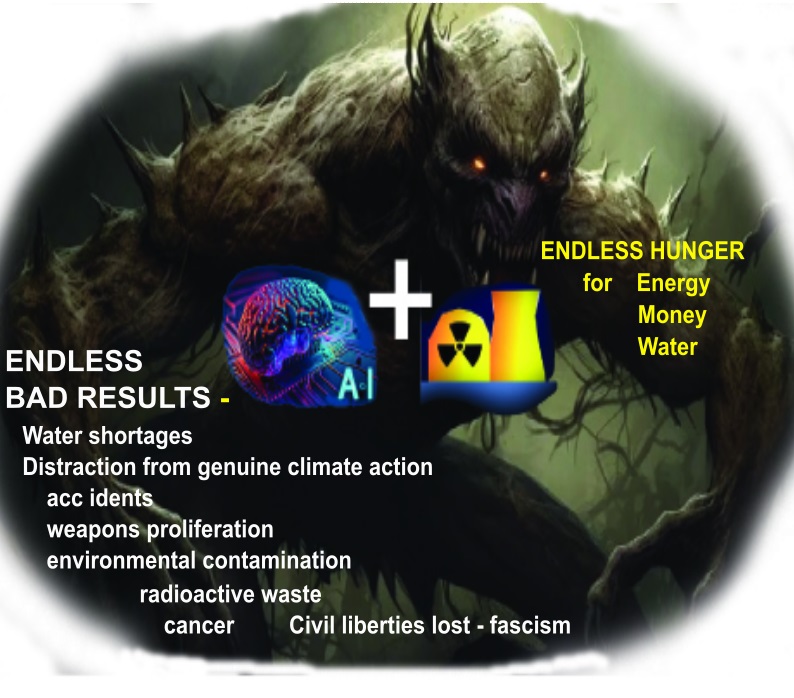
In the absence of actual intelligence, Amazon, Microsoft, and Google are making grand plans to use nuclear energy to power their Artificial Intelligence installations. Even the site of the most famous (even if never properly understood) U.S. nuclear disaster, Three Mile Island, is making plans for courting new disasters, despite strong local opposition.
Why is nuclear power a bad idea?
The top six reasons might be these:
1. There is no solution whatsoever to the indisputable problem of nuclear waste disposal. 2. There is no solution to the risk of more Three Mile Island- , Chernobyl- , Fukushima-like disasters — or, if there is, it has not persuaded any private insurance companies to take the risk of insuring nuclear power plants. The people of the United States will foot the bill (not to mention the cancer deaths) from the next catastrophe — whether accidental or caused by an attack (nuclear plants being prime targets for terrorism/war).
3. Nuclear energy is not “green,” but slow, dangerous, expensive, and inefficient. 4.Solar, wind, and tide energy solutions have been progressing even faster in reality than has nuclear energy in propaganda. While the solution of lower energy use has always been staring us in the face, the solution of energy that is cleaner, safer, faster, and cheaper is now well established. 5. Drone warfare has predictably spread far and wide, turning every nuclear power plant into a self-imposed nuclear weapon. 6. The nuclear energy and weapons industries rise or fall together. The energy technology is used as a stepping stone to the weapons. The energy waste is used as material for Depleted Uranium weapons. Nuclear energy powers the submarines that carry the weapons. And military contractors are working to give the world the marvelous gift of portable nuclear reactors that can be brought into war zones — in an apparent effort to win a prize for the worst idea ever.
But dozens of U.S. cities and counties are nuclear-free zones.
No nuclear weapons or energy allowed. There is no reason that U.S. states cannot take the same step.Click here to tell your state legislators and governors, that now is a time for independence and wisdom: Tell them to make NY a nuclear-free zone.
Holloman Drone Training Base, Southern NM The largest drone training base in the U.S., where 700+ drone pilots and operators graduate annually! 16 years ago the American public started to become aware of the secret and very illegal assassin drone program. Soon afterwards the peace community mobilized against it, while the US Air Force top brass were bragging about what a tremendous advancement drones were, enabling our forces to destroy “enemy terrorists” without putting our troops at risk. As drone whistleblower Daniel Hale stated, drones “embolden commanders” making it easier for them to orchestrate more horrendous crimes against humanity.
16 years later Americans are forced to ask ourselves: Who are the real terrorists? Israeli and U.S. drones have been a primary weapon in the 16 month long genocidal seige on Gaza that has nearly completely obliterated Palestinian communities, killing tens of thousands of civilians, including over 700 infants, and leaving the survivors without adequate food, water, shelter or medical care. Homicide, Hospitalcide, Scholasticide, Ecocide, Urbicide, Medicide, Truthicide, Climatocide…the list is endless. This obscene aggression has expanded across borders into the West Bank, Lebanon, Yemen, Syria, Iran and elsewhere. What will we do as Americans to halt this insanity?
The settler-colonial genocidal campaign in Gaza and elsewhere, using AI and remotely controlled drones to dominate the world has destabilized our world, as the first drone whistleblowers warned us 10 years ago. What will we do? “Silence is complicity,” warned the late, great Martin Luther King Jr. Let’s enter the belly of the beast:
Be Fearless Angelic Troublemakers determined to demilitarize our country and our planet together. Mother earth needs us now more than ever before. Join us at Holloman in April for all or part of the week: A week of persistent peaceful action to nonviolently resist, educate and promote GI resistance. Palestine will take front stage: NO WEAPONS or TAX $$ for GENOCIDE!
WE MUST DEMILITARIZE OUR SOCIETY. Time is running out. Join Our Organizing Team…help it grow! Check out our website for more info. Camping and Hotel Options available.
Trump’s executive order regarding the Inflation Reduction Act of 2022, and similar action against the Infrastructure Investment and Jobs Act (IIJA, or Bipartisan Infrastructure Law) of 2021, could starve the Palisades zombie reactor of massive taxpayer funding requested by Holtec International for its unprecedented restart. Holtec is looking to various troughs of funding from both laws, totaling a shocking $8+ billion (with a B!) in mostly federal, but also State of Michigan, bailouts.
Palisades is located in Covert Township, just south of the City of South Haven, in Van Buren County, s.w. Michigan. It is immediately upon the beach of Lake Michigan, drinking water supply for 16 million people along its shores, including the City of Chicago.
Palisades was permanently shut down by its previous owner, Entergy, on May 20, 2022, supposedly for good. But Palisades took over the site, supposedly to decommission it, only to instead secretively apply to the U.S. Department of Energy and State of Michigan for many billions of dollars in taxpayer funds, to restart the more than half-century old, extremely problem-plagued reactor.
NIRS’s analysis of the IRA revealed that more than $380 billion (with a B!) in nuclear power subsidies had been authorized therein. The analysis also addressed additional billions of dollars in nuclear power subsidies contained in the IIJA.
Another $7.4 billion in federal funds, in the form of loan guarantees, for so-called “Small Modular Reactor” (SMR) design certification, construction, and operation, would come from the Energy Policy Act of 2005, and the follow on December 23, 2007 appropriations. Holtec has targeted Palisades for two SMR-300s (300 Megawatts-electric each), which would nearly double the tiny 432-acre site’s nuclear Mega-wattage. Holtec has also targeted Palisades’ sibling nuclear site, the closed and decommissioned Big Rock Point hundreds of miles north, in Hayes Township, between Charlevoix and Petoskey, likewise on the Lake Michigan shore. Whether Trump will order a freeze on these funds as well, remains to be seen.
Self-inflicted steam tube degradation, due to two years of neglect by the inexperienced and incompetent company, also puts in doubt Holtec’s late 2025 restart plans at Palisades.
The article quotes Beyond Nuclear’s radioactive waste specialist, Kevin Kamps:
Kevin Kamps, an activist with Maryland-based Beyond Nuclear who grew up near the plant, said that safety assurances are “very dubious, as [the] NRC is completely captured by the industry it is supposed to regulate.”
To learn more about Beyond Nuclear’s and our allies’ resistance to the Palisades zombification, see our one-stop-shop for related website posts, dating back to 2002:
NNSA has yet to satisfy Government Accounting Office best practice guidelines for the SRS pit project.
LANL itself has experienced numerous and serious safety accidents, including a plutonium fire, flooding, glove box contamination and a plutonium “criticality” accident, in recent years.
Why does the production of new plutonium pits take priority over cleaning up the hazardous legacy of previous pit production?
Last week U.S. District Judge Mary Lewis Geiger, South Carolina, faulted the Department of Energy and the National Nuclear Security Agency for ignoring the National Environmental Protection Act and rushing plans to fabricate plutonium pit bombs at Savannah River Site, near Aiken, South Carolina.
Newly designed plutonium pits will serve as “triggers” for the next generation of nuclear warheads mounted atop Sentinel, the next generation of intercontinental ballistic missile, and for new submarine-launched nuclear weapons. Combined, these projects comprise major components in the trillion-dollar “modernization” of the U.S. strategic deterrence force.
Plaintiffs including Savannah River Site Watch, South Carolina Environmental Law Project Gullah/Geechee Sea Island Coalition, Nuclear Watch New Mexico and Tri-Valley CAREs forced NNSA to halt construction on many phases of its plutonium pit facility near Aiken, SC, to hold public scoping meetings, solicit public comments, and produce a Programmatic Environmental Impact Statement within thirty months.
Plaintiffs successfully argued that the plutonium pit modernization project was complex, involving diverse entities, was spread over wide geographical regions and therefore, by definition, required a “programmatic environmental impact statement, PEIS.
The proposed plutonium pit facility at Savannah River Site will reconstruct a massive 500-room partially completely abandoned building designed for the Mixed Oxide Plant. The spectacularly failed MOX plant would have processed old plutonium pits from de-commissioned US nuclear weapons per a nuclear weapons agreement with the Russians in 2000. Poor management and engineering revisions multiplied costs exceeding $7 billion when DOE finally terminated the MOX project in 2019. DOE recently paid the State of South Carolina an extra $600 million fine for failure to remove 10 tons of plutonium delivered to the MOX plant and stored at SRS. Ironically SRS is importing a different 10 tons of plutonium pits from the PANTEX pit storage site in Texas to manufacture new pits.
NNSA’s plan for plutonium pit production at Savannah River Site involves complex coordination between Los Alamos, the Waste Isolation Pilot Plant in Carlsbad NM, the Lawrence Livermore National Laboratory in CA and the Kansas City National Security Campus, and therefor requires a NEPA “programmatic environmental impact statement”. NNSA refused repeated calls to perform the PEIS, which resulted in the successful lawsuit agreed last week.
NNSA has yet to satisfy Government Accounting Office best practice guidelines for the SRS pit project. GAO’s repeated calls for NNSA to create quality Integrated Master Schedules and Life Cycle Cost Estimates for its plutonium pit modernization program remain unfulfilled. These plans and guidelines establish best practices for building an efficient cost-effective project, something MOX consistently ignored, leading to its disastrous failure. Congress subsequently ordered NNSA meet these GAO parameters by July 2025.
Congress had mandated in 2019 that Los Alamos National Laboratory in New Mexico manufacture 80 plutonium pits per year by 2030. Because LANL is a research facility, it has not produced any plutonium pits since 2011, and never at scale. It was unprepared to fulfill this Congressional mandate, authored by Senator John McCain. In response, NNSA then divided the plutonium pit project in two: Savannah River Site would produce 50 pits per year by 2030, and LANL 30 pits. SRS has never manufactured plutonium pits, though it did produce 10 tons of plutonium for pit fabrication at Rocky Flats, CO beginning in 1957. Thirty million gallons of highly radioactive wastes from that project, more than 200 million curies* of radiation, remain stored on- site at SRS, making it one of the most radioactive Superfund sites in the U.S.
Rocky Flats had produced one to two thousand plutonium pits per year for decades until it was closed in 1989. After whistleblower leaks, (see Jon Lipsky, James Stone) the FBI and EPA raided Rocky Flats discovering gross fraud and egregious violations of environmental regulations by contractor, Rockwell International. Rocky Flats was closed and will remain a superfund site into the far distant future.
Parts of Los Alamos National Lab, wedged on a tabletop mesa, comprises a superfund site with residual plutonium still found around the site and in surrounding canyons from operations and waste dumping begun in the 1940’s “Oppenheimer years”.DOE recently signed a consent decree with the State of New Mexico to assume greater responsibility for the clean-up of waste deposit wells and trenches that threaten nearby towns like White Rock, the San Ildefonso Pueblo and the Rio Grande River with radiological contamination. DOE paid New Mexico a $420,000 fine for mishandling hazardous wastes is 2024.
LANL itself has experienced numerous and serious safety accidents, including a plutonium fire, flooding, glove box contamination and a plutonium “criticality” accident, in recent years. The most recent 2023 safety report for LANL, operated by Triad LLC, showed improvement in its safety operations, though in that same year LANL was fined $420,000 by New Mexico for improper handling of hazardous materials.
Plutonium, Pu, is a man-made metallic element. It is highly toxic, highly radioactive, pyrophoric, (spontaneously ignites on contact with air) and fissionable. It is extremely challenging to produce, purify, mill, melt, mold, weld, control and store. All these processes have taken place at sites across the U.S. since the 1940’s and are now catalogued by DOE as “legacy hazardous waste sites”.
Because plutonium ignites on contact with air, it must be handled in “glove boxes”, self-contained hermetically sealed boxed filled with inert gases. Impervious rubber sleeves extend into the box, and workers slip their arms into these sleeves, then manipulate the plutonium through different phases of pit production. Any nicks or cracks in the rubber gloves can and have resulted in plutonium leaks, and serious illnesses.
Glove boxes and gloves for the plutonium pit project, in example, are already is short supply, demonstrating how integral and integrated every aspect of the plutonium pits program is, and how poor planning could disrupt the program; the basic tenant of the lawsuit against NNSA.
Training a skilled glove box worker at LANL can take four years. A shortage of skilled workers at LANL poses a regular challenge, one that will intensify as LANL workers will also train unskilled SRS workers. A shortage of workers at WIPP in Carlsbad NM has been a chronic problem despite significant wage increases from DOE.
Historically, sites involved with the production, refining, milling or fabrication of plutonium or plutonium pits for nuclear weapons have left a voluminous legacy of radionuclide pollution. Radioactive wastes generated in weapons production beginning with the 1940’s Manhattan Project, by statute, are destined for the Waste Isolation Pilot Plant, WIPP, in Carlsbad, New Mexico. Because plutonium has a half life of 24,000 years and remains lethal for much longer, plutonium waste products trucked over millions of highway miles to WIPP are stored in vaults excavated into salt domes 2000 feet underground. While WIPP is the sole repository for defense department transuranic wastes, the Government Accounting Office cautioned that WIPP may not have the capacity to accept all the plutonium pit wastes generated at LALN and SRS. Timely removal of plutonium waste from SRS and LANL is crucial for uninterrupted pit production.
A fire in WIPP’s salt dome closed the facility for 3 years in 2014. A fire at LANL closed its operation for 3 years in 2013.
Both SRS and LANL will recycle surplus plutonium pits from the strategic reserve at PANTEX near Amarillo, TX. Currently 4000 reserve pits and 10,000 surplus pits waiting disposal are stored at PANTEX. Re-engineered pits from SRS and LANL will be returned to PANTEX for final assembly into W87-1 and W 88 nuclear warheads.
The rate of deterioration of plutonium pits, 30 or more years old, has concerned and motivated lawmakers to legislate a complete replacement of all 3,600 deployed and reserve nuclear warheads. Independent scientific groups like JASON and the Livermore National Lab have estimated that plutonium pits maintain their viability for 100 or even 150 years. Hardware within the nuclear warhead corrodes much more quickly than the pits themselves, focusing doubt on the race to replace the pits themselves.
The programmatic environmental statement ordered by federal Judge Geiger may resolve many questions posed by the rush to produce new plutonium pits. The pits produced at SRS and LANL will trigger new W87-1 nuclear warheads. What need is there for a new warhead when the old W87-0 has the same safety features? Why are SRS and LANL adopting an aggressive production schedule when the new Sentinel ICBM deliver systems is way over budget and at least a decade away from deployment? Why does the production of new plutonium pits take priority over cleaning up the hazardous legacy of previous pit production? Has any plutonium production site ever not become a hazardous waste site? Will NNSA slow pit production to engineer safety improvements instead of placing workers in risky dangerous situations? Do we really want to spend a trillion dollars and start a new nuclear arms race?
Note.
* A curie, Ci, is a measure of radiation per second, named after Marie and Pierre Curie. Exposure to even a few curies can be fatal.
The United States is estimated to have spent more than $400 billion on the kinds of antimissile goals that the president now says will provide “for the common defense.”
Star Wars is back, with an executive order from President Trump that the White House said “directs the building of the Iron Dome missile defense shield for America.”
The order, issued on Monday night, didn’t quite do that. It was more a vaguely worded set of instructions to accelerate current programs or explore new approaches to defending the continental United States than a blueprint for arming the heavens with thousands of antimissile weapons, sensors and tracking devices.
But two blocks away, on the same evening, the Office of Management and Budget issued a 56-page spreadsheet that detailed the suspension of funding for thousands of programs. They included most of the major U.S. efforts to reduce the amount of nuclear fuel that terrorists might seize, to guard against biological weapon attacks and to manage initiatives around the globe to curb the spread of nuclear arms.
The two announcements seemed to encapsulate the administration’s conflicting instincts in its opening weeks. Mr. Trump wants to build big and take the Space Force he created to new heights, even at the risk of new arms races. That effort has been underway since Ronald Reagan’s day, with only mixed results.
But in its drive to shut down programs it believes could be creations of the so-called deep state, the administration wants to cut off funding for many programs that seek to reduce the chances of an attack on the United States — an attack that could very well come in forms other than a missile launched from North Korea, China or Russia.
A judge paused Mr. Trump’s spending freeze on Tuesday, but the president’s intentions are clear.
Though Mr. Trump calls his plan the Iron Dome, it has little if any resemblance to the Israeli system of the same name that has succeeded in destroying small missiles that move at a snail’s pace compared with the blinding speeds of intercontinental warheads………………………………………………………..
Missile defense has long been a favorite topic for Mr. Trump, who has envisioned the project as the next step for the Space Force, which he created in his first term.
But it could also trigger a new arms race, some experts fear. And unaddressed in Mr. Trump’s new initiative is the threat of nuclear terrorism and blackmail with an atomic bomb, which might be smuggled into the United States on a truck or a boat. Many experts see the terrorism threat as far bigger than an enemy firing a single missile or a swarm.
In 2001, after Sept. 11 attacks, the federal government scrambled to get wide-ranging advice on how outwit terrorists and better protect Americans from the threats of germ, computer, chemical and nuclear attacks.
“The combination of simultaneously deploying a missile defense system of questionable effectiveness against any real threat” while “suspending operative programs against nuclear or bioterrorists, sophisticated cyberattackers or others” is a “terrible trade-off,” said Ernest Moniz, the energy secretary under President Barack Obama who now heads the Nuclear Threat Initiative.
“The Iron Dome reference conjures up the success of the Israeli missile defense, but that’s misleading given the relatively short-range missiles that Israel defends against and the small territory it needs to defend,” said Mr. Moniz, a former professor at the Massachusetts Institute of Technology with long experience in nuclear weapons ………………
Critics of the executive order say it is more a list than a program, and includes systems that have never panned out. In an interview, Theodore A. Postol, an emeritus professor of science and national security at M.I.T., called Mr. Trump’s missile plan “a compendium of flawed weapons systems that have been shown to be unworkable.”…………………………………………
The Iron Dome’s functionality depends on Israel’s comparatively miniscule size and proximity to enemies. This makes it particularly hard to imagine a similar setup in the US, which is over 400 times the geographical size of Israel. Such an apparatus, national security analyst Joseph Cirincione estimated, would cost about 2.5 trillion dollars. That’s over three times the country’s entire projected military budget for 2025.
A central campaign promise, the proposed $2 trillion-plus missile shield is, to experts, silly.
Donald Trump’s Republican Party platform, released in July, contains little in terms of tangible policy proposals.
But one of the few concrete ideas is a call to (apologies for the capitalization) “PREVENT WORLD WORLD III” by building “A GREAT IRON DOME MISSILE DEFENSE SHIELD OVER OUR ENTIRE COUNTRY”—a plan that experts say is nearly impossible to execute, unnecessary, and hard to even comprehend.
Trump has vowed to build this Iron Dome in multiple speeches. It is among his campaign’s 20 core promises. The former president has said that the missile shield would be “MADE IN AMERICA,” creating jobs, as well as stopping foreign attacks.
“It’s dramatically unclear to me what any of this means,” Lewis said of the Iron Dome idea, “other than just treating it like the insane ramblings of a senile old person.”
It may be more useful to consider an American Iron Dome as a bombastic businessman’s branding exercise, rather than a viable policy position, said Lewis: “The Iron Dome here has just become a kind of brand name, like Xerox or Kleenex for missile defense.”
The Iron Dome, a short-range missile defense system created by Israeli state-owned company Rafael Advanced Defense Systems and American weapons manufacturer Raytheon, has been a prized part of the country’s military arsenal since it became operational in 2011. It is not, as the name suggests, an impenetrable shield. It’s more mobile: when a short-range missile reaches Israel’s airspace, “interceptor missiles” are launched to blow them up before they can touch the ground.
The Iron Dome’s functionality depends on Israel’s comparatively miniscule size and proximity to enemies. This makes it particularly hard to imagine a similar setup in the US, which is over 400 times the geographical size of Israel. Such an apparatus, national security analyst Joseph Cirincione estimated, would cost about 2.5 trillion dollars. That’s over three times the country’s entire projected military budget for 2025.
uch a system would also be unnecessary. As of now, there are no armed groups sending missiles toward the United States from within a theoretical Iron Dome’s 40-mile interception range. Such a system “couldn’t even protect Mar-a-Lago from missiles fired from the Bahamas, some 80 miles away,” Cirincione wrote in late July.
America’s pre-existent missile defense network, which has been in place since the Bush administration, is currently made up of 44 interceptors based in California and Alaska, geared towards longer-range missiles, such as those that could be fired from North Korea. But the system has performed abysmally in tests, despite Republicans generally claiming “it works,” said Lewis. (Groups like the right-wing Heritage Foundation have been calling for increased missile defense funding since at least the 1990s.)
“This is why it’s so hard to make heads or tails of what Trump is saying,” Lewis continued. “Is Trump saying the system in Alaska doesn’t work? Is Trump saying that Canada is going to develop artillery rockets to use against North Dakota?”
Saskatoon – Canada’s federal nuclear regulator is holding a public meeting in Saskatoon today about uranium mines, including closed and decommissioned uranium mines in northeastern Ontario. In their overview presentation this morning Canadian Nuclear Safety Commission (CNSC) staff omitted any discussion of the closed mines in Elliot Lake or the Agnew Lake mine, which were issues of high concern to intervenors including the Township of Nairn and Hyman and the northeastern Ontario environmental group Northwatch.
The Township of Nairn and Hyman retained a technical expert and provide a written intervention outlining their community’s growing concerns regarding the environmental and public health risks associated with the Agnew Lake Tailings Management Area (TMA). The Township noted that the 2023 Annual Report prepared by the Ministry of Mines exposes critical deficiencies in the Agnew Lake TMA’s environmental monitoring and contamination levels. Groundwater, surface water, and soil samples collected during the monitoring period indicate widespread exceedances of contaminants and heavy metals.
“Nothing could be more important to Nairn & Hyman than our drinking water and natural resources. The Agnew Lake Tailings Management Area (ALTMA) needs to be adequately managed to safeguard our immediate neighbours, waterways, and the surrounding environment”, commented Mayor Amy Mazey.
“We have profound concerns for the lack of site-specific details contained in this report. For instance, the report fails to acknowledge contaminant exceedances in the surface water, ground water and sediment adjacent to the site that include uranium, radium, arsenic and cyanide. We are hopeful that the CNSC will take these concerns seriously and act appropriately by expertly managing ALTMA.”
Northwatch outlined similar concerns in their written intervention, including general comments on the CNSC regulatory report, which it found to be lacking detail and sufficient supporting information and rationale for conclusions, and noted that most concerns Northwatch and its technical experts had identified during previous reviews did not appear to have been resolved, and many concerns have continued or perhaps worsened during the current reporting period, particularly at the Agnew Lake site. Northwatch also commented on negative trends in the decommissioned mines in the Elliot Lake area, including rising concentrations of radium in water discharge and sediments and poor performance in meeting water quality benchmarks.
The Township of Nairn and Hyman and Northwatch both expressed strong concerns about a proposal to transfer large low-level radioactive wastes from just outside North Bay to deposit on the tailings management area at the Agnew Lake Mine.
During a 2015 inspection, CNSC staff found sections of the tailings were exposed where the tailings management area cover had degraded. The response proposed by the Ministry of Mines, who is licensed to manage the Agnew Lake Mine, was to transfer 20,000 m3 of niobium bearing material classified as naturally occurring radioactive material (NORM) from the former Beaucage Mine near North Bay and place it on the Agnew Lake tailings. Northwatch objected in its 2018 written intervention on the grounds of there having been insufficient review of the potential for negative effects of adding the niobium wastes to the Agnew Lake tailings. At a public meeting in Nairn Centre on September 11th of this year, repairs to the tailings cover had still not been done and no information on the potential cumulative effects of adding the niobium waste to the uranium tailings was presented by staff from the Canadian Nuclear Safety Commission or the Ontario Ministry of Mines.
Neither the Township of Nairn and Hyman or Northwatch were permitted to present at the Commission meeting underway today in Saskatoon. CNSC staff presented the regulatory report in the morning session but included no mention of the closed mines in northeastern Ontario or the several significant concerns raised by the Township of Nairn and Hyman or Northwatch in their written interventions.
The public meeting is being streamed live at https://cnsc.isilive.ca/ and will continue throughout the day. The Commission has the option of asking questions of CNSC staff about the written interventions during the afternoon session.
The Township of Nairn and Hyman and the Township of Baldwin will be holding a Joint Public Meeting on February 18 at 7:00 p.m. in the community centre in Nairn Centre to provide updates to residents on the review undertaken by the Township of Nairn and Hyman and various meeting outcomes, including today’s public meeting of the CNSC.
The order’s most contentious element directs the Department of Defense to pursue space-based interceptors — weapons positioned in orbit to destroy incoming missiles. While proponents argue these could provide global coverage and early intercept capabilities, critics warn they could trigger an arms race and undermine existing treaties.
The order sets a bold agenda to address emerging threats, including hypersonic missiles, through advanced technological solutions, including space-based interceptors.
WASHINGTON — President Donald Trump signed an executive order Jan. 27 that calls for the development of a sweeping new missile defense system for the United States, including controversial space-based interceptors.
The Pentagon must submit within 60 days a proposed architecture for the system, including plans to accelerate the Missile Defense Agency’s ongoing Hypersonic and Ballistic Tracking Space Sensor program and develop a “custody layer” within the Proliferated Warfighter Space Architecture — a planned constellation of military satellites currently being acquired by the U.S. Space Force’s Space Development Agency.
The executive order also emphasizes securing the defense industrial base, requiring “next-generation security features” for the supply chain as the U.S. races to build advanced interceptors and tracking systems.
The “Iron Dome for America” order, which invokes Israel’s successful rocket defense system, directs the Pentagon to accelerate development of defenses against hypersonic weapons and other advanced aerial threats that Trump’s order describes as “the most catastrophic threat facing the United States.”
While drawing inspiration from Israel’s Iron Dome system, the U.S. initiative would need to be dramatically different in scale and capability to defend the continent-spanning American territory against sophisticated intercontinental ballistic missiles, rather than the short-range rockets that threaten Israel.
The U.S. has collaborated with Israel on missile defense technology since the 1980s, including support for the Iron Dome system, which has intercepted thousands of incoming rockets since its 2011 deployment. Unlike Israel’s system, which defends a territory roughly the size of New Jersey, a U.S. continental defense system would need to protect an area nearly 500 times larger against more sophisticated threats such as Chinese hypersonic glide vehicles.
Unlike traditional ground- or sea-based systems, the envisioned architecture leans on space-based solutions, which have long been controversial.
The order’s most contentious element directs the Department of Defense to pursue space-based interceptors — weapons positioned in orbit to destroy incoming missiles. While proponents argue these could provide global coverage and early intercept capabilities, critics warn they could trigger an arms race and undermine existing treaties.
Climate change was a major factor behind the hot, dry weather that gave rise to the devastating LA fires, a scientific study has confirmed. It made those weather conditions about 35% more likely, according to World Weather Attribution – globally recognised for their studies linking extreme weather to climate change. The authors noted that the LA wildfire season is getting longer while the rains that normally put out the blazes have reduced. The scientists highlight that these wildfires are highly complex with multiple factors playing a role, but they are confident that a warming climate is making LA more prone to intense fire events.
As the front of modern warfare slowly evolved from direct military action into weaponized financial speculation, the market for data became just as valuable as the defense budget itself.
Facebook, not unlike Palantir, was one of the vehicles used to privatize controversial U.S. military surveillance projects
While often mythologized as having been created to champion human freedom, the internet and many of its most popular companies were directly birthed out of the national security apparatus of the United States.
Today, the world’s economy no longer runs on oil, but data. Shortly after the advent of the microprocessor came the internet, unleashing an onslaught of data running on the coils of fiber optic cables beneath the oceans and satellites above the skies. While often posited as a liberator of humanity against the oppressors of nation-states that allows previously impossible interconnectivity and social organization between geographically separated cultures to circumnavigate the monopoly on violence of world governments, ironically, the internet itself was birthed out of the largest military empire of the modern world – the United States.
The ARPANET
Specifically, the internet began as ARPANET, a project of the Advanced Research Projects Agency (ARPA), which in 1972 became known as the Defense Advanced Research Projects Agency (DARPA), currently housed within the Department of Defense. ARPA was created by President Eisenhower in 1958 within the Office of the Secretary of Defense (OSD) in direct response to the U.S.’ greatest military rival, the USSR, successfully launching Sputnik, the first artificial satellite in Earth’s orbit with data broadcasting technology. While historically considered the birth of the Space Race, in reality, the formation of ARPA began the now-decades-long militarization of data brokers, quickly leading to world-changing developments in global positioning systems (GPS), the personal computer, networks of computational information processing (“time-sharing”), primordial artificial intelligence, and weaponized autonomous drone technology.
In October 1962, the recently-formed ARPA appointed J.C.R. Licklider, a former MIT professor and vice president of Bolt Beranek and Newman (known as BBN, currently owned by defense contractor Raytheon), to head their Information Processing Techniques Office (IPTO). At BBN, Licklider developed the earliest known ideas for a global computer network, publishing a series of memos in August 1962 that birthed his “Intergalactic Computer Network” concept. Six months after his appointment to ARPA, Licklider would distribute a memo to his IPTO colleagues – addressed to “Members and Affiliates of the Intergalactic Computer Network”– describing a “time-sharing network of computers” – building off a similar exploration of communal, distributed computation by John Forbes Nash, Jr. in his 1954 paper “Parallel Control” commissioned by defense contractor RAND – which would build the foundational concepts for ARPANET, the first implementation of today’s Internet.
Prior to the technological innovations explored by Licklider and his ARPA colleagues, data communication – at this time, mainly voice via telephone lines – were based on circuit switching, in which each telephone call would be manually connected by a switch operator to establish a dedicated, end-to-end analog electrical connection between the two parties. The RAND Corporation’s Paul Baran, and later ARPA itself, would begin to work on methods to allow formidable data communication in the event of a partial disconnection, such as from a nuclear event or other act of war, leading to a distributed network of unmanned nodes that would compartmentalize the desired information into smaller blocks of data – today referred to as packets – before routing them separately, only to be rejoined once received at the desired destination.
While certainly unbeknownst to the technologists at the time, this achievement of both distributed routing and global information settlement via data packets created an entirely new commodity – digital data.
A Brief History of Weaponized Financial Intelligence
Long before the USSR spooked the United States into formalizing ARPA due to fears of militarized satellite applications post-Sputnik launch, data brokers have played a significant role in warfare and specifically the markets surrounding military conflict……………………………………………….
As the front of modern warfare slowly evolved from direct military action into weaponized financial speculation, the market for data became just as valuable as the defense budget itself. It is for this reason that the necessity of sound data emerged as the foremost issue of national security, leading to a proliferation of advanced data brokers coming out of DARPA and the intelligence community, akin to the 21st century’s Manhattan Project.
The San Jose Project: Google, Facebook, and PayPal
Exemplified by the creation of the CIA’s venture firm, In-Q-Tel, and the proliferation of Silicon Valley-based venture firms coalescing on Sand Hill Road in Palo Alto, CA, the financialization of a new crop of American data brokers was complete. The first firm to grace Sand Hill Road was Kleiner Perkins Caufield & Byers, better known as KPCB, which participated in funding internet pioneers Amazon, AOL, and Compaq, while also directly seeding Netscape and Google. KPCB partners have included such government stalwarts as former Vice President Al Gore, former Secretary of State Colin Powell, and Ted Schlein – the latter being a board member of In-Q-Tel and member of the NSA’s advisory board. KPCB also had an intimate connection with internet networking pioneer Sun Microsystems, best known for building out the majority of network switches and other infrastructure needed for a modern broadband economy.
……………………… Perhaps the world’s most famous data broker, Google, whose founders both came out of Stanford University, was seeded by former Sun Microsystems founder Andy Bechtolsheim and his partner at the Ethernet switching company Granite Systems (later acquired by Cisco), David Cheriton, with Google’s most iconic CEO, Eric Schmidt, being the former CTO of Sun Microsystems.
The emergence of Silicon Valley out of the academic circuit in Northern California was no accident, and in fact was directly influenced by an unclassified program known as the Massive Digital Data Systems (MDDS) project. The MDDS was created with direct participation from the CIA, NSA, and DARPA itself within the computer science programs at Stanford and CalTech, alongside MIT, Harvard and Carnegie Mellon……………… over a few years, more than a dozen grants of several million dollars each were distributed via the NSF (the National Science Foundation) in order to capture the most promising efforts, ensuring that those efforts would become intellectual property controlled by the United States regulatory regime.
……………………………………………….The first unclassified briefing for scientists was titled “birds of a feather briefing” and was formalized during a 1995 conference in San Jose, CA, which was titled the “Birds of a Feather Session on the Intelligence Community Initiative in Massive Digital Data Systems.” That same year, one of the first MDDS grants was awarded to Stanford University, which was already a decade deep in working with NSF and DARPA grants. The primary objective of this grant was to “query optimization of very complex queries,” with a closely-followed second grant that aimed to build a massive digital library on the internet. These two grants funded research by then-Stanford graduate students and future Google cofounders, Sergey Brin and Larry Page. Two intelligence-community managers regularly met with Brin while he was still at Stanford and completing the research that would lead to the incorporation of Google, all paid for by grants provided by the NSA and CIA via MDDS.
…………………………………………………………………………………………….It was also during these formative years that the PayPal team worked closely with the intelligence community. …………………………………………………………………..In 2003, a year after PayPal was sold to eBay, Thiel approached Alex Karp, a fellow alumnus of Stanford with a new venture concept: “Why not use Igor to track terrorist networks through their financial transactions?” Thiel took funds from the PayPal sale to seed the company, and after a few years of pitching investors, the newly-formed Palantir received an estimated $2 million investment from the CIA’s venture capital firm, In-Q-Tel.
………………………………..As of 2013, Palantir’s client list included “the CIA, the FBI, the NSA, the Centre for Disease Control, the Marine Corps, the Air Force, Special Operations Command, West Point and the IRS” with around “50% of its business” coming from public sector contracts…………… As The Guardianreports: “Palantir does not just provide the Pentagon with a machine for global surveillance and the data-efficient fighting of war, it runs Wall Street, too.”
Facebook, not unlike Palantir, was one of the vehicles used to privatize controversial U.S. military surveillance projects after 9/11, having also been birthed out of one of the MDDS partners, Harvard University. PayPal and Palantir co-founder Peter Thiel became Facebook’s first significant investor at the behest of file-sharing pioneer Sean Parker, whose first contact with the CIA took place at age 16. ………………………… Facebook’s long-standing ties to the military and intelligence communities go far beyond its origins, including revelations about its collaboration with spy agencies as part of the Snowden leaks and its role in influence operations – some have even directly involved Google and Palantir.
Facebook’s growing role in the ever-expanding surveillance and “pre-crime” apparatus of the national security state demands new scrutiny of the company’s origins and its products as they relate to a former, controversial DARPA-run surveillance program that was essentially analogous to what is currently the world’s largest social network.
An unspoken outcome of the global proliferation of Facebook was the sly, roundabout creation of the first digital ID system – a necessity for the coming digital economy. Users would set up their profiles by feeding the social network with a plethora of personal information, with Facebook being able to use this data to generate large webs of connectivity between otherwise unknown social groups. There is even evidence that Facebook generated placeholder accounts for individuals that appeared in user data but did not have a profile of their own. Both Google and PayPal would also use similar digital identification methods to allow users to sign into other websites, creating interoperable identification systems that could permeate the internet.
A similar evolution is occurring in the financial sector, as data broker social networks – including Facebook and Musk’s X (formerly Twitter) – are posturing themselves as the future of financial service companies. ……………………………
From Public-Private, to Private-Public
As outlined above, it is clear that the public sector’s intelligence community used the veil of the private sector to establish financial incentives and commercial applications to build out the modern data economy. A simple glance at the seven largest stocks in the American economy demonstrate this concept, with Meta (Facebook), Alphabet (Google), and Amazon – with founder Jeff Bezos being the grandson of ARPA founder Lawrence Preston Gise – leading the software side, and Microsoft, Apple, NVIDIA and Tesla leading the hardware component. While many of these companies have egregious ties to the intelligence community and the public sector during their incubation, now these private sector companies are driving the globalization and national security interests of the public sector.
The future of the American data economy is firmly situated between two pillars – artificial intelligence and blockchain technology. With the incoming Trump administration’s close advisory ties to PayPal, Tether, Facebook, Palantir, Tesla and SpaceX, it is clear that the data brokers have returned to roost at Pennsylvania Avenue. AI requires massive amounts of sound data to be of any use for the technologists, and the data provided by these private sector stalwarts is poised to feed their learning modules – surely after securing hefty government contracts. Private companies using public blockchains to issue their tokens generates not only significant opportunities for the United States to address its debt problem, but simultaneously serves as a “boon in surveillance”, as stated by a former CIA director.
Trump’s recent speech on bitcoin and crypto embraced policies that will seek to mold bitcoin into an enabler of irresponsible fiscal policy and will employ programmable, surveillable stablecoins to expand and entrench dollar dominance.
Within the Trump administration’s embracing of the blockchain – itself the final iteration of the public-private commercialization of data, despite its libertarian posturing – reveals the culmination of a decades-long technocratic dialectic trojan horse. Nearly all of the foundational technology needed to push the world into this new financial system was cultivated in the shadows by the military and intelligence community of the world’s largest empire. While technology can surely offer solutions for greater efficiency and economic prosperity, the very same tools can also be used to further enslave the citizens of the world.
Air Force general Anthony Cotton, the man in charge of the United States stockpile of nuclear missiles, says the Pentagon is doubling down on artificial intelligence — an alarming sign that the hype surrounding the tech has infiltrated even the highest ranks of the US military.
As Air and Space Forces Magazine reports, Cotton made the comments during the 2024 Department of Defense Intelligence Information System Conference earlier this month.
Fortunately, Cotton stopped short of promising to hand over the nuclear codes to a potentially malicious AI.
“AI will enhance our decision-making capabilities,” he said. “But we must never allow artificial intelligence to make those decisions for us.”
Algorithmic Deterrence
The US military is planning to spend a whopping $1.7 trillion to bring its nuclear arsenal up to date. Cotton revealed that AI systems could be part of this upgrade.
However, the general remained pointedly vague about how exactly the tech would be integrated.
“Advanced AI and robust data analytics capabilities provide decision advantage and improve our deterrence poster,” he added. “IT and AI superiority allows for a more effective integration of conventional and nuclear capabilities, strengthening deterrence.”
Vagueness aside, nuclear secrecy expert and Stevens Institute of Technology expert Alex Wellerstein told 404 Media that “I think it’s safe to say that they aren’t talking about Skynet, here,” referring to the fictional AI featured in the sci-fi blockbuster “Terminator” franchise.
“He’s being very clear that he is talking about systems that will analyze and give information, not launch missiles,” he added. “If we take him at his word on that, then we can disregard the more common fears of an AI that is making nuclear targeting decisions.”
Nonetheless, there’s something disconcerting about Cotton’s suggestion that an AI could influence a decision of whether to launch a nuclear weapon.
Case in point, earlier this year, a team of Stanford researchers tasked an unmodified version of OpenAI’s GPT-4 large language model to make high-stakes, society-level decisions in a series of wargame simulations.













 nuclear-news