Why Ontario won’t consider the nuclear option in its fight over Trump’s tariffs
Although Ontario Premier Doug Ford vowed that his
government would “not back down,” “apply maximum pressure” and
“keep up the fight” in the Canada-U.S. trade war, one nuclear option is
off the table: cancelling contracts to build American power reactors.
The province’s utility, Ontario Power Generation, is on the cusp of starting
construction of the first of four BWRX-300 small modular reactors, or SMRs,
at Darlington Nuclear Generating Station in Clarington. They’re designed
by Wilmington, N.C.-based GE-Hitachi Nuclear Energy, a stalwart of the
U.S.‘s nuclear industry. While the cost hasn’t been disclosed yet, the
first reactor is likely to cost several billion dollars.
Globe & Mail 30th March 2025,
https://www.theglobeandmail.com/business/article-why-ontario-wont-consider-the-nuclear-option-in-its-fight-over-trumps/
Trump Threatens Iran With ‘Bombing’ If Nuclear Deal Is Not Reached

no evidence Iran is trying to build a nuclear weapon or that Iranian Supreme Leader Ayatollah Ali Khamenei has reversed his 2003 fatwah that banned the production of weapons of mass destruction.
The threat comes after US intelligence agencies reaffirmed that Iran is not building a nuclear weapon
by Dave DeCamp March 30, 2025, https://news.antiwar.com/2025/03/30/trump-threatens-iran-with-bombing-if-no-nuclear-deal-is-reached/
President Trump on Sunday threatened to bomb Iran if a deal isn’t reached on the country’s civilian nuclear program.
“If they don’t make a deal, there will be bombing. It will be bombing the likes of which they have never seen before,” Trump told NBC News in a phone interview.
The president has made similar threats toward Iran, but Sunday’s marked the most explicit one yet, and it comes as the US is sending more bombers to the region and pounding Yemen with daily airstrikes. Trump also said the US could hit Iran with “secondary tariffs” if a deal isn’t reached.
Trump’s threat comes after US intelligence agencies said in their annual threat assessment that there’s no evidence Iran is trying to build a nuclear weapon or that Iranian Supreme Leader Ayatollah Ali Khamenei has reversed his 2003 fatwah that banned the production of weapons of mass destruction.
Iran recently responded to a letter Trump sent to Khamenei proposing nuclear talks and giving Tehran a two-month deadline to reach a deal. A US official told Axios that the deployment of US B-2 bombers to Diego Garcia was “not disconnected” from that deadline.
Iranian officials have repeatedly rejected the idea of direct talks with the US in the face of Trump’s so-called “maximum pressure campaign” but have left the door open to indirect negotiations.
Iranian President Masoud Pezeshkian said Sunday that Iran’s response to Trump’s letter made indirect talks possible but that the US’s behavior would determine how things would move forward.
“While Iran’s response rules out the possibility of direct talks between the two sides, it states that the path for indirect negotiations remains open,” Pezeshkian said. Iranian officials have been noting the fact that Trump was the one who tore up the 2015 nuclear deal by reimposing sanctions on Iran.
“As we have stated before, Iran has never closed the channels of indirect communication. In its response, Iran reaffirmed that it has never shied away from engaging in negotiations, but rather, it has just been the United States’ repeated violations of agreements and commitments that have created problems on this path,” Pezeshkian said.
“It’s the behavior of the Americans that will determine whether the negotiations can move forward,” the Iranian leader added. In his interview with NBC, Trump said that US and Iranian officials were talking but didn’t elaborate further.
Will Texas Become ‘the Epicenter of a National Nuclear Renaissance’?
A new bill would create a taxpayer-funded incentive program of at least $2 billion for nuclear power plants.
By Arcelia Martin, 24Mar 25
Texas lawmakers are considering a bill to
resuscitate the state’s nuclear power industry through a taxpayer-funded
incentives program. State Rep. Cody Harris, a Republican from Palestine in
East Texas, proposed allocating $2 billion toward a fund to create the
Texas Advanced Nuclear Deployment Office. The bill proposes using public
dollars to help fund nuclear construction, provide grants for reactors and
fund development research. HB 14 would also create a state coordinator to
assist in the state and federal permitting processes.
Inside Climate News 24th March 2025,
https://insideclimatenews.org/news/24032025/texas-national-nuclear-renaissance/
Behind the hype -“New wave of smaller, cheaper nuclear reactors sends US states racing to attract the industry “

No modular reactors are operating in the U.S. and a project to build the first, this one in Idaho, was terminated in 2023, despite getting federal aid.
The U.S. remains without a long-term solution for storing radioactive waste
Nuclear also has competition from renewable energies.
New wave of smaller, cheaper nuclear reactors sends US states racing to attract the industry, By ASSOCIATED PRESS, 29 March 2025 https://www.dailymail.co.uk/wires/ap/article-14549543/New-wave-smaller-cheaper-nuclear-reactors-sends-US-states-racing-attract-industry.html
HARRISBURG, Pa. (AP) – With the promise of newer, cheaper nuclear power on the horizon, U.S. states are vying to position themselves to build and supply the industry’s next generation as policymakers consider expanding subsidies and paving over regulatory obstacles.
Advanced reactor designs from competing firms are filling up the federal government’s regulatory pipeline as the industry touts them as a reliable, climate-friendly way to meet electricity demands from tech giants desperate to power their fast-growing artificial intelligence platforms.
The reactors could be operational as early as 2030, giving states a short runway to roll out the red carpet, and they face lingering public skepticism about safety and growing competition from renewables like wind and solar. Still, the reactors have high-level federal support, and utilities across the U.S. are working to incorporate the energy source into their portfolios.
Last year, 25 states passed legislation to support advanced nuclear energy and this year lawmakers have introduced over 200 bills supportive of nuclear energy, said Marc Nichol of the Nuclear Energy Institute, a trade association whose members include power plant owners, universities and labor unions.
“We´ve seen states taking action at ever-increasing levels for the past few years now,” Nichol said in an interview.
Smaller reactors are, in theory, faster to build and easier to site than conventional reactors. They could be factory-built from standard parts and are touted as flexible enough to plunk down for a single customer, like a data center or an industrial complex.
Advanced reactors, called small modular reactors and microreactors, produce a fraction of the energy produced by the conventional nuclear reactors built around the world for the last 50 years. Where conventional reactors produce 800 to 1,000 megawatts, or enough to power about half a million homes, modular reactors produce 300 megawatts or less and microreactors produce no more than 20 megawatts.
Tech giants Amazon and Google are investing in nuclear reactors to get the power they need, as states compete with Big Tech, and each other, in a race for electricity.
For some state officials, nuclear is a carbon-free source of electricity that helps them meet greenhouse gas-reduction goals. Others see it as an always-on power source to replace an accelerating wave of retiring coal-fired power plants.
Tennessee Gov. Bill Lee last month proposed more than $90 million to help subsidize a Tennessee Valley Authority project to install several small reactors, boost research and attract nuclear tech firms.
Long a proponent of the TVA’s nuclear project, Lee also launched Tennessee’s Nuclear Energy Fund in 2023, designed to attract a supply chain, including a multibillion-dollar uranium enrichment plant billed as the state’s biggest-ever industrial investment.
In Utah, where Gov. Spencer Cox announced “Operation Gigawatt” to double the state’s electricity generation in a decade, the Republican wants to spend $20 million to prepare sites for nuclear. State Senate President J. Stuart Adams told colleagues when he opened the chamber’s 2025 session that Utah needs to be the “nation´s nuclear hub.”
Texas Gov. Greg Abbott declared his state is “ready to be No. 1 in advanced nuclear power” as Texas lawmakers consider billions in nuclear power incentives.
Michigan lawmakers are considering millions of dollars in incentives to develop and use the reactors, as well as train a nuclear industry workforce.
One state over, Indiana lawmakers this month passed legislation to let utilities more quickly seek reimbursement for the cost to build a modular reactor, undoing a decades-old prohibition designed to protect ratepayers from bloated, inefficient or, worse, aborted power projects.
In Arizona, lawmakers are considering a utility-backed bill to relax environmental regulations if a utility builds a reactor at the site of a large industrial power user or a retired coal-fired power plant.
Still, the devices face an uncertain future.
No modular reactors are operating in the U.S. and a project to build the first, this one in Idaho, was terminated in 2023, despite getting federal aid.
The U.S. Department of Energy last year, under then-President Joe Biden, estimated the U.S. will need an additional 200 gigawatts of new nuclear capacity to keep pace with future power demands and reach net-zero emissions of planet-warming greenhouse gases by 2050 to avoid the worst effects of climate change.
The U.S. currently has just under 100 gigawatts of nuclear power operating. More than 30 advanced nuclear projects are under consideration or planned to be in operation by the early 2030s, Nichol of the NEI said, but those would supply just a fraction of the 200 gigawatt goal.
Work to produce a modular reactor has drawn billions of dollars in federal subsidies, loan guarantees and more recently tax credits signed into law by Biden.
Those have been critical to the nuclear industry, which expects them to survive under President Donald Trump, whose administration it sees as a supporter.
The U.S. remains without a long-term solution for storing radioactive waste, safety regulators are under pressure from Congress to approve designs and there are serious questions about industry claims that the smaller reactors are efficient, safe and reliable, said Edwin Lyman, director of nuclear power safety at the Union of Concerned Scientists.
Plus, Lyman said, “the likelihood that those are going to be deployable and instantly 100% reliable right out of the gate is just not consistent with the history of nuclear power development. And so it´s a much riskier bet.”
Nuclear also has competition from renewable energies.
Brendan Kochunas, an assistant professor of nuclear engineering at the University of Michigan, said advanced reactors may have a short window to succeed, given the regulatory scrutiny they undergo and the advances in energy storage technologies to make wind and solar power more reliable.
Those storage technologies could develop faster, bring down renewables’ cost and, ultimately, make more economic sense than nuclear, Kochunas said.
The supply chain for building reactors is another question.
The U.S. lacks high-quality concrete- and steel-fabrication design skills necessary to manufacture a nuclear power plant, Kochunas said.
That introduces the prospect of higher costs and longer timelines, he said. While foreign suppliers could help, there also is the fuel to consider.
Kathryn Huff, a former top Energy Department official who is now an associate professor at the University of Illinois Urbana-Champaign, said uranium enrichment capacity in the U.S. and among its allies needs to grow in order to support reactor production.
First-of-their-kind reactors need to get up and running close to their target dates, Huff said, “in order for anyone to have faith that a second or third or fourth one should be built.”
Trump warns of ‘bad, bad things’ for Iran if nuclear deal not reached
https://www.iranintl.com/en/202503289286 29 Mar 25
AS president Donald Trump warned Iran on Friday that “bad, bad things” would happen if Tehran did not agree to a nuclear deal, a day after Iran declined to have direct talks under his stepped-up sanctions.
“My big preference … is we work it out with Iran. But if we don’t work it out, bad, bad things are going to happen to Iran,” Trump told reporters in the Oval Office.
This is what Trump said he conveyed in his letter to Iran’s supreme leader Ali Khamenei last week.
Tehran confirmed on Wednesday that a response to the letter had been sent via Oman.
“Our policy remains not to engage in direct negotiations under maximum pressure and military threats. However, indirect negotiations as existed in the past can continue,” foreign minister Abbas Araghchi said.
Iran denies seeking a nuclear weapon but the UN’s nuclear watchdog says it has enriched more uranium than any state lacking a bomb. While Washington assesses Tehran is not actively building one, it doubts Iranian intentions.
Trump last month reinstated the “maximum pressure” campaign of sanctions on Iran from his first term, with the stated aim of driving its oil sales to zero.
Trump’s remarks come as Iran’s parliament speaker on Friday accused the US of using nuclear talks to pressure Tehran into relinquishing its defense capabilities.
“The US means disarmament when it says negotiation,” Mohammad Bagher Ghalibaf said in a speech during Quds Day rallies in Tehran on Friday. “Our people understand that talks under threat are just a show to impose their will. No wise nation would accept that.”
His comments were echoed by other senior Iranian officials speaking at Quds Day events showcasing Tehran’s solidarity with Palestinians, including Foreign Minister Abbas Araghchi and senior adviser to Iran’s Supreme Leader Ali Larijani.
I’m Oppenheimer’s grandson. I support Trump’s pursuit of nuclear diplomacy.
President Donald Trump is right to propose direct talks with President Vladimir Putin of Russia and President Xi Jinping of China on nuclear arms control.
USA Today, Charles Oppenheimer, 28 Mar 25
Amid all the chaos in the world, I want to provide a ray of light, a sliver of hope: We may be on the verge of radically reducing the gravest global existential danger ‒ that of nuclear weapons.
Many people and countries have felt threatened by the rapidly changing world order, and many increasingly look to nuclear weapons for supposed protection. But an uncontrolled global nuclear arms race would be the worst outcome, as global nuclear risks have already surged to the highest level since the end of the Cold War. The Bulletin of the Atomic Scientists recently pushed its famed Doomsday Clock to 89 seconds to midnight, the closest ever to humanity’s destruction.
To his credit, President Donald Trump has proposed confronting the growing global nuclear danger head-on. He is right to be repeatedly calling for bold denuclearization talks among the United States, China and Russia ‒ the world’s three biggest nuclear powers ‒ to de-escalate the new nuclear arms race.
If Trump is serious about pursuing nuclear diplomacy, I’ll strongly support his initiative ‒ and there is much work to be done.
How many countries now have nuclear weapons? 9.
As Trump has pointed out, nothing in the world is more dangerous than the persistent threat that nuclear weapons pose to our very existence. During the Cold War, the United States and the Soviet Union waged a dangerous, costly and ultimately unwinnable nuclear arms race under the doctrine of mutual assured destruction (MAD). At its peak, the two countries amassed more than 70,000 nuclear weapons and repeatedly brought the world to the brink of nuclear annihilation.
MAD was always a crazy gamble, positing that more nuclear weapons make us safer. But if it had any merit, it was designed for two nuclear peers, not for three nuclear superpowers. Nor did it account for the growing number of countries looking to acquire their own nuclear weapons or irrational leaders with their fingers on the button.
Yet, MAD still dominates countries’ nuclear thinking.
At a time of profound global changes and instability, following the dangerous and outdated Cold War playbook will only lead to another futile nuclear arms race among the world’s now nine nuclear powers and encourage even more countries to build their own nukes.
Instead of increasing security, such a nuclear free-for-all will only hasten our own demise.
We don’t need to go down this path. There is a reason for hope. A new opening for peace. Not to solve all conflicts and all problems ‒ but the world’s most important and dangerous one.
As the president suggested, the best shot at reducing the growing nuclear threat is directly de-escalating the arms race among the United States, China and Russia. China’s rise as a world power has led it to increase its once-small nuclear arsenal.
China now has roughly 600 nuclear weapons and is on a path to match America’s and Russia’s deployed arsenals of about 1,500 each (thousands more are in reserve).
Many U.S. politicians see the growth of China’s power as a reason to escalate tensions. The military-industrial complex still sells the old lie: The more nuclear weapons we have, the more we can “deter” China and Russia, and the safer we will be………………………………………………………………………………………………….
President Trump is right to propose direct talks with President Vladimir Putin of Russia and President Xi Jinping of China on nuclear arms control. Though nuclear negotiations are often held by bureaucrats with no real power and don’t go anywhere, it’s time the leaders themselves step up to lead.
A meaningful commitment from these three leaders to reducing global nuclear threats would be the biggest breakthrough on this most important of issues since the 1986 summit between Soviet leader Mikhail Gorbachev and President Ronald Reagan ‒ a hawkish leader who ended up embracing nuclear disarmament.
Such an accomplishment would be worthy of a Nobel Peace prize for Trump, Putin and Xi, regardless of what you think of their respective politics.
There are many great ideas out there on how trilateral nuclear negotiations could work. My recommendation is to start with prohibiting artificial intelligence from launching nuclear weapons, something all parties could agree to. Washington and Moscow could then explore reducing their respective arsenals from thousands toward Beijing’s much lower level. They can further negotiate with China on a mutual pledge not to use nuclear weapons first, which China has already committed to………………………………… https://www.usatoday.com/story/opinion/2025/03/28/trump-nuclear-diplomacy-russia-china-oppenheimer/82651474007/
Calls to restart nuclear weapons tests stir dismay and debate among scientists
Testing “has tremendous symbolic importance,” says Frank von Hippel, a physicist at Princeton University. “During the Cold War, when we were shooting these things off all the time, it was like war drums: ‘We have nuclear weapons and they work. Better watch out.’ ” The cessation of testing, he says, was an acknowledgment that “these [weapons] are so unusable that we don’t even test them.”
A U.S. return to underground detonations would have wide-ranging implications.
Science News, By Emily Conover, March 27, 2025
hen the countdown hit zero on September 23, 1992, the desert surface puffed up into the air, as if a giant balloon had inflated it from below.
It wasn’t a balloon. Scientists had exploded a nuclear device hundreds of meters below the Nevada desert, equivalent to thousands of tons of TNT. The ensuing fireball reached pressures and temperatures well beyond those in Earth’s core. Within milliseconds of the detonation, shock waves rammed outward. The rock melted, vaporized and fractured, leaving behind a cavity oozing with liquid radioactive rock that puddled on the cavity’s floor.
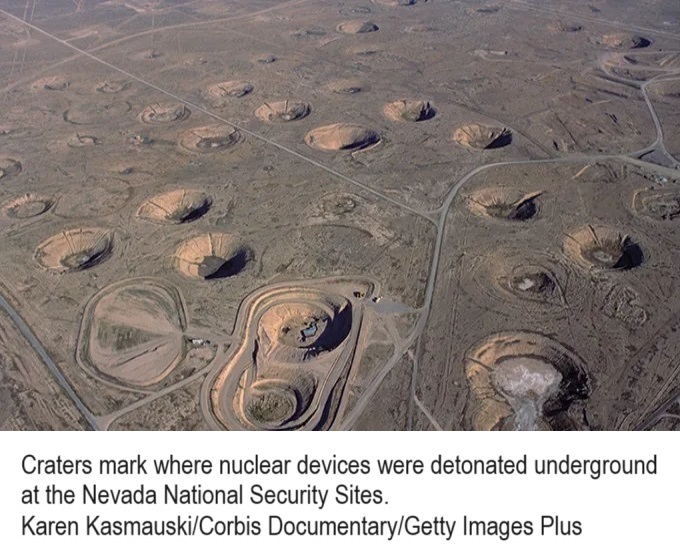
As the temperature and pressure abated, rocks collapsed into the cavity. The desert surface slumped, forming a subsidence crater about 3 meters deep and wider than the length of a football field. Unknown to the scientists.
working on this test, named Divider, it would be the end of the line. Soon after, the United States halted nuclear testing.
Beginning with the first explosive test, known as Trinity, in 1945, more than 2,000 atomic blasts have rattled the globe. Today, that nuclear din has been largely silenced, thanks to the norms set by the Comprehensive Nuclear-Test-Ban Treaty, or CTBT, negotiated in the mid-1990s.
Only one nation — North Korea — has conducted a nuclear test this century. But researchers and policy makers are increasingly grappling with the possibility that the fragile quiet will soon be shattered.
Some in the United States have called for resuming testing, including a former national security adviser to President Donald Trump. Officials in the previous Trump administration considered testing, according to a 2020 Washington Post article. And there may be temptation in coming years. The United States is in the midst of a sweeping, decades-long overhaul of its aging nuclear arsenal. Tests could confirm that old weapons still work, check that updated weapons perform as expected or help develop new types of weapons.
Meanwhile, the two major nuclear powers, the United States and Russia, remain ready to obliterate one another at a moment’s notice. If tensions escalate, a test could serve as a signal of willingness to use the weapons.
Testing “has tremendous symbolic importance,” says Frank von Hippel, a physicist at Princeton University. “During the Cold War, when we were shooting these things off all the time, it was like war drums: ‘We have nuclear weapons and they work. Better watch out.’ ” The cessation of testing, he says, was an acknowledgment that “these [weapons] are so unusable that we don’t even test them.”……………………………………………………………………………………………………………
“A single United States test could trigger a global chain reaction,” says geologist Sulgiye Park of the Union of Concerned Scientists, a nonprofit advocacy group. Other nuclear powers would likely follow by setting off their own test blasts. Countries without nuclear weapons might be spurred to develop and test them. One test could kick off a free-for-all.
“It’s like striking a match in a roomful of dynamite,” Park says.
The rising nuclear threat
The logic behind nuclear weapons involves mental gymnastics. The weapons can annihilate entire cities with one strike, yet their existence is touted as a force for peace. The thinking is that nuclear weapons act as a deterrent — other countries will resist using a nuclear weapon, or making any major attack, in fear of retaliation. The idea is so embedded in U.S. military circles that a type of intercontinental ballistic missile developed during the Cold War was dubbed Peacekeeper…………………………………………………
….. . The last remaining arms-control treaty between the United States and Russia, New START, is set to expire in 2026, giving the countries free rein on numbers of deployed weapons………………………………………………………………………………..
The United States regularly considers the possibility of testing nuclear weapons……………………………………………………………………………………………………………………………………………………………………….
Is there a need to test nuclear weapons?
Subcritical experiments are focused in particular on the quandary over how plutonium ages. Since 1989, the United States hasn’t fabricated significant numbers of plutonium pits. That means the pits in the U.S. arsenal are decades old, raising questions about whether weapons will still work.
An aging pit, some scientists worry, might cause the multistep process in a nuclear warhead to fizzle. For example, if the implosion in the first stage doesn’t proceed properly, the second stage might not go off at all.
Plutonium ages not only from the outside in — akin to rusting iron — but also from the inside out, says Siegfried Hecker, who was director of Los Alamos from 1986 to 1997. “It’s constantly bombarding itself by radioactive decay. And that destroys the metallic lattice, the crystal structure of plutonium.”
The decay leaves behind a helium nucleus, which over time may result in tiny bubbles of helium throughout the lattice of plutonium atoms. Each decay also produces a uranium atom that zings through the material and “beats the daylights out of the lattice,” Hecker says. “We don’t quite know how much the damage is … and how that damaged material will behave under the shock and temperature conditions of a nuclear weapon. That’s the tricky part.”
One way to circumvent this issue is to produce new pits. A major effort under way will ramp up production. In 2024, the NNSA “diamond stamped” the first of these pits, meaning that the pit was certified for use in a weapon. The aim is for the United States to make 80 pits per year by 2030. But questions remain about new plutonium pits as well, Hecker says, as they rely on an updated manufacturing process………………………
the benefits of performing a test would be outweighed by the big drawback: Other countries would likely return to testing. And those countries would have more to learn than the United States. China, for instance, has performed only 45 tests, while the United States has performed over 1,000. “We have to find other ways that we can reassure ourselves,” Hecker says…………………………………………………………………………………………………………………………………………………….
Underground tests are not risk-free
Tests that clearly break the rules, however, can be swiftly detected. The CTBT monitoring system can spot underground explosions as small as 0.1 kilotons, less than a hundredth that of the bomb dropped on Hiroshima. That includes the most recent nuclear explosive test, performed by North Korea in 2017.
Despite being invisible, underground nuclear explosive tests have an impact. While an underground test is generally much safer than an open-air nuclear test, “it’s not not risky,” Park says……………………………………………………………………………………………………………………………………
Even if the initial containment is successful, radioactive materials could travel via groundwater. Although tests are designed to avoid groundwater, scientists have detected traces of plutonium in groundwater from the Nevada site. The plutonium traveled a little more than a kilometer in 30 years. “To a lot of people, that’s not very far,” Park says. But “from a geology time scale, that’s really fast.” Although not at a level where it would cause health effects, the plutonium had been expected to stay put.
The craters left in the Nevada desert are a mark of each test’s impact on structures deep below the surface. “There was a time when detonating either above ground or underground in the desert seemed like — well, that’s just wasteland,” Jeanloz says. “Many would view it very differently now, and say, ‘No, these are very fragile ecosystems, so perturbing the water table, putting radioactive debris, has serious consequences.’ ”…………………………………..
more https://www.sciencenews.org/article/nuclear-weapons-tests-comeback-threats
CODEPINK Responds to US Senate McCarthy-Style Attack

March 26, 2025 By Ann Wright, https://consortiumnews.com/2025/03/26/codepink-responds-to-us-senate-mccarthy-style-attack/?fbclid=IwY2xjawJSve9leHRuA2FlbQIxMQABHfT5qi0QWquXKXsyVWAvmWYbVHJu31jtYa8i4R2SJ2Xs8jadVioQ-kJknA_aem_7QqiWhe1geDtZ6x-PdskAg
We must push back” — Retired Army Colonel Ann Wright takes on AIPAC-funded Tom Cotton, charging him with reckless libel.
Yesterday, in the U.S. Senate Intelligence Committee hearing on global threats with the five heads of intelligence agencies of the U.S. government, Sen. Tom Cotton, accused on national TV a group I have worked with for over 20 years, CODEPINK: Women for Peace, of being funded by the Communist Party of China.
During the hearing CODEPINK activist Tighe Barry stood up following the presentation of the Director of National Security Tulsi Gabbard’s lengthy statement about global threats to US national security and yelled “Stop Funding Israel,’ since neither Intelligence Committee Chair Tom Cotton and Vice Chair Mark Warner had mentioned Israel in their opening statement nor had Gabbard mentioned the Israeli genocide of Palestinians in Gaza in her statement either.
As Capitol police were taking Barry out of the hearing room, in the horrific style of the McCarthy hearings in the 1950s, Cotton maliciously said that Barry was a “CODEPINK lunatic that was funded by the Communist party of China.” Cotton then said if anyone had something to say, to do so.
Refusing to buckle or be intimidated by Cotton’s lies about the funding of CODEPINK, I stood up and yelled, “I’m a retired Army Colonel and former diplomat. I work with CODEPINK and it is not funded by Communist China.” I too was hauled out of the hearing room by Capitol police and arrested.
After I was taken out of the hearing room, Cotton libelously continued his McCarty lie: “The fact that Communist China funds CODEPINK which interrupts a hearing about Israel illustrates Director Gabbard’s point that China, Russia, Iran and North Korea are working together in greater concert than they ever had before.”
Cotton does not appreciate the responsibility he has in his one-month-old elevation to the chair of the Senate’s intelligence committee.
Cotton does not seem to care that his untruthful statements in a U.S. congressional hearing aired around the world can have immediate and dangerous consequences for those he lies about, their friends and family.
In today’s polarized political environment we know that the words of senior leaders can rile supporters into frenzies as we saw on Jan. 6, 2021, with President Donald Trump’s loyal supporters injuring many Capitol police and destroying parts of the nation’s Capitol building in their attempt to stop the presidential election proceedings.
CODEPINK members have been challenging in the U.S. Congress the war policies of five presidential administrations, beginning in 2001 with the George W. Bush administration’s wars on Afghanistan and Iraq, long before Cotton was elected as a U.S. senator in 2014. We have been in the U.S. Senate offices and halls twice as long as he has. We have nonviolently protested the war policies of Presidents George W. Bush, Barack Obama, Donald Trump, Joe Biden and now Trump again.
After getting out of the Capitol Hill police station, a CODEPINK delegation went to Cotton’s office in the Russell Senate Office building and made a complaint to this office staff.
We are also submitting a complaint to the Senate Ethics Committee for the untrue and libelous statements Senator Cotton made in the hearing.
The abduction and deportation of international students who joined protests against U.S. complicity in the Israeli genocide of Palestinians in Gaza and ethnic cleansing of the West Bank, the scathing treatment of visitors who have wanted to enter our country and now the McCarthy intimidating tactics used by Cotton in a Senate Intelligence Committee hearing of telling lies about individuals and organizations that challenge U.S. government politics, particularly its complicity in the Israeli genocide of Gaza must be called out and pushed back.
And we must push back against U.S. senators who actually receive funding from front groups for other countries. Cotton has received $1,197,989 from the American Israel Public Affairs Committee (AIPAC) to advocate for the genocidal policies of the State of Israel.
Ann Wright served 29 years in the U.S. Army/Army Reserves and retired as a Colonel. She was a U.S. diplomat for 16 years and served in US embassies in Nicaragua, Grenada, Somalia, Uzbekistan, Kyrgyzstan, Sierra Leone, Micronesia, Afghanistan, and Mongolia. She resigned from the U.S. government 22 years ago in March 2003 in opposition to the U.S. war on Iraq. She is a member of CODEPINK, Veterans For Peace, Women Cross DMZ and many other peace groups. She is the co-author of Dissent: Voices of Conscience.
The rush to war in space only needs a Gulf of Tonkin incident, and then what happens?

| Spacecom Protecting Homeland From Growing Threats March 26, 2025 | By David Vergun , https://www.defense.gov/News/News-Stories/Article/Article/4136285/spacecom-protecting-homeland-from-growing-threats/ |
The Defense Department must prepare for conflict in space to ensure deterrence. If that fails, the U.S. military is ready to fight and win, said Space Force Commander Gen. Stephen N. Whiting, who testified today at a Senate Armed Services subcommittee on strategic forces.
He said threats continue to expand at a breathtaking pace and pose a risk to the joint force.
The Defense Department must prepare for conflict in space to ensure deterrence. If that fails, the U.S. military is ready to fight and win, said Space Force Commander Gen. Stephen N. Whiting, who testified today at a Senate Armed Services subcommittee on strategic forces.
He said threats continue to expand at a breathtaking pace and pose a risk to the joint force.
Whiting said no other country can match the United States’ understanding of the complexities of space and the requirements to operate effectively in the most challenging areas of responsibility.
“Our military has the best trained, most capable space warfighting force in the world, and they stand dedicated to for America,” he added.
The general said Operation Olympic Defender is an example of working with allies and partners. He noted that Germany, France and New Zealand recently joined the United Kingdom, Canada and Australia as participating nations.
The operation’s mission optimizes space operations, improves mission assurance, enhances resilience and synchronizes efforts, according to a Spacecom news release.
This growth further strengthens partnerships and enables our allies to share the burden of collective space security, Whiting said.
“These advantages and our ability to deter potential adversaries cannot be taken for granted,” he said. “Deterrence in space is consistent with other domains. It requires a keen understanding and clear communication of what we are deterring against, credible, acknowledged capabilities to impose costs on those who attack us, and resilient architectures to dissuade attack by making any effort futile.”
Whiting said Spacecom is fully integrated into and contributing to the department’s efforts to establish a Golden Dome for American missile defense shield, adding that Space Command requires stable funding, as well as effective and efficient acquisition programs that deliver advanced space capabilities.
He identified the most pressing issues as the delivery of integrated space fires, enhanced battlespace awareness, and integrated command and control capabilities to achieve space superiority, which enhances homeland defense while protecting and enabling the joint force.
“Although many challenges lie ahead, the future of space holds tremendous promise for America if we actively and thoughtfully protect it,” he said.
In Whiting’s prepared testimony submitted to lawmakers, he wrote: “Spacecom is partnering with U.S. Northern Command and other stakeholders to write an initial capabilities document aimed at defining capability-based requirements for the Golden Dome architecture, based on forecasted threat scenarios. As these capabilities develop and deliver, we stand ready to take an active role in the operation of a next-generation space architecture which will be resident in our in support of protecting American citizens from attack.”
In his prepared testimony, he also addressed China’s views on space technology and its goal of becoming the dominant power in East Asia and a global superpower.
” seeks to rival the United States in nearly all areas of space technology by 2030 and establish itself as the world’s preeminent space power by 2045. Since 2015, China’s on-orbit presence has grown by 1,000%, with 1,094 active satellites as of January 2025. Its sophisticated space and counter-space systems enhance its ability to secure territorial claims, project power, and challenge U.S. advantages.”
New nuclear arms race looms as US threatens to pull atomic shield
For decades the nuclear weapons ‘club’ has been limited to nine nations. But fears Trump could withdraw America’s ‘nuclear umbrella’ is threatening proliferation
When Donald Trump and Vladimir Putin held their latest phone call a week
ago, the leaders of the two countries with the world’s largest nuclear
arsenals agreed on “the need to stop proliferation of strategic
weapons”. The point of accord between Moscow and Washington was in many
ways the continuation of a stance that has endured for the best part of 80
years – namely, that it is in the interests America, Russia and their
respective allies to keep the global “club” of nuclear-armed nations as
small as possible.
In order to do so, the United States has extended its
so-called “nuclear umbrella” – a promise of nuclear protection in
return for allies not seeking atomic weapons themselves – to some 30
countries. But it is a post-war consensus that is increasingly under
strain.
Indeed, in his efforts to make his “America First” policy a
geopolitical reality, there is growing evidence that Trump is flirting
dangerously with starting a new nuclear arms race. From Berlin to Seoul,
alarm bells are ringing that the United States, the lynch stone of the
Western security apparatus in Europe and Asia for three generations, is no
longer a reliable guarantor of the ultimate deterrence offered by nuclear
weapons.
iNews 26th March 2025,
https://inews.co.uk/news/new-nuclear-race-looms-usa-threatens-pull-atomic-shield-3604636
A nuclear Svengali on Capitol Hill?
Linda Pentz Gunter by beyondnuclearinternational
Attempts by the Breakthrough Institute’s Ted Nordaus to derail NRC commissioner candidacies have met with mixed success, writes Linda Pentz Gunter
We’re getting used to the swagger of entitlement and the complacency of corporate nuclear lobbyists on Capitol Hill. They, in turn, have become accustomed to getting their way — usually through the powerful persuasion of big money or saturation propaganda campaigns financed with those large stashes of handy corporate cash.
But when that isn’t enough, then a nice smear campaign should do. One who appears to enjoy such an endeavor is the Breakthrough Institute’s founder, Ted Nordhaus, who has made it his business of late to decide who does and does not get a commissioner seat at the US Nuclear Regulatory Commission. Those who should not, in Nordhaus’s views, are the Democratic candidates or incumbents who have too much of a regard for nuclear safety as a priority.
Safety is a big ticket item for the nuclear power industry. Literally. Maintaining, upgrading and replacing aging parts in these decades-old dinosaurs of the 20th century, many of them running well past their sell-by date, is an expensive undertaking. But a relaxation of — or looking the other way on — some of those pesky safety regulations would be made easier by more compliant NRC commissioners.
Cue Nordhaus, Capitol Hill’s nuclear Svengali.
His most recent target was Matthew Marzano, the candidate for the long vacant fifth seat on the NRC commission. Nordhaus pulled out all the stops to derail Marzano, beginning last September prior to Marzano’s hearing before the Senate Committee on Environment and Public Works.
Nordhaus prepared a veritable death warrant in which he claimed, among other things, that Marzano would, if approved, be “the least qualified commissioner ever seated on the Nuclear Regulatory Commission”. Nordhaus also wrote that Marzano, if chosen, “will not be a voice for reform and modernization on the commission.”
Never mind that Marzano, who was then an official at the Idaho National Laboratory, has a pretty solid nuclear background, having worked both on commercial reactors and as an instructor for the Naval Nuclear Propulsion Program at the US Department of Energy. (As a side note, this exemplifies once again the two-way street and inexorable link between the civil and military nuclear sectors.)
“Modernization” is Nordhaus’s absolutely most favorite word. He used it, or a derivation of it, nine times in his public assassination-by-blogpost of Marzano’s qualifications (accusations that were obediently re-quoted by senators during Marzano’s hearing.)
“Modernization” is code of course. What it really means is “weakening” or “emasculation,” because what Nordhaus, the Republicans and far too many Democrats are now intent on doing is to transform the NRC from what is already a lame safety regulator into an even meeker nuclear industry lapdog.
The same hand of influence belonging to Nordhaus and his Breakthrough Institute had earlier been felt when legislation was passed on Capitol Hill designed specifically to weaken the NRC. At that time, the Breakthrough Institute railed on its website that the NRC’s “national progress is hindered by its self-imposed narrowly defined mission, primarily concentrated on nuclear safety, which leads to unwarranted delays in reactor licensing.”
Last June, the Senate voted almost unanimously for a bill introduced by Senator Gary Peters, a Democrat from Michigan —S.870 – A bill to authorize appropriations for the United States Fire Administration and firefighter assistance grant programs, to advance the benefits of nuclear energy, and for other purposes. Ostensibly designed to provide improved benefits and safety conditions for firefighters, it included an entire section on the NRC straight from the Nordhaus playbook.
The bill required the NRC to “update the mission statement of the Commission to include that licensing and regulation of the civilian use of radioactive materials and nuclear energy be conducted in a manner that is efficient and does not unnecessarily limit—
(1) the civilian use of radioactive materials and deployment of nuclear energy; or
(2) the benefits of civilian use of radioactive materials and nuclear energy technology to society.”
Afraid of appearing to throw firefighters under the bus, all but two senators voted for the bill. Predictably, the dissenters were Democrat Ed Markey of Massachusetts and independent Bernie Sanders of Vermont, the only consistent anti-nuclear voices on Capitol Hill…………………………………………………………………………………………………………………………..
What has really crippled the nuclear power sector is its exorbitant costs. But the ruse to undermine the NRC and weaken (“modernize” or “reform”) safety oversight is precisely because it is nuclear power’s immense dangers that cause its costs to sky-rocket.
None of this fazes Nordhaus, however, who insists that new reactors constitute “a new generation of even safer reactors” and that nuclear power has “substantial environmental public health benefits”.
The former assertion is strongly challenged by physicists such as Edwin Lyman at the Union of Concerned Scientists and M.V. Ramana at the University of British Columbia, who happen to understand the science and know that the untested, recycled and long ago rejected design ideas for small modular reactors are replete with radiological risks and serious and unsolved uncertainties around safety.
As for the substantial health benefits of nuclear power, perhaps Mr. Nordhaus would like to say that to the (non-White) faces of Native Americans coping with the deadly legacy of abandoned uranium mines and to the mothers of childhood leukemia sufferers living near nuclear plants, who would beg to differ.
This article is adapted from a piece that first appeared in the February/March 2025 edition of Ralph Nader’s newspaper, Capitol Hill Citizen, available in print only.
https://beyondnuclearinternational.org/2025/03/23/a-nuclear-svengali-on-capitol-hill/
Ukraine and Israel are not US allies.
Walt Zlotow, West Suburban Peace Coalition, Glen Ellyn IL , 25 Mar 25
They are essentially US Trojan Horses used to project US power dominance in Europe and Middle East respectively.
Both US Trojan Horses have come up lame and are heading for the glue factory.
The US marched their Ukraine Trojan Horse up to Russia’s borders armed with NATO entrance papers and billions in US weapons. When Russia pleaded with the US for years to discuss Russia’s valid security concerns, the US replied ‘Nyet.’ Former President Biden knew Russia would attack but believed any invasion would be a Vietnam style quagmire for Russia. Biden saw the upcoming Russian collapse as the shining achievement of his half century anti-Russian Cold War mantra. That failed spectacularly.
The election of Trump has injected a healthy dose of realpolitik that acknowledges Biden’s folly. Trump is currently in negotiations to put America’s Ukraine Trojan Horse to pastoral retirement. Can’t come soon enough.
America’s Israeli Trojan Horse to dominate the Middle East is a horse of a different color. It’s more like Israel’s Trojan Horse near totally financed by Uncle Sam. America gets to sit back while Israel marches around their neighborhood committing genocide is Gaza, indiscriminately bombing innocents in Syria and Lebanon, and promoting US attacks on Yemen and eventually Iran. All this senseless carnage constitutes Israel serving as the US battering ram to recreate the Middle East according to its dominant worldview.
Like our Ukraine Trojan Horse, our Israeli Trojan Horse is failing to promote America’s true national interests. Most of the world’s 193 countries are aghast America promotes the most grotesque genocide this century. America’s standing may be at an all time low. Like with Ukraine, we’re enabling Israel to self destruct. It’s now a pariah state. Tourism and investment are in decline. Its military is demoralized both from significant casualties and having to commit genocide.
Both allies are flirting with wider war; nuclear in Ukraine, regional war in Israel.
America gets nothing from allies Ukraine and Israel except worldwide condemnation, squandered treasure and diminishing unipolar world dominance.
With allies like Ukraine and Israel, America does not need enemies.
Trump’s Star Wars Revival: The Golden Dome Antimissile Fantasy

March 26, 2025 Dr Binoy Kampmark, https://theaimn.net/trumps-star-wars-revival-the-golden-dome-antimissile-fantasy/
Bad ideas do not necessarily die; they retire to museums of failure and folly, awaiting to be revived by the next proponent who should know better. The Iron Dome shield vision of US President Donald Trump, intended to intercept and destroy incoming missiles and other malicious aerial objects, seems much like a previous dotty one advanced by President Ronald Reagan, known rather blandly as the Strategic Defense Initiative.
In its current iteration, it is inspired by the Israeli “Iron Dome” multilayered defensive shield, a matter that raised an immediate problem, given the trademark ownership of the name by the Israeli firm Rafael Advanced Defense Systems. Given the current administration’s obsession with all things golden, the Missile Defense Agency (MDA) has dubbed this revived endeavour “Golden Dome for America”. The renaming was noted in a February 24 amendment to request for information from industry. Much sniggering is surely in order at, not only the name itself, but the stumbling.
Reagan, even as he began suffering amnesiac decline, believed that the United States could be protected by a shield against any attack by Soviet intercontinental ballistic missiles. The technology intended for that endeavour, much of it requiring a space component, was thin on research and non-existent in development. The envisaged use of laser weapons from space and terrestrial components drew much derision: the President had evidently been too engrossed by the Star Wars films of George Lucas.
The source for this latest initiative (“deploying and maintaining a next-generation missile defense shield”) is an executive order signed on January 27 titled “The Iron Dome for America.” (That was before the metallurgical change of name.) The order asserts from the outset that “The threat of attack by ballistic, hypersonic and cruise missiles and other advanced aerial attacks remains the most catastrophic threat facing the United States.” It acknowledges Reagan’s SDI but strikes a note of disappointment at its cancellation “before its goal could be realized.” Progress on such a system since the US withdrawal from the Anti-Ballistic Missile Treaty in 2002 had been confined to “limited homeland defense” efforts that “remained only to stay ahead of rogue-nation threats and accidental or unauthorized missile launches.”
The Secretary of Defense is also directed, within 60 days, to submit to Trump “a reference architecture, capabilities-based requirements, and an implementation plan for the next-generation missile defense shield.” Such a shield would defend the US from “ballistic, hypersonic, advanced cruise missiles and the other next-generation attacks from peer, near-peer and rogue adversaries.” Among some of the plans are the accelerated deployment of a hypersonic and ballistic tracking space sensor layer; development and deployment of proliferated space-based interceptors and the development and deployment of capabilities that will neutralise missile assaults “prior to launch and in the boost phase.”
The original SDI was heavy on the intended development and use of energy weapons, lasers being foremost among them. But even after four decades, US technological prowess remains unable to deploy such weapons of sufficient power and accuracy to eliminate drones or missiles. The Israelis claim to have overcome this problem with their Iron Beam high energy laser weapon system, which should see deployment later this year. For that reason, Lockheed Martin has partnered with Israeli firm Rafael to bring that technology into the US arsenal.
To date, Steven J. Morani, currently discharging duties as undersecretary of defense for acquisition and sustainment, has given little away about the herculean labours that have been set. “Consistent with protecting the homeland and per President Trump’s [executive order],” he told the McAleese Defense Programs Conference in Washington earlier this month, “we’re working with the industrial base and [through] supply chain challenges associated with standing up the Golden Dome.” He admitted that this was “like the monster systems engineering problem” made even more difficult by being “the monster integration problem.”
The list of demerits to Golden Dome are many, and Morani alludes to them. For one, the Israeli Iron Dome operates across much smaller territory, not a continent. The sheer scale of any defence shield to protect such a vast swathe of land would be, not merely from a practical point but a budgetary one, absurd. A space-based interceptor system, a point that echoes Reagan’s Star Wars fantasy, would require thousands of units to successfully intercept one hefty ballistic missile. Todd Harrison of the American Enterprise Institute has offered a calculation: a system of 1,900 satellites would cost somewhere between US$11 and US$27 billion to develop, build and launch.
A study for Defence and Peace Economics published this year goes further. The authors argue that, even if the US had appropriate ballistic missile defence technology and a sufficient number of interceptors to be distributed in a two-layer defence with an efficiency return of 90%, 8 times more would have to be spent than the attacker for a bill between US$60 and US$500 billion. If it was assumed that individual interceptor effectiveness was a mere 50%, and the system could not discriminate against decoys, the cost would be 70 times more, with a staggering bill of US$430 billion to US$5.3 trillion.
The most telling flaw in Golden Dome is one long identified, certainly by the more sober members of the establishment, in the annals of defence. “The fundamental problem with any plan for a national missile defense system against nuclear attack,” writes Xiaodon Liang in an Arms Control Association issues brief, “is that cost-exchange ratios favor the offense and US adversaries can always choose to build up or diversify their strategic forces to overwhelm a potential shield.” As Liang goes on to remark, the missile shield fantasy defies a cardinal rule of strategic competition: “the enemy always gets a vote.”
Monster system; monstrous integration issues. Confusion with the name and trademark problems. Strategically misguided, even foolish. Golden Dome, it would seem, is already being steadied for a swallow dive.
Nuclear experts pour cold water on US idea to restore and run Ukrainian power plant.
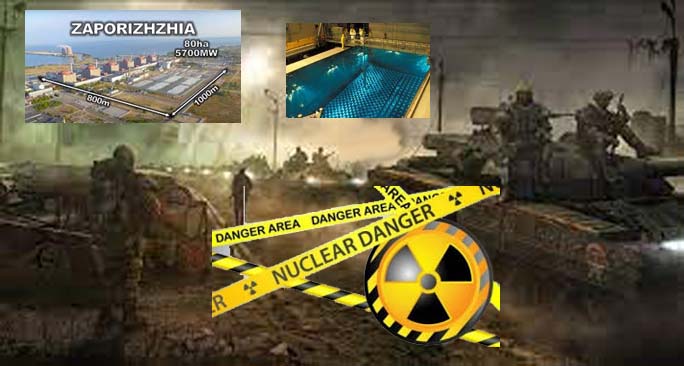
Nuclear experts have also highlighted that the US does not have any nuclear plants that use the same class of technology as Zaporizhzhia, which is a Soviet-designed “water water energetic reactor” (abbreviated as “VVER” in Russian).
By Lauren Kent, CNN, 20th March 2025, https://edition.cnn.com/2025/03/20/europe/ukraine-us-zaporizhzhia-nuclear-power-plant-explainer/index.html
Ukraine’s Zaporizhzhia nuclear power plant, occupied by Russian forces since the early days of the war, could be restored and protected by US ownership – at least according to the Americans.
But it’s unclear how the operation would work in practice, experts say, especially as the plant is on the front line, in territory controlled by Russia.
As part of ongoing talks to inch toward a partial ceasefire, US President Donald Trump and Ukrainian counterpart Volodymyr Zelensky “discussed Ukraine’s electrical supply and nuclear power plants” during a Wednesday phone call, according to the US readout of the call.
“(Trump) said that the United States could be very helpful in running those plants with its electricity and utility expertise. American ownership of those plants would be the best protection for that infrastructure and support for Ukrainian energy infrastructure,” the readout said.
On Thursday, Zelensky disputed that section, saying: “In terms of ownership, we definitely did not discuss this with President Trump.” Zelensky stressed that “all nuclear power belongs to the (Ukrainian) state, including the temporarily occupied Zaporizhzhia region.”
Zelensky said the day before that Ukraine is ready to consider the possibility of American investment in the restoration and modernization of Zaporizhzhia. During a news conference after his call with Trump, Zelensky said they only discussed the occupied Zaporizhzhia plant, rather than Ukraine’s wider nuclear power network.
“I believe that the station will not work under occupation. I believe that the station can be restored to operation,” Zelensky said, also cautioning that the process will take an estimated two years or more.
Before Russia’s full-scale invasion in 2022, the Zaporizhzhia plant supplied roughly 20% of Ukraine’s energy, with six reactors, making it the largest nuclear power station in Europe. Ukrainian staff remain at the plant under Russian occupation, and at one point staff were forced to work at “gunpoint.”
But the plant is now disconnected from the grid and the electricity infrastructure required to operate the plant safely has been damaged by drone strikes and frequent shelling. Russia also destroyed the nearby Kakhovka dam, emptying the reservoir that supplied water to cool the plant.
All six reactors are shut down and there are concerns over the plant’s ongoing maintenance, as explosions continue nearby, according to a UN nuclear watchdog team on the ground.
When asked about how the US could potentially run a Ukrainian nuclear plant, Energy Secretary Chris Wright told Fox News that he didn’t believe it would require American troops on the ground.
“Certainly, we have immense technical expertise in the United States to run those plants. I don’t think that requires boots on the ground,” Wright said. “But I’ll leave the foreign policy to President Trump and Secretary (of State Marco) Rubio. I know they are working tirelessly, ‘How do we bring peace to Ukraine?’
“But, if it was helpful to achieve that end – have the US run nuclear power plants in Ukraine? No problem. We can do that,” Wright added.
But experts question how feasible the idea floated by the Trump administration would be.
Operating the plant safely would require a safe, constant power supply to avoid a reactor meltdown, as well as the restoration of sufficient water supplies for cooling the plant.
“The first word of business would be to establish definitively that there could be no attacks on either the plant directly or on the supporting infrastructure – both power and water resources – and that would have to be iron-clad,” said Edwin Lyman, director of nuclear power safety at the Union of Concerned Scientists. “So far, that kind of agreement has been elusive, as shelling occurs at a daily basis in the vicinity of the reactors.”
“There’s no point in trying to rebuild a plant and operate it if it could be jeopardized at any moment,” Lyman said. “And the notion that US-ownership would somehow be more of a deterrent to Russia attacking the plant than now, when the Russians themselves control the plant, that doesn’t make sense either.”
The idea of US operation “raises a whole lot of logistical and technical and practical questions that are very unclear,” Lyman said, including the question of US liability for any accident at the facility. “With ownership or operator status comes responsibility.”
Nuclear experts have also highlighted that the US does not have any nuclear plants that use the same class of technology as Zaporizhzhia, which is a Soviet-designed “water water energetic reactor” (abbreviated as “VVER” in Russian).
“These are different technologies,” said Elena Sokova, director of the Vienna Center for Disarmament and Non-Proliferation, adding that there are strict licensing requirements for the plant’s operators.
“The US is an advanced country… but to be prepared to immediately take control of something that is of a different design, designed by different country, and where you have no experience of running it – I don’t think it’s a good solution or viable option.”
“Having said that, if we’re talking about a long process, I’m sure certain things could be worked out, particularly if there is an arrangement… to have the majority of the Ukrainian staff and operators running these reactors,” Sokova added.
Ukraine wants role in restoration of plant
Zelensky emphasized on Wednesday night that safe restoration of the plant is in the whole world’s interest, and Ukraine should have a role in that “because it is ours, and this is our land, this is our station.”
The Ukrainian president said any return of the plant would not be possible without control of the area where it is located – the city of Enerhodar – on the Russian-occupied side of the Zaporizhzhia region.
“If you just hand over the station, and a meter away from the station, everything is occupied or there are Russian weapons, no one will work like that,” Zelensky told reporters, raising concerns that the plant could be restored with US and Ukrainian investment, only to have Russia possibly damage or destroy it again later.
As fighting continues along the front line, the dire situation at the Zaporizhzhia plant “remains unchanged,” Andrian Prokip, energy program director at the Ukrainian Institute for the Future, wrote last month.
“It still does not receive adequate maintenance and it continues to serve as a Russian ammunition depot,” said Prokip, also a senior associate at the Wilson Center.
CNN’s Svitlana Vlasova, Christian Edwards and DJ Judd contributed to this report.
1 This Month
Chernobyl: The Lost Tapes – A good documentary on Chernobyl on SBS available On Demand for the next 3 weeks– https://www.sbs.com.au/ondemand/tv-program/chernobyl-the-lost-tapes/2352741955560

of the week–London Campaign for Nuclear Disarmament

Tell the Ukrainian Government to Drop Prosecution of Peace Activist Yurii Sheliazhenko
To see nuclear-related stories in greater depth and intensity – go to https://nuclearinformation.wordpress.com
-
Archives
- April 2026 (126)
- March 2026 (251)
- February 2026 (268)
- January 2026 (308)
- December 2025 (358)
- November 2025 (359)
- October 2025 (376)
- September 2025 (257)
- August 2025 (319)
- July 2025 (230)
- June 2025 (348)
- May 2025 (261)
-
Categories
- 1
- 1 NUCLEAR ISSUES
- business and costs
- climate change
- culture and arts
- ENERGY
- environment
- health
- history
- indigenous issues
- Legal
- marketing of nuclear
- media
- opposition to nuclear
- PERSONAL STORIES
- politics
- politics international
- Religion and ethics
- safety
- secrets,lies and civil liberties
- spinbuster
- technology
- Uranium
- wastes
- weapons and war
- Women
- 2 WORLD
- ACTION
- AFRICA
- Atrocities
- AUSTRALIA
- Christina's notes
- Christina's themes
- culture and arts
- Events
- Fuk 2022
- Fuk 2023
- Fukushima 2017
- Fukushima 2018
- fukushima 2019
- Fukushima 2020
- Fukushima 2021
- general
- global warming
- Humour (God we need it)
- Nuclear
- RARE EARTHS
- Reference
- resources – print
- Resources -audiovicual
- Weekly Newsletter
- World
- World Nuclear
- YouTube
-
RSS
Entries RSS
Comments RSS
 nuclear-news