Conflicts of interest in the Trump group’s push to sell nuclear reactors to Saudi Arabia.

|
The Trump administration is eager to sell nuclear reactors to Saudi Arabia. But why? Bulletin of the Atomic Scientists, By Aileen Murphy, M. V. Ramana, April 16, 2019 US government officials appear to be advancing a potential sale of nuclear power plants to Saudi Arabia. Late last month, Reuters reported that Energy Secretary Rick Perry approved six secret authorizations for companies to do preliminary work on a Saudi nuclear deal without congressional oversight. The Reuters article followed an interim staff report that US Rep. Elijah Cummings, chairman of the House Oversight Committee, released in February; the report cited whistleblowers who had warned that the White House was trying to rush the transfer of nuclear technology to the Kingdom.
Many experts have expressed concern about the terms of a US-Saudi nuclear cooperation agreement now apparently under negotiation. Some despair at the very idea of transferring such sensitive technology to a regime known to have been involved in the gruesome murder of a prominent US-based journalist and to have led a bloody war in Yemen. Saudi Arabia has attempted to justify its nuclear power program as a way to shift its electrical system away from fossil fuels, in part because of climate change concerns and in part because it is economically useful for the Kingdom to sell its oil and gas on the international market, rather than use them to generate electricity. But for sun-baked Saudi Arabia, the economical and obvious switch is to solar energy, which also doesn’t result in carbon emissions and can be used to reduce domestic consumption of oil and gas. The limited efforts in installing solar power capacity on the part of the Saudi government suggest that climate action and economics may not be the driving motivations for its extensive nuclear energy plan. Indeed, members of the Saudi regime have, on other occasions, made it clear that their interests in nuclear energy derive from the idea that it would help them acquire the capability to make nuclear weapons and match Iran, whose regional status is seen to have risen as a result of its uranium enrichment program, even though it is now apparently limited by the Iran nuclear deal. The contrast between Saudi Arabia’s solar potential and its focus on nuclear power raises a question: Why is the Trump administration so eager to provide nuclear technology to such a questionable partner? We offer some tentative answers to this question and argue that it would be best for the United States to stop trying to sell nuclear reactors to Saudi Arabia, and to use its considerable diplomatic capacity to encourage other countries to do the same. Outside inducement, inside interest. Despite President Trump’s outspoken interest in maintaining a close relationship with the Saudi leadership, the White House is not seeking a Saudi nuclear agreement entirely on its own volition. It is also responding to a major lobbying effort. In February, representatives from several nuclear energy firms, including NuScale, TerraPower, Westinghouse, and General Electric, met with President Trump reportedly with the aim of having the president “highlight the role US nuclear developers can play in providing power to other countries.” The motivation for nuclear reactor suppliers is understandable. Thanks in part to the multibillion-dollar cost of reactors, the nuclear energy market is slim. One can literally count the number of new reactor construction projects starting each year since 2010 on the fingers of one hand. Westinghouse, the leading company among those that lobbied Trump, has not signed a new reactor contact in more than a decade. The Middle East has been an especially competitive market for companies interested in building reactors in the Kingdom. If any reactors are sold, it will only be with the help of high-level support, probably involving national governments or even heads of state. But the effort to sell US nuclear power plants has also garnered some new players: companies involving ex-members of the armed forces. For about two years now, there have been reports of former national security advisor Michael Flynn playing an important role in trying to start nuclear exports to the Middle East, especially Saudi Arabia. More recently, a host of articles have uncovered the role of the newly established IP3 Corporation (derived from International Peace, Power, and Prosperity), a company dominated by a number of retired military officials. The extent of IP3’s lobbying became apparent only after the House Oversight Committee report was published. The influence trail is murky, and the various conflicts of interest within the Trump administration render the picture even murkier. One example is the case of Westinghouse and Jared Kushner, son in law of and senior advisor to President Donald Trump and a close friend of Saudi Crown Prince Mohammad bin Salman. Westinghouse is the largest nuclear reactor supplier in the United States, but, thanks to cost escalations in multiple projects involving its AP1000 nuclear reactor design, the company filed for bankruptcy protection in 2017. It was then purchased by the Canadian company Brookfield Business Partners. Brookfield Business Partners is a subsidiary of Brookfield Asset Management Inc., which reached a deal in August 2018 with the Kushner family’s real estate company to lease a highly unprofitable building in New York. The Kushner company had purchased 666 Fifth Avenue in New York for $1.8 billion in 2007, just before the property markets collapsed. The company had been trying for years to offload this debt. Brookfield’s deal might be just a coincidence, but the timing and the earlier foray into the nuclear business raise obvious conflict of interest questions………. Three reasons to question. Three aspects of the proposed sale of nuclear reactors to Saudi Arabia demand attention. The first, which has received much media attention, involves the opaque tangle of shady talks and negotiations between the Trump administration and the Kingdom, in the realm of nuclear energy and in other areas. Second, it is clear that nuclear energy makes little economic sense for Saudi Arabia, suggesting that there are other motives for its nuclear power program. Third, one of these motives need no longer be the subject of speculation: Saudi Arabia’s leaders have clearly stated their interest in potentially developing nuclear weapons. The acquisition of nuclear power and associated technology could well aid that process. Given these questions, neither the United States nor any other country should be exporting nuclear power plants to Saudi Arabia. This will not just be in the interest of the United States, but also in the economic interest of the Saudis. To the extent that there is concern that other countries like Russia and China might step in and sell nuclear reactors to Saudi Arabia, the obvious corollary is that the United States should use its considerable diplomatic capacity to discourage such efforts. Success is, of course, not guaranteed, but not trying is the surest way to fail. https://thebulletin.org/2019/04/the-trump-administration-is-eager-to-sell-nuclear-reactors-to-saudi-arabia-but-why/ |
|
Close the US military bases in Asia!

The US acts as if Japan needs to be defended against China. Let’s have a look. During the past 1,000 years, during which time China was the region’s dominant power for all but the last 150 years, how many times did China attempt to invade Japan? If you answered zero, you are correct. China did not attempt to invade Japan on a single occasion.
Jeffrey D. Sachs, Swiss Standpoint, Sun, 04 May 2025, https://www.sott.net/article/499470-Close-the-US-military-bases-in-Asia
(2 May 2025) President Donald Trump is again loudly complaining that the US military bases in Asia are too costly for the US to bear. As part of the new round of tariff negotiations with Japan and Korea,1 Trump is calling on Japan and Korea to pay for stationing the US troops. Here’s a much better idea: close the bases and return the US servicemen to the US.
Donald Trump implies that the US is providing a great service to Japan and Korea by stationing 50,000 troops in Japan and nearly 30,000 in Korea. Yet these countries do not need the US to defend themselves. They are wealthy and can certainly provide their own defense. Far more importantly, diplomacy can ensure the peace in northeast Asia far more effectively and far less expensively than US troops.
The US acts as if Japan needs to be defended against China. Let’s have a look. During the past 1,000 years, during which time China was the region’s dominant power for all but the last 150 years, how many times did China attempt to invade Japan? If you answered zero, you are correct. China did not attempt to invade Japan on a single occasion.
You might quibble. What about the two attempts in 1274 and 1281, roughly 750 years ago? It’s true that when the Mongols temporarily ruled China between 1271 and 1368, the Mongols twice sent expeditionary fleets to invade Japan, and both times were defeated by a combination of typhoons (known in Japanese lore as the Kamikaze winds) and by Japanese coastal defenses.
Japan, on the other hand, made several attempts to attack or conquer China. In 1592, the arrogant and erratic Japanese military leader Toyotomi Hideyoshi launched an invasion of Korea with the goal of conquering Ming China. He did not get far, dying in 1598 without even having subdued Korea. In 1894-1895, Japan invaded and defeated China in the Sino-Japanese war, taking Taiwan as a Japanese colony. In 1931, Japan invaded northeast China (Manchuria) and created the Japanese colony of Manchukuo. In 1937, Japan invaded China, starting World War II in the Pacific region.
Nobody thinks that Japan is going to invade China today, and there is no rhyme, reason, or historical precedent to believe that China is going to invade Japan. Japan has no need for the US military bases to protect itself from China.
The same is true of China and Korea. During the past 1,000 years, China never invaded Korea, except on one occasion: when the US threatened China. China entered the war in late 1950 on the side of North Korea to fight the US troops advancing northward towards the Chinese border. At the time, US General Douglas MacArthur recklessly recommended attacking China with atomic bombs. MacArthur also proposed to support Chinese nationalist forces, then based in Taiwan, to invade the Chinese mainland. President Harry Truman, thank God, rejected MacArthur’s recommendations.
South Korea needs deterrence against North Korea, to be sure, but that would be achieved far more effectively and credibly through a regional security system including China, Japan, Russia, North Korea, South Korea, than through the presence of the US, which has repeatedly stoked North Korea’s nuclear arsenal and military build-up, not diminished it.
In fact, the US military bases in East Asia are really for the US projection of power, not for the defense of Japan or Korea. This is even more reason why they should be removed. Though the US claims that its bases in East Asia are defensive, they are understandably viewed by China and North Korea as a direct threat – for example, by creating the possibility of a decapitation strike, and by dangerously lowering the response times for China and North Korea to a US provocation or some kind of misunderstanding.
Russia vociferously opposed NATO in Ukraine for the same justifiable reasons. NATO has frequently intervened in US-backed regime-change operations and has placed missile systems dangerously close to Russia. Indeed, just as Russia feared, NATO has actively participated in the Ukraine War, providing armaments, strategy, intelligence, and even programming and tracking for missile strikes deep inside of Russia.
Note that Trump is currently obsessed with two small port facilities in Panama owned by a Hong Kong company, claiming that China is threatening US security (!), and wants the facilities sold to an American buyer. The US on the other hand surrounds China not with two tiny port facilities but with major US military bases in Japan, South Korea, Guam, the Philippines, and the Indian Ocean near to China’s international sea lanes.
The best strategy for the superpowers is to stay out of each other’s lanes. China and Russia should not open military bases in the Western Hemisphere, to put it mildly. The last time that was tried, when the Soviet Union placed nuclear weapons in Cuba in 1962, the world nearly ended in nuclear annihilation. (See Martin Sherwin’s remarkable book, “Gambling with Armageddon” for the shocking details on how close the world came to nuclear Armageddon). Neither China nor Russia shows the slightest inclination to do so today, despite all the provocations of facing US bases in their own neighborhoods.
Trump is looking for ways to save money – an excellent idea given that the US federal budget is hemorrhaging $2 trillion dollars a year, more than 6% of US GDP. Closing the US overseas military bases would be an excellent place to start.
Trump even seemed to point that way at the start of his second term, but the Congressional Republicans have called for increases, not decreases, in military spending. Yet with America’s 750 or so overseas military bases in around 80 countries, it’s high time to close these bases, pocket the saving, and return to diplomacy. Getting the host countries to pay for something that doesn’t help them or the US is a huge drain of time, diplomacy, and resources, both for the US and the host countries.
The US should make a basic deal with China, Russia, and other powers. “You keep your military bases out of our neighborhood, and we’ll keep our military bases out of yours.” Basic reciprocity among the major powers would save trillions of dollars of military outlays over the coming decade and, more importantly, would push the Doomsday Clock back from 89 seconds to nuclear Armageddon.2
Trump’s trip to Saudi Arabia raises the prospect of US nuclear cooperation with the kingdom

By ASSOCIATED PRESS, Daily Mail, 10 May 2025
WASHINGTON (AP) – Saudi Arabia wants U.S. help developing its own civil nuclear program, and the Trump administration says it is “very excited” at the prospect. U.S.-Saudi cooperation in building reactors for nuclear power plants in the kingdom could shut the Chinese and Russians out of what could be a high-dollar partnership for the American nuclear industry.
Despite that eagerness, there are obstacles, including fears that helping the Saudis fulfill their long-standing desire to enrich their own uranium as part of that partnership would open new rounds of nuclear proliferation and competition. Saudi Arabia’s pursuit of a nuclear agreement is likely to play into the ever-evolving bargaining on regional security issues involving the U.S., Iran and Israel.
This coming week, Republican President Donald Trump will make his first trip to Saudi Arabia of his second term. Here´s a look at key issues involved in the Saudi request…………………………………………………………………………………………
Crown Prince Mohammed bin Salman also is pushing to build up Saudi Arabia’s mining and processing of its own minerals. That includes Saudi reserves of uranium, a fuel for nuclear reactors.
For the Trump administration, any deal with Iran that lets Tehran keep its own nuclear program or continue its own enrichment could increase Saudi pressure for the same.
That’s even though Saudi Arabia and other Gulf states have toned down their enmity toward Iran in recent years and are supporting the U.S. efforts to limit Iran´s nuclear program peacefully.
For the U.S., any technological help it gives the Saudis as they move toward building nuclear reactors would be a boon for American companies…………………………………..
“Without a doubt, if Iran developed a nuclear bomb, we would follow suit as soon as possible,” Prince Mohammed said in 2018, at a time of higher tension between Arab states and Iran.
Saudi Arabia and other Gulf states stress better relations and diplomacy with Iran now. But Prince Mohammed’s comments – and other Saudi officials said similar – have left open the possibility that nuclear weapons are a strategic goal of the Saudis.
The Saudis long have pushed for the U.S. to build a uranium enrichment facility in the kingdom as part of any nuclear cooperation between the two countries. That facility could produce low-enriched uranium for civilian nuclear reactors. But without enough controls, it could also churn out highly enriched uranium for nuclear bombs.
Trump administration officials cite the Saudis’ desire to make use of their country´s uranium deposits. The kingdom has spent tens of millions of dollars, with Chinese assistance, to find and develop those deposits. But the uranium ore that it has identified so far would be “severely uneconomic” to develop, the intergovernmental Nuclear Energy Agency says.
It has been decades since there has been any state-sanctioned transfer of that kind of technology to a nonnuclear-weapon state, although a Pakistani-based black-market network provided enrichment technology to Iran, North Korea, Libya and possibly others about 20 years ago, Robert Einhorn noted for the Brookings Institute last year.
Allowing Saudi Arabia – or any other additional country – to host an enrichment facility would reverse long-standing U.S. policy. It could spur more nuclear proliferation among U.S. allies and rivals, Einhorn wrote………………………………….
After Wright’s trip, some Israelis expressed their opposition to allowing Saudi Arabia to enrich uranium, and Iran and Saudi Arabia are both carefully watching the other’s talks with the U.S. on their nuclear issues…………………………
https://www.dailymail.co.uk/wires/ap/article-14698407/Trumps-trip-Saudi-Arabia-raises-prospect-US-nuclear-cooperation-kingdom.html
Iran calls latest nuclear talks with US ‘difficult’ but both sides agree negotiations will continue

By CNN, May 12, https://www.9news.com.au/world/us-iran-nuclear-talks-iran-calls-latest-nuclear-talks-difficult-but-both-sides-agree-negotiations-will-continue/0d7dc1d5-72da-4a91-a356-4676ac116ea8
The latest round of high-stakes nuclear talks between Iran and the US have ended, with Tehran calling them difficult but with both sides agreeing to further negotiations.
Iranian Foreign Ministry spokesman Esmaeil Baqaei confirmed on X on Sunday that the talks had concluded, saying they were “difficult but useful to better understand each other’s positions and to find reasonable & realistic ways to address the differences”.
A senior Trump administration official gave a more positive assessment, telling CNN the discussions “were again both direct and indirect” and lasted over three hours, calling them encouraging.
“Agreement was reached to move forward with the talks to continue working through technical elements,” the official said, adding that the US side was “encouraged by today’s outcome” and looked forward to their next meeting, “which will happen in the near future”.
No date has been agreed for the next round although Baqaei said it would be announced by mediator Oman.
The talks on Sunday were aimed at addressing Tehran’s nuclear program and lifting sanctions
That they are happening at all is something of a breakthrough – the talks are the highest-level in years – but signs of firm progress are slim.
Both countries have expressed a willingness to resolve their disputes through diplomacy. A central issue remains Iran’s demand to continue enriching uranium for its nuclear program, which is insists is peaceful, something the US calls a “red line.”
US President Donald Trump, who is headed to the Middle East next week, has threatened that the US would resort to military strikes against Iranian nuclear sites, with Israel’s help, should Tehran fail to reach a deal with its interlocutors.
The Iranian delegation was led by Foreign Minister Abbas Araghchi, who said before the talks got underway that the US side “holds contradictory positions which is one of the issues in our negotiations”.
“We have been clear about our boundaries,” Araghchi added, according to the Fars news agency.
Iranian officials told CNN on Saturday that recent talks with the US were “not genuine” from the American side. The Iranian source also reiterated that allowing uranium enrichment on Iranian soil is Iran’s “definite red line” in the negotiations.
US special envoy Steve Witkoff, who has been heading the American side, warned that if this session of talks were not productive, “then they won’t continue and we’ll have to take a different route”.
Speaking to Breitbart, Witkoff outlined the US’ expectations for the talks, including on the country’s uranium enrichment program.
“An enrichment program can never exist in the state of Iran ever again. That’s our red line. No enrichment,” he said.
Iran has said it will not surrender its capability to enrich uranium. The country has long insisted it does not want a nuclear weapon and that its program is for energy purposes.
The head of the International Atomic Energy Agency, Rafael Grossi, warned last month that Iran was “not far” from possessing a nuclear bomb.
“It’s like a puzzle. They have the pieces, and one day they could eventually put them together,” Grossi told French newspaper Le Monde.
Lawsuit Compels Nationwide Public Review of Plutonium Bomb Core Production

9 May 25, https://nukewatch.org/lawsuit-compels-nationwide-public-review-of-plutonium-bomb-core-production

AIKEN, S.C. — Today the National Nuclear Security Administration (NNSA), the semi-autonomous nuclear weapons agency within the Department of Energy, published a formal Notice of Intent in the Federal Register to complete a nationwide “programmatic environmental impact statement” on the expanded production of plutonium “pit” bomb cores. Pits are the essential radioactive triggers of modern nuclear weapons. The NNSA is aggressively seeking their expanded production for new-design nuclear weapons for the new nuclear arms race.
The South Carolina Environmental Law Project (SCELP) successfully represented the Gullah/Geechee Sea Island Coalition and Nuclear Watch New Mexico, Savannah River Site Watch and Tri-Valley Communities Against a Radioactive Environment in a legal challenge to NNSA’s attempt to improperly jump start dual site pit production. On September 30, 2024, United States District Court Judge Mary Geiger Lewis ruled that the NNSA had violated the National Environmental Policy Act (NEPA) by failing to properly consider alternatives before proceeding with its plan to produce at least 30 pits per year at the Los Alamos National Laboratory (LANL) in New Mexico and at least 50 pits per year at the Savannah River Site (SRS) in South Carolina.
The Court found that NNSA’s plans for pit production had fundamentally changed from its earlier analyses which had not considered simultaneous pit production at two sites. Co-plaintiffs argued that these changes required a reevaluation of alternatives under NEPA, which Defendants failed to undertake prior to moving forward and spending tens of billions of taxpayers’ dollars.
As a result of this ruling and a subsequent settlement, the Defendants are now required to newly analyze pit production at a nationwide programmatic level. This means undertaking a thorough analysis of the impacts of pit production at NNSA sites throughout the United States, including the generation of new radioactive wastes and their uncertain future disposal. Under NEPA, this will provide the opportunity for public scrutiny on NNSA’s aggressive production plans. In addition, NNSA is enjoined from building certain facilities and introducing nuclear materials to the plutonium pit plant at SRS until it completes the PEIS.
Virtual public hearings to determine the needed scope of the programmatic environmental impact statement are scheduled for May 27 and 28. The public comment period for scoping ends July 14 and can be emailed to PitPEIS@nnsa.doe.gov. NNSA expects to complete its draft PEIS within a year, after which in-person public hearings will be held in Livermore, CA; Santa Fe, NM; Kansas City, MO; Aiken, SC; and Washington, DC.
As an indicator of the potential importance of this PEIS process, SCELP and co-plaintiffs have been asked by the Nobel Peace Prize Center in Oslo, Norway, to present (by video) on “how it is possible to do activism inside the court room” on August 6, the 80th anniversary of the Hiroshima atomic bombing. Also, in recognition of its astute legal strategy, SCELP will be receiving an award from the Alliance for Nuclear Accountability comprised of some three dozen public interest organizations (including three of the lawsuit’s co-plaintiff) at a ceremony in Washington, DC, on June 10th.
As background, plutonium pits are the fissile cores of nuclear weapons. The Los Alamos Lab was assigned a mission of limited pit production after a 1989 FBI raid investigating environmental crimes abruptly stopped production at the notorious Rocky Flats Plant near Denver, CO. In 2018 the NNSA decided to pursue pit production at both LANL and SRS. The agency erroneously claimed that an outdated 2008 programmatic environmental impact statement that did not consider simultaneous production was sufficient legal justification under the National Environmental Policy Act.
No future pit production is to maintain the safety and reliability of the existing, extensively tested nuclear weapons stockpile. Instead, future production is only for speculative new-design nuclear weapons that can’t be tested because of an international testing moratorium, thereby perhaps eroding confidence in stockpile reliability. Or, instead, the first new design nuclear weapons since the end of the Cold War could prompt the U.S. to return to full-scale testing, which would have severe national and international consequences.
Independent experts have found that plutonium pits have reliable lifetimes of at least 100 years (their average age is now around 42). Moreover, at least 15,000 pits are already stored at the NNSA’s Pantex Plant near Amarillo, TX. Expanded plutonium pit production will cost taxpayers more than $60 billion over the next thirty years.
The independent Government Accountability Office (GAO) has repeatedly pointed that the NNSA has no credible cost estimates for its largest and most complex program ever, nor an “Integrated Master Schedule” between the two production sites. Further, the Department of Energy and the NNSA have been on the GAO’s “High Risk List” for project mismanagement and waste of taxpayers’ money since 1991. All of these issues and the basic need or not for expanded plutonium pit production are ripe for analysis and public comment in the now required programmatic environmental impact statement.
Ben Cunningham, SCELP’s lead attorney in this case, declared the following: “We implore the public to participate fully in the PEIS process—from attending the scoping hearings to commenting on the draft PEIS. The vast expansion of the nuclear arsenal that is facilitated by the increase in pit production will be exorbitantly expensive, will create radioactive wastes that can last for thousands of years, and the new weapons produced by this expansion could ultimately endanger hundreds of millions of lives. Please weigh in and express your concerns to the decisionmakers.”
Queen Quet, elected Chieftess of the Gullah/Geechee Nation, said: “I am thankful to SCELP and the rest of our national team that stood together to ensure that we protect our communities not only today but also for future generations. The type of compliance that we have fought for is even more crucial given the current environmental and political climate. I am looking forward to us being able to engage in the next phase of this process so that we can ensure that the waters that reach the Sea Islands will be safe.”
Tom Clements, director of Savannah River Site Watch, noted, “Given that we are armed with a decisive federal court ruling that requires the preparation of the PEIS by NNSA, we expect a thorough examination of all environmental and health impacts of pit production at all impacted sites. The draft PEIS must include an analysis of plutonium aging and pit reuse, the proliferation risks of new U.S. warheads, plans for plutonium transportation and the uncertain future disposal of plutonium wastes in the Waste Isolation Pilot Plant in southern New Mexico.”
“Prior to our lawsuit, the agency failed to include other sites involved in future plutonium pit production in its required analyses, chief among them the Lawrence Livermore Lab in California, the Kansas City Plant in Missouri, and the Waste Isolation Pilot Plant. The judge clearly saw these violations and ordered the NNSA to complete the programmatic nationwide analysis which should have been done from the outset. This is a victory for public involvement. It will hopefully result in credible alternatives that are more protective of the environment and the impacted communities,” said Scott Yundt, Executive Director at Tri-Valley CAREs, in Livermore, CA.
Jay Coghlan of Nuclear Watch New Mexico commented, “This programmatic environmental impact statement that we fought long and hard for empowers citizens to tell policy makers what they think about decisions being made in their name. Let them know what you think about the $2 trillion ‘modernization’ program to keep nuclear weapons forever while domestic programs are gutted to pay for tax cuts for the rich. We should demand that this required process under the National Environmental Policy Act becomes a public referendum on the new nuclear arms race and the hollowing out of our society.”
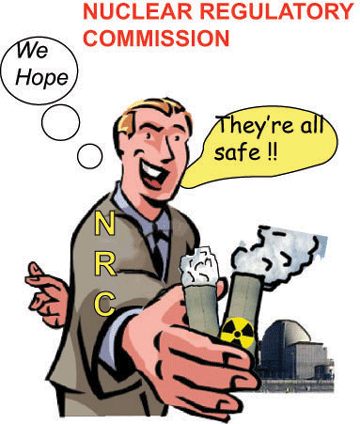
Trump tightens control of independent agency overseeing nuclear safety
Geoff Brumfiel, NPR. May 9, 2025
The Trump administration has tightened its control over the independent agency responsible for overseeing America’s nuclear reactors, and it is considering an executive order that could further erode its autonomy, two U.S. officials who declined to speak publicly because they feared retribution told NPR.
Going forward, the Nuclear Regulatory Commission (NRC) must send new rules regarding reactor safety to the White House, where they will be reviewed and possibly edited. That is a radical departure for the watchdog agency, which historically has been among the most independent in the government. The new procedures for White House review have been in the works for months, but they were just recently finalized and are now in full effect.
NPR has also seen a draft of an executive order “ordering the reform of the Nuclear Regulatory Commission.” The draft calls for reducing the size of the NRC’s staff, conducting a “wholesale revision” of its regulations in coordination with the White House and Elon Musk’s Department of Government Efficiency team, shortening the time to review reactor designs and possibly loosening the current, strict standards for radiation exposure.
“It’s the end of the independence of the agency,” says Allison Macfarlane, director of the School of Public Policy and Global Affairs at the University of British Columbia in Canada who was nominated by President Obama to serve as Chair of the NRC from 2012 to 2014. Macfarlane believes the changes will make Americans less safe.
“If you aren’t independent of political and industry influence, then you are at risk of an accident, frankly,” Macfarlane says.
The draft executive order was marked pre-decisional and deliberative. It was one of several draft orders seen by NPR that appeared to be aimed at promoting the nuclear industry. Other draft orders called for the construction of small modular nuclear reactors at military bases, and for the development of advanced nuclear fuels. Axios first reported on the existence of the executive orders.
It remains unclear which, if any, will be signed by President Trump.
In a statement, the NRC said it was working with the White House “as part of our commitment to make NRC regulatory processes more efficient. We have no additional details at this time.”
“The President of the United States is the head of the executive branch,” a spokesperson for the White House’s Office of Management and Budget wrote to NPR in an email. “The President issued an independent agencies executive order which aligns with the president’s power given to him by the constitution. This idea has been talked about for nearly 40 years and should not be a surprise.”………………………………………………………………………………………………………………………
Going nuclear
The NRC has been working to respond to the new law, but it has historically operated largely outside the purview of the White House. That began to change with an executive order signed by the president in February that called for independent agencies to begin reporting directly to the White House Office of Management and Budget………………………………………………………..
Only after the rule is finalized will the commissioners’ votes be made public. It was not immediately clear how the public would know whether the White House had changed a safety rule for a nuclear reactor.
Some questioned what the White House could gain from reviewing abstruse rules for nuclear safety.
“Who has the technical knowledge to actually do a substantive review?” asks Edwin Lyman, a nuclear physicist at the Union of Concerned Scientists, a nonprofit that has been critical of the nuclear industry. “To have political appointees meddling in these technical decisions is just a recipe for confusion and chaos.” https://www.npr.org/2025/05/09/nx-s1-5392382/trump-nuclear-regulatory-commission-watchdog-safety-radiation
Trump administration considers orders expediting nuclear plant construction, NYT reports.

By Reuters, May 10, 2025,
https://www.reuters.com/business/energy/trump-administration-considers-orders-expediting-nuclear-plant-construction-nyt-2025-05-09/
U.S. President Donald Trump’s administration is considering several executive orders to expedite the construction of nuclear power plants, the New York Times reported on Friday, citing drafts it has reviewed.
Ontario’s Darlington SMR project to cost nearly $21-billion, significantly higher than expected.

Matthew McClearn, May 8, 2025
The Ontario government approved Ontario Power Generation’s plan to spend $7.7-billion to construct the first small modular reactor in a G7 country – a price far greater than independent observers deem necessary to spark widespread adoption.
On Thursday, the government announced its wholly-owned utility can spend $6.1-billion to build the first BWRX-300 reactor adjacent to OPG’s existing Darlington Nuclear Generating Station. In addition, it can spend another $1.6-billion on common infrastructure such as administrative buildings and cooling water tunnels the new reactor will share with three additional BWRX-300s to be built later.
Those remaining units are expected to cost substantially less: all told, the 1,200-megawatt plant‘s estimated cost is $20.9-billion, expressed in 2024 dollars and including interest charges and contingencies.
Those costs are far higher than what independent observers argue are necessary for widespread adoption of SMRs. For comparison, a recently-completed 377-megawatt natural gas-fired power station in Saskatchewan cost $825-million.
High costs, overruns and delays contributed to the decline of nuclear power in advanced economies such as the U.S., France and Canada, all former leaders in reactor construction. The global reactor fleet‘s collective generating capacity has been largely flat since the 1990s, around the same time Canada’s newest reactor (Darlington Unit 4) was built. Most reactors under construction today are of Chinese and Russian design. Only one reactor is currently under construction in the Western hemisphere, and two in Western Europe, according to Mycle Schneider Consulting.
OPG’s project, known as the Darlington New Nuclear Project, is being watched closely by utilities around the world. The BWRX-300 is a candidate for proposed projects in the U.S., U.K., Poland, Estonia and elsewhere.
Thursday’s announcement marks a significant milestone for major capital projects. Proposals and memorandums of understanding for nuclear power plants abound, but very few advance to this stage.
Construction was scheduled to wrap up in 2028, but OPG has pushed that back by one year. It attributed the delay to a construction licence the Canadian Nuclear Safety Commission granted in April, later than expected; the scheduled months between breaking ground and completion remain unchanged.
OPG’s costs are several times greater than Wilmington, N.C.-based GE Hitachi Nuclear Energy originally promised. Early in the BWRX-300’s development, GE Hitachi emphasized it was designing to achieve a specific cost: US$700-million per reactor, or US$2.25-million per megawatt, low enough to compete with natural gas.
OPG said the government is not funding the project: the utility will pay for it using its own funds, including cash on hand, cash flow from generating stations and debt.
Ontarians will pay OPG back over time through their electricity bills.
Officials estimated the average cost of power from the four reactors at 14.9 cents per kilowatt hour, contingent on the federal government providing investment tax credits.
The IESO said an alternative would be to build between 5,600 and 8,900 megawatts of wind and solar generators supported by batteries. Their capacity would need to be far greater, it reasoned, to account for the intermittent nature of wind and sunlight, and they would also require far more new transmission infrastructure. The IESO estimated the costs for all that at between 13.5 and 18.4 cents per kilowatt hour. Building the BWRX-300, the IESO concluded, is the lower-risk option.
Clean Prosperity, a Canadian climate policy think tank, said in a report last year that the final construction cost of the first BWRX-300 will be influential in determining how many other utilities will be interested in building their own. A cost of $3-billion, or $10.16-million per megawatt, would encourage rapid adoption of SMRs – a level some countries have achieved.
“Russia, India, South Korea and Japan have had average construction costs of $3.4-million to $4.6-million per megawatt since 2000,” the report said.
“In contrast, France and the U.S. built reactors for $12.5-million and $17.5-million per megawatt, respectively, over the same time frame.”
In a January report, the International Energy Agency said costs must come down; SMRs need to reach US$4.5-million per megawatt by 2040 to enjoy rapid uptake, far less than OPG’s estimated costs.
OPG said it‘s confident it will stick to its schedule and budget. The utility pointed to its ongoing $12.8-billion refurbishment of Darlington’s existing four reactors, a complex project it said remains on schedule and on-budget and is scheduled to wrap up next year. But if overruns do occur on the Darlington SMR, OPG and its partners (which include GE Hitachi, architect/engineer AtkinsRéalis and constructor Aecon) will share those costs.
The utility added that 80 per cent of its spending on the project will go to Ontario companies; just 5 per cent goes to U.S. companies, primarily GE Hitachi for its design and development work.
Last fall, the Ford government passed legislation dubbed the Affordable Energy Act, which committed to prioritizing nuclear power to meet future increases in electricity demand. The province plans up to 4,800 megawatts of new nuclear capacity at the Bruce Nuclear Generating Station, and as much as 10,000 megawatts at Wesleyville, a proposed new OPG station in Port Hope.
Why Is US Congress Silent on the Manmade Nightmare It Is Enabling in Gaza? -Bernie Sanders

With Israel having cut off all aid, what we are seeing now is a slow, brutal process of mass starvation and death by the denial of basic necessities. This is methodical, it is intentional, it is the stated policy of the Netanyahu government.
Bernie Sanders, May 08, 2025 , https://www.commondreams.org/opinion/congress-silent-gaza
I want to say a few words about an issue that people all over the world are thinking about—are appalled by—but for some strange reason gets very little discussion here in the nation’s capital or in the halls of Congress. And that is the horrific humanitarian disaster that is unfolding in Gaza.
Thursday marks 68 days and counting since ANY humanitarian aid was allowed into Gaza. For more than nine weeks, Israel has blocked all supplies: no food, no water, no medicine, and no fuel.
Hundreds of truckloads of lifesaving supplies are waiting to enter Gaza, sitting just across the border, but are denied entry by Israeli authorities.
There is no ambiguity here: Israeli Prime Minister Benjamin Netanyahu’s extremist government talks openly about using humanitarian aid as a weapon. Defense Minister Israel Katz said, “Israel’s policy is clear: No humanitarian aid will enter Gaza, and blocking this aid is one of the main pressure levers.”
Starving children to death as a weapon of war is a clear violation of the Geneva Convention, the Foreign Assistance Act, and basic human decency. Civilized people do not starve children to death.
What is going on in Gaza is a war crime, committed openly and in broad daylight, and continuing every single day.
There are 2.2 million people who live in Gaza. Today, these people are trapped. The borders are sealed. And Israel has pushed the population into an ever-smaller area.
With Israel having cut off all aid, what we are seeing now is a slow, brutal process of mass starvation and death by the denial of basic necessities. This is methodical, it is intentional, it is the stated policy of the Netanyahu government.
Without fuel, there is no ability to pump fresh water, leaving people increasingly desperate, unable to find clean water to drink, wash with, or cook properly. Disease is once again spreading in Gaza.
Most of the bakeries in Gaza have now shut down, having run out of fuel and flour. The few remaining community kitchens are also shutting down. Most people are now surviving on scarce canned goods, often a single can of beans or some lentils, shared between a family once a day.
The United Nations reports that more than 2 million people out of a population of 2.2 million face severe food shortages.
The starvation hits children hardest. At least 65,000 children now show symptoms of malnutrition, and dozens have already starved to death.
Malnutrition rates increased 80% in March, the last month for which data is available, after Netanyahu began the siege, but the situation has severely deteriorated since then.
UNICEF reported Wednesday that “the situation is getting worse every day,” and that they are treating about 10,000 children for severe malnutrition.
Without adequate nutrition or access to clean water, many children will die of easily preventable diseases, killed by something as simple as diarrhea.
For the tens of thousands of injured people in Gaza, particularly the countless burn victims from Israeli bombing, their wounds cannot heal without adequate food and clean water. Left to fester, infections will kill many who should have survived.
With no infant formula, and with malnourished mothers unable to breastfeed, many infants are also at severe risk of death. Those that survive will bear the scars of their suffering for the rest of their lives.
And with little medicine available, easily treatable illnesses and chronic diseases like diabetes or heart disease can be a death sentence in Gaza.
What is going on there is not some terrible earthquake, it is not a hurricane, it is not a storm. What is going on in Gaza today is a manmade nightmare. And nothing can justify this.
What is happening in Gaza will be a permanent stain on the world’s collective conscience. History will never forget that we allowed this to happen and, for us here in the United States, that we, in fact, enabled this atrocity.
There is no doubt that Hamas, a terrorist organization, began this terrible war with its barbaric October 7, 2023 attack on Israel, which killed 1,200 innocent people and took 250 hostages.
The International Criminal Court was right to indict Yahya Sinwar and other leaders of Hamas as war criminals for those atrocities.
Clearly, Israel had the right to defend itself against Hamas.
But Netanyahu’s extremist government has not just waged war against Hamas. Instead, they have waged an all-out barbaric war of annihilation against the Palestinian people.
They have intentionally made life unlivable in Gaza.
Israel, up to now, has killed more than 52,000 people and injured more than 118,000—60% of whom are women, children, and the elderly. More than 15,000 children have been killed.
Israel’s indiscriminate bombardment has damaged or destroyed two-thirds of all structures in Gaza, including 92% of the housing units. Most of the population now is living in tents or other makeshift structures.
The healthcare system in Gaza has been essentially destroyed. Most of the territory’s hospitals and primary healthcare facilities have been bombed.
Gaza’s civilian infrastructure has been totally devastated, including almost 90% of water and sanitation facilities. Most of the roads have been destroyed.
Gaza’s education system has been obliterated. Hundreds of schools have been bombed, as has every single one of Gaza’s 12 universities.
And there has been no electricity in Gaza for 18 months.
Given this reality, nobody should have any doubts that Netanyahu is a war criminal. Just like his counterparts in Hamas, he has a massive amount of innocent blood on his hands.
And now Netanyahu and his extremist ministers have a new plan: to indefinitely reoccupy all of Gaza, flatten the few buildings that are still standing, and force the entire population of 2.2 million people into a single tiny area, where hired U.S. security contractors will distribute rations to the survivors.
Israeli officials are quite open about the goal here: to force Palestinians to leave for other countries “in line with President [Donald] Trump’s vision for Gaza,” as one Israeli official said this week.
Israeli Finance Minister Bezalel Smotrich said this week that “Gaza will be entirely destroyed,” and that its population will “leave in great numbers.”
For many in Netanyahu’s extremist government, this has been the plan all along: It’s called ethnic cleansing.
This would be a terrible tragedy, no matter where or why it was happening. But what makes this tragedy so much worse for us in America is that it is our government, the United States government, that is absolutely complicit in creating and sustaining this humanitarian disaster.
Last year alone, the United States provided $18 billion in military aid to Israel. This year, the Trump administration has approved $12 billion more in bombs and weapons.
And for months, Trump has offered blanket support for Netanyahu. More than that, he has repeatedly said that the United States will actually take over Gaza after the war, that the Palestinians will be pushed out, and that the U.S. will redevelop it into what Trump calls “the Riviera of the Middle East,” a playground for billionaires.
This war has killed or injured more than 170,000 people in Gaza. It has cost American taxpayers well over $20 billion in the last year. And right now, as we speak, thousands of children are starving to death. And the U.S. president is actively encouraging the ethnic cleansing of over 2 million people.
Given that reality, one might think that there would be a vigorous discussion right here in the Senate: Do we really want to spend billions of taxpayer dollars starving children in Gaza? You tell me why spending billions of dollars to support Netanyahu’s war and starving children in Gaza is a good idea. I’d love to hear it.
But we are not having that debate. And let me suggest to you why I think we are not having that debate.
That is because we have a corrupt campaign finance system that allows the American Israel Public Affairs Committee (AIPAC) to set the agenda here in Washington.
In the last election cycle, AIPAC’s PAC and Super PAC spent nearly $127 million combined.
And the fact is that, if you are a member of Congress and you vote against Netanyahu’s war in Gaza, AIPAC is there to punish you with millions of dollars in advertisements to see that you’re defeated.
One might think that in a democracy there would be a vigorous debate on an issue of such consequence. But because of our corrupt campaign finance system, people are literally afraid to stand up. If they do, suddenly you will have all kinds of ads coming in to your district to defeat you.
Sadly, I must confess, that this political corruption works. Many of my colleagues will privately express their horror at Netanyahu’s war crimes, but will do or say very little publicly about it.
History will not forgive our complicity in this nightmare. The time is long overdue for us to end our support for Netanyahu’s destruction of the Palestinian people. We must not put another nickel into Netanyahu’s war machine. We must demand an immediate cease-fire, a surge in humanitarian aid, the release of the hostages, and the rebuilding of Gaza—not for billionaires to enjoy their Riviera there—but rebuilding Gaza for the Palestinian people.
‘It’s deceitful’: Critics slam owners of TMI Unit 2 for not reporting fire at plant
Penn Live, By Charles Thompson | cthompson@pennlive.com, May. 08, 2025
Accidents can happen.
But when they happen at a nuclear power plant, who gets told, and when?
That’s a question that some neighbors of the still-shuttered Three Mile Island nuclear power stations are asking after recent disclosures about a small fire at the Three Mile Island Unit 2 reactor building this winter.
The owners of Unit 2 – the scene of the notorious March 1979 partial meltdown – have received a “non-cited violation” from federal regulators for the fire that broke out at its reactor building on Feb. 11.
The fire got its first public disclosure through a May 2 posting on the Nuclear Regulatory Commission’s public library.
No one was hurt in the incident, in which a partition surrounding a worksite at the crippled plant’s ongoing deconstruction ignited.
And according to the NRC’s inspection report, there were no releases of radiation associated with it.
Overall, and importantly, the inspection report concludes, the incident itself was one of “very low safety significance.”
But the fact the fire was not publicly reported in real time is raising some alarm bells with some of the plant’s critics.
Neither plant owners TMI-2 Solutions nor federal or state regulators put out a real-time public notice about the incident.
It also wasn’t briefed at a March meeting of a community advisory panel established specifically “to enhance open communication, public involvement and education about the… decommissioning project,” according to two people who attended that session.
“It’s not only tone-deaf. It’s deceitful, because they know how the public feels about it,” said Joyce Corradi, a Lower Swatara Township resident who 45 years ago was a founding member of Concerned Mothers’ and Women, a grassroots group concerned about the accident.
To be clear, TMI-2 Solutions wasn’t exactly hiding the situation.
The company did make same-day courtesy calls to “appropriate stakeholders” including the NRC, the state Department of Environmental Protection …………………………………………………………………………………………………………………..
“Constellation Energy does not own Three Mile Island Unit 2, but anything that happens at Unit 1 can be influenced by accidents at Unit 2,” Stilp said.
“The best solution is not to restart Unit 1, so that there will never be a chance that a nuclear incident will occur there.”
And the lack of full public disclosure infuriated others.
“It undermines confidence in their ability to communicate during a (bigger) incident or accident,” said Eric Epstein, longtime leader of Three Mile Island Alert.
“This is how we had the (1979) accident in the first place,” said Corradi, who co-founded the women’s group after the partial meltdown. “A lack of checking out the details and doing things safely.”…………………………………………………………………………………………………………………..
The Stakes of Donald Trump’s Negotiations with the Islamic Republic of Iran.
First, the United States, faithful to Trump’s Art of the Deal technique, threatened Iran while trying to placate it. International relations are not governed by the same rules as business. Giving in to threats is a sign of weakness that the Iranians could not accept in these negotiations.
by Thierry Meyssan, Voltaire Network | Paris (France) | 29 April 2025
The general public is completely unaware of the real stakes in the negotiations between Washington and Tehran. This article presents a situation in which lies have been piling up over three decades, making any progress particularly difficult. Contrary to popular belief, the nuclear issue in Iran is not whether Tehran will acquire an atomic bomb, but whether it will be able to help Palestine without resorting to weapons.
month and a half ago, I announced that even before concluding peace in Ukraine, President Donald Trump would open negotiations with Iran [1]. As usual, commentators steeped in Joe Biden’s ideology showered me with sarcasm, while my colleagues, specialists in international affairs, noted my observations [2].
The difference between the two lay in their understanding of the negotiations in Ukraine. For the former, it was Donald Trump’s revenge against Volodymyr Zelensky, or a genuflection before Vladimir Putin. For the latter, it was, on the contrary, a desire for peace with Russia in order to devote US resources to its economic recovery.
It follows that the two sides approach the Iranian issue differently. For the former, it is a matter of continuing the chaos that began during the first term with the withdrawal from the nuclear agreement (JCPOA). Conversely, for the latter, it is a desire for peace with Iran, given that it is the only regional power that supports the resistance to Israel.
In early March 2024, President Donald Trump sent a letter to the leader of the Revolution, Ayatollah Ali Khamenei. The existence of this document was mentioned by the author himself during his speech to Congress on March 4, and then debated in the press. According to Sky News Arabia, which read this document, Donald Trump called for negotiations, while specifying: “If you reject the outstretched hand and choose the path of escalation and support for terrorist organizations, I warn you of a swift and determined response […] I am writing this letter with the aim of opening new horizons for our relations, away from the years of conflict, misunderstandings and unnecessary confrontations that we have witnessed in recent decades […] The time has come to leave hostility behind and open a new page of cooperation and mutual respect.” A historic opportunity presents itself to us today […] We will not stand idly by in the face of your regime’s threats against our people or our allies […] If you are willing to negotiate, so are we. But if you continue to ignore the world’s demands, history will testify that you missed a great opportunity.”
Simultaneously, the United States and the United Kingdom launched several attacks against Ansar Allah in Yemen. Unlike previous attacks, these did not target hidden military targets, but rather political targets scattered among the civilian population. They therefore killed leaders of the movement and many other collateral victims, which constitutes war crimes.
It should be recalled that Ansar Allah, pejoratively referred to by Westerners as the “Houthi family gang” or “the Houthis,” attacks Israeli ships in the Red Sea in order to force Tel Aviv to agree to allow humanitarian aid to pass through to Gaza.
Washington and London, believing that this was hampering international trade, and having failed to obtain approval from the Security Council, resumed the war. They initially targeted military objectives and quickly realized that these, buried deep within the country, could not be significantly affected.
Donald Trump’s letter only arrived in Tehran on March 12, and the Iranian response was slow in coming. It is important to understand that while Tehran was flattered by Washington’s secret handwritten approach, it could not accept several aspects of its behavior.
• First, the United States, faithful to Trump’s Art of the Deal technique, threatened Iran while trying to placate it. International relations are not governed by the same rules as business. Giving in to threats is a sign of weakness that the Iranians could not accept in these negotiations. Ayatollah Ali Khamenei commented on March 28: “The enmity of the United States and Israel has always existed. They threaten to attack us, which we believe is not very likely, but if they commit a misdeed, they will certainly receive a strong blow in return.” If the enemies think they can instigate sedition in the country, the Iranian nation itself will respond to them.” President Donald Trump further emphasized this on March 30, telling NBC News: “If they don’t reach an agreement, there will be bombing. It will be bombing like they’ve never seen before.”
According to the United Nations Charter (Article 2, paragraph 4), “members of the Organization shall refrain in their international relations from the threat or use of force against the territorial integrity or political independence of any state.”
The negotiations were therefore compromised before they even began.
• Moreover, massacring the leaders of Ansar Allah was a gratuitous war crime: General Qassem Soleimani, by reorganizing the “Axis of Resistance,” had given Iran’s former proxies their complete freedom. Tehran currently has no influence, other than ideological, over Ansar Allah. Ambassador Amir Saeid Iravani therefore raised these points at the United Nations [3].
• Finally, and most importantly, Donald Trump, by accumulating contradictory signals, did not allow the Iranians to assess his relations with Israel. Does he support the project of a binational state in Palestine (the one promoted by the United Nations)? Or of a Jewish state in Palestine (“Zionism”)? Or that of a “Greater Israel” (“Revisionist Zionism”)? No one knows for sure.
Ultimately, Iran sent a secret response to the secret letter from the United States, and negotiations were able to begin, but only indirectly. That is, the two delegations did not speak directly to each other, but only through a mediator. In this way, Tehran responded to the invitation, but expressed its disapproval of the manner in which it was convened.
ntervening directly, France and the United Kingdom convened a closed-door meeting of the Security Council. Paris and London wished to address several outstanding issues. As nothing has been leaked, it is unclear whether President Emmanuel Macron and Prime Minister Keir Starmer wanted to clarify what had caused all other attempts at negotiations to fail or, on the contrary, to obscure what could have been further obscured…………………………………………………………………………………………………………………………………….. https://www.voltairenet.org/article222165.html
80 years on, US still embattled in senseless Cold War with Russia

Walt Zlotow, West Suburban Peace Coalition, Glen Ellyn IL , 7 May 25, https://theaimn.net/80-years-on-us-still-embattled-in-a-cold-war-with-russia/#google_vignette
May 8 marks 80 years since Victory in Europe Day. That victory kicked off the 46 year long Cold War against our great WWII ally Soviet Union (now Russia).
Sadly, the 1991 end of the Soviet Union simply transferred the Cold War into a cool war against Russia which has since gone cold again.
We’ve spent the last 34 years ever expanding the Cold War NATO alliance to Russia’s borders to keep them out of the European political economy and guarantee a yearly trillion dollar defense budget to prop up American capitalism. What good is the world’s largest military if you do not have a monstrous enemy to justify it?
That could have been avoided except for arguably the worst vice presidential pick in American history.
Every American today knows who Harry Truman was but few have a clue about his predecessor. Henry Wallace was a 20th century American visionary shoved out of the vice presidency in 1944, denying him the presidency upon the death of FDR, and changing America and the world for the worse.
Henry Wallace has been largely written out of the American Story told to succeeding generations of Americans by the protectors of the American Super Power Myth.
Born in 1888 to an affluent Iowa Republican farm family, Wallace increased family wealth with his Hi-Bred Corn Company. But the Depression turned Wallace into a zealous champion of the common man, landing him the Secretary of Agriculture post in FDR’s first term. Possibly the most effective New Dealer, Wallace championed the broken American farmer using curtailed production and price supports to ameliorate rampant rural poverty. His unbridled Bernie Sanders like democratic socialism of the 30’s garnered him FDR’s reverence and the 1940 third term vice presidency.
Wallace transformed the vice presidency for the good, long before Dick Cheney transformed it for evil. FDR made him what journalists tabbed the ‘Assistant President’ in his role mobilizing war production during WWII and championing FDR’s vision for a truly peaceful post WWII world working in partnership with critical war ally Russia for a peaceful Europe and ending European colonialism in Asia and Africa.
In 1942 he gave his famous “Common Man” speech, declaring the 20th century must celebrate the common man, not just, as Time publisher Henry Luce postured, the American Century. In 1943, he joined with the black community following the Detroit race riot, arguing “We cannot crush Nazi brutality abroad and condone race riots at home.”
His near FDR like popularity made him a lock for VP again on the ’44 Democratic ticket. But with FDR fading mentally and physically, party leaders saw opportunity to dump him. His peace proclivities threatened their continuation of a war economy to combat their imaginary new Hitler in the form of Joseph Stalin.
They closed the late night convention session on the brink of re nominating Wallace for a second term. That garnered time to make deals with the other candidates to move the pliant Harry Truman from last to first in the final VP tally.
Three months into term four FDR died thrusting Truman into the White House. This set the stage for the Cold War due to Truman’s capitulation to the neo-conservatives of his day such as Jimmy Byrnes and Jimmy Forestall who demanded a fresh enemy to keep the emerging Military-Industrial Complex in business. A Wallace presidency would have sidelined these anti Russian hardliners. The chance for a truly peaceful post WWII world was irrevocably lost.
The post WWII neocons won out over Wallace, but undaunted he launched a 3rd party progressive campaign in 1948 to unseat Truman. McCarthyite red smears and personal attacks on his progressive philosophy doomed him to just 3% of the ’48 vote, ending his career. Also ended was any opportunity for America to retreat from senseless Cold War.
That leaves us to ponder if today’s new Cold War will rage on for another 80 years.
Ohio EPA launches limited Luckey water testing after independent report shows high radiation in wells.

The Ohio Environmental Protection Agency, now under sharp scrutiny, will begin targeted water sampling in the village of Luckey on Wednesday, May 7. The move comes in response to independent testing conducted by The Toledo Blade, which uncovered elevated levels of radioactive contaminants in residential wells surrounding a former Cold War-era nuclear materials site.
The Ohio EPA said it will collect samples from Eastwood Local School buildings, Pemberville Public Library branches, and the Pemberville water treatment plants. The agency stated that certified laboratories will perform radiological analyses using “standard protocols,” though it has not clarified whether that includes specific isotope detection or testing for beta-emitting radionuclides.
Of the 38 samples tested for gamma radiation, 19 revealed bismuth-214 levels at least 10 times higher than the background thresholds established by the U.S. Army Corps of Engineers. The presence of bismuth-214 strongly indicates the presence of radon-222, a radioactive gas known to increase cancer risk. Some wells also tested positive for radium-226, radon-222, alpha and beta radiation, beryllium, and mercury.
https://googleads.g.doubleclick.net/pagead/ads?gdpr=0&gdpr_consent=tcunavailable&tcfe=3&client=ca-pub-2554767935405984&output=html&h=280&adk=3957413466&adf=830603344&pi=t.aa~a.3453247533~i.6~rp.4&w=634&abgtt=6&fwrn=4&fwrnh=100&lmt=1746683330&num_ads=1&rafmt=1&armr=3&sem=mc&pwprc=3568220565&ad_type=text_image&format=634×280&url=https%3A%2F%2Fappareport.com%2F2025%2F05%2F06%2Fohio-epa-launches-limited-luckey-water-testing-after-independent-report-shows-high-radiation-in-wells%2F%3Futm_source%3Dfacebook%26utm_medium%3Djetpack_social%26fbclid%3DIwY2xjawKH1O9leHRuA2FlbQIxMQBicmlkETFqODFPMTBmQTF5TEZicE1sAR7DD3WHCKFbMcsxONI6PwwU3BG179LZeDq1kHE5syHZgCdNvasXdjpfr-DjYw_aem_DfMkHt4eTpIDIAfrZFlmGQ&host=ca-host-pub-2644536267352236&fwr=0&pra=3&rh=159&rw=633&rpe=1&resp_fmts=3&wgl=1&fa=27&uach=WyJXaW5kb3dzIiwiMTUuMC4wIiwieDg2IiwiIiwiMTM1LjAuNzA0OS4xMTUiLG51bGwsMCxudWxsLCI2NCIsW1siR29vZ2xlIENocm9tZSIsIjEzNS4wLjcwNDkuMTE1Il0sWyJOb3QtQS5CcmFuZCIsIjguMC4wLjAiXSxbIkNocm9taXVtIiwiMTM1LjAuNzA0OS4xMTUiXV0sMF0.&dt=1746683047064&bpp=1&bdt=4365&idt=1&shv=r20250506&mjsv=m202505050101&ptt=9&saldr=aa&abxe=1&cookie=ID%3D64420eca75c0ed2b%3AT%3D1746229513%3ART%3D1746683048%3AS%3DALNI_MadpzcDidvM12j1XEfmCG_w3cmjYA&gpic=UID%3D000010171172a210%3AT%3D1746229513%3ART%3D1746683048%3AS%3DALNI_Ma3MjH8_Lx9G9s2ELouutptKcrFZQ&eo_id_str=ID%3Df70225faa56d1ddf%3AT%3D1746229513%3ART%3D1746683048%3AS%3DAA-AfjY3YWrttstp60Hpetggs1xY&prev_fmts=0x0%2C1265x585&nras=3&correlator=6082623994933&frm=20&pv=1&u_tz=600&u_his=2&u_h=720&u_w=1280&u_ah=672&u_aw=1280&u_cd=24&u_sd=1.5&dmc=8&adx=127&ady=3031&biw=1265&bih=585&scr_x=0&scr_y=699&eid=95358862%2C95358864%2C95354563%2C95359240%2C95359120%2C95359476&oid=2&pvsid=8479030565798310&tmod=1640054256&uas=3&nvt=1&fc=1408&brdim=0%2C0%2C0%2C0%2C1280%2C0%2C1280%2C672%2C1280%2C585&vis=1&rsz=%7C%7Cs%7C&abl=NS&fu=128&bc=31&bz=1&td=1&tdf=2&psd=W251bGwsbnVsbCxudWxsLDNd&nt=1&pgls=CAEQBBoHMS4xNTIuMQ..~CAEQBRoGMy4yOC40&ifi=3&uci=a!3&btvi=1&fsb=1&dtd=M
Beryllium, used at the Luckey site in the 1950s, was a focal point. Of 14 wells tested for it and other metals, multiple locations showed concerning levels. Several samples were also retested to look for specific contamination types.
Katie Boyer, spokesperson for the Ohio EPA, told investigative journalist Jason Salley during an earlier investigation into drinking water concerns in Pike County, that “Ohio public water systems are not required to monitor for gross beta radiation unless they are located near a known contamination source or are at risk of contamination. If initial tests show low or no beta radiation, no further testing is necessary. Gross beta monitoring is very rare in public water systems.”
https://googleads.g.doubleclick.net/pagead/ads?gdpr=0&gdpr_consent=tcunavailable&tcfe=3&client=ca-pub-2554767935405984&output=html&h=280&adk=3957413466&adf=1277231945&pi=t.aa~a.3453247533~i.8~rp.4&w=634&abgtt=6&fwrn=4&fwrnh=100&lmt=1746683332&num_ads=1&rafmt=1&armr=3&sem=mc&pwprc=3568220565&ad_type=text_image&format=634×280&url=https%3A%2F%2Fappareport.com%2F2025%2F05%2F06%2Fohio-epa-launches-limited-luckey-water-testing-after-independent-report-shows-high-radiation-in-wells%2F%3Futm_source%3Dfacebook%26utm_medium%3Djetpack_social%26fbclid%3DIwY2xjawKH1O9leHRuA2FlbQIxMQBicmlkETFqODFPMTBmQTF5TEZicE1sAR7DD3WHCKFbMcsxONI6PwwU3BG179LZeDq1kHE5syHZgCdNvasXdjpfr-DjYw_aem_DfMkHt4eTpIDIAfrZFlmGQ&host=ca-host-pub-2644536267352236&fwr=0&pra=3&rh=159&rw=633&rpe=1&resp_fmts=3&wgl=1&fa=27&uach=WyJXaW5kb3dzIiwiMTUuMC4wIiwieDg2IiwiIiwiMTM1LjAuNzA0OS4xMTUiLG51bGwsMCxudWxsLCI2NCIsW1siR29vZ2xlIENocm9tZSIsIjEzNS4wLjcwNDkuMTE1Il0sWyJOb3QtQS5CcmFuZCIsIjguMC4wLjAiXSxbIkNocm9taXVtIiwiMTM1LjAuNzA0OS4xMTUiXV0sMF0.&dt=1746683047068&bpp=3&bdt=4369&idt=3&shv=r20250506&mjsv=m202505050101&ptt=9&saldr=aa&abxe=1&cookie=ID%3D64420eca75c0ed2b%3AT%3D1746229513%3ART%3D1746683048%3AS%3DALNI_MadpzcDidvM12j1XEfmCG_w3cmjYA&gpic=UID%3D000010171172a210%3AT%3D1746229513%3ART%3D1746683048%3AS%3DALNI_Ma3MjH8_Lx9G9s2ELouutptKcrFZQ&eo_id_str=ID%3Df70225faa56d1ddf%3AT%3D1746229513%3ART%3D1746683048%3AS%3DAA-AfjY3YWrttstp60Hpetggs1xY&prev_fmts=0x0%2C1265x585%2C634x280&nras=4&correlator=6082623994933&frm=20&pv=1&u_tz=600&u_his=2&u_h=720&u_w=1280&u_ah=672&u_aw=1280&u_cd=24&u_sd=1.5&dmc=8&adx=127&ady=3428&biw=1265&bih=585&scr_x=0&scr_y=1123&eid=95358862%2C95358864%2C95354563%2C95359240%2C95359120%2C95359476&oid=2&pvsid=8479030565798310&tmod=1640054256&uas=3&nvt=1&fc=1408&brdim=0%2C0%2C0%2C0%2C1280%2C0%2C1280%2C672%2C1280%2C585&vis=1&rsz=%7C%7Cs%7C&abl=NS&cms=2&fu=128&bc=31&bz=1&td=1&tdf=2&psd=W251bGwsbnVsbCxudWxsLDNd&nt=1&pgls=CAEQBBoHMS4xNTIuMQ..~CAEQBRoGMy4yOC40&ifi=4&uci=a!4&btvi=2&fsb=1&dtd=M
This admission has further fueled public concern, given that Luckey sits adjacent to a federally managed cleanup site under the Formerly Utilized Sites Remedial Action Program (FUSRAP). Critics argue that limited testing of public buildings, rather than the private wells identified in The Blade’s report, leaves gaps in understanding potential exposure risks.
In response to the Ohio EPA’s vague testing plan, the Appalachian Press and Public Affairs Report (APPA Report) submitted a formal request to the agency, pressing for clarity on whether the upcoming analyses will include beta emitters or man-made radionuclides. As of publication, the agency has not responded.
https://googleads.g.doubleclick.net/pagead/ads?gdpr=0&gdpr_consent=tcunavailable&tcfe=3&client=ca-pub-2554767935405984&output=html&h=280&adk=3957413466&adf=3563305841&pi=t.aa~a.3453247533~i.10~rp.4&w=634&abgtt=6&fwrn=4&fwrnh=100&lmt=1746683332&num_ads=1&rafmt=1&armr=3&sem=mc&pwprc=3568220565&ad_type=text_image&format=634×280&url=https%3A%2F%2Fappareport.com%2F2025%2F05%2F06%2Fohio-epa-launches-limited-luckey-water-testing-after-independent-report-shows-high-radiation-in-wells%2F%3Futm_source%3Dfacebook%26utm_medium%3Djetpack_social%26fbclid%3DIwY2xjawKH1O9leHRuA2FlbQIxMQBicmlkETFqODFPMTBmQTF5TEZicE1sAR7DD3WHCKFbMcsxONI6PwwU3BG179LZeDq1kHE5syHZgCdNvasXdjpfr-DjYw_aem_DfMkHt4eTpIDIAfrZFlmGQ&host=ca-host-pub-2644536267352236&fwr=0&pra=3&rh=159&rw=633&rpe=1&resp_fmts=3&wgl=1&fa=27&uach=WyJXaW5kb3dzIiwiMTUuMC4wIiwieDg2IiwiIiwiMTM1LjAuNzA0OS4xMTUiLG51bGwsMCxudWxsLCI2NCIsW1siR29vZ2xlIENocm9tZSIsIjEzNS4wLjcwNDkuMTE1Il0sWyJOb3QtQS5CcmFuZCIsIjguMC4wLjAiXSxbIkNocm9taXVtIiwiMTM1LjAuNzA0OS4xMTUiXV0sMF0.&dt=1746683047074&bpp=1&bdt=4375&idt=1&shv=r20250506&mjsv=m202505050101&ptt=9&saldr=aa&abxe=1&cookie=ID%3D64420eca75c0ed2b%3AT%3D1746229513%3ART%3D1746683048%3AS%3DALNI_MadpzcDidvM12j1XEfmCG_w3cmjYA&gpic=UID%3D000010171172a210%3AT%3D1746229513%3ART%3D1746683048%3AS%3DALNI_Ma3MjH8_Lx9G9s2ELouutptKcrFZQ&eo_id_str=ID%3Df70225faa56d1ddf%3AT%3D1746229513%3ART%3D1746683048%3AS%3DAA-AfjY3YWrttstp60Hpetggs1xY&prev_fmts=0x0%2C1265x585%2C634x280%2C634x280&nras=5&correlator=6082623994933&frm=20&pv=1&u_tz=600&u_his=2&u_h=720&u_w=1280&u_ah=672&u_aw=1280&u_cd=24&u_sd=1.5&dmc=8&adx=127&ady=3794&biw=1265&bih=585&scr_x=0&scr_y=1493&eid=95358862%2C95358864%2C95354563%2C95359240%2C95359120%2C95359476&oid=2&pvsid=8479030565798310&tmod=1640054256&uas=3&nvt=1&fc=1408&brdim=0%2C0%2C0%2C0%2C1280%2C0%2C1280%2C672%2C1280%2C585&vis=1&rsz=%7C%7Cs%7C&abl=NS&fu=128&bc=31&bz=1&td=1&tdf=2&psd=W251bGwsbnVsbCxudWxsLDNd&nt=1&pgls=CAEQBBoHMS4xNTIuMQ..~CAEQBRoGMy4yOC40&ifi=5&uci=a!5&btvi=3&fsb=1&dtd=M
Sampling will begin at 1 p.m. on Wednesday at Basic Park in Luckey. Amy Klei, chief of Ohio EPA’s Division of Drinking and Ground Waters, will be available to address media questions about the scope and intent of the testing.
While state officials move forward with limited action, residents and environmental watchdogs continue to demand transparency and accountability, warning that failure to address the full scope of potential contamination could have long-term public health consequences.
Durbin successor must not be co opted by the Israel Lobby.
Walt Zlotow, West Suburban Peace Coalition, Glen Ellyn IL 5 May 25
My outgoing senator Dick Durbin spent his entire 29 year Senate career beholding to the Israel Lobby. In the past 25 years alone he’s received $1,131,900 in campaign cash to ignore Israel’s ethnic cleansing of Palestinians in Gaza, transformed into genocide after the October 7, 2023 Hamas attack. His support for a 2 state solution (Palestinian statehood) is worthless virtue signaling as he’s done nothing of substance to achieve that goal along with making America the 148th nation out of 193 to recognize Palestinian statehood.
We need to replace Durbin with a principled candidate not ensnared by Israel Lobby money. Alas, the 5 Illinois House members mentioned as possible successors are all in the tank to remain mum on truly promoting Palestinian statehood and seeking end to US enabling Israel’s genocidal ethnic cleansing of 2,300,000 Palestinians in Gaza.
Raja Krishnamoorthi (D-IL 8) $269,530
Nikki Budzinski (D-IL 13) $187660
Darin LaHood (R-IL 16) $112,687
Robin Kelly (D-IL 2) $187,272
Lauren Underwood (D-IL 14) $ 75,593,
Tho not mentioned as a possible candidate, we of peace should encourage Congresswoman Delia Ramirez (D-IL 3) to seek Durbin’s open seat next year.
Her take from the Israel Lobby since her election in November 2022? Zero, nada, zilch.
That allowed Ramirez to push back against US billions funding the Israeli genocide, saying this in March, 2024: “The death toll in Gaza continues to rise. Gazans are starving. Over 1.5 million people have been displaced. Hostilities between the U.S. and Iran are escalating. And just this morning, The New York Times reported that one-fifth of the hostages still in captivity since the start of the conflict have likely died. We must change course. Under no circumstances could I have voted for today’s H.R. 7217 to provide $17.6 billion in unconditioned military funding for Israel. The supplemental funding proposed, which includes no humanitarian aid for Gaza, supports weapons of war and destruction that further jeopardize Israeli hostages and Palestinian civilians. Each U.S.-made or funded bomb dropped in Gaza further jeopardizes the chances of long-lasting peace for Israelis and Palestinians. I’ve said it before, and I’ll say it now: I will only support actions that bring us closer to peace.”
Come on Krishnamoorthi, Budzinski, LaHood, Kelly, Underwood, either drop accepting Israel Lobby money to ignore the genocidal ethnic cleaning of Gaza, or drop any consideration of replacing the Lobby’s million dollar Senator Dick Durbin.
Senator Strangelove
Like the ghost of Armageddon Future, former Senator Jon Kyl keeps reappearing in nuclear debates, writes William Hartung
A primary responsibility of the government is, of course, to keep us safe. Given that obligation, you might think that the Washington establishment would be hard at work trying to prevent the ultimate catastrophe—a nuclear war. But you would be wrong.
A small, hardworking contingent of elected officials is indeed trying to roll back the nuclear arms race and make it harder for such world-ending weaponry ever to be used again, including stalwarts like Sen. Ed Markey (D-Mass.), Rep. John Garamendi (D-Calif.), and other members of the Congressional Nuclear Weapons and Arms Control Working Group. But they face ever stiffer headwinds from a resurgent network of nuclear hawks who want to build more kinds of nuclear weapons and ever more of them. And mind you, that would all be in addition to the Pentagon’s current plans for spending up to $2 trillion over the next three decades to create a whole new generation of nuclear weapons, stoking a dangerous new nuclear arms race.
There are many drivers of this push for a larger, more dangerous arsenal—from the misguided notion that more nuclear weapons will make us safer to an entrenched network of companies, governmental institutions, members of Congress, and policy pundits who will profit (directly or indirectly) from an accelerated nuclear arms race. One indicator of the current state of affairs is the resurgence of former Arizona Sen. Jon Kyl, who spent 18 years in Congress opposing even the most modest efforts to control nuclear weapons before he went on to work as a lobbyist and policy advocate for the nuclear weapons complex.
His continuing prominence in debates over nuclear policy—evidenced most recently by his position as vice chair of a congressionally appointed commission that sought to legitimize an across-the-board nuclear buildup—is a testament to our historical amnesia about the risks posed by nuclear weapons.
Senator Strangelove
Republican Jon Kyl was elected to the Senate from Arizona in 1995 and served in that body until 2013, plus a brief stint in late 2018 to fill out the term of the late Sen. John McCain.
One of Kyl’s signature accomplishments in his early years in office was his role in lobbying fellow Republican senators to vote against ratifying the Comprehensive Test Ban Treaty (CTBT), which went down to a 51 to 48 Senate defeat in October 1999. That treaty banned explosive nuclear testing and included monitoring and verification procedures meant to ensure that its members met their obligations. Had it been widely adopted, it might have slowed the spread of nuclear weapons, now possessed by nine countries, and prevented a return to the days when aboveground testing spread cancer-causing radiation to downwind communities.
The defeat of the CTBT marked the beginning of a decades-long process of dismantling the global nuclear arms control system, launched by the December 2001 withdrawal of President George W. Bush’s administration from the Nixon-era Anti-Ballistic Missile (ABM) treaty. That treaty was designed to prevent a “defense-offense” nuclear arms race in which one side’s pursuit of anti-missile defenses sparks the other side to build more—and ever more capable—nuclear-armed missiles. James Acton of the Carnegie Endowment for International Peace called the withdrawal from the ABM Treaty an “epic mistake” that fueled a new nuclear arms race. Kyl argued otherwise, claiming the withdrawal removed “a straitjacket from our national security.”
The end of the ABM treaty created the worst of both worlds—an incentive for adversaries to build up their nuclear arsenals coupled with an abject failure to develop weaponry that could actually defend the United States in the event of a real-world nuclear attack………………………………………………………………………………………………………………………………………………………………………………………………….
There is another way. Even as Washington, Moscow, and Beijing continue the production of a new generation of nuclear weapons—such weaponry is also possessed by France, India, Israel, North Korea, Pakistan, and the United Kingdom—a growing number of nations have gone on record against any further nuclear arms race and in favor of eliminating such weapons altogether. In fact, the Treaty for the Prohibition of Nuclear Weapons has now been ratified by 73 countries.
As Beatrice Fihn, former director of the Nobel-prize-winning International Campaign to Abolish Nuclear Weapons, or ICAN, pointed out in a recent essay in The New York Times, there are numerous examples of how collective action has transformed “seemingly impossible situations.” She cited the impact of the antinuclear movement of the 1980s in reversing a superpower nuclear arms race and setting the stage for sharp reductions in the numbers of such weapons, as well as a successful international effort to bring the nuclear ban treaty into existence. She noted that a crucial first step in bringing the potentially catastrophic nuclear arms race under control would involve changing the way we talk about such weapons, especially debunking the myth that they are somehow “magical tools” that make us all more secure. She also emphasized the importance of driving home that this planet’s growing nuclear arsenals are evidence that all too many of those in power are acquiescing in a reckless strategy “based on threatening to commit global collective suicide.”
The next few years will be crucial in determining whether ever growing numbers of nuclear weapons remain entrenched in this country’s budgets and its global strategy for decades to come or whether common sense can carry the day and spark the reduction and eventual elimination of such instruments of mass devastation. A vigorous public debate on the risks of an accelerated nuclear arms race would be a necessary first step toward pulling the world back from the brink of Armageddon.
William D. Hartung is a Senior Research Fellow at the Quincy Institute for Responsible Statecraft, and the author most recently of “Pathways to Pentagon Spending Reductions: Removing the Obstacles.” This article first appeared on Tom Dispatch and on Common Dreams, whose content is available through a Creative Commons license. https://beyondnuclearinternational.org/2025/05/04/senator-strangelove/
1 This Month
Chernobyl: The Lost Tapes – A good documentary on Chernobyl on SBS available On Demand for the next 3 weeks– https://www.sbs.com.au/ondemand/tv-program/chernobyl-the-lost-tapes/2352741955560

of the week–London Campaign for Nuclear Disarmament

Tell the Ukrainian Government to Drop Prosecution of Peace Activist Yurii Sheliazhenko
To see nuclear-related stories in greater depth and intensity – go to https://nuclearinformation.wordpress.com
-
Archives
- April 2026 (127)
- March 2026 (251)
- February 2026 (268)
- January 2026 (308)
- December 2025 (358)
- November 2025 (359)
- October 2025 (376)
- September 2025 (257)
- August 2025 (319)
- July 2025 (230)
- June 2025 (348)
- May 2025 (261)
-
Categories
- 1
- 1 NUCLEAR ISSUES
- business and costs
- climate change
- culture and arts
- ENERGY
- environment
- health
- history
- indigenous issues
- Legal
- marketing of nuclear
- media
- opposition to nuclear
- PERSONAL STORIES
- politics
- politics international
- Religion and ethics
- safety
- secrets,lies and civil liberties
- spinbuster
- technology
- Uranium
- wastes
- weapons and war
- Women
- 2 WORLD
- ACTION
- AFRICA
- Atrocities
- AUSTRALIA
- Christina's notes
- Christina's themes
- culture and arts
- Events
- Fuk 2022
- Fuk 2023
- Fukushima 2017
- Fukushima 2018
- fukushima 2019
- Fukushima 2020
- Fukushima 2021
- general
- global warming
- Humour (God we need it)
- Nuclear
- RARE EARTHS
- Reference
- resources – print
- Resources -audiovicual
- Weekly Newsletter
- World
- World Nuclear
- YouTube
-
RSS
Entries RSS
Comments RSS
 nuclear-news