Trump claims ceasefire reached between Israel and Iran.

US president congratulates Iran and Israel on truce deal, but neither country has confirmed agreement to end war.
23 Jun 2025, https://www.aljazeera.com/news/2025/6/23/trump-claims-ceasefire-reached-between-israel-and-iran
United States President Donald Trump says that Iran and Israel have agreed to a “complete and total” ceasefire, which will come into effect in the coming hours.
Trump’s announcement on Monday came shortly after an Iranian missile attack on Al Udeid Air Base in Qatar, which houses US troops.
“On the assumption that everything works as it should, which it will, I would like to congratulate both Countries, Israel and Iran, on having the Stamina, Courage, and Intelligence to end, what should be called, ‘THE 12 DAY WAR,’” Trump said in a social media post.
“This is a War that could have gone on for years, and destroyed the entire Middle East, but it didn’t, and never will! God bless Israel, God bless Iran, God bless the Middle East, God bless the United States of America, and GOD BLESS THE WORLD!”
Neither Israel nor Iran has confirmed the agreement.
Trump’s statement suggested that Iran would stop firing at Israel hours before the Israeli military ends its operations.
Reporting from Tehran, Al Jazeera’s Tohid Asadi noted that there has not been an official confirmation of the deal more than an hour after Trump’s announcement.
“Just a few minutes ago, we heard the sounds of explosions related to an interception and the activation of the air defence system here across the capital,” Asadi said.
“So the reality on the ground is that we are witnessing the continuation of the Israeli strikes, and that’s paving the way for further retaliatory reactions by the Iranian side.”
Middle East analyst Omar Rahman told Al Jazeera that many details are missing from Trump’s announcement, including whether negotiations would follow the purported ceasefire.
Rahman accused Trump of previous “deception” on behalf of Israel. The US president had re-asserted the US commitment to diplomacy hours before Israel launched its initial attack on Iran.
Last week, Trump said he would decide within two weeks whether to join Israel in the war, only to strike Iran two days later.
Rahman said a major Israeli attack in the final hours, including the possible assassination of Iranian Supreme Leader Ayatollah Ali Khamenei could blow up the deal.
“If that’s the last operation, would that suddenly end the war? No, of course, not. So, I don’t know what’s in the cards,” he said.
Israel launched a massive attack against Iran in the early hours of June 13, without direct provocation. Israeli officials claimed that the strikes, which killed hundreds of people, were “preemptive” and aimed at the country’s nuclear and missile programmes.
In the first wave of the attacks, Israel killed several Iranian generals.
Iran said the attacks were unprovoked aggression in violation of the United Nations Charter, and responded with hundreds of missiles that left widespread destruction inside Israel.
On Saturday, Trump authorised US strikes on three Iranian nuclear facilities.
Earlier on Monday, Iran launched an unprecedented missile attack at Al Udeid Air Base in Qatar in response to the US strikes. Trump dismissed the retaliation as “weak”, suggesting that the US would not respond.
Liqaa Maki, a scholar at Al Jazeera Media Institute, said the US may be able to withstand Iranian attacks on its bases without responding if they do not cause casualties.
“The US, after the important strike on Iran’s nuclear facilities, needs to transform the military achievement into a political one enshrined by an agreement,” Maki told Al Jazeera Arabic after the Iranian attack.
He noted that Iran still has large quantities of highly enriched uranium as well as nuclear know-how.
“So in two to three years, Iran could resume its nuclear activity but without inspections. It could produce a bomb without the world noticing,” Maki said.
The damage that the Iranian nuclear programme has sustained remains unclear. Iran insists that it is not pursuing a nuclear weapon, while Israel is widely believed to have an undeclared nuclear arsenal.
Trump Suggests He Wants Regime Change in Iran
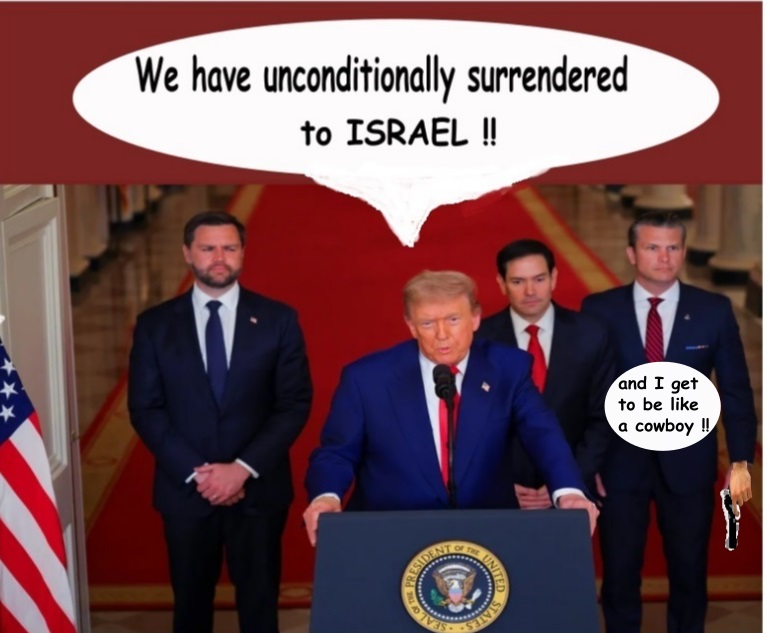
The president previously threatened Iran’s leader, claiming the US knew his location
by Dave DeCamp | Jun 22, 2025, https://news.antiwar.com/2025/06/22/trump-suggests-he-wants-regime-change-in-iran/
President Trump suggested in a Truth Social post on Sunday that he seeks regime change in Iran, contradicting earlier statements from top US officials who denied that was the goal of the US military campaign against the country.
“It’s not politically correct to use the term, ‘Regime Change,’ but if the current Iranian Regime is unable to MAKE IRAN GREAT AGAIN, why wouldn’t there be a Regime change??? MIGA!!!” the president wrote.
In the morning, Secretary of Defense Pete Hegseth insisted the US bombing of Iran’s nuclear facilities and support for Israel’s attacks on the country have “not been about regime change.” But Trump’s post suggests that regime change is the goal and that the administration’s calls for diplomacy with Iran continue to be a smokescreen.
Last week, President Trump threatened Iranian Supreme Leader Ayatollah Ali Khamenei, suggesting the US was aware of his location. “We know exactly where the so-called ‘Supreme Leader’ is hiding. He is an easy target, but is safe there – We are not going to take him out (kill!), at least not for now,” he said.
Israeli Prime Minister Benjamin Netanyahu has made it increasingly clear that his goal is regime change. He insisted last week that killing Khamenei would “end the conflict” with Iran.
Many observers have pointed to the fact that Netanyahu was a major proponent of the US invasion of Iraq and promised that taking out Saddam Hussein would have a positive impact on the region. “If you take out Saddam, Saddam’s regime, I guarantee you that it will have enormous positive reverberations on the region,” he told Congress in 2002.
Israeli Defense Minister Israel Katz has also threatened Khamenei, saying the Iranian leader “cannot continue to exist.”
Trump’s “Unleashing Atomic Power” is Unhinged

June 19, 2025, https://beyondnuclear.org/trumps-unleashing-atomic-power-unhinged/
Without explanation, on June 16, 2025, President Trump unceremoniously fired Democrat Commissioner Christopher Hanson from the US Nuclear Regulatory Commission (NRC) as the first senior manager causality initiating a slash and burn attack on commercial nuclear power regulatory oversight. Hanson’s second term of office was to have expired in 2029. Hanson’s abrupt removal follows a barrage of White House Executive Orders by decree of the Trump Administration “to unleash nuclear power” from a federal regulator pilloried by industry and its bipartisan political allies as “risk-averse” and “safety zealots” preventing the rapid expansion of new reactor licensing and extending operating license renewals of deteriorating reactors to an extreme 80 years.
None of these industry lobbied accusations are true. For years, the NRC has in fact been shifting away from prescriptive regulation to “risk-informed” regulation that Beyond Nuclear and other public interest organizations have criticized as “gambling” at the expense of public safety margins to protect nuclear industry profit margins. After all, what is gambling but considering risk to gain monetary reward which in this case is for an inherently dangerous and aging technology.
Following the Energy Policy Act of 2005 (EPAct2005), Congress and President G.W. Bush provided billions of US taxpayer dollars to incentivize a so-called “nuclear renaissance” of new “advanced” reactor construction with federal loan guarantees, new reactor production tax credits, and streamlined new reactor licensing to grease the skid. The Congressional Research Service (CRS) published its 2007 report to Congress “Nuclear Power: Outlook for New Reactors” assessing EPAct2005’s impact to prop up the federal revival and cited the industry pledge to cash in on taxpayer money for 34+ units in new reactor projects. The NRC staff and Commissioners took full advantage of the politics. NRC speeded up its license review process that now combined construction and operating applications (COL) into one convenient licensing hearing while cutting back on the public’s due process. Of those pledges, only two projects for four units [V.C. Summer 2 & 3 (SC) and Vogtle 3 & 4 (GA)] managed to muster the financing and only then by using electricity rate hikes paid by utility customers in advance for construction work in progress.
Here’s the reality check: of those 34+ units, only two units awarded COLs by NRC, Vogtle 3 & 4, that were originally estimated at total completion costs of $14 billion, managed to finish construction seven years behind schedule in 2023 and 2024 at a total construction cost well exceeding $35 billion.
Of the remaining 32 units identified in the CRS report, an additional 12 units were provided COLs by NRC licensing boards to start construction. Only V.C. Summer 2 & 3 started construction that was abandoned mid-construction with $10 billion in sunk cost, again, largely at the expense of its captured ratepayers. The remainder were cancelled, withdrawn or terminated by construction cost-averse utilities. As of March 2025, the NRC reports that five US nuclear power companies still hold NRC-approved COL applications for 8 “advanced” reactor units that have not been acted upon because of the projected uncontrollable construction costs.
The NRC did its part to fast track reactor licensing. It was the utilities that by and large financially chickened out.
Still, to some Commissioners’ credit, it was NRC Democrat then Chairman Christopher Hanson and Democrat Commissioner Jeff Baran who on February 24, 2022 astutely heeded Beyond Nuclear’s and other intervenors appeals filed in response to the dismissal of their request for relicensing hearings on a contention illuminating a glaring “error of law” that was being ignored and ramrodded by the NRC. The NRC relicensing process was simply carrying over its environmental review completed for the “initial” or first 20 years of license renewal (40 to 60 years of operation) into the “subsequent” or second 20 year extension of operations (60 to 80 years) without adequately upgrading its environmental review analysis, more specifically for impacts of “climate change” projected into that future operating period. The piling up a regulatory train wreck of seriously flawed Subsequent License Renewal Applications and bungled regulatory decisions.
The agency and their licensees were repeatedly violating the National Environmental Policy Act (NEPA) by NRC staff, the Office of General Counsel, numerous Atomic Safety Licensing Boards and the previous Commission to ramrod operating licensing renewals for a second 20 year extension (60 to 80 years) without updating the letter of the law to require environmental reviews to take a “hard look” at the projected extension period and do the analysis on the potential impacts of climate change (sea level rise, increasing intense hurricanes and storms, floods, etc.) on increased severe nuclear accident risk and frequency of nuclear accidents as a result.
In the 2 to 1 vote the seated Commission vote (Hanson and Baran vs. Republican Commissioner David Wright) issued NRC Orders to send the federal agency back to the drawing board to rewrite the Subsequent License Renewal Rule’s Generic Environmental Impact Statement (GEIS) to specifically make it relevant to the 60 to 80 year projected operating time frame. The NRC spent nearly two years in it rewrite of the license renewal rule to comply with NEPA only to remain a stubbornly captured federal agency by industry lobbyists funding and Congress. The rewrite of the GEIS came back without the agency addressing climate change and now claiming that climate change is “out of scope” of reactor operation environmental reviews. Beyond Nuclear and the Sierra Club are currently before the US Court of Appeals for the District of Columbia Circuit in request of a judicial review of the NRC’s flagrant and continued violation of NEPA by ignoring climate change impacts on increasingly extreme relicensing periods.
Unfortunately for nuclear safety, Hanson and Baran’s attention to the letter of the law earned them both the enduring scorn and ultimately revenge of the nuclear industry and their devoted political champions.
The energy trade journal Nuclear Intelligence Weekly reported June 6, 2025 that, “[t]he White House campaign to erode the NRC’s independence comes alongside fresh fears that President Donald Trump might fire some or all of the five NRC commissioners.” Meanwhile, Trump’s scandalous Department of Government Efficiency (DOGE) is now plotting to make deep cuts in NRC staffing levels and divert more attention from public safety margins and environment protection to focus a leaner agency work force on expanding the industry production agenda and gold plated science. Shortly after Hanson’s abrupt dismissal, Trump renominated NRC Chairman David Wright, a Republican whose current term of office as NRC Chairman expires on June 30, 2025, and renewed his post for another 5-year term as one of the Commissioners.
Which raises the question, will President Trump fill the NRC Chair seat once empty with his handpicked Republican nominee to swing the Commission vote back to a 3-2 Republican advantage? The goal being to erase any notions of a “risk-averse” NRC, shutdown the agency’s public transparency and regulatory accountability and dangerously unhinging the national nuclear energy policy.
US State Department Spokeswoman Says Israel Is Greater Than America.
Caitlin Johnstone, Jun 23, 2025, https://www.caitlinjohnst.one/p/us-state-department-spokeswoman-says?utm_source=post-email-title&publication_id=82124&post_id=166596495&utm_campaign=email-post-title&isFreemail=true&r=1ise1&triedRedirect=true&utm_medium=email
Journalist Ken Klippenstein has drawn attention to an overlooked remark made by State Department spokeswoman Tammy Bruce last month saying that the United States is “the greatest country on earth, next to Israel.”
“The pride of being able to be here and do work that facilitates making things better for people and in the greatest country on Earth, next to Israel,” Bruce told Jewish News Syndicate. “It’s an honor to be able to make a difference and to be able to speak in this regard with an administration that I love so much and that I feel genuinely represented by.”
It’s like this administration is doing everything it can to vindicate those who accuse it of being Israel First instead of America First.
I feel like we don’t talk enough about the fact that Donald Trump publicly admitted to being bought and owned by the richest Israeli on earth, Republican megadonor Miriam Adelson.
On the campaign trail last year Trump told the Israeli American Council Summit that the first time he was president, Miriam and her late husband Sheldon “would come into the White House probably almost more than anybody, outside of people that work there.” He said they were always after something, “always for Israel,” and “as soon as I’d give them something, they’d want something else.” He named the US recognition of the occupied Golan Heights as part of Israel as one of the gifts he showered the Zionist state with to please the Adelsons, who pumped hundreds of millions of dollars into his presidential campaigns.
It’s hard to focus on Israel’s airstrikes in Lebanon due to Israel’s invasion of Syria, which is hard to focus on due to Israel’s atrocities in the West Bank, which are hard to focus on due to Israel’s genocide in Gaza, which is hard to focus on due to Israel’s war on Iran, which is hard to focus on because of America’s war on Iran.
❖
Top Ten dumbest things we’re being asked to believe about Iran:
1. That the Iranians want to be bombed.
2. That the guy bombing Iran wants peace.
3. That regime change interventionism is a swell idea this time.
4. That anyone who doesn’t want war with Iran hates Jews.
5. That this time the government and the media are telling us the truth about an American war.
6. That this time the neocons are smart and correct.
7. That bombing Iran makes it LESS likely to try to obtain nukes.
8. That Iran is trying to assassinate the US president when all US presidents have the same foreign policy.
9. That Iran (a country that never starts wars) cannot be trusted with nuclear weapons, but Israel (a country that starts wars constantly) can.
10. That attacking Iran benefits Americans.
❖
It blows my mind that there are people trying to argue that Trump does not seek war. What do these idiots think the United States would do if another country started bombing American energy infrastructure?
I’m trying to get an important business deal done, so I firebombed the guy’s house to make him more likely to negotiate with me. I just want peace.
The following things are antisemitic:
– opposing war with Iran
– viewing Palestinians as human
– opposing genocide
– Greta Thunberg
– peace
– journalism
– Ms Rachel
– truth
– critical thinking
– the UN
– Tucker Carlson
– Amnesty International
– Human Rights Watch
– equal rights
It’s hilarious that anyone still takes this “antisemitism” schtick seriously. Oh no there’s a special group of white people who might get hurt feelings if I don’t want to send my kids to invade Iran.
The western world has been on a two-year crash course learning all the reasons why the Muslim world has been correct about Israel this entire time.
It’s kind of nice to be arguing with George W Bush conservatives about US foreign policy again. For the last few years I’ve been getting called a Nazi by western Zionists and a Putin-loving fascist by NATO simps; it’s refreshing to be hated for the hippie moonbat I actually am for once.
Trump’s attack on Iran is ‘unconditional surrender’ to Israel
Aaron Maté, Jun 22, 2025, https://www.aaronmate.net/p/trumps-attack-on-iran-is-unconditional?utm_source=post-email-title&publication_id=100118&post_id=166521469&utm_campaign=email-post-title&isFreemail=true&r=ln98x&triedRedirect=true&utm_medium=email
Shunning the US intelligence consensus, Trump and top principals rely on Israeli fraud to bomb Iran.
Since his election in 2016, Donald Trump’s political opponents have portrayed him as a dangerous, unstable fabulist doing the bidding of a malign, nuclear-armed foreign power.
Having returned to the White House this year, Trump is proving his detractors correct on all counts but one: the location on the map. The rogue state that he’s colluding with — at great peril to the planet — is not Russia, as his most vocal detractors alleged, but Israel.
Israel’s June 13th attack on Iran sabotaged the then-ongoing talks on a new nuclear deal with the United States, and Trump has gone to unprecedented lengths to support its aggression. Trump undercut his own Secretary of State’s claim that Israel had undertaken “unilateral action” by acknowledging that “we knew everything” in advance of what he called a “very successful attack.” Administration officials then disclosed that Trump had previously authorized giving Israel intelligence support for the bombing. Trump then called on Tehran’s 9.8 million residents to evacuate, mused about killing Iran’s supreme leader, Ayatollah Ali Khamenei, and declared that “we” – meaning Israel – “have complete and total control of the skies over Iran.”
After Iran rejected his demand for “unconditional surrender”, Trump imposed a new deadline of two weeks, only to break it three days later by ordering a US military attack on three Iranian nuclear energy sites, including the deeply buried mountain complex Fordo, which he quickly hailed as a “great success.” Just as with Trump’s diplomacy with Iran, his two-week deadline turns out to have been a ruse whose “goal was to create a situation when everyone wasn’t expecting it,” a senior administration official said.
To wage war on Iran, Trump and his allies have employed the traditional Iraq WMD playbook of ignoring or manipulating the available evidence to fear-monger about a foreign state marked for regime change. Unlike the Iraq war, where the fraudulent case for invading was mostly concocted in-house, Trump has outsourced the job to Israel, while not even pretending to care about public opinion or Congressional approval.
Back in March, the US intelligence community assessed that “Iran is not building a nuclear weapon” and “has not reauthorized the nuclear weapons program… suspended in 2003.” According to US officials who spoke to the New York Times, “[t]hat assessment has not changed.” Moreover, the US has found that “not only was Iran not actively pursuing a nuclear weapon, it was also up to three years away from being able to produce and deliver one,” CNN reports, citing four sources.
Whereas Dick Cheney and company went through the trouble of nudging subordinates to fabricate intelligence, including via torture, Trump does not care about seeking their imprimatur. “[M]y intelligence community is wrong,” Trump told reporters on Friday. White House Press Secretary Karoline Leavitt insisted that “Iran has all that it needs to achieve a nuclear weapon,” and, if authorized by Ayatollah Khamenei, “it would take a couple weeks to complete the production of that weapon.” In White House meetings, CIA chief John Ratcliffe has argued that Iran is close to a nuclear bomb and that claiming otherwise “would be similar to saying football players who have fought their way to the one-yard line don’t want to score a touchdown,” according to one US official who spoke to CBS News. (After the Iraq war, a “Slam dunk” basketball analogy is no longer available).
If Trump’s intelligence community is “wrong,” who does he think is right? As US officials told the New York Times, the claims from Trump and his circle “echoed material provided by Mossad,” Israel’s intelligence agency. And whereas some in the government, undoubtedly those close to Trump, “find the Israeli estimate credible”, others believe that “Israeli assessments have been colored by Prime Minister Benjamin Netanyahu’s desire to gain American support for his military campaign against Iran.” Moreover, according to multiple officials, “[n]one of the new assessments on the timeline to get a bomb are based on newly collected intelligence,” but instead on “new analysis of existing work.” In other words, Trump is sidelining his own intelligence community to trust a “new analysis” that is based on no new information, just the manipulation of a foreign government.
Trump’s disdain for his own agencies is a particular slight to intelligence chief Tulsi Gabbard. “I don’t care what she said,” Trump said this week, referring to Gabbard’s presentation of the US intelligence consensus on Iran in March. “I think they [Iran] were very close to having it.”
Rather than defend the agencies she oversees – and the record she earned challenging previous US-driven regime change deceptions — Gabbard has bent the knee to Trump, and Israel by extension. In a social media post, Gabbard chided “the dishonest media” for taking her March testimony “out of context.” The US, Gabbard now claimed, “has intelligence that Iran is at the point that it can produce a nuclear weapon within weeks to months, if they decide to finalize the assembly.” Gabbard also shared video of that March testimony, without addressing the contradictory fact that it does not include any mention of her newfound claim that Iran has the capability to produce a nuclear bomb “within weeks to months.”
Gabbard is engaging in disingenuous wordplay. If Israel tells America that Iran “can produce a nuclear weapon within weeks”, then yes, American intelligence now “has” that intelligence. That doesn’t mean it is true, or that American intelligence believes it, which it does not. A US official familiar with the available record on Iran tells me that there is no US intelligence assessment concluding that Iran is “weeks” away from building a nuclear weapon. Gabbard is only saying, therefore, that the US intelligence community has received “intelligence” from Israel, without mentioning that the IC does not actually endorse it.
Moreover, pretend for a moment that the Israeli claim is correct. Gabbard’s caveat of “if they decide to finalize” is an acknowledgment that Iran has not decided to build a nuclear weapon. That’s because Iran has said it does not want one, and is willing to commit to that in a binding agreement — the one they were negotiating with the US until Trump and Israel sabotaged it, and not for the first time. In fact, as US intelligence officials have also predicted, Trump’s bombing now increases the likelihood that Iran will pursue the nuclear bomb that it has long foresworn. Iran claims to have moved enriched uranium stockpiles prior to the US bombing, which preserves its capacity to weaponize.
Trump and Israel insisted, in the president’s words, on “unconditional surrender”: capitulation to maximalist US-Israeli demands that Iran end its uranium enrichment program, which it is entitled to have under the Non-Proliferation Treaty; and that it limit its arsenal of missiles. In other words, Trump and Netanyahu demanded that Iran agree to abandon its sovereignty and right to self-defense just as it is under attack from US-backed Israeli aggression; and all while US-backed Israeli mass murder in Gaza and annexation of the West Bank continues unimpeded.
Iranian officials did not surrender. Trump, by contrast, cannot say the same. By enabling its bombing campaign, parroting its deceptions, and now going to war against Iran on its behalf, Trump has already offered an unconditional surrender to Israel — a betrayal that grows more dangerous by the day.
Trump Announces ‘Successful’ Attack On Iranian Nuclear Sites

Trump said Iran must quickly make peace or he will authorize larger attacks
by Kyle Anzalone | Jun 21, 2025, https://news.antiwar.com/2025/06/21/trump-announces-successful-attack-on-iranian-nuclear-sites/
President Donald Trump announced on Saturday that the US has completed an attack on three nuclear sites in Iran.
“We have completed our very successful attack on the three Nuclear sites in Iran, including Fordow, Natanz, and Esfahan. All planes are now outside of Iran air space. A full payload of BOMBS was dropped on the primary site, Fordow,” the President wrote on Truth Social. “All planes are safely on their way home. Congratulations to our great American Warriors. There is not another military in the World that could have done this. NOW IS THE TIME FOR PEACE! Thank you for your attention to this matter.”
In an address to the nation, Trump said that Iran’s three main nuclear enrichment sites had been “completely obliterated.” Trump added that if “peace does not come quickly,” the US would conduct larger attacks soon.
Iranian state media downplayed the success of the strike, saying the personnel and nuclear material were removed from the facilities before the attack.
Fox News reporter Jennifer Griffin spoke with a “well-placed source” who did not believe the Esfahan facility was destroyed. “ There is no way they got in that tunnel It’s deeper than [Fordow]- and harder rock,” they explained.
Axios reporter Barak Ravid said an Israeli official confirmed that Tel Aviv was informed of the strike before the operation. He added that Trump had called him following the attack, with the message, “We had great success tonight. Your Israel is much safer now.”
Ravid is an Israeli who served in an Israeli Army intelligence unit.
Trump also called Israeli Prime Minister Benjamin Netanyahu after the strike.
Netanyahu posted a video message on social media Saturday night praising Trump’s decision to bomb Iran. “Congratulations, President Trump. Your bold decision to target Iran’s nuclear facilities with the awesome and righteous might of the US will change history.” The Israeli leader continued, “In operation Rising Lion, Israel has done truly amazing things. But in tonight’s action against Iran’s nuclear facilities, America has been truly unsurpassed. It has done what no other country on earth could do.”
Reuters reports speaking with a US official who confirmed B-2 bombers were involved in the attack. Earlier on Saturday, six B-2 bombers departed a US airbase in Missouri, with officials saying they were en route to Guam.
B-2s are capable of dropping the GBU-57A/B MOP, a 30,000-pound bunker-busting bomb, that some US officials believed to be capable of destroying Iran’s Fordow nuclear site.
Fox News host Sean Hannity said that six GBU-57s were used to strike Fordow. The nuclear facilities in Natanz and Esfahan were targeted with 30 submarine-launched Tomahawk missiles.
Shortly after announcing the attack, Trump posted an image from the “Open Source Intel” X account that claimed Fordow is gone. The owner of the account says he is based in Israel.
Following the attack, the Pentagon began warning US troops in the region that the stikes likely put them in danger of Iranian retaliatory attacks. Ken Klippenstein reports obtaining a briefing that said strike on Iran “will likely result in counterstrikes on US bases and facilities” in the Middle East, and “likely activate Iran and other foreign terrorist organizations cells abroad including the US to conduct strikes against US persons and facilities.”
In a post on Truth Social, Trump threatened that any Iranian response “WILL BE MET WITH FORCE FAR GREATER THAN WHAT WAS WITNESSED TONIGHT.”
The American strike follows Israeli requests that the US enter the war it started last week with Iran. Over the past week, Trump appeared convinced that Iran was weeks away from building a nuclear weapon, an intelligence assessment that originated with Israel’s intelligence agency, Mossad. That message was amplified in the White House by CIA Director John Ratcliffe.
Officials Concede They Don’t Know the Fate of Iran’s Uranium Stockpile.
Both Vice President JD Vance and Rafael Grossi, the head of the
International Atomic Energy Agency, acknowledged questions about the
whereabouts of Iran’s stockpile of near-bomb-grade nuclear material.
New York Times 22nd June 2025, https://www.nytimes.com/2025/06/22/us/politics/iran-uranium-stockpile-whereabouts.html
Trump speculates about ‘regime change’ in Iran as Tehran vows ‘decisive response’ to US attack
23 June 25, https://www.bbc.co.uk/news/live/cn7ze4vmk2pt
- Donald Trump has floated the possibility of leadership change in Iran, hours after his team said replacing the Iranian government was not the aim of US attacks
- Iran’s military vows a “decisive response” after Trump says US strikes caused “monumental damage” to Iranian nuclear sites – the UN’s nuclear watchdog calls for a ceasefire in order to inspect the damage
Israel’s military is striking Tehran with “unprecedented force”, the country’s defence minister says, after “one of the most intense attacks” on Iran’s military infrastructure overnight- Iran’s foreign minister is in Moscow for talks with Putin about “common challenges and threats” – the UK’s foreign secretary is among those urging Iran not to escalate its response
- Elsewhere the US asks China to put pressure on Iran not to close the Strait of Hormuz, a critical shipping route
Trump Bombs Iran, Then Demands Iran Agree to End the War.
After the unprovoked attack, Trump demanded that Iran effectively surrender while continuing to threaten the country.
By Sharon Zhang , Truthout, June 21, 2025, https://truthout.org/articles/trump-bombs-iran-then-demands-iran-agree-to-end-the-war/?utm_source=Truthout&utm_campaign=4917bf90b8-EMAIL_CAMPAIGN_2025_06_22_07_19_COPY_01&utm_medium=email&utm_term=0_bbb541a1db-cb3a7b1ac8-650192793
resident Donald Trump announced on Saturday that the U.S. military struck three sites in Iran, in an unprovoked act of aggression. The strikes come after Israel launched its own unprovoked attack on Iran on June 13, leading to an all-out war between the two countries. The U.S. strikes mark a major escalation and threaten to bring further instability to the region.
In a post on Truth Social, Trump said that the U.S. has bombed three nuclear facilities in Iran, at Fordow, Natanz, and Esfahan.
The Iranian government’s Atomic Energy Organization confirmed the strikes, saying that they “were attacked in a violent act against international laws, including the Non-Proliferation Treaty, by the enemies of Islamic Iran.” Regional Iranian officials also confirmed the strikes, as Iranian news outlets have reported.
Iran has not directly targeted U.S. bases with an attack thus far in its war with Israel. Still, in his post announcing the strikes, Trump also demanded that Iran effectively surrender.
“NOW IS THE TIME FOR PEACE!” he wrote. In a follow-up post, he said, “IRAN MUST NOW AGREE TO END THIS WAR.”
The strikes mark the U.S.’s official direct entry into the war, though the U.S. has provided Israel with support in its bombings on Iran and has also helped provide defense for Israel. The attacks come after politicians and war mongers in the U.S. have called for war with Iran for decades.
In a brief address on Saturday night, Trump layered further threats against Iran, saying that the U.S. would continue its strikes if Iran doesn’t “make peace.” He called Iran the “bully of the Middle East” and said the strikes had gone “a long way to erasing this horrible threat to Israel” — the state that, in addition to currently conducting a genocide in Gaza, has been relentlessly attacking and invading countries and territories around it for decades.
“This cannot continue. There will be either peace, or there will be tragedy for Iran far greater than we have witnessed over the last eight days. Remember, there are many targets left,” Trump said.
Numerous lawmakers slammed the strikes, saying that they are unconstitutional as domestic law prohibits the president from launching an unprovoked strike without approval from Congress. Rep. Alexandria Ocasio-Cortez (D-New York) called for Trump to be impeached.
“The President’s disastrous decision to bomb Iran without authorization is a grave violation of the Constitution and Congressional War Powers. He has impulsively risked launching a war that may ensnare us for generations. It is absolutely and clearly grounds for impeachment,” said Ocasio-Cortez.
UN Secretary-General António Guterres condemned the strikes, and called for de-escalation and diplomacy.
“This is a dangerous escalation in a region already on the edge — and a direct threat to international peace and security. There is a growing risk that this conflict could rapidly get out of control — with catastrophic consequences for civilians, the region, and the world,” Guterres said.
The real threat to Israel is Netanyahu
23 June 2025 AIMN Editorial, By Walt Zlotow, https://theaimn.net/the-real-threat-to-israel-is-netanyahu/
Steven Katz misunderstands the real existential fight occurring in Israel and its performance in its unprovoked attack on Iran.
In his Chicago Tribune op-ed, ‘Israel’s war against Iran is just’ Katz begins with; “Israel is waging an existential fight for its survival as a Jewish state. And it is winning and fighting well.”
While Israel is waging an existential fight for its survival as a Jewish state, it’s not from Iran. Iran never was, is not now and won’t in the future be an existential threat to Israel. It has neither the will nor the means to do that.
Israeli leadership under Prime Minister Benjamin Netanyahu and his even more extreme cabinet are doing that quite well without any help from Iran or any of its other neighbors. Netanyahu’s genocidal campaign of ethnically cleansing all 2,300,000 Palestinians in Gaza has made Israel a pariah state being shunned by much of the world.
Tourism is down 90%, inflicting a $3.4 billion drop in tourist revenue. Almost 470,000 Israelis have emigrated since the genocide began October 8, 2023, a day after the Hamas attack. Israel’s economy has been battered. Bank of Israel estimates war costs since October, 2023 will amount to $55.6 billion costing Israel 10% of its economy. Israeli GDP dropped to 2% since the Gaza genocide from 6.5% before. Consumer spending declined 27%, imports dropped 42% and exports fell 18%.
Instead of ending the bleeding in Gaza and the Israeli economy, Netanyahu launched another murderous misadventure sure to make all these demographic and economic declines worse. The existential threat to Israel lies not in Tehran but in the Israeli Prime Minister’s office
Regarding Katz’s take on Israel’s war performance, it’s neither winning nor fighting well. Israel cannot destroy Iran’s nuclear capability by itself nor topple the Iranian regime. Only massive US military involvement can possibly do that and with no certainty of success.
Israel knows this which is why it has goaded the US to attack Iran for decades, beginning with their cheering on America’s illegal, immoral, criminal war on Iraq 22 years ago. That war was designed then to end up toppling the Iranian regime in Tehran. Instead it backfired and didn’t.
Israel’s sneak attack enabled by duplicitous US diplomacy to lull Iran into complacency, has caused retaliatory strikes never before experienced in Israel’s 77 year existence. And they will get worse as Israel runs out of weapons to shoot down incoming missiles.
Steven Katz certainly knows all of this. But in the service of US and Israeli exceptionalism promoting world/regional dominance, he turns a blind eye. The Tribune’s readership deserves better.
Trump Has Bombed Iran. What Happens Next Is His Fault.
Caitlin Johnstone, Jun 22, 2025,https://www.caitlinjohnst.one/p/trump-has-bombed-iran-what-happens?utm_source=post-email-title&publication_id=82124&post_id=166504460&utm_campaign=email-post-title&isFreemail=true&r=1ise1&triedRedirect=true&utm_medium=email
The US military has bombed multiple Iranian nuclear sites on the orders of President Trump, immediately putting tens of thousands of US military personnel in the region at risk of an Iranian retaliation which can then escalate to full-scale war.
Earlier this month Iran’s Defense Minister Aziz Nasirzadeh explicitly warned the United States that a direct US attack would result in Tehran ordering strikes on US bases in the middle east, saying “all US bases are within our reach and we will boldly target them in host countries.”
In the lead-up to Trump’s act of war on Iran, the president told the press that an attack on American troops will mean a harsh response from the US, saying, “We’ll come down so hard if they do anything to our people. We’ll come down so hard. The gloves are off. I think they know not to touch our troops.”
Trump reiterated this threat to Iran in his announcement of the US attack today.
“There will be either peace, or there will be tragedy for Iran, far greater than we have witnessed over the last eight days,” Trump said. “Remember, there are many targets left. Tonight’s was the most difficult of them all, by far, and perhaps the most lethal. But if peace does not come quickly, we will go after those other targets with precision, speed and skill. Most of them can be taken out in a matter of minutes.”
So you can see how we might already be on our way toward a war of nightmarish proportions as a result of the president’s unprovoked act of aggression. Tehran now has to choose between reestablishing deterrence with extreme aggression or opening the floodgates to a whole host of existential threats from both outside and inside the country. Add to that the possibility of Iran blockading the Strait of Hormuz and the fact that Iran has now been strongly incentivized to actually obtain a nuclear weapon, and it looks very likely that we are plunging into a situation that could unfold in any number of horrific ways.
Right now American political discourse is rife with the narrative that the US has been “dragged” into Israel’s war, which I reject entirely. Every step of the way this entire thing has been signed off on by US leadership. We are at this point because Trump and his regime knowingly chose to take us here.
US troops within reach of Iran’s missiles are reportedly being briefed that they can expect to be on the receiving end of retaliatory strikes in the coming days.
Again, Iran explicitly warned it would attack the US military if the US military did the thing it just did. If and when these retaliatory strikes come, the warmongers will try to argue that this is a valid reason to escalate this war. They will be lying. They chose to make this happen.
Whatever transpires from this point on is the fault of Donald Trump and the unelected thugs he listens to. If US troops are killed, the war sluts in Washington and the Pentagon propagandists in the press will list their names and bandy about their photos and demand that their deaths be avenged with further acts of war — but it will not be Iran’s fault that they died.
It will be Trump’s fault. It will be the fault of everyone whose decisions led up to bombs being dropped on Iranian energy infrastructure, and the fault of everyone who put those soldiers in harm’s way.
None of this needed to happen. Iran was at the negotiating table. The Iran deal was working fine before Trump shredded it to put us on this terrible trajectory. The warmongers artificially manufactured this situation and knowingly inflicted this horror upon our world.
I am really not looking forward to all the melodramatic victim-LARPing if and when Iran kills US military personnel stationed in west Asia. The US is the only nation on earth that can rival Israel in its ability to play the victim when the ball they’ve thrown at the wall bounces back.
Ted Cruz Suggests US Is Involved in Israeli Strikes on Iran, Despite US Denials
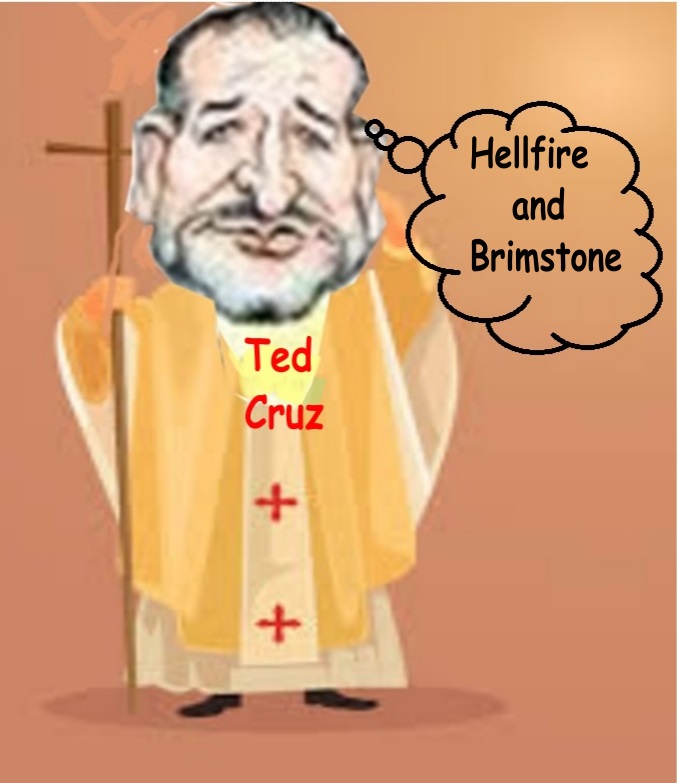
“We are carrying out military strikes today,” Senator Cruz said in an interview.
By Sharon Zhang , Truthout, June 18, 2025, https://truthout.org/articles/ted-cruz-suggests-us-is-involved-in-israeli-strikes-on-iran-despite-us-denials/
Sen. Ted Cruz (R-Texas) was caught stumbling to answer basic questions about Iran and the U.S.’s role in Israel’s war in an eye-opening interview airing Wednesday, despite his full-throated support for overthrowing the Iranian government and deeper U.S. involvement in the fighting.
In clips of the interview with far right provocateur Tucker Carlson posted on social media on Tuesday, the senator alarmingly suggests that the U.S. is, in fact, already heavily involved in Israel’s strikes on Iran.
“We are carrying out military strikes today,” Cruz said. “I said we — Israel is leading them, but we’re supporting them.”
This directly contradicts what federal officials have said about the U.S.’s involvement. The State Department has said that Israel’s strikes are “unilateral,” and directed all embassies and consular posts to reiterate that claim in a cable, CBS reported on Sunday. The cable instructed officials to emphasize to their respective host governments that the U.S. “is not involved in Israel’s unilateral action against targets in Iran and did not provide tanker support.”
This position has not changed in recent days, as the strikes have intensified and President Donald Trump openly mulls becoming more deeply involved in the war. Numerous Trump administration spokespeople claimed on Tuesday that any reports of the U.S. participating in Israeli strikes in Iran are “not true.”
“American forces are maintaining their defensive posture, and that has not changed. We will defend American interests,” said spokesperson Alex Pfeiffer on Tuesday.
The U.S. military is already involved in the conflict. Officials have been open about the U.S.’s defensive positions in helping to strike down missiles fired at Israel.
However, direct U.S. involvement in conducting strikes on Iran, as Cruz suggests is happening, would be a major escalation of the war. Cruz’s statements potentially suggest that the U.S. is actually directly aiding in the bombings, as the Senate is privy to classified information about the military not available to the public.
“You’re breaking news here,” said Carlson. “This is high stakes, you’re a senator. If you’re saying the United States government is at war with Iran right now, people are listening!”
It’s possible that Cruz is suggesting deeper U.S. involvement to push the Trump administration into striking Iran, as many conservative lawmakers have done in recent days — in hopes of pushing the dangerous pipe dream of regime change in Iran.
“I think it is very much in the interest of America to see regime change,” Cruz told Fox News on Sunday. “I don’t think there’s any redeeming the ayatollah.”
Despite his confidence that he could install a better government in Iran, earlier in the interview, Cruz is caught unable to even name basic facts about Iran’s population.
“I don’t know the population,” Cruz says.
“You don’t know the population of the country you seek to topple?” Carlson asks, incredulously. “How could you not know that?”
In a follow up, Carlson says, “okay, what’s the ethnic mix of Iran?”
Cruz hesitates, then says, “they are Persians, and predominantly Shia,” he says, tellingly naming a religious sect rather than an ethnicity. When Carlson asks what proportion of the population is Persian, Cruz becomes incensed.
“I’m not the Tucker Carlson expert on Iran,” Cruz says sarcastically, his voice raised.
“You’re a senator who’s calling for the overthrow of the government!” Carlson exclaims in response.
The exchange highlights a rift among the right over the U.S.’s role in the Middle East. Carlson’s interview circulated widely online for exposing Cruz’s blasé ignorance of the country he wants to wage war against.
However, Carlson, who has consistently allied with white supremacists, himself owes much of his career to the figures who peddled the lies that led to the Iraq War. Early on, Carlson was a proponent of the U.S.’s invasion, and only changed his mind later because of racist beliefs that Iraq and Afghanistan aren’t “worth invading” because “the people aren’t civilized.”
This is, as commentators have noted, a drastically different approach to anti-interventionism from the left’s anti-war and anti-imperialist foundations. And yet, Carlson’s interview caught attention online as the right has sought to capitalize on genuine anti-war sentiment among the public that’s been completely dismissed by the Democratic Party.
Ford’s nuclear obsession is robbing Ontario of its true clean energy future
Canada’s National Observer Adrienne Tanner, June 19th 2025
Ontario’s Premier Doug Ford just can’t seem to shake his aversion to renewables.
Ford’s new Energy for Generations plan, mapping out energy generation from now to 2050, is laudable for its end goal: to all but end Ontario’s reliance on gas for electricity generation. But its single-minded pursuit of new nuclear power projects is myopic when it comes to solar and wind, the gold standard sources of clean energy.
Ontario is seriously eyeing sites for three even bigger nuclear plants than it already has — “the equivalent of adding about five Darlington Nuclear Generating Stations to the grid,” the report states — with the possibility of even more of them down the road.
As for solar and wind, the plan calls for a modest increase of slightly more than double the small amounts produced now which comprise 11 per cent of Ontario’s power supply. And the clincher: solar and wind will get a boost while nuclear plants are being scaled up, but only for a short while.
Once new nuclear plants are up and running, Ontario actually plans to dial back progress on renewables. It sounds like the province plans to tear down solar installations and wind farms and haul the pieces off to metal recyclers and landfills. And why? On those questions, the plan is silent.
The only hint is a bullseye graphic comparing the amount of land needed for a new nuclear plant compared to the much greater amounts needed to generate the same amount of power from solar or wind. As might be expected from a plan that reads like a pro-nuclear manifesto, there isn’t a single mention of the radioactive waste generated from nuclear power plants and the still-unsolved challenges associated with its disposal.
Like his Alberta counterpart, Premier Danielle Smith, Ford seems almost pathologically opposed to solar and wind energy. From the moment he was elected, Ford made it clear he was not interested in clean technology of any description; he cancelled 750 renewable energy projects, slowed the buildout of electric vehicle charging stations, ended the provincial EV rebate, repeatedly lowered gas taxes and has sided with Enbridge, Ontario’s natural gas provider, at every turn.
He’s budged on EV charging stations recently, probably because failing to build at least some would be a bad look for a province trying to capture EV and battery manufacturing industries. And last year, when it became clear Ontario needed more energy to meet skyrocketing demand, the Ontario government finally opened the door to more solar and wind. Judging by his past record, I would bet that wasn’t Ford’s idea.
…………………………………………. There might be other forces at play causing Ford to favour Big Nuclear over solar and wind. Ford’s government has always been open-minded, shall we say, to the siren songs of business lobbyists, and the nuclear industry is currently in high gear. It could be Ford can only get excited about energy megaprojects with their jobs and potential for federal backing, regardless of the risk and cost. https://www.nationalobserver.com/2025/06/19/opinion/ford-ontario-energy-nuclear-solar-wind?nih=Vf0DQztC-W6YOqBGCjgdMvyuSr-jgXEgtm__lNRKxi0&utm_source=National+Observer&utm_campaign=d7478891e6-EMAIL_CAMPAIGN_2025_06_19_01_16&utm_medium=email&utm_term=0_cacd0f141f-d7478891e6-277039322
It’s good to talk: US-UK anti-nuclear alliance forged from film discussion
The NFLAs were delighted to partner with film makers and producers from
the United States in promoting the documentary film ‘SOS – The San
Onofre Syndrome: Nuclear Power’s Legacy’ and by participating in a
discussion last week of the issues raised. NFLA Secretary Richard Outram
joined US filmmakers James Heddle, Mary Beth Brangan and Morgan Peterson
for the discussion on Wednesday 11 June. UK participants were invited to
watch the documentary film before the event and then contribute their
questions and comments. Attendees included academics and activists from
several of the established campaigns opposed to nuclear power in the UK,
and their knowledge and experience helped make the discussion more
engaging.
NFLA 19th June 2025 https://www.nuclearpolicy.info/news/its-good-to-talk-us-uk-anti-nuclear-alliance-forged-from-film-discussion/
Trump says US intelligence ‘wrong’ about Iran not building nuclear bomb
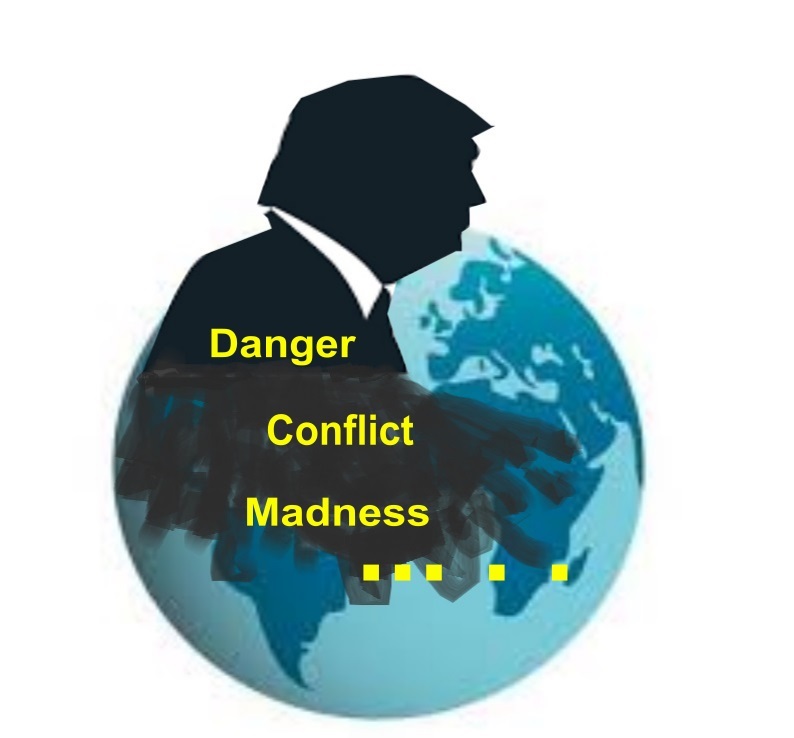
It is extremely rare for a US president to openly contradict the country’s intelligence community.
“This is not just one person, one team saying something,” “It’s the entire intelligence community in the United States. That he would dismiss them … it’s just astounding.”
US president doubles down on claim Iran is building nuclear weapon, again contradicting US intelligence community.
20 Jun 2025, https://www.aljazeera.com/news/2025/6/20/trump-says-us-intelligence-wrong-about-iran-not-building-nuclear-bomb
United States President Donald Trump has said his director of national intelligence was “wrong” when she testified that Iran was not building a nuclear weapon and that Supreme Leader Ayatollah Ali Khamenei had not re-authorised the country’s suspended nuclear weapons programme.
The comments come after Trump earlier this week cast doubt on Tulsi Gabbard’s March 25 report to Congress, in which she reiterated the US intelligence community’s assessment. On Tuesday, Trump told reporters, “I don’t care” that the intelligence community’s finding contradicted his own claims, saying Iran was in the late stages of developing a nuclear weapon.
But speaking on Friday, Trump went further.
A reporter asked, “What intelligence do you have that Iran is building a nuclear weapon? Your intelligence community said they have no evidence.”
The president responded, “Then my intelligence community is wrong. Who in the intelligence community said that?”
“Your DNI [director of national intelligence], Tulsi Gabbard,” the reporter replied.
“She’s wrong,” Trump said.
Gabbard appeared to come to Trump’s defence later on Friday.
“America has intelligence that Iran is at the point that it can produce a nuclear weapon within weeks to months, if they decide to finalize the assembly,” she wrote in a social media post. “President Trump has been clear that can’t happen, and I agree.”
However, that statement does not contradict her earlier assessment that Iran is not building a weapon. No known US intelligence assessment concludes that Iran is weaponising its nuclear programme.
It is extremely rare for a US president to openly contradict the country’s intelligence community, with critics accusing Trump of flagrantly disregarding evidence to justify potential direct US involvement in the fighting, according to Al Jazeera’s senior political analyst Marwan Bishara.
“This is not just one person, one team saying something,” Bishara said. “It’s the entire intelligence community in the United States. That he would dismiss them … it’s just astounding.”
Speaking on Friday, Trump also appeared to downplay the prospect of the US brokering a ceasefire agreement between Iran and Israel, saying he “might” support such a deal, while adding, “Israel’s doing well in terms of war, and I think you would say that Iran is doing less well.”
“It’s hard to make that request right now. When someone’s winning, it’s harder than when they’re losing,” he added.
Reporting from Washington, DC, Al Jazeera’s Heidi Zhou Castro noted that Trump was “really making a point that he’s not going to make an effort to ask Israel to ease up on its aerial bombing of Iranian targets”.
“It seems that Trump is very squarely on Israel’s side as things are progressing, and … it appears that he is not leaning towards the diplomacy route, though, again, he is giving himself that two weeks’ time to make a final decision,” she said.
Trump on Thursday said he would take two weeks to decide the US response to the conflict. Experts say the decision would likely be transformative.
The US is seen as one of the few countries with the leverage to pressure Israel to step back from the brink of wider-scale regional war.
At the same time, the involvement of the US military is seen as key to Israel’s stated mission of completely dismantling Iran’s nuclear programme, which hinges on destroying the underground Fordow enrichment plant.
A successful attack on the facility would require both Washington’s 30,000-pound (13,000kg) GBU-57 Massive Ordnance Penetrator and the B-2 bombers needed to deliver it.
Speaking to reporters on Friday, Trump also downplayed the potential role of European countries in de-escalating the situation. That came hours after Iran’s Foreign Minister Abbas Araghchi met the top diplomats from France, the UK, Germany and the EU in Geneva.
“Europe is not going to be able to help,” the US president said.
1 This Month

of the week – Shut Down Drone Warfare!


Tell the Ukrainian Government to Drop Prosecution of Peace Activist Yurii Sheliazhenko

Petition to revoke the licensing of the Near Surface Nuclear Disposal Facility (NSDF) at Chalk River. https://www.ourcommons.ca/petitions/en/Petition/Details?Petition=e-7247
To see nuclear-related stories in greater depth and intensity – go to https://nuclearinformation.wordpress.com
-
Archives
- April 2026 (114)
- March 2026 (251)
- February 2026 (268)
- January 2026 (308)
- December 2025 (358)
- November 2025 (359)
- October 2025 (376)
- September 2025 (257)
- August 2025 (319)
- July 2025 (230)
- June 2025 (348)
- May 2025 (261)
-
Categories
- 1
- 1 NUCLEAR ISSUES
- business and costs
- climate change
- culture and arts
- ENERGY
- environment
- health
- history
- indigenous issues
- Legal
- marketing of nuclear
- media
- opposition to nuclear
- PERSONAL STORIES
- politics
- politics international
- Religion and ethics
- safety
- secrets,lies and civil liberties
- spinbuster
- technology
- Uranium
- wastes
- weapons and war
- Women
- 2 WORLD
- ACTION
- AFRICA
- Atrocities
- AUSTRALIA
- Christina's notes
- Christina's themes
- culture and arts
- Events
- Fuk 2022
- Fuk 2023
- Fukushima 2017
- Fukushima 2018
- fukushima 2019
- Fukushima 2020
- Fukushima 2021
- general
- global warming
- Humour (God we need it)
- Nuclear
- RARE EARTHS
- Reference
- resources – print
- Resources -audiovicual
- Weekly Newsletter
- World
- World Nuclear
- YouTube
-
RSS
Entries RSS
Comments RSS
 nuclear-news