Trump reiterates Iran nuclear talking points despite swirling questions.

US president denies multiple reports and accounts that say US strikes did not destroy Iran’s nuclear capabilities.
Aljazeera, 29 Jun 2025
United States President Donald Trump has reiterated a vow not to allow Iran to get nuclear weapons following the end of Iran and Israel’s recent 12-day conflict, in which the US militarily intervened, and has stuck closely to his narrative as questions remain about the impact of US strikes on Iran’s nuclear sites.
On the Fox News programme Sunday Morning Futures with Maria Bartiromo, Trump repeated his claim that Iran was “weeks away” from making the weapons before Israel attacked on June 13. Nine days later, the US targeted Iran’s top three nuclear facilities: Fordow, Natanz and Isfahan.
Both US intelligence and the United Nations nuclear watchdog have ascertained that Tehran was not building a nuclear arsenal. Iran has long insisted that its nuclear programme is for civilian purposes only.
While Trump has said that the sites were “obliterated” by the US bombers, in the wake of the attacks, several major news organisations, citing intelligence sources, have reported that the US strikes did not destroy the facilities.
The International Atomic Energy Agency (IAEA) said on Monday that it was unclear what damage had been sustained at the Fordow plant, which houses the bulk of Iran’s most highly enriched uranium needed to make a nuclear weapon.
On Sunday, IAEA chief Rafael Grossi said Iran could restart uranium enrichment in a matter of months, while Trump insisted over the weekend that the attacks had set Iran’s nuclear ambitions back “by decades”.
According to an IAEA report last month, Iran has more than 400kg (880lb) of uranium enriched to up to 60 per cent purity, close to the roughly 90 per cent weapons grade – which is enough, if enriched further, for nine nuclear weapons.
Trump told Fox News that the news outlets questioning the efficacy of the attacks he ordered and lauded were spreading “fake news”.
“It’s just horrible and I could see it happening, and they [news outlets] tried to build that into a story, but then it turned out, no, it was obliterated like nobody has ever seen before and that meant the end to their nuclear ambitions at least for a period of time,” Trump said.
On whether or not Iran would restart its nuclear programme following the end of the conflict, Trump said, “The last thing they want to do right now is think about nuclear.”
During the attack on the sites, reports emerged that Iran had removed the enriched uranium from Fordow, but Trump claimed that was false.
“It’s a very hard thing to do, plus we didn’t give them much notice because they didn’t know we were coming until just then and nobody thought we would go after that site because everybody said that site was impenetrable… it’s at the bottom of a mountain and it’s granite,” he said.
“[But] the bomb went through it like butter, like it was absolute butter,” he said…………………………….. https://www.aljazeera.com/news/2025/6/29/trump-reiterates-iran-nuclear-talking-points-despite-swirling-questions
How Trump dumped the Ukraine war into Europe’s lap
it appears clear that any future Ukrainian purchases of American military materiel, if they happen, will in any case be made with European money…………… , Rutte appears single handedly trying to keep the European gravy train chugging forward.
President Zelensky has not given up on his aspiration for Ukraine to join NATO which renders any peace deal, and possibly any durable ceasefire with Russia, impossible.
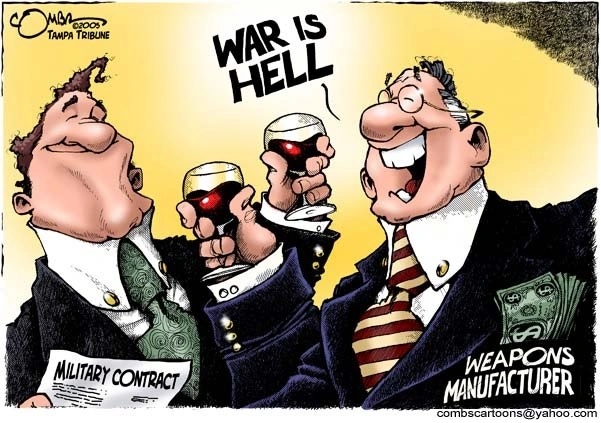
One thing is clear, U.S. defense contractors will arguably benefit the most from The Hague Summit.
Daddy says, ‘spend more on defence, pay for the war yourselves, but buy American kit’
Ian Proud, Jun 28, 2025, https://thepeacemonger.substack.com/p/how-trump-dumped-the-ukraine-war?utm_source=post-email-title&publication_id=3221990&post_id=166996238&utm_campaign=email-post-title&isFreemail=true&r=1ise1&triedRedirect=true&utm_medium=email
The NATO Summit was a coup for Trump. Cajoling the Europeans into upping defence spend to 5%, something most countries, Britain included, can’t afford. I was pleased therefore to see that Lord McDonald, the former Head of the Diplomatic Service, coming out today to suggest that the 5% target might wreck the UK economy.
Either way, it would take most countries time to ramp up their spending and military industrial capacity to even near this level. But it does raise questions about whether, as Mark Rutte suggested in his meeting with Zelensky, that NATO can fund the war in Ukraine for another decade.
That statement was far more concerning that his calling Donald Trump ‘daddy’, given the continued losses Ukraine is facing on the battlefield. And its ongoing quest to force unwilling Ukrainian men into fighting. More videos continue to emerge of recruitment officers fighting off mothers and wives in the street, as they force more recruits into minibuses headed for the front. How many men would Ukraine have left if NATO kept the fight going for another decade?
Really not clear that Rutte has considered that, which is disgraceful.
The aerial war between Israel and Iran over the past two weeks sucked most of the world’s attention away from the war in Ukraine.
The Hague NATO Summit confirms that President Donald Trump now sees paying for the war as Europe’s problem. It’s less clear that he will have the patience to keep pushing for peace.
One of the biggest diplomatic casualties of Israel and Iran’s aerial war was U.S. focus on and media coverage of the war in Ukraine. Despite continued exchanges of dead bodies and prisoners of war, there has been no further progress in peace talks between both sides that commenced in Istanbul in early June.
However, there has been talk of a third round of talks as early as next week. Before then, The Hague NATO Summit offered an opportunity to keep Ukraine on the U.S. radar. It didn’t quite happen that way.
Instead, if the NATO Summit showed any real purpose, it was to lock in European allies’ commitment to spend 5% of GDP on defense, a key priority for President Trump since he assumed office.
Mission accomplished. With the exception of Spain, NATO allies have now made that commitment.
Chipper as ever, NATO Secretary General, Mark Rutte, sent a message to President Trump, so eye-wateringly obsequious that it might even make some pro-war neocons cringe and reach for a sick bag. “Mr President, dear Donald… you have driven us to a really, really important moment for America and Europe, and the world. You will achieve something NO American president in decades could get done.” He was then chided for making remarks like he was calling Trump “daddy” at the summit.
But there was nevertheless no escaping the feeling that Ukraine has fallen some way down Trump’s priority list, and therefore NATO’s.
While the 2024 Washington Summit Communique ran to over 5300 words rich in normative intent and bureaucratic babble, the 2025 Hague Summit Declaration ran to a pithy 425 words focused almost exclusively on the NATO spending goal.
Whereas, the Washington Communique said, “we will continue to support it [Ukraine] on its irreversible path to full Euro-Atlantic integration, including NATO membership,” The Hague Declaration did not, which has already been seized upon as a softening of NATO’s stance by some mainstream commentators.
European ire was further provoked by Secretary of State Marco Rubio’s indication that the U.S. would not support further Russia sanctions at this time.
The declaration simply said, “Allies reaffirm their enduring sovereign commitments to provide support to Ukraine, whose security contributes to ours, and, to this end, will include direct contributions towards Ukraine’s defence and its defence industry when calculating Allies’ defence spending.”
For those not familiar with interpreting the subtleties of communique language, this language said two things. First, including the word “sovereign” means that while some allies may make sovereign choices to fund Ukraine, others may choose not to.
This is a clear indication of what we have observed for some time, that President Trump sees paying for the Ukraine war as Europe’s problem, not America’s. Second, and more obviously, that funding for Ukraine can contribute to Allies’ 5% target although, at least for the UK, this is already the case.
During their meeting, it is understood that Ukrainian President Volodymyr Zelensky asked President Trump about the possibility of purchasing additional Patriot missiles. While Trump was non-committal on this point, it appears clear that any future Ukrainian purchases of American military materiel, if they happen, will in any case be made with European money.
For his part, Rutte appears single handedly trying to keep the European gravy train chugging forward. Speaking ahead of the Summit, he referred to pledges of $35 billion in additional support to Ukraine so far this year without providing specifics.
However, we do know that over half of the earlier April pledge of $24 billion included funds from Germany to be paid over 4 years. In reality, therefore, NATO has only, so far, secured a maximum total of $22 billion for 2025, adding further pressure to Ukraine’s huge war financing needs.
What we haven’t seen in The Hague is any impetus behind efforts to bring the war in Ukraine to a close. Instead, and on the back of a Hague Declaration that rowed back any condemnation of Russia, Sir Keir Starmer continues to insist that allies remain resolved to “push again to get Putin to the table for the unconditional ceasefire.”
Like the proverbial scratched record, the British Prime Minister still believes that with U.S. offering no new money, with Ukraine continuing to lose ground on the battlefield, and with Europe struggling to make up the difference, that Russia will make unconditional concessions from a position of strength.
For his part, President Zelensky has not given up on his aspiration for Ukraine to join NATO which renders any peace deal, and possibly any durable ceasefire with Russia, impossible.
If the Hague Summit proved one thing, it may have been that getting European allies to spend more on defense is a bigger priority to President Trump than bringing peace to Ukraine. More focussed on the conflict in the Middle East, President Trump has once again conceded the difficulty of bringing the war in Ukraine to an end.
“It’s more difficult than people would have any idea,” he said. “Vladimir Putin has been more difficult, and frankly, I had some problems with Zelensky, you might have read about them. It’s been more difficult than other wars.”
One thing is clear, U.S. defense contractors will arguably benefit the most from The Hague Summit. To hit 5% of GDP, Britain would need to increase its spending by around $114 billion per year by 2035 and Germany has already pledged to hit the 5% target six years early, in 2029, hiking spending by $128 billion per year.
To kick off the spending spree, the UK has agreed to purchase twelve of the most modern F35A aircraft at a cost of $700 million. The F-35A is capable of delivering U.S. provided B61 nuclear bombs that were first designed in 1963. Keeping us safer, in this regard, relies on aircraft being able to fly far enough into Russia through its sophisticated air defences, to deliver a gravity nuclear bomb to target.
The most recent upgrade to the B61, during the Obama Administration, involved addition of a tail assembly to provide limited stand-off capability; it was so over-priced that every Sixties-era nuke is now worth more than its weight in gold, perhaps, the perfect allegory for Western defence spending.
With the fanfare of The NATO Summit starting to subside, the big question now is how much patience President Trump will have to push a peace agenda in Ukraine now that European allies have stepped up to spend more and buy American kit? My worry is, not much.
Canadian Coalition for Nuclear Responsibility’s recommendations opposing the proposed30-year operating licence extension for the Darlington Nuclear Generating Station (DNGS)

27June 25, Gordon Edwards
Recommendation 1: CCNR urges the Commission to grant Darlington no more than a five-year licence, to incentivize the public to remain engaged on matters of radiological safety, and to pressure the staff of OPG and CNSC to improve their practices related to public heath and safety. In our opinion, under no circumstance should a licence of more than ten years be countenanced.
Comments: The CNSC is expected to review the financial guarantee for decommissioning the Darlington plant every five years. The plant’s safety analysis is expected to be reviewed every 10 years. Why should public input be so underappreciated that it only has to be considered once in three decades?
Suspicions of regulatory capture can only be intensified when regulatory staff meets with industry representatives behind closed doors, decade after decade, without any meaningful public involvement. After all, the CNSC’s primary legal obligations are to the Canadian public, the Canadian environment, and the international community – not to the licencee. Without reasonably frequent public hearings, without listening to the concerns of the public directly, staff may come to regard those legislated responsibilities as more abstract than real. The staff of the licensee and the staff of the regulator become of one mind; the public is seen as an unwelcome intruder.
Ultimately, this is not good for the CNSC or for OPG. CCNR believes it is also not good for the public, or for the trust that CNSC wishes to enjoy from the public.
Recommendation 2: CNSC staff should be required to report to the Commissioners and to the public on a regular basis what efforts are being made to drastically reduce the routine releases of radioactive materials into the environment from Darlington.
Comments: On an annual basis, Darlington releases several hundred trillions of becquerels of radioactive hydrogen (tritium). Tritium is readily incorporated into all living things in the form of radioactive water molecules, as a result of ingestion, inhalation, or absorption through the skin. Tritium emissions from Darlington are far greater than corresponding tritium emissions from any other power reactors in the world, except for other CANDU reactors. Although CNSC and OPG staff are both quick to point out that these tritium emissions are “within regulatory limits”, that does not exonerate CNSC from the responsibility of requiring that such emissions be kept “As Low As Reasonably Achievable”, in accordance with the ALARA principle. All radioactive emissions are ionizing. Ionizing radiation is acknowledged to be a Class 1 carcinogen. No genotoxic carcinogenic material should be disseminated freely into the environment without the strictest possible controls, regardless of whatever regulatory limits may have been established arbitrarily by fiat. There is no science-based rationale for Canada’s tritium standards. It is not honourable to allow such very large releases of radioactive hydrogen to continue unabated for another three decades without any discernible effort to drastically reduce those emissions. Indeed, what efforts have been made in the last 30 years or will be made in the next 30 years to cut these emissions by orders of magnitude? Is that even a goal of the Commission? Or is the operating licence for a nuclear power reactor also a licence to freely pollute ad infinitum?
Similar considerations apply to routine emissions of radioactive carbon-14 from Darlington, which are reported to be at least a trillion becquerels per year or more. Since carbon-14 has a radioactive half-life of 5,700 years, carbon-14 emissions accumulate in the environment year after year as each year’s emissions are simply added to the previous year’s emissions. Carbon-14 from DNGS has been accumulating already for over 30 years, and it will continue to accumulate for the next 30 years if the licence is granted as requested. Thus 1 trillion becquerels per year turns into 60 trillion becquerels overall. What, if anything, is CNSC or OPG doing to prevent this from continuing?
As long ago as 1980, the Select Committee on Ontario Hydro Affairs reported that trium and carbon-14 “are easily incorporated into human tissue. Carbon-14 is incorporated into the carbon that comprises about 18 percent of total body weight, including the fatty tissue, proteins and DNA [molecules]. Tritium is incorporated into all parts of the body…. Thus the radiological significance of both elements is not related to their inherent toxicity, as each is a very low energy form of radiation, but to their easy incorporation in the body.”
Recommendation 3: All radioactive releases from Darlington should be posted on-line in real time so the public can be properly notified of those releases as they happen.
Comments: Testimony before the Select Committee on Ontario Hydro Affairs in 1979 by Dr. Edward Radford (Professor of Environmental Epidemiology at the Graduate School of Public Health, University of Pittsburgh) indicated that sudden large pulses of tritium absorbed by a pregnant woman can have a life-long effect on her unborn daughter by causing genetic damage to the baby girl’s eggs – damage that will persist throughout her life and could affect her eventual offspring. In 2023, in just one week, 6,469 curies = 239 trillion becquerels of tritium were released from Darlington. That’s comparable to an entire year’s release of tritium from just one unit happening in just one week. Yet the public has no way of knowing about this sudden massive leak of tritium in order to do what they can to protect themselves and their unborn babies. For these reasons, OPG should be required by CNSC to publicly report all radioactive emissions on-line in real time, so that vulnerable citizens such as pregnant women and parents of young children can choose to vacate the area when sudden large releases of triium or other radionuclides occur.
Recommendation 4: In accordance with its mandate to disseminate objective scientific information, CNSC should publicly declare that it is not correct for anyone to say that nuclear energy is “clean” (or non-polluting).
Comments: In addition to the radioactive hydrogen and radioactive carbon released routinely in large amounts from Darlington, as well as the radioactive iodine, other routine emissions occur. Over 100 million becquerels of radioactive iodine vapour is released annually from Darlington, along with more than 10 million becquerels of radioactive particulates. In addition, millions of becquerels of alpha emitters are released every year from Darlington. Bear in mind that alpha-emitters are hundreds to thousands of times more biologically damaging, per becquerel, than beta-emitters or gamma-emitters. For example, elementary arithmetic shows that one becquerel of plutonium inside the body is about 18,000 times more biologically damaging than one becquerel of tritium at the same location. Tens of trillions of Bq-MeVs of radioactive noble gases are released, that are heavier than air and so stay close to the ground, delivering radioactuve exposures from abve by what is called “skyshine”. Does the Commission ever concern itself with drastically reducing these large routine radioactive emissions? Does the Commission ever feel uneasy when nuclear power is called a “clean” or “non-emitting” energy source in defiance of scientific fact?
Recommendation 5: Darlington Nuclear Generating Station should not be given an operating licence for more than five years. At all future licencing hearings for Darlington, OPG’s detailed plans for dismantling the Darlington reactors should be spelled out in very specific terms and the public should be invited to weigh in on those plans from a community health and safety perspective.
Comments: During a retubing operation at Pickering many years ago, workers were contaminated with carbon-14 dust and carried that contamination into their homes for a period of several weeks. More recently, over 500 workers were contaminated with airborne plutonium dust for a period of several weeks during the refurbishment of Bruce unit 1. In both cases, the contamination was not detected by the standard radiation monitors in place at every nuclear power plant. In both cases, the radioactive contamination was only detected when air samples were analyzed and the offending materials were identified.
Dust that can contaminate the clothing or the lungs of workers, undetected, can equally well blow in the wind and contaminate people and property far from the reactor site. The public should be fully informed of the precise details of OPG’s plans for radioactive demolition, and given a chance to have their own input into those plans. It is possible, indeed likely, that a detailed examination of those plans will lead to the need for a greatly enhanced financial guarantee on the part of OPG to ensure that those plans can be carried out safely and to the complete satisfaction of local residents. It is also important that ratepayers learn the true cost of nuclear decommissioning, which will give a more realistic assessment of the total cost of nuclear-generated electricity.
Recommendation 6: CNSC staff be instructed by the Commission members to commission experts not affiliated with CANDU reactor design, operation, or regulation, to conduct an independent peer review of the calculations that led CNSC staff to conclude that 100 trillion becquerels of cesium-137 is a realistic and acceptable estimate of the “source term” following a severe nuclear accident at Darlington Nuclear Generating Station.
Comments: CCNR has obtained documentary evidence that this number was arbitrarily chosen by CNSC staff without any credible accident scenario to support that number. CCNR analysts have also examined the 2015 CNSC document Study of Consequences of a Hypothetical Severe Nuclear Accident and Effectiveness of Mitigation Measures. In paragraph one of section 3.1, the authors of the report state that a “large release” of radioactivity is, by definition, any release of more than 100 terabecquerels of cesium-137. Anything less than 100 TBq does not even qualify as a large release. Then, in the second paragraph of section 3.1, the authors arbitrarily select that very number, the lowest possible number, namely 100 terabecquerels, as their assumed large release from Darlington. In doing so staff ignores its own definition, that all large releases must be greater than that amount. Please note that the authors of the CNSC report have simply chosen the lowest possible number that can be used to describe a large radioactive release, and they have used that number as an estimate of what a large release at Darlington might actually be. Despite promising to do so, the authors fail to describe or refer to any realistic accident scenario that would in fact result in such a small radioactive release of cesium-137.
Using straightforward calculations, CCNR estimates that a typical Darlington core contains a total of at least 55,000 trillion becquerels of cesium-137. Since there are 480 fuel channels in each Darlington reactor, each channel contains about 114.6 trillion becquerels of cesium-137. At a temperature of 1500 degrees C (well below the melting point of the fuel) the exposed fuel will release about 25% of the cesium inventory in one hour. In the event of severe core damage, all of the cesium released from the overheated fuel will escape from the calandria because the rupture disks on top will have exploded, providing an unfiltered pathway for the cesium vapour to escape into the containment. Given the fact that each of the 480 fuel channels can release 57 trillion becquerels of cesium-137 in one hour, it is impossible to believe that only 100 trillion becquerels of cesium-137 will find its way out into the environment, given the relatively leaky containment system that exists at Darlington.
Recommendation 7: OPG should not be given an operating licence for a period of more than five years, and all future licencing hearings for Darlington should include a detailed re-evaluation of Emergency Measures in accordance with a more realistic estimated source term.
Comments: In the event of a severe accident in a CANDU reactor, leading to a truly large release of radioactivity, emergency measures that are currently predicated on a maximum release of 100 trillion becquerels of cesium-137 will be woefully inadequate. Radioactive cesium contamination of homes and properties will be far greater, more extensive, and persistent, than currently considered possible. Residential and commercial areas closest to the Darlington plant may well remain uninhabitable for decades, as we learned from bitter experiuence at Chernobyl and Fukushima Daiichi. Considering the enormous volume of radioactively contaminated water that was flushed into the Pacific Ocean following the Fukushima accident, including the 1.2 million tons of radioactive water that is currently being dumped into the Pacific, one can only wonder about the deleterious effects on Lake Ontario and the millions of people that draw their drinking water from the Lake. Canadians deserve an honest, science-based, realistic assessment of what the consequences of a severe nuclear accident might be in Canada. The CNSC has an obligation to provide them with objective scientifically based information, not self-serving efforts to low-ball the risk estimates for public relations purposes. The public will have to be consuilted more frequently rather than less frequently. Their right to a healthy body and a healthy environment cannot be taken for granted for thirty yeards at a time. Shame on OPG for even suggesting such a thing.
One final word. CCNR fully supports the position of Dr. Frank Greening against wasting valuable hearing time by allowing private profit-making parties or other project-supporting groups to have equal time with public or indigenous intervenors who are addressing legitimate matters of public health and safety or environmental integrity that are fundamental to the core mission of CNSC as a regulator. The time saved by eliminating such promotional testimony can be used to extend the time available for other presenters to make their interventions, or to provide closing argumants near the end of the proceedings as would be permitted in a judicial setting.
“Midnight Hammer” – a Fordow’s Bunker Buster or just Busted [i]
The reality is that the location of Iran’s 60% enriched uranium, along with key components of the program, is known only to a select few within Iran. Moreover, there are underground facilities believed to be even deeper than those at Natanz or Fordow — capable of continuing enrichment activities beyond the reach of current conventional weapons.
In short, the nuclear game is far from over.
The USA bombing the Iranian Nuclear facilities – Aftermath
– EXCELLENT ILLUSTRATIONS on original
Mike Mihajlovic, Jun 28, 2025, Black Mountain Analysis
The United States has conducted a series of airstrikes targeting key Iranian nuclear facilities – specifically, three high-value sites, with at least three B-2 Spirit bombers as well as a salvo of Tomahawk cruise missiles launched from submarines. In total, 14 GBU-57A/B Massive Ordnance Penetrators (MOPs) ( 12 for Fordow and 2 for Natanz) were deployed, along with 30 cruise missiles.
According to President Trump, who often portrays himself as a strongman unafraid to use force, the operation was extremely successful and all goals achieved, meaning the Iranian nuclear program went up in ashes. However, beneath the rhetoric and posturing, serious doubts remain about whether such strikes could meaningfully degrade Iran’s nuclear capabilities, especially when it comes to deeply embedded sites like Fordow. cspsbilities
At best, this could amount to little more than strategic theater, a carefully orchestrated display of power aimed at sending a political message rather than achieving lasting military results. In effect, the U.S. may have executed a strike based on an Israeli wish list: using bombs to project strength while avoiding actions that could trigger broader conflict.
For neoconservatives and proponents of an aggressive foreign policy, such a scenario would be hailed as a success—proof that decisive military action can shape geopolitical outcomes. Yet, Iran, a nation known for its strategic patience and resilience, chose to respond publicly in a controlled manner, targeting the US bases in Qatar. What will happen next is that they quietly assess the damage, reinforce their underground infrastructure, and continue their nuclear work beyond the reach of even the most powerful conventional weapons.
The world may be led to believe that the “threat” has been neutralized, for now. But history suggests that such illusions rarely last. Eventually, the same concerns will resurface, bringing the crisis back into the global spotlight.
“The roaring mountain just gave birth to a mouse.”
In the case of a high-profile strike, such as the one on Fordow, the symbolic value often overshadows the physical outcome. A site as hardened and deeply buried as Fordow—originally constructed within a mountain to withstand conventional attacks. It can’t be easily neutralized even with specialized munitions like the MOP or a direct hit from a hypersonic ballistic missile.
Yet, even then, the effectiveness depends on:
- Intelligence accuracy: Was the target still active?
- Timing: Was the infrastructure recently evacuated or relocated?
- Munition capability: Did the weapon used have sufficient penetration depth and explosive yield?
If the facility was decommissioned, emptied, or redundant, then the operation becomes more about message than material damage, a geopolitical performance aimed at deterring adversaries and reassuring allies.
Optical Effect Over Outcome
Such events often produce more theater than transformation. The media cycle amplifies the action, leaders issue statements of resolve, flags are waved, and bombs and missiles are launched – but the real question remains: What was actually destroyed?
This is where the gap between perception and reality widens. If core infrastructure remains intact or the targeted regime adapts quickly, the long-term strategic balance may not shift significantly. In this light, the operation resembles a symbolic punctuation mark in an ongoing diplomatic struggle rather than a decisive blow.
While political rhetoric and military parades dominate headlines, financial markets often act as the first honest arbiter of whether a crisis has real economic consequences, including:
A spike in oil prices could signal concerns over regional stability.- Currency fluctuations could reflect investor confidence (or lack thereof) in involved nations.
- Defense stocks may rise on expectations of increased military spending.
Markets don’t care about slogans or intercepted missiles shown in shaky phone videos; rather, they react to risk, uncertainty, and real shifts in power dynamics. So far, as the punches were exchanged, the market is not reacting “violently”.
The Depth
How deep is Fordow?
Open sources provide at least three distinct estimates for the depth of the Fordow facility: approximately 60–90 meters, 80–100 meters, and even up to 500–800 meters. These discrepancies arise from differences in measurement methodologies, limitations of satellite imagery, and deliberate information obfuscation by the Iranian government. Until engineering plans are leaked or the IAEA gains direct access to the site for inspection, the precise depth of Fordow remains uncertain.
Still, it is worth examining why Iran might engineer such a deeply buried facility, possibly extending toward the half-kilometer mark, and why that possibility alarms the Pentagon more than it does Israel.
The 60–90 Meter Estimate:
Outlets such as Deutsche Welle, Economic Times, and the Foundation for Defense of Democracies (FDD) estimate Fordow’s depth based on the thickness of the mountain rock layer above the main halls. In practical terms, this reflects the vertical cover, like measuring the height of “floor-1” from the surface. Their estimates place the depth at 60–90 meters.
The 80–100 Meter Estimate:
Moneycontrol cites a slightly deeper figure, likely accounting for a broader interpretation of structural depth rather than just the overhead rock.
The ~100 Meter Estimate via Satellite DEM:
Bloomberg reportedly used digital elevation models (DEMs) from commercial satellite imagery (Planet Labs and Maxar) to measure the distance from the entrance tunnel’s opening to the presumed facility roof. This method places Fordow around 100 meters deep. However, it should be noted that small angular errors, such as a ±3° deviation in tunnel slope, can introduce measurement discrepancies of dozens of meters. Additionally, some sources introduce further variance when rounding feet to meters.
Given these limitations, depth estimates are best treated as approximations unless corroborated by direct data……………………………………………………………………………………………………………………..
……………………………………………………………………………………………………………………………..Conclusion
Israel, acting without direct U.S. involvement, does not possess the necessary means to guarantee the destruction of the Fordow facility, even if its depth is “only” around 90 meters. While Israel has advanced airpower and precision munitions, it lacks the deep-penetration capability required to reach and neutralize such hardened underground infrastructure.
By contrast, the United States is undoubtedly capable of achieving a “mission kill”—disabling the site by targeting entrances, ventilation systems, and power nodes. However, a “layout kill” (the complete structural destruction of the underground halls) can only be reliably achieved if the facility is no deeper than approximately 35-40 m. Beyond that depth, even the GBU-57 MOP’s effectiveness is significantly reduced by the geological protection offered by dense rock formations.
So, how does the MOP manufacturer claim penetration of 60 m of concrete?
The U.S. spent considerable time and resources developing the MOP. Testing was conducted not far from the site where the first nuclear bomb test was previously carried out.
I am not aware of the Pentagon publicly sharing extensive results of these tests, but it is reasonable to believe that the intention was to demonstrate the MOP’s ability to penetrate to a depth comparable to the estimated depths of key Iranian nuclear sites, as well as underground facilities in North Korea and China.
It is reasonable to assume that U.S. assessments of destruction are based not only on classified intelligence but also on rudimentary analysis of test results shown in publicly released videos. However, the question remains: who should we believe?
The media landscape offers little clarity, with both pro-Trump and anti-Trump outlets presenting conflicting narratives. Analysts continue to assess the situation from multiple angles, and it may take time before a more definitive picture emerges.
Iranian sources contribute to the confusion, often contradicting themselves, with reports ranging from minimal damage to claims of major destruction. This inconsistency raises questions about intent: Is Iran attempting to downplay the impact of any strikes, or is it deliberately obscuring the true status of its nuclear infrastructure?
From a strategic perspective, there are clear incentives for each side to shape the narrative in their favor. By asserting total destruction, the U.S. can project military dominance and suggest the permanent end of Iran’s nuclear ambitions, at least for public consumption.
Meanwhile, Iranian claims of localized damage could serve as a deliberate distraction, shifting attention away from deeper, more resilient parts of its program. In this context, everyone has a stake in letting the dust settle, allowing ambiguity to work in their favor.
The reality is that the location of Iran’s 60% enriched uranium, along with key components of the program, is known only to a select few within Iran. Moreover, there are underground facilities believed to be even deeper than those at Natanz or Fordow — capable of continuing enrichment activities beyond the reach of current conventional weapons.
In short, the nuclear game is far from over. If anything, it has merely entered a new phase—one marked by strategic misdirection, information warfare, and long-term resilience planning.
The bottom line, summed up in one sentence about the current equation between the U.S., Israel, and Iran: “the wolves are fed, and all the cattle are accounted for”.
Edited by Piquet (EditPiquet@gmail.com)
References…. https://bmanalysis.substack.com/p/midnight-hammer-a-fordows-bunker?utm_source=post-email-title&publication_id=1105422&post_id=166540747&utm_campaign=email-post-title&isFreemail=true&r=1ise1&triedRedirect=true&utm_medium=email
The president who talks like a child

28 June 2025 Roswell, https://theaimn.net/the-president-who-talks-like-a-child/
Watching President Trump respond to questions is like watching a child give a report on a book they didn’t read. He rambles, repeats himself, and jumps from topic to topic with little connection to the original question. Ask about the economy, and you might get a story about how everyone says he’s done more than Lincoln. Ask about foreign policy, and he’s suddenly reminiscing about crowd sizes or a golf course he owns.
It’s cringeworthy – not just because it’s embarrassing to witness, but because it’s dangerous. The world sees it. Allies shake their heads; adversaries take notes. His speech patterns aren’t just odd – they reveal a mind that struggles with depth, nuance, or even basic coherence.
He often sounds like someone who needs constant validation, like a child needing applause. Every sentence is laced with “the best,” “nobody knew,” or “a lot of people are saying.” But the substance? Missing in action.
What’s even more concerning is that this isn’t new. His speaking style has always raised eyebrows, but in his second term, it seems to have become even more unhinged. When asked a direct question – about inflation, war, or national security – he responds with something entirely unrelated. He pivots to grievances, boasts about his supposed achievements, or launches into a tirade about the media. It’s not just deflection. It’s a fundamental inability to engage with the question at hand.
This is not a partisan complaint. It’s not about policy. It’s about the basics of leadership: coherence, focus, responsibility. A functioning adult in the Oval Office should be able to answer a question without wandering into fantasy, nostalgia, or conspiracy. Trump rarely does.
Supporters (both MAGAs and media) might claim it’s part of his charm – that he’s just speaking off the cuff, unscripted. But there’s a difference between authenticity and incoherence. When every answer sounds like a poorly rehearsed rally speech, it’s not refreshing – it’s exhausting.
Even his defenders have learned to lower the bar. “That’s just Trump being Trump,” they shrug, as if we should expect the most powerful man in the world to behave like a distracted child. If this were a reality show, it might be entertaining. But it’s not. It’s the presidency. And the stakes are real.
What does it say about America when its president communicates like a confused child? When complexity is replaced with slogans, when questions are treated as insults, and when leadership is reduced to soundbites?
A president doesn’t need to be a poet or a scholar. But they do need to be able to think, listen, and respond like an adult. On that front, Trump continues to fail – loudly.
Why Trump’s Golden Dome must be opposed – Bruce Gagnon & Dae-Han Song
19 Jun 2025
In January 2025, Donald Trump signed an executive order directing the US armed forces to construct a missile defense system – the ‘Golden Dome’ – a proposed multi-layer defense system, comparable to the Iron Dome system in Israel. It aims to place and maintain space weapons orbit, for the first time in history.
The proposed system will be exorbitant. According to US Congress sources it could cost several trillion dollars. This would require the US to cut every one of its remaining social programs. Such a military system would inflict ever more damage to the environment both on and around our planet.
Trump wants such a system, so that the US can launch a nuclear attack on another nuclear armed country and the US be confident that it has sufficient defenses to reduce the impact of any retaliatory missiles launched against US to levels deemed acceptable to US military planners. As the US advances its war drive, it is developing its military alliances with other countries and locking them into its war preparations.
Military coordination is being stepped up with increased ‘interoperability’ of hardware. In these alliances, such as NATO, it is always the US that is ‘in charge of the tip of the spear’.
Bruce Gagnon, in discussion with Dae-Han Song, explains why the proposed Golden Dome should be opposed. Bruce Gagnon has been organizing to stop the new arms race in space (Star Wars) since 1982. He began by coordinating the Florida Coalition for Peace and Justice from 1983-1998. During those years, in 1992, he co-founded the Global Network Against Weapons & Nuclear Power in space that he now coordinates. Bruce began his organizing career working for the United Farm Workers Union. He is a Vietnam war era veteran. He lives in Brunswick, Maine.
Website of The Global Network Against Weapons & Nuclear Power in Space: https://space4peace.org/ The petition against the Golden Dome is here: https://space4peace.org/global-networ… Dae-Han Song is a part of the International Strategy Center and the Korea Policy Institute. He is a member of the international No Cold War collective.
Why Limit Iranian Enrichment Peacefully When You Can Bomb Them Instead?
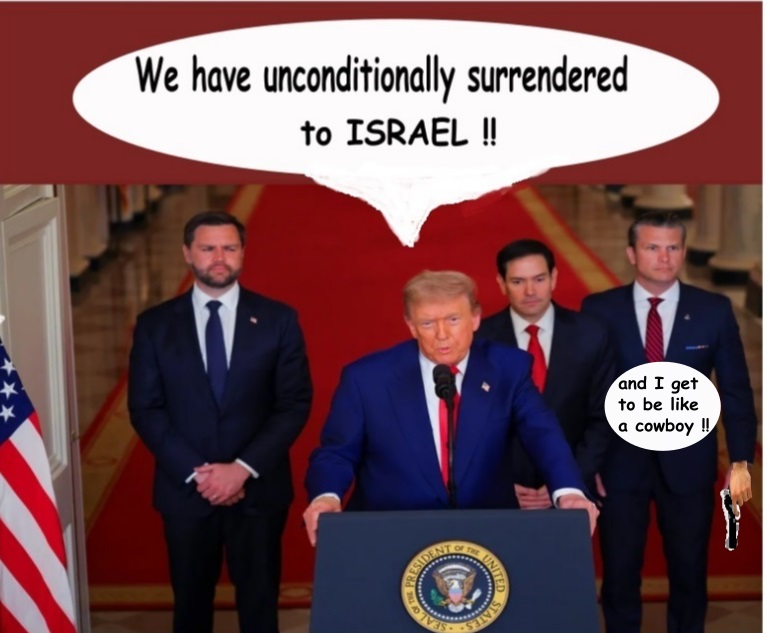
A deal was limiting Iran’s enrichment of uranium until Donald Trump pulled the U.S. out of it. Instead the Dealmaker bombed Iran, threatening to set the region on fire, writes Joe Lauria. With a ceasefire what does he do now?
By Joe Lauria, Consortium News. June 24, 2025, https://consortiumnews.com/2025/06/24/why-limit-iranian-enrichment-peacefully-when-you-can-bomb-them-instead/
In the last great achievement of international diplomacy, the United States and its allies Britain, France and Germany, concluded a deal in 2015 with Russia, China and Iran — something that today would be unthinkable — to limit Iran’s nuclear enrichment to purely civilian uses at 3.67 percent.
Negotiations on the deal began in November 2013, just three months before the U.S.-backed unconstitutional change of government in Kiev that started the long slide in U.S.-Russian relations. That did not prevent the nuclear deal from being concluded in July 2015 and endorsed by the Security Council in October of that year.
Seven years later, Washington and its European allies began fighting a hot war against Moscow through its proxy Ukraine. Relations with China have also sharply deteriorated. The idea of such cooperation on Iran now is unthinkable.
But in 2013 such wise diplomacy was still possible and the result was a peaceful resolution of the Iranian enrichment issue.
Iran agreed to stringent monitoring by the International Atomic Energy Agency and in exchange, the United States, Europe and the United Nations lifted economic sanctions against Tehran.
The IAEA certified that the deal was working. Iran was sticking to 3.67 percent enrichment. Diplomacy worked. Iran’s nuclear program was in check.
But the Israelis had opposed it all along because Israel’s aim has long been to overthrow the government in Iran in Israel’s quest for regional dominance.
Netanyahu could not stop Barack Obama from working with the Chinese and the Russians to conclude the deal that solved the nuclear issue and left the Iranian government in a more secure position.
Then Donald Trump became president. He did what Netanyahu wanted. He pulled the U.S. out of the deal, saying it was a lousy agreement and he could do better. But there was no new deal. Iran continued to cooperate with the existing agreement for a year before increasing enrichment, eventually to 60 percent for leverage in the negotiation. (90 percent is needed for a bomb, but U.S. intelligence and the IAEA said in recents months that Iran is not pursuing a bomb).
Obama’s vice president, Joe Biden, did nothing to return the U.S. to the deal to save it when he got into the White House, dishonoring probably Obama’s greatest achievement.
Trump 2.0’s idea of a better deal to limit Tehran’s enrichment was to demand zero percent after Iran agreed to return to 3.67 percent. Trump would look like a fool if he accepted 3.67 percent, as that would mean agreeing to the very deal that was working well before he tore it up.
So it was bombs away instead.
Clearing Smoke Reveals Trump’s Lies
More than 24 hours after the smoke cleared above Fordow, Natanz and Isfahan nuclear facilities Trump’s lies during his address Saturday night came clearly into view.
The strikes were not “a spectacular military success.” Iran’s “key nuclear enrichment facilities” were not “completely and totally obliterated.” There is no evidence that a single centrifuge was damaged and Iran’s 60 percent enriched fuel had already been removed and is in a location unknown to Israel, the U.S. and the IAEA.
Trump called Iran the “bully of the Middle East” when any neutral person knows that bully is Israel backed by the U.S., the bully of the world.
In just the past few months, with U.S. backing, Israel has invaded Lebanon and Syria, launched an unprovoked attack on Iran and is committing genocide in Gaza. The last time Iran invaded anyone was Iraq in 1982 but only after Iraq had invaded it first in 1980.
Israel gets away with this by portraying itself as the perpetual victim of an imminent new Holocaust 80 years after the fact and thus needs to invade and bomb its neighbors in “self defense” to pre-empt this from happening.
Regional hostility toward Israel does not stem from a reaction to its decades of aggression against Palestinians and its neighbors but purely from anti-semitic hatred. These countries must constantly be attacked to wipe out this hatred, not to reconstitute an ancient Hebrew empire from (beyond) the River to the Sea.
One power that empire never conquered was Persia
With their overlapping empires — Israel’s regional and the U.S.’s global — Iran, the land of Darius and Cyrus, is the prime target. The U.S. has sought to control it since at least its 1953 coup restored the shah to power for its oil and because of its Cold War rivalry with Russia.
Trump mimicked Israel, calling Iran “the world’s number one state sponsor of terror,” when an objective analysis would correctly award that title to the Gulf Sunni monarchies, principally Saudi Arabia, all allied with the United States.
They have sponsored al-Qaeda and ISIS and all their offshoots and rebrandings, while Iran has mostly supported militia resisting occupations in Lebanon, Iraq, Syria and Gaza.
Though formed in 1982 in response to Israel’s invasion and occupation of Lebanon, Hezbollah was only designated a terrorist organization by the European Union in 2013, for instance. Though founded in 1987, the EU did not view Hamas as a terrorist group until 2001.
Then Trump said of Iran:
“They have been killing our people, blowing off their arms, blowing off their legs with roadside bombs. That was their specialty. We lost over 1,000 people, and hundreds of thousands throughout the Middle East and around the world have died as a direct result of their hate.”
This is a bizarre statement that can only be related to attacks by militia against U.S. occupation forces in Iraq after the U.S. 2003 invasion. But only some of these groups were Iranian-backed and they killed not a thousand, but 169 U.S. soldiers, whom Trump referred to as “our people,” as if they were tourists and not an occupying army.
Trump’s thousand U.S. victims appears to come from propaganda put out by the Jerusalem Center for Public Affairs, which calls itself “a leading independent research institute, serving as Israel’s global embassy for national security and applied diplomacy.”
It combats what it calls “apartheid antisemitism.” It falsely called the 2015 nuclear agreement that Trump withdrew from “a deal that would allow Iran to become a nuclear-armed state.” In 2015, Haaretz named Sheldon Adelson, Trump’s principal donor, “one of the main financers of JCFA in recent years.”
Israel had to cut short its ambitions to conquer Iran (at least overtly) and agree to a ceasefire because it was running out of interceptor missiles; it’s economy, already weakened by Gaza, was threatened at $200 million a day; and it sustained far more damage than it will admit.
Now that there is a ceasefire, Trump is back to square one. The New York Times reported:
“Rafael Mariano Grossi, the director of the U.N.’s nuclear watchdog, welcomed news of a cease-fire. In a social-media post, he said he has invited Iran’s foreign minister Abbas Araghchi to meet to discuss a diplomatic solution on Iran’s nuclear program.”
That solution would be a return to 3.67 percent enrichment and Iran giving up its 60 percent stockpile, in other words, returning exactly to the deal Trump tore up to plunge the region into extreme danger with his bombing stunt.
Where will he turn now?
Joe Lauria is editor-in-chief of Consortium News and a former U.N. correspondent for The Wall Street Journal, Boston Globe, and other newspapers, including The Montreal Gazette, the London Daily Mail and The Star of Johannesburg. He was an investigative reporter for the Sunday Times of London, a financial reporter for Bloomberg News and began his professional work as a 19-year old stringer for The New York Times. He is the author of two books, A Political Odyssey, with Sen. Mike Gravel, foreword by Daniel Ellsberg; and How I Lost By Hillary Clinton, foreword by Julian Assange.
Iran Shows Us Why The US And Israel Should Not Be Allowed To Have Nukes.
Caitlin Johnstone, Jun 25, 2025
Well it’s been a crazy couple of days.
Trump bombed Iran’s civilian nuclear energy facilities in an attack that CNN reports did no lasting damage, and Iran exercised extraordinary restraint with symbolic retaliatory strikes on US military bases coordinated to avoid American casualties — a move many are comparing to Iran’s non-lethal response to the US assassination of General Qassem Soleimani in 2020.
After pumping out deception and fake diplomacy for weeks in order to assist Israel’s unprovoked war on Iran and launch an unprovoked attack on his own, Trump took to social media to proudly celebrate his administration’s facilitation of a ceasefire to the war he himself needlessly started, like an arsonist giving himself a trophy for extinguishing one of his own house fires.
And, for the moment at least, the ceasefire appears to be holding. Which is good. There are a lot of terrible people who did everything they could to get Iran to kill US troops and spark a horrific war, but Iran didn’t take the bait. Iran doesn’t want war at all. Trump found out that Americans disapproved of the airstrikes and opposed war with Iran. And Israel found out that fighting an actual military force is a lot less easy than fighting hospital patients and children.
So for now we’ve got a ceasefire.
We have never been shown any evidence that Iran was working on obtaining nuclear weapons, which given the US empire’s extensive history of lying about this sort of thing means we should assume it was not. But it has certainly been given every incentive to obtain them now, given that that’s probably the only thing that can stop the US and Israel from casually committing these egregious acts of aggression whenever they feel like it.
And isn’t it interesting how Iran keeps demonstrating a degree of restraint that we all know we’d never see from the United States or Israel if another country bombed their energy infrastructure or assassinated their military leaders, and yet Iran is the country we’re told can never be trusted with nuclear weapons?
The US empire and Israel both exist in a perpetual state of war and attack other countries constantly; Iran never invades other countries and avoids war like Melania Trump avoids missionary position. But we’re meant to accept that it’s fine for the US and Israel to have nukes and do anything necessary to prevent Iran from getting any?
Even if you accept the evidence-free premise that Iran would do crazy and reckless things if it became a nuclear-armed state, there is no rational argument that Trump and his handlers have been going about preventing this outcome intelligently. As Joe Lauria explains in Consortium News, the Iran nuclear deal was a remarkable achievement of international diplomacy that was working fine until Trump shredded it in 2018. Iran was following all the agreed upon rules and its nuclear enrichment was capped at 3.67 percent, but Trump killed it because the Zionists and warmongers who brought him to power want more aggression toward Iran instead of less.
It’s so intensely stupid that we have to keep doing this horrifying dance every few years just because there are too many war-horny freaks with way too much power inside the US empire. And every time they get closer to getting their wish. Iran is being given more and more reasons to view the US and Israel as an existential threat, more and more motive to obtain nuclear weapons, and less and less reason to negotiate anything with Washington.
These bastards keep pushing us toward something very ugly. Let’s hope people keep waking up to the depravity of Israel and the US empire before the warmakers succeed in obtaining their long-sought prize.
2
Trump rejects leaked intelligence that says strikes did not destroy Iran nuclear programme.
Donald Trump insists nuclear sites in Iran were
“completely destroyed” by US military strikes, despite an intelligence
report casting doubt on their success The leaked damage assessment from the
Pentagon’s Defense Intelligence Agency estimates the attack only set Iran’s
nuclear programme back “a few months”
BBC 25th June 2025,
https://www.bbc.co.uk/news/live/c20xel1e97gt
Meet the Israeli fanatic running Ted Cruz’s office

Wyatt Reed·June 23, 2025, The Grayzone
After Ted Cruz’s humiliation by Tucker Carlson, attention has focused on a top staffer of the self-proclaimed “leading defender of Israel in the United States Senate.”
On June 18, former Fox host Tucker Carlson published a video which, though marketed as an interview, was more of a snuff film. Over the course of two hours, Carlson can be seen rhetorically disemboweling his debate opponent, US Senator Ted Cruz, on the politician’s determination to see the US attack Iran on Israel’s behalf.
While Cruz presents himself as a Christian Zionist moved by his own zealotry to support Israel, the politician’s Tel Aviv-driven policy line can also be traced back to his Senior Advisor for Policy and Communications, an Israeli-born Zionist lobbyist named Omri Ceren.
Before overseeing Cruz’s public relations, Ceren managed his foreign policy docket as his national security advisor. Prior to joining the Senator’s staff, Ceren served as the press director for The Israel Project, a Zionist pressure group which was forced to close down after being exposed as a de facto Israeli government front by Al Jazeera’s groundbreaking undercover investigation, The Lobby. Before that, Ceren cut his teeth lobbying for Ivory Coast dictator Laurent Gbagbo, who relied on Ceren as a registered foreign agent lending his marketing expertise to the embattled regime.
Ceren has consistently opposed a nuclear deal with Iran since at least 2015, when he declared that any agreement would simply ensure Tehran was “able to cheat with impunity.” At a talk hosted by the neocon Hudson Institute think tank in 2018, he suggested Washington should continue preaching about “freedom” and encouraging Iranian protesters to pursue regime change while simultaneously maintaining Trump’s ban on Iranians entering the US…………………………………………….
Since the attack, Cruz has posted 14 comments on Twitter/X. 12 of them consisted of breathless statements cheering the bombing or attacks on opponents of the war, whom he branded as “the death to America crowd.”… https://thegrayzone.com/2025/06/23/israeli-fanatic-ted-cruz-office/
US didn’t destroy Iran’s nuclear programme: Here’s what new intel says
US President Trump doubles down on his assertion that the Iranian nuclear programme has been set back by decades.
By Al Jazeera Staff, 25 Jun 2025, https://www.aljazeera.com/news/2025/6/25/us-didnt-destroy-irans-nuclear-programme-heres-what-new-intel-says
The United States’ strikes on three key Iranian nuclear sites on Sunday failed to destroy underground facilities, and set Tehran’s nuclear programme back only by a few months, according to an assessment of a confidential American intelligence report.
The “top secret” document prepared by the Defense Intelligence Agency (DIA) – the intelligence arm of the Pentagon – and published by major US news outlets on Tuesday is at odds with President Donald Trump’s claims about the strikes. Trump has insisted that the nuclear facilities at Fordow, Natanz, and Isfahan were “obliterated” by a combination of bunker busting and conventional bombs.
Trump and his administration’s senior officials are dismissing the intelligence report and calling out the reporting over the DIA’s assessment as “fake news”.
Speaking at a NATO summit in The Hague, the US president said he believed Iran’s nuclear programme was set back by decades.
So, what did the DIA assessment say about US strikes? What has Iran said about the attacks? And how does the intelligence report contrast with the Trump administration’s public claims?
What did the DIA report say?
A preliminary report prepared by the DIA noted that rather than obliterating Iran’s nuclear programme, the US bombings had only set it back by a few months.
Before Israel attacked Iran on June 13, US agencies had noted that if Iran rushed to assemble a nuclear weapon, it would take it about three months.
The DIA’s five-page report now estimates this to be delayed by less than six months, reported The New York Times. As per the early findings, the US strikes blocked the entrances to two of the facilities but did not collapse the underground facilities.
The DIA report also reveals that the US agency believes that Iran’s stockpile of enriched uranium was moved before the strikes, which destroyed little of the nuclear material.
Shortly after the US strikes on June 22, Mehdi Mohammadi, an adviser to the chairman of the Iranian parliament, claimed that the authorities had evacuated the Fordow facility in advance. “Iran has been expecting strikes on Fordow for several days. This nuclear facility was evacuated, no irreversible damage was sustained during today’s attack,” Mohammadi had said.
The US president on Wednesday said he doesn’t buy Iranian claims that they moved enriched uranium out of the Fordow nuclear facility. “I believe they didn’t have a chance to get anything out because they acted fast,” said Trump. “If it would have taken two weeks, maybe, but it’s very hard to remove that kind of material… and very dangerous.
“Plus, they knew we were coming,” Trump added. “And if they know we’re coming, they’re not going to be down there.”
CNN first reported on the DIA report, quoting unnamed officials that the US strikes’ effect on all three sites – Fordow, Natanz, and Isfahan – was largely restricted to aboveground structures, which were severely damaged.
On Tuesday, the Trump administration told the United Nations Security Council that the US strikes had “degraded” the Iranian facilities – short of Trump’s earlier assertion that the attacks had “obliterated” the sites.
The strikes have reportedly badly damaged the electrical system at the Fordow facility. However, it was not immediately clear how long Iran could take to gain access to the underground facilities and repair these systems.
On Monday, Rafael Grossi, the head of the UN nuclear watchdog IAEA, said that while “no one, including the IAEA, is in a position to have fully assessed the underground damage at Fordow”, it is expected to be “very significant”.
Two people familiar with the DIA’s assessment told CNN that Iran’s stockpile of enriched uranium was not destroyed and the centrifuges are largely “intact”.
Some analysts cautioned against drawing final conclusions. Analysts told the Reuters news agency that the extent of damage to the Fordow uranium enrichment facility would not necessarily be revealed if the assessment was based on satellite imagery.
How did the US strike Iranian nuclear sites?
After 10 days of fighting between Israel and Iran, the US had militarily intervened on June 22 by hitting the Iranian nuclear sites.
Fordow is a highly fortified underground uranium enrichment facility reportedly buried hundreds of metres deep in the mountains in northwestern Iran. While Natanz is Iran’s largest and most central enrichment complex, containing vast halls of centrifuges, some underground, Isfahan is a major nuclear research and production centre that includes a uranium conversion facility and fuel fabrication plants.
How did the US strike Iranian nuclear sites?
After 10 days of fighting between Israel and Iran, the US had militarily intervened on June 22 by hitting the Iranian nuclear sites.
Fordow is a highly fortified underground uranium enrichment facility reportedly buried hundreds of metres deep in the mountains in northwestern Iran. While Natanz is Iran’s largest and most central enrichment complex, containing vast halls of centrifuges, some underground, Isfahan is a major nuclear research and production centre that includes a uranium conversion facility and fuel fabrication plants.
The US forces dropped 14 30,000-pound (13,000kg) bunker-buster bombs, while Navy submarines are said to have coordinated strikes by cruise missiles at the Natanz and Isfahan sites.
The GBU-57 Massive Ordnance Penetrator (MOP) – the most powerful bunker-buster bomb in the US military arsenal weighing nearly 13,000kg (30,000lb) – was used in the strike.
The US intervention was understood to be critical for the Israeli campaign against Iranian nuclear facilities, especially Fordow, due to its depth that kept it out of reach for the Israeli military.
How did the DIA report contrast with Trump’s claims?
In March this year, the US spy chief Tulsi Gabbard had informed Congress that there was no evidence Iran was building a nuclear weapon, and Iranian Supreme Leader Ali Khamenei had not authorised the nuclear weapons programme that he had earlier suspended in 2003.
On June 17, as Israel and Iran continued to trade ballistic missiles, Trump was returning to Washington from the G7 summit in Canada, when he snubbed his own administration, including the spy chief Gabbard, saying she and the intel agencies had gotten it “wrong”.
He claimed that Iran was “very close” to having a nuclear weapon. On June 22, the US struck Iranian nuclear facilities. “The strikes were a spectacular military success,” Trump said in a televised address. “Iran’s key nuclear enrichment facilities have been completely and totally obliterated.”
The next day, Trump wrote on his Truth Social platform, “The damage to the Nuclear sites in Iran is said to be ‘monumental.’ The hits were hard and accurate. Great skill was shown by our military. Thank you!”
On Wednesday, at the NATO summit, he reiterated his stance. “The last thing they [Iran] want to do is enrich anything right now… They’re not going to have a bomb and they’re not going to enrich,” he said at The Hague.
Top officials from his administration, including Vice President JD Vance and Defense Secretary Pete Hegseth, have repeated the obliteration claims since then.
“Based on everything we have seen – and I’ve seen it all – our bombing campaign obliterated Iran’s ability to create nuclear weapons,” Hegseth said in a statement provided to Reuters.
“Our massive bombs hit exactly the right spot at each target – and worked perfectly. The impact of those bombs is buried under a mountain of rubble in Iran; so anyone who says the bombs were not devastating is just trying to undermine the President and the successful mission.”
How has Trump, the White House reacted?
Trump spent a good amount of time letting off steam on his Truth Social platform after the DIA report dropped.
“THE NUCLEAR SITES IN IRAN ARE COMPLETELY DESTROYED! BOTH THE TIMES AND CNN ARE GETTING SLAMMED BY THE PUBLIC!” Trump wrote in all-caps, referring to the reporting by The New York Times and CNN.
“FAKE NEWS CNN, TOGETHER WITH THE FAILING NEW YORK TIMES, HAVE TEAMED UP IN AN ATTEMPT TO DEMEAN ONE OF THE MOST SUCCESSFUL MILITARY STRIKES IN HISTORY,” Trump said in a post.
The US president also posted a series of apparently bizarre videos, including one of B-2 bombers taking off to a “bomb Iran” song in the background.
Trump is currently in the Netherlands, attending this week’s NATO summit, and reiterated to reporters that the damage from the strikes was significant. “I think it’s been completely demolished,” he said, adding, “Those pilots hit their targets. Those targets were obliterated, and the pilots should be given credit.
“That place is under rock. That place is demolished,” Trump responded to a question on the possibility of Iran rebuilding its nuclear program.
He took further shots at CNN, saying: “These cable networks are real losers. You’re gutless losers. I say that to CNN because I watch it – I have no choice. I got to watch it. It’s all garbage. It’s all fake news.”
He said the intelligence following the strikes in Iran was “inconclusive”. “The intelligence says we don’t know. It could’ve been very severe. That’s what the intelligence suggests.”
“It was very severe. There was obliteration,” he reiterated on Wednesday.
The White House press secretary, Karoline Leavitt, called the DIA assessment “flat-out wrong” and leaked to the press “by an anonymous, low-level loser in the intelligence community”.
“The leaking of this alleged assessment is a clear attempt to demean President Trump, and discredit the brave fighter pilots who conducted a perfectly executed mission to obliterate Iran’s nuclear program,” she said in a statement. “Everyone knows what happens when you drop 14 30,000 pound bombs perfectly on their targets: Total obliteration.”
War on Iran Is Fight for US Unipolar Control of World
The plan to use Netanyahu as America’s counterpart to Ukraine’s Zelensky, demanding U.S. intervention with his willingness to fight to the last Israeli, much as the U.S./NATO are fighting to the last Ukrainian, is a tactic that is quite obviously at the expense of strategy.
June 24, 2025 , By Michael Hudson / Geopolitical Economy Report, https://geopoliticaleconomy.com/2025/06/22/michael-hudson-war-iran-us-unipolar-control/
Economist Michael Hudson explains how the war on Iran seeks to stop countries from breaking away from U.S. unipolar control and dollar hegemony, and to disrupt Eurasian integration with China and Russia.
Opponents of the war with Iran say that the war is not in American interests, seeing that Iran does not pose any visible threat to the United States.
This appeal to reason misses the neoconservative logic that has guided U.S. foreign policy for more than a half century, and which is now threatening to engulf the Middle East in the most violent war since Korea.
That logic is so aggressive, so repugnant to most people, so much in violation of the basic principles of international law, the United Nations, and the U.S. Constitution, that there is an understandable shyness in the authors of this strategy to spell out what is at stake.
What is at stake is the U.S. attempt to control the Middle East and its oil as a buttress of U.S. economic power, and to prevent other countries from moving to create their own autonomy from the U.S.-centered neoliberal order administered by the IMF, World Bank, and other institutions to reinforce U.S. unipolar power.
The 1970s saw much discussion about creating a New International Economic Order (NIEO). U.S. strategists saw this as a threat, and since my book Super Imperialism ironically was used as something like a textbook by the government, I was invited to comment on how I thought countries would break away from U.S. control.
I was working at the Hudson Institute with Herman Kahn, and in 1974 or 1975, he brought me to sit in on a military strategy discussion of plans being made already at that time to possibly overthrow Iran and break it up into ethnic parts. Herman found the weakest spot to be Baluchistan, on Iran’s border with Pakistan. The Kurds, Tajiks, and Turkic Azeris were others whose ethnicities were to be played off against each other, giving U.S. diplomacy a key potential client dictatorship to reshape both Iranian and Pakistani political orientation if need be.
Three decades later, in 2003, General Wesley Clark pointed to Iran as being the capstone of seven countries that the United States needed to control in order to dominate the Middle East, starting with Iraq, Syria, Lebanon, Libya, Somalia, and Sudan, culminating in Iran.
The U.S. fight for unipolar control of the world
Most of today’s discussion of the geopolitical dynamics of how the international economy is changing is understandably (and rightly) focusing on the attempt by BRICS and other countries to escape from U.S. control by de-dollarizing their trade and investment.
But the most active dynamic presently reshaping the international economy has been the attempts of Donald Trump’s whirlwind presidency since January to lock other countries into a U.S.-centered economy, by agreeing not to focus their trade and investment on China and other states seeking autonomy from U.S. control. (Trade with Russia is already heavily sanctioned.)
As will be described below, the war in Iran likewise has as an aim blocking trade with China and Russia and countering moves away from the U.S.-centered neoliberal order.
Trump, hoping in his own self-defeating way to rebuild U.S. industry, expected that countries would respond to his threat to create tariff chaos by reaching an agreement with America not to trade with China, and indeed to accept U.S. trade and financial sanctions against it, Russia, Iran, and other countries deemed to be a threat to the unipolar U.S. global order.
Maintaining that order is the U.S. objective in its current fight with Iran, as well as its fights with Russia and China – and Cuba, Venezuela, and other countries seeking to restructure their economic policies to recover their independence.
From the view of U.S. strategists, the rise of China poses an existential danger to U.S. unipolar control, both as a result of China’s industrial and trade dominance outstripping the U.S. economy and threatening its markets and the dollarized global financial system, and by China’s industrial socialism providing a model that other countries might seek to emulate and/or join with to recover the national sovereignty that has been eroded in recent decades.
U.S. administrations and a host of U.S. cold warriors have framed the issue as being between “democracy” (defined as countries supporting U.S. policy as client regimes and oligarchies) and “autocracy” (countries seeking national self-reliance and protection from foreign trade and financial dependency).
This framing of the international economy views not only China but any other country seeking national autonomy as an existential threat to U.S. unipolar domination. That attitude explains the U.S./NATO attack on Russia that has resulted in the Ukraine war of attrition, and most recently the U.S./Israeli war against Iran that is threatening to engulf the whole world in U.S.-backed war.
The motivation for the attack on Iran has nothing to do with any attempt by Iran to protect its national sovereignty by developing an atom bomb. The basic problem is that the United States has taken the initiative in trying to preempt Iran and other countries from breaking away from dollar hegemony and U.S. unipolar control.
Here’s how the neocons spell out the U.S. national interest in overthrowing the Iranian government and bringing about a regime change – not necessarily a secular democratic regime change, but perhaps an extension of the ISIS/Al-Qaida Wahhabi terrorists who have taken over Syria.
With Iran broken up and its component parts turned into a set of client oligarchies, U.S. diplomacy can control all Middle Eastern oil. And control of oil has been a cornerstone of U.S. international economic power for a century, thanks to U.S. oil companies operating internationally (not only as domestic U.S. producers of oil and gas) and remitting economic rents extracted from overseas to make a major contribution to the U.S. balance of payments.
Control of Middle Eastern oil also enables the dollar diplomacy that has seen Saudi Arabia and other OPEC countries invest their oil revenues into the U.S. economy by accumulating vast holdings of U.S. Treasury securities and private-sector investments.
The United States holds OPEC countries hostage through these investments in the U.S. economy (and in other Western economies), which can be expropriated much as the United States grabbed $300 billion of Russia’s monetary savings in the West in 2022. This largely explains why these countries are afraid to act in support of the Palestinians or Iranians in today’s conflict.
But Iran is not only the capstone to full control of the Near East and its oil and dollar holdings. Iran is a key link for China’s Belt and Road Initiative for a New Silk Road of railway transport to the West.
If the United States can overthrow the Iranian government, this interrupts the long transportation corridor that China already has constructed and hopes to extend further west.
Iran also is a key to blocking Russian trade and development via the Caspian Sea and access to the south, bypassing the Suez Canal. And under U.S. control, an Iranian client regime could threaten Russia from its southern flank.
To the neocons, all this makes Iran a central pivot on which the U.S. national interest is based – if you define that national interest as creating a coercive empire of client states observing dollar hegemony by adhering to the dollarized international financial system.
I think that Trump’s warning to Tehran’s citizens to evacuate their city is just an attempt to stir up domestic panic as a prelude to a U.S. attempt to mobilize ethnic opposition as a means to break up Iran into component parts. It is similar to the U.S. hopes to break up Russia and China into regional ethnicities.
That is the U.S. strategic hope for a new international order that remains under its command.
The irony, of course, is that U.S. attempts to hold onto its fading economic empire continue to be self-defeating.
The objective is to control other nations by threatening economic chaos. But it is this U.S. threat of chaos that is driving other nations to seek alternatives elsewhere. And an objective is not a strategy.
The plan to use Netanyahu as America’s counterpart to Ukraine’s Zelensky, demanding U.S. intervention with his willingness to fight to the last Israeli, much as the U.S./NATO are fighting to the last Ukrainian, is a tactic that is quite obviously at the expense of strategy.
It is a warning to the entire world to find an escape hatch.
Like the U.S. trade and financial sanctions intended to keep other countries dependent on U.S. markets and a dollarized international financial system, the attempt to impose a military empire from Central Europe to the Middle East is politically self-destructive.
It is making the split that already is occurring between the U.S.-centered neoliberal order and the Global Majority irreversible on moral grounds, as well as on the grounds of simple self-preservation and economic self-interest.
Trump’s Republican budget plan and its vast increase in military spending
The ease with which Iranian missiles have been able to penetrate Israel’s much-vaunted Iron Dome defense shows the folly of Trump’s pressure for an enormous trillion-dollar subsidy to the U.S. military-industrial complex for a similar Golden Dome boondoggle here in the United States.
So far, the Iranians have used only their oldest and least effective missiles. The aim is to deplete Israel’s anti-missile defenses so that in a few weeks it will be unable to block a serious Iranian attack.
Iran already demonstrated its ability to evade Israel’s air defenses a few months ago, just as during Trump’s previous presidency it showed how easily it could hit U.S. military bases.
The U.S. military budget actually is much larger than is reported in the proposed bill before Congress to approve Trump’s trillion-dollar subsidy.
Congress funds its military-industrial complex (MIC) in two ways: The obvious way is by arms purchases paid for by Congress directly. Less acknowledged is MIC spending routed via U.S. foreign military aid to its allies – Ukraine, Israel, Europe, South Korea, Japan, and other Asian countries – to buy U.S. arms.
This explains why the military burden is what normally accounts for the entire U.S. budget deficit and hence the rise in government debt (much of it self-financed via the Federal Reserve since 2008, to be sure).
The need for alternative international organizations
Unsurprisingly, the international community has been unable to prevent the U.S./Israeli war against Iran.
The United Nations Security Council is blocked by the United States’ veto, and that of Britain and France, from taking measures against acts of aggression by the United States and its allies.
The United Nations is now seen to have become toothless and irrelevant as a world organization able to enforce international law. (Its situation is much as Stalin remarked regarding Vatican opposition, “How many troops does the Pope have?”)
Just as the World Bank and International Monetary Fund are instruments of U.S. foreign policy and control, so too are many other international organizations which are dominated by the United States and its allies, including (relevantly for today’s crisis in West Asia) the International Atomic Energy Agency (IAEA), that Iran has accused of having provided Israel targeting information for its attack on Iranian nuclear scientists and sites.
Breaking free of the U.S. unipolar order requires a full spectrum set of alternative international organizations independent of the United States, NATO, and other client allies.
Trump’s attack on Iran
The sound and fury of Trump’s missile attack on Iran’s most famous nuclear sites on June 21 turned out not to be the capstone of America’s conquest of the Middle East. But it did more than signify nothing.
Trump must have listened to the military’s warnings that all game plans for conflict with Iran at this time showed the United States losing badly.
His Trumpian solution was to brag on his social media account that he had won a great victory in stopping Iran’s march toward making an atom bomb.
Iran for its part evidently was glad to cooperate with the public relations charade. The U.S. missiles seem to have landed on mutually agreed-upon sites that Iran had vacated for just such a diplomatic stand-down.
Trump always announces any act as a great victory, and in a way it was, over the hopes and goading of his most ardent neoconservative advisors. The United States has deferred its hopes for conquest at this time.
The fight is now to be limited to Iran and Israel. And Israel already has offered to stop hostilities if Iran does. Iran gave hope for an armistice once it has exacted due retaliation for Israeli assassinations and terrorist acts against civilians.
Israel is the big loser, and its ability to serve as America’s proxy has been crippled. The devastation from Iranian rockets has left a reported one-third of Tel Aviv and much of Haifa in ruins.
Israel has lost not only its key military and national security structures, but will lose much of its skilled population as it emigrates, taking its industry with it.
By intervening on Israel’s side by supporting its genocide, the United States has turned most of the UN’s Global Majority against it.
Washignton’s ill-thought backing of the reckless Netanyahu has catalyzed the drive by other countries to speed their way out of the U.S. diplomatic, economic, and military orbit.
So America’s Oil War against Iran can now be added to the long list of wars that the United States has lost since the Korean and Vietnam wars, Afghanistan, Iraq, and the rest of its adventures leading up to its imminent loss in Ukraine. Its victories have been against Grenada and German industry – its own imperial “backyard,” so to speak.
Trump Claims Iran Nuclear Sites ‘Totally Destroyed’—But That Clashes With Vance And Experts
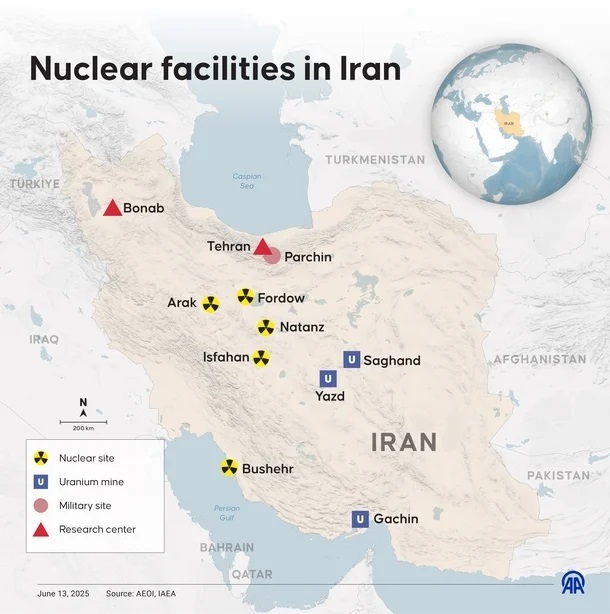
By Ty Roush, Forbes Staff. https://www.forbes.com/sites/tylerroush/2025/06/23/did-the-us-destroy-irans-uranium-supply-or-not-vance-experts-clash-with-trumps-claims/
President Donald Trump on Monday said U.S. strikes “totally destroyed” nuclear facilities in Iran and criticized “sleazebags” in the media for suggesting otherwise—but comments from Vice President JD Vance, military officials and nuclear watchdogs all suggest the damage to Iran’s nuclear program remains unconfirmed.
Key Facts
“The sites we hit in Iran were totally destroyed, and everyone knows it,” Trump wrote on Truth Social, disputing “Fake News” he claims “would say anything different in order to try and demean, as much as possible—and even they say they were ‘pretty well destroyed!’”
White House press secretary Karoline Leavitt told ABC on Monday the U.S. is “confident” Iran’s nuclear program was “completely and totally obliterated,” noting there is a “high degree of confidence” the locations the U.S. strikes took place is where Iran stored its enriched uranium and that Iran “no longer [has] the capability … to threaten the world.”
International Atomic Energy Agency chief Rafael Grossi appeared to dispute Trump’s claims in a statement earlier Monday by suggesting the agency would need to verify damage to Iran’s underground Fordow facility, including whether the site’s uranium enrichment halls were impacted, though he noted the U.S. strikes likely caused “very significant” damage.
On Sunday, Defense Secretary Pete Hegseth and Chairman of the Joint Chiefs of Staff Gen. Dan Caine said an assessment on damage to Iran’s nuclear sites was “still pending,” and Caine claimed it was “way too early for me to comment on what may or may not still be there.”
Vance, in an interview with ABC on Sunday, suggested the U.S. strikes only set back Iran’s potential to weaponize its uranium stockpile and said the U.S. was “going to work in the coming weeks to ensure that we do something with that fuel.”
Jeffrey Lewis, a professor of nonproliferation at the Middlebury Institute of International Studies at Monterey, wrote on X he was “unimpressed” by the U.S. strikes while citing satellite images of the attacks, claiming the U.S. “failed to target significant elements of Iran’s nuclear materials and production infrastructure.”
How Large Is Iran’s Uranium Stockpile?
Iran stored about 400 kilograms (about 881 pounds) of uranium enriched to 60%, near weapons-grade enrichment of 90%, according to Grossi. It’s unclear whether Iran’s uranium stockpile is still this large, Grossi noted, adding IAEA’s inspectors last verified Iran’s stockpile a “few days” before Iran’s conflict with Israel began earlier this month.
Could Iran Rebuild Its Uranium Stockpile?
It’s possible Iran could rebuild its nuclear program, but a timeline for development would depend on how much damage was done to Iran’s nuclear sites, according to the Centers for Strategic and International Studies, a U.S.-based think tank. Recent U.S. strikes would make Iran “more motivated than ever” to obtain nuclear weapons, Rosemary Kelanic, a director at the U.S.-based think tank Defense Priorities, told the New York Times. Some American officials estimated an attack on Fordow set back Iran’s nuclear program by as much as five years, the Times reported.
‘Completely & Totally Obliterated’
“Iran’s key nuclear enrichment facilities have been completely and totally obliterated,” Trump declared Saturday evening.
It is certainly unclear how “the Jewish state” will take it if Iran’s nuclear program has been damaged but remains extant.
The Iraq invasion and the bombing of Iran are acts of desperation — the conduct of a wounded, uncertain nation that went on the defensive when the Twin Towers went down and history arrived on its shores.
By Patrick Lawrence, Consortium News, 23 June 25, https://consortiumnews.com/2025/06/23/patrick-lawrence-completely-totally-obliterated/
I have heard many unhinged speeches by American presidents over the years, but — no risk of exaggeration here — Donald Trump’s as he declared “a spectacular military success” after seven B–2 bombers attacked three nuclear sites in Iran Saturday night is the barmiest of my lifetime.
“The nuclear threat posed by the world’s No. 1 state sponsor of terror?” “The bully of the Middle East?” There was this by way of a plunge into the crowded precincts of American paranoia:
“They have been killing our people, blowing off their arms, blowing off their legs with roadside bombs. That was their specialty. We lost over a thousand people and hundreds of thousands throughout the Middle East and around the world have died as a direct result of their hate.”
And for the good people out in Peoria, a decisive majority of whom, the polls say, oppose American aggression against the Islamic Republic: “I want to just say, we love you, God, and we love our great military.”
Let me remind readers, as rhetoric this base makes it easy to forget: The speaker of these words is the 47th president of the United States. Yes, the commander-in-chief.
It is difficult to take Trump’s four minutes in front of the microphone late Saturday evening the slightest bit seriously. But we must, precisely because what Trump had to say to his nation was so utterly unserious.
Donald Trump, to put this point another way, turns out to be worse than Donald Trump.
It is natural, for those with some sense of history to compare Trump’s my-God-and-my-military talk with the more craven moments of the McCarthyist 1950s, or with the John Birchers. I say it is more useful to think of that famous remark Karl Rove made during an interview conducted by Ron Suskind a year and seven months after the Bush II regime invaded Iraq.
“Faith, Certainty and the Presidency of George W. Bush” was published in The New York Times Sunday Magazine in October 2004. Suskind identifies Rove, then an adviser to the Bush White House, as “the aide,” but it was soon enough known it was he Suskind had interviewed.
The memorable passage in the Suskind piece is this:
“Guys like me were ‘in what we call the reality-based community,’ which he defined as people who ‘believe that solutions emerge from your judicious study of discernible reality.’ … ‘That’s not the way the world really works anymore,’ he continued. ‘We’re an empire now, and when we act, we create our own reality. And while you’re studying that reality — judiciously, as you will — we’ll act again, creating other new realities, which you can study too, and that’s how things will sort out. We’re history’s actors … and you, all of you, will be left to just study what we do.”
America had by then given Iraqis and the rest of the world a bitter display of what results when a nation purports to conjure realities to its liking. Trump now takes on the same preposterous project, as the ungrounded language cited above indicates.
Bush II failed extravagantly in Iraq, and Trump’s new adventure cannot but come to the same fate.
Creating reality, as if the irreducible foundations of cognition and logic are mere irritants to be set aside, may look like the very zenith of hubristic power. It is not.
The Iraq invasion and the bombing of Iran are to be read as acts of desperation — the conduct of a wounded, uncertain nation that assumed the defensive crouch when the Twin Towers went down in 2001 and history arrived on its shores — history, that process America all along thought was the burden of others.
We must bear this always in mind. Desperation is the mulch wherein recklessness germinates.
“Iran’s key nuclear enrichment facilities have been completely and totally obliterated,” Trump declared Saturday evening. Does this remind you of anything?
Maybe Bush II’s ridiculous appearance, in a bomber jacket no less after landing on board, to declare on an aircraft carrier off San Diego a few days after the Iraq invasion began, “Mission accomplished?” An infamous bit of staging,
We are already well down from “completely and totally.” By Sunday morning the Pentagon was trading in “severe damage,” catch-all vocabulary such that there is no telling what it means.
Casting further doubt on the state of matters, a digital publication called Amwaj.media reported Sunday afternoon that Washington had advised Tehran in advance of its intent to bomb and indicated the limits of its targeting. Citing “a high-ranking Iranian political source,” Amwaj said this source “also confirmed that the targeted sites were evacuated, with ‘most’ of Iran’s stockpile of enriched uranium kept in secure locations.”
Amwaj.media has its head office in Britain and publishes news and comment on West Asia in Arabic, Farsi and English. I cannot verify this report, but I am not at all inclined to discount it. It conforms, certainly, with the Trump regime’s vigorous efforts to stress that it does not seek a full-out war with the Islamic Republic.
“We have no idea where this war will go,” The New York Times declared in the headline atop an opinion piece published in its Sunday editions. “It may appear like a tactical victory less than four hours after the bombs began to fall,” W.J. Hennigan writes, “but projecting any sense of finality about this ordeal is wildly premature.”
This is so by way of facts on the ground, as the expression goes. It is certainly unclear how “the Jewish state” will take it if Iran’s nuclear program has been damaged but remains extant. The Zionist fanatics who started all this seem willing to settle for nothing short of Trump’s “completely and totally.”
But I see finality aplenty when I turn the weekend’s events 180° and consider them from this perspective. Whatever the destruction at Fordow, Isfahan and Natanz by way of the “bunker busters” those B–2s dropped, the damage the Trump regime has done to itself and the nation it pretends to govern is nearly too extravagant to reckon.
Remember “Nous sommes tous Américains,” that celebrated headline atop an editorial Le Monde published shortly after the Sept. 11, 2001, attacks? I did not then think the United States had enjoyed the world’s approval so unreservedly for decades.
The slide began two years later, with Bush II’s wanton, unquestionably illegal invasion of Iraq. The policy cliques could not since have squandered the residual good will of the postwar decades more efficiently had they tried.
It was not a question of trying, of course. It has been a question since 2001 of those planning and executing U.S. policy simply not giving a damn what the rest of the world thinks — or wanting even to know what the rest of the world thinks.
Trump just decisively clarified the point, in my judgment. Nothing other than power matters to the Americans now. If this has been true since 2001, Trump makes clear there is no turning back from this: Power is all the United States has left to give the world — or impose upon it.
“There’s no military in the world that could have done what we did tonight, not even close,” Trump declared triumphantly Saturday night. “There has never been a military that could do what took place just a little while ago.”
What a thing to boast of. So hopelessly out of sync with the 21st century. No, no other military could have done what the American did at the weekend, and no other military would ever be sent on such a mission.
I cannot imagine what some metric of global good will toward America would register now that Trump has led the United States into what looks like another war. If “completely and totally obliterated” were on the dial, the needle would be close.
As widely reported, Trump colluded with the Israelis to deceive Tehran with the suggestion that talks toward a diplomatic settlement of the nuclear question would proceed in Oman two Sundays ago. And as the Iranians prepared for another round of negotiations, Israel launched its attacks the preceding Friday.
Sucker-punching. This now seems part of America’s diplomatic repertoire.
It is hard to believe any American administration would be this craven, but Trump did the same thing again when he stated last week he would take two weeks to give diplomacy a last chance. It was a matter of a few days before the B–2s flew.
When Seymour Hersh predicted this in “What I have been told is coming in Iran,” published in his Substack newsletter last Friday, I confess I thought Sy’s neck was out a touch too far this time. I leave readers to finish the thought.
The Washington policy cliques have been more or less indifferent to statecraft for decades. Diplomacy is for the weak nations, the powerful having no need of it, former U.N. chief Boutros Boutros Ghali wrote insightfully in his memoirs. Trump just burned the bridges diplomats are supposed to build — all of them.
Who — the Russians, the Chinese, the Africans, the Latin Americans, the Europeans, the East Asians, the Indians — who will engage the Americans diplomatically any longer but with deep suspicions, deep reservations, and a profound reluctance to trust? Not to mention a well of contempt.
This is grave far beyond the Iranians, in my view. Contrary to appearances these past 25 years, diplomacy is an essential 21st century technology. B–2s and bunker busters do not seem so to me. High-technology weaponry is deployed at an ever-rising cost.
Incessant breaches of international law, cavalier abuses of the sovereignty of other nations: This will go on for who knows how long. But Trump and his people and the neoconservatives who appear to control them just went some distance destroying all possibility that the U.S. might participate in the making of a new world order.
This matters nil in Washington now, but such an order materializes as we speak, and the day will come when this foreclosed prospect will be up for regret.
I read something else in Trump’s Saturday night speech. To me it was the culmination of weeks of irrationality, a frenzy of it that led — just as the Israelis hoped it would — to senseless attacks with no logical justification.
There seems to me another kind of finality to what Trump just did. He has destroyed — completely and totally, I fear to say — rational thought as the basis of action in the name of what historians of our time will record as a rear-guard defense of raw power.
A late-phase imperium cannot do what Trump just did and then return to sound deliberations, measured policy, sophisticated statecraft. I do not now see a path to any such return.
America has long been — since 2001, again — on the way into an era of unreality, as we may as well call it. Trump just gave the nation a final shove and slammed the door behind it, to put my point another way.
When the bunker busters fell Saturday night the Trump regime created a reality all right. Look at it. Take a hard look. This is essential if some new direction is to be discovered.
Patrick Lawrence, a correspondent abroad for many years, chiefly for the International Herald Tribune, is a columnist, essayist, lecturer and author, most recently of Journalists and Their Shadows, available from Clarity Press or via Amazon. Other books include Time No Longer: Americans After the American Century. His Twitter account, @thefloutist, has been permanently censored.
Chris Hedges: War With Iran

By Chris Hedges / Original to ScheerPost, https://scheerpost.com/2025/06/22/chris-hedges-war-with-iran/
War opens a Pandora’s box of evils that once unleashed are beyond anyone’s control. The warmongers who ordered the strikes by U.S. bombers on Iranian nuclear sites have no more of a plan for what comes next in Iran than they had in Afghanistan, Iraq, Libya or Syria.
European allies, whom Israel and Trump have alienated with these air assaults, are in no mood to cooperate with Washington. The Pentagon, even if it wanted to, does not have the hundreds of thousands of troops it would need to attack and occupy Iran — the only way Iran might be subdued.
And the idea that the marginal and discredited Iranian resistance group Mujahedeen-e-Khalq (MEK), which fought alongside Saddam Hussein in the war against Iran and is viewed by most Iranians as composed of traitors, is a viable counter force to the Iranian government is ludicrous.
In all these equations the 90 million people in Iran are ignored just as the people of Afghanistan, Iraq, Libya and Syria were ignored. They will not welcome the United States and certainly not Israel as liberators. They may hate the regime, but they will resist. They don’t want to be dominated by foreign powers.
A war with Iran will be interpreted throughout the region as a war against Shiism. Soon there will be retaliation. Lots of it. It will come at first with desultory missile strikes and then attacks carried out by elusive enemies on ships, military bases and installations. Steadily it will grow in volume and lethality.
The death toll, including among the some 40,000 soldiers and Marines stationed in the Middle East, will mount. Ships, including aircraft carriers, will be targeted. We will, as we did in Iraq and Afghanistan, begin to lash out with a blind fury, fueling the conflagration we began.
Those who lured us into this war know little about the instrument of war and even less about the cultures or peoples they seek to dominate. Blinded by hubris, believing their own hallucinations, they have learned none of the lessons of the last two decades of warfare in the Middle East. A war with Iran will be a self-defeating and costly quagmire, one more nail in the rotting edifice of the empire.
1 This Month

of the week – Shut Down Drone Warfare!


Tell the Ukrainian Government to Drop Prosecution of Peace Activist Yurii Sheliazhenko

Petition to revoke the licensing of the Near Surface Nuclear Disposal Facility (NSDF) at Chalk River. https://www.ourcommons.ca/petitions/en/Petition/Details?Petition=e-7247
To see nuclear-related stories in greater depth and intensity – go to https://nuclearinformation.wordpress.com
-
Archives
- April 2026 (114)
- March 2026 (251)
- February 2026 (268)
- January 2026 (308)
- December 2025 (358)
- November 2025 (359)
- October 2025 (376)
- September 2025 (257)
- August 2025 (319)
- July 2025 (230)
- June 2025 (348)
- May 2025 (261)
-
Categories
- 1
- 1 NUCLEAR ISSUES
- business and costs
- climate change
- culture and arts
- ENERGY
- environment
- health
- history
- indigenous issues
- Legal
- marketing of nuclear
- media
- opposition to nuclear
- PERSONAL STORIES
- politics
- politics international
- Religion and ethics
- safety
- secrets,lies and civil liberties
- spinbuster
- technology
- Uranium
- wastes
- weapons and war
- Women
- 2 WORLD
- ACTION
- AFRICA
- Atrocities
- AUSTRALIA
- Christina's notes
- Christina's themes
- culture and arts
- Events
- Fuk 2022
- Fuk 2023
- Fukushima 2017
- Fukushima 2018
- fukushima 2019
- Fukushima 2020
- Fukushima 2021
- general
- global warming
- Humour (God we need it)
- Nuclear
- RARE EARTHS
- Reference
- resources – print
- Resources -audiovicual
- Weekly Newsletter
- World
- World Nuclear
- YouTube
-
RSS
Entries RSS
Comments RSS
 nuclear-news