Democrats bashing Trump, Putin summit ensuring continued destruction of Ukraine.

Walt Zlotow, West Suburban Peace Coalition, Glen Ellyn IL, 18 Aug 25
Democrats are horrified that Trump and Putin are actively seeking an end to the 3 year, 6 month US proxy war against Russia in Ukraine. They avoid entirely the imminent collapse of Ukraine’s military in Ukraine’s lost cause to enter NATO and conquer the Donbas Ukrainian separatists. Neither will ever happen as the war is lost with 4 eastern Ukrainian oblasts gone forever. NATO will never include the rump state that is left of Ukraine once they capitulate.
While Democrats have good reason to lambast Trump’s deranged domestic policies, they should be wishing him success, indeed cheering him on as he tries to extricate America for possibly the worst foreign policy blunder in its 250 years.
All 6 US administrations preceding Trump 2.0, including 3 Republicans (H.W. Bush, W. Bush and Trump 1.0), and 3 Democrats (Clinton, Obama, Biden) endlessly provoked the Russian invasion of February 22, 2022. But it was the third Democrat, virulent Russophobe Joe Biden, who made that invasion inevitable. He greenlighted Ukraine’s massing troops on the Donbas border to finish off the Ukrainian separatists in late 2021. Then he dismissed Russia’s entreaties in December to grant the separatists independence and rule out Ukraine NATO membership.
But the August 15 summit has changed the US, Russia trajectory from endless war to seeking an off ramp to peace. Alas, Democratic congresspersons and their sycophant Democratic media had their hair on fire over the summit. ‘Trump was cozying up to a war criminal dictator.’ Trump got rolled.’ ‘Trump betrayed the brave Ukrainian people.’ ‘Trump disgraced America and himself by not including Ukraine President Zelensky ‘
Democrats adhere to the party platform that forbids any support of Trump even it could alleviate Ukrainian suffering and lead to peace. Their endless rant against the Trump summit avoided any mention Ukraine is on US/NATO life support and will likely be finished on the battlefield by summer’s end.
Democrats offer nary an idea to reverse Ukraine’s imminent defeat. Nuke Russia? Nope. Offer up American cannon fodder? Nope. All they offer is ‘Tell Putin to get the hell out of Ukraine.’
Democratic leadership remains oblivious several million of the 6 million 2020 Biden voters who abandoned Harris in 2024 did so over their failed proxy war against Russia and support of Israel’s genocide in Gaza, both getting hundreds of thousands killed for nothing.
Democrats checked all the boxes demonizing Trump for attempting to end the lost US proxy war against Russia in Ukraine. They left unchecked all the boxes that offer any hope for the 70% of Ukrainians who look to America to end forthwith this nightmare war America provoked.
Whether in the White House or out, Democrats’ support of endless war is destroying their party along with the millions in Ukraine and Gaza. Their reaction to the Trump, Putin summit is Exhibit A.
Review of the Alaska meeting – The goal is always domination.
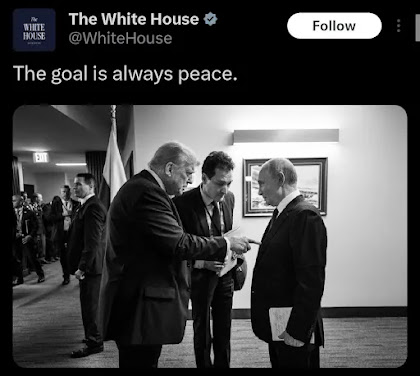
Organizing Notes, Bruce Gagnon, coordinator of the Global Network Against Weapons & Nuclear Power in Space, 16 Aug 25, https://space4peace.blogspot.com/2025/08/the-goal-is-always-domination.html?utm_source=substack&utm_medium=email
The Washington post reports in their top headline this morning the following: Trump reverses on Ukraine war ceasefire demand, aligning with Putin, splitting with allies: An immediate ceasefire to the war in Ukraine had long been a bedrock demand by the U.S., Ukraine and their European allies.
One can easily imagine that most neocons in Washington, London and the EU are pulling their hair out. Zelensky as well. His cash cow is wandering off the farm.
No immediate ceasefire was agreed upon. That was the chief demand of Zelensky, Starmer, Macon and Merz. They wanted to use that time to re-stock Ukraine with more weapons (especially drones) that could keep attacking civilians in the Donbass and inside of Russia.
Give Trump a nod (what ever his real motivations might be) he has now angered the ‘allies’ and they know that if they want the proxy war on Russia to continue (and they surely do) they are going to have to pay for it.
In one interview on Fox, Trump said the US funded Ukraine at the tune of $350 billion while the EU gave $100 billion.
Actually the US can’t afford to keep pissing money down the rat hole – especially when they want to spend that money getting ready for war with China. (And maybe still with Russia and Iran too.)
The Ukraine gamble is lost.
The oligarchic owned media in the US ensured that the Obama-Biden-Hillary Clinton orchestrated coup in Kiev in 2014 was swallowed by the people across the ‘democratic’ west. The public was firmly brainwashed to believe that Ukraine was the white hat team and Russia was the black hat bad guys.
Few know that the US-NATO started the war in 2014 and killed/wounded tens of thousands of Russian-ethnics in the Donbass region of eastern Ukraine – the place where the war is centered today.
In early 2022 Russian went into the Donbass after years of fruitless negotiations with the west to end their attacks on the Donbass. The US-NATO always wanted the war. They dreamed of breaking Russia up into pieces.
But don’t think the US has given up on its ill-fated quest to break up Russia. Alaska was just a ‘strategic retreat’. Just look at how Washington is fiddling with Armenia and Azerbaijan to destabilize another border land of both Russia and Iran.
The US is also working with Canada, Sweden, Denmark, Norway and Finland to militarize the Arctic in order to challenge Russia’s large border with that vast resource rich region.
The US-NATO only know war. Their economies are driven by military spending. Their so-called leaders are virtually all corporate apparatchiks.
And don’t forget that many of these EU-NATO leaders are related to former high level Nazi operatives during WW2.
Europe appears stuck in the quicksand of their disappearing ‘unipolar’ control. They just can’t accept that they must get along with the Global South that is rising after 500 years of colonial domination.
The US and EU got rich off the treasure they stole from the Global South. Museums across the west are loaded with treasures taken from these nations.
Trump is still about America First. That has not changed. The public in the US must campaign against the Pentagon’s trillion dollar a year offensive war machine.
That is the only way we will get true peace.
US flies nuclear bombs to Britain.

“The new nuclear bombs which are now based at Lakenheath are entirely under the control of Donald Trump and could be used without the UK having any say at all in the matter.
Nukewatch UK reveals how US nuclear gravity bombs were deployed on US soil for the first time in 17 years
By Peter Burt
US nuclear bombs were delivered to Lakenheath air base on Thursday 17 July as part of NATO plans to deploy new battlefield nuclear nuclear weapons intended for war-fighting in Europe. The following is an examination of how we know this, with an update also below.
The flight
The arrival of a special flight transporting the bombs was observed by Nukewatch UK, who judge that the evidence publicly available from our observations and flight-tracking data now supports the conclusion that nuclear weapons are based at the Lakenheath US air base in Suffolk. This article explains how the weapons were brought to Lakenheath by the US Air Force and sets out the evidence which indicates they are now stationed at the British base.
Shortly after 7 am local time on Tuesday 15 July a giant C-17 Globemaster transport aircraft, flight number RCH4574 (‘Reach 4574’), assigned to the US Air Force’s 62nd Airlift Wing left Joint Base Lewis–McChord, its home base in Washington state. The 62nd Airlift Wing is an elite, highly trained transport unit which serves as the US Air Force’s Prime Nuclear Airlift Force: the only Air Force section tasked with the role of supporting the US Department of Defence and Department of Energy with their nuclear airlift operations. The aircraft undertaking the flight was a C-17 with the serial number 08-8200, flying on high priority mission with the air force mission number PAM112271196.
The aircraft flew across the continental United States to Kirtland Air Force Base in Albuquerque, New Mexico – the hub of the US Air Force’s nuclear operations, where the largest nuclear weapons storage facility in the world is located: the Kirtland Underground Munitions Maintenance and Storage Complex(KUMMSC). KUMMSC stores a significant portion of the US nuclear arsenal, including gravity bombs and warheads.
At Kirtland the aircraft almost certainly loaded up with a cargo of anything up to 20 newly manufactured B61-12 nuclear weapons – a new, modernised version of the US Air Force’s principal nuclear gravity bomb with greater accuracy than older variants of the weapon. Manufacturing of the B61-12 variant was completed in December 2024 and the weapon is currently being rolled out on deployment. Whilst at Kirtland the aircraft was parked on Pad 5 – the section of the airbase designated for handling hazardous cargoes. Other aircraft at the airport were given a warning not to overfly the aircraft on Pad 5 for a period of over five hours, which ended only once the C-17 had departed.
Mid evening local time on Wednesday 16 July Reach 4574 took off, with the pilot reminding the ground controller that the aircraft has “haz cargo” on board. The aircraft flew through the night across the Atlantic Ocean, rendezvousing with two KC-46 tanker aircraft from Pease Air National Guard Base and McGuire Air Force Base to refuel over the ocean east of New York.
In a co-ordinated operation, a second C-17 aircraft (aircraft number 09-9211, flight number RCH4205, mission number PAM112472196) also left Lewis-McChord on 15 July and flew to Ramstein Air Force Base in Germany (stopping briefly at Lakenheath) to be on standby in the event of a failure or emergency involving the primary aircraft. This standby aircraft may have been loaded with nuclear emergency response equipment for dealing with an accident involving the primary aircraft.
Reach 4574 approached the UK flying south of Ireland, then flew up the Bristol Channel, cut across north Devon, and flew north west along a corridor taking it close to Oxford and Milton Keynes, but avoiding overflying major centres of population. The plane landed at Lakenheath air base at 12.50 local time.
Unloading the bombs
Nukewatch UK was able to observe the aircraft landing and unloading from outside the Lakenheath base. During the unloading operation base security was at an unusually high level, with USAF security patrols and police cars undertaking patrols inside the base’s security fence and plain-clothed (but badged) personnel from the Air Force Office of Special Investigations patrolling outside the base……………………………………………………………………………………………..
Nukewatch UK believes that this C-17 aircraft was transporting a batch of B61-12 nuclear weapons to Lakenheath. Our reasons for arriving at this conclusion are given below.
US nuclear weapons in Europe
The 62nd Airlift Wing regularly conducts Prime Nuclear Airlift Force missions across the Atlantic to transport materials and equipment to air bases in Europe which support NATO’s nuclear mission in Europe, under which B61 bombs are stored at US bases in Europe and bases of European nations which take part in NATO nuclear-sharing arrangements with the US. Nukewatch has been actively tracking these flights for three years, and has used archived tracking data to analyse flights since the beginning of 2020. Over this period missions have included occasional operations which have been unusually complex, involving up to seven aircraft as stand-bys and for in-flight refuelling. In addition to operations involving nuclear weapons, the unit also conducts missions transporting special nuclear materials which visit several NATO nuclear bases in Europe in sequence, and also conducts missions involving training with ground personnel at several nuclear bases.
It is possible that the earliest of these missions were training and rehearsal flights for the delivery of new B61-12 nuclear bombs to Europe, with more recent flights actually transporting the nuclear bombs across the Atlantic for deployment at bases in Europe. Nukewatch has observed that Lakenheath has been involved in many of these missions, initially as a location for basing a stand-by aircraft in Europe – possibly for use by a nuclear emergency response team. More recently Lakenheath appears to have been involved in a series of ‘work up’ exercises and security drills involving aircraft from 62 Airlift Wing to prepare the base for the arrival of nuclear weapons, culminating in a large-scale exercise over two days on 10 – 11 June 2025 which may have been a dress rehearsal for the nuclear delivery operation. ………………………………………………………………………………………………………………………………………
What we think
Speaking on the delivery of US B61-12 nuclear weapons to Lakenheath, Juliet McBride of Nukewatch UK said:
“The new nuclear bombs which are now based at Lakenheath are entirely under the control of Donald Trump and could be used without the UK having any say at all in the matter. In fact, we wonder whether the UK government has even been notified by the US Air Force that the weapons are now stationed at Lakenheath.
“The nuclear weapons now stored at Lakenheath have an explosive power of up to 50 kilotons. For comparison, the atom bomb that devastated Hiroshima in 1945 had an explosive yield of 15 kilotons. Far from protecting Europeans during wartime, these nuclear weapons would contribute to turning Europe into a radioactive wasteland.
“Despite the significant issues and risks involved in basing these weapons of mass destruction in Europe, neither the US nor the UK government have bothered to inform citizens or Parliament that they have been deployed here. Nukewatch UK believes that UK citizens have a right to know that these preparations for fighting a nuclear war are under way, and we will continue to report on nuclear movements to Lakenheath and other European nuclear bases”.
Update: Second nuclear flight arrives at Lakenheath
Following a delivery of nuclear weapons to Lakenheath US air base in Suffolk on 17-18 July 2025, a second Prime Nuclear Airlift force flew to Lakenheath on 24-25 July to delivery a high priority hazardous cargo……………………………………………………………………….
Nukewatch concludes the following:
- A high security unloading operation for hazardous materials took place at Lakenheath.
- The operation seemed to follow slightly different procedures to the one observed the previous week.
- Nevertheless, the degree of security and general circumstances of the flight seem to indicate that a nuclear-related load was probably delivered in the aircraft. This may have been components and equipment related to nuclear weapons, or possibly weapons themselves.
- Between four to six loads seemed to be transported away from the aircraft in small convoys to a location on the airbase nearby.
- Assuming two or three transporting vehicles in each convoy, and each convoy carried one nuclear bomb, this suggests that between around 8 and 18 ‘units’ of cargo were delivered by this flight. https://beyondnuclearinternational.org/2025/08/17/us-flies-nuclear-bombs-to-britain/
Trump Declares Victory After Putin Summit: The Spin Begins.
17 August 2025, Roswell, https://theaimn.net/trump-declares-victory-after-putin-summit-the-spin-begins/
The Trump-Putin summit concluded with no ceasefire or formal deal on Ukraine after nearly three hours of talks. Yet, President Trump and his supporters are framing it as a resounding success, turning a diplomatically thin outcome into a narrative of triumph.
If you listened to Trump and his loyalists, you’d think history had just been made. Trump hailed the meeting as “very productive,” rating it a “10” in a Fox News interview with Sean Hannity. He emphasised “great progress” and “many points agreed to,” though specifics remain elusive. The White House, through Press Secretary Karoline Leavitt, praised it was a restoration of dialogue benefiting U.S. interests – a claim critics argue overlooks the lack of enforceable commitments. Trump leveraged Putin’s remark that the Ukraine invasion “might not have happened” under his watch, spinning it as proof of his foreign policy prowess and a fix for “Democrat mess-ups.” The summit’s optics – red carpets, a joint press conference, and Putin’s ride in “The Beast” limo – were highlighted as symbols of American dominance, though skeptics dismissed them as stagecraft masking substantive failures.
MAGA’s Victory Lap
MAGA supporters amplified the victory lap, flooding social media with memes of Trump as a peacemaker, insisting that the world had witnessed leadership in action. Posts celebrated Putin’s praise as a global endorsement, with one user calling it a “clear winner for America” due to the “USA dominance narrative.” Others blamed Democrats for the war, framing the no-deal outcome as a deliberate dump of the “forever war” on Europe, setting the stage for future deals. The grandeur of flyovers and applause was touted as evidence of Trump’s negotiation mastery, dismissing critics as panicked. Yet, foreign policy analysts noted that without tangible concessions from Russia – such as troop withdrawals or guarantees on Ukrainian sovereignty – the summit risked being remembered as a photo op rather than a turning point.
The Spin vs. Reality
With no concrete outcomes, the summit’s legacy hinges on whose narrative sticks. Trump’s camp bets on spectacle overshadowing substance, while opponents warn that legitimising Putin without concessions undermines international law. As details emerge – and if Russian attacks continue – the “success” narrative may face harder scrutiny. For now, the world is left parsing theatrics from geopolitics, with Ukraine’s fate hanging in the balance.
Trump on Summit with Putin: We Made Great Progress Today.

Russian President Vladimir Putin concluded the summit by inviting Trump to Moscow
by Kyle Anzalone | August 15, 2025 https://news.antiwar.com/2025/08/15/trump-on-summit-with-putin-we-made-great-progress-today/
Following a three-hour meeting between Russian President Vladimir Putin and President Donald Trump, the leaders delivered brief statements at a press conference, stating that the talks were productive and constructive.
Putin spoke first, telling the press that the talks were in a “constructive atmosphere of mutual respect. We had very thorough negotiations.” He added that he hoped European governments and Ukraine would receive the agreements made with Trump “constructively” and that they would not interfere with the progress.
The Russian leader also blamed former US President Joe Biden for starting the war in Ukraine and argued that the invasion would not have happened if Trump had been the president. Trump has often claimed the conflict in Ukraine was Biden’s war, and he could have prevented the war from breaking out.
Putin noted that before the start of the war in 2022, Moscow sent Washington a proposal that would have stopped the Russian invasion of Ukraine. A core issue for the Kremlin was the growing ties between NATO and Ukraine. However, the Biden administration refused to negotiate on this point, and Putin ordered the invasion.
The Russian President said that during the Biden administration, US and Russian relations hit a post-Cold War low point. Putin expressed hope that the summit would be the start of the process to repair the ties and resolve the Ukrainian crisis.
“I believe we had a very productive meeting. There were many, many points we agreed on, I would say most of them,” Trump said. “A couple of big ones we haven’t quite gotten there, but we made some headway.”
Trump explained that no final agreement was made. “So there’s no deal until there’s a deal,” he added. He went on to say he would call European leaders and Ukrainian President Zelensky. He added that it was ultimately up to the Ukrainians to accept any agreement.
The President did not specify what issues were left unresolved, but later in his statement, he mentioned that the “most significant” issue remains unsettled.
At the end of the press conference, Putin extended an invitation to Trump to attend a summit in Moscow. “That is an interesting one. I will get a little heat on that one. But I can see it possibly happening,” Trump replied.
Friday’s meeting in Alaska also included Secretary of State Marco Rubio, envoy Steve Witkoff, Foreign Minister Sergei Lavrov, and aide Yury Ushakov.
Kyle Anzalone is the opinion editor of Antiwar.com and news editor of the Libertarian Institute. He hosts The Kyle Anzalone Show and is co-host of Conflicts of Interest with Connor Freeman.
Trump meets with Putin: the non-event that was sold as history.
16 August 2025 Michael Taylor, https://theaimn.net/trump-meets-with-putin-the-non-event-that-was-sold-as-history/
The buildup was epic. For weeks, the Trump administration talked up the meeting with Vladimir Putin as if the world was about to witness a defining moment in history. Media speculation was feverish – would there be a grand bargain on Ukraine, arms control, or even global security itself? Some even hinted it might mark the beginning of a “new era” in U.S.–Russia relations.
And then it happened.
The meeting was less “historic breakthrough” and more “awkward photo-op.” No landmark agreements were reached, no peace deals signed, no strategies unveiled. Just vague talk about “respect,” “better relations,” and “future discussions.” In other words: business as usual, wrapped in hype.
Trump will, of course, try to frame it as a personal victory – that’s his style. He even claimed afterward that Putin praised him for what he’d done for America. Maybe he did, maybe he didn’t – but given Trump’s track record of exaggerating praise, it’s hard to take the claim at face value. What we do know is that there was little of substance for anyone to point to. America’s allies were left wondering why so much diplomatic capital was spent for so little return, while adversaries quietly enjoyed the spectacle.
Putin, for his part, looked calm and unruffled. He gave away nothing, promised little, and let Trump carry the theatrics. In the end, he walked away looking like the steady hand, while Trump appeared desperate for validation.
This wasn’t the dawn of a new era. It was a reminder that in international politics, theatrics without substance are just that – theatrics. And the more often the world sees this pattern repeat, the less seriously America’s leadership is taken on the global stage.
Quebec engineering body finds former SNC-Lavalin CEO guilty on multiple counts of misconduct.

Aajah Sauter, August 12, 2025
Former SNC-Lavalin Group chief executive Jacques Lamarre has been found guilty of seven of 14 allegations of misconduct made against him by Quebec’s professional order for engineers.
Last fall, the disciplinary council of L’Ordre des ingénieurs du Québec began several days of hearings to decide whether Mr. Lamarre infringed the organization’s code of ethics and professional duties in the early 2000s when he was CEO of SNC-Lavalin, now known as AtkinsRéalis Group Inc.
These hearings followed an investigation by the Ordre’s Office of the Syndic, which then launched a formal complaint against the former engineering executive.
The Syndic made 14 separate allegations against Mr. Lamarre as part of its disciplinary complaint, which are related to previous legal cases involving the company. The allegations link broadly to SNC-Lavalin’s past business conduct as it sought contracts in Libya, as well as past political financing activities in Montreal.
Among the findings of guilt, L’Ordre concluded that SNC-Lavalin under Mr. Lamarre’s leadership directly or indirectly made payments amounting to about $2-million to the family of former Libyan leader Moammar Gadhafi, notably for expenses incurred by his son Saadi while he stayed in Canada.
Mr. Lamarre was found not guilty on allegations that he sanctioned the purchase of a luxury yacht for Saadi.
The former CEO last year denied the Syndic’s allegations. In a statement released Wednesday, Mr. Lamarre announced his resignation as a retired member of the Ordre des ingénieurs du Québec. He said he’s “disappointed” with the way the disciplinary investigation was conducted and called the ruling “deeply unfair” and “unreasonable.”
“The Syndic of the Order granted complete immunity to certain witnesses with conflicts of interest, while seeking to hold me responsible for actions for which those same witnesses were found guilty in other proceedings. ”
In early 2012, Swiss and Canadian police discovered questionable payments from SNC-Lavalin that ran through bank accounts in Switzerland and other countries. These payments were later found to be bribes to procure contracts for projects in Libya during Moammar Gadhafi’s rule, as SNC-Lavalin sought a share of contracts offered by his government.
In 2015, SNC-Lavalin and two affiliates were charged with fraud and violating Canada’s Corruption of Foreign Public Officials Act tied to its dealings in Libya. The company requested a settlement to the case, commonly known as a deferred prosecution agreement, but was denied.
SNC-Lavalin solidified an agreement with prosecutors in 2019 for the company’s construction division to plead guilty to a single charge of fraud while the corruption charge was dropped. The company agreed to pay a $280-million fine and received a three-year probation order.
In 2016, the company acknowledged that it engaged in a scheme that involved SNC-Lavalin employees being encouraged to donate to federal political parties and then be reimbursed through fake personal-expense claims, bonuses or benefits. Canadian law states that businesses cannot make financial contributions to political parties irrespective of candidates.
The company later entered into a compliance agreement with the Commissioner of Canada Elections. SNC-Lavalin also admitted that it used a similar strategy for donations to Quebec political parties.
No penalties for Mr. Lamarre were announced by L’Ordre, though it said it will set a date for sanctions. He could be revoked of his status as a professional engineer, or face fines.
“I am proud of my career and the role I played as an executive at SNC-Lavalin,” Mr. Lamarre said in his statement. “But given the ongoing conflict with the Order and the way I have been treated, I have no choice but to resign.”
It’s not ‘Who lost Ukraine?’ It’s ‘Who destroyed Ukraine?

Walt Zlotow, West Suburban Peace Coalition, Glen Ellyn IL , 15 Aug 25
When Mao won the Chinese civil war in 1949, adding China to the USSR in the roster of commie countries, the US war hawks of that era excoriated the Truman administration for ‘losing’ China’. Their unhinged claim was that the commie filled State Department made Mao’s inevitable takeover possible. That helped fuel Sen. Joe McCarthy’s equally unhinged campaign to smoke out all those imagined commies in the Truman administration a year later.
A whiff of that 1949 anti commie hysteria is playing out on mainstream media ahead of Friday’s sit down between President Trump and Russian President Putin seeking a ceasefire and end to this disastrous war destroying Ukraine.
Morning Joe Scarborough this morning pondered whether Trump will cave to evil Putin’s Ukraine dismembership demands to achieve the peace that might garner him a Nobel Peace Prize. Yep, Moring Joe laid out the ‘Who lost Ukraine’ meme on Trump to prepare us for the onslaught of anti-Trump, anti-Russian hysteria sure to follow if a settlement reflecting the reality of Ukraine’s dismembership is inked in Alaska tomorrow.
A settlement is only possible if a US/Russia settlement verifies the battlefield reality. Ukraine’s military is teetering on collapse with over a million dead cannon fodder and 4 oblasts gone to Russia forever. If Trump accomplishes peace…which is far from likely, the blame game will focus on Trump who ‘lost’ Ukraine which will end up as a greatly diminished rump state dependent on US/European life support for years to come.
Historians instead should begin with the 6 administrations preceding Trump’s second term 2.0: George H.W. Bush, Bill Clinton, W. Bush, Barack Obama, Donald Trump 1.0 and most grievously Joe Biden. H.W. Bush, Clinton, W. Bush, Obama, Trump 1.0 and Biden all promoted NATO expansion into Ukraine and dismissed all Russian security pleas that such expansion was a Red Line Russia would view as an existential threat.
While his predecessors put Ukraine on the road to destruction, Joe Biden essentially pulled the trigger on a war Ukraine had no chance of winning. Putin tried to avoid invading. He saw Ukraine massing 60,000 elite troops on the Donbas border to polish off the Ukrainian separatists there seeking independence and safety from Kyiv neo fascists. His plea of December 21 2021 was dismissed out of hand. Biden told Putin that Russia’s security interests, which included autonomy for Ukrainian separatists as well as a neutral Ukraine not in NATO, were ‘not subject to discussion whatsoever.’
Biden knew that response would provoke a Russian invasion. But Biden miscalculated that US weapons combined with draconian Russian sanctions would result in a Vietnam style defeat for Russia, possibly even the overthrow of President Putin.
So here we are three years, eight months later with Putin, not Trump holding all the cards in tomorrow’s negotiation. Trump knows the correct outcome is settling on Russia’s terms: no return of Ukraine territory, no NATO for Ukraine and a demilitarized Ukraine that can never attack inside Russia territory again. He also knows he’ll be branded by America’s ravenous war hawks as ‘The man who lost Ukraine’ should he end the war.
Nobody lost Ukraine. But we now know who destroyed Ukraine. The only question to be answered is…How severely Ukraine will be destroyed before the guns go silent.
‘A million calls an hour’: Israel using Microsoft cloud for mass surveillance of Palestine.

Aug 09, 2025 , Mikael Thalen (Tech Reporter), https://san.com/cc/a-million-calls-an-hour-israel-using-microsoft-cloud-for-mass-surveillance-of-palestine/
Summary
1 million an hour
Israel is reportedly collecting and storing as much as 1 million phone calls an hour from Palestine on Microsoft’s Azure cloud servers.
200 million hours
Since the partnership began between Microsoft and Israel in 2022, over 200 million hours of phone call audio has been captured as of July.
Used in war
The captured cell phone data from Gaza and the West Bank is reportedly being used for blackmail, detainments, arrests and airstrikes.
Full story
Israel’s military intelligence unit has been relying on Microsoft to conduct mass surveillance of phone calls from Palestine, according to a joint investigation by The Guardian, +972 Magazine and the Local Call. The operation, enabled by a customized and segregated environment on Microsoft’s Azure cloud platform, is reportedly capable of processing up to 1 million phone calls an hour.
The system launched in 2022 following a meeting the year prior between Yossi Sariel, then the commander of the intelligence agency known as Unit 8200, and Microsoft CEO Satya Nadella. Leaked internal Microsoft documents as well as interviews with 11 sources, including Microsoft staff and Israeli intelligence officials, revealed that approximately 11,500 terabytes of data, equivalent to 200 million hours of audio, was stored on Microsoft servers in the Netherlands and Ireland as of July.
The captured data has reportedly been used to target Palestinians in Gaza and the West Bank for blackmail, detention and arrest.
Arrests, detainments and airstrikes
“When they need to arrest someone and there isn’t a good enough reason to do so, that’s where they find the excuse,” a Unit 8200 source was quoted as saying.
Israel also dug through the data, according to the investigation, after carrying out airstrikes to find intelligence that could be cited as justification.
Captured phone calls are retained in the cloud for around one month. That time may be expanded to give Unit 8200 the ability to retrieve older telephone conversations involving people who become of interest, The Guardian said.
Microsoft denies knowledge
Microsoft said its CEO was not aware of the types of data that would be stored when he agreed to aid Unit 8200. An external review commissioned by Microsoft on the partnership, carried out earlier this year after the ties between the company and Israel were revealed, found no evidence that Azure was used to target or harm people in Palestine, the company said.
After the surveillance operation was uncovered, Microsoft again said that at no time was it “aware of the surveillance of civilians or collection of their cellphone conversations using Microsoft’s services, including through the external review it commissioned.”
Internal records on the 2021 meeting between Nadella and Sariel do not show that cell phone surveillance was mentioned. Instead, Sariel is said to have referred to “sensitive workloads” of secret data.
Other documents, however, suggest Microsoft engineers in both the U.S. and Israel were aware that raw intelligence, such as audio files, would be stored in the cloud environment. Israel initially reached out to Microsoft after realizing its own internal servers were incapable of storing such vast amounts of data.
“You don’t have to be a genius to figure it out,” one source said. “You tell [Microsoft] we don’t have any more space on the servers, that it’s audio files. It’s pretty clear what it is.”
Numerous Israeli sources insisted that the mass-surveillance program had saved lives by detecting and thwarting attacks on civilians. The system, however, did not prevent the Oct. 7, 2023, Hamas attack, which has been used to justify increased surveillance.
Alan Judd (Content Editor) contributed to this report.
Pentagon to Create ‘Domestic Civil Disturbance Quick Reaction Force’

“You will see them flowing into the streets of Washington“
“They will be strong, they will be tough and they will stand with their law enforcement partners.”
by Kyle Anzalone | Aug 12, 2025, https://libertarianinstitute.org/news/pentagon-to-create-domestic-civil-disturbance-quick-reaction-force/
The Department of Defense is planning to create a rapid response force of National Guard troops to quickly deploy to American cities where protests or unrest are occurring.
On Tuesday, The Washington Post reported that it obtained documents showing the Pentagon is creating a “Domestic Civil Disturbance Quick Reaction Force.”
“The plan calls for 600 troops to be on standby at all times so they can deploy in as little as one hour,” the outlet explained. “They would be split into two groups of 300 and stationed at military bases in Alabama and Arizona, with purview of regions east and west of the Mississippi River, respectively.”
One hundred troops at each base would be on standby to deploy within an hour, while the entire quick force would begin operations within 12 hours. The National Guard will be equipped with weapons and riot gear, and the deployments will be limited to 90 days to prevent burnout among the troops.
On Monday, Trump announced a major crackdown on crime in Washington, DC, by federalizing the Metropolitan DC police and deploying 800 National Guard troops to the capital city. “This is Liberation Day in DC, and we’re going to take our capital back,” Trump said during a press conference at the White House. “I’m officially invoking the District of Columbia Home Rule Act. And placing the DC Metropolitan Police under direct federal control.”
“In addition, I’m deploying the National Guard to help restore law, order and public safety,” he added.
Defense Secretary Pete Hegseth said residents of DC will soon see the National Guard in the capital. “You will see them flowing into the streets of Washington in the coming week,” he explained. “At your direction as well, sir, there are other units we are prepared to bring in — other National Guard units, other specialized units. They will be strong, they will be tough and they will stand with their law enforcement partners.”
The new quick reaction force may be deployed to other American cities if Trump perceives that there is too much crime. Trump threatened to take similar steps in other major cities, noting he hopes some of them “self-clean up.” “If we need to, we’re going to do the same thing in Chicago, which is a disaster,” the president said.
The planned force could face legal barriers as it attempts to deploy to American cities. Many Democratic led-cities may object to a Republican President deploying troops. Additionally, federal law limits the National Guard’s ability to conduct law enforcement within the U.S.
Vonnegut on Nagasaki: “The most racist, nastiest act by this country, after human slavery”

““The rights and wrongs of Hiroshima are debatable,” Telford Taylor, the chief prosecutor at Nuremberg, once said, “but I have never heard a plausible justification of Nagasaki” — which he labeled a war crime.”
Author: John LaForge, August 7, 2014, https://www.peacevoice.info/2014/08/06/vonnegut-on-nagasaki-the-most-racist-nastiest-act-by-this-country-after-human-slavery/
For the full article:
Vonnegut on Nagasaki: “The most racist, nastiest act by this country, after human slavery”
877 Words
“The rights and wrongs of Hiroshima are debatable,” Telford Taylor, the chief prosecutor at Nuremberg, once said, “but I have never heard a plausible justification of Nagasaki” — which he labeled a war crime.
In his 2011 book Atomic Cover-Up, Greg Mitchell says, “If Hiroshima suggests how cheap life had become in the atomic age, Nagasaki shows that it could be judged to have no value whatsoever.” Mitchell notes that the US writer Dwight MacDonald cited in 1945 America’s “decline to barbarism” for dropping “half-understood poisons” on a civilian population. The New York Herald Tribune editorialized there was “no satisfaction in the thought that an American air crew had produced what must without doubt be the greatest simultaneous slaughter in the whole history of mankind.”
Mitchell reports that the novelist Kurt Vonnegut, Jr. — who experienced the firebombing of Dresden first hand and described it in Slaughterhouse Five — said, “The most racist, nastiest act by this country, after human slavery, was the bombing of Nagasaki.”
On Aug. 17, 1945, David Lawrence, the conservative columnist and editor of US News, put it this way: “Last week we destroyed hundreds of thousands of civilians in Japanese cities with the new atomic bomb. …we shall not soon purge ourselves of the feeling of guilt. …we…did not hesitate to employ the most destructive weapon of all times indiscriminately against men, women and children. … Surely we cannot be proud of what we have done. If we state our inner thoughts honestly, we are ashamed of it.”
If shame is the natural response to Hiroshima, how is one to respond to Nagasaki, especially in view of all the declassified government papers on the subject? According to Dr. Joseph Gerson’s With Hiroshima Eye, some 74,000 were killed instantly at Nagasaki, another 75,000 were injured and 120,000 were poisoned.
If Hiroshima was unnecessary, how to justify Nagasaki?
The saving of thousands of US lives is held up as the official justification for the two atomic bombings. Leaving aside the ethical and legal question of slaughtering civilians to protect soldiers, what can be made of the Nagasaki bomb if Hiroshima’s incineration was not necessary?
The most amazingly under-reported statement in this context is that of Truman’s Secretary of State James Byrnes, quoted on the front page of the August 29, 1945 New York Times with the headline, “Japan Beaten Before Atom Bomb, Byrnes Says, Citing Peace Bids.” Byrnes cited what he called “proof that the Japanese knew that they were beaten before the first atomic bomb was dropped on Hiroshima.”
On Sept. 20, 1945, Gen. Curtis LeMay, the famous bombing commander, told a press conference, “The war would have been over in two weeks without the Russians entering and without the atomic bomb. The atomic bomb had nothing to do with the end of the war at all.”
According to Robert Lifton’s and Greg Mitchel’s Hiroshima in America: 50 Years of Denial (1995), only weeks after August 6 and 9, President Truman himself publicly declared that the bomb “did not win the war.”
The US Strategic Bombing Survey, conducted by Paul Nitze less than a year after the atom bombings, concluded that “certainly prior to 31 December 1945, and in all probability prior to 1 November 1945, Japan would have surrendered even if the atomic bombs had not been dropped, even if Russia had not entered the war, and ever if no invasion had been planned or contemplated.”
Likewise, the Intelligence Group of the US War Department’s Military Intelligence Division conducted a study from January to April 1946 and declared that the bombs had not been needed to end the war, according to reports Gar Alperovitz in his massive The Decision to Drop the Atomic Bomb. The IG said it is “almost a certainty that the Japanese would have capitulated upon the entry of Russia into the war.”
Russia did so, Aug. 8, 1945, and as Ward Wilson reports in his Five Myths about Nuclear Weapons, six hours after news of Russia’s invasion of Sakhalin Island reached Tokyo — and before Nagasaki was bombed — the Supreme Council met to discuss unconditional surrender.
Experiments with hell fire?
Nagasaki was attacked with a bomb made of plutonium, named after Pluto, god of the underworld earlier known as Hades, in what some believe to have been a ghastly trial. The most toxic substance known to science, developed for mass destruction, plutonium is so lethal it contaminates everything nearby forever, every isotope a little bit of hell fire.
According to Atomic Cover-Up, Hitoshi Motoshima, mayor of Nagasaki from 1979 to 1995, said, “The reason for Nagasaki was to experiment with the plutonium bomb.” Mitchell notes that “hard evidence to support this ‘experiment’ as the major reason for the bombing remains sketchy.” But according to a wire service report in Newsweek, Aug. 20, 1945, by a journalist traveling with the president aboard the USS Augusta, Truman reportedly announced to his shipmates, “The experiment has been an overwhelming success.”
US investigators visiting Hiroshima Sept. 8, 1945 met with Japan’s leading radiation expert, Professor Masao Tsuzuki. One was given a 1926 paper on Tsuzuki’s famous radiation experiments on rabbits. “Ah, but the Americans, they are wonderful,” Tsuzuki told the group. “It has remained for them to conduct the human experiment!”
~~~~~~~~~~~~~~~
John LaForge is a Co-director of Nukewatch, a nuclear watchdog and environmental justice group in Wisconsin, edits its quarterly newsletter, and writes for PeaceVoice.
Reckon you can put a nuclear reactor on the Moon?
You have until Thursday August 21 to respond if you do
The Register, Richard Speed, Fri 15 Aug 2025
NASA’s plans to put a nuclear reactor on the Moon have moved on – the agency has now put out a Request For Information (RFI) to gauge industry interest in the project.
An RFI is not an invitation to bid for the work. Interested parties need to register their interest by 21 August, and only later, there’s a chance that they could be used to “finalize a potential opportunity later this year.” It comes after a directive from NASA Acting Administrator Sean Duffy that called for the US to be the first to put a nuclear reactor on the Moon.
Things will need to move fast if the agency is to meet the goal of being ready to launch by the first quarter of fiscal year 2030.
Dubbed the Fission Surface Power System, the reactor must have a mass of less than 15 metric tons, have a minimum power output of 100 kWe, and utilize a closed Brayton cycle power conversion system.
NASA is no stranger to nuclear power. It had rovers and spacecraft powered by the technology and has looked into Brayton cycle power conversion for nuclear electric propulsion on Mars missions [PDF].
The Apollo missions used Radioisotope Thermoelectric Generators (RTGs) to power experiments to be left on the lunar surface. These contained plutonium-238, and one returned to Earth on Apollo 13, remaining on the lunar module. The container for the plutonium is now at the bottom of the Pacific Ocean, and no release of radiation has been detected.
One hundred kilowatts of power is, however, an order of magnitude greater than the nuclear power sources launched by NASA to date. It would be enough to power the International Space Station (ISS), which currently charges its batteries using electricity generated by solar arrays attached to the outpost………………………https://www.theregister.com/2025/08/15/nuclear_moon/
Does Trump have the guts to end America’s lost proxy war against Russia?
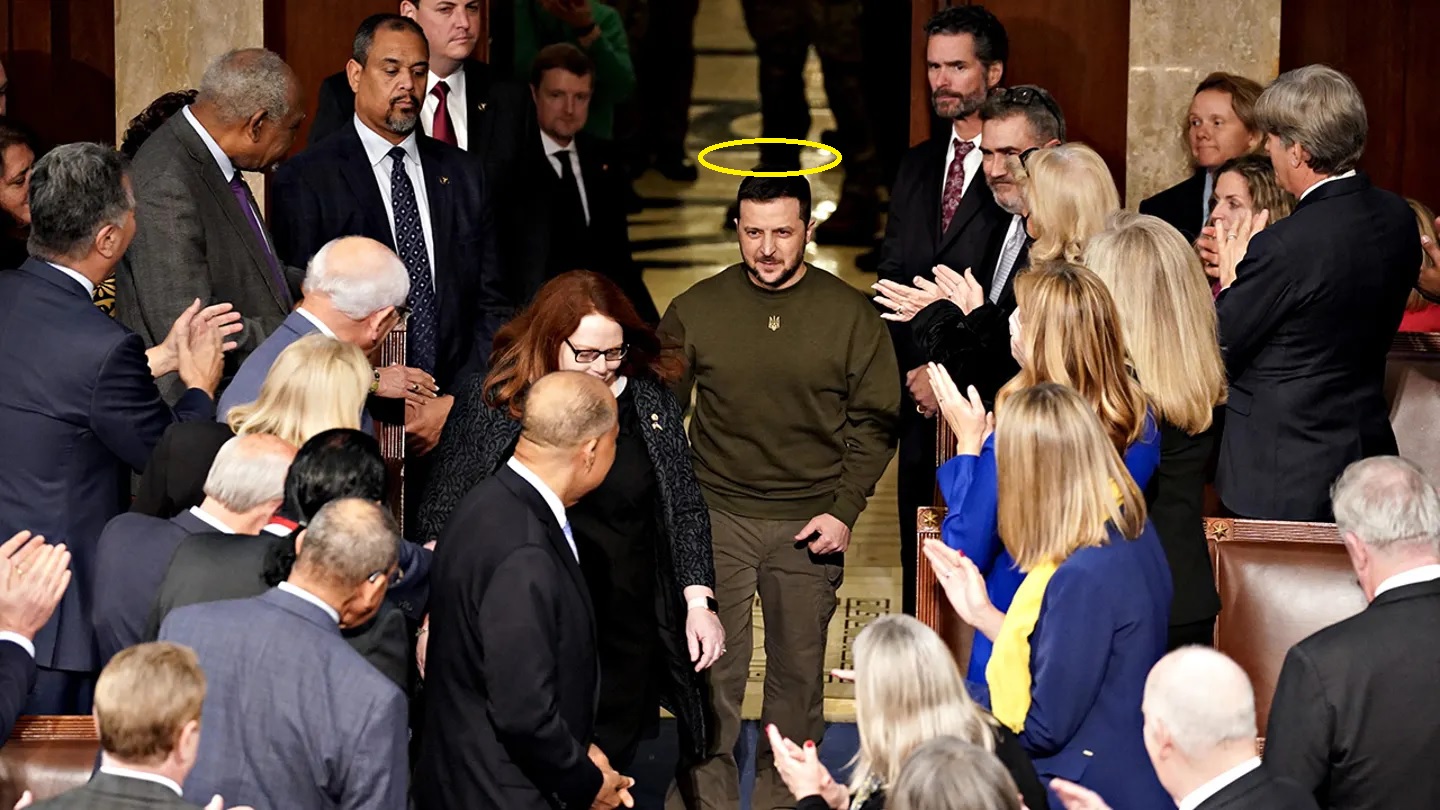
Walt Zlotow, West Suburban Peace Coalition, Glen Ellyn IL, 12 Aug 25.
For seven months Trump has reneged on his promise to end in one day America’s proxy war against Russia destroying Ukraine. Ukraine loses more soldiers and more territory every day with no chance of prevailing.
Tho a one day settlement was impossible, Trump came close to following thru by publicly berating Ukraine President Zelensky for continuing the war and threatening to cease all US weapons which keep Ukraine fighting. Then he pivoted back to war, demanding Russia’s Putin implement immediate ceasefire or face draconian sanctions. Putin responded to that nonsense with increased military attacks. Now with the upcoming summit this Friday, Trump has the opportunity to achieve peace in Ukraine.
Russia has already signaled concessions to achieve ceasefire. According to the Wall Street Journal, Russia told US envoy Steve Witkoff Russia would implement a full ceasefire if Ukraine would withdraw its remaining troops in the Donbas almost entirely controlled by Russia. In return Russia would freeze the lines in Kherson and Zaporizhzhia, the other 2 Ukraine oblasts Russia demanded full control over, rather than push on for full annexation. Russia would require Ukraine to remain neutral between East and West, giving up all intentions to join NATO.
Implementing that ceasefire would be a good start to permanently ending hostilities. But neither Ukraine President Zelensky nor European NATO leaders have bought into this sensible solution.
Zelensky maintains his delusional refusal to give up a single square mile of territory that will never return to Ukraine control. He could have kept every square mile of territory had he completed the peace deal with Russia in April 2022 that the US and UK sabotaged. Seventy percent of Ukrainians want the war to end forthwith. But the fool Zelensky keeps demanding ‘push on.’
European NATO leaders, especially UK’s Starmer, France’s Macron and Germany’s Merz are still committed to this failed war to maintain NATO dominance and isolation of Russia. They fear the loss of the US gravy train that pumps up their economies. They are as delusional as Zelensky.
Trump’s third obstacle to peace is the US national security state which abhors the US losing a senseless war of choice. War fanatics like Senator Lindsey Graham and retired generals paid off by the weapons makers, dominate mainstream news condemning inevitable US surrender. No voice for ending this proxy war madness is allowed to pitch peace on the airwaves or op ed columns. They will pound on Trump relentlessly should he chalk up another US war loss, albeit one bringing peace to Ukraine.
The only ceasefire and permanent war settlement possible will go down as a US/NATO defeat. Wonderful. NATO needs to disband as it has gone on trying to weaken, isolate Russia 34 years after becoming obsolete upon dissolution of the USSR in 1991.
Does Trump have the guts to force a settlement that overcomes the resistance of Zelensky, NATO leaders and the US war party? We may soon find out.
Trump’s Suicidal Nuclear Brinksmanship

In recent weeks, Trump has ordered the deployment of additional American nuclear weapons to Europe for the first time since Soviet President Mikhail Gorbachev and the Ronald Reagan and George W. Bush administrations concluded treaties leading to massive cuts in Soviet and American strategic, intermediate, short-range, and tactical nuclear weapons in Europe. In other words, he has negated the results of years of arms control efforts and decades of nuclear arms comity with Moscow.
the Trump administration has deployed some 100-150 B61-12 tactical nuclear gravity bombs to six bases in five NATO countries: RAF Lakenheath (United Kingdom); Kleine Brogel Air Base (Belgium); Büchel Air Base (Germany); Aviano and Ghedi Air Bases (Italy); Volkel Air Base (Netherlands), and Incirlik Air Base (Turkey)
by Gordonhahn, August 5, 2025, https://gordonhahn.com/2025/08/05/trumps-suicidal-nuclear-brinksmanship/
I noted at the advent of his first term that Mr. Trump would be good for US domestic politics, especially the economy but bad for foreign policy and that is bearing out again in this second term. It is one thing for a political leader to loosely play with language that circles around making a nuclear threat, as Russian Security Council Deputy Head and former Russian President Dmitrii Medvedev has done again recently in a public social net spat with US President Donald Trump. But it is quite another to play global chess with the repositioning of nuclear forces to actually threaten another country, especially another nuclear power of equal if not superior nuclear weapons strength. No matter, that is precisely what President Trump has been doing of late. Not even the clueless, corrupt, and strategically incompetent Biden and Obama administrations made such a foolish move.
Trump responded to Medvedev’s verbal assault by making a material nuclear threat against Russia. He announced he had redeployed to US nuclear submarines closer to Russia – an act of open nuclear threat and intimidation.
But that is not even the whole story. Trump’s nuclear sabre-rattling relates to much more than ‘merely‘ forward deploying two nuclear submarines a spart of a self-declared threatening of Moscow.
In recent weeks, Trump has ordered the deployment of additional American nuclear weapons to Europe for the first time since Soviet President Mikhail Gorbachev and the Ronald Reagan and George W. Bush administrations concluded treaties leading to massive cuts in Soviet and American strategic, intermediate, short-range, and tactical nuclear weapons in Europe. In other words, he has negated the results of years of arms control efforts and decades of nuclear arms comity with Moscow. As Larry Johnson has noted, the Trump administration has deployed some 100-150 B61-12 tactical nuclear gravity bombs to six bases in five NATO countries: RAF Lakenheath (United Kingdom); Kleine Brogel Air Base (Belgium); Büchel Air Base (Germany); Aviano and Ghedi Air Bases (Italy); Volkel Air Base (Netherlands), and Incirlik Air Base (Turkey) (https://open.substack.com/pub/larrycjohnson/p/trump-escalates-nuclear-threat-to?r=1qt5jg&utm_medium=ios).
All this comes on the background of a NATO(US)-Russia Ukrainian War and an imminent Russian-American nuclear arms race, given the expiration of the New START nuclear arms treaty coming in seven months, not to mention Trump’s apparent last ditch attempt to revive Russian-Ukrainian negotiations and transition to normal US-Russian relations with his roaming negotiator Steven Witkoff’s visit to Moscow this week. Perhaps, this is Mr. Perhaps this is Trump’s provocative way of opening up discussions on renewing or replacing the expiring New START (https://gordonhahn.com/2025/05/23/a-new-new-start-putin-sees-trump-administration-as-a-window-of-opportunity-for-strategic-arms-control/).
Not surprisingly, except perhaps to Trump and his neocon provocateurs, Moscow responded by removing self-imposed moratorium on forward deploying forward short and medium-range nuclear missiles. This might be a bit of a ruse for now, since in June 2023 Russia deployed nuclear missiles to Belarus, as NATO persisted in conducting the Ukrainian War it clearly provoked and in April 2022 blocked prevention of. Mr. Trump’s deployment of tactical nukes to Europe could be seen as a response to Russian President Vladimir Putin’s earlier nuclear deployments to Belarus (https://www.reuters.com/world/europe/belarus-has-started-taking-delivery-russian-tactical-nuclear-weapons-president-2023-06-14/). But the nuclear submarine redeployment cannot be so viewed, and the redeployment of tactical nukes to Europe comes too long after the Russian deployment to Belarus to be convincing as such.
The Western imperative of escalation in and around Ukraine after provoking the war by way of battlefield and geostrategic escalations in Ukraine is clear and undeniable. From blocking the April 2022 Istanbul peace agreement to providing offensive rather than just defensive weapons, from first providing Ukraine with tanks and armoured personnel carriers, then artillery systems, then fighter jets, mid-range missiles, and soon perhaps longer-range ones, the West has taken every opportunity to escalate the war rather than negotiate an end to it.
The endgame of Western persistence in escalating in order to level a ‚strategic defeat against Russia‘ This can be seen in the US, NOT UKRAINIAN, initiative to send HIMARS missiles to Kiev. For it was not Ukraine that requested the supply of HIMARS to Kiev, but rather it was American generals who did. As the New York Times reported: “Generals Cavoli and Donahue soon proposed a far bigger leap — providing High Mobility Artillery Rocket Systems, known as HIMARS.” “When the generals requested HIMARS, one official recalled, the moment felt like ‘standing on that line, wondering, if you take a step forward, is World War III going to break out?’” (https://archive.is/Fdwq3). This also can be seen in the proposal by some Biden-era US officials, according to the New York Times, to ‚return‘ nuclear weapons to Ukraine (www.nytimes.com/2024/11/21/us/politics/trump-russia-ukraine-war.html). This would end either in a pre-emptive Russian nuclear strike or massive conventional one, using the likes of Oreshkin missiles, that would finish off the process of Ukraine‘s Second Great Ruin. This is suicidal brinksmanship and over what? NATO’s expansion to Ukraine.
Mr. Trump is returning to this stupid, futile, and dangerous Biden-era escalation policy, even as he ostensibly pursues a Ukrainian peace process. But Trump’s innovation is to escalate at the nuclear level, threatening a security-vigilant Moscow with a nuclear first strike in eastern Ukraine or the homeland proper. Continuing this petulant foolishness, as I have noted repeatedly in the course of the decade-long Ukrainian crisis, cannot end well.
Nuclear developers turn to Special Purpose Acquisition Companies.
Three nuclear energy developers are seeking to raise more than $500mn
through mergers with special purpose acquisition companies as investors
rush to tap into an atomic energy boom.
Terra Innovatum, Terrestrial Energy
and Eagle Energy Metals said the transactions, which they expected to be
completed by the end of the year, would accelerate the development of small
modular reactors.
Several other companies developing nuclear technologies
are considering listings via initial public offerings, including Holtec
International and Quantum Leap Energy, a division of ASP Isotopes.
“Investors now realise that nuclear energy is here to stay because it is
needed to power the artificial intelligence revolution and this is
turbocharging interest, particularly in the US,” said Nick Lawson, the
chief executive of Ocean Wall, an investment group advising ASP Isotopes on
the QLE spin off.
Shares in nuclear energy companies surged near record
highs last week as optimism about a nuclear renaissance gathered pace owing
to AI power demand and political support from the Trump administration.
Last month Westinghouse outlined plans to build 10 large nuclear reactors
in the US at a meeting in Pittsburgh attended by President Donald Trump,
who has set a target of quadrupling American nuclear power capacity in the
next 25 years.
FT 11th Aug 2025, https://www.ft.com/content/087f3fac-52ca-4ca7-8827-734125af4a2b
1 This Month

of the week – Shut Down Drone Warfare!


Tell the Ukrainian Government to Drop Prosecution of Peace Activist Yurii Sheliazhenko

Petition to revoke the licensing of the Near Surface Nuclear Disposal Facility (NSDF) at Chalk River. https://www.ourcommons.ca/petitions/en/Petition/Details?Petition=e-7247
To see nuclear-related stories in greater depth and intensity – go to https://nuclearinformation.wordpress.com
-
Archives
- April 2026 (114)
- March 2026 (251)
- February 2026 (268)
- January 2026 (308)
- December 2025 (358)
- November 2025 (359)
- October 2025 (376)
- September 2025 (257)
- August 2025 (319)
- July 2025 (230)
- June 2025 (348)
- May 2025 (261)
-
Categories
- 1
- 1 NUCLEAR ISSUES
- business and costs
- climate change
- culture and arts
- ENERGY
- environment
- health
- history
- indigenous issues
- Legal
- marketing of nuclear
- media
- opposition to nuclear
- PERSONAL STORIES
- politics
- politics international
- Religion and ethics
- safety
- secrets,lies and civil liberties
- spinbuster
- technology
- Uranium
- wastes
- weapons and war
- Women
- 2 WORLD
- ACTION
- AFRICA
- Atrocities
- AUSTRALIA
- Christina's notes
- Christina's themes
- culture and arts
- Events
- Fuk 2022
- Fuk 2023
- Fukushima 2017
- Fukushima 2018
- fukushima 2019
- Fukushima 2020
- Fukushima 2021
- general
- global warming
- Humour (God we need it)
- Nuclear
- RARE EARTHS
- Reference
- resources – print
- Resources -audiovicual
- Weekly Newsletter
- World
- World Nuclear
- YouTube
-
RSS
Entries RSS
Comments RSS
 nuclear-news