U.S. General Considered Nuclear Response in Vietnam War, Cables Show, By David E. Sanger, NYT, Oct. 6, 2018 WASHINGTON — In one of the darkest moments of the Vietnam War, the top American military commander in Saigon activated a plan in 1968 to move nuclear weapons to South Vietnam until he was overruled by President Lyndon B. Johnson, according to recently declassified documents cited in a new history of wartime presidential decisions.
The documents reveal a long-secret set of preparations by the commander, Gen. William C. Westmoreland, to have nuclear weapons at hand should American forces find themselves on the brink of defeat at Khe Sanh, one of the fiercest battles of the war.
With the approval of the American commander in the Pacific, General Westmoreland had put together a secret operation, code-named Fracture Jaw, that included moving nuclear weapons into South Vietnam so that they could be used on short notice against North Vietnamese troops.
Johnson’s national security adviser, Walt W. Rostow, alerted the president in a memorandum on White House stationery.
The president rejected the plan, and ordered a turnaround, according to Tom Johnson, then a young special assistant to the president and note-taker at the meetings on the issue, which were held in the family dining room on the second floor of the White House………..
Had the weapons been used, it would have added to the horrors of one of the most tumultuous and violent years in modern American history. Johnson announced weeks later that he would not run for re-election. The Rev. Dr. Martin Luther King Jr. and Robert F. Kennedy were assassinated shortly thereafter.
The story of how close the United States came to reaching for nuclear weapons in Vietnam, 23 years after the atomic bombings of Hiroshima and Nagasaki forced Japan to surrender, is contained in “Presidents of War,” a coming book by Michael Beschloss, the presidential historian.
……….The incident has echoes for modern times. It was only 14 months ago that President Trump was threatening the use of nuclear weapons against North Korea — which, unlike North Vietnam at the time, possesses its own small nuclear arsenal.
………And before he was dismissed in 1951 by President Harry S. Truman, Gen. Douglas MacArthur explored with his superiors the use of nuclear weapons in the Korean War. Truman had feared that MacArthur’s aggressive strategy would set off a larger war with China, but at one point did move atomic warheads to bases in the Pacific, though not to Korea itself…….
We understand bringing jobs to the state has been the governor’s chief priority and achievement, and it is one economic benefit of the project. But utility customers should only have to pay for their electric power, not a jobs program without end or limits on how much is spent.
The project, the nation’s only nuclear plant construction still ongoing, is already a year overdue, nowhere near finished and $1 billion overbudget. final cost is expected to reach near $27 billion, more than twice the original $13 billion price tag. Last year’s bankruptcy filing of the project’s lead contractor, Westinghouse, set the deadline back even further.
Yet late last year, the Georgia Public Service Commission fended off pressure from ratepayers and anti-nuclear advocates and voted to back Georgia Power’s request to continue the work.
But now, after years of seemingly exhaustive support for an enterprise with no limits, some are finally fed up enough to say no.
The most recent and crucial rebellion came recently from one of the project’s partner utilities. Oglethorpe Power threatened to pull out of the reactor construction if some effort wasn’t made to ease its financial commitment. Oglethorpe is one of three smaller electric membership corporations that serve as junior partners in the project along with Georgia Power and its parent, the Southern Company.
But though Georgia Power is a for-profit with shareholders to help shoulder the costs, smaller EMCs don’t have that flexibility and must make their customers bear the funding burden.
Oglethorpe balked at reaffirming its partnership and argued its case to lawmakers for relief. They seemed to find sympathetic ears, with 20 legislators, including Hall County Sen. Butch Miller and other influential leaders, urging the partners to consider a cap on the project’s costs before more losses are passed on to consumers.
The new deal doesn’t exactly do that, but it does to ensure that further cost overruns will be shared more equitably among Georgia Power and the owners of the project — Georgia Power, Oglethorpe Power, the Municipal Electric Authority of Georgia and Dalton Utilities. Specifically Georgia Power must take on a greater portion of future deficits.
Yet even with a somewhat more reasonable deal for the owners, it could still leave ratepayers on the hook for the extra costs as the project wobbles toward the finish line.
“We’re very concerned about today’s announcement because it’s clear the Plant Vogtle nuclear project is in serious trouble if this much arm twisting is necessary to keep all four partners at the table,” Stephen Smith, executive director of Southern Alliance for Clean Energy said in an emailed statement.
Liz Coyle, executive director of consumer advocate Georgia Watch, said it “appears the owners have decided to plow ahead with a project that holds continued uncertainty and certainly clear risk of major cost increases and very little, if any true protections for Georgia’s electric customers.”
It’s worth noting that in addition to those who see the reactor construction as an endless money pit, others object over the viability and safety of nuclear power as a long-term solution to ease off carbon-based fuels.
Defenders of the Vogtle reactors argue that the jobs it creates in that part of the state justify its support. Among them is Gov. Nathan Deal, who urged Oglethorpe to stay with construction plans “before walking away from 7,000 Georgia jobs.”
We understand bringing jobs to the state has been the governor’s chief priority and achievement, and it is one economic benefit of the project. But utility customers should only have to pay for their electric power, not a jobs program without end or limits on how much is spent.
Oglethorpe’s resistance to continuing without some guarantees was timely and needed, but it’s only the first step. The only way to ensure customers won’t have to keep paying more is if legislators insist on the cost caps they suggested. Perhaps that would accomplish what the Public Service Commission has thus far been unwilling or unable to do to rein in cost overruns.
Remember, that five-member board voted unanimously last year to allow the utilities to keep charging customers for its boondoggle. It fits the profile of a state agency that over the years has seldom met a rate hike it wouldn’t rubber-stamp for utilities, many of which provide campaign donations to its members.
Yet Georgians do get a say in how this plays out. There’s a statewide election in less than a month and two PSC seats are on the ballot. Perhaps if commissioners got a message from voters making it clear they’re tired of footing the bill, the board wouldn’t be as eager to keep signing off on this and other costly ventures.
Customers of Georgia Power and its partner EMCs already have paid more than their fair share to get the reactors on line. Even if the plant is finished and begins turning out electrical power, it will take years to recoup what has been invested. It’s time to unplug ratepayers from the burden and let the big corporation’s shareholders take that responsibility.
Even the strongest advocates for nuclear power as a replacement for carbon-based energy have to understand there isn’t an endless supply of construction money in the pockets of Georgia utility consumers.
When the nuclear era ends: Struggling Zion, Ill., a lesson for Lacey Township, Press of Atlantic city, MICHELLE BRUNETTI POST Staff Writer , 7 Oct 18
More than 20 years after its nuclear plant closed, Zion, Illinois, is still dealing with the financial and community repercussions of its loss, says its mayor.
Almost all of the $19 million in annual property taxes the dual-reactor plant paid while in operation — about half the town’s tax base — disappeared.
“In five years it went down to $750,000 a year,” Zion Mayor Al Hill said of tax payments from the plant. “We are still trying to figure out how to dig out from under financial troubles created by the closing 20 years later.”
Lacey Township, where the Oyster Creek nuclear plant just closed, is similar in size to Zion — both have populations of about 25,000. Both nuclear plants were owned and operated by Exelon Generation.
But differences in how reliant the towns are on property taxes from their plants may save Lacey from a similar fate……….
Hill said the town knew when the plant was proposed it would have to live with an eyesore of a nuclear power plant. But the plant brought in tax dollars and a lot of jobs, he said, so people decided to go along with the tradeoff.
“But now we have spent fuel storage,” Zion Mayor Al Hill said, which wasn’t part of the agreement………
The spent fuel at Zion is guarded by armed guards with automatic weapons 24 hours a day, seven days a week.
“It’s behind a bunkered building,” Hill said, with the dry casks stored above ground. “You don’t need to do that if nothing can go wrong.”
Exelon officials said at a recent press conference that most of the 700 acre site in Lacey can be redeveloped after decommissioning, even with 753 metric tons of spent fuel stored there. Only the area right around the fuel would be off limits, they said.
But Hill said it won’t be a high value development, such as condos or a resort. That would require a developer to risk too much money, should an accident or attack happen.
Hill, like Lacey Township’s Juliano, is trying to get his U.S. Senators to back a bill to pay towns that host nuclear plants for acting as interim storage facilities for spent fuel rods. The rods are leftover from plant operation and must be carefully stored for hundreds of years or more.
The bill, H.R. 3053, the Nuclear Waste Policy Amendments Act of 2018, is co-sponsored by New Jersey’s Republican Congressman Tom MacArthur. The House of Representatives passed it in May, said MacArthur. But it has not come up for a vote in the Senate, and Juliano said he has not been able to get either of New Jersey’s senators to pay attention to the bill.
But the Energy and Water, Legislative Branch, and Military Construction and Veterans Affairs Appropriations Act of 2019 — H.R. 5895 — has passed and requires the Department of Energy to report on funding for municipalities hosting closed nuclear power plants. It awaits President Donald Trump’s signature.
Exelon transferred its license for the Zion plant to EnergySolutions of Salt Lake City, Utah, for the decommissioning. But Exelon will take the property back and be responsible for longterm storage of spent fuel after the cleanup of the site.
EnergySolutions got control of a $680 million decommissioning fund paid for by ratepayers.
“It’s gone, and they are not done yet,” said Hill, who said the company must come up with the funds to finish. “They are going to finish. They want to do more (cleanups).”
Exelon wants to sell the Oyster Creek plant outright to Holtec International of Camden, which would take over its $900 million decommissioning fund, keep the land and be responsible for handling the spent fuel rods until the federal government finds a storage solution for them.
The NRC said it started reviewing the potential sale this week and usually takes about a year to make a decision. But it will try to finish its review in eight months, at the request of Holtec and Exelon.
Hill cautions Lacey officials and residents not to rely on Exelon for help.
“Be careful. They are not going to do anything for you,” said Hill. “They have a responsibility to their shareholders. Your responsibility is to your constituents.”
In a speech on Oct. 2 in Brussels, U.S. Ambassador to NATO Kay Bailey Hutchison demanded that Russia return to complying with the Intermediate-Range Nuclear Forces (INF) Treaty or else the United States would be forced to develop its own non-INF-compliant weapons to match Russian capabilities. In response, Russian Foreign Ministry spokeswoman Maria Zakharova said that “It seems that people who make such statements do not realize the level of their responsibility and the danger of aggressive rhetoric.”
Some Background on the INF
The INF Treaty is a key arms control pact between the United States and Russia that halted a destabilizing buildup of intermediate-range nuclear missiles in Europe during the 1980s. The pact served as a cornerstone in efforts to end the Cold War. Recently, however, the United States has accused Russia of developing, testing and deploying a type of cruise missile that violates the limits set by the INF, and Moscow in turn has accused Washington of deploying drones and missile launchers that violate the terms of the treaty.
Over the past year, the United States has tried various tactics to get Russia to comply with the treaty. Washington has sanctioned Russian officials and tried to pressure Moscow by deploying tactical nuclear weapons aboard its submarine-launched ballistic missiles. The U.S. Congress has also passed legislation that would pave the way for the development of a missile that, if fielded, would violate the INF treaty. None of these measures appear to have worked yet; the United States and its NATO allies insist that the Russians are still in violation of the treaty.
Why It Matters
Hutchinson’s statements show that the White House is clearly determined to follow Congress’ lead in considering the deployment of U.S. missiles that violate the INF. The first open INF violations from both the United States and Russia will likely lead to many more violations that could kill the already fragile treaty. The demise of the INF would further catalyze a budding and potentially highly destabilizing arms race between the United States and peer competitors Russia and China. It would also be deeply alarming to Washington’s European allies, who would once again sit between Russian and U.S. intermediate range nuclear missile arsenals, just as they did during the Cold War.
An additional concern is that an ugly fight over the status of the INF could spill over into negotiations for the renewal of the other big global nuclear arms control treaty: the New START treaty, which limits the number of U.S. and Russian deployed strategic nuclear weapons and launchers. Unlike the INF, New START is nominally on much surer ground, as Russia and the United States both already have so many strategic nuclear weapons that there are few major incentives to violate it. However, mistrust from the demise of the INF could potentially erode New START anyway. This outcome, although unlikely for now, would lead to a far more serious arms race than is currently taking place.
Utilities just voted to continue Vogtle reactor construction; residents want cleanup, By Jeremy Deaton, Nexus Media
You could be forgiven for taking a Geiger counter on a visit to Shell Bluff, Georgia. The town lies just across the Savannah River from a nuclear weapons facility and just down the road from an aging nuclear power plant. The river is one of the most toxic waterways in the country. The weapons facility is one of the most contaminated places on the planet, and the power plant is about to double in size.
Locals are outraged.
“We believe that Plant Vogtle is going to exacerbate the existing contamination that’s already in the area and make things worse,” said Lindsay Harper, deputy director of Georgia WAND, a women-led advocacy group working to end nuclear proliferation and pollution. “We believe that more money should be put toward cleaning up the contamination instead of continuing to produce more.”
Organizers from Georgia WAND and other advocacy groups gathered in Atlanta recently to discuss Plant Vogtle and related environmental issues and to register voters. The town hall marked the first stop on a bus tour organized by environmental leaders from across the South.
The Freedom to Breathe Tour will highlight environmental hazards facing marginalized communities — starting with the expansion to Plant Vogtle, the only nuclear project under construction in the country.
In 2009, Southern Company began building two reactors, which are expected to go online in 2021 and 2022, respectively. The expansion has stoked fears of contamination in what is already a heavily polluted area, leading advocates to call for more testing.
“We need independent monitoring in the area that can help us to paint a larger, broader picture of what’s actually going on,” Harper said.“We need more information. We need more money for information.”
CNN Report – Plant Vogtle
Both the power plant and the weapons facility across the river produce a radioactive form of hydrogen called tritium that has been tentatively linked to Down syndrome in infants. Monitoring has found “elevated levels” of tritium in the groundwater near Plant Vogtle — too little to threaten public health, officials say, but enough to raise eyebrows.
Locals are also worried that pollution from the plant may be causing cancer. Epidemiologist Joseph Mangano found evidence of an uptick in infant mortality and cancer deaths in Burke County, seat of Plant Vogtle, after the facility went online in 1987. It is unclear if the power plant was responsible for the increase.Research has shown that children exposed to radiation are more susceptible to cancer — leukemia, in particular — but it is unclear if nuclear power plants produce enough radiation to threaten public health.
Studies in Germany and France found that the rate of childhood leukemia was significantly higher near power plants, and a study in the United States found that nuclear plant closures were followed by a decline in childhood cancer.
However, similar studies, including one undertaken by the National Cancer Institute, found no evidence of a link. To settle the matter, the federal government undertook a multi-year study on nuclear power and cancer in 2010, but it prematurely halted that effort in early 2017.
Adding to the uncertainty, the federal government stopped paying for monitoring of contamination near Plant Vogtle in 2003, believing the power plant posed little risk. To allay public concerns about radiation, the government is funding an outreach effort to reassure residents that the facilities are harmless, but locals remain unconvinced. Advocates want more rigorous testing and continued research into the risks of exposure to even low levels of radioactive waste……….
Some, however, believe that nuclear is simply too costly and have called for more investment in batteries that can store power generated by solar and wind for when it’s needed.
This is the outcome that locals are hoping for. Many Burke County residents are employed by Plant Vogtle, but they would rather work in wind or solar. “People are having to choose between feeding their families and taking a job that may contaminate their body,” Harper said, referring both to the power plant and the weapons facility. “We want to put our money towards civilians and people, clean economies and clean, sustainable jobs.” https://beyondnuclearinternational.org/2018/09/30/the-most-contaminated-corner-of-georgia/
The bill reinforces the administration’s efforts to revitalize the U.S. nuclear industry. GreenTech Media
JULIA PYPEROCTOBER 01, 2018“…….On Friday, President Trump signed the Nuclear Energy Innovation Capabilities Act (NEICA), which passed earlier last month with bipartisan support. The bill is expected to speed up the development of advanced reactors in the U.S. by eliminating several of the financial and technological barriers standing in the way of nuclear innovation…….
NEICA was designed to foster collaboration between the public and private sectors, building on relationships formed under the Department of Energy’s Gateway for Accelerated Innovation in Nuclear program. To help offset upfront costs, the bill calls for a cost-share grant program to cover a portion of the licensing fees charged by the U.S. Nuclear Regulatory Commission during its new technology review process.
It also directs the DOE to facilitate the siting of advanced reactor research demonstration facilities through partnerships with private industry.
On the technical side, the legislation requires DOE to develop a fast test reactor, or fast neutron source, used for testing advanced reactor fuels and materials. The U.S. doesn’t currently have this capability.
In addition, DOE must expand its high-performance computing expertise by focusing on the modeling and simulation of advanced nuclear reactors. “The national labs, universities and private sector will help develop new software and tools for developers to use to speed up their research on fission and fusion reactors, in addition to space applications,” according to the DOE announcement.
Nuclear power advocates pushed for several of these reforms in a recent policy paper.
Energy Secretary Rick Perry now has 180 days to provide Congress with a report assessing the ability to host and operate experimental advanced nuclear reactors at the national labs or other DOE sites. He must also submit two 10-year budget plans for nuclear R&D.
The renewed focus on advanced nuclear technology builds on the Trump administration’s support for traditional nuclear power plants. Last fall, Secretary Rick Perry introduced a planto shore up power plants with 90 days of fuel on site — something only nuclear and coal plants can provide. But that proposal was ultimately rejected by the Federal Energy Regulatory Commission.
In June, the White House issued a new order for Secretary Perry to stem the loss of existing nuclear and coal power resources. A leaked memo revealed the administration is working on a new plan to offer guaranteed profits for nuclear and coal plants, leveraging emergency authorities.
Hornepayne, Ont., municipal election to become debate on nuclear waste, Community one of three in northwestern Ontario to consider hosting nuclear waste Jeff Walters · CBC NewsOct 04, 2018 Voters in the small northwestern Ontario town of Hornepayne will have more to consider at the ballot box than tax rates and economic growth.
The township of 1,000 located between Highways 11 and 17 is in the running to host a nuclear waste repository. It’s one of three in northwestern Ontario, the others being Manitouwadge and Ignace.
Aison Morrison organized a walk this summer to demonstrate against hosting the toxic waste and is now running for town council.
The thought of having a burial area near her family camp, about 20 kilometres from town, caused Morrison to become more vocal in her opposition…….Nearly all of the communities in northwestern Ontario who have shown an interest in hosting the facility, including those no longer in the process, had fallen on hard economic times. Many had lost their primary industry, be it a sawmill or mine.
Morrison said she fears the Nuclear Waste Management Organization (NWMO) will use its counts of ‘engagements’ as a sign the community supports the site – which she believes the silent majority does not.
Ken Fraser, who is also running for Hornepayne town council, believes the major motivator for the site is financial.
He said the community has received about $1.3 million in funding from the NWMO, and continues to get about $300,000 annually which supports community events, including Canada Day celebrations and the local fish derby…….Morris and Fraser both hope a victory at the ballot box will mean they can change the current direction of how council feels about hosting nuclear waste. https://www.cbc.ca/news/canada/thunder-bay/hornepayne-nuclear-waste-2018-election-1.4849106
The municipal election is October 22.
Fraser said the population of the town, just under 1,000 people, should not be ‘bought’ at any cost.
“And over an eight year period, that’s what it comes out to, 49 cents. So, they divided a town, they’ve actually, you have family fighting, friends fighting friends for 49 cents a day.”
UTILITIES SUBMIT PROPOSALS FOR NUCLEAR SUBSIDIES, NJ Spotlight TOM JOHNSON | OCTOBER 3, 2018
While some residential customers may end up paying $30 more annually, large energy users may see their bills rise by $1 million a year.
It will be months before the state decides whether customers need to subsidize nuclear power, but New Jersey’s four electric utilities are already proposing how they will recover those costs.
In filings with the Board of Public Utilities, each of the utilities submitted tariffs disclosing how they will recoup the cost of buying Zero Emission Certificates (ZECs), the potential $300 million annual subsidy aimed at propping up the state’s supply of nuclear power.
The proposals are the latest in a series of filings that could boost bills to customers by billions of dollars if approved by the regulatory agency, most stemming from two bills signed into law this spring that will transform energy policy in New Jersey.
PSEG threatened to shut down units in South Jersey
The most contentious bill involved proposed subsidies to avert the closing of the three remaining nuclear power plants in New Jersey. Without financial incentives, Public Service Enterprise Group threatened to shut down the units it operates in South Jersey……
Is it a done deal?
“It gives the appearance of being a fait accompli,’’ said Doug O’Malley, director of Environment New Jersey, part of a coalition that opposed the nuclear bill. “The ZEC tariffs give the appearance that it is a done deal.’’
The board must still approve the tariffs, as well as any application by a nuclear-plant owner for the subsidy.
The proposed surcharge is established by the bill signed by Gov. Phil Murphy, but the tariffs submitted to the BPU vary on how much customers will pay depending on what customer class they’re in……..
Stefanie Brand: ‘It all adds up’
“The numbers appear small, but in fact they are quite large,’’ said Steve Goldenberg, an attorney representing large energy users. When you multiply the change by a whole lot of kilowatt hours, you derive a very large number.’’
The annual costs for some large energy users will exceed $1 million, Goldenberg said. “The lowest I’ve heard is $300,000.’’
Others worry the potential subsidies, when added to other costs that are pending before the BPU, or recently approved, will be a huge hit to ratepayers.
“It all adds up,’’ said Stefanie Brand, director of the Division of Rate Counsel. PSE&G has more than $10 billion in proposed rate increases pending before the BPU, if a recent $1.9 billion gas modernization program is included, Brand said.
Those cases include $2.5 billion to improve the resilience of its electric and gas distribution system; a $4 billion clean-energy initiative filed last Friday, and the proposed nuclear subsidy.
US threatens to ‘take out’ Russian missiles if Moscow keeps violating nuclear treaty By Ryan Browne and Frederik Pleitgen, CNN October 2, 2018 CNN)The United States Permanent Representative to NATO, Amb. Kay Bailey Hutchison, warned Tuesday that the US could “take out” Russian missiles that are perceived to be in violation of the Intermediate-Range Nuclear Forces Treaty should Moscow continue to violate the agreement…..
“They are building a medium-range ballistic missile in violation of the INF. That is a fact which we have proven,”
Asked what type of countermeasures the US and NATO would pursue in the face of the Russian violation, Hutchison said “the countermeasures would be to take out the missiles that are in development by Russia in violation of the treaty.”…..
Bernard McNamee could soon sit on the commission that unanimously rejected a DOE coal and nuclear bailout plan he has championed.
JEFF ST. JOHNOCTOBER 03, 2018President Donald Trump has nominated Bernard McNamee to the Federal Energy Regulatory Commission, seeking to put a chief proponent of the Energy Department’s coal and nuclear bailout efforts on the same commission that has unanimously rejected these efforts over the past year.
Environmental groups were quick to decry McNamee’s choice to replace outgoing Commissioner Ron Powelson, a Republican who nonetheless voted last year with the rest of the commission to deny Energy Secretary Rick Perry’s proposal for FERC to use its authority to create out-of-market payments for coal and nuclear power plants.
McNamee, by contrast, worked on this proposal as DOE’s deputy general counsel for energy policy and defended it in a Senate hearing this year as head of DOE’s Office of Policy. He has also defended the department’s ongoing efforts to demand out-of-market payments for coal and nuclear power plants, using federal laws intended to keep critical infrastructure running in times of national emergency.
These efforts have been roundly decried by environmental groups, state and federal regulators including many former FERC commissioners, consumer advocates, and the natural gas, solar, wind and energy efficiency industries. They’ve also been undermined by data from mid-Atlantic grid operator PJM, which has reported no threats to grid reliability from the impending closures of several coal and nuclear plants in its territory .
These power plants belong to FirstEnergy, the utility that in March asked DOE to use its emergency power to prop up its now-bankrupt generation unit. DOE’s plan was also influenced by Perry’s association with coal company CEO and owner Robert Murray, an outspoken financial supporter of Donald Trump’s presidential campaign, whose company sells much of its coal to FirstEnergy’s plants.
DOE hasn’t made its plans public — they were revealed via a leak of a supporting document in June — which makes it difficult to assess how they would affect energy markets. But forcing utilities to buy power from the power plants likely to be supported could raise costs for U.S. consumers by billions of dollars per year. Preliminary estimates range from the American Coalition for Clean Coal Electricity’s projection of about $4 billion per year, to The Brattle Group’s estimate of between $9.7 billion and $17.2 billion per year.
Unlike Powelson, who previously served as a utility executive and Pennsylvania utility regulator before being appointed to FERC, McNamee is an attorney who’s worked for the attorneys general of Texas and Virginia and for Senator Ted Cruz (R-Texas), as well as for anti-regulation think tanks.
His nomination, first floated as a possibility by Politico in August, has largely been seen as the Trump administration’s efforts to get a reliable pro-coal and nuclear vote on FERC.
“The selection is not at all unanticipated, as Powelson’s departure was widely seen as opportunity for the White House to more closely align FERC with its own policies,” Jason Johns, a partner at the law firm Stoel Rives, wrote in a Wednesday email. “It is my belief that Powelson’s opposition to certain policy efforts came as a surprise to the White House, particularly the White House’s efforts to subsidize coal and nuclear facilities. I’m confident the White House is looking to address those surprises with this choice.”
John Moore, director of the Natural Resources Defense Council’s Sustainable FERC Project, noted that “McNamee’s past writings and career track record suggest that he would seek every opportunity possible to support fossil fuels. […] He should be prepared to answer some very hard questions about his previous comments and positions, and how they would affect FERC independence” during his Senate confirmation hearings.
Mary Anne Hitt, senior director of Sierra Club’s Beyond Coal campaign, called McNamee “a political plant for Energy Secretary Rick Perry and Donald Trump. Collectively, they are trying to use FERC to manipulate America’s electricity markets to bail out dirty and expensive coal plants that are heading toward retirement, while locking in a fossil fuel future for communities across the country.”
The United States on Thursday indicted seven Russian intelligence officers for conspiring to hack computers and steal data, including attempts to break into the computer networks of the nuclear power company Westinghouse Electric Co. France 24 4 Oct 18The Justice Department said one of the Russian officers performed online reconnaissance and stole log-in credentials of Westinghouse workers, including staff that work at its advanced nuclear reactordevelopment and new reactor technology units.
Westinghouse, which is located outside of Pittsburgh, provides fuel, services and plant design to customers, including Ukraine.
Three of the seven Russian military officers indicted on Thursday were charged in a separate case brought by Special Counsel Robert Mueller’s office for their role in hacking activities designed to influence the 2016 presidential election……..
In the indictment, prosecutors alleged that one of the Russian officers, Ivan Sergeyevich Yermakov, performed “technical reconnaissance” of the company as early as Nov. 20, 2014, and got access to IP addresses, domains and network ports. The hackers also researched Westinghouse to learn about the company’s employees and their backgrounds in nuclear energy research.
In December, the Justice Department said, Yermakov and his co-conspirators registered a fake domain and website designed to mimic the company’s website and sent phishing emails to at least five employees. Once people clicked on the spoofed domain and provided their log-ins, they were rerouted to the original network.
On other occasions, according to the indictment, the conspirators also sent spearphishing emails to the personal emails of employees at Westinghouse. Two account users clicked on the malicious links.
The indictment does not clearly explain why Westinghouse was targeted or whether the hackers succeeded, and Justice Department officials declined to comment beyond the indictment.
NJ BPU set to move ahead with nuclear subsidy application process, By Daniel J. Munoz, NJBIZ October 4, 2018The state’s public utilities board is set to begin the process for determining which nuclear power plants should receive ratepayer subsidies to stay afloat.
Known as the zero emissions certificate (ZEC) program, $300 million of subsidies would be paid through an additional surcharge on ratepayers bills, and nuclear power plant operators can apply for a piece of the pie.
The ZEC program was enacted with Gov. Phil Murphy’s signing of Senate Bill 2313 in May.
Thursday evening in Hackensack, the board will hold the first of three public sessions to gather testimony on how it will structure the application process. The board will hold additional hearings in Atlantic City on Oct. 10 and in New Brunswick on Oct. 11.
The BPU is scheduled to unveil the program recipients in April……….
The state’s largest utility, Public Service Enterprise Group, threatened to shut down its South Jersey Salem and Hope Creek nuclear power, if it did not receive the subsidies.
PSEG argued that the plants were losing money and could not stay afloat without the ZEC subsidies.
On Aug. 29, the BPU sent out a letter regarding the ZEC program’s implementation to the state’s largest electric companies: PSEG, Jersey Central Power & Light Co., Rockland Electric Co. and Atlantic City Electric Co. The letter was also sent to the New Jersey Rate Counsel and Butler Power & Light.
But the ZEC program has fallen under disapproval by New Jersey’s environmental activists.
Jeff Tittel, president of the environmental advocacy group the New Jersey Sierra Club, said the program is a subsidy to PSEG and other nuclear plant operators at the expense of ratepayers.
On September 26, the global community celebrated International Day for the Total Elimination of Nuclear Weapons, a day designated by the United Nations (UN) to draw attention to one of its oldest goals: achieving global nuclear disarmament.
By unhappy coincidence, September 26 was also the day President Donald Trump addressed the UN Security Council, and total nuclear disarmament wasn’t exactly high on his agenda. As expected, he wants North Korea to fully abandon its arsenal (and Iran, though it doesn’t have one) — without the United States reducing its own in return.
Trump’s aggressive, bullying rhetoric was on full display throughout his remarks when he addressed the UN General Assembly the previous day. (He did dial it back a bit from last year’s UN address, when he said the United States would “totally destroy” North Korea and referred to Kim Jong Un as “Rocket Man,” but maybe that’s a low bar.)
Trump has made it abundantly clear that he’s not committed to nuclear disarmament. Like other presidents before him, he has the power to unilaterally order a first nuclear strike. Rather unlike others, he’s previously asked, if we have nuclear weapons, why can’t we use them?
But Congress has the power to act to avert a nuclear catastrophe. In fact, a few champions in Congress have recently taken critical steps to prevent the outbreak of nuclear war.
On September 18, Representatives Ted Lieu, Adam Smith, John Garamendi, Earl Blumenauer, and Senator Ed Markey introduced a bill called the “Hold the LYNE Act,” which stands for Low-Yield Nuclear Explosive. It would “prohibit the research, development, production, and deployment of low-yield nuclear warheads for submarine-launched ballistic missiles.”
So-called “low-yield” nuclear weapons actually lower the threshold for nuclear war and increase the risk that they may actually be used.
“There’s no such thing as a low-yield nuclear war,” said Lieu in the joint press release announcing the bill. “Use of any nuclear weapon, regardless of its killing power, could be catastrophically destabilizing. It opens the door for severe miscalculation and could drag the U.S. and our allies into a devastating nuclear conflict.”
We’ve come very close to nuclear war in the past. On September 26, 1983, Soviet military officer Stanislav Petrov made a split-second decision and deemed a supposed missile attack from the United States to be an error, refusing to carry out an order to counterattack and thus averting a nuclear war.
If Petrov hadn’t made that judgment, we might not even be here to advocate for a world free of nuclear weapons.
Let’s take the lessons we’ve learned from the past and use them to create a healthier, safer future for young people and future generations, so they won’t have to worry about the looming threat of nuclear war.
The president of the United States may not have marked the International Day for the Total Elimination of Nuclear Weapons. The rest of us still can.
Nuke Expert Dana Durnford Unpacks – Linear No-Threshold (LNT) Debate
Trump’s EPA moving to loosen radiation limits, Financial Post, Ellen Knickmeyer, 2 Oct 18 WASHINGTON — The Trump administration is quietly moving to weaken U.S. radiation regulations, turning to scientific outliers who argue that a bit of radiation damage is actually good for you — like a little bit of sunlight.
The government’s current, decades-old guidance says that any exposure to harmful radiation is a cancer risk. And critics say the proposed change could lead to higher levels of exposure for workers at nuclear installations and oil and gas drilling sites, medical workers doing X-rays and CT scans, people living next to Superfund sites and any members of the public who one day might find themselves exposed to a radiation release.
The Trump administration already has targeted a range of other regulations on toxins and pollutants, including coal power plant emissions and car exhaust, that it sees as costly and burdensome for businesses. Supporters of the EPA’s new radiation guidance argue the government’s current no-tolerance rule for radiation damage forces unnecessary spending for handling exposure in accidents, at nuclear plants, in medical centres and at other sites.
…… The proposed rule would require regulators to consider “various threshold models across the exposure range” when it comes to dangerous substances.
While it does not specify that it’s addressing radiation and chemicals, an EPA news release on the rule quotes Edward Calabrese as saying it would: “The proposal represents a major scientific step forward by recognizing the widespread occurrence of non-linear dose responses in toxicology and epidemiology for chemicals and radiation and the need to incorporate such data in the risk assessment process.”
The comment period for the science regulation has ended and the agency is currently reviewing the comments. There’s no specific date for final action by the administration. The EPA declined to make an official with its radiation-protection program available.
… what’s of concern is the higher-energy, shorter-wave radiation, like X-rays, that can penetrate and disrupt living cells, sometimes causing cancer.
As recently as this March, the EPA’s online guidelines for radiation effects advised: “Current science suggests there is some cancer risk from any exposure to radiation.”
“Even exposures below 100 millisieverts” — an amount roughly equivalent to 25 chest X-rays or about 14 CT chest scans — “slightly increase the risk of getting cancer in the future,” the agency’s guidance said.
But that online guidance — separate from the rule-change proposal — was edited in July to add a section emphasizing the low individual odds of cancer: “According to radiation safety experts, radiation exposures of …100 millisieverts usually result in no harmful health effects, because radiation below these levels is a minor contributor to our overall cancer risk,” the revised policy says.
…….. The radiation regulation is supported by Steven Milloy, a Trump transition team member for the EPA who is known for challenging widely accepted ideas about manmade climate change and the health risks of tobacco. He has been promoting Calabrese’s theory of healthy radiation on his blog.
But Jan Beyea, a physicist whose work includes research with the National Academies of Science on the 2011 Fukushima nuclear power plant accident, said the EPA science proposal represents voices “generally dismissed by the great bulk of scientists.”
The EPA proposal would lead to “increases in chemical and radiation exposures in the workplace, home and outdoor environment, including the vicinity of Superfund sites,” Beyea wrote.
At the level the EPA website talks about, any one person’s risk of cancer from radiation exposure is perhaps 1 per cent, Beyea said.
“The individual risk will likely be low, but not the cumulative social risk,” Beyea said.
“If they even look at that — no, no, no,” said Terrie Barrie, a resident of Craig, Colorado, and an advocate for her husband and other workers at the now-closed Rocky Flats nuclear-weapons plant, where the U.S. government is compensating certain cancer victims regardless of their history of exposure.
“There’s no reason not to protect people as much as possible,” said Barrie.
U.S. agencies for decades have followed a policy that there is no threshold of radiation exposure that is risk-free.
The National Council on Radiation Protection and Measurements reaffirmed that principle this year after a review of 29 public health studies on cancer rates among people exposed to low-dose radiation, via the U.S. atomic bombing of Japan in World War II, leak-prone Soviet nuclear installations, medical treatments and other sources.
Twenty of the 29 studies directly support the principle that even low-dose exposures cause a significant increase in cancer rates, said Roy Shore, chief of research at the Radiation Effects Research Foundation, a joint project of the United States and Japan. Scientists found most of the other studies were inconclusive and decided one was flawed.
None supported the theory there is some safe threshold for radiation, said Shore, who chaired the review.
If there were a threshold that it’s safe to go below, “those who profess that would have to come up with some data,” Shore said in an interview.
Grand Canyon uranium mining ban upheld as supreme court declines to hear challenge
Court says extraction ban is among cases it refuses to review, in victory for environmental groups and Native American communities, Guardian, Joanna Walters in New York@Joannawalters13 2 Oct 2018 The ban on new uranium mining near the Grand Canyon implemented by the Obama administration was effectively upheld on Monday when the US supreme court declined to hear a challenge from the industry.
Environmental groups and Native American communities declared victory when, on the first day of its fall season, the bench announced that the uranium extraction ban was among cases it refuses to review.
An appeals court decision from December 2017 that the ban is legal will now stay in place. Hundreds of mineral deposit claims from Canadian, British and US interests that want to seek out and exploit uranium deposits close to Grand Canyon National Park now remain on hold.
Under Barack Obama, the interior department announced in 2012 a 20-year ban on fresh mining activity, which protects a million acres of public land in the vicinity of the canyon. The ban, also known as a mineral withdrawal, has faced a series of legal challenges from commercial interests………
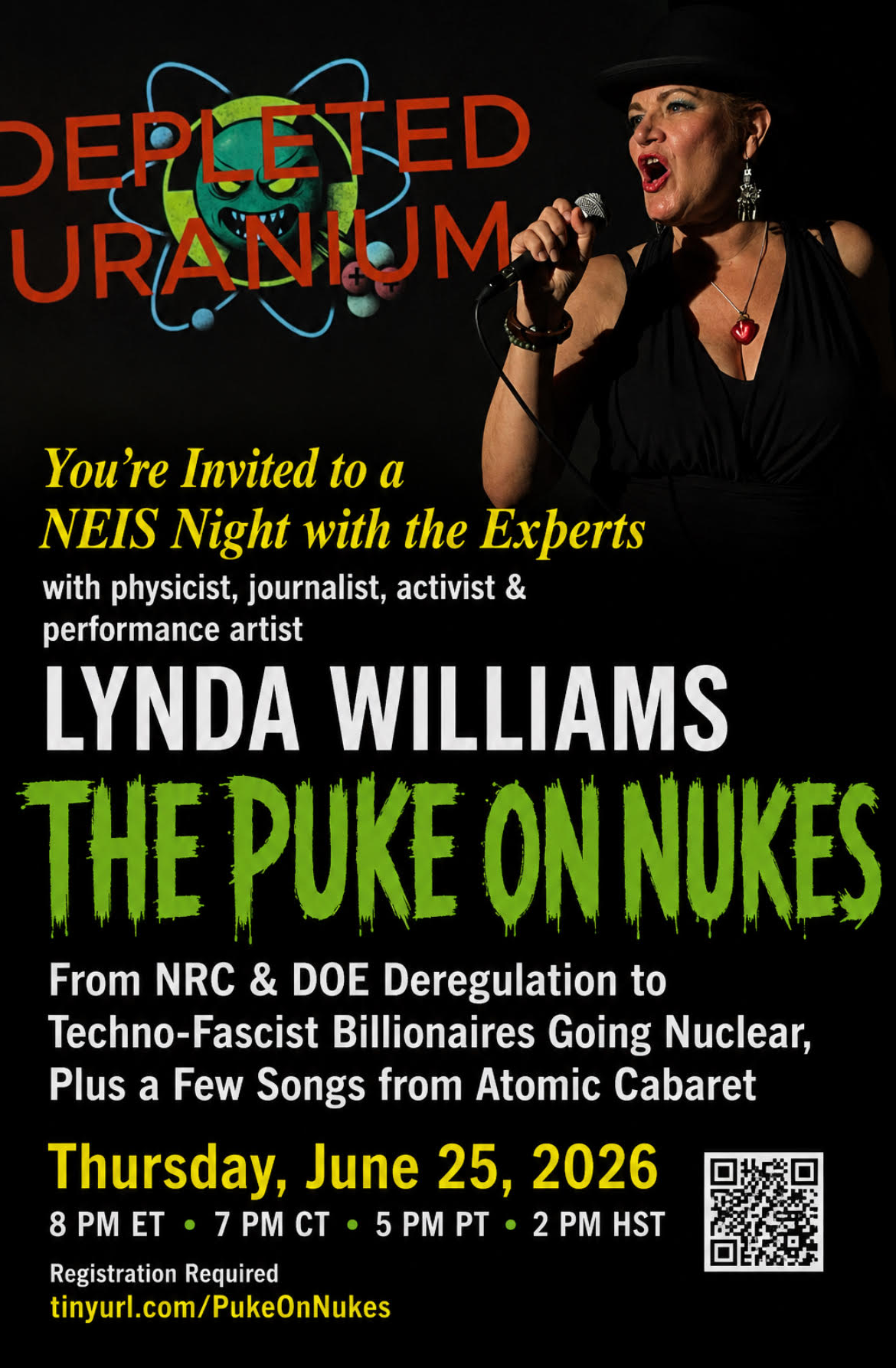
7pm Central Time (8pm ET, 6pm MT, 5pm PT) UTC – 5 From NRC & DOE Deregulation to Techno-Fascist Billionaires Going Nuclear, Plus a Few Songs from Atomic Cabaret REGISTER












 nuclear-news