 A nuclear October surprise? https://thehill.com/opinion/energy-environment/412413-a-nuclear-october-surprise, BY TIM JUDSON, 10/21/18 The Trump administration has been plotting for many months to seize power over the electrical generation sector by executive order, and despite widespread opposition and infighting that set the effort back this week, analysts say President Trump is personally invested in the idea, and that he and Energy Secretary Perry remain committed to ordering a bailout of failing coal and nuclear plants.
It wouldn’t exactly nationalize the industry or impose martial law. But the administration has invoked false national security claims and inappropriate “emergency” powers to claim the right to upend the market and force ratepayers and taxpayers to subsidize nuclear and coal plants against their will. It would commandeer their money to prop up aging, unsafe, uncompetitive plants that should, and otherwise would, shut down.
Throughout the summer the administration signaled that soon, likely before the midterm election, Trump would issue a Section 202(c) emergency order imposing a two-year moratorium on nuclear and coal plant closures, ostensibly for the Department of Energy to study the ramifications of letting them close.
Meanwhile, grid operators would be required to buy electricity from struggling coal and nuclear plants, creating the equivalent of tariffs guaranteeing large profits for nuclear and coal plants. Grid managers would be forced to buy power from them, even though it’s more expensive than other sources of electricity, including renewables and efficiency.
The Electricity Consumers Resource Council has argued against the plan. Ratepayers are a captive market, so utilities are supposed to shop around for cheaper electricity on their behalf. A Trump executive order would prevent that, on the specious theory letting uncompetitive nuclear plants close threatens electrical grid reliability and national security, so consumers should get a big rate hike to keep them open.
While in effect over the next two years, such an order could preempt closure of uncompetitive nuclear plants, including those already scheduled to close. It might also delay or derail nuclear plant closures scheduled more than two years out, including New York’s Indian Point.
The Heritage Foundation opposes the Trump plan and points out there is no evidence that subsidizing aging nuclear plants helps grid reliability or national security. Keeping them open actually increases risks of radiological accidents and cyberattacks. But there’s plenty of evidence subsidies help nuclear plant owners.
Over the last year, owners ramped up spending on lobbying and pushed through billion-dollar state subsidies to guarantee large profits at public expense, first in New York ($7.6 billion) and Illinois ($2.4 billion), then in New Jersey ($3.6 billion) and Connecticut (estimated up to $3 billion). They are now aiming at Pennsylvania and other states. They argue they deserve subsidies for fighting climate change, by supplying “clean energy” with “zero emissions.”
In fact, these aging plants are dirty and dangerous. Propping them up worsens climate change by undermining growth of renewables and efficiency measures. Owners got their subsidies anyway, after threatening state politicians with the fallout from closing their plants early.
By my calculation, most of the windfall is going to the largest US nuclear operator, Exelon. New York and Illinois subsidies accounted for about 60 percent of its profit growth this year. New Jersey and other state subsidies will swell it further. A Trump executive order would transfer yet more wealth from ratepayers to Exelon and other nuclear owners.
Is all this even legal? We’re about to find out. There are a slew of lawsuits waiting to challenge Trump’s executive order from consumer advocates and non-nuclear/non-coal generators. Many grounds for challenging it exist.
Since there is no energy or national security emergency, invoking them in a Section 202(c) order misapplies the Federal Powers Act and the Defense Production Act. Trump’s order would be unprecedented, anti-competitive, government interference in power markets. It’s a federal mandate forcing individuals and businesses to pay for uneconomical power they don’t want. Those in New York and other states already coughing up billions for state nuclear subsidies will be subject to double jeopardy from this new federal surcharge, even if they object to subsidizing nuclear power and try to opt out through renewables-only purchasing programs.
There’s a fundamental question of whether nuclear subsidies serve the public interest, or whether they violate due process and the public trust.
In New York and other states, subsidies were rammed through with only perfunctory public input. Tens of thousands of New Yorkers filed complaints after they were passed. A lawsuit in New York State Supreme Court (Matter of Hudson River Sloop Clearwater v. NYS Public Service Commission, Albany County, 7242-16) is the first to challenge state subsidies on such fundamental, public interest grounds.
The organization I lead is a plaintiff in that case, which is also the last remaining legal challenge to state nuclear subsidies still standing, since federal suits asking the more technical question of whether state subsidies interfere with federal regulation of wholesale electricity markets were struck down. The NYS Supreme Court case survived motions to dismiss, and will soon go into evidentiary hearings. That means the question of whether New York’s nuclear subsidies are unfair, illegal or improper will finally get adjudicated in court.
The suit can’t reverse nuclear subsidies already established in Illinois and other states, but it could end them in New York and deter new states from adopting them.
t may also provide a glimpse of how lawsuits against a Trump executive order could get traction. Nuclear subsidies via government fiat contradict the public will, severely distort markets, and misapply the law. Executive overreach extended so far is ripe for remedy in court.
Tim Judson is the Executive Director of the Nuclear Information and Resource Service (NIRS), one of the plaintiffs in the New York lawsuit.
October 22, 2018
Posted by Christina Macpherson |
business and costs, politics, USA |
Leave a comment
|
 https://www.aljazeera.com/news/2018/10/5-threatened-russia-nuclear-weapons-deal-181021140208661.html https://www.aljazeera.com/news/2018/10/5-threatened-russia-nuclear-weapons-deal-181021140208661.html
Trump wants to withdraw from the INF treaty that was signed over three decades ago by the US and Soviet leaders. US President Donald Trump has said Washington
will withdraw from a 31-year-old nuclear weaponsagreement with Moscow, accusing Russia of violating the treaty and demanding the inclusion of China.
Here are five things to know about the Intermediate-Range Nuclear Forces Treaty (also known as the INF treaty:
1. How did the agreement come about?
The INF treaty was signed in December 1987 by the then-US President Ronald Reagan and Soviet leader Mikhail Gorbachev. It resolved a crisis that had begun in the 1980s with the deployment of Soviet SS-20 nuclear-tipped, intermediate-range ballistic missiles targeting Western capitals.
By signing the agreement, Washington and Moscow swore off from possessing, producing or test-flying a ground-launched cruise missile with a range between 500 and 5,500km.
2. Why is the US withdrawing from the treaty?US officials believe Moscow is developing and has deployed a ground-launched system in breach of the INF treaty that could allow it to launch a nuclear strike on Europe at short notice.
Russia has consistently denied any such violation.
Trump said on Saturday that it was only fair for US to develop the weapons since Russia and China (not a signatory of the treaty) were already doing it.
3. How does Russia feel about the INF deal?Moscow has long been accusing the US of violating the nuclear agreement, pointing to a NATO missile shield in Romania that could launch nuclear missiles at any time.
In 2007, Russia even threatened to withdraw from the INF treaty.
On Sunday, an unnamed Russian foreign ministry official told state news agencies that Washington has been “deliberately and step-by-step destroying the basis for the agreement” for many years.
4. What can the US withdrawal from the nuclear treaty lead to?The move will end the prospect of the renewal of the New Start agreement between Moscow and Washington which is set to expire in 2021, as the INF treaty is its backbone. Signed in 2010, New Start requires both nations to cut their deployed strategic nuclear warheads to no more than 1,550.
Russian Senator Alexei Pushkov wrote on Twitter that the move was “the second powerful blow against the whole system of strategic stability in the world” after Washington’s 2001 withdrawal from the Anti-Ballistic Missile treaty.
Gorbachev, the co-signatory of the INF treaty, said on Sunday it would be a mistake for Washington to quit the deal, and that it would undermine work he and US counterparts did to end the arms race.
5. Can the nuclear deal be saved? John Bolton, Trump’s national security adviser, is scheduled to meet Russian leaders, including Foreign Minister Sergey Lavrov and Security Council Secretary Nikolai Patrushev, this week in Moscow.
The trip is likely to show whether there is a chance for the deal to be saved. Trump’s announcement on Saturday suggested that he hoped for the re-negotiation of the terms.
Last week, The Guardian reported Bolton, a long-standing opponent of arms control treaties, was pushing for the US withdrawal over alleged Russian violations.
US Defence Secretary James Mattis has previously suggested that a Trump administration proposal to add a sea-launched cruise missile to Washington’s nuclear arsenal could provide the US with leverage to try to persuade Russia to come back in line on the arms treaty.
|
|
October 22, 2018
Posted by Christina Macpherson |
history, politics international, Russia, USA, weapons and war |
Leave a comment
|
 Trump should stick to his guns and close failed South Carolina nuclear MOX project https://thehill.com/opinion/energy-environment/412384-trump-should-stick-to-his-guns-and-close-failed-south-carolina
BY EDWIN LYMAN, OPINION CONTRIBUTOR — 10/20/18 Sen. Lindsey Graham (R-S.C.) is picking another fight that he promises will be even bigger spectacle than his over-the-top performance during Brett Kavanaugh’s confirmation hearings. Over what? A pork-barrel nuclear construction project in his state that his new best friend, President Donald Trump, is determined to shut down.
Graham, Sen. Tim Scott (R-S.C.), Rep. Joe Wilson (R-S.C.), and South Carolina state officials met with Trump at the White House on Thursday in a last-ditch attempt to get the president to change his mind about canceling the project. Hopefully, the president will stick to his guns and allow the Department of Energy (DOE) to finally put an end to this boondoggle.
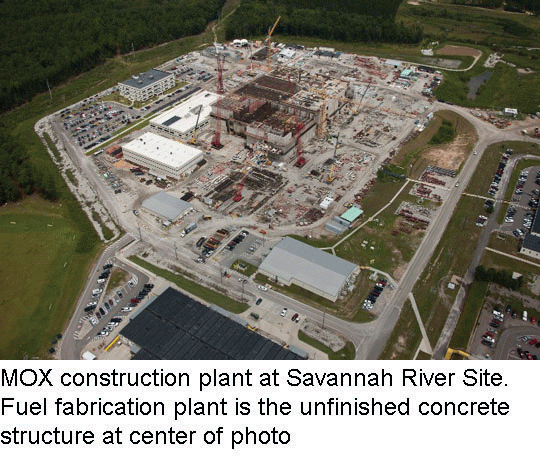
The project is costing taxpayers more than $1 million a day. The facility, the Mixed Oxide (MOX) Fuel Fabrication Plant, is three decades behind schedule and projected to cost some $15 billion more than its original $2 billion estimate. To date, the project is only 30 percent complete but has already cost more than $5 billion.
The MOX plant has a long and troubled history. After the end of the Cold War in 1991, both the United States and the former Soviet Union were stuck with dozens of tons of plutonium — a key fuel for nuclear weapons — that were no longer necessary for their shrinking nuclear arsenals.
Sen. Lindsey Graham (R-S.C.) is picking another fight that he promises will be even bigger spectacle than his over-the-top performance during Brett Kavanaugh’s confirmation hearings. Over what? A pork-barrel nuclear construction project in his state that his new best friend, President Donald Trump, is determined to shut down.
Graham, Sen. Tim Scott (R-S.C.), Rep. Joe Wilson (R-S.C.), and South Carolina state officials met with Trump at the White House on Thursday in a last-ditch attempt to get the president to change his mind about canceling the project. Hopefully, the president will stick to his guns and allow the Department of Energy (DOE) to finally put an end to this boondoggle.
The project is costing taxpayers more than $1 million a day. The facility, the Mixed Oxide (MOX) Fuel Fabrication Plant, is three decades behind schedule and projected to cost some $15 billion more than its original $2 billion estimate. To date, the project is only 30 percent complete but has already cost more than $5 billion.
The MOX plant has a long and troubled history. After the end of the Cold War in 1991, both the United States and the former Soviet Union were stuck with dozens of tons of plutonium — a key fuel for nuclear weapons — that were no longer necessary for their shrinking nuclear arsenals.
The DOE proposed the MOX plant as one method for converting retired U.S. plutonium weapon components into a form that was less readily usable in bombs and more difficult for terrorists to steal. The factory would turn the plutonium into fuel for commercial nuclear power reactors. After the reactors used the MOX fuel, the remaining plutonium would wind up trapped in heavy and highly radioactive spent fuel assemblies.
But the MOX plan would actually increase the risk of nuclear terrorism. The MOX plant is so large and complex that if terrorists posing as plant workers diverted enough plutonium for a bomb, the loss might not be detected for weeks or even longer. Moreover, MOX fuel would have to be shipped to commercial reactors around the country, where security measures are far weaker than at DOE weapons facilities.
MOX soon proved disastrous. Construction of the fuel factory, which began in 2007, has been plagued with prolonged delays and cost overruns. One major recurring problem was the need to redo defective construction. For example, the project contractor, now called CB&I AREVA MOX Services, bought 9,500 tons of steel rebar for reinforced concrete that was discovered to be inferior, but not before MOX Services installed 142 tons of it.
Also, the DOE found in 2014 that “electrical work at the MOX facility was not being completed in accordance specifications and had to be repeatedly removed and reinstalled.” Adding insult to injury, the contractor billed the DOE for the extra labor needed to fix its mistakes, wasting even more taxpayer money. The DOE testified to Congress in 2015 that 25 percent of construction work had to be redone, but because MOX Services did not begin to systematically track and manage rework until 2014, the full extent of the problem may never be known.
Faced with ballooning costs and uncertain prospects, the Obama administration decided in 2014 to terminate MOX and adopt a simpler, cheaper alternative that would be at much lower risk for nuclear terrorism. Surplus plutonium could be diluted with an inert material, packaged in small quantities, and shipped to the Waste Isolation Pilot Plant (WIPP) in New Mexico, the deep geologic repository for military nuclear waste. This policy made so much sense that the Trump administration rebuffed calls by MOX supporters to reverse it when it took office in 2017.
For years, Graham and his South Carolina allies convinced Congress to prohibit the DOE from terminating MOX. Last year, however, Congress finally provided a way out: It decided that the DOE could shut down the MOX program if it could show that the alternative approach could dispose of all the surplus plutonium at less than half the cost of MOX. The DOE met that requirement in May, but in June the state of South Carolina won a federal injunction blocking termination, which was temporarily reversed on appeal last week. The DOE cancelled the project the very next day.
That left Graham with only one card to play: a direct appeal to the president to reverse course. But is Graham’s loyalty worth $12 billion in taxpayer money? Let’s just hope Trump, who considers himself to be a shrewd businessman, really knows a bad deal when he sees one.
Edwin Lyman is a senior scientist with the Union of Concerned Scientists’ Global Security Program in Washington, D.C.
|
|
October 22, 2018
Posted by Christina Macpherson |
business and costs, technology, USA |
2 Comments
 Hanford wants more time to empty leak-prone radioactive waste tank. Here’s the new deadline, Tri City Herald, BY ANNETTE CARY, acary@tricityherald.com, 18, 2018 , RICHLAND, WA
The Department of Energy will have more time to empty some of Hanford’s leak-prone underground waste storage tanks under an order issued in federal court.
Judge Rosanna Malouf Peterson agreed to a request by the state of Washington and DOE to give DOE until the end of 2026 to empty radioactive and hazardous chemical waste from nine more single-shell tanks.
It is an extension from March 31, 2024. A second deadline to keep work on pace to meet that milestone also has been extended.
DOE has another six months — until June 2021 — to have the first two tanks of the nine emptied. New court-enforced consent decree deadlines for retrieving the waste from tanks and treating it at the $17 billion vitrification plant under construction were set by Malouf Peterson in 2016………https://www.tri-cityherald.com/news/local/hanford/article220235380.html
October 22, 2018
Posted by Christina Macpherson |
USA, wastes |
Leave a comment
 60,000 tons of dangerous radioactive waste sits on Great Lakes shores, THE EFFECTS OF A WORST-CASE SCENARIO — FROM A NATURAL DISASTER TO TERRORISM — COULD CAUSE UNTHINKABLE CONSEQUENCES FOR THE GREAT LAKES REGION, Keith Matheny, Detroit Free Press, Oct. 19, 2018 More than 60,000 tons of highly radioactive spent nuclear fuel is stored on the shores of four of the five Great Lakes — in some cases, mere yards from the waterline — in still-growing stockpiles.
“It’s actually the most dangerous waste produced by any industry in the history of the Earth,” said Gordon Edwards, president of the nonprofit Canadian Coalition for Nuclear Responsibility.
The spent nuclear fuel is partly from 15 current or former U.S. nuclear power plants, including four in Michigan, that have generated it over the past 50 years or more. But most of the volume stored along the Great Lakes, more than 50,000 tons, comes from Canadian nuclear facilities, where nuclear power is far more prevalent.
It remains on the shorelines because there’s still nowhere else to put it. The U.S. government broke a promise to provide the nuclear power industry with a central, underground repository for the material by 1998. Canada, while farther along than the U.S. in the process of trying to find a place for the waste, also doesn’t have one yet.
The nuclear power industry and its federal regulator, the U.S. Nuclear Regulatory Commission, point to spent nuclear fuel’s safe on-site storage over decades. But the remote possibility of a worst-case scenario release — from a natural disaster, a major accident, or an act of terrorism — could cause unthinkable consequences for the Great Lakes region.
Scientific research has shown a radioactive cloud from a spent fuel pool fire would span hundreds of miles, and force the evacuation of millions of residents in Detroit, Chicago, Cleveland, Toronto or other population centers, depending on where the accident occurred and wind patterns.
It would release multiple times the radiation that emanated from the Fukushima disaster in Japan in 2011 — a disaster that led to mass evacuations, no-go zones that exist to this day, and a government ban on fishing in a large, offshore area of the Pacific Ocean because of high levels of radioactive cesium in the water and in fish. The fishing industry there has yet to recover, more than seven years later.
“The Mississippi and the Great Lakes — that would be really bad,” said Frank von Hippel, senior research physicist and professor of public and international affairs emeritus at Princeton University.
Added Jim Olson, environmental attorney and founder of the Traverse City-based nonprofit For Love of Water, or FLOW: “The fact that it’s on the shorelines of the Great Lakes takes that high consequence that would be anywhere and paints it red and puts exclamation marks around it.”
Spent nuclear fuel is so dangerous that, a decade removed from a nuclear reactor, its radioactivity would still be 20 times the level that would kill a person exposed to it. Some radioactive byproducts of nuclear power generation remain a health or environmental hazard for tens of thousands of years. And even typically harmless radioactive isotopes that are easily blocked by skin or clothing can become extremely toxic if even small amounts are breathed in, eaten or drank, making their potential contamination of the Great Lakes — the drinking water supply to 40 million people — the connected Mississippi River and the prime agricultural areas of the U.S. a potentially frightening prospect. ……….
For five years, Michigan residents, lawmakers, environmental groups and others around the Midwest have, loudly and nearly unanimously, opposed a planned Canadian underground repository for low-to-medium radioactive waste at Kincardine, Ontario, near the shores of Lake Huron.
Meanwhile, spent nuclear fuel, vastly more radioactive, sits not far from the shores of four Great Lakes — Michigan, Huron, Erie and Ontario — at 15 currently operating or former nuclear power plant sites on the U.S. side. In Michigan, that includes Fermi 2; the Donald C. Cook nuclear plant in Berrien County; the Palisades nuclear plant in Van Buren County, and the former Big Rock Point nuclear plant in Charlevoix County, which ceased operation in 1997 and where now only casks of spent nuclear fuel remain.
Neither the U.S. nor the Canadian government has constructed a central collection site for the spent nuclear fuel. It’s not just a problem in the Great Lakes region — more than 88,000 tons of spent nuclear fuel, an amount that is rising, is stored at 121 U.S. locations across 39 states…….
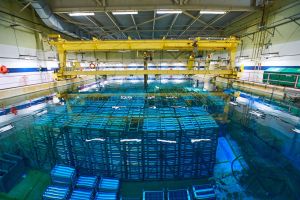
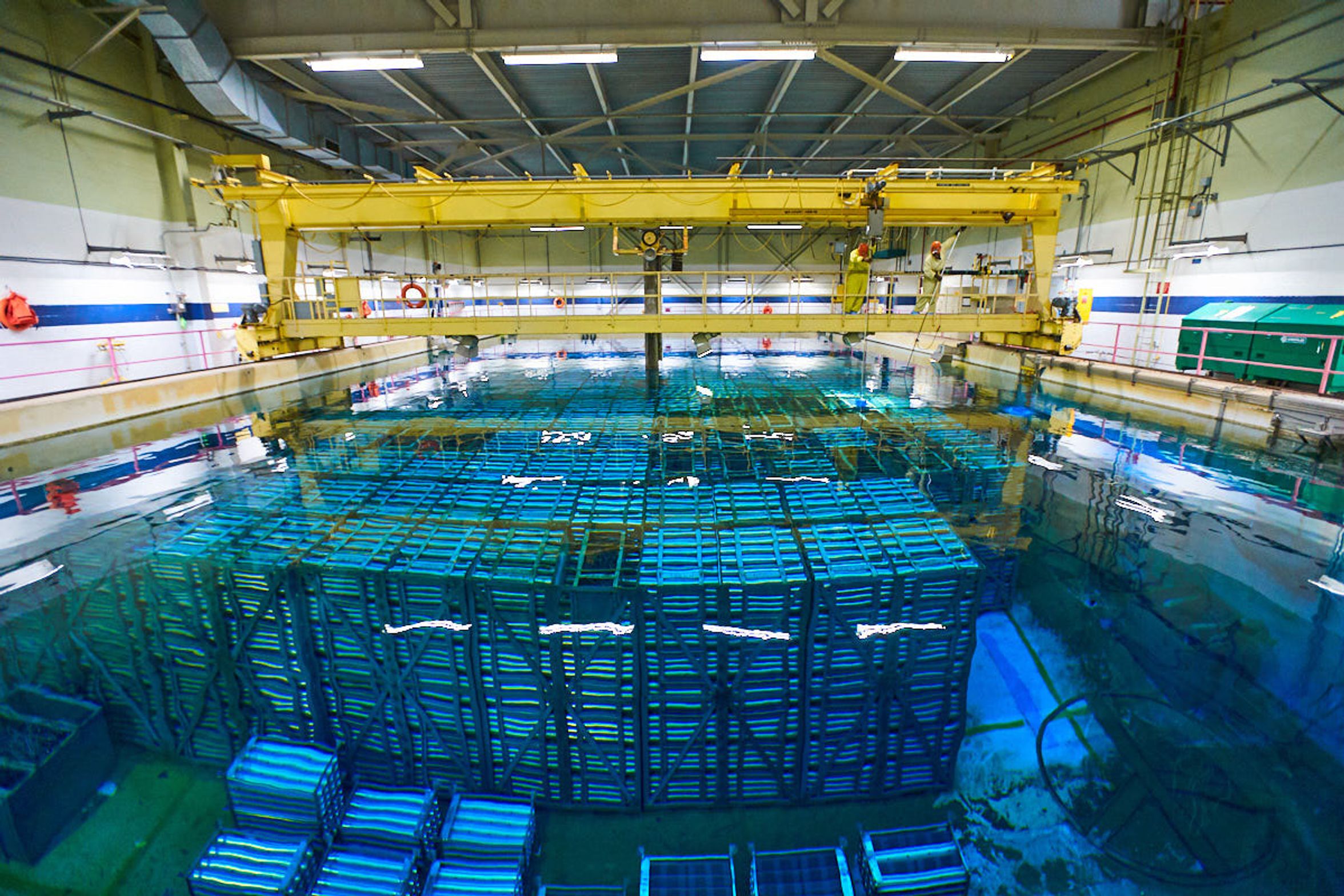
Spent nuclear fuel isn’t only radioactive, it continues to generate heat. It requires storage in pools with circulating water for typically five years before it can be moved into so-called dry-cask storage — concrete-and-steel obelisks where spent fuel rods receive continued cooling by circulating air.
In practice, however, because of the high costs associated with transferring waste from wet pools to dry casks, nuclear plants have kept decades worth of spent fuel in wet storage. Plant officials instead “re-rack” the pools, reconfiguring them to add more and more spent fuel, well beyond the capacities for which the pools were originally designed.
“The prevailing practice in the United States is you re-rack the pools until they are just about as dense-packed as the nuclear core,” von Hippel said.
Only in recent years have nuclear plants stepped up the transition to dry cask storage because there’s no room left in the wet pools. Still, about two-thirds of on-site spent nuclear fuel remains in wet pools in the U.S.
That’s a safety concern, critics contend. A catastrophe or act of terrorism that drains a spent fuel pool could cause rising temperatures that could eventually cause zirconium cladding — special brackets that hold the spent fuel rods in bundles — to catch fire.
Such a disaster could be worse than a meltdown in a nuclear reactor, as spent nuclear fuel is typically stored with nowhere near the fortified containment of a reactor core.
“The long-term land-contamination consequences of such an event could be significantly worse than those from Chernobyl,” a 2003 research paper by von Hippel and seven other nuclear experts stated.
The reference is to the worst nuclear power disaster in world history, the April 1986 reactor explosion at the Chernobyl Nuclear Power Plant in the former Soviet Union, now a part of the Ukraine, where 4,000 to 90,000 are estimated to have died as a result of the radiation released. A study by the University of Exeter in Great Britain, released this June, found that cow’s milk from farms about 125 miles from the Chernobyl accident site still — more than 30 years later —- contains the radioactive element cesium at levels considered unsafe for adults and at more than seven times the limit unsafe for children.
Allison Macfarlane, a professor of public policy and international affairs at George Washington University, served as chairman of the NRC during the Obama administration from July 2012 until December 2014.
“What I think needs more examination is the practice of densely packing the fuel in the pool,” she said.
The NRC does not regulate how much fuel can be in a pool, in what configuration it’s placed, and how old the fuel is, Macfarlane said. ……….
In a Great Lakes region where magnitude-9.0 earthquakes and tsunamis aren’t a potential threat to stockpiles of spent nuclear fuel, terrorism remains possible………
In a Great Lakes region where magnitude-9.0 earthquakes and tsunamis aren’t a potential threat to stockpiles of spent nuclear fuel, terrorism remains possible.
“The NRC’s position on beyond design basis threats is essentially that this is a matter for the national security apparatus — it’s not our job, so somebody else will take care of it,” he said. “But if you look at the Pentagon, Homeland Security, I think you will look in vain to find any part of that apparatus that is addressing that area that the NRC says is not its job.”……….
Welcome to Zion, nuclear waste dump ………..
Canada’s Yucca Mountain
Because nuclear power is much more widely used in Canada — the province of Ontario alone has 20 nuclear reactors at three plants — it also generates much more nuclear waste.
In Ontario, nearly 52,000 tons of spent nuclear fuel is stored on-site at nuclear plants along Lakes Huron and Ontario.
“There’s a huge amount of high-level, radioactive waste stored right along the water,” said Edwards, the president of the nonprofit Canadian Coalition for Nuclear Responsibility……… . https://www.freep.com/story/news/local/michigan/2018/10/19/nuclear-waste-great-lakes/1417767002/
October 20, 2018
Posted by Christina Macpherson |
Canada, wastes |
1 Comment
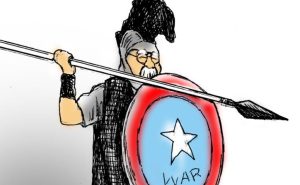 John Bolton pushing Trump to withdraw from Russian nuclear arms treaty, Exclusive: national security adviser recommends ending intermediate-range nuclear forces treaty over alleged Russia violations, Guardian, Julian Borger , 20 Oct 18
, John Bolton is pushing for the US to withdraw from a cold war-era arms control treaty with Russia, in the face of resistance from others in the
Trump administration and US allies, according to sources briefed on the initiative.
Bolton, Donald Trump’s third national security adviser, has issued a recommendation for withdrawal from the 1987 intermediate-range nuclear forces treaty (INF), which the US says Russia has been violating with the development of a new cruise missile.
Withdrawal from the treaty, which would mark a sharp break in US arms control policy, has yet to be agreed upon by cabinet and faces opposition from within the state department and the Pentagon. A meeting on Monday at the White House to discuss the withdrawal proposal was postponed.
The INF faces a congressionally imposed deadline early next year. An amendment in the 2019 defence spending bill requires the president to tell the Senate by 15 January whether Russia is in “material breach” of the treaty, and whether the INF remains legally binding on the US.
Bolton, who has spent his career opposing arms control treaties, is seeking to shrug off the traditional role of national security adviser as a policy broker between the agencies, and become a driver of radical change from within the White House.
Former US officials say Bolton is blocking talks on extending the 2010 New Start treaty with Russia limiting deployed strategic nuclear warheads and their delivery systems. The treaty is due to expire in 2021 and Moscow has signaled its interest in an extension, but Bolton is opposing the resumption of a strategic stability dialogue to discuss the future of arms control between the two countries.
The US has briefed its European allies this week about the proposal, sounding out reactions. The briefing alarmed UK officials who see the INF as an important arms control pillar. The treaty marked the end of a dangerous nuclear standoff in 1980s Europe pitting US Pershing and cruise missiles against the Soviet Union’s SS-20 medium-range missiles.
The US alleges Russia is now violating the treaty with the development and deployment of a ground-launched cruise missile, known as the 9M729. Moscow insists the missile does not violate the range restrictions in the INF and alleges in return that a US missile defence system deployed in eastern Europe against a potential Iranian threat can be adapted to fire medium-range offensive missiles at Russia.
The National Security Council (NSC) declined to comment on the fate of the INF………
Bolton’s meeting with his Russian counterpart, Nikolai Patrushev, in Geneva in August, was expected to give the final green light to the dialogue, but Bolton is said to have blocked it. He is due to visit Moscow next week, when the Kremlin said he may meet Vladimir Putin.
(pic DANBY/BDN) The New York Times reported on Friday that Bolton intended to use his Moscow trip to inform Russian leaders of the administration’s plans to exit the INF agreement. Under the terms of the treaty, withdrawal would take six months.
In remarks in Sochi on Thursday, Putin appeared to suggest that Russia would adopt a “no first use” policy on nuclear weapons.
“We have no concept of a pre-emptive strike,” he told a conference. “[W]e expect to be struck by nuclear weapons, but we will not use them first,” he said.
A meeting of Nato defence ministers earlier this month in Brussels issued a joint statement saying the INF “has been crucial to Euro-Atlantic security and we remain fully committed to the preservation of this landmark arms control treaty”………
“The decision has been taken in the NSC [National Security Council] that the US should withdraw, and they are trying to persuade other parts of the administration. There has been no formal Trump decision yet,” said Hans Kristensen, the director of the nuclear information project at the Federation of the American Scientists. “Very little good will come of this, other than another round of nuclear escalation with Russia.” ………https://www.theguardian.com/us-news/2018/oct/19/john-bolton-russia-nuclear-arms-deal-trump-lobbying
October 20, 2018
Posted by Christina Macpherson |
politics, politics international, USA |
Leave a comment
|
60,000 tons of dangerous radioactive waste sits on Great Lakes shores, Keith Matheny, Detroit Free Press
Oct. 19, 2018 “………The original 9/11 idea
In August 2002, al-Jazeera reporter Yosri Fouda got an anonymous call offering him an incredible interview with two of the biggest fugitives from justice on the globe: al-Qaida leaders Khalid Sheikh Mohammed, the so-called mastermind of the 9/11 terrorist attacks, and Ramzi bin al-Shibh.
Wrote London’s The Guardian about Fouda’s account at the time: “After two days in a run-down hotel (in Karachi, Pakistan), he was passed through a chain of people before being blindfolded, put in a car (trunk) and driven to an apartment building. He was taken to a flat strewn with laptop computers and mobile phones and occupied by two men whom he recognized as Bin al-Shibh and Mohammed.
Among the things Fouda said he learned in his interview: That the initial targets for what became the Sept. 11, 2001, terrorist attacks included two, unspecified U.S. nuclear power plants.
“It was decided to abandon nuclear targets for the moment,” Fouda said Mohammed explained to him. “I mean for the moment,” Mohammed added.
Al-Qaida leaders feared an attack on U.S. nuclear facilities “might get out of hand,” Fouda said he was told.
Noted Kamps of the nonprofit Beyond Nuclear, “We’re relying on the moral restraint of a terrorist organization not to attack nuclear plants.”
That startling revelation was later amplified in the 9/11 Commission’s report, which not only noted Mohammed’s account, but that 9/11 ringleader and hijacker Mohammed Atta, in July 2001 meetings with Bin al-Shibh in Spain, “mentioned he had considered targeting a nuclear facility he had seen during familiarization flights near New York.”
The plan was ultimately scuttled because Atta “thought a nuclear target would be difficult because the airspace around it was restricted, making reconnaissance flights impossible and increasing the likelihood that any plane would be shot down before impact,” the 9/11 Commission report states.
Edwin Lyman of the Union of Concerned Scientists said the nuclear facility in question was probably Indian Point in New York, about 25 miles north of New York City. In an ironic twist, the supposed heightened security measures that discouraged Atta from a nuclear plant strike don’t exist, Lyman said.
“In fact, there was no such protection,” he said. “There is no no-fly-zone around nuclear plants.”
It’s still not an outright prohibition. After 9/11, the Federal Aviation Administration issued a “notice-to-airmen” stating: “In the interest of national security and to the extent practicable, pilots are strongly advised to avoid the airspace above, or in proximity to such sites as power plants (nuclear, hydro-electric, or coal), dams, refineries, industrial complexes, military facilities and other similar facilities. Pilots should not circle as to loiter in the vicinity over these types of facilities.”
Personnel at nuclear plants “voluntarily report to us and to local law enforcement whenever they see a plane loitering in the vicinity,” NRC spokesman David McIntyre told the Free Press. “Such pilots may be greeted by local law enforcement upon landing and further advised not to fly over or loiter over a plant.”
The policy also applies for remote-controlled drones, McIntyre said……. https://www.freep.com/story/news/local/michigan/2018/10/19/nuclear-waste-great-lakes/1417767002/
|
|
October 20, 2018
Posted by Christina Macpherson |
safety, USA |
Leave a comment
As we might have expected, the de facto abandon of the Intermediate-Range Nuclear Forces Treaty (INF Treaty) – concluded between Washington and Moscow at the end of the Cold War – has now rebooted the competition. Except that this time, it’s even more complicated, since the United States violated the Treaty first, while they were already violating the Non-Proliferation Treaty (NPT). Meanwhile, Russia has discreetly forged ahead with its technological progress while pretending to allow the problem to drag on.
VOLTAIRE NETWORK | ROME (ITALY) | 19 OCTOBER 2018 he B61-12, the new US nuclear bomb which replaces the B-61 deployed in Italy and other European countries, will begin production in less than a year. The announcement was made officially by the National Nuclear Security Administration (NNSA). It reveals that the revision of the final project has now been completed with success, and the qualification stage will begin this month at the Pantex Plant in Texas. Production will be authorised to begin in September 2019.
In March 2020, the first unit of production will begin fabricating a series of 500 bombs. As from that time, in other words in about a year and a half, the United States will begin the anti-Russian deployment in Italy, Germany, Belgium, Holland and probably certain other European countries, of the first nuclear bomb in their arsenal with a precision guidance system. The B61-12 is designed with penetrating capacity, built to explode underground in order to destroy bunkers housing command centres.
Since Italy and the other countries, in violation of the Non-Proliferation Treaty, are offering the USA the bases, the pilots and the aircraft for the deployment of the B61-12, Europe will soon be exposed to a greater risk as the front line of the developing nuclear confrontation with Russia.
An even more dangerous situation appears at the same moment – the return of the Euromissiles, meaning the nuclear missiles which are similar to those deployed in Europe in the 1980’s by the USA, with the official aim of defending against Soviet missiles. This category of ground-based nuclear missiles of intermediate range (between 500 and 5,500 km) were eliminated with the INF Treaty of 1987. But in 2014, the Obama administration accused Russia of having experimented with a cruise missile (# 9M729) whose category was forbidden by the Treaty. Moscow denied that the missile violated the INF Treaty and, in turn, accused Washington of having installed in Poland and Romania launch ramps for interceptor missiles (elements of the « shield »), which could be used to launch cruise missiles bearing nuclear warheads.
The accusation aimed by Washington at Moscow, which is not supported by any evidence, enabled the USA to launch a plan aimed at once again deploying in Europe ground-based intermediate-range nuclear missiles. The Obama administration had already announced in 2015 that « faced with the violation of the INF Treaty by Russia, the United States are considering the deployment of ground-based missiles in Europe ». This plan was confirmed by the Trump administration – in fiscal year 2018, Congress authorised the financing of a « programme of research and development for a cruise missile which could be launched from a mobile road base ».
The plan is supported by the European allies of NATO. The recent North-Atlantic Council, at the level of Europe’s Defence Ministers, which was attended for Italy by Elisabetta Trenta (M5S), declared that the « INF Treaty is in danger because of the actions of Russia », which it accused of deploying « a disturbing missile system which constitutes a serious risk for our security ». Hence the necessity that « NATO must maintain nuclear forces which are stable, trust-worthy and efficient » (which explains why the members of the Alliance rejected en bloc the United Nations Treaty for the prohibition of nuclear weapons).
So the grounds are being laid for a European deployment, on the borders of Russian territory, of ground-based intermediate-range US nuclear missiles. It’s as if Russia were deploying in Mexico nuclear missiles pointed at the United States. Manlio Dinucci
Translation
Pete Kimberley
Source
Il Manifesto (Italy)
October 20, 2018
Posted by Christina Macpherson |
EUROPE, USA, weapons and war |
Leave a comment
|
Newsweek 17th Oct 2018, It is more likely than in the past that China and the U.S. could enter into
a military conflict, and the possibility of such a battle going nuclear is
higher than many analysts believe, a security expert from Georgetown
University has warned.
Caitlin Talmadge, who is an associate professor of
security studies at the Walsh School of Foreign Service, laid out a grim
picture of how military escalation could play out between Washington and
Beijing in an article for Foreign Affairs’ November-December issue.
|
|
October 20, 2018
Posted by Christina Macpherson |
China, politics international, USA, weapons and war |
Leave a comment
SCE&G regulatory trial: Who will pay for the failed nuclear project? The State, BY FRANK KNAPP JR., October 19,
On Nov. 1, the S.C. Public Service Commission (PSC) will start a hearing that will impact the electric rates of SCE&G customers for decades.
The primary issue to be decided is how much if anything SCE&G customers will be forced to pay for the incurred construction costs of its abandoned nuclear project in Fairfield County.
Essentially, this is a regulatory trial.
SCE&G is being accused of intentionally withholding critical information from the S.C. Office of Regulatory Staff (ORS) and the PSC.
ORS is the state agency that was responsible for analyzing data received from SCE&G for the approval of construction cost increases, construction schedule delays and rate hike requests to pay for construction cost financing. ORS then made recommendations to the PSC for decisions on these matters.
After reviewing more than a million pages of SCE&G-produced documents, ORS concluded that by March 2015, the company knew that it would take several years longer to complete the nuclear project and the cost would be billions higher than it was telling the regulators.
By not providing this information to ORS and the PSC, critics contend that SCE&G enabled itself to obtain undeserved electric rate increases to fund the doomed project.
The principle SCE&G challengers — ORS, Sierra Club and Friends of the Earth — maintain that had ORS and the PSC known what SCE&G knew in March 2015, the regulators might have pulled the plug on the project then, saving the ratepayers billions……….https://www.thestate.com/opinion/op-ed/article220308855.html
October 20, 2018
Posted by Christina Macpherson |
Legal, USA |
Leave a comment

Saudi Arabia is putting money in Trump’s pocket. Is that shaping U.S. policy? https://www.washingtonpost.com/blogs/plum-line/wp/2018/10/16/saudi-arabia-is-putting-money-in-trumps-pocket-is-that-shaping-u-s-policy/?noredirect=on&utm_term=.434cc7237930, By Paul Waldman,October 16
As hard as it is to resist writing about the fact that on Tuesday the president of the United States called the adult film actress to whom he paid hush money “Horseface,” I want to focus on a different aspect of this presidency that we’re seeing play out right now.
.As the apparent murder of Saudi journalist and Post contributor Jamal Khashoggi complicates our relations with Saudi Arabia, we have to ask what the implications are of having a fully transactional presidency, one not just built on “deals” but where policy is determined by what is financially beneficial to the president.
We should begin by reminding ourselves that as awful as Khashoggi’s apparent murder is, it’s only the latest in a long list of Saudi abuses that administrations both Democratic and Republican have chosen to overlook for decades. The country is a cruel dictatorship that embodies none of the values we as a nation hold dear, such as democracy, freedom of expression, freedom of the press and freedom of religion. But we decided long ago that since the Saudis have a great deal of oil and they provide us with a strategic ally in the Middle East, we’ll overlook all that.
There is something unsettling about the fact that Saudi intervention in Yemen’s civil war, in which they have reportedly killed thousands of civilians, has received steady U.S. support, while the murder of a single journalist threatens to upend the relationship between the two countries.
Or so you might think. But here’s the reality: This will blow over, not only because of the complex relationship between the two countries, but also because everything in foreign policy is personal with President Trump, and he likes the Saudis.
And why does he like them so much? Because they pay him.
This is not something Trump has been shy about saying. “Saudi Arabia, I get along with all of them. They buy apartments from me. They spend $40 million, $50 million,” he said at a rally in Alabama in 2015. “Am I supposed to dislike them? I like them very much.”
Trump says so many shocking things that it’s sometimes easy to slide right past the most appalling ones, but read that again. Here you have a candidate for president of the United States saying that he is favorably disposed toward a foreign country because they have given him millions of dollars, and all but promising to shape American foreign policy in their favor for that very reason.
“Am I supposed to dislike them?” he asks. How could I possibly dislike them when they pay me?
We should note that it’s more than just apartments. Trump has sold many properties to Saudis, and Saudis have invested in Trump projects. And as David Fahrenthold and Jonathan O’Connell report:
Business from Saudi-connected customers continued to be important after Trump won the presidency. Saudi lobbyists spent $270,000 last year to reserve rooms at Trump’s hotel in Washington. Just this year, Trump’s hotels in New York and Chicago reported significant upticks in bookings from Saudi visitors.
This is precisely the reason the framers of the Constitution added a provision saying that neither the president nor other officials could “accept of any present, Emolument, Office, or Title, of any kind whatever, from any King, Prince, or foreign State.” If a foreign country is putting money in the president’s pocket on an ongoing basis, how in the world can we trust that the decisions he makes will be based on the best interests of the United States and not on his bank account?
This is of more concern with Trump than with any other president in American history. His entire life has been devoted to the accumulation of wealth, as though there were no other goal anyone should consider seeking (“My whole life I’ve been greedy, greedy, greedy. I’ve grabbed all the money I could get. I’m so greedy,” he has said). He made sure that upon assuming office his businesses would continue to operate and continue to provide avenues for those wishing to further enrich him to do so. And he refuses to release his tax returns, so we have no idea exactly how much money he’s getting and from whom.
But Tuesday, Trump tweeted this:
For the record, I have no financial interests in Saudi Arabia (or Russia, for that matter). Any suggestion that I have is just more FAKE NEWS (of which there is plenty)!
This is the same claim Trump has made with regard to Russia, and it’s the same dodge. The point isn’t whether Trump has interests in Saudi Arabia, it’s whether Saudi Arabia has interests in him. And just as is the case with Russia, they do.
If you’re the Saudis, the nice thing about Trump is that he lacks any subtlety whatsoever, so you don’t have to wonder how to approach him. He has said explicitly that the way to win his favor is to give him money. He has established means for you to do so — buying Trump properties and staying in Trump hotels. And with his combination of narcissism and insecurity, if you invite him to your country and give him a gold medal, he’ll forever be your friend.
Every president has to balance the desire to honor U.S. values with more crass interests such as whether a country will buy weapons from us, which Trump also cited as a reason we shouldn’t punish Saudi Arabia for Jamal Khashoggi’s murder (even though they aren’t actually buying what Trump claims). But only Trump apparently gets direct and significant payoffs from other countries, and only Trump is so clear that if you pay him he’ll do what you want. That may not have changed the American stance toward Saudi Arabia too much yet, but we have no idea what’s to come.
October 18, 2018
Posted by Christina Macpherson |
politics international, Saudi Arabia, USA |
1 Comment
 SNC-Lavalin shares fall to lowest since 2016 on news foreign bribery case will go to court SNC-Lavalin shares fall to lowest since 2016 on news foreign bribery case will go to court
Former employees accused of paying bribes in Libya to win contracts CBC News · October 11 Shares in Canadian engineering giant SNC-Lavalin fell to their lowest level in more than two years after the company revealed the federal government has decided it won’t let the company settle allegations of foreign bribery out of court.
The company has had the legal cloud hanging over its head since 2015, stemming from allegations that some of its former employees paid bribes to officials in Libya to influence government decisions and win contracts prior to 2012.
The RCMP alleges that between 2001 and 2012, the company paid almost $48 million in bribes and defrauded various other entities of almost $130 million.
SNC-Lavalin had hoped to negotiate a remediation agreement to settle the matter, an outcome that would have seen the company pay fines and other forms of punishment in exchange for setting aside the legal charges.
But the government has apparently decided not to let the company do that, and the decision by the Public Prosecution Service of Canada — which handles prosecutions on behalf of the government — means that federal court case will proceed.
“The Criminal Code sets out the criteria for remediation agreements,” PPSC spokesperson Nathalie Houle told CBC News. “The [director of public prosecutions] has determined that the criteria were not met.”…….Shares in the company were halted shortly after the TSX opened on Wednesday, and when trading resumed about an hour later they immediately fell. Near midday, they were down by more than 14 per cent. https://www.cbc.ca/news/business/snc-lavalin-1.4856869
|
|
|
October 18, 2018
Posted by Christina Macpherson |
Canada |
1 Comment
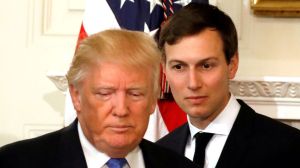 Trump and Kushner Put Saudi’s Money First https://www.bloomberg.com/view/articles/2018-10-17/trump-and-kushner-put-saudi-arabia-s-money-ahead-of-khashoggi
Jamal Khashoggi’s death has exposed the White House and two of its most powerful figures as naive, ill-informed and craven. What comes next?, By Timothy L. O’Brien, October 17, 2018, The Trump team is standing by Saudi Arabia and Crown Prince Mohammed bin Salman as the investigation and controversy surrounding the disappearance of journalist Jamal Khashoggi deepens.
On Tuesday, Secretary of State Mike Pompeo visited Riyadh for a photo op with the prince. In a press release, he praised the Saudi leadership for “supporting a thorough, transparent and timely” investigation into the Khashoggi affair, a full two weeks after the dissident first went missing.
Pompeo also said that Saudi leaders denied any involvement in Khashoggi’s disappearance, something his boss, President Donald Trump, let the world know on Twitter as well.
By Tuesday evening, that line became more complex to defend after the New York Times reported that at least four suspects in Khashoggi’s disappearance had ties to the crown prince. A fifth was “of such stature that he could be directed only by a high-ranking Saudi authority,” the newspaper said.
Complexity has never deterred the president, however. In an interview with the Associated Press on Tuesday, he blamed critics of Saudi Arabia for holding it “guilty until proven innocent.” Lest anyone doubt his motives, Trump took to Twitter to talk about his finances:
“For the record, I have no financial interests in Saudi Arabia (or Russia, for that matter). Any suggestion that I have is just more FAKE NEWS (of which there is plenty)!”
That statement would be easier to digest if Trump hadn’t bragged publicly in the past about how much Saudis have spent buying his condominiums – and if he wasn’t the steward of the most financially conflicted presidency of the post World War II era.
Trump is playing word games, of course. He says he has no investments in Saudi Arabia or Russia. But that doesn’t mean money from those countries hasn’t flowed into his coffers. In Saudi Arabia’s case, that has meant very different things over the years.
In the early 1990s, Saudi billionaire Prince Alwaleed bin Talal bought Trump’s prized yacht on the cheap from the property developer’s creditors when he was on the cusp of personal bankruptcy. A few years later, one of Trump’s lenders forced him to sell the Plaza Hotel, a New York City landmark also mired in debt, to Alwaleed. As David Fahrenthold and Jonathan O’Connell noted in the Washington Post recently, this was a period when Trump was trying to dig himself out of $3.4 billion of debt, about $900 million of which he had guaranteed personally. But Alwaleed was a bargain-hunter at the time, not someone trying to ensnare a failed developer on the unlikely chance that he might someday become president.
Still, Alwaleed, who once described Trump on Twitter as a “disgrace not only to the GOP but to all America,” kept those early deals in mind. When Trump made fun of him on Twitter two years ago, Alwaleed responded by tweeting, “I bailed you out twice; a 3rd time, maybe?”
As Trump climbed out of his debt hole in the late 1990s and early 2000s, he courted Saudi condo buyers. The Saudi Arabian government bought the entire 45th floor of the Trump World Tower in 2001, and, before running for president, Trump was apparently contemplating doing business in Saudi Arabia – he incorporated eight limited-liability companies with names suggesting he planned to do business there (they were later dissolved).
After becoming president, Trump flouted tradition by declining to authentically separate himself from the Trump Organization and its hotel and golf properties. The Trump International Hotel in Washington has been a favorite venue for Saudi diplomats who have spent lavishly there, as well as at other Trump hotels.
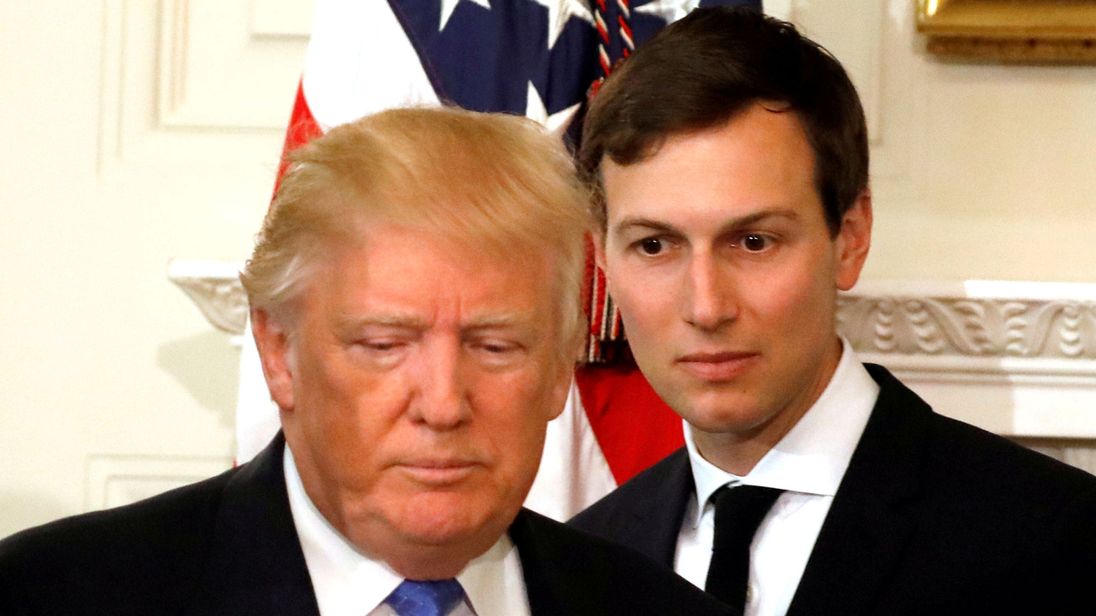
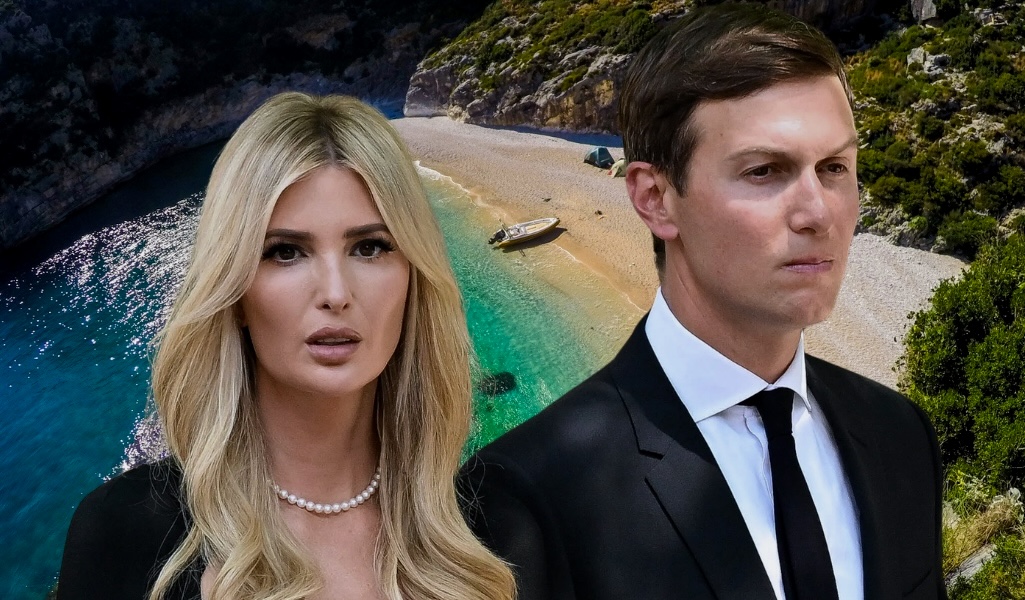
The president and his son-in-law, Jared Kushner, also decided to make Saudi Arabia a linchpin of their policy in the Middle East. Kushner, lacking full security clearance and any diplomatic experience, lobbied the crown prince directly in early 2017 to secure what was fancifully and inaccurately touted as a $110 billion arms sale – most of which had been agreed a year earlier, and the bulk of which still hasn’t been completed.
Shortly after that transaction was arranged, Trump visited Saudi Arabia. And soon after that, the Saudis announced they would invest $20 billion in an infrastructure fund managed by Blackstone Group LP. The New York-based firm had financed several of the Kushner family’s deals and its chairman, Stephen Schwarzman, sat on the president’s business-advisory council. The private equity firm told Bloomberg News that the Saudi investment had been contemplated long before Trump was even the Republican nominee.
Kushner’s forays alarmed members of the intelligence and national security communities, as Bob Woodward outlined in his book, “Fear.” At the very moment Kushner was throwing himself into these diplomatic adventures, he was coming under scrutiny for his own financial conflicts – in particular, his efforts to secure funding for 666 Fifth Avenue, a troubled Manhattan skyscraper his family owned.
Although the family has since sold off the property, Kushner had tried unsuccessfully to secure funding for it from a Chinese investor. His intersection with a prominent banker and diplomats from Moscow during the Trump campaign’s transition into the White House raised questions about whether he was courting Russian investors (which he denied). Inevitably, the Kushner family also courted a prominent Saudi investor to bail them out of 666 Fifth, as detailed by my Bloomberg News colleagues David Kocieniewski and Caleb Melby.
Late last year, Kushner made another secretive trip alone to Riyadh. He later described the visit as an effort to “brainstorm” Middle East strategies with Mohammed bin Salman. Not long afterward, the crown prince placed dozens of prominent businessmen and political rivals under house arrest in what was described as an anti-corruption drive. Among them was Alwaleed, the man who once snatched the Plaza Hotel and yacht from Kushner’s father-in-law.
Earlier this year, leaked intelligence reports revealed that diplomats in Mexico, Israel, China and the United Arab Emirates had decided to target Kushner because they believed he could be easily manipulated due to “his complex business arrangements, financial difficulties and lack of foreign policy experience.”
For his part, Kushner just plowed ahead, continuing to rest the White House’s plans for the Middle East on the shoulders of an equally young and untested man, Saudi Arabia’s crown prince. The disappearance of a single journalist, a one-time ally of the royal family turned critic, may ultimately cause Kushner’s plans to unravel – and expose his machinations in Saudi Arabia to more revealing and unwanted scrutiny.
If it doesn’t, it may well be because the president – putting the lie to his dissembling about his family’s financial ties to Saudi Arabia – will openly and stubbornly put money ahead of the moral and diplomatic issues at play in Khashoggi’s disappearance.
As he told Fox News in an interview on Tuesday night: “I don’t want to give up a $100 billion order or whatever it is.”
October 18, 2018
Posted by Christina Macpherson |
politics, politics international, Saudi Arabia, USA |
1 Comment
White House shelves rescue plan for coal, nuclear: report https://thehill.com/policy/energy-environment/411604-white-house-shelves-rescue-plan-for-coal-nuclear-report BY TIMOTHY CAMA – 10/16/18, The White House has shelved a proposed effort to prop up coal and nuclear power plants at risk of closure, Politico reported.
Some of President Trump’s advisers in the White House National Security Council and National Economic Council oppose Energy Secretary Rick Perry’s plan, due largely to the likelihood that it would raise energy prices, Politico said, citing four people familiar with the matter.
The rescue plan was a key piece of the Trump administration’s energy agenda, and Trump’s promise to save the coal industry. Perry first pursued the policy last year, asking that the Federal Energy Regulatory Commission (FERC) write a rule to require higher electricity payments to coal and nuclear plants, in a bid to preserve the “resiliency” of the electric grid.
But FERC, an independent agency, rejected the proposal unanimously.
Earlier this year, Trump formally asked his administration to find a way to save uneconomic coal and nuclear plants from closing.
A White House memo leaked in May showed that officials were considering using legal authorities to force coal and nuclear plants to stay open for two years. During that time, the National Security Council would study the issue from a security perspective and determine if other interventions could be used.
The Energy Department and the White House didn’t return requests for comment.
October 18, 2018
Posted by Christina Macpherson |
politics, USA |
1 Comment








 nuclear-news