Nuclear waste removed from Sequoyah Fuels site Cherokee Nation, GORE, Okla. 30 Nov 18— A semitrailer quietly left the former Sequoyah Fuels Corporation site near Gore this week, hauling away the last of 511 loads of nuclear waste that has plagued Sequoyah County and its citizens for decades.
The Cherokee Nation and Oklahoma attorney general’s office worked for 18 months to ensure the off-site disposal of 10,000 tons of radioactive material were removed from the Sequoyah Fuels site. The waste was transported to a disposal site in Utah where the uranium will be recycled and reused, leaving the area near the Arkansas River free of this nuclear waste for the first time in nearly 50 years.
“It is a historic day for the Cherokee Nation and the state of Oklahoma. Our lands are safe again, now that we have removed a risk that would have threatened our communities forever,” Cherokee Nation Secretary of State Chuck Hoskin Jr. said. “This would not have been possible if the tribe and state had not worked tirelessly together in court to ensure removal of this material.”
The uranium processing plant was opened by Kerr-McGee in 1970. It converted yellowcake uranium into fuel for nuclear reactors. The plant changed ownership more than once and was eventually sold to General Atomics under the name Sequoyah Fuels Corporation.
An accident at the plant killed one worker and injured dozens of others in 1986. Another accident in 1992 injured about three dozen workers. Following that accident and years of violating numerous environmental rules and nuclear safety standards, the plant was closed in 1993.
Tons of radioactive waste remained at the facility when it closed, so in 2004 the Cherokee Nation and state of Oklahoma entered into a settlement agreement that required the highest-risk waste be removed from the site. The owners of Sequoyah Fuels Corporation announced in 2016 their intention to bury the waste on site, but a judge forced the company to comply with the original agreement. Removal of the material is now complete.
“The Cherokee Nation has been in and out of court with Sequoyah Fuels since 2004, and now this material is no longer a ticking time bomb on the banks of the Arkansas River, one of our most precious natural resources,” Cherokee Nation Secretary of Natural Resources Sara Hill said. “Decommissioning this plant was never enough to satisfy our goals for a clean and safe environment. Removal of this highly contaminated waste was our goal, and we’re pleased that goal has finally been achieved.”
The plant is located where the Arkansas River and Illinois River meet.
“Today’s announcement is another example of the strength behind the continued partnership between the state of Oklahoma and the Cherokee Nation,” said Attorney General Mike Hunter. “The successful outcome is also affirmation of my office’s commitment to finding avenues of collaboration with tribal governments to ensure our state’s natural resources remain protected and our citizens and communities remain safe.”
Sequoyah County is home to 41,000 residents. Many of those residents are Cherokee and were once employed at the plant, where dozens of workers were injured over the years…….http://webtest2.cherokee.org/News/Stories/20181130_Cherokee-Nation-state-of-Oklahoma-city-of-Gore-announce-nuclear-waste-removed-from-Sequoyah-Fuels-site
December 1, 2018
Posted by Christina Macpherson |
indigenous issues, USA, wastes |
Leave a comment
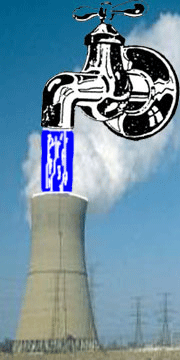 For nuclear plants, that warning is particularly grave. Reactors require 720 gallons of water per megawatt-hour of electricity they produce……Solar plants, by contrast, use approximately 20 gallons per megawatt-hour, mostly for cleaning equipment
Trump Administration’s Climate Report Raises New Questions About Nuclear Energy’s Future
The thirstiest source of electricity is already struggling, and greater risk of droughts will only add to those woes. Huffington Post.By Alexander C. Kaufman, 28 Nov 18,
Call it the nuclear power industry’s thirst trap.
The United States’ aging fleet of nuclear reactors ― responsible for one-fifth of the country’s electricity and most of its low-carbon power ― has never been more necessary as policymakers scramble to shrink planet-warming emissions. Yet the plants are struggling to stay afloat, with six stations shut down in the last five years and an additional 16 reactors scheduled to close over the next decade. So far, new coal- and gas-burning facilities are replacing them.
The nuclear industry blames high maintenance costs, competition from cheaper alternatives and hostile regulators concerned about radiation disasters like the 2012 Fukushima meltdown in Japan. But the country’s most water-intensive source of electricity faces what could be an even bigger problem as climate change increases the risk of drought and taxes already crumbling water infrastructure.
That finding, highlighted in the landmark climate change report that the Trump administration released with apparent reluctance last Friday, illustrates the complex and at times paradoxical realities of anthropogenic, or human-caused, warming. It also stokes an already hot debate over the role nuclear energy should play in fighting global warming, a month after United Nations scientists warned that carbon dioxide emissions must be halved in the next 12 years to avoid cataclysmic climate change leading to at least $54 trillion in damage.
The report ― the second installment of the Fourth National Climate Assessment, a congressionally mandated update on the causes and effects of anthropogenic warming from 13 federal agencies ― devoted its entire third chapter to water contamination and depletion. Aging, deteriorating infrastructure means “water systems face considerable risk even without anticipated future climate changes,” the report states. But warming-linked droughts and drastic changes in seasonal precipitation “will add to the stress on water supplies and adversely impact water supply.”
Nearly every sector of the economy is susceptible to water system changes. And utilities are particularly at risk. In the fourth chapter, the report’s roughly 300 authors conclude, “Most U.S. power plants … rely on a steady supply of water for cooling, and operations are expected to be affected by changes in water availability and temperature increases.”
For nuclear plants, that warning is particularly grave. Reactors require 720 gallons of water per megawatt-hour of electricity they produce, according to data from the National Energy Technology Laboratory in West Virginia cited in 2012 by the magazine New Scientist. That compares with the roughly 500 gallons coal requires and 190 gallons natural gas needs to produce the same amount of electricity. Solar plants, by contrast, use approximately 20 gallons per megawatt-hour, mostly for cleaning equipment, according to the Solar Energy Industries Association, a trade group.
Nuclear plants are already vulnerable to drought. Federal regulations require plants to shut down if water in the river or lake that feeds its cooling drops below a certain level. By the end of the 2012 North American heat wave, nuclear generation fell to its lowest point in a decade, with plants operating at only 93 percent of capacity.
The availability of water is one problem, particularly for the majority of U.S. nuclear plants located far from the coasts and dependent on freshwater. Another is the temperature of the water that’s available.
Nearly half the nuclear plants in the U.S. use once-through cooling systems, meaning they draw water from a local source, cool their reactors, then discharge the warmed water into another part of the river, lake, aquifer or ocean. Environmental regulations bar plants from releasing used water back into nature above certain temperatures. In recent years, regulators in states like New York and California rejected plant operators’ requests to pull more water from local rivers, essentially mandating the installation of costly closed-loop systems that cool and reuse cooling water.
In 2012, Connecticut’s lone nuclear power plant shut down one of its two units because the seawater used to cool the plant was too warm. The heat wave that struck Europe this summer forced utilities to scale back electricity production at nuclear plants in Finland, Germany, Sweden and Switzerland. In France the utility EDF shut down four reactors in one day.
“Already they’re having trouble competing against natural gas and renewable energy,” said John Rogers, a senior energy analyst at the Union of Concerned Scientists. “Add onto that high water temperatures, high air temperatures and drought. It’s just another challenge.”
…….. the heart of the biggest question looming over the nuclear industry: Is it, given the radioactive waste it produces, clean energy?
……… For the Sierra Club, the environmental giant making a huge push to get cities and states to go all renewable, nuclear power is “a uniquely dangerous energy technology for humanity” and “no solution to climate change.”
“There’s no reason to keep throwing good money after bad on nuclear energy,” Lauren Lantry, a Sierra Club spokeswoman, said by email. “It’s clear that every dollar spent on nuclear is one less dollar spent on truly safe, affordable, and renewable energy sources like wind, solar, energy efficiency, battery storage, and smart grid technology.” https://www.huffingtonpost.com.au/entry/nuclear-energy-climate-change-report_us_5bfdb9cae4b0a46950dce58f
November 29, 2018
Posted by Christina Macpherson |
climate change, USA, water |
Leave a comment
Why Saudi Arabia Will Acquire Nuclear Weapons If the Trump administration continues to turn its nuclear negotiations into a boondoggle, then nothing will prevent Riyadh from building bombs.,National Interest by Paul R. Pillar, 28 Nov 18
The Trump administration’s handling of nuclear negotiations with Saudi Arabia promises to lay bare some realities about security issues and nuclear programs in that part of the world that the administration has refused to acknowledge. A front-page article by David Sanger and William Broad in the New York Timesreviews some of the still-unresolved questions. The Saudi regime insists on producing its own nuclear fuel, which would be different from terms the United States has negotiated with some other states, including the United Arab Emirates, that have sought U.S. assistance in developing their nuclear programs. The Saudis have balked at comprehensive international inspections to detect any work on nuclear weapons. And Saudi Arabia’s Crown Prince Mohammed bin Salman (MbS) has explicitly threatened to develop nuclear weapons, ostensibly in response to any similar development by Iran.
A useful model for approaching this situation involves Iran. The model is the Joint Comprehensive Plan of Action (JCPOA), the multilateral accord commonly known as the Iranian nuclear deal, which Donald Trump has castigated and on which his administration has reneged by imposing new economic sanctions despite continued Iranian compliance with the JCPOA. The JCPOA closed all possible pathways to development of an Iranian nuclear weapon through stringent restrictions on enrichment of uranium, the gutting of reactors that otherwise might be used to produce plutonium, and the prohibition of any reprocessing by Iran of nuclear fuel. The agreement also established a thorough inspection system that involves not only routine monitoring of nuclear facilities but also the ability of international inspectors to inspect any other sites they may have reason to suspect are housing nuclear-related activity, with the other parties to the agreement being able to outvote Iran in the event of disagreement about the relevance of a requested inspection. This is the kind of highly intrusive inspection arrangement that the Saudis reportedly are refusing to apply to themselves.
The principal U.S. negotiator has been Secretary of Energy Rick Perry, for whom this is a learning-on-the-job experience. Perry was initially unaware of the Department of Energy’s nuclear responsibilities and believed his job would consist of promoting the oil industry. (This contrasts with Perry’s predecessor, Ernest Moniz, a nuclear physicist who played a key role in negotiation of the highly detailed JCPOA.)………
Amid all the talk among opponents of the JCPOA about ballistic missiles, it is worth noting that Saudi Arabia has been ahead of its regional neighbors on that count as well. Two decades ago, Saudi Arabia secretly purchased medium-range missiles from China that, although reportedly configured to carry conventional weapons, were of a type originally designed to deliver a nuclear warhead. The Saudis in more recent years have modernized their missile force, again relying on China as the supplier.
Destabilizing regional activity also implies that Saudi Arabia is more of a worry than most states regarding the implications of possible acquisition of nuclear weapons. Saudi Arabia has bombed Yemen into becoming a humanitarian catastrophe, has kidnapped and attempted to coerce into resignation the prime minister of Lebanon, and has used diplomatic facilities in foreign countries to assassinate nonviolent dissidents. The impetuous young prince behind these policies has been moving toward one-man rule, shedding even the restraints of what had been a collective family autocracy.
The murder of Jamal Khashoggi has drawn some recent and welcome attention to this pattern of behavior, although it has not budged Donald Trump from his stance of sticking with MbS no matter what he does. California Rep. Brad Sherman has appropriately observed, “A country that can’t be trusted with a bone saw shouldn’t be trusted with nuclear weapons.”
The administration’s assault on the JCPOA may provide the trigger for Saudi Arabia to try to obtain such weapons. If the U.S. “maximum pressure” campaign succeeds in negating completely the economic relief Iran was supposed to have received under the JCPOA, then Iranian leaders may yet throw up their hands in disgust and pronounce the agreement null and void. This would release Iran from all its nuclear restrictions under the agreement, which in turn might provide the perfect rationale for Riyadh, especially as long as MbS is in charge, to acquire the bomb.
Paul R. Pillar is a contributing editor at the National Interest and the author of Why America Misunderstands the World . https://nationalinterest.org/blog/paul-pillar/why-saudi-arabia-will-acquire-nuclear-weapons-37197
November 29, 2018
Posted by Christina Macpherson |
politics international, Saudi Arabia, USA |
Leave a comment
 TRUMP SAYS HIS ‘VERY HIGH LEVELS OF INTELLIGENCE’ MEANS HE CAN’T BELIEVE IN CLIMATE CHANGE, SCIENTISTS DESPAIR News Week ,BY BRENDAN COLE ON 11/28/18 Scientists have reacted with dismay to President Donald Trump’s assertion that he was not among the “believers” in the seriousness of climate change. TRUMP SAYS HIS ‘VERY HIGH LEVELS OF INTELLIGENCE’ MEANS HE CAN’T BELIEVE IN CLIMATE CHANGE, SCIENTISTS DESPAIR News Week ,BY BRENDAN COLE ON 11/28/18 Scientists have reacted with dismay to President Donald Trump’s assertion that he was not among the “believers” in the seriousness of climate change.
His administration released a dense report compiled by 13 federal agencies last week that painted a bleak picture of the severity of the impact of climate change on the lives of Americans, and the U.S. economy.
But Trump dismissed it.
“One of the problems that a lot of people like myself, we have very high levels of intelligence but we’re not necessarily such believers,” Trump told The Washington Post in an interview in the Oval Office.
“As to whether or not it’s man-made and whether or not the effects that you’re talking about are there, I don’t see it,” he said, doubling down on his initial reaction to the National Climate Assessment report on Monday, when he said: “I don’t believe it.” ….
The White House report warned that rising temperatures had already harmed the U.S., and that limiting greenhouse gases would substantially benefit the American economy…..
Andrew Dessler, a professor of atmospheric sciences at Texas A&M University, called the president’s comments “idiotic,” The Post reported.
And Katharine Hayhoe, a climate scientist at Texas Tech University, told The Post: “Facts aren’t something we need to believe to make them true, we treat them as optional at our peril.
“And if we’re the president of the United States, we do so at the peril of not just ourselves but the hundreds of millions of people we’re responsible for.” https://www.newsweek.com/trump-says-his-very-high-levels-intelligence-means-he-cant-believe-climate-1234608
|
|
November 29, 2018
Posted by Christina Macpherson |
climate change, USA |
Leave a comment
There has been great concern about extensive and extremely toxic and radioactive waste at the SSFL for years.
According to Daniel Hirsch, who recently retired as director of the Program on Environmental and Nuclear Policy at the University of California, Santa Cruz, SSFL is “one of the most contaminated sites in the country
There are multiple human health impacts that have been known to stem from the site well before the Woolsey Fire began.
A study prepared by Professor Hal Morgenstern for the federal Agency for Toxic Substances and Disease Registry studied the community surrounding SSFL and found a greater than 60 percent increase in incidence of key cancers associated with proximity to the site.
“DTSC is a classically captured regulatory agency, captured by the polluters it is supposed to regulate,”
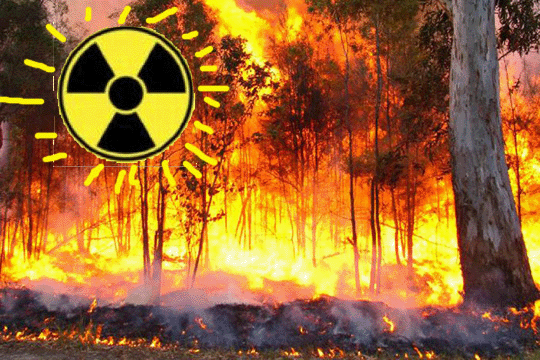
California Wildfire Likely Spread Nuclear Contamination From Toxic Site https://truthout.org/articles/california-wildfire-likely-spread-nuclear-contamination-from-toxic-site/, Dahr Jamail,, November 26, 2018The incredibly destructive Woolsey Fire in southern California has burned nearly 100,000 acres in Los Angeles and Ventura counties, killed three people, destroyed more than 400 structures, and at the time of this writing, was finally nearly completely contained.
The fire may also have released large amounts of radiation and toxins into the air after burning through a former rocket engine testing site where a partial nuclear meltdown took place nearly six decades ago.
“The Woolsey Fire has most likely released and spread both radiological and chemical contamination that was in the Santa Susana Field Laboratory’s soil and vegetation via smoke and ash,” Dr. Bob Dodge, president of Physicians for Social Responsibility-Los Angeles (PSR-LA), told Truthout.
The fire has been widely reported to have started “near” the Santa Susana Field Laboratory site (SSFL), but according to PSR-LA, it appears to have started at the site itself.
The contaminated site — a 2,849-acre former rocket engine test site and nuclear research facility — is located just 30 miles northwest of downtown Los Angeles.
A press release issued by PSR-LA on November 12 stated: Continue reading →
November 27, 2018
Posted by Christina Macpherson |
environment, incidents, USA |
Leave a comment
Russia says it’s planning for the US to deploy nuclear weapons to Europe after ban treaty abandoned, Business Insider, Andrew Osborn and Tom Balmforth, Reuters, 26 Nov 18
- Russia and the United States have both accused each other of violating a Cold-war era arms treaty that prohibits short- and intermediate-range nuclear weapons within Europe.
- President Donald Trump has threatened to quit the treaty, pointing to Russian violations, but National Security Advisor John Bolton has said the US is a long way from discussing new nuclear weapons deployments to Europe.
- Russia said on Monday that despite US promises, it is still planning for the US to deploy new nuclear missiles.
MOSCOW (Reuters) – Russia said on Monday it was planning for a U.S. deployment of new nuclear missiles in Europe following Washington’s planned withdrawal from a landmark Cold war-era arms control treaty despite the United States denying it has such plans.
Russia is keen to dissuade U.S. President Donald Trump from carrying out a threat for Washington to quit the Intermediate-Range Nuclear Forces (INF) Treaty which eliminated both countries’ land-based short- and intermediate-range nuclear missiles from Europe.
Both countries accuse each other of violating the 1987 treaty and President Vladimir Putin and Trump are due to discuss the matter at the G20 in Argentina later this month. …….https://www.businessinsider.com/russia-doesnt-trust-us-nuclear-arms-treaty-2018-11/?r=AU&IR=T
November 27, 2018
Posted by Christina Macpherson |
politics international, Russia, USA, weapons and war |
Leave a comment
 Daily Mail 25th Nov 2018
 Troubled utility SCANA has reached a $2 billion settlement with the South Carolina customers who sued after they were charged high rates to pay for the company’s failed nuclear construction project. SCANA announced the agreement in a news release Saturday. As part of the settlement, South
Carolina Electric & Gas Co. customers will also receive $115 million that The State newspaper reports had been set aside for soon-to-be-ousted SCANA executives.
November 25, 2018
Posted by Christina Macpherson |
Legal, USA |
Leave a comment
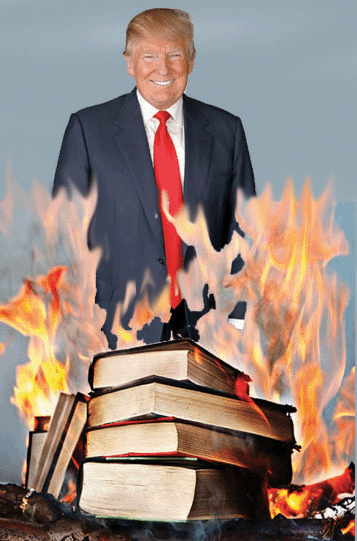 Climate report: Trump administration downplays warnings of looming disaster
Democrats ramp up pressure to act in wake of most sobering government analysis yet, Guardian, Oliver Milman@olliemilman Sun 25 Nov 2018
Report: climate change ‘will inflict substantial damages’ The Trump administration attempted to downplay the stark findings of its own climate change assessment, as Democrats sought to pressure the White House to avert looming economic and public health disaster.
The US National Climate change assessment, the work of 300 scientists and 13 federal agencies, was released on Friday afternoon. It found that wildfires, storms and heatwaves are already taking a major toll on Americans’ wellbeing, with climate change set to “disrupt many areas of life” in the future.
The voluminous report, which warns of hundreds of billions of dollars lost, crop failures, expanding wildfires, altered coastlines and multiplying health problems, represents the most comprehensive and sobering analysis yet of the dangers posed to the US by rising temperatures……….
A White House spokeswoman, however, said the assessment was “largely based on the most extreme scenario, which contradicts long-established trends by assuming that, despite strong economic growth that would increase greenhouse gas emissions, there would be limited technology and innovation, and a rapidly expanding population”.
The spokeswoman added the next report, due in four years’ time, will “provide for a more transparent and data-driven process”.
Katharine Hayhoe, a climate scientist at Texas Tech University and a report co-author, said the White House’s statement was “demonstrably false”.
She added on Twitter: “I wrote the climate scenarios chapter myself so I can confirm it considers ALL scenarios, from those where we go carbon negative before end of century to those where carbon emissions continue to rise.”
The climate assessment galvanized Democrats, who will control the House of Representatives next year.
“The days of denial and inaction in the House are over,” said Frank Pallone, a New Jersey congressman set to chair the energy and commerce committee. “House Democrats plan to aggressively address climate change and hold the administration accountable for its backward policies that only make it worse.”
Alexandria Ocasio-Cortez, a newly elected representative from New York City who has become a standard-bearer for the left, tweeted: “People are going to die if we don’t start addressing climate change ASAP. It’s not enough to think it’s ‘important’. We must make it urgent.”
Authors of the report, which is mandated by Congress, echoed the sense of urgency and lamented the timing of its release on the day after Thanksgiving, which is usually the busiest shopping day of the year.
“This report makes it clear that climate change is not some problem in the distant future – it’s happening right now in every part of the country,” said Brenda Ekwurzel, a co-author and director of climate science at the Union of Concerned Scientists, in a statement.
“When people say the wildfires, hurricanes and heatwaves they’re experiencing are unlike anything they’ve seen before, there’s a reason for that and it’s called climate change.”……..
The president took a trip last week to see the aftermath of California’s deadliest ever wildfires, a phenomenon experts say is worsened by warming temperatures. During a visit to the town of Paradise, which was wiped out by the so-called Camp fire, Trump said he wanted “a great climate”. But he has largely blamed forest management for the blaze.
He has repeatedly disparaged or dismissed climate science in the past…….https://www.theguardian.com/environment/2018/nov/24/climate-change-report-trump-administration-democrats-reaction
November 25, 2018
Posted by Christina Macpherson |
climate change, politics, USA |
Leave a comment
|
Trump’s Utter Denial About Saudi Arabia and Its Crown Prince, New Yorker, By Robin Wright,November 20, 2018
So much for American justice. In a statement both stunning and coldhearted, President Trump on Tuesday
gave Saudi Arabia a pass on the grisly murder and dismemberment of journalist Jamal Khashoggi in the
name of U.S. national security. He blithely rejected a U.S. intelligence assessment as well as damning
physical evidence provided by Turkey indicating that the kingdom’s de-facto ruler, Crown Prince
Mohammed bin Salman, authorized the Saudi dissident’s execution, in Istanbul, on October 2nd. The President
of the United States sounded more like a defense attorney—or lobbyist—for the oil-rich kingdom than
a protector of American values.
“It could very well be that the Crown Prince had knowledge of this tragic event—maybe he did and maybe
he didn’t!” Trump said in a two-page statement. He condemned the Khashoggi assassination as an
“unacceptable and horrible crime,” but then said Saudi Arabia was too important a purchaser of U.S. weaponry,
an exporter of oil, and an ally in “our very important fight against Iran” to take punitive action. “The United
States intends to remain a steadfast partner of Saudi Arabia to ensure the interests of our country,” Trump said.
“Very simply,” he concluded, “it is called America First!”
The President’s statement was riddled with falsehoods and contradictions. He embraced the “vigorous” denials
from King Salman and his tempestuous young heir, Prince Mohammed—even though several members of the fifteen-man hit squad that killed Khashoggi worked for the crown prince, who is known by his initials, M.B.S. Trump based his justification on what he claimed was the kingdom’s promise to invest or spend four hundred and fifty billion dollars, including a hundred and ten billion dollars in arms purchases, in the United States. Last month, however, Politifact concluded that Trump’s claim earned a “pants
on fire” rating. “Orders on that scale don’t exist” and are only a “mirage,” it said. “There is no data behind the $450
billion, and the $110 billion is a blend of smaller deals in progress, old offers”—from the Obama era—“that have
not come through, and speculative discussions that have yet to move forward.”
Saudi Arabia, in fact, has only followed through so far on fourteen and a half billion dollars in arms and aircraft,
the State Department acknowledged last month. Other deals are merely vague memorandums of understanding
that cover the next decade, not this year. On Tuesday, a new report by the Center for International Policy also
called Trump’s claims “wildly exaggerated”—and noted that many of the jobs created from the arms sales are
in Saudi Arabia, not the United States.
Washington is also far from dependent on Riyadh’s oil wealth. Rather, the Center for International Policy’s new
report detailed the kingdom’s “extreme dependence” on the United States. With the U.S.-Saudi relationship
under scrutiny after Khashoggi’s murder, “it’s important to remember that the United States has substantial
leverage over Saudi behavior,” William Hartung, the director of the center’s Arms and Security Project, wrote.
“The Saudi military depends on U.S. arms, spare parts and maintenance to carry out its brutal war in Yemen
and could not prosecute that war for long without that support.”
The President’s comments, which flouted a C.I.A. assessment that M.B.S. likely ordered Khashoggi’s death,
provoked scorn, dismay, and outrage from human-rights groups, politicians, and foreign-policy experts.
Joseph Cirincione, the president of the Ploughshares Fund, a global-security foundation, told me, “This is,
without a doubt, the most uninformed, toady, poorly written, categorically untrue statement I have ever seen
a President of the United States make. His statement has provoked such a strong, overwhelmingly negative
reaction for good reason: it raises serious questions about the President’s fitness for office.”
Sarah Leah Whitson, the executive director of the Middle East division of Human Rights Watch, told me that
Trump’s statement “isn’t just immoral, it’s reckless and will come back to haunt and hurt U.S. interests.” She
said the crown prince has proved to be “an impulsive, sadistic, unhinged leader” who has destabilized the
region, most notably by launching the deadly war in Yemen, in 2015. “This only signals to tyrants around
the world that it’s open season on journalists and critics, wherever they are, so long as they’re cozy with Trump.”
The former U.N. Ambassador Samantha Power, who won the Pulitzer Prize for her book on efforts to halt
genocide and other war crimes, tweeted that the President’s remarks were “an abomination that will define
the ignorance, corruption, cruelty and recklessness of this presidency for generations to come.” The former
nato Ambassador Nicholas Burns, a career diplomat who is now at Harvard’s Belfer Center, called Trump’s
seven-paragraph statement “beyond embarrassing. It is shameful. He cites uncritically the MBS smear that
Khashoggi was a traitor. He argues the U.S. can’t afford to alienate Riyadh due to oil+Iran. He is silent on
our most important interest—Justice.”…….
Trump, apparently, believes that his policies could be endangered if he spurns Prince Mohammed, who has
amassed authoritarian powers. The Prince is now gaming his own rehabilitation, which Trump’s statement
will help. The Saudi press recently reported that M.B.S. will represent the kingdom at the annual G20
summit of the world’s twenty most important economies, which is next week in Buenos Aires. Trump is
expected to meet with the crown prince there…….https://www.newyorker.com/news/news-desk/trumps-utter-denial-about-saudi-arabia-and-its-crown-prince?mbid=nl_Daily%20112118&CNDID=46508601&utm_source=nl&utm_medium=email&utm_campaign=Daily%20112118&utm_content=&utm_brand=tny&utm_mailing=Daily%20112118&hasha=c25c4ad8a3e4cbc8faed20a1376eed39&hashb=637cacb29baeeb67e63d66fee2c449133fb8087a&spMailingID=14662796&spUserID=MTcxNTIwODYzMTU2S0&spJobID=1521660067&spReportId=MTUyMTY2MDA2NwS2 |
|
November 24, 2018
Posted by Christina Macpherson |
politics international, USA |
Leave a comment

Contaminated US nuclear plant Hanford Site Plutonium supplier for the atomic bomb on Nagasaki, Deutschlandfunk Kultur. By Nicole Markwald 21 Nov 18 [machine translation] The nuclear complex Hanford Site in the US state of Washington supplied plutonium since 1943 – also for the atomic bomb on Nagasaki. Leaky tanks on the contaminated terrain make headlines. But in the reactor tours tourists learn nothing of it……
Hanford Site – today a national memorial
The site was declared a National Memorial three years ago, along with Oak Ridge, Tennessee and Los Alamos, New Mexico. At these three sites, the atomic bomb was developed during the Second World War – under the code name Manhattan Project.
“We’re gonna start today by giving you the backstory of the Manhattan Project.”………
 The shock is to see it: We are on a heavily contaminated terrain with a total of nine reactors, all of which are now switched off. The area is about twice as large as the urban area of Hamburg. The danger lurks underground, radioactive waste is stored in huge underground tanks – sirens, which is clear to every visitor, can not mean anything good. But the situation quickly relaxes – it’s one Thursday, 10:15 am – once a month the emergency systems are tested, the tour guide thinks…….
The production started in September 1944, after a good six weeks the first plutonium could be won. The intended use: Fat Man, the nuclear weapon that was dropped on August 9, 1945 over the Japanese city of Nagasaki.
David Anderson is one of today’s visitors to the B reactor. He seems thoughtful – in the place that has brought so much suffering over Japan.
“We have become numb when it comes to the Second World War. We have been at peace with us for so long. We can no longer understand the violence and much else that was happening back then. It makes me sad to know what happened back then. Why? … Why?”
But that’s not an issue in the B reactor tour. And not that Hanford Site today is an oversized atomic dump.
Scientists estimate that the waste stored here still contains around 190 kilograms of plutonium. That would be enough for 23 bombs like the one that was killing Nagasaki and killing at least 70,000 people at once.
The nuclear danger lurks everywhere
But no one knows how much atomic waste is actually stored on the huge area. Exact records from the early days on introduced quantities and their composition or pumping actions between different tanks does not exist. And outside of Washington State or the neighboring state of Oregon, little or nothing is known about Hanford Site and the dangers lurking in the ground……..
Americans know little about Hanford Site
Holly Barker holds an anthropology lecture at the University of Washington in Seattle. Topic today: Hanford site and the threats to the environment and workers. As a young woman, Barker was involved in the volunteer service Peace Corps. This work led them to the Marshall Islands in Oceania, where the United States performed many atomic bomb tests between 1946 and 1958. No, she says, whoever does not live in Washington State probably knows little about Hanford.
“That’s one reason why I offer this course. I think that as citizens we have a duty to know more about it in order to change anything at all. The problems are so enormous and complex that we need the brilliance of the young people in my lecture, the next generation to set about addressing this complicated inheritance. “
Probably the biggest cleaning action in the world
Over the next two hours, she talks in the storied lecture theater about the secrecy with which the project was driven, how it was advised, what quantities of workers could be exposed, and what kind of health problems some of them were carrying. She also tells about the world’s largest cleaning operation, which has been going on for years in Hanford to dispose of radioactive waste safely. After the lecture, Barker tells in her small office in the basement that Hanford Site rarely makes it into the news:
“At least when, as recently, a tunnel collapses and workers have been exposed to higher radiation levels. There are other tunnels that are unstable – if you hear anything about Hanford, it’s just bad. “
“In another developing story at emergency what declared today at the Hanford Nuclear Reservation in Washington State, a vast storage facility in the Eastern part of that state, part of a tunnel, used to transport radioactive waste collapsed.”
In 2017, a tunnel collapsed
In May 2017, a storage tunnel collapsed, a six-by-six-meter off-road area had collapsed. At the time there were 5,000 workers on the site, a security alarm was triggered. The Department of Energy explained that there were eight wagons of nuclear waste in the tunnel, and that radioactive material should not have leaked out………
 Increased radiation as a cause of cancer?
……..There are several studies that deal with the cancer rates around Hanford. With different results. Only in one, the studies are unanimous: It is really dangerous for the workers in Hanford site, who clean the grounds.
2060 should be completed decontamination
The decontamination and disposal works have been running since the mid-80s, they are expected to be completed in 2060. There are 177 tanks in the ground, with at least 50 million gallons of garbage in them. Included: 1500 different, easily evaporating chemicals, many highly toxic. And they regularly quit and injure workers, as Attorney General of Washington State lists Bob Ferguson.
“You have a headache, the skin is burning, your lungs are sometimes completely damaged and there are cancer cases.”
In September 2019, the workers involved in cleaning up the nuclear waste were able to celebrate an important success. Washington State, Hanford Challenge, and a union group had sued the Department of Energy for safer working conditions in 2015. Hanford Site is under the Ministry. A court in Seattle has now, after three years, the plaintiffs right. The ministry has been sentenced to over $ 900,000 in fines and must provide better protection for workers.
“Workers have been getting sick for years, but energy, and there’s no way to sugarcoat this, they did not take it seriously.”
Workers have been ill for years
Bob Ferguson says the Energy Department did not take the problem seriously, although workers had been ill for years. Next to him was Tom Carpenter, managing director of the Hanford Challenge interest group………..
“Years pass and it still looks the same. This lack of progress frustrates people. Here, so much money flows in here. But you do not hear that it goes ahead. Because it does not.
One of the main problems: where to go with the destructive stuff? an official final deposit does not exist in the US either.
“We do not even have a place to put this waste once we get it out of these high-level nuclear waste tanks.”
Cleaning costs: up to $ 200 billion
And yet there is no alternative for Tom Carpenter:
“Cleaning Hanford will cost up to $ 200 billion. Nothing – compared to the cost of the atomic bomb. We have to do it, we have no choice. To protect our resources, our people and future generations. It would be an incredible crime on the environment not to dispose of this material. “
Washington State also depends on the financial drip. Each year, $ 2 billion goes to the state for the so-called ‘clean up effort’. There is not much in the region except some farming – and workers are well worth a job with a minimum income of $ 60,000 a year. As absurd as it is, the contaminated land is lucrative for Washington State.
Hanford Site is a place of extremes. Once a flagship project in the Cold War, today the bearer of a frightening title: the radioactively most contaminated site in the Western Hemisphere.
Anthropologist Holly Baker:
“I think the challenge Hanford is too big to be understood by a single person. One would have to be a physicist – I know too little about water, radiation, engineering – one would need to have the knowledge of each of these issues associated with Hanford. No single person can do it. And maybe that’s not why Hanford has yet to be solved – because it’s such a complex place where so many different things overlap. ” https://www.deutschlandfunkkultur.de/verseuchte-us-nuklearanlage-hanford-site-plutoniumlieferant.979.de.html?dram:article_id=433666
November 24, 2018
Posted by Christina Macpherson |
spinbuster, USA |
Leave a comment
 U.S. senator joins nationwide call for caution on Hanford waste change https://www.tri-cityherald.com/news/local/hanford/article221916070.html BY ANNETTE CARY acary@tricityherald.com November 19, 2018 RICHLAND, WA
The public needs more time to comment on an issue as important as reclassifying high level radioactive waste at Hanford and other Department of Energy sites, says 75 organizations nationwide.
On Monday, Sen. Ron Wyden, D-Ore., added his support to their call for more additional time on the DOE proposal.
DOE is considering a change to how it interprets the legal definition of high level radioactive waste, which would allow more flexibility in how it disposes of some waste at the Hanford site.
Defining less of the nation’s nuclear waste as high level could speed up environmental cleanup and save billions of dollars.
But it also could mean more toxic waste allowed to remain in the ground at Hanford, say critics.
Wyden wrote in a letter to Anne Marie White, DOE assistant secretary for environmental management, that the proposed definition change could provide less protection for future generations and the environment.
“ . . . (C)hanging the definition of what has always been considered high level waste requiring permanent disposal is a significant change and could lead to dramatically different clean-up practices and outcomes,” he wrote.
He called for a 120-day extension to the public comment period, which now is 60 days ending Dec. 10.
A letter signed by leaders of 75 organizations was sent Wednesday to White making the same request.
Among organizations backing the letter were Hanford Challenge, Columbia Riverkeeper, Heart of America Northwest and the Natural Resources Defense Council.
The new interpretation would be “a drastic and controversial change” to DOE environmental cleanup policy, the letter said.
“We believe all interested stakeholders — and the DOE — agree that this decision requires thorough and thoughtful consideration by all affected parties,” the letter said.
Congress has passed laws that define high level radioactive waste as waste that results from processing irradiated nuclear fuel if the waste is “highly radioactive.”
At Hanford, chemicals were used to separate plutonium from irradiated fuel at huge processing plants. The plutonium was produced from World War II through the Cold War for the nation’s nuclear weapons program.
The fuel processing left 56 million gallons of radioactive and hazardous chemical waste in underground tanks until it can be treated for disposal. It now is considered high level waste.
DOE is proposing that waste from fuel processing not be classified as high level if it can meet the radioactive concentration limits for low level radioactive waste.
While high level waste is defined mostly by the processes that created it, low level waste is defined mostly by its radioactive content.
DOE also would consider a second way to determine that waste from chemical reprocessing not be consider high level. It could be disposed of as low level radioactive waste if an assessment shows it can be safely dispose of without sending it to a deep geologic repository, such as the repository proposed for Yucca Mountain, Nev.
The Energy Communities Alliance — which includes Hanford Communities, a coalition of small governments near the Hanford nuclear reservation — supports the proposal to change the definition.
It has the potential to save $40 billion across the DOE complex, said Richland Mayor Bob Thompson.
DOE has declined to discuss how changing the definition would impact different Hanford waste.
However, it could make it easier to send waste held in up to 20 of Hanford’s 149 single-shell tanks to a national repository for transuranic waste in New Mexico, the Waste Isolation Pilot Plant.
Transuranic waste contains certain levels of plutonium or other isotopes heavier than uranium.
DOE also is in the early steps of considering how to close underground tanks at Hanford that have had most, but not all, of their radioactive waste removed.
Changing the classification of tank waste might help a plan to use concrete-like grout to fill the tanks rather than trying to remove additional waste.
Hanford Challenge opposes the change in defining high level radioactive waste, saying it could leave more waste at Hanford, including soil contaminated from past leaks and spills of 1 million gallons of tank waste.
It also gives DOE far too much discretion in the factors it could consider if it is allowed to determine whether waste does not need to go to a deep repository like Yucca Mountain, said Tom Carpenter, executive director of Hanford Challenge, when DOE announced the proposal.
Comments may be emailed to HLWnotice@em.doe.gov.
Annette Cary; 509-582-1533; @HanfordNews
November 22, 2018
Posted by Christina Macpherson |
USA, wastes |
Leave a comment

Trump’s Defense Spending Is Out of Control, and Poised to Get Worse https://www.rollingstone.com/politics/politics-features/trump-defense-spending-757028/ 15 Nov 18,
Using a time-honored trick, a bipartisan congressional panel argues we should boost the president’s record defense bill even more
By MATT TAIBB
A bipartisan commission has determined that President Trump’s recent record defense bill is insufficiently massive to keep America safe, and we should spend more, while cutting “entitlements.”
The National Defense Strategy Commission concluded the Department of Defense was too focused on “efficiency” and needed to accept “greater cost and risk” to search for “leap-ahead technologies” to help the U.S. maintain superiority.
The panel added that Defense is “not where most of the money is.” It said Congress should be focused on “domestic entitlement programs” and “interest payments on the national debt” as sources of savings.
The report even contains a graph that shows defense spending crawling sadly along the floor of the spending X-axis as mighty mandatory “entitlements” soar to great heights.
This is the same Department of Defense with a serious existing accounting problem. In 2016, before Trump was elected, its Inspector General said he could not properly track $6.5 trillionin defense spending. A later academic study claimed the number was $21 trillion, looking at the years 1998-2015.
Trump originally asked for over $730 billion in defense spending for Fiscal Year 2019, and last spring a budget setting spending at $716 billion passed 85-10 in the Senate. This would have meant an $82 billion spending hike, an increase that by itself was larger than the entire defense budget of every country on earth, save China.
Trump later called for an across-the-board budget cut of 5 percent, leaving the amount of the defense budget in confusion. He still claims he wants $700 billion. Whatever the final amount turns out to be, it will be massive — about 10 times the size of Russia’s defense budget, and four times the size of China’s.
The National Defense Strategy Commission was created as part of the 2017 National Defense Authorization Act. It’s section 942 in this bill, and it requires that the majority and minority committee chiefs for Armed Services in both the House and the Senate to each name three people to the panel.
Eric Edelman, who was the senior policy official in the Defense Department from 2005-2009, chairs the panel. The co-chair, appointed by Democrat Adam Smith of Washington, is Admiral Gary Roughead, who was named chief of Naval operations in 2007 and now sits on the board of Northrup Grumman.
Other members include Dr. Andrew Krepinevich, who heads a defense consulting firm called Solarium and once authored a Foreign Policy article called How To Win in Iraq that called for a “protracted commitment of U.S. resources” in the Middle East (this was a precursor to the “surge” concept). Former acting head of the CIA Michael Morell is one of the Democratic appointees.
To recap: While spending record sums on a defense bill, Congress allocated still more money to a panel of current and former defense specialists whose purpose seems to have been to write a report asking for more money.
We regularly hear that our weapons systems are old, outdated and placing troops in harm’s way. It’s an ancient political device and it usually works.
Ronald Reagan was a master at this. In 1983, Reagan was giving speeches about how our last new nuclear missile system, the Minuteman, had been designed in 1969. Meanwhile, the Soviets since then had built five new classes and “upgraded five times.”
This appeal to national consumerist shame — we can’t be seen in public driving something old! — is effective. On a policy level, such appeals are usually couched in terms of needing to make American “hard power” a more “credible” foreign policy tool.
Any sober assessment of the challenges faced by the United States since the collapse of the Soviet Union would have stressed human intelligence and data security at the expense of World War II-style arsenals designed to fight conventional wars. Aircraft carriers aren’t much help against terrorism or cyber-attacks.
But the companies that build ships and subs and fighter jets have huge lobbies in D.C., and the congressional pork system significantly revolves around defense allocations.
So instead of looking honestly at where we do and do not need to spend, the military mostly looks at existing weapons systems — even ones that work pretty well — and focuses on how long it’s been since we unveiled jazzy re-designs. That allows the endless cycle of patronage and political contributions to stay in place.
November 22, 2018
Posted by Christina Macpherson |
politics, secrets,lies and civil liberties, USA, weapons and war |
1 Comment
 Climate Change Denial Is Raking the Ashes of Paradise
 ,
William Rivers Pitt, Truthout, November 20, 2018″………….The Camp and Woolsey fires are two of the
10 worst fires in California history, and have so far caused an
estimated $19 billion in damages. Eight of the worst California wildfires on record have happened in the last two years. These disasters are increasing in number and severity due to a collection of factors — 100 years of forest policies aimed at stopping fires entirely rather than controlling them, corporate malfeasance on the part of companies like PG&E, unsafe construction zoning and poor water management, to name but a few — but accelerating human-caused climate change
looms above them all.
“The ongoing California drought is the driest period in the state’s history since before Charlemagne ruled the Holy Roman Empire,” reportedScience News in 2014. In 2015, Gov. Jerry Brown declared California to be in a drought state of emergency. “Drought and dry soil conditions widened to 100 percent of flame-whipped California from 26 percent a year earlier,” Bloomberg News reported this weekend. According to the National Integrated Drought Information System, some 23,824,000 California residents currently live in drought conditions.
“Climate change is drying the state,” states the California Chaparral Institute in a Facebook post. “Dryer conditions lead to a more flammable landscape. We may see more of the kind of winds that powered the Camp Fire into Paradise. More fires will dramatically alter the kinds of habitats we are used to seeing. Non-native weed-filled landscapes that dominate places like Riverside County will likely become more common.”
The ocean is coming. The fires are here. The inexorable violence of climate change has arrived, and the president of the United States still believes it’s a hoax. Because he does, efforts to mitigate the onrushing, inevitable damage are not begun, or are deliberately undone. There is no good time for someone like Donald Trump to be in charge of the country, but there can be no doubt that his ascendancy has come at the worst possible moment for the planet.
Two days after the Camp Fire began, when the full scope of the calamity was becoming evident, Trump took to Twitter to weigh in with his thoughts on the matter. “There is no reason for these massive, deadly and costly forest fires in California except that forest management is so poor,” he wrote at 2:08 am. “Billions of dollars are given each year, with so many lives lost, all because of gross mismanagement of the forests. Remedy now, or no more Fed payments!”……….
At the end of the Paradise press conference, Trump was asked point-blank if he believed climate change had a hand in the deadly fires. “No,” he replied bluntly. “I have a strong opinion,” he continued. “I want great climate. We’re going to have that, and we’re going to have forests that are very safe. That’s happening as we speak.”
And that, as they say, is that…….https://truthout.org/articles/climate-change-denial-is-raking-the-ashes-of-paradise/
November 22, 2018
Posted by Christina Macpherson |
climate change, politics, USA |
1 Comment
 Pompeo to Seoul: Nuclear progress must not lag better Korea ties, REUTERS, November 21, 2018 WASHINGTON--The United States has told its ally South Korea it should not improve ties with North Korea faster than Pyongyang takes steps to give up its nuclear weapons, U.S. Secretary of State Mike Pompeo said on Tuesday.
Speaking as a working group with South Korea to coordinate North Korean policy held an inaugural meeting in Washington, Pompeo indicated that Washington had been concerned that Seoul had moved too quickly with Pyongyang.
“We have made clear to the Republic of Korea that we do want to make sure that peace on the peninsula and the denuclearization of North Korea aren’t lagging behind the increase in the amount of inter-relationship between the two Koreas,” he told a news briefing………
Last month, in a rare sign of discord between Seoul and Washington, South Korean Foreign Minister Kang Kyung-wha said Pompeo had expressed “discontent” at an inter-Korean military pact reached during a summit in September.
The Koreas also agreed in October to begin reconnecting rail and road links despite U.S. concerns that the rapid North-South thaw could undermine efforts to press Pyongyang to give up its nuclear weapons.
At an unprecedented summit in June, U.S. President Donald Trump and North Korean leader Kim Jong Un agreed to work toward denuclearization and peace on the Korean Peninsula and establish new relations.
But negotiations have since made little headway, with Pyongyang upset by Washington’s insistence that international sanctions must remain until it gives up its nuclear weapons.
Last week, South Korean Unification Minister Cho Myoung-gyon said in Washington it was important to provide North Korea with motivation to denuclearize but that sanctions would stay in place “until we see actual progress on denuclearization.” http://www.asahi.com/ajw/articles/AJ201811210041.html
November 22, 2018
Posted by Christina Macpherson |
North Korea, politics international, South Korea, USA |
1 Comment





 U.S. senator joins nationwide call for caution on Hanford waste change https://www.tri-cityherald.com/news/local/hanford/article221916070.html BY ANNETTE CARY






 nuclear-news