Trump Is Very Confused About Nuclear Weapons.

The president says he wants to resume nuclear testing but doesn’t seem to know why.
By Tom Nichols, https://www.theatlantic.com/ideas/archive/2025/10/trump-nuclear/684758/
Just before heading to his meetings with the leader of China, the president of the United States issued some comments about nuclear weapons, or “nuclear,” as he tends to call them. He wants to resume nuclear-bomb tests, something no nuclear state except North Korea has done since the last century. But his reasoning is a bit confused: In the space of one short announcement, he managed to get a lot wrong, which is worrisome, because he’s the only person in America who has the authority to order the use of nuclear arms.
On Wednesday evening, the president placed this post on his Truth Social site:
The United States has more Nuclear Weapons than any other country. This was accomplished, including a complete update and renovation of existing weapons, during my First Term in office. Because of the tremendous destructive power, I HATED to do it, but had no choice! Russia is second, and China is a distant third, but will be even within 5 years. Because of other countries testing programs, I have instructed the Department of War to start testing our Nuclear Weapons on an equal basis. That process will begin immediately. On Wednesday evening, the president placed this post on his Truth Social site:
The United States has more Nuclear Weapons than any other country. This was accomplished, including a complete update and renovation of existing weapons, during my First Term in office. Because of the tremendous destructive power, I HATED to do it, but had no choice! Russia is second, and China is a distant third, but will be even within 5 years. Because of other countries testing programs, I have instructed the Department of War to start testing our Nuclear Weapons on an equal basis. That process will begin immediately. On Wednesday evening, the president placed this post on his Truth Social site:
The United States has more Nuclear Weapons than any other country. This was accomplished, including a complete update and renovation of existing weapons, during my First Term in office. Because of the tremendous destructive power, I HATED to do it, but had no choice! Russia is second, and China is a distant third, but will be even within 5 years. Because of other countries testing programs, I have instructed the Department of War to start testing our Nuclear Weapons on an equal basis. That process will begin immediately. Thank you for your attention to this matter! PRESIDENT DONALD J. TRUMP
Almost none of this is right. Russia has the world’s largest stockpile of nuclear bombs, largely because the Russians are still holding on to a lot of smaller tactical weapons designed for use on a battlefield. Trump is correct that China is much further back; the People’s Republic probably has something like 600 warheads, meaning that it would have to produce almost 1,000 bombs a year to reach parity with the U.S. or Russia by the end of the decade. (Possible? Maybe, but Beijing has only added about 100 warheads in the past two years.) Also, the United States did not create some shiny new arsenal during Trump’s first term. It is true that America is about to spend a gigantic amount of money—roughly $1 trillion—to modernize its strategic nuclear arsenal, but that plan has been in the works since the Obama administration.
So what, exactly, is Trump talking about? Parsing the president’s posts is never easy, but Trump is probably nettled about Russia’s claim to have tested a long-range, nuclear-powered cruise missile, the Burevestnik.
Trump shouldn’t worry too much: The Burevestnik is a truly stupid idea. Cruise missiles are stealthy and difficult to counter, because they can fly low and hug terrain—but they are basically just unpiloted small aircraft using regular fuel, and so they have a far more limited range than ballistic missiles. The Russians, however, now claim that they have a cruise missile powered by a nuclear reactor that can fly halfway around the world. Russian President Vladimir Putin first announced this project back in 2018, and the Burevestnik has all the hallmarks of Soviet-era boasting about a great technical achievement that doesn’t provide a lot of strategic advantage. (In the old days, the Soviets had a compulsion to claim that the Soviet Union had the biggest and best of everything, leading to the Cold War–era joke that the Kremlin bragged about making the world’s biggest microchips.)
In any case, resuming nuclear testing is a terrible idea, not only because it would undermine America’s long-standing commitment to restraining a global arms race, but because detonating warheads to see if they actually work hasn’t been necessary in a very long time. Nuclear tests don’t make much sense for U.S. national security, but they’re a great way to raise international tensions. During the Cold War, the superpowers sometimes engaged in nuclear tests as a way of signaling nerve and resolve. Unfortunately, these tests served mostly to put both East and West on edge, pollute parts of the United States and the former Soviet Union, and make a lot of people sick.
Trump may be stuck in this sort of Cold War mentality, trying to show his toughness by resuming testing, especially because he seems to take it personally when Russia engages in occasional nuclear swaggering. But Trump is not alone on this issue. Some nuclear hawks will claim that the U.S. deterrent lacks credibility because none of its bombs have been detonated in decades, as if other nations are emboldened by the possibility that America is fielding weapons that won’t work. In fact, America and other nuclear states have ways of testing every component of their arsenal—and every nuclear-armed nation knows it. Nuclear stability rests on many policies, but no one is contemplating an attack on the United States based on some mad assumption that the response will be a rain of duds.
Of course, another possibility is that Trump’s announcement means nothing. Before Trump, statements by the president were policy. But Trump says a lot of things, and he reverses course regularly; often, what look like important pronouncements turn out to be random thoughts that have escaped the weak gravity of Trump’s attention span. In any case, resuming nuclear testing isn’t easy: Such tests require a lot of preparation and infrastructure, unless Trump’s goal is merely to explode some weapons and call it a “test.”
For now, this announcement about nuclear testing seems to be yet another example of Trump reflexively taking Russian bait. Resuming nuclear testing looks weak and petulant, not strong and confident. No American president should ever let the Kremlin get under his skin—especially not where nuclear weapons are concerned.
Donald Trump’s nuclear testing order sparks pushback from Russia, China and the UN.
SBS World News, 31 Oct 25
Trump said the Pentagon will immediately resume testing the US nuclear arsenal on an “equal basis” with other nuclear powers.
United States President Donald Trump has landed back in the US after a surprise directive to begin nuclear weapons testing that has raised the spectre of renewed superpower tensions.
Trump announced the order on social media, just as he was entering a summit with Chinese leader Xi Jinping in South Korea on Thursday.
It came days after Russia declared it had tested nuclear-capable, nuclear-powered cruise missiles and sea drones.
The blunt statement from Trump, who boasts frequently about being a “peace” president, left much unanswered.
Chiefly, it was unclear whether he meant testing weapons systems or actually conducting test explosions — something the US has not done since 1992.
“Because of other countries’ testing programs, I have instructed the Department of War to start testing our Nuclear Weapons on an equal basis,” Trump said in a post on his Truth Social platform.
Trump also said that the US has more nuclear weapons than any other country and that he had achieved this in his first term as president.
The Stockholm International Peace Research Institute said in its latest annual report that Russia possesses 5,489 nuclear warheads, compared to 5,177 for the United States and 600 for China.
In his post, Trump said — minutes ahead of his meeting with Xi — that China was expected to “be even within 5 years”, without substantiating the claim.
China, Russia express concerns
In response to Trump’s announcement, Chinese foreign ministry spokesperson Guo Jiakun urged the US to “earnestly abide” by a global nuclear testing ban.
Russia questioned whether Trump was well-informed about its activities.
“President Trump mentioned in his statement that other countries are engaged in testing nuclear weapons. Until now, we didn’t know that anyone was testing,” Kremlin spokesman Dmitry Peskov told reporters.
Russia’s recent weapons drills “cannot in any way be interpreted as a nuclear test”, Peskov said. “We hope that the information was conveyed correctly to President Trump.”
Peskov then implied that Russia would conduct its own live warhead tests if Trump did it first.
“If someone departs from the moratorium, Russia will act accordingly,” Peskov said.
Russian President Vladimir Putin has repeatedly said that if any country tests a nuclear weapon, then Russia will do so too.
Both countries observe a de facto moratorium on testing nuclear warheads, though Russia and the United States do regularly run military drills involving nuclear-capable systems.
The US has been a signatory since 1996 to the Comprehensive Nuclear-Test-Ban Treaty, which bans all atomic test explosions, whether for military or civilian purposes.
United Nations secretary-general António Guterres said through his deputy spokesman that “nuclear testing can never be permitted under any circumstances”………………………………………… https://www.sbs.com.au/news/article/trump-nuclear-testing-order-pushback/a21zghnl1
Trump cuts Westinghouse reactors deal

one thing should be clear, significant financial risks are still there. Only four Westinghouse AP1000 units were ever financed in the US and remain a testament to nuclear power high risk, recurring and gross failure to financially control runaway cost-of-completion and time-to-completion estimates.
October 30, 2025, https://beyondnuclear.org/trump-cuts-westinghouse-reactors-deal/
On October 28, 2025, the Trump White House announced its commitment to stake at least $80 billion of US federal dollars to initiate yet another very risky run at new construction of Westinghouse Electric Company’s AP1000 nuclear stations. This is the follow-up to his May 23, 2025 executive orders to “unleash” more atomic power in the nation. Only this time, the Trump deal entitles the federal government, the designated buyer of the new reactors, to a 20% equity stake thereafter in Westinghouse’s returns in excess of $17.5 billion. Trump’s financing deal was cut with Westinghouse’s newest parent companies Brookfield Asset Management and Cameco, after the March 29, 2021 Westinghouse bankruptcy as of “the largest historic builder of nuclear power plants in the world.” At the time of the bankruptcy, Westinghouse was a wholly owned subsidiary of Japan’s Toshiba Corporation. Toshiba itself only narrowly escaped the financial meltdown.
On his latest visit to Asia, President Trump signed a nuclear deal with Japan newest, most hawkish and first woman Prime Minister, Saneae Takaichi, also announced on October 28th with an agreement to invest hundreds of billions of dollars in US critical infrastructure including in Trump’s pledge to domestically build new Westinghouse AP1000 reactor units and small modular reactors in the United States conditional on the involvement of Japanese contractors.
The Trump deal doesn’t specify just how much US taxpayer money will be spent on the new Westinghouse units Trump wants to build.
But one thing should be clear, significant financial risks are still there. Only four Westinghouse AP1000 units were ever financed in the US and remain a testament to nuclear power high risk, recurring and gross failure to financially control runaway cost-of-completion and time-to-completion estimates. Those new AP-1000 project orders were the only four units that managed to muster financing in South Carolina (V.C. Summer Units 2 & 3) and Georgia (Vogtle Units 3 & 4) of 34 US units announced in the 2007 launch with much ballyhoo of a so-called “nuclear renaissance.” The two projects’ financing was only made possible by the two state regulators indenturing their electricity ratepayers to Construction Work In Progress (CWIP) charges through their respective Public Utility Commissions levying a series of customer rate hikes in advance of electricity usage to guarantee construction financing. Otherwise, without public ratepayer on the hook for the advanced financing, a total of 30 other proposed new “advanced” reactor units (including 8 additional AP1000 units) were cancelled and withdrawn nationwide without a shovel in the ground.
South Carolina’s V.C. Summer AP1000 construction project was abandoned in 2017 with $10 billion in sunk costs and shrouded in FBI arrests, federal criminal convictions and guilty pleas by two high ranking SCANA utility executives, CEO Kevin Marsh, and Vice President Stephen Byrne, pleaded guilty to defraud South Carolina state regulators and its ratepayers after being charged with the crime by the U.S. Attorney’s office. Additionally, two Westinghouse Electric executives, Carl Churchman, a Vice President, pled guilty to making related false statements to the FBI investigators and sentenced to serve house detention and Jeffrey A. Benjamin, Senior Vice President for new plants and major products, who plead guilty to conspiracy to commit wire and securities fraud and serving one year and a day in federal prison.
Georgia’s Vogtle AP1000 two-unit project was eventually completed seven years behind the schedule to start operations in 2023 and 2024 with their original estimated combined cost of construction ballooning from $14 billion to an estimated $36.8 billion. Due to the expansion, massive rate hikes and prolonged delay, the Vogtle nuclear power station is now the largest and most expensive generator of electricity by atomic power in the United States.
In other related news, on Friday, October 24, 2025, South Carolina’s Santee Cooper Board of Directors unanimously voted to authorized the state-owned utility to sign a letter of intent to ask Brookfield Assets Management, previously mentioned as one of Westinghouse’s parent companies, to sign a Memorandum of Understanding (MOU) to take over the completion of the previously abandoned and only partially built nuclear reactors.
Santee Cooper’s CEO Jimmy Stanton was quoted by The State news service to pledge that, “There are no additional financial risks for our customers at all”. The Letter of Intent is meant to be the first step in a new permitting for the completion of construction project and then obtaining a federal license for full power operations. The original Nuclear Regulatory Commission (NRC) combined construction and operating license that Santee Cooper and SCE&G held is no longer valid following their 2017 abandonment of construction. The new licensee, assuming that to be Brookfield Assets or its qualified proxy, will need to go back to the US NRC and the state to reacquire the necessary permits to restart what is now called “the greatest construction failure in state history.” Santee Cooper has said it does not plan to hold the federal construction permit. Customers of Dominion Energy, the VC Summer Unit 1 new operator, are already on the hook to pay roughly 5% of their monthly bills for the original expansion project.
It’s Just Wall-To-Wall News Stories About The US And Its Allies Abusing The World.
Caitlin Johnstone, Oct 29, 2025, https://www.caitlinjohnst.one/p/its-just-wall-to-wall-news-stories?utm_source=post-email-title&publication_id=82124&post_id=177462655&utm_campaign=email-post-title&isFreemail=true&r=1ise1&triedRedirect=true&utm_medium=email
It’s just news story after news story about the US and its allies terrorizing the world today.
The Rapid Support Forces (RSF) have been filming themselves committing horrific massacres in Sudan over the last couple of days, reportedly murdering some two thousand civilians. You can see the bloodstains on the ground in satellite images. As we discussed the other day, the RSF and its atrocities are backed by the UAE, a close partner of the United States.
Meanwhile Israel has committed another wave of massacres of its own throughout the Gaza Strip, reportedly killing 104 people in a single day, including 46 children. This is as many Palestinians as would typically be killed on any given day in Gaza prior to the so-called “ceasefire”.
CBS News’ 60 Minutes has released a cartoonishly blatant war propaganda piece on “Nicolas Maduro, Venezuela’s dictator” about how poor and unhappy the people of Venezuela are under their current government. The piece featured an interview with Republican Senator Rick Scott, who said that “If I was Maduro I’d head to Russia or China right now; his days are numbered.”
The US can make threats, impose sanctions and amass war machinery, but you don’t truly know they’re serious about attacking a country until they start churning out Pentagon propaganda in the mainstream press.
In the same interview, Scott also said that if Maduro is successfully ousted, “it’ll be the end of Cuba.”
“America is gonna take care of the southern hemisphere and make sure there’s freedom and democracy,” he added.
The senator’s statements suggest that the US is preparing a push in Latin America similar to what it has been executing with Israel in the middle east, eliminating any powers which refuse to bend the knee. South of the US border the top two disobedient governments are the socialist states of Venezuela and Cuba. In the middle east the US and Israel have spent the last two years bombing Iran and Yemen, securing a regime change in Syria, and doing everything they can to eliminate Hamas and Hezbollah in order to rule the region uncontested.
And of course we’ve still got the horrifying US proxy war in Ukraine, where men continue to be dragged off against their will to fight in a nightmarish conflict that most Ukrainians now oppose, but which Zelensky is saying he intends to keep fighting for years against the will of the public. This whole miserable ordeal could have been avoided with a little diplomacy and a few low-cost concessions, but the western power alliance avoided off-ramp after off-ramp in order to ensure that Russia would get sucked into another costly military quagmire.
All over the world the US and its allies are murdering and abusing people in order to dominate the planet and ensure the survival of the capitalist system with which its power is intertwined. It is a giant murder machine feeding on human blood and the life force of our biosphere while providing nothing but obstacles to a healthy world.
The US-centralized empire is a disease that affects our entire species. We had better find a cure, and fast.
Donald Trump says South Korea can build nuclear-powered submarines in US
Donald Trump has said he has given South Korea permission to build
nuclear-powered submarines in Philadelphia, in an announcement that could rattle China as the US president prepares to meet Xi Jinping. “South
Korea will be building its Nuclear Powered Submarine in the Philadelphia
Shipyards, right here in the good ol’ U.S.A.,” Trump wrote on the Truth
Social platform on Thursday during his visit to the US ally and ahead of a
summit with President Xi. Trump said the US-South Korea military alliance
was “stronger than ever” so he had “given them approval to build a
Nuclear Powered Submarine”.
FT 30th Oct 2025,
https://www.ft.com/content/a6ee6741-5a66-41b1-80b6-5e01e4a823a5
Furloughing Workers for Armageddon: Trump, Nuclear Weapons and the NNSA
To maintain and reproduce an arsenal of mass death and thanatotic desire, you need people of suspended moral principles. “Oversight matters,” Plonski remarks. “Reducing the federal workforce means increased risk in ensuring the reliability and safety of our nuclear stockpile.”
30 October 2025 Dr Binoy Kampmark, https://theaimn.net/furloughing-workers-for-armageddon-trump-nuclear-weapons-and-the-nnsa/
Instead of satirising nuclear war – a possible if difficult thing to do – the time has come to satirise the laying off and furlough of those who solemnly monitor and maintain such machinery fit, not for preserving life so much as ending it at a fiery, radiated terminus. If it’s not possible to totally disarm a nuclear inventory, it might be possible to reduce the forces behind them or render some idle. It turns out that this is happening in Freedom’s Land itself, the United States of America.
Those responsible for maintaining the US nuclear weapons arsenal have not been having the best of years. In February, President Donald Trump signed an executive order directing the heads of agencies to “promptly undertake preparations to initiate large-scale reductions in force, consistent with applicable law.” This was part of the now infamous Department of Government Efficiency Workforce Optimization Initiative. Within a few days, 300 employees at the National Nuclear Security Administration (NNSA), located within the Department of Energy, were fired. Prior to that, it had 2,000 staff and 55,000 contractors at its disposal.
The NNSA describes, as one of its “core missions” ensuring that the US “maintains a safe, secure, and reliable nuclear stockpile through the application of unparalleled science, technology, engineering, and manufacturing.” Easy to forget, on reading this, that we are not talking about agricultural supplies or lifesaving medicines, but over 3,000 nuclear warheads and ongoing production specific to that agency. “The Office of Defense programs,” the description goes on to say, “carries out NNSA’s mission to maintain and modernize the nuclear stockpile through the Stockpile Stewardship and Management System.”
NNSA deputy division director, Rob Plonski, was understandably upset that his citadel was being thinned. Ego, reputation and prowess in the nuclear field was at stake. “We cannot expect to project strength, deterrence and world dominance while simultaneously stripping away the federal workforce,” he moaned in a post on LinkedIn. He would have taken heart by the subsequent rescinding of the termination decision for all but 28 of the staff by NNSA acting director Teresa Robbins.
Trump, on the other hand, was having one of his more lucid moments, telling reporters on February 13 that nuclear forces should not be exempt from budgetary trimming. “There’s no reason for us to be building brand-new nuclear weapons. We already have so many, you could destroy the world 50 times over, 100 times over.” Daryl Kimball, executive director of the Arms Control Association, was having none of that. DOGE employees, he charged, were storming “in with absolutely no knowledge of what these departments are responsible for.” They barely realised that the purge was less to do with the Department of Energy than “the department of nuclear weapons.”
In October, the NNSA was again revisited by crisis, with the decision to furlough 1,400 employees due to that event distinct to US politics, the government shutdown. Till that point, the shutdown had lasted almost three weeks, with the Senate failing to pass a continuing resolution bill since October 1. Only 400 essential employees are being retained, labouring in patriotic sweat without pay. A spokesperson for the DOE explained that they would be working “to support the protection of property and safety of human life.”
Since its creation in 2000, the agency has had few such hiccups. “This has never happened before,” noted Energy Secretary Chris Wright during a news conference at the Nevada National Security Site on October 20. “This should not happen.” Wright, however, spoke of pursuing “creative ways” in paying the vast number of contractors, at least till the end of October.
Particular concern centres on the Pantex plant in Texas, the assembly and disassembling site for nuclear weapons, and the Y-12 National Security Complex in Tennessee, responsible for, according to the DOE, the retrieval and storage of nuclear materials, fuelling of naval reactors, and the performance of “complementary work for other government and private-sector entities.”
The NNSA had tried to argue that money be made available from previously passed spending bills to prevent the furlough. A DOE spokesperson proved icy in remarking that, “While the administration was able to identify funds to keep NNSA weapons laboratories, plants, and sites operating with our contractors, legal and budgetary limitations required the administration to begin furloughing NNSA federal employees.”
Therein lies the problem. To maintain and reproduce an arsenal of mass death and thanatotic desire, you need people of suspended moral principles. “Oversight matters,” Plonski remarks. “Reducing the federal workforce means increased risk in ensuring the reliability and safety of our nuclear stockpile.” With the support of 26 lawmakers, Rep. Dina Titus (D-Nev.) in her October 23 letter to Wright and NNSA administrator Brandon Williams similarly argued that the federal employees in question “play a critical oversight role in ensuring that the work required to maintain nuclear security is carried out in accordance with long-standing policy and the law.” Trump has also been fuzzy on the matter of nuclear weapons, acknowledging the nonsense of increasing the pile, yet simultaneously wanting tighter deadlines to deliver ever more modern weapons to the Pentagon.
This fantastically confused state of affairs throws up an interesting question: Why not turn the attention to reducing the stockpile itself and pause the euphemistically named modernisation process? A slimmer, sharper workforce for a more diminished, manageable arsenal of death that should never be used in any case. The National Security State remains, however, a tough, insatiable customer.
The experts respond to Trump’s proposal to “start testing our Nuclear Weapons on an equal basis”

even if China was to up the number of its warheads dramatically, that would still amount to less than a third of what the United States and Russia each already have.
By Dan Drollette Jr | October 30, 2025, https://thebulletin.org/2025/10/the-experts-respond-to-trumps-proposal-to-start-testing-our-nuclear-weapons-on-an-equal-basis/
President Donald Trump wrote on Truth Social, his social media site, that he had instructed the Department of War (formerly the Defense Department) to return to “nuclear testing” — although it’s unclear whether he was referring to testing a nuclear delivery system or testing a nuclear explosive device. Those are two very different things that Trump seems to be confused about.
In the words of prominent nuclear weapons expert Hans Kristensen of the Federation of American Scientists (who is one of the lead authors of the “Nuclear Notebook” column, published regularly in the Bulletin of the Atomic Scientists): “It’s hard to know what he means. As usual, he’s unclear, all over the map, and wrong.” Kristensen then goes into detail, debunking a series of Trump’s assertions in his social media post. For instance, Trump’s initial claim that “[t]he United States has more Nuclear Weapons than any other country. This was accomplished, including a complete update and renovation of existing weapons, during my First Term in office…” is simply false.
As Kristensen points out, Russia has more nuclear weapons than the United States. And Trump’s assertion about a “a complete update and renovation of existing weapons” is also flatly wrong. In Kristensen’s words, “The nuke modernization program currently underway was initiated by Obama, Trump didn’t finish it, and it will continue for another two decades.”
Kristensen then proceeds for eight linked posts to correct or clarify the many other misstatements made by the president in Trump’s Truth Social post. For example, even if China was to up the number of its warheads dramatically, that would still amount to less than a third of what the United States and Russia each already have.
And as Kristensen notes, the US already tests its missiles (without nuclear payloads) to ensure that they can launch safely and correctly: “If by testing he [Trump] means nuclear explosive testing, that would be reckless, probably not possible for 18 months, would cost money that Congress would have to approve, and it would certainly trigger Russian and Chinese and likely also India/Pakistan nuclear tests. Unlike the US, all these countries would have much to gain by restarting test testing. There have been occasional rumors that Russia/China may have conducted very small-yield tests, I’m not aware of any reports that they have conducted significant nuclear test explosions.”
The process of resuming testing would be nowhere near as swift as Trump suggests; the White House would have to direct the US Energy Department to order our national nuclear laboratories to start preparing for a nuclear warhead test. And since the United States doesn’t currently have a nuclear weapons test explosion program, Congress would have to appropriate the money.
Furthermore, Kristensen notes “[i]t would be expensive and take time: a simple explosion is 6-10 months, a fully instrumented test in 24-36 months, and a test to develop a new nuclear warhead is about 60 months.”
Just in case Trump is indeed talking about testing a nuclear explosive device, it’s probably a good time to look back at the Bulletin’s March 2024 issue, “A return to nuclear testing?”, which lays out the many negative impacts of nuclear testing. In that issue, veteran national security reporter Walter Pincus explains exactly what those who live in a place chosen for testing experience in “The horrors of nuclear weapons testing.” People today seem to have forgotten—if they ever knew—what a single nuclear weapon can do. The inhabitants of the Marshall Islands, whose home was turned into a nuclear proving ground, have certainly never forgotten.
Beyond that, the reasons for preserving a ban on nuclear tests are many—even though Russia, China, and the United States have been keeping their test sites ready for a potential resumption of full-scale tests of explosive devices, just in case. Eminent researcher Pavel Podvig delves into this in detail in his Bulletin essay, “Preserving the nuclear test ban after Russia revoked its CTBT ratification.”
And one thing that seems to get overlooked is that the United States has benefited from a test ban as much as anyone else. Consequently, bringing the Comprehensive Nuclear Test Ban Treaty into force would lock in an American advantage in nuclear knowledge and expertise and hinder other states from developing more sophisticated nuclear arms, as Stanford University expert Steven Pifer notes in “The logic for US ratification of the Comprehensive Nuclear Test Ban Treaty.”
Members of Congress object to plutonium giveaway

October 26, 2025, https://beyondnuclear.org/senators-object-to-plutonium-giveaway/
On December 31, the Trump White House will start revealing which lucky startup companies will receive free plutonium needed for their new reactor fuel. Trump will give away between 20-25 tons, according to reports, going against US energy policy that has long avoided the transfer of nuclear weapons-usable materials into the commercial sector. One likely recipient is Oklo, on whose board Trump’s present energy secretary, Chris Wright, once sat, raising serious conflict of interest issues.
Several Members of Congress have already written to Trump expressing their concerns. In the letter sent by Senator Ed Markey and Reps. Don Beyer and John Garamendi, all Democrats, they pointed out that dishing out plutonium “to private industry for commercial energy use,” crossed a line that “goes against long-standing, bipartisan US nuclear security policy. It raises serious weapons proliferation concerns, makes little economic sense, and may adversely affect the nation’s defense posture.” They also pointed out that the amount of plutonium Trump is preparing to move into the commercial sector “is enough for at least 2,000 nuclear bombs.”
And they also took care to remind Trump that “commercial nuclear energy does not require separated plutonium, and today there is no global demand for plutonium to make civilian nuclear reactor fuel. Nuclear power reactors instead rely on uranium fuel, which is safer and cheaper to process.”
Golden Dome funding lags as industry partners line up

By John T. Seward – The Washington Times – Tuesday, October 28, 2025
The head of President Trump’s Golden Dome missile defense program gave a classified briefing to the Senate Armed Services Committee last week that described the secretive architecture of the project, The Washington Times has learned.
U.S. Space Force Gen. Michael A. Guetlein, who was tapped earlier this year by Mr. Trump to lead the design of Golden Dome, told committee members about key target dates for the project’s delivery.
Gen. Guetlein also outlined how the project will integrate missile detection capabilities and early warning systems, said two sources familiar with the briefing who spoke on the condition of anonymity to discuss aspects of the classified meeting.
Sen. Dan Sullivan, Alaska Republican and a member of the Armed Services Committee, confirmed the meeting to The Times but declined to comment on specifics because of the classified nature of the planned Golden Dome architecture.
Mr. Sullivan, who is routinely involved with the military’s missile defense programs because of his state’s strategic geographic location, said he was impressed with Gen. Guetlein’s presentation.
“He just has a really good sense of how he wants to layer it and put it together,” the senator said. “He’s got a plan, you know, it’s got like 30-day, 60-day, 120-day, and I thought it was good.”
Speculation about the specific architecture of the Golden Dome is rampant among defense industry insiders. So is unease over the status of some $24.5 billion in funding that Congress approved this year for the missile shield’s development.
Multiple sources have told The Times that none of the money has been allocated for contracts and that White House Office of Management and Budget is holding the funds.
Some defense strategy analysts say Congress’ approval of the money was unprecedented.
The initial $24.5 billion was included in the passage of H.R. 1, the One Big Beautiful Bill Act, in July. At the time, Mr. Trump touted the money as an initial down payment for the Golden Dome.
“Congress pre-appropriated $24.5 billion without a program plan, scheduled requirements — nothing,” said Todd Harrison, a senior fellow at the American Enterprise Institute.
“Never have we seen that much money appropriated in advance of a program actually starting,” Mr. Harrison said during a virtual panel discussion last week.
The discussion, hosted by the Center for New American Security, was titled: “Stuck in the Cul-de-Sac: How U.S. Defense Spending Prioritizes Innovation over Deterrence.”
Mr. Harrison said the Pentagon and the Trump administration have not publicly defined Golden Dome’s capability goals.
Analysts estimate the missile shield will be a multidecade program costing hundreds of billions of dollars for space-based and other futuristic missile defense capabilities that will continue to evolve technically over time.
Under the One Big Beautiful Bill Act, initial funding was made available for the next four years, with spending flexibility baked into the law that could make congressional oversight difficult.
There is consensus among many in the national security community that Golden Dome is urgently needed amid rising nuclear and ballistic missile threats from U.S. adversaries, most notably Russia, China, North Korea and Iran.
Mr. Harrison said the potential exists for the systems involved in the project to be focused on every threat, from small drones fulfilling a counter small uncrewed systems (C-sUAS) role to protecting against things “like a strategic nuclear strike from Russia or China, or both of them simultaneously, or a rogue missile from North Korea.”
Such concerns didn’t stop the initial funding for Golden Dome from being approved by law, a situation that has drawn criticism from some Democrats on the Senate Armed Services Committee.
The committee’s ranking Democrat, Sen. Jack Reed of Rhode Island, has called the $24.5 billion for Golden Dome a “slush fund” and said the Trump administration may try to use the funds however it sees fit.
“We’re still waiting for really detailed plans,” Mr. Reed said. “It’s such a comprehensive program, but there’s nothing there yet. What is the priority?”………………………………… https://www.washingtontimes.com/news/2025/oct/28/golden-dome-funding-lags-industry-partners-line/
Bechtel boss urges US government to share risk of nuclear build-out

The construction group that rescued the last big US nuclear energy project
from bankruptcy has called on Washington to share the risk of cost overruns to deliver Donald Trump’s “American nuclear renaissance”.
Bechtel president Craig Albert told the Financial Times industry could deliver on the president’s executive orders to start work on developing 10
large-scale nuclear reactors by 2030. But government and the private sector would need to work together to overcome financing hurdles linked to risks of cost overruns and delays.
“The advice we’ve been giving the government is . .there is overrun risk, and no one company can take it all because they’d be betting their company,” he said in an interview.
“The government has provided very good tax incentives that improve the
rate of return, but that doesn’t address overrun risk, that just improves
the rate of return. So, I do think the government will have a role to
play.”
FT 28th Oct 2025. https://www.ft.com/content/74d1f5f0-a255-4e63-8ffa-86a9cdf663df
The Next Nuclear Renaissance?

Will a new wave of nuclear power projects deliver the safe and economical electricity that proponents have long predicted?
CATO Institute, Fall 2025, By Steve Thomas
Over the past decade, there has been a growing interest in building new nuclear power stations, particularly among policymakers. This comes some two decades after a previously forecast “nuclear renaissance” petered out, having produced few orders, all of which went badly wrong.
This article reviews the previous renaissance: What was promised, what was delivered, and why it failed. It then considers the current claims of a new renaissance led by Small Modular Reactors, forthcoming “Generation IV” designs, new large reactors, and extending the lifetime of existing nuclear plants. Despite the need for clean generation, the growing demand for electricity to power new technologies and global development, and claims of nuclear generation breakthroughs that are either here or soon will be, this new renaissance appears destined for the same failure as the previous ones.
The Last Renaissance
Around the start of this century, there was a great deal of publicity about a new generation of reactors: so-called Generation III+ designs. These would evolve from the existing dominant “Gen III” designs—Pressurized Water Reactors (PWRs) and Boiling Water Reactors (BWRs), collectively known as Light Water Reactors (LWRs)—rather than be radical new designs. There was no clear definition of the characteristics that would qualify a design as Gen III+ rather than just Gen III LWRs. However, Gen III+ was said to incorporate safety advances that would mitigate the risks of incidents like the 1979 partial meltdown at Three Mile Island (a Gen II design) and the 1986 Chernobyl meltdown (a Soviet design that used Gen I/II technology). Three Gen III+ designs received the most publicity: the Westinghouse AP1000 (Advanced Passive), the Areva EPR (European Pressurized Water Reactor), and the General Electric ESBWR (Economic Simplified Boiling Water Reactor).
The narrative was that Gen III designs had become too complex and difficult to build because designers were retrofitting safety features to avoid another Three Mile Island. Gen III+ supposedly went back to the drawing board, rationalizing existing systems and incorporating new safety features, thereby supposedly yielding a cheaper and easier-to-build design. A particular feature of these designs was the use of “passive safety” systems. In an accident situation, these did not require an engineered safety system to be activated by human operators and were not dependent on external sources of power; instead, the reactor would avoid a serious accident by employing natural processes such as convection cooling. These had an intuitive appeal, and a common assumption was that because they were not mechanical systems, they would be cheaper, and because they involved natural processes, they would never fail. Neither assumption is correct.
Another major safety feature resulting from the Chernobyl disaster was a system that, if the core was melting down, prevented the molten core from burning into the surrounding ground and contaminating it. A common approach was a “core-catcher” (already used in a few early reactors) that would be placed underneath the reactor. An alternative, often used for smaller reactors, was a system to flood the core with so much water that it would halt the meltdown.
After the September 11, 2001, terrorist attacks, designers attempted to further increase safety by strengthening the reactor shell so it could withstand an aircraft or missile impact. The core-melt and aircraft protection features inevitably tended to increase the size and complexity of the Gen III+ designs.
Nuclear advocates also claimed that the large cost and time overruns of previous plants were caused in part by the high proportion of work carried out on site. To combat this and the additional complexity noted above, designers vowed to rely more on factory-made modules that could be delivered by truck, reducing sitework mostly to “bolting together” the pieces. In practice, there was significant variability between the Gen III+ designs, with the AP1000 and ESBWR relying much more on passive safety and modular construction than the EPR.
What sold these designs to policymakers were some extraordinary claims about construction costs and times. It was claimed that their cost (excluding finance charges; so-called “overnight cost”) would be around $1,500–$2,000 per kilowatt (kW), meaning a large, 1,000-megawatt (MW) reactor would cost $1.5–$2 billion. Construction time would be no more than 48 months. While there were few existing nuclear projects then to compare the new designs with, these projected costs and times were far below the levels then being achieved with existing designs.
These claims convinced the US government, under President George W. Bush, and the UK government, under Prime Minister Tony Blair, to launch large reactor construction programs. As those countries were two of the pioneering users of nuclear power, this appeared to be a strategically important victory for the nuclear industry.
US / In 2002, President Bush announced his Nuclear 2010 program, so-called because it was expected the first reactor under the program would come online in 2010. It was assumed the new nuclear designs would be competitive with other forms of generation,………………………………………..
In states with regulated electricity markets, utilities were concerned that regulators might not allow them to recover their costs from consumers if there were time and cost overruns. Most of the other projects were abandoned on these grounds, leaving only two to enter the construction stage: a two-reactor project to join an existing reactor at the V.C. Summer plant in South Carolina, and a two-reactor project to join two existing reactors at the A.W. Vogtle project in Georgia. All four new reactors would be Westinghouse AP1000s.
In those two states, regulators gave clear signals that the utilities would be allowed to recover all their costs. The state governments broke with regulatory practice by passing legislation allowing the utilities to raise rates and start recovering their costs from the date of the investment decision, not the date when the reactors entered service…………………………………………….
Consumers started paying for the reactors in 2009–2010, even though construction didn’t start until 2013. By 2015, both projects were in bad shape, way over time and budget. Westinghouse, then owned by Toshiba of Japan, was required to offer fixed-price terms to complete the projects. Those prices soon proved far too low, and in March 2017 Westinghouse filed for Chapter 11 bankruptcy protection. The whole of Toshiba was reportedly at risk as a result. In August 2017, the V.C. Summer project was abandoned. The A.W. Vogtle project continued, and the first reactor was completed in July 2023 with the second unit following in April 2024, six or seven years behind schedule and at more than double the forecasted cost. There are now no proposals for additional large reactor projects in the United States.
UK / In 2003, a UK Energy White Paper (DTI 2003) concluded there was no case for nuclear power because renewables and energy efficiency measures were cheaper. According to the report, “the current economics of nuclear power make it an unattractive option for new generating capacity and there are also important issues for nuclear waste to be resolved.” Only three years later and despite the lack of evidence that nuclear had become cheaper or that renewables and energy efficiency had become more expensive, Blair reversed the government’s position, claiming nuclear power was “back on the agenda with a vengeance.”
As with the US program, the assumption was that the new designs would be competitive. A key promise that made the program politically acceptable was there would be no public subsidies. Politicians—even those who were favorable to nuclear—were aware that previous UK nuclear projects had gone badly and the costs of this had fallen on taxpayers and electricity consumers. The energy minister told a Parliamentary Select Committee:
There will be no subsidies, direct or indirect. We are not in the business of subsidizing nuclear energy. No cheques will be written; there will be no sweetheart deals.
This promise of no subsidies remained government policy until 2015, despite it being clear long before then that new nuclear projects were only going forward in anticipation of large public subsidies……………………………………………………………
Three consortia were created, each led by some of the largest European utilities………………………………………………….. As early as 2007, the consortium led by EDF established a leading presence, with the CEO of EDF Energy, Vincent de Rivaz, notoriously claiming that Christmas turkeys in the UK would be cooked using power from the Hinkley Point C EPR in 2017. In 2010, the UK energy secretary still claimed Hinkley would begin generating no later than 2018.
The Final Investment Decision (FID) for Hinkley was not taken until October 2016, when it was expected the two reactors would be completed by October 2025 at an overnight cost of £18 billion (in 2015 pounds sterling, equivalent to $35 billion in today’s dollars). ……………………………………………..In January 2024, EDF issued a new cost and time update—its fifth—with completion now expected to be as late as 2032 at a cost of £35 billion (in 2015 pounds sterling, equivalent to $68.7 billion in today’s dollars). As a result, EDF wrote off €12.9 billion ($14 billion) of its investment in Hinkley Point C in 2023. By 2018, EDF recognized the error it made in accepting the risk of fixing the power price, and it abandoned plans for an EPR station at Sizewell using the Hinkley C financial model. In July 2025, an FID was taken on the Sizewell C project using a different financial model and completion is not expected before 2040.
The effect of the 2011 Fukushima, Japan, nuclear plant disaster, where a tsunami resulted in meltdowns in three reactors, combined with the effect of competition in wholesale and retail markets in electricity meant that European utilities could not justify to their shareholders the building of new reactors. The Horizon and Nugen consortia were sold to reactor vendors Westinghouse and Hitachi–GE, respectively. Those firms did not have the financial strength to take significant ownership stakes in the reactors, but they saw this as an opportunity to sell their reactors on the assumption that investors could later be found. Westinghouse (then planning three AP1000s for the Moorside site) filed for Chapter 11 bankruptcy protection in 2017. Hitachi–GE abandoned its two projects (four ABWRs, two each at Wylfa and Oldbury) in 2019 when it became clear that, despite the UK government offering to take a 30 percent stake in the reactors and to provide all the finance, other investors were not forthcoming.
Lessons learned / Thus ended the last nuclear renaissance. Its failure does not determine the outcome of the present attempt, but there are some important lessons that will shape the outcome this time:
- While governments have always had to play a facilitating role in nuclear power projects, such as providing facilities to deal with the radioactive waste, they were centrally involved in the 2000 renaissance. This trend has continued, and governments are now offering to provide finance, take ownership stakes, offer publicly funded subsidies, and impose power purchase agreements that will insulate the reactors from competitive wholesale electricity markets.
- Forecasts of construction costs and times made by the nuclear industry must be treated with extreme skepticism. The claim that the new designs would be so cheap they would be able to compete with the cheapest generation option then available—natural gas generation—proved so wide of the mark that other claimed characteristics, such as supplying base-load power and offering low-carbon generation, are now given as the prime justifications for the substantial extra cost of nuclear power over its alternatives.
- The technical characteristics claimed to give advantages to the Gen III+ designs (such as factory-manufactured modules and passive safety) have not been effective in controlling construction times and costs.
- The large reactor designs now on offer are the same ones that were offered previously. No fundamentally new designs have started development this century. It is hard to see why these designs that have failed by large margins to meet expectations will now be so much less problematic……………………………………………… https://www.cato.org/regulation/fall-2025/next-nuclear-renaissance#small-modular-reactors
It’s Not a Ballroom. It’s a Bunker.

The billionaires have gone bunkers. …..every action indicates that they’re not just preparing for collapse, they’re betting on it, they’re driving it. They want it to happen. We’re already crossing tipping points, like the loss of the coral reefs. Things we predicted for the 2040s are happening now.

Trump serves as the figurehead of a deeply paranoid technocratic network who sees the world collapsing, because they collapsed it. They plan to wage wars from their cyberbunkers, at home and abroad.
And there’s a reason.
Jessica Wildfire, Sentinel Intelligence, October 27 2025
The Trump administration has torn down the East Wing to build a new ballroom. Despite all the noise, everyone seems to be overlooking a simple fact.
As a piece in The Hill mentions in passing, the east wing hides a bunker. Roosevelt built the bunker during WWII, after Pearl Harbor, and he used the east wing specifically to cover it up. The bunker has served as an emergency operations center ever since. They don’t care what sits on top of it. That’s an afterthought.
Traditionally, the First Lady uses it.
Tiny corners of the internet are whispering that the demolition has nothing to do with a ballroom. It has everything to do with upgrading the bunker. Since they’re hardening the bunker, they might as well build Trump the ballroom of his dreams, the perfect place to run crypto schemes and host corrupt dictators.
Trump’s niece Mary, a vocal critic, has confirmed that the regime is simply using the ballroom as a cover for new bunker plans. Sources have also informed CBS News that the bunker upgrades will definitely happen during the ballroom’s construction. You can read about all of that here.
So, there you go.
If you don’t believe in conspiracies: When Roosevelt’s administration was building the first bunker, they also lied to the public about it. They said they were renovating the east wing to put in a museum. They knew they were fibbing.
The president technically has more than one bunker. There’s the first one built by Roosevelt’s administration, and a second one under the north lawn, and potentially a whole network of subterranean tunnels and command centers throughout D.C., stretching all the way into the Virginia mountains. They run hundreds of feet deep. The second one, under the White House Lawn, contains its own air supply.
It also has a food and water cache.
The media frequently primes the public to salivate over plush bunkers while dismissing the motivations for them as “paranoia.” Meanwhile, actuaries have warned world leaders that current estimates of the climate crisis are deeply misleading. In reality, 3C of global warming will drop the global GDP by 50 percent and kill billions. As a report by The Guardian summarizes: “At 3C or more of heating by 2050, there could be more than 4 billion deaths, significant sociopolitical fragmentation worldwide, failure of states (with resulting rapid, enduring, and significant loss of capital), and extinction events.” That’s right, 3C of warming equals 4 billion deaths. Climate research increasingly points at 3-4C of warming as the new likely scenario. In practical terms, we’ve already crossed the 1.5C threshold, a decade earlier than expected.
We’ll likely breach 2C by the end of the decade, and by then things will look bad enough that life will look and feel like collapse. It won’t be theoretical or hypothetical anymore. It’s going to be a lived experience for many of us.
That’s why they’re building bunkers.
It’s not exactly surprising that someone like Trump would want an upgraded bunker where he plans to spend more time hanging out as the world falls apart. Everyone from Sam Altman to Mark Zuckerberg are doing it. Zuckerberg has reportedly spent $300 million on his bunker, which just happens to match the amount Trump has raised to pay for his bunker, ahem, I mean, his ballroom.
They’re not just making the Spartan bomb shelters of yore.
They’re installing premium sanctuaries. Their demands have spawned an entire industry that builds luxury bunkers. These bunker companies are building their clients everything from underground sports car garages and swimming pools to movie theaters and virtual golf courses. They’re building fabrication workshops. They’re building arsenals. They’re building drone hatches. As one bunker builder puts it, “The scale and complexity of these environments have expanded dramatically, evolving far beyond survivalist shelters into fully integrated, high-comfort retreats.”
Will Trump’s bunker have a virtual golf course?
I wouldn’t doubt it.
The press casts doubt on the Trump regime’s timeline, saying there’s almost no chance they’ll actually finish before he leaves office. Of course, they’re basing that on what’s “normal.” Nothing normal is happening under this administration. As we’ve seen, when the super rich put their minds to it, they can accomplish almost anything with a swiftness that leaves everyone’s jaws on the floor.
For example:
Elon Musk’s AI company partnered with Nvidia to build the Colossus supercomputer near Memphis. It took them about four months, after estimates said it would take years. Experts consider it a superhuman feat. Now look at the speed they’re attacking the “ballroom” with. They’ve already completely torn down the old east wing. They’re not wasting any time on this thing, are they?
Consider who’s paying for it.
From The Guardian:
Donors for the proposed ballroom include a slew of major tech companies, including Apple, Amazon, Meta, Microsoft and Google. Defense contractors and communications companies have also pitched in, including Lockheed Martin, Palantir, T-Mobile and Comcast.
These corporations have accumulated $350 million for construction. The biggest tech companies in the world are paying hundreds of millions for… a ballroom? Defense contractors are chipping in?
No, I don’t think so…
Companies like Palantir don’t dabble in ballrooms. They’re in the business of building mass surveillance software, artificial intelligence suites, and drones. In fact, the U.S. military recently signed a $10 billion contract with Palantir for new toys. They’ve signed contracts with several big tech companies, including Google, Meta, and OpenAI. Even Amazon is quietly starting partnerships with the defense industry.
As we recently noted here, Silicon Valley has taken a hard military turn over the last year. The Trump administration has even created a “technical innovation unit” that’s recruiting CEOs and project managers from the same major tech companies that are funding the east wing construction. Tech investment in military tech has spiked 33 percent. They’re clearly preparing for all kinds of wars, especially urban ones.
Of course, Mary Trump makes the big mistake of dismissing the bunker as yet another sign of a fragile ego, and not a dark omen.
It’s a dark omen.
You don’t spend hundreds of millions on a structure with a bunker underneath it simply because you’re a paranoid loon with a big ego. Big military tech companies certainly don’t foot the bill for it. Don’t get me wrong, Trump is definitely a paranoid loon with a big ego. So is Peter Thiel and Russell Vought. But these aren’t the paranoid loons of ten years ago. They’re the paranoid loons of the 2020s, the ones who understand the depths of the climate crisis, the ones who lived through a pandemic, the ones watching the collapse take shape and all of the civil unrest it’s inspiring.
These bunkers have become their own perverse status symbols, with super rich families trying to top each other in terms of luxury and spectacle. Some families have built bunkers with moats, with underground race tracks for their kids, inside bamboo forests, and I suspect one or two have theme parks and shopping malls. The Kardashians tried to build a bunker with an underground spa.
Trump’s bunker tells us something.
They know.
As we’ve discussed here, the super rich and their political puppets are fully aware of what’s going on with the climate crisis. Big tech companies have largely dropped their climate pledges. So have the big banks and investment firms. They’re all going full steam ahead with coal and gas, and they’re rebooting nuclear plants, too. They’re doing it to power their AI fantasies, because they desperately want to replace people with robots while starving us and unleashing a pandora’s box of diseases. They know what’s in the latest climate reports. They know “there’s no future.” They sell hope to the masses, while quietly preparing for the end of the world. The mainstream media, and the Mary Trumps of the world, write them off as paranoid.
It’s so much worse than that.
The billionaires have gone bunkers. As we document here every week, every action indicates that they’re not just preparing for collapse, they’re betting on it, they’re driving it. They want it to happen. We’re already crossing tipping points, like the loss of the coral reefs. Things we predicted for the 2040s are happening now.
What else?
Consider what’s going on in South America…………………………………….
Trump serves as the figurehead of a deeply paranoid technocratic network who sees the world collapsing, because they collapsed it. They plan to wage wars from their cyberbunkers, at home and abroad.
You may have also seen stories that Trump is contemplating a third term. Yes, we already know it’s unconstitutional. But this Trump, often called “Trump 2.0,” has even less regard for the constitution than he did in 2020.
Everything they’ve done so far indicates that they’re planning to seize control of elections by 2026, and certainly by 2028. By then, it won’t matter what’s constitutional. The Thiels and Voughts will run Trump as long as they can, until he literally keels over dead, either in office or at one of his rallies, and then they’ll replace him with Vance. By then, they’ll have a firm grip on blue cities and polling places. If Trump never gets to enjoy his ballroom bunker, I’m sure Vance will use it.
So, if you were planning to take over the government, invade major cities, preside over a deep recession, nurture new pandemics, start wars with other countries for their resources, and potentially invade Canada, all while the planet’s climate breaks down into a chaotic mix of droughts, dust storms, heat waves, and hurricanes that ultimately collapse the GDP by 50 percent and kill billions of people….
Wouldn’t you want a cool new bunker?
US Deploying Aircraft Carrier Strike Group Near Venezuela as Regime Change Push Heats Up
by Dave DeCamp | October 26, 2025 , https://news.antiwar.com/2025/10/26/us-deploying-aircraft-carrier-strike-group-near-venezuela-as-regime-change-push-heats-up/
The US military is deploying an aircraft carrier to the waters near South America as the Trump administration continues its military buildup in the Caribbean and its push toward war with Venezuela.
Sean Parnell, a US War Department spokesman, wrote on X on Friday that the USS Gerald Ford and its strike group, which includes five destroyers, will be heading to US Southern Command’s area of responsibility to “bolster US capacity to detect, monitor, and disrupt illicit actors and activities that compromise the safety and prosperity of the United States homeland and our security in the Western Hemisphere.”
The Gerald Ford has been deployed in the Mediterranean Sea, and according to a ship tracker, it is currently off the coast of Croatia in the Adriatic Sea. According to USNI News, it would take the aircraft carrier at least a week to reach SOUTHCOM’s area of responsibility from Croatia.
The deployment of the aircraft carrier and accompanying warships will mark a significant escalation of US military power in the region amid reports that the US is soon planning to bomb Venezuela with the goal of ousting President Nicolas Maduro.
The US has been stepping up the military pressure on Venezuela by flying bombers near its coast and continuing its bombing campaign against alleged drug boats in the region. A US Navy destroyer, the USS Gravely, has also arrived in Trinidad and Tobago for joint exercises near the coast of Venezuela.
Also on Friday, War Secretary Pete Hegseth announced the 10th US airstrike against a boat that he claimed was carrying drugs. The Pentagon has provided no evidence to back up its claims about what the boats it has been bombing are carrying, and has also not provided any information about the identities of the people it has been killing, who are labelled as “narco-terrorists” to justify their extrajudicial execution.
Hegseth said the latest boat strike targeted a vessel in the Caribbean and killed six “narco-terrorists,” bringing the total number of people extrajudicially executed by the US military in the region since September 2 to 43, according to numbers released by the Trump administration. “If you are a narco-terrorist smuggling drugs in our hemisphere, we will treat you like we treat Al-Qaeda. Day or NIGHT, we will map your networks, track your people, hunt you down, and kill you,” the US war chief said.
President Trump and his top officials have framed the bombing campaign and push toward war with Venezuela as a response to the large number of overdose deaths in the US, but the deaths are primarily caused by Fentanyl and other opioids, which do not come from Venezuela. A US official has told Drop Site News that US intelligence has assessed that little to no of the fentanyl trafficked to the United States is being produced in Venezuela.
Trump officials have also been claiming that the boats they are targeting are attempting to carry drugs to the US, but the official speaking to Drop Site said many of the boats targeted for strikes do not even have the requisite gasoline or motor capacity to reach US waters.
Israel and US Scorn ICJ Ruling Against Starving Civilians as Method of Warfare

The World Court says Israel has a duty as the occupying power to cooperate with UN relief efforts, not impede them.
By Marjorie Cohn , Truthout. October 24, 2025
World Court) told Israel what seems obvious to any reasonable person — that it cannot starve civilians as a method of warfare. But Israel does not act in accordance with international law, as evidenced by its two-year campaign of genocide against the Palestinian people in Gaza, during which it has killed over 68,000 Gazans (more likely 680,000, UN Special Rapporteur Francesca Albanese said on September 15).
In its 71-page advisory opinion, issued on October 22, the ICJ reiterated that Israel is illegally occupying the Gaza Strip. The court unanimously held that as the occupying power, Israel has obligations under international humanitarian law to ensure that the population of the Occupied Palestinian Territory, including Gaza, has essential supplies of everyday life, including water, food, shelter, clothing, bedding, and fuel, as well as medical equipment and services. The court also held that Israel must respect and protect all medical and relief personnel and facilities.
The ICJ ruled 10-1 in its advisory opinion that Israel has an obligation to facilitate humanitarian relief by the United Nations Relief and Works Agency for Palestine Refugees in the Near East (UNRWA) and other international organizations and third states, and must refrain from impeding that relief.
And the court unanimously held that Israel must respect the prohibition on deportation and forcible transfer in the Occupied Palestinian Territory, and the right of the Palestinian prisoners held in Israel to be visited by the International Committee of the Red Cross. The court noted that transfer is forcible not just when it is achieved by physical force, but also when people have no choice but to leave because the occupying power has inflicted conditions of life that are intolerable.
The ICJ rejected Israel’s bogus defense that its national security trumped its obligations under international humanitarian law, saying that the protection of security interests is not a “free-standing exception” allowing a state to violate its international humanitarian law obligations………………………………………………………………………….
Impacts of ICJ Advisory Opinions
Although advisory opinions of the ICJ are nonbinding, they carry great moral, political, and diplomatic weight with third states. On July 19, 2024, the ICJ held that Israel’s occupation of Palestinian territory is illegal and all states have an obligation not to recognize as legal the situation arising from the unlawful presence of Israel in the Occupied Palestinian Territory, and not to render aid or assistance in maintaining that situation. As a result of that ruling (and domestic pressure), several states have now recognized Palestine as an independent state…………………………………………………………………………………………………………….
The Israeli Foreign Ministry said that it “categorically rejects” the ICJ’s October 22 advisory opinion, stating that the court ignored the “extensive evidence” Israel provided of what it claimed was UNRWA’s “infiltration” by Hamas and UNRWA’s complicity in terrorist activities. “This is yet another political attempt to impose political measures against Israel under the guise of ‘International Law,’” the ministry alleged.
Likewise, the U.S. State Department called the advisory opinion “corrupt,” claiming that it “unfairly bashes Israel and gives UNRWA a free pass for its deep entanglement with and material support for Hamas terrorism.”………………………………………………………………………………………………………………………………………………………………………………………………….
The Current Situation
Before the October 10 ceasefire deal between Israel and Hamas took effect, UN-supported global experts warned that over 640,000 Palestinians were facing catastrophic levels of food insecurity and that there was an “entirely man-made” famine in Gaza City.
Since the ceasefire began, Israel has started allowing some aid into Gaza, but nowhere near enough to meet its legal obligations and assist the starving Gazans. The UN World Food Program is getting about 750 tons of food aid into Gaza daily, still far below its target of 2,000 tons per day. Although the ceasefire agreement requires 600 trucks per day of food and other humanitarian supplies, only 263 trucks entered Gaza on October 20, and 281 trucks entered Gaza on October 22, less than half of the agreed-upon number.
The Gaza Humanitarian Foundation has suspended operations, as it runs out of money and faces leadership problems and logistical obstacles to a resumption of its work.
Meanwhile, the ICJ is considering the merits of South Africa’s case against Israel that alleges Israel breached the Genocide Convention. Arrest warrants for Israeli Prime Minister Benjamin Netanyahu and former Defense Minister Yoav Gallant for war crimes and crimes against humanity — for intentionally and knowingly depriving the civilian population in Gaza of objects indispensable to their survival and intentionally directing an attack against a civilian population — are pending in the International Criminal Court.
During the past two years, millions of people globally have demonstrated in solidarity with the Palestinian people, and the Boycott, Divestment, Sanctions movement has achieved widespread popular support.
The new advisory opinion issued by the ICJ will continue to shame Israel in the eyes of the world. https://truthout.org/articles/israel-and-us-scorn-icj-ruling-against-starving-civilians-as-method-of-warfare/
South Carolina’s state utility says private firm set to restart abandoned $9 billion nuclear project.
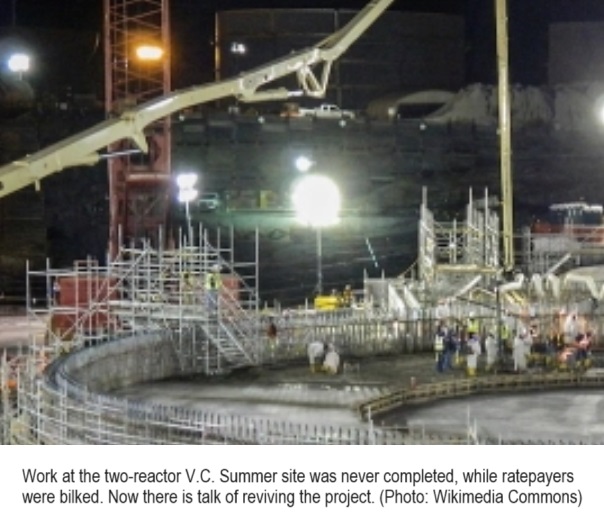
After eight years in the elements, all the equipment and the structure of the plant, which was less than halfway finished, will need to be carefully inspected before it can be used. The permits to build and the licenses to operate the nuclear plants will need to be renewed, likely starting from scratch.
The permits to build and the licenses to operate the nuclear plants will need to be renewed, likely starting from scratch,
the agreement appears to let Brookfield walk away if it decide it’s not feasible.
By ASSOCIATED PRESS, 25 October 2025, https://www.dailymail.co.uk/wires/ap/article-15225007/South-Carolinas-state-utility-says-private-firm-set-restart-abandoned-9-billion-nuclear-project.html
COLUMBIA, S.C. (AP) – South Carolina’s state-owned utility is looking to a private company to revive a project to build two nuclear power plants that was abandoned eight years ago, losing more than $9 billion without generating a watt of power.
Santee Cooper’s board agreed Friday to start six weeks of negotiations with Brookfield Asset Management that they hope will lead to a deal that lets the private company build the nuclear plants at the V.C. Summer site near Jenkinsville at their own risk to generate power that they could mostly sell to whom they want, such as energy-gobbling data centers.
Santee Cooper said Brookfield preliminarily agreed to provide the utility with some of the power generated. But that and probably thousands of other details will have to be negotiated. In a twist, Brookfield took over the assets of Westinghouse Electric Co., which had to declare bankruptcy because of difficulties building new nuclear reactors.
Utility officials said the agreement gives hope the state can get something out of a debacle that led to four executives going to prison or home confinement for lying to regulators, shareholders, ratepayers and investigators and left millions of people paying for decades for a project that never produced electricity.
“The risk to the ratepayer is nil. The risk to the taxpayer is nil,” Santee Cooper Board Chairman Peter McCoy said.
There are still too many hurdles for the project to get past to consider this a win right now, said Tom Clements, executive director of the nuclear watchdog group Savannah River Site Watch.
After eight years in the elements, all the equipment and the structure of the plant, which was less than halfway finished, will need to be carefully inspected before it can be used. The permits to build and the licenses to operate the nuclear plants will need to be renewed, likely starting from scratch, Clements said.
“I still believe that the cost, technical and regulatory hurdles are too big to lead to completion of the project,” Clements said, adding the agreement appears to let Brookfield walk away if it decide it’s not feasible.
Santee Cooper heard from 70 bidders and received 15 formal proposals to restart construction of the reactors. Interest in the project has grown as power demand in the U.S. surges with the increase in data centers as artificial intelligence technology develops.
Santee Cooper executives credited President Donald Trump’s executive order in May calling for the U.S. to quadruple the amount of power generated by nuclear plants over the next 25 years for opening the door to the potential agreement.
“You have placed South Carolina in the epicenter of the resurgence of nuclear power in the United States,” Santee Cooper CEO Jimmy Staton said.
Santee Cooper was the minority partner with what was then South Carolina Electric and Gas when construction on the two new nuclear plants started in 2013 at the V.C. Summer site – about 25 miles (40 kilometers) northeast of Columbia – where SCE&G was already operating a reactor.
The project needed to be finished in seven years to get tax credits to keep the project’s cost from overwhelming the utilities, but it ended up behind schedule almost immediately.
Executives lied about the problems to keep money coming in. Taxpayers and ratepayers ended up on the hook because of a state law that allowed the utilities to charge for costs before any power was generated.
Two nuclear reactors built in a similar way in Georgia went $17 billion over budget before they were fully operational in 2023.
1 This Month

of the week– Nuclear Reactor Information Task Force

14 May – online event From Bombs to Data Centres: the Face of Nuclear Colonialism
To see nuclear-related stories in greater depth and intensity – go to https://nuclearinformation.wordpress.com
-
Archives
- May 2026 (82)
- April 2026 (356)
- March 2026 (251)
- February 2026 (268)
- January 2026 (308)
- December 2025 (358)
- November 2025 (359)
- October 2025 (376)
- September 2025 (257)
- August 2025 (319)
- July 2025 (230)
- June 2025 (348)
-
Categories
- 1
- 1 NUCLEAR ISSUES
- business and costs
- climate change
- culture and arts
- ENERGY
- environment
- health
- history
- indigenous issues
- Legal
- marketing of nuclear
- media
- opposition to nuclear
- PERSONAL STORIES
- politics
- politics international
- Religion and ethics
- safety
- secrets,lies and civil liberties
- spinbuster
- technology
- Uranium
- wastes
- weapons and war
- Women
- 2 WORLD
- ACTION
- AFRICA
- Atrocities
- AUSTRALIA
- Christina's notes
- Christina's themes
- culture and arts
- Events
- Fuk 2022
- Fuk 2023
- Fukushima 2017
- Fukushima 2018
- fukushima 2019
- Fukushima 2020
- Fukushima 2021
- general
- global warming
- Humour (God we need it)
- Nuclear
- RARE EARTHS
- Reference
- resources – print
- Resources -audiovicual
- Weekly Newsletter
- World
- World Nuclear
- YouTube
-
RSS
Entries RSS
Comments RSS
 nuclear-news