In US House, Democrats stop Republicans’ push for low-yield nuclear weapons
 Democrats rebuff GOP push for low-yield nuclear weapons, By SUSANNAH GEORGE, 12 June 19, WASHINGTON (AP) — House Democrats rebuffed attempts by Republicans Wednesday to authorize funding for so-called low-yield nuclear weapons that the Trump administration says are key to deterring Russia.
Republicans put forward two amendments to fund the weapons in a defense bill, but both were rejected in a voice vote Wednesday. A formal roll-call vote on the amendments was planned for later.
Armed Services Committee Chairman Adam Smith, D-Wash., eliminated funding in the legislation for low-yield nuclear weapons that could be placed on submarines. He said the weapons increase the likelihood of nuclear conflict. …..
Nuclear policy issues will likely reemerge in the Republican-controlled Senate. The House and Senate will have to negotiate a final version of the annual policy bill before it becomes law……
Republicans and Democrats also disagree over the total amount of money needed to properly fund the Pentagon and nuclear elements of the Energy Department. The White House requested a $750 billion budget, but Smith said a slightly smaller budget of $733 billion would promote efficiency…..https://www.apnews.com/d04a6f8f5edb4c4490013aa32e78417f
Danger in Trump’s decision to keep nuclear weapons data classified
|
Decision to keep nuclear weapons data classified hurts US national security, Bulletin if the Atomic Scientists By Heather Wuest, June 11, 2019 The Trump administration’s decision to classify the total number of nuclear weapons that the United States possesses and the number of nuclear warheads dismantled in 2018 marks an abrupt change from the recent norm. Every year since 2010, the United States has chosen to declassify its nuclear stockpile and disarmament figures as part of an effort to encourage nuclear diplomacy and openness. But this year when the Federation of American Scientists asked the Pentagon for the figures to check its work in the Nuclear Notebook (a collection of world nuclear stockpile and disarmament information), the administration chose not to declassify.
Hans Kristensen—the director of the Federation of American Scientists Nuclear Information Project and a longtime author of the authoritative Nuclear Notebook column on world nuclear arsenals the Bulletin has published since 1987—is particularly vocal about the classification setback. The decision not to declassify the stockpile and decommissioned numbers, he says, “surrenders any pressure on other nuclear-armed states to be more transparent about the size of their nuclear weapon stockpiles” and is an “unnecessary and counterproductive reversal of nuclear policy.” This decision to classify comes at a time when the Trump administration says it is looking to ramp up talks with Russia and China on arms control, a negotiation that would be easier for United States diplomats if they could go in backed by the official numbers. In a short conversation with Kristensen, I asked about the future of the Nuclear Notebook and if the Federation of American Scientists would continue to push for declassification. He made it clear how the government’s simple denial of one information request can affect many aspects of an open and honest nuclear debate……….https://thebulletin.org/2019/06/hans-kristensen-on-how-the-tump-administrations-decision-to-keep-nuclear-weapons-data-classified-hurts-us-national-security/ |
|
|
Holtec and Ukraine developing Small Modular Nuclear Reactors (dodgy underground devices)
 Consortium established for SMR-160 deployment in Ukraine, WNN 12 June 2019
The consortium document was signed by Holtec CEO Kris Singh, Energoatom President Yury Nedashkovsky and SSTC President Igor Shevchenko. The signing ceremony – held at Holtec’s headquarters in Camden, New Jersey – was attended by senior Holtec officials and delegations from Mitsubishi Electric, the US Department of Energy and Energoatom.
The consortium is a US company registered in Delaware with each of the three parties owning allotted shares. Its technology operation centre will be based in Kiev, Ukraine…….
The MoU includes the licensing and construction of SMR-160 reactors in Ukraine, as well as the partial localisation of SMR-160 components. The Ukrainian manufacturing hub is to mirror the capabilities of Holtec’s Advanced Manufacturing Plant in Camden, and will be one of four manufacturing plants Holtec plans to build at distributed sites around the world by the mid-2020s.
Holtec’s 160 MWe factory-built SMR uses low-enriched uranium fuel. The reactor’s core and all nuclear steam supply system components would be located underground, and the design incorporates a wealth of features including a passive cooling system that would be able to operate indefinitely after shutdown….
The SMR-160 is planned for operation by 2026.
The SMR-160 is currently undergoing the first phase of the Canadian Nuclear Safety Commission’s three-phase pre-licensing vendor design review process. State Nuclear Regulatory Inspectorate of Ukraine, the nuclear regulatory authority in Ukraine, is expected to coordinate its regulatory assessment of SMR-160 under a collaborative arrangement with its Canadian counterpart. http://www.world-nuclear-news.org/Articles/Consortium-established-for-SMR-160-deployment-in-U
Edwin lyman on the safety of these reactors “Holtec SMR-160. The Holtec SMR-160 will generate 160 MWe. Like the NuScale, it is designed for passive cooling of the primary system during both normal and accident conditions. However, the modules would be much taller than the NuScale modules and would not be submerged in a pool of water. Each reactor vessel would be located deep underground, with a large inventory of water above it that could be used to provide a passive heat sink for cooling the core in the event of an accident. Each containment building would be surrounded by an additional enclosure for safety, and the space between the two structures would be filled with water. Unlike the other iPWRs, the SMR-160 steam generators are not internal to the reactor vessel. The reactor system is tall and narrow to maximize the rate of natural convective flow, which is low in other passive designs. Holtec has not made precise dimensions available, but the reactor vessel is approximately 100 feet tall, and the aboveground portion of the containment is about 100 feet tall and 50 feet in diameter (Singh 2013)
For these and other SMRs, it is important to note that only limited information is available about the design, as well as about safety and security. A vast amount of information is considered commercially sensitive or security-related and is being withheld from the public. ….
in the event of a serious accident, emergency crews could have greater difficulty accessing underground reactors.
Underground siting of reactors is not a new idea. Decades ago, both Edward Teller and Andrei Sakharov proposed siting reactors deep underground to enhance safety. However, it was recognized early on that building reactors underground increases cost. Numerous studies conducted in the 1970s found construction cost penalties for underground reactor construction ranging from 11 to 60 percent (Myers and Elkins). As a result, the industry lost interest in underground siting. This issue will require considerable analysis to evaluate trade-offs…. ” https://nuclearinformation.wordpress.com/2017/11/29/edwin-lyman-on-small-modular-reactors/ erious accident, emergency crews could have greater difficulty accessing underground reactors.
Trump is more interested in helping nuclear companies to sell to Saudi Arabia, than in the well-being of Americans

 WASHINGTON ,WATCH: IS TRUMP HELPING THE SAUDIS GO NUCLEAR? https://www.jpost.com/Opinion/Washington-Watch-Is-Trump-helping-the-Saudis-go-nuclear-592310,BY DOUGLAS BLOOMFIELD, JUNE 12, 2019
US President Donald Trump recently took another step toward bringing Saudi Arabia into the nuclear club. While Israeli-Saudi ties have warmed in recent years, helping the desert kingdom go nuclear – with its ongoing support for the most extreme Islamic radicals in the world – can hardly be good for the Jewish state.
Secret negotiations with the US Energy Department over many months have led Washington to “transfer highly sensitive US nuclear technology, a potential violation of federal law,” to Saudi Arabia, according to House Oversight Committee sources cited by The Washington Post.
Sen. Tim Kaine (D-Virginia) revealed last week that at least two transfers were approved since the assassination of Washington Post journalist Jamal Khashoggi.
The Saudis say they want to begin building their own nuclear power plants with their own enriched uranium, even though it could be purchased elsewhere more cheaply. That raises suspicions that their real goal isn’t producing electricity. By enriching their own uranium, they could begin diverting it to highly enriched weapons grade, especially if they bar international inspectors, as they’ve insisted.
Given its record of obeisance to Saudi demands for top technology and weapons, it is unlikely the Trump administration would object, but instead continue helping to conceal the kingdom’s plans. Crown Prince Muhammad bin Salman, the de facto ruler, has said that the kingdom would build nuclear weapons if the Iranians did. He may have taken encouragement from a speech in the UAE last month by Trump’s national security adviser, John Bolton.
The Iranians are threatening to leave the nuclear pact with the major powers – the Joint Comprehensive Plan of Action (JCPOA) – in the wake of the Trump administration’s unilateral exit last year and imposition of sanctions to tighten the economic screws on Tehran.
That should give MBS the rationale he seeks to develop his version of the bomb.
When he turns to Trump for help, he will remind the president that if America won’t sell it to him, there are others who will. Trump is a sucker for that pitch.
North Korea would be a good place to go shopping, since they tried helping Syria build nukes until the Israeli Air Force stopped the plan, something it had done earlier in Iraq. Then there’s Pakistan, which is believed to have built its own nuclear weapons stockpile with Saudi financial help.
THERE MIGHT BE some resistance on Capitol Hill, where Saudi support is low and sinking, but Trump has shown himself more responsive to the wishes of the Saudis than the US Congress.
All US administrations – Republican and Democratic – have indulged the Saudi appetite for top technology and weapons. They’ve been driven by pressure from industry and its friends in the Pentagon to sell, sell, sell – and an inexplicable attitude that we need the Saudis far more than they need us. Trump has just raised this to a new level.
Trump’s latest selling spree includes 120,000 conversion kits to produce smart bombs. It is part of an $8.1 billion package that Trump labeled “emergency” to bypass Congressional review.
Most alarming is the Trump administration’s approval for the transfer of highly sensitive weapons technology and equipment to Saudi Arabia so the kingdom can produce electronic guidance systems for Paveway precision-guided bombs, according to congressional sources cited by The New York Times.
Saudi Arabia is the Pentagon’s favorite cash cow. Arms sales are a lucrative business for the US Defense Department, which charges commissions and other fees, and gets economies of scale for its own purchases while selling off old inventory to help pay for replacements. Military attachés around the world are top salesmen for defense contractors as they lay the groundwork for post-uniform careers. Then there are the former – and possibly future – defense industry executives at the highest levels of the Pentagon, starting with the Secretary of Defense.
Sen. Chris Murphy (D-Connecticut) said the administration “has effectively given a blank check to the Saudis – turning a blind eye to the brutal murder of Jamal Khashoggi and allowing their ballistic missile program to expand.”
The United States is not allowed to sell ballistic missiles, so the Saudis have turned to China. CNN reported last week that American intelligence believes Beijing is helping enhance the kingdom’s strategic missile program. In the 1980s, it secretly bought Chinese DF-3 missiles and based them within range of Israel. It bought more advanced missiles in 2007 with the approval of then-president George W. Bush. Unconfirmed published reports suggest they also bought other missiles from Pakistan, which produces a version of the North Korean Nodong missile.
With Trump looking for business that will create jobs he can claim credit for – and with John Bolton rattling sabers and B-52s, and calling for regime change in Iran – can Saudi Arabia be knocking on an open door to the nuclear club?
Rick Perry, USA’s Secretary on Behalf of the Nuclear Industry
 DOE’s Perry: Coal, Nuclear Must Be Saved, Power, 06/12/2019 | Darrell Proctor Energy Secretary Rick Perry said coal and nuclear power must be part of the nation’s “all of the above” energy strategy, but the Department of Energy (DOE) does not have the “regulatory or statutory ability” to establish economic incentives for struggling U.S. coal and nuclear plants.Perry, who addressed the Edison Electric Institute’s (EEI’s) annual convention in Philadelphia on June 11, said the Federal Energy Regulatory Commission (FERC) would take the lead on creating incentives for any energy resource. Perry spoke with media after his address to convention delegates……. DOE’s Perry: Coal, Nuclear Must Be Saved, Power, 06/12/2019 | Darrell Proctor Energy Secretary Rick Perry said coal and nuclear power must be part of the nation’s “all of the above” energy strategy, but the Department of Energy (DOE) does not have the “regulatory or statutory ability” to establish economic incentives for struggling U.S. coal and nuclear plants.Perry, who addressed the Edison Electric Institute’s (EEI’s) annual convention in Philadelphia on June 11, said the Federal Energy Regulatory Commission (FERC) would take the lead on creating incentives for any energy resource. Perry spoke with media after his address to convention delegates…….
Federal Bailout Still an OptionPerry’s comments Tuesday came after the White House Council of Economic Advisors in March released a report to the president calling for a strategic electricity reserve that could provide support to financially struggling power plants. Perry earlier that month reiterated his position that a federal bailout of coal and nuclear plants was still an option, though he said state incentives might be a better path forward. “Each state has their own economic right to either put tax credits, tax breaks [or] incentives in place,” Perry said in response to a question about House Bill 6 in Ohio, which would provide $190 million in subsidies for nuclear power each year through 2026 ….. Some states, such as Illinois, have put legislation in place to save nuclear plants. Some energy industry groups have challenged those subsidies, though the Supreme Court in April upheld lower-court decisions that support the subsidies. Perry also said he supports a nuclear bailout bill in Pennsylvania. He said the measure would bring “thoughtful, competitive programs where states don’t have to rely upon the federal government to support a particular industry sector.”… https://www.powermag.com/does-perry-coal-nuclear-must-be-saved/ |
|
A Cool $20 million Bailout to Ohio’s Seven Utility Scammers
 Ohio’s “Chernobyl Socialism” Would Hand $20 Million to Seven Utility Scammers https://readersupportednews.org/opinion2/277-75/57020-rsn-ohios-qchernobyl-socialismq-would-hand-20-million-to-seven-utility-scammers By Harvey Wasserman, Reader Supported News, 10 June 19 Ohio’s “Chernobyl Socialism” Would Hand $20 Million to Seven Utility Scammers https://readersupportednews.org/opinion2/277-75/57020-rsn-ohios-qchernobyl-socialismq-would-hand-20-million-to-seven-utility-scammers By Harvey Wasserman, Reader Supported News, 10 June 19  huge proposed bailout of two Chernobyl-in-progress Ohio nukes (plus two old coal burners) would put $20 million directly into the pockets of seven utility executives. Their bankrupt company last year spent $3 million “lobbying” the legislature. huge proposed bailout of two Chernobyl-in-progress Ohio nukes (plus two old coal burners) would put $20 million directly into the pockets of seven utility executives. Their bankrupt company last year spent $3 million “lobbying” the legislature.
Akron’s bankrupt FirstEnergy (FE) owns the Perry nuke, east of Cleveland, which in 1986 became the first US reactor damaged by an earthquake. Critical pipes and concrete were cracked, as were nearby roads and bridges. A top-level state study showed soon thereafter that evacuation amidst a major accident would be impossible. FE’s uninsured Davis-Besse nuke, near Toledo, is a 42-year-old Three Mile Island clone. In 2002, boric acid ate through its head, threatening a Chernobyl-scale accident irradiating Toledo, Cleveland, and the Great Lakes. At FE’s request, the Nuclear Regulatory Commission has exempted Davis-Besse from vital regulations for flooding, fire protection, earthquake vulnerability, and security. Its radiation shield building is literally crumbling. In 2003, when nearby power lines sagged onto tree limbs, FirstEnergy blacked out some 50 million people throughout the northeast and well into Canada. By then, FE had scammed Ohio for some $9 billion in “stranded cost” bailouts. The utility said “open market competition” would lower rates … after it pocketed the public’s money. Now FE says its subsidized nukes can’t compete with gas and wind power. It wants $190 million/year or more from all Ohio ratepayers, even though most get zero nuke electricity. FE first said the money was for “clean air” and “zero emission reactors.” But all nukes emit heat, chemicals, radiation, Carbon 14, and more. Their cooling towers kill birds, their waste hot water kills marine life, their cores (at about 300 degrees Centigrade) heat the planet. The bailout bill, called HB6, attacks renewable and efficiency programs that have saved Ohio ratepayers billions of dollars and created thousands of jobs. A single sentence in the Ohio Code is blocking some $4 billion in turbine development. The breezy “North Coast” region along Lake Erie is crisscrossed with transmission lines and good sites near urban consumers. Farmers throughout the flat, fertile agricultural land desperately want the income turbine leases could provide. The new projects would create thousands of construction and maintenance jobs. They would feed Ohio’s manufacturing base, which produces a wide range of wind and solar components. By lowering electric rates, they would restore a competitive position long lost to high electric rates. Indiana, Michigan, New York, and Pennsylvania all have at least double Ohio’s installed wind capacity. Texas has twenty times more. By 2022, Germany will be totally nuke-free. Ohio has just been shaken by findings that significant radiation has leaked from a dead uranium plant in southern Ohio, contaminating schools and terrifying local residents. Like that old “stranded cost” scam, FE’s new bailouts would suck desperately needed capital from Ohio’s faltering industrial base. The reactors are obsolete. The workforce is aging. The nukes will shut anyway … if they don’t blow up first. FE is really protecting its huge executive salaries. In 2018, it spent $3 million on “lobbying.” Its top seven officers, who bankrupted the company, were collectively paid more than $20,000,000, more than 10% of the proposed bailout: Charles E. Jones Jr., President & CEO: $9,858,109; Leila L. Vespoli, EVP, Corporate Strategy, Regulatory Affairs & Chief Legal Officer: $3,801,639; James F. Pearson, EVP, Finance: $3,840,576; Donald R. Schneider, President, FE Solutions: $2,343,232; Steven E. Strah, SVP & CFO: $2,798,523; Bennett L. Gaines, SVP, Corporate Services & Chief Information Officer: $1,442,149; Samuel L. Belcher, SVP & President, FE Utilities: $3,004,019. The Ohio House has already ignored extensive anti-bailout public testimony (see mine at https://ohiochannel.org/video/ohio-house-energy-and-natural-resources-committee-5-22-2019) and voted 53-43 to keep those executive handouts soaring. The bill now moves to the Senate and its gerrymandered GOP majority. Ohio’s corporate-owned governor has assured FE he’ll approve their bailout. Ohio consumers may then join lawsuits against similar bailouts in New York, New Jersey, and elsewhere. A referendum, which they might well win, is also possible. Meanwhile, millionaire utility execs everywhere will see if the Buckeye State can be suckered again into bailing out two obsolete, cash-sucking nukes on the brink of catastrophic collapse. Stay tuned. |
|
|
Dispute over Ottawa River nuclear waste dump: more transparency needed

 Fight over Ottawa River nuclear waste dump getting political, but Liberals downriver standing behind the project—or staying quiet, The HillTimes, By PETER MAZEREEUW, BEATRICE PAEZ JUN. 10, 2019 Aplan to bury low-level nuclear waste at a site near the Ottawa River is raising opposition from municipalities and environmentalists. The company behind the project, Canadian Nuclear Laboratories, says it’s safe. The Near Surface Disposal Facility proposal is in year three of an environmental assessment handled by a regulator the Liberal government is on the verge of stripping of that responsibility.
A proposed dump for low-level nuclear waste near the Ottawa River has stirred up opposition from community groups, environmentalists, and municipalities worried the waste could leach into the river that flows past about 50 federal ridings, including Ottawa Centre, the home of Parliament Hill and Canada’s environment minister, Catherine McKenna.
Members of Parliament from riverside ridings closest to the site of the proposed dump at thesprawling nuclear laboratories at Chalk River, Ont., are largely staying out of the fray. That includes Ms. McKenna, who has the final say over an environmental assessment for the project that is being conducted through a Harper-era assessment process, which she and an independent review panel have discredited………
Several Liberal MPs from ridings just downstream of the site declined to comment on or be interviewed about the proposed project, as did Natural Resource Minister Amarjeet Sohi (Edmonton Mill Woods, Alta.), , while two others organized or held information sessions on the subject for their constituents.
Ms. McKenna told The Hill Times during a press conference that she “heard” concerns from her constituents about the project, but didn’t say whether she shared them. Her office did not respond to numerous interview requests on the subject.
The Ottawa Riverkeeper environmental group and the NDP candidate in Ottawa Centre, Emilie Taman, are among those who say they will raise the issue during the upcoming election campaign. Municipal politicians in Montreal and Gatineau have already expressed their opposition. CNL staff, meanwhile, are trying to spread the word about the safety and safeguards planned to keep the proposed dump, which is located less than one kilometre from the Ottawa River, from harming the environment, or people around and downstream from Chalk River.
No ‘public trust’ in assessment system
The Near Surface Disposal Facility to hold the low-level nuclear waste is being proposed by Canadian Nuclear Laboratories (CNL). It is part of a complicated arrangement of private and public organizations created under the previous Conservative federal government, which privatized the operation of the Chalk River nuclear facilities that had been run by Atomic Energy of Canada Ltd. (AECL), a Crown corporation, in 2013.
Under the new model, the part of AECL that ran the labs was shrunk down to a shell of its former self, with most of its employees transferred to CNL. The government pays CNL to run the Chalk River facilities, and AECL—and by extension, the federal government—keeps both the assets and liabilities tied to the site.
CNL is owned by a consortium of companies that mounted a bid for the right to run Chalk River. It includes Quebec’s SNC-Lavalin and U.S. engineering firms Fluor and Jacobs, which call themselves the Canadian National Energy Alliance.
The Near Surface Disposal Facility, commonly abbreviated as NSDF, is three years into an environmental impact assessment overseen by the Canadian Nuclear Safety Commission, a regulator for the nuclear industry.
It started the assessment in 2016, months after Ms. McKenna was given a mandate letter from Prime Minister Justin Trudeau (Papineau, Que.) that tasked her with reviewing the process immediately “to regain public trust and help get resources to market.”
Ms. McKenna struck an expert review panel that same year, which spent seven months surveying environmental groups, project proponents, academics, government officials, and other stakeholders about the environmental assessment process established by the previous Conservative government in 2012. Some said that CNSC should continue to be responsible for conducting assessments, given the technical expertise of its staff, but others said it was too close to industry, creating an “erosion of public trust” in the process and its outcomes. The panel recommended that CNSC be stripped of its role conducting assessments on nuclear projects.
Ms. McKenna tabled a bill in Parliament, C-69, which did just that. An omnibus bill that has been subject to criticism by Conservative politicians, industry, and some environmentalists, C-69 would put the power over assessments into the hands of the Canadian Environmental Assessment Agency, which it would rename to the Impact Assessment Agency of Canada. CNSC officials would still play a role, occupying some of the seats on review panels struck to guide assessments of nuclear projects. The Senate sent Bill C-69 back to the House last week with nearly 200 amendments, including those that would put more power over reviews back into the hands of CNSC officials.
In the meantime, however, the NSDF nuclear dump proposal is being evaluated under the old assessment system. Isabelle Roy, a spokesperson for CNSC, said in an email statement that the projects currently being examined “would not be subject to Bill C-69 if it passes,” and that the decision will ultimately be made by its independent commission. Ms. Roy said CNSC is awaiting CNL’s response to public comments regarding concerns about the project. ………
More transparency needed on what CNL considers low-level waste, experts say
In the face of public concerns that one per cent of the waste in the engineered mound would be intermediate-level waste, Ms. Vickerd said, CNL has since tweaked its proposal, limiting it to low-level waste.
According to the International Atomic Energy Agency (IAEA), a near-surface disposal facility doesn’t have the capacity to safely contain and isolate intermediate-level waste, which, by its definition, has long-lived radionuclides. Such waste, it says, has to be buried underground, by up to a few hundred metres.
Michael Stephens is a former AECL employee whose career in the nuclear industry spanned 25 years, including 16 years at the Chalk River labs, where he helped oversee the decommissioning of nuclear waste. He is one among several retired AECL employees who have decried the project as environmentally unsound.
Mr. Stephens said his main contention with NSDF is the criteria CNL is using to determine what the mound can hold. “What bothered me from the outset was originally the proposal [called] for intermediate-level waste [to be dumped],” he said. “That, by definition, is a non-starter.”
Gordon Edwards, president of the Canadian Coalition for Nuclear Responsibility, a non-profit organization that aims to educate the public on nuclear-energy issues, said the lab seems to be trying to push the limits of what it can reasonably get away with. “If you put forward an outrageous, totally unacceptable proposal, you can trim it and see how far you can go,” Mr. Edwards said. “CNL [was urged by the Harper government] to act quickly, to find a timely remediation to reduce Canada’s nuclear liability, in a … cost-effective manner. That’s code for relatively quickly, cheaply.”
Mr. Edwards has worked as a nuclear consultant; in 2017, he was hired by the federal auditor general’s office to consult for its performance audit of CNSC.
He said scrapping the idea of adding intermediate-level waste only goes “a little way” to addressing the larger issue. “What we’re talking about is a mound of literally hundreds of radioactive materials. All have different chemistries, and have different pathways to the environment, to the food chain,” he said………
Another concern for him is the plan to transport and dump the waste of other decommissioned plants, including from Whiteshell Laboratories in Pinawa, Man. “How do they know what’s in those containers? As far as we know, if they get the go-ahead to drive those containers right into where the mound will be, they’ll simply put them there, bury them … without having properly identified what’s in there,” he said.
Mr. Stephens echoed Mr. Edwards’ concerns about what, he said, could conceivably wind up in the dump. CNL, he argued, hasn’t been transparent about whether, for example, it would dump packaged solid waste, which could have varying degrees of toxicity, or building rubble that’s just been slightly contaminated…………
Contentious debate expected as USA House debates annual Defense Bill
|
House defense bill sets stage for contentious nuclear debate, The Hill BY REBECCA KHEEL – 06/10/19 The House version of the annual defense policy would require an independent study on the United States adopting a “no first use” policy on nuclear weapons.Nuclear issues are shaping up to be among the most contentious issues as Congress debates this year’s National Defense Authorization Act (NDAA), with Republicans already coming out strongly against what’s in the bill.
The bill, a summary of which was released Monday morning, does not go as far as Chairman Adam Smith (D-Wash.) has opined about in the past. But it does seek to “start that debate” about the appropriate size and cost of the nuclear arsenal, staffers told reporters ahead of the bill’s release. “The chairman feels strongly that the nuclear arsenal is too large, that we spend too much money on legacy weapons systems when we have emerging requirements like cyber, like [artificial intelligence], like space, which aren’t getting the kind of focus that’s required, and he wants to reevaluate where we’re spending money, if we’re going to have another money to spend on these emerging things that are coming out,” a staffer said. Smith, who has long lambasted the price tag for nuclear modernization, pledged to make the issue a priority when he took control of the gavel after Democrats won back the House. In hearings and speeches, he has questioned the need for the nuclear triad, said he wants to “kill” the low-yield warhead and blasted Trump for casting aside nuclear treaties. n late January, Smith also reintroduced his No First Use Act that would make it U.S. policy not to use nuclear weapons first. Right now, U.S. policy leaves open the possibility of being the first to use a nuclear weapon in a conflict. Rather than incorporating that bill, the NDAA requires the independent study on the implications of adopting such a policy. Staffers also stressed the bill would not eliminate a leg of the triad, which refers to the three methods of delivering nuclear warheads. …….. Every Republican on the subcommittee voted against the bill last week over the low-yield warhead provision and three other issues. ……. https://thehill.com/policy/defense/447664-house-defense-bill-sets-stage-for-contentious-nuclear-debate |
|
NO to high-level nuclear waste- governor of New Mexico
 New Mexico governor says no to high-level nuclear waste, June 8, 2019, ALBUQUERQUE, N.M. (AP) — New Mexico’s governor said Friday she’s opposed to plans by a New Jersey-based company to build a multibillion-dollar facility in her state to temporarily store spent nuclear fuel from commercial reactors around the U.S.
In a letter to U.S. Energy Secretary Rick Perry, Gov. Michelle Lujan Grisham said the interim storage of high-level radioactive waste poses significant and unacceptable risks to residents, the environment and the region’s economy.
She cited the ongoing oil boom in the Permian Basin, which spans parts of southeastern New Mexico and West Texas, as well as million-dollar agricultural interests that help drive the state’s economy.
Any disruption of agricultural or oil and gas activities as a result of a perceived or actual incident would be catastrophic, she said, adding that such a project could discourage future investment in the area.
“Establishing an interim storage facility in this region would be economic malpractice,” she wrote…………
Lujan Grisham’s stance marks a shift from the previous administration, which had indicated its support for such a project.
During her last year in Congress, Lujan Grisham, a Democrat, opposed changes to the Nuclear Waste Policy Act and the possible development of a temporary storage facility in New Mexico. She was concerned that loopholes could be created and result in the waste being permanently stranded in New Mexico.
The Permian Basin Petroleum Association, the New Mexico Farm and Livestock Bureau and the New Mexico Cattle Growers’ Association all have sent letters of concern to the governor.
Several environmental groups also have protested the idea of an interim storage site for spent nuclear fuel. The groups raised their concerns during a hearing before federal regulators earlier this year.
Opponents question the project’s legality, the safety of transporting high-level waste from sites scattered across the country and the potential for contamination if something were to go wrong.
The governor’s letter came as the Nuclear Regulatory Commission considers whether to issue a 40-year license for the facility proposed by Holtec. ……..
Municipalities elsewhere in New Mexico and Texas have passed resolutions expressing concerns about an interim storage proposal in the region.
Reams of documents have already been submitted to the regulatory commission, and the overall permitting process is expected to be lengthy.
A Texas-based company also has applied for a license to expand its existing hazardous waste facility in Andrews County, Texas, to include an area where spent fuel could be temporarily stored. https://www.apnews.com/25e295f2157343b7b644c82936aee01d
Nuclear Regulatory Commission’s “Reference Man” gives a distorted, inaccurate picture of radiation impacts
 Mary Olsen: Disproportionate impact of radiation and radiation regulation. Journal of Interdisciplinary Science Reviews (accessed) 9th June 2019
 Abstract. Reference Man is used for generic evaluation of ionizing radiation impacts, regulation, and nuclear licensing decisions made by the U.S. Nuclear Regulatory Commission (US NRC).
particularly when exposed as young girls, than is predicted by use of Reference Man; the difference is a much as 10-fold. Since females have been ignored in regulatory analysis, this has resulted in systematic under-reporting of harm from ionizing radiation exposure in the global population.
A critique is also offered on the US Environmental Protection Agency’s attempt to include females in its regulation. Recommendations for interim regulation to provide better protection, and questions forfurther study are offered.
https://www.tandfonline.com/doi/full/10.1080/03080188.2019.160386
|
|
USA court deliberates on whether or not global warming violates children’s rights

 US court weighs if climate change violates children’s rights Business Mirror, By The Associated Press, June 10, 2019 PORTLAND, Oregon—In a courtroom packed with environmental activists, federal judges wrestled last week with whether climate change violates the constitutional rights of young people who have sued the US government over the use of fossil fuels.
USA in a real mess over nuclear wastes: stalemate in storage options
|
House Panel Highlights Risks Over Nuclear-Storage Stalemate, https://www.usnews.com/news/us/articles/2019-06-07/house-panel-highlights-risks-over-nuclear-storage-stalemate
Members of Congress say America’s long stalemate over where to put its nuclear waste needs to end _ and as soon as possible. By Associated Press, Wire Service Content June 7, 2019 BY MICHAEL R. BLOOD, LAGUNA NIGEL, Calif. (AP) — Southern California‘s San Onofre nuclear power plant was permanently closed in 2013, but the site remains home to 3.5 million pounds (1.59 million kilograms) of nuclear waste that has nowhere else to go. Members of a House subcommittee held a hearing Friday not far from the defunct plant to highlight the urgency behind efforts to build a long-term national repository for used radioactive fuel, a proposal that has languished for decades in Washington. “The federal government has failed, and continues to fail, to find a solution to our country’s nuclear waste problem,” said Rep. Harley Rouda, a Democrat whose district is up the coast from the seaside San Onofre plant. Even if a bipartisan agreement is reached soon, development of a site would be at least a decade away, he said. In the meantime, 8.4 million residents live within 50 miles (about 80 kilometers) of the plant, which is within sight of a busy freeway and in a region crossed by earthquake faults. Nationally, one in three Americans lives within 50 miles of nuclear waste, Rouda said. The nation does “not have any more time to waste” to find a solution, he said, citing potential safety risks. Development of a proposed long-term storage site at Nevada‘s Yucca Mountain was halted during the Obama administration, although the Trump administration has moved to restart the licensing process while the plan continues to face stiff resistance in Nevada. Meanwhile, proposals in New Mexico and Texas for temporary storage sites are also facing criticism. On Friday, New Mexico Gov. Michelle Lujan Grisham said she’s opposed to plans to build the facility in her state. Building a long-term storage site would lead to another question: How would the radioactive waste get there from nuclear power plants? “There is not consensus about health and safety standards, including whether commercial spent fuel is safe where it is,” said Don Hancock of the Southwest Research and Information Center, a nonprofit watchdog group. “If it is safe where it is, why move it? If it’s not safe where it is, how can it be safe to transport through many other communities?” During the hearing, Democratic Rep. Mike Levin, whose 49th District includes the plant site, urged federal regulators to increase oversight at San Onofre, which received approval in 2015 to move tons of highly radioactive fuel from storage pools into steel canisters sheathed by concrete. Those transfers were halted about a year ago after a 50-ton canister of spent fuel was left hanging and at risk of being dropped rather than lowered 18 feet (5.5 meters) into a storage vault. Federal regulators later fined plant operator Southern California Edison $116,000. Levin has asked the Nuclear Regulatory Commission to appoint a full-time inspector at the plant, which is no longer producing power. NRC Administrator Scott Morris told the panel it would take a change in policy by the commission. The NRC has given Edison permission to resume transferring canisters filled with nuclear waste to the separate storage site. But the commission announced this month it will conduct surprise inspections at the plant to help make sure it’s running smoothly. Edison said in a statement that it strongly encourages action by Congress, but warned that “misrepresenting the science and potential consequences of spent nuclear fuel makes the challenge of finding a … location for storage more difficult.” “The federal government must honor its decades-long obligation to create a permanent repository and begin the process of relocating spent nuclear fuel from reactor sites throughout the country,” the company said. San Onofre was shut down in January 2012 after a small radiation leak led to the discovery of extensive damage to hundreds of tubes inside the virtually new generators. The plant never produced electricity again. Edison closed San Onofre for good in 2013 amid a fight with environmentalists over whether the plant was too damaged to restart safely. |
|
|
Mike Pompeo thinks that climate change is not really a serious problem, could be good for trade
“The climate’s been changing a long time. There’s always changes that take place,” Pompeo said during an interview with the Washington Times published Friday, when asked whether he thought climate change was man-made and how best to address it. He did not mention anything about man-made pollution in his remarks…..
The comments aren’t Pomepo’s first foray into controversial climate assessments.
In May, Pompeo praised the Arctic’s rapidly shrinking sea levels for their subsequent economic opportunities, despite continued warnings about the catastrophic effects of climate change….. https://myfox8.com/2019/06/09/pompeo-downplays-climate-change-suggests-people-move-to-different-places/
A mistake for USA to deploy the low-yield Trident nuclear warhead
The Trump administration’s 2018 Nuclear Posture Review called for a low-yield warhead on some Trident D5 submarine-launched ballistic missiles (SLBMs). The plan modifies a W76-1 warhead, which has an explosive yield of 100 kilotons — seven times the size of the weapon used against Hiroshima — to produce the W76-2, reportedly with a yield of “just” five-seven kilotons.
Adding this weapon to the arsenal would risk lowering the nuclear threshold. To be sure, Pentagon officials assert that new low-yield weapons would not lower the threshold.
Yet the Nuclear Posture Review argued for low-yield weapons out of concern that Russia might feel it could use its “small” nuclear weapons free of concern about U.S. retaliation because the United States arsenal consists mainly of large-yield weapons.
So, at a minimum, the goal of new U.S. low-yield nuclear weapons would appear to be to persuade Moscow that the United States is more likely to go nuclear.
It is in the U.S. interest to maintain the highest possible threshold against the use of any nuclear arms. We should avoid steps that might signal, even inadvertently, that the use of “small” nukes is somehow acceptable………
SLBMs on submarines at sea constitute the most important and most survivable leg of the U.S. strategic triad, because the submarines can hide underwater and have lots of ocean in which to roam. Each submarine at sea carries a significant portion of the survivable U.S. nuclear deterrent.
The problem with launching an SLBM with a W76-2 is that it would reveal the submarine’s location. The submarine could maneuver away from the launch point, but it still would have compromised its general position, putting at risk the boat and the other 80-90 warheads it carried. Would the U.S. military run that risk, particularly given the availability of other low-yield options?
A bigger problem is discrimination. The Russians could not tell whether a launched SLBM carried a W76-2 or a W76-1 (100 kilotons) or, for that matter, a W88 (450 kilotons) until the weapon (or weapons) detonated………
The problem is that a launch from many parts of the Atlantic toward the Baltics would also appear, at least initially, to be a launch against Moscow.
Would the U.S. leadership launch a W76-2 — and run the risk that the Russians misread it as larger warhead intended to flatten Moscow in a decapitation strike — when F-35s and B61-12 bombs are available in Europe (as they will be in the early 2020s)?
The W76-2 makes little strategic sense, could inadvertently lower the nuclear threshold and likely would never be used, even in the most dire circumstances.
The Trump administration made a mistake by deciding to produce it. Congress should use the 2020 National Defense Authorization Act to correct that mistake and prohibit its deployment.
Steven Pifer is a William Perry fellow at Stanford University’s Center for International Security and Cooperation. https://thehill.com/opinion/national-security/447514-stop-the-low-yield-trident-nuclear-warhead
America came close to having its own Chernobyl-level nuclear catastrophe
Command and Control, Chapter 1
The U.S. kept nuclear accidents like the Damascus Incident secret for decades.
HBO’s Chernobyl is over, but if you’ve seen the series, you’ll remember it for a long time.
Coming on the heels of the mega-hyped Game of Thrones series finale, the five-part miniseries—created and written by Craig Mazin, and directed by Johan Renck—quickly overtook the fantasy story with its astonishing performances and commitment to its immersion in a world that Americans never really understood.
The focus in the discussion around Chernobyl lies where the miniseries has gone: nuclear reactors meant for peaceful energy. The safety of nuclear plants is of upmost importance, but that’s not the only place nuclear energy is located. According to the Bulletin of Atomic Scientists, the Department of Defense maintains an estimated stockpile of approximately 4,000 warheads. Mishaps with these weapons of mass destruction are referred to as “Broken Arrow” accidents.
The United States has officially had approximately 32 of these incidents, often involving the transport of weapons from one location to another. None of these incidents caused a major disaster, let alone a Chernobyl-like event. Two nuclear weapons were dropped on Goldsboro North Carolina in 1961 and are now commemorated with an historical marker. But there’s no such memorial for the 1980 accident in which a Titan II missile carrying a thermonuclear reactor exploded near Damascus, Arkansas.
Chernobyl offers a new chance to examine these Broken Arrows. Fortunately, both the stories of Goldsboro, the Damascus Incident, and other Broken Arrows have already been documented in the film Command and Control, directed by Robert Kenner and based on a book by Eric Schlosser.
Available on PBS, Netflix, and other streaming services, the documentary shows that the story of lies and of nuclear mismanagement is not limited to Soviet borders.
On September 18, 1980, routine maintenance on an Titan II went awry. A Propellant Transfer System (PTS) team was working on the missile under the authority of the Air Force. A ratchet was used instead of a torque wrench, and that was all it took for a socket from the missile’s oxidizer tank to fall 80 feet down, where a freak bump allowed it to puncture the missile’s first-stage fuel tank.
Efforts to stabilize the missile failed, and late into the night, it exploded. Two men sent in to vent the gas were presumed dead. One of them, Senior Airman David Livingston, died 12 hours later. The nuclear warhead was later found in a field.
There are many differences between Damascus and Chernobyl, of course. Honesty was maintained within the chain of command, although the man who dropped the socket had trouble articulating the truth of the situation for half an hour afterward. And while safety protocols couldn’t keep the 7-story missile from exploding, they did keep the warhead in check.
But when it comes to nuclear incidents, Command and Control makes it clear that the U.S. shares more with the scientists of Chernobyl than many feel comfortable to admit.
There may not be a deeply embedded culture of lying stateside, but the U.S. was as willing to cover up the truth of Damascus, as well as thousands of other nuclear accidents, for decades. And when it came down to the final decision making in Damascus, the documentary paints a picture of an out-of-touch Strategic Air Command that issued commands without any understanding of the situation on the ground—decisions that resulted in Livingston’s death.
Mazin has made it clear that his Chernobyl is not primarily focused on nuclear power. It’s a complex subject, as Valery Legasov, played masterfully by Jared Harris, makes clear in the final episode. But perhaps the greatest similarity between Damascus and Chernobyl was the confident belief that nuclear power could be safely managed at all.
Explaining how nuclear power works in a Soviet court, Legasov describes a dance that can generate tremendous energy. But as Adam Higginbottom shows in Midnight in Chernobyl, it’s a dance that people have been trying to get right for many years.
The Soviet system might have set up the scientists at V.I. Lenin Nuclear Power Plant for failure. But even with the best dancers in the world, there’s eventually a missed step.
1 This Month

22 June – Virtual Event –Climate Change: New Data, New Debate

Monday, June 22, 2026 2:30 p.m. – 3:15 p.m. CT
YouTube. Register here

Protect Sazan Island from the Trump family! https://secure.avaaz.org/campaign/en/protect_sazan_island_from_the_trump_family_loc/?bqFCVab&v=174511&cl=22707147157&_checksum=5e9dde668860e8231c33699735e16a1fbf22ab2cb01da50c999fe8732b9775ef&utm_source=email&utm_medium=blast_email&utm_campaign=174511
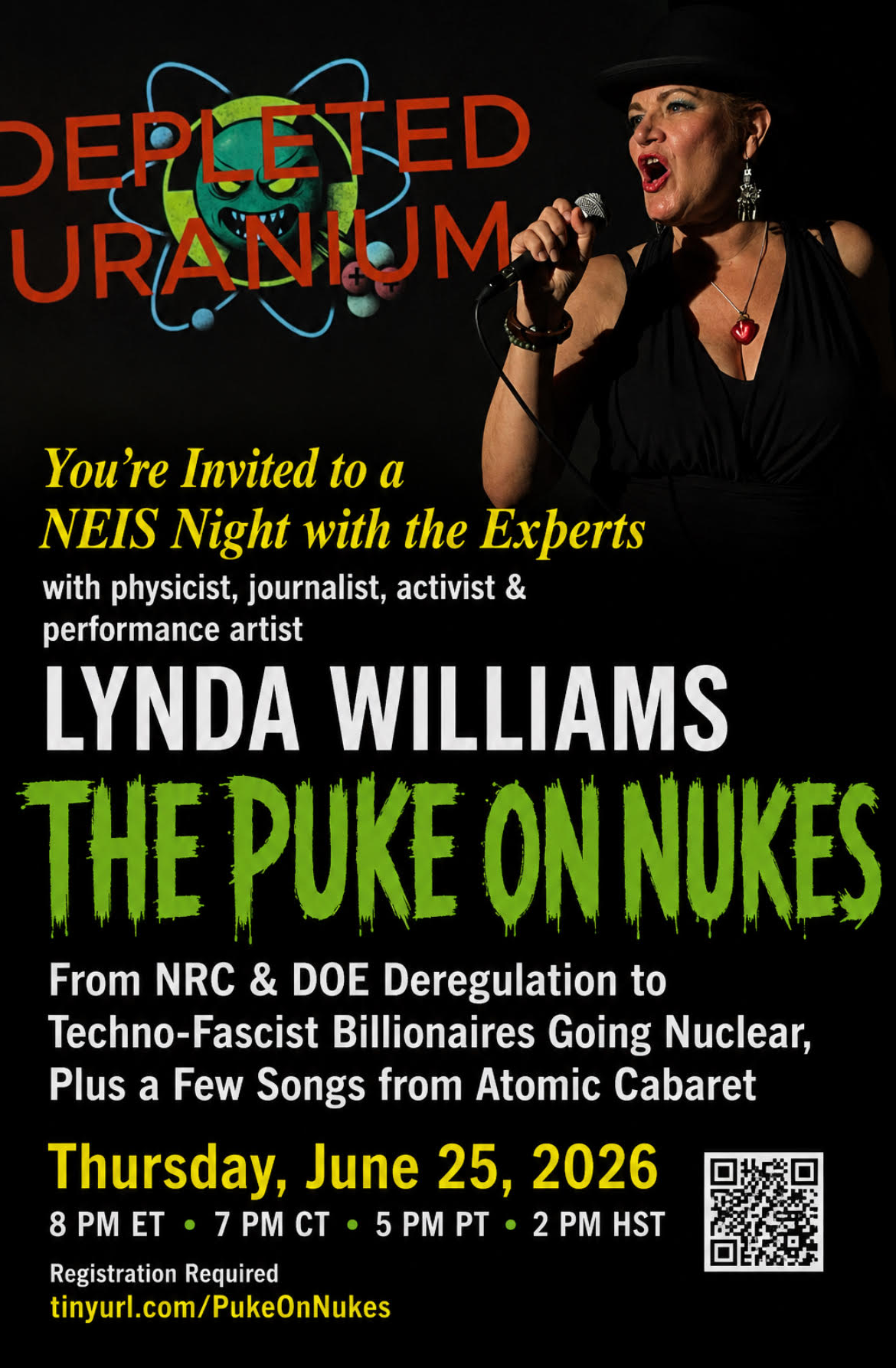
25 June- THE PUKE ON NUKES
Thursday, June 25, 2026
7pm Central Time (8pm ET, 6pm MT, 5pm PT) UTC – 5
From NRC & DOE Deregulation to Techno-Fascist Billionaires Going Nuclear, Plus a Few Songs from Atomic Cabaret REGISTER
26 June – Radiation Trainwreck at the NRC / Join the Protect Better Campaign – https://us02web.zoom.us/meeting/register/4ZlZ5_qLSHGiLSCg8FF6Bg#/registration


Cuba Is Not a Failed State – It Is a Besieged State
PETITION: “Global Appeal to Endorse Palestinian Right of Return of Refugees”
To see nuclear-related stories in greater depth and intensity – go to https://nuclearinformation.wordpress.com
-
Archives
- June 2026 (211)
- May 2026 (306)
- April 2026 (356)
- March 2026 (251)
- February 2026 (268)
- January 2026 (308)
- December 2025 (358)
- November 2025 (359)
- October 2025 (376)
- September 2025 (257)
- August 2025 (319)
- July 2025 (230)
-
Categories
- 1
- 1 NUCLEAR ISSUES
- business and costs
- climate change
- culture and arts
- ENERGY
- environment
- health
- history
- indigenous issues
- Legal
- marketing of nuclear
- media
- opposition to nuclear
- PERSONAL STORIES
- politics
- politics international
- Religion and ethics
- safety
- secrets,lies and civil liberties
- spinbuster
- technology
- Uranium
- wastes
- weapons and war
- Women
- 2 WORLD
- ACTION
- AFRICA
- Atrocities
- AUSTRALIA
- Christina's notes
- Christina's themes
- culture and arts
- Events
- Fuk 2022
- Fuk 2023
- Fukushima 2017
- Fukushima 2018
- fukushima 2019
- Fukushima 2020
- Fukushima 2021
- general
- global warming
- Humour (God we need it)
- Nuclear
- RARE EARTHS
- Reference
- resources – print
- Resources -audiovicual
- Weekly Newsletter
- World
- World Nuclear
- YouTube
-
RSS
Entries RSS
Comments RSS
 nuclear-news