Political opposition grows to nuclear waste storage plan, SF Chronicle, June 21, 2019 ALBUQUERQUE, N.M. (AP) — Plans by a New Jersey-based company to temporarily store spent nuclear fuel from commercial reactors in the New Mexico desert is running into more political trouble, as some of the state’s top elected officials are raising red flags.
Congresswoman Deb Haaland became the latest member of the delegation to weigh in Friday, sending a letter to the U.S. Energy Department and the Nuclear Regulatory Commission.
The first-term Democratic lawmaker suggested existing railways weren’t built to withstand the weight of the special casks that would be used to transport the high-level waste from sites around the country to southeastern New Mexico.
Haaland said there are no plans for new construction or renovations as part of the project proposed by Holtec International and that cities and states shouldn’t bear the cost of the infrastructure improvements needed to ensure safe transportation.
“I believe such a facility poses too great a risk to the health and safety of New Mexicans, our economy and our environment,” Haaland wrote.
Holtec is seeking a 40-year license from federal regulators to build what it has described as a state-of-the-art complex near Carlsbad……….
n her letter, Haaland pointed to past studies done by the Energy Department when it was considering Yucca Mountain. She said modeling predicted rail accidents at a rate of 1 in 10,000 shipments.
She also said the agency has found that a severe accident involving one cask of radioactive waste has the potential to contaminate dozens of square miles and result in hundreds of millions of dollars in cleanup costs.
State and industry officials also have concerns about potential effects on oil and gas development, as Holtec’s proposed site is located within the Permian Basin — one of the world’s most prolific energy production regions. https://www.sfchronicle.com/news/article/Political-opposition-grows-to-nuclear-waste-14028381.php
June 24, 2019
Posted by Christina Macpherson |
politics, USA, wastes |
Leave a comment
there is no credible official figure for civilian casualties because the U.S. commanders and the Pentagon played down the killing of civilians in the Iraq conflict, though some estimates place deaths in the Mideast country at between a half-million and 1  million.
 it was the widespread deployment of depleted uranium (DU) munitions that was to have lasting human damage.
The British scientific report entitled “Cancer, Infant Mortality, and Birth-Sex Ratio in Fallujah, Iraq 2005-2009” confirmed that DU was in shells and also in bullets that were fired in large, unreported quantities, causing radiation contamination. DU’s effects can last for a long period and resulted over time in physical deformities among children.
Ghosts of Fallujah Haunting America http://americanfreepress.net/ghosts-of-fallujah-haunting-america/
June 21, 2019 Staff A U.S. legislator has arrogantly admitted publicly that his Marine Corps unit may have killed hundreds of civilians in Fallujah. Will these war crimes continue to go unpunished?
By Richard Walker
The admission by Rep. Duncan Hunter (R-Calif.) that his Marine Corps unit may have killed hundreds of civilians, including women and children, in the city of Fallujah in Iraq in April 2004 once again raises the question of whether U.S. forces committed war crimes and used chemical and other unnamed weapons during major battles in Iraq that year.
Hunter was an artillery officer in what became known as the First Battle of Fallujah in April 2004, a city known for its beautiful, ancient mosques 30 miles from Baghdad. It was transformed into a war zone when protesters killed four Blackwater contractors and hung their bodies from a bridge. An operation was launched to find those responsible, but it developed into a full scale engagement. What is remarkable about this First Battle of Fallujah is that it did not last long, so the revelation by Hunter encourages additional scrutiny since it was not the battle that garnered the most controversy. Nevertheless, we have now learned that one artillery unit, by Hunter’s reckoning, may have killed hundreds of innocent civilians.
It is worth noting that there is no credible official figure for civilian casualties because the U.S. commanders and the Pentagon played down the killing of civilians in the Iraq conflict, though some estimates place deaths in the Mideast country at between a half-million and 1 million.
While the first battle was bloody, the Second Battle of Fallujah, in November 2004, was the one that we at American Free Press focused on most, believing correctly that the mainstream media was relying too much on official accounts of what transpired and was being denied the truth. AFP followed the story conscientiously, and we continued to do so in succeeding years. We were confident our reporting would be proved accurate and that new facts would emerge to confirm the claims we made that Marines used chemical weapons and depleted uranium munitions.
The U.S. military suffered 71 dead and over 250 injured in the Fallujah battles, leading to comparisons being made with some of the major exchanges of the Vietnam War.
In November 2004, Fallujah was sealed off from the outside world and quickly became a free-fire zone. This would be the Second Battle of Fallujah. There were many Iraqi fighters in the city, but there were civilians, too, who did not want to leave or had been unable to escape.
The battle was akin to what one might associate with the Second World War battle for Leningrad, with many snipers on both sides. In Fallujah, however, Marine Corp commanders had more firepower than the Iraqi fighters and used it to devastating effect. Some might argue that they used it with abandon.
Within a month, in what was dubbed Operation Phantom Fury, 36,000 homes were leveled, as well as 60 schools and 65 mosques. The city resembled a wasteland. At the time, and later, AFP reported that the Marines used white phosphorus bombs similar to ones the Israelis used later in Gaza, but it was the widespread deployment of depleted uranium (DU) munitions that was to have lasting human damage.
In 2004, and for several years afterwards, the Pentagon admitted having used white phosphorus, a chemical weapon that should not be used against civilians but denied that DU munitions were on the battlefield.
The truth emerged in 2010, however, when a British scientist and his team revealed that levels of radiation illnesses in Fallujah were comparable to, if not higher, than those found in Hiroshima and Nagasaki after the atoms bombs were detonated there in 1945.
It is still believed that other chemical weapons were used in Fallujah by the Marine Corps, but never identified. For example, aside from evidence of radiation, traces of mercury and other poisonous substances were found that could not be linked to known weapons.
The British scientific report entitled “Cancer, Infant Mortality, and Birth-Sex Ratio in Fallujah, Iraq 2005-2009” confirmed that DU was in shells and also in bullets that were fired in large, unreported quantities, causing radiation contamination. DU’s effects can last for a long period and resulted over time in physical deformities among children. The DU bullets were reported to have cut through walls like a hot knife through butter. The Pentagon has been reluctant to confirm whether experimental weapons were used on that battlefield.
Daniel DePetris, a conservative columnist, believes America has learned little from the Iraq War even though most Americans believe it was a disaster that caused thousands of American lives and tens of thousands of casualties.
He offers opinions on what our leaders should do before going to war, but perhaps his best piece of advice to them is “. . . deliver a case to the American people about why military action is appropriate and make them fully aware of what can go wrong.”
He knows, like the rest of us, that in Iraq everything that could go wrong did go wrong, especially in Fallujah.
Richard Walker is the pen name of a former N.Y. news producer.
June 22, 2019
Posted by Christina Macpherson |
children, depleted uranium, Iraq, USA, weapons and war |
Leave a comment
http://www.globalresearch.ca/pre-emptive-nuclear-war-role-israel-attack-iran/5677025/amp, Global Research (contributed  by Amel Polarte ) Prof Michel Chossudovsky 14 June 19
The text below is Chapter III of Michel Chossudovsky’s book entitled: The Globalization of War. America’s Long War against Humanity, Global Research Publishers, Montreal, 2015.
This chapter provides a historical perspective of US war plans directed against Iran, including the use of a preemptive nuclear attack, using low yield, “more usable” tactical nuclear weapons.
While one can conceptualize the loss of life and destruction resulting from present-day wars including Iraq and Afghanistan, it is impossible to fully comprehend the devastation which might result from a Third World War, using “new technologies” and advanced weapons, until it occurs and becomes a reality. The international community has endorsed nuclear war in the name of world peace. “Making the world safer” is the justification for launching a military operation which could potentially result in a nuclear holocaust.”
The stockpiling and deployment of advanced weapons systems directed against Iran started in the immediate wake of the 2003 bombing and invasion of Iraq. From the outset, these war plans were led by the U.S. in liaison with NATO and Israel.
Following the 2003 invasion of Iraq, the Bush administration identified Iran and Syria as the next stage of “the road map to war”. U.S. military sources intimated at the time that an aerial attack on Iran could involve a large scale deployment comparable to the U.S. “shock and awe” bombing raids on Iraq in March 2003:
American air strikes on Iran would vastly exceed the scope of the 1981 Israeli attack on the Osiraq nuclear center in Iraq, and would more resemble the opening days of the 2003 air campaign against Iraq.1
“Theater Iran Near Term” (TIRANNT)
Code named by U.S. military planners as TIRANNT, “Theater Iran Near Term”, simulations of an attack on Iran were initiated in May 2003 “when modelers and intelligence specialists pulled together the data needed for theater-level (meaning large-scale) scenario analysis for Iran.”2
The scenarios identified several thousand targets inside Iran as part of a “Shock and Awe” Blitzkrieg:
The analysis, called TIRANNT, for “Theater Iran Near Term,” was coupled with a mock scenario for a Marine Corps invasion and a simulation of the Iranian missile force. U.S. and British planners conducted a Caspian Sea war game around the same time. And Bush directed the U.S. Strategic Command to draw up a global strike war plan for an attack against Iranian weapons of mass destruction. All of this will ultimately feed into a new war plan for “major combat operations” against Iran that military sources confirm now [April 2006] exists in draft form.
… Under TIRANNT, Army and U.S. Central Command planners have been examining both near-term and out-year scenarios for war with Iran, including all aspects of a major combat operation, from mobilization and deployment of forces through postwar stability operations after regime change.3
Different “theater scenarios” for an all-out attack on Iran had been contemplated:
The U.S. army, navy, air force and marines have all prepared battle plans and spent four years building bases and training for “Operation Iranian Freedom”. Admiral Fallon, the new head of U.S. Central Command, has inherited computerized plans under the name TIRANNT (Theatre Iran Near Term).4
In 2004, drawing upon the initial war scenarios under TIRANNT, Vice President Dick Cheney instructed U.S. Strategic Command (U.S.STRATCOM) to draw up a “contingency plan” of a large scale military operation directed against Iran “to be employed in response to another 9/11-type terrorist attack on the United States” on the presumption that the government in Tehran would be behind the terrorist plot. The plan included the pre-emptive use of nuclear weapons against a non-nuclear state:
The plan includes a large-scale air assault on Iran employing both conventional and tactical nuclear weapons. Within Iran there are more than four hundred fifty major strategic targets, including numerous suspected nuclear-weapons-program development sites. Many of the targets are hardened or are deep underground and could not be taken out by conventional weapons, hence the nuclear option. As in the case of Iraq, the response is not conditional on Iran actually being involved in the act of terrorism directed against the United States. Several senior Air Force officers involved in the planning are reportedly appalled at the implications of what they are doing –that Iran is being set up for an unprovoked nuclear attack– but no one is prepared to damage his career by posing any objections.
June 22, 2019
Posted by Christina Macpherson |
Iran, Israel, USA, weapons and war |
Leave a comment

The program is a cooperative effort between the Air Force and the Navy that will share common-use technologies and  take advantage of the Navy progress on its Trident II D5 nuclear armed submarine launched missile. National Interest,
The Air Force plans to fire off new prototype ICBMs in the early 2020s, assessing new ICBMs with improved range, durability, targeting technology and overall lethality when compared to the existing arsenal. The new arsenal of ICBMs will serve well into the 2070s – called Ground Based Strategic Deterrent, or GBSD. The service has at times been discussing the progress of the program, but is now specifying when the new weapons will be ready.
The goal of the program is both clear and self-evident, as described in an Air Force report by Maj. Gen. Shaun Morris, Strategic Systems Program Executive Officer. In the service’s official 2018 Annual Acquisition Report, Morris described the purpose of the program as “ensuring our strategic deterrent is never doubted and always feared.” “Fear,” in fact, forms the basis of strategic deterrence – as knowledge of assured retaliatory destruction keeps potential enemies from contemplating a first strike. For this reason, Morris’ reasoning does, the threat of nuclear attack must be modern, effective and sustainable…….
Northrop Grumman and Boeing teams were awarded Technology Maturation and Risk Reduction deals from the Air Force last year as part of a longer-term developmental trajectory aimed at developing, testing, firing and ultimately deploying new ICBMs. Following an initial 3-year developmental phase, the Air Force plans an Engineering and Manufacturing Development phase, and award a single contract in late fiscal year 2020. ….
Overall, the Air Force plans to build as many as 400 new GBSD weapons to modernize the arsenal and replace the 1970s-era Boeing-built Minuteman IIIs. ……
June 22, 2019
Posted by Christina Macpherson |
USA, weapons and war |
Leave a comment
NRC approves transfer of NJ nuclear plant to Holtec International, which will dismantle it https://www.inquirer.com/ business/nrc-approves-reactor-transfer-exelon-oyster-creek-nuclear-holtec-decommission-20190620.html
The Nuclear Regulatory Commission approved the transfer of the reactor’s license from Exelon Generation Co. to a subsidiary of Holtec International Inc., a nuclear services provider with headquarters in Camden. Holtec has developed a specialty in handling spent nuclear fuel and dismantling retired reactors.
The decommissioning will largely be concentrated in 2019 through 2025, but completed by 2035, according to a schedule submitted to the NRC. Under law, the owner could have taken up to 60 years to dismantle the plant and restore the site. ……
Holtec is hiring 200 of 600 Oyster Creek employees to work on the decommissioning. In addition, the other experts will be hired to assist in the project at various stages, Pierre Oneid, Holtec senior vice president and chief nuclear officer, said in a statement.
The company will pay the decommissioning costs from a $848 million trust fund that built up from payments collected from customers during 49 years of operations. The owner anticipates the fund, conservatively invested, will generate $46 million in interest income in the coming years that will also go toward decommissioning.
Exelon secured a license renewal through to 2029, but announced in 2010 that it planned to shut down the reactor by 2019 rather than install a costly cooling tower required under new environmental standards to reduce the temperature of the water it discharges into Barnegat Bay.
June 22, 2019
Posted by Christina Macpherson |
business and costs, politics, USA, wastes |
Leave a comment
NUCLEAR UTILITIES SCRAMBLE TO STAVE OFF TRUMP URANIUM QUOTAS, by John Siciliano & Josh Siegel June 20, 2019 Washington Examiner, : Major U.S. nuclear utilities are warning President Trump it would be a big mistake to impose strict limits on the amount of uranium the nation imports from Canada and other allies, risking thousands of layoffs and other calamitous effects at nuclear power plants.
Trump is expected to meet with his Cabinet in the next few days to discuss recommendations the Commerce Department provided to him in April on placing firm quotas on uranium imports as a matter of national security.
Utility lobbyists representing Exelon, Duke Energy, and other owners of nuclear power plants, say the idea of placing limits on the amount of fissile fuel the nation imports is misguided, and Trump should reject any proposal that recommends such action.
Uranium mining firms had petitioned for the quotas to protect U.S. jobs in the mining sectors under trade provisions aimed at protecting national security……..
Canadian Prime Minister Justin Trudeau, however, is expected to push back against the idea of imposing quotas at Thursday’s bilateral meetings at the White House. …… https://www.washingtonexaminer.com/policy/energy/daily-on-energy-nuclear-utilities-scramble-to-stave-off-trump-uranium-quotas
June 22, 2019
Posted by Christina Macpherson |
politics, Uranium, USA |
Leave a comment
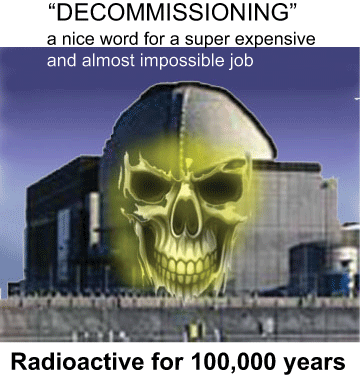
Dismantling nuclear plants is a gold mine for some, but at what risk to you? https://www.lohud.com/story/news/investigations/2019/06/19/nuclear-plant-decommissioning-is-a-gold-mine-for-some-but-at-what-risk/1269407001/
AS THE NATION’S NUCLEAR PLANTS CLOSE, A NEW INDUSTRY HAS SPROUTED. WORTH BILLIONS TO SOME, THE DECOMMISSIONING PROCESS WORRIES OTHERS.
Thomas C. Zambito, Rockland/Westchester Journal News June 19, 2019 Shutting down nuclear plants is set to become a multi-billion dollar business. If that business fails, critics say, your tax dollars – and possibly your safety – could be on the line. Learn more in our USA TODAY NETWORK Northeast project, The Nuclear Option.
 The nuclear power industry is shrinking by the day.
Some 20 reactors at 15 power plants across the U.S. have plans to shut down or are in the midst of being decommissioned, a process that traditionally takes decades.
Now, a new crop of companies — fed by Wall Street speculators — are claiming they can cut that time to at least eight years, as they eye the $60 billion set aside in trust funds to handle the messy work of shutting down nuclear reactors.
Two firms, Holtec International of Camden, New Jersey, and its rival, New York-based NorthStar Group Services, together with their partners, have been on a buying spree in recent years, snatching up power plants across the nation with the promise of quicker teardowns.
A quicker-to-finish timeline appeals to folks who live near power plants in communities that for decades could count on balancing their budgets with the tax revenue they generated.
 Safety sacrificed for speed?
But watchdog groups, politicians, scientists and experts on decommissioning nuclear plants are questioning whether safety will be sacrificed for speed, as profit-seeking companies rush to finish one job so they can move on to the next.
There are also worries that the trust funds will be bled dry before the job is completed, leaving taxpayers — and anyone who pays for electricity — footing the bill.
“If the decommissioning fund goes bankrupt and the job isn’t completed, they walk away and leave the cleanup to the states,” said Tim Judson, the executive director of the Nuclear Information and Resource Service.
In February, Massachusetts Attorney General Maura Healey voiced her concerns in a petition to intervene in the Nuclear Regulatory Commission’s review of the pending sale of Pilgrim Nuclear Power Station in Plymouth to Holtec.
The proposed deal puts the health and safety of our residents at risk,” Healey said. “We’re intervening to protect the public and ensure that the transaction does not leave our state’s taxpayers on the hook for any of the costs of safely decommissioning the plant, and managing spent nuclear fuel.”
With so much money at stake, things are moving quickly:
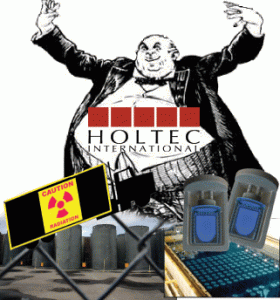 On May 31, Pilgrim shut down. A day earlier, Duke Energy announced it had a contract with Accelerated Decommissioning Partners (ADP), a joint venture between NorthStar and Orano USA, to dismantle its Crystal River plant in Florida. ADP says the job will be finished by 2027.
- Holtec has pending deals to buy Indian Point in New York’s Hudson Valley and Oyster Creek on Barnegat Bay, with plans to tear them down. Oyster Creek shut down in the fall and Indian Point will shut down in 2021. Indian Point’s trust fund totals $1.85 billion and Oyster Creek’s is nearly $1 billion.
- Holtec and its partners also have a pending deal to buy Palisades Nuclear Generating Station in Michigan. If the deal goes through, Holtec will own six reactors in four states.
- Northstar, meanwhile, purchased Vermont Yankee from Louisiana-based Entergy in January and is already moving ahead with demolition following a lengthy state and federal approval process.
It’s the largest number of shutdowns since the 1990s, when some of the industry’s earliest reactors powered down.
In recent years, Entergy and Exelon, the owners of Indian Point and Oyster Creek, have faced economic challenges that forced them to reconsider their investment.
The cheap price of abundant natural gas has made it difficult to compete in the energy market.
And fears of a mishap like the partial meltdown that occurred at Pennsylvania’s Three Mile Island in 1979, coupled with disasters at Fukushima and Chernobyl — the focus of a recent series on HBO — have contributed to the chorus of political opposition.
Several other struggling nuclear power plants might have shut down if they hadn’t secured state bailouts to keep them operating. In upstate New York, the state agreed to divert billions of dollars in ratepayer money to subsidize three power plants — Nine Mile Point and James A. FitzPatrick in Oswego County and R.E. Ginna near Rochester.
And in April, New Jersey regulators approved $300 million a year in subsidies so Newark-based Public Service Enterprise Group can keep operating three nuclear reactors at the Salem and Hope Creek Nuclear Generating Stations in Lower Alloways Creek. The money will come out of ratepayers’ electricity bills.
Industry proponents view the latest downturn as part of the natural business cycle.
Rod McCullum, who specializes in decommissioning issues for the Nuclear Energy Institute, a trade group for power plant owners, says last year the nation’s 98 nuclear reactors had one of their best years ever.
Over each of the past three years, energy generated by nuclear power in the U.S. has been around 805 million megawatt hours, up from about 790 million megawatt hours in 2013.
McCullum noted, however, that several older plants are being phased out as more efficient, less costly reactor designs become available.
Georgia Power is building two nuclear reactors in Augusta, a rare event in the nuclear power industry over the past 20 years.
“The nuclear industry in the future will be very different,” McCullum said. “There are a lot of advanced nuclear designs on the table and over time we will be shutting down and decommissioning the older plants. You’re starting to see a wave of that now.”
New players in the decommissioning industry
Decommissioning is not new. Several plants were decommissioned in the 1990s at places like Rancho Seco in Sacramento County, California, and Maine Yankee in Wiscasset.
What’s new are two key changes.
First, companies are forming consortiums dedicated to dismantling. Holtec has partnered with SNC-Lavalin, a Canadian company that specializes in demolitions, to create a subsidiary called Comprehensive Decommissioning International. And NorthStar, which has experience knocking down large hotels and casinos, is teaming with a company whose experience is in the nuclear industry.
Second, and perhaps more importantly, the lessons learned in Maine and other sites provide a road map for how to do the job more efficiently, McCullum said. In prior years, the prevailing thought was to remove the fuel from the reactor, place it in either a cooling pool or canisters and leave the plant intact while radiation decayed. Such a process could take up to 60 years.
Not so today.
“The idea now is it’s a better use of the trust fund to get the plants down as fast as possible,” McCullum says. “That’s why you’re seeing these business deals.”
These newly formed companies use a “rip and ship,” which saves time and limits worker exposure to dangerous levels of radiation.
“They used to decontaminate the floor drains and it was hard to do,” said Bruce Watson, who heads the NRC’s decommissioning branch and has overseen shutdowns at Maine Yankee and Rancho Seco. “Now you go up, you hit it with a hammer, break the concrete, yank the pipe out and put it in a low level waste bin. You don’t waste your time cleaning it. You just measure it and put it in the bin.”
Holtec has yet to do a decommissioning but is no stranger to the nuclear industry. It manufactured a wet storage system used to store spent fuel once it’s removed from the reactor.
The company began manufacturing dry storage canisters in 1994. The canisters are built from stainless and carbon steel and more than two feet of cement is added to the interior once they arrive at the power plant.
Its decommissioning plan calls for moving spent fuel out of cooling pools as soon as possible so workers can get to work tearing down contaminated buildings without unnecessary exposure to radiation. And it has applied to the NRC for permission to use a cask that will allow workers to move hotter fuel into canisters after less than three years in a cooling pool.
By taking the spent fuel out of the pool faster it gives you the added benefit of making it almost a fully industrial decommissioning process,” said Joy Russell, Holtec’s senior vice president for business development.
Holtec has plans for an underground repository in southeastern New Mexico to hold some of the 80,000 metric tons of spent nuclear fuel that’s been building up at the nation’s nuclear power plants over the past six decades. Federal officials say it’s enough to fill a football field 20 meters deep.
 If successful, the plan could help resolve the nation’s nuclear fuel problem while making Holtec a lot of money.
“Holtec engineers have come up with a solution that puts that used fuel below the ground, away from the reach of terrorists, away from risks to humankind in any form,” Holtec’s owner, Krishna Singh said at a 2017 event in Camden.
The occasion was the grand opening of a state-of-the-art factory built on the shores of the Delaware River, where Holtec manufactures the mammoth steel canisters that will entomb spent nuclear fuel for hundreds of years.
“If it (the New Mexico repository) becomes a reality then we will need to build 10,000 canisters,” Singh said. “That will employ thousands of people for many, many, many years.”
Like Holtec, NorthStar’s partners, Waste Control Specialists, have plans to build a storage site out West. Theirs will be in Texas, not far from the site where Holtec has decided to build.
The sites would, in theory, serve as interim storage facilities until the U.S. Department of Energy secures a permanent repository for the nation’s nuclear waste. Efforts to create a final resting ground at Yucca Mountain north of Las Vegas have stalled.
 Stranded nuclear waste
As a result, nuclear power plants have sued the federal government for leaving nuclear waste stranded at their facilities.
At the end of 2016, the Department of Energy said the federal government had already paid out $6.1 billion to the owners of spent nuclear fuel and owes another $25 billion. The amount of waste is growing by 2,200 metric tons a year and is expected to hit 140,000 metric tons over the next 50 years, the Government Accountability Office says.
The NRC will have to sign off on the repository proposals, a process that could take several years.
“The companies specializing in decommissioning don’t share their strategies with us, including whether they are interested in managing the near- and long-term storage of spent nuclear fuel, including at interim repositories they hope to build,” said Watson. “But we will be closely reviewing all of those plans both at plant-specific and holistic levels.”
In May, Holtec cleared a significant hurdle in its effort to build its New Mexico facility when the NRC’s Atomic Safety Licensing Board rejected a challenge from environmental groups.
But the plan has a long way to go.
For one, the federal government will have to sign off on the transportation routes chosen to get spent fuel to New Mexico from power plants across country, whether by rail, truck or barge.
And Holtec will have to raise the money for the project. Russell said the company has already spent about $8 million on its efforts to secure an NRC license but will need much more to build.
“We haven’t made that jump yet to say we will build the facility,” Russell said during a May interview at Holtec headquarters in Camden. “As far as the construction goes, Holtec looks for funding from either the Department of Energy or utilities or some other source to begin the construction. That still has to be figured out and we’re actively working on it.”
If the funding comes through, construction would begin in 2021 and the first shipment of spent fuel would arrive in 2023.
Reactors in the U.S. have generated approximately 80,000 metric tons of nuclear waste.
That’s about about eight times as heavy as the Eiffel Tower.
About 14,700 metric tons of used nuclear fuel sits in storage in New York, Pennsylvania and New Jersey.
That’s roughly three-fifths the weight of the Statue of Liberty.
In the meantime, back home, Holtec has been forced to answer difficult questions about how it secured some $260 million in tax incentives from New Jersey’s Economic Development Authority (EDA) to build its technology campus in Camden.
On June 7, the Concerned Citizens of Lacey sent a letter to the NRC asking the federal agency to hold off on any decisions regarding Oyster Creek’s license transfer to Holtec until New Jersey state officials resolve questions raised by the award.
Earlier this month, ProPublica reported that New Jersey had put a hold on tax credits to Holtec.
“Holtec continues to have interactions with the EDA,” the company said in a statement. “No notice has been received by Holtec indicating that the tax credits are frozen.”
And in September Singh issued an apology after he made what some considered disparaging comments about Camden’s workforce in a published interview.
Singh immigrated to the U.S. from India in the late 1960s and received degrees from the University of Pennsylvania. In 2007, he donated $20 million to his alma mater to help fund a nanotechnology center that bears his name.
Singh’s expertise is in heat transfer, put simply the process of turning hot things cold and hot things hotter. In the lobby of Holtec’s Camden corporate offices plaques recognize some of his 60 patents.
Focused on the work ahead
Russell says the company remains focused on the work ahead.
“We’re going to show the world that we can safely decommission and safely manage spent fuel storage at these sites and instill confidence in the rest of the country that nuclear is a viable option,” Russell said.
“At a time when other companies in our industry and in the U.S. in general are rolling up their carpet and closing their shops and heading overseas, we’re not,” Russell added. “We’re investing in nuclear.”
The Camden factory is the size of eight football fields and resides on a site that was home to New York Shipbuilding Corp., which shut down in 1967 after building warships for the Navy with a workforce that at its peak numbered 30,000.
The factory will eventually be used to build Holtec’s modular nuclear reactors, smaller than the type currently used at power plants and less reliant on water sources. That has led some to speculate whether Holtec is looking to put the reactors into use at the nuclear power plants it plans to purchase.
 For now, though, the reactors are being marketed overseas.
“That’s why we built this factory here because we fully intend to bring that small modular reactor to market,” Russell said. “Unfortunately, we don’t see a market in the United States but we have signed a memorandum of understanding with a Ukraine nuclear utility and so we’ll likely build our first small modular reactor in Ukraine.”
It houses machines capable of bending steel plates seven inches thick, giant spinning lathes and an X-ray machine that insures every weld is leak free. On the factory floor are canisters destined for power plants across the county and overseas to Slovenia. This report is brought to you by USA TODAY Network Northeast, a group of network news organizations based throughout New Jersey, New York, Delaware, Pennsylvania, Vermont and Virginia.
June 20, 2019
Posted by Christina Macpherson |
USA, wastes |
Leave a comment
 Luria calls for national effort on advanced nuclear technology https://www.dailypress.com/news/politics/shad-plank-blog/dp-nws-luria-nukes-20190619-story.html Dave Ress Contact Reporter Staff writer
Sometimes, life experience — say, a Navy career that includes running aircraft carriers’ nuclear reactors — shapes legislation.
Which is why Rep. Elaine Luria, D-Norfolk, has proposed a bill meant to fast track advanced nuclear energy. And, as seems to be emerging as a pattern, she’s enlisted Virginia colleagues from the across the aisle — Rep. Rob Wittman, R-Westmoreland County, and Rep Denver Riggleman, R-Nelson County — as co-sponsors.
“As an engineer who operated nuclear reactors on aircraft carriers, I know that ensuring a thriving civilian nuclear industry is vital,” Luria said. “Nuclear energy must be part of any solution to transitioning to a clean energy future because nuclear power provides over 55% of our carbon-free energy.”
The bill would:
*set a strategy for nuclear science and engineering research and development;
* provide for at least two advanced nuclear reactor demonstration projects, to be completed by the end of 2025;
* let federal entities arrange power purchase agreements for up to 40 years, to make it more feasible for nuclear plant operators to venture into this line of business;
* start a pilot program for a long-term nuclear power purchase agreements for new nuclear technology;
* require the Department of Energy to provide a source for fast-neutron research;
* launch a program to supply reactors with High-Assay Low-Enriched Uranium (HALEU) fuel.
* set up scholarships and funding for students pursuing studies in nuclear science.
“We need an all-the-above energy strategy, and nuclear energy is an important component of that,” Wittman said.
Riggleman said “This bill will help position the United States as a global energy leader in a responsible and bipartisan way.”
Dave Ress, 757-247-4535, dress@dailypress.com
June 20, 2019
Posted by Christina Macpherson |
politics, USA |
1 Comment
|
The Crushing Cost Of Nuclear Waste Is Weighing On Taxpayers https://oilprice.com/Alternative-Energy/Nuclear-Power/The-Crushing-Cost-Of-Nuclear-Waste-Is-Weighing-On-Taxpayers.html# By Haley Zaremba – Jun 19, 2019, The Maine Yankee nuclear power plant hasn’t produced a single watt of energy in more than two decades, but it cost U.S. taxpayers about $35 million this year.” So begins a powerful report this week about the crushing cost of nuclear waste storage by the Los Angeles Times.Nuclear waste has always been a contentious topic in the United States, and the issue has a particularly long history of litigation and protest in the country, from the anti-nuclear movement of the 1960s to the major outcry over the Yucca Mountain nuclear waste repository approved for construction in 2002 under George W. Bush and later de-funded in 2011 under the Obama administration. Even though nuclear power remains controversial, the United States is nevertheless the largest nuclear power generator in the world, producing a whopping 30 percent of global nuclear energy supplies.
“About 80,000 metric tons of nuclear waste have been stored at 72 private locations across the nation, enough to cover a football field to a depth of about 66 feet, according to the Government Accountability Office. Most are at operating plants, incorporated into the plant’s daily activities, but 17 are at closed facilities, with seven at sites — including Maine — where the plant itself has been demolished,” says the LA Times. “In those cases, only the storage casks remain, and keeping them monitored and protected as they get older can be an expensive operation.”
For the first 40 years of nuclear power production in the United States, there were no federal regulations on how the industry should operate or dispose of its dangerously radioactive byproducts. Before the Nuclear Waste Policy Act of 1982, private companies in the U.S. were responsible for their own clean-up and storage of spent nuclear fuel, quickly running out of storage space. However, those private companies were not sufficiently equipped to store their waste long-term, as some kinds of nuclear waste have a half-life (meaning the amount of time they remain radioactive) of up to 17 million years. Congress decided that going forward the burden of responsibility would lie with the United States government, putting the massive cost of cleanup on the shoulders of U.S. taxpayers.
Now, that price tag has reached a whopping $7.5 billion, and that number is only going to keep growing.
As the United States has scrapped the Yucca Mountain nuclear waste repository for the time being, there is still no simple solution for ongoing nuclear waste management. “With no place of its own to keep the waste, the government now says it expects to pay $35.5 billion to private companies as more and more nuclear plants shut down, unable to compete with cheaper natural gas and renewable energy sources,” reports the LA Times. “Storing spent fuel at an operating plant with staff and technology on hand can cost $300,000 a year. The price for a closed facility: more than $8 million.”
In the United States, where the nuclear industry is ailing, this is particularly bad news. More plants are shutting down than are going online, and many of the nuclear plants that are continuing to function are able to do so in large part thanks to government subsidies at the state level, which is to say, even more taxpayer dollars.
The Trump administration, for its part, has made efforts to combat the rising prices of nuclear waste storage–albeit extremely controversial ones. Just this month, “in a move that will roll back safety standards that have been observed for decades” says not-for-profit news organization Truthout, “the Trump administration reportedly has plans to reclassify nuclear waste previously listed as “high-level” radioactive to a lower level, in the interest of saving money and time when disposing of the material.”
While this may be a quick fix for the massive amounts of money flowing out of taxpayer pockets and into the nuclear energy industry, it’s certainly not a sustainable solution for what could easily become a national health crisis if mismanaged. What’s more, the United States nuclear industry may not stay struggling forever–it could easily make a comeback as national attitudes change about the benefits of nuclear and the downsides of fossil fuels. In fact, the United States has enough Uranium domestically to power the country for hundreds of years into the future.
|
|
June 20, 2019
Posted by Christina Macpherson |
USA, wastes |
1 Comment
A generation of Canadian children was given radiation treatment and never warned of the cancer risks https://theconversation.com/a-generation-of-canadian-children-was-given-radiation-treatment-and-never-warned-of-the-cancer-risks-116403 Itai Bavli
PhD candidate in Interdisciplinary Graduate Studies (Public Health and Political Science), University of British Columbia June 20, 2019 On February 9, 2001, the Vancouver Sun published an article about Nancy Riva who lost her two brothers and was diagnosed with cancer as a result of thymus radiation treatment they received as children — in the belief that this would prevent sudden infant death.
Riva and her brothers were born in Vancouver General Hospital (VGH) in the late 1940s and underwent radiation treatment at the hospital as babies.
Radiation treatment for benign illnesses (that is not for treating cancer), like Riva’s inflamed thymus gland, was a standard medical practice worldwide during the 1940 and 1950s. The treatment was considered to be safe and effective for non-cancerous conditions such as acne and ringworm as well as deafness, birthmarks, infertility, enlargement of the thymus gland and more.
In the early 1970s, medical research confirmed the long-standing suspicion that children and young adults treated with radiation for benign diseases, during the 1940s and 1950s, showed an alarming tendency to develop thyroid cancer and other ailments as adults.
In our recent paper, published in the American Journal of Public Health, Shifra Shvarts and I have explored how health authorities in the United States responded to the discovery of the late health effects of radiation treatment.
Over two million people are estimated to have been treated with radiation in the U.S. for benign conditions. We show how an ethical decision at Michael Reese Hospital in Chicago in 1973 to locate and examine former patients, who had been treated with radiation in childhood, led to a nationwide campaign launched in July 1977 by the National Cancer Institute (NCI) — to warn the medical community and public about the late effects of radiation treatment in childhood for a variety of diseases.
U.S. campaign promotes thyroid checkups
Media coverage of the Chicago hospital’s campaign had a snowball effect that prompted more medical institutions to follow suit (first in the Chicago area and later in other parts of the U.S.), resulting in the NCI’s campaign.
Hundreds of thousands of pamphlets were distributed in shopping centres across the U.S., asking people who had undergone radiation treatment to go to their family doctor for a thyroid checkup. In addition, television presenters opened their programs with warnings; notices were published in newspapers.
Meanwhile in Canada, an unknown number of patients, like Riva and her brothers, were treated with radiation. Interviewed by the Vancouver Sun in 2001, Riva wanted to raise public awareness about this issue, encouraging people who might have been treated with radiation as children to have their thyroid checked.
According to VGH’s officials, quoted in the article, locating former patients was logistically impossible. Spokeswoman Tara Wilson told Vancouver Sun reporter Pamela Fayerman:
“Under the Hospital Act, records only have to be maintained for 10 years after a patient’s last hospital admission, so it’s unlikely we would have these birth records, although people can still phone the hospital to check.”
No systematic investigation in Canada
Riva’s story raises the question of why the Canadian health authorities did not launch a campaign to warn the public, as happened in the United States. Early detection of thyroid cancer saved lives.
The U.S. campaign was known in Canada. On July 14, 1977 a Globe and Mail article titled, “U.S. increasing efforts to warn million potential cancer victims,” described the national program to alert the public of the late health effects of radiation treatment.
Moreover, in an article published in Annals of Internal Medicine in February 1978, two University of Toronto professors of medicine, Paul Walfish and Robert Volpé, discussed the long-term risk of therapeutic radiation and described the efforts made by the U.S. Department of Health, Education and Welfare to educate the American public about the late effects of the treatment.
To date, there has been no known attempt to systematically investigate how many children underwent radiation treatment in Canada for benign conditions and what has been done to alert the public and the medical community of the risks. From Riva we learn that in 2001 patients were still looking for advice.
Had the Canadian health authorities effectively warned the public of the long-term risk of radiation treatment, illnesses and deaths may have been prevented.
Perhaps some still could?
June 20, 2019
Posted by Christina Macpherson |
Canada, radiation, USA |
Leave a comment
Decades later, Maine Yankee plant stuck with spent nuclear fuel as feds pick up $10M tab https://www.lohud.com/story/news/investigations/2019/06/19/maine-yankee-nuclear-plant-stuck-spent-fuel/1345799001/
AT A COST OF $10 MILLION A YEAR, THE OWNERS OF THE CLOSED PLANT PAY ARMED GUARDS TO WATCH 60 CEMENT AND STEEL CASKS FULL OF SPENT NUCLEAR FUEL.
Thomas C. Zambito, Rockland/Westchester Journal News June 19, 2019 The 11-acre site on a peninsula off the coast of Wiscasset, Maine, is home to what may be the nation’s most expensive storage facility.
At a cost of $10 million a year, the owners of the shuttered Maine Yankee nuclear power plant pay armed guards to watch 60 cement and steel canisters loaded with decades’ worth of spent nuclear fuel, each weighing 150 tons.
When Maine Yankee stopped producing power in 1996, folks in Wiscasset figured it would be a few years before that spent fuel would be shipped to Yucca Mountain in the Nevada desert, where the federal government was preparing an underground repository for the nation’s nuclear waste.
That never happened. Twenty-three years later, Wiscasset is still waiting.
“For 20 years we’ve heard, ‘Oh, it’s all going to Yucca Mountain, don’t worry about it,'” said Benjamin Rines Jr., a longtime Wiscasset selectman who was around when Maine Yankee was built in 1972. “Well, you know what happened to all of that, and here we are.”
Maine Yankee wrapped up its decommissioning in 2005, one of the first at a nuclear power plant in the U.S.
Early on, the company faced major hurdles. Maine Yankee was forced to take on the job of removing fuel from the reactor and dismantling buildings itself after the contractor it hired could not finish the $250 million job.
But the effort is still considered an achievement in a nuclear power industry that once saw decommissioning as a 60-year job.
Maine Yankee leads the way
Techniques used at Maine Yankee are now being applied by a new generation of decommissioning companies that have promised to match the eight years it took Maine Yankee to tear down its plant.
A hot-spot removal program used radiation detection equipment to identify for removal any pipes and valves with high levels of radiation, so workers would be spared exposure to dangerous doses of radiation.
And in 2004, explosives were used to demolish the plant’s 150-foot containment dome, the first time that was done at a nuclear power plant, according to Maine Yankee. It created 25 million pounds of rubble.
Three miles of pine forest separate Paul Berkowicz’s ranch-style home from a cluster of towering canisters on a concrete pad containing one of mankind’s most dangerous substances.
For decades, the 68-year-old retired educator has lived and worked near the Oyster Creek Generating Station, the nation’s oldest operating commercial nuclear power plant until it stopped energy production in September.
But while the plant’s decommissioning was labeled a success, efforts to redevelop portions of the 800-acre site on which it stood have fizzled. And many don’t see any prospects ahead until the spent fuel is gone.
The spent fuel installation sits behind a chain-link fence on the 180-acre Bailey Point Peninsula, where the plant’s reactor was located. The canisters there are said to be warm enough in winter to melt snow.
“The surrounding communities are stuck with a spent fuel installation, which is safe and secure, and I don’t think anybody doubts that, but it’s an impediment to any future use of this property,” said Don Hudson, the chairman of Maine Yankee’s Community Advisory Panel. “Once it’s out of there, then you can imagine a number of things happening.”
Maine Yankee donated 200 acres to the Chewonki Foundation for use as a nature preserve and walking trails as part of a 1999 settlement agreement, which allowed Maine Yankee to increase charges to ratepayers so it could move ahead with the decommissioning. And some 430 acres were eventually sold to a developer who specializes in “challenging” properties.
So far, though, there has been no development.
A 2007 referendum proposal to build an energy plant that turned coal into gas was shot down by voters.
In the interim, the owners of Maine Yankee and two other Yankee plants decommissioned in Connecticut and Massachusetts have won some $472 million after suing the federal government for failing to create an underground repository for the nation’s nuclear waste, as it had promised.
Yucca Mountain was supposed to be ready by 1998, but those efforts stalled amid political opposition from Nevada lawmakers and environmentalists.
As part of the 1999 agreement, Maine Yankee sued the U.S. Department of Energy (DOE) to recover the money ratepayers had, through the years, kicked in for the plant’s decommissioning.
“Had they [the DOE] met their obligation, all of the fuel would have been gone by 2004 and Maine Yankee as a single-asset company would have been out of business by 2008,” said Eric Howes, the director of public and government affairs for Maine Yankee.
Public pension funds invested with J.F. Lehman
J.F. Lehman’s $883 million fund received at least $126.5 million from variouspublic employee retirement funds that may have invested in nuclear decommissioning projects through J.F. Lehman & Co.
With Maine Yankee no longer making electricity, Wiscasset was left with a gaping hole in its budget.
The town took in nearly $12 million a year in taxes from Maine Yankee, more than 90 percent of its tax base. In 2005, the year the decommissioning was finished, the total was $1 million and last year it was closer to $700,000, according to town figures.
Taxes had to be raised. Municipal jobs went unfilled. And the village started charging for sewer service.
Similar scenarios have played out in towns across the U.S. — in places like Zion, Illinois, and Vernon, Vermont — when nuclear power plants shut down, leaving communities with economic challenges.
Wiscasset was helped by long-term investing ahead of the shutdown that left some $12 million in reserve, money used years later to keep taxes down, said Rines, the selectman.
“It was always the thought of the town that we would put it away for a rainy day when we needed it, and the rainy day showed up a lot quicker than we thought,” said Rines, 66.
Wiscasset remains a busy pass-through for travelers using Route 1 on the way to Boothbay and Bar Harbor. Some will stop in at Sarah’s, where “The First Ingredient is Love,” or Red’s Eats across the street for a lobster roll.
Maine Yankee’s spent fuel is located some 5 miles away, past car dealerships, Big Al’s Fireworks and a welcome sign that announces Wiscasset as “The Prettiest Village in Maine.”
After the plant shut down, Hudson, then the director of the Chewonki Foundation, was asked to lead Maine Yankee’s community advisory panel. The company arranged for Hudson and others to visit Yucca Mountain to see the underground rail tunnels where Maine Yankee’s spent fuel would be sent to cool down.
“It’s out in the middle of a vast desert about as far away as you can be from anywhere,” Hudson said. “If we can’t put it there, I don’t know where we’re going to put it.”
These days, the panel meets just once a year. Its primary business is drafting a letter to federal lawmakers urging them to back legislation written to aid towns stuck with nuclear waste.
“We write the delegation, we reference the bills, we encourage them,” Hudson said. “We’re basically the cheerleaders for moving this stuff along, and we’re trying to give them the moral courage and public support that says, ‘We’re with you. We know this is really difficult. We encourage you to tackle it.’ ”
June 20, 2019
Posted by Christina Macpherson |
USA, wastes |
Leave a comment
 Investors see huge profits from old nuclear plants, but it could cost taxpayers https://www.lohud.com/story/news/watchdog/2019/06/19/nuclear-plant-decommissioning-holtec-other-firms-see-profit/1456809001/
INVESTORS ARE SCRAMBLING TO BUY OLD NUCLEAR PLANTS. THEY SAY THEY CAN CLEAN THEM FOR PROFIT. IF THEY FAIL, EXPERTS WORRY TAXPAYERS MAY BE ON THE HOOK.
Christopher Maag, North Jersey Record, June 19, 2019 Shutting down nuclear plants is set to become a multi-billion dollar business. If that business fails, critics say, your tax dollars – and possibly your safety – could be on the line. Learn more in our USA TODAY NETWORK Northeast project, The Nuclear Option.
Some of the nation’s richest investors are betting they see profit where no one else does: tearing down America’s aging nuclear reactors.
Among them is one of the most recognized names from the Reagan Administration, former Secretary of the Navy John Lehman.
Lehman’s plans are shrouded in secrecy. The hedge fund that bears his name does not disclose basic information about its finances.
But an examination of deals made by the hedge fund since 2017 to raise money and acquire firms, makes it clear the company sees a pot of gold for the taking — some $60 billion accumulating in trust funds owned by nuclear power plants — all of it bankrolled by ratepayers.
“We believe that the profitability potential remains high,” said Daryl Walcroft, a lead adviser at the accounting firm PwC, which recently released a 20-page report titled “Ready, set…shut down!” to lure new investors.
If they succeed, investors will control a brand-new industry. If they fail, as some independent experts predict, those investors — including public employee pension funds for teachers, police and firefighters — could lose hundreds of millions of dollars.
Past projects blew their budgets by up to half a billion dollars, forcing ratepayers to cover the costs. Current projects may be even riskier, as companies saddle the trust funds with new cleanup costs that federal rules never envisioned, and do not allow.
Such deals may enable big investors like Lehman to take their profit and walk away, leaving “taxpayers to bear the financial burden and responsibility for finishing the work,” Massachusetts Attorney General Maura Healey said in a petition to federal regulators.
For years, power companies supervised reactor cleanup themselves. Nearly every project was a financial failure. In some cases the cost approached $1 billion, double the original estimate.
“I would say all of the early projects went over budget,” said Scott State, CEO of NorthStar Group, a company that deconstructs buildings.
Industry leaders like State believe they can decommission a nuclear plant faster and cheaper, and share the savings with their investors as profit.
“They’re taking on a big risk that they can do a big job,” said Tom LaGuardia, an engineer widely regarded as the world’s top expert on decommissioning costs.
The New Model
TO INVESTORS, EACH REACTOR IS A POT OF GOLD
To some people, a closed nuclear plant is a dangerous place contaminated with radioactive waste.
To investors, each reactor is a pot of gold.
Federal law requires electricity companies to save money in trust funds for the eventual closure and cleanup of nuclear reactors. Fund totals ranged from $286.6 million for Beaver Valley reactor 1 in Pennsylvania to $1.5 billion for Diablo Canyon reactor 2 in California, according to 2016 tallies from the Nuclear Regulatory Commission, the latest available.
Nationwide, trust fund balances topped $60 billion in 2016, the NRC found. They grew to $70 billion by 2018, according to The Callan Institute, which advises fund managers. And the total may soon rise to $90 billion, according to PwC, a major accounting firm formerly known as PriceWaterhouseCoopers.
And unlike virtually every other big construction project, companies decommissioning nuclear plants get paid upfront, before work even starts.
“Having pre-funded work is very good,” said State, of NorthStar.
Powerhouses including the PwC accounting firm also see profit opportunity in teardown deals.
“(T)he growth of this market is accelerating more quickly than predicted,” according to the company’s recent report. “Already, we are seeing qualified decommissioning specialists and institutional investors clamoring through various deals to own” decommissioning companies.
Here’s what that clamor looks like. After serving as President Ronald Reagan’s Secretary of the Navy, John Lehman founded J.F. Lehman & Co., a hedge fund that invested $1.9 billion primarily in defense and aerospace industries, according to the company’s website.
In 2016, J.F. Lehman & Co. sought to raise $700 million. It attracted more than 48 investors, including “leading public and private pension funds” who together invested $883 million, more than 25 percent above Lehman’s original plan, according to a Lehman press release.
Investments included $40 million from the Teachers’ Retirement System of Oklahoma. Another $36.5 million came from three public employee retirement funds in Connecticut. The public employee retirement fund in Montgomery County, Maryland invested $23 million, the Arkansas Teacher Retirement System invested $14.6 million, and the retirement system for municipal police in Louisiana invested $12.5 million, according to the funds’ annual reports, for a total of at least $126.6 million. Together, these funds own $75.9 billion in assets.
Three months after Lehman announced it had beaten its fundraising goal, in June 2017, it gained a foothold in the decommissioning industry by acquiring NorthStar. The following month, it announced a partnership with a company now called Orano, which specializes in nuclear teardowns. In January 2018 Lehman bought Waste Control Specialists, which owns radioactive waste disposal sites in Texas.
The deals allow Lehman’s companies to save money at every step of decommissioning, said State, who is CEO of both NorthStar and Waste Control Specialists.
“We own and control everything we need to do this work,” State said.
Important details about Lehman’s companies remain unknown, including how much cash each keeps for emergencies. Even less is known about Holtec’s decommissioning venture Comprehensive Decommissioning International, which is co-owned with SNC-Lavalin, a large Canadian engineering firm.
The company is secretive about its finances, refusing to disclose basic information about its revenue, assets or ability to handle contingencies. “Both Holtec and SNC-Lavalin supplied the capital for establishing CDI,” Joe Delmar, a Holtec spokesman, said by email.
Potential pitfalls
HOLTEC AND NORTHSTAR HAVE REQUESTED EXEMPTIONS FROM THE NRC’S TRUST FUND FORMULA
The financial success or failure of decommissioning a nuclear reactor hinges on one thing: the size of its trust fund.
“The most unique risk in this market has to do with the health of the trust fund,” said Walcroft, lead adviser on American infrastructure projects for PwC.
In Holtec’s application to buy Pilgrim nuclear power plant in Massachusetts, and in NorthStar’s application to buy the Vermont Yankee plant, both companies said they expect each reactor’s trust fund to pay for the entire project.
“I am telling you they will get it done with the trust fund because they’re really good,” said Rod McCullum, senior director of used fuel and decommissioning at the Nuclear Energy Institute, the industry’s powerful trade group.
Consultants, financial experts and three federal agencies are not so confident. Plant owners must prove their trust funds meet the Nuclear Regulatory Commission’s minimum formula, which the commission estimates will generate enough money to clean up a nuclear plant’s radioactive contamination.
But the commission’s own Office of Inspector General, as well as the Government Accountability Office and Pacific Northwest National Laboratory, together published four reports since 2011 finding the formula — created in the early 1980s — is so old that it consistently underestimates the amount of money needed.
“The NRC estimate is still low,” said LaGuardia, who said he has completed cost estimates on 90 percent of all decommissioning projects in North America.
Moreover, Holtec and NorthStar plan to use trust funds in ways the NRC never envisioned. According to federal rules, trust money may be used only to clean up nuclear contamination. Other jobs, like managing spent reactor fuel and removing asbestos or lead, must use other money.
“It comes from their own money, their own profits,” said Richard Turtil, a senior financial analyst for the NRC.
That’s not what NorthStar and Holtec have in mind. At Pilgrim, Holtec requested an exemption allowing the trust fund to cover $541 million in spent fuel management and site restoration costs. NorthStar requested a similar exemption at Vermont Yankee for $425 million. Both companies stated the funds will have sufficient money to cover the additional work, and provide them with profits.
“This very substantial amount — over a billion dollars — in Pilgrim’s [trust fund] will be sufficient to cover the estimated cost of decommissioning and spent fuel management, as well as site restoration,” Holtec said in a filing to the NRC.
Some current and former regulators disagree. If granted, the exemption “poses a significant risk that insufficient funds will exist” to clean the site, Massachusetts Attorney General Maura Healey told the NRC.
“Certainly, I think the funds are sufficient to cover the cost of the cleanup,” Gregory Jaczko, former chairman of the Nuclear Regulatory Commission, said in May at a Congressional briefing. “But I’m not sure that they’re sufficient to cover the costs of the cleanup and a very nice level of leftover benefit for the company.”
Blowing budgets?
THE BIGGEST DRIVER OF COST INCREASES IS FINDING POCKETS OF PREVIOUSLY UNKNOWN CONTAMINATION
Finally, there’s the question of cost overruns. The cost to decommission Yankee Rowe nuclear plant in Massachusetts was estimated at $370 million in 1994. By the time it was finished in 2003, costs rose by an extra $266 million, according to book co-authored by LaGuardia. At Connecticut Yankee the final bill was $931 million, more than double original estimates.
“Almost invariably in the work I’ve done, the costs were greater than expected,” said Julia Moriarty, senior vice president of The , which advises nuclear fund managers.
Work accidents and changing government rules caused many projects to run over-budget, LaGuardia said, but the biggest driver of cost increases is finding pockets of previously unknown contamination.
Companies learned from these mistakes, State and Delmar said. Teardown experts now perform more intensive site studies; avoid cutting apart reactors with tools like grit sanders that spread contamination around a site; and often control the final disposition of nuclear waste. This means they can simply “rip and pitch” waste into trucks or trains bound for disposal sites, State said, rather than spend valuable workers’ time decontaminating materials on-site.
“They’re getting smarter now, and they’re doing site characterization first,” LaGuardia said. “They know the risks. If they’re not comfortable with their cost estimating method, they’re not going to be in this business.”
Site studies remain imperfect, however.
“Site conditions are never known with absolute precision,” Warren K. Brewer, a decommissioning expert, told the Vermont Public Utilities Commission.
All construction companies build cushions into their plans to cover unexpected costs. At Vermont Yankee, NorthStar set aside 10 percent of the trust fund’s $500 million for contingency and profits, far below standard industry practice, according to Brewer and Gregory Maret, another expert hired by the state.
Even small changes in site conditions or state regulations could increase costs by up to $200 million, Brewer found, enough to overwhelm the contingency fund.
“That’s a very risky business play,” LaGuardia said of NorthStar’s plan.
Eventually NorthStar and its partners committed $200 million in additional financial assurances, said Dan Dane, a financial expert involved in the negotiations.
Holtec’s contingency at Pilgrim is even smaller. The company will set aside 17 percent of Pilgrim’s projected $1.3 billion trust fund for surprises, it told the NRC.
But as Healey found, Holtec plans to spend all but $3.6 million of the $1.3 billion in its trust fund on basic decommissioning work.
“In other words, its contingency allowance covers costs it expects to incur,” Healey wrote in her petition. “Holtec’s attempt to account for contingencies and uncertainty risk is woefully deficient.”
The buck stops where?
IF EVEN A HANDFUL OF PROJECTS GO BROKE, RETIREES IN AT LEAST FIVE STATES STAND TO LOSE $126.6 MILLION
Leaders of decommissioning companies are confident they can avoid the failures of the past.
“Does that mean every project will go perfectly? No,” State said. “But I don’t lose any sleep thinking we aren’t going to be able to do these projects in precisely the way we say we expect we can.”
Consultants think failure is an option, however.
“I think the vast majority will do just fine,” said Moriarty, who has monitored nuclear funds for 20 years. “I think there will be cases where they run into problems.”
If even a handful of decommissioning projects goes broke, current and future public employees in at least five states stand to lose $126.6 million in investments. In its report, PwC advised investors to consider, “Do I have the financial capability to manage the nuclear decommissioning trust fund as required by the NRC — or to make up the difference if it falls short?”
If investors can’t step up, some worry it will fall to “taxpayers to bear the financial burden and responsibility for finishing the work,” Healey told the NRC.
“If they go bankrupt,” Moriarty said, “I assume the taxpayers are on the hook.”
Email: maag@northjersey.com
Data reportreFrank Esposito contributed to this report.
June 20, 2019
Posted by Christina Macpherson |
business and costs, USA, wastes |
Leave a comment
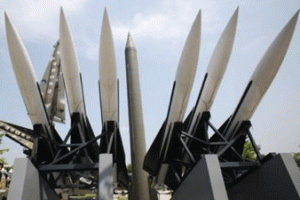 Nuclear weapons: experts alarmed by new Pentagon ‘war-fighting’ doctrine, Guardian, Julian Borger in Washington 20 Jun 2019
US joint chiefs of staff posted then removed paper that suggests nuclear weapons could ‘create conditions for decisive results’ The Pentagon believes using
nuclear weapons could “create conditions for decisive results and the restoration of strategic stability”, according to a new nuclear doctrine adopted by the US joint chiefs of staff last week.
The document, entitled Nuclear Operations, was published on 11 June, and was the first such doctrine paper for 14 years. Arms control experts say it marks a shift in US military thinking towards the idea of fighting and winning a nuclear war – which they believe is a highly dangerous mindset.
“Using nuclear weapons could create conditions for decisive results and the restoration of strategic stability,” the joint chiefs’ document says. “Specifically, the use of a nuclear weapon will fundamentally change the scope of a battle and create conditions that affect how commanders will prevail in conflict.”
At the start of a chapter on nuclear planning and targeting, the document quotes a cold war theorist, Herman Kahn, as saying: “My guess is that nuclear weapons will be used sometime in the next hundred years, but that their use is much more likely to be small and limited than widespread and unconstrained.”
Kahn was a controversial figure. He argued that a nuclear war could be “winnable” and is reported to have provided part of the inspiration for Stanley Kubrick’s film Dr Strangelove.
The Nuclear Operations document was taken down from the Pentagon online site after a week, and is now only available through a restricted access electronic library. But before it was withdrawn it was downloaded by Steven Aftergood, who directs the project on government secrecy for the Federation of American Scientists.
A spokesman for the joint chiefs of staff said the document was removed from the publicly accessible defence department website “because it was determined that this publication, as is with other joint staff publications, should be for official use only”.
In an emailed statement the spokesman did not say why the document was on the public website for the first week after publication.
Aftergood said the new document “is very much conceived as a war-fighting doctrine – not simply a deterrence doctrine, and that’s unsettling”……..
The doctrine has been published in the wake of the Trump administration’s withdrawal from two nuclear agreements: the 2015 joint comprehensive programme of action with Iran, and the 1987 Intermediate-range Nuclear Forces treaty with Russia. The administration is also sceptical about a third: the New Start accord that limits US and Russian forces strategic nuclear weapons and delivery systems, which is due to expire in 2021.
Meanwhile, the US and Russia are engaged in multibillion-dollar nuclear weapon modernisation programmes. As part of the US programme, the Trump administration is developing a low-yield ballistic missile, which arms control advocates have said risks lowering the nuclear threshold, making conceivable that a nuclear war could be “limited”, rather than inevitably lead to a global cataclysm.
The last nuclear operations doctrine, published during the George W Bush administration in 2005, also caused alarm. It envisaged pre-emptive nuclear strikes and the use of the US nuclear arsenal against all weapons of mass destruction, not just nuclear.
The Obama administration did not publish a nuclear operations doctrine but in its 2010 nuclear posture review it sought to downgrade the role of nuclear weapons in US military planning.
It renounced the Bush-era plan to build nuclear “bunker-buster” bombs, and ruled out nuclear attack against non-nuclear-weapon states, but it did not go as far towards disarmament as arms control activists had wanted or expected.https://www.theguardian.com/world/2019/jun/19/nuclear-weapons-pentagon-us-military-doctrine
June 20, 2019
Posted by Christina Macpherson |
USA, weapons and war |
Leave a comment
 Is It Safe To Store Nuclear Waste At San Onofre? The Science Behind It, kpbs, June 19, 2019
By Shalina Chatlani Southern California Edison will soon resume storing spent nuclear fuel at San Onofre Nuclear Generating Station. The move comes almost a year after a near-miss accident, when one of the canisters that contained the spent nuclear fuel nearly fell 18 feet.
Resuming storing the fuel has also reignited concerns from residents who live around San Onofre on whether storing 1,700 tons of nuclear waste next to the beach is safe.
Residents still worried
Many of those concerned residents, like Peter McBride of Oceanside, attend regular meetings of the San Onofre Community Engagement Panel.
“Nobody has talked about the half-life of the nuclear waste that’s there,” he said at a June meeting. “Some of (the nuclear waste) goes quickly. But some of it goes 24,000 years. We’re talking about canisters … that are going to hold it for 10 to 60 years. It’s ridiculous.”
McBride and others at the meeting said the canisters are too thin, and with the salt air, they will corrode and break open. Some also said rising ocean levels could smother the canisters in water and cause them to breach.
“I’m worried about the fact that not only this area but other areas of the country face the same kind of irresponsibility with this potentially disastrous material,” McBride said. “I’m worried about our children, my grandson.”
San Onofre’s senior nuclear engineer Randall Granaas said residents shouldn’t be concerned. He recently led KPBS on a tour of the station and said any danger would come from heat and radiation.
Right after being removed from the reactor, fuel rods are extremely hot. They are then put in cooling ponds for five to seven years.
“After five years then we can transfer it into this dry storage system,” he said. “And that’s adequate, using the natural convection to cool the fuel.”
Granaas said vents on the canisters allow cold air to come in, so the heat can circulate out.
There is, however, still the issue of radiation. Even spent nuclear fuel is highly radioactive. Part of that radiation can go through some materials, like aluminum, but not through steel or concrete. The radiation, known as gamma, can take years to dissipate.
“So if you had no shielding between our fuel and yourself, it could be fatal in a relatively short amount of time. So it is important to maintain that shielding,” Granaas said. “But if you fast-forward several hundred years from now you can walk up to one of those fuel assemblies for a short period of time and you’ll be fine.”
But we can’t fast forward — that has residents such as McBride worried. What would happen if the shielding suddenly went away?
Storage is structurally sound, officials say
At San Onofre’s spent fuel site, a thick concrete slab acts as a 35,000-pound lid. It sits on top of a 20-foot crevice, where the fuel canisters are stored. Officials say this system can withstand massive amounts of stress.
Still, some scientists are skeptical.
Physicist Tom English told KPBS he thinks there are a number of ways this operation could go wrong.
“They’re basically going to put the stuff in a thin storage container, which probably will have some problems with corrosion given this ocean environment here,” he said. “The second idea is they’re going to store it such that it will be about 100 feet from the water and a few inches above the groundwater table, which is totally ridiculous. As the sea level rises, what will happen is the bottom of the containers will corrode.”……. https://www.kpbs.org/news/2019/jun/19/nuclear-waste-beach-science-and-safety-explained/
June 20, 2019
Posted by Christina Macpherson |
USA, wastes |
Leave a comment
 Meet the nuclear plant project reporters https://www.lohud.com/story/news/investigations/2019/06/19/nuclear-plant-project-team/1352103001/ Rockland/Westchester Journal News June 19, 2019
A team of veteran reporters from the USA TODAY NETWORK’s Northeast Metro Group teamed up to investigate who is getting the billions of dollars set aside to clean up the nation’s closed and decommissioned nuclear plants and how that process is being handled.…
A team of veteran reporters from the USA TODAY NETWORK’s Northeast Metro Group teamed up to investigate who is getting the billions of dollars set aside to clean up the nation’s closed and decommissioned nuclear plants and how that process is being handled.
With the nuclear power industry shifting into decommissioning mode, the nation’s plants are facing closure, leaving a raft of questions and concerns in its wake.
Our reporters who tackled the project:
Tom Zambito has been an investigative reporter with The Journal News/lohud and the USA TODAY NETWORK since August 2015.
In a 33-year career, Zambito has had stints at The Record, the New York Daily News, Newsday and the Star-Ledger (nj.com). His current focus is transportation and energy.
Zambito’s work has been recognized with more than three dozen writing awards, among them honors from press associations in three states as well as Investigative Reporters and Editors (IRE), The Associated Press, the Deadline Club, the American Bar Association, the National Press Club, the New York City Police Department Emerald Society and the Society of the Silurians.
Amanda Oglesby is an Ocean County, New Jersey, native who covers the environment for the Asbury Park Press and the USA TODAY NETWORK New Jersey. She has covered the Oyster Creek nuclear power plant, the Pine Barrens and other news for the Press since 2008. She is a Rutgers University graduate who studied journalism and environmental policy before starting her reporting career. In 2014, she was one of two Gannett reporters who were finalists in the Deadline Club’s “Public Service Award” for their work on the Asbury Park Press’ “Heroin at the Shore” series.
Christopher Maag is a columnist for The Record. His columns focus on the overlooked characters of New Jersey and the Northeast, bringing readers into the lives of a chopper-riding chihuahua, a convicted drug cartel strategist and the farmer whose field overlooks the Lincoln Tunnel. Formerly a regular contributor to The New York Times and TIME, he has written for daily newspapers, monthly magazines and alternative news weeklies, winning awards for writing and investigative reporting. A graduate of Columbia University School of Journalism, he lives in Queens.
Samantha Ruland is the Pennsylvania issues reporter for the York Daily Record and USA TODAY NETWORK. During her time at YDR, she’s worked to understand and report on the issues that affect the people of central Pennsylvania and beyond, while keeping a close eye on legislation in Harrisburg. She was part of a team of reporters whose work received first place in public service by the Pennsylvania Associated Press Media Editors contest for chronicling the ongoing child sexual abuse by priests in the state.
Frank Esposito is a data reporter for The Journal News/lohud and the USA TODAY NETWORK. He writes about technology and systems running awry and what happens to the people caught in their path. Frank was part of the team that won the New York State Associated Press Association First Amendment award for coverage of the governor of New York’s political donations. He studied international political economics and journalism at Penn State University.
June 20, 2019
Posted by Christina Macpherson |
investigative journalism, USA |
Leave a comment




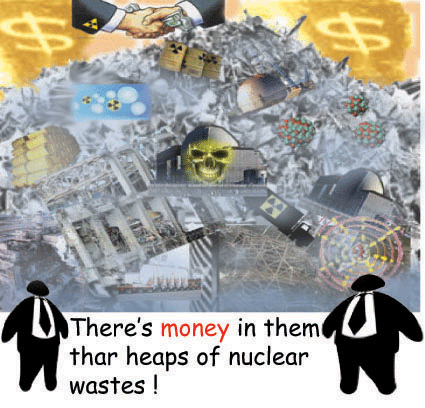
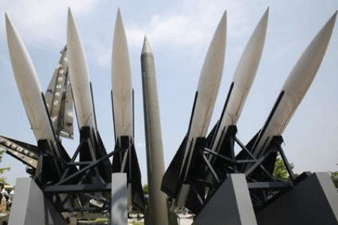






 nuclear-news