NATO says it will act unless Russia destroys nuclear-ready missile, CNBC, JUN 26 2019
KEY POINTS
NATO has said Russia’s SSC-8 missile violates terms of a 1987 missile treaty.
The U.S. says it will exit the treaty unless Russia stops their production.
But Russia has continued to develop and site the missiles within range of Europe.
NATO said Russia must destroy its short-range nuclear-ready cruise missile system, or the alliance will be forced to respond.
The U.S. has previously said it will quit a decades-old missile treaty with Russia if the latter fails to destroy the missile, labeled the SSC-8 by NATO.
The 1987 INF Treaty between the U.S. and Russia sought to eliminate nuclear and conventional missiles, as well as their launchers, with short ranges (310–620 miles) and intermediate ranges (620–3,420 miles).
NATO has said the SSC-8 violates those terms and that Russia has been deploying the system at locations which could threaten countries across Europe.
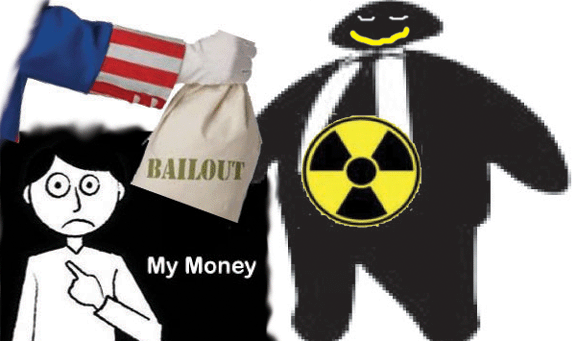
The only suspense: How much per month the subsidy bill, House Bill 6, will force each Ohio electricity customer to pay to keep open Lake County’s Perry and Ottawa County’s Davis-Besse nuclear plants, built by what’s now FirstEnergy Corp., but owned by the utility’s FirstEnergy Solutions unit, which plans to become an independent company.
Ohioans required to pay subsidies wouldn’t just be FirstEnergy customers, but also every Ohioan who gets electricity from DP&L, Duke or American Electric Power (AEP).
Some HB 6 backers claim that because the bill (depending on the version discussed) would cut some renewable energy, etc., costs that Ohio consumers already pay, it could make the nuclear subsidy, at worst, a wash for consumers – maybe even net savings. (Voters might want to get that in writing.) Still, these factors make HB 6’s passage a decent bet:
* The Republican-run House has passed it – with some Democratic votes.
* The bailout is pending in the GOP-run Senate, which, after ending its Hamlet act, will pass the bill.
* Gov. Mike DeWine, a Cedarville Republican, favors a bailout.
* Nuclear bailouts are underway in Democratic-run Connecticut, Illinois, New Jersey and New York, arguably making bailouts cross-party.
The bill started in the House, led by Speaker Larry Householder, a Republican from Perry County’s Glenford. Politically speaking, he owes FirstEnergy big-time.
To pass HB 6, Householder crafted it to (a) appeal to as many House members possible and (b) persuade other electric utilities to support, or at least not fight, HB 6.
As to (a), the House-passed bill is said to net out the nuclear subsidy’s cost by stripping renewal energy, etc., mandates from current Ohio law. As to (b), the House-passed bill would help AEP, DP&L and Duke extend Ohio customers’ subsidies (now set to expire in four to six years) of two coal-burning power plants – one in Appalachian Ohio’s Gallia County, the other in Indiana.
Trouble is, the Senate’s (currently proposed) rewrite of HB 6 pulls the rug from under House tweaks – so much that AEP no longer supports HB 6, it told the Senate Energy and Public Utilities Committee. If that’s the bill senators send back to Householder, he’d have his hands full trying to win House agreement in Senate changes. Likelier, he’d call for a Senate-House conference, but Senate-House relations appear less than cozy right now.
Not that the Senate’s version is pro-consumer: “Fundamentally the bill remains a bailout of aging nuclear power plants, at public expense, for bankrupt FirstEnergy Solutions and its big Wall Street creditors,” Michael Haugh, of the Ohio Consumers’ Counsel, told the committee Thursday. The Consumers’ Counsel is the state agency that represents Ohio’s residential utility consumers.
But facts don’t necessarily kill bills. Some General Assembly members are all but duty-bound to side with contributors. After all, if someone takes you to the prom, you’re more or less expected to dance with him or her. Same thing happens in Columbus. FirstEnergy and Ohio’s other electric utilities are generous contributors to Statehouse campaigns. Whether your name is Fido or Rep. John Doe, it’s never a good idea to bite the hands that feed you. So legislators don’t.
And if you think otherwise, look at the Ohio Revised Code. Or agricultural pollution in the Maumee valley. Or the looming (and likely successful) bid by big retailers and plastic bag peddlers to forbid local governments from banning single-use plastic bags. Legislators may respect Old Glory and motherhood. But campaign donors they revere.
That’s why, at the Statehouse, when utilities and other big-ticket political players want favors, things can suddenly get … “bipartisan.” That calls to mind what Louisiana kingfish Huey P. Long said. He likened the two parties to a limited-menu restaurant: “They’ve got a set of Republican waiters on one side and a set of Democratic waiters on the other side. But no matter which set of waiters brings you the dish, the legislative grub is all prepared in the same Wall Street kitchen.”
Japan hopes latest Trump-Kim meeting will help get nuclear, abduction talks moving again, Japan Times , 29 June KYODO,Japan hopes the third meeting between U.S. President Donald Trump and North Korean leader Kim Jong Un on Sunday will reinvigorate stalled denuclearization talks and help resolve the issue of past abductions of Japanese citizens.
“The meeting could serve as an opportunity for North Korea to come out of its shell,” a senior Japanese Foreign Ministry official said.
Trump and Kim held talks in the Demilitarized Zone dividing the two Koreas and agreed to restart denuclearization talks within weeks following the rupture of their last summit in Hanoi in February.
Bulletin of Atomic Scientists 28th June 2019 , Within a 10-day period in
February 2014, two accidents happened at the Waste Isolation Pilot Plant
(WIPP) in New Mexico – the United States’ only underground repository
for nuclear waste.
First, a truck fire deep in the mine spread soot over
key equipment and disabled the repository’s air monitoring system. Then a
chemical reaction breached a waste drum, causing a radiological release
that contaminated large areas of the repository.
Two Accident Investigation
Boards and a Technical Assessment Team identified the immediate causes of
the accidents and recommended remedial actions.
The author, who served as the Deputy Under Secretary of the Energy Department at the time of the
accidents and during the three years WIPP was closed, examines the larger
problems within the Energy Department and its contractors that set the
stage for the accidents. He places the blame on mismanagement at the Los
Alamos National Laboratory; structural problems created by a statutory
“fence” between the National Nuclear Security Administration and the
rest of the Energy Department, including the Office of Environmental
Management, which is responsible for disposing of the waste from more than
60 years of nuclear weapons production; and a breakdown of the “nuclear
culture.”
Time to Downsize the Nuclear Attack Sub, The Maritime Executive BY CIMSEC 2019-06-28 [By Duane J. Truitt]
It is clear that U.S. Naval Sea Systems Command (NAVSEA) needs to re-engineer the next generation of SSNs. The bloated SSN(X) (now “New SSN”) concept should be rejected entirely because it is more of the same, but bigger and more expensive. Instead, the Navy should go for a new class of SSN that is far smaller and cheaper than the current Block 5 Virginias. …….. https://www.maritime-executive.com/editorials/op-ed-time-to-downsize-the-nuclear-attack-sub
The China Syndrome (1979) ORIGINAL TRAILER [HD 1080p]
How THE CHINA SYNDROME Brought Down The Nuclear Power Industry, The film that predicted Three Mile Island and affected the response to Chernobyl. Birth, Movies, Death. By ANDREW TODDJun. 28, 2019When we think about nuclear power, we tend to think about disasters. Real life has given us plenty of reason to do so: between Three Mile Island, Chernobyl, and Fukushima, three major global powers have each seen their nuclear industries fall subject to catastrophe. People died; economies crashed; whole sections of Earth were rendered uninhabitable. Hell, Chernobyl arguably ended the entire Soviet Union.
Entertainment, too, has played a significant role in creating this image of nuclear power. Dozens of movies, TV miniseries, and documentaries over the years have played off and magnified real-life fears, often drawing a direct connection between the “peaceful atom” and its destructive wartime counterpart. One of the first, and most influential, was James Bridges’ 1979 atomic energy thriller The China Syndrome.
“The China Syndrome” is a colloquial term for a very real threat in the event of a nuclear accident. It refers to a reactor accident wherein reactivity becomes so supercritical that operators cannot control it. The fuel gets so hot, it melts its mounting channels, control rods, and even exterior housing, burning through concrete and steel to seep unstoppably downwards – in fanciful terms, all the way to China (hence the name). This actually happened, to a degree, at Chernobyl: the reactor transformed into hundreds of tons of corium lava, eating through multiple basement levels and nearly breaching the building’s foundations before it cooled sufficiently to stop melting concrete. The danger, as with any China Syndrome situation, was that the fuel would reach groundwater, poisoning the land or creating a steam explosion that would blast radioactive material across an enormous area.
Curiously, there is no China Syndrome in The China Syndrome. Based primarily on a 1970 accident at the Dresden Nuclear Power Station in Illinois, the film follows reporter Kimberly Wells (Jane Fonda) and cameraman Richard Adams (Michael Douglas) after they witness an accident while reporting at a California nuclear power plant. ………….
Predictably, the nuclear industry had a fiery reaction. Westinghouse executive John Taylor described the film as “an overall character assassination of an entire industry.” Nuclear experts generally agreed that the film’s specific events were highly improbable (if not entirely impossible), but also that an inherent clash exists between earning corporate profits and spending the money required to keep reactors safe. The industry may have been correct to debate the film’s finer technical points or melodramatic ending, but it’s hard to argue that unchecked capitalism doesn’t encourage corner-cutting.
On that note, it’s worth noting, that The China Syndrome’s institutional failure is near-identical to that which contributed to the Chernobyl disaster. Both saw powerful organisations covering up disastrous mistakes made in the name of cost-efficiency, but they come from opposite ends of the ideological spectrum. One comes from American capitalism, where making money and gaining power comes first and safety regulations are a costly hassle. The other comes from Soviet communism, where saving money and maintaining power came first and safety regulations were a costly hassle. Personal and institutional selfishness knows no political boundaries, and both all-powerful states and all-powerful corporations are prone to malfeasance.
All the industry’s rebuttal ultimately proved ill-advised, of course, as less than two weeks after the film’s release, a reactor underwent a partial meltdown at the Three Mile Island Nuclear Generating Station. Still the most serious nuclear accident in US history, the accident caused no immediate deaths, but the radiation leakage may have contributed to cancers, and the fourteen years of cleanup cost a billion dollars. More importantly, it caused opinion to solidify around the The China Syndrome’s thesis: that the nuclear energy industry could not be trusted with nuclear energy……… https://birthmoviesdeath.com/2019/06/28/how-the-china-syndrome-brought-down-the-nuclear-power-industry
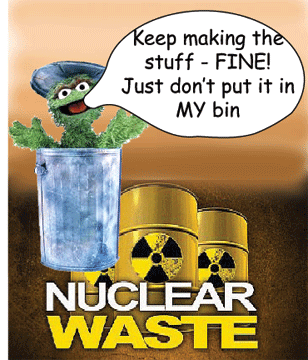
ON THURSDAY SENATORS tackled the radioactive question of the nation’s nuclear waste, this time with a new plan to circumvent the hot-potato politics that doomed Yucca Mountain and other proposals. A combination of new legislation that spreads out the nuclear waste burden and perhaps new technology could offer a new way forward.
Everyday, the Department of Energy sends $2.2 million to the nation’s electric utilities to store spent nuclear fuel that has nowhere to go. Under a 1982 law, the federal government was supposed to pick up the nuclear industry’s waste and put it in a safe place underground for the next few hundreds of thousands of years (the half-life of some radioactive isotopes). That deadline passed in 1998, and after more than two decades of lawsuits and political delays, there’s still no permanent location to put the nasty stuff. Instead, spent fuel rods are sitting at 95 nuclear plants around the country in either “fuel pools,” where the waste cools down for a few years after the rods finish producing energy, or in special steel-and-concrete casks that sit above ground like nuclear garbage cans.
Pretty much everyone—utility industry leaders, environmentalists, nuclear engineers, and local mayors—knows the status quo isn’t working. Nobody wants to invest in an industry that can’t deal with its waste (even if it’s carbon-free); and nobody likes the idea of these nuclear-rod-carrying casks multiplying ad infinitum.
The place that the government picked to store all the nuclear waste back in 1987, a repository in Yucca Mountain, Nevada, was canceled in 2009 by the Obama administration. Since then, the project has been in a bureaucratic limbo. The Trump administration moved to take another look at Yucca Mountain and restart the licensing process, but Congress removed funds to do that from last year’s budget.
Despite these obstacles, there’s a glimmer of bipartisan hope on Capitol Hill that this nuclear logjam might be broken, although maybe not at Yucca Mountain.
“It is long, long past time to figure this out, and the sooner we find a path the better,” said Senator Lisa Murkowski (R–Alaska) as she opened a hearing on the issue Thursday in the Senate’s Energy and Natural Resources Committee. Murkowski is sponsoring a bill that would both create a new agency in charge of handling nuclear waste and develop a way for local consent to become part of the decision-making process, although insulated from pressure by members of Congress. That means that the local residents living near a selected site—either temporary or permanent—would get some say in the matter, although perhaps not a veto.
At the hearing, experts testified that without some kind of storage facility, the nuclear industry will continue its slow decline. Nearly all of the nation’s plants were built in the early 1970s. Five are scheduled to shut down by 2025. Plans for two new nuclear reactors in South Carolina got scrapped in 2017 after contractors ran over budget and locals were forced to spend $9 billion to dig a hole in the ground and then fill it back up. A new plant under construction in Georgia has been tied up in contractor fights and court battles.
Murkowski’s bill would set up a new agency outside of Congress to pick a place for a new temporary nuclear waste site to take the spent fuel right away (well, within 10 years). The big holdup is “consent.” While some local communities or native tribes might want the money or jobs that go along with hosting a nuclear waste site, state politicians have blocked such attempts in Nevada, Utah, and Tennessee.
Senator Angus King (I–Maine) asked perhaps the most probing question of the two-hour hearing. “What if every state says no?” King said. “Where are we then?”
Geoffrey Fettus, senior attorney at the Natural Resources Defense Council, agreed that the stalemate will continue unless Congress changes the process of who gets to decide. “We have a higher chance of states getting to yes if they don’t have to take the entire burden” of all the nuclear waste, Fettus said. Fettus says the burden and the costs should be shared among states, with perhaps several smaller interim disposal sites in different parts of the country rather than a single facility.
West Virginia Democrat Joe Manchin wanted to know if the fuel casks could just stay where they are for awhile, and perhaps the fuel could be recycled. France and Japan, for example, reprocess spent fuel to squeeze out more energy. France then converts the twice-used fuel into glass logs that are awaiting a final burial.
Congress has banned nuclear reprocessing since the Carter administration because of fears that it can be turned into nuclear weapons material. Steven Nesbit, head of nuclear policy for Duke Energy and the American Nuclear Society, which represents nuclear scientists and engineers, says uranium is so cheap and plentiful that it doesn’t make economic sense to reprocess spent fuel. ………. https://www.wired.com/story/senators-tryagainto-solve-the-nuclear-waste-debacle/
The formal debates for the 2020 Democratic nomination for President have begun this week. While there are many substantive topics that need to be covered, there are two existential threats that demand to be addressed. The threat of climate change has been discussed nominally though hardly with the urgency that it requires to stop our steady drift to ever greater catastrophic climate events. The other threat is that of nuclear war which increases as environmental degradation, resource depletion and its associated conflict follows. Yet the threat of nuclear weapons and the concept of nuclear deterrence has not and is not likely to be discussed. Despite growing scientific evidence of the increasing vulnerability and threat posed by these weapons, we seem incapable of having a national dialogue on why they should even exist. Ultimately, they threaten every single thing we care about every moment of every day.
At a time when the Bulletin of Atomic Scientists calculates that we are closer to nuclear war either by intent, cyberattack or accident than at any time since the height of the cold war, we would be well advised to take note so as to take appropriate action and educate our citizenry to eliminate these risks. In keeping their 2019 Doomsday Clock at 2 Minutes to Midnight, the Bulletin’s advisory board noted the close interplay of climate crises with growing international conflict, and the risk of nuclear war.
Our nation and the world need a virtual IQ test to understand the risk we face from these weapons. Each of us and every presidential candidate should be required to take this test and respond to these questions so we can have a greater understanding of the devastating risks we face.
Such an IQ assessment might go as follows:…….
The risk of nuclear war remains with us as long as these weapons exist. The only way to eliminate this risk is by the complete abolition of these weapons. The non-nuclear nations of the world, refusing to be held hostage by the nuclear states, are moving forward in the process of making these weapons illegal by international law and norms in the same way every other weapon of mass destruction has been dealt with before.
Opinions on nuclear project at SC plant clash at public forum, Post and Courier, By Colin Demarest cdemarest@aikenstandard.com, Jun 28, 2019 NORTH AUGUSTA — Vocal support for producing nuclear weapon cores at the Savannah River Site sharply contrasted with questions, criticism and pushback Thursday night at a government-led public forum.
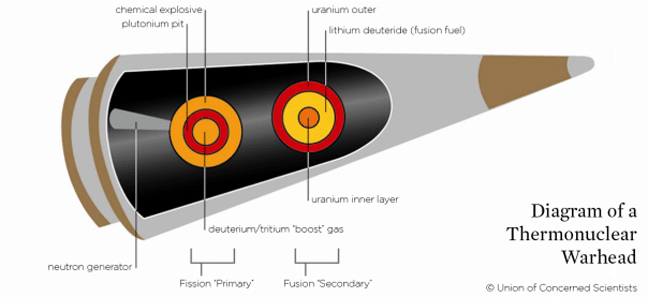
The U.S. Department of Energy’s National Nuclear Security Administration wants to produce 50 of the weapon components each year at the sprawling complex near Aiken. The cores, known as plutonium pits, use one of the world’s most dangerous substances to trigger a series of explosions that unleash the deadly potential of nuclear weapons.
Supporters tout the economic benefits of the project, which would create about 1,000 jobs and provide a new anchor for SRS after the government abandoned its long-delayed efforts to finish a facility designed to turn weapons-grade plutonium into fuel for nuclear power plants.
Critics, however, remain skeptical of the proposed mission and worry about the potential risks to the environment and workers’ health.
A slew of officials, including Aiken Mayor Rick Osbon, Aiken County Council Chairman Gary Bunker and Jim Marra of Citizens for Nuclear Technology Awareness, voiced support for the effort, offering their takes on why SRS is the correct fit for the looming weapons-oriented mission.
Encouragement also came from several chambers of commerce, University of South Carolina Aiken, and state and federal lawmakers.
……… Nuclear watchers and other groups, however, took aim at the effort’s multibillion-dollar projected cost, as well as potential dangers from exposing the environment and workers to plutonium.
“What is the environmental impact of a nuclear weapon?” Glenn Carroll, with Nuclear Watch South, said Thursday. “The absolute and wholesale destruction of the environment. Every human, every animal. Every plant.”
The anticipated costs of pit production have raised eyebrows in Washington, D.C. A congressional budget report published this year estimated pit production would cost $9 billion over the next decade.
Among other things, SRS Watch Director Tom Clements said the pit production process was off to a “rocky start.”
“The project is not funded by Congress, it’s not authorized by Congress,” he said.
Clements, alongside Tri-Valley CAREs and Nuclear Watch New Mexico, hosted a pit production forum earlier this month at the Aiken Municipal Building. He and others urged opponents to push back against the plan.
The public “can be effective against bad Department of Energy ideas, like the pit production one,” Clements said at the time.
One Aiken resident on Thursday described the pit production effort at SRS as hurried, and a woman representing The Human Family organization expressed concerns about earthquakes and becoming a target of terrorism.
………. The NNSA terminated the MOX project — which was over-budget and congressionally controversial — on Oct. 10, 2018. The government had shoveled almost $8 billion into the effort by that point, but it remained years and billions of dollars away from completion.
Clements on Thursday told the audience the Energy Department and others are attempting to “sweep the MOX debacle under the rug.”
June 28 (Reuters) – A committee in the Ohio Senate could
vote on a nuclear bailout bill this weekend that would enable
the full state legislature to pass legislation over the weekend
to prevent the state’s two power reactors from early retirement,
sources familiar with the bill said on Friday.
FirstEnergy Solutions, the bankrupt unit of Ohio energy
company FirstEnergy Corp , has said it would shut the
money-losing reactors in 2020 and 2021 if the state did not
adopt a plan to provide some money for the plants by June 30.
Officials at FirstEnergy Solutions and several legislative
offices were not immediately available for comment.
The House and Senate have sessions available to vote on the
bill if needed on Saturday and Sunday, sources said.
“We expect the legislature will move quickly to get multiple
votes on the bill ahead of (FirstEnergy Solutions’) June 30
deadline,” analysts at Height Capital Markets in Washington,
D.C., said in a report on Thursday.
The Ohio Senate Energy and Public Utilities Committee
adopted amendments on House Bill 6 (HB 6) earlier this week and
may add more amendments before the vote on Saturday, sources
said.
State lawmakers have just days to agree on legislation that would give a financial lifeline to the nuclear plants near Cleveland and Toledo.
The plant operators say they must know soon whether the state will add a fee onto every electricity bill in Ohio to raise millions each year for the plants. A Senate committee could vote on the plan this weekend.
Some lawmakers say they shouldn’t bail out the nuclear plants that are struggling and costly to operate.
Environmental groups are upset that the latest proposal includes changing a mandate that says utilities must find some of their power from renewable energy.
Proposed nuclear storage consent bill excludes Yucca Mountain, Las Vegas Sun, By John Sadler (contact) June 27, 2019A proposed Senate bill requiring local and state consent for a nuclear waste repository excludes Nevada’s Yucca Mountain site from the process.
The Nuclear Waste Administration Act would require a state’s governor, affected tribes and local governments to OK any proposed site. But it would not apply to “any proceeding or any application for any license or permit pending,” which would exempt Yucca Mountain, said Robert Halstead, executive director of the Nevada Agency for Nuclear Projects.
“Specific provisions would exclude Nevada from the newly created consent-based siting process that would apply to all other potential repository host states,” Halstead said in a letter to the Senate Committee on Energy and Natural Resources, which held a hearing on the bill today…… https://lasvegassun.com/news/2019/jun/27/proposed-nuclear-storage-consent-bill-excludes-nev/
Energy Department Invests Nearly $50 Million at National Laboratories and Universities to Advance Nuclear Technology
JUNE 27, 2019 “……… DOE is awarding more than $28.5 million through its Nuclear Energy University Program (NEUP) to support 40 university-led nuclear energy research and development projects in 23 states. NEUP seeks to maintain U.S. leadership in nuclear research across the country by providing top science and engineering faculty and their students with opportunities to develop innovative technologies and solutions for civil nuclear capabilities.Additionally, seven university-led projects will receive more than $1.6 million for research reactor and infrastructure improvements providing important safety, performance and student education-related upgrades to a portion of the nation’s 25 university research reactors as well as enhancing university research and training infrastructure.
Crosscutting Research Projects
Five research and development projects led by DOE national laboratories and U.S. universities will receive $4.5 million in funding. Together, they will conduct research to address crosscutting nuclear energy challenges that will help to develop advanced sensors and instrumentation, advanced manufacturing methods, and materials for multiple nuclear reactor plant and fuel applications.
Trump is quietly leading us closer to nuclear disaster, WP, By Steven Andreasen, June 26 2019 Steven Andreasen, director for defense policy and arms control on the National Security Council staff from 1993 to 2001, is a national security consultant who teaches at the University of Minnesota.
Quietly and under a shadow of unease at home and abroad, the Trump administration is opening the door to U.S. resumption of underground nuclear explosive testing. If the president follows his national security team into this dark room, it could shatter the 50-year international consensus behind preventing the spread of nuclear weapons and launch a new nuclear arms race that shakes both the Nevada desert and one of the last remaining pillars of arms control.
The 1996 Comprehensive Nuclear-Test-Ban Treaty (CTBT) prohibits “any nuclear weapon test explosion or any other nuclear explosion” in the atmosphere, in space, underwater or underground. During the negotiations, the United States, Russia, China, Britain and France also agreed on a “not all-inclusive, but illustrative” list of activities not prohibited by the CTBT, recorded by President Bill Clinton in a 1997 directive and given to the Senate. As the U.S. negotiatortold the Senatein 1999, “the zero line, between what would be prohibited to all under the treaty and what would not be prohibited, would be precisely defined by the question of nuclear yield” — that is, whether the activity produced a self-sustaining nuclear reaction. “If what you did produced any yield whatsoever, it was not allowed. If it didn’t, it was allowed.”
The CTBT, unratified though it is by the United States, but with 184 signatories, created a near-universal norm against nuclear explosive testing. (Only North Korea has tested since 1998.) Beyond this benefit, the commitment by the five nuclear weapon states to conclude the treaty by 1996 was crucial to achieving the indefinite extensionin 1995 of the existing nuclear Non-Proliferation Treaty. Today, the Non-Proliferation Treaty remains central to limiting the spread of nuclear weapons. Any action that weakens the test-ban treaty weakens the Non-Proliferation Treaty.
So why would the Trump administration seek to restart nuclear testing? In March, four Republican senators wrote the president asking whether he would consider “unsigning” the CTBT, calling the pact a “deeply flawed treaty that purports to ban all nuclear weapons tests.” In late May, the director of the Defense Intelligence Agency stated Russia “probably” is not adhering to its nuclear testing moratorium. The word “probably” prompted more queries and a new DIA statement: “The U.S. government, including the Intelligence Community, has assessed that Russia has conducted nuclear weapons tests that have created nuclear yield.”
Are the Russians cheating? Russia’s nuclear test site has been under close scrutiny for years. But in the absence of more public information — information that if it exists would probably be highly classified and unlikely to be made public — we have little choice but to assess the administration’s charge based on its motivations and methods.
National security adviser John Bolton and other administration officials are fervent test-ban treaty opponents. The seemingly out-of-the-blue letter from Republican senators and the DIA director’s public remarks had the look of an orchestrated campaign — significantly with no apparent effort to engage with Moscow.
……… The move to “unsign” the CTBT could lead to more destructive nuclear capabilities in the hands of potential U.S. adversaries and be perceived by non-nuclear-weapon states as the ultimate “bait and switch” two decades after the Non-Proliferation Treaty was extended indefinitely. It would fuel uncertainty bordering on chaos for the future of nuclear nonproliferation. And it would generate controversy around our own weapons laboratories, which play a vital role in our security. It would be a high price to pay for fulfilling the dreams of those who seek to destroy another treaty.https://www.washingtonpost.com/opinions/trump-is-quietly-leading-us-closer-to-nuclear-disaster/2019/06/26/3348ca5e-9445-11e9-aadb-74e6b2b46f6a_story.html?utm_term=.375b76b382e7
7pm Central Time (8pm ET, 6pm MT, 5pm PT) UTC – 5 From NRC & DOE Deregulation to Techno-Fascist Billionaires Going Nuclear, Plus a Few Songs from Atomic Cabaret REGISTER










 nuclear-news