The Other Existential Threat: Nuclear Weapons & the 2020 Presidential Campaign https://blog.ucsusa.org/sean-meyer/nuclear-weapons-candidates-primaries
SEAN MEYER, | JULY 3, 2019 The 2020 presidential campaign kicked off in earnest with last week’s Miami debates, and many of the “high profile” topics were covered: climate change, immigration, gun control. One topic was a little more unexpected: nuclear weapons. On the first night, three of the ten candidates on stage said nuclear weapons or the threat of nuclear war is the biggest geopolitical threat facing the United States.
This should not be surprising: recent polling shows that in key primary states, including New Hampshire and Iowa, over 80% of respondents want to know what candidates think about nuclear weapons. We also know from recent national polling that more than 80% of people support arms control treaties with Russia.
Unfortunately, current US policies put the public at danger from nuclear use. Today, the United States retains the right to use nuclear weapons first in a crisis and maintains hundreds of land-based missiles on hair trigger alert. New, more usable nuclear weapons are being developed as part of a trillion-dollar plan to re-build and maintain the entire nuclear arsenal (a proposal mind you that dates to the Obama administration). For its part, the Trump administration has pulled out of crucial nuclear agreements that have kept us safe, including the Iran nuclear deal and the Intermediate-Range Nuclear Forces (INF) Treaty, and seems poised to walk away from the New START Treaty as well.
These kinds of policies should be a major topic of discussion among candidates in the 2020 election, and candidates are already being asked about their positions on the campaign trail. Their responses and comments show a range of thought and understanding on the topic. You can see videos of the conversations with the presidential candidates about nuclear weapons on our YouTube channel.We’ll keep adding videos to this channel as members of the public and activists around the country continue to have these conversations with the candidates in the months ahead.
Indeed, voters have a critical role to play by raising the profile of these discussions and helping to elevate this important conversation and debate—both within our communities and online.
Nuclear weapons and climate change are the two existential threats facing humanity. They are serious. They are growing. They are urgent. And our country and leaders must act—before it’s too late.
So that’s where “we the people” come in. Let’s educate others. Let’s raise our voices. Let’s insist that those who wish to lead our country do just that—lead us on a path that reduces the risks these horrible weapons pose.
The Union of Concerned Scientists aims to increase public discussion about the use of nuclear weapons; we are posting these videos to highlight such discussion by candidates for president. As a 501c3 nonpartisan organization, UCS does not support or oppose any candidate for election.
July 4, 2019
Posted by Christina Macpherson |
election USA 2020 |
Leave a comment

Who paid all that money to buy all those nuclear bailout ads raining on Ohio? https://www.cincinnati.com/story/news/2019/07/02/who-paid-all-money-buy-all-those-nuclear-bailout-ads-ohio-house-bill-6/1443145001/
Josh Goad, Cincinnati Enquirer July 3, 2019 If you’re an Ohioan with a TV or radio, you’ve probably heard about a nuclear power bailout bill that lawmakers are considering in Columbus. But what you can’t find out is exactly how much money is being spent on those ads – or who originally gave the money for them.
House Bill 6 seeks to tax Ohioans 80 cents a month through their utility bill to bailout First Energy Solutions’ nuclear power plants in Northern Ohio. Critics say the bill, which also will boost costs for commercial and industrial customers, will discourage the use of renewable energy for businesses across the state. Proponents say the bill will help Ohio stay energy independent and keep badly needed jobs in the communities around the plants.
The bill, which has the backing of powerful House Speaker Larry Householder, triggered up to $8.3 million in ads and other campaign spending, published estimates show. For comparison, a record $45 million was spent in the 2018 Ohio gubernatorial race.
Yet an Enquirer analysis of ad purchases for and against House Bill 6 and reported to the Federal Communications Commission shows just $2.7 million in sales. The Cincinnati market, the state’s third largest, was the leader in ads on the bailout bill.
Why the gap between the $2.7 million hard figure and the $8.3 million estimate? Some broadcasters, including Cincinnati’s WCPO-TV, are choosing not to post billings for the ads – and under FCC rules, they don’t have to do so.
The big money behind the bill hasn’t been reserved for ads this year. Groups allied with Householder put $800,000 into ads for Ohio’s 2018 campaigns, boosting candidates who put Householder into the speaker’s seat. A couple of the winning candidates also are key sponsors of House Bill 6.
But donors behind the campaign money, and for many of the ads you’ve seen about the bill, can’t be pinpointed.
The money backing the bill primarily started with a 501(c)(4) or “dark money” organization called Generation Now that doesn’t have to list donors. Generation Now then gave to a political action committee, which must disclose donors. So while it’s clear which candidates got the “dark money” boosting the nuke plant bailout went, it’s uncertain who originally contributed it or the money that bought airtime.
Who runs Generation Now and is on its board isn’t clear. But the Columbus address of a longtime Householder adviser, Jeff Longstreth, is listed as the principal office in documents filed to the Ohio Secretary of State. So far, the 501(c)(4) hasn’t filed paperwork with the IRS – a step that such nonprofits seeking to stay in existence take. Paperwork that’s normally filed with broadcasters, listing the board members of groups airing political ads also is missing.
How much is being spent?
Generation Now has spent over $1.9 million on ads supporting House Bill 6, documents filed with the FCC show. This is out of around $2.7 million reported being spent on ads across Ohio on the proposal.
First Energy, which owns the plants being bailed out, backs the Ohio Clean Energy Jobs Alliance. The alliance has spent around $275,000 on ads in support of the bill and has stuck to Facebook for distribution.
The opposition to House Bill 6 has put $400,000 into its ads. The total from Ohio Consumers Power Alliance, American Energy Action and Ohioans Against Nuke Bailout compares to the roughly $1.3 million Generation Now has spent in Cincinnati alone.
Why isn’t all the spending being reported?
The FCC requires stations to make ad spending records available for the public record, but only if the ads are focused on a specific candidate or a national issue. State and local issues are not on the short list of requirements.
Some stations choose to file everything for the sake of transparency. Others don’t.
FCC public inspection files show 41 stations in markets across Ohio – Cincinnati, Dayton, Columbus, Cleveland-Akron, Toledo, Zanesville and Wheeling-Steubenville – were contacted by Generation Now or other interested parties because they are required to file such contracts by FCC rules.
But 13 stations, including every commercial TV broadcaster in Dayton, did not report how much Generation Now and other organizations spent on ads.
Where did the money come from?
‘Dark money’ is inherently difficult to track. While we don’t know the source, the money can be followed when it changes hands.
Other than the money Generation Now spent in 2019 on ads, the nonprofit also donated over $1 million to the Growth & Opportunity PAC in 2018. The political action committee is based in Lexington, Kentucky, but operates throughout the Midwest.
According to documents filed with the FEC, the PAC only raised around $1.1 million in 2018. Almost all of that money would go on to pay for ads for Ohio Republican candidates during the midterm elections. Though Generation Now did not directly pay for those ads, it did provide the majority of funds necessary through three sizable donations to the PAC.
When the donations were made last year, Generation Now and the PAC had something in common: A treasurer from Dinsmore Agent Co, a subsidiary of Cincinnati-based law firm Dinsmore and Shohl.
Eric Lycan, the treasurer and former lawyer at Dinsmore’s Lexington office, would have overseen the donation. He still serves as the treasurer for both the organization and the PAC, and several documents filed to the FEC include his Dinsmore email address.
The only Ohio-based organization that is easily traceable is Ohio Citizen Action, founded in Cleveland in 1976. Through its education fund, Ohio Citizen Action created the Ohio Consumers Power Alliance, who has paid for $8,000 in anti-House Bill 6 ads.
As nonprofits, Ohio Citizens Action and its education fund report their annual revenues to the IRS but not their donors. The last available filing for the education fund was for 2017, which was posted in January 2019.
Where did the ‘dark money’ go?
Reps. Jamie Callender, R-Concord, and Shane Wilkin, R-Hillsboro, both primary sponsors of House Bill 6, directly benefited from the ads purchased by the Growth & Opportunity PAC.
Of the 22 Republican candidates that received either mail or radio ads, 19 would go on to win a seat in the House. Callender received more in ad spending than any other winning candidate, with $93,000 spent on seven different ad buys.
Householder also had nearly $50,000 worth of ads paid for by the PAC during his election to his Southeast Ohio seat. Another $25,000 was donated directly to Householder by FirstEnergy’s PAC.
Karen Kasler, of public radio’s Statehouse News Bureau, asked Householder earlier this year if House Bill 6 was a priority to him because of his connections to Eric Lycan and the Growth & Opportunity PAC.
“It’s a priority bill for me because I’ve always cared about the energy in the state of Ohio,” said Householder. “I’ll tell you who’s paying for these ads: it’s working men and women from Ohio, who want to save their jobs and it’s Ohio corporations, headquartered in Ohio, that want to stay here. That’s who’s paying for it.”
Why is ‘dark money’ hard to track?
It can be as simple as Generation Now, and other dark money groups, not filing the appropriate paperwork to the IRS. If a tax-exempt organization doesn’t file for three consecutive years, it loses its status. Since Generation Now was incorporated in January 2017, the three-year deadline is approaching.
Though Householder says that hardworking men and women donated money to the organization, Generation Now doesn’t have a donation portal on its website.
While reaching out to Generation Now for comment, Curt Steiner, CEO of Columbus-based Steiner Public Relations, answered instead. He said that he represents Generation Now and that he couldn’t speak on why there is no donation portal.
Why have the ads run recently?
Many of the ads about House Bill 6 played on Ohio’s airwaves talked about getting the bill passed before the end of June.
Some of the ads feature an ominous voice talking about what Ohio’s future might look like under the bill, others showcase somebody who talks about their life and what FirstEnergy has done for them.
So why the deadline for passage? FirstEnergy Solutions needed to know whether to place an order for $52 million worth of fuel for one of its nuclear power plants. It takes months for such an order to be filled.
Action on FirstEnergy Solutions restructuring plan, filed through the Bankruptcy Court for the Northern District of Ohio, has been posted four times, moves that a FirstEnergy spokeswoman described as “not unusual.”
Senate President Larry Obhof, R-Medina, told Statehouse reporters on Saturday he isn’t worried about the delayed fuel purchase.
“I’ve had a number of conversations with (FirstEnergy) going back several months about what the timeline was and there’s always been a little bit of flexibility,” Obhof said.
Meanwhile, House Bill 6 is still awaiting a vote in the Ohio Senate.
July 4, 2019
Posted by Christina Macpherson |
politics, secrets,lies and civil liberties, USA |
Leave a comment
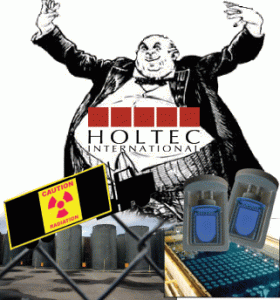 Oyster Creek nuclear plant sale to Holtec is complete, App.com, Amanda Oglesby, Asbury Park Press, July 2, 2019, LACEY
 Oyster Creek Generating Station is now in the hands of Holtec – International, which completed the purchase of the now-defunct nuclear facility on Monday.
Oyster Creek, before it shut down in September, was one of the nation’s oldest nuclear power plants. Camden-based Holtec plans to decommission this half-century-old facility and profit off the reactor’s nearly $1 billion decommissioning trust fund, money set aside for dismantling the reactor.
Under the agreement, Holtec subsidiaries Oyster Creek Environmental Protection International LLC will serve as owner and Holtec Decommissioning International will oversee decommissioning.
Holtec purchased the power plant for an undisclosed amount from Exelon Generation of Chicago.
Exelon had originally planned to take the plant down slowly over the course of 60 years in a process that would have allowed some of the facility’s dangerous radioactivity to degrade to safer levels. But Holtec’s proposal seeks to complete the decommissioning within a mere 10 years. The company says its new spent fuel storage systems enable hot, radioactive fuel to be removed from the plant’s cooling pool and placed into storage casks years earlier than originally planned.
Holtec is also applying to build an fuel storage facility in New Mexico, but is waiting on approvals. In the meantime, the spent fuel will be stored in steel and concrete canisters on the plant’s property in Lacey…….
Holtec has also applied to purchase other nuclear plants at Indian Point in New York, Palisades in Michigan, and Pilgrim in Massachusetts from Entergy Nuclear. Each has massive decommissioning trust funds that would be transferred to Holtecupon completion of the sales. …..this is Holtec’s first major expansion into the business of decommissioning.
Currently, Holtec is also developing small modular nuclear reactors….
Casks hold dangerous radioactive elements like Cesium-137, Strontium-90 and Plutonium-239, fuel bi-products created inside reactors, which remain dangerous for generations.
Here’s what they do to people.
![Chart]()
Cesium 137
Can burn skin, cause radiation sickness and damage tissue. In high doses, it can cause cancer.
Strontium-90
Is absorbed like calcium within the body and can lead to bone cancer, bone marrow cancer, and cancer in the tissues near bones.
Plutonium 239 and 240
Both remain dangerously radioactive for thousands of years. If inhaled, plutonium particles can scar the lungs, damage bones, liver and spleen and cause cancer.
A local residents group, the Concerned Citizens for Lacey Coalition, is demanding more answers from the company about its plans to quickly demolish Oyster Creek. Coalition member Paul Dressler worries about Lacey being a “guinea pig” for the relatively new and evolving process.
“We want to see transparency,” he said during a meeting with Press staff last week.
Dressler and coalition Chairman Ron Martyn, who live about five miles from the plant, want assurances that Holtec won’t abandon the project if money runs out before completion. They also want to see the regulatory agency that oversees plant decommissioning, the Nuclear Regulatory Commission, come up with more stringent rules and best practices for this emerging practice.
“There are too many unanswered questions to go forward, and no one is stepping up to answer the basic business questions,” said Martyn. “It’s not fair to the community, it’s not fair to the state, to operate in such a vacuum.”……… https://www.app.com/story/money/business/2019/07/02/oyster-creek-nuclear-plant-sale-to-holtec-is-complete/1622164001/
July 4, 2019
Posted by Christina Macpherson |
business and costs, politics, USA |
Leave a comment








 nuclear-news