A heightened solar cycle, by chance, reduced the exposure of Apollo astronauts to space radiation
The term “radiation” is used to describe energy that is emitted in the form of electromagnetic waves and/or particles. Humans can perceive some forms of electromagnetic radiation: visible light can be seen and infrared radiation (heat) can be felt.
Meanwhile, other varieties of radiation such as radio waves, X-rays and gamma rays are not visible and require special equipment to be observed. Worryingly, when high energy (ionising) radiation encounters matter, it can cause changes at the atomic level, including in our bodies.
There are a several sources of ionising radiation in space. The sun continuously pours out electromagnetic radiation across all wavelengths – especially as visible, infrared and ultraviolet radiation. Occasionally, enormous explosions on the solar surface known as solar flares release massive amounts of X-rays and gamma rays into space, as well as energetic electrons and protons (which make up the atomic nucleus along with neutrons). These events can pose a hazard to astronauts and their equipment even at distances as far from the sun as Earth, the moon and Mars.
Potentially dangerous radiation in space also originates from outside our solar system. Galactic cosmic rays are high energy, electrically charged atomic fragments that travel at nearly the speed of light and arrive from all directions in space.
On Earth, we are protected from most of this ionising radiation. The Earth’s strong magnetic field forms the magnetosphere, a protective bubble that diverts most dangerous radiation away, while the Earth’s thick atmosphere absorbs the rest.
But above the atmosphere, the magnetosphere traps energetic subatomic particles in two radiation regions. These “Van Allen belts” comprise an inner and outer torus of electrically charged particles.
Lucky escape
So how did NASA solve the problem of crossing the Van Allen belts? The short answer is they didn’t. To get to the moon, a spacecraft needs to be travelling quickly to climb far enough away from the Earth such that it can be captured by the moon’s gravity. The trans-lunar orbit that the Apollo spacecraft followed from the Earth to the moon took them through the inner and outer belts in just a few hours.
Although the aluminium skin of the Apollo spacecraft needed to be thin to be lightweight, it would have offered some protection. Models of the radiation belts developed in the run-up to the Apollo flights indicated that the passage through the radiation belts would not pose a significant threat to astronaut health. And, sure enough, documents from the period show that monitoring badges worn by the crews and analysed after the missions indicated that the astronauts typically received doses roughly less than that received during a standard CT scan of your chest.
But that is not the end of the story. To get to the moon and safely back home, the Apollo astronauts not only had to cross the Van Allen belts, but also the quarter of a million miles between the Earth and the moon – a flight that typically took around three days each way.
They also needed to operate safely while in orbit around the moon and on the lunar surface. During the Apollo missions, the spacecraft were outside the Earth’s protective magnetosphere for most of their flight. As such, they and their crews were vulnerable to unpredictable solar flares and events and the steady flux of galactic cosmic rays.
The crewed Apollo flights actually coincided with the height of a solar cycle, the periodic waxing and waning of activity that occurs every 11 years. Given that solar flares and solar energetic particle events are more common during times of heightened solar activity, this might seem like a cavalier approach to astronaut safety.
There is no doubt that the political imperative in the 1960s to put US astronauts on the moon “in this decade” was the primary driving factor in the mission timing, but there are counterintuitive benefits to spaceflight during solar activity maxima. The increased strength of the sun’s magnetic field that permeates the solar system acts like an umbrella – shielding the Earth, moon and planets from galactic cosmic rays and therefore lessening the impact on astronaut radiation doses. https://theconversation.com/space-radiation-the-apollo-crews-were-extremely-lucky-120339
US nuclear weapon locations in Europe accidentally exposed in NATO committee report,
US nuclear weapon locations in Europe accidentally exposed in NATO committee report, BY OWEN DAUGHERTY – 07/16/19 A report from a NATO committee that has since been deleted reportedly exposed the the secret locations of U.S. nuclear weapons in Europe.
The Washington Post reports that the document by a Canadian senator for the Defense and Security Committee of the NATO Parliamentary Assembly detailed the future of the organization’s nuclear deterrence policy but accidentally exposed the open secret.
The report stated that U.S. nuclear weapons are being stored in Belgium, Germany, Italy, the Netherlands and Turkey.
While the document titled “A new era for nuclear deterrence? Modernisation, arms control and allied nuclear forces” was originally published in April without making waves, a Belgian newspaper Tuesday published a copy of the document featuring the locations of about 150 U.S. nuclear weapons .
“These bombs are stored at six US and European bases — Kleine Brogel in Belgium, Büchel in Germany, Aviano and Ghedi-Torre in Italy, Volkel in The Netherlands, and Incirlik in Turkey,” a section of the newspaper’s report read, according to the Post.
The Post made note that the original document did not attribute this information to any source.
A final version of the report was reportedly published last week that did not have any specific references to where the weapons are stored…… https://thehill.com/policy/international/europe/453426-us-nuclear-weapon-locations-in-europe-accidentally-exposed-in
Ohio Senate to vote on subsidy bill to save state’s nuclear power plants.

Ohio Senate to vote on bill to save state’s nuclear power plants. (Reuters) 18 July 19 – The Ohio Senate will likely pass a bill on Wednesday that will create subsidies to avoid the early shutdown of the state’s two nuclear power reactors, according to analysts and those watching the legislation.
The two reactors in Ohio – Davis Besse and Perry – are owned by FirstEnergy Solutions, which has said it would shut the money-losing plants in 2020 and 2021 unless the state provides some financial assistance to keep them operating.
FirstEnergy Solutions is a bankrupt unit of Ohio power company FirstEnergy Corp.
Analysts said the Senate version of the nuclear bill, House Bill 6 (HB6), would likely pass the Senate Energy and Public Utilities and the Senate Rules and Reference Committees before going to the full Senate for a vote.
“If the Senate passes HB6 later today as expected, the bill will go over to the House for a concurrence vote,” said Josh Price, senior analyst at Height Capital Markets, noting the state House has an “if needed” session scheduled for Thursday if members need more time to debate the Senate changes to the bill. HB6 passed the House in May.
The current version of the bill would provide an overall reduction in consumer power rates by weakening the state’s renewable and energy efficiency goals even though FirstEnergy Solutions would receive an estimated $150 million a year from 2020-2026 to keep its reactors in service.
……. On Monday, U.S. electric generator LS Power warned it would be forced to terminate development of an expansion of its Troy natural gas-fired power plant in Ohio if the state passes legislation to subsidize nuclear energy. …..https://www.reuters.com/article/us-ohio-nuclear/ohio-senate-to-vote-on-bill-to-save-states-nuclear-power-plants-idUSKCN1UC1Y2
US’ Nuclear Regulatory Commission planning to reduce inspections at the country’s nuclear reactors?
 Nuclear Regulatory Commission mulls cutting back on inspections at nuclear reactors CBS News, 17 July 19 Washington – The staff of the Nuclear Regulatory Commission is recommending that the agency cut back on inspections at the country’s nuclear reactors, a cost-cutting move promoted by the nuclear power industry but denounced by opponents as a threat to public safety. Nuclear Regulatory Commission mulls cutting back on inspections at nuclear reactors CBS News, 17 July 19 Washington – The staff of the Nuclear Regulatory Commission is recommending that the agency cut back on inspections at the country’s nuclear reactors, a cost-cutting move promoted by the nuclear power industry but denounced by opponents as a threat to public safety.
The recommendations, made public Tuesday, include reducing the time and scope of some annual inspections at the nation’s 90-plus nuclear power plants. Some other inspections would be cut from every two years to every three years. Some of the staff’s recommendations would require a vote by the commission, which has a majority of members appointed or reappointed by President Trump, who has urged agencies to reduce regulatory requirements for industries. The nuclear power industry has prodded regulators to cut inspections, saying the nuclear facilities are operating well and that the inspections are a financial burden for power providers. Nuclear power, like coal-fired power, has been struggling in market completion against cheaper natural gas and rising renewable energy. …… Commission member Jeff Baran criticized the proposed changes Tuesday, saying reducing oversight of the nuclear power industry “would take us in the wrong direction.” “NRC shouldn’t perform fewer inspections or weaken its safety oversight to save money,” Baran said. The release comes a day after Democratic lawmakers faulted the NRC’s deliberations, saying they had failed to adequately inform the public of the changes under consideration……. “Cutting corners on such critical safety measures may eventually lead to a disaster that could be detrimental to the future of the domestic nuclear industry,” Rep. Frank Pallone, D-N.J., chair of the House Energy and Commerce Committee, and other House Democrats said in a letter Monday to NRC Chairwoman Kristine Svinicki. Edwin Lyman, a nuclear-power expert at the nonprofit Union of Concerned Scientists, faulted the reasoning of commission staff that the good performance of much of the nuclear power industry warranted cutting back on agency inspections for problems and potential problems. “That completely ignores the cause-and-effect relationship between inspections and good performances,” Lyman said. https://www.cbsnews.com/news/nuclear-regulatory-commission-mulls-cutting-back-on-inspections-at-nuclear-reactors/ |
|
Waste drum at Westinghouse nuclear fuel factory exploded, caught fire
Waste drum at Westinghouse nuclear fuel factory exploded, caught fire https://www.postandcourier.com/business/waste-drum-at-westinghouse-nuclear-fuel-factory-exploded-caught-fire/article_a0052bf8-a726-11e9-8bc5-b3f9366e8ad3.html, By Andrew Brown abrown@postandcourier.co, Jul 15, 2019
A waste drum at a nuclear fuel factory near Columbia caught fire and exploded last week, according to a federal safety report.
The workplace accident occurred at a Westinghouse facility in Hopkins, just off of Bluff Road. The plant makes pellets for nuclear power plants.
In a report filed with the Nuclear Regulatory Commission, Westinghouse said the drum exploded around 2 a.m. Friday after workers at the plant filled it with uranium-contaminated filters, rags, mops and some paper. The container held just over 70 grams of uranium, which is used in nuclear power plants to create a chain reaction that generates electricity.
Westinhouse said a chemical reaction caused the material to heat up, building pressure in the drum. The container blew off its lid, paper inside caught fire, and some of the contaminated material showered the surrounding area, according to the report.
A spokesman for the Nuclear Regulatory Commission said the fire essentially put itself out.
No workers at the plant were injured during the accident and testing confirmed that radiation levels didn’t exceed federal safety limits, according to the company. Westinghouse employees also checked the other drums at the facility to ensure they wouldn’t overheat and explode.
“Air samples taken within the area confirmed no impact to plant personnel, the public or the environment,” Westinghouse spokeswoman Courtney Boone.
Boone said Westinghouse was studying what caused the drum to explode. The company plans to set new rules to keep the wrong materials from mixing, and it will let containers of nuclear material vent to keep pressure from building inside. The Hopkins plant isn’t packaging waste in the meantime
NRC spokesman Joey Ledford said federal inspectors would address the explosion when they make a routine inspection later this month.
It’s not the first time the factory has caught the attention of regulators. The NRC reported last year that uranium at the factory leaked out a small hole and into the ground, according to a story in The State newspaper.
Thad Moore contributed to this report.
U.S. Bill: he Radiation Exposure Compensation Act Amendments of 2019
HAGÅTÑA — The Radiation Exposure Compensation Act Amendments of 2019, officially introduced in the U.S. House of Representatives on Tuesday, includes a congressional apology to individuals exposed to radiation while either working in or living near uranium mines or downwind from nuclear weapon test sites.
The bill, introduced by New Mexico Congressman Ben Ray Lujan and cosponsored by Guam Delegate Michael San Nicolas, would expand the coverage of the RECA program to include Guam and the Northern Marianas.
The RECA program is set to expire in 2022. The bill, if enacted into law, would extend the Radiation Exposure Compensation Trust Fund until 2045.
Other jurisdictions covered by the proposed RECA expansion are New Mexico, Idaho, Colorado, Arizona, Utah, Texas, Wyoming, Oregon, Washington, South Dakota, North Dakota and Nevada.
“Tens of thousands of individuals, including miners, transporters, and other employees who worked directly in uranium mines, along with communities located near test sites for nuclear weapons, were exposed during the mid-1900s to dangerous radiation that has left communities struggling from cancer, birth defects, and other illnesses,” states a press release from Lujan’s office.
The RECA amendment legislation provides health and monetary compensations for individuals who were exposed to high levels of radiation that caused sickness, cancer and deaths in identified jurisdictions.
A similar bill was introduced by Sen. Mike Crapo in the U.S. Senate.
The 35th Guam Legislature is scheduled today, Thursday, to hold a public hearing on Resolution 94-35, supporting the passage of Crapo’s S. 947.
The bill does not include the CNMI.
In August 2018, CNMI Delegate Gregorio Kilili Camacho Sablan said the Northern Marianas should also be considered “downwinders.”
“Perhaps, because the [Northern] Marianas was not represented in Congress in 2005, we were not included in a congressionally mandated study of how fallout from nuclear testing in the Marshall Islands may have harmed people on downwind islands,” Sablan said in an August 2018 letter to the U.S. Senate Judiciary Committee. “I think that inequity needs to be addressed.”
Kim and Kourtney Kardashian join the fight to clean up Santa Susanna nuclear site
Kim and Kourtney Kardashian are flexing their social platforms for good, and they only had to go 10 miles away from their Southern California homes to do it. This weekend, they supported and advocated for the cleanup of one of America’s largest partial nuclear meltdown sites responsible for more than a thousand cancer cases.
Kim and Kourtney, along with their kids, came to the event and joined the community in painting rocks to be used for a memorial commemorating those harmed by radiation and chemicals. The Kardashians became aware of the site following the Woolsey Fire, which allegedly began at the Santa Susana Field Lab. Since then, Kim has advocated for the cleanup of the site on social media.
Space is “new domain of military operations” – nuclear weapons enthusiast Gen Mark Milley , Trump’s choice to head Joint Chiefs of Staff

Does this guy think that USA can start, and win a nuclear war? I have moved this item up to the front page, because of its importance – should this belligerent man get in control of USA’s nuclear weapons policy.
 Milley throws support behind nuclear modernization, Space Force, Defense News, 14 July 19, WASHINGTON — U.S. President Donald Trump’s choice for the next chairman of the Joint Chiefs of Staff has thrown his full support behind nuclear modernization plans, the creation of a Space Force and developing new capabilities to offset China.
Bill Gates now glum about the prospects for his nuclear power company TerraPower

Bill Gates faces “daunting” nuclear energy future, Amy Harder AXIOX 15 July 19 ,The optimism usually radiating from billionaire Bill Gates when it comes to climate change is starting to fade on one of his biggest technology bets: nuclear power.
Driving the news: The Microsoft co-founder has focused much of his time lately on climate change and energy innovation. In an exclusive interview with Axios, Gates said that setbacks he is facing with TerraPower, a nuclear technology firm he co-founded in 2006, has got him questioning the future of that entire energy source.
……It’s declining in most places around the world, including the U.S., due to aging reactors, cheaper energy alternatives and public unease about radioactive risk ……
- The industry’s future is riding on largely unproven technologies like that of TerraPower because they’re smaller and deemed safer than today’s huge reactors.
“Without this next generation of nuclear, nuclear will go to zero,” Gates said during an interview in Washington last month. Germany is shutting 22 nuclear plants, France — a leader in clean-burning nuclear power — has plans to shut down some of its reactors and a similar trend is underway in the U.S. due to economic conditions, said Gates, before adding with a sigh: “So yes, it is daunting.”
Flashback: Gates announced in December that TerraPower was scrapping plans to build a demonstration reactor in China, largely due to the Trump administration deciding that fall to crack down on technological agreements between the two nations.
“There are times like when TerraPower gets told not to work in China, you’re thinking, ‘Boy, is this thing going to come together or not?’ ” Gates said in what are his first public comments on the matter since it happened. “That was a real blow.”
Where it stands: Gates is now trying to build TerraPower’s demonstration reactor in the U.S., calling on the Energy Department and Congress to more aggressively support advanced nuclear power through more funding and new legislation. Such a plant could cost anywhere between $3-$6 billion, say experts and Gates’ energy advisers.
- Bellevue, WA-based TerraPower is opening a new 65,000-square foot facility in the same region later this year to expand its research and testing, which is currently done in a lab 1/6th that size.
- Gates, whose net worth is roughly $100 billion, hasn’t disclosed how much money he has put toward the company, but experts think it’s at least $500 million.
“If at the end of the day we don’t find a country that wants to build an advanced nuclear power plant, then TerraPower will fail. I’m going to keep funding it for a period of years. And working with the U.S. is our strategy right now.”
— Bill Gates ………‘TerraPower’s traveling wave may prove to be an example of a very ambitious attempt to solve a very challenging problem that has turned out to be too expensive and too difficult,” said Chris Gadomski, head of nuclear research at Bloomberg New Energy Finance. ………
Maine Bill for grants to local governments to offset costs of STRANDED nuclear wastes
 Bill would help Maine town offset cost of storing nuclear waste https://wgme.com/news/local/bill-would-help-maine-town-offset-cost-of-storing-nuclear-waste by The Associated Press Monday, July 15th WISCASSET, Maine (AP) — A proposal before the U.S. Senate would seek to help communities around the country that face the expensive problem of storing spent nuclear fuel.
Republican Sen. Susan Collins of Maine and Democratic Sen. Tammy Duckworth of Illinois are calling the proposal “the STRANDED Act.”
That stands for “Sensible, Timely, Relief for America’s Nuclear Districts’ Economic Development.”
The proposal calls for economic impact grants to local governments to offset the impacts of stranded waste. Communities would be eligible for $15 per kilogram of spent nuclear fuel stored.
Collins says the town of Wiscasset has endorsed the proposal. Wiscasset is the location of decommissioned Maine Yankee nuclear plant.
Collins says a permanent solution for the waste is also needed.
The co-sponsors of the bill include Maine’s other senator, independent Sen. Angus King.
Private Notes Show How Big Oil Spread Climate Science Denial
The ‘Historical Jigsaw of Climate Deception’: Private Notes Show How Big Oil Spread Climate Science Denial  DeSmogBlog, By Mat Hope • Thursday, July 11, 2019 We’ve all heard the dodgy arguments: ‘the science is uncertain’, ‘climate change is natural, not down to humans’, ‘science has been hijacked by politics’… Now a new cache of documents sheds light on the origins of the disinformation.
In another verse of a now familiar refrain, a fossil fuel industry group in the 1990s publicly promoted arguments to undermine confidence in climate science while internally acknowledging their products were driving up temperatures.
A cache of meeting minutes, briefings, and emails uncovered by the Climate Investigations Center shows how industry group the Global Climate Coalition (GCC) used its financial clout and political connections to cast doubt on mainstream climate science until its disbandment in 2002. The GCC would for decades cast doubt on the veracity of climate science and strategically spread the message that the UN Intergovernmental Panel on Climate Change (IPCC) was a politicised body, to discourage regulatory reform that would hit coalition members’ profits.
The documents show that the group, which counted fossil fuel giants Exxon, Shell, and Peabody among its members, knowingly pushed misinformation on climate change even as the GCC internally acknowledged humans’ impact on the climate “cannot be denied”. Some of those same companies have been the recent targets of lawsuits seeking damages for climate change impacts.
“These documents are another stain on the fossil fuel industry’s track-record as a disingenuous rogue agent in climate science and politics,” Geoffrey Supran, a Postdoctoral Fellow at Harvard University researching climate science denial, told DeSmog. “They further illustrate the sophisticated combination of inside- and outside-lobbying used by the fossil fuel industry to protect their status quo business operations.”
Peddling Denial
Within the GCC, the Science and Technology Assessment Committee (STAC) took responsibility for assessing contemporary climate science and formulating strategic arguments to undermine it. The STAC was chaired by Mobil Oil’s Lenny Bernstein. Mobil, Exxon, and Texaco (now part of Chevron) all contributed five staffers to the committee.
An internal 1994 document outlining “issues and options” for the GCC to consider regarding “potential global climate change” shows the group’s outright climate science denial.
The document concludes that “the claim that serious impacts from climate change have occurred or will occur in the future has not been proven” and “consequently, there is no basis for the design of effective policy action that would eliminate the potential for climate change.”
In the same document, the GCC cites the work of infamous academics known for spreading climate science denial including Richard Linzen, Patrick Michaels, and Robert Balling. The document asserts that these academics’ arguments disputing mainstream climate science “have received far less attention than they deserve”. ……….
Politicisation
The GCC’s disinformation strategy extended beyond casting aspersions on the science to the process of gathering evidence for the major IPCC reports, the documents show.
Porter Womeldorff, an Illinois Power Company employee and co-chair of the STAC, suggested the group focus on the politicisation of the IPCC process.
And that’s exactly what the GCC did. In an internal document from 1996, the GCC boasted that its criticism of the IPCC’s processes had been picked up more widely by the mainstream media:
“Publications which have joined in questioning the IPCC approach to conforming technical reports to summaries include the NYTimes, Wall St. Journal, Energy Daily, and Nature.”
This followed a 1995 report that noted with glee a Nature editorial taking aim at the IPCC for a press-release that the erstwhile journal considered to be needlessly attention seeking.
Harvard’s Supran, who recently testified to the European Parliament about Exxon’s history of climate science denial, told DeSmog that the documents “help fill in pieces of the historical jigsaw of climate deception by the fossil fuel industry”.
“History teaches us that when it comes to the fossil fuel industry’s rhetoric on climate change and energy, we take them at face value at our peril.” https://www.desmogblog.com/2019/07/11/historical-deception-global-climate-coalition-science-denial?utm_source=desmog%20%20weekly%20newsletter
New research – climate change is exacerbating wildfires

 Climate change is worsening wildfires, new study highlights
Research shows that warming temperatures are likely fueling more deadly and devastating fires. Think Progress
U.S., Russia to discuss nuclear arms limits in Geneva on Wednesday –officials
U.S., Russia to discuss nuclear arms limits in Geneva on Wednesday –officials https://news.yahoo.com/u-russia-discuss-nuclear-arms-185425751.html
WASHINGTON, July 15 (Reuters) – Representatives from the United States and Russia are set to meet in Geneva on Wednesday to explore the idea of a new accord limiting nuclear arms that could eventually include China, U.S. senior administration officials said on Monday.
U.S. President Donald Trump has said that he would like to see a new type of arms control deal with Russia and China to cover all types of nuclear weapons, a topic that he has discussed individually with Russian President Vladimir Putin and Chinese President Xi Jinping.
China is not currently a party to nuclear arms pacts between the United States and Russia.
The U.S. delegation will be led by U.S. Deputy Secretary of State John Sullivan and will include Tim Morrison, a top aide at the White House National Security Council, as well as representatives from the Pentagon, the Joint Chiefs of Staff, and the National Security Agency, said the U.S. officials, who spoke to reporters on condition on anonymity.
Russia’s deputy foreign minister, Sergei Ryabkov, will lead the Russian delegation, the U.S. officials said.
“We actually feel that – touch wood – we’ve actually got to a point where we can try to start this again,” one of the officials said, listing off a long series of incidents that have soured relations between the United States and Russia during the past year.
“I say touch wood because we’re always just one incident away from unfortunately things getting derailed,” the official said. (Reporting by Roberta Rampton Editing by Marguerita Choy)
Army Corps to test groundwater at nuclear waste dump
https://triblive.com/local/valley-news-dispatch/army-corps-to-test-groundwater-at-nuclear-waste-dump-in-parks-township/ MARY ANN THOMAS | Monday, July 15, 2019 The Army Corps of Engineers will be on site to conduct routine groundwater sampling at the nuclear waste dump along Route 66 in Parks Township from July 22 to 25, and maybe later.
Nuclear clean-up agreements broken for the Santa Susanna Field Laboratory (SSFL) site
 60 Years Since the Largest U.S. Nuclear Accident and Captured Federal Agencies https://www.commondreams.org/views/2019/07/13/60-years-largest-us-nuclear-accident-and-captured-federal-agencies
What is needed now is action, by Robert Dodge, 13 Jul 19,
1 This Month

Protect Sazan Island from the Trump family! https://secure.avaaz.org/campaign/en/protect_sazan_island_from_the_trump_family_loc/?bqFCVab&v=174511&cl=22707147157&_checksum=5e9dde668860e8231c33699735e16a1fbf22ab2cb01da50c999fe8732b9775ef&utm_source=email&utm_medium=blast_email&utm_campaign=174511
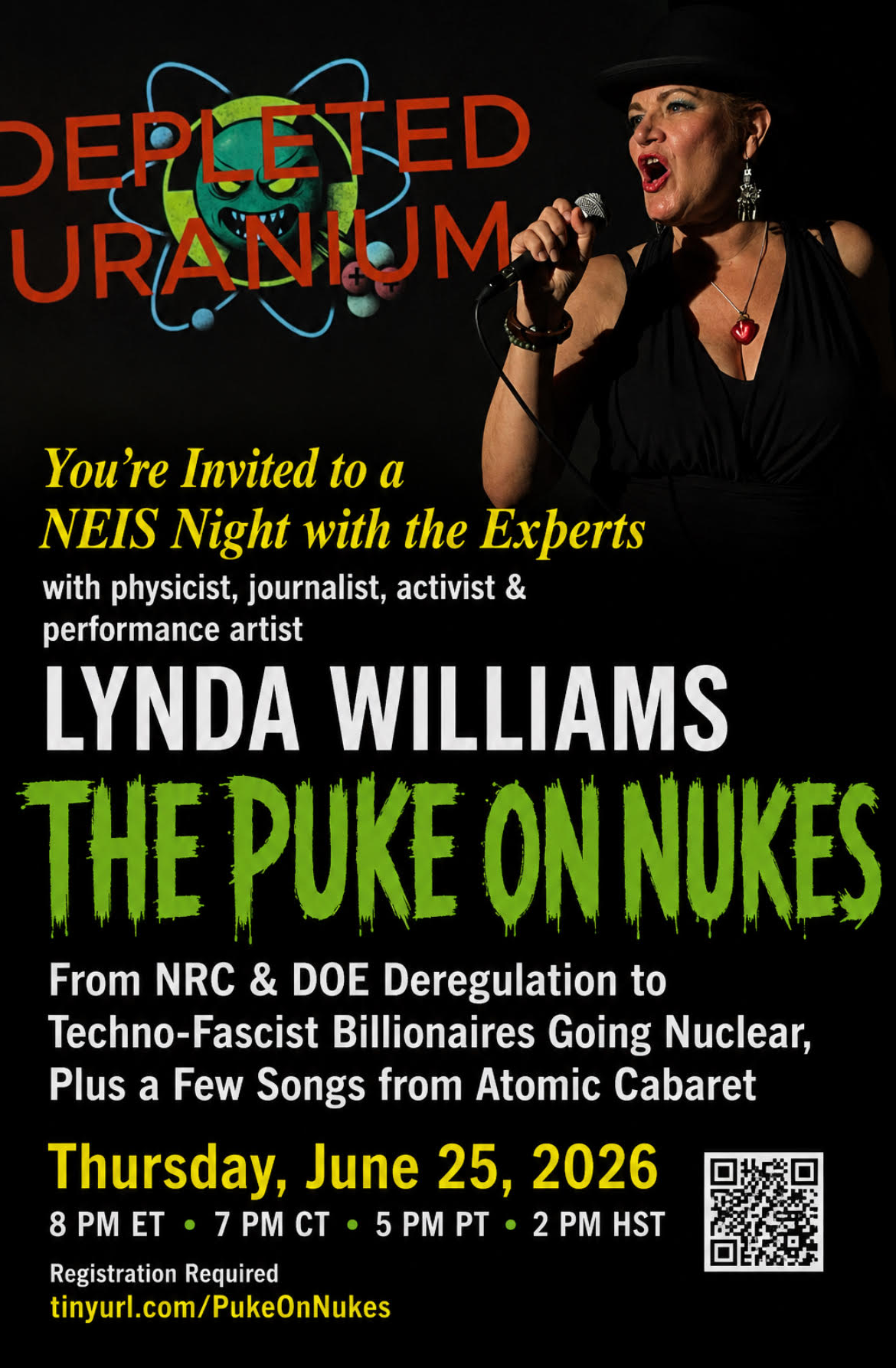
25 June- THE PUKE ON NUKES
Thursday, June 25, 2026
7pm Central Time (8pm ET, 6pm MT, 5pm PT) UTC – 5
From NRC & DOE Deregulation to Techno-Fascist Billionaires Going Nuclear, Plus a Few Songs from Atomic Cabaret REGISTER
26 June – Radiation Trainwreck at the NRC / Join the Protect Better Campaign – https://us02web.zoom.us/meeting/register/4ZlZ5_qLSHGiLSCg8FF6Bg#/registration


Cuba Is Not a Failed State – It Is a Besieged State
PETITION: “Global Appeal to Endorse Palestinian Right of Return of Refugees”
To see nuclear-related stories in greater depth and intensity – go to https://nuclearinformation.wordpress.com
-
Archives
- June 2026 (142)
- May 2026 (306)
- April 2026 (356)
- March 2026 (251)
- February 2026 (268)
- January 2026 (308)
- December 2025 (358)
- November 2025 (359)
- October 2025 (376)
- September 2025 (257)
- August 2025 (319)
- July 2025 (230)
-
Categories
- 1
- 1 NUCLEAR ISSUES
- business and costs
- climate change
- culture and arts
- ENERGY
- environment
- health
- history
- indigenous issues
- Legal
- marketing of nuclear
- media
- opposition to nuclear
- PERSONAL STORIES
- politics
- politics international
- Religion and ethics
- safety
- secrets,lies and civil liberties
- spinbuster
- technology
- Uranium
- wastes
- weapons and war
- Women
- 2 WORLD
- ACTION
- AFRICA
- Atrocities
- AUSTRALIA
- Christina's notes
- Christina's themes
- culture and arts
- Events
- Fuk 2022
- Fuk 2023
- Fukushima 2017
- Fukushima 2018
- fukushima 2019
- Fukushima 2020
- Fukushima 2021
- general
- global warming
- Humour (God we need it)
- Nuclear
- RARE EARTHS
- Reference
- resources – print
- Resources -audiovicual
- Weekly Newsletter
- World
- World Nuclear
- YouTube
-
RSS
Entries RSS
Comments RSS
 nuclear-news