Bernie Sanders climate plan phases out nuclear power – angers the pro nuclear shills
Attacks on the Sanders’ climate plan appear to have less to do with the ongoing viability of nuclear power as a legitimate climate solution and more to do with an ongoing effort to convince the public to subsidize another unsuccessful sector of the energy industry.
|
Bernie Sanders’ Plan to Phase out Nuclear Power Draws Attacks — Here’s Why They’re Wrong https://www.desmogblog.com/2019/08/30/bernie-sanders-climate-plan-nuclear-phase-out-attacks, By Justin Mikulka • Friday, August 30, 2019 Senator and Democratic presidential hopeful Bernie Sanders has released an ambitious climate proposal, one which champions of the status quo were quick to criticize. One line of attack, coming from many different sources, focuses on Sanders’ plan to phase out nuclear power, but the arguments, and who is behind them, deserve a closer look.Sanders’ proposal refers to nuclear power as one of several “false solutions” to the climate crisis:
The Washington Post editorial board quickly blasted Sanders’ plan to eliminate nuclear power: “Mr. Sanders also promises to make his plan unnecessarily expensive by ruling out a long-established source of carbon-free electricity: nuclear power.” The New York Times quoted Joshua Freed, vice president for clean energy at Third Way, a think tank that describes itself as promoting “modern center-left ideas.” “The Sanders plan appears to be big, but it’s not serious,” Freed said. “We need to have every option on the table.” Freed’s biography on the Third Way website makes clear that “advanced nuclear” is a top priority for the organization. In an op-ed at Forbes attacking Sanders’ plan, Ellen R. Wald, an energy historian and senior fellow at The Atlantic Council, went so far as to say that the outcome of the plan would be that “we would live in darkness” and “many of us would starve.” Former Top Regulator Says ‘Nuclear is Dying’However, if you ask a former top nuclear regulator about the future of nuclear power, the prospects are much dimmer. Gregory Jaczko was the chairman of the U.S. Nuclear Regulatory Commission from 2009 to 2012 and is the author of the book Confessions of a Rogue Nuclear Regulator. In an op-ed for the Washington Post in May, Jaczko asserted that “[n]uclear is dying” and argued that nuclear power is not a solution to the climate crisis. He spells out multiple reasons not to pursue nuclear power, with the obvious safety risks topping his concerns. And rightly so. Jaczko served on the Nuclear Regulatory Commission during the 2011 Fukushima nuclear disaster in Japan. In addition to nuclear’s well-publicized safety risks, Jaczko also highlighted a less well-known one. He said that the nuclear industry wields such influence over regulatory agencies — something he saw firsthand — that safety is being sacrificed for profit. Another downside is that building nuclear power plants is an incredibly expensive undertaking. Recent attempts to revive nuclear energy in the U.S. have been financial disasters, with $9 billion spent on one failed project in South Carolina alone. Jaczko cites the low cost and low risk of renewables as another factor that makes nuclear obsolete. “I’ve now made alternative energy development my new career, leaving nuclear power behind. The current and potential costs — in lives and dollars — are just too high,” wrote Jaczko, who has founded the company Wind Future LLC. Last year, William Von Hoene, senior vice president at Exelon, which operates nuclear plants, predicted that there would be no new nuclear power plants built in America for the same reason. “They are too expensive to construct, relative to the world in which we now live,” said Hoene. Bailing Out Another Failing IndustryLike the coal industry, the U.S. nuclear industry has been on the decline, but in this case, the drop is primarily due to aging nuclear plants closing and not being replaced. Still, this trend doesn’t mean U.S. taxpayers won’t pay the price as both industries continue to lobby hard for bailouts. n Ohio, nuclear industry lobbyists recently secured a $1.1 billion bailout of two economically failing nuclear power plants (and struggling coal plants) while incentives for renewables were cut. Not all Ohio citizens were happy with this handout, and one group is currently collecting signatures to put the bailout before voters in a referendum next year. A similar bailout of the nuclear industry was proposed in Pennsylvania. “I don’t see nuclear as a solution to climate change,” Jaczko told The Intercept. “It’s too expensive, and would take too long if it could even be deployed. There are cheaper, better alternatives. And even better alternatives that are getting cheaper, faster.” The International Energy Agency (IEA) released a report in May urging the use of more nuclear power but also admitted that this move would require the government picking up the tab. As Oilprice.com reported at the time, the “IEA pleaded with governments to rescue the industry” while admitting that without government intervention the prospect of new nuclear power projects in the U.S. and Europe was “inconceivable.” Industry Not Giving UpAs evidenced by the nuclear bailouts, there is still money to be made in the utility business, and while the chances of building new nuclear power plants in the U.S. are remote, the industry is pushing back hard against Bernie Sanders’ plan. Nuclear industry executives are perhaps inspired by the executives of failed coal, oil, and gas firms who get rich while bankrupting their companies. Industry-backed think tanks and academic groups echo their funders’ talking points and continue to champion nuclear power as a climate solution. The Manhattan Institute — known for its climate denial and oil and gas industry funding — claims that no one can be taken seriously on climate issues unless they embrace nuclear power. And this think tank isn’t alone. According to the right-leaning Washington Examiner, Dr. Noah Kaufman, a research scholar at Columbia University’s Center on Global Energy Policy (CGEP), also disagreed with Sanders’ approach to nuclear power. “I see ruling out any valuable low-carbon technologies and policies as fighting the [climate] battle with one arm tied behind our backs,” said Kaufman. However, CGEP itself is known for supporting climate-killing policies, such as its successful effort to help lift the crude oil export ban. Additionally, last year CGEP hired former Trump energy advisor and fossil fuel defender George “David” Banks as an expert on “international climate policy.” Attacks on the Sanders’ climate plan appear to have less to do with the ongoing viability of nuclear power as a legitimate climate solution and more to do with an ongoing effort to convince the public to subsidize another unsuccessful sector of the energy industry. |
|
A very small nuclear reactor still results in expensive and risky decommissioning
 Environmental groups concerned about demolition plan for Saskatoon’s SLOWPOKE-2 nuclear reactor, https://www.cbc.ca/news/canada/saskatoon/saskatoon-nuclear-reactor-demolition-concerns-1.5264231
Groups worried about transportation of nuclear waste, pouring treated water into sewer,
· CBC News ·Aug 30, 2019 Environmental groups from across the country are expressing concerns about the decommissioning of a small nuclear reactor near the University of Saskatchewan campus.
The Saskatchewan Research Council is applying to dismantle its SLOWPOKE-2 reactor. The demolition would likely happen next year, but before that happens the Canadian Nuclear Safety Commission (CNSC) will hold a hearing in Ottawa next month to look at approving the plan.
Environmental groups’ concerns about the plan include the intentions to release treated water from the reactor pool into the City of Saskatoon’s sewer system and to send the non-radioactive building materials to a private landfill.
“We don’t know what the cumulative effect or the additive effect of the radioactive burden is going to be of either of those practices,” said Brennain Lloyd, project manager of Northwatch, an environmental group in northern Ontario.
Other concerns include the fate of the reactor pool itself. The proposed plan includes filling the empty pool with concrete, rather than removing the contaminated site completely, as long as the site meets radioactivity guidelines.
Michael Poellet of Saskatchewan’s Inter-Church Uranium Committee Educational Co-operative (ICUCEC) questioned leaving the pool site in the ground.
“The issue there is that the cement in the pool has absorbed radioactivity,” said Poellet. “It’s not assured that the cement will be able to keep that radioactivity within that cement.”
Northwatch, along with the ICUCEC and Nuclear Waste Watch, have all applied to provide comment at the hearing.
The groups said they have important questions, including concerns about eight cubic meters of nuclear waste being transported hundreds of kilometres to a holding facility in South Carolina and parts of the reactor being sent to long-term storage in Chalk River Laboratories in Ontario.
“It’s a big deal project,” said Lloyd. “It seems to have been flying under the radar but it needs to come out out front.” Continue reading
As America’s nuclear reactors age, and become more dangerous, the Nuclear Regulatory Commission (NRC) reduces oversight
Aging nuclear plants, industry cost-cutting, and reduced safety oversight: a dangerous mix, Bulletin of the Atomic Scientists, By Edwin Lyman, August 29, 2019 After the 2011 Fukushima nuclear disaster in Japan, the US Nuclear Regulatory Commission (NRC) set up a task force to assess whether there were deficiencies in its oversight of nuclear reactor safety. The task force came back with twelve major areas for improvement. Its top recommendation: The agency needed to strengthen its fundamental regulatory framework to reduce the risk that a Fukushima-scale accident could happen in the US. But after dragging their feet for years, the NRC commissioners finally rejected the proposal in March 2016, with then-Commissioner William Ostendorff concluding that “the current regulatory approach has served the Commission and the public well.”
Yet only a few years later, the NRC has reversed course. The agency now says it urgently needs to transform its regulatory framework, its culture and its infrastructure—but in ways that would weaken, rather than strengthen, safety and security oversight. A key aspect of that transformation is an overhaul (or what the NRC euphemistically calls an “enhancement”) of the Reactor Oversight Process, the NRC’s highly complex system for determining how it inspects nuclear power reactors, measures performance, assesses the significance of inspection findings, and responds to violations. Overall, these changes—many of which are being pushed by the nuclear industry—could make it harder for the NRC to uncover problems and mandate timely fixes before they jeopardize public health and safety.
Aging nuclear plants need to be watched more closely, not less. The US nuclear power industry is facing major challenges. Stiff competition from low-cost natural gas has placed many plants under financial strain and at risk of early closure. At the same time, the nuclear reactor fleet is getting older. The average age of the 97 operating US power reactors is 38 years, according to the Energy Information Administration, and nearly all have received NRC-approved extensions of their operating licenses from 40 to 60 years. Six reactors have even applied for an additional 20-year extension.
As nuclear reactor age, they require more intensive monitoring and preventive maintenance to operate safely. But reactor owners have not always taken this obligation seriously enough……
The impact of less frequent and less intensive inspections is clear: The NRC will have fewer opportunities to catch violators and smaller data sets for assessing reactor safety. If reactor performance were steadily improving, as the nuclear industry argues, such reductions might be appropriate. But key safety and security indicators suggest otherwise. ……
The Reactor Oversight Process in a nutshell. To appreciate how the proposed Reactor Oversight Process changes could impact reactor safety, one needs to understand a bit about how the highly technical program works…………
The future. At this time, the four sitting commissioners (there is one vacancy) have not all voted on the proposed reactor oversight changes, but the outcome isn’t in much doubt. The Republican majority, under the direction of Chairman Kristine Svinicki, has already weakened the NRC’s regulatory authority in other areas. For example, in a 3-2 vote in January 2019, the majority gutted the staff’s proposed final rule for protection against Fukushima-scale natural disasters by eliminating the requirement that reactors be able to withstand current flooding and seismic hazards. Ultimately, the commissioners are free to reject the staff’s advice and mandate any change the industry wants, from expanding self-assessments to getting rid of white-level findings altogether.
Without active pushback from Congress and the public, the NRC’s march toward less regulation may be unstoppable. Fortunately, some in Congress have become concerned. Democrats in the House of Representatives sent a letter to the NRC in July 2019 protesting the proposals and requesting a public comment period before the NRC implements them. The NRC complied and initiated a 60-day comment period on August 7, 2019. Although it is under no obligation to accept any of the public comments, the NRC will have to respond to them, justify the proposals further, and explain their impacts more clearly. Hopefully, this additional bit of daylight will help ensure that the NRC has all the tools it needs to protect public health and safety as the reactor fleet enters its not-so-golden years. https://thebulletin.org/2019/08/aging-nuclear-plants-industry-cost-cutting-and-reduced-safety-oversight-a-dangerous-mix/
Canada didn’t sign the nuclear ban treaty, but can still take up its humanitarian provisions
|
Canada played a critical role in nuclear development. We should play a critical role in reparations,
Canada didn’t sign the nuclear ban treaty. But we can still take up its humanitarian provisions · for CBC News Aug 30, 2019 Canada holds contradictory positions in the world of nuclear weapons. We played an essential role in their development, but we never built any bombs of our own. Comprehensive Nuclear-Test-Ban Treaty
We are also already a party to every other major nuclear non-proliferation treaty, including the Comprehensive Nuclear-Test-Ban Treaty, which bans all nuclear weapons testing. This was easy for us to join in 1998; we had no nuclear weapons to test. However, engaging with the Treaty on the Prohibition of Nuclear Weapons would give Canada an opportunity to go beyond our existing, relatively painless, obligations. And we would also be the first nuclear umbrella state to do so, thus setting a meaningful and lasting precedent. Perhaps most importantly, Canada has a moral obligation to provide aid to victims and environments affected by nuclear testing. We don’t like to talk about it much, but Canada played a critical role in the development of these horrific weapons: scientists at the Montréal Laboratory were an essential part of the Manhattan Project, and the first atomic bombs were made with uranium shipped from the Northwest Territories. These are unfortunate truths that Canadians have yet to truly reckon with, but committing to a platform of nuclear reparations would be a good start. https://www.cbc.ca/news/opinion/canada-nuclear- |
|
|
Residents skeptical of plans to dismantle Oyster Creek nuclear plant
Residents skeptical of plans to dismantle Oyster Creek nuclear plant, WHYY, Nicholas Pugliese,
Watchdogs ask court to stop Edison from dumping San Onofre plant’s nuclear waste at beach
|
Watchdogs ask court to stop Edison from dumping San Onofre plant’s nuclear waste at beach https://www.desertsun.com/story/news/environment/energy-water-summit/2019/08/30/watchdogs-ask-judge-stop-edison-burying-nuclear-waste-san-onofre-beach/2163119001/
The complaint, filed by Public Watchdogs with U.S. District Court in the Southern District of California, also named Sempra Energy and its subsidiary San Diego Gas & Electric; Holtec International, the contractor storing the nuclear waste underground; and the U.S. Nuclear Regulatory Commission, which allowed the waste transfers. The nuclear power plant first became operational in 1972. Decommissioning of the last operational reactors began in 2013. Unable to find off-site storage, Edison began to transfer cooled, spent nuclear fuel rods to underground storage on site at the beachfront facility, wedged between San Onofre State Beach and Interstate 5. Edison eventually hopes to transfer the waste to a federal facility. Nearly 3.6 million pounds of nuclear waste is stored at the plant, which has a spotty safety track record. Earlier this year, the NRC fined Edison $116,000 for violating safety requirements relating to fuel transfers. My immediate concern is for the health and safety of the millions of people who could be impacted by a toxic cloud being released,” Chuck La Bella, lawyer of Public Watchdog, said in a press release. “It isn’t really a question of ‘if’ but rather ‘when’ we’re going to be dealing with a nuclear accident here.” An estimated 8 million people live within a 50 mile radius of the facility, what the NRC calls a “plume zone,” where people could be exposed to toxic nuclear waste in the event of a storage equipment failure. Edison resumed burying rods last month after operations were suspended for nearly a year following an incident during which a canister containing nearly 50 tons of spent fuel rods was negligently handled while being transferred to the underground storage unit. The U.S. Nuclear Regulatory Commission found in its investigation that Edison had fallen short on a number of safety procedures, including a failure to publicly report a “near-miss” regarding nuclear waste within 24 hours. In particular, the canisters in which cooled, spent nuclear fuel rods are being packed are defective and too thin-walled at just five-eighths of an inch thick, according to Public Watchdogs. Furthermore, the canisters are being stored underground, 108 feet from the water in a known tsunami inundation zone near the San Andreas fault. The court papers identify broken bolts in the storage canisters that get scratched and gouged during transfer, among other engineering failures, as well as alleging cavalier safety attitudes at Edison. Edison spokesperson John Dobken told The Desert Sun that stopping the fuel transfers from wet to dry storage could potentially strand spent fuel on site, even when options for transport or disposal become available. “Placing spent nuclear fuel into approved canisters that meet all technical, safety and regulatory requirements for on-site storage is the first step to relocating the fuel to an off-site federally licensed facility.” Dobken said, adding that by 2021, more than 80 percent of the spent fuel stored at San Onofre will be eligible for transport. In the last month, three more canisters were transferred, leaving another 41 remaining canisters above ground. A spokesperson for the NRC said the agency does not comment on ongoing litigation, but that they stand by their earlier statement that it is safe for Edison to transfer fuels at the San Onofre facility. Impact on the beachThe California Department of Parks and Recreation says visits to San Onofre’s surfing spots have steadily declined since 2006. In August of that year, the station’s third reactor, which had been shut down for 14 years, was discovered to have been leaking radioactive cancer-causing tritium, contaminating the groundwater. During the peak month of July 2006, there were over 526,000 visitors to the beach area. This year, there were fewer than 200,000 visitors during the same month. The court filing is part of Public Watchdogs’ larger legal action against Edison. Last week, the California Public Utilities Commissions awarded the group $57,924 for making substantial contributions to their decision that Edison was unfairly making ratepayers foot the bill for the decommissioning of the facility at San Onofre State Beach. |
|
The Once and Future Threat of Nuclear Weapon Testing
The Once and Future Threat of Nuclear Weapon Testing, Just Security by Ambassador Thomas Graham Jr. 30 Aug 19 The Nuclear Non-Proliferation Treaty (NPT) is the central security instrument of the United States and the world community. It is based on a strategic bargain between the five nuclear weapon states in the NPT (the United States, the United Kingdom, France, Russia, and China) and the 185 non-nuclear-weapon parties to the treaty. The current worldwide moratorium on nuclear weapon testing and the intended ultimate conversion of that ban to legally binding treaty status by bringing the Comprehensive Test Ban Treaty (CTBT) into force are essential to the long-term viability of this strategic bargain. But some Trump administration officials have signaled hostility to the CTBT and an interest in the United States resuming nuclear weapon testing, which could cause a catastrophic unraveling of that bargain…….. https://www.justsecurity.org/66020/the-once-and-future-threat-of-nuclear-weapon-testing/
Holtec Ignores New Mexico State Land Office Authority,
|
Holtec Ignores New Mexico State Land Office Authority, Concerned Citizens for Nuclear Safety
August 30th, 2019 In filings this week with the Nuclear Regulatory Commission (NRC), Holtec International stated it “disagrees” that the New Mexico State Land Office must approve any agreements to limit or restrict continued or future mineral extraction, including oil, gas, and potash. In this and previous filings Holtec
claimed that it has “control” of the proposed site in southeast New Mexico for storing all of the irradiated, or spent, nuclear fuel from commercial nuclear power plants, more than 90 percent of which is located in the eastern half of the country. In this week’s filing, Holtec also states that it does not need to control the mineral resources to obtain an NRC license. On June 19th, Stephanie Garcia Richard, New Mexico Commissioner of Public Lands, wrote to Holtec expressing her concerns that the company misrepresented the authority of the Land Office over the mineral rights. While the Eddy-Lea Energy Alliance owns the surface, the State of New Mexico owns the mineral rights below ground in the highly productive Permian Basin. Garcia Richard wrote that Holtec “entirely disregarded the State Land Office’s authority over the Site’s mineral estate” and that the state has not approved the agreement between Holtec . and Intrepid Potash to limit potash mining below the site. In a May 7, 2019 decision, the NRC judges accepted Holtec’s statement that it “controls the mineral rights at the site down to 5,000 feet.” Fasken Oil and Ranch and the Permian Basin Land and Royalty Owners filed a motion with the NRC to submit a new contention, or objection, in the license proceeding. A basis for the new contention was the Land Commissioner’s letter to Holtec…….. http://nuclearactive.org/ |
|
“Lipstick on a Pig” – Pro nuclear groups again trying to classify nuclear power as “Renewable”
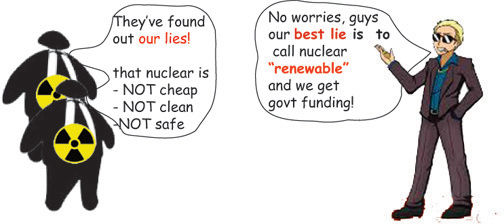
To keep Diablo Canyon open, SLO assemblyman wants to classify nuclear power as renewable, BY MATT FOUNTAIN The Tribune, AUGUST 28, 2019 A Central Coast legislator and two pro-nuclear groups are taking an unusual step to keep Diablo Canyon nuclear power plant operating: They want an amendment to the state Constitution classifying nuclear power as a renewable energy source.
Then, with the plant’s production able to count toward California’s target for renewables, the hope is that someone would acquire it through PG&E’s bankruptcy proceedings and continue to run it for another 20 years.
The effort’s a long shot, however, in a state controlled by Democrats more interested in investing in solar, wind, and geothermal energy, and with the plant facing significant relicensing hurdles.
Assemblyman Jordan Cunningham, R-San Luis Obispo, announced Wednesday that he filed a proposed constitutional amendment to prohibit the Legislature from discriminating against any form of renewable or zero-carbon energy as part of California’s Renewables Portfolio Standard, qualifying nuclear as a source of renewable energy.
The operating licenses for Diablo Canyon’s two reactors expire in 2024 and 2025 respectfully, and the plant is slated for closure in 2026.
Logistical issues aside, Cunningham says qualifying the plant as a generator of renewable energy could allow the plant to operate up to 2045.
In June 2016, PG&E abandoned its efforts to relicense the plant’s reactors, citing among other factors the state’s renewable energy policy…….
The proposed amendment is supported by the pro-nuclear nonprofit groups Environmental Progress and Californians for Green Nuclear Power.
‘LIPSTICK ON A PIG’
But David Weisman, spokesman for the Alliance for Nuclear Responsibility, which has called for the early closure of Diablo Canyon, likened the proposed amendment to a recent taxpayer bailout of Ohio’s two remaining nuclear reactors.
Saying that PG&E customers already pay among the highest rates in the country, Weisman said subsidies placed on the nuclear industry in other states have passed on extra costs to ratepayers.
“Ratepayers are already on the hook for a portion of billions of dollars in losses caused by PG&E’s negligence in Northern California,” Weisman said, referring to the utility’s liability for allegedly causing recent wildfires. “PG&E doesn’t want this plant.”
John Geesman, attorney for the Alliance, said the Diablo Canyon proposal will likely draw attention to the magnitude of Diablo’s above-market costs.
“This is an obvious attempt to put lipstick on a pig in hopes of attracting a purchaser of the asset in bankruptcy,” Geesman wrote in an email…… https://www.sanluisobispo.com/news/local/article234470352.html
Physicist Ed Lyman on new safety threats to US nuclear reactors
BO’s Chernobyl Sparks Questions About US Nuclear Power Safety, UCS, AUGUST 27, 2019
Physicist Ed Lyman discusses new safety threats to US nuclear reactors and why risks here are different than in Russia.
If you’re gonna have nuclear power, you should make sure that there’s a sufficient region around every plant that’s low population density. So that if evacuation or other emergency measures are needed, they can be carried out effectively. And by simply suburbanization and development, a lot of plants around the country that were originally sited in rural areas now find themselves in suburbs and the population’s increasing.
The idea is that it doesn’t really matter too much how old the plant is, as long as you can inspect and maintain those systems, structures, and components that are aging so that they stay within an acceptable range. Now there are certain things that can’t be changed. For instance, the concrete and steel containment buildings around most plants, it’s not something that’s going to be replaced.
There’s buried piping in a lot of plants, this piping was never intended to be replaced, but some of it is corroding. So, there may be an issue with how do you manage those structures that can’t be replaced. And finally, the reactor vessels, these are the steel vessels that hold the nuclear fuel in reactors, they become brittled over time as they’re bombarded with neutrons. And there is a risk that they could shatter like glass if they are sufficiently brittle and they undergo rapid cooling.
So that’s one of the…what is called a time limiting aspects of a nuclear plant because those reactor vessels would be way too expensive to ever replace……..
Colleen: Ed, is it true that the next generation of nuclear power plants will be so safe that they can’t meltdown?
Ed: It is not true. Any nuclear plant has vulnerabilities that could result in a serious accident or could be exploited. It is true that you can design greater safety into nuclear power, there are ways to reduce that risk. But by and large, you’re always going to have these vulnerabilities and you can’t depend on the design to save the day. It’s always going to be a good design plus a well-run plant, plus well-trained operators, plus robust inspections and maintenance, and also robust security to prevent against sabotage attacks.
Colleen: How far-fetched is the idea that terrorists could attack a nuclear power plant? What would they be trying to do or to get?
Ed: For a commercial nuclear power plant in this country, the greatest concern is radiological sabotage. And that is a deliberate act that could destroy or disable enough of the safety systems and the backup safety systems that the reactor would meltdown and there would be very little that the plant operators could do about that. And it’s a very real threat.
Because if there were a well-trained, paramilitary type terrorist attack at a nuclear reactor, without a robust security response, the attackers could essentially destroy enough equipment to cause a meltdown within minutes. So there is a very short time window for trying to respond if you have this type of event. The best thing to do is to prevent the attack from taking place…..
it’s a fallacy to think that Chernobyl was an event that was only due to Soviet incompetence and corruption and that that kind of thing couldn’t happen here. Chernobyl couldn’t happen here, but Fukushima could or something worse than Fukushima. https://ucsusa.org/ep66-lyman
Trump on climate change- USA companies’ profits more important. He is expert on environment

Trump’s climate session no-show, ABC News, 27 Aug 19
A $US20 million ($29.5 million) pledge to battle wildfires raging across the Amazon is being seen as one of the few solid agreements to come out of the meeting — but it appears to have come about with little input from Mr Trump.
“The President had scheduled meetings and bilaterals with Germany and India, so a senior member of the administration attended in his stead,” press secretary Stephanie Grisham said in a statement.
CNN and the Guardian reported Mr Trump appeared to be unaware of when the climate session would be held when asked by reporters. He thought it had not happened yet…..
The US president up-ended last year’s G7 summit in Canada, walking out of the meeting early and disassociating himself from the final communique having initially endorsed the document. …..
World leaders’ closing remarks
US President Donald Trump: …….
- On climate change: “We are the number one energy producer in the world. It is tremendous wealth — I am not going to lose that wealth on dreams, on windmills, which frankly are not working that well.”
- “I want the cleanest water on Earth, I want the cleanest air on Earth … I think I know more about the environment than most people.” https://www.abc.net.au/news/2019-08-27/trump-ready-to-meet-irans-president-to-solve-nuclear-impasse-g7/11451490
Donald Trump’s idea – use nuclear bombs to stop hurricanes from hitting the United States
 https://amp.axios.com/trump-nuclear-bombs-hurricanes-97231f38-2394-4120-a3fa-8c9cf0e3f51c.html
Jonathan Swan, Margaret Talev, 26 Aug 19, President Trump has suggested multiple times to senior Homeland Security and national security officials that they explore using nuclear bombs to stop hurricanes from hitting the United States, according to sources who have heard the president’s private remarks and been briefed on a National Security Council memorandum that recorded those comments.
Behind the scenes: During one hurricane briefing at the White House, Trump said, “I got it. I got it. Why don’t we nuke them?” according to one source who was there. “They start forming off the coast of Africa, as they’re moving across the Atlantic, we drop a bomb inside the eye of the hurricane and it disrupts it. Why can’t we do that?” the source added, paraphrasing the president’s remarks.
Asked how the briefer reacted, the source recalled he said something to the effect of, “Sir, we’ll look into that.”
Trump replied by asking incredulously how many hurricanes the U.S. could handle and reiterating his suggestion that the government intervene before they make landfall.
The briefer “was knocked back on his heels,” the source in the room added. “You could hear a gnat fart in that meeting. People were astonished. After the meeting ended, we thought, ‘What the f—? What do we do with this?'”
Trump also raised the idea in another conversation with a senior administration official. A 2017 NSC memo describes that second conversation, in which Trump asked whether the administration should bomb hurricanes to stop them from hitting the homeland. A source briefed on the NSC memo said it does not contain the word “nuclear”; it just says the president talked about bombing hurricanes.
The source added that this NSC memo captured “multiple topics, not just hurricanes. … It wasn’t that somebody was so terrified of the bombing idea that they wrote it down. They just captured the president’s comments.”
The sources said that Trump’s “bomb the hurricanes” idea — which he floated early in the first year and a bit of his presidency before John Bolton took over as national security adviser — went nowhere and never entered a formal policy process.
White House response: A senior administration official said, “We don’t comment on private discussions that the president may or may not have had with his national security team.”
A different senior administration official, who has been briefed on the president’s hurricane bombing suggestion, defended Trump’s idea and said it was no cause for alarm. “His goal — to keep a catastrophic hurricane from hitting the mainland — is not bad,” the official said. “His objective is not bad.”
“What people near the president do is they say ‘I love a president who asks questions like that, who’s willing to ask tough questions.’ … It takes strong people to respond to him in the right way when stuff like this comes up. For me, alarm bells weren’t going off when I heard about it, but I did think somebody is going to use this to feed into ‘the president is crazy’ narrative.”
Trump called this story “ridiculous” in a Monday tweet from the G7 summit. He added, “I never said this. Just more FAKE NEWS!”
The big picture: Trump didn’t invent this idea. The notion that detonating a nuclear bomb over the eye of a hurricane could be used to counteract convection currents dates to the Eisenhower era, when it was floated by a government scientist.
The idea keeps resurfacing in the public even though scientists agree it won’t work. The myth has been so persistent that the National Oceanic and Atmospheric Administration, the U.S. government agency that predicts changes in weather and the oceans, published an online fact sheet for the public under the heading “Tropical Cyclone Myths Page.”
The page states: “Apart from the fact that this might not even alter the storm, this approach neglects the problem that the released radioactive fallout would fairly quickly move with the tradewinds to affect land areas and cause devastating environmental problems. Needless to say, this is not a good idea.”
About 3 weeks after Trump’s 2016 election, National Geographic published an article titled, “Nuking Hurricanes: The Surprising History of a Really Bad Idea.” It found, among other problems, that:
Dropping a nuclear bomb into a hurricane would be banned under the terms of the Peaceful Nuclear Explosions Treaty between the U.S. and the former Soviet Union. So that could stave off any experiments, as long as the U.S. observes the terms of the treaty.
Atlantic hurricane season runs until Nov. 30.
Long history of misguided suggestions to nuclear bomb hurricanes

|
The idea has evidently surfaced multiple times in the administration, as Swan outlined, including during a hurricane preparedness briefings at the White House. “I got it. I got it. Why don’t we nuke them?” the president evidently interrupted, according to Swan’s source. “They start forming off the coast of Africa, as they’re moving across the Atlantic, we drop a bomb inside the eye of the hurricane and it disrupts it. Why can’t we do that?” Even in a White House system engineered to respond quickly and authoritatively to a president’s whims, questions, or orders, no one knew what to do with an idea so obviously batty. As one source reportedly told Swan, “You could hear a gnat fart in that meeting. People were astonished. After the meeting ended, we thought, ‘What the f—? What do we do with this?’” (Trump denied the reports in a tweet Monday.) The truth, though, is that Donald Trump’s apparent brainstorm—as terrible an idea as it is—actually has a long history. Seventy years ago, it was at the forefront of American scientific thought. What makes Trump’s embrace of nuking hurricanes unique is that, broadly speaking, no policymaker has seriously considered it a good idea since the days that the 73-year-old president was wearing diapers. The bombing of Hiroshima and Nagasaki—when the US unleashed a destructive technology more powerful than anything in history—at first spurred unbridled excitement over the power of the atom…… Engineers dreamed of the day when nuclear engines would replace gasoline-powered automobiles, when a lump of Uranium-235 the size of a vitamin pill would power the family car for years at a time. In those heady early years of the atomic age, many scientists imagined a world where humans could routinely use nuclear weapons to cleave the earth and remake its climate. Decades before climate change became a major concern, one book, Almighty Atom: The Real Story of Atomic Energy, suggested using atomic weapons to melt the polar ice caps, gifting “the entire world a moister, warmer climate.” Thought experiments exploded over how harnessing the power of the atom would finally unleash humans’ ability to control and reshape their environment through geo-engineering. “For the first time in the history of the world, man will have at his disposal energy in amounts sufficient to cope with the forces of Mother Nature,” ……. One of the first tourist attractions in Las Vegas was the chance to wake up early, stand outside your hotel, and watch the flash and mushroom cloud from the bombs rolling into the sky. The after-effects of radiation—the invisible and inescapable poison spread by nuclear explosions—became clear soon enough. With that awareness, early atomic enthusiasm waned, particularly as bombs leapt from nuclear to thermonuclear, the atomic bomb’s power of kilotons—that is, a thousand tons of TNT—growing to the hydrogen bomb’s megatons, the equivalent of a million tons of TNT….. nuking hurricanes entered the conversation. According to International Spy Museum historian Vince Houghton, whose book Nuking the Moon details wacky military and intelligence schemes, an American meteorologist named Jack Reed, one of the nation’s earliest hurricane hunters, appears to be the first to seriously consider bombing a hurricane. His calculations held that maybe one or two 20-megaton bombs might be able to deflect a hurricane from land. He called for a test of the theory, but found it embraced by precisely zero policymakers …. Reed’s idea would actually now be prohibited under international law by the Peaceful Nuclear Explosions Treaty. Yet the appeal of nuking hurricanes has never really gone away. The issue is such a MacGuffin that NOAA has dedicated a webpage to debunking it: “During each hurricane season, there always appear suggestions that one should simply use nuclear weapons to try and destroy the storms,” the weather service writes. “Apart from the fact that this might not even alter the storm, this approach neglects the problem that the released radioactive fallout would fairly quickly move with the tradewinds to affect land areas and cause devastating environmental problems. Needless to say, this is not a good idea.” The idea has enough staying power that the meteorologists at NOAA even took on the underlying science, pointing out that there’s little evidence that even a successfully placed atomic bomb would do anything to alter a hurricane’s formation —the systems are simply too large, too strong, and most of all, a nuclear explosion wouldn’t affect the underlying dynamics, …… Even for Donald Trump, launching 80 nukes a year seems extreme https://www.wired.com/story/nuking-hurricanes-polar-ice-caps-climate-change/ |
|
Santee Cooper officially cancels contract to end dispute over nuclear parts
The Green New Deal – Bernie Fraser

|
The Green New Deal, The climate crisis is not only the single greatest challenge facing our country; it is also our single greatest opportunity to build a more just and equitable future, but we must act immediately. Bernie Fraser, Climate change is a global emergency. The Amazon rainforest is burning, Greenland’s ice shelf is melting, and the Arctic is on fire. People across the country and the world are already experiencing the deadly consequences of our climate crisis, as extreme weather events like heat waves, wildfires, droughts, floods, and hurricanes upend entire communities, ecosystems, economies, and ways of life, as well as endanger millions of lives. Communities of color, working class people, and the global poor have borne and will bear this burden disproportionately. The scientific community is telling us in no uncertain terms that we have less than 11 years left to transform our energy system away from fossil fuels to energy efficiency and sustainable energy, if we are going to leave this planet healthy and habitable for ourselves, our children, grandchildren, and future generations. As rising temperatures and extreme weather create health emergencies, drive land loss and displacement, destroy jobs, and threaten livelihoods, we must guarantee health care, housing, and a good-paying job to every American, especially to those who have been historically excluded from economic prosperity. As President, Bernie Sanders Will Avert Climate Catastrophe and Create 20 Million JobsAs president, Bernie Sanders will launch the decade of the Green New Deal, a ten-year, nationwide mobilization centered around justice and equity during which climate change will be factored into virtually every area of policy, from immigration to trade to foreign policy and beyond. This plan outlines some of the most significant goals we have set and steps we will take during this mobilization, including:
|
|
1 This Month

Protect Sazan Island from the Trump family! https://secure.avaaz.org/campaign/en/protect_sazan_island_from_the_trump_family_loc/?bqFCVab&v=174511&cl=22707147157&_checksum=5e9dde668860e8231c33699735e16a1fbf22ab2cb01da50c999fe8732b9775ef&utm_source=email&utm_medium=blast_email&utm_campaign=174511
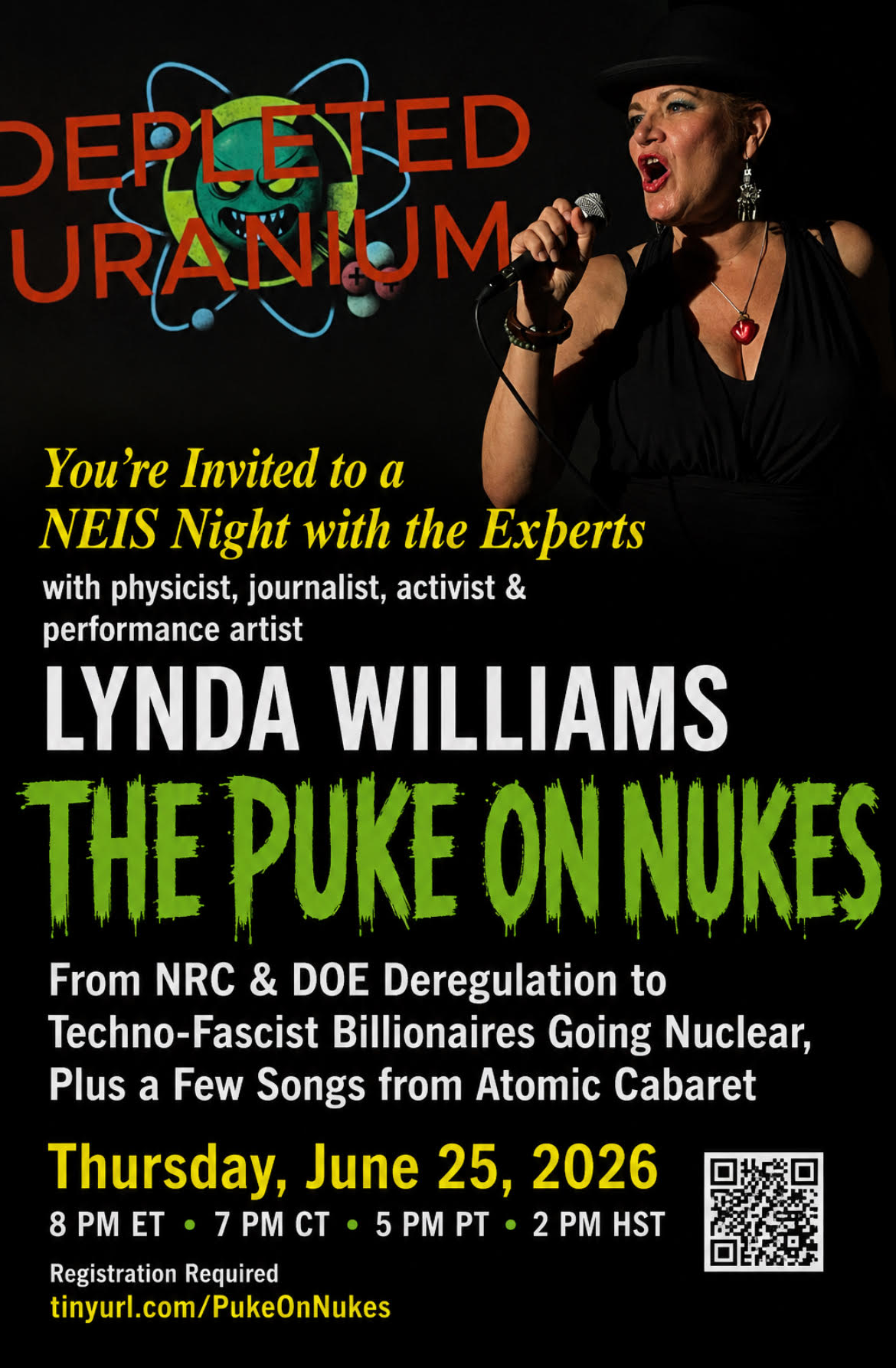
25 June- THE PUKE ON NUKES
Thursday, June 25, 2026
7pm Central Time (8pm ET, 6pm MT, 5pm PT) UTC – 5
From NRC & DOE Deregulation to Techno-Fascist Billionaires Going Nuclear, Plus a Few Songs from Atomic Cabaret REGISTER
26 June – Radiation Trainwreck at the NRC / Join the Protect Better Campaign – https://us02web.zoom.us/meeting/register/4ZlZ5_qLSHGiLSCg8FF6Bg#/registration


Cuba Is Not a Failed State – It Is a Besieged State
PETITION: “Global Appeal to Endorse Palestinian Right of Return of Refugees”
To see nuclear-related stories in greater depth and intensity – go to https://nuclearinformation.wordpress.com
-
Archives
- June 2026 (142)
- May 2026 (306)
- April 2026 (356)
- March 2026 (251)
- February 2026 (268)
- January 2026 (308)
- December 2025 (358)
- November 2025 (359)
- October 2025 (376)
- September 2025 (257)
- August 2025 (319)
- July 2025 (230)
-
Categories
- 1
- 1 NUCLEAR ISSUES
- business and costs
- climate change
- culture and arts
- ENERGY
- environment
- health
- history
- indigenous issues
- Legal
- marketing of nuclear
- media
- opposition to nuclear
- PERSONAL STORIES
- politics
- politics international
- Religion and ethics
- safety
- secrets,lies and civil liberties
- spinbuster
- technology
- Uranium
- wastes
- weapons and war
- Women
- 2 WORLD
- ACTION
- AFRICA
- Atrocities
- AUSTRALIA
- Christina's notes
- Christina's themes
- culture and arts
- Events
- Fuk 2022
- Fuk 2023
- Fukushima 2017
- Fukushima 2018
- fukushima 2019
- Fukushima 2020
- Fukushima 2021
- general
- global warming
- Humour (God we need it)
- Nuclear
- RARE EARTHS
- Reference
- resources – print
- Resources -audiovicual
- Weekly Newsletter
- World
- World Nuclear
- YouTube
-
RSS
Entries RSS
Comments RSS
 nuclear-news