Donald Trump wants to spend billions of dollars on a successor to President Ronald Reagan’s Strategic Defense Initiative, and he’s calling it “Golden Dome,” inspired by both Israel’s Iron Dome defense and Reagan’s early-1980s concept of a “peace shield” over North America. It’s a hugely ambitious project, but Secretary of Defense Pete Hegseth apparently would prefer that no one talk about it.
This week, military and civilian experts are in Huntsville, Alabama, for the 2025 Space and Missile Defense Symposium, a gathering of more than 7,000 top experts, military officers, and defense-industry representatives from around the world. One might think that such a jamboree is the obvious place to cheerlead for a new American missile-defense plan. But one would be wrong: The Pentagon has barred anyone from speaking about Golden Dome in public. Instead, according to Politico, representatives of the Missile Defense Agency joined a closed meeting that was not part of, or sponsored by, the symposium.
A new CANDU reactor does not exist. The current reactor at Point Lepreau is a CANDU 6, the same model as the one Hydro-Québec shut down permanently in 2012 and is now in the process of decommissioning. There are no plans to design a new CANDU 6.
Over the summer, New Brunswick Premier Susan Holt mused to journalists about building a second CANDU reactor at the Point Lepreau nuclear site on the Bay of Fundy.
“A second CANDU is not far-fetched,” she told the Telegraph Journal. On the weekend, Holt enthused about the idea in a CBC story about the Eastern Energy Partnership pitch to Prime Minister Mark Carney.
A new CANDU reactor for New Brunswick? It’s a puzzling thought, worth pondering.
Let’s put aside for a moment that the current CANDU reactor at the Point Lepreau site is an economic nightmare, its poor performance the main reason NB Power loses money almost every year. Overspends on the original reactor and the rebuild together represent almost two-thirds of NB Power’s nearly $6-billion debt.
Let’s forget that more than 25 years ago in Ontario, the provincial utility Ontario Hydro was similarly effectively bankrupt before it was split up, leaving a $20-billion stranded debt, largely left over from its CANDU nuclear construction program. Ontario taxpayers and ratepayers were left holding the bag for that $20 billion, paying it back on their electricity bills. A recent investigation found that: “In 2050 Ontario will still be paying the debt of the nuclear program of the 1970s and 80s.”
Let’s also try to forget that the New Brunswick government gets its nuclear advice from NB Power (the utility that loses money almost every year), the same utility that in 2018 recommended the province invite two start-up companies from the United Kingdom and the United States that had never built a nuclear reactor to come to New Brunswick and, with their experimental reactor designs, start a new nuclear export industry.
It was a breathtakingly risky recommendation that can most kindly be described as “wishful thinking.” In the seven years since, despite more than $95 million to the companies from provincial and federal taxpayers, their two “advanced” designs for small modular nuclear reactors (SMRs) have failed to attract enough private sector financing and almost certainly will never be built in New Brunswick.
Finally, are we willing to ignore the fact that the Peskotomuhkati Nation never consented to the current CANDU reactor on its homeland at Point Lepreau, has made numerous interventions against plans to put the two SMRs on the site, and is highly unlikely to consent to a second CANDU?
For this ponder, let’s park all those troubling facts and focus on what we know about a potential second CANDU reactor for Point Lepreau.
A new CANDU reactor does not exist. The current reactor at Point Lepreau is a CANDU 6, the same model as the one Hydro-Québec shut down permanently in 2012 and is now in the process of decommissioning. There are no plans to design a new CANDU 6.
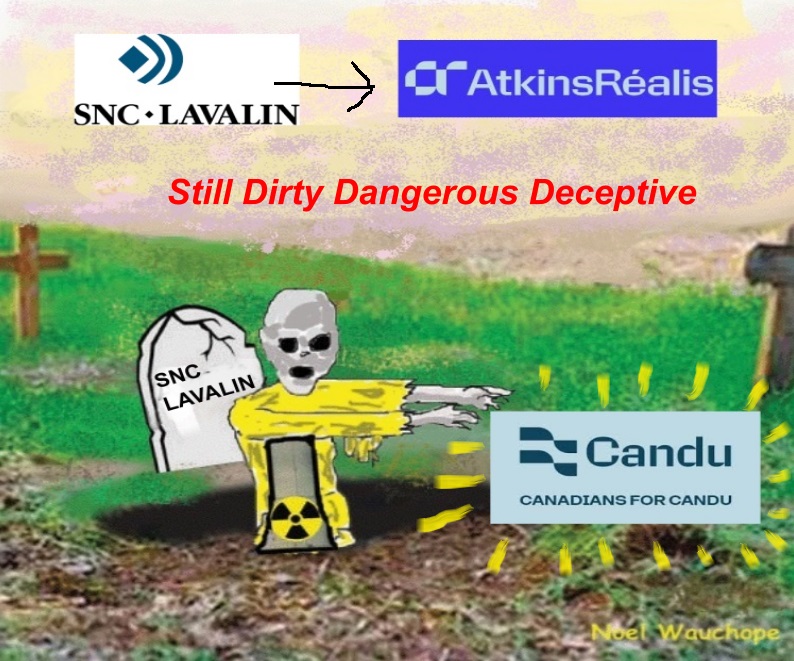
AtkinsRéalis (formerly SNC-Lavalin) owns the exclusive rights to design a new CANDU. The engineering firm announced in late 2023 that its new CANDU design is called Monark. So far, the CANDU Monark is a computer model, currently registered with the Canadian Nuclear Safety Commission as in a “familiarization and planning” stage with the start date for regulatory reviews “to be determined”.
Although AtkinsRéalis has released almost no technical details about its proposed design, the company did predict the CANDU Monark’s capacity factor, an important parameter for evaluating a nuclear reactor design. The capacity factor is a measure of efficiency, how often a nuclear reactor (or any other kind of power plant) operates at maximum power output over a specific period.
Predicted capacity factors require years of reactor operation to prove reliability. In 2023, the global average nuclear power plant capacity factor was 81.5%. Predicting a higher average capacity factor would mean AtkinsRéalis believes the CANDU Monark design can produce power more consistently and at a greater percentage of its potential than the average reactor.
This “new” CANDU Monark design has similar features (cooled and moderated with heavy water, similar core channels and heat transport system) to the design of the reactor at the Darlington nuclear site in Ontario, the last CANDU ordered in Canada more than 30 years ago. The lifetime average capacity factor for Darlington’s four CANDU units is 83%, in line with the global average.
Yet a paper sponsored by AtkinsRéalis at the June 2024 conference of the Canadian Nuclear Society claims the annual capacity of the CANDU Monark design is more than 95%, much higher than the global average or the actual number at Darlington.
How does AtkinsRéalis plan to boost this CANDU’s average capacity factor from 83% to 95%? The answer: more wishful thinking!
Now, back to the existing CANDU 6 reactor at Point Lepreau—which is currently, again, closed for repairs, this time for five months. After refurbishment, from the start of 2013 to the end of 2024, its capacity factor was 78%, below the global average. Last year, with a multi-month, unplanned shutdown for a generator repair, the reactor operated at 32% capacity. An investigation by CBC predicts that 2024 may be its worst operational year ever.
Earlier this year, the NB Power CEO said the root of the reactor’s problems can be traced to when the reactor was refurbished from 2008 to 2012. To save money, the plant’s supporting infrastructure was not upgraded, and now that infrastructure is breaking down.
Lack of money is a core constraint for New Brunswick’s nuclear plans. In 2024, another CBC investigation revealed a consultant report that linked the poor performance of NB Power’s nuclear reactor to the fact that since the refurbishment, the utility has not spent nearly enough to maintain it.
The basic problem is that New Brunswick lacks the capacity to operate a nuclear reactor. In addition to a financially stretched utility with a small grid, the province lacks nuclear management expertise.
When the plant reopened in 2012 after refurbishment, NB Power contracted a management team from Ontario Power Generation (OPG). Later, the utility hired a manager living outside the country. He billed the utility for travel expenses from his home to his work in New Brunswick in addition to his salary, a total that reached $1.3 million but delivered no improvement in the reactor’s performance. In 2023, NB Power said goodbye to the American and contracted OPG management again.
Across the globe [pdf], it is hard to find an electrical grid as small as NB Power’s with a nuclear reactor. The International Atomic Energy Agency recommends that: “A single power plant should represent no more than 10% of the total installed grid capacity.” NB Power’s Point Lepreau plant exceeds 15% of its grid capacity, including the energy available under power purchase agreements.
For decades, the utility has had oversized nuclear ambitions. As far back as 1972, a federal Department of Finance official warned [pdf] against subsidizing a power reactor for “a small, high-cost utility with barely enough cash flow to finance its present debt,” calling New Brunswick’s nuclear plans “the equivalent of a Volkswagen family acquiring a Cadillac as a second car.”
The nuclear industry depends on wishful thinking, plus its hubris and supreme confidence that have bamboozled generations of energy ministers and premiers into believing its overblown hype.
So, a second CANDU at Point Lepreau? The Premier would be wise to ignore the promotion and sales puff from NB Power and its nuclear industry friends and review the facts. Follow the money, or in this case, the billions the province has lost so far. A decision to build a second CANDU at Point Lepreau would be not only puzzling, but economically reckless.
Dr. Susan O’Donnell is a social scientist specializing in technology adoption and an Adjunct Research Professor and lead investigator of the CEDAR project at St. Thomas University.Dr. Frank Greening is nuclear research scientist with a PhD in Chemistry, retired from Ontario Power Generation (OPG). This story was first published by NB Media Co-op, and is republished by permission.
The U.S. Army will begin recruiting soldiers for its first dedicated enlisted specialty in space operations. This is part of a broader push by the service to build organic expertise as satellites become increasingly critical to modern ground warfare….
…The initiative comes as military leaders increasingly view space capabilities as essential to ground operations, driven in part by lessons from the conflict in Ukraine, where electronic jamming, cyber threats and satellite-denied environments have become routine challenges for forces.
HUNTSVILLE, Ala. — The U.S. Army will begin recruiting soldiers for its first dedicated enlisted specialty in space operations. This is part of a broader push by the service to build organic expertise as satellites become increasingly critical to modern ground warfare.
Army officials at the Space & Missile Defense Symposium this week said the 40 Delta (40D) Space Operations Specialist military occupational specialty is moving from planning to implementation, with full operations expected by October 2026.
Lt. Gen. Sean Gainey, head of the Army’s Space and Missile Defense Command, said the service is just weeks away from the official launch of the new specialty. The goal is to “build long-term, institutional knowledge and to retain noncommissioned officers (NCOs) with space expertise,” Gainey said.
The 40D program was approved in December and will begin accepting applications early next year, with selection boards starting in May, according to Command Sergeant Major John Foley, the Army’s senior enlisted leader for space operations. Selected soldiers will receive specialized training in Colorado Springs to become space operations specialists.
The initiative comes as military leaders increasingly view space capabilities as essential to ground operations, driven in part by lessons from the conflict in Ukraine, where electronic jamming, cyber threats and satellite-denied environments have become routine challenges for forces.
Organizational structure
Beyond the new enlisted specialty, the Army is developing what it calls a “space branch” – a professional category similar to existing branches like Infantry, Armor and Artillery. Foley said the space branch would initially encompass about 1,000 enlisted soldiers and officers and would allow space professionals to advocate for programs and resources. The branch is not officially in place yet but should be coming soon, he added.
These organizational changes build on the evolution of the 1st Space Brigade and expansion of “multidomain” task forces, which Gainey identified as significant developments in Army space capabilities. These units have integrated space operations with ground maneuver formations through exercises and collaboration with special operations and cyber elements, giving soldiers hands-on experience in spectrum awareness and techniques to deceive and disrupt adversaries’ satellite use.
The Army’s own labs also have produced weapons like BADGR, a portable system that combines surveillance sensors and jamming devices for electronic attack missions. Brig. Gen. Don Brooks, deputy commander for operations at the Army Space and Missile Defense Command, said five BADGR prototypes have been delivered to Army units based on feedback from ground forces requesting specialized equipment for “electronic attack.”
A joint endeavor, not a turf war
The Army’s push to develop internal space expertise has drawn criticism from some observers who view it as creating a “mini Space Force” that could duplicate the newer service’s mission. Army leaders have pushed back against such characterizations, emphasizing their goal is to cultivate organic space competencies rather than compete with the Space Force.
Army officials argue that having soldiers on the ground who understand space-based assets and can immediately translate satellite data, communication support and threat warnings into real-time action is essential for modern warfare. They contend that waiting for external support, even from an expert service like the Space Force, is often impractical when ground units need instant solutions integrated into their tactical operations.
The Army continues to rely on the Space Force for satellite launches, advanced systems and global networks, but maintains that a land component with skilled space professionals can make the entire joint force more capable and resilient.
Gen. Stephen Whiting, head of U.S. Space Command, offered support for the Army’s approach during remarks at the symposium. “I’m gratified to see that all of our military services are understanding the criticality of space,” Whiting said. “The Army recognizes that for maneuver elements to be successful, that there needs to be soldiers who understand space.”
Whiting emphasized that the Space Force maintains its “global space mission to provide space capabilities to the entire force and also to protect and defend capabilities in the domain,” while acknowledging that “all of our services have real institutional strengths.” Rather than viewing the Army’s efforts as competitive, Whiting said, “I don’t see it as being an overlapping and competitive set of responsibilities … but I do see them being complimentary.”
Following passage of the Radiation and Exposure and Compensation Act expansion, which includes post-1971 miners for the first time, Searchlight spoke with three tribal members whose lives were changed forever by a toxic industry.
SEARCHLIGHT NEW MEXICO, by Aviva Nathan, August 8, 2025
On July 25, I drove to the Pueblo of Laguna to speak with Loretta Anderson, Millie Chino and Vincent Rodriguez, steering members of an advocacy group called the Southwest Uranium Miners Coalition Post-71. Anderson co-founded the organization in 2014 to fight for the expansion of paid benefits — to uranium workers who entered the industry after 1971 — under the Radiation Exposure and Compensation Act (RECA), the 1990 law created to provide financial support to people exposed to radiation from atomic weapons testing as well as the milling, mining and transporting of uranium.
At Laguna, the mines deformed the hills into tiered sites of extraction that are still gray from the uranium. Infrastructure that was built for the mining still remains, now in a state of disrepair. In the wake of mining, what was once a hill collapsed into a contaminated green pond that smells like methane. (The mine in question, called Jackpile Mine, was the largest open-pit uranium mine in the world and operated both underground and open-pit areas.) Anderson’s late husband, Roy Cheresposy, was a miner. Chino lost her husband, James, another miner, in 2023. Vincent Rodriguez was also a miner.
Our conversation took place while we drove around various sites on pueblo land that were affected by mining that happened here between 1953 and 1982. It followed the recent RECA expansion that’s part of President Trump’s One Big Beautiful Bill Act, passed on July 4. This legislation, for the first time, will compensate post-1971 uranium workers, offering a one-time payment of $100,000 to New Mexico workers who meet certain criteria related to exposure and health consequences. Compensation will be overseen by the U.S. Department of Justice (DOJ); the agency has yet to release the new RECA application forms.
The urgent desire of downwinders and uranium workers to be compensated after decades of waiting has been seized upon by lawyers, home health care companies and other third parties that hope to get a slice of the pie for themselves. Already, there has been a cacophony of misinformation and rumors of unlawful solicitation. (For details on how the application process should work, see our sidebar about frequently asked questions.) Right now, it’s difficult to estimate how much will be paid in expanded compensation. Since Reca was first passed, more than $2.7 billion has been awarded.
While potential applicants are in limbo, the physical source of harm remains unattended. The Jackpile Mine, which was declared a Superfund site in 2013, is vacant, but it’s still exposed and quietly lethal. Meanwhile, members of the steering committee have expressed concern that uranium mining could begin again shortly, given the Trump administration’s eagerness to expand uranium mining, which includes efforts to fast-track the opening of mines in New Mexico. Susan Gordon, a coordinator with the Multicultural Alliance for a Safe Environment, adds that further steps are required of companies before they can start mining again in this state.
Land and memory converged as Anderson, Chino and Rodriguez spoke about the history and intimate impact of uranium mining in Laguna Pueblo. The following transcript is edited for clarity and length.
As I drove onto Laguna land, which sits around 50 miles west of Albuquerque, Anderson drove ahead of me and contextualized the landscape over the phone. I’ve added Chino’s comments from a trip on the same roads a few hours later.
Millie Chino:They used to have sheep camps along these hills, years ago before the mining started. But once it started, they couldn’t herd anymore, because of the blasting and all the production going on. Many of our people were farmers and sheepherders and cattle workers.
Lorretta Anderson:There was no acknowledgement of the harm being done by the mines. That’s the terrible part. If you look up at those hills, you can see where the gray clay is. That gray color is uranium.
That was where the mines were. Part of it, anyway. They did do a reclamation at one time, but they only put on a thin layer of dirt. They didn’t clean it up. That dirt all has to have blown away already. The people who did the reclamation are sick. They didn’t have any protective gear.
Chino:On your left, you’ll see the housing area where the supervisors of the mines and their children and families lived. We’ve been told they’re all deceased. Even their children, they died of cancers. My mom worked there as a housekeeper for one of the big shots. Both my parents passed away from radiation diseases.
Anderson:On the right, you can see the arroyo. Now it’s highly contaminated. It’s seeping down the Rio San Jose. Uranium contaminated our Mesita Dam. And there’s a little lake here that’s highly contaminated. That is a hot spot. They don’t know what to do with it. If you stop here, you will see that the horses, cattle and all the animals drink off that area where it’s highly contaminated.
Now we’re entering the village of Paguate. People here are very sick. They’re suffering and dying. The majority of our people were working at the mines. From January 1, 1972, the uranium mining industry just expanded so much, and everybody was employed there at that point. I was living in Seama Village. I live about 11 miles from the mines, down in the valley. I’m in the farthest village, actually. We have six villages in Laguna Pueblo.
We arrived at Chino’s house. In her living room, she read from a poster she’d made.
Chino: These are recollections of my childhood memories, and I’ve titled it, “Memories That Do Not Heal.” The recollections of childhood memories living in Paguate village are of pain, heartbreak and anger. Anger. Uranium mining operations began near our village in the 1950s. A frightening sound became an everyday event. A dynamite blasting happened at least twice per day. When the blasting occurred, everything vibrated. The village shook. The houses built with rock and mud were affected by the vibrations. The pictures that hung on the walls fell.
As children, we were so curious and excited by the loud explosive booms coming from the uranium mine. We figured out the blasting schedule. We gathered at the edge of the village to observe the huge billowing of dust clouds after the blast. The clouds of dust drifted over the village and settled on everything. Women dried fruit and meat outside their homes. Families ate the contaminated food, not knowing the eventual consequences. Years passed. The continued blasting caused cracks in the walls of homes. The outdoor oven walls cracked. The women could not bake bread, roast corn or cook. Today, there are no ovens to be used as they once were. They are in disrepair. As mining operations continued, miners and community members were exposed to the toxic environment.
The Jackpile Mine closed in 1982. Since then, we’ve lived with the knowledge that many community members are sick and dying from cancers. Kidney and respiratory diseases. My beloved spouse, a Vietnam veteran, parents and other relatives passed away from the uranium diseases. These are memories of my childhood growing up in the village so near to the uranium mine.
Anderson:Once you disrupt uranium — and the government knew this — you can’t do anything to stop it from contaminating people. You just open up a porthole of illnesses and diseases. And that’s what our people are suffering from right now. They don’t know how to stop the contamination. There’s nothing they can do. It’s awful. It’s headed down the Rio San Jose, which is going toward Albuquerque and Las Lunas and Belen. And they can’t stop it.
They only have given us until 2027 to file RECA claims. That’s not enough time. Right now, I’m working with over 500 living miners, trying to get them going. We have all these attorneys and home health care groups that are causing so much havoc throughout the community. I told people: Don’t answer them. Do not give out your information. The city of Grants right now is just craziness.
…What emerges from these individual fundraising rounds, tests and production increases…is companies who see a generational windfall…
.
PART 3 | AUGUST 6, 2025
Welcome to the third part of our four-part newsletter series on the funding, technology and mission of the Golden Dome missile defense initiative, where we break down the highly ambitious space-based military program, from its history to its planned architecture to its budget and to the role of AI. We’ll keep you up to date on what stands to become one of the most expansive military defense systems in United States history.
Today, we’ll talk more about industry’s visions for Golden Dome, and how some companies are already positioning themselves to win Pentagon contracts.
Almost immediately after President Donald Trump announced the idea that came to be known as Golden Dome, space and defense companies started making their case for how their technology could be a fit for the program.
As a result, industry officials have several visions for what Golden Dome might include and how it might work. While Gen. Michael Guetlein, recently appointed program manager for Golden Dome of America, only recently kicked off a 60-daysprint to deliver an architecture, some of the pitches and procurements already out there may offer ideas on the range of possibilities and the technologies involved.
Many of the defense industry’s largest players have started touting a vision for Golden Dome. Among them: L3Harris is touting its history and pedigree to develop part of the system. The company has built a missile-tracking satellite that successfully demonstrated the ability to track a hypersonic missile from space, the Missile Defense Agency confirmed April 25. L3Harris has also recently expanded its manufacturing capabilities, ramping up its ability to produce infrared sensing payloads — a central technology for the Golden Dome missile-defense shield that relies heavily on space-based capabilities. In addition, the company announced plans to leverage its AI partnerships with Palantir and Shield AI in the interest of securing Golden Dome contracts. And in July, L3Harris named Rob Mitrevski, who recently oversaw the company’s expansion of infrared sensor payload production capacity, as president of Golden Dome strategy and integration — signalling the company’s intent to steer its growing portfolio of work on Golden Dome.
Northrop Grumman, too, is discussing its experience as a lead contractor for the Space Development Agency’s Tracking Layer. In a recent interview with SpaceNews, Raymond Sharp, vice president of Northrop Grumman’s missile defense solutions business unit, said the company is “all in” on Golden Dome, and hopes to cement a systems-integrator role that goes beyond supplying components. The company would incorporate modular networking technologies that it’s already developed for other military contracts into Golden Dome concepts to demonstrate “plug-and-play” integration — a key requirement for a system expected to absorb a range of sensors, weapons and decision-support software from across the industrial base.
Northrop also intends to offer components — in a second-quarter earnings call, CEO Kathy Warden said the company is significantly ramping up solid rocket motor production and plans to offer a space-based interceptor concept soon, saying that ground-based tests are already happening. During an Aug. 5 meeting with reporters, Northrop Grumman executives said the company’s billion-dollar investment in solid rocket motor production facilities put the company in a strong position to capitalize on the demand likely to be generated by Golden Dome.
Similarly, Lockheed Martinannounced it hopes to conduct orbital tests of space-based interceptors, which is thought to be a key part of Golden Dome, in 2028. However, the company has not clarified whether those interceptors will rely on kinetic or directed energy weaponry and probably won’t announce those details until an architecture is released.
Booz Allen Hamiltonunveiled a concept for a megaconstellation of 2,000 smallsats operating as an artificial intelligence-powered network that the company is calling “Brilliant Swarms.” The company said the satellites would serve as both detection systems and as “kill vehicles” that would de-orbit targets by physically slamming into them — no space-based missiles required. The project is also expected to attract disruptors to the Pentagon’s business. Reutersreported in April that executives from SpaceX, Anduril and Palantir met with the Trump administration to pitch a Golden Dome architecture that involves a constellation of 400 to 1,000 missile detecting and tracking satellites and another constellation of 200 attack satellites that would target and disable missiles with lasers or with missiles of their own. The trio is reportedly being considered a frontrunner for Golden Dome, though SpaceX CEO Elon Musk disputed Reuters’ claims and those reports came prior to the public dissolution of Trump and Musk’s relationship. More recently, Reuters reported that the administration is looking to expand the companies involved in Golden Dome to reduce reliance on SpaceX. Officials have reached out to companies like Amazon, Rocket Lab and Stoke Space about participating in the effort in an attempt to reduce the role SpaceX would play.
At the same time, more traditional space companies are also now seeing a potential lane for defense work. For example, Voyager is working to paint a clear line between the technology it’s already been building and the presumed needs for an advanced missile defense system. Voyager plans to offer up its propulsion technology — the company has developed a solid propulsion roll control system designed to stabilize a missile’s flight trajectory — to Golden Dome. Voyager has also pitched edge computing systems it’s developing in partnership with Palantir.
Redwire, which includes spacecraft, sensors and digital engineering systems, is also offering up many of its core technology for Golden Dome.
Top-down visions
Some aspects of what will become Golden Dome are likely already underway; last week we mentioned that BAE Systems had won a $1.2 billion Space Force contractfor 10 medium Earth orbit missile (MEO) tracking satellites. The satellites will become part of the Resilient Missile Warning Tracking Epoch 2, which marks the second phase of the Space Force’s program to develop a missile-tracking network in MEO. The constellation is intended to help defend against evolving missile threats, particularly hypersonic weapons that have become a key focus for U.S. defense planners, and as a result will be integrated into the overall Golden Dome project.
Several other space industry firms are presenting themselves as capable of handling the work necessary for building the Golden Dome. Take Rocket Lab, which in recent months took several steps to expand into the military sector and pursue coveted status as a prime contractor for the Pentagon and a worthwhile partner for high-value contracts. Those steps include a $275 million acquisition of Geost, which produces electro-optical and infrared (EO/IR) sensor payloads that are already used in U.S. military satellites, with plans for more acquisitions down the road.
Other companies have been busy raising funds or ramping up their own capabilities, such as Sophia Space, which raised $3.5 million in pre-seed funding to develop orbiting data centers, which it hopes to demonstrate as useful for Golden Dome through a memorandum of understanding with Axiom Space.
Apex recently raised money in a $200 million Series C, which it will use to increase satellite bus production — similarly arguing that they would be useful for missile defense. And Quantum Space raised $40 million to develop its national security-focused Ranger spacecraft, also hiring to its executive team former Defense Department official Richard Matlock, who previously worked in missile defense.
Uncertainty about the scope of Golden Dome translates to uncertainty about which firms and which technologies will make their way into the program. It also means it’s way too early to guess who the winners will be. But with the size of Golden Dome’s $25 budget, many space companies will look to show off their capabilities.
There are no official criteria for what constitutes membership in the upper echelon of the US military industrial complex, but a $10 billion deal that consolidates dozens of contracts under a single blanket purchase agreement sure makes it seem like Palantir has earned entry.
The US Army announced on Thursday that, rather than continue to buy Palantir products on one of 75 different contracts the branch has with the data analytics software company, it’s awarding a ten-year Enterprise Agreement (EA) with the aforementioned cap of $10 billion. Like a standard blanket purchase agreement, the deal allows the Army to buy what it needs from Palantir over the course of a decade.
It doesn’t appear that the Army is awarding Palantir any new contracts based on the press release or a procurement notice published about the contract in May. According to that document, the Army had figured out that it’s doing so much business with Palantir over so many separate procurement actions that it’s wasting a lot of time and money.
“Consolidating these efforts under an EA will streamline future modifications and task orders under a single set of ordering instructions and terms and conditions,” the May publication pointed out. “Instead of managing dozens of contracts with varying terms, the government will empower a single team to manage the contract.”
With 75 active contracts between the Army and Palantir, it’s nearly impossible to track down what exactly the Army is using from Palantir, though we do have some ideas.
More broadly, Palantir offers various data analytics tools and suites, any number of which may be in use.
Beyond the US Army and the DoD, Palantir has also worked with US Immigration officials to develop deportation software, at the IRS to help it with new software initiatives, and even at US-backed mortgage broker Fannie Mae, where the company’s code has been put to use detecting fraud.
Palantir has found itself in US President Donald Trump’s good graces thanks to CEO Alex Karp’s previous comments about his opposition to “woke” ideology, support for DOGE, and comments about “powering the West to innate superiority.” This latest contract will likely do little to assuage conspiracy-minded fears that Palantir is gobbling up and monetizing government data for the benefit of Trump and a coterie of right-wing billionaires.
By scoring an EA, Palantir finds itself in the company of defense contractors like Boeing, Northrop Grumman, and Lockheed Martin – an elite club, to be sure.
Palantir declined to comment on this story beyond pointing to the Army press release, while the US Army didn’t immediately respond to questions.
Santa Fe, NM – Eighty years after the first radioactive waste was buried at the Los Alamos National Laboratory (LANL), Lab officials have released plans to “defer” cleanup of one of the older radioactive dumps. Material Disposal Area C (“Area C”) is an 11.8-acre site that was active from 1948 to 1974. It contains metals, hazardous constituents, and radioactively and chemically contaminated materials in six unlined disposal pits and 108 shafts. The total waste and fill in the pits and shafts are estimated at 198,104 cubic meters. Area C also has a serious gas plume of industrial solvents. Given the amount of long-lived plutonium wastes that are likely to be in Area C, leaving it buried 25 feet deep in a landfill rated for only 1,000 years is not acceptable.
On June 18, 2025, the Department of Energy (DOE) sent the New Mexico Environment Department (NMED) a letter outlining its plans to “defer corrective action” (i.e. cleanup) at Area C. It stated that the dump “is associated with active Facility operations and will be deferred from further corrective action under [NMED’s] Consent Order [governing cleanup] until MDA C is no longer associated with active Facility operations.”
DOE’s letter does not state why it wants the change or what “active Facility operations” are. However, that is not difficult to guess as Area C is within a few hundred yards of PF-4, LANL’s main plutonium facility that is gearing up for the expanded production of plutonium pit bomb cores. As co-plaintiff, Nuclear Watch New Mexico legally forced the National Nuclear Security Administration (NNSA) to undertake a nationwide programmatic environmental impact statement for pit production, which the agency chose to give a fifty year time horizon. In combination this means that DOE and LANL are seeking to indefinitely postpone cleanup while expanding nuclear weapons production on into the future.
Fortunately, NMED has responded that it “will utilize to the fullest extent all statutory and legal authority necessary to enforce the requirements of the 2016 CO [Consent Order] in order to ensure that New Mexicans receive effective cleanup of legacy contamination at LANL in a timely manner.”
The Environment Department went on to say:
“DOE continues to respond to the regulatory direction provided by NMED in ways that do not reflect any good faith efforts to be accountable for cleanup of the legacy waste at Los Alamos National Laboratory and, in fact, are directly contradictory to the assertations previously made by DOE. As you may recall, during the substantial negotiation process in 2023-24 for revision of the Consent Order, DOE repeatedly reiterated its desire to work collaboratively and effectively with NMED. This recent example of an improper, unilateral deferral contrary to the terms of the Consent Order, along with the bad-faith withdrawal of the CME [Corrective Measures Evaluation to initiate cleanup] Report, contradict such assertions and reassurances from DOE.”
At the same time DOE and LANL are still seeking to intentionally release up to 30,000 curies of tritium, which has been highly controversial. Tritium is a radioactive isotope of hydrogen that can be easily absorbed by the body as tritiated water. Instead of complying with a NMED order to organize an independent expert panel and a public meeting on the subject, they have invoked a dispute resolution process under the Consent Order. This is the kind of forum in which taxpayer supported lawyers from DOE and LANL can try to run circles around NMED’s limited staff and resources.
Overarching above all is LANL’s vast expansion of its nuclear weapons programs. A full billion dollars is being added in FY 2026 (which begins this October 1), making 84% of LANL’s $6 billion dollar annual budget directly tied to nuclear weapons. This increase is primarily for:
1) New-design nuclear weapons that can’t be tested because of the international testing moratorium; or, conversely, could prompt the U.S. to resume testing, with serious global proliferation consequences; and
2) Expanded plutonium pit bomb core production for these new-design nuclear weapons. This is ill-conceived because no future production is to maintain the existing stockpile. Independent experts have found that pits last at least a century and at least 15,000 existing pits are already in storage.
In contrast, cleanup and nonproliferation programs are being cut by 5%, non-weapons science by 50%, and renewables energies research completely eliminated.
Scott Kovac, Research Director of Nuclear Watch New Mexico commented, “LANL and DOE once again treat New Mexico as their nuclear colony with their radioactive releases, obstruction of cleanup and expansion of nuclear weapons programs. The day will come when this is no longer tolerated in the Land of Enchantment.”
Sources:
June 2016, State of New Mexico Environment Department, Compliance Order on ConsentU.S. Department of Energy – Los Alamos National Laboratory (Modified September 2024)
June 18, 2025 Letter from DOE to NMED, Deferment of Corrective Action Activities for Solid Waste Management Unit 50-009 at Material Disposal Area C under the 2016 Compliance Order on Consent
July 2,2025 Letter from NMED to DOE, Response, Deferment of Corrective Action Activities for Solid Waste Management Unit 50-009 at Material Disposal Area C
There are already many complications in this proposal, which has not been officially released yet. The Trump administration proposed a budget that would devastate NASA’s multiple science programs, and while it asked for more funding for human spaceflight in the short term, it would cancel the Space Launch System and Orion Spacecraft, making NASA exclusively reliant on private companies to get to the Moon. As yet, we don’t have one of those that won’t stop exploding.
A free and independent press is one of democracy’s last lines of defense. It’s where power is questioned, facts are verified, and the public gains its understanding of the world. But under President Trump’s leadership – particularly in his second term – the media has been steadily undermined, attacked, and manipulated into submission.
From the earliest days of his political rise, Trump branded the press “the enemy of the people.” At the time, it sounded like theatre – one of his many outrageous slogans designed to rile up the crowd. But over time, it became policy. Journalists were banned from briefings. Reporters were publicly harassed at rallies. Entire news organisations were delegitimised as “fake news” unless they offered praise. What started as rhetoric turned into a campaign of disinformation and intimidation.
This erosion of media independence has happened in two key ways: by silencing critical voices, and by co-opting sympathetic ones.
Independent journalists now work under constant threat. Legal pressure, license challenges, defamation suits, and even surveillance have become tools to muzzle dissent. Whistleblowers are prosecuted, not protected. Major networks once known for tough questions now pull their punches – or are simply locked out.
At the same time, pro-Trump media outlets have risen in influence, often indistinguishable from state-run propaganda. Whether it’s Fox News personalities given cabinet positions, or social media influencers granted White House access in exchange for loyalty, the lines between journalism and political theatre have blurred.
These outlets don’t challenge power – they amplify it. They repeat Trump’s talking points uncritically, flood the zone with outrage and distraction, and vilify any journalist who dares to question the narrative. The result is an information landscape where truth becomes tribal, and lies travel faster than facts.
Why does this matter? Because a democracy without a free press cannot stay democratic for long. When citizens no longer trust what they see or hear – when news becomes just another weapon of the powerful – then accountability dies, and corruption thrives.
Some journalists continue to fight. They fact-check, investigate, and shine light where it’s needed most. But their space is shrinking, and their safety increasingly uncertain. In many ways, the press has not just been pushed to the sidelines – it’s been made part of the battlefield.
History teaches us that authoritarian regimes always start by silencing the press. What’s unfolding in America is no exception. We may still have newspapers, networks, and headlines – but when truth itself is up for debate, freedom is already slipping through our fingers.
Walt Zlotow, West Suburban Peace Coalition, Glen Ellyn IL, 5 Aug 25
Ukraine’s military is being systematically obliterated on the battlefield. US President Trump knows this. Ukraine President Zelensky does as well.
Yet, both are pretending the war can be won on terms favorable to the US and Ukraine. Trump is threatening secondary sanctions on nations buying Russian oil if Russia doesn’t end the war by August 8. Zelensky applauds this threat. Trump is also selling additional weapons to NATO allies to give to Ukraine’s lost cause.
Neither of Trump’s actions will have any effect on Ukraine’s impending battlefield defeat. Trump gets the ‘rat’ designation because he broke his campaign pledge to end the war by withdrawing US support and forcing Ukraine to negotiate the war’s end. But since that signals defeat of the US proxy war to weaken Russia, he clearly has decided it’s better to keep the war going rather than suffer a humiliating defeat. That merely ensures Ukraine’s near complete destruction as a functioning state.
Zelensky earned his ‘rat’ designation when he bailed out of ending the war in April 2022. He was on the cusp of a negotiated settlement with Russia that would have ended Ukraine’s effort to join NATO and guaranteed regional independence for Russian cultured Ukrainians in Donbas. For Ukraine it would have mean no lost territory and no massive casualties or infrastructure destruction. That is classic diplomacy achieving win-win.
But the rat Zelensky caved to US/UK pressure to dump that deal because Zelensky believed US/UK lies he could win simply with continued Western weapons. That, along with Trump’s refusal to end the war after promising to end it, has put Ukraine into a death spiral.
So with no way to win on the battlefield, our cornered rats are risking nuclear war every day this catastrophe continues. Zelensky keeps begging for long range NATO missies to attack deep into Russia. While that has no strategic value, it has value in provoking a Russian nuclear response, something to which Zelensky remains oblivious.
The nuclear risk Trump has embarked upon is even more reckless. He responded to a harmless Russian social media comment about a potential US/Russia nuclear confrontation, by sending two Ohio Class nuclear submarines toward Russian waters. Just as provocative and reckless, Trump’s sent B61-12 nuclear gravity bombs to the UK. These are offensive weapons having nothing do with will standard NATO defensive weaponry. They are the first delivery of these offensive weapons to the UK since removing them in 2008.
To Trump, reckless action is an appropriate response to relatively harmless words. Particularly since Trump is he world champ at using social media to threaten, browbeat friends and foes alike.
It’s not just the beleaguered people of Ukraine whose lives are threatened by the two cornered rats with no sane, safe way out of the lost war in Ukraine. It is all of us.
Trump has announced plans to quadruple U.S. nuclear power by 2050, pushing for rapid approval of new reactors and slashing regulatory barriers.
Experts warn that undermining the independent Nuclear Regulatory Commission could erode essential safety standards and risk public backlash.
Critics argue the slow growth of U.S. nuclear energy stems from high costs, not overregulation, citing costly delays at projects like Plant Vogtle.
The President of the United States, Donald Trump, is betting big on nuclear power and aims to fast-track projects to prepare for the massive increase in electricity demand over the next decade. However, experts fear that his plans to accelerate project development could compromise safety standards, particularly as the independent U.S. Nuclear Regulatory Commission comes under threat.
Trump’s orders establish arbitrary deadlines for decisions on construction permits and operating licenses, even for new designs that have not yet been assessed; demand a review of all NRC regulations within 18 months; and allow for the construction of nuclear reactors on federal lands without NRC review.
While deploying more nuclear power could help the U.S. respond to the rising domestic electricity demand, there are widespread concerns that President Trump’s rapid approval of new nuclear projects threatens to weaken the independent Nuclear Regulatory Commission (NRC), which assesses projects for health and safety and ensures reactors operate securely. The objective of Trump’s executive orders is to reduce regulations and accelerate the approval of nuclear plants by overhauling the NRC…………………………………………..
………………. Weakening the powers of the independent NRC to give greater control to the government’s Department of Energy and Defence undermines the stringent safety standards that were previously enforced for the development and running of nuclear plants. At worst, this could lead to another nuclear disaster, which could jeopardise the health, or even lives, of people across the U.S. https://oilprice.com/Energy/Energy-General/Trumps-Nuclear-Energy-Overhaul-Sparks-Alarms-Over-Safety.html
The Israeli media has decided not to report on the horrors that the IDF [Israel Defense Forces] is perpetrating in Gaza. You simply will not see it on Israeli television………………….. the vast majority of the population simply does not want to know about it.”
The politics of genocide in the United States involves papering over the big gap between the opinions of the electorate and the actions of the U.S. government. While the partnership between the governments of Israel and the United States has never been stronger, the partnership between the people of Israel and the United States has never been weaker. But in the USA, consent of the governed has not been necessary to continue the axis of genocide.
For decades, countless U.S. officials have proclaimed that the bonds between the United States and Israel are unbreakable. Now, the ties that bind are laced with genocide. The two countries function as accomplices while methodical killing continues in Gaza, with both societies directly – and differently – making it all possible.
The policies of Israel’s government are aligned with the attitudes of most Jewish Israelis. In a recent survey, three-quarters of them (and 64 percent of all Israelis) said they largely agreed with the statement that “there are no innocent people in Gaza” – nearly half of whom are children.
“There is no more ‘permitted’ and ‘forbidden’ with regard to Israel’s evilness toward the Palestinians,” dissident columnist Gideon Levy wrote three months ago in the Israeli newspaper Haaretz. “It is permitted to kill dozens of captive detainees and to starve to death an entire people.” The biggest Israeli media outlets echo and amplify sociopathic voices. “Genocide talk has spread into all TV studios as legitimate talk. Former colonels, past members of the defense establishment, sit on panels and call for genocide without batting an eye.”
Last week, Levy provided an update: “The weapon of deliberate starvation is working. The Gaza ‘Humanitarian’ Foundation, in turn, has become a tragic success. Not only have hundreds of Gazans been shot to death while waiting in line for packages distributed by the GHF, but there are others who don’t manage to reach the distribution points, dying of hunger. Most of these are children and babies…. They lie on hospital floors, on bare beds, or carried on donkey carts. These are pictures from hell. In Israel, many people reject these photos, doubting their veracity. Others express their joy and pride on seeing starving babies.”
Unimpeded, a daily process continues to exterminate more and more of the 2.1 million Palestinian people who remain in Gaza – bombing and shooting civilians while blocking all but a pittance of the food and medicine needed to sustain life. After destroying Gaza’s hospitals, Israel is still targeting healthcare workers (killing at least 70 in May and June), as well as first responders and journalists.
The barbarism is in sync with the belief that “no innocent people” are in Gaza. A relevant observation came from Aldous Huxley in 1936, the same year that the swastika went onto Germany’s flag: “The propagandist’s purpose is to make one set of people forget that certain other sets of people are human.” Kristallnacht happened two years later.
Renowned genocide scholar Omer Bartov explained during an interview on Democracy Now! in mid-July that genocide is “the attempt to destroy not simply people in large numbers, but to destroy them as members of a group. The intent is to destroy the group itself. And it doesn’t mean that you have to kill everyone. It means that the group will be destroyed and that it will not be able to reconstitute itself as a group. And to my mind, this is precisely what Israel is trying to do.”
Bartov, who is Jewish and spent the first half of his life in Israel, said:
“What I see in the Israeli public is an extraordinary indifference by large parts of the public to what Israel is doing and what it’s done in the name of Israeli citizens in Gaza. In part, it has to do with the fact that the Israeli media has decided not to report on the horrors that the IDF [Israel Defense Forces] is perpetrating in Gaza. You simply will not see it on Israeli television. If some pictures happen to come in, they are presented only as material that might be used by foreign propaganda against Israel. Now, Israeli citizens can, of course, use other media resources. We can all do that. But most of them prefer not to. And I would say that while about 30 percent of the population in Israel is completely in favor of what is happening, and, in fact, is egging the government and the army on, I think the vast majority of the population simply does not want to know about it.”
In Israel, “compassion for Palestinians is taboo except among a fringe of radical activists,” Adam Shatz wrote last month in the London Review of Books. At the same time, “the catastrophe of the last two years far exceeds that of the Nakba.” The consequences “are already being felt well beyond Gaza: in the West Bank, where Israeli soldiers and settlers have presided over an accelerated campaign of displacement and killing (more than a thousand West Bank Palestinians have been killed since 7 October); inside Israel, where Palestinian citizens are subject to increasing levels of ostracism and intimidation; in the wider region, where Israel has established itself as a new Sparta; and in the rest of the world, where the inability of Western powers to condemn Israel’s conduct – much less bring it to an end – has made a mockery of the rules-based order that they claim to uphold.”
The loudest preaching for a “rules-based order” has come from the U.S. government, which makes and breaks international rules at will. …………………………………
Israel’s grisly performance as “a new Sparta” in the region is coproduced by the Pentagon, with the military and intelligence operations of the two nations intricately entangled. The Israeli military has been able to turn Gaza into a genocide zone with at least 70 percent of its arsenal coming from the United States.
………………………………..The politics of genocide in the United States involves papering over the big gap between the opinions of the electorate and the actions of the U.S. government. While the partnership between the governments of Israel and the United States has never been stronger, the partnership between the people of Israel and the United States has never been weaker. But in the USA, consent of the governed has not been necessary to continue the axis of genocide. https://znetwork.org/znetarticle/the-genocidal-partnership-of-israel-and-the-united-states/
US space agency Nasa will fast-track plans to build a nuclear reactor on the Moon by 2030, according to US media. It is part of US ambitions to build a permanent base for humans to live on the lunar surface. According to Politico, the acting head of Nasa referred to similar plans by China and Russia and said those two countries “could potentially declare a keep-out zone” on the Moon. But questions remain about how realistic the goal and timeframe are, given recent and steep Nasa budget cuts, and some scientists are concerned that the plans are driven by geopolitical goals.
Boeing lands $2.8 billion deal to build next-gen nuclear communications satellites
The ESS satellites are central to U.S. nuclear command, control and communications.
Space News, 3 Aug 25,
WASHINGTON — Boeing won a $2.8 billion contract to develop a new generation of secure military satellites (Evolved Strategic Satellite Communications spacecraft) that will serve as the backbone of the United States’ nuclear command, control and communications network, the U.S. Space Force announced July 3.
The award marks a major milestone in the Pentagon’s effort to modernize its most hardened space-based communication infrastructure. The contract is part of the Evolved Strategic Satellite Communications program, or ESS, which will ultimately replace the current constellation built by Lockheed Martin under the Advanced Extremely High Frequency (AEHF) program.
Boeing edged out Northrop Grumman after a nearly five-year competition that began in 2020, when both aerospace giants were selected to develop prototype systems. The Space Force selected Boeing as the prime contractor for the next phase of the ESS program, which includes development and production of two satellites, with options for two more. If all options are exercised, the contract could reach $3.75 billion.
The first satellite delivery is slated for 2031.
Critical infrastructure for nuclear command
The ESS satellites are designed to provide jam-resistant, always-on communications for the U.S. military’s nuclear command, control, and communications (NC3) architecture. These satellites must function under the most extreme conditions — including in the wake of a nuclear strike — ensuring the President and senior military leaders can communicate securely with deployed forces anywhere in the world.
“The strategic communication mission requires protection, power and always-available capability, even through adversary attempts to interrupt our connectivity,” said Cordell DeLaPeña, the Space Force’s program executive officer overseeing the ESS effort.
Broader $12 billion program
While Boeing’s $2.8 billion development contract is the most visible component, it is only part of a broader $12 billion ESS program that also includes ground systems, cryptographic infrastructure, and user terminals. The terminals, which allow individual military branches to access the ESS network, are acquired separately.
Boeing said its satellite design draws on technology developed for its Wideband Global SATCOM (WGS) satellites and commercial spacecraft it built for SES’s O3b mPOWER broadband constellation.
“This win validates all the investments and innovations we’ve made in our satellite technology,” said Michelle Parker, vice president of Boeing Space Mission Systems.
The ESS satellites will operate in geostationary orbit — 22,000 miles above Earth — where they can provide persistent coverage to specific regions. The full constellation is expected to support global coverage, including the Arctic, an area of growing strategic interest.
The ESS constellation is being built to replace the AEHF network, which was designed and launched over the last two decades to provide similar survivable communications capabilities. Military leaders say growing threats from advanced anti-satellite weapons and electronic warfare systems demand more modern, flexible platforms.
The Space Force is using a cost-reimbursement contracting model for the initial satellite development, a structure more suited to high-risk, high-complexity projects. Under this arrangement, the government pays for allowable costs plus a negotiated profit margin — an approach often used when requirements are not yet fully known and involve extensive non-recurring engineering.
However, future satellites under the ESS program may be procured using fixed-price contracts, which shift more cost risk to the contractor and are generally used once designs mature and production stabilizes.
In the course of a week, Canada accused Israel of violating international law, announced Ottawa will recognize a Palestinian state, and sent aid to be airlifted to Gaza. But a shocking new report makes clear that the proposed 51st state still arms Israel’s death machine.
Canada sent at least 391 shipments containing bullets, military equipment, weapons parts, aircraft components, and communication devices to Israel since late 2023, despite Ottawa’s repeated claims to have ended weapons deliveries to the apartheid state, a new report has revealed.
By sifting through data from the Israel Tax Authority, researchers at Arms Embargo Now discovered what they called “a continuous, massive pipeline of Canadian weapons flowing directly to Israel” comprising over 400,000 bullets, multiple shipments of cartridges, and a variety of parts for Israel’s fleet of F-35 fighter jets. Since mid-2024, Israel received four shipments of Doppler Velocity Sensors, which provide navigation data needed for the F-35’s target acquisition and weapons delivery systems, five shipments of lightweight composite panels used by the planes, and two shipments of Modular Product Testers, which are used to diagnose problems on Israel’s air force fleet.
Of the 391 deliveries identified, the report’s authors were able to track direct 47 shipments of military gear with detailed commercial shipping records sent by Canadian companies to Israeli companies. 38 of those shipments were sent to Israel’s biggest military firm, Elbit Systems, and its various subsidiaries.
In March 2024, the previous Canadian administration claimed to have halted all permits for arms shipments to Tel Aviv, after the legislature passed a non-binding motion declaring that “Israel must respect international humanitarian law” and that “the price of defeating Hamas cannot be the continuous suffering of all Palestinian civilians.” In the following months, then-Prime Minister Justin Trudeau insisted Canada no longer facilitated Israel’s horrors, going as far as publicly chiding one concerned Palestinian, “we’ve stopped exports of arms to Israel.”
But just before the apparent shift in policy, Ottawa greenlit a massive number of permits for Israeli-bound weapons deliveries, front-loading hundreds of orders in an apparent attempt to preemptively circumvent their own ban. Of the $30.6 million in military equipment sent to Israel in 2023 – the highest yearly total on record – $28.5 million was approved between October and December. Even today, many of those shipments continue to be fulfilled. To date, just 30 permits for military deliveries have been cancelled by Canada, which made that decision following a similar move by the UK in mid-2024 after the International Court of Justice ruled that Israel was violating international law.
“The Canadian government appears to have pursued a strategy of rushing through a record-breaking number of arms export permit approvals to Israel prior to publicly committing to pause approving any new ones,” Arm Embargo Now explained in their report. “This was then quietly undermined by a series of exceptions and loopholes,” researchers wrote, suggesting “the government’s policy shifts were… aimed at diffusing public criticism while maintaining material support.”
Other Canadian institutions to have assisted Israel’s genocidal siege include a number of its universities. A separate report published by Just Peace Advocates found that in 2023 up to $100 million went completely untaxed as it was funneled to Israeli universities from their ‘charitable’ arms in Canada. The money went to a variety of schools with strong ties to occupation forces, including Israel’s self-described “academic home of soldiers,” Bar-Ilan University, which took in around $4 million that year.
In addition, nearly $17 million was sent tax-free to Ben-Gurion University in 2023, which bragged of having “transformed itself into a back office for war” in October that year. Months later, Ben-Gurion announced the creation of two new “elite academic programs for future [Israeli military] recruits, as part of preparations for the transfer of IDF technological units to southern Israel.” The university says it works “in tandem” with the Israeli Air Force Flight School and claims to have trained around 1,000 pilots for military service.
Also receiving untaxed funds was Israel’s Weizmann Institute of Science, which has been described as “the incubator of most nuclear weapons work in Israel.” Weizmann has well-documented ties to a variety of Israeli spies implicated in efforts to steal nuclear secrets, and drew international attention after it was partially destroyed in a retaliatory Iranian airstrike on June 15.
According to Just Peace Advocates, Canadian sources delivered over $36 million to the Weizmann Institute in 2023.

















 nuclear-news