Western Shoshone land stolen for nuclear weapons tests and waste dump
Western Shoshone land stolen for nuclear weapons tests and waste dump, By Ian Zabarte Shoshone land was illegally seized by the U.S government, breaking a historic treaty, first for the atomic test site in Nevada, and then for the planned — but still canceled — Yucca Mountain high-level radioactive waste dump. Throughout, the Shoshone people have paid a terrible price.
To hide the impacts from nuclear weapons testing, Congress defined Shoshone Indian ponies as “wild horses.” There is no such thing as a wild horse. They are feral horses, but the Wild Horse and Burrow Acts of 1971 gave the Bureau of Land Management (BLM) the affirmative act to take Shoshone livestock while blaming the Shoshone ranchers for destruction of the range caused by nuclear weapons testing.
My livelihood was taken and the Shoshone economy destroyed by the BLM. On the land, radioactive fallout destroyed the delicate high desert flora and fauna, creating huge vulnerabilities where noxious and invasive plant species took hold.
Nuclear weapons testing at the Nevada National Security Site has left a dark legacy of radiation exposure to Americans downwind from the battlefield of the Cold War. Among the victims are the Shoshone people, who, by no fault of our own, were exposed to radiation in fallout from more than 924 nuclear tests.
“Yucca Mountain is a serpent…and if you don’t do the things you’re supposed to do the snake will release its poison.” Ian ZabarteToday, the media does not report Native American past exposure to radioactive fallout from US/UK secret nuclear testing and disproportionate burden of risk.
The Shoshone people cannot endure any increased burden of risk from any source including resumption of WMD testing by US/UK, plutonium disposal from the Savannah River Site, depleted uranium disposal, proposed high-level nuclear waste disposal at Yucca Mountain, coal ash uranium or fracking released radiation.
Nuclear testing is a violation of the peace treaty with the Shoshone, the Treaty of Ruby Valley, and the U.S. Constitution, Article 6 Section 2, the treaty supremacy clause. Nothing in the treaty contemplated the secret massacre of Shoshone people with radioactive poison from nuclear weapons testing within our own homelands. My tribe and family are the victims.
The enduring purpose of nuclear technology is the creation of weapons of mass destruction. Their tests within the Shoshone homelands are deliberate acts that destroy the Shoshone people. No Shoshone, not one person, should be sacrificed for the benefit of some Americans and the profit of the military industrial complex.
What the Shoshone people experience is a deliberate intent by the US to systematically dismantle the living life-ways of the Shoshone people for the benefit of the US and the profit of the nuclear industry. This meets the minimum threshold of genocide under both the UN Convention and the US enactments of the crime of genocide.
Nuclear weapons development in Shoshone homelands violates humanitarian law, human rights law and environmental law and is racist. Racism is a crime. It is called genocide, “a crime against humanity.”
To prove intent to commit genocide, we have only to look at the culture of secrecy of the military occupation of Shoshone homelands during and since the Cold War at the test site. The acts committed in nuclear weapons development and testing against the Shoshone people benefit other Americans. The Shoshone people suffer without relief or acknowledgement of our silent sacrifice. Secrecy is not transparent. Secrecy is not democratic and is unconstitutional when the acts are conducted in and upon the Shoshone land and people.
Nothing in the Nuclear Waste Policy Act of 1982, as amended in 1987, considered the fact of Shoshone ownership of the proposed Yucca Mountain high-level nuclear waste repository. Almost $15 billion was spent to characterize the site, giving it the label as, “the most studied piece of real estate in the world.” The Nuclear Regulatory Commission admitted in the licensing proceedings that the Department of Energy has not proven ownership.
Nevada took hundreds of millions of dollars for characterization studies from the federal government in grants equal to taxes from Shoshone property and gave nothing to the Shoshone. A clear case of taxation without representation to defraud the Shoshone people of our property interests.
What is needed now are hearings on and support for the extension and funding of the Radiation Exposure Compensation Act of 2019. The Shoshone people need DNA testing and funding for tribal community health education on radiation basics and information on appropriate protective behavior to mitigate radiation exposure.
The Shoshone people are committed to the enforcement of law in the service of justice and human dignity. That is human growth and development, not nuclear weapons.
Ian Zabarte is Principal Man for the Western Bands of the Shoshone Nation of Indians.
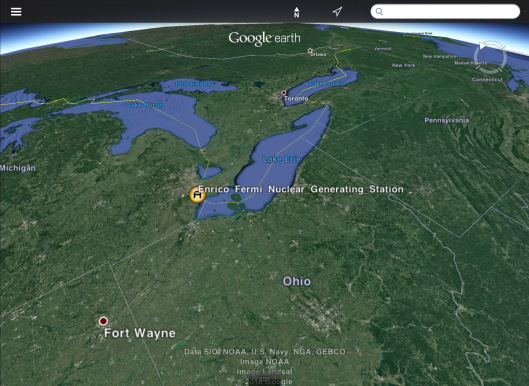
The next threat: A high-level nuclear waste dump near Lake Huron
|
The next threat: A high-level nuclear waste dump near Lake Huron https://www.voicenews.com/news/the-next-threat-a-high-level-nuclear-waste-dump-near-lake-huron/article_674abc28-c779-11ea-a297-c7742bb35220.html NWMO selects site near scrapped Ontario DGR, By Jim Bloch For MediaNews Group, Jul 16, 2020
No sooner than the Saugeen Ojibway Nation had voted overwhelmingly against Ontario Power Generation’s effort to build a deep geological repository for low and intermediate nuclear waste the repository on the lip of Lake Huron, a similar, perhaps more lethal threat has emerged. The Nuclear Waste Management Organization, the industry group tasked in 2002 with finding a permanent waste site for Canadian high-level nuclear waste, announced earlier this year that it had landed on two possible locations, down from 22 prospective sites — Ignace in northwest Ontario and the municipality of South Bruce, virtually next door to the now scrapped site for low and intermediate nuclear waste storage. “High-level radioactive waste in Canada is used (irradiated) nuclear fuel that has been declared as radioactive waste. Used nuclear fuel produces ionizing radiation,” according to the Canadian Nuclear Safety Commission. “This type of radiation has a strong ability to penetrate matter, so shielding against the radiation is required. Since used nuclear fuel contains significant quantities of radionuclides with long half-lives, it requires long-term management and isolation.” Low and intermediate nuclear waste refers to all other forms of nuclear waste. Calling any kind of radioactive waste “low level” is somewhat inaccurate, according to Diane D’Arrigo, the radioactive waste project director at the Nuclear Information and Resource Service, headquartered in Tacoma Park, Maryland. “A lot of what’s in that waste might be low level, but it’s not low risk,” said D’Arrigo. Both can contain the same dangerous radioactive elements. Like the scrapped plan, the new effort calls for a deep geological repository. The effort relies on core samples from the shelved DGR to demonstrate the ostensible suitability of the site. “In Huron-Kinloss and South Bruce, detailed assessment of available historic local and regional geo-scientific studies, including recent deep borehole data from the Bruce nuclear site, showed that the geological setting has a number of favourable characteristics for hosting a deep geological repository for used nuclear fuel,” according to information on the NWMO website. OPG proposed to excavate a storage chamber in a layer of limestone 2,200 feet underground, capped by shale on the top and granite below; OPG geologists estimated that the rock had been stable for 450 million years. The proposed site would be about 600 feet less deep. The members and financiers — via dedicated trust funds — of the NWMO are Ontario Power Generation, New Brunswick Power, Hydro-Québec and Atomic Energy of Canada Limited. Huron-Kinloss, which neighbors South Bruce, is no longer under consideration for the dump. South Bruce sits 29 miles southeast of Bruce Power nuclear station and about 20 miles east of Lake Huron. The DGR proposed for the Bruce Power site, home to eight reactors, was a half mile from Lake Huron. The nuclear complex is on the shore of Lake Huron, roughly 125 miles uplake of Port Huron and 150 miles uplake and upstream from Algonac. The new high-level waste dump would accept spent fuel rods from the 18 nuclear reactors in Ontario and the single reactor at Point Lepreau, New Brunswick. Like the previously proposed dump, the high-level dump is within the Great Lakes basin, inland from Kincardine, said Emily Grant, a South Bruce activist opposed to the project, via email. Grant is a member of the group Protect Our Waterways – No Nuclear Waste. NWMO optioned about 1,300 acres of land in January and “the site will lie directly below the Teeswater River, a tributary of Lake Huron,” said Grant. “As you know, the Great Lakes provide drinking water to over 30 million Americans and 10 million Canadians … There isn’t a single DGR that houses high-level radioactive material in the world, and this experiment does not belong anywhere near the world’s largest body of freshwater.” The Teeswater River flows generally north and joins the Saugeen River in Paisley, which then runs northwest and flows into Lake Huron at Southampton, 19 miles north of the Bruce Power nuclear station. “Spent fuel is thermally hot as well as highly radioactive and requires remote handling and shielding,” according to the U.S. Nuclear Regulatory Commission. Three of the byproducts of the fission process used to generate nuclear power remain dangerous for long periods of time. “Strontium-90 and cesium-137 have half-lives of about 30 years (half the radioactivity will decay in 30 years). Plutonium-239 has a half-life of 24,000 years.” Strontium-90 acts like calcium in the body, seeking out bones, where it can cause cancer; cesium-137 is a muscle seeker; plutonium-239 ends up in the bones, liver and spleen. “Some can give a lethal dose in 15-20 minutes unshielded,” D’Arrigo said. There is no level at which human exposure to radiation has been deemed safe. High-level nuclear waste will remain toxic for more than 100,000 years, ten times longer than the Great Lakes are old, and some of it for more than a million years. NWMO acknowledges this potential problem. “There is some uncertainty about how the system will perform over the very long term because we cannot obtain advance proof of actual performance over thousands of years,” says the organization. Protect Our Waterways – No Nuclear Waste announced on July 3 that it had hired environmental lawyer David Donnelly to help fight the repository. Right now, reactor operators are required to store high-level nuclear waste onsite. According to the Detroit Free Press in a December story, nearly 60,000 tons of spent fuel is parked at reactors that dot the shores of the Great Lakes in the U.S. and Canada. Nearly 3,000 spend fuel bundles await permanent interment in Canada. According to the NWMO’s prospective timeline, a final site will be chosen by 2023 and construction will begin in 2033. Ten years later, after costs of at least $23 billion, the dump will be in operation, accepting high-level waste for 50 years. Over the course of its construction and operating life, more than 2,000 people will be employed. The repository would be sealed and monitored for a certain amount of time and then essentially Right now, reactor operators are required to store high-level nuclear waste onsite. According to the Detroit Free Press in a December story, nearly 60,000 tons of spent fuel is parked at reactors that dot the shores of the Great Lakes in the U.S. and Canada. Nearly 3,000 spend fuel bundles await permanent interment in Canada. According to the NWMO’s prospective timeline, a final site will be chosen by 2023 and construction will begin in 2033. Ten years later, after costs of at least $23 billion, the dump will be in operation, accepting high-level waste for 50 years. Over the course of its construction and operating life, more than 2,000 people will be employed. The repository would be sealed and monitored for a certain amount of time and then essentially Right now, reactor operators are required to store high-level nuclear waste onsite. According to the Detroit Free Press in a December story, nearly 60,000 tons of spent fuel is parked at reactors that dot the shores of the Great Lakes in the U.S. and Canada. Nearly 3,000 spend fuel bundles await permanent interment in Canada. According to the NWMO’s prospective timeline, a final site will be chosen by 2023 and construction will begin in 2033. Ten years later, after costs of at least $23 billion, the dump will be in operation, accepting high-level waste for 50 years. Over the course of its construction and operating life, more than 2,000 people will be employed. The repository would be sealed and monitored for a certain amount of time and then essentially abandoned. Like the proposed dump for low and intermediate level nuclear waste, the NWMO says that the high-level dump will not go forward without the approval of the Saugeen Ojibway Nation, on whose historic lands the DGR will sit. “I would imagine that we will not allow high-level waste to be buried within our territory either, because that was the big fear with the last project, that high-level waste would go into it,” Vernon Roote, a former chief with the Saugeen First Nation, told CTV News London in March. Eighty-six percent of the first nation voted against the low and intermediate nuclear waste dump, 1,058-170, in January. Jim Bloch is a freelance writer. Contact him at bloch.jim@gmail.com. |
|
Los Alamos Study Group press Santa Fe Council – to stop Santa Fe becoming a nuclear sacrifice zone
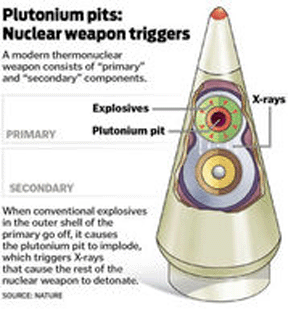 Santa Fe shouldn’t become a nuclear sacrifice zone https://www.abqjournal.com/1477033/santa-fe-shouldnt-become-a-nuclear-sacrifice-zone-ex-where-does-the-city-stand-in-matters-of-peace-the-environment-and-citizens-health-and-welfare.html,BY LYDIA CLARK, July 19th, 2020 This is an open letter to Santa Fe Mayor Alan Webber and the City Council:We, the Los Alamos Study Group, have now written to the Santa Fe City Council and the mayor of Santa Fe numerous times regarding two very important resolutions we have proposed, with no response of any significance from anyone.
These resolutions are of great import to the safety, health and welfare of the city and citizens of Santa Fe, and we are very concerned the City Council and mayor are ignoring these issues.
The City of Santa Fe has had a long-standing policy of resolutions supporting nuclear disarmament, supporting environmental impact statements and opposing production of nuclear weapons, specifically plutonium pit production.
Santa Fe has also been and is still a member of “Mayors for Peace,” which states that “nuclear weapons are inhumane” and calls for “their abolition.”
Recently, Mayor Webber attended a “peaceful protest” regarding racial issues. Is the destruction of humanity and the planet less important in keeping the peace?
The safety, health and welfare are only a part of the impact created from nuclear weapons production at Los Alamos National Laboratory. It uses and diverts much-needed funding for education, health care, sustainable jobs, and real safety and security away from New Mexico. The proposed FY2021 federal budget solely for plutonium pit production at LANL is now $1.1 billion (an increase since our last letter). How many truly beneficial programs for New Mexico would this support?
Nuclear weapons production creates vast amounts of toxic waste that has no safe method of disposal, with the potential to contaminate our environment from spills, leakage, fire hazard, seismic activity and human error. The waste currently being stored at LANL will not be transported for disposal any time in the near future. Where will the new waste be stored?
The recent exposure to LANL workers from a breach in a plutonium glove box is foreshadowing of things to come with the proposed plutonium pit factory at the facility. LANL has a history of safety failures.
The last plutonium pit factory, Rocky Flats (in Colorado), was forcibly closed for egregious environmental violations, worker injuries and deaths. Is New Mexico willing to create Rocky Flats II?
Why would the city officials not support asking for a Site-Wide Environmental Impact Statement (which is part of one of the above-referenced resolutions) that can help protect not only Santa Fe, but also the entire northern New Mexico region in this crucial matter?
The other resolution would bar the city from entering into development agreements with LANL or other nuclear weapons agencies. (There has been talk of a LANL presence on the city-owned Midtown Campus).
Your lack of concern and response is disturbing, and we ask once more for a prompt response to the request for support and implementation of these two resolutions, and an explanation to the public of the position of the city of Santa Fe in matters of peace, sustainability, environmental protection, and the health and welfare of our citizens, and the citizens of New Mexico.
Do not allow our city to become a nuclear sacrifice zone.
Lydia Clark is outreach director-Santa Fe for the Los Alamos Study Group.
Atomic veterans – the health damage to America’s nuclear workers and soldiers
The lasting effects of working with nuclear weapons https://www.wcax.com/2020/07/19/the-lasting-effects-of-working-with-nuclear-weapons/ By WCAX News Team [includes excellent short video] Jul. 19, 2020 BURLINGTON, Vt. Seventy-five years after the world’s first atomic bombs were dropped in Japan, the people and the island are still feeling the impacts.
Nuclear weapons also have had a lasting effect on American soldiers.
Garry DeFour is a Vermonter who served in the U.S. Senate Committee on Veteran Affairs between 1979 and 1981.
During those few years, he learned about the U.S. Marines who were sent to Nagasaki to help with the clean-up process after the Atomic bomb was dropped. “Now, thirty-five years later several Veterans that served in Nagasaki — are inflicted with rare blood diseases and bone-cancer,” Atomic Veterans Specialist Garry DeFour said.
He says many soldiers who helped create and test nuclear weapons also became contaminated.
Years later, some started to report severe illnesses, stemming from what they believe was from their time serving in the military.
“We were told for years to keep out mouths shut until President Clinton in 1996 did a proclamation that now Veterans could talk about it to the V.A.,” DeFour said. Vets did talk about it, and some even got compensation from the Government because of the on-going health problems they face.
They’re known as Atomic Veterans.
DuFour’s been working on a documentary highlighting the soldiers.
He estimates there are still about 28,000 still living. He believes the U.S. has no need for nuclear weapons and cites a colleague who helped create the hydrogen bomb.
“As Dr. Kenneth Ford told me, he said we have enough conventional weapons, to give a great defense,” DeFour said
Nuclear threat still looms
Commentary: Nuclear threat still looms https://www.limaohio.com/opinion/columns/418966/commentary-nuclear-threat-still-looms, By Lilly Adams – Tribune News Service, 19 Jul 20,
On July 16, 1945, at around 5:30 a.m., 11-year-old Henry Herrera was outside his home in Tularosa, New Mexico, helping his father work on the radiator of their truck, when he saw a blinding flash of light. He thought he was witnessing the end of the world. In fact, he was witnessing the first ever use of a nuclear weapon — the Trinity nuclear test.
A few weeks later, on Aug. 6 and 9, the newly tested weapons were used on Japan, in Hiroshima and Nagasaki, killing 150,000 to 246,000 innocent people. In 1946, nuclear testing began in the Marshall Islands; it would continue there until 1958, and in the United States until 1992. The production of these weapons, with its own harmful consequences, continues today. Even worse, Congress recently voted to fund expansion of the nation’s nuclear weapons program.
In a cruel twist of fate, July 16 is a double nuclear anniversary for New Mexico. On that day in 1979, a dam holding back radioactive waste at the Church Rock uranium mill broke, releasing 1,100 tons of uranium waste and 94 million gallons of radioactive water into the Rio Puerco, across three Navajo Nation chapters, and into Arizona. After both July 16 events, no health studies or medical resources were provided for residents, leaving those affected to battle the resulting illnesses and deaths alone.
Last summer, after marking these anniversaries, my colleagues and I felt a sense of anti-climax. Something was missing. Perhaps after so long, we had become numb in the face of this history of death.
As we approached the 75th anniversary of the fateful bombings of Japan, we decided we needed to do more.
To begin, we reached out to our partners in Japan, and learned an important lesson. The survivors of the bombings, known as hibakusha, generally focus on messages of hope and resiliency, in pursuit of opportunities to build a peaceful world. They share their haunting memories of the bombings, but then they look forward and demand progress.
We also looked to the survivors of nuclear weapons activities here at home. Estimates range from tens of thousands to hundreds of thousands of people in the United States and in the Marshall Islands that have been sickened and killed due to nuclear weapons testing, uranium mining and nuclear-weapons production.
Despite the distances between them — in time, place and culture — the stories of many of these survivors are the same. A flash of blinding light, the feeling the world was ending. Falling dust and powder — like snow — that sickened people and would lead, eventually, to cancers. Secrecy and neglect shrouded their experiences for decades.
United by these tragedies, now most impacted communities have the same ultimate goals: ensuring these weapons are never used again, and that they are one day eliminated.
With these goals in mind, our national coalition is gathering virtually on Aug. 6 and 9, the anniversaries of the bombings in Hiroshima and Nagasaki. The event will feature presentations from many of the 150 groups that have joined the effort so far. We hope readers will join us to learn more and hear from the people who have been impacted and are fighting for change.
Seventy-five years after these bombings, nuclear weapons are still here, continuing to threaten every person on earth. But the survivors are still here, too. And in a time of separation and mourning, this is a chance to stand in solidarity with communities around the world that are calling for peace.
Reflecting on Cape Cod’s Cold War nuclear history
Sadly, this lack of nuclear knowledge is not solely a Cape Cod problem. Nationwide, nuclear education is lacking. Most people do not know the United States government conducted 1,032 nuclear tests that sickened and killed thousands of people around the world. It is not general knowledge that the United States and Russia still possess more than 90% of the world’s remaining nuclear weapons — about 6,000 each.
So, as you eat ice cream, photograph cotton candy sunsets, and talk about how different the world is because of the pandemic, it’s worth brushing up on your nuclear history and learning how nuclear weapons continue to affect our daily lives. Thankfully, when it comes to reducing nuclear threats, Massachusetts legislators have led the way for decades. Today, our delegation continues to champion policies that protect their constituents — and the world — from nuclear catastrophe.
Kentucky man indicted after illegally dumping nuclear waste at landfill.
Associated Press 19 Jul 29, LEXINGTON, Ky. (AP) — A federal grand jury has indicted a Kentucky man with illegally dumping low-level nuclear waste at an Estill County landfill.The Lexington Herald-Leader reports that Cory David Hoskins was indicted Thursday on multiple charges earlier this week, including violating safety regulations and mail fraud due to checks as part of the alleged crimes.
In 2016, Hoskins and his company TENORM were each fined $2.65 million by the Kentucky Cabinet for Health and Family Services after officials said Advanced TENORM was responsible for dumping of out-of-state radioactive waste in landfills in Estill and Greenup counties.
Officials say the waste was a byproduct of fracking and had been transported from Ohio, West Virginia and Pennsylvania in 2015…….. https://www.courier-journal.com/story/news/crime/2020/07/18/kentucky-man-indicted-illegally-dumping-nuclear-waste-landfill/5465037002/
America’s nuclear attack on itself ? The fallout from nuclear testing
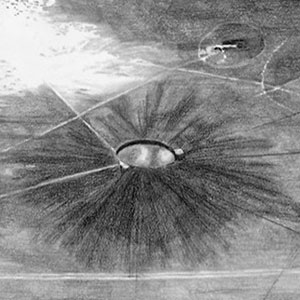
Above – Trinity nuclear test site crater 1945
It’s Been 75 Years, and America Still Won’t Admit a Nuclear Disaster. Remember when we blew radioactive ash over New Mexico? Now the Trump administration is talking about testing bombs again. https://www.nytimes.com/2020/07/15/opinion/75-anniversary-trinity-nuclear-testing.html, By Joshua Wheeler, Mr. Wheeler is the author of “Acid West.” July 15, 2020 When America detonated the world’s first atomic bomb at 0529 hours on July 16, 1945, it was an attack on American soil.
The blast melted the sand of southern New Mexico and infused it with the bomb’s plutonium core — 80 percent of which failed to fission — scattering radioactive material across the desert. The first atomic bomb was both a feat of engineering and, by today’s standards, a crude dirty bomb.
An Army doctor later wrote about Trinity: “A few people were probably overexposed, but they couldn’t prove it and we couldn’t prove it. So we just assumed we got away with it.”
Aboveground nuclear testing was halted in 1963. Underground testing, which is comparably safer but still terrifying, was stopped in 1992. But today the Trump administration is floating the idea of resuming such testing — despite the fact that America is, after more than 1,000 tests, already the most nuclear-bombed country in the world.
Any explosive nuclear test is an escalation toward global annihilation.
But the decision to resume explosive nuclear tests should never be made at all. We can and do perform successful tests in virtual-reality chambers using advanced supercomputers. Explosives tests of any kind carry magnitudes more risk, and the consequence of that risk has historically fallen on the most vulnerable Americans.
It should come as no surprise that the downwinders of Trinity were largely impoverished agricultural families, mostly Hispanic and Native. New Mexico, one of the poorest states in the nation, is the only one with a cradle-to-grave nuclear industry, where weapons are designed, uranium mined, and waste stored. After a recent study from the Nuclear Regulatory Commission raised no concerns, the federal government looks poised to finalize Holtec International’s bid to store nuclear waste between the New Mexico towns of Hobbs and Carlsbad, despite vehement objections from the governor and many residents of the area. And any resumed nuclear testing would add more radioactive waste to the controversial storage site already in existence near Carlsbad.
This is further evidence of what’s been called radioactive colonialism, where minority and impoverished communities are forced to suffer the costs of the nuclear industry.
Henry Herrera, whose family’s drying linens were stained by the fallout on that July morning in 1945, told me: “We were lab rats. That ought to make us hero patriots or something. Which we are. But nobody gives a damn.” Mr. Herrera, his brother and his two sisters all had cancer.
If Congress truly wants to awaken Americans to the dangers of nuclear testing, it should start by finally telling the truth about the disaster at Trinity. Bills to acknowledge and compensate Mr. Herrera and other Trinity downwinders have lingered in legislative purgatory for over a decade. Passing them would help establish what should be obvious: The shameful legacy of nuclear weapons testing is something we should never attempt to revive.
Joshua Wheeler is the author of the essay collection “Acid West.” He teaches in the creative writing program at Louisiana State University.
The Times is committed to publishing a diversity of letters to the editor. We’d like to hear what you think about this or any of our articles. Here are some tips. And here’s our email: letters@nytimes.com.
Follow The New York Times Opinion section on Facebook, Twitter (@NYTopinion) and Instagram.
Global heating is turning cities into death traps
|
Cities Are Becoming Climate Death Traps https://newrepublic.com/article/158537/cities-becoming-climate-death-traps 17 July 20 A new era of heat waves is here. We aren’t ready. As the coronavirus pandemic continues throughout the United States, another deadly pandemic comes out to strike in the summer: extreme heat. Year after year, more people are dying because it’s simply too hot. As of right now, both this country and others lack even an accurate way of counting those deaths—let alone a comprehensive plan to reduce them. Thanks to climate change, it’s about to get much worse.
For the past week, the American South and Southwest have been experiencing record-breaking temperatures. The National Oceanic and Atmospheric Administration has predicted above-average heat for nearly the entire U.S. this summer. Unprecedented, early-summer heat waves roasted the Middle East in May and Siberia in June, setting the latter on fire. Arizona had its earliest-ever hundred-degree heat wave in April—and another 110 degree heat wave in May. Spain endured 105 degree heat this month. When the heat index, a “feels-like” combination of temperature and humidity, reaches 104 degrees Fahrenheit indoors or out, human body temperature risks rising above the typical roughly 99 degrees Fahrenheit. When body temperature rises above 104 degrees, the consequences can be fatal within 30 to 60 minutes. “Heat-related deaths are notoriously difficult to track because the role of heat isn’t always obvious. One 2017 study found that extreme heat can kill people in 27 different ways,” Juanita Constible, senior advocate, climate and health at the National Resources Defense Council, told me. “If someone dies of a heart attack during a heat wave, there’s a good chance that’s how their death will be recorded by officials, even if high temperatures were the trigger.” Many scientists argue that official heat-death counts underestimate substantially. According to the World Health Organization, 166,000 people died due to heat waves between 1998 and 2017, but the true figure may be far higher. In the U.S., the Centers for Disease Control and Prevention only count deaths where heat illness is explicitly noted, so the official CDC count of heat-triggered deaths sits at just around 600 per year. Epidemiologists estimate that the real figure may be closer to 12,000—20 times higher than the official count. Climate change is making heat waves longer, hotter, and more deadly. Scientists estimate that 80 percent of record-breaking heat waves would not have occurred without human-caused warming due to greenhouse gas emissions. And urban areas, in particular, face special risk of heat deaths because of the heat island effect, in which dark pavement, roofs, and concrete absorb additional heat, making temperatures much hotter than the reported weather in any given city. In the U.S., heat deaths have more than doubled in Arizona in the last 10 years. Last year, a dangerous heat wave hit while storms left residents in the D.C. and New York City metro areas without power. Power outages can be deadly in a heat wave because without air conditioning, many people can’t cool off. In two heat deaths in a 2018 Arizona heat wave, the deceased were found indoors with a broken air conditioning unit that they couldn’t afford to fix. “Some people won’t use their air conditioning because they’re afraid of the bills,” Patricia Solís, executive director of the Knowledge Exchange for Resilience at Arizona State University, told National Geographic. “They think they’re OK without it, but that’s how people die.” “There are huge policy gaps in the U.S. with respect to extreme heat protections,” Rachel Licker, a senior climate scientist at the Union of Concerned Scientists, told me. “We found that without real action on climate change, by midcentury more than 250 cities across the U.S. are projected to experience 30 or more days with a heat index above 100 degrees Fahrenheit. This includes many cities that historically haven’t experienced this level of extreme heat.” |
|
Massive wildfire in rural central California

 Massive wildfire in rural central California, https://www.sbs.com.au/news/massive-wildfire-in-rural-central-california 17 Jul 20 More than 900 firefighters aided by helicopters and air tankers battled a wildfire in a rural area of central California.
Peace cranes flyimg in Vermont , in support of U.N. Treaty on the Prohibition of Nuclear Weapons
 Peace cranes on Church Street aim to abolish nukes, https://www.wcax.com/2020/07/17/peace-cranes-hanging-on-church-street-to-abolish-nuclear-weapons/ WCAX News Team Jul. 17, 2020 BURLINGTON, Vt. (WCAX) – Cranes are a symbol of peace in many cultures, and 1,000 origami peace cranes from Japan are now displayed in front of Burlington City Hall in observance of next month’s 75th anniversary of the atomic bombings of Hiroshima and Nagasaki in World War II.The story behind the peace cranes is of a little girl, Sadako Sasaki, who developed cancer from atomic radiation because of the Hiroshima bombing. Sasaki started getting sick around age 11.
Robin Lloyd, an activist for abolishing nuclear weapons, believes Sasaki’s story will not only reach the hearts of Vermonters but also teaches an important lesson.
“The cranes date from a little girl who got leukemia from the Hiroshima bombing,” Lloyd said. “Then her health started to fail and her friends said, ‘If you can fold 1,000 cranes, then your wish will come true.‘”
Sasaki died before she reached 1,000 cranes, but her story lives on. Organizers at Thursday’s event in Burlington say they want to use the peace cranes to gain support for the abolition of nuclear weapons.
Joseph Gainza, a longtime Vermont peace activist, says that Vermont has supported nuclear weapons abolition in the past.
”The House of Representatives overwhelmingly — and the Vermont Senate unanimously — voted on a resolution calling on the United States to enter into the nuclear weapons abolition treaty,” Gainza said.
Today, the Treaty on the Prohibition of Nuclear Weapons continues to gain support, according to Maho Takahashi, an activist in Burlington. ”With that treaty, once 50 countries ratify it, it will enter into force,” Gainza said.
The peace cranes will be flying for the next week. Each crane has a lesson that visitors are encouraged to take and learn from.
California Coastal Commission unanimously approves storage plan at San Onofre Nuclear Generating Station
California Coastal Commission unanimously approves storage plan at San Onofre Nuclear Generating Station CBS8, 17 Jul 20, The Commission voted 10-0 to approve the program to allow storage of spent nuclear fuel on-site. SAN DIEGO COUNTY, Calif. — The California Coastal Commission voted 10-0 in a special meeting today to approve an inspection and maintenance program allowing Southern California Edison to store spent nuclear fuel in a storage site at the San Onofre Nuclear Generating Station.
The program outlines actions SCE will take to inspect the canisters that contain spent nuclear fuel, as well as how potential issues with the canisters will be remedied.
Robotic devices will be used to inspect the canisters and site conditions will be simulated on a test canister, which will be observed for potential degradation. Two spent fuel storage canisters will be inspected every five years starting in 2024, and the test canister will be inspected every two to three years.
Canister flaws will be repaired by the application of a nickel-based metallic spray, and the presence of flaws may result in increased canister inspection frequency and an increase in the number of canisters inspected.
The inspection and maintenance program was also reviewed by the engineering consulting firm LPI, which provided recommendations that included the increase in canister inspections should flaws arise.
Nearly 3.6 million pounds of spent nuclear fuel are stored at the plant, which stopped producing electricity in 2012.
Concerns remain over the plant’s proximity to the ocean and the potential for the site to be affected by rising sea levels, tsunami inundation, seismic hazards.
By 2035, the commission may look to relocate the canisters to another site, although no such location is available, according to a commission report. ……. https://www.cbs8.com/article/news/local/san-onfre-nuclear-power-plant-storage-approval/509-b0c102a6-86b7-45c3-a5d7-b5013cfc19c4
Nuclear waste is piling up in California: leadership is needed
Gov. Gavin Newsom and leaders from the Legislature must demand action on nuclear waste and fill gaps in oversight. By Bart Ziegler, CalMatters, 17 Jul 20,
Bart Ziegler is president of the Samuel Lawrence Foundation, a nonprofit based in Del Mar, bart@samuellawrencefoundation.org.
From San Onofre to Humboldt Bay, nuclear waste is piling up in California.
This most-toxic waste – tons and tons of it – is deadly for 200,000 years. Stranded next to a rising ocean at aging and decommissioned plants, the waste has no permanent home.
California is overdue in showing leadership.
Just as California has broken ranks with the federal government on regulating greenhouse gas emissions, Gov. Gavin Newsom and leaders from the Legislature must demand action on nuclear waste and fill gaps in oversight.
With federal regulators all but cornering nuclear policy, the industry all too often is left to regulate itself. Meanwhile, private contractors slop at ratepayer-funded decommissioning troughs while running loose with safety.
Enough is enough, California!
In north San Diego County, conditions at the shuttered San Onofre Nuclear Generating Station scream for state intervention, as Rep. Mike Levin, a Democrat from San Juan Capistrano, concluded in a task force report issued recently.
First, some background.
Decommissioning started this year at the San Onofre plant, which quit making electricity in 2012. The plant’s majority owner, Southern California Edison, has opened its $4 billion decommissioning purse to Holtec International as lead contractor in charge of transferring 3.6 million pounds of spent nuclear fuel from cooling pools to a storage system of Holtec’s design.
That’s where things get dicey.
Edison’s contractors are cramming the spent fuel assemblies into thin-walled, steel canisters. Workers hoist the canisters from wet storage with a behemoth, track-driven gantry crane and crawl them to a concrete, dry-storage vault. That’s where the 73 canisters will stay. Indefinitely.
Public hand-wringing intensified after a near-accident in 2018 involving a fully-loaded canister and the release of reports showing the canisters are prone to gouging during transfer. That can lead to corrosion and failure, especially in a marine environment. To make matters worse, the canisters cannot be repaired, monitored, inspected or transported once entombed in the vault.
What can California do? For starters, leaders can immediately improve oversight of nuclear waste storage.
Nuclear plant owners admit to not having developed procedures to replace fully-loaded canisters. That’s why, as part of decommissioning California’s coastal nuclear plants at San Onofre, Diablo Canyon and Humboldt Bay, the state Coastal Commission must demand the construction of handling facilities – known as “hot cells” – where canisters can be repaired or replaced.
State lawmakers should order construction of a hot cell at the decommissioned Rancho Seco Nuclear Generating Station, just 40 miles south of their offices in Sacramento.
In San Diego County, near the border with Orange County, 8.2 million people live within 50 miles of the old San Onofre plant. On July 16, the California Coastal Commission is set to act on a staff recommendation to approve Edison’s application to dismantle the plant’s cooling pools. That approval would be disastrous. For now at least, the spent fuel cooling pools provide our last option for dealing with a damaged canister.
Coastal Commissioners are appointed by the same Legislature that should prepare for a crisis instead of responding to one. You don’t wait for a fire to create a fire department. Preparation is cheaper and faster than responding to a crisis. Tragically, the COVID-19 pandemic has shown that preparation is not always our strongest suit.
As recommended in the Report of the San Onofre Nuclear Generating Station Task Force, a state model would improve agency coordination on waste storage permit applications and increase engagement with federal agencies to advance solutions for containing and handling deadly nuclear waste. The solutions should be tied to strict, economic enforcement.
Coastal commissioners, lawmakers, regulators and anyone else with a stake in California – that’s nearly 40 million of us – should read the report and demand action on nuclear waste.
Slow progress of Michigan bill opposing high-level nuclear waste dump
Michigan bill opposing high-level nuclear waste dump languishes in Senate committee Iosco County News Herald, By Jim Bloch For MediaNews Group,Jul 16, 2020
-
- The Michigan House of Representative passed a concurrent resolution on Feb. 5 opposing the proposed high-level nuclear waste dump near the shores of Lake Huron in the municipality of South Bruce, Ontario, Canada.
The resolution was sponsored by Gary Howell, the republican representative of the 82nd District, which comprises Lapeer County.
It urges “the United States Congress to take every legal action possible to prevent the construction of any underground high-level nuclear waste repository in the Great Lakes basin,” and urges “the Canadian government to prohibit a high-level nuclear waste repository anywhere in the Great Lakes basin.”
One of the cosponsors of the resolution was Gary Eisen, the St. Clair Township Republican who represents the 81st District, which swoops around the southern half of St. Clair County and includes Marysville, St. Clair, Marine City and Algonac, as well as surrounding townships.
“It’s sitting in the Senate now in Dan Lauwers’s committee,” Eisen said in June, noting that the onset of the COVID-19 pandemic put the brakes on a lot of the legislature’s work. “Everything’s ten times harder now.”
The resolution is in the Committee on Energy and Technology, which Lauwers chairs. His 25th Senate District includes St. Clair County………..
“Placing a deep geological repository near the Great Lakes is a high-risk venture with the potential of causing irreparable harm to millions of lives,” said the resolution. “Underground waste repositories have leaked in the past, costing billions of dollars to repair. Germany, for instance, is spending billions of dollars to dig up low- and intermediate-level radioactive waste that was stored in a salt mine due to leakage and other environmental concerns. In 2014, chemical reactions in a steel barrel full of radioactive waste caused an explosion and fire at a low- and intermediate-level underground waste site in Carlsbad, New Mexico causing a cloud of radioactivity to be released at the surface. Not only did this put the health and safety of the public at risk, it cost taxpayers $2 billion to clean up and repair. As demonstrated, low- and intermediate-level facilities have failed, and this high-level nuclear proposal provides no guarantee, whatsoever, to keep radioactive waste from our environment.”
If the Michigan Senate approves the resolution, it will be sent to Prime Minister of Canada, the Minister of Environment and Climate Change, the Minister of Foreign Affairs, the Premier of Ontario, the Canadian Nuclear Safety Commission, the Canadian Environmental Assessment Agency, the Speaker of the U.S. House, the President of the U.S. Senate, the members of the Michigan congressional delegation, and the U.S. Nuclear Regulatory Commission.
On Jan. 17, Michigan’s U.S. Sens. Debbie Stabenow and Gary Peters, along with Congressman Dan Kildee and Congressman John Moolenaar, introduced a bipartisan resolution opposing Canada’s placement of a permanent nuclear waste storage in South Bruce.
If the Michigan Senate approves the resolution, it will be sent to Prime Minister of Canada, the Minister of Environment and Climate Change, the Minister of Foreign Affairs, the Premier of Ontario, the Canadian Nuclear Safety Commission, the Canadian Environmental Assessment Agency, the Speaker of the U.S. House, the President of the U.S. Senate, the members of the Michigan congressional delegation, and the U.S. Nuclear Regulatory Commission.
On Jan. 17, Michigan’s U.S. Sens. Debbie Stabenow and Gary Peters, along with Congressman Dan Kildee and Congressman John Moolenaar, introduced a bipartisan resolution opposing Canada’s placement of a permanent nuclear waste storage in South Bruce. http://www.iosconews.com/news/state/article_c5a6ae58-996b-5665-b599-cfa8fde7c6ae.html
State of Texas allows reduction in price of importing nuclear waste
State allows reduction in price of importing nuclear waste to Texas https://news4sanantonio.com/news/trouble-shooters/state-allows-drastic-reduction-in-price-of-importing-nuclear-waste-to-texas by APRIL MOLINA, Friday, July 17th 2020 SAN ANTONIO — The state has agreed to allow a private company in West Texas to drop the price charged for incoming nuclear waste.
Waste Control Services (WCS) has been disposing of the nation’s low level nuclear waste in Andrews County at a cost of $100 dollars per cubic foot for Class A waste and $1000 dollars per cubic foot for Class B and C waste.
There is an additional surcharge of 40 cents per unit of radioactivity, but The Texas Commission on Environmental Quality recently approved the request by WCS to drop the price to 5 cents per unit.
A spokesman for WCS explained the market is dynamic so when the price drops, they need to be able to continue to compete.
Public Citizen Texas Office Director, Adrian Shelley worries that by allowing WCS to import nuclear waste at a fraction of the cost, it could result in massive liability for the state.
“If WCS collects less money to import waste in Texas, then there will be less money available should an accident occur and ultimately we’re concerned Texas taxpayers will be on the hook should an accident occur,” Shelley said.
The company doesn’t expect less revenue, rather they anticipate more income as a result of the price drop.
WCS reports Andrews County gets 5% of their revenue and the state gets 25%.
WCS has also been working to get approval for years to temporarily store the nation’s high level nuclear waste that would include spent nuclear fuel rods.
1 This Month

of the week– Nuclear Reactor Information Task Force

14 May – online event From Bombs to Data Centres: the Face of Nuclear Colonialism
To see nuclear-related stories in greater depth and intensity – go to https://nuclearinformation.wordpress.com
-
Archives
- May 2026 (92)
- April 2026 (356)
- March 2026 (251)
- February 2026 (268)
- January 2026 (308)
- December 2025 (358)
- November 2025 (359)
- October 2025 (376)
- September 2025 (257)
- August 2025 (319)
- July 2025 (230)
- June 2025 (348)
-
Categories
- 1
- 1 NUCLEAR ISSUES
- business and costs
- climate change
- culture and arts
- ENERGY
- environment
- health
- history
- indigenous issues
- Legal
- marketing of nuclear
- media
- opposition to nuclear
- PERSONAL STORIES
- politics
- politics international
- Religion and ethics
- safety
- secrets,lies and civil liberties
- spinbuster
- technology
- Uranium
- wastes
- weapons and war
- Women
- 2 WORLD
- ACTION
- AFRICA
- Atrocities
- AUSTRALIA
- Christina's notes
- Christina's themes
- culture and arts
- Events
- Fuk 2022
- Fuk 2023
- Fukushima 2017
- Fukushima 2018
- fukushima 2019
- Fukushima 2020
- Fukushima 2021
- general
- global warming
- Humour (God we need it)
- Nuclear
- RARE EARTHS
- Reference
- resources – print
- Resources -audiovicual
- Weekly Newsletter
- World
- World Nuclear
- YouTube
-
RSS
Entries RSS
Comments RSS
 nuclear-news
