Trump/Newsom Attack Renewables and Push Nuclear

the Trump family’s media company announced a merger with TAE Technologies, a California-based nuclear fusion company, in a deal worth over $6 billion. So, Trump now has a vested financial interest in nuclear power.
Trump-style, Democrat Newsom has also backstabbed a 2018 comprehensive plan he had signed to phase in a 100% renewable energy-based state grid while phasing out the embrittled, hyper-expensive Diablo reactors, which are surrounded by earthquake faults.
Karl Grossman – Harvey Wasserman
Amidst Donald Trump’s wild Middle East War declarations, the tech billionaire push to nuclear reactor suicide has escalated with the shock relicensing of California’s two nuclear power plants at Diablo Canyon, now being pushed by the state’s liberal Governor Gavin Newsom, who has also joined Trump in their all-out attack against renewable energy.
Together, Trump and Newsom are pushing decrepit, virtually uninsured, militarily indefensible nuclear power plants whose drastic deregulation may now rival the dangers posed by any bombs Iran could produce
They also make no economic or ecological sense.
Despite the latest tsunami of “Nuclear Renaissance” hype, nuclear power plants are losing bigly to the worldwide surge in renewable energy. Solar panels, wind turbines, geothermal, and epic advances in battery storage continue to make the green alternative to fossil fuels and nuclear reactors—big and small—a far cheaper, safer, cleaner, more reliable, more job-producing alternative.
Despite the all-out Trump/Newsom all-out anti-green attack, as the “independent global energy think tank” Ember reported last month, “the world installed a record 814 GW of new solar and wind capacity in 2025, 17% more than in 2024 (696 GW).”
“The latest additions bring the combined global installed capacity of wind and solar to 4,174 GW (over 4 TW),” it said.
One GW (gigawatt) equals a billion watts, roughly the capacity of a big nuclear power plant; a TW is a trillion watts.
London-based Ember adds that “solar accounted for the majority of new capacity additions, with almost 4 GW of new solar added globally for every 1 GW of wind.”
Reuters reported last month: “Renewable power made up almost 50% of the world’s electricity capacity last year after a record increase in solar installations.”
Despite the nuclear power push, some 90% of Earth’s annual newly installed annual generating capacity for the past few years has been solar, wind or geothermal, with battery backup.
Nonetheless, Republican Trump says, “nuclear’s a great energy.” His flood of executive orders on nuclear power have weakened or eliminated nuclear safety regulations—making nuclear power plants more dangerous than ever—and has expedited their being built. Last year his administration finalized an $80 billion deal with Westinghouse for new nuclear power plants.
Also, last year, the Trump family’s media company announced a merger with TAE Technologies, a California-based nuclear fusion company, in a deal worth over $6 billion. So, Trump now has a vested financial interest in nuclear power.
Trump is also attacking wind turbines everywhere. He even wants a $928 million chunk of taxpayer cash spent to kill a French-proposed offshore wind project and to instead fund Texas gas/oil projects, some of which will go for export.
Trump is joined in his all-out war on renewables by Newsom’s pro-utility rate hikes, virtually killing California’s once-booming rooftop photovoltaics industry, costing thousands of jobs and billions in extra rate payments. Even a proposed “balcony solar” bill would strictly limit a technology now cheap, reliable, and enough to power the whole state, as it does on a regular basis, without the need for Diablo’s hyper-expensive billionaire-benefitted power.
Trump is also attacking wind turbines everywhere. He even wants a $928 million chunk of taxpayer cash spent to kill a French-proposed offshore wind project and to instead fund Texas gas/oil projects, some of which will go for export.
Trump is joined in his all-out war on renewables by Newsom’s pro-utility rate hikes, virtually killing California’s once-booming rooftop photovoltaics industry, costing thousands of jobs and billions in extra rate payments. Even a proposed “balcony solar” bill would strictly limit a technology now cheap, reliable, and enough to power the whole state, as it does on a regular basis, without the need for Diablo’s hyper-expensive billionaire-benefitted power.
Trump-style, Democrat Newsom has also backstabbed a 2018 comprehensive plan he had signed to phase in a 100% renewable energy-based state grid while phasing out the embrittled, hyper-expensive Diablo reactors, which are surrounded by earthquake faults.
Trump has promised many millions to cover a loan to keep Diablo operating. But state legislators fear he may leave them holding much of the bag. They could vote to turn down the NRC’s 20-year license extension, and close Diablo instead in 2030.
But Newsom, who’s term-limited this year, will be pushing hard, even as his Diablo betrayal underscores global economic failure of nuclear power.
The two nuclear power projects in the U.S. since 2000 have been fiscal fiascoes. Construction of two plants in South Carolina was halted, the would-be plants abandoned, wasting $9 billion while producing zero electricity. Two plants at Vogtle, Georgia, opened seven years late, costing nearly $40 billion, more than double their original price. Projected cost estimates for the ceaselessly hyped “Small Modular Reactors” vastly exceed current prices for proven battery-backed solar, wind and geothermal.
And from the Diablo Canyon nuclear power plants in California to the Palisades plant in Michigan to the Indian Point plants in New York and onto Ukraine and Iran, the perils of nuclear power are clear.
Coupled with nuclear war, nuclear power—hyped as “Atoms for Peace” in the last century—and the more than 400 nuclear power plants worldwide that are now in operation, 94 of them in the United States, constitute lethal threats. The ability of the human species to survive on this planet is being put in nuclear danger, and not just at Diablo Canyon.
Kevin Kamps, executive director of Don’t Waste Michigan, the statewide anti-nuclear coalition founded in the mid-1980s, commented in an interview: “The nuclear industry’s massive campaign contributions to help get its preferred politicians elected in the first place, and it’s even more massive lobbying expenditures to influence office holders and government bureaucrats, explains its stranglehold on law and regulation—it’s the best pro-nuclear democracy money can buy, to paraphrase Greg Palast,” said Kamps. (Palast is the author of the book The Best Democracy Money Can Buy.)
“The industry barbarians are so running rampant through the ‘Halls of Power,’ we might as well just hand over the keys to the U.S. Treasury to the nuclear lobbyists and their bosses,” says Kamps.
“Nearly $400 billion in nuclear power bailouts, at federal taxpayer expense, was authorized in just three bills—the Infrastructure Investment and Jobs Act of 2021, and the Inflation Reduction Act of 2022 as well as the absurdly named, downright dangerous ADVANCE Act of 2024 (“Accelerating Deployment of Versatile, Advanced Nuclear for Clean Energy”). The three bills, signed into law by President Biden, teed up the current even more outrageous giveaways under Trump, not to mention the regulatory free fall, without a parachute, regarding safety, security, health, and the environment.”
“Such collusion,” said Kamps, “between safety regulators, industry, and government officials, was the root cause of the still unfolding Fukushima Daiichi nuclear catastrophe that began in 2011, the Japanese Parliament officially concluded after its year-long independent investigation, the first in its history.”
“After successfully lobbying Michigan Governor Gretchen Whitmer to champion the unprecedented zombie reactor restart of the infamous, closed Palisades reactor, and to grant Holtec $300 million of state taxpayer funding for its trouble, the head of the University of Michigan nuclear engineering department was downright giddy.” Todd Allen, as reported in Stateline, said: “You’re starting to see a lot of states transition to a position where they’re supportive of nuclear. And compared to 30 years ago, the amount of federal support for nuclear is unbelievable.”
Said Kamps: “It is unbelievable, in a shocking, horrifying, insanely exorbitant, and extremely risky sense.”
The U.S. Nuclear Regulatory Commission, emasculated by Trump, has just extended the operating licenses of the two Diablo Canyon nuclear power plants by 20 years.
They are now more than 40 years old—with 40 years the length of time nuclear regulators originally set as the limit for a nuclear power plant running before its innards became embrittled by radioactivity leaving them prone for accidents. And. indeed, both Diablo Canyon plants are now deeply embrittled.
Further, the earthquake faults that surround the Diablo Canyon nuclear plants could easily trigger a catastrophic accident. Indeed, the other major industry in the area of the Diablo Canyon plants are hot spas.
The plants were to be shut down, Unit 1 in 2024 and Unit 2 in 2025, but California Governor Newsom, a Democrat, led in undoing that arrangement.
In the middle of the U.S., the Palisades nuclear plant was closed in 2022, after five decades of operation, and Holtec International got a contract to decommission it. But then Holtec turned around and said it would instead restart the plant. It would be first restart of a closed nuclear power plant in U.S. history.
Last week, Don’t Waste Michigan warned of “dire consequences” in a little more than a year following a restart. It issued a report by Arnie Gundersen, a nuclear engineer with 55 years experience, that cited a document of Holtec contractor, Framatone, that said “if Palisades is allowed to restart, the steam generators will degrade quickly.”
Gundersen said Framatone “determined that Palisades cannot operate safely even after just the first 14.5 months. Holtec’s contractor admits the likelihood of damage will increase ‘exponentially’ after that point if Palisades is restarted.”
The proposed restart has been made possible by $3.12 billion in federal grants and loans and funds from the state of Michigan with Michigan Governor Whitmer, a Democrat, a major advocate of a Palisades restart.
As Roger Rapoport, an author and journalist who has long reported on nuclear power and also Palisades, wrote last month in the Detroit Free Press, how Holtec International’s purported “unprecedented milestone in U.S. nuclear energy” may be turning into a millstone. Holtec is attempting the first-ever reopening of a nuclear plant permanently closed for decommissioning—the Palisades reactor….Twenty-one months into the project, Holtec has announced delay after delay while continuing to draw vast public subsidies…”
Currently, “Holtec seeks exceptions from Nuclear Regulatory Commission for work on a reactor so noncompliant that no government agency would even consider approving its construction today….After multiple delays…Holtec, a New Jersey company with zero nuclear reactor operating experience, is back in line at the Nuclear Regulatory Commission seeking forgiveness for unpermitted welding on the 55-year-old Palisades reactor pressure vessel containment head.”
This “follows a controversial NRC exemption related to re-sleeving approximately 1,400 cracked tubes at the plant’s ancient steam generators…”
Meanwhile, in New York at the site of the Indian Point nuclear power plants—25 miles from New York City—U.S. Department of Energy Secretary Chris Wright, formerly CEO and founder of a fracking company, joined last month with Republican Congressman Mike Lawler of New York calling for the reopening of the two plants.
One plant was shut down in 2020 and a second in 2021 because of safety concerns related to the plants being located in the most densely populated area of the U.S. Some 22 million people live within 50 miles of the nuclear plants. The two plants began operating in 1974 and 1976.

Holtec also got the contract to decommission these plants. Holtec International President Kelly Trice declared interest in his company restarting them instead, at a cost of $10 billion. “I’m getting so many people asking me from New York if this is possible,” he said. “The answer is yes.”
Even on Long Island, east of New York City, where the Long Island Lighting Company proposed nearly 60 years ago to build seven to eleven nuclear power plants, suddenly a pro-nuclear voice has emerged. There was strong opposition from the grassroots and from the government of Suffolk County, where the plants were to be located, and the scheme was blocked, along with the opening of the one plant built, at Shoreham.
Among issues raised in the decades-long battle against nuclear power on Long Island was how the eight million people on Long Island could evacuate in the event of a major nuclear plant accident—considering that the only ways off Long Island are several bridges and tunnels into New York City.
But, last week, John Duffy, treasurer and business manager of Local 138 of the International Union of Operating Engineers, wrote in Long Island Business News a piece which included the heading that “let’s repower Shoreham.”
Even on Long Island, east of New York City, where the Long Island Lighting Company proposed nearly 60 years ago to build seven to eleven nuclear power plants, suddenly a pro-nuclear voice has emerged. There was strong opposition from the grassroots and from the government of Suffolk County, where the plants were to be located, and the scheme was blocked, along with the opening of the one plant built, at Shoreham.
Among issues raised in the decades-long battle against nuclear power on Long Island was how the eight million people on Long Island could evacuate in the event of a major nuclear plant accident—considering that the only ways off Long Island are several bridges and tunnels into New York City.
But, last week, John Duffy, treasurer and business manager of Local 138 of the International Union of Operating Engineers, wrote in Long Island Business News a piece which included the heading that “let’s repower Shoreham.”
She also, in her state of the state address this year, called for the construction of five gigawatts of new nuclear power in the state—the equivalent of five large nuclear power plants. And her Public Service Commission last year approved $33.3 billion to be paid by every electric ratepayer in New York State as a subsidy for four nuclear power plants in upstate New York, including Nine Mile Point 1, the oldest nuclear power plant now running in the United States.
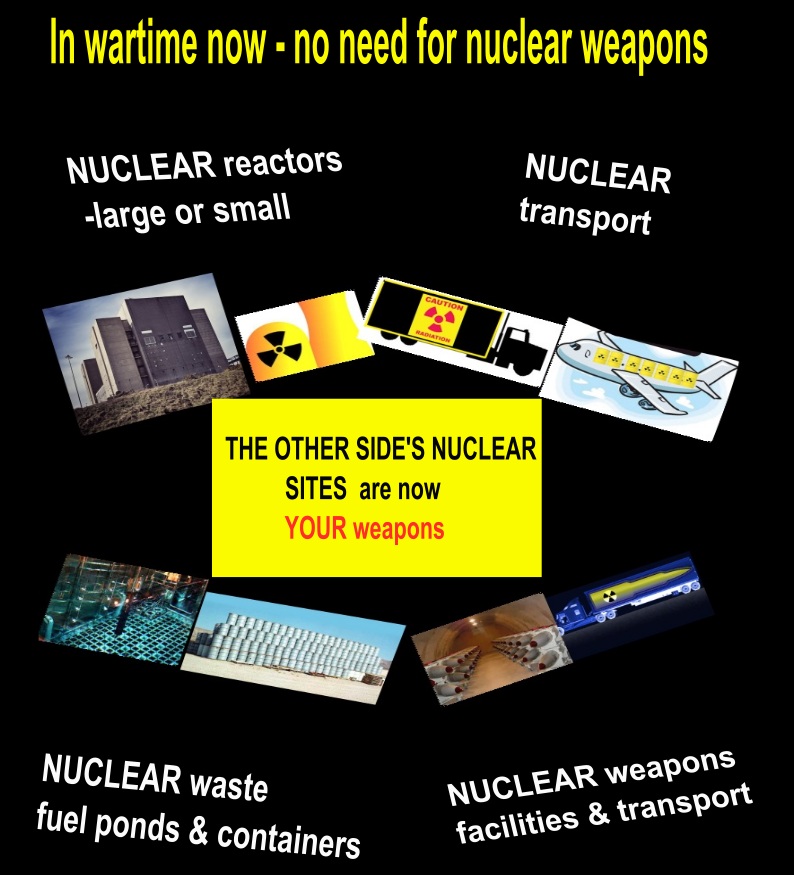
Meanwhile, overseas, in the wars in Ukraine and Iran, nuclear power plants have become examples of what Dr. Bennett Ramberg, an internationally known expert on nuclear proliferation, wrote about in his book “Nuclear Power Plants as Weapons for the Enemy: An Unrecognized Military Peril,” first published in 1980. In it he wrote that “despite multiplication of nuclear power plants, little public consideration has been given to their vulnerability in time of war.”
When Putin sent troops pouring through Belarus into northern Ukraine in 2022, they quickly assaulted the remains of the Chernobyl nuclear power plant, which exploded in 1986. The core of Unit 4 has been covered with a $2 billion sarcophagus funded by European nations.
Since then, Russia has used drones at the Chernobyl site which have punctured the sarcophagus. And has also attacked the six-reactor Zaporyzhia nuclear plant site in Ukraine.
In Iran, there have been attacks at the Bushehr nuclear power plant. Just last month, the International Atomic Energy Agency reported that “following information from Iran of a projectile incident on Tuesday evening, the IAEA can confirm that a structure 350 metres from the Bushehr NPP reactor was hit and destroyed.” IAEA Director General Rafael Mariano Grossi said: “Although there was no damage to the reactor itself nor injuries to staff, any attack at or near nuclear power plants violates the seven indispensable pillars related to ensuring nuclear safety and security during an armed conflict and should never take place.”
But they are taking place—and can be expected to continue because, indeed, nuclear power plants can be “weapons for the enemy” and, indeed, this largely remains an “unrecognized military peril.”
A measure of the impacts of a nuclear plant disaster are detailed in the book “Chernobyl: Consequences of the Catastrophe for People and the Environment.”
Published by the New York Academy of Sciences in 2009, it was authored by three noted scientists: Russian biologist Dr. Alexey Yablokov, former environmental advisor to the Russian presidents Gorbachev and Yeltsin; Dr. Alexey Nesterenko, a biologist and ecologist in Belarus; and Dr. Vassili Nesterenko, a physicist and at the time of the accident director of the Institute of Nuclear Energy of the National Academy of Sciences of Belarus. Its editor was Dr. Janette Sherman, a physician and toxicologist long involved in studying the health impacts of radioactivity.
The book is based on health data, radiological surveys and scientific reports—5,000 documents. It concluded that based on the records that were scrutinized, some 985,000 people died largely of cancer caused by the Chernobyl accident in nations that underwent radioactive fallout from the disaster. That was between when the accident occurred in 1986 and 2004. More deaths, it projected, would follow. And they have.
Contrary to the industry hype, all atomic reactors emit planet-killing radioactive Carbon 14. They directly heat the planet, destroy our lakes, rivers and oceans with chemicals and radiation, kill millions of fish per year. They create radioactive waste for which there is no safe place on this planet. Their “normal” radiation releases ceaselessly harm and kill untold thousands of downwind neighbors.
And with the planet-killing new “Nuclear Renaissance” now in play, there will be more and more deaths from nuclear power—unless there is a stop put to this failed, deadly, hyper-expensive technology, with our species finally taking the true Solartopian road with energy we can live with.
Harvey Wasserman wrote the books Solartopia! Our Green-Powered Earth and The Peoples Spiral of US History. He helped coin the phrase “No Nukes.” He co-convenes the Grassroots Emergency Election Protection Coalition at www.electionprotection2024.org Karl Grossman is the author of Cover Up: What You Are Not Supposed to Know About Nuclear Power and Power Crazy. He the host of the nationally-aired TV program Enviro Close-Up with Karl Grossman (www.envirovideo.com)
They Always Tell You Why The Empire Uses Violence, But Never Why Its Enemies Do
Caitlin Johnstone, Apr 16, 2026, https://www.caitlinjohnst.one/p/they-always-tell-you-why-the-empire?utm_source=post-email-title&publication_id=82124&post_id=194361787&utm_campaign=email-post-title&isFreemail=true&r=1ise1&triedRedirect=true&utm_medium=email
One common feature of western empire propaganda is that we are always given reasons for the empire’s violence, while the violence of those who resist the empire tends to be framed as happening for no reason at all.
We’ve all been fed reasons for the US-Israeli war on Iran, and we all know what those reasons are. Even less-informed members of the western public will have heard something about the Iranians being a nuclear threat, having a tyrannical government, and maybe something about sponsoring terrorist groups.
But the so-called “peaceful protesters” who were killed in an uprising fomented and facilitated by the United States? They were killed for no reason, simply because the Iranian government is evil and hates dissent. All the Iranian police officers who died in the uprising perished for no reason, perhaps of natural causes. It is only by pure coincidence that this happened at the exact same time the US empire was making the decision to try to topple the Iranian government.
We’ve all been given the official reasons why Israel has spent years blanketing the Gaza Strip with military explosives: Israel was attacked by Hamas on October 7 2023, so it needs to get rid of Hamas for its own security.
But why did the Hamas attack happen? It happened for no reason. If you look to the propagandists in the western press for answers, October 7 happened solely because Hamas are evil and wanted to kill Jews for belonging to the wrong religion. Absolutely no mention of Israel’s savage treatment of Palestinians for generations, or the dreadful living conditions imposed upon the giant concentration camp that Gaza had become.
We’ve been told why the western empire is pouring weapons into Ukraine: Ukraine was invaded by Russia. The empire wants to protect the freedom and democracy of the Ukrainian people, and to deter future expansionism by Vladimir Putin.
Why did Russia invade Ukraine? No reason. Putin’s just evil and hates freedom, that’s all. Sure, countless western experts and analysts had been warning for years that NATO aggressions were going to lead to a war on Russia’s border, but they were just rambling lunatics whose forecasts of war were proven correct by pure coincidence.
Our entire understanding of history is framed in this way. Fidel Castro killed people in Cuba. Why did he kill them? No reason; he was just a mean jerk. All the violence of the socialist revolutionaries around the world overthrowing the abusive governments which preceded them is framed as causeless genocidal carnage inflicted by murderous tyrants who simply loved killing people. The desperation caused by the capitalist exploitation that had been imposed upon those populations is completely redacted from our history books.
A mature understanding of our world begins with a curiosity about why the violence is happening. Violence is not always justified, but there is always a reason why it happens. Western pundits, politicians and newscasters will very seldom tell you what those reasons are unless it advances the interests of the western empire.
So if you want to have a truth-based understanding of what’s really going on in our world, you need to actively seek out the answers for yourself.
“‘This war is the result of a coup.’”

The Israeli regime’s deep penetration into the U.S. government is not a new story, if this is not to state the obvious. Via the Zionist lobbies in Washington, Israel more or less owns both houses of Congress. The same is emphatically true of the Trump administration itself: Israel and its Zionist supporters in the United States have groomed Trump since he began his rise in national politics 11 years ago. Wealthy American Jews acting in Israel’s behalf donated $90 million to Donald Trump’s first campaign for the presidency, in 2016, and at least $100 million to his second. Israel owns Donald Trump.
The long, steady Zionist takeover in Washington is now complete. There is no longer any flinching from this.
15 APRIL—We were as stunned as many others to read the closely reported account of how, minute-by-minute, Bibi Netanyahu led the Trump regime into war with Iran when it appeared in The New York Times a little more than a week ago. The two correspondents who produced this work chose the most powerful device available to journalists: The reporting evokes compelling visual images. Images are immediate and force recognitions. They do not bear interpretation as language does. There is no turning away from them.
And there is no turning away from what the Times piece shows us: That the leader of a racist, collectively crazed terror state, a man who is self-evidently psychotic in our view, has taken control of the Executive Branch of the U.S. government.
What follows is a piece that appeared Tuesday in Global Bridge, the independent Swiss journal. There have since been further revelations that, to us, could not be more sobering for the gravity of their implications. During his failed negotiations with the Iranians in Pakistan last weekend, J.D. Vance consulted not only with President Trump—11 telephone calls in the 21 hours of talks—but reportedly also with Netanyahu in Jerusalem. In a videoed appearance subsequently broadcast on Israeli television, the Israeli leader boasted—this in Hebrew—that Vance called him while en route back to Washington to give a full account of what transpired in Islamabad and noted that he, Vance, and other members of the Trump regime, “report to me daily.”
The Iran war faces Americans with many new realities. The limits of U.S. power is one of them, and we will address this in weeks to come. The more immediate truth is the abject surrender of American sovereignty by the hand of a president more beholden to the Zionist state than any other in history. As Americans are able fully to see this for the first time, they are also confronted now with realities from which, with media’s complicity, they have for decades averted their eyes, or shrugged off, or pretended were not of consequence, or to which they have otherwise acquiesced. It is in this that what The Times just forced Americans to look at is of a magnitude it is hard to overstate.
AIPAC’s systematic corruption of Congress and many elections to it: This is a very old story. So is the Zionists’ insidious corruption of mainstream media and, by equally subtle means, public discourse altogether. Lately we witness Zionist takeovers of many American media, attacks on free speech and association in the name of combatting a phantom wave of anti–Semitism, the criminalization of criticism of Israel by way of a preposterous definition of “anti–Semitism.” And on and on.
With the Zionists’ assertion of control over the White House, Americans must now recognize—must if they are to save their crumbling republic, we mean to say—that all of this amounts to a long, systematic attack on their sovereignty. It is obvious now, if it has not been to date, that Zionist ideology is inimical to America’s democratic ideals—representative government, civil liberties, the separation of powers and of church and state. Ridding the government of Zionist control and influence—top-to-bottom, at federal, state and municipal levels—must be the beginning of any restoration project worthy of the term.
Two cases in point to bring these thoughts home. One, all those acting in the Zionist state’s behalf—the Israel lobbies, the Adelsons and others with dual citizenship—should be registered as foreign agents and monitored accordingly. Two, media ownership should be similarly regulated.
The creep of Zionist influence into so many aspects of American life has been a calculated operation conducted over many years. This is the bitter truth that now confronts us. The same is true of Trump we now know (if we didn’t already): The Israelis, by much evidence, determined as soon as he entered national politics that he was sufficiently pliable, sufficiently susceptible to flattery and persuasion, altogether sufficiently stupid to serve their interests—the ultimate among the “useful idiots.” This is the purpose he has just served in following Israel into “Bibi’s war.”
Why has he, Trump, acted so diametrically against his own interests as well as America’s and, indeed, the world’s? This is not clear and may never be. But the thought that the Mossad has a file on Trump that locates him well inside the Epstein mess grows more plausible the deeper Trump digs himself and his country into his hole. Study the photograph atop this piece: To us it is highly suggestive that a cynical exercise in blackmail may be at work between these two men—one victimizer turning another into a victim.
We have chosen to publish the piece that follows as it appeared yesterday but for minor editing adjustments.
—The Editors.
Patrick Lawrence.
13 April—The Israeli regime’s deep penetration into the U.S. government is not a new story, if this is not to state the obvious. Via the Zionist lobbies in Washington, Israel more or less owns both houses of Congress. The same is emphatically true of the Trump administration itself: Israel and its Zionist supporters in the United States have groomed Trump since he began his rise in national politics 11 years ago. Wealthy American Jews acting in Israel’s behalf donated $90 million to Donald Trump’s first campaign for the presidency, in 2016, and at least $100 million to his second. Israel owns Donald Trump.
These are known facts. But one must look very hard to find reference to them in mainstream media or in America’s public discourse altogether. No, Israel’s corruption of American politics and power is part of what I call the Great American Unsayable—a collection of truths too bitter to be acknowledged publicly other than rarely.
Continue readingFresh off Artemis, America is now turning its attention to creating nuclear power in space.
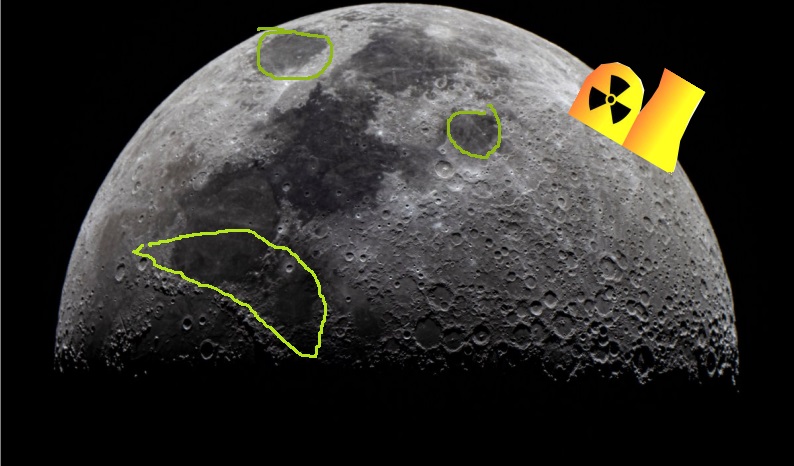
The administration wants to launch the reactors to the moon within the next four years – a timeline that critics say could be a problem
Indeoendent, Julia Musto in New York, Tuesday 14 April 2026
The Trump administration is renewing its focus on creating nuclear power in space, releasing updated guidance for federal agencies following the historic Artemis II lunar mission.
The action is aimed at ensuring the U.S. stays ahead of China in the new space race, which will determine which political power creates the rules there in the future, as humans establish a permanent moon base and work toward getting to Mars in a nuclear-powered spacecraft.
Nuclear energy will be necessary to live and work on the moon because there is not unlimited access to solar power and lunar nights are 14.5 Earth days long. Nuclear reactors can be placed in permanently shadowed areas and can generate power continuously, according to NASA.
The administration’s guidance, issued Tuesday, instructs the Departments of Energy and Defense, the White House Office of Science and Technology Policy and NASA to start taking steps toward safely deploying nuclear reactors in orbit as early as 2028 and launching them to the moon by 2030, in line with a December executive order from President Donald Trump.
“The time has come for America to get underway on nuclear power in space,” NASA Administrator Jared Isaacman, a former SpaceX astronaut, wrote in a post sharing the news on the social media platform X
………………………………. By the next 60 days, it calls for a Department of Energy assessment on the readiness of the nuclear industry to produce “up to four space reactors within five years, including reactor design, delivery of long lead-time components, and fuel allocation or production, along with recommendations for addressing any gaps.”
And the guidance also instructs the OSTP to develop a roadmap that identifies obstacles to achieving these objectives within the next 90 days.
“DOW will, pending availability of funding, pursue deployment of a mission-enabling mid-power in-space reactor by 2031,” the guidance said.
…………………..But some experts say that recent goals for reactors are just not feasible within the allotted timeline – although not everyone agrees.
“The whole proposal is cock-eyed and runs against the sound management of a space program that is now being starved of money,” national security analyst, nuclear expert and author Joseph Cirincione told The Independent last August.
He believes a nuclear reactor on the moon could take up to 20 years to become a reality. https://www.independent.co.uk/space/us-nasa-space-nuclear-power-b2957498.html
Trump’s Will Be Done
SCHEERPOST, April 14, 2026 Joshua Scheer Intro
At a moment when political power is increasingly wrapped in spectacle, symbolism, and something closer to religious devotion than democratic accountability, this piece from ScheerPost cuts straight through the illusion. In “Trump’s Will Be Done,” Kenneth A. Carlson examines the dangerous fusion of faith and politics that has helped elevate Donald Trump beyond the realm of politician and into something far more untouchable in the eyes of his followers.
Republishing this now feels especially urgent. As imagery, rhetoric, and power continue to blur into something resembling mythology, Carlson’s question lingers with uncomfortable clarity: not just what would Jesus do—but what happens when political loyalty begins to replace it.
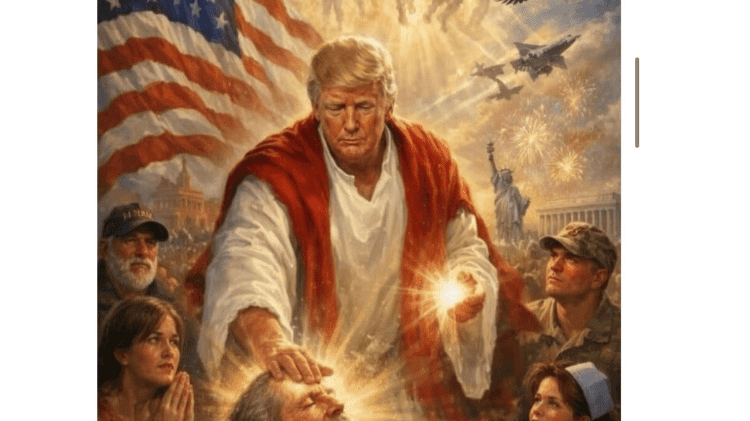
As the war abroad spirals and the stakes grow more dangerous by the day, the spectacle at home has taken on an almost surreal edge. President Donald Trump briefly posted—and then deleted—an AI-generated image depicting himself in Christ-like form, hands glowing as he “healed” the sick, wrapped in flags, fighter jets, and divine symbolism. When pressed, Trump dismissed the backlash, claiming it was merely an image of him as a doctor, not a messianic figure.
But the moment lands differently in a political climate already saturated with religious imagery, blind allegiance, and the merging of power with mythology. It’s not just a post—it’s a signal—one that fits neatly into a broader pattern where politics becomes performance, leadership becomes spectacle, and belief begins to blur into something far more dangerous.
Which brings us to the reality this piece explores: what happens when illusion collides with consequence.
By Kenneth A. Carlson ScheerPost
Trump’s Will Be Done
…………………………………………………………………………………………………………………………………………………………………………………………………………………………………………….. Today, Donald Trump, the former reality TV star, and those around him, understand how to do this all too well. They took their skillset to a new level as they somehow succeeded in fashioning him, and/or he fashioned himself, into a new role as a modern-day messiah — the Chosen One, the Second Coming, the Son of God. And I truly believe he sees himself this way. Remember, this is the same man who once bragged, “I could stand in the middle of Fifth Avenue and shoot somebody, and I wouldn’t lose any voters, OK?” The shocking thing about that statement? It’s likely to be 100% true.
And why? I believe it’s due to some extent to the unfortunate fact that critical thinking in our society is on life-support. People don’t question. They don’t dive deeply and independently into issues. They let others feed it to them in their own private echo chambers. The thirst for knowledge has been replaced by blind allegiance, paving the way for the rise of Donald “The Music Man” Trump — a master showman selling a reckless and dangerous illusion. ……………………………………………………………………
……………………………………. what Donald Trump has tapped into. He positions himself as a godlike figure, offering his followers a false sense of security — a “Daddy’s Home” mentality (yes, there are actual T-shirts for sale on Amazon).
Trump has lulled his base into a dangerous complacency, even as they watch stock markets tumble, inflation soar, entire agencies dismantled, jobs slashed, tariff wars escalated, and unemployment climb. Yet the news they consume assures them it’s all part of his grand plan, and so they wait — idly, expectantly — for a miracle. I never thought my livelihood would be at risk when I voted for him, they say, as if the consequences were unforeseeable.
But critical thinking has been shoved to the backseat, while blind faith handed Trump the wheel. Many have stopped questioning, stopped discerning, stopped seeking truth — because they believe the Almighty Donald Trump will ultimately take care of business.
Nothing could be further from the truth — and the sheer number of his businesses that have filed for bankruptcy should be proof enough. Six of his companies (that we know of) have sought Chapter 11 bankruptcy protection, allowing them to continue operating while erasing massive debts. But behind that legal maneuvering lies a harsh reality: hundreds, perhaps thousands, of workers, vendors, and small businesses left unpaid for their goods and services, are bearing the cost of his failures.
But none of that seems to matter to his unwavering base — the citizens of this so-called God-fearing nation. As a collective, today’s Evangelical and Charismatic Christians appear all too willing to believe a man who promises to end the wars in Ukraine and the Middle East within hours, slash grocery prices, “end inflation,” and miraculously lower the cost of eggs. He also assures us the economy will be “the best ever” — thanks, in large part, to tariffs imposed on both allies and adversaries alike. Few reputable economists would dispute the fact that American consumers will ultimately bear the cost of these tariffs — better known as taxes.
And yet, just over two months into his second term, none of these campaign promises have materialized — not even close. In fact, some might argue the exact opposite has happened.
So why do people still believe him? Why do they worship him with such fervent devotion? Why do they trust him with blind, unquestioning enthusiasm? I believe it’s because he has transcended the role of a mere politician. He has fashioned himself into something greater — a deity of sorts — untouchable, unquestionable, and, to many, infallible.
Trump’s will be done.
So when I ask myself today, ”What would Jesus do?,” the answer seems clear: seek truth, think critically, care for “the other” and break free from the echo chambers that breed blind allegiance. Because if we don’t, our Constitution could erode, our democracy could falter, and Donald Trump could seize the power to declare himself president for an unconstitutional third term — or worse, for life.
US Aims at Heavy Staff & Budgetary Cuts for United Nations, Seeks to Launch Cost-Saving Artificial Intelligence at UN meetings

By Thalif Deen, UNITED NATIONS, Apr 6 2026 (IPS) –
The US has spelled out in detail its own concept of what a restructured United Nations should look like: after drastic reductions in staff, cutting down its budget, avoiding duplication in mandates, slashing peacekeeping operations worldwide and deploying artificial intelligence (AI) for translations and interpretations in six languages.
As the biggest single contributor to the UN budget—and despite nearly $4.0 billion in unpaid dues—it is using its perceived financial clout to help radically change the world body.
The US says it wants to “make UN great again (MUNGA)”—a variation of President Trump’s oft-repeated slogan “Make America Great Again (MAGA).” ”.
But will it work? And is it feasible?
Ambassador Mike Waltz, U.S. Representative to the United Nations, addressing a Congressional Field Hearing on UN Reform, said last week, “As I stated in my confirmation hearing, the UN truly does need to get what we’re calling back to basics and back to its original mission, from its founding, back to maintaining international peace and security.
“As I’ve mentioned in my hearing then, the UN’s budget in the last 25 years has quadrupled. We have not seen, arguably, a quadrupling of peace and security around the world commensurate with those hard-earned dollars, he said.
“So, we are pressing it. We’re pressing it to streamline its bureaucracy, to eliminate duplication. We’ve made it clear that we will cease participation in some UN agencies that undermine our sovereignty and cannot be reformed.”
Earlier this year, he pointed out, President Trump announced “our withdrawal from 66 international organizations. That review is ongoing. And from my perspective, let me be clear, the U.S. will not fund organizations that act contrary to our interests.”
“On UN compensation and personnel,” he said, “We’re leading reforms to what are often exorbitant compensation and benefit standards that the over 100,000 UN staff receive. The UN pays 17% more than US equivalent civil servants, even though many of them are right here in New York.
“They also have additional generous benefits packages far exceeding what our great civil servants, both here and abroad, receive. And staff costs alone are 70% of their regular budget for these things we’re trying to bring back in line.
“So, we need to, and we are working to bring those compensation and benefits packages back in line with common-sense standards. Part of that will be the pension. There’s over $100 billion in management in the UN pension with 16%—I don’t know of an employer or a government out there that contributes 16% to their pension.”
And there are other reforms, he said.
For example, the number of interpreters and translators—times six for the six UN languages here—technology can be used, AI can be used, and remote translation can be used that will save a lot of the travel and the conference costs, said Waltz.
Stephen Zunes, Professor of Politics at the University of San Francisco and director of Middle Eastern Studies, who has written extensively on the politics of the United Nations, told Inter Press Service (IPS) this is not about cost-cutting or fiscal responsibility.
“Like cutbacks to important U.S. government agencies and domestic programs, the Trump administration appears determined to dismantle the system itself.”
This should be understood in the context of pulling out of international organizations and treaties, the establishment of the so-called “Board of Peace,” the Iran War, and the recently announced dramatic increases in military spending—it is about undermining international legal institutions and replacing them with an imperial order backed by raw military force, said Zunes.
Richard Gowan, Program Director, Global Issues and Institutions, at the Brussels-based International Crisis Group, told IPS in the first half of 2025, U.S. policy towards the UN was pretty chaotic, and diplomats from other countries really had no idea what Washington wanted from the world organization.
Like it or not, he said, Mike Waltz and his team have brought some message discipline and are clarifying their goals for the UN pretty sharply.
“Most diplomats say that Waltz can be reasonable in private and that ultimately, he and his team want to reshape the UN rather than just wreck it. There are times when Waltz goes out of his way to bash the UN and individual UN officials on social media, but I think that is partly him playing to the Republican base.”
Waltz is clear that he wants a slimmed-down UN, Gowan pointed out, and it is worth admitting that this is a popular message among many UN member states. The U.S. is not alone in thinking that the organization’s bureaucracy has grown too big and needs a tough financial diet.
“Trump, Rubio and Waltz are pretty consistent in arguing that the UN should focus on peace and security issues. But I think the administration has not really convinced most other UN members that it has a plan to make the UN deliver on conflict prevention and diplomacy again.”
Instead, he said, the U.S. appears to have a very selective and instrumentalist approach to when and how it uses the UN as a security partner. It wants the UN to help in Haiti but to get out of the way in Lebanon. I do not think there is really a coherent vision at work here. It is a very ad hoc, case-by-case approach.
“Trump’s boosting of the Board of Peace as a potential alternative to the UN has complicated Waltz’s position too. The fact that Trump is willing to flirt with the Board, even if it is not a very serious institution, makes it harder to believe that Washington really wants the UN to regain credibility on peace and security,” declared Gowan.
Meanwhile, excerpts from Ambassador Waltz’s testimony include the following:
- “On budget and staffing cuts, the UN should be doing less and doing it better. Let’s get it more focused and actually achieve more results. The 2026 UN regular budget was estimated at $3.45 billion. The U.S. funds roughly a fifth of that at $820 million in 2025 alone.
- Again, I think we need to reduce the UN’s size and assure every taxpayer dollar is spent responsibly, and thanks to the strong efforts by the United States, led by Ambassador Bartos here and his team in what we call the UN’s Fifth Committee, which approves its budget, we are working towards a leaner and better prioritized 2026 budget going forward.
- In December, we led Member States to adopt a historic 15% cut. $570 million out of the UN’s regular budget. That will eliminate nearly 3000 headquarters positions. And for our contribution, it will reduce our assessment by $126 million. So just in the six months that we’ve been here, we will see going forward, $126 million savings to the U.S. taxpayer.
- We’ve also pushed for a 25% reduction in peacekeeping troops, and I’ll talk a bit about other peacekeeping reforms in a moment that will also save us tens, if not hundreds of millions of dollars while enabling what we call here the repatriation, the sending home of poorly performing peacekeeping troops.
- From an oversight perspective, beyond the salaries and benefits, oversight is essential. We’re leading efforts to empower oversight bodies to root out waste, fraud, abuse, and misconduct.
- On peacekeeping reform, he said, the administration has been clear about focusing on the core mandate of peace and security, and we’re leading efforts to wind down some of these ineffective and costly peacekeeping missions.
………………………………………………………………………………………………………………………….. “We will have a new Secretary-General elected this year, and we’re having those conversations now with the candidates about what they seek to keep and continue or what new things they seek to put in place, but reform is at the top of our list as we meet with some of these candidates.
“So, this is a critical moment with senior leadership transitions approaching here over this next year. We need to have a clear message. We will prioritize qualified Americans. Representative DeLauro, along the lines of what you sought to do so many years ago, of having qualified Americans in UN leadership positions, not just here, but across the ecosystem in Geneva, in Vienna, and Nairobi and other places where you have UN agencies.
“And I’ll just conclude with echoing President Trump’s own words.
“As he said most recently at the General Assembly, the UN has tremendous potential. My charge from him is to help it realize that potential. We are dedicated to making the UN live up to that promise, to making the UN great again—if I can say so, our new acronym is MUNGA…………. https://www.ipsnews.net/2026/04/us-aims-at-heavy-staff-budgetary-cuts-seeks-to-launch-cost-saving-artificial-intelligence-at-un-meetings/?utm_source=email_marketing&utm_admin=146128&utm_medium=email&utm_campaign=US_Pushes_Sweeping_UN_Cuts_Including_Staff_Reductions_and_Budget_Slashes_Inequalities_in_Human_Morta
Will Trump nuke Iran?
Never has humankind seen so much power concentrated in the hands of one so capricious. Whether the ceasefire will hold, for how long, and in what ways is for the days ahead to tell. No one—not even Donald Trump—knows the end game. But the constant is the man whose finger can push the nuclear button. A man used to quick, vacuous victories through bullying and unbridled force is rancorous, thwarted, and vengeful.
What once seemed preposterous is now a palpable possibility.
When Trump, echoing Gen. Curtis LeMay’s 1965 threat toward North Vietnam, threatened to “obliterate” Iran and bomb it “back into the Stone Age”—rhetoric repeated by Defense Secretary Pete Hegseth—he wasn’t just posturing. In fact he was signaling that in an administration which respects no norms, mushroom clouds may be acceptable.
By Pervez Hoodbhoy | Opinion | April 10, 2026, https://thebulletin.org/2026/04/will-trump-nuke-iran/?utm_source=ActiveCampaign&utm_medium=email&utm_content=Will%20Trump%20nuke%20Iran%3F&utm_campaign=20260413%20Monday%20Newsletter
No one—not even Donald Trump—knows the end game as the six-week old US-Israeli war on Iran enters a temporary ceasefire. Just look at the head-spinning time-line:
Sunday, April 5 (infrastructure destruction-I): “Tuesday will be Power Plant Day, and Bridge Day, all wrapped up in one, in Iran. There will be nothing like it!!! Open the fucking strait, you crazy bastards, or you’ll be living in Hell — JUST WATCH! Praise be to Allah.”
Monday, April 6: (infrastructure destruction-II): “Their infrastructure could be taken out in one night. I’m telling you, no bridges, no power plants. I’m considering blowing everything up and taking over the oil.”
Tuesday, April 7 (morning) (threat to commit genocide): “A whole civilization will die tonight, never to be brought back again. I don’t want that to happen, but it probably will. However, now that we have Complete and Total Regime Change… maybe something revolutionarily wonderful can happen, WHO KNOWS?”
Tuesday, April 7 (evening): Announcement of two-week Pakistan-mediated ceasefire.
Never has humankind seen so much power concentrated in the hands of one so capricious. Whether the ceasefire will hold, for how long, and in what ways is for the days ahead to tell. No one—not even Donald Trump—knows the end game. But the constant is the man whose finger can push the nuclear button. A man used to quick, vacuous victories through bullying and unbridled force is rancorous, thwarted, and vengeful. He has been stymied by a recalcitrant theocratic state that has taken blow after blow, withstood the killing of its venerated leader, the bombing of its cities, the destruction of vital infrastructure, and the systematic targeting of its schools and universities.
Weeks later, when it should rightly be on its knees, Iran still controls the Strait of Hormuz and refuses to negotiate while it is being bombed. Instead, it continues to cause mayhem among America’s allies and take potshots at Israel. Imagine Trump’s frustration, especially after his bloodless victory in Venezuela.
But a so-far-unbroken taboo, inviolate since the nuclear ash settled over Hiroshima and Nagasaki, may crack. What once seemed preposterous is now a palpable possibility. When Trump, echoing Gen. Curtis LeMay’s 1965 threat toward North Vietnam, threatened to “obliterate” Iran and bomb it “back into the Stone Age”—rhetoric repeated by Defense Secretary Pete Hegseth—he wasn’t just posturing. In fact he was signaling that in an administration which respects no norms, mushroom clouds may be acceptable.
The “how” and “when” remain open questions, but if the ceasefire ceases to hold the crosshairs are likely fixed on the Fordow Fuel Enrichment Plant or, just as probably, Isfahan, where Iran’s fissile material was allegedly transferred before the June 2025 attack. Buried deep beneath a mountain of solid rock, Fordow is the nuclear facility that Trump had earlier claimed to have “obliterated.”
The math of escalation is inexorable: Iran reportedly holds roughly 450 kilograms of 60 percent enriched uranium. While a rudimentary gun-type nuclear weapon would be assembled using 80-100 kilograms of this material, a sophisticated implosion-type bomb needs 20-25 kilograms of uranium enriched to contain 90 percent of the uranium 235 isotope, a process requiring only some weeks. If Iran has mastered the complex engineering required for the latter, its current reserves represent a potential arsenal of eight to 10 nuclear warheads.
The game hinges on the upgrade. Iran can push its stockpile to weapons-grade in a matter of weeks. Conventional “bunker busters” like the GBU-57 have already failed; 14 were dropped on Fordow and Natanz in 2025, yet the heart of the program kept beating. To achieve absolute destruction, the hammer would have to be nuclear.
If the United States chooses to go nuclear in Iran, the Pentagon’s solution would likely be an earth-penetrating warhead like the B61-11 or the newly deployed B61-12. Washington would frame such a strike not as a Hiroshima-style apocalypse but as a “clinical necessity”—a tactical operation designed to kill hundreds rather than tens of thousands.
But Iran will not surrender quietly and would retaliate with everything it has. A lucky strike from a sophisticated missile could sink an American aircraft carrier; a coordinated swarm of drones and missiles could turn major Arab oil terminals into pillars of fire. At that point, the “clinical” experiment could end, and the apocalypse might begin as the United States reaches for its next nuclear target.
Even for a man who finds gratification in the suffering of others—who celebrated the recent destruction of Iran’s biggest bridge followed by cars plummeting down—Trump’s nuclear ambitions are constrained by American electoral politics and the upcoming November elections, a potentially hostile public reaction, and a somewhat reluctant military.
For now, America and Israel are operating in lockstep. They reportedly executed coordinated strikes on Iran’s Bushehr nuclear power plant—which has nothing to do with bomb-making—on March 18 and April 4. These were presumably “signaling strikes” since they destroyed only an auxiliary building and killed a single guard. Their intent was clear—even if the endgame is not. The message has been received: In coordination with the Israeli Defence Forces, over 200 high-level Russian technicians have already evacuated Bushehr, leaving behind only a skeleton crew to manage a potential emergency shutdown.
But “signaling” near a live reactor is a high-stakes gamble with an unclear ultimate purpose. While the plant continues to feed the grid, a direct hit on its containment dome would trigger a radiological catastrophe far exceeding that of Chernobyl or Fukushima. With 70-80 tons of uranium dioxide in its core and a massive inventory of spent fuel lying in nearby cooling ponds, a breach would shroud the Persian Gulf with a lethal miasma of radioiodine and cesium-137. This wouldn’t just be a strike against a regime; it would be a death sentence for the region’s environment and its people.
Israel—which pulverized Gaza to rubble and seeks a similar outcome in South Lebanon—may have fewer inhibitions than the United States. Where Washington might hesitate, Israel may well aim for the dome. For America’s Gulf allies—the UAE, Kuwait, Bahrain, Qatar, Saudi Arabia, and Oman—the fallout would range from the devastating to the permanent, the outcome depending on wind direction and speed.
With an undeclared arsenal of over 150 warheads and reliable means to deliver them to any corner of Iran, Israeli nuclear strikes on Iranian population centers are no longer a fringe theory; they would become a live strategic option in Jerusalem if somehow Iran manages to breach the Israel’s Iron Dome missile defenses more regularly and with greater effectiveness.
Operation Epic Fury is now entering its sixth week. As yet there are no direct negotiations, just a temporary ceasefire. With optimism in short supply, the world is watching a grim lesson unfold. The takeaway for every middle power and so-called rogue state is becoming undeniable: If you have the bomb, you don’t get bombed. The race is on to get it while they still can.
Trump’s Extreme Use of Military Is Stirring a Crisis of Conscience Among Troops
US soldiers have a rich history of questioning the wars they’re told to wage abroad.
By Sam Carliner , Truthout, April 13, 2026
s President Donald Trump increasingly uses the U.S. military to carry out his agenda through brute force, organizations that provide counseling services for U.S. servicemembers are reporting growing numbers of calls. These calls have further spiked in response to Trump’s war on Iran, one of the most unpopular in U.S. history.
The United States has carried out the war through intense attacks on densely populated civilian areas, the impact of which was clearly shown in the bombing of a girls’ school, killing well over 100 children. Not even concerned with selling the war to the public, Secretary of Defense Pete Hegseth has leaned into treating the intervention as a “holy war” for Christianity.
Mike Prysner, an Iraq War veteran and executive director at the Center on Conscience & War (CCW), told Truthout that troops are telling his organization that they don’t want to be involved in the killing.
“That’s pretty much all of the cases that we have,” Prysner said. “It’s all people who don’t want to take part in killing in a war that they don’t believe in, and this war has made them realize that they can’t take part in any kind of U.S. military action ever again.”
The CCW, formerly the National Interreligious Service Board for Conscientious Objectors, was founded in 1940 to assist religious communities whose beliefs prohibited them from participating in war. Over time, and as a result of broadening criteria for who can qualify as a conscientious objector (CO), the organization evolved to assist troops of all backgrounds whose values prevent them from being able to participate in war.
Prysner told Truthout that in recent weeks CCW has already been able to help several servicemembers become COs to avoid being deployed.
To reach more servicemembers experiencing crises of conscience, CCW and other organizations including the Quaker House founded the GI Rights Hotline in 1994. Steve Woolford, a resource counselor at the Quaker House, has taken calls for the hotline since 2001 and agreed that the war on Iran, and Trump’s broader use of the military, has caused a spike in calls.
“The biggest increase has come from people who are feeling a lot of opposition to the ways the military’s currently being used,” Woolford said. “That includes people who feel like they don’t want to be sent into cities and point a weapon at U.S. citizens, they don’t want to be part of what to many of them look like war crimes, shooting down speedboats in Venezuela that wouldn’t be able to make it to the United States, and I would say with the invasion, or whatever you want to call it, ‘Operation Epic Fury’ in Iran, there’s been significant opposition to that.”
Woolford clarified that not all troops who call the hotline are able to leave the military by filing as COs. While every member of the military has that right, the process requires applicants to prove that they have deeply held antiwar beliefs. This means that even if someone is opposed to certain orders or operations, they don’t qualify as CO if they aren’t opposed to participation in all wars.
Prysner said that the social pressure in the military can also make it difficult for troops to declare themselves COs.
“Especially for people who have deployments happening, you’re telling all of your brothers and sisters in uniform that you don’t believe in what you’re doing and you’re not gonna be able to do it with them,” Prysner said. “The thing is, the people that we’re dealing with, they simply don’t have any other choice … They cannot live with themselves participating.”
Echoes of Antiwar History
This is not the first time that members of the military have questioned their role in U.S. wars. In fact, there is a rich history of GI dissent throughout U.S. history.
The role of antiwar veterans was especially important in bringing about the end of the Vietnam War. …………………………………………………………………………………………………………………………….. https://truthout.org/articles/trumps-extreme-use-of-military-is-stirring-a-crisis-of-conscience-among-troops/?utm_source=Truthout&utm_campaign=de92a70740-EMAIL_CAMPAIGN_2026_04_13_09_27&utm_medium=email&utm_term=0_bbb541a1db-de92a70740-650192793
Israel is losing its grip on U.S. politics
By Dave Reed , Mondoweiss, April 12, 2026
We’ve been covering the shift in American politics on Israel for years. Donald Trump’s disastrously failed war on Iran has accelerated it.
For years, conventional wisdom held that support for Israel was a third rail in U.S. politics. Phil Weiss has written a library of analysis and coverage on that here at Mondoweiss over the past 20 years. Uncritical support for Israel was toxic for politicians to touch, impossible to oppose, and self-reinforcing across both parties through the combined pressure of donor money, media consensus, and institutional loyalty. That consensus is broken forever. It didn’t break because of a sudden moral awakening in Washington. That will never happen, on virtually any issue. If you need any more proof of that, just look at the way the survivors of Jeffrey Epstein are being treated, or refer to the fact that even massacres of schoolchildren haven’t moved Congress to do something about guns in the country. The consensus across the political elite on Israel broke because Israel’s conduct in Gaza, Lebanon, and now in its open effort to torpedo an end to the war with Iran, has become a liability that American politicians can no longer ignore.
Michael Arria, our U.S. correspondent, documented this week how military aid to Israel has finally become a true litmus test in Democratic Party primaries. Alexandria Ocasio-Cortez announced she will vote against all military aid to Israel, including weapons classified as “defensive,” a position she had previously hedged. Even J Street, the organization meant to offer a counter to AIPAC’s extremism but locked in perpetual confusion about its identity, is even now opposing U.S. support for the Iron Dome missile defense system. AIPAC, once considered the most powerful of all the many lobby groups, is now a liability in Democratic races, losing key primaries and watching candidates run against it by name. A recent NBC News poll shows just 13 percent of Democrats view Israel positively. These numbers are not marginal; they represent a fundamental and permanent realignment of the Democratic base. Politicians, candidates, and political institutions are paying attention.
This fracturing is thankfully not limited to the left. The Iran war has cracked open the MAGA coalition in ways that the genocide in Gaza could not. Powerful conservative commentators commanding huge audiences and figures closely aligned with the MAGA movement have been openly and harshly critical of Trump over the war. The widespread, and correct, view is that Netanyahu manipulated Trump into a conflict that serves Israeli interests, not American ones. The critique of the tail wagging the dog is now being advanced loudly by people who would never have entertained it two years ago. The political ground is moving, dramatically, in the months before an all-important mid-term election. Republican figures with aspirations for more power, such as J.D. Vance and Marco Rubio, are beginning to distance themselves from the Iran debacle………………………………………………………………………………………………………. https://mondoweiss.net/2026/04/weekly-briefing-israel-is-losing-its-grip-on-u-s-politics/
Jeffrey Sachs: Ending Israel’s War on Peace
To make lasting peace in the Middle East, the US must end its blank check to Israel’s perpetual wars and join with the rest of the world to force Israel to live within its internationally recognized borders of June 4, 1967.
Jeffrey D. SachsSybil Fares, Apr 09, 2026, https://www.commondreams.org/opinion/israel-war-on-peace
A two-week ceasefire has partially halted the Israel-US war on Iran. The war accomplished precisely nothing that a competent diplomat could not have achieved in an afternoon. The Strait of Hormuz was open before the war and it is open again now, but with more Iranian control.
Meanwhile, the chaos continues. Israel is intent on blowing up the ceasefire, as this was Israel’s war from the start. Israel dazzled Trump with the prospect of a one-day decapitation strike that would put Trump in charge of Iran’s oil. Israel, in turn, was out for bigger prey: to bring down the Iranian regime and thereby become the regional hegemon of Western Asia.
The foundation of the ceasefire is Iran’s 10-point plan, which Trump (perhaps unwittingly) called a “workable basis on which to negotiate.” The plan makes sense, but it is a major climbdown for the US, and probably a redline for Israel. Among other points, the plan calls for an end to the wars raging in the Middle East, almost all of which have Israel at their root cause. The plan would also resolve the nuclear issue, essentially by going back to the JCPOA that Trump ripped up in 2018.
The Iran War, and the other wars raging across the Middle East, trace back to one core Israeli idea, that Israel will permanently and steadfastly oppose a sovereign Palestinian state and will topple any government in the Middle East that supports armed struggle for national sovereignty. It is crucial to note that the UN General Assembly has passed multiple resolutions, such as Resolution 37/43 (1982), affirming that political self-determination is so vital, that armed struggle in the quest for self-determination is legitimate. The UN was born, in part, out of the determination to end the centuries of European imperial domination over Africa and Asia. Of course, there would be no cause for armed struggle if Israel would accept a political solution, notably the two-state solution that has overwhelming support throughout the world.
The peace is within reach, if the US grasps it.
Netanyahu’s core goal may be summarized as Greater Israel. This means no Palestinian sovereignty, and no clear boundaries for Israel even beyond the boundary of historical Palestine under British rule after WWI. Zionist extremists like Netanyahu’s political allies, Ben-Gvir and Smotrich favor Israeli control over parts of Lebanon and Syria, as well as permanent control over all of what was British Palestine. America’s Christian Zionists, exemplified by the US Ambassador to Israel Mike Huckabee, and a strong voter base of Trump, speak of God’s promise to Israel of the lands between the Nile and the Euphrates. Crazy stuff, but these are real beliefs, nonetheless, and they are conveyed in the White House.
Israel’s strategy is therefore regime change in every country that resists Greater Israel, a plan already foreshadowed in the famous political document “A Clean Break: A New Strategy for Securing the Realm,” written by US Zionist neocons as a platform for Netanyahu’s new government in 1996. We’ve had constant wars in the Middle East since then to implement the Clean Break vision. This has included the war in Libya to overthrow Moammar Qaddafi, the wars in Lebanon, the war to overthrow Syria’s Bashar al-Assad, the war to overthrow Iraq’s Saddam Hussein, and now the war to topple the Iranian regime.
This is not to say that the US lacks its own grandiose ideas. Israel wants regional hegemony, this is not a secret. Netanyahu confirmed these ambitions in his recent remarks about Israel becoming “a regional power, and in certain fields a global power.” On the other hand, American officials dream of global hegemony. And Trump dreams of money. He craves the Iranian oil and repeatedly said so.
In any event, it’s clear that this war was Netanyahu’s creation. He and the Mossad chief came to Washington to sell Trump a bill of goods. It’s not hard. Trump was suckered, while everybody else had their doubts about Netanyahu’s claims of an easy one-day decapitation strike—essentially a replay of the US operation in Venezuela.
It’s pathetic to “listen in” on the White House discussion, as revealed by the New York Times. Netanyahu, a con man, presented rosy scenarios of regime change that US intelligence contradicted, yet Trump foolishly accepted. Trump and Netanyahu were cheered on by Christian Zionists (Hegseth), Jewish Zionists and real-estate developers (Kushner and Witkoff), a faith healer (Franklin Graham), and high-level sycophants (Rubio and Ratcliffe).
While Trump was telling the world that Iran was begging for a ceasefire, it was Trump himself who was begging for a ceasefire.
Until Tuesday evening, it looked like Trump might lead the world blindly to World War III. The vulgarity and brutality of his public rhetoric was unmatched in US presidential history. Now we know that he was desperately seeking an off-ramp and using Pakistan for that purpose. While Trump was telling the world that Iran was begging for a ceasefire, it was Trump himself who was begging for a ceasefire. The Pakistani leader delivered it.
The ceasefire is good, and the 10-point plan is good, even if perhaps Trump didn’t know what was in it when he said that it was a good basis for negotiation. Israel will, in any event, work overtime to break it, and has already started to do so, with carpet bombing of Beirut that is killing hundreds of civilians, and with other strikes. A permanent US-Iran agreement is the last thing that Netanyahu wants. That would end his dream of Greater Israel.
Yet there is a way to peace and that is for the US to face reality. Israel is the real “terror state,” waging perpetual war throughout the Middle East for a wholly indefensible reason—to have unchecked freedom to terrorize and rule over the Palestinian people and to expand its borders as Israel’s zealots see fit. To make lasting peace in the Middle East, the US must end its blank check to Israel’s perpetual wars and join with the rest of the world to force Israel to live within its internationally recognized borders of June 4, 1967. Iran’s 10-point plan can be the basis of a comprehensive regional peace—if the US accepts the reality of a state of Palestine. In that case, Iran would likely agree to stop funding non-state belligerents, and Israel, Palestine, Lebanon, and the entire region could live in mutual security and peace. That outcome should be the basis of a negotiated agreement of the US and Iran in the next two weeks.
Israel is the real “terror state,” waging perpetual war throughout the Middle East for a wholly indefensible reason…
The American people have made their views clear. A 2025 Pew survey finds most Jewish Americans lack confidence in Netanyahu and back the two-state solution. Most Americans now view Israel unfavorably, the highest unfavourability in history. Sympathy for Israel has hit a 25-year low. Now the political class must catch up with the public.
The peace is within reach, if the US grasps it. Iran’s proposal is serious and the ceasefire is a fragile opening for a comprehensive settlement. The question is whether the US will, once again, allow Israel to destroy the peace, or rather this time stand up for America’s interests and the world’s interests in a lasting peace.
US’s Erosion of the Right to Cartoon Is No Laughing Matter
Hank Kennedy, April 9, 2026 https://fair.org/home/uss-erosion-of-the-right-to-cartoon-is-no-laughing-matter/
During World War II, cartoonist Bill Mauldin was summoned to a meeting with Gen. George S. Patton. Mauldin’s Stars and Stripes cartoons drew Patton’s ire over his matter-of-fact depictions of war and American GIs.
To Mauldin, war was no fun adventure. In Up Front, his Willie and Joe were war-weary and disheveled soldiers, not heroes ready for movie stardom. They expressed a darkly comic view of the life of an infantryman. In an exemplary cartoon, one of the duo says to a medic attempting to hand out a medal: “Just gimme th’ aspirin, I already got a Purple Heart.”
Mauldin avoided punishment when Gen. Dwight Eisenhower circulated a letter instructing all officers “not to interfere” with “such things as Mauldin’s cartoons” (Oklahoman, 4/16/82). Mauldin won the Pulitzer twice for his editorial cartooning, once during the war and once afterwards.
Perhaps Donald Trump’s Pentagon saw itself as acting in the Patton tradition when it eliminated comics from Stars and Stripes. As FAIR (3/20/26) previously documented, Pete Hegseth has taken steps to crack down on the independence of the Pentagon’s own newspaper. Among the new guidelines to promote “good order and discipline” is a ban on syndicated material, including comics (Stars and Stripes, 3/13/26). US servicemembers have now been saved from the woke, subversive influences of Doonesbury, Pearls Before Swine and, perhaps worst of all, Beetle Bailey.
A global trend
Hegseth’s anti-comics viewpoint is part of a global trend. Cartooning for Peace, Cartoonists Rights, Reporters Without Borders and several others have teamed up to produce Under Pressure; the March 2 report surveys the status of caricaturists around the world.
Under Pressure collects the stories of some of the most grave casualties in the global war on satire. Egyptian Ashraf Omar has been imprisoned for over a year, awaiting trial under specious charges of terrorism (Committee to Protect Journalists, 3/2/26). Saudi Cartoonist Mohammed Al Ghamdi (pen name Al Hazza) faces a 23-year sentence for “sympathizing with Qatar” (Reporters Without Borders, 7/23/25)—reflecting a since-resolved quarrel between the two governments—and because he allegedly “insulted the kingdom of Saudi Arabia” . In 2024, Palestinian cartoonist Mahasen al-Khateeb was killed in Gaza by Israeli bombardment (Middle East Eye, 10/20/24).
When the survey turns to the United States, things remain ominous. Kak, the president of Cartoonists for Peace whose work appears in L’Opinion, found the “same tactics” that appear in authoritarian regimes, or those headed in a dictatorial direction, “are being used” in the US. He continued that “the ‘Land of the Free’ is now flashing bright red on our threat map,” putting the US in the same crowd as Iran, India, Turkey and Russia.
It’s quite a shift from the 2023 report Cartoonists on the Line, which had no section dedicated to the United States. Much has changed for the worse in three years.
Trump has long mused about using official pressure to suppress satirical responses to his government. In 2018, he threatened to sue Saturday Night Live over their mockery of his administration (Mother Jones, 12/16/18). His FCC chair, Brendan Carr, argued that it was in the “public interest” to threaten Jimmy Kimmel’s late-night ABC show over the host’s comedy (Variety, 12/17/25). These words and deeds have created a climate of fear in the United States, one that political cartoonists are feeling.
‘Long overdue for a housecleaning’
The report cites a few US examples that paint a dark portrait of freedom of expression under the second Trump administration. Some of them have previously been covered by FAIR, including the resignation of Ann Telnaes from the Washington Post (FAIR.org, 1/7/25), the firing of Palm Beach Post editorial page editor Tony Doris (FAIR.org, 3/27/25) and Bob Whitmore’s firing and belated reinstatement to Creative Loafing (FAIR.org, 9/30/25).
There are other examples, however, that deserve more examination.
In 1999, Felipe Galindo (Pen name Feggo) drew “4th of July From the South Border,” an endlessly reproduced and reprinted piece criticizing the militarization of the border with Mexico. Starting in 2022, Feggo’s work hung in the Smithsonian’s National Museum of American History as part of the ¡Presente! A Latino History of the United States exhibit. Feggo’s illustration was taken down after the Trump White House (8/21/25) attacked it as part of an “anti-American exhibition” that showed the US’s legacy of “colonization” and the history of Latino “victimhood and exploitation.” A crowing editorial in the Washington Examiner (8/24/25) asserted “the Smithsonian is long overdue for a housecleaning” over its “fashionable, culturally Marxist ideas.” The New York Times (3/28/25) described Trump’s interference with the Smithsonian as seeking “a more positive view of American history.” More positive for whom, is a question left unasked. Artist Rigoberto Gonzalez, whose “Refugees Crossing the Border Wall Into South Texas” was likewise removed, compared the administration’s censorship to the Nazi campaign against “degenerate art” (NPR, 8/24/25).
Julie Trébault of Artists at Risk Connection, who wrote Under Pressure‘s section on the United States, said it was a “rare and significant move” for the executive branch to single out “a specific work for removal from a federal museum.”
‘Direct threats’
The report cited another Pulitzer winner, Adam Zyglis, in its section on the United States. His July cartoon for the Buffalo News (7/7/25) on flooding in Texas showed a MAGA hat-sporting Texan being swept away while proclaiming, “Gov’t is the problem not the solution!”
The New York Post (7/10/25) reran a Fox News piece (7/9/25) that slammed the cartoon as “vile.” The Post’s conscience is an interesting development, considering that the paper ran a cartoon in 2009 comparing President Obama to a chimpanzee (Guardian, 2/18/09), echoing a well-known racist trope.
The slings and arrows of press criticism were nothing compared to what was to come. In response to this cartoon, Zyglis was subject to numerous death threats. An appearance at Buffalo Museum was canceled over public safety concerns (Politico, 7/11/25). The Association of American Editorial Cartoonists, the Society of Professional Journalists and the Committee to Protect Journalists all released statements condemning the threats and supporting Zyglis (Daily Cartoonist, 7/17/25).
Trébault notes this as a sinister development. To criticize “the government’s actions or positions,” she wrote, “now exposes artists to direct threats.”
Heads in the sand
Unfortunately, Under Pressure has received little coverage in the United States, excepting the Daily Cartoonist (3/4/26). This contrasts with the coverage in New African Magazine (3/2/26), which gave the incidents the report highlights on that continent wider publicity.
The lack of attention media outlets gave to Under Pressure comes at a dangerous time for press freedom. The Inter American Press Association, a hemispheric media watchdog, recently classified the United States as a nation with “‘restrictions’ on freedom of speech” and of the press (AP, 3/10/26). By not giving reports like Under Pressure attention, media outlets are placing their heads in the sand.
Beyond open political censorship, there are also economic pressures on political cartoonists. Many newspapers do not employ their own cartoonists. Instead they choose material from syndicates, which reduces the amount of total cartoonists employed. It’s simple math. Why hire a dedicated cartoonist when syndicated material can be purchased for a fraction of the price?
The venues for cartoonists are also shrinking and sometimes disappearing. Since 2005, around 3,500 newspapers have shut down (Poynter, 10/20/25). Publications like the Atlantic Journal-Constitution, the Newark Star-Ledger and the Pittsburgh Post-Gazette are either ending their print editions or shutting down entirely. Cartoonist Walt Handelman (Editor & Publisher, 2/18/26), recently retired from the New Orleans Times-Picayune and the Advocate, said he was “optimistic about satire…. The real question is, how do you make a professional living doing it.”
Are there still political cartoonists out there worth looking for? Of course. In These Times has a vibrant comics section with witty and insightful commentary from the likes of Mattie Lubchansky, Jen Sorenson, Tom Tomorrow and others. The annual collection World War 3 Illustrated provides a perspective not likely to be found in other outlets, as exemplified by last year’s issue dedicated to Palestinian cartoonists. In between winning awards for Insectopolis, his comic study of creepy crawlies, Peter Kuper’s work enlivens The Nation. Cartoonists may be “under pressure,” but the best of them are capable of rising to the challenge.
America Is Losing the World—and It Doesn’t Know How to Stop
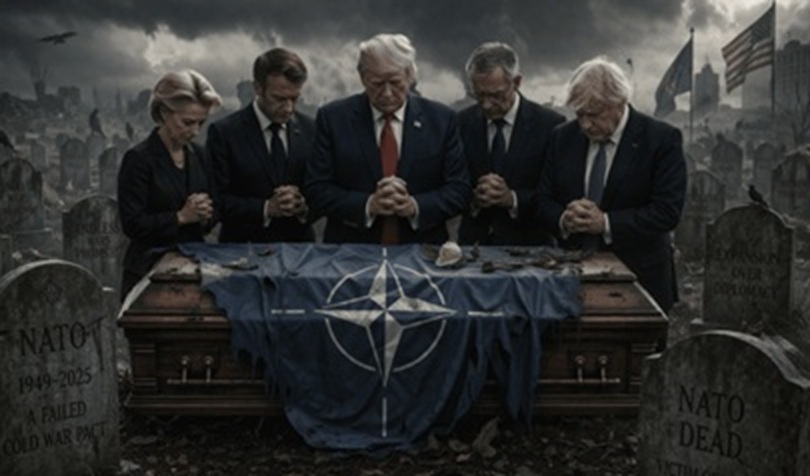
April 10, 2026, Joshua Scheer
The so-called ceasefire is already cracking—and anyone paying attention knows why.
In this wide-ranging and unsettling conversation, retired U.S. Colonel Lawrence Wilkerson pulls back the curtain on a geopolitical order that is not stabilizing, but unraveling. The war with Iran isn’t ending—it’s mutating. NATO isn’t adapting—it’s collapsing. And the United States, rather than recalibrating to a changing world, is doubling down on the very policies accelerating its decline. With Wilkerson saying of NATO: “I think NATO’s dead. I’ve said that before, I’ll say it again. It may take a few months, even a couple of years, for everyone to finally pronounce it dead and say a prayer over its grave—but it’s dead.
Trump may never formally declare the United States is leaving NATO. He’s not that kind of leader—he’s mercurial, inconsistent. You’re not going to get a clear, cogent statement out of him. But it’ll happen all the same.
This is already a fatal situation. Ukraine put the dagger in NATO’s heart—but the wound was there long before that. It began when we broke our promises to Russia after George H.W. Bush, when we failed to integrate them into Europe.
Every president since—starting with Clinton—drove that knife in deeper.”
Wilkerson, a former insider at the highest levels of American power, doesn’t speak in euphemisms. He describes a system running on inertia, denial, and violence—where ceasefires serve as cover, diplomacy is treated as theater, and entire regions are sacrificed to maintain a crumbling illusion of control. The result is not just endless war abroad, but growing instability at home, with the specter of internal fracture no longer unthinkable but increasingly probable.
This is not analysis meant to reassure. It is a warning—from someone who has seen how these decisions are made, and where they lead.
The ceasefire is a lie—and the system selling it knows it.
In this blistering conversation, retired U.S. Colonel Lawrence Wilkerson doesn’t hedge, sanitize, or play along. He calls it what it is: a collapsing global order held together by deception, violence, and delusion. The so-called ceasefire with Iran, he warns, may be nothing more than a tactical pause—a familiar pattern where diplomacy becomes cover for the next round of escalation.
And the implications go far beyond one war.
Wilkerson flatly declares that NATO is “dead”—not weakened, not strained, but functionally finished, a relic already gutted by decades of broken promises and strategic arrogance. He points to a United States that has “created an enemy out of the whole planet,” pursuing confrontation over adaptation as global power shifts away from Western dominance.
Meanwhile, on the ground, the brutality continues. Civilians are being killed at scale, entire cities reduced to rubble, while political leaders posture and stall. There is, in Wilkerson’s assessment, “no inclination whatsoever” from Israeli leadership to stop the slaughter in Lebanon—making any broader ceasefire structurally impossible from the start.
But perhaps most alarming is what comes next.
Wilkerson warns that the United States is not just losing its grip abroad—it is fracturing internally. He describes a political system corrupted across branches, a military being reshaped along ideological lines, and a society saturated with weapons and polarization. The result? A credible path—not hypothetical, but emerging—toward internal conflict.
An empire in denial. A war without an endpoint. And a leadership class, in Wilkerson’s words, willing to “bomb the hell out of everything” rather than confront reality.
But the deeper story isn’t just about Iran or Israel. It’s about a global system breaking apart in real time—and leaders who would rather burn it down than adapt. Wilkerson describes a United States clinging to dominance it no longer has, fighting the rise of a multipolar world with sanctions, bombs, and denial. The result, he warns, is not stability—but escalation on multiple fronts at once.
He points to something even more destabilizing: a fundamental transformation in how power operates. Warfare is changing. Economics are shifting from sea to land. Alliances are dissolving. And yet Washington continues to act as if nothing has changed—doubling down on outdated strategies while the rest of the world moves on without it.
Some of the most important things for all Americans to understand—especially those who may not already—are truths like this from Wilkerson about the United States’ global position: “We’ve created an enemy out of the whole planet—and now we’re shocked the world is pushing back.”
The United States is confronting a reality it refuses to face: the world is changing, and where that change is acknowledged, it is met not with adaptation but with resistance—fought “tooth and nail.” At home, the decay is just as severe. The country, as Wilkerson puts it, has been “damned for a generation,” with dysfunction now entrenched across its core institutions—from Congress to the Supreme Court. That internal fracture is no longer abstract; it carries the real potential for conflict, with multiple factions poised in a nation that has “more guns than people.” And all of this is unfolding at the worst possible moment—during a period of imperial decline—where, in his blunt assessment, this is precisely when you do not want incompetent leadership steering a nation losing ground to rising powers.
As Wilkerson mentioned, there is is the distinct possibility of a civil war, with Wilkerson saying, “You have the potential for a lot of different people out there on the streets—and we have more guns than people.”
I would add this: when some states seem determined to drag us back into the dark ages—stripping away rights, narrowing the horizon of what it means to be free—and when our national leadership speaks of little beyond funding the machinery of war, it forces a reckoning. It makes one confront the unthinkable as something increasingly possible.
A nation cannot endure when its parts move in opposite directions—when some push toward repression while others struggle toward dignity and survival. At a certain point, unity becomes a fiction we tell ourselves to avoid the harder truth: that what we call a country may already be fractured beyond repair.
And if that is the case, then the question is no longer whether we hold together, but whether breaking apart might be the only way to prevent something far worse from tearing us apart first.
On that not at home, the consequences are just as severe. Wilkerson outlines a country hollowed out by corruption, gripped by polarization, and increasingly incapable of governing itself. Institutions are eroding. Trust is collapsing. And in that vacuum, more extreme forces are organizing, arming, and preparing for confrontation.
This is not just a warning about war abroad.
It’s a warning about what happens when a declining power refuses to recognize its own decline—and drags the world down with it.
U.S. Media finally acknowledging Israel’s central role in Trump’s criminal war on Iran
11 April 2026 AIMN Editorial, By Walt Zlotow , https://theaimn.net/u-s-media-finally-acknowledging-israels-central-role-in-trumps-criminal-war-on-iran/
For the first 5 weeks of President Trump’s criminal war on Iran, mainstream media pretended this was totally a US war to defend the Homeland by destroying Iran’s nuclear bomb capability and neutering its missile arsenal. Israel was barely mentioned tho they started the war by assassinating Iranian leader Ali Khamenei. Israel’s relentless bombing of Iran was largely ignored to focus on the devastating US bombing. Also ignored was Iran’s robust retaliation causing the greatest damage to Israel in its 78 year history.
The reality is that on February 28th Israel realized its three decade dream of getting a US President to serve as their proxy to destroy Iran as Israel’s last hegemonic rival in the Middle East. Israel Prime Minister Benjamin Netanyahu has spent the entire 21st century lobbying George W. Bush, Barack Obama, Donald Trump in term one and Joe Biden to take out Iran. Netanyahu finally hit pay dirt with Donald Trump in term two. On February 11 Netanyahu met with Trump, assuring him that once Israel assassinated Iranian leader Ali Khamenei, the regime would collapse within a few days with Iran’s populous rallying around their US liberators.
Gigantic mistake. The Iranian populous coalesced around the regime which retaliated with devastating effectiveness, not only inflicting massive damage on US, Israeli resources but shutting down the Strait of Hormuz, inflicting worldwide economic decline.
Knowing he’s lost, Trump is seeking an off ramp to save his presidency. Netanyahu, the lead actor in this lost war, will have none of it. He’s sabotaging the ceasefire Trump agreed to which would have allowed Iran to survive, retain control of the Strait and keep its nuclear enrichment and its defensive missile arsenal. Netanyahu’s massive bombing of Lebanon, forbidden by Iran’s 10 Point peace plan, puts the ceasefire hanging by a thread.
Mainstream media has taken note, beginning to allow analysts to publicly state this was largely Netanyahu’s war, not Trump’s. MS NOW’s Jen Psaki gave former Secretary of State John Kerry, who negotiated the 2015 Iran nuclear agreement, extensive time to review Netanyahu’s endless demands that US presidents destroy Iran on their behalf. Kerry noted how Netanyahu hyped the imminent Iranian nuclear threat to each president which was swallowed whole only by President Trump. A nuclear agreement meant nothing to Netanyahu. Regime change in a failed state Iran was the sole goal.
The more mainstream media tells the truth about Israel’s central role in Trump’s lost war upending the world economy, the more Trump will be pressured to break with Israel. Whatever Netanyahu has on Trump, whether the hundreds of millions in campaign cash or scandalous Epstein secrets, must be disregarded if Trump has any chance of salvaging his presidency, and more importantly, the world economy.
Keep it up, mainstream news. Expose the dirty secret of Trump’s dirty war launched on orders of Benjamin Netanyahu. If Trump does cut off the weapons train, Israel’s rampage against Iran, Syria, Lebanon, Gaza and Yemen may be over. Time to force Israel to make peace with their neighbours, not endless war.
Mainstream news can assist that noble goal.
Ceasefire with Iran: Don’t hold your breath – Israel and US lie all the time
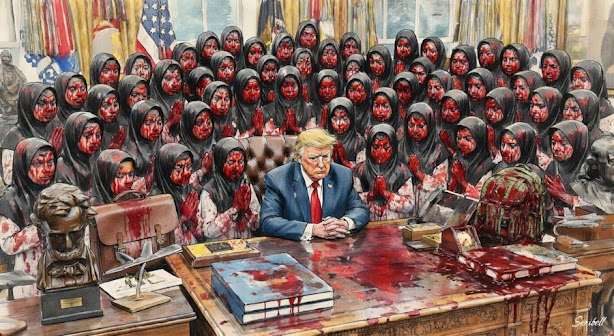
Donald Trump deceived millions of American voters with false promises of ending the wars, stopping globalization and industrial revival, and now he has proven himself to be one of the biggest puppets of Israel.
Trump: The United States will work closely with Iran, which we have determined has undergone what will be a very productive regime change! There will be no uranium enrichment, and the United States, in cooperation with Iran, will extract and remove all the deeply buried nuclear “dust”. (It is more than obvious that this ‘ceasefire’ is just a public relations gimmick and a plan to reset US and Israeli offensive operations.)
Bruce K. Gagnon , 9 Apr 2026, https://space4peace.blogspot.com/2026/04/ceasefire-with-iran-dont-hold-your.html
- Iran says the United States has agreed to the following:
1. A non-aggression commitment
2. Continued Iranian control over the Strait of Hormuz
3. Acceptance of uranium enrichment
4. Lifting of all primary sanctions
5. Lifting of all secondary sanctions
6. Termination of all UN Security Council resolutions
7. Termination of all Board of Governors resolutions
8. Payment of reparations to Iran
9. Withdrawal of US combat forces from the region
10. Cessation of hostilities on all fronts, including against Hezbollah in Lebanon
- Axios, citing a White House official: The ceasefire will take effect as soon as Iran opens the Strait of Hormuz.
- Iran’s National Security Council: The agreement stipulates the lifting of all sanctions and the release of frozen Iranian assets abroad. It is emphasized that this does not mean the end of the war, and Iran will only accept the end of the war when, considering the acceptance of Iran’s principles in the 10-article plan, its details are also finalized in negotiations.
- These negotiations will begin with complete distrust on Friday, April 10, in Islamabad, and Iran will allocate two weeks for these negotiations.
- Greater Iran and the Origin of Civilizations: We did not abandon our allies in Yemen, Lebanon, and Iraq; this was a condition for a ceasefire in all these countries.
- Kan Hebrew Channel: If the agreement includes Hezbollah, we must burn the [Israeli] state down.
- During this two-week period, Israel will bolster its defenses, the United States will reinforce its forces, and the global economy will be revitalized. However, the negotiations could very well be a charade, as has happened before, with America launching a new offensive accompanied by assassinations.
- There’s a saying in Farsi which says: “My eyes aren’t watering.” من چشمم آب نمیخوره Which means: “I don’t think anything will come out of this.” But….if this truly does get implemented, this might be the biggest victory (for Iran) of all modern time.
- Donald Trump deceived millions of American voters with false promises of ending the wars, stopping globalization and industrial revival, and now he has proven himself to be one of the biggest puppets of Israel, the World Economic Forum and the Bilderberg Group.
- Over 55 US lawmakers called for invoking the 25th Amendment after Trump threatened to destroy Iranian civilization. Former Trump ally Marjorie Taylor Greene called it “evil and madness.” Tucker Carlson urged military personnel to refuse orders; the Pope and UN Human Rights chief condemned threats against civilians as violations of international law.
- Moscow and Beijing blocked a Bahrain-drafted Security Council resolution on Hormuz, with Russia’s envoy calling it a “greenlit aggression” that ignored the conflict’s root causes. The two powers submitted an alternative text calling for negotiated settlement. China’s representative said the vetoed draft would have “added fuel to the fire.”
- Around 10 AM today, Iran’s Lavan oil refinery facilities on Lavan Island were attack by the enemies. In response, Iran struck targets inside UAE & Kuwait.
- Iran’s UN representative: Israel must adhere to the ceasefire in Lebanon; continued attacks will further complicate the situation and have dire consequences.
- Lebanese Health Minister: Hospitals are overflowing with the injured and victims, and we have hundreds of martyrs and wounded throughout Lebanon as a result of the Israeli strikes. The raid that targeted Shamshtar occurred during a funeral procession, when the enemy bombed the place, resulting in the martyrdom of all those present. “Eternal Darkness” is the name given by Israel to the new aggression against Lebanon.
- Lebanese hospitals are appealing for blood donations due to the large number of injuries and deaths in the major zionist offensive.
- US Chairman of the Joint Chiefs of Staff: Let’s be clear, a ceasefire is a temporary pause. The US Secretary of Defense told US forces involved in the war against Iran: Stay prepared.
- Iran’s IRGC Navy warned ships near the Strait of Hormuz that they must obtain permission from the IRGC naval forces to pass, stating over radio that any vessel attempting to transit without authorization “will be destroyed,” according to a recording shared with The Wall Street Journal.
- Trump: The United States will work closely with Iran, which we have determined has undergone what will be a very productive regime change! There will be no uranium enrichment, and the United States, in cooperation with Iran, will extract and remove all the deeply buried nuclear “dust”. (It is more than obvious that this ‘ceasefire’ is just a public relations gimmick and a plan to reset US and Israeli offensive operations.)
- Iranian media, quoting a high-ranking Iranian military source: We have begun a wave of attacks on US-allied countries in the region as a warning message to implement a ceasefire throughout the region, including Lebanon.
- Spain has called Israel’s continued attacks in Lebanon “unacceptable,” despite the recent U.S.–Iran two-week ceasefire. Foreign Minister José Manuel Albares said all fronts, including Lebanon, must stop.
- Israeli main opposition leader Yair Lapid: There has never been such a political disaster in all of our history. Israel wasn’t even at the table when decisions were made about the core of our national security. Netanyahu failed politically, failed strategically, and did not meet a single goal he set himself. It will take years to repair the political and strategic damage caused by arrogance, negligence, and a lack of planning. Israeli Channel 12 reports from a source: Washington will ask Tehran to cancel the ballistic missile program.
- U.S. Vice President JD Vance: Trump “lacks patience” to make progress on everything related to Iran. If the Iranians do not act in good faith, they will discover that President Trump is not to be trifled with.
- (Update): Iran has halted the passage of vessels through the Strait of Hormuz after Israel’s ceasefire violations against Lebanon — Fars.
1 This Month

To see nuclear-related stories in greater depth and intensity – go to https://nuclearinformation.wordpress.com
-
Archives
- September 2026 (184)
- August 2026 (330)
- July 2026 (355)
- June 2026 (287)
- May 2026 (306)
- April 2026 (356)
- March 2026 (251)
- February 2026 (267)
- January 2026 (308)
- December 2025 (358)
- November 2025 (359)
- October 2025 (375)
-
Categories
- 1
- 1 NUCLEAR ISSUES
- business and costs
- climate change
- culture and arts
- ENERGY
- environment
- health
- history
- indigenous issues
- Legal
- marketing of nuclear
- media
- opposition to nuclear
- PERSONAL STORIES
- politics
- politics international
- Religion and ethics
- safety
- secrets,lies and civil liberties
- spinbuster
- technology
- Uranium
- wastes
- weapons and war
- Women
- 2 WORLD
- ACTION
- AFRICA
- Atrocities
- AUSTRALIA
- Christina's notes
- Christina's themes
- culture and arts
- Events
- Fuk 2022
- Fuk 2023
- Fukushima 2017
- Fukushima 2018
- fukushima 2019
- Fukushima 2020
- Fukushima 2021
- general
- global warming
- Humour (God we need it)
- Nuclear
- RARE EARTHS
- Reference
- resources – print
- Resources -audiovicual
- Weekly Newsletter
- World
- World Nuclear
- YouTube
-
RSS
Entries RSS
Comments RSS
 nuclear-news