Two more cities opt out of Utah’s dubious small nuclear reactor project
|
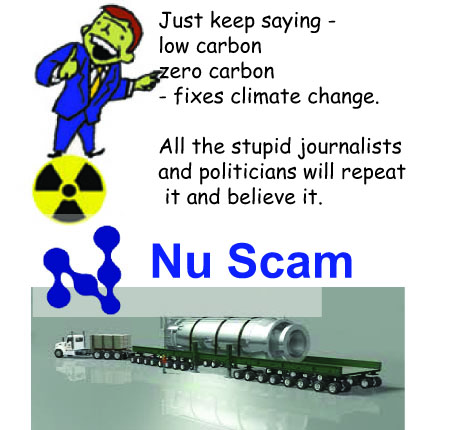
The $6 billion project has built in “off-ramps” for members of the Utah Associated Municipal Power Systems to bow out of participation at this stage, with a deadline for this exit set for Saturday. The 720-megawatt NuScale Power project is planned for construction at the U.S. Department of Energy’s Idaho National Laboratory, about 180 miles north of Salt Lake City. Earlier this month, the federal agency announced it will provide nearly $1.4 billion for the project to pay for one-time costs for a plant that is being billed as a first-of-its-kind, next-generation nuclear power technology. The infusion of money would be subject to yearly appropriations by Congress, but project backers say it has had bipartisan support under both the Trump and Obama administrations. The power association is made up of 47 members in Utah and throughout the Intermountain West that are independent utilities. Bountiful and Beaver are the latest to leave the Carbon Free Power Project, citing concerns over rising costs,…. Concerns over costs and utilities acting as “seed investors” have been raised by the Utah Taxpayers Association, which warns project delays and mounting costs may make members vulnerable. The project passed one regulatory hurdle in a design certification process before the U.S. Nuclear Regulatory Commission and is moving onto the next phase of licensing…… If successful, the Carbon Free Power Project would be the first globally to deploy the modular technology. Construction of the 12-modular unit is expected to start in 2025, with the first unit coming online in 2029. https://www.deseret.com/utah/2020/10/28/21536595/news-nuclear-power-project-utah-cities-bountiful-bow-out-of-planned-nuscale-plant-idaho-uamps |
|
Suspected COVID-19 outbreak declared at Canadian Nuclear Laboratories in Chalk River, Ontario.
The Renfrew County and District Health Unit (RCDHU) said it’s working closely with CNL to identify close contacts of the employees, who have been told to self-isolate at home and to get tested.
It also reminded those deemed high-risk contacts must self-isolate and monitor for symptoms for 14 days even if they’ve had a negative test, as it says COVID-19 could be incubating at the time of testing and that residents should not return to work, school or any public places during this time. …..
Three buildings at the Chalk River campus have been closed down for a thorough cleaning and 80 employees were sent home as a precaution. McGirl said, of those 80, two people have been told to self-isolate in addition to the two employees who tested positive. The names of all employees have been given to the RCDHU for contact tracing. …. https://ottawa.ctvnews.ca/suspected-covid-19-outbreak-declared-at-canadian-nuclear-laboratories-in-chalk-river-ont-1.5164185
World climate at the crossroads – much depends on USA election result
 Guardian 26th Oct 2020, Among the myriad reasons world leaders will closely watch the outcome of a
  fraught US presidential election, the climate crisis looms perhaps largest of all. The international effort to constrain dangerous global heating will hinge, in large part, on which of the dichotomous approaches of Donald Trump or Joe Biden prevails.
anxiety has only escalated during the hottest summer ever recorded in the northern hemisphere, with huge wildfires scorching California and swaths of central South America, and extraordinary temperatures baking the Arctic.
|
|
Hope for nuclear arms control with Russia?
|
Hope for nuclear arms control with Russia? Brookings Steven Pifer, Monday, October 26, 2020 Editor’s Note: The U.S.-Russia nuclear arms treaty, New START, is set to expire in February 2021. Little progress was made during the summer and it was unclear if the two countries would reach an agreement. However, a breakthrough has given the arms control treaty a new lease on life, albeit with a lot of questions, writes Steven Pifer. This piece originally published by the Freeman Spogli Institute’s Center for International Security and Cooperation at Stanford University.
While concern had grown over the past several weeks about a breakdown in U.S.-Russian arms control, it appears the 2010 New Strategic Arms Reduction Treaty and nuclear arms control more broadly may have a new lease on life, albeit with lots of questions. Washington’s negotiation with Moscow on New START hit a roadblock on October 16. President Putin said Russia would agree to a one-year extension, which U.S. negotiators had proposed instead of five years, but without the conditions sought by the American side. National Security Advisor O’Brien summarily rejected the Russian position because it ignored the U.S. demand for a freeze on all nuclear warhead numbers.
Things changed recently. The Russians announced that they would agree to a one-year extension of New START and said they are “ready to assume a political obligation together with the United States to freeze the sides’ existing arsenals of nuclear warheads during this period.” The Russian statement added that this presumed no additional U.S. conditions. The Department of State spokesperson quickly and positively reacted, saying U.S. negotiators are “prepared to meet immediately to finalize a verifiable agreement.” New START constrains U.S. and Russian strategic nuclear forces to their lowest levels since the 1960s. However, when it comes to nuclear warheads as opposed to delivery systems, the treaty limits only “deployed” strategic warheads—that is, warheads on deployed intercontinental ballistic missiles (ICBMs) or submarine-launched ballistic missiles (SLBMs). The treaty does not cover reserve strategic warheads or any non-strategic (tactical) nuclear weapons. If Russian acceptance of a one-year freeze means that the Trump administration has succeeded in persuading Moscow to negotiate a treaty limiting all U.S. and Russian nuclear weapons, that is a commendable breakthrough. Indeed, a treaty covering all the two sides’ nuclear arms has long seemed the logical next step after New START (President Obama proposed such a negotiation in 2010). Questions remain, however. The Russian statement indicates that Moscow is ready to undertake, as a political obligation, a one-year freeze on nuclear warhead numbers. It remains unclear whether Russian officials, beyond that freeze, are prepared to negotiate a legally-binding and verifiable treaty constraining all nuclear warheads that would be in effect for a number of years (New START is in force for 10 years, with the possibility of its extension for an additional five years). ……
it appears that U.S. and Russian negotiators still have issues to resolve. Irrespective of the freeze, New START is worth saving and extending to 2026 (the treaty’s terms provide that there could be multiple extensions). Extension to 2026 would mean five more years of limits on Russian strategic nuclear forces. It would mean five more years of information about those forces provided by the treaty’s verification measures, including data exchanges, notifications and on-site inspections. And extending the treaty would require no change in U.S. strategic modernization plans, as those plans were designed to fit within the treaty’s limits. One last observation: New START requires that, if a side wishes to withdraw from the treaty, it must give the other three months’ notice before doing so. It is now October 21, which means that, if negotiations with the Russians do not go well and the Trump administration were to give notice, the United States could not actually withdraw from the treaty until after January 20, 2021—when Donald Trump will be starting his second term or Joe Biden will have become the 46th U.S. president. Mr. Biden is on record as supporting New START’s extension for five years, with no conditions. https://www.brookings.edu/blog/order-from-chaos/2020/10/26/hope-for-nuclear-arms-control/ |
|
Joe Biden calls climate change the ‘number one issue facing humanity
 Joe Biden calls climate change the ‘number one issue facing humanity’, CNBC, OCT 24 2020
-
- Joe Biden declared climate change the “number one issue facing humanity” and vowed a national transition from fossil fuels to renewable energy that he says will create millions of new jobs.
- Biden has a $2 trillion plan that puts the U.S. on a path to zero carbon pollution from the electricity sector by 2035 and net-zero emissions by 2050.
- Scientists say that Biden’s transition plan is required to avoid the most catastrophic consequences of climate change.
- Climate change has fueled record-setting wildfires in the U.S. West and one of the most active Atlantic hurricane seasons this year………
- “Climate change is the existential threat to humanity,” the former vice president said. “Unchecked, it is going to actually bake this planet. This is not hyperbole. It’s real. And we have a moral obligation.” ……
Biden, the Democratic presidential nominee, has boasted a $2 trillion plan that invests significantly in clean energy in the transportation, electricity and building industry, cuts fossil fuel emissions and improves infrastructure.
Biden’s plan also puts the U.S. on a path to zero carbon pollution from the electricity sector by 2035 and net-zero emissions by 2050. Coal and natural gas comprise more than 60% of the electricity sector, according to the Energy Information Association.
“It’s going to create millions of jobs … We can’t be cavalier about the impact it’s going to have on how we’re going to transition to do all this,” Biden said of his plan on the podcast. “But I just think it’s a gigantic opportunity, a gigantic opportunity to create really good jobs.”
Scientists say that Biden’s transition plan is required to avoid the most catastrophic consequences of climate change. …..
Trump has denied the science of climate change and reversed more than 70 major environmental regulations during his four years in office, with nearly 30 more in progress.
But climate change has been a top issue of the 2020 presidential election, especially among younger voters…….
Biden leads on climate change by an enormous margin, with 58% to 19% of registered voters saying the former vice president would address the problem better than President Trump, according to an NBC News/Wall Street Journal poll. …..
-
-
- September 2020
-
-
- and this year is set to be one of the five hottest in recorded history.
https://www.cnbc.com/2020/10/24/joe-biden-climate-change-is-number-one-issue-facing-humanity.html
Trump government’s dangerous plan to deregulate disposal of radioactive trash
 Trump team pushes nuke dumping http://njtoday.net/2020/10/25/trump-team-pushes-nuke-dumping/, by Staff Report • October 25, 2020 Many Americans alarmed over the deadly coronavirus pandemic, a worsening climate crisis, an economic disaster on par with the Great Depression, or the White House’s surrender of Afghanistan to the Taliban would sleep better if they had assurances the radioactive waste disposal is as secure as it could possibly be… but President Donald Trump is still in charge so there’s no such luck.
The Nuclear Regulatory Commission is finalizing a year-long drive to functionally deregulate disposal of massive amounts of radioactive waste.
NRC’s plan would allow commercial nuclear reactors to dump virtually all their radioactive waste, except spent fuel, in local garbage landfills, which are designed for household trash not rad-waste, according to comments filed by Public Employees for Environmental Responsibility (PEER).
Friday marked the end of public comments for an NRC “interpretative rulemaking” that would, in effect, abrogate longstanding requirements that virtually all such waste must be disposed of in licensed radioactive waste sites meeting detailed safety standards and subject to NRC inspection and enforcement.
Instead, the Trump administration wants to allow the NRC to grant generic exemptions for unlicensed waste handlers.
NRC declares its “intent” that these newly exempt disposal sites would be limited to “very low-level radioactive wastes” – a term undefined by statute – which NRC considers to be “below 25 millirem per year.”
“NRC’s definition would allow public exposure to the equivalent to more than 900 chest X-rays over a lifetime,” explained Lisa McCormick. “This new approach creates a cancer risk twenty times higher than the Environmental Protection Agency’s acceptable risk range, thousands of times the risk goal for Superfund sites, or enough radiation to cause every 500th person exposed to get cancer.”
McCormick, a progressive Democratic activist in New Jersey, says the rule change is “the worst thing to do as dozens of America’s 104 nuclear power plants come to the end of their operation.”
“Once an exempt entity accepts radioactive waste, it enters a regulatory black hole, with no one accountable for it,” stated PEER Pacific Director Jeff Ruch, pointing out that NRC’s plan eliminates the need for radiation monitoring, health physics personnel, design standards, and NRC inspections – all now required of licensed operators. “Unlicensed radioactive waste dumps could operate in ways that endanger communities free from any NRC oversight.”
NRC’s cryptic justification merely indicates that the plan “would provide an efficient means by which the NRC may issue specific exemptions for disposal” but ignores impacts that would –
- Transform many municipal dumps into radioactive repositories, with no safeguards for workers, nearby residents, or adjoining water tables;
-
- Allow unlicensed radioactive waste dumps to expose the public to 2.5 times higher levels of radiation than the NRC now allows for licensed low-level radioactive waste sites, thus creating a strong incentive to send all the radioactive waste to unlicensed dumps; and
- Eliminate the public’s ability to find out radioactive waste is being dumped near them.
At present, the U.S. has 104 commercial nuclear power plants, many of which are beginning, or will soon start, the decommissioning process.
Removing the need for licensed sites to handle the staggering amounts of debris from old reactors would be a major cost savings for that industry.
“One of New Jersey’s oldest nuclear power plants just came off line and it poses a drastic problem for the people and environment” said McCormick.
“NRC’s deregulation will make it nearly impossible to trace recycled radioactive waste flowing through the stream of American commerce,” added Ruch, noting that it may also create a market for the U.S. to import radioactive waste for cheaper disposal. “This plan would plunge the U.S. into the wild, wild West of radioactive waste disposal, on a par with a Third World natio
Safety of SanOnofre nuclear waste storage is disputed
Dust-UPS Continue Over Radioactive Waste Storage at San Onofre https://goodmenproject.com/featured-content/dust-ups-continue-over-radioactive-waste-storage-at-san-onofre/ The most recent dispute centers on the green light the California Coastal Commission gave Edison on July 16 to remove the cooling pools where spent fuel rods were submerged for several years to begin cooling down. October 25, 2020 by EarthTalk By Sarah Mosko
The decommissioning of San Onofre Nuclear Generating Station (SONGS) has been riddled with controversies since it was shuttered in 2013, undermining public confidence in Southern California Edison’s management of highly radioactive nuclear waste which will be stored on-site for the foreseeable future.
In 2018 for example, a whistleblower exposed how a 54-ton canister loaded with radioactive waste nearly plummeted 18 feet because of a design flaw and human error, prompting the Nuclear Regulatory Commission (NRC) to cite Edison with the most serious violation ever imposed on a spent fuel licensee.
The most recent dispute centers on the green light the California Coastal Commission gave Edison on July 16 to remove the cooling pools where spent fuel rods were submerged for several years to begin cooling down. Edison argued the pools aren’t needed anymore because the rods have all been transferred into dry storage canisters.
Each of SONGS’s 123 canisters holds roughly the same amount of Cesium-137 as released during the 1986 Chernobyl disaster.
At issue is this: If a canister were to begin degrading, creating risk of radiation release, returning it to the cooling pools is the only means whereby the contents could be repackaged into a new canister. Nonetheless, Edison convinced the Coastal Commission that an untested, unapproved nickel “cold spray” overlay technology could be applied to patch degrading canisters, making the cooling pools unnecessary.
NRC spokesperson David McIntyre confirmed that NRC has neither evaluated nor approved any method for fixing a canister. The only sure solution is to replace the canister. Many nuclear safety advocates in Orange and San Diego counties are outraged, believing Edison, the Coastal Commission, and NRC are gambling public safety on unproven repair methodology piggy-backed on already inferior dry storage canisters that need to last far longer than originally intended.
This situation is only partly due to the federal government’s failure to construct a mandated permanent national repository for storing the country’s highly radioactive nuclear waste, leaving U.S. nuclear plants saddled with storing spent fuel on-site indefinitely.
Objections to eliminating the pools revolve around this specter of stranded radioactive waste remaining on-site for the foreseeable future, with no means to repackage it, together with concerns about the canisters Edison chose and SONGS’s beachfront location.
Inferior Storage Canisters
SONGS uses two models of thin-walled (5/8 inch thick), welded shut, stainless steel canisters (Holtec and Areva). They are warranted only for manufacturing defects and for just 10-25 years. Thick-walled casks (10-19 inch) with bolted lids, as survived the Fukushima earthquake and tsunami, are standard throughout most of the world.
Nuclear safety advocates point to evidence thin-walled canisters are vulnerable to cracking yet can’t be inspected for tiny cracks which can grow through the canister wall. They are critical of NRC for ignoring established safety codes for nuclear pressure vessels used for storage and transport of nuclear waste (American Society of Mechanical Engineers, ASME N3) when they approved SONGS’s canisters which can’t be inspected by proven methodology (liquid penetrant).
Instead, Edison applied a robotic camera in 2019 to eight Holtec canisters to characterize the extent of canister scraping/gouging incurred during downloading into their holes in the in-ground concrete storage pad. Because of the small clearance between a canister and the guide ring at the mouth of the hole, canisters are routinely scraped/gouged, potentially initiating cracking.
Edison admitted their improvised camera technique doesn’t qualify as a formal inspection, yet the NRC accepted Edison’s conclusion that damage to the canisters during downloading poses no current credible threat.
Thin-walled canisters also fail to block gamma or neutron radiation so require additional individual thick concrete containers for storage and thick metal containers for transport. The unsealed steel lined concrete containers require air vents for convection cooling.
Marine Environment
SONGS is situated within 50 miles of 8 million people, sandwiched between the ocean and the I5 Freeway, and accessible to terrorist attack from either side. A mysterious two-night swarm of drones over the Palo Verde nuclear plant in Arizona last September highlights vulnerability to malfeasance.
SONGS sits 108 feet from shore in a known earthquake zone, creating risks of flooding from sea level rise and shaking and tsunamis from earthquakes. The in-ground pad holding the Holtec canisters already sits just 18 inches above the water table.
US urges countries to withdraw from UN nuclear ban treaty
 US urges countries to withdraw from UN nuke ban treaty, By EDITH M. LEDERER, October 22, 2020, UNITED NATIONS (AP) — The United States is urging countries that have ratified a U.N. treaty to ban nuclear weapons to withdraw their support as the pact nears the 50 ratifications needed to trigger its entry into force, which supporters say could happen this week.The U.S. letter to signatories, obtained by The Associated Press, says the five original nuclear powers — the U.S., Russia, China, Britain and France — and America’s NATO allies “stand unified in our opposition to the potential repercussions” of the treaty……..
Beatrice Fihn, executive director of the International Campaign to Abolish Nuclear Weapons, the 2017 Nobel Peace Prize-winning coalition whose work helped spearhead the nuclear ban treaty, told The Associated Press Tuesday that several diplomatic sources confirmed that they and other states that ratified the TPNW had been sent letters by the U.S. requesting their withdrawal.
She said the “increasing nervousness, and maybe straightforward panic, with some of the nuclear-armed states and particularly the Trump administration” shows that they “really seem to understand that this is a reality: Nuclear weapons are going to be banned under international law soon.”
Fihn dismissed the nuclear powers’ claim that the treaty interferes with the Nuclear Nonproliferation Treaty as “straightforward lies, to be frank.”
“They have no actual argument to back that up,” she said. “The Nonproliferation Treaty is about preventing the spread of nuclear weapons and eliminating nuclear weapons, and this treaty implements that. There’s no way you can undermine the Nonproliferation Treaty by banning nuclear weapons. It’s the end goal of the Nonproliferation Treaty.”
The NPT sought to prevent the spread of nuclear arms beyond the five original weapons powers. It requires non-nuclear signatory nations to not pursue atomic weapons in exchange for a commitment by the five powers to move toward nuclear disarmament and to guarantee non-nuclear states’ access to peaceful nuclear technology for producing energy………
“That the Trump administration is pressuring countries to withdraw from a United Nations-backed disarmament treaty is an unprecedented action in international relations,” Fihn said. “That the U.S. goes so far as insisting countries violate their treaty obligations by not promoting the TPNW to other states shows how fearful they are of the treaty’s impact and growing support.”
The treaty was approved by the 193-member U.N. General Assembly on July 7, 2017 by a vote of 122 in favor, the Netherlands opposed, and Singapore abstaining. Among countries voting in favor was Iran. The five nuclear powers and four other countries known or believed to possess nuclear weapons — India, Pakistan, North Korea and Israel — boycotted negotiations and the vote on the treaty, along with many of their allies………… https://apnews.com/article/nuclear-weapons-disarmament-latin-america-united-nations-gun-politics-4f109626a1cdd6db10560550aa1bb491
Shadow of $25 billion Nuclear Plant Vogtle hangs over Georgia Public Service Commission elections

Nuclear costs loom over races for Georgia PSC races
Public Service Commission must deal with $25 billion Plant Vogtle’s impact on electric rates, News 4 Ajax, Jeff Amy, Associated Press, 25 Oct 20, ATLANTA – The shadow of two nuclear reactors that Georgia Power Co. is building near Waynesboro hangs over two statewide elections for the Georgia Public Service Commission. Although the reactors are now getting so close to completion that they are likely to enter service, whoever is elected will have to deal with the $25 billion project’s ultimate impact on customer bills.
Electric customers statewide and even in Jacksonville will help pay for Plant Vogtle, as Georgia Power has contracts to provide power from the plant around the Southeast.
The five-person utility regulatory body is currently all Republican, with two members up for reelection this year. ………..
Amid rising costs, the plan to add a third and fourth nuclear reactor at Plant Vogtle survived a cost-overrun scare in 2018 with the heavy support of the state’s Republican establishment. Georgia Power, the largest subsidiary of the Atlanta-based Southern Co. is now building the only new nuclear plants in the U.S. ……… https://www.news4jax.com/news/georgia/2020/10/25/nuclear-costs-loom-over-races-for-georgia-utility-regulator/
And again, it’s delay delay at the costly Vogtle nuclear project
 Progress slips again at Vogtle nuclear plant, By Matt Kempner, The Atlanta Journal-Constitution, Georgia Power has fallen months further behind on critical steps to start the first of two new nuclear reactors at Plant Vogtle, despite having last revised its schedule only three months ago. Progress slips again at Vogtle nuclear plant, By Matt Kempner, The Atlanta Journal-Constitution, Georgia Power has fallen months further behind on critical steps to start the first of two new nuclear reactors at Plant Vogtle, despite having last revised its schedule only three months ago.And measures to halt COVID-19 within the project’s massive workforce continue to complicate construction.
The utility said it still expects to meet a state regulatory deadline to have the first reactor in commercial operation in November 2021. But its wiggle room for doing so has become increasingly thin. Missing the deadline little more than a year from now would increase already soaring costs, which could end up in the electric bills of 2.6 million customers……….. The Vogtle project already is years behind schedule and billions of dollars over budget, with customers at risk of having to cover those cost. State staffers and independent monitors have warned about the potential for still more delays, even before factoring in effects from the pandemic. …….. So far, more than 1,000 Vogtle workers have tested positive during the pandemic, according to the company’s latest filing. ……… Meanwhile, Georgia Power’s continued shifts in predictions about when it will complete scheduled Vogtle milestones have made it “impossible to determine where the project really stands,” said Kurt Ebersbach of the Southern Environmental Law Center, which has represented groups critical of Vogtle’s impact on consumers and the state……… https://www.ajc.com/news/progress-slips-again-at-vogtle-nuclear-plant/OK656Q6TQFHANDQW72D2ASP76E/ |
|
USA government puts out a financial lifeline to the failing nuclear industry
But the winds of change could soon be blowing for U.S. nuclear. Last month the nuclear sector got a small but certainly not insignificant state-sponsored lifeline when the the Department of Energy (DOE) announced that “it would be awarding more than $65m in nuclear energy research, crosscutting technology development, facility access, and infrastructure awards.” According to reporting by PowerTechnology, “the awards fall under the department’s nuclear energy programs – the Nuclear Energy University Programme, the Nuclear Energy Enabling Technologies, and the Nuclear Science User Facilities.”
And now, just this week, there’s even better news for U.S. nuclear power. “After hemming and hawing for decades, the United States is taking some big steps in developing advanced nuclear reactor technologies,” Forbes reported on Wednesday. The article is referring to yet another major announcement from the DOE that took place just last week. The department will be awarding $80 million each–and that’s just in initial funding–to two different teams under the Advanced Reactor Demonstration Program (ARDP). The DOE has planned for an additional $3.2 billion in investment over the next seven years, an impressive sum that will be matched by the private sector within the nuclear industry. One of these teams is to be led by Bill Gates’ brainchild TerraPower in a joint effort with GE Hitachi. The other will be spearheaded by X-energy. …….https://oilprice.com/Alternative-Energy/Nuclear-Power/Nuclear-Energy-Granted-A-State-Sponsored-Lifeline-In-The-US.html
The Atlantic raised the big question. In a crisis, do Americans want Trump’s finger on the nuclear button?
 The Atlantic’s endorsement of Joe Biden raises a sobering point all Americans should consider. Daily Kos, Dartagnan Community, Friday October 23, 2020 “………. —The Atlantic reminds us that the person in charge of this country’s nuclear arsenal matters.
In most matters related to the governance and defense of the United States, the president is constrained by competing branches of government and by an intricate web of laws and customs. Only in one crucial area does the president resemble, in the words of the former missile officer and scholar Bruce Blair, an absolute monarch—his control of nuclear weapons. Richard Nixon, who was president when Major Hering asked his question, was reported to have told members of Congress at a White House dinner party, “I could leave this room and in 25 minutes, 70 million people would be dead.” This was an alarming but accurate statement.
Donald Trump and Joe Biden on climate change
Independent 23rd Oct 2020 It has been around 20 years since a lengthy discussion on climate change featured in a presidential debate during which time a monumental shift has happened in how America views the crisis.
Two-thirds of Americans think that the US government should do more on climate change and moderator Kristen Welker asked both Donald Trump and Joe Biden how they would step up
on the issue during the final presidential debate on Thursday, with millions of Americans already taking to the polls ahead of election day on 3 November.
Calling it an “existential crisis”, Mr Biden sounded the alarm for the world to address global warming, as Mr Trump took credit for pulling the US out of the 2015 Paris Climate Accord, the international agreement aimed at doing precisely that. Mr Trump said his focus was saving
American jobs, while taking credit for some of the “cleanest air and water the nation has seen in generations” — partly down to regulations passed in the Obama era.
Independent 23rd Oct 2020, President Trump, who has repeatedly called climate change a “hoax”, said he planned for a “trillion trees” before touting America’s “clean air”, “clean water” and lower carbon emissions (all of which are, at best, misleading, as The Independent has reported).
The president then pivoted to an attack on clean energy, taking particular issue with windmills. “He thinks wind causes cancer. Windmills,” Mr Biden noted. “I know more about wind than you do,” Mr Trump replied, before going on to say windmills are extremely expensive, “kill all the birds” and “the fumes coming up, if you’re a believer in carbon emission … for these massive windmills is more than anything we’re talking about with natural gas which is very clean”.
Fossil fuels are ”very clean” – Donald Trump
Guardian 23rd Oct 2020, In Donald Trump’s world – laid bare during Thursday night’s finalpresidential debate with his Democratic rival Joe Biden in Nashville – fossil fuels are “very clean”, the US has the best air and water despite his administration’s extensive regulatory rollbacks, and thecountry can fix climate change by planting trees.
not exist. Humanity has just eight years to figure out how to get climate change under control before the future starts to look drastically worse – multiple-degree temperature increases, global sea-level rise, and increasingly disastrous wildfires, hurricanes, floods and droughts. Doing so will mean that unless there is a technological miracle, humans will at some point have to stop burning oil, gas and coal.https://www.theguardian.com/us-news/2020/oct/23/joe-biden-transition-from-oil-industry-rowing-back
Another city leaves small nuclear reactor project – unanimous vote by Murray City Council, Utah
 Murray City votes to withdraw from nuclear power project, Salt Lake Tribune, By Taylor Stevens– 23 Oct 20, The Murray City Council voted unanimously this week to back out of a first-of-its-kind nuclear power project that has the support of a number of Utah municipalities.
It’s the fourth Utah city to exit the small modular nuclear reactor pursuit over the last few months amid pressure from opponents who have raised concerns about environmental and financial risks of the proposed 12-module plant, which would be located at Idaho National Laboratory in Idaho Falls and produce a total 720 megawatts of electricity.
During the city’s Tuesday council meeting, Murray Power Manager Blaine Haacke outlined several advantages of the project, including the potential that it could fill the energy gap that will be left when the Hunter Power Plant in Castle Dale goes offline in the coming years.
He told the council that he expects UAMPS will carry the project forward without Murray. But he said the association’s members will meet during the first week of November to make a final decision, after they find out how many cities have exited.
1 This Month

of the week– Nuclear Reactor Information Task Force

14 May – online event From Bombs to Data Centres: the Face of Nuclear Colonialism
To see nuclear-related stories in greater depth and intensity – go to https://nuclearinformation.wordpress.com
-
Archives
- May 2026 (81)
- April 2026 (356)
- March 2026 (251)
- February 2026 (268)
- January 2026 (308)
- December 2025 (358)
- November 2025 (359)
- October 2025 (376)
- September 2025 (257)
- August 2025 (319)
- July 2025 (230)
- June 2025 (348)
-
Categories
- 1
- 1 NUCLEAR ISSUES
- business and costs
- climate change
- culture and arts
- ENERGY
- environment
- health
- history
- indigenous issues
- Legal
- marketing of nuclear
- media
- opposition to nuclear
- PERSONAL STORIES
- politics
- politics international
- Religion and ethics
- safety
- secrets,lies and civil liberties
- spinbuster
- technology
- Uranium
- wastes
- weapons and war
- Women
- 2 WORLD
- ACTION
- AFRICA
- Atrocities
- AUSTRALIA
- Christina's notes
- Christina's themes
- culture and arts
- Events
- Fuk 2022
- Fuk 2023
- Fukushima 2017
- Fukushima 2018
- fukushima 2019
- Fukushima 2020
- Fukushima 2021
- general
- global warming
- Humour (God we need it)
- Nuclear
- RARE EARTHS
- Reference
- resources – print
- Resources -audiovicual
- Weekly Newsletter
- World
- World Nuclear
- YouTube
-
RSS
Entries RSS
Comments RSS
 nuclear-news