Trying to test for cracks in nuclear waste containers that have to last for over a million years

Waste from nuclear fuel must be stored for more than a million years/
“Salt can be present in the ambient air and environment anywhere, not just near the ocean. We need to be able to plan for extended long-term storage of spent nuclear fuel at nuclear power plants for the foreseeable future — it’s a national reality,”
 Sandia to put nuclear waste storage canisters to the test, https://www.newswise.com/articles/sandia-to-put-nuclear-waste-storage-canisters-to-the-test, Scientists will explore science of cracks caused by corrosion, 10-Dec-2020 , by Sandia National Laboratories Newswise — ALBUQUERQUE, N.M. — Sandia National Laboratories is outfitting three 22.5-ton, 16.5-feet-long stainless-steel storage canisters with heaters and instrumentation to simulate nuclear waste so researchers can study their durability.
The three canisters, which arrived in mid-November and have never contained any nuclear materials, will be used to study how much salt gathers on canisters over time. Sandia will also study the potential for cracks caused by salt- and stress-induced corrosion with additional canisters that will be delivered during the next stage of the project.
Currently there is not an operating geologic repository in the U.S. for the permanent disposal of spent nuclear fuel. As a result, spent fuel is being stored at commercial nuclear power plants in both storage pools and dry storage canisters. The storage canisters currently holding the spent nuclear fuel were designed to have a useful life of a few decades but will now likely need to be used longer than planned, said Tito Bonano, Sandia’s nuclear energy fuel cycle senior manager.
Data is urgently needed to validate and guide how industry should manage storage canisters for longer than originally anticipated, Bonano said.
“Salt can be present in the ambient air and environment anywhere, not just near the ocean. We need to be able to plan for extended long-term storage of spent nuclear fuel at nuclear power plants for the foreseeable future — it’s a national reality,” he said.
The researchers expect the project could have long-reaching implications for public health and safety, industry practices, regulatory framework and defining future research paths, said Bonano.
The three-year project is funded by the Department of Energy’s Nuclear Energy office. Overall, fifteen never-used, never-irradiated DOE-owned canisters are being distributed for large scale testing to Sandia and two other national laboratories, an industry research institute and an independent storage facility at an existing nuclear power plant.
Waste from nuclear fuel must be stored for more than a million years
Nuclear power plants use uranium pellets inside a metal-cladded tube, called a fuel rod, to power reactors to create the heat needed to make electricity. After the fuel rods can no longer be used in the reactor, they need to be stored onsite until they are taken offsite to another facility and eventually permanently disposed because they will be radioactive for a long time, said Samuel Durbin, a mechanical engineer and Sandia’s canister project lead.
“When fuel is removed from a reactor, it’s very hot, both in temperature and radioactivity” Durbin said. “The utility loads it into a pool for about five years to cool down. After that, the spent fuel can be offloaded into a dry storage canister.”
A storage canister starts as a flat piece of stainless steel that is rolled into a cylinder and then welded where the seams come together. The heat from the welding creates heat-affected zones in the seams of the canister that experience tensile, or pulling, stress. This stress makes these areas around the welds more susceptible to corrosion from salt over time, said Durbin.
Research will test how much salt deposits on canisters over time
Sandia received three canisters Nov. 13. The research team will outfit each of them with 32 electrical heaters to simulate the decay heat, which is heat released as a result of radioactive decay, from the 32 spent fuel assemblies that would typically be stored in this type of canister. No radioactive materials will be used in the testing, Durbin said.
Instruments called thermocouples, which measure temperature, and other sensors for diagnostic testing and surface sampling also will be added, he said.
Once the outfitted canisters have been tested and repacked for transport at Sandia, the team plans to move them to a storage pad at an independent spent fuel storage installation on the West Coast where they will experience the same real-life conditions of in-use canisters. The Sandia team, led by managers Sylvia Saltzstein and Geoff Freeze, Durbin, and chemists/corrosion scientists Charles Bryan and Rebecca Schaller, along with partners from other national laboratories will monitor the test canisters and record surface deposits, especially chloride-bearing salts, for three to more than 10 years, depending on how much the data varies over time.
“Sodium-chloride, or salt, that settles on the surface of spent nuclear-fuel canisters can lead to chloride-induced stress corrosion cracking, and right now there is inadequate data on these surface deposits,” said Durbin.
In real-life storage of nuclear waste, Durbin said the decay heat from the spent fuel creates natural convection around the storage canisters, causing outside air to be drawn over the canister surface. This process helps cool the spent fuel over time. As ambient air is drawn in, salt and other particulates in the air are drawn in as well and can settle on the canister surface. During the test, the electrical heaters installed inside the canisters at Sandia will replicate this decay heat-driven convection without using nuclear materials.
In hot, dry conditions, Durbin said salt deposits alone don’t cause any issues, but over time, as the decay heat decreases and the canister cools, water can condense on the canister surface and a brine can form.
“These conditions can occur nationwide and are seen as precursors to chloride-induced, stress-corrosion cracking. Back when these canisters were being designed, people weren’t thinking about this as an issue because we had a plan for permanent disposal. The current national nuclear waste situation forces canisters to be stored onsite for the foreseeable future, which could be 100 years or longer, so stress corrosion cracking becomes more of a concern,” Durbin said.
In addition to the long-term heating and surface deposition test, Sandia will use up to another three canisters for laboratory-based tests to conduct fundamental research on cracking caused by salt and stress, especially on the welded seams and intersections of the canisters. Researchers will measure the effectiveness of commercially available crack repair and mitigation coatings.
To test these seams, the team will cut the canisters into small segments and test pieces with and without welded seams to study the pre-cursor conditions for salt and stress to cause the corrosion that leads to cracks, he said.
Growing political opposition in Canada to Small Nuclear Reactors
 Hill Times -Political opposition growing to new nuclear reactors, https://wordpress.com/read/feeds/74740422/posts/3066856410 Hill Times -Political opposition growing to new nuclear reactors, https://wordpress.com/read/feeds/74740422/posts/3066856410By EVA SCHACHERL DECEMBER 9, 2020 The nuclear industry and Liberals have not only been laying the groundwork for government funding. It appears they have been ensuring that the framework for nuclear energy in Canada gets even more accommodating. Natural Resources Minister Seamus O’Regan has been hyping so-called next-generation reactors for months, portraying the industry as a future utopia.
Many Canadians are anxious to see what our energy future will be. Politically, it’s a question that stirs passions from Alberta’s oil patch to Ontario’s cancelled wind farms. But political debate is picking up around our nuclear energy future. And with good reason. Government-funded expansion of the nuclear industry, and a simultaneous watering-down of regulations, could be the Liberal government’s toxic legacy.
Natural Resources Minister Seamus O’Regan has been hyping so-called next-generation reactors for months. A recent nuclear industry summit—hosted with federal funding—portrayed nuclear energy expansion in Canada as a future utopia. The Green Party caucus, the NDP’s natural resources critic Richard Cannings, and the Bloc Québécois’s environment critic Monique Pauzé have all slammed O’Regan’s expected small modular reactor (SMR) “action plan.” They say it does not belong in a plan to reduce greenhouse gas emissions. Energy efficiency, wind, solar, and storage technologies are ready to build, and much cheaper, according to Lazard, a financial advisory and asset management firm. The prototype reactors will take years, if not decades, to develop, and could absorb hundreds of millions, even billions, in taxpayer subsidies, according to Greenpeace Canada.
That would mean opportunities lost for those dollars to build many times the amount of zero-emission energy with renewables and energy-efficiency projects. The latter would not create toxic radioactive waste for future generations to contend with. Independent research says that a nuclear solution for remote communities (as proposed by the government) is likely to cost 10 times more to build and operate than the alternatives. It seems inevitable that the Liberal action plan will soon be launched with generous handouts for the nuclear industry, whose aspiring players in Canada today include SNC-Lavalin and U.S. corporations like Westinghouse and GE-Hitachi Nuclear Energy. Few Canadians are aware that “Canadian” Nuclear Laboratories (CNL) is owned by a consortium of SNC-Lavalin and two U.S. firms, Fluor and Jacobs.
In recent years, the nuclear industry and Liberals have not only been laying the groundwork for government funding. It appears they’ve also been ensuring that the framework for nuclear energy in Canada gets even more accommodating. The biggest step was exempting most new reactors from the Impact Assessment Act, which, in 2019, replaced the Canadian Environmental Assessment Act. This was deemed so important to the nuclear industry’s future that the Canadian Nuclear Safety Commission (CNSC) lobbied the Liberal government to exempt small reactors—and won. So much for the CNSC, the regulator that’s supposed to oversee the industry, being seen as objective and “world class.”
The Impact Assessment Act was intended to create “greater public trust in impact assessment and decision-making.” But there will be no federal assessment of nuclear reactors up to 200 thermal MW in size, nor of new reactors built at existing nuclear plants (up to 900 MWth). Yet new tidal power projects, as well as offshore wind farms with 10 or more turbines, need an assessment under the regulations, as do many new fossil fuel projects.
Also exempted from federal assessment is the “on-site storage of irradiated nuclear fuel or nuclear waste” associated with small modular reactors. This will make it easier for SMRs’ radioactive waste to be potentially left in the northern, remote, and First Nations communities, where they are proposed to be built. The nuclear regulator has also been responsible for introducing a suite of “regulatory documents” on reactor decommissioning and radioactive waste that environmental groups have called “sham regulation.”
Meanwhile, the bureaucrats at the CNSC have been busy signing a memorandum of cooperation with the U.S. Nuclear Regulatory Commission on Small Modular Reactors. This agreement means that Canada can recognize U.S. reviews of reactor designs in order to “streamline the review process.” CNSC has also outlined its plan in a document called Strategy for Readiness to Regulate Advanced Reactor Technologies. In a nutshell, the document says that regulations for new reactor designs will have to be flexible. It notes that CNSC regulated the earlier generation of water-cooled reactors (such as CANDUs) at first based on “objectives” in the 1950s and ‘60s. Then, as experience with these reactors evolved, regulations became more detailed and prescriptive. It says the same may have to happen with the new next-gen reactor designs.
In the 1950s, there were indeed few “prescriptive requirements” for the newfangled reactors. In 1952, the NRX reactor at Chalk River, Ont., had a meltdown. It was the first large-scale nuclear reactor accident in the world and took two years to clean up—which, by 1950s standards, included pumping 10,000 curies of long-lived fission products into a nearby sandy area. Then in 1958, the NRU reactor at Chalk River—a test bed for developing fuels and materials for the CANDU reactor—had a major accident, a fuel-rod fire that contaminated the building and areas downwind. It took 600 workers and military personnel to do the top-secret clean-up. Let’s hope today’s regulators and lawmakers can learn from history. Does Canada really need or want to be the “leading-edge” testing ground for new experimental nuclear reactors? Canadians should have their say in a referendum—or at the ballot box. |
With Small Nuclear Reactors (SMRs) Canada is back in the nuclear weapons business
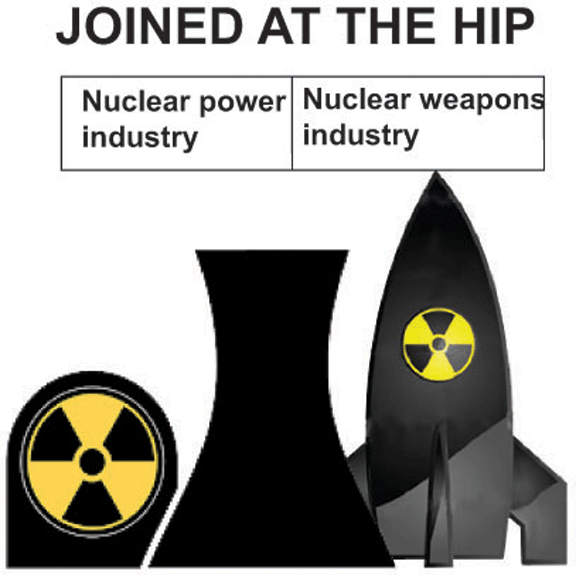 Canada re-engages in the Nuclear Weapons Business with SMRs, December 3, 2020, WWW.HILLTIMES.COM/2020/12/03/CANADA-RE-ENTERS-NUCLEAR-WEAPONS-BUSINESS-WITH-SMALL-MODULAR-REACTORS/274591
Natural Resources Minister Seamus O’Regan is expected to announce within weeks his government’s action plan for development of “small modular” nuclear reactors (SMRs).
SMR developers already control the federally-subsidized Chalk River Laboratories and other facilities owned by the crown corporation, Atomic Energy of Canada Limited (AECL). Canada is now poised to play a supporting role in the global nuclear weapons business, much as it did during World War II.
Canada was part of the Manhattan project with the U.S. and U.K. to produce atomic bombs. In 1943 the three countries agreed to build a facility in Canada to produce plutonium for nuclear weapons. Researchers who trained at the Chalk River Laboratories went on to launch weapons programs in the U.K. and France. Chalk River provided plutonium for U.S. weapons until the 1960s.
Canada’s Nuclear Schizophrenia describes a long tradition of nuclear cooperation with the United States: “For example, in the early 1950s, the U.S. Navy used Canadian technology to design a small reactor for powering its nuclear submarines.” C.D. Howe, after creating AECL in 1952 to develop nuclear reactors and sell weapons plutonium, remarked that “we in Canada are not engaged in military development, but the work that we are doing at Chalk River is of importance to military developments.”
The uranium used in the 1945 Hiroshima bomb may have been mined and refined in Canada. According to Jim Harding’s book Canada’s Deadly Secret: Saskatchewan Uranium and the Global Nuclear System, from 1953 to 1969, all the uranium mined in Saskatchewan went to make U.S. nuclear weapons. Canada remains the world’s second-largest producer of uranium. North America’s only currently operating uranium processing facility is owned by Cameco in Port Hope, Ontario.
Canada built India’s CIRUS reactor, which started up in 1960 and produced the plutonium for India’s first nuclear explosion in 1974. Canada also built Pakistan’s first nuclear reactor, which started up in 1972. Although this reactor was not used to make weapons plutonium, it helped train the engineers who eventually exploded Pakistan’s first nuclear weapons in 1998.
In 2015 the Harper Government contracted a multi-national consortium called Canadian National Energy Alliance – now comprised of two U.S. companies, Fluor and Jacobs, along with Canada’s SNC-Lavalin – to operate AECL’s nuclear sites, the main one being at Chalk River. Fluor operates the Savannah River Site, a South Carolina nuclear weapons facility, under contract to the U.S. Department of Energy (DOE). Jacobs also has contracts at DOE weapons facilities and is part of a consortium that operates the U.K. Atomic Weapons Establishment.
Joe McBrearty, the president of the consortium’s subsidiary that operates Chalk River and other federal nuclear sites, was a U.S. Navy nuclear submarine commander and then chief operating officer for the DOE’s nuclear laboratories between 2010 and 2019.
All three consortium partners have investments in SMRs and are ramping up research and development at AECL’s Chalk River facility. Some SMR designs would use uranium enriched to levels well beyond those in current reactors; others would use plutonium fuel; others would use fuel dissolved in molten salt. All of these pose new and problematic weapons proliferation risks.
Rolls Royce, an original consortium partner that makes reactors for the U.K.’s nuclear submarines, is lead partner in a U.K. consortium (including SNC-Lavalin) that was recently funded by the U.K. government to advance that country’s SMR program.
A military bromance: SMRs to support and cross-subsidize the UK nuclear weapons program, says “Industry and government in the UK openly promote SMRs on the grounds that an SMR industry would support the nuclear weapons program (in particular the submarine program) by providing a pool of trained nuclear experts, and that in so doing an SMR industry will cross-subsidize the weapons program.”
The article quotes a 2017 Rolls Royce study as follows: “expansion of a nuclear-capable skilled workforce through a civil nuclear UK SMR programme would relieve the Ministry of Defence of the burden of developing and retaining skills and capability.”
The SMR connection to weapons and submarines could hardly be clearer – without SMRs, the U.S. and U.K. will experience a shortage of trained engineers to maintain their nuclear weapons programs.
With the takeover of AECL’s Chalk River Laboratories by SMR developers, and growing federal government support for SMRs, Canada has become part of a global regime linking nuclear power and nuclear weapons.
Opponents of the Ohio bailout of nuclear industry want more than just a freeze on this law
|
Opponents of HB6 Say Nuclear Bailout Freeze is not Enough https://www.wksu.org/government-politics/2020-12-08/opponents-of-hb6-say-nuclear-bailout-freeze-is-not-enough
The Statehouse News Bureau | By Andy Chow December 8, 2020, New charges are set to appear on everyone’s electric bills in Ohio to support a nuclear power plant bailout. While that bailout is linked to an alleged bribery scheme, House Republicans seem poised to freeze the law rather than repeal it. House leadership is signaling a freeze to the bailout, HB798, will be the vehicle used to address the energy laws created through HB6. The energy law allows for new charges of up to $2.35 a month on electric bills for nuclear, coal, and solar subsidies. Rachael Belz with Ohio Consumers Power Alliance says a freeze on the new charges doesn’t truly help the ratepayers. “It’s more like pushing something off that you never intend to get back to,” Belz said. Talk of an HB6 repeal began after House Speaker Larry Householder was arrested about five months ago accused of a bribery scheme that helped him rise to leadership and HB6 become law. It’s believed FirstEnergy funneled millions of dollars into the alleged scheme. HB6 accomplishes several things on the company’s legislative agenda. The nuclear and solar subsidies amount to a $0.85 monthly charge on electric bills. That new charge generates $150 million a year for two nuclear power plants in Ohio and $20 million for existing solar farms. HB798 would not repeal the provisions in HB6 that cuts renewable energy standards and eliminates energy efficiency standards. |
|
Significant problems for UK’s Trident nuclear deterrent ,if U.S. Congress refuses to fund a next-generation warhead.
   Guardian 8th Dec 2020, Britain’s most senior defence official admitted there would be “very significant implications” for the future of the Trident nuclear deterrent if Democrats in the US Congress refused to fund a next-generation warhead. Sir Stephen Lovegrove, permanent secretary at the Ministry of Defence, saidthat the UK was monitoring the US standoff closely but could not say what impact a refusal to start work on the new W93 warhead would have – or how many billions it would cost. Guardian 8th Dec 2020, Britain’s most senior defence official admitted there would be “very significant implications” for the future of the Trident nuclear deterrent if Democrats in the US Congress refused to fund a next-generation warhead. Sir Stephen Lovegrove, permanent secretary at the Ministry of Defence, saidthat the UK was monitoring the US standoff closely but could not say what impact a refusal to start work on the new W93 warhead would have – or how many billions it would cost.British politicians and officials have, until now, had little to say about the long-running US row over the W93, crudely estimated to be twice as explosive as the ageing Trident warhead now usedby the UK. Prior to the US presidential election, Democrats in the House ofRepresentatives had refused to fund a $53m (£40m) development programme for the first year of the W93 despite lobbying from both the White House and the UK.
|
Federal funding for new nuclear reactors is a serious mistake that blocks swift ation on climate
|


Canada’s Coalition for Responsible Energy Development sceptical about Small Nuclear Reactors
Questions abound about New Brunswick’s embrace of small nuclear reactors
 Critics question business case, but CEO says the market is ‘screaming’ for the units, Jacques Poitras · CBC News Dec 07, 2020
When Mike Holland talks about small modular nuclear reactors, he sees dollar signs.
When the Green Party hears about them, they see danger signs.
The loquacious Progressive Conservative minister of energy development recently quoted NB Power’s eye-popping estimates of the potential economic impact of the reactors: thousands of jobs and a $1 billion boost to the provincial economy.
“New Brunswick is positioned to not only participate in this opportunity, but to be a world leader in the SMR field,” Holland said in the legislature last month.
Green MLAs David Coon and Kevin Arseneau responded cheekily by ticking off the Financial and Consumer Services Commission’s checklist on how to spot a scam.
Is the sales pitch from a credible source? Is the windfall being promised by a reputable institution? Is the risk reasonable?
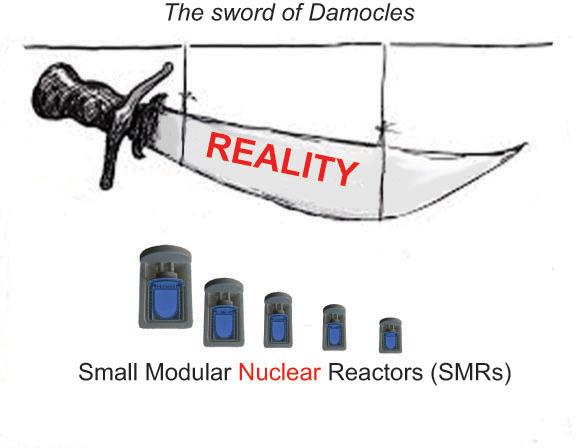 For small nuclear reactors, they said, the answer to all those questions is no.
“The last thing we need to do is pour more public money down the nuclear-power drain,” Coon said, reminding MLAs of the Point Lepreau refurbishment project that went $1 billion over budget. …….
Premier Blaine Higgs is a fervent supporter, but in the last provincial election the Liberals promised they’d do even more than Higgs to promote them.
Under Brian Gallant, the Liberals handed $10 million to two Saint John companies working on SMRs, ARC Nuclear and Moltex Energy.
Greens point to previous fiascoes
The Greens and other opponents of nuclear power fear SMRS are the latest in a long line of silver-bullet fiascoes, from the $23 million spent on the Bricklin in 1975 to $63.4 million in loans and loan guarantees to the Atcon Group a decade ago.
“It seems that [ARC and Moltex] have been targeting New Brunswick for another big handout … because it’s going to take billions of dollars to build these things, if they ever get off the drawing board,” said Susan O’Donnell, a University of New Brunswick researcher.
O’Donnell, who studies technology adoption in communities, is part of a small new group called the Coalition for Responsible Energy Development formed this year to oppose SMRs.

“What we really need here is a reasonable discussion about the pros and cons of it,” she said……..
What we didn’t see was a market analysis,” O’Donnell said. “How viable is the market? … They’re all based on a hypothetical market that probably doesn’t exist.”
O’Donnell said her group asked for the full report but was told it’s confidential because it contains sensitive commercial information………..
The market is screaming for this product,” Rory O’Sullivan, CEO of Moltex said, adding “all of the utilities” in Canada are interested in Moltex’s reactors ……
ARC’s CEO Norm Sawyer is more specific, guessing 30 per cent of his SMR sales will be in Atlantic Canada, 30 per cent in Ontario and 40 per cent in Alberta and Saskatchewan — all provincial power grids.
O’Donnell said it’s an important question because without a large number of guaranteed sales, the high cost of manufacturing SMRs would make the initiative a money-loser.
The cost of building the world’s only functioning SMR, in Russia, was four times what was expected.
An Australian government agency said initial cost estimates for such major projects “are often initially too low” and can “overrun.”
Up-front costs can be huge
University of British Columbia physicist M.V. Ramana, who has authored studies on the economics of nuclear power, said SMRs face the same financial reality as any large-scale manufacturing.
“You’re going to spend a huge amount of money on the basic fixed costs” at the outset, he said, with costs per unit becoming more viable only after more units are built and sold.
He estimates a company would have to build and sell more than 700 SMRs to break even, and said there are not enough buyers for that to happen. ….
O’Sullivan says: “In fact, just the first one alone looks like it will still be economical,” he said. “In reality, you probably need a few … but you’re talking about one or two, maximum three [to make a profit] because you don’t need these big factories.”
‘Paper designs’ prove nothing, says expert
Ramana doesn’t buy it.
“These are all companies that have been started by somebody who’s been in the nuclear industry for some years, has a bright idea, finds an angel investor who’s given them a few million dollars,” he said.
“They have a paper design, or a Power Point design. They have not built anything. They have not tested anything. To go from that point … to a design that can actually be constructed on the field is an enormous amount of work.
Both CEOs acknowledge the skepticism about SMRs.
“I understand New Brunswick has had its share of good investments and its share of what we consider questionable investments,” said ARC’s CEO Norm Sawyer….
But he said ARC’s SMR is based on a long-proven technology and is far past the on-paper design stage “so you reduce the risk.”
Moltex is now completing the first phase of the Canadian Nuclear Safety Commission’s review of its design, a major hurdle. ARC completed that phase last year.
But, Ramana said there are problems with both designs. Moltex’s molten salt model has had “huge technical challenges” elsewhere while ARC’s sodium-cooled system has encountered “operational difficulties.” …..
federal Natural Resources Minister Seamus O’Regan told CBC earlier this year that he’s “very excited” about SMRs…..
O’Donnell said while nuclear power doesn’t emit greenhouse gases, it’s hardly a clean technology because of the spent nuclear fuel waste.
Government support is key
She also wonders why, if SMRs make so much sense, ARC and Moltex are relying so much on government money rather than private capital.
…….. So far, Ottawa hasn’t put up any funding for ARC or Moltex. During the provincial election campaign, Higgs implied federal money was imminent, but there’s been no announcement in the almost three months since then.
Last month the federal government announced $20 million for Terrestrial Energy, an Ontario company working on SMRs.
…….O’Donnell said her group plans to continue asking questions about SMRs.
“I think what we really need is to have an honest conversation about what these are so that New Brunswickers can have all the facts on the table,” she said. https://www.cbc.ca/news/canada/new-brunswick/questions-small-nuclear-reactors-1.5828784
Nuclear powered electric vehicles? not existing, and not likely
|
One promising option, according to scientists at Argonne National Laboratory, is small nuclear reactors. Engineer Derek Kultgen is leading efforts at Argonne to develop a microreactor — about the size of two home water heaters — that is specifically designed to charge electric trucks at rest stops across the country lacking EV charging stations………… One promising, carbon-free charging option, according to scientists at Argonne National Laboratory, is small nuclear reactors………. Small nuclear reactors could be ideal for e-truck charging, he said……. In August, the Nuclear Regulatory Commission issued a final safety evaluation report endorsing NuScale Power’s small modular nuclear reactor design (Greenwire, Aug. 31). ……. Critics, however, say there’s insufficient evidence that small reactors are safer than nuclear power plants. It could also take years before they’re ready to be deployed, whereas new solar and wind resources could be built much more quickly. The microreactor being designed at Argonne, for example, is not being planned for construction at this point. NuScale’s design is the first to gain approval by the NRC, and even that project is still more than one year away from coming online, said Edwin Lyman, director of nuclear power safety at the Union of Concerned Scientists. Many proposed microreactor applications — including this one from Argonne — are inappropriate uses of nuclear energy, according to Lyman. “The Department of Energy is desperately trying to think of applications for all sorts of nuclear reactors, no matter how improbable or impractical they are, and I think this is a good example,” he said…….. Cost, security questionsWhile the concept is worth considering as a potential charging tool, some issues would need to be addressed before truck stop microreactors could become a reality, said Rick Mihelic, director of emerging technologies at the North American Council for Freight Efficiency. Opposition to nuclear power could delay the distribution of the microreactors, he said. A network of microreactors would also add to the country’s nuclear waste problem, for which there is no permanent disposal solution. It could be difficult to make the microreactors economical as well. To overcome that barrier, the researchers would need to find a way to mass-produce them, Buongiorno said. “If they are deployed each a little differently, each built at a different location with a different workforce, then achieving good economics may prove hopeless,” he said. Opposition to nuclear power could delay the distribution of the microreactors, he said. A network of microreactors would also add to the country’s nuclear waste problem, for which there is no permanent disposal solution. It could be difficult to make the microreactors economical as well. To overcome that barrier, the researchers would need to find a way to mass-produce them, Buongiorno said. “If they are deployed each a little differently, each built at a different location with a different workforce, then achieving good economics may prove hopeless,” he said……. https://www.eenews.net/stories/1063719531 |
|

USA Republicans and Democrats can’t agree on funding to help Covid-9 victims, but there’s always money for war.
|
by
The annual approval of the gargantuan U.S. military budget is one of the most reliable rituals in Congress. It is so ordinary and overwhelmingly bipartisan, it’s barely considered newsworthy, and few outlets follow the details of exactly how much the government is allocating to a nuclear weapons buildup, or deployments to the Asia Pacific, or the steady creep of U.S. military bases across the continent of Africa. Even under President Trump, when the Democratic leadership claims to have struck a more confrontational posture, those same leaders have repeatedly handed him bloated military budgets, as we saw Wednesday with Congress’ bicameral approval of a roughly $740 billion military budget for 2021. ,,,,,,,,,,,,, this is no ordinary year. As Congress races to pass the NDAA for 2021, it does so in a country that is hurtling toward months that could be among “the most difficult in the public health history of this nation,” according to Dr. Robert Redfield, the director of the Centers for Disease Control and Prevention. Along with this health crisis, whose scale in the United States was entirely preventable, comes economic devastation: Lines for food banks are stretching for miles and, according to one study, one in six people is food insecure. As of September, one in six adults said they live in a house that’s behind on rent. ………. As the pandemic was raging, Congress had no problem passing legislation to continue U.S. military violence. The Senate version of the NDAA passed on July 23 in a vote of 86 – 14, while the House version was approved July 21 by 295 – 125. This defense bill was then approved December 2 by both chambers of Congress. …………
While entirely routine at this point, it’s useful to highlight on the eve of yet another massive Pentagon handout how the budget for war could instead go toward life-preserving social goods. This is useful, not to buy into austerity notions of scarcity, but simply to show the profound immorality of where our public resources go. When it comes to military spending, the sky is the limit. Space Force? Sure. Roughly $21.9 billion for nuclear weapons programs? No problem. But when it comes to keeping people alive, U.S. political imagination is significantly more constrained. Right off the bat in March, Democratic leader Rep. Nancy Pelosi (Calif.) shot down universal, robust cash payments to keep people afloat, even as high-profile figures like Sen. Bernie Sanders (I‑Vt.) and Rep. Rashida Tlaib (D‑Mich.) called for such measures. ………
we should not allow bipartisan agreement on military spending to simply fade into the background, as an unremarkable and immutable fact of U.S. politics. That we can find the money for war but not for coronavirus relief exposes the moral rot at the center of U.S. politics, a rot that must be dug out and expunged if we are to get through this crisis. https://www.commondreams.org/views/2020/12/04/congress-deadlocked-covid-relief-came-together-fund-pentagon-740-billion?utm_campaign=shareaholic&utm_medium=Social&utm_source=twitter
|
|


Three Mile Island – radiation is forever – will nuclear waste storage withstand flooding?
 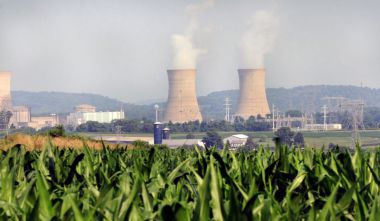 Radiation is forever’: How long will it take to clean up Three Mile Island? [Lancaster Watchdog] lancaster Online, Radiation is forever’: How long will it take to clean up Three Mile Island? [Lancaster Watchdog] lancaster Online, SEAN SAURO | Staff Writer , 6 Dec 20, Traveling Route 441 across Lancaster County’s northwestern border, motorists, for decades, have been able to look out toward the Susquehanna River to see a pair of cooling towers stretching skyward from the now-defunct Three Mile Island nuclear power plant.For almost as long, Eric Epstein said he’s kept a watchful eye, worrying about safety on the island, where a 1979 partial reactor meltdown remains the worst commercial nuclear accident in U.S. history. And Epstein, a Harrisburg-based nuclear watchdog, said those concerns persist even as plant owners move forward to dismantle its reactors — a process likely to take nearly 60 years. Even after that, he said, some nuclear waste is expected to remain onsite, just north of Conoy Township in the river. Plans exist for both, separately owned reactors on the island. Unit 2, the site of the partial meltdown, has remained inactive since 1979. And Unit 1 was taken offline last year. Epstein shared his concerns last week in the days after it was announced that officials at the U.S. Nuclear Regulatory Commission approved a Unit 2 license transfer that would move ownership of the reactor and related assets from FirstEnergy to TMI-2 Solutions. The subsidiary of Utah-based EnergySolutions would lead the decommissioning. That transfer is likely to wrap up by the end of 2020, FirstEnergy spokeswoman Jennifer Young said………………. “Decommissioning work can begin after the license transfer is completed, but TMI-2 Solutions would have to provide a more specific timeline for its projected start date,” NRC spokesman Neil Sheehan said. While most of the highly radioactive fuel was removed from Unit 2 by the mid-1990s, the upcoming decommissioning work is expected to cost at least $1 billion, paid for with ratepayer funds set aside for that purpose. According to an EnergySolutions timeline, the two-phased Unit 2 decommissioning is scheduled for completion in 2037, with “a potential area set aside for waste storage facilities” on the island. All along, Epstein has remained skeptical of the plan for Unit 2, where interior conditions largely remain a mystery due to high radiation levels, which have precluded close inspection. Those fears have only been exacerbated by the idea that waste could be stored on the island, where Epstein believes natural disasters like flooding could lead to released radiation, he said. “The plant was not designed to be a high-level radioactive waste site. Everybody agrees the radioactive waste shouldn’t be on an island,” Epstein said. “This is like putting waste on an airplane with no place to land. At some point, that plane is going to crash.” EnergySolutions officials did not return messages left with them about the decommissioning by Friday afternoon. However, Unit 1 owners at Exelon provide some insight into their separate decommissioning plan, which also will require some on-site storage — likely to begin in 2022, when spent fuel is moved into casks. “Dry cask storage will require robust metal canisters placed in a massive concrete housing,” according to Exelon spokesman David Marcheski. It is storage that officials claim will be able to withstand a 100-year flood. The Unit 1 decommissioning process is expected to wrap up in 2078, costing about $1.2 billion, covered by a related trust fund. https://lancasteronline.com/news/local/radiation-is-forever-how-long-will-it-take-to-clean-up-three-mile-island-lancaster/article_643a5aea-3676-11eb-a87d-1ffabfe61953.html |
|
Good Biden-Kim Relationship Necessary to Avoid a Nuclear Crisis
Because North Korea has nuclear weapons, the Biden administration cannot unilaterally impose terms on Pyongyang. Refusal to even talk with Pyongyang until it takes steps to denuclearize is a foolish and dangerous approach. Such an approach will likely inflame tensions and return Washington to a tense nuclear standoff with Pyongyang that poses a risk of miscalculation and accidental escalation into a nuclear war. Biden may be under pressure to be “tough” on North Korea to differentiate himself from Trump’s alleged cozy relationship with the North Korean dictator. However, a hostile stance toward Pyongyang will only make North Korea feel more insecure and drive Kim to pursue further nuclear development to ensure his regime’s survival.
President-elect Joe Biden – in the grip of the “new nuclear” industry
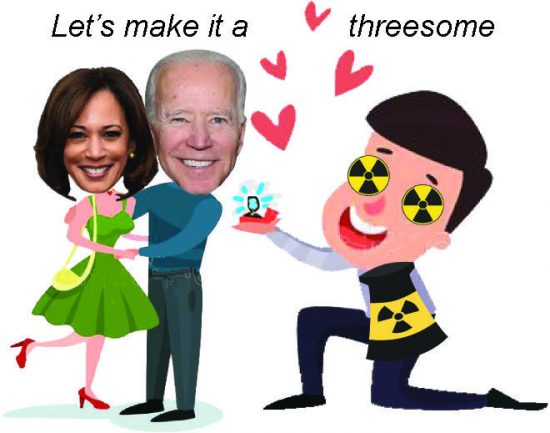 Biden, once a critic, may boost nuclear power, Peter Behr, E&E News reporter , December 3, 2020 When mismanagement of a nuclear plant on the Lower Delaware River forced an emergency shutdown in 1994, harsh criticism came from a junior U.S. senator whose state lay opposite the Salem, N.J., plant 3 miles away.”For more than a decade, I have sought expanded oversight, enforcement and sanctions to make the Salem facility operate according to the law,” then-Sen. Joe Biden (D-Del.) said, accusing the operator and the Nuclear Regulatory Commission of turning a blind eye to serious, repeated safety issues, including dangerously degraded reactor equipment.
Fast-forward a quarter-century, and now it is President-elect Biden who has included proposals for a new generation of nuclear reactors in his clean energy platform, parting ways with “no-nuke” progressives further to his left.
It isn’t clear how hard Biden will fight in the next few years to support the possible development of a fleet of still-experimental, billion-dollar reactors that wouldn’t come online until at least the 2030s.
A second issue centers on the 95 operating U.S. reactors, some of which may close prematurely because they are losing money, plant owners warn. Getting public support to hold on to the plants’ zero-carbon electricity has been an issue for state governors, but not the White House, so far.
In the 2020 presidential campaign, Biden focused his support for nuclear power on new designs……
“Joe Biden was the first Democratic presidential candidate who’s ever actively talked about advanced nuclear power” as part of the campaign platform, said Jeff Navin, acting chief of staff at the Department of Energy in President Obama’s first term. Navin heads governmental affairs and public policy for TerraPower LLC in Bellevue, Wash., which won an $80 million DOE contract in October to further its novel reactor design.
Navin said he does not think that Vice President-elect Kamala Harris’ reservations about nuclear power as a senator will turn into opposition as Biden’s No. 2. Harris, for example, had opposed the 2018 Nuclear Energy Innovation and Modernization Act — co-sponsored by Sen. Cory Booker (D-N.J.), her 2019 opponent in the Democratic presidential primary — citing reactor safety and nuclear waste disposal concerns………
“Things we’ve seen out of the Biden campaign and the transition team are very promising for a continuation and even acceleration of programs and policies that will support nuclear energy,” said John Kotek, policy development vice president for the Nuclear Energy Institute, the industry’s chief lobbying organization. Kotek was assistant DOE secretary for nuclear energy in the Obama administration. ………
But Biden will hear from environmental policy advocates and nuclear power opponents protesting that the NRC has gone too far to streamline and reduce costs of safety oversight on old reactors as well as safety reviews of new reactor designs.
“The Biden administration will have to turn first to regulatory issues and repair the damage that’s been done at the NRC over the past four years” under President Trump, said Matthew McKinzie, director of the nuclear, climate and clean energy program at the Natural Resources Defense Council.
There are still too many critical questions about new reactor designs to justify writing them into clean energy plans, McKinzie said. “We are very far from an understanding of whether they could ever be commercialized,” he said……..
Transition choices
To head his transition team on energy, Biden chose one of the top technology experts in the Obama administration, Arun Majumdar, founding director of the Advanced Research Projects Agency-Energy (ARPA-E), which funds experimental energy technologies. Majumdar now directs a Stanford University energy institute (Energywire, Nov. 19).
Others on the Biden-Harris transition team bring specific expertise on nuclear issues, including Rachel Slaybaugh, a nuclear engineering professor at the University of California, Berkeley, and a senior technical adviser at ARPA-E……. https://www.eenews.net/stories/1063719675
Reject Michele Flournoy as U.S. Defense Secretary – too close to military-industrial-complex

|
Rejecting Michèle Flournoy, Progressives Demand Biden Pick Pentagon Chief ‘Untethered’ From Military-Industrial Complex
“We urge President-elect Joe Biden and U.S. senators to choose a secretary of defense who is unencumbered by a history of advocating for bellicose military policies and is free of financial ties to the weapons industry.” Common Dreams, Jake Johnson, staff writer-4 Dec 20, |
|
Analysis: why Michèle Flournoy should not be U.S. Secretary of Defense
|
Keep in mind Flournoy‘s extensive defense industry ties. In 2002 she went from positions in the Pentagon and the National Defense University to the mainstream but hawkish Center for Strategic and International Studies, which is largely funded by industry and Pentagon contributions. Five years later, she co-founded the second-most heavily contractor-funded think tank in Washington, the highly influential Center for a New American Security (CNAS). That became a stepping stone to her role as under secretary of defense for policy in the Obama administration. From there she rotated to the Boston Consulting Group, after which the firm’s military contracts expanded from $1.6 million to $32 million in three years. She also joined the board of Booz Allen Hamilton, a consulting firm laden with defense contracts. In 2017 she co-founded WestExec Advisors, helping defense corporations market their products to the Pentagon and other agencies. Though WestExec Advisors does not reveal its clients, Flournoy has stated, “Building bridges between Silicon Valley and the U.S. government is really, really important,” even a “labor of love.” WestExec is also careful not to designate Flournoy as a lobbyist, which could run afoul of Biden’s likely prohibitions against appointing “lobbyists” to senior positions. But a WestExec source did tell an interviewer, “We’ll tell you who to go talk to” and what to tell them. This simply circumvents the legalities; it is lobbying by remote control. In a CNAS article this July, Flournoy laid out a plan embraced by candidate Biden and other Democrats, “Sharpening the U.S. Military’s Edge: Critical Steps for the Next Administration.” The piece reveals Flournoy’s corporate outlook and outlines how the next secretary of defense should manage the Pentagon. The nature of any Pentagon administration stems from the quality of the people selected to run it. Addressing this central question, Flournoy states:
Nowhere does she list ethics, character, objectivity, or independence from contractor, service, or political biases, all qualities stunningly missing from Trump’s Pentagon as well as earlier ones………….. Pork, unmentioned by name, also rears its head in the Flournoy article. She advocates various funds, organizations, and a “center of excellence” to monetize technology. Again, history counts. In 2010 the House initiated a Rapid Innovation Fund to support technology development, just as Flournoy proposes. In actuality, it turned out to be an earmarking slush fund so members of Congress could satisfy local interests and circumvent new rules in Congress to pretend to end earmarks. Flournoy would likely expand this contractor self-funding process inside the Defense Department. Once it shows up in a Pentagon spending bill, the congressional add-ons will proliferate, given how voraciously today’s Congress stuffs earmarks into defense bills. Another word that does not appear in the Flournoy article is “audit.” The Defense Department is the only major federal agency that has never passed an audit, despite statutory and constitutional mandates. Some feeble progress has been made in recent years, but without far stronger action, it will be many years before the department delivers to Congress and the public clean audits of contractor spending and profits, much less routine audits of agency and contractor fraud. Under an uninterested Flournoy, it would be an even longer time…………… None of the Biden/Flournoy/Clinton thinking is new. Recall slogans from the George W. Bush and Clinton administrations like “transformation” and “revolution in military affairs” that promised modernized forces for affordable costs. In reality, the outcome of those promises has been shrinking combat forces, more program failures, weapon fleets growing steadily older, and troops training less—all at ever-growing cost. To explain, we need to examine some Pentagon budget history. Defense spending is now at an all-time post-World War II high no matter how you adjust for inflation—barring three years, 2010 to 2012, of even higher spending under President Barack Obama. Looking at yearly appropriations since the Korean War (unadjusted for inflation in order to avoid the Pentagon’s doctored inflation indices), the figure below reveals that the Pentagon budget has never fallen below a steady 5% growth curve, except for a brief departure in the late Obama and early Trump years. This 65 years’ worth of inexorable spending growth has been unaffected by dramatic changes in America’s actual national security needs, revisions of U.S. national strategies, the rise or collapse of perceived enemies, or—for the most part—who is president or whether we are at war or peace. Second, throughout this perpetual budget expansion, the Army, Air Force, and Navy have been shrinking—with the shrinkage accelerating during the period of highest spending growth: the period since 9/11. Moreover, the added money and smaller forces have not resulted in overall modernization. Our smaller inventories of armored vehicles, ships and aircraft are all today dramatically older, on average, than at any time in modern history. Nor are these forces better trained, nor their equipment better maintained. Indeed, all of these measures have been declining significantly, especially now. How can so much more money lead to smaller, older, less effective forces? ………….. Beyond hardware and technology, we need to do a far more intelligent job of understanding the never-ending evolution of tactics and forms of warfare……….. Mercenary parties have no part in that process. We need to listen to military leaders who have experienced both defeat and victory on the battlefield while remaining free of industry influence and careerism; engineers and scientists who have developed proven, useful technologies; and industry leaders who have delivered successful, affordable products and eschewed self- and corporate-interest. The Flournoy plan proposes no such rigorous evaluation or evaluators of new ideas and new weapons. Under her plan, the students wouldn’t just grade their own exams; they would write them and then demand we reward them handsomely for doing so. Instead of this toxic plan, we need to select, nominate, and confirm a new generation of defense leaders who have demonstrated the ethics, competence, independence, and spine to produce a stronger national defense and a more honest system for delivering it. The president-elect should be asking who those people are. https://www.pogo.org/analysis/2020/11/should-michele-flournoy-be-secretary-of-defense/ |
|
Biden’s team includes top posts linked to corporations and military contractors
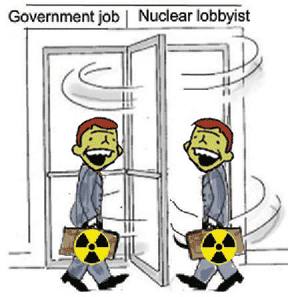 Biden Aides’ Ties to Consulting and Investment Firms Pose Ethics Test
Some of the president-elect’s choices for top posts have done work for undisclosed corporate clients and aided a fund that invests in government contractors. NYT, By Eric Lipton and Kenneth P. Vogel, Dec. 1, 2020
WASHINGTON — One firm helps companies navigate global risks and the political and procedural ins and outs of Washington. The other is an investment fund with a particular interest in military contractors.
But the consulting firm, WestExec Advisors, and the investment fund, Pine Island Capital Partners, call themselves strategic partners and have featured an overlapping roster of politically connected officials — including some of the most prominent names on President-elect Joseph R. Biden Jr.’s team and others under consideration for high-ranking posts.
Now the Biden team’s links to these entities are presenting the incoming administration with its first test of transparency and ethics.
The two firms are examples of how former officials leverage their expertise, connections and access on behalf of corporations and other interests, without in some cases disclosing details about their work, including the names of the clients or what they are paid.
And when those officials cycle back into government positions, as Democrats affiliated with WestExec and Pine Island are now, they bring with them questions about whether they might favor or give special access to the companies they had worked with in the private sector. Those questions do not go away, ethics experts say, just because the officials cut their ties to their firms and clients, as the Biden transition team says its nominees will do.
WestExec’s founders include Antony J. Blinken, Mr. Biden’s choice to be his secretary of state, and Michèle A. Flournoy, one of the leading candidates to be his defense secretary. Among others to come out of WestExec are Avril Haines, Mr. Biden’s pick to be director of national intelligence; Christina Killingsworth, who is helping the president-elect organize his White House budget office; Ely Ratner, who is helping organize the Biden transition at the Pentagon; and Jennifer Psaki, an adviser on Mr. Biden’s transition team.
WestExec did not respond when asked for a list of its clients. But according to people familiar with the arrangement, they include Shield AI, a San Diego-based company that makes surveillance drones and signed a contract worth as much as $7.2 million with the Air Force this year to deliver artificial intelligence tools to help drones operate in combat missions.
At the same time, Mr. Blinken and Ms. Flournoy have served as advisers to Pine Island Capital, which this month raised $218 million for a new fund to finance investments in military and aerospace companies, among other targets.
The team recruited by Pine Island Capital Partners — which is led by John Thain, the chief executive of Merrill Lynch at the time of its collapse in 2008 during the recession and sale to Bank of America — was chosen based on its members’ “access, network and expertise” to help the company “take advantage of the current and future opportunities present in the aerospace, defense and government services industries,” including artificial intelligence, according to a Securities and Exchange Commission filing in September describing the new fund, Pine Island Acquisition Corporation.
Pine Island Capital has been on something of a buying spree this year, purchasing the weapons system parts manufacturer Precinmac and a company until recently known as Meggitt Training Systems and now known as InVeris, which sells computer-simulated weapons training systems to the Pentagon and law enforcement agencies.
Another person listed as a member of the Pine Island team is Lloyd J. Austin III, a retired Army general who is also under consideration for defense secretary, according to a person familiar with the selection process……..
Mr. Biden’s team has faced pressure from the left and government watchdogs to outline steps to minimize the sort of corporate influence and conflicts of interest that marked President Trump’s tenure from the start.
These groups worry not only that Mr. Biden’s aides could shape government policies in ways that could benefit companies that paid their firms, but also that the firms could become magnets for access seekers in the Biden administration……….. https://www.nytimes.com/2020/11/28/us/politics/biden-westexec.html?smid=tw-share
1 This Month

of the week– Nuclear Reactor Information Task Force

14 May – online event From Bombs to Data Centres: the Face of Nuclear Colonialism
To see nuclear-related stories in greater depth and intensity – go to https://nuclearinformation.wordpress.com
-
Archives
- May 2026 (82)
- April 2026 (356)
- March 2026 (251)
- February 2026 (268)
- January 2026 (308)
- December 2025 (358)
- November 2025 (359)
- October 2025 (376)
- September 2025 (257)
- August 2025 (319)
- July 2025 (230)
- June 2025 (348)
-
Categories
- 1
- 1 NUCLEAR ISSUES
- business and costs
- climate change
- culture and arts
- ENERGY
- environment
- health
- history
- indigenous issues
- Legal
- marketing of nuclear
- media
- opposition to nuclear
- PERSONAL STORIES
- politics
- politics international
- Religion and ethics
- safety
- secrets,lies and civil liberties
- spinbuster
- technology
- Uranium
- wastes
- weapons and war
- Women
- 2 WORLD
- ACTION
- AFRICA
- Atrocities
- AUSTRALIA
- Christina's notes
- Christina's themes
- culture and arts
- Events
- Fuk 2022
- Fuk 2023
- Fukushima 2017
- Fukushima 2018
- fukushima 2019
- Fukushima 2020
- Fukushima 2021
- general
- global warming
- Humour (God we need it)
- Nuclear
- RARE EARTHS
- Reference
- resources – print
- Resources -audiovicual
- Weekly Newsletter
- World
- World Nuclear
- YouTube
-
RSS
Entries RSS
Comments RSS
 nuclear-news