Trump Signs Directive to Bolster Nuclear Power in Space Exploration

|
Trump Signs Directive to Bolster Nuclear Power in Space Exploration, One goal laid out in the new policy is the testing of a fission power system on the moon by the mid- to late 2020s, Scientific American By Mike Wall, SPACE.com on December 21, 2020 Nuclear power will be a big part of the United States’ space exploration efforts going forward, a new policy document affirms. President Donald Trump on Wednesday (Dec. 16) issued Space Policy Directive-6 (SPD-6), which lays out a national strategy for the responsible and effective use of space nuclear power and propulsion (SNPP) systems. “Space nuclear power and propulsion is a fundamentally enabling technology for American deep-space missions to Mars and beyond,” Scott Pace, deputy assistant to the president and executive secretary of the National Space Council, said in an emailed statement Wednesday. “The United States intends to remain the leader among spacefaring nations, applying nuclear power technology safely, securely and sustainably in space.”…….. NASA and the U.S. Department of Energy are working together on a fission-reactor project called Kilopower, which could provide juice for crewed outposts on the moon and Mars. …….. SPD-6 is the sixth space policy directive signed by President Trump, as its name suggests. SPD-1 officially instructed NASA to return astronauts to the moon to help prepare for crewed Mars missions; SPD-2 eased regulations on the private spaceflight industry; SPD-3 aimed to help with space-traffic management; SPD-4 directed the Department of Defense to establish the U.S. Space Force; and SPD-5 laid out a cybersecurity policy for U.S. space systems. As that list indicates, President Trump has been quite active in the space-policy domain. He also resurrected the National Space Council, which had been dormant since the early 1990s. And just last week, he issued a new national space policy, which aims to bolster national security and American leadership in space, among other goals. https://www.scientificamerican.com/article/trump-signs-directive-to-bolster-nuclear-power-in-space-exploration/ |
|
USS Calhoun County sailors dumped thousands of tons of radioactive waste into ocean

|
They asked the dying Pasco County man about his Navy service a half-century before. He kept talking about the steel barrels. They haunted him, sea monsters plaguing an old sailor.”We turned off all the lights,” George Albernaz testified at a 2005 Department of Veterans Affairs hearing, “and … pretend that we were broken down and … we would take these barrels and having only steel-toed shoes … no protection gear, and proceed to roll these barrels into the ocean, 300 barrels at a trip.”
Not all of them sank. A few pushed back against the frothing ocean, bobbing in the waves like a drowning man. Then shots would ring out from a sailor with a rifle at the fantail. And the sea would claim the bullet-riddled drum.
Back inside the ship, Albernaz marked in his diary what the sailors dumped into the Atlantic Ocean. He knew he wasn’t supposed to keep such a record, but it was important to Albernaz that people know he had spoken the truth, even when the truth sounded crazy. For up to 15 years after World War II, the crew of Albernaz’s ship, the USS Calhoun County, dumped thousands of tons of radioactive waste into the Atlantic Ocean, often without heeding the simplest health precautions, according to Navy documents and Tampa Bay Times interviews with more than 50 former crewmen. Albernaz began a battle for his life in 1988 when part of his brain began to die, mystifying doctors who eventually concluded the rare ailment might be linked to radiation. He filed a VA claim for benefits in 2001 that was repeatedly rejected, often with tortured government reasoning.
The VA and Navy told Albernaz he was not exposed to radiation on the Calhoun County, a vessel the Navy ordered sunk in 1963 because it was radioactive. The VA ignored Navy documents discovered by a former congressional aide proving the ship’s radioactivity, telling Albernaz they were “unsubstantiated.” And the Navy today points to Cold War records that are incomplete and unreliable as proof crewmen were not exposed to dangerous radiation. The Navy and VA’s insistence that atomic waste on the Calhoun County was not dangerous comes 15 years after the VA linked the death of a crewman who served with Albernaz to radiation…….
Up to 1,000 men served on the Calhoun County in the years it dumped radioactive waste, a practice that continued until about 1960 — two years before the ship’s decommissioning. It’s impossible to know how many suffered unusual health problems after they left the ship. The VA and Navy never followed up on their health. Some got sick and never filed VA claims. And after more than a half-century, much of the crew has died………
The opening of the Atomic Age brought a vexing problem — how to dispose of radioactive waste. The Atomic Energy Commission, which then managed most aspects of U.S. atomic energy policy, settled on a cheap, convenient fix: ocean dumping. The Calhoun County soon became the only Navy ship on the East Coast dumping radioactive waste. The containers looked like ordinary 55-gallon steel drums. Nobody on the ship was quite sure what was in them.
They arrived by the hundreds by train and truck at the ship’s home port at Sandy Hook Bay, N.J. or the ship picked them up at Floyd Bennett Field on Long Island. Less often, waste was picked up at other ports, including Boston. The hottest waste came from Floyd Bennett. At times, the barrels were marked with color-coded dots or a painted X. The “red dot” barrels were said to be the most dangerous.
Not that it mattered. Few if any of the crewmen, according to interviews, received any special training on handling the waste. They said they handled the “red dot” barrels the same as all the rest. Much of the waste, which was packed in concrete, came from Brookhaven National Laboratory, a government research facility on Long Island that had a reactor and generated radioactive material. Several shipments emitted 17 rems per hour of radioactivity even after the waste was encased in concrete, Calhoun County‘s deck logs show. That is the equivalent of about 1,700 typical chest X-rays. Two sailors would place each barrel on its side and roll it to the edge of the ship. The Calhoun County, with its flat, shallow bottom, always shifted crazily in the waves, back and forth, a metronome marking time for a dangerous waltz.
As the ship tilted in their direction, the men released their barrel with a push and let gravity help take it overboard. The ship carried the waste out off the continental shelf several times a year to waters of varying depths, usually 6,000 to 12,000 feet. The designated dumping areas were a full day’s trip up to 200 miles out to sea, though several men said in interviews that the ship would dump much closer to the coast when the weather was bad. After they handled the barrels, the men went below deck to drink coffee or eat.
No documents appear to exist showing what exactly the Navy dumped. Deck logs list dumping coordinates, tonnage handled and drum radiation levels — but often, even that information is missing. And from 1946 to 1953, the Calhoun County‘s officers were not recording any dumps in deck logs at all………
On the Calhoun County, according to documents and interviews, radiation was neither feared nor respected. “We had no supervision,” said Bob Berwick, 82, of Laguna Niguel, Calif., an officer on the ship in 1952 and 1953. “We were on our own.”…….
None of the crew interviewed for this story recall getting special clothing or gear during dumping operations. An exception were the cotton gloves provided to the crew in the early to mid-1950s. “We threw the gloves overboard into the ocean when we were done with them,” said Richard Tkaczyk, 85, of Buffalo, N.Y., who served on the ship from 1949 to 1951. Several men said they were told to shower and take off clothing for washing after dumps. But for much of the ship’s history, this was not done, according to crewmen.
Albernaz told the VA in 2007 he recalled a trip when an AEC worker came through the crew quarters with a Geiger counter. “It would go off like a machine-gun and he would say to us, ‘Okay. Get your pillow, blanket and mattress. We’re moving you to the tank deck,’ ” Albernaz said. But the tank deck was under barrels, too. “So actually, there was really no place on that ship that was safe,” Albernaz said……….
the ship was radioactive. On June 5, 1956, according to Navy memos, Naval Research Laboratory technicians took radiation readings on the Calhoun County before barrels were loaded on its deck. Parts of the ship were radioactive, a memo to the Third Naval District commandant said. The ship’s captain, Herbert Hern, was ordered to “decontaminate affected areas” as soon as possible. The discovery prompted a more thorough examination of dumping operations. Navy brass did not like what they found. The ship’s handling of this dangerous waste was sloppy, haphazard………..
George Albernaz, then 22, was excited to be on the Calhoun County as its newest quartermaster. He was born in Fall River, Mass., and had hardly been away from home. He thought he was going to be part of the Navy’s storied amphibious force. He took a diary with him and recounted his adventure in the words of a wide-eyed sailor. “This is the story of the most fascinating experience of my life … doing a job I never dreamed existed, serving on a ship whose days as a man of war are but a story in the past but today she is engaged in a service equally important as any fighting ship in the Navy,” he wrote. It wasn’t long before Albernaz began keeping a different kind of diary. He titled this new log “Nuclear Waste Dumping Diary.”
Jan. 20 1957: “371 tons atomic waste.” Feb. 7, 1957: “368 tons atom waste.” Nov. 13, 1957: “299 (tons) poison gas (and) A.W.” One of Albernaz’s last entries was on June 12, 1958: “200 tons. Spec. weapons,” or special weapons. That was the day, Albernaz later told his wife, that he helped dispose of an atomic bomb. The Calhoun County sailed out of Norfolk, Va. with two giant crates. The ship’s log noted it dumped “confidential material” at 2:31 a.m.
Albernaz’s wife said he told her about that trip. He said the crew was told the crates contained two atomic bombs. Other sailors interviewed said the occasional dumping of disassembled atomic bombs occurred several times in its history. • • •…….. On March 10, 1958, one of the Calhoun County‘s crew, Harvey Lucas, was ordered to a Navy hospital. He was in pain and vomiting a brownish liquid, hospital records show. Two months later, the ship’s muster rolls show, Albernaz was hospitalized for two weeks. His wife said he later told her he had severe nausea. The two men were among a handful that year with long hospitalizations, records show. Albernaz later said doctor’s diagnosed them with stomach ulcers………..
A Dec. 13 memo by the chief of the Navy’s Bureau of Ships doubted radiation on the Calhoun County could ever be reduced to levels then considered safe. The memo noted the Navy had never been able to decontaminate a radioactive ship. “Complete paint stripping and sandblasting have failed to accomplish this (on the Calhoun County) and in the cases of ships contaminated in nuclear weapons tests,” the memo said. So the Navy ordered the Calhoun County sunk……….
Navy officer George Self, 83, of Pahrump, Nev., got the job to ready the Calhoun County for sinking. …………
Self did not go out on the second trip, so he is unsunsure how the ship met its end. The Navy said demolition charges sent the old LST to the bottom.
The years after his 1960 Navy discharge were cruel to Calhoun County crewman Harvey Lucas.
Lucas, a Denver man who spent more than three years on the ship, had always been suspicious of the Calhoun County‘s mission even while still a deckhand. Like Albernaz, Lucas tried to document the ship’s work. He stole a radiation badge and took pictures of the barrels. “He documented everything,” said daughter Jeanine Lucas. His family said he wondered if the work had been far more dangerous than the Navy let on. Those concerns could only have been stoked when his uncle, George Dutcher, who served on the ship with Lucas, died of cancer in the late 1960s still in his 40s. Lucas left the Navy and developed osteoporosis. It was so severe that a doctor said he had the bones of a 95-year-old, his family told the VA. He and his wife had five children born with birth defects or health problems. Cancer took Lucas, too. He died on June 17, 1985, at age 47 of leiomyosarcoma, an aggressive soft-tissue cancer. It has been documented in women who in the 1950s and 1960s received radiation treatment for excessive menstrual bleeding. Damage from the disease was so bad a funeral home couldn’t embalm him. Lucas was buried in a body bag. Lucas, and then his wife after his death, battled the VA for benefits, arguing the radiation caused his cancer and brittle bones. The VA repeatedly denied a link, at first saying the ship hadn’t carried radioactive waste………….. William Kemper, a retired Naval physicist, estimated Lucas had been exposed to radiation five times greater than the legal limit when he served. Kemper told the VA, “it seems most likely that he had ingested some cobalt 90 or other (radioactive) waste in . . . his duties.” In 1998, the VA finally ruled Lucas’s death was caused by radiation he was exposed to on the Calhoun County and approved benefits for his widow………… Civilian workers at Brookhaven, the lab that packaged much of the waste dumped by the Calhoun County, found it difficult to prove their on-the-job exposure to radiation in the Cold War led to cancers some of them suffered. Records were too incomplete. Some workers were never monitored. o in 2010, the federal government decided they would no longer have to prove their specific radiation exposure to get financial compensation and medical care. If they worked at the lab at least 250 days from 1947 to 1979 and were diagnosed with one of 22 radiation-related cancers, they qualified. Congress protects military personnel in much the same way. But none of the men who served on the Calhoun County are eligible for automatic VA benefits for radiation illnesses because they did not participate in underwater or atmospheric atomic tests and related activities, the government says. Thus, the crewmen do not meet their country’s definition of “Atomic Veteran.” https://www.tampabay.com/news/military/veterans/the-atomic-sailors/2157927/?fbclid=IwAR2LJbkpgGf3wFer8x96o_60n2EMtJ8hS-JREmkbBp_EkER9sl_iAxJuDkA |
|

Former SCANA CEO to plead guilty on another charge for failed nuclear plant project

 Former SCANA CEO to plead guilty on another charge for failed nuclear plant project, https://abcnews4.com/news/local/former-scana-ceo-to-plead-guilty-on-another-charge-for-failed-nuclear-plant-project by Tony Fortier-Bensen, Thursday, December 24th 2020, COLUMBIA, SC (WCIV)
The former CEO of SCANA will plead guilty to a third charge on Tuesday related to fraud charges for the failed V.C. Summer project in Fairfield County.
S.C. Attorney Peter McCoy Jr. announced in a press release that Kevin Marsh would plead guilty on Tuesday, Dec. 29 in federal court to conspiracy to commit mail and wire fraud.
In late November, Marsh pleaded guilty to one count of conspiracy and one count of obtaining false property by false pretenses.
According to that plea agreement, Marsh could serve 18 to 36 months and must pay $5 million in restitution.
His plea agreement for the third charge has not been announced.
Marsh has a hearing scheduled for 10:00 a.m. in federal court, and following that plea, he is scheduled for another hearing on a state charge at noon on the same day.
In June, retired SCANA chief operating officer Steve Byrne entered a guilty plea for his actions in relation to the failed nuclear power plant.
The U.S Attorney’s office alleges Byrne and Marsh conspired with other SCANA executives to deceive state and federal government overseers, stock holders and power customers in order to keep funding coming in to build two nuclear reactors at the V.C. Summer Nuclear Station.
The expansion project cost Santee-Cooper and the defunct South Carolina Electric & Gas over $9 billion before the two entities abandoned the project in July 2017.
USA’s Dept of Energy pouring $millions into gimmicky new untested nuclear projects
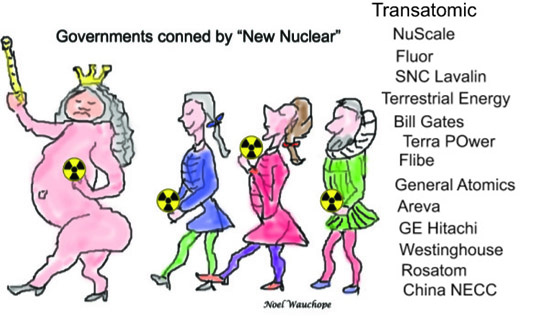
The US Department of Energy (DOE) has announced USD20 million in awards for the third of three programmes under its new Advanced Reactor Demonstration Program (ARDP). DOE’s Office of Nuclear Energy has selected three teams to receive FY2020 funding for the ARDP’s Advanced Reactor Concepts-20 (ARC-20) programme.
DOE expects to invest about USD600 million over the next seven years in ARDP, which aims to help domestic private industry demonstrate advanced nuclear reactors in the USA.
The department issued an ARDP funding opportunity announcement in May this year, which included the ARC-20 awards, the Advanced Reactor Demonstration awards, and the Risk Reduction for Future Demonstration awards. For the ARC-20 projects, DOE expects to invest a total of about USD56 million over four years with its industry partners providing at least 20% in matching funds. The goal of the ARC-20 programme is to assist the progression of advanced reactor designs in their earliest phases.
DOE yesterday announced the selection of three US-based teams to receive ARC-20 funding. These are:
- Inherently Safe Advanced SMR for American Nuclear Leadership. Advanced Reactor Concepts will deliver a conceptual design of a seismically isolated advanced sodium-cooled reactor facility that builds upon the initial pre-conceptual design of a 100 MWe reactor facility. The total award value over three-and-a-half years is USD34.4 million, with the DOE’s share being USD27.5 million.
- Fast Modular Reactor Conceptual Design. General Atomics will develop a fast modular reactor conceptual design with verifications of key metrics in fuel, safety and operational performance. The design will be for a 50 MWe fast modular reactor. Total award value over three years is USD31.1 million (DOE share is USD24.8 million).
- Horizontal Compact High Temperature Gas Reactor. Massachusetts Institute of Technology will mature the Modular Integrated Gas-Cooled High-Temperature Reactor (MIGHTR) concept from a pre-conceptual stage to a conceptual stage to support commercialisation. The total award value over three years is USD4.9 million (DOE cost share is USD3.9 million).
“ARDP is significant because it will enable a market for commercial reactors that are safe and affordable to both construct and operate in the near- and mid-term,” said Secretary of Energy Dan Brouillette. “All three programmes under ARDP pave the way for the United States to be highly competitive globally.”
On 16 December, DOE selected five teams to receive USD30 million in initial funding for risk reduction projects under its ARDP programme. All five of the selected designs have the potential to compete globally once deployed, DOE said. The five projects are: the BWXT Advanced Nuclear Reactor; Westinghouse’s eVinci Microreactor; Kairos Power’s Hermes Reduced-Scale Test Reactor; the Holtec SMR-160 light-water small modular reactor; and the Molten Chloride Reactor Experiment, a project led by Southern Company Services Inc.
Two projects led by TerraPower and X-energy were selected in October to receive USD160 million in initial funding for under the DOE’s Demonstration projects pathway to develop and construct two advanced nuclear reactors that can be operational within seven years.
“Funding for ARDP beyond the near term is contingent on additional future appropriations, evaluations of satisfactory progress, and DOE approval of continuation applications,” DOE noted.
USA’s $128 billion next-generation submarine program at risk of cost overruns
|
Next-Generation U.S. Nuclear Sub Facing Cost Overruns, Delays, Bloomberg, Anthony Capaccio December 24 2020, — The U.S. Navy’s plan to deliver the first vessel in its $128 billion next-generation submarine program on time is at risk by a dependence on inexperienced contractors with spotty quality control track records, according to a congressional watchdog.
The Government Accountability Office, in a restricted Nov. 6 report to the Pentagon and congressional defense committees, said the design contract for the first vessel in the Columbia-class sub fleet being built by General Dynamics Corp. could have a cost overrun of as much as 14%, or $384 million.
The GAO report outlines in detail the myriad challenges facing contractors and the Navy in the design and construction of a 12-vessel program that advocates say is most survivable leg of the U.S. nuclear triad, comprising land, air and sea-based warheads. Trump’s 5-Year Budget Plan for Navy Would Add 82 New Vessels (2) As an example, the report says that General Dynamics “continues to identify problems with non-destructive testing and welding across the supplier base, including suppliers responsible for piping, valves and large mechanical equipment.” More broadly, the report signals the difficulties the Navy will face in trying to carry out the Trump administration’s vision for a 355-to-500 vessel fleet by 2045 up from 297 today.
Those difficulties will be one of the first defense-procurement challenges confronting the Biden administration when it takes office next month amid a U.S. economy hobbled by the Covid-19 pandemic. The Columbia’s five-year plan envisions $30 billion being spent on the program through 2026, increasing from $4.7 billion planned for next year to $8.2 billion in 2026.
But first, several quality-control issues have to be addressed………….. https://www.bloombergquint.com/business/next-generation-u-s-nuclear-sub-facing-cost-overruns-delays : https://www.bloombergquint.com/business/next-generation-u-s-nuclear-sub-facing-cost-overruns-delays
|
|
Ohio House Fails To Take Any Action On Nuclear Bailout Law.
Ohio House Fails To Take Any Action On Nuclear Bailout Law, WOSU Radio, By ANDY CHOW 24 Dec 20, • Ohio House Republican leadership says 2020 will end without a vote on any proposal to change HB6. With no delays or repeal, the law stays in place despite being connected to the largest alleged bribery scandal in Ohio history.
When it comes to HB6, the nuclear bailout law connected to a racketeering investigation, House Speaker Bob Cupp (R-Lima) has gone from saying the House will find a way to repeal and/or replace the law, to wanting more discussion on the issue, to saying the House ran out of time to come to a consensus.
That was in the span of five months. Now it appears the House will finish the legislative session without making a single change to HB6……….
In their lawsuit, the cities of Columbus and Cincinnati argued that HB6 amounted to an unconstitutional lending of state credit to a private entity. https://radio.wosu.org/post/ohio-house-fails-take-any-action-nuclear-bailout-law#stream/0
Nuclear weapons agency updates Congress on hacking attempt
|
Nuclear weapons agency updates Congress on hacking attempt
Officials from the Department of Energy told Hill staffers this week that they don’t believe their systems were compromised. Politico, By NATASHA BERTRAND, 12/22/2020 The Department of Energy and the National Nuclear Security Administration, which maintains the U.S. nuclear weapons stockpile, told congressional staffers in several briefings this week that there is currently no known impact to its classified systems from a massive hack that targeted its networks, according to an official with direct knowledge of the briefings. The officials told staffers, however, that the incident has proven how difficult it is to monitor the Energy Department’s unclassified systems, and acknowledged that an issue with a network extension within the Office of Secure Transportation — which specializes in the secure transportation of nuclear weapons and materials — had been discovered………. The internal investigation has been complex and time-consuming because the compromised SolarWinds software was used widely throughout the nuclear security administration, officials told the staffers — including at the Los Alamos, Lawrence Livermore, and Sandia national labs; NNSA headquarters; NNSA’s Emergency Communication Network; NNSA’s Mixed Oxide Fuel Fabrication Facility, where fuel is made for reactors; the Nevada National Security Site, a disposal site; and Naval Reactors, which provides propulsion plants for nuclear powered ships. …….https://www.politico.com/news/2020/12/22/nuclear-weapons-agency-congress-hacking-450184 |
|
Small Nuclear Reactor unicorns for Canada

Canada’s SMR ‘Action Plan’ banks on private sector nuclear pipe dreams, Burgess Langshaw-Power / December 21, 2020 For many kids who grew up in the 1980s and 1990s, Star Trek was a big part of our childhoods. The series is filled with strange new worlds, futurist politics, and advanced technology that is almost indistinguishable from magic. Yet even as a child I knew the show was a work of science fiction. Warp speed, transporters and phasers were all gadgets I could comprehend, but in my rational mind I knew they would never exist within my lifetime.
Unfortunately, recent announcements by Canada’s Natural Resources Minister Seamus O’Regan—a self-professed fan of science fiction—demonstrate that the government has yet to arrive at the same conclusion I did as a kid watching Star Trek.
On December 18, the Trudeau government launched Canada’s Small Modular Reactor (SMR) Action Plan, to great fanfare. This new action plan builds on the 2018 SMR Roadmap, which made the promise that, “SMRs are a re-scaling and repurposing of nuclear technology for wider markets. They represent a paradigm shift for nuclear reactor technology—analogous to the shift of steam engines from mineshafts into ships and vehicles, or the movement of computers from mainframe to desktop and then to laptop.”
This idea of a paradigm shift channels Star Trek-level aspirations, yet the new Action Plan is significantly more hesitant: “Small modular reactors (SMRs) could be a source of clean, safe and affordable energy, opening opportunities for a resilient, low-carbon future and capturing benefits for Canada and Canadians while supporting reconciliation with Indigenous peoples as essential enabling partners.”
In just two years, from the launch of the Roadmap to the announcement of the Action Plan, the government has gone from a paradigm shift to the possibility that SMRs could be a source of clean energy. It’s as though there is something else about SMRs that the government doesn’t want us to consider in more depth.
Before we go any further, what are SMRs, anyway? Well, it turns out that’s a very good question. In fact, the Globe and Mail notes that “SMR lacks a universally agreed definition, and the Canadian Nuclear Safety Commission regards it as a marketing rather than a technical term.” In other words, SMRs are a group of many different technologies, none of which have actually been proven or tested, with only one project proposed and no timeframe for its realization. None of the technologies currently under consideration have solved any major issues with nuclear energy, including the problem of high-level radioactive waste management, however some are less likely to have meltdown-like events and cannot produce isotopes for creating weapons.
The Statement of Principles section of the Action Plan notes that, “Markets around the globe are signalling a need for smaller, simpler, and cheaper nuclear energy.” However, there is simply no evidence to support this claim. In fact, the polar opposite is true, with many major governments and large corporations exiting the nuclear sector entirely. Meanwhile, German experts have stated that, “SMRs are always going to be more expensive than bigger reactors due to lower power output at constant fixed costs, as safety measures and staffing requirements do not vary greatly compared to conventional reactors.”
The British press is even more blunt about the prospects of a more ‘tactile’ nuclear future: “There is no commercial case for giant new reactors in any developed country. They cannot meet post-Chernobyl and post-Fukushima safety demands at viable cost and have been priced out of the global energy market. Precipitous falls in renewable costs over the last five years have rendered the technology effectively obsolete in the West.”
This doesn’t sound like a bold future to me………..
The theory is that SMRs will be cheaper and safer than conventional nuclear reactors. Again, German experts disagree on the cost front. In terms of levelized energy costs, says Nicolas Wendler of industry association Nuclear Technology Germany (KernD), SMRs will always be more expensive than big plants. Moreover, he says, “nuclear power plant owners have repeatedly rejected the idea that the nuclear exit be reversed, arguing the technology is no longer economically viable anyway.”
In the United States, some nuclear plants are being decommissioned early, while other projects are being cancelled at a huge financial loss. Why? They aren’t competitive. This does not even account for the fact that we have yet to successfully build even a single SMR. Yet, if we were to, how much would they cost? The record for delays and cost overruns in Canada is not positive, and nuclear facilities have an unusually poor record in this regard. After 1970, the average nuclear facility saw cost overruns exceed 241 percent (not including the added burden of construction delays).
This does not even begin to address the costs and hazards associated with cleaning up nuclear sites, such as expensive remediation projects now underway in the US and the UK. Perhaps unsurprisingly, these failures and cost overruns sound a lot like the last major federal investment in the energy sector—the Trans Mountain pipeline fiasco.
There is no doubt Canada will need new energy sources for our clean energy transition to address the climate crisis. The Government of Canada claims, “At the same time, international experts are telling us that new nuclear energy, together with the full range of low-carbon technologies, are needed to combat global climate change and meet federal, provincial and territorial emissions targets for 2030 and 2050.”
However, international examples do not inspire confidence that nuclear needs to be a part of this solution. Germany is close to achieving half its energy supply from renewables excluding nuclear. In the UK, some estimates show that not including nuclear energy in the mix will save hundreds of millions of pounds and that the only justification for pursuing nuclear energy in the UK or France is to support a nuclear military strategy (which Canada obviously does not have).
At least the UK is putting its money where its mouth is, with over half a billion pounds invested into nuclear, while Canada’s new SMR Action plan includes precisely $0 of investment, as opposed to our new federal hydrogen strategy, which received $1.5 billion.
Why would we choose nuclear over other cheaper and readily available renewable technologies? It is true that there are still major flaws with renewables, but given that most SMRs are a decade away (at least), and the cost of solar has already dropped 89 percent in the last decade, it seems unlikely that SMRs—whenever they are ready—will be competitive.
One of the theoretical selling points is the deployment of SMRs in rural and remote communities to replace diesel. Yet, many Indigenous and northern communities have expressed trepidation towards SMRs dotting their territory, and are building solar arrays instead. Another argument is that SMRs could be used for industrial facilities such as those in the mining sector, or the Alberta oil sands (this was a terrible idea in the past, and its terrible idea now). However, others suggest that SMRs are only capable of, “ticking off the Financial and Consumer Services Commission’s checklist on how to spot a scam.”
Canada’s SMR Action Plan is nothing more than science fiction: idle dreams of an indefinite group of technologies which may be ready in a decade, with no financial support or investment by the government. In the meantime, renewable energy continues to leap ahead, mostly without any federal support.
One can only imagine how government investment, if effectively pursued, could push our renewable energy potential by the time the first SMRs are ready for deployment. Given these considerations, perhaps the reason this “Action Plan” is so empty, is that the federal government is in fact aware of how little potential SMRs hold. Like nuclear fusion, maybe SMRs will always be just around the corner. In which case, why bother launching this plan at all? Let’s save our time and investment for renewable energy projects that have viability today, not somewhere down the road.
Burgess Langshaw-Power is a former policy analyst currently completing his PhD in Global Governance at the Balsillie School, University of Waterloo. His policy expertise includes energy technologies, regulatory approvals, climate change, and energy infrastructure. Views expressed here are his own and not necessarily those of his employer. https://canadiandimension.com/articles/view/canadas-smr-action-plan-banks-on-private-sector-nuclear-pipe-dreams
“Mutual admiration society” -between civilian and military nuclear experts
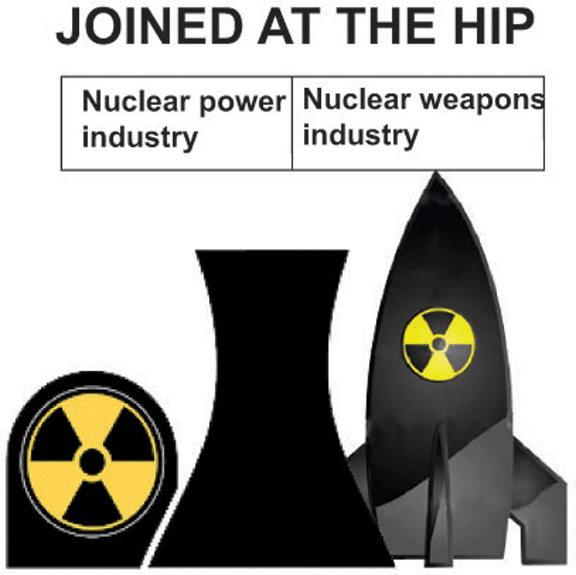 Civilian nuclear and military nuclear members of a “mutual admiration society” ~
  Dr. Gordon Edwards, https://concernedcitizens.net/2020/12/19/civilian-nuclear-and-military-nuclear-members-of-a-mutual-admiration-society/ Dr. Gordon Edwards, President of the Canadian Coalition for Nuclear Responsibility, December 19, 2020
Civilian nuclear and military nuclear have always been friendly room-mates, members of a “mutual admiration” society. In today’s announcement of an SMR Action Plan, Natural Resources Minister Seamus O’Regan said that nuclear power in Canada is a “home-grown” technology and referred to C. D. Howe’s role in this connection. In fact C.D. Howe arranged for all Canadian uranium extracted from Canadian mines to be sold to the US military for use in tens of thousands of nuclear weapons from 1945 to 1965. C D Howe was also on the Committee that met in Washington DC in 1944 to approve the first nuclear reactors to be built in Canada (at Chalk River) as part of the ongoing effort to produce plutonium for use as a nuclear explosive. Mr. Howe approved of the policy of selling plutonium produced at Chalk River to the US military for weapons use, a practice that continued until 1975 and beyond. Plutonium from Chalk River was sent to Britain (it was the first sample of plutonium that Britain had ever obtained) just a few months before Britain detonated its first A-Bomb in the Monte Bello Islands off Australia.
To the best of my knowledge, no civilian nuclear power agency – not the Canadian Nuclear Association, nor the Canadian Nuclear Society, nor the Canadian Nuclear Safety Commission, nor Atomic Energy of Canada Limited, nor Canadian Nuclear Laboratories, NOBODY – has ever issued a clear statement denouncing nuclear weapons or even calling for a nuclear weapons free world. Most nuclear scientists and engineers feel a strong kinship and camaraderie with those who are in the nuclear weapons business. The same goes for those in the nuclear division of Natural Resources Canada. I remember on one occasion (prior to the exchange of nuclear tests between India and Pakistan) I expressed alarm at the fact that both neighbours are developing a nuclear war-fighting capability and a couple of senior civil servants said “Would that be so bad? Maybe that’s just what the world needs. More deterrence. Creates stability”
Despite regular denials from our puppet masters that civilian nuclear has nothing to do with military nuclear, it is clear that civilian nuclear (including the frankly discriminatory provisions of the NPT) has adopted an appeasement policy that will never succeed in bringing about a nuclear weapons free world. Why does Canada continue to sell uranium to countries that are in the process of investing hundreds of billions to improve and modernize the nuclear arsenals in utter defiance of the NPT, knowing that the vast bulk of Canadian uranium that is rejected from enrichment plants as DU end up as the raw material for producing plutonium for Bombs, and that the lion’s share of the explosive power – and the overwhelming share of the radioactive fallout – of every H-bomb comes from the fissioning of DU atoms that are freely accessed by the military even if they are the leftovers of “peaceful” fuel production for nuclear power plants?
“See ‘The Nuclear Fudge’ at https://www.youtube.com/watch?v=0lK65S5eHRQ&feature=youtu.be“. This 16-minute W5 segment from the Regan era is very informative.
US Navy nuclear-powered guided-missile submarine and 2 warships sail through Strait of Hormuz, (Persian Gulf-Gulf of Oman)
|
“The nuclear-power Ohio-class guided-missile submarine USS Georgia (SSGN 729), along with the guided-missile cruisers USS Port Royal (CG 73) and USS Philippine Sea (CG 58), transited the Strait of Hormuz entering the Arabian Gulf, Dec. 21,” the Navy said in a statement using an alternative name for the Persian Gulf.
The vessels’ entrance into the area comes amid heightened tensions with Iran, with Secretary of State Mike Pompeo blaming Iranian backed militias for a rocket attack on the US Embassy compound in Baghdad, on Sunday.
Some US officials have expressed concern that Iran may use the anniversary of the killing of General Qasem Solemani to carry out a strike on the US.
The US Navy rarely discusses the movement of its submarines, but Monday’s announcement also included details on the vessel’s capabilities, including its “ability to carry up to 154 Tomahawk land-attack cruise missiles.”……………… https://edition.cnn.com/2020/12/21/politics/us-nuclear-sub-hormuz/index.html
|
|

Following huge bribery scandal, Energy Harbor still manipulating to keep nuclear bailout law
 Energy Harbor seeks option of turning down HB6 nuclear bailout money, Cleveland.com Dec 21, 2020; Ohio. Energy Harbor is lobbying for Ohio lawmakers to let it choose whether it should be eligible for House Bill 6 nuclear bailout money,
COLUMBUS, Ohio—Energy Harbor is lobbying for state lawmakers to allow it to decide whether to accept more than $1 billion in House Bill 6 bailout money for its two nuclear power plants because a federal regulatory ruling might otherwise make the subsidies a liability, according to a top lawmaker.
It’s still unclear whether legislators will agree to the proposal, which is being crafted by House Majority Leader Bill Seitz, or whether they will pass any reforms to HB6 at all on Tuesday, expected to be the final day of the current legislative session.But it shows that Energy Harbor, a former subsidiary of FirstEnergy, is working behind the scenes to influence what reforms might be made to HB6, which is at the center of what authorities say is the largest bribery scheme in Ohio history. Federal authorities say $60 million in FirstEnergy bribery money was used to pass the law and keep it on the books.
Under the 2019 law, Energy Harbor’s Davis-Besse and Perry nuclear power plants are set to get $150 million per year from ratepayers from 2021 until 2027. Energy Harbor officials have said without the bailout, they will have to close the plants, though they’ve offered no financial data to back their claims.
But after the HB6 scandal broke last summer, GOP lawmakers have been working on possible changes to the law — including requiring yearly audits to see how much money the nuclear plants need to break even, then adjusting accordingly the amount of subsidies paid to Energy Harbor.
House and Senate leaders are still working to craft an HB6 reform plan that has the votes to pass both chambers. The main reform plan, House Bill 798, would delay the start of the bailout until 2022 to provide time for an audit to be conducted.
When asked whether lawmakers were close to a deal, Seitz said, “That’s kind of above my pay grade.”
“Energy Harbor is a corporation under investigation for orchestrating the largest bribery scandal in Ohio history,” Leland said, “and now Republicans want to let it decide whether to take $1.3 billion straight out of the pockets of everyday Ohioans.” https://www.cleveland.com/open/2020/12/energy-harbor-seeks-option-of-turning-down-hb6-nuclear-bailout-money.html
USA to turn the moon into a nuclear weapons site
 US to turn moon into ‘nuclear weapons site’ US to turn moon into ‘nuclear weapons site’
By Huang Lanlan Source: Global Times: 2020/12/18, The US ambition to build a nuclear power plant on the moon by 2027, which may contribute to future lunar military projects, shows it seeks space supremacy regardless of the damage and dangers it may cause to people, Chinese experts on military and international relations said.
Establishing a nuclear power plant on the moon by the end of 2027 was included in a number of specific goals in a memorandum signed by US President Donald Trump on Wednesday, which is known as Space Policy Directive 6 (SPD-6). The plant would “support a sustained lunar presence and exploration of Mars,” SPD-6 said. Military purposes are likely to be behind the establishment, Chinese military expert and commentator Song Zhongping said. By setting up a nuclear power plant, which includes exploiting nuclear materials and building equipment like nuclear reactors and uranium enrichment facilities, the US can theoretically turn the moon “into a production site of nuclear weapons,” Song told the Global Times Friday. The moon is rich in helium-3, a material that could be used as fuel to produce energy by nuclear fusion, Song said. In the name of building a nuclear power plant, the US may directly exploit this material on the moon and then construct nuclear fuel-processing plants there, he said. The plan once again shows American unilateralism in space, which runs counter to the will of the international community in terms of lunar issues, Li Haidong, a professor at the Institute of International Relations of the China Foreign Affairs University, said………. As Chang’e-5 successfully completed its lunar trip on Thursday, the signing of SPD-6 also shows the US’ intention of dragging China into a space race, trying to divert China’s attention to an endless consumption of national resources for the race from improving its economy and people’s livelihood, Li said. This is similar to what the US did to the Soviet Union in the 1980s under Ronald Reagan’s “Star Wars” program, he noted.
Its goal of building a lunar nuclear power plant, nonetheless, may hardly be achieved on time by 2027 as the US is stuck in domestic trouble and chaos, such as the ongoing COVID-19 pandemic, Li said. https://www.globaltimes.cn/content/1210357.shtml |
|
Many Canadian organisations dispute the government’s plan for small nuclear reactors
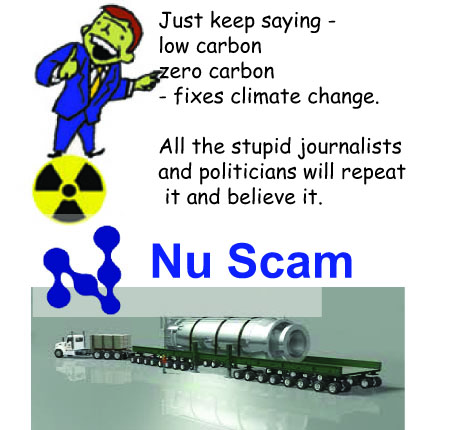 Feds throw support behind development of mini nuclear reactors; action plan released, Saskatoon / 650 CKOM Feds throw support behind development of mini nuclear reactors; action plan released, Saskatoon / 650 CKOMThe Canadian PressDec 18, 2020 “……. Among steps in the plan is developing prototypes and demonstration models.,,,,,
Dozens of groups, including opposition parties, some Indigenous organizations and environmentalists, want the government to fight climate change by investing more in renewable energy and energy efficiency rather than in the new reactors. They argue nuclear energy costs far too much money and is far from clean given the growing mound of radioactive waste it generates. O’Regan said the government is actively trying to figure out what do with the dangerous material….. The federal government estimates the global market for SMRs will be worth between $150 billion and $300 billion a year by 2040 but critics question the validity of the estimate. They also wonder who exactly might want one. …https://www.ckom.com/2020/12/18/feds-throw-support-behind-development-of-mini-nuclear-reactors/ |
|
In midst of pandemic crisis, more U.S. tax-payer money to go to nuclear power in space
 White House Issues Space Policy Directive on Space Nuclear Power and Propulsion. Via Satellite, By Rachel Jewett | December 17, 2020
SPD-6 establishes that the U.S. government will pursue a roadmap for federally-supported space nuclear power and propulsion activities.
Important considerations about the 2020 Cyberattack and Nuclear Power Plants
|
6 Things to Know about the 2020 Cyberattack and Nuclear Power Plants, https://www.ucsusa.org/?_ga=2.33422906.56524403.1608530745-1569294116.1608530745, ED LYMAN, DIRECTOR OF NUCLEAR POWER SAFETY, CLIMATE & ENERGY | DECEMBER 18, 2020 News reports over the last day indicate that a massive and devastating cyberattack on US government agencies and private companies in the United States and abroad has occurred, and UCS will be watching as this news develops. While the scope of the cyberattack is still far from clear, here are some facts to consider regarding how the hack may have impacted US nuclear energy infrastructure.
|
|
-
Archives
- May 2026 (72)
- April 2026 (356)
- March 2026 (251)
- February 2026 (268)
- January 2026 (308)
- December 2025 (358)
- November 2025 (359)
- October 2025 (376)
- September 2025 (257)
- August 2025 (319)
- July 2025 (230)
- June 2025 (348)
-
Categories
- 1
- 1 NUCLEAR ISSUES
- business and costs
- climate change
- culture and arts
- ENERGY
- environment
- health
- history
- indigenous issues
- Legal
- marketing of nuclear
- media
- opposition to nuclear
- PERSONAL STORIES
- politics
- politics international
- Religion and ethics
- safety
- secrets,lies and civil liberties
- spinbuster
- technology
- Uranium
- wastes
- weapons and war
- Women
- 2 WORLD
- ACTION
- AFRICA
- Atrocities
- AUSTRALIA
- Christina's notes
- Christina's themes
- culture and arts
- Events
- Fuk 2022
- Fuk 2023
- Fukushima 2017
- Fukushima 2018
- fukushima 2019
- Fukushima 2020
- Fukushima 2021
- general
- global warming
- Humour (God we need it)
- Nuclear
- RARE EARTHS
- Reference
- resources – print
- Resources -audiovicual
- Weekly Newsletter
- World
- World Nuclear
- YouTube
-
RSS
Entries RSS
Comments RSS
 nuclear-news