Republican lawmaker reintroduces Bill to repeal Ohio’s corrupt nuclear bailout law
 Ohio Lawmaker Reintroduces Bill To Repeal Nuclear Bailout Ohio Lawmaker Reintroduces Bill To Repeal Nuclear Bailout  Law https://radio.wosu.org/post/ohio-lawmaker-reintroduces-bill-repeal-nuclear-bailout-law#stream/0 Law https://radio.wosu.org/post/ohio-lawmaker-reintroduces-bill-repeal-nuclear-bailout-law#stream/0
By ASSOCIATED PRESS 8 Feb 21, • A bill to repeal a bailout of two aging nuclear power plants at the heart of a federal $60 million bribery probe has been re-introduced in the Ohio House by its Republican sponsor.
State Rep. Laura Lanese (R-Grove City) introduced a repeal bill last week similar to the one she introduced last year. That died after some fellow Republicans in the GOP-controlled House disagreed on whether a repeal was necessary. “A full repeal of House Bill 6 would protect consumers from predatory pricing, restore our renewable energy policy, and instill public confidence in the legislative process,” Lanese said in a statement. The legislation known as HB6 was signed into law by GOP Gov. Mike DeWine in 2019. The Justice Department accused five individuals, including former Republican House Speaker Larry Householder, of shepherding $60 million in energy company money for personal and political use in exchange for passing the law and then derailing an attempt to place a rejection of the bailout on the ballot. Two of those five have pleaded guilty, and a plea deal has also been reached with a nonprofit that authorities believe was used to funnel payments from the scheme. Householder, who pleaded not guilty to the rackteering charges, was removed as Speaker over the summer but won re-election to his House seat in November. |
|
How the United States can chart a new path that avoids war with China


How the United States can chart a new path that avoids war with China https://thebulletin.org/2021/02/how-the-united-states-can-chart-a-new-path-that-avoids-war-with-china/?utm_source=Newsletter&utm_medium=Email&utm_campaign=ThursdayNewsletter02042021&utm_content=NuclearRisk_NewPath_02032021
By Henry Bienen, Jeremiah Ostriker | February 3, 2021 The Biden administration has said that it will conduct a full review of trade and economic relations with China. It needs, actually, to conduct a review of all aspects of Sino-American relations: trade; technology; cultural, student, and scientific exchanges; and above all, security. There is room for vast improvement in all these realms, but the most pressing (and potentially dangerous) area involves security.
Relations between China and the United States have degenerated so far that some foreign policy experts now believe that war between the countries is possible. While this is a minority view, it is a dangerous one.
In the past, a US-China war was often considered unlikely for reasons of mutual economic interdependence and nuclear deterrence, not to mention the huge costs of war. Moreover, it has been said, ideological conflict and regional and international striving for advantage are not reasons enough for war. But now more pessimistic voices are also being heard. Citing pre-World War I analogies, in which it was (quite inaccurately) said that economic interdependence among European powers made war impossible, and noting what Harvard University’s Graham Allison has called the “Thucydides Trap,” in which there is a drift towards war when an emerging power threatens to displace an existing leading power, some believe war between China and the United States is becoming more conceivable and even probable.
We are concerned with the current direction of US-China’s policies, but we believe that the pessimists both overstate the possibility of a US-China war and understate the consequences of possible armed conflict. The production of so-called “small” nuclear weapons is given as a reason for the possibility of war without massive destruction. Nuclear war among nuclear powers has not occurred since the spread of nuclear weapons precisely because destruction would be huge and ghastly. But even lower-yield nuclear weapons nonetheless are quite deadly; each has the destructive potential of thousands of WWII airplane bombs. We cannot tell how limited the use of such weapons would be in advance of armed conflict, and, since Chinese missiles can reach our shores, we do not know if such a conflict could be contained.
There are other reasons for thinking war between China and the United States not only should be but will be avoided. We have past experience to warn us. The United States and China fought in the Korean War when US forces pushed to the Yalu River on China’s border. We know how that turned out. We also note that the United States did not send a land army to North Vietnam after China warned that the first US troops in North Vietnam would be met by Chinese “volunteers.” Lesson learned.
What points of conflict does the United States have with China that could actually lead to war? We can find only one, and it has nothing to do with trade, economic competition, ideology, human rights violations by China, or struggle for relative power in Asia or elsewhere. Taiwan is the critical point of conflict. China asserts its historical right to Taiwan as an integral part of China. The United States is committed to the principle that Taiwan’s relationship with China cannot be changed by force. Thus, how much military assistance to give to Taiwan, if China uses blockades or applies military force, is a critical issue for US policy. How and in what way to defend Taiwan loom as large questions. To do nothing in the face of Chinese military threats would not only call into question US commitments everywhere but might well lead to nuclear proliferation in Asia. What lessons would Japan, the Republic of Korea, Australia, perhaps Vietnam and Indonesia take? Taiwan itself has the capacity to build nuclear weapons and could do so, if the United States made clear that it would not respond to threats against Taiwan.
We do not minimize the difficulty of the Taiwan issue. There needs to be both clarity and ambiguity in how the United States deals with Taiwan. The United States needs to make clear that if China uses force against Taiwan there will be severe consequences. But we cannot in advance specify the consequences. We do not think war with China is probable over Taiwan. But we admit to the difficulties of finding the right policies in this area. We propose the following: As Joseph Nye noted recently in the Wall Street Journal, in consultation with China, the Biden administration should review policies for accident avoidance, crisis management, and high-level communications. Military-to-military relations already exist, and we do not know the details of them. But we suspect that the Trump administration let lapse, or weakened, constant communications and accident-avoidance protocols. These must be maintained and strengthened.
Arms sales to Taiwan are sensitive. Our aim is to avoid an invasion of Taiwan, and thus sales of missiles and technologies for defensive purposes seem right. We must make clear that we would work to circumvent a blockade of Taiwan. But obviously, Taiwan is not Berlin during the Cold War, and airlifts would have limited utility. Thus, it is the avoidance of a blockade that must be worked toward. And here, we need allies and friends in Asia and beyond to support the position that such a blockade would be disastrous for China’s economy and trade worldwide.
We can find no other issues where war could plausibly arise between China and the United States. And we reassert that any armed conflict could lead to a global catastrophe. In a more positive vein, the United States should be finding new paths to both cooperate and compete with China. The demonization of China—as per Donald Trump’s “China virus” and Secretary of State Pompeo’s bellicose language—are misguided and counterproductive. The two countries need to cooperate on climate and environmental issues and on the pandemic and other health matters.
Decoupling the economies of the United States and China would be very difficult, very expensive, and very foolish, as the Trump administration found out. It continued to want to export agricultural goods to China, and where it imposed tariffs, they raised costs to US consumers and manufacturers. We need to challenge China over its trade policies, but the best way to do that is to strengthen the US domestic economy and invest in education and technology innovation and research. So much of our vaunted technological progress has come from government investment. We should renew our government support for advanced research and technology, rather than faulting the Chinese for imitating our past actions. For but one example, consider how the internet was developed in the 1970s.
The United States has benefitted from an infusion of Chinese undergraduates, graduate students, and faculty. Undergraduates pay tuition; graduate students and post-grad medical and science researchers have strengthened the quality of universities and research centers. Most universities do not host classified research on their main campuses. Of course, there are dual-use technologies that can be copied or stolen. But the United States has gained from having Chinese scholars and students and researchers come to our shores. Many stay as productive and important citizens. As was the case with students and researchers from other countries in the past, many who return home see themselves as friends of the United States and hope for a more positive turn in Sino-American relations.
We now should join the Trans-Pacific Partnership. And we should form alliances and cooperative endeavors with China’s neighbors on trade, climate, health and regional conflict issues. And here we include Vietnam, Thailand, Indonesia, as well as India, Australia, New Zealand, Japan, and Korea. China’s push into Asia and Africa via its Road and Belt Initiative has not been a huge success. But here too the US could be more active and constructive with its own health and development policies abroad. The most useful thing that we could do to combat climate change would be to help the underdeveloped world move from coal and oil to renewable energy.
Above all, a strong and confident United States can compete and cooperate with China without conjuring up new enemies, or creating a new Cold War.
USA ramps up production of nuclear bomb cores
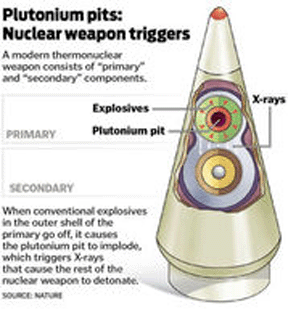 The U.S. is Boosting Production of Nuclear Bomb Cores (For More Nuclear Weapons), The National Interest. Thanks, arms race. by Michael Peck, 7 Feb 21, In another sign that the nuclear arms race is heating up, the U.S. is ramping up production of nuclear bomb cores. The National Nuclear Security Administration (NNSA) has announced that it plans to increase the production of plutonium pits to 80 per year. The grapefruit-sized pits contain the fissile material that give nuclear weapons such tremendous power. The U.S. is Boosting Production of Nuclear Bomb Cores (For More Nuclear Weapons), The National Interest. Thanks, arms race. by Michael Peck, 7 Feb 21, In another sign that the nuclear arms race is heating up, the U.S. is ramping up production of nuclear bomb cores. The National Nuclear Security Administration (NNSA) has announced that it plans to increase the production of plutonium pits to 80 per year. The grapefruit-sized pits contain the fissile material that give nuclear weapons such tremendous power.
Production will center on the Mixed-Oxide Fuel Fabrication Facility at Savannah River site in North Carolina, which would be modified to manufacture at least 50 pits per year, and Los Alamos National Laboratory in New Mexico, which would generate at least 30, by 2030. America’s nuclear weapons cores are aging, with some pits dating back to the 1970s, leading to concerns about the reliability of the U.S. nuclear stockpile……… In its 2018 Nuclear Policy Review, the Trump administration called for 80 new plutonium pits per year. Congress has also allocated large sums, with $4.7 billion alone allocated in FY 2019 for maintenance and life extension of the nuclear stockpile. The NNSA says it is legally mandated to ensure a capacity of at least 80 pits per year. ……. Anti-nuclear groups are furious. “Expanded pit production will cost at least $43 billion over the next 30 years,” argues the Natural Resources Defense Council and other groups. Yet the Defense Department and NNSA have never explained why expanded plutonium pit production is necessary. More than 15,000 plutonium pits are stored at NNSA’s Pantex Plant near Amarillo, Texas. Independent experts have concluded that plutonium pits have reliable lifetimes of at least 100 years (the average pit age is less than 40 years). Crucially, there is no pit production scheduled to maintain the safety and reliability of the existing nuclear weapons stockpile. Instead, proposed future pit production is for speculative new-design nuclear weapons, but those designs have been canceled.” Introducing a new generation of nuclear weapons “could adversely impact national security because newly produced plutonium pits cannot be full-scale tested without violating the global nuclear weapons testing moratorium.” Michael Peck is a contributing writer for the National Interest. He can be found on Twitter and Facebook. https://nationalinterest.org/blog/reboot/us-boosting-production-nuclear-bomb-cores-more-nuclear-weapons-177825 |
|
Canadian local community group opposes nuclear waste dump on farming land

South Bruce nuclear dump opponents address Minto council . Group: site near Teeswater would mean transporting waste through neighbouring communities, https://www.wellingtonadvertiser.com/south-bruce-nuclear-dump-opponents-address-minto-council/ , Wellington Advertiser, Patrick Raftis, February 4, 2021 MINTO – A group fighting a proposal to locate an underground dumpsite for radioactive nuclear waste in neighbouring South Bruce brought its concerns to council here on Feb. 2.
“Over 50 years ago the nuclear industry told the government to let them start producing nuclear power and they would have a solution for the waste within five years,” said Michelle Stein of Protect Our Waterways – No Nuclear Waste (POWNNW), during a council video-conference meeting.
“But they didn’t. Now they have a problem.”
Stein explained POWNNW was formed last February after an announcement that 1,300 acres of prime farmland had been purchased and optioned by the Nuclear Waste Management Organization (NWMO).
NWMO is proposing to locate a deep geologic repository (DGR) in South Bruce to contain high-level radioactive nuclear waste from all of Canada’s nuclear reactors.
Stein said the radioactive waste from Canada’s reactors is “safe where it is right now.
“But politically, it’s no longer acceptable and the government and the public are demanding a solution before they grant the nuclear industry permission to expand.”
Stein continued, “There’s a lot of money on the line. So the industry has set up [NWMO], which is funded and directed by the nuclear industry and the best idea they’ve come up with is to take this highly radioactive nuclear waste that is dangerous for over 100,000 years and bury it under prime farmland in the municipality of South Bruce.”
The proposed site near Teeswater was selected, said Stein, because “that’s where they found owners willing to sell them land” and “South Bruce was one of the municipalities who offered to learn more in exchange for money – lots of money.
“A lot of the money is spent on promoting the project, but there’s also donations to local organizations and community projects,” she noted.
Stein told council l the proposed site “has the Teeswater river running through it, wetlands at the edge of the Greenock Swamp, springtime floodplain and the town of Teeswater is close enough to see, with its elementary schools and the Teeswater Gay Lea plant.”
Stein called the proposed South Bruce repository “an experiment,” noting there are currently no operating DGRs for high level nuclear waste on the planet.
She noted an almost complete, but not yet licensed, DGR in Finland is presently the closest to coming on line.
According to the Canadian Nuclear Safety Commission, said Stein, the Waste Isolation Plant Pilot (WIPP) in New Mexico is the only operational DGR in the world.
It accepts only low/intermediate nuclear waste, not high level, and is located in a desert, 35 kilometres from the nearest town and surrounded by a controlled safety zone encompassing more than 10,000 acres.
“The only thing we can really learn from this project is that accident happens and you can’t predict human error,” said Stein.
She added that in 2014 the WIPP “became radio actively contaminated by explosion of an underground drum of nuclear waste due to human error.”
Stein said the 2014 incident was “a mistake that took three years and $500 million to clean up.”
She pointed out establishing a DGR in South Bruce would massively increase the amount of nuclear waste being transported through a wide region.
“Currently they are around five loads of high level waste being moved per year, but an operating DGR would increase that to one or two shipments per day. These loads would be transported through surrounding communities,” she stated.
“And what does this mean for agriculture? Will consumers want to purchase products produced next to a nuclear dump? Will people want to buy freezer beef or chicken raised on or beside a nuclear dump?”
With the NWMO publicly stating it is looking for a “willing host,” Stein said POPNNW wants to see a clear benchmark that defines the term.
The group is lobbying for a standard that would require a two-thirds vote in favour of the proposed DGR, using a community referendum with a clear yes or no question, supervised by an independent third party.
Councillor Ron Elliott asked Stein what her group believes would be a better solution to burying the waste.
“You’re recommending we can’t get rid of the nuclear waste underground. What do you recommend we do with it? Because it’s there, we’ve got nuclear waste to get rid of,” said Elliott.
Stein replied, “At this time we’re recommending they go with rolling stewardship, which is keeping it above ground in a monitored state until they come up with a real solution.”
“So wouldn’t that be more dangerous?” asked Elliott
“Building a DGR doesn’t remove it from above ground. It still needs to be above ground (in containment pools) for 30 years before it can even be moved,” said Stein.
“What is a safe recommendation?” Elliott persisted.
“At the end of the day the nuclear industry has had over 50 years to come up with an idea and they haven’t,” Stein responded.
“To be honest, most of us have only been thinking about it for a year. But to accept the wrong solution is in fact no solution at all.”
Bill Noll, another member of the POPNNW delegation, said Ontario Power Generation has stated nuclear waste has been stored safely above ground for 60 years “and it can be stored longer.”
Noll said the group would like to see Canada wait for the results from the planned Finnish DGR in 2024 before going ahead with one here.
“Let them experiment for a couple of decades while we keep it above ground safely and then maybe we can consider whether or not the DGR is safe,” said Noll.
Deputy mayor Dave Turton asked Stein if local officials in South Bruce responded to the group’s concerns.
“Are they listening to you?” he asked.
Noll replied, “We are up against the wall to some degree. Our council is very much interested to see some economic development in the area, and we certainly understand and appreciate that, and so they’re very much in tune with the agenda being put forward by the NWMO.”
Mayor George Bridge thanked the group for sharing information with council.
Deploying weapons in space crosses a threshold that cannot be walked back.

weaponizing space could become a classic case of trying to solve one problem while creating a much worse problem.
It’s time for arms control planning to address the issues raised by this drift toward militarization of space. Space is a place where billions of defense dollars can evaporate quickly and result in more threats about which to be concerned. China and Russia have been proposing mechanisms for space arms control at the United Nations for years; it’s time for the U.S. to cooperate in this effort.
Deploying weapons in space crosses a threshold that cannot be walked back.
The US should negotiate a ban on basing weapons in space, BY JOHN FAIRLAMB, — 02/04/21, https://thehill.com/opinion/national-security/536774-the-us-should-negotiate-a-ban-on-basing-weapons-in-space
The Biden administration is assembling a deep bench of personnel with experience negotiating arms control agreements and already has agreed with Russia to extend the New Start Treaty. It’s clear the administration intends to initiate another look at the 2018 Nuclear Posture Review and the massive buildup in nuclear weapons begun by the Trump administration. While it’s good that the Biden administration intends to resume negotiations to continue nuclear force reductions, the specter of placing weapons in space is another area that requires a serious arms control effort.
Now that separate space organizations have been established, major military commands are advocating to develop new capabilities. Pentagon buzzwords characterize space as a “contested domain” and some consider actual war-fighting in space to be inevitable. Some advocates argue that the U.S. should strive for technological superiority in space to ensure our dominance of that critical domain.
The history of technological advancement in weapons systems shows that any advantage gained usually lasts fewer than five years and guarantees a cycle of ever-increasing cost and new perceptions of threat. Already, there are weapons that can be targeted against space-based assets from non-space domains. Russia and China are believed to have deployed ground-based capabilities to attack satellites, and India joined this club last year by using a ground-based missile to bring down a satellite.
Although it isn’t clear how the Biden administration will shape space policy, during his confirmation hearing, Secretary of Defense Lloyd Austin seemed to signal a shift away from a more muscular approach and back to a focus on space resiliency and protecting U.S. space assets. As one analyst concluded, the language Austin used signals the Biden team wants to “start to lean away from … the pugilistic aspects of what’s been articulated [by the Trump administration].” Responding to a question about what his advice would be to the U.S. Space Command concerning military space operations, Austin stressed measures to protect U.S. assets that don’t include offensive options for taking the fight to adversaries. While not a fully articulated space policy, this is a welcome change of tone after the past few years of heavy breathing about waging war in space.
If the U.S. and other nations continue the current drift toward organizing and equipping to wage war in space, Russia, China and others will strive to improve capabilities to destroy U.S. space assets. Over time, this would greatly increase the threat to the full array of U.S. space-based capabilities. Intelligence, communications, surveillance, targeting and navigation assets already based in space, upon which the Department of Defense (DOD) depends for command and control of military operations, increasingly would be at significant risk. As a consequence, weaponizing space could become a classic case of trying to solve one problem while creating a much worse problem.
For example, buried in the DOD 2020 budget is $150 million for research into putting missile defense assets in space to attack enemy nuclear missiles in the boost phase. If the U.S. or another nation does deploy weapons in space, it would be the first country to do so and likely would be a disaster for strategic stability. To ensure the credibility of their nuclear deterrents, Russia, China and others could be expected to respond by deploying additional and new types of long-range ballistic missiles, as well as missiles employing non-ballistic trajectories that are harder to hit. Russia and China also would strive to improve their ability to destroy U.S. space-based interceptors, which would greatly increase the threat to the full array of U.S. space assets.
It’s time for arms control planning to address the issues raised by this drift toward militarization of space. Space is a place where billions of defense dollars can evaporate quickly and result in more threats about which to be concerned. China and Russia have been proposing mechanisms for space arms control at the United Nations for years; it’s time for the U.S. to cooperate in this effort.
In 2015, Frank Rose, assistant secretary for arms control, verification and compliance in the State Department, called for arms control in space at the Association of Southeast Asian Nations Regional Forum workshop on space security. But, he said the Obama administration opposed a 2008 Russian and Chinese proposal to ban all weapons in space because it was unverifiable, contained no prohibition on developing and stockpiling space arms, and did not address ground-based space weapons such as direct ascent anti-satellite missiles.
Instead of just criticizing others’ proposals, the U.S. should join in the effort and do the hard work of crafting a space arms control agreement that deals with the concerns we have and that can be verified. A legally binding international treaty banning the basing of weapons in space should be the objective.
Let’s be clear: Deploying weapons in space crosses a threshold that cannot be walked back. Given the implications for strategic stability, and the likelihood that such a decision by any nation would set off an expensive space arms race in which any advantage gained would likely be temporary, engaging now to prevent such a debacle seems warranted.
John Fairlamb, Ph.D., is a retired Army colonel with 45 years of government service, much of it in joint service positions formulating and implementing national security strategies and policies, including two four-year details in the Department of State and as the political-military affairs adviser for a major Army command. His doctorate is in comparative defense policy analysis.
Two Ohio state Republican Senators aim to remove subsidies to nuclear power plants
State Senators Jerry Cirino of Kirtland and Michael Rulli of Salem have introduced Senate Bill 44. Cirino says it does not repeal or replace House Bill 6. It just removes the subsidy provision, which he says will lower electric bills.
“We are eliminating, in the bill, $130 million plus per year that if HB6 was left intact, would be going to the nuclear facilities,” Cirino said. “So we’re taking that away and they’re on their own to figure out how to operate better and what they can do with the federal government.”
PJM Interconnection is a Regional Transmission Organization that coordinates the movement of wholesale electricity across 13 states including District of Columbia and Ohio.
They are offering pricing support to energy operators, but Cirino says it would be difficult for PJM to provide this support to operators accepting these subsidies.
Cirino says he supports nuclear power and says the plants will remain open with federal support that can help them continue to operate without the subsidy.
The Senate Energy Committee will have hearings about Senate Bill 44 beginning next week.
Read the bill as proposed:…………https://www.wksu.org/government-politics/2021-02-05/senate-bill-introduced-to-remove-power-plant-subsidies
America’s new strategy for space nuclear power pays little consideration to safety aspects
 America’s New Strategy for Space Nuclear Power, By Zhanna Malekos Smith. Wednesday, February 3, 2021
Among the flurry of executive orders and proclamations signed during his final weeks in office, President Trump issued two directives that have received little fanfare—about space. One directive concerns enhancing the cybersecurity of GPS satellites. The other is perhaps more exciting: It focuses on exploring Mars and the moon.
New Iran envoy shows Biden is serious about reviving nuclear deal
|
New Iran envoy shows Biden is serious about reviving nuclear deal
Robert Malley appointment marks abrupt break with Trump administration’s approach to Tehran, Ft.com, DAVID GARDNER – 4 Feb 21, In the 2008 US presidential election campaign, Barack Obama suddenly pushed out Robert Malley, a top adviser on the Middle East. Mr Malley’s supporters tried to face down a barrage of attacks by rightwing pro-Israel groups. But the Obama team capitulated after it became public that he had met with Hamas, the Palestinian Islamist movement that controls the Gaza Strip. No matter that such meetings were intrinsic to Mr Malley’s previous job with the International Crisis Group, an NGO devoted to preventing or defusing conflict. He was seen as a political liability. Fast forward to President Joe Biden, Mr Obama’s vice-president, who has just appointed Mr Malley as US special envoy for Iran. Once more, he was pilloried by the pro-Israel right, Gulf Arab officials and some Iranian-Americans, who claimed he is biased against Israel and “Iran’s ideal candidate for the position of American envoy”. This time a counter-barrage, from a foreign policy elite studded with unimpeachably pro-Israel figures, was ready to fire back. The smears against Mr Malley were swiftly countered. The attempt to sabotage the appointment by detonating a proxy war over the Biden team’s Iran policy failed.
…………. The Malley appointment, alongside Mr Biden’s selection of seasoned diplomats involved in the 2015 nuclear deal, such as Antony Blinken as secretary of state and William Burns as CIA director, is a strong statement of intent. It could hardly be more different to the outgoing US envoy for Iran, Elliott Abrams, one of a cohort of Trump aides who acted more as lawyers for Israel than mediators. https://www.ft.com/content/eae24633-844a-4bb5-b5a9-28deead96a
|
|
|
America’s ”fleet” of dangerously embrittled nuclear reactors
|
Embrittlement in Nuclear Power Plants, https://www.counterpunch.org/2021/02/01/embrittlement-in-nuclear-power-plants/ BY KARL GROSSMAN – HARVEY WASSERMAN
– 1 Feb 2021
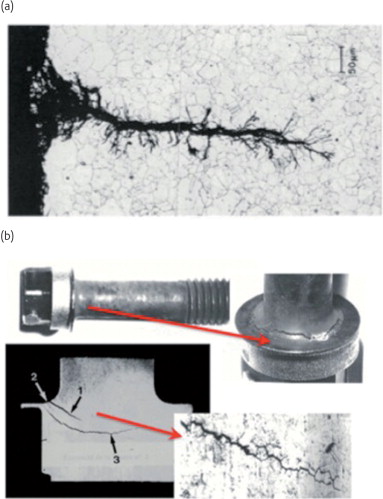
Of all the daunting tasks Joe Biden faces, especially vital is the inspection of dangerously embrittled atomic reactors still operating in the United States. A meltdown at any one of them would threaten the health and safety of millions of people while causing major impact to an already struggling economy. The COVID-19 pandemic would complicate and add to the disaster. A nuclear power plant catastrophe would severely threaten accomplishments Biden is hoping to achieve in his presidency. The problem of embrittlement is on the top of the list of nuclear power concerns. The “average age”—length of operation—of nuclear power plants in the U.S., the federal government’s Energy information Agency, reported in 2019 was 38 years. That’s why the operating licenses originally issued for the plants were limited to 40 years. Here’s how Arnold “Arnie” Gundersen, a nuclear engineer with more than 44 years of experience in the nuclear industry, who became a whistleblower and is now chief engineer at Fairewinds Associates, explains embrittlement: “When exposed to radiation, metal becomes embrittled and eventually can crack like glass. The longer the radiation exposure, the worse the embrittlement becomes.” A nuclear reactor is just like a pressure cooker and is a pot designed to hold the radioactive contents of the atomic chain reaction in the nuclear core,” continues Gundersen, whose experience includes being a licensed Critical Facility Reactor Operator. “And metals in reactors are exposed to radiation every day a plant operates” “If the reactor is embrittled and cracks,” says Gundersen, “it’s ‘game over’ as all the radiation can spew out into the atmosphere.Diablo Canyon [a twin-reactor facility in California] is the worst, the most embrittled nuclear power facility in the U.S., but there are plenty of others that also could crack. Starting with Diablo, every reactor in the U.S. should be checked to determine they are too embrittled to continue to safely operate.” Metals inside a nuclear power plant are bombarded with radiation, notes Gundersen. The steel used in reactor pressure vessels—which contain the super-hot nuclear cores—is not immune. Every U.S. reactor has an Emergency Core Cooling System and a Core Spray System to flood the super-hot core in the event of a loss-of-coolant accident. Embrittled metal would shatter when hit with that cold water. The ensuing explosion could then blow apart the containment structure—as happened at the Chernobyl and Fukushima nuclear power plants—morphing into a radioactive plume moving into the atmosphere and be carried by the winds, dropping deadly fall-out wherever it goes. This apocalyptic outcome was barely missed in Pennsylvania where, starting at 4 a.m. on March 28, 1979, fuel inside the Three Mile Island Unit Two nuclear power plant began to melt. Its Emergency Core Cooling System was activated. But only the year before—in 1978—did the plant receive a license to operate and begin operating. Had TMI, like so many of U.S. nuclear power plants now, been decades old and its metal pressure vessel embrittled and had shattered—a far greater disaster would have occurred. The entire northeastern U.S. could have been blanketed with deadly radioactivity The “fleet” of old, decrepit nuclear power plants in the U.S.—with embrittled metal components—must be inspected. And with embrittlement they must be shut down. Biden must jump into the situation—for the sake of American lives, for the sake of the nation’s future. Nuclear power in the U.S. is under the jurisdiction of the Nuclear Regulatory Commission, or NRC. That acronym NRC should really stand for Nuclear Rubberstamp Commission. Whatever the nuclear industry wants, the NRC says yes to. As the result of the series of globally infamous catastrophic nuclear power plant accidents—at Three Mile Island, Chernobyl and Fukushima—and the availability of safe, green, cost-effective, clean renewable energy, led by solar and wind, coupled with increasing energy efficiency, the nuclear industry is in its death throes. Only two nuclear power plants are being built now in the U.S., Vogtle 3 and 4 in Georgia. At nearly $30 billion for the pair, they’re hugely over budget—and their construction costs are still rising. In fact, virtually all operating atomic reactors are producing electricity at much higher base costs than solar and wind. The NRC is currently seeking to try to bail out the nuclear industry—to keep it going—by allowing nuclear power plants to operate for 100 years. In recent years it agreed to let nuclear power plants to run for 60 years and then it upped that to 80 years. On January 21 the Nuclear Rubberstamp Commission held a “public meeting” on its plan to now extend operating licenses for U.S. nuclear power plants and allow them to run for 100 years. Speaker after speaker protested this scheme. “It’s time to stop this whole nuke con job,” testified Erica Gray nuclear issues chair of the Virginia Sierra Club, at the meeting. There is “no solution” to dealing with nuclear waste, she said. It is “unethical to continue to make the most toxic waste known to mankind.” And renewable energy” with solar and wind “can power the world.” “Our position… is a resounding no,” declared Paul Gunter, director of the Reactor Oversight Project of the national organization Beyond Nuclear, for letting nuclear power plants run for 100 years. Speakers cited the greatly increased likelihood of accidents if nuclear plants were allowed to run for a century. Biden must step in and order the inspection for embrittlement of U.S. nuclear power plants. The “fleet” of old, decrepit nuclear power plants in the U.S.—with embrittled metal components—must be inspected. And with embrittlement and other likely age-induced problems, they must be shut down. Biden must act to prevent what would constitute nuclear suicide in the United States. On January 27, Biden announced a climate change agenda transitioning the U.S. towards renewable energy. But taking action against fossil fuel is not enough. Nuclear power plants are also engines of global warming. The “nuclear fuel chain” which includes uranium mining, milling and fuel enrichment is carbon intensive. Nuclear plants themselves emit Carbon-14, a radioactive form of carbon. Biden must take the lead. NOW! Harvey Wasserman wrote the books Solartopia! Our Green-Powered Earth and The Peoples Spiral of US History. He helped coin the phrase “No Nukes.” He co-convenes the Grassroots Emergency Election Protection Coalition at www.electionprotection2024.org Karl Grossman is the author of Cover Up: What You Are Not Supposed to Know About Nuclear Power and Power Crazy. He the host of the nationally-aired TV program Enviro Close-Up with Karl Grossman (www.envirovideo.com) |
|
Nuclear Rubberstamping Commission rushes to approve Holtec’s New Mexico nuclear waste plan

Republican Texas Gov. Greg Abbott has categorically denounced the Holtec project and all other proposals to store nuclear waste in the area.
there are “no plans of ever removing” the waste. “We see no reason,” they said, “to rush a decision that affects generations of New Mexicans during a pandemic on behalf of an international, for-profit corporation.”
New Mexico’s nuclear rush, A massive nuclear waste site near Carlsbad is seemingly on a fast track. Can the company behind it be trusted? Searchlight New Mexico, By Sammy Feldblum and Tovah Strong|February 3, 2021
For most New Mexico businesses, the arrival of COVID-19 wreaked havoc, caused shutdowns or threatened doom. But for one enterprise — potentially one of the world’s largest nuclear waste sites — the pandemic offered an unusual opportunity.
A long-planned nuclear waste storage facility in the southeastern New Mexico desert was rushed through the approval process during the pandemic, according to New Mexico’s congressional delegation, environmentalists and other opponents.
Typically, project foes would have been able to voice their disapproval at Nuclear Regulatory Commission hearings around the state. The coronavirus brought an end to such public gatherings, however, so New Mexico lawmakers asked the NRC to pause the hearings.
Instead, the agency switched to online meetings — and shut out dissenters in the process.
“There is a large population of individuals living in New Mexico without internet or phone access” — and the virtual hearings required both, said environmental activist Leona Morgan of the Nuclear Issues Study Group. A Diné woman who protests what she calls nuclear colonialism, Morgan said that many people couldn’t join the meetings because they didn’t have robust broadband connections, a common problem in tribal areas and remote parts of New Mexico. Continue reading
Although Biden is pro-nuclear, there’s a chance that the new Nuclear Regulatory Commission might get out of bed with the nuclear lobby.
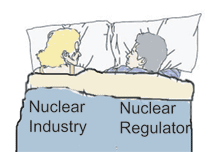 NRC has been too deferential to a nuclear industry eager to reduce the cost of operating nuclear plants while keeping aging plants online.
Nuclear has another friend in Biden, but changes at the NRC could mean more scrutiny ahead, Utility Dive . 1 Feb 21, Matthew Bandyk
Nuclear power is in a period of transformation, and so is the U.S. Nuclear Regulatory Commission. On Jan. 23, President Joe Biden appointed NRC Commissioner Christopher Hanson, a Democrat, as the new chairman of the agency. Hanson replaces Kristine Svinicki, a Republican who was designated by President Donald Trump to lead the commission days after his 2017 inauguration, and left Jan. 20, ending a 3-2 Republican majority on the commission……..
And now, while the industry faces an administration that sees nuclear as an important source of carbon-free power [ carbon-free – this is a lie] , the NRC under Biden is not likely to have the same regulatory approach as the commission did under Trump. ……
Environmental groups say NRC has been too deferential to a nuclear industry eager to reduce the cost of operating nuclear plants while keeping aging plants online. Jeffrey Baran, the sole remaining Obama appointee on the commission, has echoed these criticisms across a number of issues, such as the new safety rules for reactors based on lessons learned from the 2011 Fukushima incident and the process for evaluating advanced reactors. ……..
Biden enters the White House with one of the most explicitly pro-nuclear agendas of any president. His climate plan calls out nuclear as a zero-carbon technology [ but it’s NOT zero-carbon] that has a role to play in addressing climate change, and says his administration will look at ways to overcome the cost, safety and waste disposal challenges for nuclear power.
Based on his campaign’s policies, Biden’s presidency “bodes well” for nuclear power, Doug True, the chief nuclear officer at the Nuclear Energy Institute (NEI), the main advocacy organization for the industry, said in an interview…….
Subsequent license renewal
A top priority of the nuclear industry continues to be extending the lifetime of existing nuclear plants, …….
Over the past several years the NRC started accepting applications from nuclear plants to remain open for 80 years. The commission is also considering whether it should begin developing a framework for licensing plants to run for up to 100 years, holding the first public meeting on that topic on Jan. 21.
No U.S. nuclear plant had ever been licensed to operate beyond 60 years until Florida Power & Light’s Turkey Point reactors received a second license renewal from the NRC at the end of 2019, allowing operation for 80 years. Exelon’s Peach Bottom plant in Pennsylvania got permission to operate up to 80 years a few months later. These approvals came despite objections from environmental groups that the NRC was failing to do its duty by not requiring these plants to undergo more extensive reviews of the potential environmental and safety risks from 80 years of operation.
The NRC rejected a challenge to the Turkey Point relicensing process filed by the Natural Resources Defense Council and Friends of the Earth. Baran dissented, saying the commission should evaluate the groups’ position that Turkey Point cannot rely on a review of the environmental impacts of relicensing the reactors that was from 2013 and not specific to the site, and that the plant must instead perform a new review.
NRDC and Friends of the Earth have appealed the NRC’s decision on Turkey Point, and that challenge is currently pending before the U.S. Court of Appeals for the D.C. Circuit.
The nuclear watchdog group Beyond Nuclear brought a similar challenge against the Peach Bottom relicensing, and Baran once again dissented when the NRC released its order in November 2020 rejecting the group’s claim, but this time, he was joined by Hanson, who had been appointed to the commission after the Turkey Point decision.
The dissent of Baran and Hanson “conveys that a Democratically-led commission is at least more open to taking the hard looks at these license extensions that [the National Environmental Policy Act] demands,” said Paul Gunter, reactor oversight project director at Beyond Nuclear. A “hard look” would mean performing new environmental assessments of issues related to the aging of a nuclear plant, such as whether components of the plant have been embrittled by exposure to radiation over the course of decades, according to Gunter.
Dominion’s North Anna and Surry reactors in Virginia are next in line to potentially receive 80-year licenses. In addition, last November, NextEra Energy applied for license extensions up to 80 years for both of its reactors at the Point Beach plant in Wisconsin, and Duke Energy has told the NRC it intends to apply for similar extensions for the three reactors at its Oconee plant in South Carolina later this year.
Beyond Nuclear is still reviewing whether or not it will file more challenges to the environmental reviews of plants going for 80 year licenses, according to Gunter. An NRDC spokesman said that given the group’s active litigation on the mater, it cannot comment on how the change in the NRC leadership could affect future relicensing challenges.
The future of nuclear technology
Another priority for the NRC that will continue under the Biden administration is the consideration of new types of reactors that are intended to represent a leap forward for nuclear technology …….
The commission is wrestling with the question of how much of the safety requirements that apply to existing power reactors, such as the need to maintain evacuation zones, strict security procedures and more, should apply to advanced reactors. It also recently announced it is seeking public comments on how the process for licensing new reactors can be made overall more efficient……….
The NRC is expected to make many future decisions about the extent to which advanced reactors should be subject to existing regulations. One issue that has not been decided yet but could be voted on by the new commission, according to Merrifield, concerns the security measures that advanced reactors must follow, such as how much security staff a reactor must maintain.
The commission is under pressure to transform its treatment of advanced reactors — under the 2019 Nuclear Energy Innovation and Modernization Act, by this summer, the NRC must report to Congress on how it has established a “technology-inclusive regulatory framework” that eases the path to approval for advanced reactors.
Safety regulations
Another area where opposing views inside and outside the NRC have clashed is over nuclear plant safety and whether or not the commission is mitigating the risk of severe accidents at the existing nuclear fleet to a reasonable level.
“A general trend toward deregulation and streamlined regulation…accelerated under Svinicki, for sure,” according to Tim Judson, executive director of the Nuclear Information and Resource Service, a group focused on creating “a nuclear-free, carbon-free world.” He said “the industry is desperately trying to reduce regulation to reduce operating costs.”
Nuclear plants have a financial incentive to reduce the amount of inspections because “they are billed for every hour that inspectors are on site,” said Lyman, of UCS.
Baran has also expressed concern that the NRC is easing off safety regulations. One of his most strident dissents came in 2019 when he said that a decision approved by a majority of the commission “guts” the U.S. safety response to Fukushima because the majority did not require plants to prepare for Fukushima-level disasters based on the most recent evaluations of the earthquake and extreme weather threats posed to individual plants………. https://www.utilitydive.com/news/nuclear-has-another-friend-in-biden-but-changes-at-the-nrc-could-mean-more/593609/
Rapacious nuclear company Holtec: its dodgy record on safety, finance and lack of transparency

-” ………………There really is no fixed date on a repository,” said Rod McCullum of the Nuclear Energy Institute, an industry trade group. In the absence of a permanent storage place, the conversation has turned to interim storage sites that could save companies money until a final destination is established.Enter Holtec. The company was formed in the 1980s to design spent-fuel storage technology for nuclear plants. By the early 2000s, Holtec had secured contracts to provide specialized dry storage casks for a never-built interim facility on the Skull Valley Goshute reservation in Utah and the Tennessee Valley Authority’s Sequoyah Nuclear and Browns Ferry Nuclear plants. By 2018, Holtec operated branches in seven countries, including Ukraine and Spain.
In 2019, Holtec began acquiring decommissioned nuclear power plants. (Such plants can bring large profits, including whatever decommissioning funds are left over after they’ve been cleaned up.) Holtec purchased New Jersey’s Oyster Creek Generating Station; Massachusetts’ Pilgrim Nuclear Power Station; New York’s Indian Point Energy Center; and Michigan’s Palisades Nuclear Generating Station, as well as spent fuel from the former Big Rock Point Nuclear Power Plant.
But the company’s record was not without concern. Holtec has received an estimated nine violation notices since 2001 for failing to follow NRC quality assurance procedures, including rules meant to ensure that the company’s storage casks — the kind it would be using in New Mexico — consistently met safety standards.
The most recent violation occurred in 2018 when Holtec modified its casks without notifying the NRC, as mandated. The change was only discovered when workers preparing to load a cask at San Onofre Generating Station in California noticed a four-inch pin, meant to hold the fuel basket, loose at the bottom of the cask — an obvious manufacturing flaw. When asked for comment on the incidents, a Holtec spokesman told Searchlight that the company is an industry leader in quality assurance.
Holtec has run into other problems as well. An investigation conducted in 2010 by the Tennessee Valley Authority into suspected overbilling revealed that the company had bribed a TVA employee in order to secure a contract. In 2007, the employee pleaded guilty to concealing more than $54,000 received from Holtec. In the wake of the investigation, the TVA ordered the company to pay a $2 million fine, open its operations to outside monitors and face a largely symbolic 60-day ban from doing federal business — the first debarment in TVA history.
In 2014, Holtec failed to mention that debarment on tax credit application forms. The misrepresentation initially went unnoticed, allowing the company to receive $260 million in tax credits from the New Jersey Economic Development Authority (NJEDA), a story first reported by ProPublica and WNYC.
In 2019, the NJEDA announced it would investigate Holtec’s use of tax credits, prompting the company to sue the agency for withholding money. (The NJEDA declined to answer questions about the investigation’s status, saying it did not comment on matters related to pending litigation.)
Holtec’s use of offshore banking has also come under scrutiny. According to leaked records called the Paradise Papers, Holtec has operated at least one shell corporation in Bermuda between 2005 and 2007. The records, which were obtained by the German daily newspaper Süddeutsche Zeitung and shared with the International Consortium of Investigative Journalists, listed Krishna P. Singh II as an officer: He is the son of Holtec CEO Krishna P. Singh. Several of the CEO’s other family members were also listed as officers, as was Niraj Chaudhary, director of the executive committee for Holtec Asia. An additional offshore company in Bermuda that operated during the same time period, Southampton Technologies Ltd., included nearly identical officers and was listed at the same address.
Holtec did not respond to questions from Searchlight about why the accounts were used and whether the company still keeps bank accounts in tax havens. The leaked records don’t reveal this information, either. But tax havens like Bermuda can allow companies to avoid paying taxes.
“There’s nothing inherently nefarious about [the accounts],” said Jack Blum, a national authority on international tax evasion and money laundering whose anti-corruption work contributed to the establishment of the U.S. Foreign Corrupt Practices Act. However, Blum told Searchlight, Holtec “is a closely held company that has a history of being controlled by its founders, and wherever it goes, it wants to keep its finances as secret as it can and its taxes as low as it can.”
In general, Blum said: “Companies that are dealing in nuclear materials are in a world where there’s very little transparency.”
Holtec did not respond to questions from Searchlight about why the accounts were used and whether the company still keeps bank accounts in tax havens. ……. https://searchlightnm.org/new-mexicos-nuclear-rush/
USA and Russia extend The New Strategic Arms Reduction Treaty (New START Treaty) to 2026
|
US and Russia extend nuclear arms control treaty to 2026 Aljazeera,
Both Washington and Moscow cast the extension as a victory, saying it would provide stability and transparency. 3 Feb 2021 The United States and Russia have finalised an agreement to extend until 2026 a treaty limiting their stockpiles of nuclear weapons.
The New Strategic Arms Reduction Treaty (New START Treaty), which was due to expire on Friday, imposes limits on Russian and US intercontinental missiles and bombers, but does not cover new types of weapons. Both Washington and Moscow cast the extension as a victory, saying it would provide stability and transparency on nuclear issues while acknowledging some of their disagreements. …………. Tom Collina of Ploughshares Fund, which advocates for the elimination of nuclear weapons, said Russia’s priority in any new accord would be dealing with the threat it sees to its long-range strategic nuclear arsenal from US missile defences. Washington, for its part, likely will seek to limit Moscow’s vast short-range nuclear arsenal, Collina told the Reuters news agency. https://www.aljazeera.com/news/2021/2/3/us-extends-strategic-nuclear-arms-treaty-with-russia |
|
Radiation illnesses and COVID-19 in the Navajo Nation
 Radiation illnesses and COVID-19 in the Navajo Nation, Bulletin of the Atomic Scientists, By Jayita Sarkar, Caitlin Meyer, February 3, 2021 The COVID-19 pandemic is wiping out Indigenous elders and with them the cultural identity of Indigenous communities in the United States. But on lands that sprawl across a vast area of the American West, the Navajo (or Diné) are dealing not just with the pandemic, but also with another, related public health crisis. The US Centers for Disease Control and Prevention says COVID-19 is killing Native Americans at nearly three times the rate of whites, and on the Navajo Nation itself, about 30,000 people have tested positive for the coronavirus and roughly 1,000 have died. But among the Diné, the coronavirus is also spreading through a population that decades of unsafe uranium mining and contaminated groundwater has left sick and vulnerable.
In Indigenous lands where nuclear weapons testing took place during the Cold War and the legacy of uranium mining persists, Indigenous people are suffering from a double whammy of long-term illnesses from radiation exposure and the COVID-19 pandemic. Yet, we have not witnessed in the mainstream media and policy outlets a frank discussion of how the two public health crises have created an intractable situation for Indigenous communities. The Diné are drinking poisoned water, putting them at risk for more severe coronavirus infections.
From 1944 until 1986, 30 million tons of uranium ore was extracted on Navajo lands. At present, there are more than 520 abandoned uranium mines, which for the Diné represents both their nuclear past as well as their radioactive present in the form of elevated levels of radiation in nearby homes and water sources. Due to over four decades of uranium mining that supplied the US government and industry for nuclear weapons and energy, radiation illnesses characterize everyday Diné life.
The water crisis Continue reading
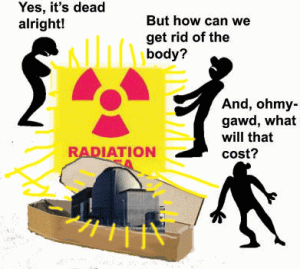
How the nuclear industry will try to avoid decommissioning costs

They want to renew reactor licenses. It’s not just for their immediate survival – it’s also to take attention away from the astronomic costs of decommissioning nuclear reactors, and to avoid those cosrs during their lifetime (the lifetime of the companies, not the reactors).
Nuclear has another friend in Biden, but changes at the NRC could mean more scrutiny ahead, Utility Dive . 1 Feb 21, Matthew Bandyk ”’……………Subsequent license renewal
A top priority of the nuclear industry continues to be extending the lifetime of existing nuclear plants, a necessary step to maintain nuclear power’s position as a major source of electricity generation. Many reactors have retired for economic reasons, with several more expected to close in 2021, and the construction of new reactors to replace them remains a herculean task.
Over the past several years the NRC started accepting applications from nuclear plants to remain open for 80 years. The commission is also considering whether it should begin developing a framework for licensing plants to run for up to 100 years, holding the first public meeting on that topic on Jan. 21.
No U.S. nuclear plant had ever been licensed to operate beyond 60 years until Florida Power & Light’s Turkey Point reactors received a second license renewal from the NRC at the end of 2019, allowing operation for 80 years. Exelon’s Peach Bottom plant in Pennsylvania got permission to operate up to 80 years a few months later. These approvals came despite objections from environmental groups that the NRC was failing to do its duty by not requiring these plants to undergo more extensive reviews of the potential environmental and safety risks from 80 years of operation.
The NRC rejected a challenge to the Turkey Point relicensing process filed by the Natural Resources Defense Council and Friends of the Earth. Baran dissented, saying the commission should evaluate the groups’ position that Turkey Point cannot rely on a review of the environmental impacts of relicensing the reactors that was from 2013 and not specific to the site, and that the plant must instead perform a new review.
NRDC and Friends of the Earth have appealed the NRC’s decision on Turkey Point, and that challenge is currently pending before the U.S. Court of Appeals for the D.C. Circuit.
The nuclear watchdog group Beyond Nuclear brought a similar challenge against the Peach Bottom relicensing, and Baran once again dissented when the NRC released its order in November 2020 rejecting the group’s claim, but this time, he was joined by Hanson, who had been appointed to the commission after the Turkey Point decision.
The dissent of Baran and Hanson “conveys that a Democratically-led commission is at least more open to taking the hard looks at these license extensions that [the National Environmental Policy Act] demands,” said Paul Gunter, reactor oversight project director at Beyond Nuclear. A “hard look” would mean performing new environmental assessments of issues related to the aging of a nuclear plant, such as whether components of the plant have been embrittled by exposure to radiation over the course of decades, according to Gunter.
Dominion’s North Anna and Surry reactors in Virginia are next in line to potentially receive 80-year licenses. In addition, last November, NextEra Energy applied for license extensions up to 80 years for both of its reactors at the Point Beach plant in Wisconsin, and Duke Energy has told the NRC it intends to apply for similar extensions for the three reactors at its Oconee plant in South Carolina later this year. …………….. https://www.utilitydive.com/news/nuclear-has-another-friend-in-biden-but-changes-at-the-nrc-could-mean-more/593609/
-
Archives
- May 2026 (72)
- April 2026 (356)
- March 2026 (251)
- February 2026 (268)
- January 2026 (308)
- December 2025 (358)
- November 2025 (359)
- October 2025 (376)
- September 2025 (257)
- August 2025 (319)
- July 2025 (230)
- June 2025 (348)
-
Categories
- 1
- 1 NUCLEAR ISSUES
- business and costs
- climate change
- culture and arts
- ENERGY
- environment
- health
- history
- indigenous issues
- Legal
- marketing of nuclear
- media
- opposition to nuclear
- PERSONAL STORIES
- politics
- politics international
- Religion and ethics
- safety
- secrets,lies and civil liberties
- spinbuster
- technology
- Uranium
- wastes
- weapons and war
- Women
- 2 WORLD
- ACTION
- AFRICA
- Atrocities
- AUSTRALIA
- Christina's notes
- Christina's themes
- culture and arts
- Events
- Fuk 2022
- Fuk 2023
- Fukushima 2017
- Fukushima 2018
- fukushima 2019
- Fukushima 2020
- Fukushima 2021
- general
- global warming
- Humour (God we need it)
- Nuclear
- RARE EARTHS
- Reference
- resources – print
- Resources -audiovicual
- Weekly Newsletter
- World
- World Nuclear
- YouTube
-
RSS
Entries RSS
Comments RSS
 nuclear-news