From the 1953 Coup to Today: Jeffrey Sachs Explains America’s Endless War on Iran
April 25, 2026 Joshua Scheer, https://scheerpost.com/2026/04/25/from-the-1953-coup-to-today-jeffrey-sachs-explains-americas-endless-war-on-iran/
Jeffrey Sachs doesn’t raise his voice — he doesn’t have to. In this wide‑ranging conversation with Tucker Carlson, Sachs lays out a devastating, historically grounded indictment of U.S. foreign policy, the manufactured “Iran threat,” and the decades‑long fusion of American empire with Israel’s regional ambitions. What emerges is not a hot take but a cold, clinical autopsy of a war machine that has slipped beyond democratic control.
From the 1953 coup to the present blockade of the Strait of Hormuz, Sachs traces how Washington’s obsession with dominance — and Israel’s pursuit of permanent military supremacy — has pushed the world to the brink of a conflict that could collapse the global economy in weeks. He dismantles the nuclear‑weapons narrative, exposes the bipartisan addiction to sanctions and covert warfare, and warns that the U.S. is now trapped in a crisis of its own making.
This is one of Sachs’ clearest, most unflinching interviews to date — a map of how we got here, and a warning about what comes next if the “grown‑ups” don’t seize the wheel.
Jeffrey Sachs Warns: The U.S.–Israel War Path Toward Iran Is Leading the World Into Economic and Political Collapse
Jeffrey Sachs has spent decades advising governments, studying development, and watching empires rise and fall. In his latest interview, he delivers a stark message: the United States and Israel are steering the world toward a catastrophic confrontation with Iran — and the window for avoiding disaster is closing fast.
A Global Crisis Triggered by a Manufactured One
Sachs argues that the current crisis is not an accident but the predictable outcome of decades of U.S. interference in Iran, beginning with the 1953 CIA‑MI6 coup that toppled Iran’s elected prime minister. That single act — the theft of Iran’s sovereignty and its oil — set the stage for 70 years of hostility, sanctions, proxy wars, and regime‑change fantasies.
According to Sachs, the present escalation is driven less by Iranian behavior than by Washington’s refusal to accept that Iran slipped out of U.S. control in 1979. The “Iran menace,” he says, is a propaganda construct — a way to justify endless pressure on a country that has not invaded another nation in more than a century.
The Strait of Hormuz: A Choke Point for the World Economy
Sachs warns that the closure of the Strait of Hormuz — a direct consequence of the spiraling conflict — has already triggered a global economic emergency. Oil, gas, fertilizers, petrochemicals, and metals flow through this narrow waterway. With it blocked, the world economy is “reeling,” and the clock is ticking.
The off‑ramp exists, Sachs insists: de‑escalation, diplomacy, and reopening the strait. But it requires political maturity — something he argues is in short supply in both Washington and Jerusalem.
Israel’s Parallel Agenda: Regional Dominance at Any Cost
Sachs draws a sharp distinction between U.S. and Israeli motives. For Washington, Iran represents a rebellion against American empire. For Israel, Iran is the last major obstacle to full military dominance across the Middle East and North Africa.
He argues that Israel’s political leadership — backed by a powerful U.S. lobby — has long sought to neutralize Iran not because of nuclear fears, but because Iran resists Israeli hegemony. This, Sachs says, is the real engine behind the push for confrontation.
The Nuclear Lie
One of Sachs’ most forceful points is his dismantling of the nuclear narrative. U.S. intelligence agencies have repeatedly stated that Iran is not pursuing a nuclear weapon. Iran has sought international monitoring and compliance frameworks — including the JCPOA — only to see the U.S. sabotage its own agreements under pressure from domestic political forces aligned with Israel.
Calling the nuclear rhetoric “Orwellian,” Sachs argues that the real goal is regime change, not nonproliferation.
A War That Would Reshape the World in Weeks
Sachs warns that a U.S.–Israel attack on Iran would not be a limited strike. It would trigger a regional war, destroy infrastructure across the Gulf, and plunge the global economy into chaos. Within weeks, he says, the world would look “profoundly damaged,” with the risk of escalation into a global conflict.
This is not hyperbole, Sachs insists — it is the logical outcome of the current trajectory.
The Real Question: Who Is Steering U.S. Policy?
Throughout the interview, Sachs returns to a central theme: the absence of democratic control over U.S. foreign policy. Decisions of war and peace are being shaped by lobbies, political vanity, and imperial reflexes — not by the interests of the American public.
The result is a government that no longer serves its citizens, a political class insulated from consequences, and a foreign policy apparatus that treats global stability as collateral damage.
A Final Warning
Sachs’ message is clear: the U.S. and Israel are playing with forces they cannot control. The world is at a fork in the road — diplomacy or disaster — and the people making the decisions are the least equipped to choose wisely.
For Americans, the stakes are not abstract. Sachs argues that the economic, political, and moral costs of this conflict will fall squarely on the public, not on the leaders who helped create it.
Poll Finds Just 4 Percent of Democrats Support Increasing Military Aid to Israel

By Sharon Zhang, April 25, 2026 , https://scheerpost.com/2026/04/25/poll-finds-just-4-percent-of-democrats-support-increasing-military-aid-to-israel/
Separate polling found this week that Congress’s disapproval ratings have tied their all-time high of 86 percent.
New polling has found that just 4 percent of Democratic voters support increasing military aid to Israel, marking a massive rift with congressional Democrats at a time when other polling has found that disapproval of Congress has tied its all-time high.
The Economist/YouGov polling released this week found that only 11 percent of American adults say that the U.S. should increase military aid to Israel, including only 4 percent of people identifying themselves as Democrats — and only 23 percent of Republicans.
Meanwhile, the polling found that 56 percent of Democrats say the U.S. should decrease military aid to Israel, including 35 percent who say the practice should stop altogether. Just 19 percent said the U.S. should maintain current levels, while 20 percent said they were not sure.
This is a huge departure from the stance of Democratic leaders in Congress, who support military funding for Israel or even want to increase it.
Last week, for instance, Senate Minority Leader Chuck Schumer (D-New York) was one of only seven Democrats to vote against the advancement of a measure to block the sale of bulldozers to Israel introduced by Sen. Bernie Sanders (I-Vermont). He was joined by figures like Sen. John Fetterman (D-Pennsylvania), one of Israel’s staunchest advocates in Congress.
Even though Sanders’s resolutions didn’t pass, the vote was seen as a major shift among Democrats, with more Democrats voting to block the sales of certain weapons to Israel than ever before — even if the caucus leader disagreed.
Schumer, a longtime supporter of Israel, said in February that supporting aid to Israel is, in fact, a top priority of his.
“I have many jobs as leader … and one is to fight for aid to Israel, all the aid that Israel needs,” he said at a gathering in New York City. He bragged that, under his leadership, U.S. aid to Israel has grown more “than ever, ever before,” and said: “As long as I’m in the Senate, this program will continue to grow.”
The Democratic National Committee (DNC) has also stuck to its positions of backing Israel and its political apparatus in the U.S. Last year, one of its committees rejected a measure for an arms embargo on Israel, while the party also voted down a resolution to limit the influence of dark money on Democratic races, including the spending from the American Israel Public Affairs Committee (AIPAC).
Meanwhile, approval of Congress — which has done virtually nothing to stop or stem the flow of weapons to Israel, despite public opinion — has hit record lows.
Gallup polling released this week found that the proportion of Americans who disapprove of Congress’s job performance has hit a record high of 86 percent — tying the record set in 2015. Meanwhile, Congress’s approval sits at a lowly 10 percent, just one point above its record low of 9 percent.
Is President Trump mentally unstable? (Part 2)

25 April 2026 John Lord , https://theaimn.net/is-president-trump-mentally-unstable-part-2/
In 2017, The Dangerous Case of Donald Trump, a book edited by Dr Bandy X. Lee, presented the assessments of 27 psychiatrists, psychologists, and other mental health professionals, argued that Trump’s mental condition constituted a “clear and present danger” to the nation.
However, it is important to acknowledge the ethical debate within the mental health community regarding the public diagnosis of political figures. On one side, proponents of speaking out argue that when a leader’s behaviour appears to threaten public safety or welfare, mental health professionals have a “duty to warn,” even if it means commenting without a direct evaluation.
They believe that their responsibility to the public outweighs traditional restrictions. On the other side, critics invoke the American Psychiatric Association’s (APA) Goldwater Rule, emphasising that publicly diagnosing a public figure without a face-to-face assessment and consent undermines professional ethics, risks personal bias, and can erode trust in the profession. This debate remains unresolved, with experts divided over what best serves ethical standards and public interest.
The APA’s Goldwater Rule cautions professionals against offering a diagnosis without a personal examination and proper authorisation. This ongoing controversy reflects broader concerns about professional ethics, public responsibility, and the challenges of analysing the mental health of high-profile leaders.
In 2021, some members of Trump’s own Cabinet, shocked by the violence at the Capitol on January 6 and his slow response, discussed whether to use the 25th Amendment to remove him from office because of concerns about his mental fitness.
During his 2024 campaign, he attacked Kamala Harris and then launched into a wild and confusing rant:
“She destroyed the city of San Francisco, it’s – and I own a big building there – it’s no – I shouldn’t talk about this, but that’s OK, I don’t give a damn because this is what I’m doing. I should say it’s the finest city in the world – sell and get the hell out of there, right? But I can’t do that. I don’t care, you know? I lost billions of dollars. You know, somebody said, ‘What do you think you lost?’ I said, ‘Probably two, three billion. That’s OK, I don’t care.’ They say, ‘You think you’d do it again?’ And that’s the least of it. Nobody. They always say, I don’t know if you know. Lincoln was horribly treated. Uh, Jefferson was pretty horrible. Andrew Jackson, they say, was the worst of all, and he was treated worse than any other president. I said, ‘Do that study again, because I think there’s nobody close to Trump.’ I even got shot! And who the hell knows where that came from, right?”
These persistent displays of paranoia, his continuing ICE raids, his use of the Justice Department to target his enemies, his shameless corruption rage, volatility, delusions, vengefulness, foul-mouthed posturing, his bottomless vengeance toward Iran and the Pope and increasing detachment from reality directly undermine the expectations of mental stability and sound judgment outlined in the thesis.
As such, they provide substantial evidence that calls into question the President’s capacity to fulfil the responsibilities and demands of the office.
Why did Trump and Vance pick a fight with Pope Leo? His exchange with the Pope was unsightly, unnecessary and regrettable.
Despite all these warning signs, his Cabinet members and aides keep their heads down. Republican members of Congress pretend not to notice, and his billionaire supporters dare not speak of his rapid decline. Media coverage of the President’s conduct remains contested.
Some critics argue that significant portions of the media engage in “sanewashing,” thereby downplaying or rationalising the President’s erratic behaviour. Others point out that both partisan and mainstream outlets have at times foregrounded his controversial statements and actions, which suggests a level of critical scrutiny.
This divergence highlights the unevenness of media responses: while certain outlets may frame the President’s behaviour as authentic or a populist connection, others interpret it as evidence of instability and potential danger.
These framing choices shape both public opinion and elite responses by influencing how the general population perceives these actions and how policymakers justify their stances. Ultimately, this complexity in media coverage reflects deeper debates over the press’s responsibilities and the challenges of interpreting signs of instability at the highest levels of government.
But some people on the political right, including longtime Trump supporters, have had enough.
Former Representative Marjorie Taylor Greene says Trump’s threat to destroy Iran’s civilisation is “not tough rhetoric, it’s insanity.” Far-right podcaster Candace Owens calls him “a genocidal lunatic.”
Conspiracy theorist Alex Jones says Trump “does babble and sounds like the brain’s not doing too hot.” Ty Cobb, a White House lawyer during Trump’s first term, says Trump is “clearly insane.” Former Trump White House press secretary Stephanie Grisham says, “he’s clearly not well.”
The public is starting to notice. Sixty-one per cent of Americans think he’s become more unpredictable as he gets older, while only 45 per cent say he is “mentally sharp and able to deal with challenges.”
For the good of the country and the world, we need to face the truth. Based on his actions and words, the most powerful man in the world seems unfit for the job because of mental instability.
We are all endangered. What happens if, in a fit of rage, he presses the nuke button and “chucks a wobbly”? Is hewatching the “football” with the atomic codes in his lap? Who’s ready to stop him to save the world?
It is not as though Congress doesn’t have the power to dismiss this ratbag. They could “Impeach” him now.
In conclusion, the 25th Amendment to the Constitution of the United States explicitly provides a constitutional mechanism for removing a President deemed unable to discharge the powers and duties of the office. This provision underscores Congress’s responsibility to act decisively in the face of clear evidence of presidential incapacity.
However, in practice, there are significant political and procedural barriers to invoking the 25th Amendment. The process requires the Vice President and a majority of the Cabinet to agree that the President is unfit, which can be difficult to achieve given political loyalties and fear of reprisals.
Even if this initial hurdle is cleared, the President can contest the decision, and ultimately, it falls to a supermajority in Congress to resolve the dispute. These requirements make the real-world use of the 25th Amendment extremely challenging, especially in a polarised political environment.
As such, while the 25th Amendment serves as a critical safeguard for the stability of American democracy and global security, its practical application remains fraught with obstacles.
NBC News Drops Bombshell Report on Trump War Battle Damage: ‘Far Worse’ Than Trump Team Said
Tommy Christopher Apr 25th, 2026, https://www.mediaite.com/media/news/nbc-news-drops-bombshell-report-on-trump-war-battle-damage-far-worse-than-trump-team-said/
NBC News dropped a bombshell report on Saturday that multiple government officials say damage to U.S. military bases was much more extensive than President Donald Trump’s officials have publicly disclosed.
The president is preparing to speak at his first White House Correspondents’ Dinner (WHCD) in office on Saturday night, as will frequent press attackers like Secretary of Defense Pete Hegseth and FCC Chair Brendan Carr.
Pentagon reporting has been in the administration’s crosshairs, but a parade of anonymous government sources nevertheless contributed to the reporting by NBC’s Gordon Lubold, Courtney Kube, Mosheh Gains, and Natasha Lebedeva.
The team attributed six sources for their report, which revealed that repairs from the Iran War damage will cost billions:
American military bases and other equipment in the Persian Gulf region suffered extensive damage from Iranian strikes that is far worse than publicly acknowledged and is expected to cost billions of dollars to repair, according to three U.S. officials, two congressional aides and another person familiar with the damage.
The Iranian regime swiftly retaliated after the Trump administration attacked on Feb. 28, hitting dozens of targets across U.S. military bases in seven Middle East countries. Those attacks struck warehouses, command headquarters, aircraft hangars, satellite communications infrastructure, runways, high-end radar systems and dozens of aircraft, according to the U.S. officials and an assessment by the American Enterprise Institute, a conservative think tank in Washington, D.C.
In the initial days of the war, an Iranian F-5 fighter jet bombed the U.S. base Camp Buehring in Kuwait, despite the base having air defenses, a rare breach that marked the first time an enemy fixed-wing aircraft has struck an American military base in years, according to two of the U.S. officials.
The U.S. bases that came under attack are home to thousands of American troops, and in some cases their families, though they were largely cleared out in the days and hours before the U.S. and Israeli went to war with Iran.
Read the full report here.
Three dead as California faces invasion of killer snakes.
After an unusually warm and wet start to the year, rattlesnake season has started
early in parts of the Golden State,
Times 22nd April 2026, https://www.thetimes.com/us/american-politics/article/california-invasion-venomous-snakes-three-dead-k78jxt3hv
Protest Targets Capital One to Demand Bank Ends Loans to Israeli Weapons Company
Activists are urging the bank to not extend additional credit to Elbit Systems, Israel’s largest weapons manufacturer.
By Joseph Mogul , Truthout, April 23, 2026
On the morning of April 21, a dozen community members with the anti-imperialist campaign Demilitarize Brooklyn Navy Yard (DBNY) entered the Capital One corporate offices in Midtown, Manhattan, unfurling two banners that read: “Capital One Pays For Genocide” and “Eject Elbit Systems.” The group quickly installed a “soft blockade” with the banners, partially obstructing two hallways to bring attention to workers. One protester walked across the building lobby, showering the floor in faux cash stained with red paint.
A New York City Police Department (NYPD) officer and two private security guards stationed inside grabbed the banner, shoving protesters and reporters toward the exit. Before forcing DBNY outside — where the protest continued — an NYPD officer shouted at this author: “No freedom of press on private property!”
This action comes days before the expiration of a $545 million loan from a consortium of six banks — including $90 million from Capital One — to Elbit Systems, Israel’s largest weapons manufacturer. As part of a global week of action called by the Boycott, Divestment, Sanctions (BDS) movement to “intensify the BDS campaign against Elbit,” organizers planned actions in New York City, Boston, and the Washington, D.C. area targeting Capital One under the moniker “Eject Elbit.”
“This week, Capital One’s $90 million loan to Elbit Systems is set to either renew or expire, and we came out in multiple cities to let them know that we’re not giving up,” said one Eject Elbit organizer in D.C. who chose to remain anonymous for security reasons. “They’ve heard from us for months, and they will continue to hear until they drop this violent funding.”
According to a Bloomberg financial markets database, the $545 million loan was signed on May 21, 2021, and is set to mature on April 24, 2026. The BDS Global Week of Action overlaps with a pivotal moment of escalation — pressuring Capital One to not extend additional credit to Elbit Systems.
Elbit Systems is one of most complicit actors in Israel’s genocide in Gaza, supplying the Israeli military with weapons such as MPR 500 bombs, which are specifically designed for “densely populated urban warfare.” Elbit also developed border surveillance systems crucial to the maintenance of Israeli apartheid, and repressive immigration enforcement at the U.S.-Mexico border, where the Department of Homeland Security (DHS) awarded Elbit with $23.9 million to install surveillance towers in 2023.
In addition to organizing against two companies operating on city-owned property at the Brooklyn Navy Yard — Easy Aerial and Crye Precision, both with ties to the Israeli military and DHS — DBNY joined the national Eject Elbit campaign last fall.
“Easy Aerial supplies Elbit Systems; they’re collaborators,” said Iman Bowman, a DBNY spokesperson, referencing contracts to retrofit Elbit Systems ground vehicles with Easy Aerial autonomous drones.
DBNY recently celebrated its first victory after successfully pressuring the Brooklyn Navy Yard not to renew Easy Aerial’s lease in February. Now the campaign continues fighting local nodes of the global weapons supply chain to Israel, including Elbit’s financiers…………………………………………………………………………………………………………………………………….. https://truthout.org/articles/protest-targets-capital-one-to-demand-bank-ends-loans-to-israeli-weapons-company/?utm_source=Truthout&utm_campaign=01f7de4f88-EMAIL_CAMPAIGN_2026_04_23_09_18&utm_medium=email&utm_term=0_bbb541a1db-01f7de4f88-650192793
Staggering amount for guns, bullets, bombs, space superiority
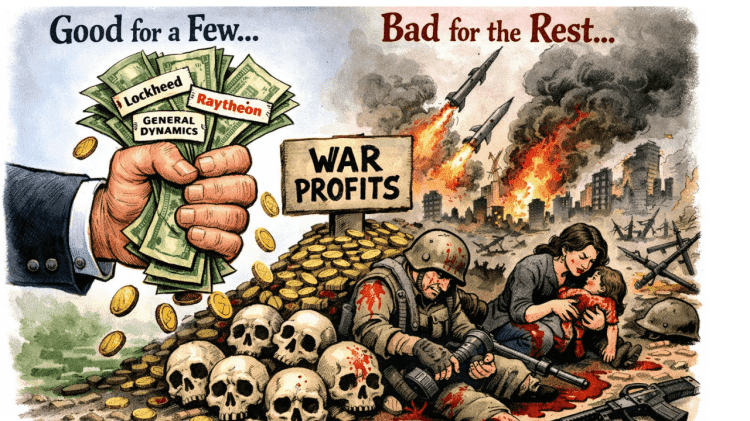
$1.5 Trillion Budget Request Prioritizes Service Members, Modernization
U.S. Department of War, April 21, 2026
“We are delivering on President [Donald J.] Trump’s commitment to expand American military dominance for decades to come,” said Secretary of War Pete Hegseth. “Previous administrations underinvested in our military while our enemies grew stronger and more dangerous, so we are now changing the game. This budget builds this arsenal without compromising readiness that will ensure we remain the world’s premier fighting force, we protect the homeland, and we create peace through strength now and into the future.”
The FY27 budget request represents a sizable increase over last year’s budget, said Jules W. Hurst III, performing the duties of the War Department comptroller.
“This is a generational investment in the United States military— the arsenal of freedom,” Hurst said. “This 42% increase will supercharge our defense industrial base by expanding production of major weapon systems, while strengthening supply chains and supporting tens of thousands of small and medium-sized businesses. It secures our homeland and military advantage through investments in the Golden Dome missile defense system, drone dominance and space superiority.”
This year’s budget request puts a huge focus on buying and investing in actual hardware, Hurst said. About 52% of the total budget request is aimed at buying munitions, planes, tanks and ships.
“The FY27 defense budget will be the largest investment in military capabilities in over a generation,” Hurst said. “This budget allocates over $750 billion … just in capability development and procuring weapons systems.”……………………………………………………………………………………………………………………………………………………………………………………………….. https://www.war.gov/News/News-Stories/Article/Article/4465551/15-trillion-budget-request-prioritizes-service-members-modernization/
10 takeaways from Trump’s senseless Iran war

Walt Zlotow West Suburban Peace Coalition Glen Ellyn IL , 23 April 26, https://theaimn.net/ten-takeaways-from-trumps-senseless-iran-war/
1. First time a foreign power, Israel, goaded, indeed demanded America launch a criminal war
2. Trump’s capitulation to Israel’s war demand is destroying his presidency and will likely hand over Congress to Democrats in November
3. Air power alone has not and will not achieve victory over Iran
4. Ignoring Iran’s ability to close Strait of Hormuz gave strategic advantage to Iran to force stalemate, if not achieve outright Iranian victory
5. US has greatly degraded world economy and may spiral it into recession, possibly even depression if it doesn’t end war soon
6. All US Gulf States bases have been damaged or destroyed and may never be rebuilt due to loss of US security credibility to Gulf States
7. Israel has largely destroyed its support among young Americans disgusted with its endless manipulation of US to support both its Gaza Genocide under Biden and war to destroy Iran under Trump
8. If desperate Trump resumes bombing to destroy Iranian infrastructure, Iran will retaliate destroying Israeli and Gulf States infrastructure, possibly all Middle East oil production
9. A peaceful settlement on Iran’s sensible terms is the only path to Middle East peace
10. As long as the war continues, Israeli use of nuclear weapons remains a possibility
GOP Senator Suggests Trump Should “Finish” Iran With Nuclear Bomb

The senator, Roger Marshall, said Trump has to “take everything into consideration” if ceasefire progress stalls
.By Sharon Zhang , Truthout, April 22, 2026, https://truthout.org/articles/gop-senator-suggests-trump-should-finish-iran-with-nuclear-bomb/?utm_source=Truthout&utm_campaign=9a9827f3a8-EMAIL_CAMPAIGN_2026_04_22_09_22&utm_medium=email&utm_term=0_bbb541a1db-9a9827f3a8-650192793
epublican Sen. Roger Marshall (Kansas) said in an interview on Wednesday that President Donald Trump faces issues on par with those of World War II with regard to the U.S. and Israel’s war with Iran, seeming to suggest that Trump should nuke Iran in order to prevent the country from ever having nuclear weapons.
Marshall was asked by a Newsmax anchor if he believes that the U.S. military will “have to go in and finish this job” if negotiations between the U.S. and Iran for a permanent ceasefire continue for several more weeks.
“I think that’s right,” said the senator. “Previous presidents have had the same issues on what to do. Think about President Truman’s decision on dropping the bomb, and D-Day for President Eisenhower.”
“You’ve got to take everything into consideration,” Marshall said, including whether negotiations are “truly making progress or not.”
Earlier in the interview, the senator said that the U.S.’s aggression against Iran is necessary because “Iran can never, never, ever have a nuclear weapon.”
Related Story
“If Iran had a nuclear weapon, gasoline would be $10 a gallon, and for generations to come, Americans’ lives would be threatened,” the lawmaker said.
The statements echo Trump’s genocidal rhetoric toward Iran, including his threat to “blow up the rest of their Country” if negotiations falter on Tuesday. Legal experts have said that Trump’s indiscriminate threats against Iran as a whole, as well as his pledges to target civilian infrastructure like power plants, constitute threats to commit war crimes.
Marshall also bragged about the harm that the U.S. is causing civilians with Trump’s blockade on Iran.
“We also have this embargo working as well, the blockade, and we’re literally starving them,” said Marshall, “both financially and they can’t feed themselves either, very long.”
The use of starvation as a weapon of war is prohibited under international law.
The UN indeed warned last month that an additional 45 million people may be “pushed into acute hunger by price rises” if the conflict and closure of the Strait of Hormuz continue through June, adding to the already record high of 319 million people currently facing acute food insecurity. Iran previously pledged to open passage through the strait as a term of the temporary ceasefire agreement, but is still prohibiting ships from crossing due to Israel’s attacks on Lebanon and the U.S.’s blockade of Iranian ports, which Iranian officials have said are both violations of the ceasefire.
Republicans have previously called for the usage of nuclear weapons with impunity. Last May, Rep. Randy Fine (R-Florida), said that Israel should drop a nuclear weapon on Gaza. “We nuked the Japanese twice in order to get unconditional surrender. That needs to be the same here,” he said. “There is something deeply, deeply wrong with this culture and it needs to be defeated.”
The staunchly pro-Israel lawmaker’s statements were condemned by rights advocates — but, just weeks later, Republican leaders granted him a seat on the high-powered House Foreign Affairs Committee.
This followed a remark by another Republican House lawmaker, Rep. Tim Walberg (Michigan), who said in March of 2024 that Gaza should be attacked “like Nagasaki and Hiroshima.”
Leader in nuclear”? Or leader in repeating harm?
| Elaine Cimino, Apr 23, 2026, |
Rep. Meredith Dixon stood at a pro-nuclear conference and laid it out plainly: New Mexico is building a “nuclear ecosystem.”
Let’s translate that.
An ecosystem where:
– Public money cleans up yesterday’s contamination
– Public money funds tomorrow’s nuclear expansion
– And communities are told, once again, to accept the risk
$40 million to clean up abandoned uranium mines.
$150 million to build new nuclear technology.
That’s not balance. That’s subsidizing the problem at both ends.
They say this time is “different.”
They said that last time too.
Hundreds of abandoned uranium sites across New Mexico say otherwise.
Navajo communities still living with contamination say otherwise.
Water systems already under stress say otherwise.
Now we’re told uranium can come from “produced water.”
The same toxic waste stream the oil and gas industry is trying to dump into our future.
This is not innovation.
This is expanding extraction under a new label.
And let’s be clear about what’s driving this push:
Data centers. Defense systems. Industrial demand.
Not community need. Not public health.
Meanwhile, local journalism keeps framing this as a “debate”—two equal sides.
There are not two equal sides when one side carries decades of contamination, illness, and broken promises.
That’s not “both sides.”
That’s power vs. people.
We don’t need a nuclear ecosystem.
We need clean water, clean air, and full cleanup—first.
No new uranium. No expansion. No sacrifice zones.
Democratic NM representative says state poised to become national nuclear leader • Source New Mexico https://sourcenm.com/2026/04/21/democratic-nm-representative-says-state-poised-to-become-national-nuclear-leader/
Plaintiffs Tour the Savannah River Site’s Plutonium “Pit” Bomb Core Plant -Most Expensive Building in U.S. History is Key to New Nuclear Arms Race

Tom Clements, Director, SRS Watch, Jay Coghlan, Nuclear Watch NM, Shelby Cohen, Comms Manager, SC Env. Law Project, 23 April 26, https://nukewatch.org/wp-content/uploads/2026/04/Plaintiffs-Tour-the-Savannah-River-Sites-Plutonium-Pit-Bomb-Core-Plant.pdf
Columbia, SC – On April 21, plaintiffs Savannah River Site Watch, Nuclear Watch New Mexico and Tri-Valley CAREs toured the plutonium “pit” bomb core production plant at the National Nuclear Security Administration’s (NNSA’s) Savannah River Site (SRS) near Aiken, South Carolina. They were accompanied by their attorney from the South Carolina Environmental Law Project and a science consultant from the Union of Concerned Scientists.
Plutonium pits are the core components of all U.S. nuclear weapons. The NNSA is seeking to expand production to at least 30 plutonium pits per year at the Los Alamos National Laboratory (LANL) in New Mexico and at least 50 pits per year at SRS, which has never previously produced pits. NNSA pushed forward with the project without required public review, in violation of the National Environmental Policy Act (NEPA).
Plaintiffs sued in federal court in Columbia, SC and won, requiring the NNSA to complete a nationwide programmatic environmental impact statement (PEIS), with public hearings to be held this May (listed below). The court-approved settlement agreement also required an inspection of the Savannah River Plutonium Processing Facility by plaintiffs to ensure that no production begins before the completion of the final PEIS and simultaneous Record of Decision, which NNSA now says is expected in early 2027. NNSA officials also informed plaintiffs that 90% design and “rebaselined” costs will not be completed until September 2026, which means that once again Congress will be appropriating taxpayers’ money without knowing full costs.
The SRS pit plant will be the most expensive buildings ever built in the USA, with a current NNSA estimate of up to $30 billion even before all total costs are known (includes at least $5 billion in sunk costs for SRS’ failed MOX Fuel Fabrication Facility being “repurposed” to pit production). The agency’s recent budget request for FY 2027 (pp 17-19) reveals an 87% jump in combined pit production funding for LANL and SRS, averaging $5 billion for each of the next six years.
Despite the staggering costs, the independent Government Accountability Office (GAO) has repeatedly found that NNSA has no credible cost estimates. In fact, the NNSA and its parent Department of Energy (DOE) have been on the GAO’s High Risk List for project mismanagement and waste of taxpayers’ dollars since 1991. In August 2025 the DOE Deputy Secretary ordered a “special assessment” of the troubled program completed by mid-December. Despite repeated Freedom of Information Act and congressional requests, DOE has yet to publicly release it. Finally, NNSA’s FY 2025 Performance Evaluation Report for SRS specifically notes that the managing contractor underperformed in project execution of the Savannah River Plutonium Processing Facility, likely adding yet more delays and costs.
NNSA released the Draft Pit Production PEIS on April 10, 2026. It declares that:
“NNSA missions are conducted fully consistent with current treaty obligations. The SSMP [Stockpile Stewardship and Management Plan] is fully consistent with and supports the U.S. commitment to the NPT [NonProliferation Treaty].” (Volume I, p. 1-5)
Article VI of the U.S. constitution enshrines international treaties as the “supreme Law of the Land.” The 1970 NonProliferation Treaty required the nuclear weapons powers to “to pursue negotiations in good faith on effective measures relating to cessation of the nuclear arms race at an early date and to nuclear disarmament…” After more than a half-century that has never even begun. The next NPT Review Conference, held every five years, is scheduled to begin April 27 at the United Nations. It is widely expected to fail for the third time over fifteen years to make any progress whatsoever toward nuclear disarmament. To the contrary, expanded plutonium pit production is key to the U.S.’ $2 trillion “modernization” program to keep nuclear weapons forever.
The draft PEIS also declares:
“Over time, the materials that make up the pit change in ways that reduce the pit’s functionality… Building the manufacturing capacity to produce at least 80 ppy [pits per year] before the end of the decade is essential to maintaining a reliable nuclear deterrence. Many of the aging pits will have to be replaced with new ones in the coming years to maintain a safe and reliable nuclear stockpile and deterrence.” (Volume I, p. 1-3.)
NNSA completely omits that in 2006 independent experts concluded that plutonium pits have reliable lifetimes of at least 85 to 100 years, with no stated expiration date (the average age of pits is now around 43 years). Despite congressional directives, NNSA has yet to release a fully updated pit life study since then. In fact, no future pit production is scheduled to maintain the safety and reliability of the existing stockpile. Instead it is all for new-design nuclear weapons that could prompt a return to testing.
Tom Clements, SRS Watch Director, commented:
NNSA completely omits that in 2006 independent experts concluded that plutonium pits have reliable lifetimes of at least 85 to 100 years, with no stated expiration date (the average age of pits is now around 43 years). Despite congressional directives, NNSA has yet to release a fully updated pit life study since then. In fact, no future pit production is scheduled to maintain the safety and reliability of the existing stockpile. Instead it is all for new-design nuclear weapons that could prompt a return to testing.
Tom Clements, SRS Watch Director, commented:
“This PEIS process, pursuant to the National Environmental Policy Act, gives the public the power to be engaged in democratic decision-making processes and voice their concerns on nuclear weapons projects – ones that historically have been cloaked in secrecy. This particular public comment period is crucial. Because of the current administration’s dismantling of NEPA regulations, this could be the last nuclear weapons project that the public has the opportunity to adequately scrutinize.”
Dylan Spaulding, a physicist with the Union of Concerned Scientists, observed:
“The scope and pace of pit production are frequently justified due to concerns about plutonium aging, but pits in the existing stockpile should not require replacement for decades. Newly produced pits are to furnish new types of weapons, not to maintain the ones we have. Plutonium aging is simply not a credible motivation for a rushed pit production program at this time.”
Jay Coghlan, Director of Nuclear Watch New Mexico, commented:
“It’s ironic that plutonium pit production’s exorbitant costs could lower national security instead of enhancing it. New untested designs could lower confidence in the existing, tested stockpile. Or these new-designs could prompt the U.S. to return to testing, after which other nuclear weapons powers would surely follow. It’s time to end the cover up of the NNSA’s deeply troubled pit production program and to expose everything from its runaway costs to its role in a new nuclear arms race that endangers us all.”
In closing, Attorney Ben Cunningham, commented:
“South Carolina Environmental Law Project lawyers fought for years in federal court to win this programmatic environmental impact statement – a significant victory for public participation and transparency. Now, South Carolinians have a voice in this legally required environmental and public safety review that the federal agency must take into account before deciding whether our state is used to produce nuclear weapon components along with their inevitable radioactive wastes. If you care about the future of our land, water and safety, please submit your comments on the programmatic environmental impact statement before the July 16 deadline.”
The Draft PEIS was released by NNSA on April 10, 2026 with a 90-day public comment period. Comments can be submitted by email to PitPEIS@nnsa.doe.gov until July 16. Please include the document number “DOE/EIS-0573” in the subject line. For more please see https://www.energy.gov/nepa/articles/doeeis-0573-draft-environmental-impact-statement-april-2026
Five required public hearings:
All hearings with the exception of the Washington, DC, hearing are scheduled for 5:00-5:30pm Open House Poster Session, 5:30-8:00pm Formal Public Hearing, in their respective time zones.
North Augusta, South Carolina: Tuesday, May 5, 2026, North Augusta Community Center, 495 Brookside Dr, North Augusta, SC 29841, Virtual: https://bit.ly/PitPEIS5May, Meeting ID: 267 103 716 263 892, Passcode: Wb2RJ9zA, Join by Phone: 571-429-4592, Phone conference ID: 297 381 326#
Kansas City, Missouri: Thursday, May 7, 2026, Hillcrest Community Center, Community Room, 10401 Hillcrest Road, Kansas City, MO 64134, No virtual meeting option.
Livermore, California: Tuesday, May 12, 2026, Garré Vineyard & Winery, Santa Rosa Room, 7986 Tesla Road, Livermore, CA 9455, no virtual meeting option.
Santa Fe, New Mexico: Thursday, May 14, 2026, Santa Fe Farmers Market Institute, 1607 Paseo de Peralta, Santa Fe, NM 87501, Virtual: https://bit.ly/PitPEIS14May, Meeting ID: 278 752 885 654 34, Passcode: W9Bt96vN, Join by Phone: 719-283-1404, Phone conference ID: 311 183 140#
Washington, DC: Wednesday, May 20, 2026, 2:00-2:30pm Open House Poster Session, 2:30-5:00pm Formal Public Hearing, Eastern Standard Time, Southwest Library, Large Meeting Room, 900 Wesley Pl, SW, Washington, DC 20024, no virtual meeting option.
Trump the God

Trump’s portrayal of himself as Jesus, or anointed by Jesus, is typical of cult leaders.
Chris Hedges ScheerPost, April 21, 2026 https://scheerpost.com/2026/04/21/trump-the-god/
During the two years I spent writing “American Fascists: The Christian Right and the War on America,” I encountered numerous mini-Trumps. These self-proclaimed pastors — very few had any formal religious training — preyed on the despair of their congregants. They were surrounded by sycophants and could not be questioned. They merged fact with fiction, peddled magical thinking and enriched themselves at the expense of their followers. They claimed their wealth and ostentatious lifestyle, including mansions and private jets, was a sign of being blessed. They insisted they were divinely inspired and anointed by God. They were, within their hermetic circles of their megachurches, omnipotent.
These cult pastors promised to use their omnipotence to crush the demonic forces that had created misery in the lives of their followers — unemployment and underemployment, evictions, bankruptcies, poverty, addiction, sexual and domestic abuse, and crippling despair. The more power the cult leaders possess — according to their followers — the more certain is a promised paradise. Cult leaders stand above the law. Those who desperately place their faith in them want them to be above the law.
Cult leaders are narcissists. They demand obsequious adulation and total obedience. Health and Human Services Secretary Robert F. Kennedy Jr.’s claim that Donald Trump is able to draw a “perfect map” of the Middle East, or White House Press Secretary Karoline Leavitt’s statement that Trump is always the “most well-read person in the room,” are two of innumerable examples of the abject fawning required by those in a cult leader’s inner circle. Blind loyalty matters more than competence.
Cult leaders are immune from rational and fact-based critiques amongst those who invest hope in them. This is why Trump’s hardcore followers have not abandoned him and will not abandon him. All the chatter about fissures in the MAGA universe misreads Trump cultists.
All cults are personality cults. They are extensions of the prejudices, worldview, personal style and ideas of the cult leader. Trump, with his faux “Trump crest,” revels in Louis XVI-inspired tasteless kitsch awash in gold Rococo and glittering chandeliers. The women in Trump’s court have “Mar-a-Lago Faces” – overinflated lips, taut, wrinkle-free skin, silicone gel-filled breast implants and chiseled cheekbones, capped off by gobs of make-up. They wear stiletto heels and garish outfits that Trump finds appealing. Trump’s men, who in his eyes must be telegenic and from “Central casting,” dress like 1950s advertising executives. They sport Trump-gifted Florsheim black shoes, specifically $145 Lexington Cap Toe Oxfords.
Cults impose dress codes that mirror the style and taste of the cult leader.
The followers of the Indian guru Bhagwan Shree Rajneesh, also known as Osho, dressed in red and orange robes, often combined with a turtleneck and beads. Heaven’s Gate members wore Nike Decade trainers and black jogging bottoms. Men in the Unification Church, known as Moonies, wore crisp white shirts and pressed slacks. Women wore dresses. They looked as if they were on their way to Sunday School.
Like Jim Jones, who convinced or forced over 900 of his followers — including 304 children aged 17 and younger — to die by ingesting a cyanide-laced drink, Trump is aggressively courting our collective suicide.
Trump dismisses the climate crisis as a hoax. He unilaterally withdraws from nuclear arms agreements and treaties. He antagonizes nuclear powers, such as Russia and China. He impetuously launches wars. He alienates and insults U.S. allies. He dreams of annexing Greenland and Cuba. He embraces holy crusade against Muslims. He attacks his political opponents as enemies and traitors, belittling them with crude insults. He slashes social programs designed to sustain the vulnerable. He expands an internal security apparatus — masked Immigration and Customs Enforcement (ICE) goons — to terrorize the public. Cults do not nurture and protect. They subjugate, annihilate and destroy.
Trump employs the U.S. military without oversight or constraint. He presides, for this reason, over what the psychiatrist Robert Jay Lifton called a “world-destroying cult.” Lifton lists eight characteristics of “world-destroying cults” that implant what he calls “totalistic environments.”
These eight characteristics are:
1. Milieu control. The total control of communication within the group.
2. Loading the language. Using “groupspeak” to censor, edit and shut down criticism or opposing ideas. Followers must mouth the mindless Trump-approved clichés and cult jargon.
3. Demand for purity. An us-versus-them view of the world. Those who oppose the group are wrong, unenlightened and evil. They are irredeemable. They are contaminants. They must be eradicated. Any action is justified to protect this purity. The goal of all cult leaders is to widen and make irreconcilable social divisions.
4. Confession: The public confession of past wrongs. In the case of Trump supporters, this includes the disavowal, as U.S. Vice President JD Vance and others have done, of past criticism of Trump, with public admission of their former wrong-thinking.
5. Mystical manipulation. The belief that those in the group are specially chosen with a higher purpose. Those in Trump’s orbit act as though they are divinely elected. They convince themselves that they are not coerced to embrace Trump’s lies and vulgarities — or repeat cult jargon — but do so voluntarily.
6. Doctrine over person. The rewriting and fabrication of personal history to conform to Trump’s interpretation of reality.
7. Sacred Science. Trump’s absurdities — global temperatures are declining rather than rising, the noise from wind turbines cause cancer and ingesting disinfectants such as Lysol is an effective treatment for the coronavirus — are presented as grounded in science. This scientific patina means Trump’s ideas apply to everyone. Those who disagree are unscientific.
8. Dispensing of existence. Nonmembers are “lesser or unworthy beings.” Meaningful existence means being part of the Trump cult. Those outside the cult are worthless. They do not deserve moral consideration.
Trump is no different from past cult leaders, including Marshall Herff Applewhite and Bonnie Lu Nettles — the founders of the Heaven’s Gate cult — the Rev. Sun Myung Moon — who led the Unification Church — Credonia Mwerinde — who led the Movement for the Restoration of the Ten Commandments of God in Uganda — Li Hongzhi — the founder of Falun Gong, and David Koresh, who led the Branch Davidian cult in Waco, Texas.
Cult leaders are deeply insecure, which is why they lash out with fury at the slightest criticism. They mask this insecurity with cruelty, hypermasculinity and bombastic grandiosity. They are paranoid, amoral, emotionally crippled and physically abusive. Those around them, including children, are objects to be manipulated for their enrichment, enjoyment and often sadistic entertainment.
Cults are characterized by pedophilia and sexual abuse. Those, including Trump, who were frequently in the orbit of pedophile Jeffrey Epstein, replicated the abuse endemic in cults.
“People’s Temple children were frequently sexually abused,” writes Margaret Singer in “Cults In Our Midst: The Continuing Fight Against Their Hidden Menace.” “While the group was still in California, teenage girls as young as fifteen had to provide sex for influential people courted by Jones. A supervisor of children at Jonestown had a history of child sexual abuse, and Jones himself assaulted some of the children. If husbands and wives were caught talking privately during a meeting, their daughters were forced to masturbate publicly or to have sex with someone the family didn’t like before the entire Jonestown population, children as well as adults.”
Cults, Singer writes, are “a mirror of what is inside the cult leader.”
“He has no restraints on him,” she writes of the cult leader:
He can make his fantasies and desires come alive in the world he creates around him. He can lead people to do his bidding. He can make the surrounding world really his world. What most cult leaders achieve is akin to the fantasies of a child at play, creating a world with toys and utensils. In that play world, the child feels omnipotent and creates a realm of his own for a few minutes or a few hours. He moves the toy dolls about. They do his bidding. They speak his words back to him. He punishes them any way he wants. He is all-powerful and makes his fantasy come alive. When I see the sand tables and the collections of toys some child therapists have in their offices, I think that a cult leader must look about and place people in his created world much as the child creates on the sand table a world that reflects his or her desires and fantasies. The difference is that the cult leader has actual humans doing his bidding as he makes a world around him that springs from inside his own head.
The language of the cult leader is rooted in verbal confusion. Lies, conspiracy theories, outlandish ideas and contradictory statements, often made in the same statement or only minutes apart, paralyzing those attempting to read the cult leader rationally. Absurdism is the point. The cult leader does not take his or her statements seriously. They often deny ever making them, although they are documented. Lies and truth are irrelevant. The cult leader is not seeking to impart information or truth. The cult leader is seeking to appeal to the emotional needs of cult members.
“Hitler kept his enemies in a state of constant confusion and diplomatic upheaval,” Joost A.M. Meerloo wrote in “The Rape of the Mind: The Psychology of Thought Control and Menticide.” “They never knew what this unpredictable madman was going to do next. Hitler was never logical, because he knew that that was what he was expected to be. Logic can be met with logic, while illogic cannot – it confuses those who think straight. The Big Lie and monotonously repeated nonsense have more emotional appeal in a cold war than logic and reason. While the enemy is still searching for a reasonable counterargument to the first lie, the totalitarians can assault him with another.”
It does not matter how many lies uttered by Trump are meticulously documented. It does not matter that Trump has used the presidency to enrich himself by an estimated $1.4 billion over the last year, according to Forbes. It does not matter that he is inept, lazy and ignorant. It does not matter that he stumbles from one disaster to the next, from tariffs, to the war on Iran.
The traditional establishment, whose credibility has been destroyed because of its betrayal of the working class and subservience to the billionaire class and corporations, has little power over Trump’s supporters. Their vitriol only increases his popularity. Political cults are the bastard children of a failed liberalism. Trump’s approval rating may be at around 40 percent, as of April 20 — according to an average of multiple polls collated by The New York Times — but his base remains unmovable.
The Democratic Party, rather than pivot to address the social inequality and abandonment of the working class — which it helped orchestrate — has hit upon tax cuts as a road to regaining power. It will, once again, reduce our social, economic and political crisis to the personality of Trump. It will offer no reforms to rectify our failed democracy. This is a gift to Trump and his followers. By refusing to acknowledge responsibility for inequality and proposing programs to ameliorate the suffering it has caused, Democrats engage in the same kind of magical thinking as Trump cultists.
There is no way out of this political dysfunction unless popular movements rise to cripple the machinery of government and commerce on behalf of a betrayed public. But time is running out. Trump and his goons are serious about invaliding or cancelling the midterm elections if they perceive defeat. If that happens, the cult of Trump will be unassailable.
No Peace, Only Escalation: The Push Toward Total War With Iran
April 22, 2026 , https://scheerpost.com/2026/04/22/no-peace-only-escalation-the-push-toward-total-war-with-iran/
As ceasefire talks collapse, retired Col. Douglas Macgregor warns that Washington is not negotiating—it’s preparing for a devastating, infrastructure-targeting war that could reshape the global order.
The language of peace still lingers in official statements—but on the ground, the machinery of war is accelerating.
In this stark and deeply unsettling conversation, retired U.S. Colonel Douglas Macgregor joins Glenn Diesen to dismantle the illusion of diplomacy surrounding the Iran conflict. What’s being sold as negotiation, he argues, is little more than theater—designed to calm markets, not stop bombs.
Behind the headlines, a far more dangerous reality is taking shape: a coordinated buildup for what Macgregor describes as a potential “total war” scenario, one that moves beyond military targets and toward the destruction of an entire state’s infrastructure.
If he’s right, the question is no longer whether the war will escalate—but how far it will go, and how much of the world it will drag with it.
A cause for major concern—one that cannot be repeated enough—is this warning from Macgregor:
“There was no real path to an agreeable solution—because there was no real negotiation. When the vice president steps out mid-meeting to take a call from Netanyahu, it tells you everything. These aren’t negotiations. It suggests that Netanyahu—not Trump—is effectively calling the shots on whether we go to war.”
Highlights
- “There were no real negotiations.”
Macgregor argues the so-called peace talks were never genuine, describing them as political theater meant to project stability while preparing escalation. - Power behind the scenes:
He suggests decision-making is not fully in Washington’s hands, pointing to Israeli influence shaping U.S. military direction. - From war to state destruction:
The next phase, he warns, targets not just military assets—but bridges, power plants, oil infrastructure, and civilian systems—a shift toward dismantling Iran as a functioning state. - A global economic shockwave:
Disruptions in the Persian Gulf could trigger fuel shortages, fertilizer collapse, and famine risks across the Global South. - The limits of U.S. power:
Fighting thousands of miles from supply lines while Iran operates defensively at home creates what he calls a “home court advantage” that undermines U.S. strategy. - End of the old order:
Macgregor frames the conflict as part of a larger collapse of U.S. dominance—warning that the petrodollar system and global unipolarity may already be breaking down. - No clear path to victory:
Even with overwhelming force, he sees no realistic military outcome that delivers control—only deeper instability.
Is There a Way out of the Iran War? (w/ John Mearsheimer) | The Chris Hedges Report.
As ceasefire talks hang by a thread, rising tensions over the Strait of Hormuz reveal a stark reality: escalation could trigger a global economic catastrophe—and the United States may have far less control than it claims.
April 21, 2026, Joshua Scheer, https://scheerpost.com/2026/04/21/is-there-a-way-out-of-the-iran-war-w-john-mearsheimer-the-chris-hedges-report/
The illusion of control is collapsing.
The story being told to the public is one of control—measured escalation, strategic pressure, and a superpower shaping outcomes in a volatile region.
The reality is something else entirely.
As the ceasefire deadline approaches, the United States is not dictating terms—it is reacting to them. Iran, through its ability to constrict or reopen the Strait of Hormuz, holds a form of leverage that no amount of rhetoric can override. Oil flows, fertilizer supply chains, shipping routes, and global food systems all run through this narrow corridor. And right now, that corridor is unstable.
What makes this moment especially dangerous is not just the risk of war—but the structure of it.
This is not a chaotic breakdown. It is a system under strain: competing pressures from Israel pushing for continued escalation, economic realities demanding de-escalation, and a U.S. leadership apparatus that appears, at times, unable or unwilling to reconcile the two. The result is a policy environment defined less by strategy than by contradiction.
In this conversation, Professor John Mearsheimer offers a blunt assessment: the United States cannot win an escalatory confrontation with Iran under these conditions. The longer the conflict continues, the more leverage shifts away from Washington and toward Tehran. Meanwhile, the global economy—already weakened—absorbs the shock in real time: energy disruptions, fertilizer shortages, rising food costs, and the creeping threat of systemic breakdown.
The war’s original objectives—eliminating Iran’s nuclear capacity, weakening its regional alliances, asserting dominance—remain unmet. In some cases, they have been reversed.
What remains is a narrowing set of options. Escalation risks triggering an economic crisis that could reverberate worldwide. De-escalation requires concessions that Washington—and its allies—have long resisted.
Between those two paths lies a fragile, temporary possibility: a ceasefire that holds just long enough to delay collapse.
Whether that window remains open is now the central question—not just for the region, but for the global system itself.
FULL TRANSCRIPT (CLEANED FOR PUBLICATION)
Iran, after initially balking, will send negotiators to Islamabad for a new round of talks with the United States less than 48 hours before the ceasefire is set to expire. Iran, however, has criticized the U.S. for violating the ceasefire from the beginning of its implementation, citing the U.S. naval blockade of the Strait of Hormuz since April 13 and the seizure of an Iranian container ship……………………………………………………………………………………………………………………………………………………………………………………………………………………………………. https://scheerpost.com/2026/04/21/is-there-a-way-out-of-the-iran-war-w-john-mearsheimer-the-chris-hedges-report/
Biden Official: Biden Was Preparing To Bomb Iran If Re-Elected
Caitlin Johnstone, Apr 21, 2026, https://www.caitlinjohnst.one/p/biden-official-biden-was-preparing?utm_source=post-email-title&publication_id=82124&post_id=194907653&utm_campaign=email-post-title&isFreemail=true&r=1ise1&triedRedirect=true&utm_medium=email
Former senior Biden advisor Amos Hochstein said during an interview on Sunday that the Biden administration had been preparing to bomb Iran if they had won re-election in 2024.
Hochstein was asked by Face the Nation’s Margaret Brennan, “In July 2024 Secretary Blinken claimed Iran was one or two weeks away from having enough fissile material breakout capacity to eventually make a weapon if Iran had decided to do so. There were indirect negotiations that the Biden administration did, but it went nowhere. So when President Trump argues that he did what no other president would, is it just simply that the bill was coming due and it fell on his watch?”
“I do think there’s a certain element to that, and that’s why I was supportive of President Trump joining in in June to take the strikes that we had thought internally in the Biden administration, we may have to take if there was a second term,” Hochstein replied. “We thought that the spring, summer of 2025 was probably, we may have to be there in the same place. And we did, we did war games. We did some practice runs on what it would look like to look into it, because that may have had to happen under our watch as well.”
Hochstein, for the record, is an Israel-born IDF veteran who reportedly played a major role in the Biden administration encouraging Israel’s horrific bombardment of Lebanon in September 2024. And his narrative that an attack on Iranian nuclear facilities “may have had to happen” under a theoretical second Biden term is false.
In March of last year, US intelligence chief Tulsi Gabbard testified before Congress that the intelligence community “continues to assess that Iran is not building a nuclear weapon and supreme leader Khomeini [sic] has not authorized the nuclear weapons program that he suspended in 2003,” contradicting both the claims of President Trump and of Antony Blinken the year before.
But even if you accept that Iran was a nuclear risk, there was nothing stopping the Biden administration from simply restarting the nuclear deal that the Obama administration secured with Tehran in 2015. The JCPOA was working fine while it was in place; anyone who says otherwise is a lying warmonger. Trump and his handlers torched the JCPOA in 2018 because it was the primary obstacle preventing them from getting to war with Iran, and the Biden administration refused to reverse this move because they wanted war too.
The Democrats were beating the drums of war for Iran well ahead of the 2024 election. Here’s an excerpt from the official 2024 Democratic Party platform explicitly attacking Trump for not going to war with Iran in his first term:
“All of this stands in sharp contrast to Trump’s fecklessness and weakness in the face of Iranian aggression during his presidency. In 2018, when Iranian-backed militias repeatedly attacked the U.S. consulate in Basra, Iraq Trump’s only response was to close our diplomatic facility. In June 2019, when Iran shot down a U.S. surveillance aircraft operating in international airspace above the Straits of Hormuz, Trump responded by tweet and then abruptly called off any actual retaliation, causing confusion and concern among his own national security team. In September 2019, when Iranian-backed groups threatened global energy markets by attacking Saudi oil infrastructure, Trump failed to respond against Iran or its proxies. In January 2020, when Iran, for the first and only time in its history, directly launched ballistic missiles against U.S. troops in western Iraq, Trump mocked the resulting Traumatic Brain Injuries suffered by dozens of American servicemembers as mere ‘headaches’ — and again, took no action.”
Kamala Harris, who controversially replaced the dementia-addled Biden as the Democratic candidate late in the race, labeled Iran the number one enemy of the United States. In their 2024 debate, Harris repeatedly slammed Trump for being too soft on America’s enemies and announced that she “will always give Israel the ability to defend itself, in particular as it relates to Iran and any threat that Iran and its proxies pose to Israel.”
I’ve seen a lot of people trying to argue that Trump’s depravity in Iran proves everyone should support Democrats, but it’s clear the Democratic Party is just the more polite-looking face on the same evil power structure.
The war with Iran was always planned. Analysts like Brian Berletic and Richard Medhurst have been laying out solid arguments that this American war is more about attacking the economic and energy interests of Russia and China in a last-ditch effort to retain planetary hegemony than it is about assisting Israel. This places the United States on a dangerous trajectory toward increasingly hostile escalations between nuclear-armed powers.
These moves were planned years in advance, and would have been rolled out regardless of what impotent meat puppet happened to be wheeled into office in January 2025.
You don’t get to vote out an empire. Whether or not the US will continue working to dominate the planet will never be on the ballot. We will continue seeing reckless US wars of immense human consequence until the empire falls, or until the American people bring the revolutionary change to their country that the world so desperately needs.
1 This Month

To see nuclear-related stories in greater depth and intensity – go to https://nuclearinformation.wordpress.com
-
Archives
- September 2026 (184)
- August 2026 (330)
- July 2026 (355)
- June 2026 (287)
- May 2026 (306)
- April 2026 (356)
- March 2026 (251)
- February 2026 (267)
- January 2026 (308)
- December 2025 (358)
- November 2025 (359)
- October 2025 (375)
-
Categories
- 1
- 1 NUCLEAR ISSUES
- business and costs
- climate change
- culture and arts
- ENERGY
- environment
- health
- history
- indigenous issues
- Legal
- marketing of nuclear
- media
- opposition to nuclear
- PERSONAL STORIES
- politics
- politics international
- Religion and ethics
- safety
- secrets,lies and civil liberties
- spinbuster
- technology
- Uranium
- wastes
- weapons and war
- Women
- 2 WORLD
- ACTION
- AFRICA
- Atrocities
- AUSTRALIA
- Christina's notes
- Christina's themes
- culture and arts
- Events
- Fuk 2022
- Fuk 2023
- Fukushima 2017
- Fukushima 2018
- fukushima 2019
- Fukushima 2020
- Fukushima 2021
- general
- global warming
- Humour (God we need it)
- Nuclear
- RARE EARTHS
- Reference
- resources – print
- Resources -audiovicual
- Weekly Newsletter
- World
- World Nuclear
- YouTube
-
RSS
Entries RSS
Comments RSS
 nuclear-news