Biden administration promises progress on nuclear waste
Escape From Yucca Mountain: Biden Administration Promises Progress on Nuclear Waste
Energy Department expects to announce next steps in coming months, WSJ, By Gabriel T. Rubin, May 14, 2021
THE ENERGY DEPARTMENT TAKES ON the politically radioactive issue of nuclear-waste disposal, which the past several administrations have tried and failed to resolve. The only federally designated long-term disposal site for waste from the nuclear power industry is at Yucca Mountain in Nevada (there is also a site near Carlsbad, N.M., for waste generated by the government’s nuclear weapons program). But sustained political pushback from Nevada officials has prevented the Yucca Mountain site from becoming operational. It’s a top issue for Nevada Sen. Catherine Cortez Masto, who Mr. Biden considered picking as his running mate and who is up for re-election next year.
Ms. Cortez Masto has extracted promises from Energy Secretary Jennifer Granholm that Yucca Mountain won’t be part of the administration’s planning for nuclear-waste disposal. But Ms. Granholm seems eager to still make progress on the issue, telling a House Appropriations panel last week that she anticipated announcing the department’s next steps “in the coming months.” Former President Donald Trumptried to restart the process, but after an outcry from Nevadans he reversed himself—tweeting, “Nevada, I hear you on Yucca Mountain”—and promised “innovative solutions” that didn’t come to fruition.
In a letter this month to Ms. Granholm, the American Nuclear Society and other industry groups urged her to establish an office to be the “focal point” of engagement on the waste issue with Congress and outside stakeholders. Congress appropriated money for such an office in its year-end funding deal in December. The office also would coordinate with the private sector on interim storage facilities.
n hopes of preventing presidents present and future from unilaterally establishing a Yucca Mountain-type plan, all the Democratic members of the Nevada congressional delegation co-sponsored legislation in March that would require the federal government to first receive permission from the governor and local officials before moving nuclear waste into a state
It’s anyone’s guess how concrete the Energy Department’s next steps might be ….(subscribers only) https://www.wsj.com/articles/escape-from-yucca-mountain-biden-administration-promises-progress-on-nuclear-waste-11620984602
Scepticism in Canada, about the government’s push for small nuclear reactors.
Canada pegs its energy future on nuclear power, but not everyone’s buying it, Canada’s National Observer, By Charles Mandel May 12th 2021 “…………. Gorman, along with the rest of the nuclear industry, pins the country’s future decarbonization efforts on a new breed of nuclear power known as small modular reactors (SMRs).
……… To date, not a single SMR has been built in Canada, but no matter, the technology is the current darling of nuclear power circles…. Currently, 12 proposals for SMR development are winding their way through the Canadian Nuclear Safety Commission’s (CNSC) pre-licensing vendor review process, which enables CNSC staff to provide feedback on proposed designs at a company’s request. But not a single project has yet been approved.
That hasn’t stopped the Canadian federal government from actively promoting a shift to SMRs………
For the time being, any vision of SMRs is largely aspirational. A Conference Board of Canada report in March on SMRs outlined that from concept to commercialization, the technology will require about a billion dollars of development expenditure. The same report noted that as an emerging technology, costs are still uncertain, and the “risky pre-commercial phase needs capital investment, but governments will be reluctant without major private capital commitment.”
It’s early days for financing the technology. For instance, one infusion of federal funds, the $50 million granted to New Brunswick’s Moltex Energy in mid-April, only supports research and development, employee recruitment and the expansion of academic, research and supply chain partnerships, not the physical construction of that firm’s SMR.
Beyond financial considerations, the Liberal government will have a tough time convincing environmentalists to embrace the merits of SMRs, or any nuclear power, as a clean energy source. More than 100 groups have signed a letter issued by the Canadian Environmental Law Association (CELA) condemning the government’s push to pursue nuclear power and SMRs. Among their concerns are that SMRs are more expensive to develop than renewable energy and that the reactors are “dirty and dangerous,” creating new forms of radioactive waste that are especially dangerous to manage.
As the SMR developments move forward, the environmental groups will have a chance to make their views heard during the public consultations that will have to take place as part of the environmental review phase of licensing each SMR.
For now, however, nothing is slowing the momentum. In mid-April, the Canadian Nuclear Association triumphantly announced Alberta was joining Ontario, New Brunswick and Saskatchewan in the development of SMRs.
…….. there are signs Europe is now shifting away from nuclear power. In 2019, solar installed capacity exceeded nuclear for the first time in the EU, with 130 gigawatts versus 116 gigawatts, according to the World Nuclear Industry Status annual report, which provides independent assessments of global nuclear developments. And a technical expert group convened in the EU chose not to recommend nuclear energy when asked to advise on screening criteria that would substantially contribute to climate change mitigation or adaptation while “avoiding significant harm” to other environmental objectives.
Canadian government hand in glove with the nuclear lobby for a ”NICE” nuclear future

Canada pegs its energy future on nuclear power, but not everyone’s buying it, Canada’s National Observer, By Charles Mandel May 12th 2021…………….. The development of SMRs in Canada isn’t just a matter of happy coincidence; the federal government has been lobbying hard on behalf of the industry since at least 2019. The Department of Natural Resources, for instance, is a member of the international initiative Nuclear Innovation: Clean Energy Future, or as it’s better known, NICE. Besides Canada, members include Japan, the U.S. and a number of nuclear associations. The goal “is to ensure that nuclear energy receives appropriate representation in high-level discussions about clean energy.”
Freelance researcher Ken Rubin turned up a number of documents using freedom-of-information requests that showed the federal government is collaborating with NICE and others to promote nuclear power and SMRs. The federal government, for example, offered $150,000 for the development of a “Top 20 book of short stories” on “exciting near-term nuclear innovations” designed to showcase nuclear power as an environmental force for good. The book includes stories on the safe storage of nuclear waste as well as on the emerging SMR market.
According to the book, uses for the latter technology include “energy parks” providing heat for industrial processes, steam for heating and electricity for cooling homes, offices and shops, all without emissions. The story breathlessly declares: “This isn’t science fiction.”
No matter how hard the government lobbies the public for a NICE future, though, it’s going to remain a tough sell to Canadian environmentalists. While the environmentalists have nothing specific to fight yet, given that a viable SMR has yet to be built, they’ll be ready when the technology reaches development. Already, a who’s who of groups has signed a letter protesting the next thing in nuclear.
Theresa McClenaghan, CELA’s executive director and counsel, told Canada’s National Observer: “It’s not a climate answer for many reasons, including the fact it’s not realistic and it’s way too far down the road for us to meet any serious climate targets. We’ve characterized it as a dirty, dangerous distraction.”
Susan O’Donnell, a researcher and adjunct professor in the Department of Sociology at the University of New Brunswick and a nuclear activist, says SMRs are too slow and costly as a climate crisis solution. “It’s important to remember that these technologies basically don’t exist yet,” she said. “They’re at a very early stage in development. They are speculative technologies. It will take at least a decade to get them off the drawing board and then it will take much longer than that to find out if they work.”
Endangered sea turtles sucked into nuclear power plant pipes
FPL doesn’t prevent endangered sea turtles from being sucked into nuclear power plant pipe, TC Palm, Max Chesnes, Treasure Coast Newspapers, 12 May 21, After 15 years of trying, Florida Power & Light Co. still has not found a way to keep endangered sea turtles from being sucked into its nuclear power plant’s intake pipes.
A TCPalm investigation in 2016 showed how a solution had been mired in bureaucratic red tape for 10 years. Since then, FPL has tested a proposed grate-like device, but found it could harm turtles, spokesperson Peter Robbins told TCPalm Wednesday.
FPL is still discussing the issue at the St. Lucie Nuclear Plant with the Nuclear Regulatory Commission and National Marine Fisheries Service, Robbins said.
Last year, 339 turtles were swept into the pipes at the South Hutchinson Island plant on ………
TCPalm investigation: 16,000 sea turtles sucked up since 1976
How does marine life get sucked into the intake pipes?
Ocean water used to cool the plant’s nuclear-fueled generators is slurped into three “intake structures” positioned underwater about a quarter-mile offshore.
Saltwater enters these pipes, runs under the beach at about 1 foot per second and dumps into a nearly mile-long intake canal, according to FPL. Marine life can be swept through the pipes and into the canal, from which they need to be removed………….. https://www.tcpalm.com/story/news/local/indian-river-lagoon/2021/05/12/fpl-st-lucie-nuclear-power-plant-still-sucking-endangered-sea-turtles-sawfish-into-intake-pipes/5037097001/
Elon Musk’s expensive and dangerous space delusion
The Musk delusion daryan energy blog 2 May 21, I’ve critiqued a number of Musk’s projects before, but I think we need to be a bit more direct. Quite simply is Musk entirely the full shilling? Is he the real life Tony Stark the fan boys seem to think, or a modern day Howard Hughes? Because if its the latter his bizarre behaviour will only get worse and worse until things come to a head. Which could have rather serious consequences………….
his proposed use of Starship, as a point to point transport mechanism amounts to saying that the rich should be allowed to burn vast amounts of fuel, just so they can save a few hours in transit. Well, if Starship was a vaguely sane suggestion that is. In truth, it would take almost as long to get its passengers point to point as a conventional airliner (once you factor in the time taken to get passengers out to the launch pad, suit them up, put on their astronaut diapers (yes, how do you think astronauts meet the calls of nature in a space suit), strap everyone in, fuel the rocket, etc.). And that’s assuming you’d be given permission to fly, given the many likely health and safety, environmental and noise related concerns.
In fact let’s talk about starship. It is a terrible design. I’m not going to waste time going over the many issues, in part because I’ve done so already, but also there are others who have done a far better job. But in summary, even if it worked, its a one trick pony….and that trick is the potential for down cargo (which its far from proving it can do) not going to Mars.
Even so, Musk has managed to blow up a dozen or so test prototypes with not a lot to show for it. He’s now in a dispute with the FAA and environmental groups over the mess he’s making, adding to the thousand or so active legal cases he’s currently fighting, largely because of his inability to keep his big mouth shut and not say dumb things online.
Which raises the question, what is the point of starship? ………

Caricature above by courtesy of Ryadav – caricaturecartoon.com
NASA just awarded SpaceX the contract to build the Lunar lander? Ya and if one was cynical it would be that the Biden administration, whose never really committed to space flight, knows they don’t have the funds or the political capital to blow hundreds of billions repeating Apollo. But they equally don’t want to be identified as the assassins who killed off manned lunar/Mars missions. They need a fall guy…which is where Musk comes in!
SpaceX happens to have facilities in key states that will matter in 2024 (most notably Texas, which might be a swing state by then). So, given that Congress sees NASA as a jobs programme, they sling a few billion his way. If he succeeds, well then great. If he crashes and burns, well aw shucks we tried our best, I mean we even got Elon Musk to design the hardware, how can we be to blame.
And this is what worries me about Musk and his fans. Sooner or later his luck is going to run out. Environments such as space, or public transport do not suffer fools. Likely we’ll end up with some tragic accident, or a massive overspend on a government project and he gets to spend the rest of his life going form congressional committee to committee and court house to court house……. https://wordpress.com/read/feeds/543414/posts/3318253784
USA’s unnecessary plutonium pits production to cost $10+ Billion
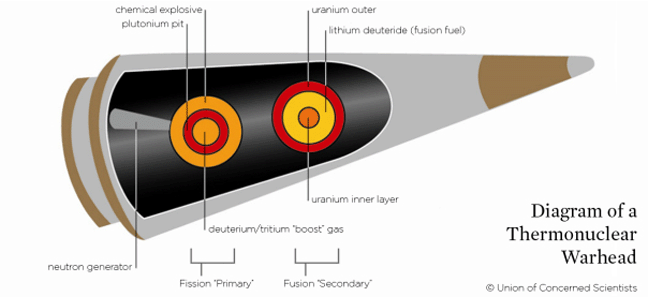
Cost Estimate for SRS Plutonium Bomb Plant to Soar to $10+ Billion? Causing Trouble for Contractors and Boosters Pushing New Pit Plant and “Money Pit” ICBM “Needing” New Plutonium Pits? https://www.rnanews.eu/cost-estimate-for-srs-plutonium-bomb-plant-to-soar-to-10-billion-causing-trouble-for-contractors-and-127657.html 11 May 21,
Stay tuned for the release by the US DOE’s National Nuclear Security Administration of a “Critical Decsion-1” determination on the proposed SRS Plutonium Bomb Plant. CD-1 would approve the basic project design and present an update cost range. The cost for the bomb plant could soar to $10 billion or more, more than double the earlier estimate of $4.6 billion to convert the partially finished plutonium fuel MOX plant at SRS to pit production.
The CD-1 document package was turned over to NNSA by contractor Savannah River Nuclear Solutions (SRNS) in January 2021. In March, the CEO of SRNS told the South Carolina Nuclear Advisory Council that a decision on CD-1 by NNSA could come in late May or June.
A huge jump in the cost of the SRS Plutonium Bomb Plant will ramp up the pressure on DOE/NNSA/Department of Defense to fund such an expensive facility and the new ICBM, Ground Based Strategic Deterrent (GBSD) – aka the Money Pit Missile – with a lifetime cost over $200 billion. The new ICBM and its W87-1 warhead would require new plutonium pits.
This missile and pits for it are not needed. As it’s part of planning for full-scale nuclear war, it would undermine national security and transfer a vast amount of money from patriotic taxpayers to contractors such as Northrop Grumman, Savannah River Nuclear Solutions and pit-production contractors at Los Alamos National Lab, the other site being considered for expanded pit production. In sum, the GBSD and plans for new pits must be canceled and the CD1 document will be a wake-up call for decision makers.
Meanwhile, Congress is still refusing to investigate possible waste, fraud, abuse and mismanagement of the failed MOX project by NNSA and contractors.
How the heck can they just sweep under the rug the waste of $8 billion on the failed project? Who is Congress protecting and why???
Standing up to the USA’s militarisation of space

U.S. push for space weaponisation must be challenged, Independent Australia While most of the world supports outlawing space weaponry, the U.S. Government is still pushing to militarise space, writes Karl Grossman.
RETIRED U.S. Army Colonel John Fairlamb stated in a piece in The Hill, the Washington, DC news website:
Fairlamb knows the issue with the weaponisation of space. His background includes being an International Affairs Specialist for the Army Space and Missile Defense Command and Military Assistant to the U.S. Secretary of State for Political-Military Affairs. He is familiar with war first-hand: he was a company commander in Vietnam and holds a doctorate in Comparative Defense Policy Analysis.
In his opinion column headed ‘The U.S. should negotiate a ban on basing weapons in space’, Fairlamb wrote:
Given the implications for strategic stability, and the likelihood that such a decision [to deploy weapons in space] by any nation would set off an expensive space arms race in which any advantage gained would likely be temporary, engaging now to prevent such a debacle seems warranted.
It’s time for arms control planning to address the issues raised by this drift toward militarisation of space. Space is a place where billions of defence dollars can evaporate quickly and result in more threats about which to be concerned. Russia and China have been proposing mechanisms for space arms control at the United Nations for years; it’s time for the U.S. to cooperate in this effort.
Indeed, if weapons are deployed in space – and for decades, including during the Reagan Administration’s “Star Wars” (officially named the Strategic Defense Initiative) push, now likely again with the Trump Administration’s creation of a U.S. Space Force and its mission to “dominate” space – there will be no return.
Space weaponisation ‘cannot be walked back’. And the world is at a crossroads.
Russian Foreign Minister Serge Lavrov two weeks ago called tor talks to create an ‘international legally binding instrument’ to ban the deployment of “any types of weapons” in space.
Lavrov declared:
We consistently believe that only a guaranteed prevention of an arms race in space will make it possible to use it for creative purposes, for the benefit of the entire mankind. We call for negotiations on the development of an international legally binding instrument that would prohibit the deployment of any types of weapons there, as well as the use of force or the threat of force.”
He made the statement on 12 April, the International Day of Human Space Flight, marked this year by the 60th anniversary of Russian Yuri Gagarin’s space flight, the first by a person in space.
The U.S., the United Kingdom and the then Soviet Union joined decades ago in drafting the Outer Space Treaty of 1967 that designated space as a “global commons” for peaceful purposes. The treaty bans the deployment of weapons of mass destruction in space. It’s been signed by most nations on Earth.
Russia and China – along with U.S. neighbour Canada – have led in a move to expand the Outer Space Treaty by outlawing the deployment of any weapons in space.
During the period of Reagan’s “Star Wars” and in years since, the U.S. has been working on developing space weaponry that has included hypervelocity guns and particle beam and laser weapons.
The Prevention of an Arms Race in Outer Space (PAROS) treaty has been pushed by Canada, Russia and China to broaden the Outer Space Treaty.
PAROS has worldwide support. But through a succession of U.S. administrations – Republican and Democrat – the U.S. Government has voted against the PAROS treaty at the Conference on Disarmament of the United Nations. Because conference decisions must be supported by consensus, the U.S. has effectively vetoed the enactment of the PAROS treaty.
The day after Lavrov’s statement, the Chinese Foreign Ministry joined Russia in its plea.
Deputy director of the Chinese Ministry of Foreign Affairs Information Department Zhao Lijian said on 13 April:
“We are calling on the international community to start negotiations and reach agreement on arms control in order to ensure space safety as soon as possible. China has always been in favour of preventing an arms race in space; it has been actively promoting negotiations on a legally binding agreement on space arms control jointly with Russia.”
As for the Biden Administration and space militarisation, spokesperson Jen Psaki tweeted: ‘We look forward to the continuing work of Space Force…’…..
The comments from retired Army Colonel John Fairlamb are quite excellent as he calls for the U.S. to seriously enter into negotiations with Russia and China on PAROS. Both those nations for years have been offering to enter into negotiations at the U.N. to close the door to the barn before the horse gets out. In other words, develop a new treaty that prevents a space arms race before it happens. Sadly, the U.S. due to aerospace industry greed and dreams of space domination has been blocking this much need treaty development process.
Some might see Mr Fairlamb’s comments as representing the U.S. military – as if a sea change was happening inside the Pentagon – on this very important issue.
The comments from retired Army Colonel John Fairlamb are quite excellent as he calls for the U.S. to seriously enter into negotiations with Russia and China on PAROS. Both those nations for years have been offering to enter into negotiations at the U.N. to close the door to the barn before the horse gets out. In other words, develop a new treaty that prevents a space arms race before it happens. Sadly, the U.S. due to aerospace industry greed and dreams of space domination has been blocking this much need treaty development process.
Some might see Mr Fairlamb’s comments as representing the U.S. military – as if a sea change was happening inside the Pentagon – on this very important issue.
Alice Slater, a member of the boards of both the Global Network and the organisation World BEYOND War, said
The U.S. mission to dominate and control the military use of space has been, historically and at present, a major obstacle to achieving nuclear disarmament and a peaceful path to preserve all life on Earth. Reagan rejected Gorbachev’s offer to give up “Star Wars” as a condition for both countries to eliminate all their nuclear weapons. Bush and Obama blocked any discussion in 2008 and 2014 on Russian and Chinese proposals for a space weapons ban in the consensus-bound Committee for Disarmament in Geneva.
At this unique time in history, when it is imperative that nations of the world join in cooperation to share resources to end the global plague assaulting its inhabitants and to avoid catastrophic climate destruction or Earth-shattering nuclear devastation, we are instead squandering our treasure and intellectual capacity on weapons and space warfare. https://independentaustralia.net/politics/politics-display/us-push-for-space-weaponisation-must-be-challenged,15066#.YJcE8NQEv74.twitter
Hanford challenge demands action on leaking nuclear waste tank

Ongoing threat.’ Groups demand action on leaking Hanford nuclear waste tank, Tri City Herald,
BY ANNETTE CARY, MAY 01, 2021 RICHLAND, WA
The newly discovered leak in another of Hanford’s aging tanks storing radioactive waste does not appear to threaten the health of Washington people in the near term, said Gov. Jay Inslee.
The Washington state Department of Ecology has the legal authority under the Tri-Party Agreement to take immediate action in response to the leaking tank only if it is “necessary to abate an imminent and substantial endangerment” to people or the environment.
Instead, the agency is starting talks with federal energy officials on what to do next.
If the two agencies can’t agree, then the state could take action, such as fines, and require specific steps to deal with the underground leak.
But groups from Seattle to the Tri-Cities that follow Hanford closely spoke out after the public was told Thursday about the leak.
Demands ranged from immediately emptying the tank to building better storage tanks for waste to a pilot project that could get more waste treated soon.
DOE notified the state Thursday that the tank was leaking, after investigating that possibility since March 2019.
Estimates of the amount of waste that have leaked vary, but the Department of Ecology puts it at a rate of nearly 1,300 gallons per year with an estimated 1,700 gallons leaked into the soil since March 2019…………..
The governor believes Congress should find opportunities to pay for construction needed to prepare waste now held in underground tanks for treatment and to glassify the tank for permanent disposal, his staff said.
Transferring waste from leak-prone single shell tanks to hold them in newer double-shell tanks is only a stop-gap measure and permanent solutions are needed, he said.
Tank B-109 is the second of Hanford’s 149 single-shell tanks identified as having active leaks in recent years. In 2013 Tank T-111 was discovered to be leaking about a half gallon to a gallon a day of waste.
Hanford is left with 56 million gallons of mixed radioactive and other hazardous chemical waste from the past production of two-thirds of the nation’s plutonium for its nuclear weapons program during World War II and the Cold War.
Work is underway to empty waste from leak-prone single-shell tanks into 27 newer double-shell tanks until it can be treated for permanent disposal.
As DOE works to start turning some of the tank waste into a stable glass form for disposal at the Hanford site’s $17 billion vitrification plant by the end of 2023, space is running short in the double-shell tanks.
NEW TANKS VS CLEANUP
Hanford Challenge, based in Seattle, said Tank B-109 needs to be emptied into another tank, putting pressure on DOE to build more tanks.
It quoted a Government Accountability Office report saying that DOE said that insufficient space in double-shell tanks was the top risk to its work to empty and close its aging tanks.
Work is underway to empty waste from leak-prone single-shell tanks into 27 newer double-shell tanks until it can be treated for permanent disposal.
As DOE works to start turning some of the tank waste into a stable glass form for disposal at the Hanford site’s $17 billion vitrification plant by the end of 2023, space is running short in the double-shell tanks.
Tank B-109 has been in use since World War II and currently holds about 123,000 gallons of waste, including about 15,000 gallons of liquid waste………………. https://www.tri-cityherald.com/news/local/hanford/article251052504.html
The Biden administration wants to go all-in on nuclear energy. Not all Democrats are on-board.

Energy Secretary Jennifer Granholm floats federal subsidies for nuclear power plants
The Biden administration wants to go all-in on nuclear energy. Not all Democrats are on-board.
By Rich Edson |Fox News, 9 May 21, “The DOE has not historically subsidized plants but I think this is a moment to consider and perhaps in the American Jobs Plan or somewhere to make sure that we keep the current fleet active,” said Energy Secretary Jennifer Granholm, in a hearing Thursday before a House Appropriations subcommittee………..
“The DOE has not historically subsidized plants but I think this is a moment to consider and perhaps in the American Jobs Plan or somewhere to make sure that we keep the current fleet active,” said Energy Secretary Jennifer Granholm, in a hearing Thursday before a House Appropriations subcommittee.
Sen. Elizabeth Warren (D-MA) has said the US should phase out nuclear power by 2035. In Sen. Bernie Sanders’ (I-VT) Green New Deal pledge, he calls nuclear power a “false solution” and argues that “toxic waste byproducts of nuclear plants are not worth the risks of the technology’s benefit, especially in light of lessons learned from the Fukushima meltdown and the Chernobyl disaster.”
“Paying to keep aging reactors online is courting disaster and guaranteed to slow the deployment of truly clean renewables,” said Lukas Ross, the program manager of Friends of the Earth. “Congress and President Biden should not throw good money after bad.”
Opponents point to the massive expense and cost overruns related to building new reactors. Once they’re operational, they face significant security costs and completion from falling prices of other renewable energy sources like wind and solar.
There’s also nuclear waste. The U.S. has over 80,000 metric tons of spent nuclear fuel from commercial nuclear power plants, according to the Government Accountability Office. Most spent nuclear fuel is stored at reactor sites around the country.
The administration’s decision to support nuclear could also affect other sources as the US tries to meet its aggressive emissions pledge………. https://www.foxnews.com/politics/jennifer-granholm-floats-federal-subsidies-for-nuclear-power-plants
Bribing a declining rural community – into taking in nuclear waste

Goodwill’ money from proposed nuclear waste site pours into declining Ontario farm town. What if it stops?
Colin Butler · CBC News ·May 07, 2021 A citizens’ group is accusing Canada’s nuclear industry of using its financial might to groom a declining Ontario farm community into becoming a willing host for the country’s most dangerous radioactive waste.
In a pamphlet about the proposed disposal site that was published last year, the Ontario municipality of South Bruce —which encompasses the farming communities of Teeswater, Mildmay, Formosa and Salem — says it’s “on the decline.”
The pamphlet tells of a shrinking population, where rural towns and village “downtowns are fading from what they used to be,” with vacant store windows, big infrastructure bills and few prospects for new economic growth.
Protecting Our Waterways – No Nuclear Waste, a grassroots citizens’ group, accuses the Nuclear Waste Management Organization (NWMO) of taking advantage of the decline by spending millions of dollars on “goodwill” projects the community couldn’t afford on its own.
Bill Noll, a resident of Teeswater and the vice-president of Protecting Our Waterways, said the money has done a lot of good — it’s helped find small-town doctors, boosted senior care, upgraded wells, and even bought local firefighters lifesaving new safety equipment.
Money ‘divorced’ from project, group says
“Its strictly a goodwill gesture,” said Noll. “That money is not tied to anything to do with the project. It is completely divorced. Why would you spend one and a half million dollars on a community if you didn’t expect something back in return?”
The project Noll is referring to is a $23-billion nuclear disposal site where the NWMO wants to inter some three million spent nuclear fuel bundles in a sprawling network of tunnels and holes 500 metres below the ground.
South Bruce is one of two Ontario communities — the other is Ignace, about 2½ hours northwest of Thunder Bay — under consideration for what the NWMO is calling the “deep geological repository.” The NWMO says it’s working with local communities in selecting the site in 2023.
In the case of South Bruce, test drilling recently began north of the dairy town of Teeswater to see if the ancient bedrock is viable enough. But funds from the NWMO have been flowing in since 2012, when the local council volunteered to be considered as a host.
According to a March 2021 report from South Bruce Treasurer Kendra Reinhart, the community has received more than $3.2 million from the NWMO since 2012. It’s been used to pay for everything from St John Ambulance training, to offsetting extra costs of the pandemic, to the salaries of municipal employees.
The report didn’t include all the money, and noted several sources of NWMO funding were omitted. For instance, left out were requests for additional support, such as the $1.5 million the municipality is seeking from a $4-million NWMO-sponsored investment fund to help offset the cost of expanding a local sewage treatment plant.
Michelle Stein, another Teeswater resident and president of Protect Our Waterways, said the money has become so ubiquitous that on March 23, the same day the treasury report was presented to South Bruce council, NWMO appeared on the council agenda 121 times.
Mayor says community ‘foolish not to’ take money……
“Our community has really started to rely on the money from the NWMO,” said Stein.Stein and Noll said the more the municipality of South Bruce becomes intertwined financially with the NWMO, the harder it will be for the community to disentangle itself by saying no to the nuclear disposal site, lest it cut off the community’s newfound source of wealth……..
Now is the opportunity for progressives in US Congress to force Biden to defund new nuclear weapons
Here’s How to Force Biden to Cut the Pentagon Budget
Get organized. Ask for meetings with your representatives or their foreign policy staffers. Be fierce; be relentless. Channel the grit of a Pentagon lobbyist. Portside, May 5, 2021 Medea Benjamin and Marcy Winograd ALTERNET
Imagine this scenario:
A month before the vote on the federal budget, progressives in Congress declared, “We’ve studied President Biden’s proposed $753 billion military budget, an increase of $13 billion from Trump’s already inflated budget, and we can’t, in good conscience, support this.”……..
Progressives uniting as a block to resist out-of-control military spending would be a no-nonsense exercise of raw power……… Without progressives on board, President Biden may not be able to secure enough votes to pass a federal budget that would then green light the reconciliation process needed for his broad domestic agenda.
For years, progressives in Congress have complained about the bloated military budget. . In 2020, 93 members in the House and 23 in the Senate voted to cut the Pentagon budget by 10% and invest those funds instead in critical human needs. A House Spending Reduction Caucus, co-chaired by Representatives Barbara Lee and Mark Pocan, emerged with 22 members on board.
Meet the members of the House Defense Spending Reduction Caucus:
Barbara Lee (CA-13); Mark Pocan (WI-2); Bonnie Watson Coleman (NJ-12); Ilhan Omar (MN-5); Raùl Grijalva (AZ-3); Mark DeSaulnier (CA-11); Jan Schakowsky(IL-9); Pramila Jayapal (WA-7); Jared Huffman (CA-2); Alan Lowenthal (CA-47); James P. McGovern (MA-2); Peter Welch (VT-at large); Alexandria Ocasio-Cortez (NY-14); Frank Pallone, Jr (NJ-6).; Rashida Tlaib (MI-13); Ro Khanna (CA-17); Lori Trahan (MA-3); Steve Cohen (TN-9); Ayanna Pressley (MA-7), Anna Eshoo (CA-18).
We also have the Progressive Caucus, the largest Caucus in Congress with almost 100 members in the House and Senate. Caucus Chair Pramila Jayapal is all for cutting military spending. “We’re in the midst of a crisis that has left millions of families unable to afford food, rent, and bills. But at the same time, we’re dumping billions of dollars into a bloated Pentagon budget,” she said. “Don’t increase defense spending. Cut it—and invest that money into our communities.”
Now is the time for these congresspeople to turn their talk into action………..
The polls show most Democrats oppose “nuclear modernization”—a euphemism for a plan that is anything but modern given that 50 countries have signed on to the Treaty on the Prohibition of Nuclear Weapons making nuclear weapons illegal and the Nuclear Non-Proliferation Treaty (NPT) requires the US pursue nuclear disarmament to avoid a catastrophic accident or intentional atomic holocaust.
Now is the time for progressive congressional luminaries such as the Squad’s AOC, Ilhan Omar, Rashida Tlaib, and Ayanna Presley to unite with Congressional Progressive Caucus Chair Pramila Jayapal, as well as Barbara Lee, Mark Pocan and others in the House Spending Reduction Caucus to put their feet down and stand as a block against a bloated military budget.
Will they have the courage to unite behind such a cause? Would they be willing to play hardball and gum up the works on the way to Biden’s progressive domestic agenda?
Odds improve if constituents barrage them with phone calls, emails, and visible protests. Tell them that in the time of a pandemic, it makes no sense to approve a military budget that is 90 times the budget of the Centers for Disease Control and Prevention (CDC). Tell them that the billions saved from “right sizing” the Pentagon could provide critical funds for addressing the climate crisis. Tell them that just as we support putting an end to our endless wars, so, too, we support putting an end to our endless cycle of exponential military spending…………..
Get organized. Ask for meetings with your representatives or their foreign policy staffers. Be fierce; be relentless. Channel the grit of a Pentagon lobbyist.
This is the moment to demand a substantial cut in military spending that defunds new nuclear weapons. https://portside.org/2021-05-05/heres-how-force-biden-cut-pentagon-budget
Climatic and Humanitarian Impacts of Nuclear War. Alan Robock to talk for Friends of Oak Ridge National Laboratory
Nuclear war impacts topic of FORNL talk https://oakridgetoday.com/2021/05/07/nuclear-war-impacts-topic-of-fornl-talk/ MAY 7, 2021, BY CAROLYN H KRAUSE,
The Climatic and Humanitarian Impacts of Nuclear War” is the topic of the monthly meeting of Friends of Oak Ridge National Laboratory. The virtual meeting, which is open to the public, will start at 12 noon on Tuesday, May 18. The Zoom link (meeting ID) can be found by clicking on the lecture title on the home page of the new FORNL website at www.fornl.org and then clicking the link just below the title on the talk’s descriptive page.
The speaker will be Alan Robock, a distinguished professor of climate science in the Department of Environmental Sciences at Rutgers University in New Brunswick, N.J. In describing the theory he will present, he said:
The world as we know it could end any day as a result of an accidental nuclear war between the United States and Russia. The fires produced by attacks on cities and industrial areas would generate smoke that would blow around the world, persist for years and block out sunlight, producing a nuclear winter.
“Because temperatures will plunge below freezing, crops would die and massive starvation could kill most of humanity. Even a nuclear war between new nuclear states, such as India and Pakistan, could produce climate change unprecedented in recorded human history and massive disruptions to the world’s food supply.”
In this talk Robock will show climate and crop model simulations, as well as analogs that support this theory. He will discuss policy changes that can immediately reduce the chance of the scenarios he will describe and that can lead to the abolition of nuclear weapons.
“The myth of nuclear deterrence has allowed nuclear weapons to persist for too long,” he said. Robock will be joined in his talk by a representative from the Physicists Coalition for Nuclear Threat Reduction.
As a result of international negotiations pushed by civil society led by the International Campaign to Abolish Nuclear Weapons (ICAN), which referenced Robock’s work, the United Nations passed the Treaty on the Prohibition of Nuclear Weapons on July 7, 2017. On Dec. 10, 2017, ICAN accepted the Nobel Peace Prize “for its work to draw attention to the catastrophic humanitarian consequences of any use of nuclear weapons and for its groundbreaking efforts to achieve a treaty-based prohibition of such weapons.”
The treaty went into effect on Jan. 22, 2021. Robock will discuss the prospects that humankind might successfully pressure the United States and the other eight nuclear nations to sign this treaty.
Robock has three degrees, including a Ph.D., in meteorology from the University of Wisconsin and the Massachusetts Institute of Technology. He has published more than 400 articles on his research on climate change, including on climate intervention (also called geoengineering), impacts of volcanic eruptions on climate and climatic effects of nuclear war. He was a lead author of the Fifth Assessment Report of the Intergovernmental Panel on Climate Change, which was awarded the Nobel Peace Prize in 2007.
U.S. Nuclear Weapons Upgrade Sees Delay on Leaky Silos, Old Tech
U.S. Nuclear Weapons Upgrade Sees Delay on Leaky Silos, Old Tech,
Tony Capaccio, Bloomberg News, (Bloomberg) 7 May 21, — Upgrading America’s nuclear missile arsenal will likely take longer than expected because of the complexities of pulling 1970s-era ICBMs out of aging silos and testing and installing replacement missiles and technology to run the system for decades to come, according to a congressional audit.
The Air Force faces the complicated challenge of removing a total of about 400 Minuteman-III intercontinental ballistic missiles and their command-and-control electronics at the rate of about 50 per year from silos and support buildings in various states of deterioration, some with water damage, the Government Accountability Office said in a report Thursday.
The difficulties — which include extracting the missiles and nuclear payloads from the silos, repairing any structural decay, and installing customized electronics and the new weapon, all while maintaining other nuclear systems on alert — mean the new ICBM won’t likely meet an initial 2029 deadline, the declassified GAO report warned.
“The Air Force is using multiple strategies to ensure on-time fielding, including financial incentives for the contractor to meet milestones,” of the Northrop Grumman Corp. program, according to the report. “Nevertheless, program schedule delays are likely” for reasons such as the complicated replacement process.
Modernizing the nation’s Cold War-era capacity to deliver nuclear weapons by air, land and sea — the so-called nuclear triad — remains a key Pentagon priority under the Biden administration after it was jumpstarted by President Barack Obama and continued by President Donald Trump. The effort is expected to cost as much as $1.2 trillion through 2046 for development, purchase and long-term support, the Congressional Budget Office estimated in 2018.
Read the full GAO report on the nuclear triad here………. https://www.bnnbloomberg.ca/u-s-nuclear-weapons-upgrade-sees-delay-on-leaky-silos-old-tech-1.1600134
Scientists refute Exelon’s claim about costs of replacing nuclear with renewable energy.
Exelon CEO: Replacing nuclear with renewables, storage to meet carbon goals could cost Illinois $80B Utility Dive, May 6, 2021 ”………..Achieving the same amount of zero emissions power through renewables and storage would be 12 times more expensive than continuing to run Illinois’ nuclear plants and cost the state’s consumers $80 billion, Exelon CEO Chris Crane said during the company’s Q1 earnings call on Wednesday………….
the Union of Concerned Scientists disputed Crane’s remarks regarding the cost of replacing nuclear with renewables and storage in Illinois.
“Crane’s comment that renewables plus storage would cost 12 [times] or $80 billion more than keeping the existing nuke plants running is ridiculous. I’m guessing he’s comparing the incremental cost of keeping them running (basically the subsidies) to the all-in cost of adding new renewables plus storage and the tax credits,” said Steve Clemmer, director of energy research for the UCS Climate and Energy Program. …….
In addition to the governor’s proposal, several other energy policy reform bills have been introduced in Illinois to drive the state’s energy transition and tackle climate change. Legislative leaders are meeting to develop a package from the various bills that can be considered this session,
Biden backs subsidies to keep nuclear plants alive, says Jennifer Granholm, energy chief.

Biden backs subsidies to keep nuclear plants alive, energy chief says, Washington Examiner. by Josh Siegel, Energy and Environment Reporter | | May 06, 2021 The Biden administration is “eager” to work with Congress on subsidizing economically struggling nuclear plants to keep them from retiring, Energy Secretary Jennifer Granholm said Thursday.
“The DOE has not historically subsidized plants, but this is a moment to consider to make sure we keep the current fleet active,” Granholm said in testimony about her agency’s budget request before an energy subcommittee of the House Appropriations Committee……
The Biden administration is “eager” to work with Congress on subsidizing economically struggling nuclear plants to keep them from retiring, Energy Secretary Jennifer Granholm said Thursday.
“The DOE has not historically subsidized plants, but this is a moment to consider to make sure we keep the current fleet active,” Granholm said in testimony about her agency’s budget request before an energy subcommittee of the House Appropriations Committee……..
The White House has signaled privately to lawmakers and stakeholders in recent weeks that it supports taxpayer subsidies to keep nuclear facilities from closing, Reuters reported this week, but no Biden administration official had said so on the record.
Granholm, on Thursday, did not propose a specific type of subsidy, only floating that help for nuclear could be included as part of President Joe Biden’s $2.3 trillion infrastructure and climate spending proposal.
The White House is interested in working with Congress to provide production tax credits to nuclear plants, sources following the conversations have confirmed to the Washington Examiner. https://www.washingtonexaminer.com/policy/energy/biden-subsidizing-nuclear-plants-energy
-
Archives
- May 2026 (62)
- April 2026 (356)
- March 2026 (251)
- February 2026 (268)
- January 2026 (308)
- December 2025 (358)
- November 2025 (359)
- October 2025 (376)
- September 2025 (257)
- August 2025 (319)
- July 2025 (230)
- June 2025 (348)
-
Categories
- 1
- 1 NUCLEAR ISSUES
- business and costs
- climate change
- culture and arts
- ENERGY
- environment
- health
- history
- indigenous issues
- Legal
- marketing of nuclear
- media
- opposition to nuclear
- PERSONAL STORIES
- politics
- politics international
- Religion and ethics
- safety
- secrets,lies and civil liberties
- spinbuster
- technology
- Uranium
- wastes
- weapons and war
- Women
- 2 WORLD
- ACTION
- AFRICA
- Atrocities
- AUSTRALIA
- Christina's notes
- Christina's themes
- culture and arts
- Events
- Fuk 2022
- Fuk 2023
- Fukushima 2017
- Fukushima 2018
- fukushima 2019
- Fukushima 2020
- Fukushima 2021
- general
- global warming
- Humour (God we need it)
- Nuclear
- RARE EARTHS
- Reference
- resources – print
- Resources -audiovicual
- Weekly Newsletter
- World
- World Nuclear
- YouTube
-
RSS
Entries RSS
Comments RSS
 nuclear-news