Joe Biden warned of nuclear ‘Armageddon’ amid Russia’s threats. The White House isn’t so sure
The US president recently made unusually direct comments about the dangers of his Russian counterpart Vladimir Putin’s thinly veiled threats to use nuclear weapons. But the White House says they didn’t reflect new intelligence.
The United States sees no sign of Russian preparations to use a nuclear weapon in the near future, the White House said Friday after President Joe Biden warned that the world risks “Armageddon.”
“We have not seen any reason to adjust our own strategic nuclear posture, nor do we have indications that Russia is preparing imminently to use nuclear weapons,” Press Secretary Karine Jean-Pierre told reporters aboard Air Force One.
Asked if Mr Biden’s alarming comment —
made late Thursday while criticising Russian President Vladimir Putin
— reflected new intelligence, she said “no.”…………………………………….. https://www.sbs.com.au/news/article/joe-biden-warned-of-nuclear-armageddon-amid-russias-threats-the-white-house-isnt-so-sure/1up40bgek
US purchases $290 million of drug for use in radiological and nuclear emergencies
The Hill, BY JULIA MUELLER – 10/06/22,
he Department of Health and Human Services (HHS) says it has spent $290 million on a drug to treat radiation sickness in the event of a nuclear emergency.
The HHS Administration for Strategic Preparedness and Response announced in a Tuesday release that it bought the drug Nplate from Amgen USA Inc. “as part of long-standing, ongoing efforts to be better prepared to save lives following radiological and nuclear emergencies.”………………..
The new purchase follows growing international concern over the potential use of nuclear weapons in Russia’s war on Ukraine. …….https://thehill.com/policy/healthcare/3676691-us-purchases-290-million-of-drug-for-use-in-radiological-and-nuclear-emergencies/
Does Russia sell nearly $1 billion in uranium to the U.S. a year?

If you can follow all this – well good luck to you!
https://www.washingtonpost.com/politics/2022/04/20/does-russia-sell-nearly-1-billion-uranium-us-year/ Analysis by Glenn KesslerThe Fact Checker, April 20, 2022 ,
“We are still sending about $100 million every month to Russia to buy uranium.”
— Sen. John Barrasso (R-Wyo.), interviewed on Fox News, April 13
“In 2021 Russian imports [of uranium] cost almost $1 billion, money that helped underwrite Mr. Putin’s war machine.”
— Barrasso, in an opinion article in the Wall Street Journal, April 12
The Biden administration has imposed sweeping sanctions on Russia since Moscow’s invasion of Ukraine, including eliminating preferential trading privileges and banning imports of Russian oil, liquefied natural gas and coal. So we were surprised to hear these numbers from Barrasso — that Russia received nearly $1 billion for uranium products in 2021 and is on track to earn $1.2 billion this year. The uranium is generally used as fuel to generate electricity in nuclear power plants.
Barrasso, the senior Republican on the Senate Energy and Natural Resources Committee, represents Wyoming, which has uranium mines that would benefit from a ban on Russian uranium. In fact, the domestic uranium mining industry has all but come to a halt, with production falling to an all-time low in 2019, as nuclear energy increasingly has relied on imports. That constituency might have made Barrasso a suspect source, though we have found that he does not routinely make up his numbers.
The Facts
Continue readingKerr McGee: Is the thorium danger over?

“These things have a half life of 14 million years,”
To Kerr McGee, “You need to pay up. We need reparations for all the people who are suffering from chronic illnesses that you caused,”
When will West Chicago finally be clear of thorium radiation?
https://wildcatchronicle.org/10131/news/kerr-mcgee-is-the-danger-over/ By Savannah Epperson, Reporter, October 5, 2022
As the recent piles of dirt indicate, Kerr-McGee clean-up is set to start this fall. The final stage of thorium removal along Ann St. and W. Blair St. in West Chicago involves remediating the groundwater using 36 million dollars in funds allocated for the clean-up.
On Aug. 24, the City of West Chicago published a press release concerning the site, indicating it was preparing for a “future park” at the location. That press release has since been removed. A member of the West Chicago City administration reached out, however. The city is planning on creating a park in the former Kerr-McGee lot in a few years.
“To get ready for this, the city will hire a park planning consultant. The planning will take a few months and include a significant amount of public input,” said Tom Dabareiner, Community Development Director for the city of West Chicago.
The most recent clean-up of the soil ended in 2015.
“However the sheet piling that was initially installed to protect workers excavating contaminated soil now traps residual contaminants preventing the ground water from naturally diluting over time,” wrote Liuan Huska for Borderless Magazine in July.
The damage of the company’s poor disposal practices continues to affect West Chicago and its residents, and may do so for generations to come.
Lindsay Light was a company that created gaslight mantles, which were small fabric bags infused with Thorium or other metal nitrates that fitted over a gas source. The company manufactured these mantles for 30 years, and then Kerr-McGee purchased the company. They manufactured for another decade before it was discovered that the company had been dumping radioactive waste into the groundwater and soil surrounding the plant and three other primary areas.
That is when it was brought to the attention of the Illinois Environmental Protection Agency through a group called TAG, Thorium Action Group that formed in West Chicago and began petitioning for a cleanup of the radiation. The Hispanic community was not informed of the radiation, and after the Campbell Soup company sold their rental housing, they were forced to find homes. Realtors took the opportunity to sell the thorium-contaminated homes. They gave new residents deals on the homes, but never told the people who were to live there that there was thorium radiation in their homes, sandboxes, and the lakes that their children played in. Clean-up began in 1984. There was a video created about the issue that shows the original cleanup.
“The residents started to notice men dressed in anti-contamination suits cleaning up and testing various residential areas,” according to a thesis titled, Thorium Shipped out and Dust of Deceit Left behind in West Chicago, written by Lindsey Stern in the spring of 2016.
The company was purchased by Anadarko Petroleum in 2006, which was later purchased by Occidental Petroleum in 2019. But have these companies turned over a new leaf?
Occidental Petroleum’s mission statement is: “To develop energy resources safely, profitably, and responsibly.”
“These things have a half life of 14 million years,” said Professor of Engineering and Technology at Northern Illinois University, and former West Chicago resident, Dr. Theodore Hogan in reference to radiation.
In other words, thorium exists in the human immune system for 28 million years.
The people who live in these communities have suffered adverse effects their entire lives. They have no way to remove the radiation they were exposed to, and they often have no means of healing themselves and their communities. Human beings are forced to live with debilitating conditions and deformities for their entire lives because these companies chose to dump their toxic chemicals into their groundwater or soil.
Hogan was a child when he was exposed to thorium in West Chicago, and has since spent his life learning about this radiation and the effects of it on the human body.
“I’m still angry now,” said Hogan when asked about his own experience with radiation.
The effects of the radiation that West Chicago has experienced can never truly be measured. That is clear with Hogan’s own reaction to questions about Thorium clean up. Even with the clean up going on, people will never be the same as before.
Hogan also noted that the only way that anyone can truly help these communities move forward is to recognize that contamination happened, and to talk about it. He suggested it was important to give people a place to air their anger, grief, and confusion after their lives are turned upside down.
To Kerr McGee, “You need to pay up. We need reparations for all the people who are suffering from chronic illnesses that you caused,” said Julieta Alcantar-Garcia, Founder of PODER, an organization that is built to stop environmental racism in the West Chicago community.
Don’t nuke the future

even the White House Environmental Justice Advisory Committee (WHEJAC) have declared nuclear power to be a false solution to climate change.

Regrettably. powerful nuclear lobbies, the Biden Administration, and nuclear supporters in Congress have ramrodded legislation (the 2021 IFA; the 2022 IRA) through Congress worth as much as $70+ billion dollars to bail out this false climate “solution”.
Time to focus on real climate solutions
Don’t nuke the future — Beyond Nuclear International https://beyondnuclearinternational.org/2022/10/02/dont-nuke-the-future/ By David Kraft, NEIS, 2 Oct 22,
As we strike for climate, we must strike nuclear power from our energy plans
The Fridays for the Future Climate Strike on September 23 called out tens of thousands of people worldwide – over 300 in downtown Chicago — to protest the inadequate governmental response to the Climate Code Red, and identify the many corporate criminals who are responsible for the bulk of the crisis.
While it is necessary to identify and hold accountable those who are the source of the problem, if the Planet is to survive the predicted catastrophic temperature rise and resulting environmental impacts, it is equally important to identify real and viable solutions to the crisis, given the limited amount of time left to act.
On that note it cannot be stressed more emphatically that nuclear power is not a viable climate solution.
Why is this the case? With eight years left before the IPCC’s 2030 deadline to literally reinvent and implement a climate friendly energy infrastructure, nuclear power serves as a drag and barrier to reaching that target. It is too costly; to slow to build out to the levels needed; displaces less atmospheric carbon per dollar spent than cheaper and quicker alternatives; and not only fails to solve its current list of unsolved problems (for example, nuclear waste disposal), but adds to this list the threat of increased nuclear proliferation and accidents, especially in war zones like Ukraine, and potentially elsewhere (India/Pakistan; China Taiwan; Iran/Saudi Arabia, etc.).
Worse, money spent on bailing out the economically failed nuclear power plants we have is money not available to be spent on real climate solutions we already know work: more renewable energy, more energy efficiency, improved transmission/distribution systems, and energy storage.
Who says so? Only: two former CHAIRPERSONS of the U.S. Nuclear Regulatory Commission; former public utilities chairs and utility CEOs from the states of California, New York, and Maine; energy experts and scientists like Amory Lovins and Mark Jacobson of Stanford University, and Dr. Andy Stirling of University of Sussex.
Cost analysts at Lazards demonstrate that nuclear (both the present old generation, and the proposed “next generation” of so-called small modular nuclear reactors) is too expensive compared to renewables and other alternatives; while those at Moody’s point out that reactors will be at severe risk of operating safely in a climate disrupted world without extraordinary added expense to enhance safety – again, money that won’t be available for real alternatives.
Environmental justice activists loudly label nuclear power as a false climate solution. Statements by the Climate Justice Alliance and Indigenous Environmental Network (IEN), and even the White House Environmental Justice Advisory Committee (WHEJAC) have declared nuclear power to be a false solution to climate change. Scores if not hundreds of environmental organizations nationwide share the same sentiment.

Who else? Mother Nature herself. The heat wave experienced in France this year (and in previous years) shuttered 32 of 54 French reactors due to lack of river water to cool them and make steam – precisely when they were needed most. The laws of physics state that reactors will also produce less electricity the warmer the water they take in to make steam. And climate induced swarms of jellyfish, mayflies and other creatures have led to reactor shutdowns on multiple occasions. These will only become more frequent with the worsening climate disruption. These incidents have led former Union of Concerned Scientists staff scientist and NRC consultant David Lochbaum to sardonically ask, “And what will save nuclear power from climate change?
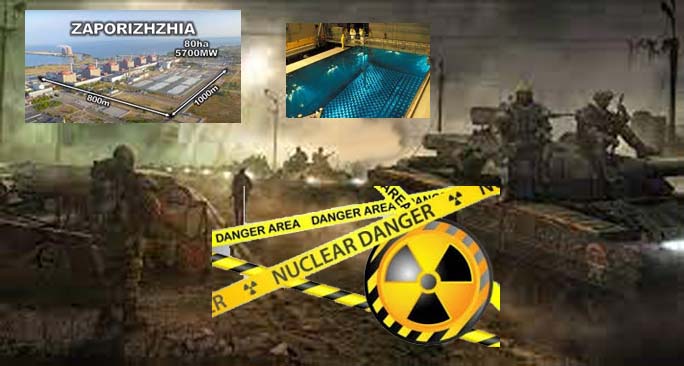
Finally, the war in Ukraine has forced to world to examine whether nuclear power even belongs on a planet where war seems omnipresent. Nuclear power plants are now targets in war. Do not think this will be the end of it. The war and what has happened at the Zaporizhzhia nuclear plant in Ukraine now forces the nuclear industry, military planners and governments of the world to face what they have long avoided and refused to discuss: nuclear power plants are gigantic, pre-positioned radiation dispersion devices. The thought of sprinkling literally thousands of so-called “small modular nuclear reactors” (SMNRs) worldwide like fairy dust — without containment buildings and with reduced emergency planning/response zones and plans, as nuclear proponents eager to market their new techno-toys currently suggest — almost seems to be the quintessential confirmation of Einstein’s admonition that insanity is doing the same thing over and over, expecting different results.
Regrettably. powerful nuclear lobbies, the Biden Administration, and nuclear supporters in Congress have ramrodded legislation (the 2021 IFA; the 2022 IRA) through Congress worth as much as $70+ billion dollars to bail out this false climate “solution.” This is one time when trying to jam a square peg down a round hole will not work. You can’t build an energy future by bailing out the past.
Today’s demonstrations make two very important points: we are out of time; and we must declare a climate crisis – and act like it is a crisis, to paraphrase climate activist Greta Thunburg. We do not have the time or money for “all of the above”, business as usual false solutions like those proposed by Sen. Joe Manchin and Sen. Chuck Schumer. We must act now to implement real energy solutions.
Nuclear power is simply a false solution to the climate crisis. Anyone who says otherwise is as much a “denier” as those who still falsely claim that climate change does not exist.
This article also appeared as a September 23, 2022 press release from Nuclear Energy Information Service, a non-profit organization committed to ending nuclear power and advocating for sustainable ecologically sound and socially just energy solutions.
Washington split over Ukraine’s NATO bid – Politico
https://www.rt.com/news/563851-washington-split-ukraine-nato/ 2 Oct 22,
Zelensky’s unexpected demand to fast-track membership talks has reportedly been met with a mixed reaction
Ukraine’s bid for accelerated accession to NATO caught Washington off-guard, driving a wedge between a number of US lawmakers, Politico reported on Friday.
When the outlet asked US House Speaker Nancy Pelosi if she supports Kiev’s demand to join NATO, she stopped short of unequivocally endorsing the move, saying the US is “very committed to democracy in Ukraine.”
“Let’s win this war. But I would be for them having a security guarantee,” she told Politico.
Democratic Party colleague Representative Mike Quigley (D- Illinois) said that Washington should support Ukraine’s NATO bid. “Ukraine’s fight is the reason we formed NATO in the first place,” he told Politico, adding that since WWII, the US has recognized “that an authoritarian regime cannot be allowed to wipe out a democratic country.”
On Friday, following the start of the formal accession of four former Ukrainian regions to Russia, Ukrainian President Vladimir Zelensky demanded that the procedure for joining NATO be fast-tracked. This apparently came as a surprise to the Biden administration, according to two US officials cited by the outlet.
Many Western officials fear that if Kiev becomes a full-fledged member of the bloc, it would not only provoke Russia, but would also draw Washington and Moscow into a direct war, as NATO’s charter stipulates that an attack on one member is considered an attack against the entire alliance. The only instance in which this principle has been applied came after the 9/11 terrorist attacks against the US.
On Friday, President Vladimir Putin signed treaties on the inclusion of the two Donbass republics, as well as the two southern Ukrainian regions which had declared independence, into the Russian Federation. All four territories held referendums from September 23 to 27, in which the people voted overwhelmingly in favor of joining Russia.
Western leaders have condemned Moscow’s latest moves. US President Joe Biden has vowed to impose further sanctions on Russia and continue to supply Kiev with military aid.
America’s nuclear industry remains dependent on Russia for enriched uranium fuel

Russia’s dominance in the global nuclear fuel market presents another
massive challenge for Washington, especially the liberal hawks in the Biden
administration, who are trying to wean Western countries off Russian energy
supplies. Secretary of Energy Jennifer Granholm said President Biden is
redoubling efforts to break the US reliance on Russian nuclear fuel,
indicating domestic uranium-enrichment capacity could be increased with
upcoming key legislation.
Oil Price 1st Oct 2022
Climate pragmatism or Faustian bargain? — Beyond Nuclear International

A (rotten) compromise
The Inflation Reduction Act, with its hodgepodge of climate measures, is what remains of progressive Democrats’ multi-trillion dollar Green New Deal agenda of 2019 and the $2 billion Build-Back-Better framework legislation that President Biden pushed last fall……..……………………………
the enacted climate action bill is technology agnostic, and includes, for example, tax support for nuclear plant lifetime extensions. Rhodium Group estimates that without the bill’s funding commitments, about one-third of U.S. nuclear plants would have to shut down by 2030 due to cost. Hundreds of millions of dollars also support nuclear fusion research………….
New US laws will prop up old nukes
Climate pragmatism or Faustian bargain? — Beyond Nuclear International What the new US climate law does—and where it fails
By Liane Schalatek, Heinrich Böll Stiftung 2 Oct 22,
Analysis: U.S. climate policy is currently putting observers through a roller coaster of emotions: just a few weeks ago, the Supreme Court limited the authority of the U.S. Environmental Protection Agency to issue far-reaching climate regulations. Now, after decades of unsuccessful legislative attempts, the U.S. Congress has passed the most comprehensive American climate legislation ever by a razor-thin majority.
The $369 billion package is now law with President Biden’s recent signature. The legislation is intended to lead to drastic emissions reductions over the next decade and transform the U.S. energy sector and the U.S. economy. What some see as an expression of goal-oriented climate pragmatism, in which the perfect must not become the enemy of the good, others see as a Faustian bargain that tightens rather than loosens the fossil fuel industry’s stranglehold on the U.S. economy. So what exactly is in the package?
The sweeping climate package, embedded alongside health care and tax reforms in the surprise passage of the more than 700-page Inflation Reduction Act, represents the largest U.S. funding boost to date to reduce greenhouse gases and promote climate-friendly “green” technologies. It is roughly four times what was authorized for climate action under President Biden’s Democratic predecessor Obama in 2009 in what was then the American Recovery and Reinvestment Act. This spending is in addition to the more than $200 billion in clean energy and climate action investments that a majority Democratic Congress already approved last year in a massive infrastructure funding bill.
Passage of the bill is a much-needed win for the Biden administration, whose approval ratings are extremely low given the impact of inflation on American households. It comes just months before the November midterm elections, in which Republicans are expected to win.
Carrots instead of sticks: financial incentives instead of bans
The law includes neither a carbon price nor a CO2 cap under a federal emissions trading system. It also fails to radically address the main cause of climate change, namely the extraction and burning of fossil fuels. Thus, the measure clearly relies on carrots rather than sticks, in part because previous attempts to push a climate bill through Congress that relies on carbon taxation have repeatedly failed over the past several decades. Then-Vice President Al Gore’s push in 1993 failed to gain traction, as did the Markey-Waxman emissions trading plan of 2010.
So instead of punitive measures and restrictions, the package prioritizes financial support as an incentive and emphasizes how much the investments will support the American economy, create jobs and benefit consumers. This also secured the almost euphoric support of the U.S. business sector for the proposed legislation, with letters of support from more than 1,000 companies, investors and trade groups, including major oil companies, as well as labor unions. The Biden administration has purposefully pursued this approach, which justifies climate protection with green jobs and economic growth, since the beginning of his term in office as part of his reconstruction strategy to Build Back Better after the pandemic-related economic crisis.
Accordingly, the White House stressed that the Inflation Reduction Act “secures America’s position as a world leader in domestic manufacturing and clean energy supply chains,” creates and sustains “good-paying union jobs in construction and manufacturing, including in rural communities,” and lowers annual energy costs for Americans by an average of up to $1840, according to expert estimates.
Expansion of the US markets for renewable energies and e-mobility…………………………………
A (rotten) compromise
The Inflation Reduction Act, with its hodgepodge of climate measures, is what remains of progressive Democrats’ multi-trillion dollar Green New Deal agenda of 2019 and the $2 billion Build-Back-Better framework legislation that President Biden pushed last fall…………………………………..
The majority of Democrats and climate experts celebrates the package as a historic success of pragmatic climate policy, in which good legislation was not sacrificed in the name of hoping for an even better ideal—especially in the face of the expected Republican win in the midterm elections, which could block U.S. climate legislation for the rest of the decade so critical for accelerated climate action. …………………………..
Safeguarding the fossil fuel industry
The many-voiced chorus of those hailing the legislative coup drowns out the critical voices from the progressive U.S. climate movement, who castigate what they see as a rather rotten compromise and a Faustian bargain.
That’s because in order to win Manchin’s approval, numerous pledges were made that solidify the fossil fuel industry’s stranglehold on the U.S. economy instead of reducing its influence. Chief among these is the provision requiring the U.S. Department of the Interior to agree to millions of acres of new oil and gas development concessions over the next decade as a precondition to leases for offshore wind and solar and wind farms on federally owned land, including in the Gulf of Mexico and Alaska’s Cook Inlet. Each year, for example, an area of ocean the size of the U.S. state of Wyoming, about 60 million acres, could be opened to offshore drilling. While such extraction concessions need not necessarily lead to expanded fossil fuel production, their forced linkage to permits for new renewable energy projects could slow such clean investments…………………………………………..
the enacted climate action bill is technology agnostic, and includes, for example, tax support for nuclear plant lifetime extensions. Rhodium Group estimates that without the bill’s funding commitments, about one-third of U.S. nuclear plants would have to shut down by 2030 due to cost. Hundreds of millions of dollars also support nuclear fusion research……………………………………………………..
even in the best-case scenario, emissions reductions are still well below what would be needed to meet the climate pledge President Biden has made to the global community, which calls for the U.S. to reduce emissions by 50 to 52 percent from 2005 levels by 2030………………………………..
Climate justice deficits
Many U.S. climate activists view the passage of the legislative package with mixed feelings , if not outright anger and disappointment, including in light of critical equity deficiencies in its design and foreseeable implementation. After all, it was their political pressure on Democrats, their mobilization of votes, and their implementation proposals over recent years, which made the Inflation Reduction Act even possible.
………………………………………………………………………. Many progressive climate groups in the U.S. see the passage of the climate package, despite or more precisely because of all its flaws, as an incentive to ramp up their climate activism in the run-up to the midterm elections and to keep up the pressure on Democrats to implement more progressive legislative goals if more progressive climate activists can be elected to Congress. They have not yet given up hope that President Biden might yet declare a national climate emergency, as they have requested, which would allow him, via presidential decrees, to, for example, halt U.S. crude oil exports, limit private investment in fossil fuel projects abroad, or spend defense budget money on renewable energy. And they are also counting on young climate activists in particular to become more involved at the local level in the coming years in order to politically implement their vision of far more comprehensive climate-just social and environmental protection rules in cities and municipalities in all U.S. states.
Uncle Sam’s Long Trail of Wreckage

the Biden administration opted to use Ukraine in a Western proxy war against Russia.
Washington and London appear to have sabotaged a possible peace accord between Moscow and Kiev.
The Biden administration is risking nuclear war with Russia to assist a corrupt, authoritarian regime in a country of little importance to the United States.
Until the early 1990s, Ukraine wasn’t even an independent country, much less a U.S. vital interest.
Very few policymakers even concede that Washington’s overseas military adventures often have not turned out as planned.
The American Conservative, Ted Galen Carpenter, Sep 28, 2022, The leaders and most of the news media in the U.S. seem to believe that Washington’s foreign policy over the past several decades has been a success and benefitted both the United States and the world. That assumption wasn’t really true even during the Cold War, although that confrontation eventually resulted in the peaceful demise of America’s nasty totalitarian adversary. There was plenty of collateral damage along the way, with the suffering caused by Washington’s conduct in Vietnam and Afghanistan being the most glaring examples.
The performance of U.S. leaders after the Cold War has been even worse. An array of disruptive, bloody tragedies—most notably those in the Balkans, Afghanistan (again), Iraq, Libya, Syria, and Yemen—mark Uncle Sam’s global trail of wreckage. The Biden administration’s decision to use Ukraine as a pawn in Washington’s power struggle with Russia is fast becoming the latest example.
Very few policymakers even concede that Washington’s overseas military adventures often have not turned out as planned. The news media, which is supposed to serve as the public’s watchdog, have routinely ignored or excused America’s foreign-policy disasters. Instead, when one intervention fails, they simply move on to lobby for the next crusade pushed by U.S. leaders. Consider how few news accounts now deal with the ongoing violence and chaos in places such as Libya, Syria, and Yemen, even though Washington was a major contributor to all of those tragedies.
Paul Poast, a scholar with the Chicago Council on Global Affairs, aptly describes the conflict in Syria as America’s “forgotten war.” “That the war in Syria has become the “forgotten war,” he observes, “points to a more disturbing trend in U.S. foreign policy: The United States is so engaged in wars and interventions around the world that a conflict involving the U.S. military that has killed hundreds of thousands of civilians does not even register with the American public anymore.”………………………………………
The turmoil in Iraq is less severe, but is still damaging the country. Political disputes and mass demonstrations against the current government regularly surface in Iraq. Pro-Iranian militias continue to play a prominent role in the country’s government, and the three-way split among Sunni Arabs, Shiite Arabs, and Kurds is becoming ever more contentious. Political violence among rival factions shows no signs of subsiding, nor does public resentment against the presence of U.S. troops. Washington so lacks trust in its “ally” that officials once threatened to seize the country’s bank reserves if Iraqi leaders continued to press for the withdrawal of U.S. forces.
The level of human tragedy in Libya and Yemen is horrifying. Washington and its NATO allies bear almost exclusive responsibility for the situation in Libya………………………
The latest application of Washington’s meddlesome policy is in Ukraine. U.S. leaders ignored repeated Russian warnings that making Ukraine a NATO member or even an unofficial NATO military asset would cross a line that threatened Russia’s security. When Moscow finally responded to the provocations with an invasion of Ukraine in February 2022, the Biden administration opted to use Ukraine in a Western proxy war against Russia.
The conflict has already done enormous damage to Ukraine’s infrastructure and taken thousands of lives. Worse, Washington and London appear to have sabotaged a possible peace accord between Moscow and Kiev.
The U.S. foreign-policy record over the past three decades could hardly be worse. It is crucial not to let policymakers and their media mouthpieces get away with convenient collective amnesia and imitations of Pontius Pilate. Instead, they need to be held fully accountable for their blunders and deception.
Future U.S. policymakers also need to avoid repeating the faulty performance of their predecessors. To do so, they must make three significant changes to U.S. foreign policy.
First, Washington should utterly renounce nation-building. Trying to remake alien societies by force and impose Western political, economic, and social values is the essence of folly.
Even when the United States has not yet been drawn into a new war to enforce crumbling nation-building goals, as in Bosnia and Kosovo, such armed social experiments are an exercise in futility and frustration. Worse, nation-building missions frequently worsen conditions in the targeted country, and the predictable failure of U.S. objectives even can lead to Washington’s outright humiliation. The debacle in Afghanistan is a stark reminder of that danger.
Second, the United States must avoid the temptation to engage in regime-change wars. Such offensives often are a prelude to disastrous nation-building ventures. That was the case in Iraq, Afghanistan, and Libya. Those wars not only made matters worse for the populations in the three countries, but worsened the security situation for neighboring states and even the United States. In both Iraq and Libya, U.S. actions toppled secular dictators, paving the way for chaos that strengthened the position of Islamic jihadists. Granted, the secular dictators were brutal and sometimes caused problems for the United States, but Washington’s “solution” clearly made matters worse, not better.
Third, U.S. leaders must do a much better job of distinguishing vital national interests from secondary or peripheral ones. Washington’s current policy of using Ukraine as a proxy for a war against Russia is a troubling example of the failure to make such basic distinctions. The Biden administration is risking nuclear war with Russia to assist a corrupt, authoritarian regime in a country of little importance to the United States.
Until the early 1990s, Ukraine wasn’t even an independent country, much less a U.S. vital interest. To accept the risks the Biden administration is incurring is irresponsible and violates the U.S. government’s responsibility to the American people.
Unless these policy changes are made, it is just a matter of time until a new set of officials repeat the disastrous blunders of their predecessors. If they do, the consequences to America and the world will be equally damaging. Indeed, the Ukraine adventure reveals that the consequences could be even worse than the wreckage already wrought by Uncle Sam. https://www.theamericanconservative.com/uncle-sams-long-trail-of-wreckage/
How can Diablo Canyon nuclear power plant stay open? ‘It’s not a done deal’
The Tribune, BY STEPHANIE ZAPPELLI SEPTEMBER 30, 2022,
PG&E is preparing for two futures: one in which it closes Diablo Canyon Power Plant in 2025 and another in which it continues operating the nuclear power plant through 2030. “It’s not a done deal,” PG&E director Tom Jones told the San Luis Obispo County Board of Supervisors on Tuesday. “We’re maintaining both tracks.” Diablo Canyon was on track to shut down in 2025, but the California State Legislature passed Senate Bill 846 in October.
The bill, which Gov. Gavin Newsom signed into law on Sept. 2, creates resources to keep the power plant near Avila Beach open until 2030. One of those resources is a $1.4 billion grant to the state Department of Water Resources. That department will then loan the money to PG&E.
The utility company will receive a $600 million loan this year, and another $800 million next year if approved by the California legislature, Jones told the Board of Supervisors. PG&E applied for a grant with the U.S. Department of Energy to “back-fill those funds,” Jones said.
Even though the state provided PG&E with new support, the utility company has to complete a few more steps to keep the power plant open, Jones said. WHAT’S NEXT FOR DIABLO CANYON? In order to continue operating Diablo Canyon, PG&E must renew the power plant’s license to operate with the U.S. Nuclear Regulatory Commission, Jones said. Normally, the federal commission requires a power plant to apply to renew its license five years before it expires…………………………………………….. more https://www.sanluisobispo.com/news/local/environment/article266566596.html
US intel wants to improve low-dose radiation detection

IARPA unleashes TEI-REX to better track nuclear sources, more
https://www.theregister.com/2022/09/30/iarpa_radiation_monitoring_research/, Brandon Vigliarolo, 30 Sep 2022 ,
The research arm of US intelligence has begun investigating methods for spotting low doses of ionizing radiation to better protect American service personnel and provide evidence of nuclear technology use.
The Intelligence Advanced Research Projects Activity (IARPA) announced the start of Targeted Evaluation of Ionizing Radiation Exposure (TEI-REX) on Friday, which will look for non-invasive methods of determining radiation exposure in low doses through samples including hair, skin, sweat, and saliva.
In its technical explanation [PDF] of the program, IARPA said current methods of collecting biodosimetry data, which looks at the effects of radiation on human or animal tissue, have a number of issues: it can require invasive samples, such as blood; multiple collections are often required; there’s a time limit for getting an accurate reading; the markers used to calculate doses are transient; and there’s a wide standard deviation of dose calculations for low-dose exposure.
“Today’s technology mostly assesses exposure to high doses of radioactive materials by looking at multiple samples that often have limited accuracy for only a few days,” said program manager Dr Michael Patterson.
Most radiation tests that require blood to be drawn rely on examining chromosomal damage, which IARPA said is unnecessary because recent research “demonstrated that biomarkers associated with ionizing radiation exposure can be detected across numerous biological targets including proteins, peptides, metabolites, and lipids.”
TEI-REX wants to look at those markers, which IARPA said are long-lasting and can be directly attributed to the initial dose of radiation. The program is looking to establish measurement models and methodologies that can measure accurate low-dose ionizing exposure within 25 days, and beyond 90 days, which it said will help it build a new understanding of the effects of low-dose radiation “through advances in artificial intelligence, machine learning, biomarker discovery, and analytical biology.”
IARPA said [PDF] there are several applications for the technology, such as investigating radiation poisoning cases similar to Alexander Litvinenko’s, which took 22 days to confirm.
Other uses include better radiation exposure measurements for military personnel, who often aren’t carrying dosimetry badges; detecting and tracking down radiation sources and nuclear contamination out in the field; and testing in remote locations – such as space – where astronauts are exposed to much more radioactivity than those of us on Earth.
The University of Washington, Ohio State University, Signature Science, and Areté Associates were awarded grants to carry out this three-and-a-half year study project, and the research will be performed at Lawrence Berkeley National Laboratory, Los Alamos National Lab, and the Armed Forces Radiobiology Research Institute.
US Senate Approves $12 Billion In New Aid For Ukraine Amid War

Russia-Ukraine War: It comes as Russian President Vladimir Putin plans to declare the annexation of parts of Ukraine occupied by Russian troops on Friday.
NDTV WorldAgence France-Presse September 30, 2022,
It also provides $4.5 billion for Kyiv to keep the country’s finances stable.
The US Senate approved $12 billion in new economic and military aid for Ukraine Thursday as part of a stopgap extension of the federal budget into December.
The measure, agreed by senators of both parties, includes $3 billion for arms, supplies and salaries for Ukraine’s military, and authorizes President Joe Biden to direct the US Defense Department to take $3.7 billion worth of its own weapons and materiel to provide Ukraine.
It also provides $4.5 billion for Kyiv to keep the country’s finances stable and keep the government running, providing services to the Ukrainian people.
It comes as Russian President Vladimir Putin plans to declare the annexation of parts of Ukraine occupied by Russian troops on Friday……………
The Ukraine aid is part of a short-term extension of the federal budget, which is to expire at the end of the fiscal year on September 30 without the parties in Congress having agreed to a full-year allocation for fiscal 2022-23………. https://www.ndtv.com/world-news/us-senate-approves-12-billion-in-new-aid-for-ukraine-amid-war-3390355
Canada and the International Fools-Based Order

https://worldbeyondwar.org/canada-and-the-international-fools-based-order/?utm_content=buffer7ff3e By Cymry Gomery, Coordinator, Montreal for a World BEYOND War, September 21st, 2022
Statement for World Peace Day, September 21st, 2022
On September 18, 2022, Canadian Minister of National Defence Anita Anand was interrupted as she made a speech promoting Canada’s participation in the war in Ukraine. Caught by surprise when an activist raised a banner with the words, ”Trudeau, Freeland, Anand, Joly : Stop the War – Peace with Ukraine and Russia” Anand invoked the NATO mantra: ”We are defending…. we are defending the International rules-based order to protect you, and everyone in this room, and our country safe [sic] ”
What is this rule-based order that politicians seem to call on whenever they are promoting war?
Some say that the rules-based order is only a vague concept invented by G7 countries to lull us into accepting their presumptive international hegemony. Nonetheless, there is a formal international body that sets rules: the United Nations. And, when it comes to war, or the potential for war, Chapter VI of the UN Charter enjoins all countries to seek to resolve their disputes through peaceful means. If this doesn’t work, they are to refer it to the UN Security Council (UNSC), which could recommend solutions.
But what if countries are considering war and they know in advance that the UNSC would not offer a resolution in their favor, because of their self-serving motives? Take, for example, the Russia-Ukraine conflict, widely considered to be a U.S. proxy war. However, not only the U.S., but also Europe, Canada, Australia and China—just about everyone with an army–has economic interests in this war, which can be seen as a geopolitical tug-of-war for valuable commodities like lithium, gas, and wheat.
How do Canadian interests stand to benefit from the Russia-Ukraine war? It is already happening :
- Canada increased oil and gas exports in 2022 as Russia’s former customer nations sought alternative energy supplies;
- The US, EU, Canada, Australia, China, and Russia are all very interested in the Lithium deposits in Ukraine, which are among the largest in the world. The outcome of this war determines which players nab the market for this key climate-change era mineral.
- Before the Russia-Ukraine war, Russia was expected to become one of the world’s largest exporters of hydrogen, and was poised to supply hydrogen fuel to Germany. However, Russia is now faced with economic sanctions and the unwillingness of the world’s most powerful nations and largest economies to do business with Russia. All this appears very convenient for Justin Trudeau and his government, who can now scoop up hydrogen exports to the EU.
So, how can we really keep a straight face when Anand invokes the International Rules-based order? Perhaps we should call it what it really is, an attempt to hoodwink the gullible public into thinking the Canadian government is sending weapons to Ukraine for altruistic, morally sound reasons, when in fact the Liberals are just doing what they do best : looking after the ”economy” (read corporate profits) and protecting their own assets.
On this International Day of Peace, we will put on our good faith hat (not to be confused with a fools cap) and respectfully ask the Canadian government to take these measures :
As the image below suggests, (Anand’s comment about our safety notwithstanding), defense spending is more indicative of a nation’s geopolitical aggressiveness than its concern for the well-being of its citizens.

The Canadian government (our representatives, in case they forgot) could use the money thus saved to implement the Green New Deal and basic income, to address climate change, to build houses, to protect Canada’s remaining wild spaces, to make national parks into Indigenous protected areas, and so much more.
We will need a nationwide consultation to decide on how best to spend this money creatively, in a life-affirming way, which is something we are not yet that experienced doing. But I am sure we will manage.
So, on this day dedicated to world peace, let’s chart a new course. Let us repudiate a foolish, nihilistic world order predicated on militarism and destruction, and vow henceforth to champion and advance a hopeful, loving world order that outlaws war.
US, UK sabotaged peace deal because they ‘don’t care about Ukraine’: fmr. NATO adviser
https://thegrayzone.com/2022/09/27/us-uk-sabotaged-peace-deal/ AARON MATÉ· SEPTEMBER 27, 2022,
Former Swiss intelligence officer and NATO adviser Jacques Baud on the next phase of the Russia-Ukraine war and new allegations that the US and UK undermined a peace deal that could have ended it.
The West’s aim “is not the victory of Ukraine, It’s the defeat of Russia,” Baud says. “The problem is that nobody cares about Ukraine. We have just instrumentalized Ukraine for the purpose of US strategic interests — not even European interests.”
Guest: Jacques Baud. Former intelligence officer with the Swiss Strategic Intelligence Service who has served in a number of senior security and advisory positions at NATO, the United Nations, and with the Swiss military.
Corrections:
- In his Sept. 21 speech, Putin did not make an explicit threat to use nuclear weapons. He vowed to “make use of all weapon systems available to us,” in the event of “a threat to the territorial integrity of our country and to defend Russia and our people.”
On nuclear weapons, the US did not have a “No First Use” policy. On the 2020 campaign trail, Joe Biden said that he supported the idea of “No First Use.” He abandoned that in his presidential nuclear posture; but that was reversing his campaign stance, not official US policy.
USA government, Pentagon, happy to escalate to a nuclear war – at the behest of Volodymyr Zelensky ?
As I really dislike Rupert Murdoch’s News Corpse, Tucker Carlson, and the whole pro Trump brigade, it pains me to have to promote them in any way. BUT – if they happen to be telling the facts, with a credible interpretation of what is going on in Ukraine – can we afford to just dismiss them, while the “respectable” corporate Western media idolises Zelensky, and promotes the escalation of the war?
1 This Month



19 November – Webinar – The Reality of Reprocessing
Time: 11:00 AM Pacific Time (US & Canada) / 2:00 PM Eastern / 7:00 PM UK / 8:00 PM CET
Register for the Zoom Event Here



Shut down the radiation-damaged Heysham nuclear reactors now
To see nuclear-related stories in greater depth and intensity – go to https://nuclearinformation.wordpress.com

Say No to NASA’s Reckless Nuclear Reactor on the Moon
Say No to NASA’s Reckless Nuclear Reactor on the Moon
-
Archives
- November 2026 (74)
- October 2026 (302)
- September 2026 (339)
- August 2026 (330)
- July 2026 (355)
- June 2026 (287)
- May 2026 (306)
- April 2026 (356)
- March 2026 (251)
- February 2026 (267)
- January 2026 (308)
- December 2025 (358)
-
Categories
- 1
- 1 NUCLEAR ISSUES
- business and costs
- climate change
- culture and arts
- ENERGY
- environment
- health
- history
- indigenous issues
- Legal
- marketing of nuclear
- media
- opposition to nuclear
- PERSONAL STORIES
- politics
- politics international
- Religion and ethics
- safety
- secrets,lies and civil liberties
- spinbuster
- technology
- Uranium
- wastes
- weapons and war
- Women
- 2 WORLD
- ACTION
- AFRICA
- Atrocities
- AUSTRALIA
- Christina's notes
- Christina's themes
- culture and arts
- Events
- Fuk 2022
- Fuk 2023
- Fukushima 2017
- Fukushima 2018
- fukushima 2019
- Fukushima 2020
- Fukushima 2021
- general
- global warming
- Humour (God we need it)
- Nuclear
- RARE EARTHS
- Reference
- resources – print
- Resources -audiovicual
- Weekly Newsletter
- World
- World Nuclear
- YouTube
-
RSS
Entries RSS
Comments RSS

