COVID-19 an obstacle for nuclear waste disposal at Waste Isolation Pilot Plant, officials say

COVID-19 an obstacle for nuclear waste disposal at Waste Isolation Pilot Plant, officials say,
Officials plan to ramp up operations as pandemic hoped to subside, Adrian Hedden, Carlsbad Current-Argus, 31 Jan 22,
COVID-19 continued to strain operations to dispose of nuclear waste at the Waste Isolation Pilot Plant near Carlsbad, officials said, slowing shipments accepted at the repository near Carlsbad last year.Officials from WIPP detailed the progress made in 2021 before state lawmakers Monday during the annual WIPP Legislative Breakfast held each year at the start of the Legislative Session.
This year’s presentation was held virtually via Zoom due to health concerns from the COVID-19 pandemic.
In the Fiscal Year 2021, about 199 shipments of waste were emplaced at WIPP, where they are permanently disposed of as an underground salt formation slowly collapses to bury the waste about 2,000 underground.
Shipments averaged about five weekly last year and were occasionally reported at seven or eight per week, said Reinhard Knerr, manager of the U.S. Department of Energy’s Carlsbad Field Office.
The facility’s target was about 240 shipments of waste for FY 2021, he said, and officials hoped to aim for up to 400 shipments in FY 2022.
“Unfortunately, COVID-19 has continued to be a significant challenge on that front,” he said of last year’s shipments. “We’ll be looking to increase here in the next few months.”
In early 2022, Knerr said WIPP hoped to increase shipments of waste to 10 to 12 per week from DOE nuclear facilities around the country including Los Alamos National Laboratory (LANL) in northern New Mexico.
Shipments from LANL recently drew concerns from state officials as the New Mexico Environment Department (NMED) called for federal oversight into how the DOE prioritizes shipments from around the country.
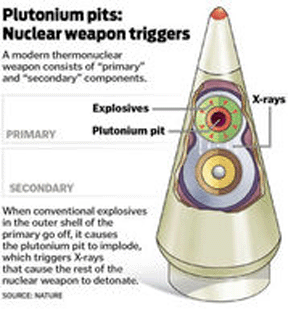
Meanwhile, the DOE announced plans to increase LANL’s production of plutonium pits, which are used to trigger nuclear bombs, to about 30 pits a year by 2026 – a move critics argued would increase waste generation at the site……………………… https://www.currentargus.com/story/news/local/2022/01/31/covid-19-obstacle-nuclear-waste-disposal-wipp/9239299002/
In 2022, compensation funds for the nuclear-affected ”Downwinders” are due to expire
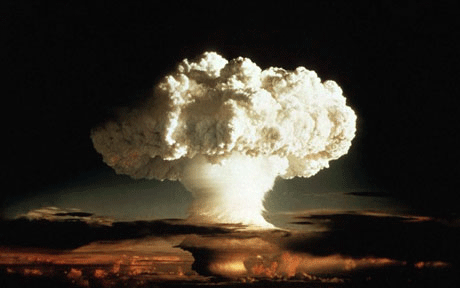
Funds for those impacted by nuclear weapons tests set to expire in 2022 https://www.thedenverchannel.com/news/national/funds-for-those-impacted-by-nuclear-weapons-tests-set-to-expire-in-2022 By: Bo Evans, , Feb 01, 2022
Raymond Harbert may not have the words to describe it.
“It is really hard to relay all the feelings you get from one of those megaton tests,”
But he never forgot the details of the detonation of a nuclear bomb well.
“If you can imagine, 40 miles away, and you can feel the heat when it arrives. It arrives at a separate time. It’s a prickly heat, and then the pressure wave coming—the brightness. The feeling when they finally say, you can take your glasses off. Those are memories that will stick with me for the rest of my life,” said Harbert.
In this 2005 interview conducted by the University of Nevada Las Vegas, Harbert lays out an experience shared by thousands of Americans exposed to radiation from nuclear weapons tests between 1945 and 1962.
The fallout has lasted for decades.
“People don’t realize over 200 above-ground tests were done between 1945 and 1962, and an additional 900+ were done after that below ground. Which exposed Nevadans, people in Utah, Arizona, Colorado, places that were downwind of these tests to fallout,” said Dr. Laura Shaw.
Shaw works with the Nevada Radiation Exposure Screening & Education Program or RESEP at UNLV to provide medical services and cancer screening to people who are known as downwinders.
We review their history, we look at their medications, we offer additional screenings that include colon cancer screening, lung imaging, labs that screen for diabetes, anemia, cholesterol, so we do a lot,” said Shaw.
It’s all paid for by the Radiation Exposure Compensation Act or RECA. The law was passed in 1990. The fund is set to expire in July 2022.
“These people have another 30, 40 years, hopefully, to live that were potentially exposed, so we need this program much, much longer,” said Shaw.
Some in Congress are attempting to extend and expand the fund.
“Tragically, for some, it is already too late. We’ve lost Idahoans Sheri Garmin, Teresa Valberg, and Srgt. 1st Class Paul Cooper to Cancer,” said Sen. Mark Crapo, (R) Idaho, in a congressional hearing.
The Radiation Exposure Compensation Act Amendments of 2021 have been introduced in both the House and Senate and have been referred to committees.
Dr. Shaw remains hopeful it will pass.
“Cancer is still going to happen. These people are going to develop problems associated with their previous exposure. Cancer can happen years later, and it’s not going to pay any attention to any deadlines,” she said.
Nuclear weapons plutonium pits development planned for Los Alamos National Laboratory, but there’s strong opposition on safety grounds.
 | |||
Nuclear weapons development coming soon to Los Alamos National Laboratory amid safety concerns https://www.currentargus.com/story/news/local/2022/01/29/los-alamos-national-lab-prepares-nuclear-weapons-development/6562490001/, Adrian Hedden, Carlsbad Current-Argus
A main component of nuclear weapons was poised to be built in New Mexico after federal regulators granted approval for a plan to prepare Los Alamos National Laboratory (LANL) for the work.
The National Nuclear Security Administration (NNSA), an arm of the U.S. Department of Energy, announced earlier this month it approved LANL’s project to prepare areas of the lab to be used in plutonium pit production – a project known as LAP4.
Plutonium pits are hollow spheres of plutonium that when compressed using explosives cause a nuclear detonation, per a DOE report.
The pits were first used in the 1940s during the Manhattan Project, the report read, used to detonate atomic bombs tested at the Trinity Site in south-central New Mexico and then in the bomb dropped on Nagasaki in Japan – largely credited with ending World War II.
Since the war ended, Los Alamos’ pit production was limited to research purposes, and from 2007 to 2011 the lab produced pits to replace those in 31 warheads carried on U.S. military submarines.
Between 1952 and 1989, most of the plutonium pits in the U.S. were generated at the Rocky Flats Plant near Denver amid the Cold War with a peak nuclear stockpile of 31,225 weapons outfitted with the pits reported in 1967, read the report.
Rocky Flats was shut down in 1989, and after concerns that the pits produced since the 1980s or earlier would begin to deteriorate over time, Los Alamos was called to make new ones.
The DOE called on Los Alamos to increase efforts at the lab to produce 30 pits a year by 2026, and the Savannah River Site in South Carolina was tasked with producing 50 pits annually by 2030.
That means that by that year, the U.S. would be producing 80 pits per year.
But to prepare LANL for the work, a project to remove existing equipment and glove boxes was needed to make way for pit manufacturing equipment.
That work was intended to begin this spring via a project known as the Decontamination and Decommissioning Subproject, the first of five operations to get the site ready.
equipment and infrastructure needed to safely manufacture pits for the nuclear stockpile,” said Summer Jones, NNSA assistant deputy administrator for production modernization at LANL.
“LAP4 is a complex, challenging endeavor, and getting the approval to begin the D&D subproject is a big step toward restoring this important capability.”
Opponents call for environmental review of plutonium operations
The effort to resume producing plutonium pits and thus nuclear weapons at the New Mexico lab and in South Carolina as met with controversy from government officials and watchdog groups in both states opposing the projects.
Santa Fe City Councilors passed a resolution last year calling for a “site-wide” environmental impact statement to be conducted and any safety issued be resolved and certified by the federal government before pit production was increased.
“The Governing Body (Santa Fe City Council) requests that the National Nuclear Security Administration suspend any planned expanded plutonium pit production until all nuclear safety issues are resolved, as certified by the independent Defense Nuclear Facilities Safety Board,” read the resolution.
Nuclear Watch New Mexico and Savannah River Site Watch subsequently in June 2021 filed a lawsuit in U.S. District Court for the District of South Carolina’s Aiken Division against the DOE and NNSA, arguing pit production should not be increased until site-wide environmental analysis were conducted at both facilities.
“The drastic expansion of plutonium pit production and the utilization of more than one facility to undertake this production are substantial changes from the Defendants’ long-standing approach of producing a limited number of pits at only one facility,” the suit read.
The suit argued the increased pit production was not only intended for replacing existing warheads but to develop a new warhead known as the W87-1.
This project was developed with proper environmental analysis, the suit read, or proper planning for where associated nuclear waste would be disposed of.
“The drastic expansion of plutonium pit production and the utilization of more than one facility to undertake this production are substantial changes from the Defendants’ long-standing approach of producing a limited number of pits at only one facility,” read the suit.
In southeastern New Mexico is the Waste Isolation Pilot Plant (WIPP), a repository for low-level transuranic (TRU) nuclear waste – clothing materials and equipment irradiated during nuclear activities.
But the litigants argued WIPP was already at limited capacity and its current permit with the New Mexico Environment Department (NMED) specified the repository would have to cease waste disposal by 2024 and begin the decommissioning process.
The DOE last year submitted a permit renewal application to NMED that removed the 2024 closure date, leaving WIPP’s lifetime largely open ended.
Still, the suit alleged the DOE failed to address the need for waste disposal.
“As a National Academy of Sciences has concluded, the WIPP is already oversubscribed for future waste from multiple sites and will overextend its capacity from this increase in TRU production from the pit project and other DOE projects set to generate large amounts of TRU waste,” read the suit.
“The Defendants have failed to meaningfully address this critical waste disposal question.”
US DOE announces clean-up progress at Savannah River Site
US DOE announces clean-up progress at Savannah River Site, NEI Magazine, 31 January 2022 The US Department of Energy’s (DOE’s) Office of Environmental Management (EM) and its clean-up contractor at the Savannah River Site (SRS) have reached an important record of decision (ROD) agreement with South Carolina and federal environmental regulators on the final clean-up of a 25-mile-long stream corridor at the site.
The corridor consists of Par Pond, nine miles of canals adjacent to the pond and a stream named Lower Three Runs. The stream begins near the centre of the site, just above Par Pond, and winds its way southward across SRS.
SRS, a 310-square-mile-site in Aiken, South Carolina, focused on the production of plutonium and tritium for use in the manufacture of nuclear weapons from its inception in the early 1950s until the end of the Cold War. In 1992, the focus turned to environmental clean-up, nuclear materials management, and research and development activities……………………
SRNS Engineer and Project Technical Lead Jim Kupar explained that much of the remaining work involves ensuring additional fencing and signage are in place to warn site workers and the public that potential hazards may be present. “Though it is illegal for the public to cross the fencing onto SRS, our first priority is always their safety,” he said.
He added that surveying 25 miles of waterways, especially Lower Three Runs, was often challenging and sometimes potentially hazardous within the forest………………….. https://www.neimagazine.com/news/newsus-doe-announces-clean-up-progress-at-savannah-river-site-9448456
U.S. and Russian Threats Over Ukraine—What They’re About

“It’s a noble principle, just not one the United States abides by. The United States has exercised a sphere of influence in its own hemisphere for almost 200 years, since President James Monroe declared that the United States ‘should consider any attempt’ by foreign powers ‘to extend their system to any portion of this hemisphere as dangerous to our peace and safety’.”.
Blinken wants a one-way street where spheres of influence are concerned. The U.S., for him, has the right to wield influence everywhere, while others don’t.
STRIPPING AWAY THE BULLS**T: U.S. and Russian Threats Over Ukraine—What They’re About and Who’s the Aggressor, Covert Action Magazine By Dee Knight – January 25, 2022 Threats and counter-threats flying between Washington and Moscow over Ukraine have caused a flurry of fear and confusion that escalates and expands daily. Is the world on the brink of war? What is it about, who is the aggressor and who is to blame?
The dangerous standoff has lasted for most of a year. Each side accuses the other of threatening war—in a way reminiscent of the Cuban missile crisis of 1962.
During a week of intense diplomatic meetings in three European capitals, which appeared to reach a dead end, President Joe Biden seemed to “blink” midweek, on January 19, telling reporters in Washington he had indicated to Russian President Putin that “we can work out something.”
New York Times senior reporter David Sanger jumped on it: “Mr. President, it sounds like you’re offering some way out here, some off-ramp—an informal assurance that NATO is not going to take in Ukraine… and we would never put nuclear weapons there.” Sanger went on to say Russia “wants us to move all of our nuclear weapons out of Europe and not have troops rotating through the old Soviet bloc.” Biden quickly said “No, there’s not space for that.”
Biden’s blink was a break in the warlike atmosphere that has prevailed endlessly. Katrina van den Heuvel wrote the day before in The Washington Post that “Hotheads [were] having a field day. A White House task force that includes the CIA [was] reportedly contemplating U.S. support for a guerrilla war if Russia seizes Ukraine; Russian hawks talk of a military deployment to Cuba and Venezuela.” Biden had “installed a team of national security managers from the ‘Blob,’ marinated in successive debacles in Iraq, Libya, Syria, Yemen and more.”
Guns and sanctions are the U.S. empire’s preferred options, van den Heuvel said: “with about 800 military bases outside the United States,” the U.S. has “more bases than diplomatic missions. (Russia’s only military bases outside the former Soviet Union are in Syria.)” She added that Secretary of State Blinken and the Blob “talk about a rules-based international order but respect it only if we make the rules, often exempting ourselves from their application.”
Spheres of influence?
“When will the U.S. stop lying to itself about global politics?” asked CUNY Professor Peter Beinart, writing in the New York Times on January 13. He took issue with Secretary of State Antony Blinken, who pontificated last month that “One country does not have the right to dictate the policies of another or to tell that country with whom it may associate; one country does not have the right to exert a sphere of influence. That notion should be relegated to the dustbin of history.”
Beinart commented: “It’s a noble principle, just not one the United States abides by. The United States has exercised a sphere of influence in its own hemisphere for almost 200 years, since President James Monroe declared that the United States ‘should consider any attempt’ by foreign powers ‘to extend their system to any portion of this hemisphere as dangerous to our peace and safety’.”………….
Blinken wants a one-way street where spheres of influence are concerned. The U.S., for him, has the right to wield influence everywhere, while others don’t.
The same day Biden blinked, French President Macron weighed in saying war would be the “most tragic thing of all.” Speaking in the European Union’s capital of Strasbourg, as new interim EU chair, Macron said he hoped to revitalize the four-way “Normandy format” talks between Russia, Germany, France and Ukraine to find a solution to the Ukraine crisis. “It is vital that Europe has its own dialogue with Russia,” Macron said. The EU had no part in the talks last week between Russia, the U.S., NATO and the Organization for Security and Cooperation in Europe (OSCD).
The Normandy format has been a vehicle for implementing the 2015 Minsk agreements designed to end the separatist war in Ukraine’s Donbas region. This solution has already been proposed and accepted in principle, according to Anatol Lieven, who wrote in The Nation that the Minsk II agreement was already adopted by France, Germany, Russia and Ukraine in 2015, and endorsed unanimously by the UN Security Council.
Key elements of the Minsk II deal are full autonomy for Ukraine’s eastern regions in the context of decentralization of power in Ukraine, demilitarization, and restoration of Ukrainian sovereignty. Despite agreement by all parties, political analyst Anatol Lieven says “because of the refusal of Ukrainian governments to implement the solution and refusal of the United States to put pressure on them to do so,” the settlement is a kind of “zombie policy.”
The issue of NATO expansion is another “zombie policy” as the U.S. refuses to acknowledge Russia’s legitimate opposition to it.
After the first of three negotiating sessions between the U.S. and Russia during the week of January 10, Russian Deputy Foreign Minister Sergei Ryabkov had declared it “absolutely mandatory” that Ukraine “never, never, ever” become a NATO member. In response, U.S. Deputy Secretary of State Wendy Sherman said: “we will not allow anyone to slam closed NATO’s open-door policy.”……………………..
US Undersecretary of State Victoria Nuland helped orchestrate the 2014 coup in Kyiv, the Ukrainian capital, that toppled a government friendly to Russia. The new far-rightist government ended language rights for Russian speakers who are the majority in the Ukraine’s eastern provinces. Donetsk and Lugansk voted to separate, as did Crimea. Russia then annexed Crimea, to protect Russian speakers there and secure its Black Sea naval base. Russia provided humanitarian aid and trade to Donetsk and Lugansk, and stationed troops on their eastern border for protection.
“Pro-Democracy Protests” or a Fascist Coup?

A New York Times report on January 6 said “Russia intervened militarily in Ukraine in 2014 after pro-democracy protests erupted there.” [Emphasis added.] The coup was actually carried out by fascist gangs, according to a May 2, 2018, report in The Nation by Stephen Cohen.
The gangs, including self-declared neo-Nazis, were encouraged by Nuland, Biden and other prominent U.S. politicians. The neo-Nazis were integrated into Ukraine’s official military which, since 2014, has been trained, armed and reorganized by the U.S., Britain, Canada and other NATO countries.
Stephen Cohen wrote that “the pogrom-like burning to death of ethnic Russians and others in Odessa later in 2014 reawakened memories of Nazi extermination squads in Ukraine during World War II.” These horrors have been all but deleted from the American mainstream narrative, despite being well-documented.
Cohen added that “stormtroop-like assaults on gays, Jews, elderly ethnic Russians, and other ‘impure’ citizens are widespread throughout Kyiv-ruled Ukraine, along with torchlight marches reminiscent of those that eventually inflamed Germany in the late 1920s and 1930s… The police and official legal authorities do virtually nothing to prevent these neo-fascist acts or to prosecute them. On the contrary, Kyiv has officially encouraged them by systematically rehabilitating and even memorializing Ukrainian collaborators with Nazi German extermination pogroms and their leaders during World War II, renaming streets in their honor, building monuments to them, rewriting history to glorify them, and more.”
The people of the self-declared people’s republics of Donetsk and Lugansk in eastern Ukraine suffer under a complete economic blockade by Ukraine and its Western allies. Historically known as the Donbass region, eastern Ukraine is a mining and industrial center. Donbass miners played a crucial and heroic role in the defeat of the German invasion of the Soviet Union in World War II. Many Russians revere the Donbass as “the heart of Russia.”
All of Ukraine east of the Dnieper river is predominantly Russian-speaking. U.S. claims of a “Russian invasion” are reminiscent of claims of North Vietnamese invasion of South Vietnam after the artificial separation of Vietnam in 1954. The entire U.S. narrative about Ukraine is a cynical fabrication designed to justify aggression.
Russian Security Proposals
In mid-December Russia took a diplomatic initiative and presented a list of security proposals to the United States. According to the Wall Street Journal, they include ending NATO’s expansion further eastward to include Ukraine, a promise for each side to refrain from hostile activities, and an end to NATO military activities in all of Eastern Europe, Transcaucasia and Central Asia……….
Among the “severe consequences” threatened by the U.S. against Russia, the Financial Times has said sanctioning Russia’s Nord Stream 2 gas pipeline to Germany was “top of the list.” Western Europe is already facing an energy crunch, with skyrocketing prices for natural gas.
Europeans need energy security and are wary of war. They want the Nord Stream 2 pipeline as soon as possible, while the Biden administration calls it a “bad deal” and claims that it makes Europe vulnerable to Russian “treachery.” Texas Senator Ted Cruz has pressed hard against the pipeline, which offsets opportunities for U.S. energy companies to supply gas to the European market. U.S. foreign adventures have often constricted Europe’s energy sources.
A 2021 survey by the European Council on Foreign Affairs found that most Europeans want to remain neutral in any U.S. war against Russia or China. But new NATO member-states align with the U.S. against Russia. They have installed terminals to receive U.S. liquid natural gas deliveries, to reduce dependence on Russian gas.
Despite all the diplomatic efforts, powerful institutional and economic forces in the U.S.—the military industrial complex and big energy companies among others—are eager for a new Cold War with Russia, which would provide them with boundless opportunities for profitable deals. “The U.S. military-industrial complex needs enemies like human lungs need oxygen,” the saying goes. “When there are no enemies, they must be invented.”
The demonization of Vladimir Putin and Russia by the U.S. media is part of this policy of inventing enemies. There is a long list of foreign leaders and nations whose attempts to defy the dictates of Washington and pursue an independent foreign policy have brought down upon them the wrath of the U.S. Capitalist Empire.https://covertactionmagazine.com/2022/01/25/stripping-away-the-bullst-u-s-and-russian-threats-over-ukraine-what-theyre-about-and-whos-the-aggressor/
Forensic experts are working to recover texts deleted by ex-FirstEnergy CEO Chuck Jones after he was fired

Forensic experts are working to recover texts deleted by ex-FirstEnergy CEO Chuck Jones after he was fired Cleveland.com : Jan. 28, 2022, By Jeremy Pelzer,
COLUMBUS, Ohio — Forensic experts have been working to recover text messages deleted by former FirstEnergy Corp. CEO Chuck Jones in October 2020, shortly after the utility fired him for violating company ethics policies amid the House Bill 6 scandal, according to a recent civil lawsuit filing.
The filing was part of a submission made Thursday by attorneys representing FirstEnergy shareholders suing company officials for not stopping a massive bribery scheme to pass HB6. In addition, the filing says the content of the deleted messages remains unknown, and it did not disclose any recipients…………..
A federal complaint against ex-Ohio House Speaker Larry Householder and several allies accuses them of using $60 million in FirstEnergy bribe money to secure the passage of HB6. The complaint says that Jones and Householder emailed and texted each other several times a week about the issues with the legislation, which offered a $1 billion-plus bailout to two Northern Ohio nuclear power plants owned by a then-subsidiary of FirstEnergy………………….
Jones has so far not been accused of any crime, and he denies any wrongdoing. However, a civil lawsuit filed by Attorney General Dave Yost accuses him and two other former FirstEnergy executives of engaging in extortion, money laundering, coercion, intimidation and an attempted coverup.
Cleveland.com has reached out to a spokesman for Jones for comment.
Thursday’s court filing states that plaintiffs in the civil suit have reviewed more than 400,000 pages of documents so far and are preparing to start depositions on Feb. 10. The filing states that plaintiffs will be ready to go to trial by this August.
Read the full filing here: https://www.cleveland.com/news/2022/01/forensic-experts-are-working-to-recover-texts-deleted-by-ex-firstenergy-ceo-chuck-jones-after-he-was-fired.html
Leaders say nuclear will save Kemmerer. Residents aren’t convinced.

when TerraPower announced in November that it would build a first-of-its-kind sodium-cooled nuclear reactor at the town’s Naughton Power Plant, community leaders exhaled at last. The project promised a lifeline, not just to the town, but to similarly coal-dependent Wyoming.
The people who claimed they didn’t have much to say about the project, the ones who actually had a lot to say — a lot of them didn’t feel like trailblazers. They felt more like guinea pigs.
Many were suspicious. Why, they asked, would TerraPower stick its flagship project in such a tiny, remote town? Was it because they were too desperate to protest? Too isolated for anyone to care if things went awry?…….
Leaders say nuclear will save Kemmerer. Residents aren’t convinced. Casper Star Tribune
Nicole Pollack, Jan 29, 2022 The Star-Tribune visited Kemmerer this month to talk with the community about TerraPower’s nuclear plant. Energy reporter Nicole Pollack and photographer Lauren Miller will continue reporting from Kemmerer as the project develops.Roaming Kemmerer, asking people about the planned nuclear reactor, I expected excitement. Or trepidation. Or anger.
Apathy wasn’t on the list.
“We don’t really talk about it,” a retired miner told me as his fellow retirees — former coal miners and quarry workers and power plant operators — heckled one another around a senior center pool table.
Most of the Kemmerer residents I met said the same thing. They were familiar with the plan to replace their half-century-old coal plant with a nuclear reactor; did I know Bill Gates was behind it? Everyone, they assured me, was aware. They just didn’t have much more to say.
The energy sector is always changing, the miner said, and people in Kemmerer are used to riding out those booms and busts. Another boom isn’t anything special. So the project doesn’t come up in conversation very often.
He discusses it with his wife sometimes, though. The two of them speculate, nervously, about how a nuclear plant might change the tiny town they’ve called home for decades.
Coal’s demise hangs heavy over Kemmerer, and when TerraPower announced in November that it would build a first-of-its-kind sodium-cooled nuclear reactor at the town’s Naughton Power Plant, community leaders exhaled at last. The project promised a lifeline, not just to the town, but to similarly coal-dependent Wyoming. Gov. Mark Gordon proudly unveiled the project last summer during a celebratory press conference featuring a video message from Gates himself.
We’re absolutely ecstatic,” Mayor Bill Thek told me after Kemmerer was chosen.
The miner and his wife aren’t so sure. While they agree Kemmerer needs an economic boost of some kind, a replacement for its fading coal sector, they’re not sure whether a next-generation reactor will be the right answer. They’d rather keep burning coal.
I asked a lot of people in Kemmerer about the nuclear plant. At first, most sounded unconcerned, almost indifferent: “I don’t have much to say about it.”
But, it turned out, they usually did………………..
Maybe, another offered, the company was already starting to build the plant itself.
He hoped construction hadn’t started. There were still too many unknowns, he told me. The town wasn’t ready for nuclear; not by a long shot. He didn’t know if it would ever be.
Life after coal
Gillette, Rock Springs, Glenrock and Kemmerer — the four communities considered for TerraPower’s first nuclear reactor — are all coal towns. But in Kemmerer, the victor, founded in 1867 near the coal mine that gave the town its name, coal has always been king.
Much of the younger workforce has opted to work at the gas plant, or even at the fossil quarries, over the coal plant, in the hopes that those jobs will last even after coal is gone. And Kemmerer and Diamondville are trying to put themselves on the map — on tourists’ lucrative radar — for their fossils………………………………………
TerraPower and Rocky Mountain Power had convened roughly 40 high-profile community leaders, including elected officials, town managers, school and hospital administrators and police officers, in the Best Western conference room for a question-and-answer luncheon.
………………… they [the community] also know about the plant’s “aggressive” seven-year time limit — a condition of the company’s nearly $2 billion Department of Energy grant. And, as the meeting wrapped up, they wanted to know: How sure was TerraPower that the project would succeed?…..
Why us?
In the Best Western conference room, the descriptor of choice was “demonstration.” Outside of that room, at the senior center and the bowling alley and the booths at Place on Pine, the nuclear plant was “experimental.”
The people who claimed they didn’t have much to say about the project, the ones who actually had a lot to say — a lot of them didn’t feel like trailblazers. They felt more like guinea pigs.
Many were suspicious. Why, they asked, would TerraPower stick its flagship project in such a tiny, remote town? Was it because they were too desperate to protest? Too isolated for anyone to care if things went awry?…….
There will be protests,” I was told several times. No one who said it wanted to participate themselves — I didn’t meet anyone who did — but they were suresomeone would………………… https://trib.com/business/energy/leaders-say-nuclear-will-save-kemmerer-residents-arent-convinced/article_64d05a74-9245-5183-8366-651079ad9b12.html……………….
West Virginia public weighs in on nuclear power plant prohibition repeal .
Public weighs in on nuclear power plant prohibition repeal The Weirton Daily Times, 30 Jan 22,
STEVEN ALLEN ADAMS STAFF WRITER, CHARLESTON —With lawmakers on the cusp of removing a more than 25-year-old ban on nuclear energy in West Virginia, members of the House of Delegates received input from the public Friday.
The House Government Organization Committee held a public hearing in the House of Delegates chamber Friday morning on Senate Bill 4, repealing sections of the state code banning the construction of nuclear power plants in West Virginia………
The bill would remove two sections of code banning the construction of new nuclear power plants except under certain circumstances. The ban has been in place since 1996.
Supporters of the bill include the West Virginia Manufacturers Association and the West Virginia Chamber of Commerce. …………………
Opposition to the bill united two sides normally fighting each other: the coal industry and environmental activists. ……….
Hannah King, a lobbyist with the West Virginia Environmental Council, read a prepared statement on behalf of Gary Zuckett, executive director of the West Virginia Citizen Action Group, due to Zuckett being quarantined for a COVID-19 infection. Zuckett, who advocated for the 1996 ban on nuclear power, said even with improvements in technology the state should take its time before repealing the ban.
“We need climate solutions now, not in 10 years,” King said on behalf of Zuckett. “The prudent thing to do would be to put these bills on hold, assemble an interim study, gather experts on both sides of this critical issue, and make a measured and informed decision. If we’re going to open up West Virginia to nuclear power, let’s do it with proper regulations and safeguards for its people, economy and environment.”……………… https://www.weirtondailytimes.com/news/local-news/2022/01/public-weighs-in-on-nuclear-power-plant-prohibition-repeal/
Montana communities have better options than nuclear power.
We have better options than nuclear, https://helenair.com/opinion/letters/we-have-better-options-than-nuclear/article_620c7b44-dfaa-5448-b4fd-f8964dded79e.html Jeff Havens, 30 Jan 22,
Voter voices were silenced last spring by legislators and the governor on the topic of whether nuclear fission reactors and their highly radioactive waste can be located within our communities. Simultaneously, a separate but related law was enacted for the state to study “small advanced nuclear reactors.”
Contrary to their myopic moves, the Union of Concerned Scientists reported “newly built reactors must be demonstrably safer and more secure …. Unfortunately, most ‘advanced’ nuclear reactors are anything but. … for any reactor concept it is critical to understand that ‘burning’ spent fuel first entails reprocessing to separate out and re-use plutonium and other weapon-usable materials. Reprocessing makes these materials more accessible for use in nuclear weapons by states or terrorists….”
I hate to think that some “recycled” material from such reactors could be diverted into manufacturing nuclear weapons to be leveraged by domestic states or terrorists during the next coup attempt on our nation. This alarming possibility is amplified when one considers federal seditious conspiracy indictment of Oath Keepers founder and leader Elmer Rhodes, who is a former Montana attorney and resident.
We have better options for jobs than hazards associated with fission reactors. Let’s try more wind and solar, first.
NATO practices nuclear missile sorties near borders of the Russia-Belarus Union

NATO practices nuclear missile sorties near Union State borders — Belarus’ security chief
A breach of international norms and elementary rules of good neighborly relations by neighboring countries is already turning into an alarming trend, Alexander Volfovich stated
MINSK, January 28. /TASS/. The NATO Air Force is practicing sorties with cruise missiles, including with nuclear warheads, near the borders of the Russia-Belarus Union State, State Secretary of the Belarusian Security Council Alexander Volfovich said on Friday.
“The head of state drew attention to intensified flights by US strategic bombers near the borders of the Union State,” the BelTA news agency quoted Volfovich as saying.
“In our assessments, this means that the NATO Air Force is practicing employing cruise missiles, including those with nuclear warheads,” he said…………….. https://tass.com/defense/1394647
Nuclear waste storage in New Mexico would be blocked if Senate, House bill pass Legislature
Nuclear waste storage in New Mexico would be blocked if Senate, House bill pass Legislature, Adrian Hedden, Carlsbad Current-Argus 27 Jan 22, High-level spent nuclear fuel would be prohibited from being stored in New Mexico if lawmakers pass a pair of bills introduced during this year’s legislative session.
The bicameral effort comes as Holtec International proposed to build and operate a facility in southeast New Mexico to temporarily hold spent nuclear fuel rods from generator sites across the U.S.
Sponsored by New Mexico Sen. Jeff Steinborn (D-36), a frequent critic of the Holtec project, Senate Bill 54 would prohibit the kind of waste Holtec planned to store in New Mexico. It’s twin bill, House Bill 127, was sponsored by Rep. Matthew McQueen (D-50).
The state does have a facility for low-level waste. The Waste Isolation Pilot Plant is operated by the U.S. Department of Energy in the same region and permitted by the State of New Mexico
The Holtec site recently received approval from the federal Nuclear Regulatory Commission, which recommended Holtec be issued a license to build the facility and a final decision was expected this year.
Holtec would hold up to 100,000 metric tons of the waste in total on an interim basis until a permanent repository was available.
The U.S. does not presently have a permanent repository for the waste after such a project at Yucca Mountain, Nevada stalled amid opposition from leaders in that state.
In New Mexico, high-ranking state officials voiced their own opposition to the proposal with Gov. Michelle Lujan Grisham calling the project “economic malpractice” as she worried it could risk nearby oil and gas and agriculture industries in the region.
Last year, New Mexico Attorney General Hector Balderas filed a lawsuit against the NRC arguing its license recommendation ignored the environmental and safety impacts the site could have if built and operated.
SB 54 was awaiting a hearing in the Senate Conservation Committee, while HB 127 was to be considered in the House Energy, Environment and Natural Resources Committee.
Both bills added language to New Mexico’s Radioactive and Hazardous Materials Act that “no one” will store high-level waste or spent nuclear fuel in New Mexico, adding to a clause that already required state consent before such a facility could be built.
The bill would also amend requirements of the state’s Radioactive Waste Consultation Task Force to include private nuclear facilities like Holtec’s in its purview for analysis and require the committee meet at least annually.
“No person shall store or dispose of radioactive materials or radioactive waste (or spent fuel) in a disposal facility until the state has concurred in the creation of the disposal facility, except as specifically preempted by federal law; provided that spent fuel and high-level waste shall not be stored or disposed of in the state; and provided further that the state or a political subdivision of the state shall not issue or certify a permit for the construction or operation of a disposal facility for spent fuel or high-level waste,” read the language of the bills.
Local leaders in southeast New Mexico opposed the bill, believing the Holtec project was a safe way to diversify the region’s economy and insulate it from future up and downswings in the oil and gas markets.
Carlsbad Mayor Dale Janway, Eddy County Commission Chairman Steven McCutcheon, along with Hobbs Mayor Sam Cobb and Lea County Commissioner Jonathan Sena signed letters to Lujan Grisham opposing each bill and asking that she not sign them into law if passed.
The cities of Carlsbad and Hobbs and Eddy and Lea counties formed the Eddy Lea Energy Alliance which sited the project and recruited Holtec………………. https://www.currentargus.com/story/news/local/2022/01/27/nuclear-waste-storage-new-mexico-would-blocked-if-bills-pass/6578755001/
”All options on the table” to punish Moscow -could bring about a nuclear conflict.
Repeated assertions that “all options are on the table” to punish Moscow should it reinvade Ukraine are seen as particularly troubling.
“In the nuclear age, ‘all options on the table’ in a conflict involving nuclear powers could be understood to mean the potential use of nuclear weapons, even if that wasn’t the intention in this instance,
Nuclear fears mount as Ukraine crisis deepens,
Officials and experts are warning that a Russian invasion could inadvertently trigger a nuclear exchange with the U.S. Politico By BRYAN BENDER, 01/27/2022, As Russian troops bear down on Ukraine and the United States prepares its own military buildup in Eastern Europe, concerns are growing across the ideological spectrum that the standoff could inadvertently escalate into the unthinkable: nuclear war.
President Joe Biden has insisted that he will not use American forces to directly defend Ukrainian territory against a possible Russian invasion. But that is no guarantee that the two sides won’t come to blows.
The world’s two largest nuclear powers could even stumble into nuclear confrontation if the situation spins out of control, current and former officials and experts on both sides of the Atlantic worry.
“At the point you unleash war in the modern environment, the one thing that is certain is the law of unintended consequences,” Des Browne, a member of the British Parliament and a former secretary of state for defense, told POLITICO. “If you are talking about a nuclear-armed environment, which is already fragile … then you are living in an environment [where] things could escalate quite quickly, by accident or miscalculation.”
“Nobody thinks any of these weapons are going to be used deliberately, but miscalculation is a significant chance,” added Browne, who chairs the Euro-Atlantic Security Leadership Group.
It’s a concern shared by current and former nuclear security officials who usually don’t agree on much — from disarmament advocates to nuclear hawks.
“I think the Ukraine conflict is demonstrating that the nuclear escalation scenario we’re worried about is not out of sight,” said Patty-Jane Geller, an expert on nuclear strategy at the hawkish Heritage Foundation.
Last week, the Bulletin of the Atomic Scientists cited the Ukraine conflict as contributing to its decision to keep the “Doomsday Clock” at 100 seconds to midnight, an indication of how close it assesses that the human race is to potential self-annihilation.
“Ukraine remains a potential flashpoint, and Russian troop deployments to the Ukrainian border heighten day-to-day tension,” it noted in citing the threat of a nuclear conflict.
A primary concern, according to Geller and others, is Russia’s arsenal of thousands of battlefield nuclear weapons, which are central to its military strategy.
“The Russians have something like 4,000 [tactical nuclear weapons] and they have an ‘escalate to win’ nuclear doctrine, which says ‘we use nuclear weapons first if the conventional conflict starts to spin out of our favor,’” said a former senior GOP government official who still works on nuclear security issues.
One Russian diplomat last month went so far as to publicly threaten the deployment of tactical nuclear weapons in the crisis.
The weapons have a lower “yield” than traditional atomic bombs and are designed to be used against conventional forces in battle. But they still have enormous explosive power and are considered particularly destabilizing to deterrent strategy.
The United States has reportedly been flying dedicated spy missions over in recent weeks to determine if Russia has deployed any of its tactical nuclear weapons along the border with Ukraine.
There’s also concern among Russian nuclear experts about the potential that the Ukraine crisis could escalate, according to former U.S. Ambassador Richard Burt, who negotiated arms control treaties with the Soviet Union…………
The situation is exacerbated by the growing number of U.S., NATO, and Russian military forces in close proximity, Burt said.
“One thing I think is useful to remember is people are not just putting their forces on alert in and around Ukraine, but you’ve got nuclear-capable naval forces in the Black Sea and in the Mediterranean,” he said. “In the Baltic Sea there also has been an intensification of activity as well. You have a lot more aircraft flying overflights.”………….
Others have taken issue with American rhetoric that they see as sowing unnecessary confusion about what military options might be under consideration to prevent a Russian invasion of Ukraine.
Repeated assertions that “all options are on the table” to punish Moscow should it reinvade Ukraine are seen as particularly troubling.
“In the nuclear age, ‘all options on the table’ in a conflict involving nuclear powers could be understood to mean the potential use of nuclear weapons, even if that wasn’t the intention in this instance,” two leading arms control advocates wrote last week.…..https://www.politico.com/news/2022/01/27/nuclear-fears-mount-ukraine-crisis-deepens-00003088
Elon Musk SpaceX rocket on collision course with moon.

Elon Musk SpaceX rocket on collision course with moon
By Georgina Rannard, BBC News, 28 Jan 22, A rocket launched by Elon Musk’s space exploration company is on course to crash into the Moon and explode.
The Falcon 9 booster was launched in 2015 but after completing its mission, it did not have enough fuel to return towards Earth and instead remained in space.
Astronomer Jonathan McDowell told BBC News it will be the first known uncontrolled rocket collision with the Moon……..
It was part of Mr Musk’s space exploration programme SpaceX, a commercial company that ultimately aims to get humans living on other planets.
Since 2015 the rocket has been pulled by different gravitational forces of the Earth, Moon and Sun, making its path somewhat “chaotic”, explains Prof McDowell from the US-based Harvard-Smithsonian Center for Astrophysics.
“It’s been dead – just following the laws of gravity.”
It’s joined millions of other pieces of space junk – machinery discarded in space after completing missions without enough energy to return to Earth.
“Over the decades there have been maybe 50 large objects that we’ve totally lost track of. This may have happened a bunch of times before, we just didn’t notice. This would be the first confirmed case,” Prof McDowell says…………………. https://www.bbc.com/news/science-environment-60148543
Nuclear-Testing ‘Downwinders’ Speak about History and Fear
Nuclear-Testing ‘Downwinders’ Speak about History and Fear. An archival project aims to document the experiences of people who suffered from U.S. nuclear weapons testing, Scientific American , By Sarah Scoles on January 27, 2022 When Sandra Evans Walsh was growing up in Parowan, Utah, her class would sometimes trek outside to a row of trees. They were about to watch history in the making, the teacher would tell them. The kids would then stare as an orange shroud spread across the sky. “I remember the clouds coming over our town and writing our names in the dust,” she said in an interview with Justin Sorensen, a geographical information systems (GIS) specialist at the University of Utah’s J. Willard Marriott Library.
That dust had traveled around 200 miles, all the way from what is now called the Nevada National Security Site, where scientists once tested nuclear weapons. Between 1945 and 1962, U.S. researchers detonated around 200 bombs aboveground—100 of them in Nevada. Fallout from the nuclear tests—radioactive particles that were swept into the atmosphere and fell back down to the earth—found their way into crops and livestock, whose radioactivity humans took on when they consumed milk, meat and produce. Fallout takes many different chemical forms, one of which is iodine-131: an isotope, or version, of iodine that has the usual 53 protons but 78 neutrons instead of the standard 74. Inside the body, the thyroid gland will absorb iodine-131, which eventually decays to produce radiation that can cause thyroid cancer and other problems.
People, such as Walsh, who lived “downwind” of nuclear development and open-air explosions are now called “downwinders.” Mary Dickson, another downwinder, told Sorensen and one of his colleagues that she thought the attitude toward those in Utah who were affected by nuclear testing was, “you know, ‘They were Mormons and cowboys and Indians—who cares?’ In general, she added, “they test where they think there are populations that don’t matter.”
Sorensen and his team spoke to both women and dozens of other people for a project called the Downwinders of Utah Archive. Hosted by the J. Willard Marriott Library, the archive is an attempt to qualify, quantify and make accessible people’s experiences of, and effects from, the American legacy of nuclear weapons testing. In 2011 the Senate unanimously designated January 27 as the National Day of Remembrance for Downwinders. “The downwinders paid a high price for the development of a nuclear weapons program for the benefit of the United States,” stated the resolution establishing the designation.
But when the tests were conducted, no one had done the research necessary to truly calculate what that price would be. Wanting to understand the potential link between regional health issues and fallout from nuclear tests, the National Cancer Institute (NCI) undertook a study on Americans exposed to iodine-131 from the Nevada tests. The results were released in 1997 in a report entitled “Estimated Exposures and Thyroid Doses Received by the American People from Iodine-131 in Fallout following Nevada Atmospheric Nuclear Bomb Tests.” It was this document that first led Sorensen to the archival project. “We were just kind of wondering, originally, ‘What does this data look like if you put it on a map?’” he says, “because a spreadsheet doesn’t really tell you a lot.” Sorensen’s background is in GIS and cartography, so he took the NCI’s fallout data and overlaid them onto his home state. “It just really grew from there,” he says. “We started seeing there’s a story to be told.”……………………..
Although no single illness can be conclusively tied to a test-site cause, investigations by the United Nations Scientific Committee on the Effects of Atomic Radiation and the International Physicians for the Prevention of Nuclear War and the Institute for Energy and Environmental Research, among others, have established links between radiation exposure and cancer occurrence. In the early 2000s a report by NCI and the Centers for Disease Control and Prevention estimated that fallout could have led to around 11,000 excess deaths. The NCI has also created a calculator that allows users to calculate their thyroid dose and risk of developing thyroid cancer from fallout. “We can’t know any individual’s cancer was caused by radioactivity,” explains Scott Williams, former executive director of HEAL Utah, a nonprofit advocacy group focused on the environment and public health, “but we do know that some people’s cancer risk was increased by radioactivity.”
Since 1990 the federal government has offered some recompense to downwinders and others affected by nuclear testing through the Radiation Exposure Compensation Act (RECA). Set to expire this summer unless a bill is passed to renew (and expand) it, RECA pays downwinders, test participants and uranium workers between $50,000 and $100,000—if they have specific ailments and can prove (with decades-old evidence that is sometimes hard to come by) they were in the wrong place at the wrong time. “We left a burden on unwitting citizens across the country without ever informing them,” Williams says. “We need to do the honorable thing and own the problem and not create these problems again.”
The Downwinders of Utah Archive is always expanding, and though Sorensen paused interviews during the pandemic, he plans to light the fuse again soon. He also hopes to expand the project to other Western states to preserve their history, too.
Making sure that information remains accessible is part of the point of the Downwinders of Utah Archive. The day of remembrance is, in its own way, an isotope of that openness. “Those kind of markers are really important…,” Dickson told Sorensen and his colleague. “Otherwise, you know, time marches on, and it’s like dipping a big spoon in the water. The rest of the water just fills in, and it’s like it was never there.”
This reporting was supported by the International Women’s Media Foundation’s Howard G Buffett Fund for Women Journalists. https://www.scientificamerican.com/article/nuclear-testing-downwinders-speak-about-history-and-fear/
NB Power and New Brunswick government gamble on untested, non existent ”small” nuclear reactors (SMRs)

While the world is turning overwhelmingly toward renewable sources of
energy, currently about four times cheaper than new nuclear plants and with
an established track record, NB Power and the New Brunswick government
insist on gambling on two new unproven nuclear plants, misleadingly termed
“small modular nuclear reactors” (SMNRs or SMRs).
SMRs do not exist at all in Canada except on paper or as computerized plans. There is no
guarantee these new untested reactors will ever succeed in producing
electricity in Canada in a safe and affordable manner.
But public utilities across the country are being pressured to generate power without emitting
greenhouse gases during operation. Instead of investing big bucks in
negawatts (energy efficiency) or renewables, four provinces are promoting
new nuclear plants – SMRs – as their best strategy for combatting
climate change. Since these plants are not likely to materialize for more
than a decade, if ever, the nuclear strategy is another way of “kicking
the can down the road.”
NB Media Co-op 27th Jan 2022
1 This Month

4 May -West Suburban Peace Coalition to discuss Iran war at May Educational Forum
Monday, May 4, 7:00 – 8:00 PM Central Standard Time
Title: : How Trump’s Narrative Tries to Shape the Reality of the War on Iran.
Contact Walt Zlotow, zlotow@hotmail.com 630 442 3045 for further information
14 May – online event From Bombs to Data Centres: the Face of Nuclear Colonialism
To see nuclear-related stories in greater depth and intensity – go to https://nuclearinformation.wordpress.com
-
Archives
- May 2026 (25)
- April 2026 (356)
- March 2026 (251)
- February 2026 (268)
- January 2026 (308)
- December 2025 (358)
- November 2025 (359)
- October 2025 (376)
- September 2025 (257)
- August 2025 (319)
- July 2025 (230)
- June 2025 (348)
-
Categories
- 1
- 1 NUCLEAR ISSUES
- business and costs
- climate change
- culture and arts
- ENERGY
- environment
- health
- history
- indigenous issues
- Legal
- marketing of nuclear
- media
- opposition to nuclear
- PERSONAL STORIES
- politics
- politics international
- Religion and ethics
- safety
- secrets,lies and civil liberties
- spinbuster
- technology
- Uranium
- wastes
- weapons and war
- Women
- 2 WORLD
- ACTION
- AFRICA
- Atrocities
- AUSTRALIA
- Christina's notes
- Christina's themes
- culture and arts
- Events
- Fuk 2022
- Fuk 2023
- Fukushima 2017
- Fukushima 2018
- fukushima 2019
- Fukushima 2020
- Fukushima 2021
- general
- global warming
- Humour (God we need it)
- Nuclear
- RARE EARTHS
- Reference
- resources – print
- Resources -audiovicual
- Weekly Newsletter
- World
- World Nuclear
- YouTube
-
RSS
Entries RSS
Comments RSS
 nuclear-news