Trump is the joke….. that is no longer funny

While comedians laughed at his rallies, millions of Americans saw something entirely different. They saw somebody attacking a political establishment they already despised.
Trump discovered scandal itself could become a weapon. Every controversy kept him at the centre of public attention
20 May 2026 Roswell, https://theaimn.net/the-joke-that-lost-its-punchline/
In 2015 and 2016, much of the world treated Donald Trump like a political novelty act.
He was loud, theatrical, unpredictable, and impossible to ignore. Commentators laughed at the rallies. Late-night comedians built entire careers around his speeches. Political experts dismissed his presidential campaign as a publicity stunt that would eventually collapse under the weight of its own absurdity.
The assumption shared by many journalists, academics, and political professionals was simple: America would never elect him.
Then America did.
What followed was one of the most extraordinary political transformations in modern democratic history. A man once regarded as a sideshow became the central figure in American politics. More remarkably, he reshaped the Republican Party, dominated the global news cycle for nearly a decade, survived scandals that would have destroyed conventional politicians, lost an election, refused to accept the result, returned to power, and began a second presidency stronger and more experienced than the first.
The joke had become reality.
And now, nobody is laughing.
That shift reveals something deeper than the story of one man. It exposes how badly political institutions, media organisations, and intellectual elites misunderstood both Trump and the conditions that made him possible.
In the beginning, ridicule was seen as sufficient. Trump was mocked endlessly for his speaking style, his exaggerations, his vanity, his midnight meltdowns on Twitter and his disregard for political norms. Satire became the preferred language of opposition because satire is easy when a figure appears ridiculous.
But ridicule can become dangerous when it replaces analysis.
Large sections of the media spent years treating Trump as entertainment rather than understanding him as a symptom of growing political anger, institutional distrust, economic frustration, and cultural division inside the United States. While comedians laughed at his rallies, millions of Americans saw something entirely different. They saw somebody attacking a political establishment they already despised.
Trump understood something many professional politicians did not: people who feel ignored do not necessarily want polished leadership. Sometimes they want disruption. Sometimes they want revenge against systems they believe abandoned them.
His critics often focused on his behaviour while his supporters focused on what his behaviour represented.
That distinction changed American politics.
By the time Trump entered his second presidency, the atmosphere surrounding him had fundamentally altered. The humour remained, but the comfort had disappeared. Even opponents who once treated him as a temporary political accident now understood that Trumpism was not a passing phase. It had become a movement with enormous influence over American institutions, courts, media ecosystems, and foreign policy.
There is also a psychological shift that occurs when a political figure survives everything thrown at them.
Every investigation, scandal, indictment, controversy, and prediction of political death that failed to remove Trump strengthened the perception among supporters that he was being targeted by a hostile establishment. At the same time, every failed prediction weakened public trust in the experts making those predictions.
Eventually, mockery stopped looking powerful.
It started looking ineffective.
History contains many examples of societies underestimating disruptive political figures because they appeared too strange, too vulgar, or too unconventional to succeed. Democracies often assume their institutions are strong enough to absorb any personality. Sometimes they are. Sometimes they are not.
The danger is rarely the joke itself.
The danger is failing to notice when the audience stops laughing.
Trump’s rise also revealed the growing collapse of shared reality in modern democracies. Americans no longer consume the same information, trust the same institutions, or even agree on basic facts. In that environment, outrage becomes fuel, controversy becomes visibility, and constant attention becomes political power.
Trump mastered that environment better than any modern politician.
Traditional politicians speak carefully because they fear scandal. Trump discovered scandal itself could become a weapon. Every controversy kept him at the centre of public attention. Every attack reinforced his image as a political outsider fighting entrenched power.
His opponents often helped build the mythology they hoped to destroy.
That does not mean Trump is invincible, nor does it mean his critics were entirely wrong. It means modern politics no longer behaves according to old assumptions. The rules changed while much of the political class kept pretending they had not.
And perhaps that is the real lesson.
The story of Donald Trump is not merely the story of one man rising to power. It is the story of institutional complacency, media failure, public anger, and a society increasingly unable to distinguish politics from spectacle.
In 2016, many believed the joke would end.
Instead, the joke outlived the punchline.
…
0
The Nuclear Lie at the Center of U.S. Foreign Policy
May 19, 2026, Joshua Scheer, https://scheerpost.com/2026/05/19/the-nuclear-lie-at-the-center-of-u-s-foreign-policy/
“One country is sanctioned, threatened, bombed, and demonized over the fear of nuclear weapons. The other already has them — and the world is expected to look away.”
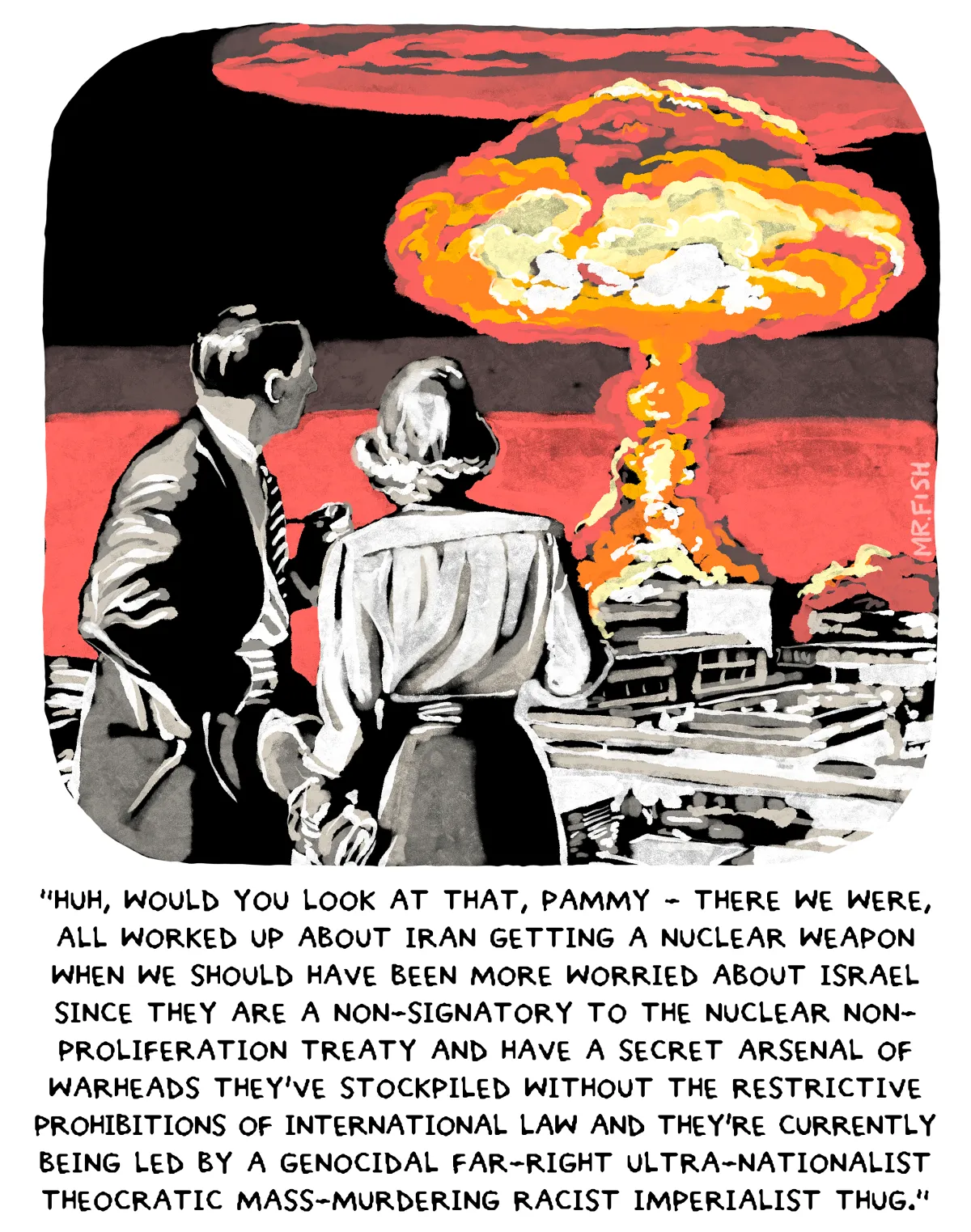
Mr. Fish’s cartoon stuck in my head because it cuts straight through the insanity of the entire conversation. One country already has nuclear weapons and the world is told not to talk about it, while another country that still doesn’t have them is treated like an immediate threat to civilization. The more I sat with the image, the more I started digging into the history underneath it — and the hypocrisy only got harder to ignore.
For decades we’ve been told to panic about the country that doesn’t have nuclear weapons while pretending not to notice the country that actually does. Iran gets sanctions, assassinations, bombings, and endless media hysteria over what it might someday build. Israel sits on an undeclared nuclear arsenal outside the Nuclear Non-Proliferation Treaty and the political/media class acts like everyone is supposed to politely shut the hell up about it.
Mr. Fish’s cartoon cuts through that theater with a sledgehammer.
Israel has never officially acknowledged its nuclear weapons program, yet experts and watchdog groups estimate it possesses roughly 90 nuclear warheads and maintains one of the most secretive nuclear infrastructures on Earth. Unlike Iran, Israel is not a signatory to the Nuclear Non-Proliferation Treaty, and international inspectors have never had full access to the Dimona facility believed to anchor its nuclear program.
The roots of Israel’s nuclear program stretch back decades. The Israel Atomic Energy Commission was established in 1952, and its first chairman, Ernst David Bergmann, openly argued that nuclear weapons would ensure “that we shall never again be led as lambs to the slaughter,” according to the Jewish Virtual Library. As with so much of Israel’s national security doctrine, the trauma and memory of the Holocaust were invoked as a central justification for building and maintaining the program.
Documents show that as far back as 1968, the CIA had already informed President Lyndon B. Johnson that Israel either possessed nuclear weapons or was on the verge of developing them. But instead of confronting the issue publicly, Washington chose silence. President Richard Nixon later struck a secret understanding with Israeli Prime Minister Golda Meir: Israel would neither officially acknowledge nor test its nuclear arsenal, and in return, the U.S. would back off demands for inspections and oversight. From that point on, one of the world’s worst-kept secrets became official policy — don’t ask, don’t tell.
They weren’t guessing. Even reporting from the 1970s pointed to what U.S. intelligence already knew. As The New York Times later revealed, the CIA disclosed in a 1974 assessment that Israel had already developed nuclear weapons — partly using uranium obtained “by clandestine means.”
Meanwhile, Iran — despite years of sanctions, assassinations, cyberwarfare, and bombing campaigns — remains under constant international scrutiny precisely because it is formally inside the nonproliferation framework. Even members of the U.S. Congress have begun openly questioning the contradiction, warning that America’s policy of “official ambiguity” around Israel’s arsenal makes any coherent nonproliferation policy nearly impossible.
That’s the uncomfortable truth sitting underneath the mushroom cloud in Mr. Fish’s illustration: the issue has never simply been nuclear weapons. It has always been about who is allowed to have power, who is allowed to threaten annihilation, and whose violence is treated as “security” instead of extremism.
The cartoon’s suburban couple staring calmly into apocalypse captures the moral numbness at the center of the debate. Entire populations have been conditioned to panic over hypothetical weapons programs while accepting real arsenals, real occupations, and real mass death as background noise. The danger isn’t only the bomb — it’s the normalization of permanent double standards enforced through military dominance and political silence.
The Council on Foreign Relations directly undercuts the claim that Iran is an imminent nuclear threat. CFR writes that “many foreign policy experts warn that a nuclear-armed Iran would destabilize the Middle East and nearby regions,” and argues that Israel viewed Iran’s potential possession of nuclear weapons as a “major, perhaps existential, threat” — a fear used to justify Israel’s June 2025 attacks on Iranian nuclear and military facilities, followed by the joint U.S.-Israeli strikes in February 2026.
But even CFR acknowledges a critical fact often buried beneath the war rhetoric: Iran does not currently possess a nuclear weapon. The organization notes that while Iran has the scientific knowledge and infrastructure to potentially build one fast, there is no confirmed evidence that its leadership has decided to do so.
Adding to that reality, the claim that Iran posed an imminent nuclear threat sharply conflicts with decades of U.S. intelligence assessments. The 2007 U.S. National Intelligence Estimate concluded that Iran halted its structured nuclear weapons program in 2003. Successive American intelligence officials — including former CIA Director William Burns — have repeatedly stated that Iran had not made the decision to build a nuclear bomb. International Atomic Energy Agency (IAEA) inspectors, including former chief Mohamed ElBaradei, likewise reported finding no evidence of an active Iranian nuclear weapons program.
Even Trump’s own Director of National Intelligence, Tulsi Gabbard, recently contradicted the administration’s escalation narrative. In Senate testimony, Gabbard stated that Iran had not rebuilt a nuclear weapons program after the 2025 strikes — directly undercutting claims used to justify continued confrontation and military escalation.
She months later changed of position came after Donald Trump publicly claimed she was “wrong” and insisted U.S. intelligence showed Iran had amassed a “tremendous amount of material” and could build a nuclear weapon “within months.” Of course what has been stated here over and over again Iran doesn’t have a nuclear weapon.
The lie, of course, is that Israel is not treated as a legitimate nuclear and existential threat while Iran — which still does not possess a nuclear weapon — is framed as the ultimate danger. This, of course, is the same logic that has fueled decades of endless war: the claim that Iran could build a weapon someday is treated as justification for permanent aggression today. Yet Iran still does not possess a nuclear weapon — and one reason may be obvious: countries like North Korea learned that once you do obtain one, you become untouchable, while nations without them remain at the mercy of the empire’s next target.
Within the last week, members of Congress have started asking the same question — because who can’t see what’s right in front of our faces anymore? As lawmakers pressed the State Department for transparency over Israel’s undeclared nuclear arsenal, the hypocrisy at the center of U.S. foreign policy became increasingly difficult to ignore.
In a letter sent to Secretary of State Marco Rubio, Democratic lawmakers pointed directly to the U.S.-Israel war on Iran as evidence that greater clarity is urgently needed.
“Congress has a constitutional responsibility to be fully informed about the nuclear balance in the Middle East, the risk of escalation by any party to this conflict, and the administration’s planning and contingencies for such scenarios,” the letter, signed by 30 members of Congress, stated. “We do not believe we have received that information.”
The lawmakers also warned that maintaining “official ambiguity” around one state’s nuclear capabilities while threatening war over another’s makes genuine nonproliferation impossible in the Middle East.
“A policy of official ambiguity about the nuclear capabilities of one party to this conflict makes coherent nonproliferation policy in the Middle East impossible,” the letter stated, “for Iran, for Saudi Arabia, and for every other state in the region making decisions based on their perceptions of the capabilities of their neighbours.”
“This initiative is taking place against the backdrop of the US-Israeli war of aggression against Iran,” said Josh Ruebner of the Institute for Middle East Understanding Policy Project. “One of Trump’s goals for ending this war involves negotiations to lift sanctions against Iran in exchange for an Iranian commitment not to develop nuclear weapons.”
“Members of Congress are right to question why Israel’s development of nuclear weapons gets a free pass while we’re trying to prevent Iran from acquiring them,” Ruebner added.
Of course, throughout the 1970s and ever since, Israeli officials have maintained the same carefully worded line: “Israel will not be the first country to introduce nuclear weapons to the Middle East.” It’s a statement built on ambiguity — one that allowed everyone to pretend not to see what was already obvious.
But now, as the world edges closer to what increasingly feels like a third world war and the Doomsday Clock sits nearer to midnight than ever before, the real question is no longer whether these weapons exist. The question is when — and under what leadership — they could be used.
That fear becomes even more dangerous under a U.S. president whose mental fitness has become a serious public concern, and who has repeatedly used apocalyptic rhetoric about “’blown off the face of the earth’” Because if Israel is treated as an undeclared nuclear power beyond accountability, the United States remains the ultimate nuclear superpower — the empire standing behind it with the largest arsenal on Earth.
Remember how all of this started — with an Mr. Fish cartoon forcing us to stare directly at the hypocrisy and madness surrounding nuclear weapons, war, and empire. Thanks for making people think. And here’s his work: The Independent Ink Archive
A national analysis of the impact of proximity to nuclear power plants on lung, breast and colon cancer mortalities in the U.S., 2000–2020
Significance
This national-scale analysis provides new evidence that proximity to nuclear power plants is associated with increased mortality from major cancers in the U.S. The magnitude and consistency of the findings highlight the importance of updated risk assessments, sustained surveillance, and strengthened public health planning for communities living near nuclear facilities.
- Yazan Alwadi,
- Joel Schwartz,
- David C. Christiani,
- Marco Kaltofen,
- Brent A. Coull,
- John S. Evans,
- Yaguang Wei &
- Petros Koutrakis
Journal of Exposure Science & Environmental Epidemiology (2026) 20 May 2026, https://www.nature.com/articles/s41370-026-00922-2
Abstract
Background
Nuclear power plants emit low levels of ionizing radiation, an established risk factor for breast, colon, and lung cancers, yet the long-term effects of chronic environmental exposure in U.S. populations remain unclear.
Objective
To evaluate sex- and age-specific associations between proximity to nuclear power plants and mortality from the three most common cancers in the U.S.: breast, colon, and lung cancer.
Methods
We quantified county-level proximity to nuclear power plants using the sum of inverse distances from each residence county’s population-weighted center to all plants within 200 km, updated annually from 2000 to 2020. Cancer-specific mortality data (breast, colon, and lung) from the CDC were analyzed by sex and five age groups (45–54, 55–64, 65–74, 75–84, 85 + ). Relative risks (RRs) were estimated using generalized estimating equations with a Poisson link. Models were adjusted for sociodemographic factors, urbanicity, region, and temporal trends.
Results
Proximity to nuclear power plants was associated with elevated mortality from breast, colon, and lung cancers. From 2000 to 2020, an estimated 39,767 female deaths (95% CI: 9312–69,381), representing 2.01% (95% CI: 0.47–3.50%), and 38,124 male deaths (95% CI: 16,106–59,600), representing 2.33% (95% CI: 0.98–3.64%), were attributable to this proximity. Lung cancer accounted for the largest burden in both sexes, followed by breast and colon cancer in females and colon cancer in males. Mortality risks declined with increasing distance, becoming negligible beyond 50 km.
Significance
This national-scale analysis provides new evidence that proximity to nuclear power plants is associated with increased mortality from major cancers in the U.S. The magnitude and consistency of the findings highlight the importance of updated risk assessments, sustained surveillance, and strengthened public health planning for communities living near nuclear facilities.
Impact
- This study provides the first national assessment of sex- and age-specific mortality from breast, colon, and lung cancers in relation to proximity to U.S. nuclear power plants, revealing consistent patterns not previously demonstrated. These findings fill a major gap in environmental epidemiology and underscore the need for cohort studies, refined exposure assessments, and pathway-specific analyses to strengthen causal interpretation. As nuclear power gains momentum in national energy planning, establishing clearer evidence on potential health impacts is increasingly essential for guiding research priorities and public health preparedness.
As support for Israel declines in the U.S., the ‘Special Relationship 2.0’ is starting to take shape.

This can be presented as an investment in American jobs in partnership with Israel rather than as taxpayer assistance to a foreign government.
Benjamin Netanyahu and his allies in Congress have begun calling for an end to U.S. aid to Israel, but this won’t end the “special relationship” between the two countries. In fact, recent signs suggest it may only deepen U.S. military ties to Israel.
By Mitchell Plitnick Mondoweiss, May 17, 2026
This month, Israel and the United States are expected to begin negotiations on a new memorandum of understanding (MOU) that would outline the United States’ plans to support Israel after the current MOU expires in 2028. Chances are this will look like a very different conversation than in the past.
In recent months, there’s been a lot of noise around the idea of ending U.S. military aid to Israel. It’s an idea that has long been pursued by Palestine solidarity activists and, in the past, has also been floated by the Israeli right and their fellow travelers, who thought the aid wasn’t worth restricting Israel’s “freedom to act.” But surprisingly, the current proposal to end the annual grant of Foreign Military Financing (FMF) to Israel—which makes up most, though not all, of the annual aid package—comes from none other than Israeli Prime Minister Benjamin Netanyahu and is championed in Washington by South Carolina Republican Senator Lindsey Graham, the biggest hawk in the Senate.
What explains this?
Back in January, the Institute for Middle East Understanding’s Policy Project published a timely and detailed backgrounder on what is actually going on here.
What emerges is a plan to continue aid to Israel in a different form. Instead of sending money to Israel, which they have to spend with American corporations, Congress would appropriate money for joint development and production projects instead. This can be presented as an investment in American jobs in partnership with Israel rather than as taxpayer assistance to a foreign government.
The time to make such a move is now. Israel’s popularity has plummeted, and the once-certain annual military aid package is now up for debate. While the current Congress is still inclined to fund an unimpeded tidal wave of weapons and money to Israel, growing opposition in both parties makes even the near future of such aid uncertain………………………………………………………………………………………………………………………………………………………………………………………………………………………………………………………….. https://mondoweiss.net/2026/05/as-support-for-israel-declines-in-the-u-s-the-special-relationship-2-0-is-starting-to-take-shape/
Golden Dome or Golden Scam?

19 May 2026 – A report by the International Physicians for the Prevention of Nuclear War,
Back from the Brink, and Physicians for Social Responsibility
On May 19, PSR along with International Physicians for the Prevention of Nuclear War and Back From The Brink, released a new report on the proposed Golden Dome defense system. Organizations hosted a press conference in DC with the Up In Arms campaign, Senator Ed Markey, and Congressman Jim McGovern.
The false promise of strategic missile defense…………………………………….
Will the Golden Dome Protect us?
This brief report looks at what the United States would get from a $3.6 trillion
system that falls short of 100 percent effectiveness. Specifically, it considers what
would happen in a war with Russia if the U.S. had an 80% effective missile
defense system in place. The technology required to shoot down an
intercontinental ballistic missile is much more complex than that used to take out
the relatively primitive short-range rockets used in the current wars in the Middle
East. [3] Given the track record of the last 40 years, an 80% success rate is almost
certainly an unrealistically optimistic goal. But examining this “best case
scenario” sheds important light on the real value, or lack of value, of the Golden
Dome.
If the U.S. were to build a missile defense system that could shoot down 80% of
the current Russian nuclear arsenal, Russia could simply build many more
warheads and decoys to overwhelm this system, or redeploy some of the nearly
three thousand warheads it has put into storage. But for the purposes of this
scenario, we use the more conservative assumption that Russia is financially
unable to do so and simply retargets all its currently deployed warheads at U.S.
cities to exact an unacceptable price in any war with the U.S.
The current Russian nuclear arsenal contains an estimated 1718 deployed
warheads: 430 warheads with the destructive power of 800 kilotons (Kt)—50
times the explosive yield of the Hiroshima bomb, 200 warheads with the power
of 250 kilotons (Kt) , and 1088 100 kiloton (Kt) warheads. [4] There are many
different targeting scenarios Russia could choose to maximize damage with
this arsenal despite the existence ………………………….of the Golden Dome.
Let’s consider one of them.
If the US had the ability to shoot down 80% of all incoming Russian warheads,
then, in order to achieve a 95% probability of hitting a given population center,
Russia would have to target that city with 13 warheads. [5]…………………………………………………………………..
CONCLUSION
The Golden Dome will not protect
the American people. Even if the
system achieved an extremely
optimistic 80% success rate, it
would leave the 132 largest
population centers open to attack
with 75 million Americans in the
zones of total destruction. Such an
attack would also cause global
climate disruption and lead to
famine that would kill 1.4 billion
people worldwide
What the Golden Dome will do is to
squander $3.6 trillion creating a
dangerous, false sense of security.
This is money that could be spent on
education, housing, health care, and
food security– social services that
are currently being cut because we
are told we can’t afford them.
Developing and deploying the
Golden Dome will also exacerbate
the danger of nuclear war by
blocking progress towards nuclear
disarmament and further fueling the
new and destabilizing arms race as
Russia and China build more
weapons to overcome any ability the
Golden Dome has to intercept some
of their current warheads. This is not
a hypothetical concern. U.S.
determination to pursue Star Wars
during the 1980’s derailed the
attempt by Presidents Reagan and
Gorbachev to reach an agreement to
eliminate all nuclear weapons at the
Reykjavik Summit in 1986. [9]
There is no technical fix to the threat
posed by nuclear weapons
We have survived this far into the nuclear era
because, according to former
Defense Secretary Robert
McNamara, “We lucked out….It
was luck that prevented nuclear
war.” The United States cannot rely
on our luck lasting forever, and it
cannot rely on a mythical Golden
Dome to protect us. The only way to
confront the growing danger of
nuclear war and to guarantee that
our world is not destroyed by these
weapons is to eliminate them
The United States should enter
negotiations now with the other 8
nuclear armed states for a
verifiable, enforceable agreement
to eliminate all of their nuclear
arsenals according to an agreed
upon timetable. We cannot know
in advance if this effort will
succeed, but we do know what
will happen if we don’t eliminate
these weapons. So there is every reason to try
…………………………………………………….. https://psr.org/wp-content/uploads/2026/05/golden-dome.pdf
The CIA’s Cuba Ultimatum: Regime Change With a Diplomatic Smile
create the crisis, punish the population, scare off investment, then demand political surrender from the government you have spent decades trying to brea. – — force Cuba to bend to Washington’s will.
SCHEERPOST, May 19, 2026.
The CIA did not sneak into Havana this time. It landed in broad daylight.
Peter Kornbluh reports in The Nation that CIA Director John Ratcliffe led a high-level U.S. delegation to Cuba on May 14, delivering what amounted to a blunt Trump administration ultimatum: Washington is willing to “engage” on economic and security issues, but only if Cuba makes “fundamental changes.”
The message is hard to miss. After decades of sabotage, sanctions, assassination plots, covert operations and economic strangulation, the U.S. is now packaging regime-change pressure as diplomacy. Cuba is facing severe fuel shortages, blackouts and growing hardship — conditions Washington’s policy has helped intensify — while Trump officials tighten sanctions, target foreign investors and float military threats.
This is not diplomacy. It is submission politics.
Kornbluh’s piece lays out the old imperial script in its newest form: create the crisis, punish the population, scare off investment, then demand political surrender from the government you have spent decades trying to break. The CIA’s public trip to Havana may look different from Bay of Pigs secrecy or Operation Mongoose sabotage, but the goal remains painfully familiar — force Cuba to bend to Washington’s will.
The danger now is that economic warfare is being paired with open military signaling. Reports of increased U.S. intelligence flights near Cuba, threats involving aircraft carriers, possible indictments of Cuban leaders and leaked claims about Cuban drones all point toward a familiar pretext-building machine.
Once again, the United States claims to be defending freedom while tightening the noose around an island it has never forgiven for refusing to obey.
The CIA has spent decades trying to overthrow the Cuban government through covert operations, assassination plots, sabotage, and economic warfare — from the Bay of Pigs to Operation Mongoose and countless regime-change schemes. But now Washington isn’t even pretending anymore. CIA Director John Ratcliffe’s very public trip to Havana marks a dangerous new phase in the long U.S. campaign to force Cuba into submission politically and economically.
According to reports, Ratcliffe delivered what was essentially a “do or die” ultimatum from the Trump administration: either Cuba accepts Washington’s demands for change, or the window for diplomacy closes. He reportedly pointed to what happened in Venezuela after Maduro refused to bend to Trump’s threats, making clear the White House is prepared to “enforce its red lines” if Cuba refuses to capitulate.
The timing says everything. Ratcliffe arrived just one day after Cuba publicly admitted the country has effectively run out of fuel. “We have absolutely no fuel oil, and absolutely no diesel,” Cuba’s energy minister said on state television. That crisis didn’t happen in a vacuum. Cutting off Cuba’s access to fuel, electricity, and basic economic survival has become central to Trump’s pressure campaign against the island.
As one analyst put it, previous administrations tried to lure Cuba with carrots. Trump’s strategy is to beat Cuba with a stick until it collapses. And with U.S. military activity escalating around the region, it’s becoming harder to ignore the possibility that Washington is preparing for something even more dangerous if Cuba refuses to surrender to its imperial demands.
Read The CIA Goes to Cuba from Peter Kornbluh at The Nation
Trump Sends CIA Chief — Not Diplomats — To Deliver Cuba Threat
……………………………………………………………………………………………………………… https://scheerpost.com/2026/05/19/the-cias-cuba-ultimatum-regime-change-with-a-diplomatic-smile/
From Asia to the Middle East, US Bombs Are a Failed Foreign Policy Choice
The only reliable products of US airpower are devastated civilian populations and suppression of internal movements.
By Christine Ahn , Truthout, May 19, 2026
The U.S.-Israeli war on Iran opened not with a declaration, not with diplomacy exhausted, but with airstrikes.
Among the first confirmed casualties were more than a hundred schoolchildren killed in a strike on their elementary school in southern Iran. Within a month, 850 U.S.-made Tomahawk missiles were used to strike Iran. President Donald Trump has delivered on his promise to bomb Iran “back to the Stone Ages,” with U.S. and Israeli missiles targeting bridges, pharmaceutical and steel plants, and civilian infrastructure like schools and hospitals. The bombing campaign has struck civilian oil infrastructure in Tehran, engulfing a city of 10 million people in toxic black rain. Thousands of Iranians and Lebanese have been killed, and hundreds of thousands of workers have lost their jobs as factories and basic infrastructure have been destroyed.
Washington calls this national security. The historical record calls it something else entirely.
For more than 75 years, the United States has reached for airpower as its preferred instrument of foreign policy — a tool that promises decisive results without the political costs of ground occupation; the illusion that enough bombs, dropped with enough precision, can produce the outcomes that diplomacy did not. Korea, Vietnam, Laos, Cambodia, Afghanistan, Iraq, and now Iran: the targets have changed, the doctrine has not.
The Failure of U.S. Doctrine
As a Korean American, Cathi Choi of Women Cross DMZ knows this history personally. From 1950 to 1953, during the Korean War, U.S. forces dropped 635,000 tons of bombs and 32,000 tons of napalm, burning 80 percent of North Korean cities to the ground. One year into the war, U.S. Maj. Gen. Emmett O’Donnell testified in the Senate, “There are no more targets in Korea.” More than 4 million people were killed, the overwhelming majority of them Korean civilians. Choi, whose grandfather fled the north during the war, is among millions of Koreans from separated families. The division of the peninsula left an estimated 10 million Koreans cut off from relatives on the other side, unable to exchange phone calls or letters or reunite, with the exception of a few state-sponsored family reunions during periods of détente. Seventy-three years later, the war has only ended in a ceasefire, not a treaty, and the peninsula has remained in a stalemate ever since.
“The Korean War didn’t just leave its mark on the peninsula,” Choi explained. “It left deep scars among divided families, inaugurated the U.S. military-industrial complex, quadrupled the Pentagon budget in three years, and set a course from which Washington has never turned back.” Today, the Trump administration is proposing a $1.5 trillion Pentagon budget while slashing investments in diplomacy, development, and domestic programs like Medicaid and food stamps. Meanwhile, 1.2 million land mines are still buried across the world’s most militarized border, keeping Korean families — like Choi’s — separated, and both sides heavily militarized while on the precipice of nuclear war.
Danae Hendrickson, chief of mission advancement and communications at the advocacy group Legacies of War, has spent years documenting what the United States left behind in Laos, Cambodia, and Vietnam — not as history, but as present danger. …………………………………………………………………………………………………………………………………………………………………………………………………………………………………. https://truthout.org/articles/from-southeast-asia-to-middle-east-us-bombs-are-a-failed-foreign-policy-choice/?utm_source=Truthout&utm_campaign=0f6b169c87-EMAIL_CAMPAIGN_2026_05_19_09_10&utm_medium=email&utm_term=0_bbb541a1db-0f6b169c87-650192793
The President of Peace Makes War on the Planet
SCHEERPOST Tom Engelhardt TomDispatch, May 19, 2026
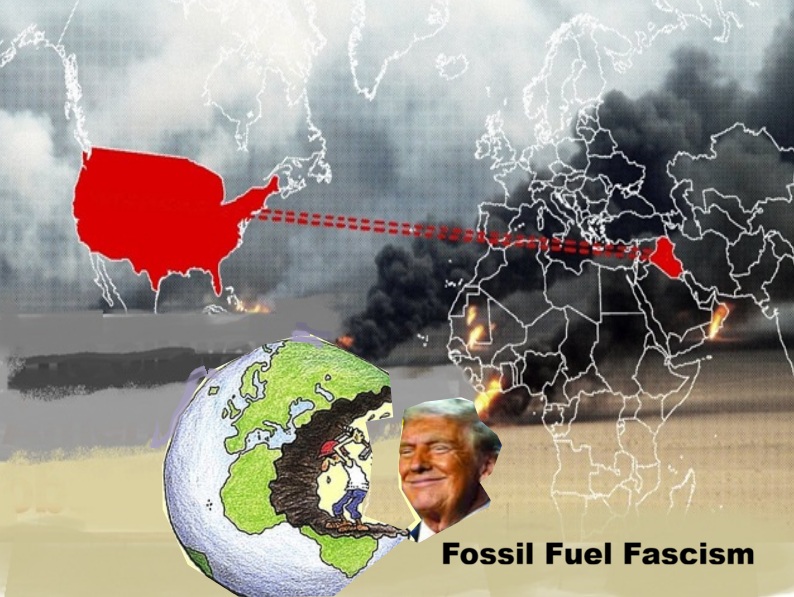
“………………………………………………………………………………………………………………………………………………………………………………………………………………………………………………………. I almost forgot to mention one more Trumpian set of acts of war, undoubtedly by far the most important and devastating of all: those he’s launched against planet Earth itself. I mean, we’re talking about the president who has done his — and this word couldn’t be more appropriate — damnedest to shut down wind farms of any sort, cut solar energy projects, and expand the burning of fossil fuels in just about every way imaginable, including by opening up 1.3 billion acres (no, that is not a misprint!) of U.S. coastal waters to further oil and natural gas drilling.
New York Times reporter Maxine Jocelow caught this Trumpian moment on Planet Earth perfectly in a recent piece on the “triumphant resurgence in Mr. Trump’s Washington” of climate-change denial. She summed up the Trumpian viewpoint this way: “Climate change is a hoax perpetrated by ‘leftist politicians.’ Fossil fuels are the greenest energy sources. More carbon dioxide in the atmosphere will be harmless.”……………………………………………
There really can’t be any question that this president is distinctly intent on nothing less than making war not just on specific nations like Iran, or on ships in the Caribbean Sea, or on anyone in or near the Strait of Hormuz, but on this very planet in every way imaginable……………………….
Defeat on Land, at Sea, and Anywhere Else Imaginable
Once upon a time, such wildly futuristic madness would have been left to the most dystopian of science-fiction novels — and undoubtedly not very popular ones at that, since such a plot and such a president would (once upon a time) have seemed far too unrealistic even for fiction. But now, thanks to President Donald J. Trump, the United States of America, in addition to all its other warring acts of recent months, is distinctly at war — and there’s no other adequate word for it — with Planet Earth (at least as a habitable place for future versions of us).
Someday, if anyone is still making TV series (since by then they’ll all undoubtedly be AI-created), I wonder if there will be one that young people, along with their parents, would be able to catch called not Defeat at Sea, but something far larger and more definitive like Defeat on Planet Earth. After all, we now have a president of the United States who seems ready not just to make war on Iran, but on more or less everything…………………………………
Trump and crew, while working as hard as they can to launch a thoroughly useless fleet of naval vessels, have also been doing their damnedest to heat this planet to the boiling point. He has literally decided to transform himself into a hell-on-earth president at a moment when renewable energy has beaten out coal as the primary source of energy globally for the first time ever.
…………………………………………………………………………………………………………………………………………………. Donald Trump, of course, is distinctly intent on making war on planet Earth (including, by recently making war on Iran, pouring yet more greenhouse gases into the atmosphere). War, after all, may be the world’s most efficient producer of such gases and the U.S. military, even in peacetime (which, unlike during his first term in office, is no longer Trump time), remains the largest institutional emitter of greenhouse gases on this planet. In the process, he’s doing his damnedest to take both his country and the planet down with him.
All too sadly, if he’s successful, American children of tomorrow, when they turn on their machines (whatever they may be), could witness not Victory, but Defeat at Sea, on Land, and Anywhere Else You Might Imagine. https://scheerpost.com/2026/05/19/the-president-of-peace-makes-war-on-the-planet/
Mirrors of Greed: Elon Musk, OpenAI and the Tech Brat Battle

19 May 2026 Dr Binoy Kampmark , https://theaimn.net/mirrors-of-greed-elon-musk-openai-and-the-tech-brat-battle/
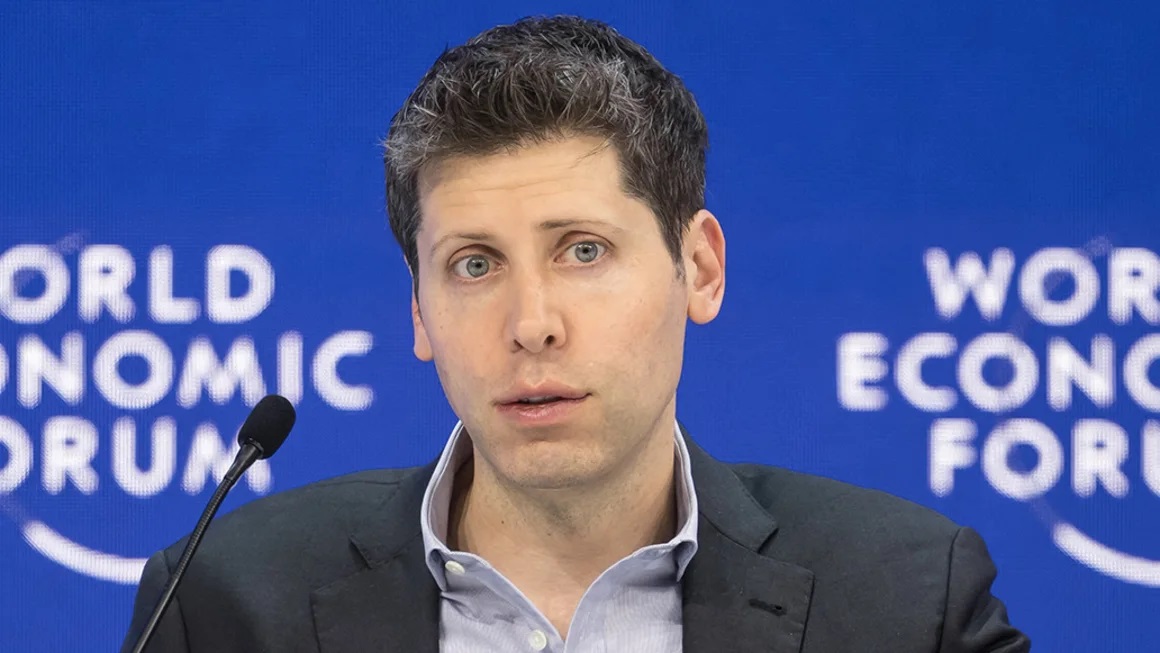
They are a disagreeable bunch, with disagreeable ideas to match. The querulous brats behind the drive for technological servility and plugged in stupidity were always going to scrap over which dystopian vision they most prefer. Elon Musk thought he was onto something hounding OpenAI and its current CEO Sam Altman for supposedly betraying one of those visions. In his $150 billion legal action, Musk alleged that Altman and OpenAI president Greg Brockman deceived him into investing in the company in its initial stages when salad green altruism was modish and humanity mattered. The litigation was a prong in a broader strategy to unseat Altman from OpenAI, sabotage the company’s $852 billion restructuring into a public benefit corporation and direct $134 billion to OpenAI’s non-profit foundation.
The deception centred on maintaining OpenAI as a non-profit entity and pursuing artificial intelligence (AI) ventures in ways beneficial to humanity. (When the tech brats have a stab at humour, they go in hard.) According to Musk, OpenAI had effectively stolen a charity. (Between 2015 and 2017, he had personally put $44 million into OpenAI, funds, he argues, that were essentially misappropriated when the company sloughed its non-profit skin.) In an introductory overview of the company from December 2015, the company badges itself a “non-profit artificial intelligence research company” with the object of advancing “digital intelligence in a way that is most likely to benefit humanity as a whole, unconstrained by a need to generate financial return. Since our research is free from financial obligations, we can better focus on a positive human impact.”
How things change. On May 18, a mere two hours was needed for a nine-jury member in Oakland, California to unanimously find against Musk, basing their decision on that most technical of grounds: the statute of limitations. This left two civil claims – breach of charitable trust and unjust enrichment – untested. Having left OpenAI’s board in 2018, Musk dithered till February 2024 to file suit. Musk claimed to have only discovered the company’s abandonment of its non-profit mission in 2022, when Microsoft showed its interest with an investment of $10 billion. OpenAI’s legal team argued that the pertinent events – the creation of a for-profit subsidiary in 2019 for instance and Microsoft’s initial injection of $1 billion that same year, were already matters of common knowledge. Time on the statute of limitations was running well before 2022. US District Judge Yvonne Gonzalez Rogers of the Northern District of California saw no reason to question the jury’s conclusion. “There’s substantial amount of evidence to support the jury’s finding, which is why I was prepared to dismiss on the spot.”
The trial was impressively ugly and amounted to an insult to the stout intelligence of the public whose welfare both parties claim to be protecting. The legal representatives from both sides jousted over respective views on AI and the credibility of the disputants. Musk’s lawyer, Steven Molo, pressed jurors to consider that several witnesses, including former OpenAI chief scientist Ilya Sutskever, doubted Altman’s candour, going so far as to find him mendacious. Altman had also conceded under cross-examination that he “told the occasional lie”. “Sam Altman’s credibility is directly at issue,” Molo crowed. “If you don’t believe him, they cannot win.”
OpenAI, Musk accusingly asserted, had wrongfully attempted to enrich investors and insiders at the expense of the non-profit. Along the way, it had failed to make AI safety a matter central to its operations. Microsoft, he further argued, had always known that OpenAI cared more about money than altruism. A personal journal entry penned by Brockman in November 2017 was also instructive, baldly revealing that OpenAI could not assert fidelity to its non-profit status if it intended becoming a benefit corporation months later. So it came to pass that Altman, Brockman and OpenAI were accused of the very same temptations, frailties and indifference to safety that could be found in Musk’s own conduct.
On the issue of safety and welfare, Musk’s own xAI, acquired by space and rocket company SpaceX, also part of the South African’s fiefdom of misrule, has drawn the attention of the European Commission and UK watchdog Ofcom over Grok, a product that has been used to create sexualised images. The combine arising from xAI and SpaceX could lead to an initial public offering that would surpass OpenAI in size, which sinks the scurrilous suggestion of altruism. Provided things go smoothly, the world’s first trillionaire might arise.
OpenAI was hardly going to leave Musk’s feeling of tech purity unchallenged. It was he, not OpenAI, who saw the shimmering dollar signs. Going back to 2017, he had floated the idea of a for-profit subsidiary with one caveat: he would have exclusive control. Failing this, he left the board in a huff. OpenAI’s attorney William Savitt suggested that Musk, having failed to “get his way at OpenAI,” filed his lawsuit only after establishing his own competing AI company in 2023. But most saliently, he waited too long to claim breaches of the founding agreement regarding the building of safe artificial intelligence for the benefit of humanity. “Mr Musk may have the Midas touch in some areas, but not in AI,” claimed Savitt.
OpenAI’s predatory reflexes will be boosted by the decision. The non-profit status in this field has been found wanting, and the scramble for profits given much encouragement in this most unprincipled of frontiers. “The decision is likely to reassure investors and the broader AI sector,” opines Sarah Kreps of the Tech Policy Institute at Cornell University, “because it avoids a potentially chaotic outcome that could have challenged OpenAI’s commercial structure, Microsoft partnership, and future fund-raising plans.”
This was by no means the first time Musk had taken to throwing a brief of anger against OpenAI. In March 2024, showing that intelligence can be authentically artificial, he filed a lawsuit citing a contract violation of a contract that did not exist. Using the misguided legal offices of Irell & Manella – the same firm that erroneously claimed on behalf of PETA that a monkey could hold copyright – Musk pursued what Techdirt’s Mike Masnick appropriately called a “vibes based” action. “Elon doesn’t have a contract with OpenAI which the company could have breached. And that’s kinda a problem in a breach of contract lawsuit.” This insuperable logic led Musk to abandon the lawsuit in June that year.
For Musk, the wells of indignation run deep. This is a man in the habit of losing or settling claims, be it with former Twitter executives and employees of the social platform now known as X, losing to investors in that same company for misleading public statements made during his untidy, often chaotic takeover, or having his lawsuit promptly dismissed against advertisers that exited that troubled platform. While such behaviour should draw scorn, those drawing benefit from his litigious pathologies – lawyers, in the main – can only be grateful. “In a lot of ways, he is just another businessperson asserting his rights,” says a credulous Shubha Ghosh, lawyer and law academic at Syracuse University. “I don’t think he’s abusing the legal system. Whether he uses it effectively, I’m not sure.” Wrong, certainly, on the first count.
Republicans should be worrying about millions of fools voting for treason and criminal war destroying the economy – Walt Zlotow.
Walt Zlotow West Suburban Peace Coalition Glen Ellyn IL, 18 May 26
It’s understandable the Chicago Tribune is concerned about the future of the Republican Party (Editorial: Republicans are preparing for the midterms. They should be worrying about the party’s future). Soon after its founding in 1847, the Trib championed creation of an anti-slavery party and its most eloquent spokesman, native son Abe Lincoln. Seven years later that led to founding of the Republican Party and eventual election of Trib favorite Lincoln in 1860.
One hundred seventy-two years on the Trib’s still favorite party is fundamentally opposed to every vestige of its historical legacy. The Trib urges Republicans to reflect on their party “whose historical brand is inextricably linked with patriotism” How did the Trib miss the Republican Party, under Donald Trump, destroyed every vestige of patriotism when it inspired an insurrection at the Capitol in 2021 to overturn the election. The tiny handful of Republican patriots like Liz Cheney and Adam Kinzinger who dared call out Trump’s treason were systematically purged from Republican Party. Trump, cheered on by nearly every Republican congressperson, then pardoned his 1,500 coup brigade who injured over 150 patriotic cops, five of whom died shortly afterwards from injury or suicide, trying to save American democracy from Trump’s treason.
Besides now being the party of treason, Trump’s Republican Party is now the party of senseless criminal war in Iran that, besides being lost with no exit strategy, is systematically degrading the world economy including America’s.
The Trib is anxious to find something of value in the Republican wrecking ball controlling the entire government with no check whatsoever. Alas, it’s not in the claim “There are plenty of rational folks who voted for Trump; 44% of Illinoisans are not fools. “Plenty of rational folks” are not words that befit the 56% to 44 % Illinois blowout against Trump. Every one of Trump’s 2,449,079 Illinois voters in 2024 were fools to vote for the only presidential candidate in US history who sought to destroy American democracy. And when each now forks over an extra 20 or 30 bucks to fill their gas guzzler due to Trump’s criminal war on Iran with no end in sight, they’ll likely ponder the wise words of a 1958 Elvis hit…”Now and then there’s a fool such as I.”
The Chicago Tribune, by spending 1,500 words seeking to salvage the Republican Party without mentioning the Trump GOP treason and criminal war on Iran , may be the biggest fool of all.
5 Stocks That Benefit From the Government’s $94 Million Spending Spree on Nuclear Reactors.

The Trump administration is giving out money to small
nuclear reactor projects, and a handful of public companies should benefit.
The Energy Department announced $94 million worth of cost-sharing grants to
build out America’s nuclear infrastructure.
The government will pay for
up to 50% of the projects. It’s the second such grant given out to
nuclear players. The first one went to the Tennessee Valley Authority, a
federally controlled utility, and Holtec, a privately held nuclear operator
that’s building small reactors. Holtec is expected to go public sometime
this year.
The government’s involvement is meant to fast-track a U.S,
nuclear renaissance, which has moved slowly so far because most private
companies don’t want to take the financial risk.
Barrons 15th May 2026,
https://www.barrons.com/articles/nuclear-reactor-stocks-e23d92f1
Trump Describes Executions to Kids, While MAGA Bans Lessons Causing “Discomfort”

Trump’s performance of masculine bravado and attacks on transgender athletes were not separate from his broader message — they were central to it. Trump has presented the revival of the Presidential Fitness Test not simply as a health initiative, but as part of rebuilding a “tougher,” more militaristic national character. Within that worldview, rigid masculinity becomes a political ideal associated with aggression, control, and toughness, while vulnerability, peace, or gender nonconformity are treated as signs of weakness and decay.
Trump’s lesson to children was to fear difference, obey power, and treat vulnerable people as threats.
By Jesse Hagopian , Truthout, May 16, 2026, https://truthout.org/articles/trump-describes-executions-to-kids-while-maga-bans-lessons-causing-discomfort/?utm_source=Truthout&utm_campaign=fcdf48b92f-EMAIL_CAMPAIGN_2026_05_16_02_57&utm_medium=email&utm_term=0_bbb541a1db-fcdf48b92f-650192793
Seated behind the Resolute Desk in the Oval Office in early May, Donald Trump delivered a disturbing lecture to a group of children huddled around him — most of them not yet even teenagers. They had been brought to the White House for what was supposed to be a celebratory event marking the reinstatement of the Presidential Fitness Test, dressed in brightly colored T-shirts bearing the government emblem of the rebooted program.
Flanked by a group including cabinet secretaries Linda McMahon, Pete Hegseth, and Robert F. Kennedy Jr., Trump turned the White House into his schoolhouse. Casting himself as a master teacher, he launched into an improvised lesson — part contemporary issues, part history, part geography, and all MAGA mythology.
During his lesson, Trump exposed a central contradiction at the heart of his politics. States and school districts across the country have enacted MAGA education policies — such as the Florida Stop WOKE Act — that prohibit teaching content that might cause students “guilt, anguish, or other forms of psychological distress.” But Trump himself showed no such restraint. During what amounted to an advanced course in authoritarian education, he immersed children in a grotesque curriculum of graphic executions, nuclear annihilation, and the threat of entire societies being wiped out — paired with nationalist triumphalism and the scapegoating of transgender people.
The premise of the event itself rested on the fear that the U.S. has become weak and soft, which could only be remedied by making the country aggressively masculine again. Trump framed the return of the Presidential Fitness Test not merely as a health initiative, but as part of a broader struggle for national strength and power. Warning in a statement to the press that declining youth fitness weakens “our economy, military readiness, academic performance, and national morale,” he cast physical toughness as a prerequisite for a nation prepared for war.
This is not education. It is spectacle, coercion, indoctrination, and the normalization of violence.
Teaching Fear
In one of the most disturbing moments of the event, a reporter asked Trump whether Iranian protesters, with U.S. support, could topple their government. He answered by explaining, in vivid detail, how those protesters might be massacred: “You can have 200,000 people protesting … and when they start shooting them right between the eyes, and you see a guy fall, and another one fall…”
Then Trump raised his hand to his face, pressing his index finger between his brows, marking the place where the bullet would strike. Recalling protests led by Iranian women, he described a demonstrator being shot by snipers as “a woman dropped dead with a bullet right there,” repeatedly pointing between his eyes to show where the bullet struck. He described the panic that could spread through the crowd as “another woman dropped” and protesters began to flee. A boy to his right pursed his lips as Trump narrated the murders. A girl to his left appeared visibly jarred — her eyes widened, her expression tense — as the adults around her stood by silently.
Educators and child psychologists have long warned that exposing children to graphic violence without context or emotional grounding can create anxiety, confusion, and fear. The National Association of School Psychologists advises adults discussing violence with children to keep explanations “developmentally appropriate” and avoid exposing them to “vengeful, hateful, and angry comments.” Trump did the opposite. Rather than helping children process violence with care and understanding, he used graphic imagery to normalize brutality and reinforce the logic of power.
Trump did not stop at describing executions. He escalated from scenes of political murder to warnings of nuclear catastrophe.
He did briefly acknowledge the inappropriateness of his comments, saying, “You might be too young for this,” before warning the children that “you can’t let a bunch of lunatics have a nuclear weapon or the world will be in a lot of trouble.” As Desi Lydic quipped on “The Daily Show”: “No, they’re not too young. I’m sure they’ve already seen the ‘Paw Patrol’ episode where they drop a ballistic missile on Humdinger.”
Organizations focused on child development emphasize that young people need guidance and context when confronting frightening world events. Child advocacy organization Defending the Early Years (DEY) notes that young children “hear headlines and snippets of conversations and are often left to make sense of confusing situations without proper guidance or facilitation.” Rather than ignoring difficult events — or exposing children only to the most disturbing fragments — DEY emphasizes the need for “age-appropriate conversations … so they can understand what is happening.”
A responsible lesson on nuclear weapons, for example, might begin by asking students what they already know and what questions they have. It might include a brief, factual explanation of what nuclear weapons are, paired with age-appropriate historical context — such as the global movements that have worked to limit or eliminate them. Students might examine how ordinary people have organized against nuclear war, or consider what actions communities can take to reduce the risk of these weapons being used.
Rather than helping children process difficult realities, Trump took it even further: “Iran with a nuclear weapon … maybe we wouldn’t all be here right now.”
He amplified the dread by asking the kids to imagine a world in which entire regions are destroyed, and where they themselves would not survive: “I can tell you, the Middle East would have been gone. Israel would have been gone. They would have trained their sights on Europe, first, and then us.”
Counselor Nathaniel N. Ivers notes that fear of nuclear devastation can have a lifelong impact on children. During the Cold War, studies found that children and caregivers often experienced heightened anxiety about nuclear threats — and that when adults expressed more fear, their children tended to become more anxious as well.
Beyond inflicting psychological trauma, Trump’s discussion of nuclear apocalypse also lacked the historical context students would need to understand how the past shapes present conflicts. The United States remains the only country to have ever used nuclear weapons in war — dropping atomic bombs on both Hiroshima and Nagasaki at the end of World War II, killing more than 200,000 civilians. Trump, of course, was not interested in allowing students to consider why many around the world fear the U.S. use of nuclear weapons more than any other country.
Nor did Trump mention the long history of U.S. intervention in Iran itself. As historian Stephen Kinzer explains, after World War II, the people of Iran rose up to achieve a brief period of democracy and “They did something that the United States never likes: They chose a leader who wanted to put the interests of his own country ahead of the interests of the United States.” The leader they elected was Prime Minister Mohammad Mosaddegh, who moved to nationalize the country’s oil industry. In response, the United States and Britain orchestrated the 1953 coup that overthrew him. As Kinzer put it, “this was not just an attack on one person, but an attack on democracy.”
But Trump didn’t teach these truths that could help children understand how those in power have misused it. And just as Trump taught children to fear “enemies” abroad, he also taught them to view transgender people at home as threats to the social order he was trying to defend. Railing against gender-affirming care for trans youth, Trump invoked “transgender mutilization” — mangling the word he was trying to weaponize — in an apparent attempt to frighten the children before abruptly catching himself and saying, “Don’t listen to this, kids.” Then, reversing his decision to have the children disregard him, Trump looked into the eyes of the youth and declared, “I’ve never had one person say it’s important we allow women to be challenged by men in women’s sports…”
Moments later, he resumed the lesson. Turning to one of the boys beside him and slapping him on the arm, Trump said, “I don’t think we are gonna have to worry about you.” He then asked, “Are you a strong person?” When the boy replied yes, Trump followed up: “Do you think you can take me in a fight?”
Again, aggression was the lesson.
Trump’s performance of masculine bravado and attacks on transgender athletes were not separate from his broader message — they were central to it. Trump has presented the revival of the Presidential Fitness Test not simply as a health initiative, but as part of rebuilding a “tougher,” more militaristic national character. Within that worldview, rigid masculinity becomes a political ideal associated with aggression, control, and toughness, while vulnerability, peace, or gender nonconformity are treated as signs of weakness and decay.
Trump’s rhetoric drew on a long bipartisan tradition in U.S. politics in which organized sports and physical fitness were treated not as recreation, but as training grounds for masculine discipline, war, and imperial power. Theodore Roosevelt’s celebration of “The Strenuous Life” warned against national “softness” and argued that athletics cultivated the “virile virtues” needed by a colonizing nation. As sports historian Dave Zirin wrote in A People’s History of Sports in the United States, Roosevelt saw “masculinity and Muscular Christianity as symbiotic with a nation poised to conquer.”
Decades later, Democratic President John F. Kennedy echoed similar fears in his essay “The Soft American,” arguing that the U.S.’s “struggles against aggressors throughout our history have been won on the playgrounds and corner lots and fields of America,” and that military victories “only come from bodies which have been conditioned by a lifetime of participation in sports.” Kennedy’s expansion of the Presidential Fitness program, established under President Dwight D. Eisenhower, was explicitly tied to Cold War anxieties about national decline, military readiness, and the U.S.’s ability to compete with global rivals. Trump’s revival of the Presidential Fitness Test tapped directly into that tradition — one that links fears of national decline to nationalism, militarism, and rigid ideas about masculinity.
“Everyone Is Welcome Here” vs. MAGA Hypocrisy
Taken together, Trump’s lesson was about teaching children who and what to fear — foreign enemies overseas and vulnerable communities at home — while deflecting from the real dangers of war, bigotry, and oppression. As Rethinking Schools argues, education should help students “see injustice, imagine possible remedies, and develop the tools to enact them.” Trump’s lesson taught the opposite: fear difference, obey power, and treat vulnerable people as threats.
For years, Trump and his allies — especially writer Christopher Rufo — have argued that schools should avoid teaching material that is “divisive,” “negative,” or emotionally distressing. Trump and his allies have described lessons on racism and slavery as “toxic,” even likening such teaching to “child abuse.”
The hypocrisy is rank.
In Idaho, middle school teacher Sarah Inama was ordered in January 2025 to take down a classroom poster that read, “Everyone is welcome here.” That demand was the result of Idaho’s 2021 “divisive concepts” law, which restricts how teachers can discuss race, identity, and inequality in schools. In that environment, a message affirming the lives of all children was recast as subversive indoctrination meant to sow division. Across the country, teachers have been reprimanded for displaying Pride flags, forced out of their jobs for acknowledging systemic racism, or warned against teaching that slavery was wrong, for fear that it might make students uncomfortable.
But describing people being shot “right between the eyes” is comforting? Imagining nuclear annihilation prevents psychological distress? Celebrating bombing campaigns is reassuring?
In this upside-down moral universe, empathy is dangerous, human dignity is controversial, and truth itself is suspect. What is condemned is not harm, but the effort to understand and end it.
And yet, there is resistance.
At first when Sarah Inama was told to take down her classroom poster, she complied. But after a student asked if taking it down meant that not all students were welcome, the meaning of the order became undeniable — and she put the poster back up.
After rehanging it, she wrote to her principal that the request “goes against everything that we work towards and the type of community that we dream to have at our school.”
“We (help students learn) by making them feel safe,” she continued. “We do that by making sure they have food. We do that by building relationships with them. And, most importantly, we do that by making sure that they know that they are all welcome there and we want them here … With that being said, I have put my sign back up.”
In putting the sign back up in her classroom, Inama posed a challenge to us all: Will we insist that students deserve classrooms that tell the truth, nurture their humanity, and equip them to challenge injustice — or will we allow fear and violence to become the curriculum
Jesse Hagopian is a Seattle educator, the director of the Zinn Education Project’s Teaching for Black Lives Campaign, an editor for Rethinking Schools, and the author of the book, Teach Truth: The Struggle for Antiracist Education. You can follow him at IAmAnEducator.com, Instagram, Bluesky or Substack.
128 years of US exploitation, degradation of Cuba continues on steroids – Walt Zlotow
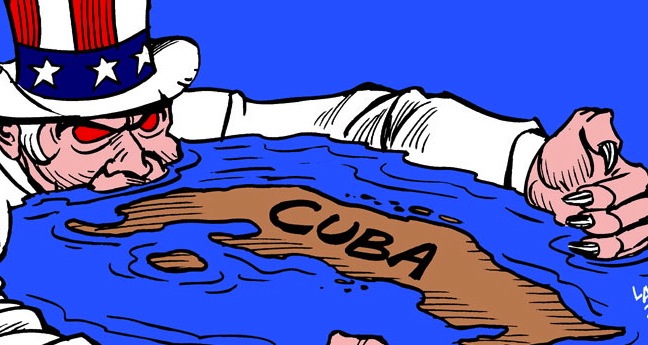
Walt Zlotow West Suburban Peace Coalition Glen Ellyn IL, 16 May 2026, https://theaimn.net/128-years-of-us-exploitation-degradation-of-cuba-continues-on-steroids/
One must go back to 1898 for the last time the US was not exploiting Cuba and its people to benefit rapacious US capitalism and organized crime. That year the US cooked up fairy tale about Spain blowing up the US Maine, sent to Havana Harbor to intimidate Cuba’s Spanish ruler. The Maine did blow up but from an accidental internal explosion, not a Spanish mine. Those 261 sailors could not to die in vain so President McKinley and his war party blamed Spain in order to declare war, kick Spain out of the Americas and take over Cuba for US exploitation.
But nothing in the previous 126 years compares to the diabolical cruelty, including death, the US has inflicted upon Cuba by President Trump and his bloodthirsty Secretary of State Marco Rubio.
This is not exaggeration. Need a lifesaving operation in Cuba under the Trump, Rubio oil blockade? Faggedaboudit. Much medical care is unavailable in oil starved Cuba when the lights go dark. Food and life sustaining supplies are becoming scares as farmers and merchants cannot get their wares to the people with a transport system largely shut down. Nearly a fifth of Cubans have fled the Trump, Rubio regime change operation.
Trump glories in their death and destruction he’s unleased. “THERE WILL BE NO MORE OIL OR MONEY GOING TO CUBA – ZERO! I strongly suggest they make a deal, BEFORE IT IS TOO LATE.” Trump is simply expanding in more grotesque terms US policy to degrade Cuba into submission going back to 1960. A secret State Department memo back then under Eisenhower promoted overthrowing Castro thru “a line of action, while adroit and inconspicuous as possible, denies money and supplies to Cuba to bring about hunger, desperation and overthrow of the Castro government.” Trump simply dropped the “adroit and inconspicuous” fig leaf.
Ironically, the first US embargo in Cuba was good for the Cuban people. In April, 1958, Eisenhower imposed an arms embargo on the Batista regime. The US had been supporting Batista’s murderous rule for 25 years to insure his support of US economic control, both legal and criminal that enriched US capitalists and Mafia enterprises to the detriment of the Cuban people. Eisenhower didn’t have an epiphany to help the Cuban people. He simply saw the inevitable triumph of Castro’s revolution and sought to curry favor with its eventual rulers.
Twenty months later Castro prevailed, Batista fled and Cuba finally ended 62 years of US cruelty and exploitation. Not quite. Within year the US imposed Cuban embargo 2.0 designed not to facilitate the inevitable revolution but to destroy it. Sixty-six years on, with the entire world community except Israel voting year after year in the UN for the US to stop, America’s endless lust to crush the Cuban revolution continues apace. And under the depraved Trump, Rubio oil embargo, it has become a monumental war crime against the 11 million sorrowful Cuban souls.
After Offering ‘No Tangible Concessions’ in Iran Peace Talks, Trump Issues Latest Violent Threat
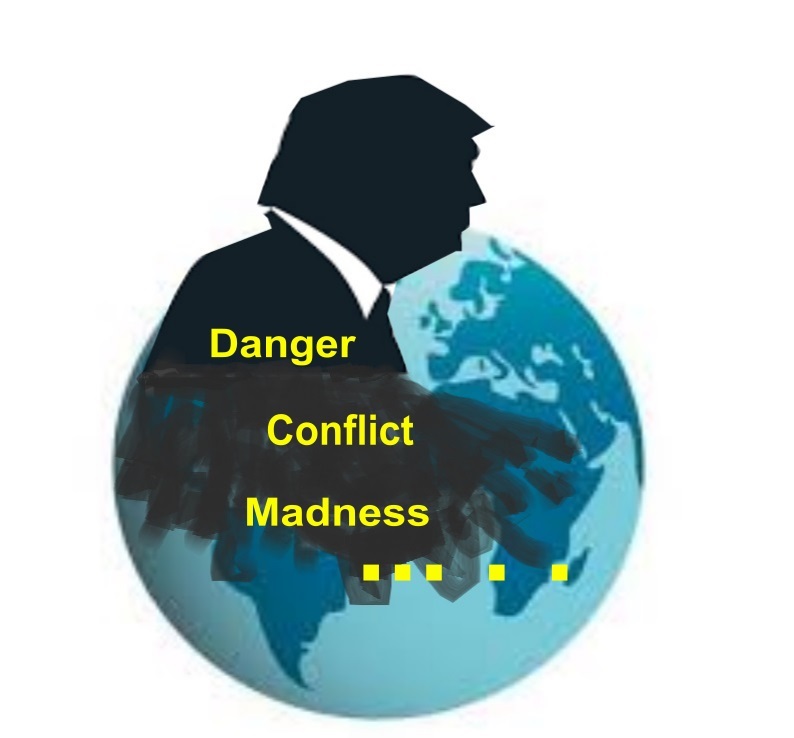
“The only realistic path to a diplomatic breakthrough would require Washington to engage more directly with the structure and substance of the Iranian proposal itself,” said a national security expert.
Julia Conley, May 17, 2026, https://www.commondreams.org/news/trump-iran-nuclear-talks
With the economic impact of the war on Iran linked to President Donald Trump’s plummeting approval rating, the president issued his latest threat to destroy the Middle Eastern country Sunday as he demanded negotiators “get moving, FAST” to end the conflict the US and Israel began by choice in February.
“For Iran, the Clock is Ticking,” said the president in a Truth Social post, adding that if a peace deal is not reached soon, “there won’t be anything left of them. TIME IS OF THE ESSENCE!”
Trump rejected Iran’s latest peace proposal last week; the country has reportedly offered significant concessions on its uranium enrichment, but seeks to have separate nuclear talks after achieving peace and reaching a deal to reopen the Strait of Hormuz, which the Iranians effectively closed in retaliation for the US-Israeli attacks.
Since launching the conflict, Trump has demanded the dismantling of Iran’s missile arsenal as well as its nuclear program, which Iran has said is not for military purposes, and has called for the country to cut ties with its regional allies.
Iran’s Mehr news agency said Sunday that Trump had offered “no tangible concessions” in his response to the Iranians’ latest proposal.
“The United States,” said the news outlet, “wants to obtain concessions that it failed to obtain during the war, which will lead to an impasse in the negotiations.”
Trump told Fox News in Beijing over the weekend that the Iranians are “crazy, and you know what? Because of that, they cannot have a nuclear weapon,” explaining why he viewed it as “unacceptable” for nuclear talks to take place separately after a peace deal is brokered.
Trump reportedly spoke to Israeli Prime Minister Benjamin Netanyahu Sunday about the possibility of renewing strikes on Iran, which would break a ceasefire that was reached more than a month ago.
Danny Citrinowicz, a senior researcher at the Institute for National Security Studies, said Sunday that “the only realistic path to a diplomatic breakthrough would require Washington to engage more directly with the structure and substance of the Iranian proposal itself.”
“Iran’s priorities remain consistent: ending what it views as economic siege conditions, reopening maritime access and reducing pressure in the Gulf, negotiating an end to the broader conflict, and only afterward addressing the nuclear issue,” said Citrinowicz. “At the present moment, it is difficult to see the Iranian leadership agreeing to any framework that does not meaningfully engage with those core demands
As with Trump’s earlier threats of violence, including one in April in which he declared that Iran’s entire civilization would die, “never to be brought back again,” Iranian officials said the president’s latest comments—which followed his posting of an image of himself on a military ship accompanied by the words, “It was the calm before the storm”—would not be tolerated.
A spokesperson for Iran’s armed forces, Abolfazl Shakarchi, told Mehr that “repeating any folly to compensate for America’s disgrace in the Third Imposed War against Iran will result in nothing but receiving more crushing and severe blows.”
Reporting for Al Jazeera, correspondent Almigdad Alruhaid said that the “kind of language” displayed by Trump on Sunday “is not acceptable here in Tehran. They are projecting defiance rather than [giving] an immediate response to this kind of rhetoric.”
“Behind all of this rhetoric, there is awareness that the diplomatic window right now is narrowing,” said Alruhid.
Meanwhile, US Sen. Lindsey Graham (R-SC) urged Trump to “hurt them more” in order to force a deal, calling on the president to go through with bombing Iran’s energy infrastructure as he’s threatened to in recent months.
“The reason why Trump didn’t do this during the war—despite threatening it—was because he realized Tehran would retaliate and take out the energy infrastructure in the [Gulf Cooperation Council] states,” said Trita Parsi, executive vice president at the Quincy Institute for Responsible Statecraft. “This would lead to a far worse oil crisis—one rooted in production problems, not just a bottleneck in the Persian Gulf.”
“The global economy would be thrown into a deep recession. Fuel shortages would lead to food shortages worldwide. Trump’s presidency would be destroyed,” he said. “None of this matters to Lindsey. He’ll burn the entire planet as long as he gets his war. Trump’s biggest mistake has been to listen to Lindsey and his allies.”
Pete Hegseth “War Crimes Secretary” Called Out
May 18, 2026 ScheerPost Staff, https://scheerpost.com/2026/05/18/pete-hegseth-war-crimes-secretary-called-out/
As the Trump administration’s war on Iran spirals deeper into civilian bloodshed and media complicity, activists with CODEPINK are demanding answers that Washington and corporate media seem determined to avoid. In this explosive conversation with ScheerPost, CODEPINK organizing director Danaka Katowicz lays out the movement’s growing campaign to force Defense Secretary Pete Hegseth to answer for the bombing of a girls’ school in Minab, Iran — an attack that reportedly killed more than 168 people, most of them children.
But this interview goes far beyond one atrocity. It exposes a collapsing media system where billionaires, mergers, propaganda, AI warfare, and state violence increasingly operate hand-in-hand. From the Pentagon’s alleged use of AI targeting systems to CNN’s responsibility to confront war crimes instead of sanitizing them, Katowicz argues that ordinary people can no longer afford to remain spectators. As Gaza burns, Iran bleeds, and dissent is criminalized, CODEPINK says the answer is not despair — it’s organizing.
“Put Him on the Hot Seat”: CODEPINK Demands Answers for Iran School Bombing
The anti-war group CODEPINK is escalating its campaign against Defense Secretary Pete Hegseth after the bombing of a girls’ school in Minab, Iran reportedly killed over 168 civilians — many of them children — during the opening phase of the Trump administration’s war on Iran.
Speaking with ScheerPost, CODEPINK organizing director Danaka Katowicz accused Hegseth and the Pentagon of evading accountability while major media institutions normalize mass civilian death.
According to Katowicz, Congress immediately demanded answers after the strike: Was AI used to select the target? What civilian mitigation procedures existed? Why was a girls’ school bombed in the first place? But instead of transparency, she says the administration stonewalled.
“Hegseth dodged those questions. He never answered them.”
That refusal sparked CODEPINK’s “Put Hegseth on the Hot Seat” campaign — a public push demanding that major outlets use their access to confront the defense secretary directly on-air.
Katowicz blasted the growing consolidation of corporate media, arguing that mergers and billionaire influence are turning news outlets into extensions of state power rather than institutions of accountability.
“The news is not even the news anymore. It’s just propaganda explaining why all these bad things are happening and why it’s actually fine.”
Throughout the interview, the conversation returned repeatedly to the alleged role of AI-assisted warfare. Joshua Scheer noted that similar targeting systems used in Gaza appear to have migrated into the Iran war — systems critics argue remove human judgment from life-and-death decisions.
The result, he argued, has been “war crime on top of war crime.”
Katowicz said CODEPINK’s disruptions inside congressional hearings are designed not only to confront power directly, but to show ordinary people that resistance is still possible.
“People see that power is being challenged in their face. And that means a lot to people.”
The organization says its long-term strategy goes beyond Washington. Through local chapters, labor organizing, coalition work, and direct action, CODEPINK hopes to build a broader anti-war movement capable of challenging what Scheer described as a “billionaire fascist ecosystem” where media, tech, finance, and militarism increasingly operate together.
Katowicz emphasized that activism cannot remain confined to Congress or social media outrage.
“The revolution isn’t just going to happen in D.C.”
The interview also highlighted CODEPINK’s expanding campaigns around Gaza, Palestine solidarity, labor organizing, and demands for the release of detained Palestinian doctor Hussam Abu Safiya.
As public opposition to endless war grows, CODEPINK argues the real battle may now be over whether Americans can still distinguish journalism from propaganda — and whether ordinary people are willing to move from outrage to organized resistance.
CODEPINK is demanding that CNN “put Hegseth on the hot seat”
After Defense Secretary Pete Hegseth refused to answer congressional questions about the bombing of a girls’ school in Minab, Iran that reportedly killed 168 people, most of them children. The campaign accuses both the Pentagon and corporate media of shielding war crimes from public accountability while demanding journalists confront Hegseth directly on-air about civilian deaths, AI targeting systems, and America’s expanding wars.
As the death toll from America’s war on Iran continues to rise, CODEPINK activists are escalating direct confrontations with Defense Secretary Pete Hegseth, accusing the Trump administration of enabling war crimes while corporate media looks the other way. During a fiery disruption of a congressional hearing, activists denounced Hegseth as a “War Crimes Secretary,” demanding answers for the Minab school massacre, alleged AI-assisted targeting of civilians, and what they describe as a criminal war machine operating with total impunity.
I end with Hegseth’s own words and hypocrisy
“If you’re doing something completely unlawful and ruthless, there is a consequence for that. That’s why the military says it will not follow unlawful orders from the commander-in-chief. There’s a standard, an ethos, a belief that we are above the kinds of actions carried out by our enemies.”
1 This Month

To see nuclear-related stories in greater depth and intensity – go to https://nuclearinformation.wordpress.com
-
Archives
- September 2026 (184)
- August 2026 (330)
- July 2026 (355)
- June 2026 (287)
- May 2026 (306)
- April 2026 (356)
- March 2026 (251)
- February 2026 (267)
- January 2026 (308)
- December 2025 (358)
- November 2025 (359)
- October 2025 (375)
-
Categories
- 1
- 1 NUCLEAR ISSUES
- business and costs
- climate change
- culture and arts
- ENERGY
- environment
- health
- history
- indigenous issues
- Legal
- marketing of nuclear
- media
- opposition to nuclear
- PERSONAL STORIES
- politics
- politics international
- Religion and ethics
- safety
- secrets,lies and civil liberties
- spinbuster
- technology
- Uranium
- wastes
- weapons and war
- Women
- 2 WORLD
- ACTION
- AFRICA
- Atrocities
- AUSTRALIA
- Christina's notes
- Christina's themes
- culture and arts
- Events
- Fuk 2022
- Fuk 2023
- Fukushima 2017
- Fukushima 2018
- fukushima 2019
- Fukushima 2020
- Fukushima 2021
- general
- global warming
- Humour (God we need it)
- Nuclear
- RARE EARTHS
- Reference
- resources – print
- Resources -audiovicual
- Weekly Newsletter
- World
- World Nuclear
- YouTube
-
RSS
Entries RSS
Comments RSS
 nuclear-news