The Dream of NuScale Small Nuclear Reactors Hangs in the Balance

Wired, 27 Feb 23
A cluster of reactors that are just 9 feet in diameter is supposed to start a nuclear energy resurgence. Mounting costs may doom the project.
JORDAN GARCIA, A deputy utilities manager in Los Alamos, New Mexico, is facing an energy crunch that is typical in the American West. For decades, the county-run utility relied on a cheap and steady mix of coal and hydroelectric power. But the region’s dams are aging and drought-parched, and its coal plants are slated to retire.
The county is aiming to fully decarbonize its grid by 2040, and the city has been tapping more solar lately, but batteries are arriving slowly, and Garcia worries about heat waves that strain the grid after the sun goes down. Wind power? He’d take more of it. But there aren’t enough wires stretching from the state’s windy eastern plains to the mesa-top community. “For us it’s pretty dire,” he says.
For the past few years, Garcia has been counting on a unique nuclear experiment to come to the rescue. In 2017, Los Alamos signed up to join a group of other local utilities as an anchor customer of the first small modular reactors, or SMRs, in the US, created by a company called NuScale. The design, which calls for reactors only 9 feet in diameter, had never been built before, but the initial cluster planned in Idaho Falls, Idaho, was promised to be much cheaper than a full-scale reactor and to offer affordable carbon-free energy 24/7.
To Garcia, this felt like a homecoming. Los Alamos, a town with the motto “Where discoveries are made,” is the birthplace of the atom bomb, and experimental reactors ran not far from downtown for much of the 20th century. But it had never actually used nuclear power to keep the lights on.
This month, Los Alamos and other local utilities across the West were facing a weighty decision: whether to pull the plug on their nuclear dream. NuScale had informed members of the group, Utah Associated Municipal Power Systems, or UAMPS, that the estimated costs of building the six 77-MW reactors had risen by more than 50 percent to $9.3 billion. For Garcia, that translated into a jump in the cost of energy from $58 to $89 per megawatt-hour.
…………… Without extra subsidies from the new Inflation Reduction Act—on top of $1.4 billion already committed to the project by the US Department of Energy—the price to energy users in places like Los Alamos would have doubled.
…………. The project’s power output is only 20 percent subscribed, and UAMPS says it will need to reach 80 percent for planning and construction to proceed next year.

Many a “nuclear renaissance” has fizzled.
…………….. Only two [large nuclear] reactors are being built in the US: a pair of 1100-MW units at the Vogtle plant in Georgia, now seven years delayed and $20 billion over their $14 billion budget.
NuScale hopes its smaller reactors can avoid that fate……… Last month, the company was the first of dozens of companies working on SMRs to have a design approved by US regulators. That makes NuScale first in the race to leap from a “paper napkin” reactor, as critics sometimes deride SMRs, to a real one, though the Idaho project involves a revised design that will need its own approval.
The project has hit roadblocks before. It began with 36 utilities signed on, but that number has fluctuated and dropped to 27 last year. In 2020, several municipal utilities dropped out in response to a construction delay and cost increases. Some later rejoined the project after the US Department of Energy upped its commitment to offset some of the costs.
Critics say those price revisions are a sign SMRs are heading down the same path as projects like Vogtle. For nearly a century, the nuclear power industry’s mantra was that building bigger plants would drive down costs. While existing plants aged and new construction withered, SMR companies began promoting a different philosophy, says David Schlissel, an analyst at the Institute for Energy Economics and Fiscal Analysis, claiming that constructing many small reactors would teach builders how to make them more cheaply.
But the evidence for progress is flimsy, says Schlissel, who notes that his 50-year career has spanned many a “nuclear renaissance” that fizzled. When that philosophy was applied in France, where dozens of reactors were built in the 1980s, costs still increased. Claims that “modularity” will help make construction construction more efficient are also suspect, he adds. The new Vogtle reactors involved nearly 1,500 “modular” components that were largely constructed offsite.
Schlissel also believes that NuScale’s current estimates are rosy because they rely on the approval of its newer design that uses less steel, one of the materials driving the cost increases. But regulators may not back that approach, he says. Towns should get out while they can, he advises, before costs climb higher still, and seek out alternatives like geothermal and battery storage. “Let the buyer beware,” he says.
……………….. officials in Morgan, Utah, a small town in the Wasatch Mountains north of Salt Lake City, decided to make a quick exit from the project…….
This year, the city realized it had new alternatives to the rising costs of nuclear power. While the Inflation Reduction Act is expected to help offset the costs of the Idaho plant, it also includes funds to help rural communities start their own energy projects. Bailey wants the city to become more self-reliant, installing its own solar panels and batteries that reserve power overnight.
In this round, Morgan was the only defector, though another Utah city, Parowan, reduced its commitment from 3 MW to 2 MW—just enough to cover the loss of its coal power. But the new agreement with utilities, negotiated during a two-day meeting with UAMPS members this winter, sets the project under a ticking clock. It includes requirements that the price hold steady at $89 per megawatt-hour, and—most worrying to utilities that want the project to succeed—that the project be at least 80 percent subscribed by next year. If it doesn’t hit that threshold, towns will get a refund on most of their expenses so far.
At this point, the utilities have sunk relatively little of their own money into the project, but that will change in 2024 as the project begins to seek site-specific building approvals followed by actual construction. To get the project fully subscribed, the group is talking with utilities elsewhere in the Northwest, where NuScale is competing with other SMR startups, including the Bill Gates–backed TerraPower, which recently signed a feasibility agreement with PacifiCorp, a private utility. Webb of UAMPS says he is optimistic about where the negotiations are headed.
…………………….. For now, the Los Alamos county council voted to formalize a long-planned increase of their share of the NuScale plant’s power, from 1.8 MW to 8.6 MW. Garcia hopes it will help encourage other utilities to take a chance on sparking a nuclear renaissance. https://www.wired.com/story/the-dream-of-mini-nuclear-plants-hangs-in-the-balance/—
Canada’s Nuclear Waste Management Organization looks to First Nations to back waste storage, AND small nuclear reactors

Ontario sites short-listed for nuclear waste storage, The organization developing a place to store spent nuclear fuel in Canada has settled on two potential sites in Ontario. The move rules out 20 other potential sites across Canada, including three in northern Saskatchewan.
The Nuclear Waste Management Organization recently announced the Wabigoon Lake Ojibway Nation-Ignace area in northwestern Ontario, and the Saugeen Ojibway Nation-South Bruce area in southern Ontario, are both under consideration.
“These communities are now working through their timelines to determine willingness,” Russell Baker, manager of media relations for the NWMO, said in an e-mail.
Baker said the NWMO hopes to settle on one of the two Ontario sites by the fall of 2024, but only “with informed and willing hosts, where the municipality, First Nation and Métis communities are working together to implement it.”
Disposing of spent nuclear fuel has been an issue for the nuclear industry for decades. A variety of countries, including Canada, are looking at deep geological repositories, where the waste can be safely stored for thousands of years within stable rock formations, like the Precambrian Shield. Finland is already building one.
Back in 2010, the NWMO announced there were 22 potential sites for underground storage across Canada, including sites near Pinehouse, English River First Nation, and Creighton, in northern Saskatchewan.
According to Guy Lonechild, executive director of the First Nations Power Authority (FNPA), coming up with a shortlist of potential sites is another step.
“There were some previous sites looked at in northern Saskatchewan but there’s been a lot of time and energy put into a deep geological repository in the province of Ontario. And those are the two viable options that that we would support for further study,” Lonechild, who is also a former FSIN chief, said.
Lonechild added the FNPA has been looking seriously at the possibility of Small Modular Nuclear Reactors (SMNR) for Indigenous and northern communities for several years.
……………. However, even though SMR’s are relatively small, the cost could easily be a billion dollars or more. Which is why FNPA would be looking for partnerships to help Indigenous communities get involved.
“So it is going to take a significant amount of capital. And so we’re looking at developing consortium groups to participate on an equity basis.”
………………….. “The only way we’re going to get there is if First Nations that are informed, that give free prior informed consent. And they identify ways that they want to participate in, in clean energy jobs and in the nuclear industry,” he said.
More Evidence Emerges That US Wanted Russia to Invade

February 24, 2023
In the past year, additional proof has emerged proving the West’s provocation of Russia to give it its “Vietnam” in Ukraine.
Consortium News on Feb. 4, 2022 warned that the U.S. was setting a trap for Russia in Ukraine, as it had in Afghanistan in 1979 and Iraq in 1990, to provoke Russia to invade Ukraine to provide the pretext to launch an economic, information and proxy war designed to weaken Russia and bring down its government — in other words, to give Russia its “Vietnam.” Twenty days later Russia invaded.
One month later, President Joe Biden confirmed that a trap had indeed been set, as reported by Consortium News on March 27, 2022, republished here today. The evidence that the U.S. wanted and needed Russia to invade as cause to launch its economic, information and proxy wars was clear:
- The U.S. backed a coup in 2014, installing an anti-Russian government in Kiev and supporting a war against coup resisters in Donbass.
- The 2015 Minsk Accords to end the Ukrainian civil war were never implemented.
- On the day of the Feb. 24, 2022 invasion Biden told reporters that economic sanctions were never intended to deter Russia, but to show the Russian people who Russian President Vladimir Putin was. In other words the U.S. was not trying to stop the invasion but to overthrow Putin, as Biden confirmed a month later in Warsaw, in order to restore the dominance over Russia the U.S. enjoyed in the 1990s.
The United States and NATO rejected Russian treaty proposals to create a new security architecture in Europe, taking Russia’s security concerns into account. Despite a Russian warning of a technical/military response if the draft treaties were rejected. The U.S. and NATO rejected them nonetheless, knowing and welcoming the consequences. Rather than withdrawing NATO forces from Eastern Europe as the treaty proposals called for, NATO sent more troops.- For 30 years, NATO continued expanding towards Russia, despite promises to the contrary, routinely holding exercises near its border, despite fully understanding Russia’s objections, from Boris Yeltsin to Putin, and knowing it would provoke a hostile reaction. Sen. Joe Biden said as much in 1997.
- The fake Russiagate scandal helped prepare the U.S. population for hostilities against Russia and launched sanctions based on a lie that have never been lifted.
- Despite 100,000 Russian troops on the Russian side of the border, the OSCE reported an increase of shelling by Ukraine of Donbass at the end of February 2022 indicating an impending offensive against ethnic Russian civilians who had suffered eight years for resisting an unconstitutional change of government in 2014. It was tantamount to baiting those Russian forces to cross the border.
- In the past year, additional evidence has emerged proving the West’s provocation:
- U.S. Secretary of Defense Lloyd Austin acknowledged that the U.S. strategy in Ukraine is to “weaken” Russia. To this end, the U.S. has stopped peace efforts, even by Israel, to prolong the conflict.
- Former German Chancellor Angela Merkel, former French President Francois Holland, former British Prime Minister Boris Johnson and former Ukrainian President Petro Poroschenko all admitted in recent months that they never had any intention of implementing the Minsk Accords (endorsed by the U.N. Security Council) and were stringing Russia along to give time for NATO to train and equip the Ukrainian military for the Russian intervention it anticipated.
- Planning for sanctions against Russia began in November 2021, three months before the invasion, according to Ursula von der Leyen, the president of the European Council.
- Planning to destroy the Nord Stream pipelines were begun by the United States in September 2021, five months before the invasion, according to reporting by Seymour Hersh.
- Taken together, all this evidence leaves little doubt that the U.S. was provoking Russia to invade Ukraine in order to implement its plan to bring down the Russian government. That the U.S. plan has so far failed, is another matter.
This was Consortium News‘ report on March 27, 2022:
By Joe Lauria
Special to Consortium News
March 27, 2022
The U.S. got its war in Ukraine. Without it, Washington could not attempt to destroy Russia’s economy, orchestrate worldwide condemnation and lead an insurgency to bleed Russia, all part of an attempt to bring down its government. Joe Biden has now left no doubt that it’s true.
The president of the United States has confirmed what Consortium News and others have been reporting since the beginnings of Russsiagate in 2016, that the ultimate U.S. aim is to overthrow the government of Vladimir Putin.
“For God’s sake, this man cannot remain in power,” Biden said on Saturday at the Royal Castle in Warsaw. The White House and the State Dept. have been scrambling to explain away Biden’s remark.
But it is too late.
…………………………………………………… Biden first gave the game away at his Feb. 24 White House press conference — the first day of the invasion. He was asked why he thought new sanctions would work when the earlier sanctions had not prevented Russia’s invasion. Biden said the sanctions were never designed to prevent Russia’s intervention but to punish it afterward. Therefore the U.S. needed Russia to invade.
………………………….. It was the second time that Biden confirmed that the purpose of the draconian U.S. sanctions on Russia was never to prevent the invasion of Ukraine, which the U.S. desperately needed to activate its plans, but to punish Russia and get its people to rise up against Putin and ultimately restore a Yeltsin-like puppet to Moscow. Without a cause those sanctions could never have been imposed. The cause was Russia’s invasion.
Regime Change in Moscow
Once hidden in studies such as this 2019 RAND study, the desire to overthrow the government in Moscow is now out in the open.
One of the earliest threats came from Carl Gersham, the long-time director of the National Endowment for Democracy (NED). Gershman, wrote in 2013, before the Kiev coup: “Ukraine is the biggest prize.” If it could be pulled away from Russia and into the West, then “Putin may find himself on the losing end not just in the near abroad but within Russia itself.”
David Ignatius wrote in The Washington Post in 1999 that the NED could now practice regime change out in the open, rather than covertly as the C.I.A. had done.
The RAND Corporation on March 18 then published an article titled, “If Regime Change Should Come to Moscow,” the U.S. should be ready for it. Michael McFaul, the hawkish former U.S. ambassador to Russia, has been calling for regime change in Russia for some time…………………………………………………………………………………….
Back in 2017, Consortium News saw Russiagate as a prelude to regime change in Moscow. That year I wrote:
“The Russia-gate story fits neatly into a geopolitical strategy that long predates the 2016 election. Since Wall Street and the U.S. government lost the dominant position in Russia that existed under the pliable President Boris Yeltsin, the strategy has been to put pressure on getting rid of Putin to restore a U.S. friendly leader in Moscow. There is substance to Russia’s concerns about American designs for ‘regime change’ in the Kremlin…………………………………………..
The Invasion Was Necessary
The United States could have easily prevented Russia’s military action. It could have stopped Russia’s intervention in Ukraine’s civil war from happening by doing three things: forcing implementation of the 8-year old Minsk peace accords, dissolving extreme right Ukrainian militias and engaging Russia in serious negotiations about a new security architecture in Europe.
But it didn’t.
The U.S. can still end this war through serious diplomacy with Russia. But it won’t. Blinken has refused to speak with Russian Foreign Minister Sergei Lavrov. Instead, Biden announced on March 16 another $800 million in military aid for Ukraine on the same day it was revealed Russia and Ukraine have been working on a 15-point peace plan. It has never been clearer that the U.S. wanted this war and wants it to continue………………………………………………………………………………………………………….
The Excised Background to the Invasion
It is vital to recall the events of 2014 in Ukraine and what has followed until now because it is routinely whitewashed from Western media coverage. Without that context, it is impossible to understand what is happening in Ukraine.
Both Donetsk and Lugansk had voted for independence from Ukraine in 2014 after a U.S.-backed coup overthrew the democratically elected president Viktor Yanukovych. The new, U.S.-installed Ukrainian government then launched a war against the provinces to crush their resistance to the coup and their bid for independence, a war that is still going on eight years later at the cost of thousands of lives with U.S. support. It is this war that Russia has entered.
Neo-Nazi groups, such as Right Sector and the Azov Battalion, who revere the World War II Ukrainian fascist leader Stepan Bandera, took part in the coup as well as in the ongoing violence against Lugansk and Donetsk.
Despite reporting in the BBC, the NYT, the Daily Telegraph and CNN on the neo-Nazis at the time, their role in the story is now excised by Western media, reducing Putin to a madman hellbent on conquest without reason. As though he woke up one morning and looked at a map to decide what country he would invade next.
The public has been induced to embrace the Western narrative, while being kept in the dark about Washington’s ulterior motives.
The Traps Set for Russia
Six weeks ago, on Feb. 4, I wrote an article, “What a US Trap for Russia in Ukraine Might Look Like,” in which I laid out a scenario in which Ukraine would begin an offensive against ethnic Russian civilians in Donbass, forcing Russia to decide whether to abandon them or to intervene to save them.
If Russia intervened with regular army units, I argued, this would be the “Invasion!” the U.S. needed to attack Russia’s economy, turn the world against Moscow and end Putin’s rule.
In the third week of February, Ukrainian government shelling of Donbass dramatically increased, according to the OSCE, with what appeared to be the new offensive. Russia was forced to make its decision.
It first recognized the Donbass republics of Donetsk and Lugansk, a move it put off for eight years. And then on Feb. 24 President Vladimir Putin announced a military operation in Ukraine to “demilitarize” and “denazify” the country.
Russia stepped into a trap, which grows more perilous by the day as Russia’s military intervention continues with a second trap in sight. From Moscow’s perspective, the stakes were too high not to intervene. And if it can induce Kiev to accept a settlement, it might escape the clutches of the United States.
A Planned Insurgency ………………………………………………………………………………………………………………………………The Economic War
Along with the quagmire, are the raft of profound economic sanctions on Russia designed to collapse its economy and drive Putin from power.
These are the harshest sanctions the U.S. and Europe have ever imposed on any nation. Sanctions against Russia’s Central Bank sanctions are the most serious, as they were intended to destroy the value of the ruble………………………………………………………………………………
The aim is clear: “asphyxiating Russia’s economy”, as French Foreign Minister Jean-Yves Le Drian put it, even if it damages the West.
more https://consortiumnews.com/2023/02/24/more-evidence-emerges-that-us-wanted-russia-to-invade/
Joe Lauria is editor-in-chief of Consortium News and a former U.N. correspondent for The Wall Street Journal, Boston Globe, and numerous other newspapers, including The Montreal Gazette and The Star of Johannesburg. He was an investigative reporter for the Sunday Times of London, a financial reporter for Bloomberg News and began his professional work as a 19-year old stringer for The New York Times. He can be reached at joelauria@consortiumnews.com and followed on Twitter @unjoe

Nuclear weapons consortium enthusiastically revving up their business.

Nuclear weapons consortium faces new global threats, JIM CARRIER S The Gazette, Feb 26, 2023
WASHINGTON • Thirty years after the Cold War, the United States is again running in a nuclear arms race.
Officially, no one calls it a race. It is contest between four or five adversaries who could destroy the world, or much of it. But it is shaping up to be a costly, unpredictable, generational competition that will shadow international nuclear geopolitics for decades.
Team USA, which is leading the pack at the moment, gathered in a hotel ballroom in Alexandria, Va., Feb. 14 to hear how it can win. The forum was the 15th Nuclear Deterrence Summit, a gathering of people employed by the “nuclear security enterprise,” the complex of laboratories, factories, corporations and federal branches that make and use nuclear weapons.
The atmosphere was by turns alarming and auspicious as contractors, who operate most of the nuclear enterprise and employ 95% of its 70,000 employees, heard of the growing threats to U.S. security, while contemplating lucrative federal contracts to counter those threats.
“Delivery of mission is becoming paramount while the fiscal environment is evolving from being cost-constrained to being cost-conscious,” reported a new study of the enterprise.
The result of that shift is clear: The first millions of trillions of dollars are flowing toward labs and factories that are designing, and starting to build, new thermonuclear bombs and new fleets of missiles, airplanes and submarines to deliver them.
For the 531 people in attendance the summit at times resembled a pep rally.
In a keynote address, Jill Hruby, administrator of the National Nuclear Security Administration (NNSA), described the U.S. buildup as a “renaissance.”
Nuclear weapons remain the “cornerstone of national defense,” she said. The current stockpile of 3,750 aging warheads — down from more than 31,000 at the height of the Cold War in the mid-1960s — is being “modernized.” They include five existing warheads for gravity bombs, Minuteman and cruise missiles, and the Trident missile for new Columbia-class submarines, now being built. One warhead, the W93, is a new design for the Sentinel, a new intercontinental ballistic missile that will replace the Minuteman III missiles in silos in Colorado, Wyoming, Montana and North Dakota.
To make that warhead, the U.S. will again make plutonium “pits,” the core of hydrogen thermonuclear bombs, at a remodeled plant in Los Alamos, N.M., and a new $10 billion plant in Savannah River, Ga.
The pit factories, which replace the infamous and now cleared from the landscape Rocky Flats factory outside Denver, are still being designed, and are the subject of lawsuits by activist groups who say the government sidestepped required full environmental impact statements. If they become operational, Los Alamos will make 30 pits a year starting in 2026 and Savannah River 50 pits a year — a number that is likely to grow, Hruby said.
In the next five years NNSA, a semi-autonomous agency within the U.S. Department of Energy responsible for applying nuclear science to military weapons, plans to complete five warhead modernizations, build at least six major construction projects and rebuild numerous facilities and capabilities that have “atrophied or disappeared” since the Cold War, she said. Many of the plants and labs are still cleaning up deadly contamination left from the Cold War.
“The American people are hearing more about nuclear issues than at any time since the Cuban Missile Crisis, or the collapse of the Soviet Union,” Hruby said.
At the conclusion of her talk, which began at 8:30 a.m. on Valentine’s Day, moderator DJ Johnson, vice president of Honeywell’s Federal Solutions Business Enterprise, prompted the audience like a cheerleader………………
The audience applauded, a bit halting at first, perhaps because of two sobering messages that accompanied NNSA’s accomplishments. The first involved new international threats that in the last year shattered the foundations of nonproliferation treaties and the delicate balance of power and peace that had prevailed since the 1960s:………………………………………………………………………….
The second sobering message involved the enterprise’s brain deficit. Last year, the complex hired 11,000 people, but lost 7,000……………
Attrition at some plants is as high as 10% a year, nearly a third of the federal overseers are nearing retirement and 40% of the workforce has less than five years’ experience……………….
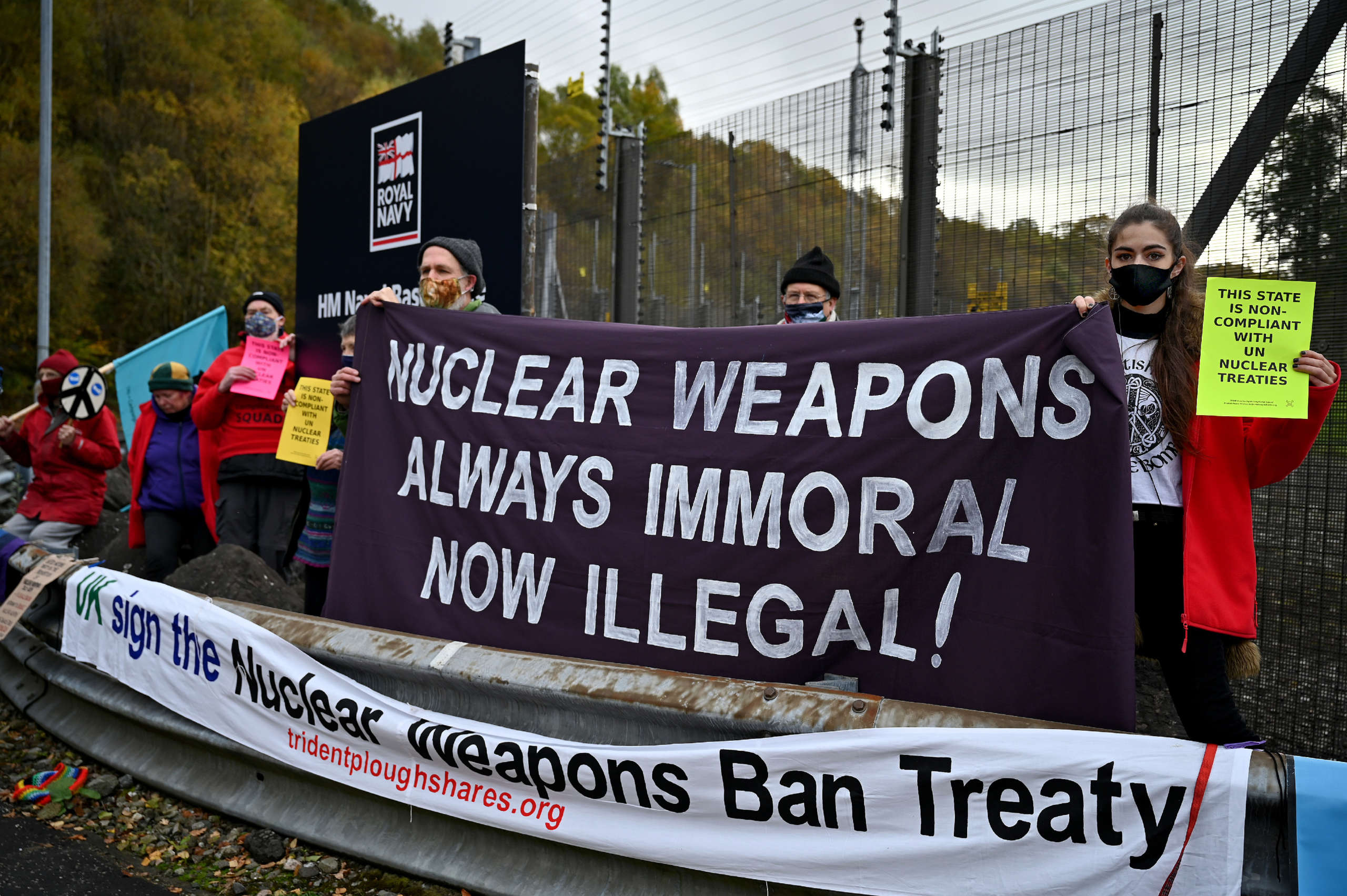
As the 500 enterprise employee met and contemplated a future full of nuclear weapons, two men stood across the street from the hotel, holding hand-painted signs. “Nuclear Weapons are illegal,” said one. “The World Wants Nuclear Disarmament,” said the other.
The Empire Gives People The Illusion Of Fighting The Power Without Ever Endangering Real Power
| CAITLIN JOHNSTONE, FEB 26 |
The one-year anniversary of Russia’s invasion of Ukraine has seen countless emotional news segments and heartstring-plucking articles, wall-to-wall social media posts, and public demonstrations decrying the evils of Vladimir Putin throughout the western world.
For what’s probably the first “anti-war” protest of most of their lives, American liberals gathered at the Lincoln Memorial in Washington DC over the weekend to bravely condemn the leader of a foreign government thousands of miles away. There they were joined by empire managers like the virulent warmonger Samantha Power, who spoke at the rally opposing Russian warmongering at the capital of the most warlike nation on the planet.
For the last year, mainstream westerners have been using this war to act out their fantasies of being courageous up-punching anti-imperialists, fighting powerful bloodthirsty tyrants in defense of the needful, all while living directly under the thumb of the most tyrannical regime in the world.
They mindlessly regurgitate the propaganda of the most powerful empire that has ever existed, parrot the same lines that are already being said all day long by all the most powerful institutions in the western world, all in service of the hegemonic agendas of the largest and most murderous power structure on earth, while pretending to be standing in opposition to the powerful.
The way the war in Ukraine allows mainstream liberals to play-act as rebellious anti-imperialists is a good illustration of how the empire gives people the illusion of fighting the power without their ever opposing the empire……………………..
In exactly the same way, Trump’s presidency allowed right wingers to pretend they were part of a movement against the establishment, despite Trump never actually challenging the establishment in any meaningful way. They believed he was fighting the Deep State even after he imprisoned Assange. They believed he was “ending the wars” even as he ramped up aggressions against Russia which helped bring us to where we are today, ……………………………………..
Imperial narrative managers actively foster these delusions of revolution and up-punching among the mainstream herd because it’s a great way to kill the possibility of any real revolutionary zeitgeist. If you can give people the illusion that they are fighting the power without their ever actually fighting the power, then you can always remain in power……………………….
Here’s hoping enough of us learn to see through the illusion one day https://caitlinjohnstone.substack.com/p/the-empire-gives-people-the-illusion?utm_source=post-email-title&publication_id=82124&post_id=105198072&isFreemail=true&utm_medium=email
Scott Ritter: Anyone Who Doesn’t Get How Serious New START Suspension is ‘Doesn’t Appreciate Life’

We’re not allowing Russian inspectors to come and inspect us while demanding that we go inspect Russia.
Unfortunately, we have people today in Washington, D.C., that believe in American nuclear superiority or American nuclear supremacy, and they don’t believe in arms control. And we need to replace them. We need to get rid of them. We need to bring in people who recognize that arms control is the only way to save the human race.”
Leaving aside the “theater of the absurd” and “bluster” of Joe Biden’s rhetoric during his trips to Ukraine and Poland this week, the consequences of the US effort to strategically weaken and destroy Russia are far more serious than anyone in Washington seems to realize, ex-UN weapons inspector and retired US Marine major Scott Ritter fear
“There’s nothing covert about this. It was theater. Theater of the absurd,” Ritter said of Biden’s visit to Kiev on Monday to meet with President Volodymyr Zelensky, speaking to Sputnik’s Wilmer Leon and Garland Nixon on The Critical Hour radio show.
“So absurd that while Biden was there, Zelensky arranged to have air raid sirens sound to make it look as if Biden was under attack….Then Biden goes to Poland, where he issues a speech. I was in the middle of a webinar earlier, so I don’t know the totality of the speech. I saw the beginning of it, but it just seems to be a regurgitation of more of the same – ‘unity against Russia, support for Ukraine’, etc., etc. Bluster, bluster, bluster,” Ritter added.
On Tuesday, Russian President Vladimir Putin announced the suspension of the New Strategic Arms Reduction Treaty (New START) with the US, citing Washington’s efforts to “inflict a strategic defeat” on Russia and help Ukraine launch drone attacks against Russia’s strategic deterrent while “absurdly” calling for more nuclear inspections.
“Meanwhile, the consequences of the American-led effort to attack Russia, to weaken Russia, to destroy Russia, to be honest, are playing out. Putin’s suspending Russian participation in the last remaining arms control treaty between our two nations. And anybody who doesn’t understand how serious this is probably doesn’t appreciate life. Without arms control agreements, there will be a nuclear arms race at a time when technology far outpaces that of the last arms race, which was the unfettered arms race in the late 1960s or early 1970s,” Ritter said.
Ritter knows a thing or two about arms control, serving as an inspector implementing the Intermediate Range Nuclear Forces Treaty – a late Cold War agreement which eliminated an entire class of US and Soviet ground-based nuclear missile systems in the 500-5,500 km range. Today, he fears, radical advances in technology make effective arms control all the more crucial to saving the world from nuclear Armageddon.
“Today, we’re talking about missiles with greater speed, greater accuracy, hypersonic maneuvering warheads that can’t be shot down by missile defense. So, so deadly, so accurate, so fast that any error, any mistake, any miscalculation has to be assumed that it’s going to have dire consequences. So you must respond. In the past, we dodged a bullet because we had time enough for people to say [to the other side] ‘this launch of American missiles against Russia was, in fact, not a launch. It was a mistake.’
Today, if they detect a launch, they have to respond because they don’t have time. They don’t have the luxury of time to say, wait a minute, let’s just wait to get more data.
. With this treaty going away, an arms race will occur and there will be nothing that is capable of putting that genie back in the bottle. And this could be fatal, probably will be fatal to everybody here. So we need to pray that the United States gets over its Ukraine fixation and gets into how do we stop the world from dying in a nuclear holocaust to which we will be singularly responsible for initiating,” Ritter urged.
President Putin and other Russian officials have addressed the lack of response time issue repeatedly in recent years, going back to when Washington decided to deploy Tomahawk-capable anti-missile defense systems in Poland and Romania, and threatened to incorporate Ukraine into NATO and station nuclear-capable missiles there.
“I have already said – they’ll put missile systems in Ukraine, 4-5 minutes’ flight time to Moscow. Where can we move? They have simply driven us into such a state that we have to tell them: stop,” Putin said in December 2021, after Moscow handed Washington and NATO a pair of comprehensive security proposals meant to dramatically reduce tensions between Russia and the Western bloc.
The West rejected the draft treaties in January 2022, reiterating that NATO’s eastward expansion was nonnegotiable. A month later, escalated attacks on the Donbass by Kiev sparked a Russian military operation in Ukraine.
“The problem is the concept of meaningful arms control was developed during the time of the Cold War, when the United States actually respected and feared its opponent, the Soviet Union. When the Soviet Union collapsed, the United States no longer respected or feared Russia. And we used arms control as a means of furthering our strategic advantage,” Ritter explained. “And then when we found arms control treaties to be inconvenient, such as the Anti-Ballistic Missile Treaty, we withdrew from the Intermediate Nuclear Forces Treaty, which I played a major role in. We withdrew from Open Skies, and now we’re cheating on the last remaining treaty, New START. We’re not allowing Russian inspectors to come and inspect us while demanding that we go inspect Russia. And so the Russians have suspended this. This is all a power play by the United States to further what we believe to be our strategic advantage over Russia.”
Today, the former weapons inspector warned, “Russia is no longer a defeated, compliant state. The Russians have nuclear superiority over us today. Their missiles are better than anything we have. We don’t have a missile defense system worthy of the name. And so if there was a nuclear conflict, we would be annihilated. Now the good chance is we would annihilate them, too. Which brings us back to the situation that we existed in the 1960s, where we suddenly realized that this concept of mutually assured destruction wasn’t a bad concept because it sort of put the brakes on nuclear conflict.
Unfortunately, we have people today in Washington, D.C., that believe in American nuclear superiority or American nuclear supremacy, and they don’t believe in arms control. And we need to replace them. We need to get rid of them. We need to bring in people who recognize that arms control is the only way to save the human race.”
Canada launches $30 million small modular reactor funding program

Kevin Clark, 2.23.2023, Power Engineering
Canada is launching a new funding program to help promote the commercial deployment of small modular reactors (SMRs). The announcement was made Feb. 23 at the Canadian Nuclear Association’s annual conference.
The program would provide $29.6 million over four years to develop supply chains for SMR manufacturing and fuel supply and security. Funding would also be used for research on safe SMR waste management solutions.
Eligible applicants could include private companies, utilities, provinces and territories, universities and Indigenous groups………………………………….
A few months prior to the contract signing, the Canada Infrastructure Bank (CIB) committed C$970 million ($708 million) in debt financing toward the Darlington SMR. This is the bank’s largest investment in clean [?] power to date.
The CIB-financed phase 1 work covers all preparation prior to nuclear construction, including project design, site preparation, procurement of long lead-time equipment, utility connections, digital strategy and other project management costs. https://www.power-eng.com/nuclear/canada-launches-30-million-small-modular-reactor-funding-program/
Officials reveal cost of shooting down ‘UFOs’ – WSJ
https://www.rt.com/news/572002-cost-shoot-down-ufos/ 24 Feb 23
The military has called off its search for the remains of the three objects, which are now thought to have been harmless balloons.
The Pentagon blew more than $1.5 million to shoot down three mysterious objects spotted in US and Canadian airspace earlier this month, multiple defense officials told the Wall Street Journal, though they suggested the true cost is likely higher.
The $1.5 million figure provided to the Journal on Wednesday only covers the cost of the four AIM-9X Sidewinder missiles used to shoot down the ‘UFOs’ over Alaska, Lake Huron, and the Yukon region in Canada, excluding funds spent by the Coast Guard, Navy, and National Guard in searching for the debris.
The flights used to spot the balloons and eventually shoot them down are not part of the cost estimates, because the US military considers the flights part of its pilots’ training and has already budgeted those flight hours,” the outlet added, citing the defense officials.
One of the missiles failed to hit its target, requiring another $400,000 Sidewinder to send the unidentified object plummeting into one of Michigan’s Great Lakes.
The string of shootdowns came after a Chinese high-altitude balloon entered US airspace in late January, which was also downed by a US fighter jet. While Washington insisted the craft was used for espionage, Beijing rejected the charge, arguing the balloon was used to collect meteorological data and had drifted off course by accident. US officials reached by the Washington Post later acknowledged that China’s version of events could be accurate, noting the balloon may have been pushed into US territory after encountering “strong winds.”
The Chinese balloon appeared to trigger anxiety in the White House, with President Joe Biden ordering the three other objects to be shot down in quick succession soon after the initial incident. However, in an address last week, Biden revealed that intelligence agencies had assessed the objects were “most likely” weather balloons, admitting the military had used sophisticated air-to-air missiles – fired from multi-million-dollar aircraft – to neutralize harmless scientific instruments.
As of last Friday, the military halted its search for the wreckage of the three objects, after officials said poor weather conditions would make them difficult to locate.
Further underscoring the blunder, an Illinois-based hobby group has offered evidence that the device downed over Canada’s Yukon territory was likely one of its ‘pico balloons’ – tiny devices sent high into the atmosphere and tracked by amateur enthusiasts, which usually cost between $12 and $200 to construct. While it remains unclear how the military could have missed the balloon, which had been in the air for 123 days and circled the Earth six times, officials have said the three objects were picked up not long after radar adjustments were made by the North American Aerospace Defense Command (NORAD).
Spreading the Bomb – Will Ottawa revisit Canada’s support for plutonium reprocessing?

Canadian Coalition for Nuclear Responsibility
February 21, 2023
Today, the Canadian Coalition for Nuclear Responsibility and researchers from five universities are urging Ottawa to reconsider its financial and political support for reprocessing in Canada – extracting plutonium from used nuclear fuel.
Plutonium is one of the key materials needed to make nuclear weapons—the other alternative is highly enriched uranium. Plutonium is created as a byproduct in nuclear reactors. Once extracted, plutonium can be used either as a nuclear fuel or as a nuclear explosive. The chemical process used to separate plutonium from other radioactive substances produced in nuclear reactors is called reprocessing
In 1974 India used plutonium from a Canadian reactor to explode an atomic bomb in an underground test. The entire world was shocked to realize that access to plutonium and the making of an atomic bomb may be separated only by an act of political will.
Last week, a House of Commons committee released a report recommending that the government “work with international and scientific partners to examine nuclear waste reprocessing and its implications for waste management and [nuclear weapons] proliferation vulnerability.
The recommendation by the House of Commons committee echoes numerous calls by civil society groups and by U.S. and domestic researchers after Canada announced a $50.5 million grant to the Moltex corporation in March 2021 for a New Brunswick project to develop a plutonium reprocessing facility at the Point Lepreau nuclear site on the Bay of Fundy.
Allowing plutonium reprocessing in Canada sends a dangerous signal to other countries that it is OK to for them to extract plutonium for commercial use. Such a practice increases the risk of spreading nuclear weapons capabilities to countries that currently do not possess the means to make nuclear weapons. The risk is that much greater if Canada sells the technology, as is currently envisaged.
“By supporting the implementation of reprocessing technology intended for export, in connection with a plutonium-fuelled nuclear reactor, without regard for the weapons implications, Canada may be once again spreading the bomb abroad,” says Dr. Gordon Edwards, President of the Canadian Coalition on Nuclear Responsibility.
Reprocessing is often justified as a solution to the problem of dealing with nuclear waste, but in reality, it only makes the challenge even harder. Instead of having all the radioactive materials produced in solid spent fuel, these get dispersed into multiple solid, liquid and gaseous waste streams.
Researchers from the University of British Columbia, Princeton University and three New Brunswick universities are supporting the call for an international review. “We’re heartened that the House of Commons Committee listened to the concerns about plutonium reprocessing raised by numerous experts and concerned citizens,” says Dr. Susan O’Donnell, Adjunct Professor at the University of New Brunswick.
Dr. Edwards cited three letters written to Prime Minister Justin Trudeau by nine prominent nonproliferation experts, including plutonium expert Dr. Frank von Hippel. “The Prime Minister’s failure to respond indicates an appalling lack of good governance on the proliferation of nuclear weapons,” said Dr. Edwards.
To date the government has not responded to the letters or even acknowledged the monumental significance of the nuclear weapons connection with reprocessing. The House of Commons Science and Research Committee cited the letters by Dr. von Hippel and others as rationale for their recommendation to conduct the review.
Commercial reprocessing has never been carried out in Canada but in the past, Canada has been complicit in the production of nuclear weapons. During the Cold War some reprocessing was done at the federal government’s Chalk River Nuclear Laboratory, at a time when Canada sold both uranium and plutonium to the US army for use in nuclear weapons. These operations resulted in a permanent legacy of nuclear waste and radioactive contamination in Canada.
The first reactors were built to produce plutonium for bombs. The first reprocessing plants were built to extract plutonium to be used as a nuclear explosive. Following India’s use of plutonium from a nuclear reactor supplied by Canada in its 1974 weapon test, the United States banned commercial plutonium reprocessing in 1977 to reduce the danger of weapons proliferation.
Canada has had an informal ban on reprocessing since the 1970s. A 2016 Canadian Nuclear Laboratories report stated that reprocessing used CANDU fuel would “increase proliferation risk.” That CNL admission was fully confirmed in a major report (330 pages) released three months ago by a U.S. National Academy of Sciences. The expert panel reached a consensus that the reprocessing technology proposed for New Brunswick by the Moltex corporation “does not provide significant proliferation resistance.”
The need for an independent international review is urgent, as Moltex announced just last week that the company is seeking an additional $250 million in government funding.
The researchers supporting the call for an international review of plutonium reprocessing in relation to the spread of nuclear weapons are:
Dr. Gordon Edwards, President, Canadian Coalition for Nuclear Responsibility
Dr. Susan O’Donnell, Adjunct Professor and Principal Investigator of the Rural Action and Voices for the Environment [RAVEN] project, University of New Brunswick
Dr. Janice Harvey, Assistant Professor, Environment & Society Program, St. Thomas University
Dr. Jean-Philippe Sapinski, Assistant Professor of Environmental Studies, Université de Moncton
Dr. M.V. Ramana, Professor and Simons Chair in Disarmament, Global and Human Security, School of Public Policy and Global Affairs, University of British Columbia
Dr. Frank von Hippel, Senior Research Physicist and Professor of Public and International Affairs Emeritus, Program on Science & Global Security, Princeton University
Our Global Surveillance System on NUKE TESTING is inadequate
For the ones whom are not aware, there is a global monitoring and surveillance system that detects radioactive particles and gases on a global scale from 80 stations to detect the “smoking gun” in regards to nuclear testing globally in which Canada and the US are collaborators for surveillance purposes.
Suffice to say, pending global atmospheric transport, there are not enough monitoring stations in Canada or the US.
This is because of the complexity of the jet stream (northern hemisphere) and the long-range transport of these radioactive particles emitted by nuclear testing because of atmospheric dilution or long-range transport, especially xenon (gas), either because of atmospheric dilution or weather patterns in the northern atmosphere. Climate change will in time make this even more problematic.
This is because of the complexity of the jet stream (northern hemisphere) and the long-range transport of these radioactive particles emitted by nuclear testing because of atmospheric dilution or long-range transport, especially xenon (gas), either because of atmospheric dilution or weather patterns in the northern atmosphere. Climate change will in time make this even more problematic.
Coriolis forces:
Link: https://education.nationalgeographic.org/resource/coriolis-effect/
Check out the link below for more details on the global surveillance system on radioactive fallouts from nuke testing: Link: https://www.ctbto.org/our-work/monitoring-technologies/radionuclide-monitoring
“How the radionuclide monitoring network works
The 80-station radionuclide monitoring network enables a continuous worldwide observation of aerosol samples of radionuclides. The network is supported by 16 radionuclide laboratories with expertise in environmental monitoring, providing independent additional analysis of IMS samples.”
“Radionuclide technology is complementary to the three waveform technologies used in the CTBT verification regime, and the only one that can confirm whether an explosion detected and located by the others is indicative of a nuclear test.”
“Radionuclide stations measure radioactive particles and noble gases, i.e. radionuclides, in the air. A radionuclide is an isotope with an unstable nucleus that loses its excess energy by emitting radiation in the form of particles or electromagnetic waves in a process called radioactive decay.”
USA’s Inflation Reduction Act is a game-changer for the nuclear industry -says Public Service Enterprise Group
PSEG to consider nuclear plant investments, capitalizing on the IRA’s production tax credits, CEO says
Utility Dive, Feb. 22, 2023, Stephen Singer
Dive Brief:
- Public Service Enterprise Group will consider “small but important value-added investments” at its nuclear plants, capitalizing on production tax credits in the Inflation Reduction Act, President and CEO Ralph LaRossa said Tuesday…………………
Dive Insight:
The passage of the IRA last August will “help to preserve the financial viability of our carbon-free nuclear fleet into the next decade,” the Newark, New Jersey-based parent company of Public Service Electric and Gas said in a statement.
“While the industry waits for clarifications, we believe the Inflation Reduction Act is a game-changer that should provide the stability required for long-term viability of the U.S. nuclear fleet,” LaRossa said.
Guggenheim analyst Shahriar Pourreza said in a client note Tuesday that “longer term upsides for nuclear” could come from U.S. Treasury Department guidance on production tax credits. Guidance will take time and “further drive strategic decision-making,” he said……….
Daniel Cregg, executive vice president and chief financial officer, said PSEG is engaged in a “waiting game” as the Treasury Department provides details on the nuclear production tax credits. “I don’t even have a date to tell you when Treasury is going to come out with it,” he told analysts.
The IRA, with $369 billion in climate provisions, provides tax credits for existing nuclear power plants and new facilities, advanced reactors and small modular reactors. The law provides a choice between a technology-neutral production tax credit of $25/MWh for the first 10 years of plant operation or a 30% investment tax credit on new zero-carbon power plants that begin operating in 2025 or later.
Tax credits have drawn interest from other energy companies. Constellation announced Tuesday it will spend $800 million for new equipment to increase the output of two nuclear generating stations in Illinois by about 135 MW.
“Support for nuclear in the IRA has made extending the lives of U.S. nuclear assets to 80 years more likely assuming continued support,” Constellation said. “It has caused Constellation to examine nuclear uprate opportunities that were canceled a decade ago due to market forces.”
LaRossa reiterated PSEG’s decision to exit offshore wind generation………… -more https://www.utilitydive.com/news/pseg-ira-nuclear-production-tax-credits/643221/—
Pentagon-Funded Plymouth University Cancels Anti-War Academic: the militarization of higher education.

Pentagon-Funded Plymouth University Cancels Anti-War Academic: Reflections on How the US Empire Conquered Higher Education, CouterPunch BY T.J. COLES 17 Feb 23,
The US Empire is in the final and most dangerous stages of its quest for what the Pentagon calls “full spectrum dominance.” Having invaded and fought proxy wars in the oil-rich Middle East, it is now trying to break nuclear-armed Russia in another proxy war before attempting “regime change” in nuclear-armed China. We need not tarry on the potential consequences. Professor Noam Chomsky called it 20 years ago: this is hegemony or survival. Which one do you choose?
As the Empire races towards its biggest bet, using humanity and all other species on the planet as gambling chips, anti-war comment is tolerated less and less. For those who want to know what happened to me, see the Annex of this article for the leaked emails and background. Meanwhile, consider what is taking shape.
DELETING THE ENEMY
Critics of Western imperialism are silenced by the Empire’s witting and unwitting minions in increasingly knee-jerk ways. Google, which was developed with CIA money, has de-ranked anti-war websites, driving traffic to state-corporate outlets that promote imperialism. After buying YouTube, it then went on a de-platforming spree, banning and de-monetizing “conspiracy theorists,” left and right, who dare deviate from the increasingly narrow orthodoxy of acceptable thought.
Under the new McCarthyism of RussiaGate, the US Federal Bureau of Investigation has used the pretext of countering foreign disinformation to suspend and terminate political accounts. In 2020, following an evidence-free CNN report alleging that it was a front for the sanctioned nation of Iran, the FBI and Department of Justice seized the US domain for the website of the American Herald Tribune, founded by Dr. Anthony James Hall, who retired from his Canadian university, Lethbridge, following pressure from the Zionist Lobby and from individuals who accused him of being a “conspiracy theorist”—a cheap smear tactic employed against me by a cabal of staff at Plymouth University.
Meanwhile, the Twitter Files have exploded the myth that “social media” are independent corporate actors. Likewise, journalist Dr. Alan Macleod has documented the dozens of former spies now employed to police content at Facebook.
SHAME IS THE GAME
The opinions of self-described fact-checkers—like the Poynter Institute—are amplified by state-corporate media which engage in public humiliation rituals in the hope that retailers will pull magazines, academic institutions will fire staff, digital providers will demonetize accounts, and web hosts will drop entire sites and/or content……….
As governments contract out censorship to “fact-checkers,” critics of Empire are demonetized. Consortium News and Mint Press have seen their PayPal accounts frozen. PayPal’s pro-Trump co-founder, Peter Thiel, has made many millions of dollars from Pentagon contracts. Between 2007 and ’19, US taxpayers gave his Palantir Technologies $1.5 billion via the Department of Defense, particularly to spy on Afghans and Iraqis.
ACADEMIC OBLIVION
The above examples show how the US military and intelligence continue to influence the infrastructure through which much of today’s information travels. Another target is academia. But how serious is the problem?……………………………………………………..
THE MILITARIZATION OF HIGHER EDUCATION
Universities serve a variety of purposes, one of which is the development of new weapons for the US military. In the past, white voices critical of Empire would be tolerated as long as their non-university work did not grind the gears of Empire. That’s how Professor Chomsky, for instance, was able to get arrested protesting mass murder in Vietnam while receiving Pentagon money to undertake his linguistics research.
The technological origins of “full spectrum dominance” can perhaps be traced back to the outgoing Reagan and incoming George H.W. Bush administrations, under whom the Pentagon founded the Multidisciplinary University Research Initiative to further integrate with education and develop tools for things like the so-called Star Wars program (Strategic Defense Initiative). One consequence is that higher education became significantly influenced—maybe not full-spectrum dominated—by the eternal war machine.
By 2015, the Department of Defense (DoD), which in more honest times was called the Department of War, was investing $250 million of taxpayer money in universities. In that year, the DoD decided to look for international partners, of which the Britain was a natural first-choice. The Pentagon’s Basic Research Office Director, Robin Staffin, said: “we decided it was time to formalize cooperation between the U.S. and the U.K.”
DARPA is the Pentagon’s taxpayer-funded innovation arm. It used to stand for the Advanced Projects Research Agency, but PR experts realized that they’d better prefix it with the word “Defense.” In 2016, venture capitalist-turned-DARPA Director, Arati Prabhakar, said: “DARPA is reliant on research universities as one part of this huge ecosystem … [We] draw from the deep foundational research, almost always at places like great universities.”
For instance, the DoD recently said that the universities of Alabama-Huntsville, Florida International, Texas A&M Engineering Experiment Station, and others, have received funding to develop solutions for—are you ready?—“monitoring the health and status of hypersonic aeroshells” (heat shields for space systems, which are core elements of “full spectrum dominance.” The “health and status” of ordinary Americans, who still don’t have free coverage, is less important). Other projects include thermodynamic ducts for hypersonic vehicles sponsored by the usual suspects, like Boeing and Lockheed Martin.
FUNDING PLYMOUTH UNIVERSITY: DARPA’S DRIVE…………………………………………………
CONCLUSION
As universities continue designing weapons of mass murder, thought criminals in Western countries continue to face deplatforming and public shaming. Are their personal fates as severe as those of dissident academics in US-UK-supported regimes, like Saudi Arabia? Of course not. But that is not the point. An obvious chilling effect is created in which scholars striving for social justice and indeed the survival of the planet are silenced. The witting an unwitting minions of Empire are too obtuse to realize that by issuing penalties for expressing opinions, those penalties may one day be imposed upon them.
ANNEX (HISTORY, EMAIL EVIDENCE, REBUTTAL):
MY STORY……………………………………………………………………………….as I have lost my University position as a result of my political views, it is worth considering exactly what I write for Nexus (article by article) and that my articles give a left-wing voice to the so-called conspiracy research community, which is often dominated by right-wingers and apolitical people.
As one can see below, the bulk of my work for Nexus consists of critiques and exposés of US military and intelligence agencies. …………………………………………………………
T. J. Coles is director of the Plymouth Institute for Peace Research and the author of several books, including Voices for Peace (with Noam Chomsky and others) and Fire and Fury: How the US Isolates North Korea, Encircles China and Risks Nuclear War in Asia (both Clairview Books). https://www.counterpunch.org/2023/02/17/pentagon-funded-plymouth-university-cancels-anti-war-academic-reflections-on-how-the-us-empire-conquered-higher-education/
What We Know About The US Air Force’s Balloon Party So Far

https://caityjohnstone.medium.com/what-we-know-about-the-us-air-forces-balloon-party-so-far-6c59b80e7a3d Caitlin Johnstone, 18 Feb 23
You know, everyone’s always talking about how the US military is only ever used to kill foreigners for resource control and generate profits for the military-industrial complex, but that’s not entirely true. Turns out the US military is also used for shooting down party balloons.
In an article titled “Object downed by US missile may have been amateur hobbyists’ $12 balloon,” The Guardian’s Richard Luscombe reports the following:
The Northern Illinois Bottlecap Balloon Brigade says one of its hobby craft went “missing in action” over Alaska on 11 February, the same day a US F-22 jet downed an unidentified airborne entity not far away above Canada’s Yukon territory.
In a blogpost, the group did not link the two events. But the trajectory of the pico balloon before its last recorded electronic check-in at 12.48am that day suggests a connection — as well as a fiery demise at the hands of a sidewinder missile on the 124th day of its journey, three days before it was set to complete its seventh circumnavigation.
If that is what happened, it would mean the US military expended a missile costing $439,000 (£365,000) to fell an innocuous hobby balloon worth about $12 (£10).
“The descriptions of all three unidentified objects shot down Feb. 10–12 match the shapes, altitudes and payloads of the small pico balloons, which can usually be purchased for $12–180 each, depending on the type,” writes Steve Trimble for Aviation Week, who first broke the Bottlecap Balloon Brigade story.
This information would put a bit of a wobble on Senate Majority Leader Chuck Schumer’s comments to ABC’s This Week on Sunday that all three of the balloons shot down through the weekend were Chinese surveillance devices, saying “the Chinese were humiliated” by the US catching them in their sinister espionage plot. If the US air force did in fact just spent millions of dollars shooting down American party balloons, it wouldn’t be the Chinese who are humiliated.
And it looks like that is indeed what happened. On Tuesday the National Security Council’s John Kirby said the “leading explanation” for the three unidentified flying objects that were shot down is that they were “balloons tied to some commercial or benign purpose.” On Thursday President Biden told the press that “The intelligence community’s current assessment is that these three objects were most likely balloons tied to private companies, recreation, or research institutions studying weather or conducting other scientific research.”
And this all comes out after US officials told The Washington Post that the “Chinese spy balloon” which started this historically unprecedented multi-day frenzy of aerial kinetic warfare over North America was probably never intended for surveillance of the United States at all. Experts assess that the balloon was blown over the continent entirely by accident, trying to reconcile that narrative with the contradictory US government claims of intentional Chinese espionage by suggesting that perhaps the Chinese had intended for the balloon to be used for spying on US military forces in the Pacific or something.
So to recap, the US air force shot down a Chinese balloon which US officials have subsequently admitted was only blown over the US by accident, then went on a spree of shooting things out of the sky which it turns out were probably civilian party balloons. The entire American political/media class has been spending the month of February furiously demanding more militarism and more cold war escalations over what is in all probability four harmless balloons.
And what’s really crazy is that they’re probably going to get those increases in militarism and cold war escalations they’ve been calling for, despite the entire ordeal originating primarily in the overactive imaginations of the drivers of the US empire. The shrieking hysterical panic about “Chinese spy balloons” has dwarfed the coverage of the revelations contradicting that narrative, and China hawks have been using the occasion to argue for increases in military spending. The Atlantic’s Richard Fontaine got all excited and wrote a whole article about how the threat of Chinese spy balloons can be used “to rally public concern and build international solidarity” against China.
These are the people who rule our world. They are not wise. They are not insightful. They are not even particularly intelligent. The US empire is a Yosemite Sam cartoon character who at any time can just flip out and start firing Sidewinder missiles at random pieces of junk in the sky, screaming “I’ll blast yer head off ya varmint!” If the US war machine was a civilian human, their family would be quietly talking amongst themselves about the possibility of conservatorship.
These are the last people in the world who should be running things, and they are the last people in the world who should be armed with nuclear weapons. But that’s exactly where we find ourselves in this bizarre slice of spacetime. God help us all.
____________________
NATO reveals new space fleet
The US-led military bloc will use commercial satellites to improve intelligence gathering.
NATO has announced a new space project that aims to create a fleet of spy satellites. The initiative, which includes NATO applicants Sweden and Finland, involves not only national but commercial assets.
The project, which is called ‘Alliance Persistent Surveillance from Space’ (APSS), was unveiled on Wednesday, with a total of 16 current member states expected to chip in. According to a statement published on NATO’s website, the project will “help streamline data collection, sharing and analysis among NATO Allies and with the NATO command structure.”
Sweden and Finland applied for NATO membership in May of 2022, though their bids have yet to be approved by Hungary and Türkiye. However, despite not being formally admitted into the military bloc, both Stockholm and Helsinki are already participating in joint projects.
APSS will entail the creation of a “constellation,” named ‘Aquila’, of national as well as commercial satellites. It is expected to “provide essential support to NATO’s military missions and operations.”
The military bloc explained that APSS comes as part of NATO’s Overarching Space Policy adopted back in 2019………………………………… https://www.rt.com/news/571561-nato-space-surveillance-project/
Dumping 1M gallons of radioactive water in Hudson is ‘best option,’ per Indian Point nuclear plant owner

Gothamist, Rosemary Misdary, Feb 18, 2023
The owner of the defunct Indian Point nuclear facility says it’s planning to dump about 1 million gallons of radioactive water into the Hudson River. The move, which the company describes as the “best option” for the waste, could happen as early as August.
A Feb. 2 meeting of the Indian Point Decommissioning Oversight Board heated up when the plant’s owner Holtec International disclosed the plan as part of its lengthy closure process. The contaminated water could just naturally — and safely — decay in storage onsite.
Environmental groups and residents are also concerned this could harm their community, as the Hudson River is already a federally designated toxic Superfund site. Rich Burroni, Holtec’s site vice president for Indian Point, agreed to give the community at least a month’s notice before any radioactive discharge into the Hudson River begins.
But Holtec is well within its legal rights and permits to discharge waste at the same rate as it did when operating, and it does not need federal, state or local approval to dump the contaminated water. This practice is standard for nuclear plants.
Nearly two years have passed since Indian Point shut down its third and final reactor in the village of Buchanan, located on the Hudson’s east bank about 30 miles north of Midtown. Toward the end of its 59-year lifespan, the plant had more than a 2,000 megawatt capacity — providing electricity to more than 2 million homes, or 13% of the state’s power demand.
Holtec received about $2.4 billion in funds, shouldered by ratepayers, to decommission the plant. And it wants to do so in 12 years, which is in accordance with town’s wishes to repurpose the site. But Holtec and the surrounding community are still debating what to do with Indian Point’s radioactive remnants.
“Yes, you can do it [discharge radioactive water]. It’s normal practice. But should you when you have other options that might avoid this additional release of radioactivity to the environment?” said Edwin Lyman, director of nuclear power safety at the Union of Concerned Scientists, a nonprofit science advocacy organization. “It may only cause a low risk to the environment as far as we know, but there are other options here, and why not try to minimize the harm?”……………………………………………
Options are limited when it comes to disposing of radioactive waste, and only three methods are typically used for tainted water. ……………………………………………………..
Lyman said a fourth option would be leaving the radioactive water onsite to decay over time into non-harmful helium. “Keep storing indefinitely and eventually the problem will solve itself,” he said.
For tritium, this process would take just over 24 years. Lyman considers this the best option because it minimizes the effects on the environment. It’s also viable because other radioactive material — spent fuel generated from operating the plant — remains onsite and will take hundreds of thousands of years to decay. This material includes plutonium and uranium.
Lyman said this waste has no place to go and will be there for a long time, so there’s no rush to deal with the radioactive water while spent fuel continues to sit on the property. Most radioactive waste is stored where it is generated. And federal regulations allow 60 years for decommissioning. That spent fuel could remain at the site even after the decommissioning is completed, according to the Nuclear Regulatory Commission.
“In the long term, it’s going to degrade, and the only way to protect the environment from that degradation is to bury it in a deep geological repository,” Lyman said…………………………………..
The next meeting for the Indian Point Decommissioning Oversight Board will take place on April 27 at 6 p.m. at Cortlandt Town Hall. Participants have the option to attend virtually. https://gothamist.com/news/dumping-radioactive-water-hudson-river-best-option-indian-point-nuclear-plant-owner-holtec
1 This Month
26 April – Chernobyl: Inside the Meltdown airs on National Geographic on Sunday 26th April from 4pm


29 April – Nuclear Expert Webinar #1 – Radiation Impacts on Families with Mary Olson and Cindy Folkers
- 12:15 PM MT – 1:45 PM MT
- Location: Virtual – REGISTER TODAY

4 May -West Suburban Peace Coalition to discuss Iran war at May Educational Forum
Monday, May 4, 7:00 – 8:00 PM Central Standard Time
Title: : How Trump’s Narrative Tries to Shape the Reality of the War on Iran.
Contact Walt Zlotow, zlotow@hotmail.com 630 442 3045 for further information
14 May – online event From Bombs to Data Centres: the Face of Nuclear Colonialism


Pine Ridge Uranium is the real threat, not Tehran- Tell Burgum: Stop the Extraction.
Chernobyl: The Lost Tapes – A good documentary on Chernobyl on SBS available On Demand for the next 3 weeks– https://www.sbs.com.au/ondemand/tv-program/chernobyl-the-lost-tapes/2352741955560
To see nuclear-related stories in greater depth and intensity – go to https://nuclearinformation.wordpress.com
-
Archives
- April 2026 (327)
- March 2026 (251)
- February 2026 (268)
- January 2026 (308)
- December 2025 (358)
- November 2025 (359)
- October 2025 (376)
- September 2025 (257)
- August 2025 (319)
- July 2025 (230)
- June 2025 (348)
- May 2025 (261)
-
Categories
- 1
- 1 NUCLEAR ISSUES
- business and costs
- climate change
- culture and arts
- ENERGY
- environment
- health
- history
- indigenous issues
- Legal
- marketing of nuclear
- media
- opposition to nuclear
- PERSONAL STORIES
- politics
- politics international
- Religion and ethics
- safety
- secrets,lies and civil liberties
- spinbuster
- technology
- Uranium
- wastes
- weapons and war
- Women
- 2 WORLD
- ACTION
- AFRICA
- Atrocities
- AUSTRALIA
- Christina's notes
- Christina's themes
- culture and arts
- Events
- Fuk 2022
- Fuk 2023
- Fukushima 2017
- Fukushima 2018
- fukushima 2019
- Fukushima 2020
- Fukushima 2021
- general
- global warming
- Humour (God we need it)
- Nuclear
- RARE EARTHS
- Reference
- resources – print
- Resources -audiovicual
- Weekly Newsletter
- World
- World Nuclear
- YouTube
-
RSS
Entries RSS
Comments RSS
 nuclear-news