“The only reason there’s a nuclear renaissance is because the federal government is throwing tens of billions of dollars at nuclear,” …….. “Investors aren’t interested.”
Opening of Georgia Power’s Vogtle unit 3 comes 7 years late and billions of dollars over budget.
The US nuclear energy industry has reached a watershed moment. Plant Vogtle unit 3 began delivering commercial electricity to the Georgia power grid, becoming the first nuclear reactor the country has built from scratch in more than three decades.
Unit 3 and a twin reactor to open in the coming months may also be the last. Years of delays and billions of dollars of cost overruns have made the megaproject as much a cautionary tale as a new chapter for atomic investment.
The 1,100-megawatt Vogtle unit 3 was initially supposed to enter service in 2016, however. Its start of operations was delayed once more in June after the company discovered a degraded seal in its main generator.
“It turns out nuclear construction is hard,” said Bob Sherrier, a staff attorney at the Southern Environmental Law Center, which challenged the project in court.
“Along the way the company kept ratcheting up the cost estimates, pushing back the deadlines a bit at a time. Every time it was raised just enough where it was still within the bounds of justification that it made sense to proceed. But they were wildly off in their estimates every single time.”
“The resurgence of America’s nuclear industry starts here in Georgia, where you’ve just got approval, for the first time in three decades, to build new nuclear reactors,” then-US energy secretary Steven Chu said as Vogtle was authorised in 2012.
The Georgia project was supposed to be the first among dozens of new reactors built across the country. But the renaissance floundered amid safety concerns after the 2011 Fukushima disaster in Japan coupled with plunging prices for natural gas, a competing generation fuel. In the end only four reactors moved ahead and two, Vogtle units 3 and 4, have been built. Unit 4 is scheduled to come online by early 2024.
Soaring costs at Vogtle, along with new reactors at the VC Summer nuclear project in South Carolina, forced engineering contractor Westinghouse into bankruptcy in 2017. While South Carolina utilities pulled the plug on their project, Georgia ploughed ahead.
The $14bn original cost of Vogtle units 3 and 4 has now ballooned to more than $30bn. The cost for Georgia Power, with a 45 per cent share of the project, will be about $15bn.
How the company’s costs are shared with its customers will be decided by the commission once unit 4 is operating: the law allows only costs deemed “prudent” to be passed on to ratepayers.
McDonald said the company should not expect an easy ride. “They are guilty until they prove themselves innocent,” he said.
Georgia Power, a division of New York-listed Southern Company, did not respond to multiple requests for an interview.
……………………………………… there are no other traditional large-scale light water reactors under way in the US. Critics say that investors have been turned off.
“The only reason there’s a nuclear renaissance is because the federal government is throwing tens of billions of dollars at nuclear,” said David Schlissel at the Institute for Energy Economics and Financial Analysis. “Investors aren’t interested.”
For Georgians, the more immediate concern is what the project means for utility bills. Georgia Watch, a consumer group, estimates ratepayers have already paid $900 extra since construction began to cover financing costs. Bills are set to rise by another $3.78, or 3 per cent, on average when unit 3 comes online.
But the ultimate impact will not be felt until unit 4 comes online and the PSC decides how much of the burden will be left for ratepayers to shoulder. Georgia Watch estimates the final increase will add anywhere between 10-13 per cent to bills……………… https://www.ft.com/content/5d8e0c6c-59c9-4b40-806f-604889dd5fb6
2 Government, Industry Explore Nuclear, Solar Space Engines
COLORADO SPRINGS, Colorado — More commercial and military activity is taking place in space, and the Defense Department and industry are investing in emerging propulsion technologies to move systems in orbit faster, farther and more efficiently.
……………………………………..In 2021, the Defense Advanced Research Projects Agency selected Lockheed Martin as one of three prime contractors — along with General Atomics and Blue Origin — for Phase 1 of its Demonstration Rocket for Agile Cislunar Operations, or DRACO, program to showcase the potential of a nuclear thermal propulsion system in space, a DARPA release said.
This January, NASA announced it had partnered with DARPA on the DRACO program, describing a nuclear thermal rocket engine as “an enabling capability for NASA crewed missions to Mars.” The goal is to demonstrate the system in orbit in fiscal year 2027, with the Space Force providing the launch vehicle for the DRACO mission, a DARPA statement said.
The program is about to enter Phase 2, which “will primarily involve building and testing on the non-nuclear components of the engine” such as valves, pumps, the nozzle and “a representative core without the nuclear materials in it,” DARPA’s program manager for DRACO Tabitha Dodson said during a panel discussion at the Space Foundation’s Space Symposium in April. Dodson said then a Phase 2 decision is “quite close.” However, at press time in mid-July, no contracts have been awarded.
…………………………………“There are no facilities on Earth that we could use for our DRACO reactor’s power test … so we’ve always baselined doing our power test for the reactor in space,” Dodson said. Once in space, DARPA will “very gradually” ramp up the system to “full power thrust,” she said………………………………………………………………………………………………………………………………………… Despite DARPA’s commitment to safety, nuclear propulsion systems face an uphill battle getting deployed on spacecraft at scale, said Joel Sercel, founder and CEO of TransAstra, a space technology company.
………………………………………………………………………………..In May, the Space Force awarded TransAstra a Phase One Small Business Innovation Research contract to explore new applications for the company’s propellant-agnostic Omnivore thruster.
The Omnivore thruster uses solar reflectors to focus sunlight onto a solar absorber, which then superheats the system’s propellant to generate thrust “typically six times faster and eight times cheaper than electric systems,” a company release said.
Additionally, TransAstra calculated an Omnivore thruster “using liquid hydrogen propellant … will perform similarly to nuclear rockets, but without nuclear materials, costs or risk.”
Sercel said Omnivore has “80 percent of the performance of nuclear at 1 percent of the cost.” The system is essentially nuclear powered, “but the nuclear reactor in question is the fusion reactor at the center of the solar system called the Sun,” he added.
“The nice thing about nuclear reactors is that you have a small, compact reactor versus large deployable solar reflectors, but the basic performance of solar thermal rockets and nuclear rockets is about the same,” he said. And with Omnivore “you don’t have all these safety concerns and radioactive material and reactor control issues and so on. So, we think it’s a much more practical approach.”
Omnivore could have multiple mission applications for the Defense Department, Sercel said. Using liquid hydrogen propellant, the thruster “can deliver hundreds of kilograms” of spacecraft to geosynchronous orbit “on small launch vehicles, and the Space Force seems to be very excited about this,” he said. The system could also deliver spacecraft weighing more than 100 kilograms to cislunar space, he said.
Additionally, TransAstra has an Omnivore variant that uses water as the propellant, the solar absorber superheating the water vapor and releasing the gas through a nozzle to generate thrust.
The water-based variant can be placed on the company’s Worker Bee small orbital transfer vehicles, about 25 of which can fit on a single Falcon 9 rocket, Sercel said.
The past and the future collided at a virtual Public Participation Hearing held by the California Public Utilities Commission (CPUC) on July 25. The subject: the potential extension of operations at Diablo Canyon nuclear power plant.
Over 100 commenters spoke. The majority of them (by a 61 percent to 39 percent margin) vigorously opposed continued operations at the plant. As Justin LeBlanc of Sustainable Transit El Dorado put it, “The way of the future is not legacy monoliths.”
Diablo Canyon’s two reactors were scheduled to shut in 2024 and 2025 when their operating licenses expire. A surprise, and very energetic, push by Governor Newsom has led to a last-minute governmental scramble to consider continued operations to 2030 or beyond. The State Legislature has already given a conditional go-ahead.
The CPUC is expected to take a position on the matter before the end of this year. That decision could facilitate or block the extension. Of the five appointed members, a single CPUC commissioner, Karen Douglas, attended the hearing.
Proponents and opponents of the extension definitely did not see the future in the same way. They didn’t agree on the past, either.
Supporters of the extension most frequently cited what they said were ongoing low costs and safe, carbon-free nuclear operations. The mayor of Arroyo Grande, Caren Ray Russom, noted jobs and said that her city is “a direct beneficiary” of the plant’s operations. Jeff Luse, of Generation Atomic, a group that describes itself as “the heart of the pro-nuclear movement,” stated that the radioactive waste stored on site is “safely handled.” Several proponents even advocated adding more nuclear reactors to the site and operating them indefinitely.
Administrative Judge Patrick Doherty, who presided at the hearing, twice had to remind participants to refrain from personal attacks on other speakers. This came after two proponents of the extension referred to those with different views as “eco-terrorists,” “superstitious,” and “propaganda peddlers.”
Those opposed to the extension didn’t need to name-call to make their points. The long list of operational problems of PG&E, Diablo’s operator, did not instill confidence. Elizabeth Brooking of San Francisco, who voiced concerns about how the radioactive waste will be handled for the centuries it will exist, commented that PG&E “doesn’t have an exemplary track record for maintenance.” That’s putting it mildly, as others noted. Adding some dark historical context were Scott Rainsford and Bob Rowen, who described their firsthand experiences with PG&E’s Humboldt Bay nuclear reactor #3, which, they said, experienced a nuclear accident in 1970 that contaminated employees and was covered up by PG&E and the regulatory agencies.
As for continuing Diablo operations beyond the ’24 and ’25 shutdown date, the reasons against that were many and varied. Here are a few that were brought up:
• Under-reported earthquake dangers that downplay the seismic risk to the plant.
• The alarming embrittlement of the metalurgical material inside the reactor vessel of Diablo’s Unit 1: Bruce Severance of San Luis Obispo gave a summary of his findings from reviewing 4,000 pages of U.S. Nuclear Regulatory Commission documents.
• The actual unreliability of the plant’s scheduled operations: Donna Gilmore of SanOnofreSafety.org stated that the two reactors at Diablo had been down 40 percent of the time in the past two years.
• The increasing availability of battery storage as an alternative baseline supply of energy that already exceeds what Diablo offers and will likely exceed it by 3x in the coming two years.
• The uranium mining and transporting that endangers communities near it and contributes significantly to the carbon footprint of nuclear power.
• The financial costs of getting Diablo sufficiently ready to operate any longer than the already agreed upon shutdown: A study by the Environmental Working Group was cited, which states the costs could be as high as $45 billion.
• The absurdity of spending so much to prop up Diablo instead of deploying those funds as rapidly as possible for solar, wind and other renewables: Rooftop solar, in particular, was urged by a number of commenters.
• The danger to the ocean and marine creatures from the once-through cooling system that would apparently be allowed to continue, even though it is no longer an approved process.
• And finally, the unthinkable loss that a catastrophic failure at Diablo would cause.
This last item seems to be something that the proponents of extension want to whistle past, while the opponents of extension do what they can to sincerely sound the loudest possible alarm.
Adrianne Davis of Santa Barbara summed up the Diablo problem succinctly, calling the aging plant a “truly lethal dinosaur.”
And Myla Reson of Santa Monica concluded her remarks with this: “Take a moment to think how you’ll feel if there is a meltdown and you didn’t do anything to shut it.”
When a new peer-reviewed study (Nature Communications, 7/25/23) announces that a crucial Atlantic Ocean circulation system, a cornerstone of the global climate, may collapse as quickly as two years from now, you’d think news outlets might want to put that on the front page.
The AMOC (Atlantic Meridional Overturning Circulation) moves warmer water from the tropics to the North Atlantic, where it cools, sinks and returns down the US East Coast. Its collapse would be a “climate tipping point” with, as the British Guardian (7/25/23) explained,
disastrous consequences around the world, severely disrupting the rains that billions of people depend on for food in India, South America and West Africa. It would increase storms and drop temperatures in Europe, and lead to a rising sea level on the eastern coast of North America. It would also further endanger the Amazon rainforest and Antarctic ice sheets.
The study, published by an open-access affiliate of the prestigious scientific journal Nature, used new statistical methods, rather than new observations, to make its prediction, which contradicts the IPCC’s latest assessment. The IPCC (6/14/19) deemed a full collapse this century “very unlikely,” but it relied on data that only went back to 2004. The new study, the Guardian reported, “used sea surface temperature data stretching back to 1870 as a proxy for the change in strength of AMOC currents over time.” The study projected the collapse of the ocean system between 2025 and 2095, with 2050 the most likely date, without sharp reductions in global carbon emissions.
Some climate scientists are cautious about the new study, suggesting that more observational data is needed to say the collapse could happen so imminently (Grist, 7/26/23). But as climate scientist Jonathan Foley argued (Twitter, 7/27/23), though the study doesn’t offer certainty, the consequences are so dire that “the only prudent reaction to this is to work to address climate change, as quickly as possible, to avoid these kinds of impacts.”
“I really wish that journalists and editors took this as seriously as scientists do, and reported it loudly and accurately, taking the time to get the facts right,” Foley wrote. “The planet is in trouble, and we need to have the best possible information.”
Unfortunately for the planet and those who inhabit it, corporate media would rather look the other way, at worst, and offer scary clickbait headlines with few connections to actionable policy at best.
‘Try all that we can’
At the Washington Post, editors put the news on page 12 (7/26/23). …………………………….
The Wall Street Journal, the favored newspaper of the business crowd, didn’t even bother to cover the report, ………………………………..
NPR (7/27/23) focused more on the importance of the timing of the collapse than on the collapse itself,…………………………………..
‘Plausible we’ve fallen off a cliff’
The New York Times (7/26/23) was one of the only major outlets to put the news on its front page, with a well-reported piece by Raymond Zhong. It also did better than many, mentioning “human-driven warming” in the second paragraph, and paraphrasing a scientist that “uncertainty about the timing of an AMOC collapse shouldn’t be taken as an excuse for not reducing greenhouse-gas emissions to try to avoid it.” That scientist, Hali Kilbourne, was given the last word:
“It is very plausible that we’ve fallen off a cliff already and don’t know it,” Dr. Kilbourne said. “I fear, honestly, that by the time any of this is settled science, it’s way too late to act.”
Yet even here, no connections were made to concrete policy options, and no policy experts or activists were quoted to offer them.
The only other front-page US newspaper mention FAIR could find in the Nexis database was in the Charleston Post & Courier (7/25/23), which similarly made no connections to policy.
In the context of a summer of extreme climate events, including unprecedented heatwaves, ocean temperatures and wildfires, we desperately need a media system that treats the climate crisis like the five-alarm fire that it is, and demands accountability from the politicians and industries—not least the fossil fuel industry—driving us off the cliff.
I met U.S. Rep. Joe Courtney (D-CT) for the first time recently. I had a short, but revealing conversation with him.
I don’t know what he thought coming away from the exchange, but I know what I felt. I felt afraid. I saw someone who was enthusiastic about the current proxy war with Russia and the potential war with China, two nuclear armed nations. I saw someone who believes that the US only fights for freedom and democracy although I wonder if he could tell me that last war that was fought for freedom or that resulted in democracy.
I will admit that the weapons manufacturers–who Joe staunchly assists at every turn–have experienced more financial freedom (read “profits”) as a result of Joe’s efforts.
I saw someone who had no use for diplomacy because he believes that you can’t negotiate with adversaries, a belief that has led to countless wars through the millennia and continuous war in this century.
This is deeply concerning to me. Violent conflict over land, resources, ideology, power, and ego may have been the only model we’ve been exposed to, but we can no longer afford to continue working within this old paradigm of might makes right, zero-sum games, and endless arms races. All this has led us to where we find ourselves today, on the brink of self-annihilation.
The fear I felt coming away from this conversation stems from the realization that many of our elected officials adamantly maintain that violence is the only way.
We must find a way to talk, negotiate, build trust, and ultimately cooperate with all nations. I come to this conclusion based on the premise that all people of all nations now face the same existential threats from pandemics, climate collapse, and war escalating to nuclear annihilation.
For the first time in history, the entire human species has obvious common interests. The only rational way forward is to put aside our petty grievances and come together to deal with these existential threats. No one nation can solve these threats alone. There is no other way but together as an international community.
People like Joe are unwilling to give peace a chance and in doing so they are condemning all of us to hardship, suffering, and potentially death. They know only “us versus them” thinking.
They cannot get past the obsolete and barbaric paradigm of resolving conflict by violence or the threat of violence. They don’t realize that we will only have safety and security when all nations have safety and security. Their belief system is incompatible with the realities that we face.
They think that fighting over there protects us here. They don’t realize that there is always blowback and tragic predictable consequences from war that come back to bite us in many ways. We now have epidemic levels of violence within a society that has been shown by its government that violence is the best way to settle disputes.
The blood and treasure that war has stolen from us has left us with crumbling infrastructure, poor results in education and health, and a failing democracy. The planet’s climate is fast approaching tipping points (points of no return) as people around the world experience escalating climate catastrophes including deadly heat waves, floods, wildfires, droughts, and storms.
We continue to spend $1 trillion/year on war and militarism when we know from experience that the military cannot protect us from the real threats that we are now facing. In fact, war exacerbates these threats. War is the worst investment ever.
We must start with a reassessment of U.S. foreign policy and draw down our overreaching military with its expensive and ineffective 750 bases on the sovereign soil of some 80 foreign countries.
If we are to survive and help head the world in the right direction, we must join treaties for nuclear weapons. We must create strong democratized international institutions.
The clock is ticking.
Someone needs to take the lead and break the cycle of mistrust we helped create. It takes courage to do this. We must realize that only peace serves our interest and the interests of all our fellow inhabitants of earth.
I believe people can change. People do change. But not everyone will change. There were people who believed that owning slaves was morally acceptable even after slavery was outlawed.
That’s the way it will be with war and militarism as well. Even when it becomes quite obvious to most of us that the only way to deal with the global threats we face is through international cooperation, I suspect that Joe will believe that wars are still the preferable way to resolve our differences. I suspect he will always believe that all US wars are good and noble even though they kill civilians, create refugees, result in war crimes, and creates poverty, trauma, and desperation just like all war does.
Fortunately, we don’t have to convince everyone that war is barbaric and destructive. We only have to convince enough of our fellow citizens. When we reach a tipping point, the old paradigm will come tumbling down like the Berlin Wall.
Joe prefers to cling to his childhood games where he played the “good” cowboy that killed the “evil savages.” I’ve got some bad news for him about that story as well.
Joe is scared to death of Russia, China, Iran and North Korea.
I am scared to death of Joe.
Joe thinks that we should continue fighting over slivers of land on the other side of the planet.
I think we should be fighting to save the planet and all living things.
Joe thinks that nuclear war is on the table.
I think we must do everything in our power to reduce and ultimately eliminate the threat of nuclear annihilation.
Joe’s fear of other nations brings us ever closer to nuclear annihilation while distracting us from dealing with impending climate collapse and future pandemics.
I believe we need international cooperation for the safety, security, and well-being of all people.
Joe’s actions jeopardize the health and well-being of all people.
I believe we need to send an unequivocal message to Joe and the many other warmongers in Congress that they need to give peace a chance, not someday, but now.
https://www.kennedy24.com/peace31 July 23, In the long term, a nation’s strength does not come from its armies. America spends as much on weaponry as the next nine nations combined, yet the country has grown weaker, not stronger, over the last 30 years. Even as its military technology has reigned supreme, America has been hollowing out from the inside. We cannot be a strong or secure nation when our infrastructure, industry, society, and economy are infirm.
A high priority of a Kennedy administration will be to make America strong again. When a body is sick, it withdraws its energy from the extremities in order to nourish the vital organs. It is time to end the imperial project and attend to all that has been neglected: the crumbling cities, the antiquated railways, the failing water systems, the decaying infrastructure, the ailing economy. Annual defense-related spending is close to one trillion dollars. We maintain 800 military bases around the world. The peace dividend that was supposed to come after the Berlin Wall fell was never redeemed. Now we have another chance.
As President, Robert F. Kennedy, Jr. will start the process of unwinding empire. We will bring the troops home. We will stop racking up unpayable debt to fight one war after another. The military will return to its proper role of defending our country. We will end the proxy wars, bombing campaigns, covert operations, coups, paramilitaries, and everything else that has become so normal most people don’t know it’s happening. But it is happening, a constant drain on our strength. It’s time to come home and restore this country.
In Ukraine, the most important priority is to end the suffering of the Ukrainian people, victims of a brutal Russian invasion, and also victims of American geopolitical machinations going back at least to 2014. We must first get clear: Is our mission to help the brave Ukrainians defend their sovereignty? Or is it to use Ukraine as a pawn to weaken Russia? Robert F. Kennedy will choose the first. He will find a diplomatic solution that brings peace to Ukraine and brings our resources back where they belong. We will offer to withdraw our troops and nuclear-capable missiles from Russia’s borders. Russia will withdraw its troops from Ukraine and guarantee its freedom and independence. UN peacekeepers will guarantee peace to the Russian-speaking eastern regions. We will put an end to this war. We will put an end to the suffering of the Ukranian people. That will be the start of a broader program of demilitarization of all countries.
We have to stop seeing the world in terms of enemies and adversaries. As John Quincy Adams wrote, “Americans go not abroad in search of monsters to destroy.” Robert F. Kennedy will revive a lost thread of American foreign policy thinking, the one championed by his uncle, John F. Kennedy who, over his 1000 days in office, had become a firm anti-imperialist. He wanted to exit Vietnam. He defied the Joint Chiefs of Staff and refused to bomb Cuba, thus saving us from nuclear Armageddon. He wanted to reverse the imperialistic policies of Truman and Eisenhower, rein in the CIA, and support freedom movements around the world. He wanted to revive Roosevelt’s impulse to dissolve the British empire rather than take it over.
John F. Kennedy’s vision was tragically cut short by an assassin’s bullet. But now we have another chance. The country is ailing, yes, but underneath there is vitality still. America is a land rich in resources, creativity, and intelligence. We just need to get serious about healing our society, to become strong again from the inside.
America was once an inspiration to the world, a beacon of freedom and democracy. Our priority will be nothing less than to restore our moral leadership. We will lead by example. When a warlike imperial nation disarms of its own accord, it sets a template for peace everywhere. It is not too late for us to voluntarily let go of empire and serve peace instead, as a strong and healthy nation.
Critics blast the ever-extending timeline and bloated budget of Plant Vogtle’s expansion. Supporters say the Georgia project is part of a nuclear revival.
Georgia Power was set to reach a milestone last month and open the first of two long-awaited nuclear reactors at Plant Vogtle. Then came a delay — and more uncertainty.
Missed deadlines are a familiar refrain for the project near Augusta, Ga. The expansion is placing the country’s first major reactors built from scratch this century near two existing nuclear units brought online in the 1980s……………………….
The Vogtle expansion’s arrival is a huge moment for the U.S. electric industry that experts and officials expect to ripple well beyond eastern Georgia. Never mind that the two new nuclear gems Southern is scrambling to add to its crown were supposed to be up and running in 2016 and 2017. Or that their cost has more than doubled to over $30 billion.
………………………………… “Yes, we’ve had our challenges,” CEO Chris Womack said during the company’s annual meeting. “I’m confident that the state of Georgia and our customers, our company, the world, will be so proud of the work that we’ve done in bringing Vogtle online.”
Spokespeople for Southern and Georgia Power did not provide updates on future nuclear investment plans when asked last week by E&E News.
‘U.S. nuclear renaissance’
Vogtle’s steps toward completion come as the Georgia Public Service Commission plans to decide how much ratepayer costs should rise to cover the project’s overruns. And U.S. senators last week passed legislation that’s supportive of the nuclear industry.
………………….To help construct the expansion to Vogtle, the Department of Energy’s Loan Programs Office had issued $12 billion in loan guarantees to Georgia power providers. Its director, Jigar Shah, said in an interview that there were a lot of mistakes made and lessons learned……………………
Clean energy groups like the Southern Alliance for Clean Energy warn that the enormous costs of units 3 and 4 could fall on ratepayers, because monopoly utilities, they say, aren’t meaningfully regulated in the region.
“There is no nuclear power plant that we’re aware of that has ever come on in the Southeast on budget or on schedule,” Stephen Smith, the alliance’s executive director, said in an interview.
…………………..Challenges ranged from workforce constraints — the project required 9,000 builders, welders, electricians at the peak of construction — to what critics called a lack of meaningful regulation from public utility commissions to the Nuclear Regulatory Commission.
“It’s not that simple to manufacture these complex components and just stamp them together like Legos,” Lyman said.
Smith from the Southern Alliance for Clean Energy pointed to difficulties at a similar South Carolina nuclear project.
An attempt to add two AP1000s to South Carolina’s V.C. Summer nuclear plant fell through in 2017. The expansion was designed to be similar to Vogtle’s and had an estimated $9.8 billion cost. But its price quickly ballooned, and its construction timeline was pushed back years past scheduled operational dates of 2016 and 2019.
Even a relatively small slice of the Pentagon and Department of Energy nuclear budgets could create many more jobs if invested in green energy, sustainable infrastructure, education, or public health – anywhere from 9% to 250% more jobs, depending on the amount spent…..
Tom Dispatch, JULY 30, 2023
Yes, the atomic bombs dropped on Hiroshima on August 6 and Nagasaki on August 9, 1945, would kill staggering numbers of people and be an eerily (if all too grimly) appropriate ending to the war that started with the Japanese sneak attack on Pearl Harbor on December 7, 1941, and, by August 1945, had resulted in the saturation bombing of 64 Japanese cities.
The scientist who led the team responsible for creating the bombs that destroyed those two cities (and for the initial nuclear test in New Mexico that, as we only recently learned, spread fallout over 46 states, Canada, and Mexico), the 41-year-old J. Robert Oppenheimer, would later borrow a line from the Bhagavad Gita, the Hindu scriptures, to describe his mood at the time: “Now, I am become death, the destroyer of worlds.” And eerily enough, the use of the weapon that would prove to be the second way humanity found to destroy our planet — the first, climate change, was already in effect but not yet known — would find all too few in the U.S. government hesitant to use it at that time. As historian John Dower would put it in his memorable book Cultures of War,
“The policy makers, scientists, and military officers who had committed themselves to becoming death… never seriously considered not using their devastating new weapon. They did not talk about turning mothers into cinders or irradiating even the unborn. They brushed aside discussion of alternative targets, despite the urging of many lower-echelon scientists that they consider this. They gave little if any serious consideration to whether there should be ample pause after using the first nuclear weapon to give Japan’s frazzled leaders time to respond before a second bomb was dropped.”
They just did it, twice, and the world changed radically. Almost 80 years later, at a moment when a global leader is once again evidently considering the possible use of what are now called “tactical nuclear weapons” (but can be several times more powerful than the bombs that destroyed Hiroshima and Nagasaki), Oppenheimer is having his moment in the sun (or is it a blaze of atomic light?) in a film that, to the surprise of many, has hit the big time in an almost nuclear fashion. And as TomDispatch regular and Pentagon expert William Hartung reminds us while considering that three-hour odyssey of a film, what “Oppie” began then has by now become a full-scale nuclear-industrial complex on a planet where ultimate destruction, it often seems, always lurks just around the corner. Tom
The Profiteers of Armageddon
Oppenheimer and the Birth of the Nuclear-Industrial Complex
“…………………………………………………………………………………………………………………… A feature film on the genesis of nuclear weapons may not strike you as an obvious candidate for box-office blockbuster status. As Nolan’s teenage son said when his father told him he was thinking about making such a film, “Well, nobody really worries about nuclear weapons anymore. Are people going to be interested in that?” Nolan responded that, given what’s at stake, he worries about complacency and even denial when it comes to the global risks posed by the nuclear arsenals on this planet. “You’re normalizing killing tens of thousands of people. You’re creating moral equivalences, false equivalences with other types of conflict… [and so] accepting, normalizing… the danger.”
These days, unfortunately, you’re talking about anything but just tens of thousands of people dying in a nuclear face-off. A 2022 report by Ira Helfand and International Physicians for the Prevention of Nuclear War estimated that a “limited” nuclear war between India and Pakistan that used roughly 3% of the world’s 12,000-plus nuclear warheads would kill “hundreds of millions, perhaps even billions” of us. A full-scale nuclear war between the United States and Russia, the study suggests, could kill up to five (yes, five!) billion people within two years, essentially ending life as we know it on this planet in a “nuclear winter.”
Obviously, all too many of us don’t grasp the stakes involved in a nuclear conflict, thanks in part to “psychic numbing,” a concept regularly invoked by Robert Jay Lifton, author of Hiroshima in America: A History of Denial (co-authored with Greg Mitchell), among many other books. Lifton describes psychic numbing as “a diminished capacity or inclination to feel” prompted by “the completely unprecedented dimension of this revolution in technological destructiveness.”
Given the Nolan film’s focus on Oppenheimer’s story, some crucial issues related to the world’s nuclear dilemma are either dealt with only briefly or omitted altogether.
The staggering devastation caused by the bombings of Hiroshima and Nagasaki is suggested only indirectly without any striking visual evidence of the devastating human consequences of the use of those two weapons. Also largely ignored are the critical voices who then argued that there was no need to drop a bomb, no less two of them, on a Japan most of whose cities had already been devastated by U.S. fire-bombing to end the war…………………..
The film also fails to address the health impacts of the research, testing, and production of such weaponry, which to this day is still causing disease and death, even without another nuclear weapon ever being used in war. Victims of nuclear weapons development include people who were impacted by the fallout from U.S. nuclear testing in the Western United States and the Marshall Islands in the Western Pacific, uranium miners on Navajo lands, and many others. Speaking of the first nuclear test in Los Alamos, New Mexico, Tina Cordova of the Tularosa Basin Downwinders Consortium, which represents that state’s residents who suffered widespread cancers and high rates of infant mortality caused by radiation from that explosion, said “It’s an inconvenient truth… People just don’t want to reflect on the fact that American citizens were bombed at Trinity.”
Another crucially important issue has received almost no attention. Neither the film nor the discussion sparked by it has explored one of the most important reasons for the continued existence of nuclear weapons — the profits it yields the participants in America’s massive nuclear-industrial complex.
Once Oppenheimer and other concerned scientists and policymakers failed to convince the Truman administration to simply close Los Alamos and place nuclear weapons and the materials needed to develop them under international control — the only way, as they saw it, to head off a nuclear arms race with the Soviet Union — the drive to expand the nuclear weapons complex was on. Research and production of nuclear warheads and nuclear-armed bombers, missiles, and submarines quickly became a big business, whose beneficiaries have worked doggedly to limit any efforts at the reduction or elimination of nuclear arms.
The Manhattan Project and the Birth of the Nuclear-Industrial Complex
……………………………………………………. According to nuclear expert Stephen Schwartz, author ofAtomic Audit, the seminal work on the financing of U.S. nuclear weapons programs, through the end of 1945 the Manhattan Project cost nearly $38 billion in today’s dollars, while helping spawn an enterprise that has since cost taxpayers an almost unimaginable $12 trillionfor nuclear weapons and related programs. And the costs never end. The Nobel prize-winning International Campaign to Abolish Nuclear Weapons (ICAN) reports that the U.S. spent $43.7 billion on nuclear weapons last year alone, and a new Congressional Budget Office report suggests that another $756 billion will go into those deadly armaments in the next decade.
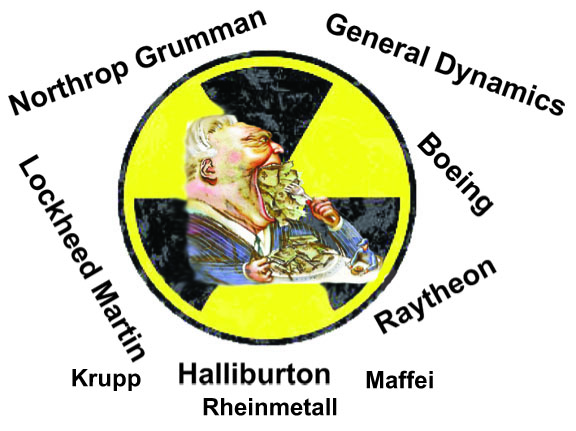
Private contractors now run the nuclear warhead complex and build nuclear delivery vehicles. They range from Raytheon, General Dynamics, and Lockheed Martin to lesser-known firms like BWX Technologies and Jacobs Engineering, all of which split billions of dollars in contracts from the Pentagon (for the production of nuclear delivery vehicles) and the Department of Energy (for nuclear warheads). To keep the gravy train running — ideally, in perpetuity — those contractors also spend millions lobbying decision-makers. Even universities have gotten into the act. Both the University of California and Texas A&M are part of the consortium that runs the Los Alamos nuclear weapons laboratory.
The American warhead complex is a vast enterprise with major facilities in California, Missouri, Nevada, New Mexico, South Carolina, Tennessee, and Texas. And nuclear-armed submarines, bombers, and missiles are produced or based in California, Connecticut, Georgia, Louisiana, North Dakota, Montana, Virginia, Washington state, and Wyoming. Add in nuclear subcontractors and most states host at least some nuclear-weapons-related activities.
And such beneficiaries of the nuclear weapons industry are far from silent when it comes to debating the future of nuclear spending and policy-making.
Profiteers of Armageddon: The Nuclear Weapons Lobby
The institutions and companies that build nuclear bombs, missiles, aircraft, and submarines, along with their allies in Congress, have played a disproportionate role in shaping U.S. nuclear policy and spending. They have typically opposed the U.S. ratification of a Comprehensive Nuclear Test Ban treaty; put strict limits on the ability of Congress to reduce either funding for or the deployment of intercontinental ballistic missiles (ICBMs); and pushed for weaponry like a proposed nuclear-armed, sea-launched cruise missile that even the Pentagon hasn’t requested, while funding think tanks that promote an ever more robust nuclear weapons force.
A case in point is the Senate ICBM Coalition (dubbed part of the “Dr. Strangelove Caucus” by Arms Control Association Director Daryl Kimball and other critics of nuclear arms). The ICBM Coalition consists of senators from states with major ICBM bases or ICBM research, maintenance, and production sites: Montana, North Dakota, Utah, and Wyoming. The sole Democrat in the group, Jon Tester (D-MT), is the chair of the powerful appropriations subcommittee of the Senate Appropriations Committee, where he can keep an eye on ICBM spending and advocate for it as needed.
The Senate ICBM Coalition is responsible for numerous measures aimed at protecting both the funding and deployment of such deadly missiles. ……………………….. That Coalition’s efforts are supplemented by persistent lobbying from a series of local coalitions of business and political leaders in those ICBM states. Most of them work closely with Northrop Grumman, the prime contractor for the new ICBM, dubbed the Sentinel and expected to cost at least $264 billion to develop, build, and maintain over its life span that is expected to exceed 60 years.
Of course, Northrop Grumman and its 12 major ICBM subcontractors have been busy pushing the Sentinel as well. They spend tens of millions of dollars on campaign contributions and lobbying annually, while employing former members of the government’s nuclear establishment to make their case to Congress and the executive branch. And those are hardly the only organizations or networks devoted to sustaining the nuclear arms race. You would have to include the Air Force Association and the obscurely named Submarine Industrial Base Council, among others.
The biggest point of leverage the nuclear weapons industry and the arms sector more broadly have over Congress is jobs. How strange then that the arms industry has generated diminishing job returns since the end of the Cold War. According to the National Defense Industrial Association, direct employment in the weapons industry has dropped from 3.2 million in the mid-1980s to about 1.1 million today.
Even a relatively small slice of the Pentagon and Department of Energy nuclear budgets could create many more jobs if invested in green energy, sustainable infrastructure, education, or public health – anywhere from 9% to 250% more jobs, depending on the amount spent. Given that the climate crisis is already well underway, such a shift would not only make this country more prosperous but the world safer by slowing the pace of climate-driven catastrophes and offering at least some protection against its worst manifestations.
A New Nuclear Reckoning?
Count on one thing: by itself, a movie focused on the origin of nuclear weapons, no matter how powerful, won’t force a new reckoning with the costs and consequences of America’s continued addiction to them. But a wide variety of peace, arms-control, health, and public-policy-focused groups are already building on the attention garnered by the film to engage in a public education campaign aimed at reviving a movement to control and eventually eliminate the nuclear danger.
Past experience — from the Campaign for Nuclear Disarmament that helped persuade Christopher Nolan to make Oppenheimer to the “Ban the Bomb” and Nuclear Freeze campaigns that stopped above-ground nuclear testing and helped turn President Ronald Reagan around on the nuclear issue — suggests that, given concerted public pressure, progress can be made on reining in the nuclear threat. The public education effort surrounding the Oppenheimer film is being taken up by groups like The Bulletin of the Atomic Scientists, the Federation of American Scientists, and the Council for a Livable World that were founded, at least in part, by Manhattan Project scientists who devoted their lives to trying to roll back the nuclear arms race; professional groups like the Union of Concerned Scientists and Physicians for Social Responsibility; anti-war groups like Peace Action and Win Without War; the Nobel Peace prize-winning International Campaign to Abolish Nuclear Weapons; nuclear policy groups like Global Zero and the Arms Control Association; advocates for Marshall Islanders, “downwinders,” and other victims of the nuclear complex; and faith-based groups like the Friends Committee on National Legislation. The Native American–led organization Tewa Women United has even created a website, “Oppenheimer — and the Other Side of the Story,” that focuses on “the Indigenous and land-based peoples who were displaced from our homelands, the poisoning and contamination of sacred lands and waters that continues to this day, and the ongoing devastating impact of nuclear colonization on our lives and livelihoods.”
On the global level, the 2021 entry into force of a nuclear ban treaty — officially known as the Treaty on the Prohibition of Nuclear Weapons — is a sign of hope, even if the nuclear weapons states have yet to join. The very existence of such a treaty does at least help delegitimize nuclear weaponry. It has even prompted dozens of major financial institutions to stop investing in the nuclear weapons industry, under pressure from campaigns like Don’t Bank on the Bomb.
In truth, the situation couldn’t be simpler: we need to abolish nuclear weapons before they abolish us. Hopefully, Oppenheimer will help prepare the ground for progress in that all too essential undertaking, beginning with a frank discussion of what’s now at stake. https://tomdispatch.com/the-profiteers-of-armageddon/
Our first president in his farewell address warned us about three things: debt, political parties and foreign entanglements. Few now would doubt the prescient wisdom of the first two warnings, but we have also become entrapped in the third. Most notably we are forced by a declining Russia and a rising China to engage in a dangerous game of nuclear deterrence.
George Washington likely could not have envisioned a world in which his country was threatened with destruction either intentionally or accidentally by ballistic missiles launched from a foreign country thousands of miles away. Despite the new nature of the threats there may still be a measure of wisdom to be distilled from his advice. It is unlikely he would engage China in a destructive war over Taiwan although he might well provide them with the weapons to defend themselves. The problem with nuclear weapons would be more complicated and the only thing we can know for sure is that Washington would do what he perceived to be in his country’s best interest.
What is his country’s best interest? As we near the 78th anniversary of the atomic bombing of Hiroshima and Nagasaki, which resulted in the instant death of 150,000 people, we should take pause. United Nations general secretary Antonio Guterres warned us over a year ago that that we are one accident or miscalculation away from disaster.
The Power 5 nuclear weapon states: China, France, Russia, United Kingdom and the United States jointly stated over a year ago that “a nuclear war cannot be won and should never be fought.” Yet all the nuclear weapon states are renewing and trying to enhance their weapons in an ever-increasing cycle of ratcheting up that undermines stability and benefits no one. Secretary of Defense Robert McNamara said after the Cuban Missile Crisis “we lucked out.” Only good luck prevented a nuclear war and to depend on continued good luck, as the risks increase, is magical thinking better suited for children’s books of fairy tales, than as part of national defense policy.
We must tear down the metaphorical wall between the soothing idea of security through nuclear deterrence and the reality of the cataclysmic threat that nuclear weapons pose. The U.S. must lead the way and work with the authoritarian states, convincing them that it is in everyone’s best interest to maintain security without the ever-present threat of global annihilation.
The United Nations’ Treaty to Prohibit Nuclear Weapons, TPNW, in force since January 2021, is the best hope to begin the multi-generational trust building that will allow the required rigid verification regimes. Pursuing the path to global elimination of nuclear weapons is the only way to free ourselves from this dreadful foreign entanglement.
Although the total elimination of nuclear weapons is the ultimate solution there are things that can be done right now to reduce the risk of catastrophe. There is a grassroots movement endorsed by hundreds of nongovernmental organizations and municipal and state governments. Back from the Brink — preventnuclearwar.org — has four additional actions that can reduce risk and encourage our adversaries to follow.
The U.S. should have a No First Use policy. Using nuclear weapons first against a nonnuclear weapon state would merit world condemnation; using them against a nuclear weapon state would bring devastating retaliation. The second and third actions are linked. The U.S. should take nukes off high alert status and eliminate sole presidential authority to launch. Only Congress can declare war and loitering nuclear-armed submarines virtually undetectable allow that option. Finally, many former military leaders including former Secretary of Defense William Perry have spoken against replacing the entire U.S. arsenal. The ground-based ICBMs are “sitting ducks” virtually inviting a first strike by a deranged tyrant.
It is also important to remember that the military industrial political complex that President Dwight Eisenhower warned us about is often disingenuous touting weapon systems for profit that do not make us safer. U.S. House of Representatives Resolution 77 introduced by Representative McGovern endorses the Back from the Brink campaign and already has 34 cosponsors. A companion bill should be introduced in the senate. The grace of public pressure by “we the people” can force our government to adopt a less insane nuclear policy.
I feel that a real leader, like Washington, would have the audacity, like presidents Reagan and Gorbachev, who made great progress ending the cold war, to pursue this path.
The space race has been revived, but this time, the goal post has been shifted much further – to Mars. As recent technological advancements promise to open new horizons of exploration, NASA plans to cut the travel time to Mars with a nuclear-powered spacecraft.
A trip to Mars currently takes approximately seven months, covering a staggering 300-million-mile journey. NASA, in collaboration with the US Defense Advanced Research Projects Agency (DARPA), now proposes an ambitious plan that hinges on the promise of nuclear thermal propulsion technology to reduce this duration significantly.
DRACO spacecraft is nuclear-powered
NASA aims to launch a nuclear-powered spacecraft, known as DRACO (Demonstration Rocket for Agile Cislunar Operations), into Earth’s orbit either by late 2025 or early 2026. The spacecraft, under construction by Lockheed Martin, a leading aerospace and defense company, will serve as a testbed for this groundbreaking technology.
NASA administrator Bill Nelson said that this technology “would allow humans to travel in deep space at record speed.” However, it remains unclear by how much the nuclear thermal propulsion technology can decrease the travel time.
…………………………………………………………………. The history of NASA’s interest in nuclear propulsion dates back over six decades. The concept was first explored in the 1960s when Wernher von Braun, a pioneer of rocket technology, advocated for a Mars mission utilizing a nuclear propulsion system. Unfortunately, budgetary constraints and shifting priorities resulted in the abandonment of this vision in 1972
But with the dawn of the new space age, NASA’s pursuit of the Red Planet has been rekindled. In collaboration with the US government, the space agency aims to expedite progress with the DRACO nuclear thermal rocket program.
“The ability to accomplish leap-ahead advances in space technology through the DRACO nuclear thermal rocket program will be essential for more efficiently and quickly transporting material to the Moon and eventually, people to Mars,” commented Dr Stefanie Tompkins, director at DARPA………………………………………………………………………………………………
More about Mars…………………….
Size
Mars is about half the size of Earth but has the same amount of dry land. It is much colder than Earth, with temperatures ranging from -195 degrees F in winter at the poles to 70 degrees F in summer near the equator. Mars has the largest dust storms in the solar system, capable of covering the entire planet and lasting for months.
Atmosphere
The planet’s atmosphere is very thin, composed mainly of carbon dioxide (95%), with traces of nitrogen and argon. It lacks a magnetic field, which on Earth serves to protect us from harmful solar radiation. As a result, the surface of Mars is exposed to higher levels of radiation, which can be a challenge for human exploration and potential colonization.
………………………….... Potential for life on Mars
The possibility of liquid water in the past, and thus the potential for life, has made Mars a prime target for future human exploration. The planned missions to Mars, such as NASA’s Artemis program and SpaceX’s Starship project, aim not only to land humans on Mars but also to establish a sustainable colony, marking a significant leap in our exploration of the cosmos. https://www.earth.com/news/could-a-nuclear-powered-spacecraft-shorten-the-trip-to-mars/
The Biden administration announced a $345 million weapons package for Taiwan on Friday, the first tranche in a total of $1 billion the U.S. has allotted to be transferred directly from Pentagon stockpiles to the island this year.
The move is sure to anger China as Washington has been trying to rebuild relations with Beijing. Senior administration officials, including Secretary of State Antony Blinken and Treasury Secretary Janet Yellen, recently visited China, but the outreach has done little to quell tensions over a range of issues, from U.S. support to Taiwan to Beijing’s spy balloon program…………………..
The package marks the first time the U.S. has used new authority from Congress to transfer military equipment directly from Pentagon inventory to Taiwan. The transfer is done under the Presidential Drawdown Authority, the same mechanism Washington uses to send weapons to Ukraine………………………………………..
Defense Secretary Lloyd Austin told lawmakers in May that a presidential drawdown package was in the works for Taiwan, but it’s taken weeks of additional work before the aid could be officially announced. Among other challenges, DOD had to work through an “accounting error” that forced officials finalizing packages for Ukraine and Taiwan to recalculate the value of equipment that was being sent………….. more https://www.politico.com/news/2023/07/28/u-s-300million-weapons-taiwan-00108811
What folly! Just as a dam necessary for cooling nuclear waste at Europe’s biggest nuclear power complex is blown up, members of the Connecticut legislature pass a bill that includes promotion of dangerous outmoded nuclear power.
Senate Bill 7 creates a “Council for Advancing Nuclear Energy Development” specifically packed with six positions for people who work in the nuclear energy industry. Their mission will be to discuss “advancements that are occurring in nuclear energy development.” They’ll study “small modular reactors, advanced nuclear reactors, [and] fusion energy facilities.”
Rather than seek “advancement,” we should be figuring out how to phase out this technology. We see by the Ukraine example that parties at war do not respect what one would think would be totally obvious, the need to do nothing to harm the safety of nuclear power plants. Not that we expect warfare to break out in the U.S., but this country should lead in best practices so that countries where war is a lot more likely won’t go down the nuclear path and risk huge releases of nuclear contamination that spread world-wide.
Realize that the Chernobyl disaster of 1986 led to thousands of fatalities. In Ukraine alone 35,000 women have received compensation for spouses who died because of the disaster. And that’s only the numbers from Ukraine. High levels of radiation covered southern Belarus too, but the government there has never released its statistics.
Another section of the Connecticut bill would classify nuclear power as a “Class 1 renewable energy source.” That would allow the owner of a new nuclear facility to sell renewable “energy credits,” another dubious idea. Rather than limit the use of polluting fuels, the idea is for “the market” to take care of things. Grand, let’s rely on the same market whose mindless profit seeking got us hooked on fossil fuels in the first place.
The new council will study ways to “promote nuclear energy development, expansion and research” in Connecticut. What won’t be studied is the problem of importation of Russian uranium that is used to generate nuclear power. Every year hundreds of millions of dollars are spent by U.S. companies to buy raw and enriched uranium from Russia. Presumably Connecticut nuclear power companies are no different.
Reuters reports that the U.S. power industry relies on Russia and its allies Kazakhstan and Uzbekistan for roughly half of the uranium powering its nuclear power plants. Why not respond to a petition about this and study how to stop relying on a fuel that enriches the Russian dictator?
On May 19 the Mirror published Jan Ellen Spiegel’s piece headlined, “Advocates searching for any kind of legislative win on environment.” Obviously, some things moved forward this session, but is there anything that’s going to have a major impact on the immense problem of our climate emergency?
On June 6 it was noted that last month carbon dioxide levels measured at the federal government’s Mauna Loa Atmospheric Baseline Observatory in Hawaii reached concentrations of 424 parts per million. That’s far, far higher than the 350 ppm that climate scientists believe necessary for long term functioning of human civilization. Sure it was probably at 424 ppm before, but that was 4 million years ago!
Governor Lamont should veto SB 7. Then call a special session to pass a revised SB 7 clean of plans for more nuclear power. After doing that stay in session and spend time passing blockbuster legislation that will provide leadership for a country teetering on a climate precipice.
FORTUNE, BY STEPHANIE COOKE, July 29, 2023 Since the turn of the millennium, at least $50 billion has been spent on a frantic effort to create a new Golden Age for nuclear energy in the U.S. Billions more are being lavished on an even more desperate effort to launch small reactors as supposedly safer, cheaper alternatives to yesteryear’s elephant-sized versions. Most of the money comes from ratepayers and taxpayers, accompanied by an avalanche of public relations that rivals the 1950s “Atoms for Peace” campaign with its claims of “too cheap to meter” electricity.
So far, the effort has produced little in tangible assets: roughly one gigawatt of capacity from the Watts Bar-2 reactor completed after decades of on-and-off-again construction and the promise of 2 GW from the long-delayed Plant Vogtle in Georgia. So far, not a single molecule of CO2 emissions has been avoided by a new reactor, and the primary beneficiaries are not the people who paid but publicly-owned utilities, reactor design companies, and PR and law firms. They are part of a chorus of advocacy groups and government agencies, led by the Department of Energy (DOE), advancing the idea that low-carbon nuclear is essential to any long-term climate change solution.
The story is selling well but the push for more and more money—in direct subsidies, ratepayer financing, and government grants or loans–has a dark side. To cite just a few examples, former state officials and utility executives in Illinois and Ohio face lengthy prison terms for bribery schemes linked to subsidies for unprofitable nuclear plants. In South Carolina, two former Scana executives received prison sentences after pleading guilty to criminal charges in 2020 and 2021 over a nuclear project that ultimately collapsed. Two Westinghouse executives also charged are facing a similar fate, with one still awaiting trial in October.
When it comes to costs and schedules, the lack of honesty surrounding nuclear projects is often breathtaking. In Georgia, where two Westinghouse reactors at Vogtle have been under construction since 2009, only one is completed and is now struggling to achieve commercial operation after multiple unplanned reactor and turbine trips, according to recent Georgia Public Service Commission staff testimony. That testimony also included allegations that utility executives have been providing “materially inaccurate” cost estimates over the project’s life. Vogtle’s estimated total $33 billion cost, as outlined in the testimony, versus $13.3 billion originally estimated makes it the most expensive power plant ever built in the United States. Most of the tab is being footed by ratepayers, with the US taxpayer, via DOE, providing $12 billion in loans.
And still, the messaging that nuclear is a must for reducing emissions goes on at a fever pitch. But the message is distorted: The industry cannot deliver what is needed. The U.S. lost its industrial base, including heavy forging capacity, decades ago–and the costs of a major nuclear buildout could now be in the trillions.
Moreover, the billions currently being spent on nuclear are crowding out viable, less costly solutions for decarbonizing the power sector (not only renewables such as wind and power but also high-voltage direct current transmission lines to deliver them to where they’re needed), thus slowing the transition. A surfeit of renewables projects is seeking grid access, enough to meet 90% of the Biden administration’s goal of a carbon-free power sector by 2035, according to a Berkeley Lab report, but the country’s Balkanized electricity market system, monopolistic utilities, and lack of adequate transmission capacity will likely prevent most of it from succeeding.
The transmission capacity needed for renewables will require anywhere from $30 billion to $90 billion to meet demand by 2030, with the figures rising to $200 billion to $600 billion between 2030 and 2050, according to a study by the Brattle Group. Squandering such sums on nuclear should be out of the question.
Our current fleet of 92 reactors generates about a fifth of the nation’s electricity, but most of the plants are slated for permanent closure by 2050, assuming they operate well beyond their 40-year design life. The DOE admits that such “life extensions” put operators in uncharted waters because there is no actual experience to support 60- or 80-year reactor lifetimes.
The problem of where to put used nuclear fuel (radioactive waste) remains after funding was withdrawn for an estimated $100 billion underground repository project at Yucca Mountain in Nevada. Proposed privately-owned interim storage sites in New Mexico and Texas, though licensed by the U.S. Nuclear Regulatory Commission, face intense local and state opposition as well as political obstacles at the federal level.
Industry officials privately acknowledge these challenges. Even so, nuclear is receiving the most favorable media coverage since the 1950s, and the latest annual Gallup poll on nuclear, released in April, showed the highest level of support in a decade for nuclear power among the American public–at 55%. Nuclear opponents in Congress are now silent on the issue or even hinting at changed views, and bipartisan support in Congress has over the past couple of years resulted in billions in tax incentives and other forms of support for both existing and planned nuclear plants.
But public opinion is fickle–and no guarantee for the future. Since Gallup began polling on nuclear in 1994, support peaked at 62% in 2010, a year before the triple meltdowns at Fukushima. After that, it went steadily down, to a low of 44% in 2016. Nor is popular opinion an indicator of whether nuclear’s formidable technical, financial, environmental, and geopolitical challenges can be overcome.
The primary aims of today’s promoters are to prevent aging, uneconomic reactors from closing, and to secure funding for small modular reactors (SMRs) and “advanced” reactors (and associated fuels).
The push for smaller reactors appears to have been an act of desperation by a nuclear-centric energy agency–the DOE (which also oversees the country’s nuclear weapons programs)—after its failed attempt to create a nuclear “renaissance” in the early 2000s. Although that project generated interest (utilities filed plans for 28 large-scale reactors), only the two at Vogtle were ever built………………………………………………………………………………………
New Mexico found itself at ground zero of a changed world on July 16, 1945 when scientists from the newly created Los Alamos National Laboratory detonated the world’s first atomic bomb, exposing nearby communities to radiation. Just 34 years later to the day, Church Rock, New Mexico became the site of the largest release of radioactive material ever to occur in the United States.
The impact of that history was something Bryan Kendall, who grew up in Albuquerque, hadn’t learned much about prior to enrolling in the Fall 2020 Nuclear New Mexico: Social and Environmental Impacts course at The University of New Mexico.
“It blew my mind that no one was talking about it. It drove a passion in me that has not subsided since,” Kendall said.
The course helped Kendall, who graduated earlier this year with a bachelor’s degree in mechanical engineering and a minor in sustainability studies, decide he would avoid working for an organization with an ongoing nuclear focus though he doesn’t fault those who do.
Though the name of the class has changed over time, the goal to provide critical, interdisciplinary nuclear education remains the same. Each course includes field trips to key sites around the state, guest speakers from organizations like the Tularosa Basin Downwinders Consortium and Tewa Women United, as well as a final project to apply learning to social or environmental justice.
Eileen O’Shaughnessy, an instructor and Ph.D. Candidate in Language, Literacy, and Sociocultural Studies with an emphasis on nuclear education, has taught the class for several years through Sustainability Studies, the Honors College, and this fall, Women and Gender Studies. Most recently, O’Shaughnessy co-taught with Associate Professor Myrriah Gómez, Ph.D., the author of the 2022 release Nuclear Nuevo México. Gómez has taught a similar course titled Atomic Bomb Cultures in the Honors College for many years. O’Shaughnessy’s upcoming course is titled The Atomic Bomb and Feminism and will explore topics like the hetero-patriarchal nuclear family, notions of apocalypse, anti-nuclear activism, environmental racism, nuclear colonialism, and more.
“I developed this class called Nuclear New Mexico based on my research that was a critical interdisciplinary look at the environmental, social, and cultural impacts of the nuclear industry, specifically on New Mexico, but also the world,” O’Shaughnessy said. “The beginning of the atomic age is located here, but it really rippled out from New Mexico.”
The class explores everything from uranium mining to the disposal and storage of radioactive materials and the outsized impact those processes have had on indigenous communities and communities of color.
does it really sound like a coincidence that we’re seeing all these news stories about UFOs and aliens at the same time we’re seeing news stories about a race between the US and China and Russia to dominate space militarily?
If Wednesday’s House Oversight subcommittee hearing on UFOs had happened ten years ago instead of today, it would have shaken the world. Imagine someone from 2013 hearing congressional testimonies about “routine” military pilot encounters with giant flying tic tacs, floating orbs, 300-foot red squares, and cubes in clear spheres zipping around in ways that surpass all known earthly technology by leaps and bounds, or about secret government possession of otherworldly aircraft they’re trying to reverse engineer and the dead bodies of their non-human pilots, or about the possibility that these creatures are not merely extraterrestrial but extra-dimensional. Their jaws would have hit the floor.
Now in 2023 we’ve been getting incrementally drip-fed bits and pieces of these stories for six years, so the scene on Capitol Hill on Wednesday didn’t have the impact it would’ve had in 2013. It’s making headlines and getting attention, but not as much as Sinead O’Connor’s death or people’s thoughts on Barbie and Oppenheimer. The response from the general public could be described as a collective nervous laugh and a shrug.
……………………………………………………. the new UFO narrative wasn’t just cooked up at the last minute to distract from current headlines, it’s been unfolding for six years, and people aren’t even paying that much attention to it. The empire doesn’t tend to orchestrate spectacular events as a “distraction” anyway; the adjustment of public attention tends to take the much more mundane form of agenda setting in the media, where some stories receive more attention than others based on what’s convenient for the oligarchs who own the press.
……………………………………. for me what really stinks about all this UFO stuff is the timing. Here we are in the early stages of a new cold war which features a race to militarize space, and we’re hearing congressional testimony about mysterious vehicles posing a threat to US airspace which have the ability to go up and down between earth and space very quickly. That smells off.
I mean, does it really sound like a coincidence that we’re seeing all these news stories about UFOs and aliens at the same time we’re seeing news stories about a race between the US and China and Russia to dominate space militarily?
A Foreign Policy article from last year blares the headline “China and Russia Are Catching Up to U.S. in Space Capabilities, Pentagon Warns” with the subheading “The militarization of space is picking up pace.” These warnings are echoed in articles by Defense One and Time. An article on the United Nations website from last year carries the title “‘We Have Not Passed the Point of No Return’, Disarmament Committee Told, Weighing Chance Outer Space Could Become Next Battlefield.” A 2021 report from the war machine-funded Center for Strategic and International Studies titled “Defense Against the Dark Arts in Space: Protecting Space Systems from Counterspace Weapons” warns of the urgent need to build more space weapons to counter US enemies. A Global Times article from last year carries the title “Chinese experts urge avoidance of space weaponization amid commercial space capability deployment in Ukraine.”
………………………………….it just seems mighty suspicious to me how we’re being slowly paced into this UFO narrative (or UAP narrative for those hip to the current jargon) right when there’s a mad rush to get weapons into space. I can’t actually think of any other point in history when the timing of something like this would have looked more suspicious.
So for me the most disturbing parts of the UFO hearing were the parts that could wind up facilitating the agenda to militarize space, like when this phenomenon was framed as a “national security” threat or when it was mentioned that they can transition from earth to space very rapidly.
When asked by congressman Glenn Grothman “do you believe UAPs pose a threat to our national security?”, former Navy commander David Fravor answered with an unequivocal yes. A few minutes later Fravor described these vehicles as being able to “come down from space, hang out for three hours and go back up.”
When asked by congressman Andy Ogles whether UFOs could be “collecting reconnaissance information” on the US military, all three witnesses — Grusch, Fravor, and former Navy pilot Ryan Graves — answered in the affirmative. Asked by Ogles if UFOs could be “probing our capabilities,” all three again said yes. Asked if UFOs could be “testing for vulnerabilities” in US military capabilities, all three again said yes. Asked if UFOs pose an existential threat to the national security of the United States, all three said they potentially do. Asked if there was any indication that UFOs are interested in US nuclear technology, all three said yes.
Ogles concluded his questioning by saying, “There clearly is a threat to the national security of the United States of America. As members of Congress, we have a responsibility to maintain oversight and be aware of these activities so that, if appropriate, we take action.”
When asked by congressman Eric Burlison if “there has been activity by alien or non-human technology, and/or beings, that has caused harm to humans,” Grusch said he couldn’t get into specifics in a public setting (a common theme throughout the hearing), but said that “what I personally witnessed, myself and my wife, was very disturbing.”
Grusch would complicate this cryptic statement a few minutes later by saying that he’s never seen a UFO. How this statement doesn’t contradict his previous statement about having witnessed harmful behavior from non-human technology and/or beings was not made clear.
So you’ve got US policymakers being told that there are vehicles using technology not of this world routinely violating US airspace and posing an existential threat to US national security, and that these craft can go from earth to space and back at will, and that they need to help make sure their nation can address this threat.
What conclusions do you come to when presented with that kind of information? If you’re a lawmaker in charge of facilitating the operation of a highly militaristic empire, you’re probably not going to conclude that it’s time to hold hands and sing Kumbaya. You’re probably eventually going to start thinking in terms of military technology.
One of the most important unanswered questions in all this UFO hullabaloo is, why now? Why are we seeing all this movement on “disclosure” after generations of zero movement? If these things are in fact real and the government has in fact been keeping them secret, why would the adamant policy of dismissal and locked doors suddenly be reversed, allowing “whistleblowers” to come forward and give testimony before congress? If they had motive to keep it a secret this entire time, why would that motive no longer be there?
…………………………………So why now? Why the drastic and sudden shift from UFOs and aliens being laughable tinfoil hat nonsense to the subject of serious congressional inquiries and widespread mainstream media coverage?
Well, the timing of the race to militarize space might provide an answer to the “why now?” question. Is it a coincidence that this new UFO narrative began its rollout in 2017, around the same time as the rollout of the Space Force? Are we being manipulated at mass scale about aliens and UFOs to help grease the wheels for the movement of war machinery into space? How likely is it that by pure coincidence this extraplanetary narrative timed out the way it did just as the US empire makes a last-ditch grab at unipolar planetary domination?
I don’t know. I do know that if I’m assigning degrees of probability, “Extraterrestrial or extradimensional beings are here and take a special interest in us and sometimes crash their vehicles and our government recovered them but kept them a secret but suddenly decided not to be so secretive about them anymore” ranks significantly lower than “Our rulers are lying and manipulating to advance their own interests again.”
I am 100 percent wide open to the possibility of extraterrestrials and otherworldly vehicles zipping around our atmosphere. What I am not open to is the claim that the most depraved institutions on earth have suddenly opened their mind to telling us the truth about these things, either out of the goodness of their hearts or because they were “pressured” by UFO disclosure activists.













 nuclear-news