Assange Be Weary: The Dangers of a US Plea Deal

August 18, 2023
By Binoy Kampmark / CounterPunch, https://scheerpost.com/2023/08/18/assange-be-weary-the-dangers-of-a-us-plea-deal/
At every stage of its proceedings against Julian Assange, the US Imperium has shown little by way of tempering its vengeful impulses. The WikiLeaks publisher, in uncovering the sordid, operational details of a global military power, would always have to pay. Given the 18 charges he faces, 17 fashioned from that most repressive of instruments, the US Espionage Act of 1917, any sentence is bound to be hefty. Were he to be extradited from the United Kingdom to the US, Assange will disappear into a carceral, life-ending dystopia.
In this saga of relentless mugging and persecution, the country that has featured regularly in commentary, yet done the least, is Australia. Assange may well be an Australian national, but this has generally counted for naught. Successive governments have tended to cower before the bullying disposition of Washington’s power. With the signing of the AUKUS pact and the inexorable surrender of Canberra’s military and diplomatic functions to Washington, any exertion of independent counsel and fair advice will be treated with sneering qualification.
The Albanese government has claimed, at various stages, to be pursuing the matter with its US counterparts with firm insistence. Prime Minister Anthony Albanese has even publicly expressed his frustration at the lack of progress in finding a “diplomatic solution” to Assange’s plight. But such frustrations have been tempered by an acceptance that legal processes must first run their course.
The substance of any such diplomatic solution remains vague. But on August 14, the Sydney Morning Herald, citing US Ambassador to Australia Caroline Kennedy as its chief source, reported that a “resolution” to Assange’s plight might be in the offing. “There is a way to resolve it,” the ambassador told the paper. This could involve a reduction of any charges in favour of a guilty plea, with the details sketched out by the US Department of Justice. In making her remarks, Kennedy clarified that this was more a matter for the DOJ than the State Department or any other department. “So it’s not really a diplomatic issue, but I think there absolutely could be a resolution.”
In May, Kennedy met members of the Parliamentary Friends of Julian Assange Group to hear their concerns. The previous month, 48 Australian MPs and Senators, including 13 from the governing Labor Party, wrote an open letter to the US Attorney General, Merrick Garland, warning that the prosecution “would set a dangerous precedent for all global citizens, journalists, publishers, media organizations and the freedom of the press. It would also be needlessly damaging for the US as a world leader on freedom of expression and the rule of law.”
In a discussion with The Intercept, Gabriel Shipton, Assange’s brother, had his own analysis of the latest developments. “The [Biden] administration appears to be searching for an off-ramp ahead of [Albanese’s] first state visit to DC in October.” In the event one wasn’t found, “we could see a repeat of a very public rebuff delivered by [US Secretary of State] Tony Blinken to the Australian Foreign Minister two weeks ago in Brisbane.”
That rebuff was particularly brutal, taking place on the occasion of the AUSMIN talks between the foreign and defence ministers of both Australia and the United States. On that occasion, Foreign Minister Penny Wong remarked that Australia had made its position clear to their US counterparts “that Mr Assange’s case has dragged for too long, and our desire it be brought to a conclusion, and we’ve said that publicly and you would anticipate that that reflects also the positive we articulate in private.”
In his response, Secretary of State Blinken claimed to “understand” such views and admitted that the matter had been raised with himself and various offices of the US. With such polite formalities acknowledged, Blinken proceeded to tell “our friends” what, exactly, Washington wished to do.
Assange had been “charged with very serious criminal conduct in the United States in connection with his alleged role in one of the largest compromises of classified information in the history of our country. The actions that he has alleged to have committed risked very serious harm to our national security, to the benefit of our adversaries, and put named sources at grave risk – grave risk – of physical harm, and grave risk of detention.”
Such an assessment, lazily assumed, repeatedly rebutted, and persistently disproved, went unchallenged by all the parties present, including the Australian ministers. Nor did any members of the press deem it appropriate to challenge the account. The unstated assumption here is that Assange is already guilty for absurd charges, a man condemned.
At this stage, such deals are the stuff of manipulation and fantasy. The espionage charges have been drafted to inflate, rather than diminish any sentence. Suggestions that the DOJ will somehow go soft must be treated with abundant scepticism. The pursuit of Assange is laced by sentiments of revenge, intended to both inflict harm upon the publisher while deterring those wishing to publish US national security information. As the Australian international law academic Don Rothwell observes, the plea deal may well take into account the four years spent in UK captivity, but is unlikely to either feature a complete scrapping of the charges, or exempt Assange from travelling to the US to admit his guilt. “It’s not possible to strike a plea deal outside the relevant jurisdiction except in the most exceptional circumstances.”
Should any plea deal be successfully reached and implemented, thereby making Assange admit guilt, the terms of his return to Australia, assuming he survives any stint on US soil, will be onerous. In effect, the US would merely be changing the prison warden while adjusting the terms of observation. In place of British prison wardens will be Australian overseers unlikely to ever take kindly to the publication of national security information.
What Happened When the US Set Off Nuclear Weapons in One of the Most Geologically Active Places on Earth?

the enduring impact on the island remains as the copious radioactive elements made when we try to come up with ways to destroy us all keep seeping from their tomb underground.
Imagine a Bond villain saying they were going to set off three nuclear bombs in one of the most volcanically and seismically active places on Earth. Now imagine that the US already did it.
Rocky Planet. By Erik Klemetti. Aug 16, 2023
“……………. the United States set three nuclear bombs off in one of the most geologically active parts of the world … and nothing happene
These days it is hard to imagine a world with nuclear testing. However, in the 1940s to 1990s, the US and USSR (amongst others) were setting off bombs like they were going out of style. In the air, on land, under the sea and eventually underground, these “experiments” were both means to develop even bigger weapons and displays of force. The consequences of many of these tests are still being felt thanks to the copious radioactive fallout produced.
Bombs in Alaska
One set of the over 1,000 nuclear explosions run by the US was conducted on Amchitka in the Aleutian Islands. Long Shot, Milrow and Cannikin were the code names given to three blasts performed from 1965 to 1971. This included the largest underground nuclear bomb ever detonated, the 5 megaton weapon as part of Operation Grommet.
The most astonishing thing about these tests is that Amchitka Island is in the middle of the Aleutian subduction zone, where the Pacific Plate is diving underneath the North American Plate. There are six potentially active volcanoes within 100 miles of the island. On top of that, the Rat Islands region has produced numerous and gigantic earthquakes across the 20th and 21st centuries. This area is highly volatile, geologically speaking.
So, why run nuclear tests there? For one, it is remote. Very few people live anywhere near these islands. It’s remoteness also allowed Amchitka to be a proxy for the USSR so that the US could work on methods to detect underground nuclear blasts from afar. The island previously hosted a US Air Force base during World War II that had over 15,000 soldiers stationed in this desolate island. This meant that the infrastructure for tests was there after the armed forces moved out.
The first nuclear test on Amchitka was 1965’s Long Shot. It was an 80-kiloton warhead that was used to test early methods of seismic detection of distant nuclear blasts. After that, nothing happened on the island again until 1969. It was realized that the Cannikin test was way too big to do in Nevada, so off to Alaska it went.
Volcanoes and Earthquakes
Let’s set out stage: the US planned to test a massive nuclear weapon in a shaft last 1 mile (2 kilometers) deep in a location that was volcanically and seismically active. Remember those six volcanoes with 100 miles? They include Semisopochnoi (currently erupting, and prior to test, 1873), Little Sitkin (last erupted 1830), Gareloi (last erupted 1989, and prior to the test, 1952), Davidof (Holocene), Segula (1600s?) and Kiska (last erupted 1990, erupting in 1969!)
On top of that, the M8.7 Rat Islands earthquake that generated a tsunami that swept across the Alaskan coast occurred ~30 miles from Amchitka on February 4, 1965. That was less than 9 months before the Long Shot test! It is hard to imagine how a massive earthquake could happen that close to the test site … and they still went ahead and did it! Combine that with the vivid memories of the 1964 M9.2 earthquake and tsunami in Alaska, and no wonder people were edgy about bomb tests.
Just to show how strange the pre-test ban treaty world was, the US Atomic Energy Commission set off a smaller (1-1.2 megaton, or 12-15 times larger than Long Shot) earlier to calibrate their sensors for the larger blast to come. Later, it was admitted that the Pentagon had run the Milrow explosion to also test if a big blast could, just maybe, cause an earthquake or eruption.
The Big One
Although the tests were performed under the auspices of the US Atomic Energy Commission, they were really being done for the Pentagon. The Cannikin test was meant to investigate the feasibility of using a 5-megaton warhead as part of an anti-ballistic missile program (the Spartan Missile). Although there was a lot of resistance to the test (see below), President Nixon still went ahead and ordered the test to proceed (with support from the Supreme Court).
Cannikin went off on November 6, 1971. It produced a M7 earthquake from the blast. You can see in this video how the land surface jumped as much as 20 feet during the explosion as the shockwave moved across the island. Thousands of birds and otters died in the shockwave. A crater over a mile wide was produced but even with the same energy released as the 2010 earthquake in Haiti, no tsunami was generated. Supposedly, very little radiation was detected either. In the eyes of the US Atomic Energy Commission and the Pentagon, it was a great success.
……………………………………………………… Looking Back 50 Years
The one long-term impact of the tests is the groundwater of Amchitka. Although little radiation was detected directly after the blast, water percolating through the underground remains of the Cannikin blast becomes radioactive. The US Department of Energy doesn’t agree with findings that show elements like plutonium in groundwater at Amchitka, but it does seem that the island still feels the effects of those blasts even today.
The other impact is a human impact. By the late 1960s, environmentalists became increasingly enflamed by the frequency of nuclear weapon tests … and rightly so. The amount of fallout produced by these tests is clearly seen in the deep-sea sediment and ice core records. When word got out about the immense Cannikin test, a group headed out in a rented boat they dubbed “Greenpeace” to try to stop the test, both in fear of fallout and the potential for triggering another earthquake and tsunami like the M8.7 event in 1965. Stormy weather with winds over 120 miles per hour prevented the ship from reaching Amchitka for the test, but the name “Greenpeace” remained as the environmental organization we know today.
Maybe the myth that we can set off eruptions and earthquakes using nuclear weapons can be (partially) put to bed. The only earthquake caused by these explosions were, well, caused by the explosion. Little evidence exists to suggest that the blasts had any trigger effect on faults and volcanoes near Amchitka. However, the enduring impact on the island remains as the copious radioactive elements made when we try to come up with ways to destroy us all keep seeping from their tomb underground. https://www.discovermagazine.com/planet-earth/what-happened-when-the-us-set-off-nuclear-weapons-in-one-of-the-most
Over Budget and Delayed—What’s Next for U.S. Nuclear Weapons Research and Production Projects?
August 17, 2023, https://www.gao.gov/blog/over-budget-and-delayed-whats-next-u.s.-nuclear-weapons-research-and-production-projects [Excellent diagrams]
The United States’ nuclear weapon stockpile depends on facilities that are, on average, about 50 years old. In fact, the processing of enriched uranium used in nuclear weapons is still conducted in an Oppenheimer-era facility built in 1945. These aging facilities pose safety and operational risks and cost taxpayers almost a billion dollars to maintain each year.
Over the next two decades, the United States plans to spend tens of billions of dollars to modernize the research and production infrastructure on which the nuclear stockpile depends. Today’s WatchBlog post looks at our new report about the status of these efforts, led by the National Nuclear Security Administration (NNSA), and the challenges that have resulted in them being over budget and delayed.
New infrastructure projects are important, complex, and expensive
NNSA is currently designing or constructing 23 major projects (each costing more than $100 million). Some projects will process nuclear components containing plutonium or enriched uranium, which are critical to the functioning of nuclear weapons. These projects are expensive and include three multi-billion dollar, one-of-a-kind efforts to build new or modify existing uranium and plutonium component production facilities in New Mexico, South Carolina, and Tennessee. Other projects do not involve nuclear materials and are less expensive, such as a $270 million project to build a high explosives laboratory and related facilities in Texas.
New projects will cost more and take longer to build than NNSA planned
As of March, NNSA’s projects that were in the construction phase collectively overran their cost estimates by over $2 billion and their schedules by almost 10 years. Some of the reasons for these increased costs and delays include poor management and planning, as well as COVID-19. Of the projects that are under construction, the multi-billion-dollar Uranium Processing Facility family of projects in Tennessee is responsible for a majority of the cost increases and schedule delays. These cost increases and schedule delays, as well as NNSA’s decision to refocus resources on higher-priority projects, led NNSA to propose placing two other projects (in Texas and South Carolina) currently in the design phase on hold for multiple years.
In addition, six projects in the design phase are implementing significant changes that may increase their cost and schedule beyond NNSA’s preliminary estimates. These include a project to modify existing plutonium processing facilities at Los Alamos National Laboratory in New Mexico.
We’ve made recommendations to help NNSA improve its oversight of these projects
We have previously made recommendations that would help NNSA better manage its projects as well as the programs that will operate the completed projects to achieve agency goals. For example, we recommended that the NNSA complete a lifecycle cost estimate for establishing the agency’s capability for producing plutonium pits (the central core of a nuclear weapon), as this effort involves dozens of programs, projects, and other activities, including two multi-billion dollar projects and multiple other projects that will cost hundreds of millions of dollars. However, NNSA has not taken action on some of these recommendations. We have expressed concerns about the management of nuclear projects and programs since 1990, and NNSA acquisition and program management remains on our most recent High Risk List.
Learn more about NNSA’s projects, their statuses, and challenges by checking out our new report.
US tightens export controls of nuclear power items to China
By Timothy Gardner, August 19, 2023
WASHINGTON, (Reuters) – The Biden administration has tightened controls on the export of materials and components for nuclear power plants to China, saying it would ensure the items were used only for peaceful purposes and not the proliferation of atomic weapons.
The steps are among the latest signs of strained relations between Washington and Beijing, which have clashed over spying allegations, human rights, China’s industrial policies, and U.S. export bans on advanced technologies.
The Bureau of Industry and Security (BIS), an arm of the Commerce Department, now requires exporters to get specific licenses to export certain generators, containers and software intended for use in nuclear plants in China.
The Nuclear Regulatory Commission (NRC), the federal agency responsible for nuclear energy safety, also requires exporters to get specific licenses to export special nuclear material and source material.
That includes different types of uranium as well as deuterium, a hydrogen isotope that, in large amounts, could be used in reactors to make tritium, a nuclear weapons component.
The Biden administration sees the action as “necessary to further the national security interests of the United States and to enhance the common defense and security” the NRC said.
A U.S. official said the changes, made on Monday, were prompted by general policy toward China…………………….
Non-proliferation analyst Edwin Lyman of the Union of Concerned Scientists non-profit group said the changes were “more symbolic than substantive” and doubted China’s nuclear weapons program would be meaningfully impacted.
…………………………….U.S. company Westinghouse has four AP1000 reactors in China. In 2018 Donald Trump’s administration issued restrictions on exports of nuclear reactor technology newer than the AP1000 due to proliferation concerns. Westinghouse did not immediately respond to a request for comment about the U.S. requirements.
Reporting by Timothy Gardner; additional reporting by Michael Martina; editing by Barbara Lewis https://www.reuters.com/world/us/us-tightens-export-controls-nuclear-power-items-china-2023-08-18/
Why the Glut of ‘Wonder Weapons’ to Ukraine Won’t Make a Difference

The primary purpose of American and Western militarism is to make profits for private corporations, the military-industrial complex.
Typically, the weapons are vastly overpriced, overhyped and designed for perpetual consumption.
They are not for winning a war. They’re for being used up, so you have to replace them now, with yet new buying.”
Finian Cunningham, August 15, 2023, https://strategic-culture.org/news/2023/08/15/us-capitalism-and-why-glut-of-wonder-weapons-ukraine-wont-make-difference/
It is slowly and reluctantly dawning on Western officials and their servile media that the Ukraine counteroffensive is failing. Not only the two-month-old counteroffensive but indeed the entire conflict. Ukraine hasn’t a chance of prevailing against Russia’s superior forces.
Still, the violence and killing go on. No diplomacy, peace, or sanity. Why?
Only a couple of months ago, the Western media were full of bravado claims that the United States’ and NATO’s weapons and training would turn the tide for a “stunning victory” against Russia. Today, those same media are meekly reporting on a “grinding counteroffensive” (Washington Post, New York Times, CNN) and “failed expectations” (London Times).
How to explain the glaring conundrum? The United States and its European NATO allies have supplied the Kiev regime with up to $100 billion worth of weaponry over the past year, ranging from battlefield tanks to Patriot missiles. And the military gifts keep coming, with the Biden administration requesting another $12 billion for Ukraine last week. In the coming months, the U.S. and its allies are planning to supply F-16 fighter jets.
And yet all this mind-boggling largesse won’t make a difference to the outcome of an eventual Russian victory. Tens of thousands more Ukrainian soldiers will be killed of course and a wider all-out nuclear war with Russia is a reprehensible risk. But why does the insanity continue? Why are Western politicians and media not exploring diplomatic alternatives to the endless slaughter?
A fundamental reason for this debacle and ultimate scandal is the inherent vice of U.S. militarism. American militarism and that of other Western capitalist states is not about the conventional understanding of “military” or “defense” for the purpose of defending nations, or indeed for actually winning wars. The primary purpose of American and Western militarism is to make profits for private corporations, the military-industrial complex.
Typically, the weapons are vastly overpriced, overhyped and designed for perpetual consumption. Take the U.S.-made Patriot air-defense system, or the Abrams tank, or the F-35 fighter jets. Independent military analysts will tell you these systems are overpriced junk that don’t really do the job they are supposed to do. Russian forces have been wiping out the Patriot and Western tanks with relative ease using superior hypersonic weapons.
Michael Hudson, the respected geopolitical commentator and author of the book ‘Superimperialism’, nails it when he observes that U.S. militarism is not about essentially defending that nation or its allies – it’s all about corporate profiteering. The weapons created by the U.S. military-industrial complex are not purposed for the conventional definition of military performance, that is to knock out the enemy and win battles.
“The arms are for creating huge profit for the U.S. military-industrial complex,” commented Hudson in a recent interview with Steven Grumbine.
In the case of Ukraine, he added, U.S. and NATO weapons “are for buying, and they’re for giving to the Ukrainians, to let Russia blow them up. But they’re not for fighting. They are not for winning a war. They’re for being used up, so you have to replace them now, with yet new buying.”
The conflict in Ukraine is exposing the long-held hype and charade attached to American and NATO weaponry. It’s being brutally outed as a paper tiger.
What Hudson is describing, in effect, is the utter scam and scandal of the U.S.-led proxy war in Ukraine against Russia. It’s on a level of Catch-22-style farce. It’s a racket for profiteering by U.S. and Western military industries. All paid for by taxpayers in the West and with the blood of Ukrainians blown to smithereens or maimed for life.
Fundamentally, this is what U.S. and Western capitalism is all about. The economic system for elite private profit is driven by militarism and global exports of arms. Western capitalism has long abandoned civilian industrial production and over the last few decades has become dominated by the military-industrial complex that owns politicians, media and lawmakers to do its bidding.
The war in Ukraine was instigated by NATO expansionism and strategic threat to Russia over many years. Moscow’s warnings were habitually dismissed. That was part of the showdown demanded by the U.S. executive of Western imperialism to subjugate Russia as a geopolitical rival, in the same way that China is also targeted. But in addition to that came the ultimate racket of funneling weapons to Ukraine. Not only that, but the European lackeys will now be obliged to stock up their depleted arsenals for decades to come by buying from Raytheon, Lockheed Martin, Boeing, and so on. It’s a perfectly rigged system.
By contrast, Russia’s military is designed to actually defend its nation. Russian weapons are outperforming NATO’s junk in Ukraine because the former are not manufactured for private profit and Wall Street investors but for the purpose of actually winning wars.
That’s why Ukraine is losing this conflict, disastrously and despicably. The weapons funneled to the Kiev regime were never meant to “defend a nation from Russian aggression”. That was just the laughable public relations hype to sell expensive weapons funded by Western taxpayers. Of course, the Nazi Kiev regime has milked the cash cow with corruption, but the bigger problem is the war racket at the rotten heart of U.S. capitalism and its military-industrial complex.
The Ukrainian puppet president Vladimir Zelensky is crying for more weapons. Of course, the corrupt Kiev regime is. Biden and Western politicians are calling for more weapons. Of course, they are. Their political funding depends on lobbyists from the weapons companies. The Western media distort the obscenity as “grinding counteroffensive”. Of course, they do because they are locked into their own self-serving lies about the war in Ukraine.
The corrupt Kiev regime rounds up civilians to be sent to a slaughterhouse while U.S. corporations and Wall Street feast on profits. And Western workers and the public are bled white from austerity. This war in Ukraine is the ghoulish epitome of Western capitalism.
Ralph Nader: Develop an Exit Strategy for the Endless War in Ukraine

August 16, 2023, By Ralph Nader / Nader.org https://scheerpost.com/2023/08/16/ralph-nader-develop-an-exit-strategy-for-the-endless-war-in-ukraine/
Russia’s criminal war in Ukraine intensifies as it grinds on, World War I style with heavy casualties on both sides. While President Joe Biden keeps repeating that NATO, mostly meaning the U.S., will expand military support for Ukraine “as long as it takes.” “As long as it takes,” is not a policy, it is deadly procrastination without any exit strategy.
Of course, Biden, who voted for Bush’s criminal war in Iraq as a Senator in 2003, along with hundreds of billions of dollars over the years, is experienced in “as long as it takes.” That invasion and occupation took over one million Iraqi lives, even more injuries and sicknesses and plunged Iraq into destructive chaos that persists to this day.
“As long as it takes” for a million Ukrainian lives lost and the comparable destruction of their country? For the war to escalate beyond Ukraine, into Russia and bordering countries?
Biden spends more time thinking about when he will say “Yes” to Ukrainian president Zelensky’s demand for more powerful weapons – Advanced Armored Vehicles, longer-reaching artillery, Abrams Tanks with depleted-uranium rounds. The United Nations Environment Programme (UNEP) warns such ammunition is “chemically and radiologically toxic heavy metal.” The Harvard International Review reports “Depleted uranium may pose a risk to both soldiers and local civilian populations. When ammunition made from depleted uranium strikes a target, the uranium turns into dust that is inhaled by soldiers near the explosion site. The wind then carries dust to surrounding areas, polluting local water and agriculture.”
Biden also supports providing Ukraine with F-16s which take many months to learn to fly and he has already sent Ukraine cluster bombs to match Russia’s cluster bombs so as to further endanger Ukrainians, including children, for years to come. The New York Times reports, “123 nations – including many of America’s allies – have agreed never to use, transfer, produce or stockpile cluster munitions.”
The Biden Administration has no diplomatic strategies, no demand for an immediate unconditional ceasefire followed by top-level peace negotiations. This war is expanding and becoming more lethal each day. Provocations are also escalating as armed Ukrainian drones appear over Moscow and more Russian missiles target Ukrainian civilians.
Congress, ignorant of history’s lessons from wars in Vietnam, Iraq, Afghanistan, Libya and other military boomerangs of the U.S. Empire, rubber-stamp Biden’s demands without any thorough Congressional hearings to examine where this war is heading. Congressional Democrats did, however, make sure to block a proposed Inspector General’s Office to oversee the spending of tens of billions of taxpayers’ dollars in U.S. military aid, watchdog corruption and investigate diversions of military supplies.
A culpable Congress is also going along with the Biden/NATO decision to put 300,000 soldiers “at high readiness” stationed in the countries on Russia’s borders and in Europe. Already, thousands of U.S. soldiers, modern artillery and warships are in that region.
Dictator Putin doesn’t have to stretch the truth far in his propaganda to alarm the Russian people. They remember the invasions by Germany in World War I and World War II that took more than 50 million Russian lives and that caused massive devastation in Russia, their country. They see a military alliance of Western countries, (NATO) including Germany, Finland, Poland, Hungary, Czechia, Estonia, Romania and Bulgaria. They also see moves to include Ukraine.
In 1990 several Western leaders assured Soviet President Mikhail Gorbachev that NATO would not expand. In 1991, when the Soviet Union started to formally dissolve and Soviet concerns about NATO increased. U.S. experts, including long-time expert George Kennan, warned of a red-line disaster. The Guardian notes that “Putin claims that [James] Baker, [former Secretary of State] in a discussion on 9 February 1990 with the Soviet leader, Mikhail Gorbachev, made the promise that NATO would not expand to the east if Russia accepted Germany’s unification.”
President Bill Clinton infuriated Russian President Boris Yeltsin by breaking with past U.S. assurances on NATO expansion.
As pointed out in a long Harper’s June 2023 article on Ukraine, “…at NATO’s Bucharest summit in April 2008, the U.S. delegation, led by President Bush, urged the alliance to put Ukraine and Georgia on the immediate path to NATO membership. German chancellor Angela Merkel understood the implications of Washington’s proposal: “I was very sure . . . that Putin was not going to just let that happen,” she recalled in 2022. “From his perspective, that would be a declaration of war.” America’s ambassador to Moscow, William J. Burns, shared Merkel’s assessment. Burns had already warned Secretary of State Condoleezza Rice that “Ukrainian entry into NATO is the brightest of all redlines for the Russian elite (not just Putin),” concluding that “Russia will respond.” (Why Are We in Ukraine? By Benjamin Schwarz, Christopher Layne).
Imagine the shoe being on the other foot, with Russia doing all this on our borders. Look how the U.S. reacted to 3000 lives lost on 9/11.
The media also hasn’t learned its history lessons. Coverage of the Ukraine War towers over its coverage of our illegal military invasions in the Middle East. Except they avoid reporting about peace advocacy by domestic and international groups.

While the New York Times’ readers are told about how domestic pets and athletes are faring in the Ukraine conflict, this newspaper of record ignores the voyage of the Golden Rule Boat, sponsored by Veterans for Peace, docking this year at ports on the west Gulf and eastern coast. The mainstream media ignored the rally by many peace groups on July 22, 2023, at Biden’s hometown in front of (Scranton, PA) the Army Ammunition Plant run by General Dynamics (See https://worldbeyondwar.org/scranton/).
Nor does the mass media probe the U.S. policy driving Germany into larger military budgets and weapons shipments to Ukraine, and ending the Nordic countries’ traditions of neutrality by bringing them into NATO. All these expansions provide huge business for the U.S. military-industrial complex, which Eisenhower warned us about. (https://www.archives.gov/milestone-documents/president-dwight-d-eisenhowers-farewell-address).
The expansions also scare the Russian public and increase popular support for the aggressor Putin and Russian troops. Roger Cohen’s long report in the New York Times on his trip through Russia shed some light on these feelings.
Our country should lead in peacemaking, in engaging the United Nations when its charter against offensive war is violated by any member country, and in observing our own constitutional mandates which reserve for Congress, not the Presidency, the power to declare war.
Instead, we expand a vast military budget (greater than the next ten countries combined, including China and Russia), operate military bases in over 100 countries, bristle with military threats or incursions in the backyards of many of these nations – in violation of international law, the UN charter (which we most prominently drafted in 1946) and federal statutes. All done in a bipartisan fashion, with astounding hypocrisy and self-righteousness.
Whether or not you are a veteran, I urge you to virtually attend the annual Veterans for Peace Convention on August 25 through August 27, 2023, to hear the views of people who abhor all wars in favor of stopping the slaughter and deliberately waging peace. (See, Veterans for Peace Convention Registration).
Otherwise, prepare for a war of attrition on both sides, which could last for years. Unless that is, it flares into a nuclear weapons war.
That should sober all hawks, including the consistent one in the White House.
Pritzker was right to keep moratorium on new Illinois nuclear plants
The bill the governor vetoed would have opened the door to negative environmental impacts and higher costs for consumers while jeopardizing progress toward Illinois’ clean energy future.
Gov. J.B. Pritzker’s veto of Senate Bill 76 on Friday solidifies his national reputation as an environmental leader. SB 76, which would have removed the ban on new nuclear power in Illinois, was moved forward without careful consideration, and signing it would have opened the door to increased risk, negative environmental impacts and higher costs for consumers, all while jeopardizing our progress toward Illinois’ clean energy future.
The original concerns about constructing new nuclear power plants that led the General Assembly to impose the current moratorium remain today and, in fact, those concerns are arguably greater now than they were in 1987.
We are no closer to a national solution for the disposal of dangerous high-level nuclear wastes. Illinois already has the most nuclear reactors in the country and bears the burden of storing this waste in our communities, including along the shores of Lake Michigan and the Mississippi River. These wastes have significant safety risks and threaten our drinking water and communities. We should not add to the growing stockpiles of hazardous waste.
Nuclear power is also extremely expensive. Efforts in other states to build new nuclear plants are plagued with high-cost overruns and extensive delays. These exorbitant costs not only dwarf those associated with readily available clean energy technologies, but they also threaten to derail the progress Illinois is now making to deploy win-win solutions like clean energy, storage and energy efficiency programs.
Illinois should continue prioritizing these investments, which support good union jobs and pathways to prosperity for our marginalized communities, rather than encourage highly speculative proposals for new nuclear energy.
Illinois does not need the massive, decades-long rate hikes it would take to attempt to site and build new nuclear power plants that wouldn’t be available for over a decade. Illinois does need action and investment now in transmission, storage, energy efficiency and demand response solutions to ensure adequate capacity and protect consumers from spikes in fossil fuel prices.
Keep the focus on clean energy
While Illinois hosts roughly 11 gigawatts of nuclear power, over 700 gigawatts of additional power are awaiting interconnection approval from regional energy markets across the country. The majority of these resources waiting in line are solar, wind and battery storage — proven technologies that are already creating good jobs and delivering consumer savings. These smart solutions should remain our focus.
The rules, regulations and oversight for all nuclear plants are not up to date. SB 76 would have removed the moratorium on nuclear power without a full study and review of whether current rules and regulations are sufficient to site, build and operate a nuclear power plant safely. In addition, the siting laws for nuclear are completely insufficient. Any plant could be built anywhere at any time, with only approval at the federal level. The issue is even worse in the case of Small Modular Nuclear Reactors — small units that have been proposed to be deployed inside shipping containers within communities. Projects could, in theory, be deployed near residences, for example.
Our community is proud of the work we did together with Pritzker and the General Assembly to enact the Climate and Equitable Jobs Act in 2021. CEJA gives Illinois a roadmap to a clean energy future that generates high-quality jobs equitably and attracts global investments in our communities. To sustain that progress, we must stay the course in implementing that vision and reject proposals that would distract our resources from this framework. The veto of SB 76 will help Illinois implement this clean energy vision, and Pritzker’s veto should be upheld by the General Assembly.
Jen Walling is the executive director of the Illinois Environmental Council. Jack Darin is director of the Illinois chapter of the Sierra Club.
Amid ‘staggering’ Ukrainian toll and souring US polls, Biden seeks billions more for war

the Zelensky government does appear to be a willing partner in McConnell’s sacrifice ritual. Ukrainian defence minister Oleksiy Reznikov is said to have told US officials that flooding Ukraine with weapons allows NATO allies to “actually see if their weapons work, how efficiently they work and if they need to be upgraded. For the military industry of the world, you can’t invent a better testing ground.”
As Ukraine faces “staggering” losses and US public mood shifts, the Biden administration seeks billions more to prolong the war.
| Aaron Maté, AUG 15, 2023, https://mate.substack.com/p/unlocked-amid-staggering-ukrainian?utm_source=post-email-title&publication_id=100118&post_id=135995766&isFreemail=true&utm_medium=email— |
The Biden administration is asking Congress for an additional $24 billion for the Ukraine proxy war, more than half of it in military aid. The request comes one week after a CNN poll showed, for the first time, that a majority of Americans oppose additional funding to Kiev.
For a White House committed to ensuring a Russian “quagmire” in Ukraine, public opinion is of secondary importance. Two months into a widely hyped yet now faltering Ukrainian counteroffensive, a fresh influx of NATO weaponry appears necessary to prolong the war. In one of several gloomy assessments to appear in US establishment media, a senior western diplomat tells CNN that the prospect that Ukrainian forces can “make progress that would change the balance of this conflict” is “extremely, highly unlikely.” Ukraine’s “primary challenge” is breaking through Russia’s heavily fortified defensive lines, where “Ukrainian forces have incurred staggering losses.” According to Democratic Rep. Mike Quigley, US military assessments of the war are “sobering,” with Ukraine now facing “the most difficult time of the war.”
This picture, CNN’s Jim Sciutto observes, represents “a marked change from the optimism at the start of the counteroffensive,” with Western officials now acknowledging that “those expectations were ‘unrealistic.’” The battlefield reality is so dire that it is even “now contributing to pressure on Ukraine from some in the West to begin peace negotiations, including considering the possibility of territorial concessions.”
But as Biden’s new spending request suggests, there is no sign that the US is among those Western states applying pressure for peace. After all, the stated US aim, as top officials have made clear, is not to defend Ukraine and its long-term future but to instead “weaken” Russia (Lloyd Austin) and ensure “a strategic failure for Putin,” so that Russian can “pay a longer-term price in terms of the elements of its national power.” (Jake Sullivan)
Whereas CNN’s Western sources now allow themselves to admit that their publicly voiced “optimism at the start of the counteroffensive,” was “unrealistic”, it was in fact, dishonest. As Pentagon leaks and subsequent disclosures have confirmed, US officials were well aware that Ukraine was not prepared to take on Russia’s heavily fortified defenses, but kept that assessment under wraps. Accordingly, while Ukraine’s battlefield losses are indeed “staggering”, what is perhaps most “sobering” is the fact that the Biden administration both anticipated and encouraged them.
But just like souring US public opinion, Ukrainian casualties are also a secondary concern, as the Biden administration’s more candid neoconservative proxy war partners continue to make clear.
To push through the new spending package , the White House is “counting on help from Senator Mitch McConnell of Kentucky, the Republican minority leader,” the New York Times reports. At a public event, McConnell detailed his rationale: The US, he explained, hasn’t “lost a single American in this war,” – not accurate if one counts mercenaries and private citizens, but correct in its implicit recognition that Ukraine has lost tens of thousands of lives on its American sponsors’ behalf. According to McConnell, there are additional benefits of the war that do not extend to ordinary Ukrainians: “Most of the money that we spend related to Ukraine is actually spent in the US, replenishing weapons, more modern weapons. So it’s actually employing people here and improving our own military for what may lie ahead.”
Therefore, according to prevailing Biden-McConnell policy, the US must continue to fund a war that will sacrifice many more Ukrainian lives, all so that domestic war profiteers can reap taxpayer largesse for “replenishing weapons”, and so that the US – not having its soldiers die in Ukraine – can use the opportunity for “improving our own military” for a war that it might actually fight.
Although US officials have reportedly “expressed frustration” at Ukraine’s efforts to minimize military casualties, the Zelensky government does appear to be a willing partner in McConnell’s sacrifice ritual. Ukrainian defence minister Oleksiy Reznikov is said to have told US officials that flooding Ukraine with weapons allows NATO allies to “actually see if their weapons work, how efficiently they work and if they need to be upgraded. For the military industry of the world, you can’t invent a better testing ground.”
For the benefit of weakening Russia, enriching US military contractors and serving as a NATO “testing ground,” Ukrainian lives are not the only staggering sacrifice. According to the Wall Street Journal, “20,000 and 50,000 Ukrainians who have lost one or more limbs since the start of the war,” a scale unseen for a Western military since the First World War, and a potential undercount “because it takes time to register patients after they undergo” surgery.
According to veteran State Department bureaucrat Aaron David Miller, the Biden administration has no other choice but to continue sacrificing Ukrainians. The US, he explained, “is in an investment trap in Ukraine with no clear way out. Chances of a military breakthrough or a diplomatic solution are slim to none; and slim may have already left town. We’re in deep and lack the ability to do much more than react to events.” The key term here is “investment trap”: having invested in a proxy war aimed at bleeding Russia, the US is therefore obliged to continue it.
But if the US were driven by other concerns – such as Ukrainian well-being – it could consider supporting the diplomatic opportunities that it has blocked to date. Prior to Russia’s invasion, the Biden administration encouraged the Ukrainian government to crack down on political opponents; further integrate its military into NATO; avoid implementing the Minsk accords for ending its post-2014 civil war; and assault the Russian-allied Donbas. When Russia submitted detailed proposals in December 2021 to address its concerns, the White House effectively balked. And after Russia’s invasion, the US blocked a tentative peace deal that would have seen Russia withdrew to its pre-February 2022 lines. More recently, the US has pushed Ukraine into a counteroffensive that it knew had no chance, and rejected a Ukrainian NATO bid that it had long encouraged for the apparent purpose of baiting Moscow.
In short, the Biden administration has provoked this war and is now seeking a new influx of taxpayer money to prolong it. Even the latter goal is now openly admitted. At last month’s NATO summit in Lithuania, the New York Times reported, “several American and European officials acknowledged” that their “commitments” to Ukraine “make it all the more difficult to begin any real cease-fire or armistice negotiations.” Additionally, US-led “promises of Ukraine’s eventual accession to NATO — after the war is over —create a strong incentive for Moscow to hang onto any Ukrainian territory it can and to keep the conflict alive.”
So long as keeping the conflict alive comes predominantly at the cost of Ukrainian lives, then Washington’s bipartisan proxy warriors clearly have no qualms about forcing a war-weary public to foot the bill.
Small Modular reactors- a US view

we now have ‘an echo chamber, with each outlet clambering over the next to crow about the great benefits of nuclear power in misleading language that suggests this technology is already entirely proven out’.
It all fits into what see she see as an emerging pro-SMR mind set, with there being a lot of speculative investment venture cash still around- and a lot of press support. She says that though ‘very few of the proposed SMRs have been demonstrated and none are commercially available, let alone licensed by a nuclear regulator’, the media has been promoting them as the way ahead.
August 12, 2023 https://renewextraweekly.blogspot.com/2023/08/small-modular-reactors-us-view.html

Allison Macfarlane, who was Chair of the US Nuclear Regulatory Commission (NRC) from 2012-2014, has been looking at Small Modular Reactors in the USA and elsewhere. She thinks they are likely to be uneconomic, much like the their larger brethren, which, as she describes, have recently been doing very poorly in the USA.
Indeed, just like the EPR story in the EU, it makes for a sorry saga: ‘The two units under construction in South Carolina were abandoned in 2017, after an investment of US$9 billion. The two AP-1000 units in Georgia were to start in 2016/2017 for a price of US$14 billion. One unit started in April, 2023, the second unit promises to start later in 2023. The total cost is now over US$30 billion.’
Big reactors do look increasingly hard to fund and build on time and budget, while it is argued that smaller ones could be mass produced in factories at lower unit costs and finished units installed on site more rapidly. However, that would mean foregoing conventional economies of (large) scale, and, overall, Macfarlane claims that SMRs may end up being worse that large plants in operational and economic terms.
For example, she says ‘one of the reasons SMRs will cost more has to do with fuel costs’ with some designs requiring ‘high-assay low enriched uranium fuel (HALEU), in other words, fuel enriched in the isotope uranium-235 between 10-19.99%, just below the level of what is termed “highly enriched uranium,” suitable for nuclear bombs.’ She notes that ‘currently, there are no enrichment companies outside of Russia that can produce HALEU, and thus the chicken-and-egg problem: an enrichment company wants assurance from reactor vendors to invest in developing HALEU production. But since commercial-scale SMRs are likely decades away, if they are at all viable, there is risk to doing so.’

She also notes that the use of HALEU, so as to offset the smaller size of the reactor core, will ‘result in increased security and safeguards requirements that will add to the price tag’. As she has explored in a PNAS paper with others, smaller cores mean more neutron escapes and so a need for more shielding, which will become activated, adding to the waste burden to be dealt. Indeed she says, overall, some SMRs may produce ‘significantly more high-level waste by volume that current light water reactors.’ That view did not go down well with SMR promoters, who sometimes portray SMRs as being cleaner than standard reactors.
Some advanced SMRs may use molten salt fluids as a reactant and also coolant, and the waste chemistry then is different, although there will still be wastes to deal with. But for the moment, the focus is on simpler technology – just scaled down versions of the standard Pressurised Water Reactor (PWR). Macfarlane notes that one of these, NuScale, is the only SMR design to received ‘design certification’ for its 50MW unit from the NRC

However, the company has now decided to submit a new application to the NRC to build a larger version, presumably in the expectation that this would be more economic. It’s also proposed to have multiple units on one site, sharing some common services. That might offset some of the extra costs of small systems, but not much. Macfarlane says ‘cost estimates for the reactor have risen from US$55/megawatt electric (MWe) in 2016 to $89/MWe in 2023, according to the Institute for Energy Economics and Financial Analysis.’
Arguably, to be economic, they need to be bigger. That seems to have been the logic behind another mini-PWR, the Rolls Royce SMR being developed in the UK by Rolls Royce. Although at 470MW, that one is hardly ‘small’.
By contrast, Oklo, another US company, is going in the opposite direction. It has been developing Auora, an advanced micro-nuclear power plant. It’s a tiny (1.5 MW) liquid sodium cooled fast neutron reactor. However, it was outright rejected by the NRC. Macfarlane says that ‘the NRC rarely outright rejects an application, instead working with licensees until they either get the application right or decide to walk away. In this case, Oklo refused to fill “information gaps” related to “safety systems and components.’ But Oklo persevered. And she notes it has gone for public finance via a merger with AltC Acquisition Corporation.
It all fits into what see she see as an emerging pro-SMR mind set, with there being a lot of speculative investment venture cash still around- and a lot of press support. She says that though ‘very few of the proposed SMRs have been demonstrated and none are commercially available, let alone licensed by a nuclear regulator’, the media has been promoting them as the way ahead.
Even usually sane US outlets like the Atlantic Policy journal seem to have joined in. She says we now have ‘an echo chamber, with each outlet clambering over the next to crow about the great benefits of nuclear power in misleading language that suggests this technology is already entirely proven out’.
So she concludes, a bit pessimistically, that, in the USA, ‘in the nuclear celebratory mood of the moment, there is little patience or political will for sober voices to discuss the reality that new nuclear power is actually many decades away from having any measurable impact on climate change – if at all’.
The situation in Europe is a bit different. Although nuclear is also being supported in some countries, like the UK and France, anti-nuclear views are also apparent. For example a recent academic paper in Joule claims that ‘relying on nuclear new-builds to achieve the EU climate targets is virtually impossible.’ And overall it concludes ‘in solving the climate crisis, new nuclear is a costly and dangerous distraction.’ Whereas SMRs will be any better is unclear. There are quite few speculative SMR ventures around the word, as a UK review noted, but a recent study of 19 proposed SMR designs found that they were likely to be generally more expensive than conventional nuclear, and even more so than renewables. So, why bother?
As Macfarlane says, the battle lines are drawn on this issue around the world, with much of it being a PR battle – there is no real hardware yet. While the likes of Forbes magazine are pushing SMRs as the ‘go-to energy source’, in a hard hitting article in Fortune, Stephanie Cookes says ‘the billions currently being spent on nuclear are crowding out viable, less costly solutions for decarbonizing the power sector.’
Place your bets…but, for some, the outcome already looks clear. As David Schlissel said in US trade journal Utility Drive, ‘an old adage is that anything that sounds too good to be true probably is. Given the history of the nuclear power industry, everyone – utilities, ratepayers, legislators, federal officials and the general public – should be very skeptical about the industry’s current claim the new SMRs will cost less and be built faster than previous designs.’
McCarthyism Is Back, and It’s Coming for the Peace Movement
https://portside.org/2023-08-12/mccarthyism-back-and-its-coming-peace-movement
With rising global tensions, unsurprisingly the same old McCarthyite playbook is again being dusted off. We reject these smears.
Defending Rights & Dissent condemns in the strongest possible terms the increasing McCarthyite attacks on leftwing and peace groups critical of US-policy towards China. As tensions between the US and China escalate, we have unsurprisingly seen attacks against those who dissent from the prevailing foreign policy orthodoxy.
Over the weekend, the New York Times published an inflammatory regurgitation of innuendo, aspersions, and propaganda focusing on a number of groups, including Code Pink and the People’s Forum.
With the “paper of record” giving these smears a veneer of legitimacy, Senator Marco Rubio sent a letter to the Department of Justice urging them to investigate these activist groups under the Foreign Agents Registration Act. This would not be the first time that biased reporting was used to predicate an FBI investigation.
Defending Rights & Dissent has worked with Code Pink for decades. Just days before the Times published their hit job, we joined with Code Pink to deliver a letter to the State Department about imprisoned journalist Julian Assange. In 2020, we launched our report Still Spying on Dissent: The Enduring Problem of FBI First Amendment Abuse at the People’s Forum. We also co-sponsored the New York session of the Belmarsh Tribunal, which was held at the People’s Forum. In spite of the attempted intimidation of Sen. Rubio, Defending Rights & Dissent fully plans to continue working with both Code Pink and the People’s Forum.
Code Pink has been a courageous and bold voice and the People’s Forum has been an invaluable space for activists. These efforts to silence them have far-reaching implications beyond just US-China policy.
On October 10, 1960, Defending Rights & Dissent was formed as the National Committee to Abolish the House Un-American Activities Committee. The New York Times covered the event, regurgitating the press release issued by the House Un-American Activities Committee (HUAC), which noted that HUAC had accused six of our founders of being Communists. Over a decade later when we sued the FBI under the Freedom of Information Act, it was revealed the FBI were the true authors of the HUAC press-release the New York Times dutifully parroted.
In those days, merely opposing HUAC or questioning the FBI’s vast domestic surveillance leviathan was enough to tar someone with suspicion of something sinister. During the Cold War, J. Edgar Hoover’s FBI, HUAC, and other forces of political repression all treated the holding of verboten views on anything from civil rights to foreign policy as evidence the speaker was part of a subversive plot. According to Hoover, although it was difficult to prove membership in the Communist Party, it was easy to prove they were speaking the “Communist Line.” The FBI compiled reports on the “Communist Line” and did side-by side comparisons with activist groups or political publications. Both membership in a subversive organization or the belief that one may be influenced by subversives opened one up to the same intensive surveillance and dirty tricks of the FBI.
After restrictions were placed on the FBI in the 1970s, the FBI used its nebulous foreign counterintelligence powers to say it was combatting “active measures” in the form of Soviet disinformation and international terrorism to target dissent. The official reasoning may have changed, but the internal logic was the same, and the FBI set out in pursuit of opponents of Ronald Reagan’s murderous Central American policy arguing they were “foreign agents” or supporting terrorism as evidenced by their political views.
We saw this same playbook repeated again after September 11, 2001 and applied to critics of the US wars in Iraq and Afghanistan, as well as the suppression of civil liberties at home. Repeatedly, supporters of Palestinian rights have also been subject to similar McCarthyite tactics. In many cases, the FBI justified its investigations and inquiries based on information coming from right wing groups. That is precisely what Sen. Rubio and others are hoping will be the result of the Times piece.
With rising global tensions, unsurprisingly the same old McCarthyite playbook is again being dusted off. We reject these smears.
Racism and the choice to bomb Hiroshima and Nagasaki

Dehumanizing of “others” began but did not end with Japan
By Linda Pentz Gunter, Aug 13 2023, e https://beyondnuclearinternational.org/2023/08/13/the-choice-to-bomb-hiroshima-and-nagasaki/
The debate about whether the United States “needed” to drop atomic bombs on Japan will likely be waged indefinitely. Was it to end the war, save American lives, test the bomb or send a message to Stalin?
Amidst all the theories, some of which are disputed and a few disproven, one over-riding motivation remains: racism.
After the bombing of Pearl Harbor, a highly effective propaganda campaign was waged in the US to paint Japanese people as sub-human or worse. The Japanese were depicted as predators and vermin. During reporting from Iwo Jima, Time magazine, pronounced the Japanese people “ignorant” and went on speculate: “Perhaps he is human. Nothing. . . indicates it.”
Today, the posters and rhetoric in circulation then would be considered abhorrent hate speech. But in the 1940s, it instilled enough revulsion in the American public to justify the annihilation of at least 200,000 human beings in Hiroshima and Nagasaki.
And it was only the beginning. After World War II, the newly emergent atomic powers began testing their weapons of annihilation on Indigenous communities far away. The Americans bombed the Marshall Islanders; the British targeted Aboriginal lands in Australia and the islands of Micronesia; the French went to Algeria and then Polynesia; the Soviet Union chose Kazakhstan.
The Marshallese, like the Japanese before them, were characterized as subhuman. They were deliberately experimented on, to see what would happen to human beings living in a highly radioactive environment. This included returning the people of Rongelap to their atoll just three years after they were removed to make way for the enormous and disastrous Castle Bravo test on March 1, 1954. They were returned, because, said, Merril Eisenbud, director of the U.S. Atomic Energy Agency’s health and safety laboratory, “That island is by far the most contaminated place on Earth and it will be very interesting to get a measure of human uptake when people live in a contaminated environment.”
Much of this was celebrated by the US military brass. The Marshallese victims of atomic tests were brutally denigrated as uncivilized, albeit they were, conceded Eisenbud in one his most appalling statements, “more like us than mice”.
The uranium needed for atomic weapons was mined in places such as the Congo in Africa, and on Native American and First Nations lands in North America.
Today, France still gets at least half of the uranium needed to power its commercial nuclear reactors from Niger, although the recent coup there may have put that supply chain in jeopardy. But many of the people who mine it live without electricity and running water and suffer the health consequences of the radioactive tailings and waste left behind in their environment.
Of course, it’s not an entirely racist story. Atomic veterans the world over have struggled for recognition of their suffering and for compensation, largely unsuccessfully. Many experienced the tests directly. Others were sent in later to “clean up” the radioactive mess left behind.
In the US, citizens of Nevada and surrounding states were shocked to learn that their own government was willing to treat them like guinea pigs. The more than one thousand atomic tests carried out at the Nevada Test Site, situated on Western Shoshone land, contaminated communities across multiple US states.
Those communities were not warned or protected. Indeed, the Nevada tests were treated as something thrilling. Las Vegas even promoted them as some sort of bizarre tourist attraction. One postcard of the time depicts a massive mushroom cloud rising behind the “Desert Inn” in Las Vegas as an American family unpack their luggage. But the postcard was no mere fantasy. Photographs of the time show Las Vegas hotel guests around a swimming pool watching a mushroom could rise in the distance.
Still today, sickeningly, you can buy Fat Man and Little Boy earrings at the National Atomic Testing Museum in Las Vegas.
The United States has never officially apologized — to the people of Japan, or the Marshall Islands, or New Mexico, where the first Trinity test took place, or Nevada and the neighbouring states. Nor has France for its part in bombing Algerians in the Sahara and French Polynesians in the South Pacific. The UK has neither apologized to, nor agreed to compensate, its atomic veterans for their exposures during atomic tests on Australian Aboriginal land and the Line Islands of the Pacific.
The dehumanizing of other human beings, mostly on the basis of what we erroneously call “race” (we are all the same “race”) is of course not restricted to the nuclear sector. Communities of color, at least in the United States, are routinely targeted by the fossil fuel and chemical industries and by industrial and inhumane factory farming.
In North Carolina, for example, where a large portion of the country’s horrendous hog factory farms are located — known as Concentrated Animal Feeding Operations or CAFOs — there are 10 million pigs, about one per person. However, these are concentrated in a handful of mainly African American counties. As the Rachel Carson Council describes it in its report, Pork and Pollution, in one predominantly North Carolina African American county alone there are 2.3 million hogs.
Addressing the fundamental crime of racism is an essential step if we are to eliminate the existential threats of nuclear war and the climate catastrophe now upon us.
This article is adapted from a blog entry originally published by Scottish CND and a subsequent webinar presentation for Scottish CND on August 8. For an essential deep look at racism and the nuclear sector, read Vincent Intondi’s excellent book, African Americans Against The Bomb.
Proposed radioactive waste dump in Deep River met with opposition at final hearing.
Canadian Nuclear Safety Commission heard final arguments Thursday
Guy Quenneville · CBC News · Aug 10, 2023
The Canadian Nuclear Safety Commission (CNSC) held its final hearings in Ottawa on Thursday into a proposed radioactive waste disposal site further north in the Ottawa Valley that is fiercely opposed by Algonquin First Nation groups.
Canadian Nuclear Laboratories (CNL) wants to build an engineered mound near the ground’s surface on the Chalk River Laboratories site, located in Deep River, Ont., and on the traditional unceded territory of the Algonquin Anishinābe people. It’s about 190 kilometres northwest of Ottawa. ……………………….
Should be asking our permission’
The disposal site was proposed years ago, with the commission launching an environmental assessment back in 2016.
Opposition to the project, from Indigenous groups and municipalities, has intensified in the years since.
In 2017, the Assembly of First Nations accused the commission and the federal government of failing to meet their constitutional duty to consult and accommodate First Nations.
“They should be asking for our permission … and right now we have the Algonquin people saying no,” Chief Casey Ratt of Algonquins of Barriere Lake said during a pause in Thursday’s hearing.
The project is also of concern because of its proximity to Kichi Zibi (the Algonquin name for the Ottawa River) and because the site is near Algonquin sacred sites at Oiseau Rock and Pointe au Baptême, according to Kebaowek First Nation, another Algonquin group calling on the commission to reject the project.
CNL’s plan includes releasing effluent from a wastewater treatment plant into Perch Lake, a point of concern for the Kitigan Zibi Anishinabeg First Nation.
“There is no public access to the Perch Creek and Perch Lake watershed where … effluent discharges will occur,” the company has argued in a written submission to the commission.
Justin Roy of Kebaowek First Nation told the commission there are risks that can’t be ignored.
“When building a camp and you need potable drinking water and you build a well, you don’t go and build your outhouse beside that well,” Roy said.
What happens next
The commission describes itself as an independent administrative tribunal set up at arm’s length from government, without ties to the nuclear industry.
The group’s hearings into the proposed facility began in person in February and May of 2022, were supposed to pick up in June 2023, but were adjourned to Thursday, taking place over Zoom.
“[That’s] not our ways,” Chief Dylan Whiteduck of Kitigan Zibi Anishinabeg First Nation said of the online format.
“We were only provided an hour to give our final statement, which to us is obviously disrespectful,” he added.
The commission has yet to issue its final report on whether CNL’s site licence can be amended, which would allow the company to build the disposal facility. ……………………………………………..
The commission said it may be “several months” for a decision to be made and published.
Illinois Gov. Pritzker vetoes bill that would have allowed new nuclear construction
Capitol News Illinois | By Andrew Adams August 11, 2023
Gov. JB Pritzker on Friday vetoed a bill that would have lifted a 1980s moratorium on the construction of new nuclear reactors.
The passed in May with three-fifths majorities in both legislative chambers, meaning that if all of the members that voted for it also support an override of the governor’s veto, it still could become law. Its Senate sponsor, state Sen. Sue Rezin, R-Morris, said she has already filed paperwork to bring the bill up in the legislature’s fall veto session scheduled for late October and early November.
The governor said in a message to lawmakers explaining his veto that he did it “at the request of the leadership team of the Speaker of the House and advocates.”……………
“This bill provides no regulatory protections for the health and safety of Illinois residents who would live and work around these new reactors,” Pritzker wrote. “My hope is that future legislation in Illinois regarding SMRs would address this regulation gap.”
The governor also cited an “overly broad definition of advanced reactor” in the bill that he said could “open the door to proliferation” of large-scale nuclear power plants, like the reactors at the state’s six existing generating stations.
Pritzker said these traditional reactors are “so costly to build that they will cause exorbitant ratepayer-funded bailouts.”……………………………………………………………..
Rezin’s claims about advanced nuclear reactors are contentious, particularly among some environmental advocates that have been leading voices in the push for carbon-free energy in Illinois.
On Tuesday, a pair of influential advocacy groups sent a letter to Pritzker asking him to veto the bill. The Sierra Club Illinois Chapter and the Illinois Environmental Council’s joint letter outlined several concerns, including waste disposal, costs and a lack of up-to-date regulation.
………………………………… Beyond waste, environmental advocates also say that focusing on nuclear power diverts attention and resources away from the development of wind, solar and battery storage technology.
“SB76 would have opened the door to increased risk, negative environmental impacts, and higher costs for consumers while jeopardizing our progress toward Illinois’ clean energy future,” Sierra Club Illinois Director Jack Darin said in a Friday news release……………………………. https://www.wsiu.org/state-of-illinois/2023-08-11/gov-pritzker-vetoes-bill-that-would-have-allowed-new-nuclear-construction
Background to Proposed radioactive waste dump in Deep River -opposition from indigenous and non-indigenous groups

| Gordon Edwards 11 Aug 23 |
A consortium of multinational corporations, headed by SNC-Lavalin, was hired by the government of Canada in 2015 to “reduce the liability” associated with federally owned radioactive wastes. The dollar value of that liability has been estimated to exceed $7 billion.
For the last 5 1/2 years, the consortium has been proposing to store the most voluminous waste in a “megadump” intended to hold about one million cubic metres of radioactive and nonradioactive toxic wastes in perpetuity. The proposed dump is essentially a landfill operation one kilometre from the Ottawa River, a heritage river that courses through the nation’s capital and feeds into the St Lawrence River at Montreal.
The project is opposed by all but one of the 11 Algonquin communities on whose unsurrendered territory the megadump is to be sited. It is part of the Chalk River Nuclear Laboratories site – land that was stolen from the Algonquin Nation in 1944. The federal government expropriated the site on national security grounds, required for the World War II Atomic Bomb Project, without asking or notifying or compensating the Algonquins for whom the site had cultural and religious significance for thousands of years.
On Thursday August 10, 2023, three Algonquin communities gave their final arguments to two members of the Canadian Nuclear Safety Commission (CNSC). Both of these Commissioners had previously worked for many years for the nuclear industry. The Algonquins were not allowed to present in person before the Commissioners, so they rented a hall for $8000 and had their own live audience to witness the proceedings as they made their presentations to the Commissioners by zoom.
In addition to Chiefs, elders, councillors, researchers and lawyers from three Algonquin communities – Kebaowek First Nation, Kitigan Zibi Anishinabeg, and Barriere Lake First Nation – there were in attendance members of several Algoquin communities, as well as many non-Indigenous people. The latter included representatives from federal parliamentarians, mayors of local communities, Ottawa city councillors, and representatives of the following Non-Governmental Organizations:
Ottawa Riverkeeper, Grennspace Alliance of Canada’s Capital, Ecology Ottawa, Ottawa River Institute, Canadian Coalition for Nuclear Responsibility, Canadian Environmental Law Association, The Atomic Photographers’ Guild, First United Church Water Care Allies, Old Fort William Cottagers’ Association, Ottawa Charter of the Council of Canadians, Sierra Club Canada Foundation, Pontiac Environmental Protection, Friends of the Earth, Ottawa Raging Grannies, Canadian Parks and Wilderness Society (Ottawa Valley), Biodiversity Conservancy International, Bonnechere River Watershed Project, Council of Canadians Regional, Coalition Against Nuclear Dumps on the Ottawa River, National Capital Peace Council.
Mony of the non-Indigenous representatives who came to hear the Algonquin Nations final arguments before the Canadian Nuclear Safety Commission (CNSC) signed their names to the following statement:
“NO CONSENT, NO DUMP. August 10, 2023″Today, CNSC conducts its final hearings on the planned ‘megadump’ at Chalk River – a gigantic mound of radioactive and non-radioactive toxic wastes, seven stories high, one kilometre from the Ottawa River. Most of the radionuclides to be dumped have half-lives of more than 5000 years. 99 percent of the initial radioactivity is from profit-making companies – waste that is imported for permanent disposal at public expense.
“Chalk River is sited on the unceded traditional territory of the Algonquin Nation. The Kebaowek and Kitigan Zibi Anishinabeg Algonquin communities do not consent to this radioactive and toxic dump, which is euphemistically called a Near Surface Disposal
Facility (NSDF).“We are non-Indigenous citizens. We do not presume to speak on behalf of Indigenous peoples, but as proud Canadians we wish to state clearly that if CNSC grants permission for the NSDF despite the lack of free, prior and informed consent from the Kebaowek and Kitigan Zibi Anishinabeg, it will be an act that dishonours all Canadians.
“We – and many others across Canada – regard such a decision as a blow to the process of reconciliation. It will set a dire precedent by suggesting that Indigenous consent is not a priority. Such a development could set back the cause of reconciliation for generations.”[56 signatures by attendees]
Oppenheimer, Japan bombings put nuclear energy in a harsh light
Utah Public Radio | By Eric Tegethoff, August 11, 2023 , https://www.upr.org/utah-news/2023-08-11/oppenheimer-japan-bombings-put-nuclear-energy-in-a-harsh-light
The power and destructiveness of nuclear energy has been in the spotlight since the film “Oppenheimer” was released in July. It is in focus again this week with the anniversaries of the atomic bombs dropped on Hiroshima and Nagasaki, Japan during World War II.
Mary Miller, a member of Idaho nuclear energy watchdog Snake River Alliance, explained the movie about J. Robert Oppenheimer and the first experiment with the atomic bomb stops short of the bombs dropped on Japan. But Miller noted Oppenheimer’s ideas changed after that.
“His message was that humanity must learn humility in the face of nature and use its experience with atomic energy to prosper international peace,” she said. “The nuclear power that was unleashed on Japan was just unimaginably too big and too lethal for humankind.”
The 78th anniversary of the dropping of the atomic bomb on Hiroshima was Sunday, and the anniversary of the Nagasaki bombing is on Wednesday. It is estimated the two bombs may have killed as many as 226,000 people, most of whom were civilians.
Advocates for nuclear energy are increasingly promoting its ability to help move the country from dirty sources of fuel in the fight against climate change, but Miller said it should not be considered a clean source of energy because its negatives outweigh the good it might be able to achieve.
“Just like that power that was unleashed in the bomb, the use of nuclear energy for electricity, which is called nuclear power, cannot be safely anticipated, predicted or controlled,” she explained.
Miller pointed to a number of issues with nuclear energy, such as safe transportation and storage of its waste, which sometimes has a radioactive half life that extends thousands of years. Experiments on new types of nuclear reactors are eing conducted at the Idaho National Laboratory.
1 This Month
26 April – Chernobyl: Inside the Meltdown airs on National Geographic on Sunday 26th April from 4pm

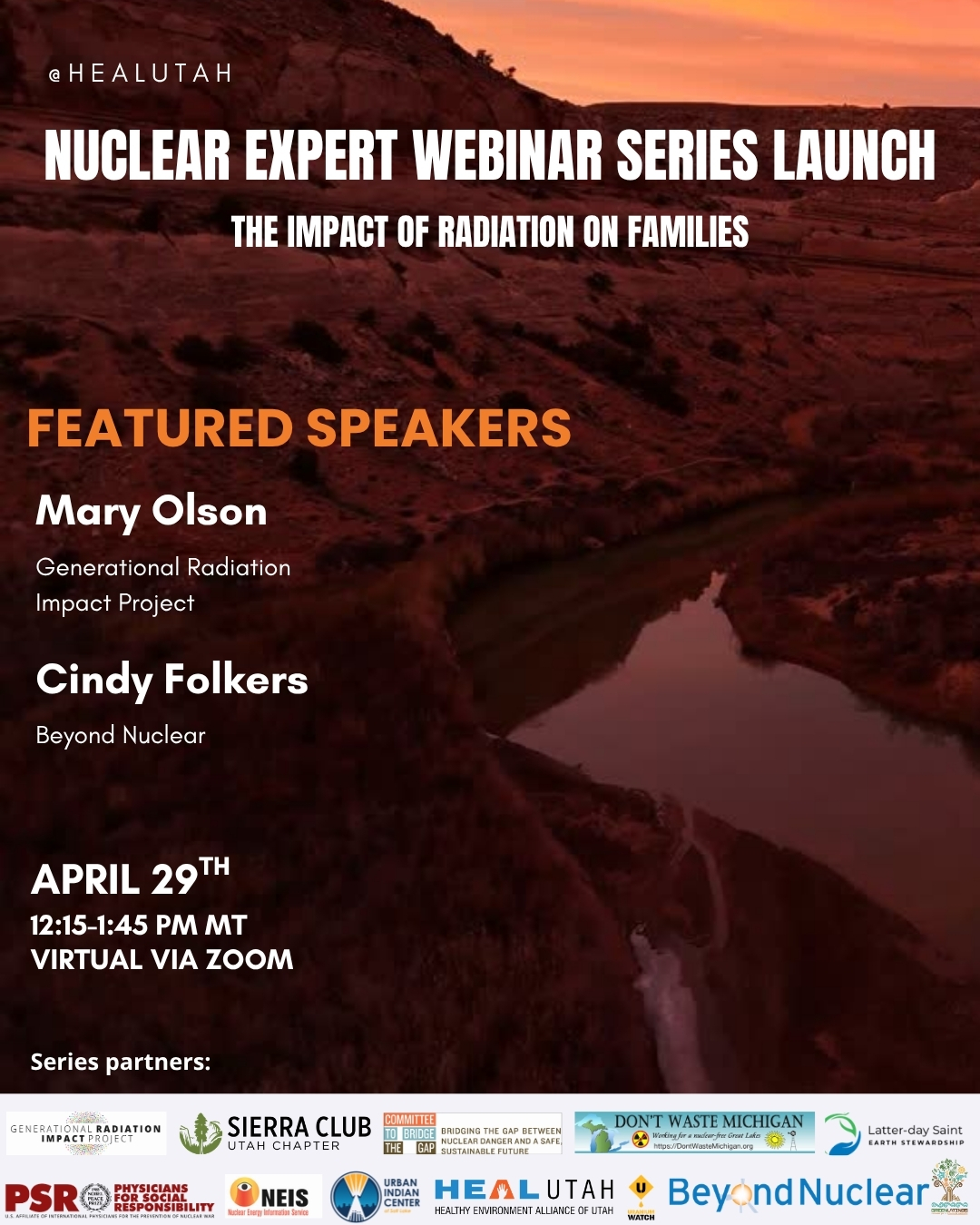
29 April – Nuclear Expert Webinar #1 – Radiation Impacts on Families with Mary Olson and Cindy Folkers
- 12:15 PM MT – 1:45 PM MT
- Location: Virtual – REGISTER TODAY

4 May -West Suburban Peace Coalition to discuss Iran war at May Educational Forum
Monday, May 4, 7:00 – 8:00 PM Central Standard Time
Title: : How Trump’s Narrative Tries to Shape the Reality of the War on Iran.
Contact Walt Zlotow, zlotow@hotmail.com 630 442 3045 for further information
14 May – online event From Bombs to Data Centres: the Face of Nuclear Colonialism


Pine Ridge Uranium is the real threat, not Tehran- Tell Burgum: Stop the Extraction.
Chernobyl: The Lost Tapes – A good documentary on Chernobyl on SBS available On Demand for the next 3 weeks– https://www.sbs.com.au/ondemand/tv-program/chernobyl-the-lost-tapes/2352741955560
To see nuclear-related stories in greater depth and intensity – go to https://nuclearinformation.wordpress.com
-
Archives
- April 2026 (305)
- March 2026 (251)
- February 2026 (268)
- January 2026 (308)
- December 2025 (358)
- November 2025 (359)
- October 2025 (376)
- September 2025 (257)
- August 2025 (319)
- July 2025 (230)
- June 2025 (348)
- May 2025 (261)
-
Categories
- 1
- 1 NUCLEAR ISSUES
- business and costs
- climate change
- culture and arts
- ENERGY
- environment
- health
- history
- indigenous issues
- Legal
- marketing of nuclear
- media
- opposition to nuclear
- PERSONAL STORIES
- politics
- politics international
- Religion and ethics
- safety
- secrets,lies and civil liberties
- spinbuster
- technology
- Uranium
- wastes
- weapons and war
- Women
- 2 WORLD
- ACTION
- AFRICA
- Atrocities
- AUSTRALIA
- Christina's notes
- Christina's themes
- culture and arts
- Events
- Fuk 2022
- Fuk 2023
- Fukushima 2017
- Fukushima 2018
- fukushima 2019
- Fukushima 2020
- Fukushima 2021
- general
- global warming
- Humour (God we need it)
- Nuclear
- RARE EARTHS
- Reference
- resources – print
- Resources -audiovicual
- Weekly Newsletter
- World
- World Nuclear
- YouTube
-
RSS
Entries RSS
Comments RSS
 nuclear-news