Public Need Versus the Business of War
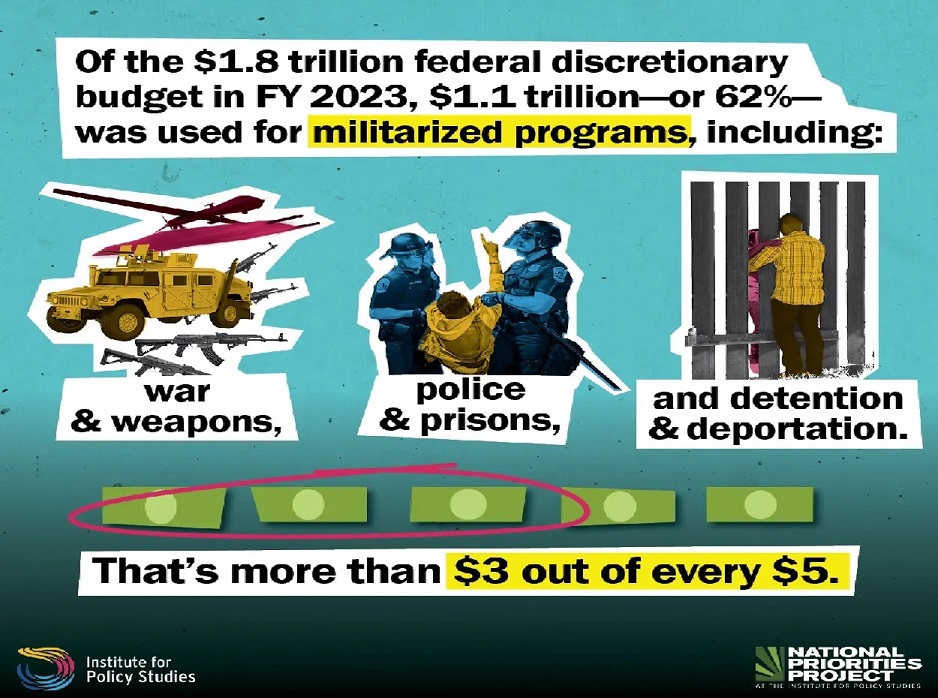
What does military contracting tell us about the priorities of the U.S. ruling class?
CHRISTIAN, SEP 16, 2023 Christian’s Substack
The American public is hurting. The bare necessities—clean water, nutritious food, and affordable housing—are hard to come by.
Tap water is contaminated with lead, PFAS, and other pollutants. The water systems that serve cities and towns suffer additional stressors, including drought, overuse, and a failure to incorporate greywater systems. And, like many necessities, you have to pay for it in the United States: Water utility prices continue to go up and up.
Hunger is a severe problem. ……………………………………
Housing is prohibitively expensive. …………………………………..
What is U.S. Congress doing as the public suffers?
Water Is Not a Priority
Every year, U.S. Congress appropriates money for two federal water funds. The Environmental Protection Agency gives this money to states in the form of grants. The Washington Post recently reported, “Since 2022, the federal allocation has totaled roughly $5.5 billion, amounting to a literal and figurative drop in the bucket for a nation with an estimated $625 billion backlog in projects just to provide cleaner, reliable drinking water.”
In other words, Congress has allocated 0.88 percent of the funding needed to establish infrastructure that dependably provides potable water.
It gets worse. Members of Congress skim funds off the top……………………………………
Food is Not a Priority
Stephen Semler, co-founder of the Security Policy Reform Institute, recently showed that annual U.S. military spending increased during the Trump administration by 20 percent in nominal terms and then increased during the first two years of the Biden administration by 15 percent in real terms. The military budget is now a record $858 billion for fiscal 2023, a bipartisan feat.
Food insecurity “climbed 18 percent during the same stretch,” Semler explained. “Something’s wrong when either military spending or food insecurity spikes over a two-year period. When they soar in tandem, it’s an abomination…”
There is plenty of money available to make sure people don’t go hungry. For example, the amount of money to be spent over several years on new land-based nuclear weapons ($263.9 billion) could instead build 52.5 million community gardens ($2,750 each) across the country, with more than enough money left over ($119.52 billion) to cover a year of food stamps. Tax dollars, we see, could be used to nourish instead of accidentally or deliberately eliminating human life on Earth.
The Housing Crisis……………………………………
Support the Troops
Evidence suggests that the federal government doesn’t even prioritize the troops’ water, food, and housing…………………………………………………………………………………
A State of Permanent Warfare
Military and intelligence personnel don’t deploy themselves. The U.S. ruling class deploys them.
When “successful,” military or intelligence operations open up an economy to multinational corporations, enriching the ruling class. Examples spanning the three main eras of the military-industrial complex (the first Cold War, the “global war on terror”, and today’s “strategic competition”) illustrate this success:……………………………………………………………………………………….
Moreover, U.S. military activity itself is extremely profitable for Wall Street and top corporate executives, as the U.S. military doesn’t shoot, move, or communicate—let alone eat, refuel, fly, or spy—without corporate goods and services. Corporations absorb more than half of the U.S. military budget. Many regularly price gouge the military.
The ruling class is organized and relentless in its pursuit of profit. The three branches of government (legislative, judicial, executive) largely respond to the needs of this class. Some of the richest and/or most influential members of U.S. government, such as a coal baron or a person who has profited from the provision of healthcare, even come from that class.
The Front Burner
A military aircraft, the F-35 Joint Strike Fighter, embodies the priorities of the ruling class. With a lifetime cost expected to top $1.7 trillion, the F-35 is on track to becoming the most expensive weapon of all time………………………………………………………………………………………………………………
One-Two Punch
The military-industrial complex is a one-two punch to the public………………………………………………………………………………… more https://thebusinessofwar.substack.com/p/public-need-versus-the-business-of?utm_source=post-email-title&publication_id=1769284&post_id=137081544&utm_campaign=email-post-title&isFreemail=true&r=c9zhh&utm_medium=email
Hyping Ukraine Counteroffensive, US Press Chose Propaganda Over Journalism

The fact that US officials pushed for a Ukrainian counteroffensive that all but expected would fail raises an important question: Why would they do this? Sending thousands of young people to be maimed and killed does nothing to advance Ukrainian territorial integrity, and actively hinders the war effort.
Even as Ukraine and Russia sat at the negotiation table early in the war, the US made it clear that it wanted the war to continue and escalate. The US’s objective was, in the words of Raytheon board member–turned–Defense Secretary Lloyd Austin, “to see Russia weakened.”
The consensus among policymakers in Washington is to push for endless conflict, no matter how many Ukrainians die in the process. As long as Russia loses men and material, the effect on Ukraine is irrelevant. Ukrainian victory was never the goal.
BRYCE GREENE, FAIR, 15 Sept 23
It has been clear for some time that US corporate news media have explicitly taken a side on the Ukraine War. This role includes suppressing relevant history of the lead-up to the war (FAIR.org, 3/4/22), attacking people who bring up that history as “conspiracy theorists” (FAIR.org, 5/18/22), accepting official government pronouncements at face value (FAIR.org, 12/2/22) and promoting an overly rosy picture of the conflict in order to boost morale.
For most of the war, most of the US coverage has been as pro-Ukrainian as Ukraine’s own media, now consolidated under the Zelenskyy government (FAIR.org, 5/9/23). Dire predictions sporadically appeared, but were drowned out by drumbeat coverage portraying a Ukrainian army on the cusp of victory, and the Russian army as incompetent and on the verge of collapse.
Triumphalist rhetoric soared in early 2023, as optimistic talk of a game-changing “spring offensive” dominated Ukraine coverage. Apparently delayed, the Ukrainian counteroffensive launched in June. While even US officials did not believe that it would amount to much, US media papered over these doubts in the runup to the campaign.
Over the last three months, it has become clear that the Ukrainian military operation will not be the game-changer it was sold as; namely, it will not significantly roll back the Russian occupation and obviate the need for a negotiated settlement. Only after this became undeniable did media report on the true costs of war to the Ukrainian people.
Overwhelming optimism
In the runup to the counteroffensive, US media were full of excited conversation about how it would reshape the nature of the conflict. NATO Secretary General Jens Stoltenberg told Radio Free Europe (4/21/23) he was “confident Ukraine will be successful.” Sen. Lindsey Graham assured Politico (5/30/23), “In the coming days, you’re going to see a pretty impressive display of power by the Ukrainians.” Asked for his predictions about Ukraine’s plans, retired Lt. Gen. Ben Hodges told NPR (5/12/23), “I actually expect…they will be quite successful.”
Former CIA Director David Patraeus, author of the overhyped “surge” strategy in Iraq, told CNN (5/23/23):
I personally think that this is going to be really quite successful…. And [the Russians] are going to have to withdraw under pressure of this Ukrainian offensive, the most difficult possible tactical maneuver, and I don’t think they’re going to do well at that.
The Washington Post’s David Ignatius (4/15/23) acknowledged that “hope is not a strategy,” but still insisted that “Ukraine’s will to win—its determination to expel Russian invaders from its territory at whatever cost—might be the X-factor in the decisive season of conflict ahead.”
The New York Times (6/2/23) ran a story praising recruits who signed up for the Ukrainian pushback, even though it “promises to be deadly.” Times columnist Paul Krugman (6/5/23) declared we were witnessing “the moral equivalent of D-Day.” CNN (5/30/23) reported that Ukrainians were “unfazed” as they “gear up for a counteroffensive.”
Cable news was replete with buzz about how the counteroffensive, couched with modifiers like “long-awaited” or “highly anticipated,” could turn the tide in the war. Nightly news shows (e.g., NBC, 6/15/23, 6/16/23) presented audiences with optimistic statements from Ukrainian President Volodymyr Zelenskyy and other figures talking about the imminent success.
Downplaying reality
Despite the soaring rhetoric presented to audiences, Western officials understood that the counteroffensive was all but doomed to fail. This had been known long before the above comments were reported, but media failed to include that fact as prominently as the predictions for success………………………………………………………………..
Too ‘casualty-averse’?
……………………………………………………………… A mid-July New York Times article (7/14/23) reported that US officials were privately frustrated that Ukraine had become too afraid of dying to fight effectively. The officials worried that Ukrainian commanders “fear[ed] casualties among their ranks,” and had “reverted to old habits” rather than “pressing harder.” A later Times article (8/18/23) repeated Washington’s worries that Ukrainians were too “casualty-averse.”
Acknowledging failure
After it became undeniable that Ukraine’s military action was going nowhere, a Wall Street Journal report (7/23/23) raised some of the doubts that had been invisible in the press on the offensive’s eve…………………………………………………………………………………………………..
Rather than dwelling on the stalled campaign, the New York Times and other outlets focused on the drone war against Russia, even while acknowledging that the remote strikes were largely an exercise in public relations. The Times (8/25/23) declared that the strikes had “little significant damage to Russia’s overall military might” and were primarily “a message for [Ukraine’s] own people,” citing US officials who noted that they “intended to demonstrate to the Ukrainian public that Kyiv can still strike back.” Looking at the quantity of Times coverage (8/30/23, 8/30/23, 8/23/23, 8/22/23, 8/22/23, 8/21/23, 8/18/23), the drone strikes were apparently aimed at an increasingly war-weary US public as well.
War as desirable outcome
The fact that US officials pushed for a Ukrainian counteroffensive that all but expected would fail raises an important question: Why would they do this? Sending thousands of young people to be maimed and killed does nothing to advance Ukrainian territorial integrity, and actively hinders the war effort.
The answer has been clear since before the war. Despite the high-minded rhetoric about support for democracy, this has never been the goal of pushing for war in Ukraine. Though it often goes unacknowledged in the US press, policymakers saw a war in Ukraine as a desirable outcome. One 2019 study from the RAND Corporation—a think tank with close ties to the Pentagon—suggested that an effective way to overextend and unbalance Russia would be to increase military support for Ukraine, arguing that this could lead to a Russian invasion.
In December 2021, as Russian President Vladimir Putin began to mass troops at Ukraine’s border while demanding negotiations, John Deni of the Atlantic Council published an op-ed in the Wall Street Journal (12/22/21) headlined “The Strategic Case for Risking War in Ukraine,” which laid out the US logic explicitly: Provoking a war would allow the US to impose sanctions and fight a proxy war that would grind Russia down. Additionally, the anti-Russian sentiment that resulted from a war would strengthen NATO’s resolve.
All of this came to pass as Washington’s stance of non-negotiation successfully provoked a Russian invasion. Even as Ukraine and Russia sat at the negotiation table early in the war, the US made it clear that it wanted the war to continue and escalate. The US’s objective was, in the words of Raytheon boardmember–turned–Defense Secretary Lloyd Austin, “to see Russia weakened.” Despite stated commitments to Ukrainian democracy, US policies have instead severely damaged it.
NATO’s ‘strategic windfall’
In the wake of the stalled counteroffensive, the US interest in sacrificing Ukraine to bleed Russia was put on display again. In July, the Post‘s Ignatius declared that the West shouldn’t be so “gloomy” about Ukraine, since the war had been a “strategic windfall” for NATO and its allies. Echoing two of Deni’s objectives, Ignatius asserted that “the West’s most reckless antagonist has been rocked,” and “NATO has grown much stronger with the additions of Sweden and Finland.”
In the starkest demonstration of the lack of concern for Ukraine or its people, he also wrote that these strategic successes came “at relatively low cost,” adding, in a parenthetical aside, “(other than for the Ukrainians).”
Ignatius is far from alone. Hawkish Sen. Mitt Romney (R–Utah) explained why US funding for the proxy war was “about the best national defense spending I think we’ve ever done”: “We’re losing no lives in Ukraine, and the Ukrainians, they’re fighting heroically against Russia.”
The consensus among policymakers in Washington is to push for endless conflict, no matter how many Ukrainians die in the process. As long as Russia loses men and material, the effect on Ukraine is irrelevant. Ukrainian victory was never the goal.
‘Fears of peace talks’
Polls show that support for increased US involvement in Ukraine is rapidly declining………………..
The failure of the counteroffensive has not caused Washington to rethink its strategy of attempting to bleed Russia. The flow of US military hardware to Ukraine is likely to continue so long as this remains the goal.
The Hill (9/5/23) gave the game away about NATO’s commitment to escalation with a piece titled “Fears of Peace Talks With Putin Rise Amid US Squabbling.”

But even within the Biden administration, the Pentagon appears to be at odds with the State Department and National Security Council over the Ukraine conflict. Contrary to what may be expected, the civilian officials like Jake Sullivan, Victoria Nuland and Antony Blinken are taking a harder line on perpetuating this conflict than the professional soldiers in the Pentagon. The media’s sharp change of tone may both signify and fuel the doubts gaining traction within the US political class. https://fair.org/home/hyping-ukraine-counteroffensive-us-press-chose-propaganda-over-journalism/
—
Uranium Mining Protections Needed Across the West
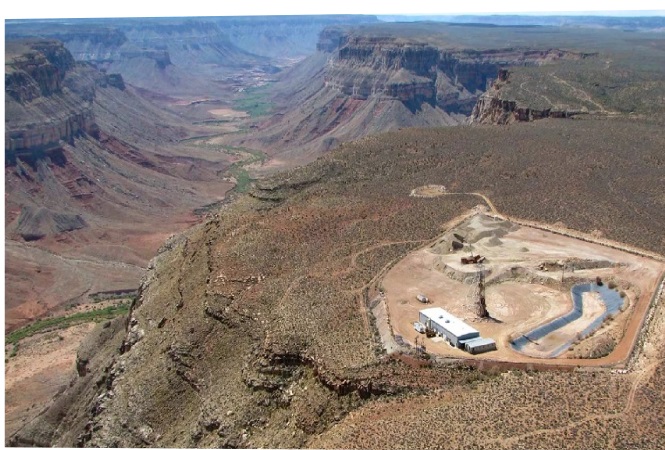
The Biden administration needs to protect communities and water supplies across the West from the dangers of uranium mining.
Geoffrey H. Fettus Senior Attorney, Nuclear, Climate & Clean Energy Program
President Biden’s designation of the Baaj Nwaavjo I’tah Kukveni—Ancestral Footprints of the Grand Canyon National Monument will go far in protecting the rich cultural and ecological value of this majestic landscape. It will safeguard some of the most iconic public lands in the American West from the ravages of destructive mining and destructive waste. This protection has been a top priority for tribes in the area, and the designation is long overdue.
“That’s our aboriginal homelands,” Dianna Sue Uqualla, a Havasupai tribal council member, told the Bureau of Land Management at a public meeting according to Bloomberg Law. The monument will “keep at bay these mining people that are coming in,” and will protect the Grand Canyon from companies that are “desecrating, raping the Mother Earth.”
This is wonderful news, but there is much more to be done about uranium mining across the American West. And there’s also a lot of misinformation out there that muddies what should be a clear path forward to protecting all the people and watersheds of the West from unchecked uranium mining.
Uranium mining contaminated tribal lands for decades
The uranium mining industry has left a dreadful history of contamination and harm across vast swathes of the American West, but especially with respect to the Indigenous People who call this area home. It’s a complicated history that intertwines with the Manhattan Project and the Cold War, and it’s a legacy that has yet to be addressed.
On Navajo land alone, nearly four million tons of uranium ore were extracted from 1944 to 1986. The industry and the U.S. government left behind hundreds of abandoned uranium mines, four inactive uranium milling sites, a former dump site, and the widespread contamination of land and water; this includes the 1979 collapse of a tailings dam in Church Rock, New Mexico, that deposited 93 million gallons of radioactive and chemically contaminated liquid and 1,100 tons of solid radioactive tailings into the Rio Puerco, contaminating the river for more than 60 miles downstream. After decades of pressure, the government has finally started to assess and mitigate this contamination.
Much is left to be done: More than 500 abandoned uranium mines remain on Navajo land.
We need new standards
Back in 2016, the Obama administration was poised to take action on uranium mining standards, but then Donald Trump was elected president. It will come as no surprise that the U.S. Environmental Protection Agency (EPA) under the Trump administration cast aside the Obama EPA’s long-overdue protective environmental standards. In an about-face, the Trump EPA and Nuclear Regulatory Commission (NRC) moved to weaken uranium mining rules.
Once Biden took office in 2021, NRDC had hoped for a new approach. So far, however, we haven’t heard anything from either the EPA or NRC, despite repeated requests by NRDC and other major environmental groups, tribal representatives, and regional groups across the West.
It is time for the EPA to clear the obstacles and move forward on the uranium protections it drew up years ago.
The Biden administration can begin to protect the communities and water resources that have been negatively affected by uranium mining for decades by taking two steps: (1) dissolving a 2020 memorandum of understanding between the EPA and NRC that undercuts the EPA’s ability to enact standards; and (2) issuing protective uranium in situ mining standards that have been sitting on a shelf for years. ……………………………………………………………….
Environmental groups urge regulators to shut down California reactor over safety, testing concerns.

Daily Mail, By ASSOCIATED PRESS, 15 September 2023
LOS ANGELES (AP) – Environmental groups called on federal regulators Thursday to immediately shut down one of two reactors at California´s last nuclear power plant until tests can be conducted on critical machinery they believe could fail and cause a catastrophe.
Friends of the Earth and Mothers for Peace said in a petition filed with the Nuclear Regulatory Commission that tests and inspections have been delayed for nearly 20 years on the pressure vessel in the Unit 1 reactor at the Diablo Canyon Nuclear Power Plant, midway between Los Angeles and San Francisco.
Instead, the groups argue, operator Pacific Gas & Electric has relied on data from similar reactor vessels to justify continued operations at Diablo Canyon, while dismissing indications that the steel wall in Unit 1 might be deteriorating from sustained exposure to radiation and is becoming susceptible to cracking, a condition technically known as embrittlement.
“We will not sit idly by while PG&E cuts corners on Unit 1´s safety,” Hallie Templeton, legal director for Friends of the Earth, said in a statement.
The vessels are thick steel containers that hold nuclear fuel and cooling water in the reactors.
The statement from the anti-nuclear groups contended that PG&E “has repeatedly postponed essential metallurgical tests and ultrasound inspections over the past two decades” on the vessel…………………………………..
The petition, filed Thursday in Washington, was accompanied by a 46-page report by Digby Macdonald, a University of California, Berkeley, professor in nuclear engineering and materials science, who wrote that continued operation of the Unit 1 reactor “poses an unreasonable risk to public health and safety due to serious indications of an unacceptable degree of embrittlement.”
“The reactor should be closed until PG&E obtains and analyzes additional data regarding its condition,” wrote Macdonald, who was retained by the environmental groups.
The petition asks the NRC to convene a hearing to review a 2003 decision by agency staff to extend the testing schedule for the Unit 1 pressure vessel until 2025. According to the groups, the last inspections on the vessel took place between 2003 and 2005. The utility postponed further testing in favor of using results from similar reactors to justify continued operations, they said.
In his report, Macdonald concludes PG&E should have accelerated its testing schedule, not delayed it, to assess possible defects. He noted that unlike most other reactor safety components, the pressure vessel has no independent backup system that can be called upon if it should crack or fracture and lose essential cooling water.
He added that obtaining more testing data on Unit 1 is especially important because its steel has excessive copper and nickel content “that render it more vulnerable to embrittlement.”
The “NRC currently lacks an adequate basis to conclude that Diablo Canyon Unit 1 can be operated safely,” Macdonald said.
Construction at Diablo Canyon began in the 1960s. Critics have long argued that potential shaking from nearby earthquake faults not recognized when the design was approved could damage equipment and release radiation. One nearby fault was not discovered until 2008. The groups argue that the embrittlement assessment is even more critical, given the plant’s seismic vulnerabilities………… https://www.dailymail.co.uk/wires/ap/article-12519587/Environmental-groups-urge-regulators-shut-California-reactor-safety-testing-concerns.html
50 US Lawmakers Reintroduce ‘CBDC Anti-Surveillance State Act’ to Protect ‘the American Way of Life’

BY PATRICIA HARRITY ON
Fifty U.S. lawmakers have reintroduced the CBDC Anti-Surveillance State Act to prohibit the Federal Reserve from issuing a retail Central Bank Digital Currency while protecting innovation and any future development of true digital cash. This is in direct opposition to the Globalists and the WEF agenda that seeks to enslave and remove all personal freedoms and privacy with CCP-style credit scores and surveillance.
U.S. Congressman Tom Emmer (R-MN) who has been a longtime advocate that any Fed-issued digital dollar (central bank digital currency) remain open, permissionless, and private announced on Tuesday that he and 49 other lawmakers have reintroduced the CBDC Anti-Surveillance State Act “to halt the efforts of unelected bureaucrats in Washington D.C. from issuing a Central Bank Digital Currency (CBDC) that dismantles Americans’ right to financial privacy.”
“If not open, permissionless, and private — like cash — a CBDC is nothing more than a CCP-style surveillance tool that can be weaponized to oppress the American way of life.” argues the congressman, “President Biden is willing to compromise the American people’s right to financial privacy for a surveillance-style CBDC. I don’t believe in compromising Americans’ rights,” he added.
CBDC Power
In many Western countries, including England, the USA, and Australia, banks are continuing to push towards the goal of Central Bank Digital Currencies as the only money as they plan to completely phase out cash use before the end of 2024. Individuals may argue that they already mostly use digital banking and debit or credit cards.
However, we have witnessed the freezing of the bank accounts of protesters in 2022 by Canadian PM Justin Trudeau simply for standing against the tyrannical restrictions of the plandemic, and hundreds of personal bank accounts were frozen under special powers.
Although yes, banks already have the power to close your account if they deem it necessary at the moment there is a small number of people already dealing with this, with their only offence being buying Bitcoin or questioning why the banks need to know what we’re doing with our money or questioning the banks ever tightening rules about holding an account with them, imagine what’s going to happen with CBDCs as the only legal currency says Brad Bleckwehl author of from the gutter up.
He continues:
“If you think the careers, contracts, and accounts of famous people getting canceled for saying or doing something that offends has nothing to do with you.. think about how ever-tightening PC culture is growing, and how authoritarian our Western governments have been becoming in recent years.”
“They’re literally trying to pass misinformation and censorship bills so they can legally control what we’re allowed to talk about. Combine the loss of freedom of speech with the ability to blackball us financially by freezing CBDCs, and we’re headed to a very bleak time for society. It’s not just going to be what is currently considered socially acceptable or not, it’s going to be forced behavior, forced ways of thinking. Look at how they bullied us with covid vaxxes.” (source).
The news of this pushback against the authoritarian control of our finances is huge
CBDC Anti-Surveillance State Act Updated, Reintroduced
Congressman Emmer posted on social media platform X: “Today, with 49 of my Republican colleagues, I reintroduced the CBDC Anti Surveillance State Act.” (source)……………………………………………………………………………………………………………….
“Bottom Line: If not open, permissionless, and private — like cash — a CBDC is nothing more than a CCP-style surveillance tool that can be weaponized to oppress the American way of life,” the lawmaker concluded,
The House Financial Services Committee will consider his bill this month. more https://expose-news.com/2023/09/14/50-us-lawmakers-reintroduce-cbdc-anti-surveillance-state-act-to-protect-the-american-way-of-life/
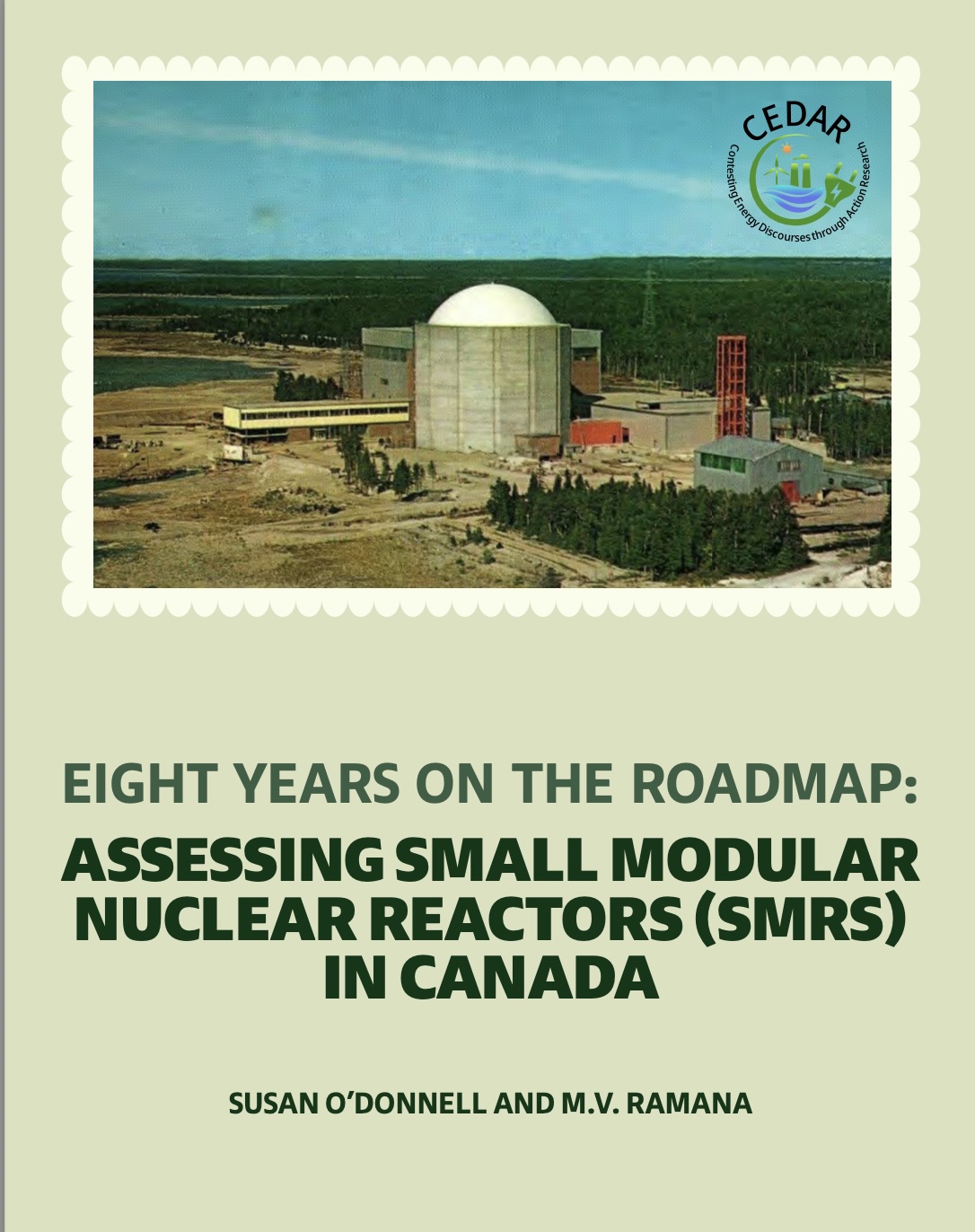
USA can’t get investors for Small Nuclear Reactors: no problem – flog them off to Ghana!
U.S. Announces New Support for Ghana’s Civil Nuclear Energy Program under the FIRST Capacity Building Program
US Embassy in Ghana 16 Sept 23

Accra, Ghana – U.S. Principal Deputy Assistant Secretary of State for International Security and Nonproliferation Ann Ganzer joined Ghanaian counterparts today to announce further U.S. support for establishing Ghana as a Small Modular Nuclear Reactor (SMR) Regional Training Hub and center of excellence for the sub-Saharan African region……………………………………………………………………………………….
Pentagon’s new plan to counter China includes swarms of smart satellites

Deputy Secretary Kathleen Hicks: DoD wants to “leverage platforms that are small, smart, cheap, and many”
Space News, Sandra Erwin, September 6, 2023
ARLINGTON, Va. — Under a new strategy to counter China’s military buildup, the Pentagon is advocating the use of low-cost autonomous platforms that can be mass produced and deployed at sea, on land, in the air and in space.
“This is about driving culture change just as much as technology change — so we can gain military advantage faster,” Deputy Defense Secretary Kathleen Hicks, said Sept. 6 at the DefenseNews annual conference.
Hicks discussed DoD’s plan to field thousands of autonomous systems across all domains within the next 18 to 24 months. China’s advantage is “mass,” said Hicks. DoD will continue to invest in its traditional platforms but will counter with “mass of our own,” or large numbers of autonomous systems.
DoD would field fleets of tiny drones and swarms of satellites that would be inexpensive to replace.
“Imagine constellations of autonomous, attritable systems on orbit, flung into space scores at a time, numbering so many that it becomes impossible to eliminate or degrade them all,” she said.
The strategy is to “leverage platforms that are small, smart, cheap, and many,” Hicks said. …………………………………………………….
The U.S. military’s Space Development Agency is building a government-owned proliferated constellation. DoD is also a major customer of Starlink, SpaceX’s massive internet in space. ……………….. https://spacenews.com/pentagons-new-plan-to-counter-china-includes-swarms-of-smart-satellites/?utm_medium=email
US incapable of negotiating – Russian diplomat
Rt.com 12 Sept 23
Strategic dialogue with Washington has done nothing for Moscow’s national security, Aleksandr Kramarenko claims
No amount of negotiating with the US has been able to bring about meaningful results, as Washington has repeatedly broken the trust of its partners and refused to respect agreements, acting solely in its own interests, Russian diplomat Aleksandr Kramarenko has said.
In an article for International Affairs published last week, Kramarenko, the director of the Russian Foreign Ministry Institute of Current International Problems, said that despite decades of trying to maintain strategic dialogue with the US, Russia has ultimately been unable to achieve any results in ensuring its national security, and neither has China.
He added that trust between Moscow and Washington was undermined long ago. In 2011, Russia allowed the passing of what seemed to be a humanitarian UN resolution on Libya, which was then used by the West to lay ruin the country.
In 2015, Russia was deceived by the Minsk agreements, which were meant to resolve the internal conflict in Ukraine, but instead were used to buy time to build up Kiev’s army with the goal of inflicting a military or strategic defeat on Russia.
“What kind of trust can we talk about here? Where is the principle of pacta sunt servanda [contracts must be respected]? And what then is the meaning of contracts when everything happens regardless and in spite of any contracts? Apparently, it turns out that Washington is simply unable to negotiate,” Kramarenko wrote, noting that Russia is not the only country to come to this conclusion.

Commenting on the conflict in Ukraine, he recalled the words of US National Security Advisor Jake Sullivan (above)at the recent Aspen Security Forum, who said that the US and its allies are willing to “take risks” with their arms supplies to Kiev. What Sullivan meant, according to Kramarenko, was that Washington is willing to risk nuclear escalation, and that it is willing to do so because the principle of nuclear deterrence does not work for Russia.
“This means we need to think about how to restore trust in it.”
Kramarenko went on to suggest that all the arms control systems that have been destroyed by the US in attempts to maintain strict control over other nations while remaining ambiguous with regards to its own nuclear potential, could soon be replaced by a new process based on a multipolar world. ………. https://www.rt.com/russia/582797-us-incapable-of-negotiating/
Crooked Canadian company Lavalin trying to sell ?zombie nuclear technology to China and UK

 Canada now dominates World Bank corruption list, thanks to SNC-Lavalin, Financial Post Armina Ligaya | September 18, 2013 Canada’s corporate image isn’t looking so squeaky-clean in the World Bank’s books — all thanks to SNC-Lavalin.Corruption’s double standard: It’s time to punish countries whose officials accept bribes
Out of the more than 250 companies year to date on the World Bank’s running list of firms blacklisted from bidding on its global projects under its fraud and corruption policy, 117 are from Canada — with SNC-Lavalin and its affiliates representing 115 of those entries, the World Bank said.
“As it stands today, the World Bank debarment list includes a high number of Canadian companies, the majority of which are affiliates to SNC Lavalin Inc.,” said the bank’s manager of investigations, James David Fielder.
“This is the outcome of a World Bank investigation relating the Padma Bridge project in Bangladesh where World Bank investigators closely cooperated with the Royal Canadian Mounted Police in an effort to promote collective action against corruption.”
As a result of the misconduct found during the probe, the Montreal-based engineering and construction firm, and its affiliates as per World Bank policy, were debarred in April 2013 for 10 years, as part of a settlement with SNC-Lavalin. And in one fell swoop, 115 Canadian firms were blacklisted by the World Bank, making Canada seemingly look like the worst offending country.
It’s quite the jump from 2012, when no Canadian companies were barred……..http://business.financialpost.com/2013/09/18/canada-now-dominates-world-bank-corruption-list-thanks-to-snc-lavalin/

Lavalin looks to expand nuclear enterprise in China http://www.theglobeandmail.com/report-on-business/industry-news/energy-and-resources/lavalin-looks-to-grow-in-china/article17950935/ SHAWN MCCARTHY – GLOBAL ENERGY REPORTER OTTAWA — The Globe and Mail, Apr. 13 2014, SNC-Lavalin Inc. is hoping to revitalize its international nuclear business through an effort with its Chinese partners to burn reprocessed fuel in a Candu reactor as a way to reduce radioactive waste.
Officials from Candu Energy Inc. are leading a Canadian nuclear industry mission to China this week, which will include a visit Monday to the Qinshan nuclear power station south of Shanghai where two heavy-water Candu 6 reactors are in operation. Candu Energy is the former Atomic Energy of Canada Ltd., and is now wholly owned by SNC-Lavalin
The Mississauga-based nuclear vendor has been working with the Chinese operator of the Qinshan plants to fashion reprocessed fuel from the waste products of competing light-water reactors. The Candu could, in effect, become the blue box of the nuclear industry, company executives said in an interview.
“We’re very excited that this advances the discussion we can have about introducing more Candus into China,” Jerry Hopwood, the company’s vice-president of marketing and product development, said.
Candu reactors use heavy water, which includes a hydrogen isotope called deuterium, both for coolant and to moderate atomic reactions. Light-water reactors use ordinary water for both purposes.
Each approach offers different benefits, but the world market is dominated by light-water reactors, which require enriched uranium as fuel. In contrast, the heavy-water Candus can burn natural uranium as well as reprocessed fuel.
Mr. Hopwood said China now has 21 light-water reactors that produce two streams of energy-rich waste: spent fuel from the reactor itself and depleted uranium from the enrichment process. China plans to more than double its number of light-water reactors to meet the demands of its growing economy.
“Those reactors are going to produce a lot of waste fuel and China has a plan to recycle all the waste fuel from its reactor,” Mr. Hopwood said. “We believe there is a very strong opportunity to sell a significant number of Candu units in China.”
He said the partners have completed all the development and licensing work, and the Chinese operators expect to begin running reprocessed fuel in the two Candu reactors at an industrial level by the end of the year.
The company is also working with Chinese partners to modify the existing Enhanced Candu model so it will more efficiently burn the recycled fuel but also run on thorium, an abundant alternative to uranium that produces less highly radioactive waste. China has vast reserves of thorium but must import uranium, and develop a thorium-fired reactor.
As well, Candu Energy is one of two finalists in the United Kingdom’s competition to select a reactor design that will eliminate a stockpile of plutonium. “We think this work in China is paving the way for other options where Candu’s fuel-cycle ability is a benefit, notably in the U.K.,” Mr. Hopwood said.
The trade delegation will include Ontario’s Minister of Research and Innovation, Reza Moridi, who is a nuclear physicist, and several business leaders from the Organization of Canadian Nuclear Industries, an Ontario-based suppliers’ group that is eager to land export and service business in the world’s fast growing reactor market.
Critics contend the Candu 6 is an outdated design that lacks safety features included in newer reactors, and that it is a technology that the international marketplace has largely rejected since the 1990s.
“So yeah, the industry is trying to say Candu isn’t dead. Never say die,” said Shawn-Patrick Stensil, a nuclear campaigner at Greenpeace Canada. “If Candu isn’t dead, it’s a zombie.”
With long-range missiles for Ukraine, US crosses own red line
The US will reportedly send ATACMS to Ukraine — yet another advanced weapons system that the White House had previously ruled out.
Substack AARON MATÉ, SEP 12, 2023
The Biden administration is reportedly close to authorizing yet another weapons system for Ukraine that it had previously ruled out. According to ABC News and the Financial Times, the US will send Army Tactical Missile Systems, or ATACMS, a high priority for Kiev and its most hawkish backers. The long-range missiles, which travel up to 190 miles, would bolster Ukraine’s capacity to hit Crimea and possibly mainland Russia.
The White House previously invoked that very capability to rule out the ATACMS as too dangerous an escalation. As National Security Advisor Jake Sullivan explained in June 2022, President Biden was “not prepared to provide” long-range missiles, given the “key goal” of avoiding “the road towards a third world war.”
Just over one year later, the road towards a third world war is no longer closed…………………….. (subscribers only) more https://mate.substack.com/p/with-long-range-missiles-for-ukraine?utm_source=post-email-title&publication_id=100118&post_id=136923393&utm_campaign=email-post-title&isFreemail=true&r=ln98x&utm_medium=email
If The US Really Were What It Pretends To Be

CAITLIN JOHNSTONE, SEP 12, 2023 https://www.caitlinjohnst.one/p/if-the-us-really-was-what-it-pretends?utm_source=post-email-title&publication_id=82124&post_id=136958632&utm_campaign=email-post-title&isFreemail=true&r=1ise1&utm_medium=email
It’s wild to consider how many of the world’s problems would not exist if the US really was the thing it advertises itself as.
Ukraine would not be at war right now, because the US empire would not have provoked that war, since the US really would be an upholder of peace and international order.
The world would not be staring down the barrel of nuclear armageddon, because the US really would be a normal country that respects the sovereignty of other nations instead of the hub of a globe-spanning undeclared empire which keeps ramping up aggression against nuclear-armed states who refuse to consent to its planetary rule.
China would not be preparing for war, because the US military really would be used for the defense of the United States instead of rapidly encircling the US empire’s top geopolitical rival with massive amounts of war machinery.
The middle east would not have spent the 21st century being ripped to pieces by western aggression, because the US really would care about the lives of the people who live there and not just pretend to in order to promote regime change interventionism.
Mountains of human corpses would not have been amassed in Yemen by violence, starvation and disease, because the US really would oppose tyrannical dictatorships like Saudi Arabia instead of enthusiastically facilitating their war crimes.
The information ecosystem of the western world would not be strangled by empire propaganda, internet censorship and Silicon Valley algorithm manipulation, because the US really would value free speech and free thought instead of churning out a continual barrage of mass-scale psychological operations designed to dominate the way people think, speak, work, act and vote.
Julian Assange would not be languishing in prison, because the US really would support press freedoms instead of working to set a legal precedent normalizing the persecution of journalists for reporting inconvenient facts.
The people of the United States would not be floundering in poverty and broken infrastructure, because they really would live in a democracy that allows them to influence government policy instead of an oligarchy rigged to benefit the rich and powerful at the expense of normal human beings.
The US would not be a tyrannical police state with the largest incarceration rate on the planet, because the US government really would care about civil rights and liberty instead of only caring about the profits that can be harvested via prison slavery and private prisons from those citizens who don’t make good cogs in the capitalist machine.
Developing nations would be thriving a lot more, because the US really would support their national sovereignty and independence instead of doing whatever’s necessary to facilitate the imperialist extraction of their wealth.
Human civilization would be far more just and equitable than it currently is, because the US really would value every nation’s right to forge its own path, and therefore would not have spent generations aggressively stomping out every attempt to move toward socialism everywhere in the world.
The planet would not be circled by hundreds of foreign US military bases and continually terrorized by US wars of aggression, proxy conflicts, CIA coups and starvation sanctions, because all the US government secrecy which makes this malfeasance possible wouldn’t exist, since the US really would value truth and transparency instead of power and domination.
The world would be a much more healthy and harmonious place if the US really was the peace-loving, tyranny-opposing democracy that it and all its propaganda systems frame it as. But because the US government is actually the most tyrannical regime on earth and values nothing apart from its own ability to dominate as many members of the human species as possible, we live in a world of far greater peril and abuse than we otherwise would.
I write so much about the US empire because that’s just what you find yourself doing when you set out to describe the problems of our world with an open mind; trace those problems back to their origins, and many of them revolve around this strange and profoundly abusive power structure which manages to evade much criticism and scrutiny because it has the most sophisticated soft power narrative control systems ever devised.
The US empire depends on keeping the world asleep to its abusiveness. And the world depends on everyone waking up to it.
Don’t underestimate ravages of climate crisis when storing nuclear waste:
Meg Sears, 11 Sept 23, https://preventcancernow.ca/dont-underestimate-ravages-of-climate-crisis-when-storing-nuclear-waste/
The Canadian Nuclear Safety Commission should heed Mother Nature’s warning and deny the present proposal. In today’s weather, much less the future, the commission is unlikely to meet its goal to keep nuclear waste secure for hundreds of years.
What happens when a federal Environmental Impact Assessment is fundamentally flawed? Will authorities pause for a rethink when a key assumption and design limitation of the assessment is wrong, risking catastrophic failure?
The Canadian Nuclear Safety Commission is facing this late-day reality test as it is poised to rule whether the Chalk River can go ahead as planned.
The 2021 Environmental Impact Statement for near-surface nuclear waste disposal lists severe rainfall as the top risk for stability of the hillside site. Excessive rain could result in the nuclear waste being swept down the hill and into Perch Lake, Perch Creek, and the Ottawa River a kilometre away. Chemicals would pollute the ecosystem and food sources, as well as drinking water for millions of people in smaller towns, as well as in Ottawa and cities downstream.
On Aug. 10, 2023, where the Rideau, Ottawa and Gatineau rivers tumble together, chiefs of Kebaowek, Kitigan Zibi Anishinabeg and Mitchibikonik Inik First Nations, elders and other experts, made final submissions to the Canadian Nuclear Safety Commission. As they spoke against the nuclear waste disposal site at Chalk River, attendees heard the roar of rain drumming on the roof.
During this event, Ottawa streets and basements flooded, traffic stopped, power failed, sewers backed up, and more than 300 million litres of untreated water flowed into the Ottawa River. At least, unlike nuclear waste, untreated sewer water degrades within weeks—not years or generations.
The Environmental Impact Statement weather severity estimates are out of date. It defines “heavy rainfall” to be more than 0.7 cm per hour—one seventh of what fell during the hearing. The statement also cites a 2013 estimate of low tornado risks—an insult to fresh memories of catastrophic tornadoes and derechos in Eastern Ontario.
The acceleration of climate disasters is boggling Canada’s long-term predictions of the scale of extreme weather. The nuclear waste disposal facility was designed to withstand end-of-the century estimates of less than five cm of precipitation in a day for Deep River, and over five cm in a day—not an hour—for Ottawa.
Ottawa’s not alone in breaking rainfall records. July 2023 brought rainfall disasters to Nova Scotia, with rainfall up to 50 cm per hour measured in one location. Much of the province experienced 20 cm in a day, causing widespread damage. The climate predictions from the federal government call for much less—up to 9 cm in a day by the end of the century.
If an Environmental Impact Assessment for a bridge was discovered to be flawed—that the bridge would not withstand a storm as severe as what occurred just last month—it would be pause for thought and a good reason to reconsider the plans. The Canadian Nuclear Safety Commission should heed the warning from Mother Nature and deny the present proposal. In today’s weather, much less the coming years’, the Commission is unlikely to meet its objective to keep nuclear waste secure for hundreds of years.
“A Good Investment”: The Ukraine War and the US Arms Racket
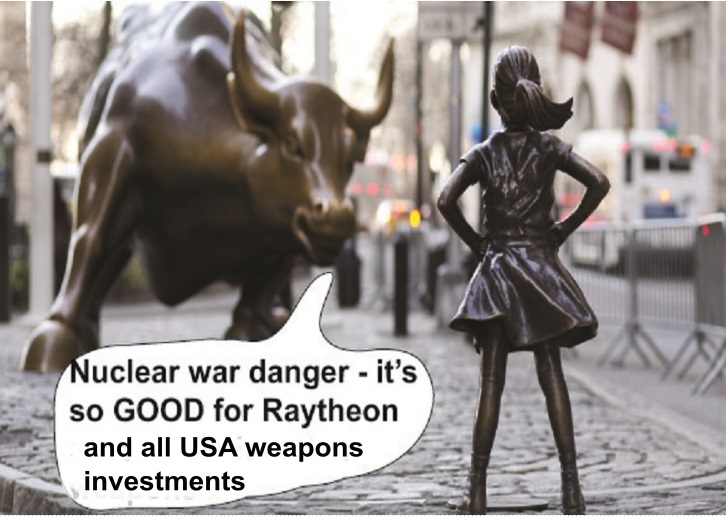
“from numerous perspectives, when viewed from a bang-per-buck perspective, US and Western support for Ukraine is an incredibly cost-effective investment.”
the US arms industry is the “one clear winner” in this bloody tangle.
September 9, 2023 by: Dr Binoy Kampmark https://theaimn.com/a-good-investment-the-ukraine-war-and-the-us-arms-racket/
It all tallies. War, investments and returns. The dividends, solid, though the effort expended – at least by others – awful and bloody. While a certain narrative in US politics continues in the vein of traditional cant and hustling ceremony regarding the Ukraine War – “noble freedom fighters, we salute you!” twinned with “Russian aggressors will be defeated” – there are the inadvertently honest ones let things slip. A subsidised war pays, especially when it is fought by others.
The latter narrative has been something of a retort, an attempt to deter a growing wobbling sentiment in the US about continuing support for Ukraine. In a Brookings study published in April, evidence of wearying was detected. “A plurality of Americans, 46%, said the United States should stay the course in supporting Ukraine for only one to two years, compared with 38% who said the United States should stay the course for as long as it takes.”
In early August, a CNN survey found that 51% of respondents believed that Washington had done enough to halt Russian military aggression in Ukraine, with 45% approving of additional funding to the war effort. A breakdown of the figures on ideological grounds revealed that additional funding is supported by 69% of liberals, 44% of moderates and 31% of conservatives. In Congress, opposition to greater, ongoing spending is growing among the Republicans, reflecting increasing concern among GOP voters that too much is being done to prop up Kyiv.
Such a mood has been anticipated by number crunching types keen to reduce human life to an adjustable unit on a spreadsheet. The Centre for European Policy Analysis, for example, suggested that a “cost-benefit analysis” would be useful regarding US support for Ukraine. “Its producing wins at almost every level,” came the confident assessment. In spectacularly vulgar language, the centre notes that, “from numerous perspectives, when viewed from a bang-per-buck perspective, US and Western support for Ukraine is an incredibly cost-effective investment.”
War-intoxicated Democrats would do well to remind their Republican colleagues about such wins, notably to those great patriots known as the US Arms Industry. Aid packages to Ukraine, while dressed up as noble, democratic efforts to ameliorate a suffering country’s position vis-à-vis Russia, are much more than that.
In May 2022, for instance, President Joe Biden signed a bill providing Kyiv $40.1 billion in emergency funding, split between $24.6 for military programs, and $15.5 billion for non-military objects. Even then, it was clear that one group would prove the greatest beneficiary. Stephen Semler of the Security Policy Reform Institute was unequivocal: US military contractors.
Of the package, rich rewards amounting to $17.3 billion would flow to such contractors, comprising goods, be they in terms of weapons and equipment, or services in the form of training, logistics and intelligence. “It allows the Biden administration,” writes Semler, “to continue escalating the United States’ military involvement in the war as the administration appears increasingly disinterested in bringing it to an end through diplomacy.”
Broadly speaking, the US military-industrial complex continues to gorge and merely getting larger. Whatever the outcome of this war – talk of absolute victory or defeat being the stuff of dangerous fantasy – it remains the true beneficiary, the sole victor fed by new markets and opportunities. Former Israeli foreign minister Shlomo Ben-Ami, now vice president of the Toledo Center for Peace, had to concede that the US arms industry was the “one clear winner” in this bloody tangle.
The addition of new member states to NATO, in this case Finland and Sweden, will, Ben Ami suggests, “open up a big new market for US defence contractors, because the alliance’s interoperability rule would bind them to American-made defence systems.” The evidence is already there, with Finland’s order of 64 new F-35 strike fighters developed by Lockheed Martin, Northrop Grumman and BAE Systems. The Ukraine War has been nothing short of lucrative in that regard.
Such expansion also comes with another benefit. The interoperability requirement in the NATO scheme acts as a bar to any alternatives. “The market for their goods is expanding,” writes Jon Markman for Forbes, “and they will face no competition for the foreseeable future.”
It should come as little surprise that the US defence contractors have been banging the drum for NATO enlargement from the late 1990s on. While a good number of those in the US diplomatic stable feared the consequences of an aggressive membership drive, those in the business of making and selling arms would have none of it. The end of the Cold War necessitated a search for new horizons in selling instruments of death. And with each new NATO member – Hungary, Poland, the Czech Republic – the contracts came. Washington and the defence contractors, twinned with purpose, pursued the agenda with gusto.
In 1997, Democratic Senator Tom Harkin was awake to that fact in hearings of the Senate Appropriations Committee on the cost of NATO enlargement. He was particularly concerned by a fatuous remark by Secretary of State Madeleine Albright comparing NATO’s expansion with the economic Marshall plan implemented in the aftermath of the Second World War. “My fear is that NATO expansion will not be a Marshall plan to bring stability and democracy to the newly freed European nations but, rather, a Marshall plan for defense contractors who are chomping [sic] at the bit to sell weapons and make profits.”
The moral here from the US military-industrial complex is: stay the course. The returns are worth it. And in such a calculus, concepts such as freedom and democracy can be commodified and budgeted. As for Ukrainian suffering? Well, let it continue.
Are They Already Cutting Corners on Worker Protection at DOE’s New Plutonium Processing Plant?

plutonium is toxic at the scale of micrograms, deadly at the scale of milligrams, and useable in nuclear weapons of mass destruction at the scale of kilograms. This is why plutonium work requires rigid, intensive safety systems, referred to as “defense in depth,” to protect workers and the surrounding people and landscape; as well as extreme levels of security and material accounting.
CounterPunch, BY DON MONIAK 11 Sept 23
As of this past Labor Day, there are strong indications that future workers at the planned, new Savannah River Plutonium Processing Plant (SRPPF) may face unnecessary, increased risks of exposure to radiological hazards inherent in plutonium toxicity and chemical complexity.
According to an August 3, 2023 letter from the Defense National Facilities Safety Board (DNFSB) to the Department of Energy’s (DOE) National Nuclear Security Agency (NNSA), the SRPPF project leadership team does not consider vital plutonium processing safety equipment as “safety significant controls.”
According to the letter, NNSA’s project leadership team believes a reliance on worker sense of sight, hearing, taste, smell, and touch is sufficient to detect and/or prevent accidents such as plutonium fires and dispersal of plutonium oxide powder.
In the hierarchy of nuclear safety, the Department of Energy standards place “Safety Significant Controls” above administrative controls that are reliant upon the absence of human error.
The motive for SRPPF project team’s preference for administrative controls is unknown.
The New Plutonium Processing Plant.
The plutonium/MOX (Pu/MOX) fuel facility was a massive, multi-billion dollar endeavor designed to help dispose of dozens of tons of surplus nuclear weapons plutonium (Pu). This Savannah River Site(SRS) project was abandoned in the late 2010’s, following a chronic array of technical issues, mismanagement, major cost overruns, cutting of corners, and the lack of commercial Pu/MOX fuel customers.
After the project was abandoned, the Department of Energy’s (DOE) National Nuclear Security Agency (NNSA) decided to repurpose the unfinished facility into a new “plutonium pit”production plant. The Mixed Oxide Fuel Fabrication Facility (MFFF) was then renamed the Savannah River Plutonium Processing Plant (SRPPF). This $11 billion plus repurposed facility is already burdened by cost overruns—-the original estimate was $3.7 billion.
Plutonium pits are referred to as the primary nuclear explosives, or triggers,” (1) that dominate the known U.S. nuclear weapons arsenal. Pits acquired their quaint nickname by virtue of the resemblance of the configuration of high explosives surrounding the primary nuclear explosive to stone fruit like peaches and plums—an example of early nuclear weaponeers’ inside humor.
The Pu pits are pressure vessels with nested shells of material, comprised of other non-nuclear parts, including the metal cladding, welds, a pit tube, neutron tamper(s) and initiator, as well as the usually hollow-cored plutonium hemispheres. In most pit designs, a sealed pit tube carries deuterium-tritium gas into the hollow-core to boost the nuclear explosive power of weapons.
But unlike the sweet, fruity, and and delectable flesh surrounding plum and peach pits, a Pu pit is surrounded by a high explosives package powerful enough to implode the plutonium metal sphere contained in the pit. This is not like compressing a tin can, as plutonium is the most durable of the transuranic heavy metals.
The current plan is to annually produce at least eighty new plutonium pits in the SRPPF. Pit fabrication was once the exclusive task at the long-closed Rocky Flats plant in Colorado, and the work processes constitute the most dirty—in terms of waste production—and dangerous workplace in the national nuclear weapons complex. In this century, Los Alamos National Laboratory (LANL) has failed miserably to reconstitute a tiny fraction of the Rocky Flats pit production rate.
Pit production is unlikely to be the only task at the SRPPF. An estimated ten to twelve-thousand surplus plutonium pits, containing a sum of 30 to 34-metric tonnes of plutonium, could also be processed at a plutonium pit disassembly and conversion line at the SRPPF. The resulting plutonium oxide powder would then be sent to the SRS K-Area’s Pu waste production facility, where the powder is diluted to a three to five percent level within a larger mixture of inert materials………………………….
Some Plutonium Processing Hazards
There is a negligible level of debate that plutonium is toxic at the scale of micrograms, deadly at the scale of milligrams, and useable in nuclear weapons of mass destruction at the scale of kilograms. This is why plutonium work requires rigid, intensive safety systems, referred to as “defense in depth,” to protect workers and the surrounding people and landscape; as well as extreme levels of security and material accounting.
The most hazardous plutonium operations involve plutonium pit fabrication. After pit disassembly, the plutonium within pits is converted to a finely dispersed powder form (2), made up of sticky grains containing energetic alpha particles that easily damage soft lung tissues. Sticky plutonium oxide particles clinging to ductwork can also hinder ventilation systems over time.
Recycling plutonium for pit production then requires difficult and dangerous processes to remove impurities and undesirable decay products such as intensely radioactive Americium-241. (3) The resulting plutonium form is transferred to the next step, the plutonium foundry.
The foundry work involves a complex ten-step process, summarized as melting, casting, and heat treating of plutonium metal. Gallium is added at a one-percent ratio to produce an alloy that is considered almost as easy to machine as aluminum or silver. The risk from explosion, criticality, and spill hazards must be rigidly controlled; while contaminated parts such as crucibles pose unique waste management measures.
The final plutonium processing step is machining the foundry product into a precise sub-critical configuration. Like any machining, Plutonium metal work casts tiny shavings and creates fine dust.
These shavings can ignite upon exposure to air and lead to larger fires that can destroy glove boxes and ventilation systems, and cause large releases of plutonium into the atmosphere. The Rocky Flats experience suggests that fires of any size are not a remote possibility, they are a probability.
The task is to keep Pu metal fires small and nondestructive, while preventing injury and harmful exposures to workers. A small fire can render costly equipment useless. A large fire can lead to a countryside contaminated with particles that become more intensely radioactive for decades.
Extreme care must also be taken to keep plutonium metal in a non-critical configuration at all times. The wrong geometry or placement of metal pieces in the wrong configuration can produce the deadly blue light that signifies criticality accidents. In 2009, a number of Los Alamos criticality engineers walked off the job at the lab’s pit production line, citing a casual approach to criticality safety.
The final step is assembly, where the parts that make pits tick are introduced. The making of these parts pose their own toxic hazards, such as the fine dust from machining beryllium metal.
Those are just several aspects of the safety issues involved with the plutonium pit fabrication.
The True, and False, Necessity for New Pit Fabrication and Production. ……………………………………………………………………………………………………………………………………………………………………………….
The Pit Plant’s Initial Design: One Less Layer of Safety Depth?
Because of all these factors, new pit production is considered essential, and a new, smaller scale—by Cold War Standards—plutonium pit fabrication capacity is presently in the preliminary design phase at the SRPPF complex.
The highest standards of safety are expected to prevent accidents or mitigate the impacts of spills, fires, leaks, and dispersion of fine radioactive dust. A less rigid approach to safety is quite unexpected for a high hazard, hardened nuclear facility that would only be the second its kind in the weapons complex—-the last being the Rocky Flats plant built in the 1950’s.
But according to the August 3, 2023 letter from the Defense Nuclear Facilities Safety Board (DNFSB), the DOE/NNSA’s project leadership team does not consider vital plutonium processing safety equipment as “safety significant controls.”…………………………………………………………………………………………………………………………………………………………………………………………….more https://www.counterpunch.org/2023/09/11/are-they-already-cutting-corners-on-worker-protection-at-does-new-plutonium-processing-plant/
Oregon hasn’t said never to nuclear power, but it should

BY LLOYD K. MARBET, Sep 10, 2023 https://www.bendbulletin.com/opinion/guest-column-oregon-hasnt-said-never-to-nuclear-power-but-it-should/article_5f0b13ec-4e93-11ee-873b-6fbd0628540c.html
Recently, editorials have appeared across Oregon in a number of newspapers. They are remarkably similar, and subtly deceptive in their content, as if the Nuclear Pied Piper is once again in town, playing new music for a great revival if only you will follow the Pied Piper down its unforseen road once again.
Have we resolved the problems of the nuclear fuel cycle? NO! A complicated cycle consisting of: — availability of uranium, mining, milling, enrichment, and fuel fabrication — construction of nuclear power plants with its delays and tremendous cost overruns — uncertain safety of nuclear plant operations with government limited liability leaving taxpayers holding the bag — targets of war, terrorism and natural disasters — radiation releases difficult to detect, and health effects difficult to prove, with ongoing disputes over the number of deaths — radioactive wastes throughout the fuel cycle demanding permanent disposal, up to thousands of years for high level radioactive waste — and decommissioning of an elaborate contaminated nuclear infrastructure. The problems of the nuclear fuel cycle are not resolved, nor fully accounted for!
Nuclear energy is not “zero emissions.” Oregon law measures carbon emissions at only one point in its fuel cycle: at the generation of electricity. The nuclear fuel cycle is an ongoing tragedy visiting its impacts on generations to come. Commercial “Small Modular Nuclear Reactors” are unproven designs on paper. If we are going to save ourselves from Climate Annihilation the time for honest accountability has come. Read Mark Jacobson’s book “No Miracles Needed: How Today’s Technology Can Save Our Climate and Clean Our Air.”
Oregon’s ballot measure and legislative referral process is a valuable educational tool for enlightening the electorate on important issues. It is also the reason why I strongly support preserving the ballot measure law passed by Oregon voters in 1980 and not repealing this hard-fought effort, that has protected Oregonians for 43 years by requiring the commercial nuclear power industry to have a “terminal” repository for its high level radioactive waste before producing any more. This law doesn’t say never to nuclear power.
Secondly, and most important, it provides, by referral to all Oregon voters, the right to make the final decision on whether proposed commercial nuclear power plants are needed, cost effective, and can safely operate in our state! The Bulletin’s editorial provides an incorrect history of the 1980 and 1986 ballot measures. The 1986 ballot measure on nuclear power was not passed into law!
Why are nuclear proponents seeking another vote on the 1980 law? Especially when repealing what gives Oregonians an ongoing vote on whether the nuclear industry has successfully met its obligation to provide a viable cost effective energy resource, capable of terminally disposing its high level nuclear wastes.
In the last Oregon legislative session, a hearing was held on one of the two identical bills that sought to re-refer the 1980, not the failed 1986, ballot measure to another vote. Both 2023 bills “fizzled out” after a House Committee heard testimony in favor of them and overwhelming testimony in opposition! Especially of note is testimony provided by Dirk Dunning, formerly of the Oregon Department of Energy, and Tami Thatcher, formerly of the Idaho National Laboratory. All testimony is available to read online at: tinyurl.com/Testimonyonnukes.
1 This Month
26 April – Chernobyl: Inside the Meltdown airs on National Geographic on Sunday 26th April from 4pm

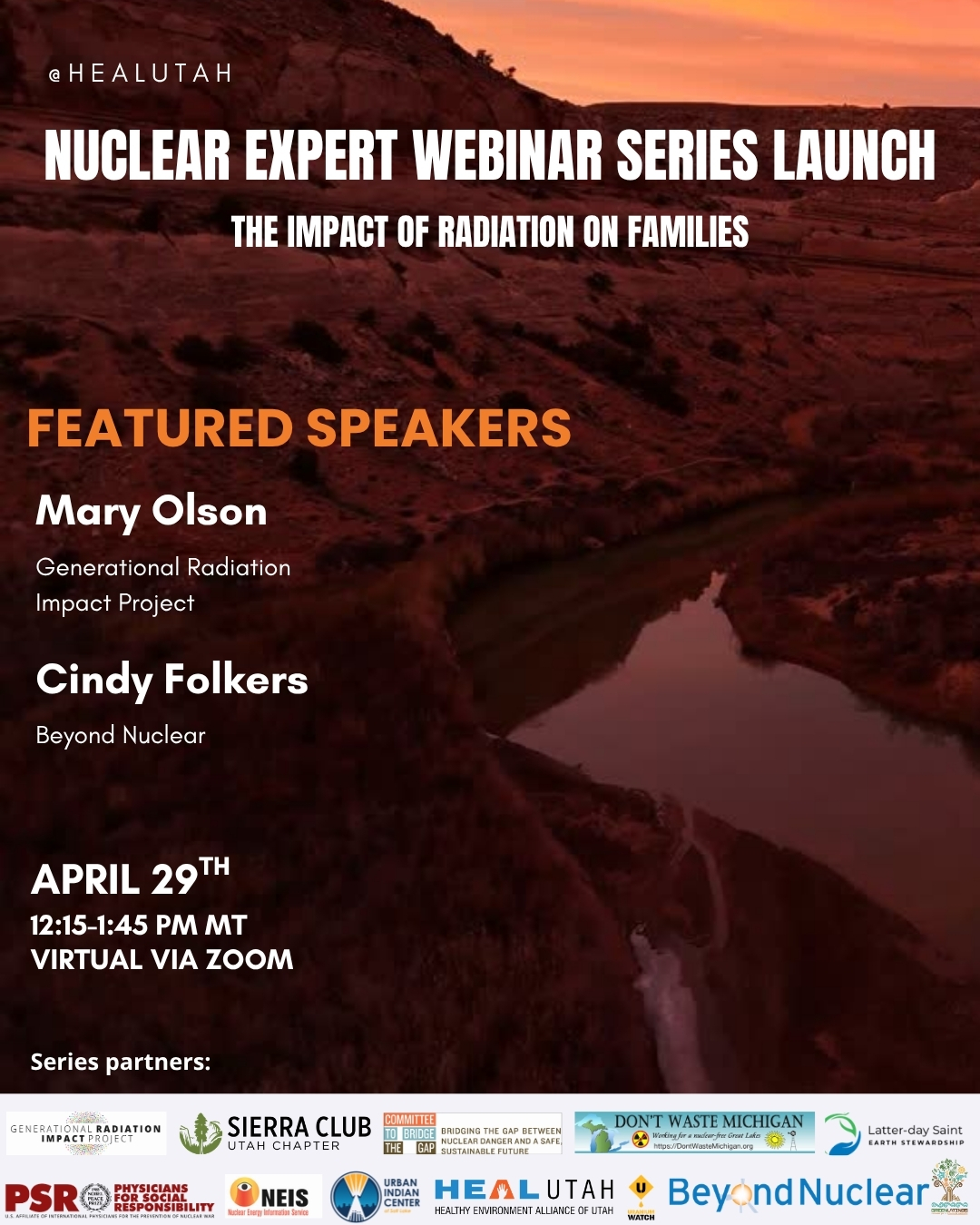
29 April – Nuclear Expert Webinar #1 – Radiation Impacts on Families with Mary Olson and Cindy Folkers
- 12:15 PM MT – 1:45 PM MT
- Location: Virtual – REGISTER TODAY

4 May -West Suburban Peace Coalition to discuss Iran war at May Educational Forum
Monday, May 4, 7:00 – 8:00 PM Central Standard Time
Title: : How Trump’s Narrative Tries to Shape the Reality of the War on Iran.
Contact Walt Zlotow, zlotow@hotmail.com 630 442 3045 for further information
14 May – online event From Bombs to Data Centres: the Face of Nuclear Colonialism

Pine Ridge Uranium is the real threat, not Tehran- Tell Burgum: Stop the Extraction.
Chernobyl: The Lost Tapes – A good documentary on Chernobyl on SBS available On Demand for the next 3 weeks– https://www.sbs.com.au/ondemand/tv-program/chernobyl-the-lost-tapes/2352741955560
To see nuclear-related stories in greater depth and intensity – go to https://nuclearinformation.wordpress.com
-
Archives
- April 2026 (300)
- March 2026 (251)
- February 2026 (268)
- January 2026 (308)
- December 2025 (358)
- November 2025 (359)
- October 2025 (376)
- September 2025 (257)
- August 2025 (319)
- July 2025 (230)
- June 2025 (348)
- May 2025 (261)
-
Categories
- 1
- 1 NUCLEAR ISSUES
- business and costs
- climate change
- culture and arts
- ENERGY
- environment
- health
- history
- indigenous issues
- Legal
- marketing of nuclear
- media
- opposition to nuclear
- PERSONAL STORIES
- politics
- politics international
- Religion and ethics
- safety
- secrets,lies and civil liberties
- spinbuster
- technology
- Uranium
- wastes
- weapons and war
- Women
- 2 WORLD
- ACTION
- AFRICA
- Atrocities
- AUSTRALIA
- Christina's notes
- Christina's themes
- culture and arts
- Events
- Fuk 2022
- Fuk 2023
- Fukushima 2017
- Fukushima 2018
- fukushima 2019
- Fukushima 2020
- Fukushima 2021
- general
- global warming
- Humour (God we need it)
- Nuclear
- RARE EARTHS
- Reference
- resources – print
- Resources -audiovicual
- Weekly Newsletter
- World
- World Nuclear
- YouTube
-
RSS
Entries RSS
Comments RSS
 nuclear-news