White House hopes to merge Ukraine and Israel aid – media

https://www.rt.com/news/584507-israel-ukraine-aid-package/ 11 Oct 23
The measure could push Republicans to support new assistance for Kiev
Top White House officials are considering whether to include more Ukraine funding in an emergency aid package for Israel, multiple news outlets have reported. One staffer suggested the move would force “far-right” lawmakers to authorize additional aid for Kiev.
Though President Joe Biden had already announced that military assistance was “on its way” to Israel following a surprise attack by Palestinian militants over the weekend, the White House has signaled that it would soon ask Congress to approve additional aid for the Jewish state.
Lawmakers in both parties and senior administration officials have hinted that the aid package could also include provisions for Ukraine, unnamed sources told the Washington Post, NBC News and other outlets on Monday.
Though no final decision has been made, one anonymous official told the Post that the move would be wise because it “jams the far right” – referring to Republicans who vocally support Israel but are skeptical of continued aid to Ukraine. White House spokesman John Kirby, meanwhile, declined to say whether the two aid packages would be linked, only stating “We believe both are important.”
While debate over the aid is likely to be contentious, the Pentagon has insisted that it has plenty of weapons for all US partners. During a background briefing on Monday, a senior defense official told reporters that Washington could “continue our support both to Ukraine, Israel, and maintain our own global readiness,” noting that the US has been able to meet “every request that our Israeli counterparts have made.”
Israel is among the largest recipients of US foreign aid, taking in some $3.3 billion in American tax dollars in 2022 alone – a comparable amount to previous years – according to US government statistics. Since the conflict with Russia escalated in February 2022, Ukraine has also become a major beneficiary, with the White House approving at least $45 billion in direct military aid through 47 separate transfers.
Both Republicans and Democrats have largely voiced support for Israel after the deadly Hamas attack early on Saturday morning, which has prompted harsh retaliation by the Israel Defense Forces (IDF) and an intense bombing campaign on Gaza. More than 1,500 people have been killed on both sides of the conflict so far, while Palestinian fighters claim to have captured more than 100 Israeli and foreign hostages during their raids.
Thousands of Israelis and Palestinians have evacuated their homes due to the violent flare-up, while the IDF has called on 300,000 reservists as it mobilizes for a larger conflict. Israeli Prime Minister Benjamin Netanyahu declared that his country was in a state of “war” as the attack unfolded, and said on Monday that the military response was “just getting started.” #Ukraine
New Mexico could try again to challenge nuclear waste storage project in court

Adrian Hedden, Carlsbad Current-Argus, 11 Oct 23
Officials with the State of New Mexico continued their fight against a proposed storage site for spent nuclear fuel in southeast New Mexico during a Tuesday hearing before lawmakers in Carlsbad, and said the project could be challenged a second time in federal court.
The New Mexico Environment Department (NMED) and Office of the Attorney General voiced opposition to such a site during the discussion held at Southeast New Mexico College with the Legislature’s interim Radioactive and Hazardous Materials Committee.
Representatives of both agencies called into question the legality of such a site to store nuclear fuel away from a reactor amid the ranchlands and oilfields of the Permian Basin.
Holtec International applied to the federal Nuclear Regulatory Commission (NRC) for a license to build the facility in 2017, and it was issued in May………………………………………
The State of New Mexico challenged in court the NRC’s findings in an environmental analysis ahead of the license, but the 10th Circuit Court of Appeals ruled the state could not object before it was issued.
Gov. Michelle Lujan Grisham, her cabinet secretaries and Commissioner of Public Lands Stephanie Garcia Richard all voiced their opposition to the Holtec project throughout the licensing process, citing risks to the local communities and industries like oil and gas and agriculture.
Bruce Baizel, director of compliance and enforcement with the NMED said the State could file another challenge to the license now that it is issued to Holtec.
He pointed to a federal court ruling earlier this year that vacated a license for a similar site issued by the NRC to Interim Storage Partners in Andrews, Texas, along the New Mexico border, which Baizel said could have legal implications for the New Mexico site.
Assistant Attorney General William Grantham said the Office of the Attorney General believed a federal court would vacate Holtec’s license, arguing federal law did not allow an interim storage site as proposed by Holtec without a permanent repository available.
Also going against the project, during the 2023 Legislative Session, lawmakers passed Senate Bill 53 to block state agencies from issuing any permits for any site storing high-level nuclear waste as Holtec’s would.
Baizel said the facility would require five such permits to operate.
“That language would not allow us to process or approve any of those state permits for that project,” he said.
Carlsbad mayor attacks lawmakers for not including nuclear industry voices
Carlsbad Mayor Dale Janway, an ardent Holtec supporter, did not attend the hearing, citing an “imbalance” in the panels, particularly on nuclear storage, according to Rep. Cathrynn Brown (R-55) of Carlsbad……………………………………………………….
Camilla Feibelman, director of the Sierra Club’s Rio Grande Chapter said that if Holtec was allowed to operate its facility, New Mexico would take all the risks of the waste with no benefits like the jobs provided to states that do host nuclear power plants.
“Holtec wants to bring the entire store of nuclear waste by rail to southeast New Mexico through thousands of communities along the way,” she said. “Spent nuclear fuel should be stored at the site of origin in the safest manner possible.”
Committee Vice Chair Sen. Jeff Steinborn (D-36), who sponsored SB 53, said the “reality” was that it made Holtec’s project and others like it illegal in New Mexico.
“We have passed a law in New Mexico making it illegal to store high level nuclear waste in New Mexico,” Steinborn said. “That is the reality now. Only the courts could change that reality.”
https://www.currentargus.com/story/news/2023/10/11/new-mexico-could-challenge-nuclear-waste-holtec-international-storage-project-in-court/71121256007/–#nuclear #antinuclear #NuclearFree #NoNukes #NuclearPlants
This is one scary opinion about the Israeli-Palestine war – “Get Ready, Because The U.S. Is Going To War In The Middle East”
MICHAEL SNYDER, OCT 12, 2023 https://michaeltsnyder.substack.com/p/get-ready-because-the-us-is-going?utm_source=post-email-title&publication_id=1520363&post_id=137881937&utm_campaign=email-post-title&isFreemail=true&r=ln98x&utm_medium=email
We are on the precipice of a major regional war in the Middle East, and the U.S. military is going to be involved. Of course if this war was just limited to a fight between Israel and Hamas, there would be no need for the U.S. military to intervene, because the IDF can handle Hamas quite easily. But Hezbollah is another matter entirely. Hezbollah possesses an extremely powerful military, and they have an arsenal of approximately 130,000 missiles ready to be fired at Israel. If Hezbollah enters the war and starts firing thousands upon thousands of missiles at Israel, the United States will take action.
Unfortunately, we are already dangerously close to that point. Hezbollah has not formally entered the war yet, but clashes along Israel’s northern border have been happening for four consecutive days…
Cross-border violence between Lebanon and Israel has escalated into a fourth day, pushing many Lebanese in southern towns to leave as Hezbollah and the Israeli military continue to trade fire.
Hezbollah said it fired precision missiles on an Israeli position across from the Lebanese town of Dharya on Wednesday, drawing retaliatory Israeli shelling that has left a number of houses damaged.
Once Israel launches a ground operation inside Gaza, I believe that Hezbollah will formally enter the war shortly thereafter.
But it appears that Hezbollah is not just gearing up to fight Israel. In fact, they have issued a statement declaring the U.S. to be a “full partner” in the conflict with Hamas…
Hezbollah issues a statement saying the United States is a ‘full partner’ of Israeli ‘aggression’ on the Gaza Strip. Hezbollah also says that it holds the United States fully responsible for the airstrikes that are killing civilians in Gaza.
And one Hezbollah official is publicly warning that his forces in Iraq “are ready to direct qualitative strikes at the American enemy in its bases”…
The leader of a prominent Iranian-backed militia in Iraq threatens to attack American bases in retaliation if the United States intervenes in the war between Hamas and Israel in Gaza.
“Our missiles, drones, and special forces are ready to direct qualitative strikes at the American enemy in its bases and disrupt its interests if it intervenes in this battle,” Ahmad “Abu Hussein” al-Hamidawi, head of the Kataib Hezbollah militia, says in a statement. He also threatened to launch missiles at Israeli targets.Of course the U.S. has been delivering some very strong warnings to Hezbollah as well…
The United States and Allied Countries through Back-Channels have reportedly been issuing Direct Warnings to Hezbollah against them Escalating and possibly Joining the Israel-Hamas War; however so far Senior Biden Administration Officials do not believe that Hezbollah is planning to Join the War, but that could always change.
I am sure that the Biden administration is desperately hoping that Hezbollah stays on the sidelines, but they are also preparing for the worst.
On Wednesday, we learned that a second U.S. aircraft carrier is being sent to the Eastern Mediterranean…
US National Security Council Coordinator John Kirby confirmed that the United States will be sending the USS Dwight D. Eisenhower aircraft carrier to the Eastern Mediterranean, after it was already announced that the USS Gerald R. Ford would be deployed as part of “support” operations related to the Israel-Gaza conflict.
However, Kirby said that the Eisenhower will not be directly joining or escorting. Instead, the carrier will be in the region for availability if called upon. While in a press briefing Kirby tried to downplay the dual carrier deployment as somewhat routine or expected, they will certainly be on standby to potentially intervene if all hell continues breaking loose in the Middle East.
Hopefully those carriers will be smart and will stay a long way from shore.
Because Hezbollah possesses missiles that are capable of sinking a carrier.
Needless to say, images of a sinking carrier would cause great fury here in the United States.
The U.S. is also deploying special forces to the region in case they are needed to locate American hostages…
The United States is readying its special forces to help Israel locate American hostages, as waves of Israeli Defense Force reservists arrived at JFK airport in New York to join the fight against Hamas.
Two senior U.S. military officials told The Messenger that ‘door kickers’ have been put on alert in a nearby European country, ready to assist Israel if necessary in their battle against Hamas. The Israeli death toll rose to 1,200 on Tuesday.
This is just the beginning.
As this war escalates, more U.S. forces will inevitably be deployed.
Sadly, there can never be lasting peace with these Islamic terrorists. Franklin Graham recently shared a video of a prominent Hamas leader declaring what their real long-term plan is…
On social media, Franklin cited a video of Hamas’ Mahmoud al-Zahar, and wrote, “We just saw Hamas brutally murder 900+ Israelis, most all civilians. If you want to know what else they’re after, a Hamas commander made it clear. He said they want to kill every Jew and every Christian – and take control of the ‘entire 510 million sq. kilometers of Planet Earth.’ If you think what is happening in Israel is limited to Israel, think again.”
As this war escalates, more U.S. forces will inevitably be deployed.
Sadly, there can never be lasting peace with these Islamic terrorists. Franklin Graham recently shared a video of a prominent Hamas leader declaring what their real long-term plan is…
On social media, Franklin cited a video of Hamas’ Mahmoud al-Zahar, and wrote, “We just saw Hamas brutally murder 900+ Israelis, most all civilians. If you want to know what else they’re after, a Hamas commander made it clear. He said they want to kill every Jew and every Christian – and take control of the ‘entire 510 million sq. kilometers of Planet Earth.’ If you think what is happening in Israel is limited to Israel, think again.”
This Hamas Commander says this is not about land, not just Palestine. “The entire planet will be under our law, there will be no more Jews or Christian traitors.” Only then, if everyone adopts his law, will there be peace. pic.twitter.com/97sWBcH8yJ
— CSW Latinoamérica (@CSWLatAm) October 8, 2023
They will never stop until they rule the entire world.
There is no negotiating with people like that.
On Friday, there is supposed to be a “global Day of Rage” for those that support Hamas…
Khaled Mashal, a leader and founding member of the Islamic terror group Hamas, has called for a global Day of Rage this Friday, saying “this is the time for Jihad.”
Hamas, an Islamic political and military organization that governs the Gaza Strip, carried out a brutal, highly coordinated terror attack on Israel over the weekend, slaughtering more than 1,200 people—including fourteen Americans—and wounding more than 2,100, according to the latest reports. The Palestinian terrorists also took more than 130 civilians hostage and have threatened to execute them on live broadcasts.
Mashal reportedly gave a speech on Tuesday exhorting Muslim across the world to “show anger” and be “martyrs for Al-Aqsa” in what he called “the Friday of Al-Aqsa flood.” Hamas has dubbed their murderous rampage in Israel Saturday “operation Al-Aqsa Flood,” saying the assault was “in defense of the Aqsa Mosque,” the main congregational mosque in the Old City of Jerusalem.
Hopefully there will not be too much violence.
But I can’t say that I am too optimistic about that.
For a long time I have been warning that a historic war would be coming to the Middle East, and now it is here.
So many people are going to die, and that should deeply sadden all of us.
More Americans are likely to die too, because it is just a matter of time before the U.S. military becomes a direct part of this conflict.
South Carolina nuclear plant gets warning over another cracked emergency fuel pipe
JENKINSVILLE, S.C. (AP) 10 Oct 23— Federal officials have issued a warning about a substantial safety violation at a South Carolina nuclear plant after cracks were discovered again in a backup emergency fuel line.
Small cracks have been found a half-dozen times in the past 20 years in pipes that carry fuel to emergency generators that provide cooling water for a reactor if electricity fails at the V.C. Summer plant near Columbia, according to the U.S. Nuclear Regulatory Commission.
The agency issued what it calls a preliminary “yellow” warning to plant owner Dominion Energy last week.
It is the second most serious category and only seven similar warnings have been issued across the country since 2009, nuclear power expert David Lochbaum told The State newspaper after reviewing records from federal regulators.
A crack first appeared on a diesel fuel pipe in 2003, and similar pipes have had other cracks since then.
During a 24-hour test of the system in November, a small diesel fuel leak grew larger, according to NRC records.
The agency issued the preliminary yellow warning because of the repeated problems………………….
Dominion has recently requested to renew the license for the nuclear plant for an additional 40 years.
Longtime nuclear safety advocate Tom Clements told the newspaper the pipe problems should mean a lot more scrutiny by regulators.
“This incident serves as a wake-up call to fully analyze all such systems prior to a license-renewal determination,’’ Clements said in an email. https://apnews.com/article/nuclear-plant-south-carolina-dominion-energy-b71d1e3b598b84623259205997602aaf #nuclear #antinuclear #NuclearFree #NoNukes #NuclearPlants
New Brunswick small nuclear tech could be used for nuclear war: physicist.
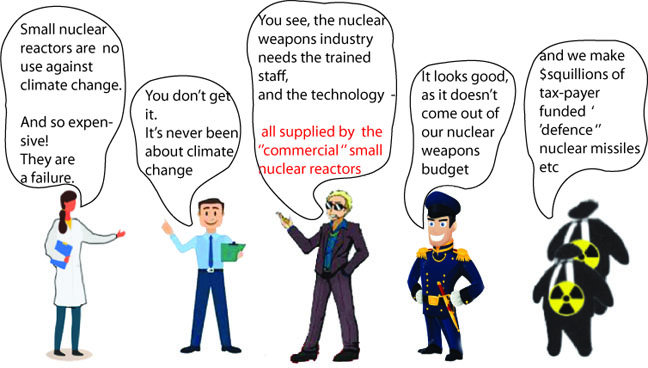
John Chilibeck, Local Journalism Initiative reporter|, Brunswick News, 11 Oct 23
A physicist from British Columbia is warning that New Brunswick is heading down a dangerous path, increasing the likelihood of a nuclear war by supporting the development of small reactors for export.
M. V. Ramana, a professor and Simons Chair in Disarmament, Global and Human Security at the University of British Columbia, says the two companies that are trying to develop small modular reactors at Point Lepreau near Saint John – Moltex and ARC – use technology that could one day be used to make nuclear weapons.
If those reactors fell in the wrong hands, he says, humankind could be put at risk.
“All reactors use plutonium and many of them use enriched uranium. Both of these processes can also be used to produce weapons material,” the academic said from the Vancouver airport on Wednesday, a day ahead of his lecture at St. Thomas University in Fredericton at 7 p.m. at the Kinsella Auditorium, McCain Hall. “The other issue is personnel. People working with reactors can learn to make nuclear weapons. And lastly, in many countries, it’s the same institutions that are involved in developing nuclear energy as developing nuclear weapons.”
Ramana cited the country of his birth, India, which ostensibly developed reactors for peaceful purposes through its Department of Nuclear Energy but after a couple of decades started making weapons out of the material to counter the influence of Pakistan, which it has fought four wars against since independence in 1947.
He also mentioned Iran, which first acquired the technology for nuclear energy in the 1970s when the Shah was in power and the country was friendly to the West. Following the revolution of 1979, religious extremists took over who now sponsor terrorist attacks around the world – such as the Hamas raid last weekend that left 1,000 Israeli citizens and soldiers dead – and also want to develop their own nuclear arsenal.
New Brunswick, he said, could unwittingly undo years of international efforts to stop nuclear proliferation once the ARC and Moltex technologies are ready, expected sometime around 2030 or a few years after.
Despite a long history of producing nuclear energy, Canada has never made nuclear weapons. Ramana said that could change if the wrong politicians came to power.
“Look at what happened on January 6, 2021 at the Capitol Building,” he said of the attempted insurrection in the United States. “I don’t think anyone thought that would ever happen. And we don’t know who will be in power in Canada in 30 years.”
Moltex and ARC have made no secret of their desire to create prototype reactors in New Brunswick that could one day be made and sold to other places, both within Canada and to other countries. It’s part of their business model.
Rory O’Sullivan, the CEO of Moltex, recently wrote a letter to Prime Minister Justin Trudeau rebutting the criticisms of a group of anti-nuclear non-proliferation academics from the United States.
Ottawa has already provided Moltex $50 million to develop its technology, and New Brunswick $5 million. It will likely need more public investment to keep developing its technology…………………………..
“Imagine one day they export reactors to South Korea, or Saudi Arabia, or Nigeria, whatever country you want to think about it. When they send the reactors abroad, they’ll have to send the fuel for those reactors, and they have a very large amount of plutonium. A country could get the reactor and the plutonium and say, ‘we’re going to use the plutonium to make nuclear weapons,’ there’s very little we can do to sanction that country.”– said Ramana #nuclear #antinuclear #NuclearFree #NoNukes #NuclearPlants
Interest, but skepticism, on nuclear microreactors, fusion , and thorium

The Nuclear Microreactor Race Is Heating Up
Zero Hedge,Oct 11, 2023,
“…………………………………………………………..Interest and Skepticism
Interest in microreactors and other advanced nuclear technology has increased partly because of concerns about climate change. While various processes associated with nuclear power can produce greenhouse gasses–for example, mining uranium for fuel–nuclear fission doesn’t directly generate them. For governments and corporations that have committed to net zero carbon emissions by 2050, nuclear energy can look rather enticing.
Yet, some experts and activists contend that the world can radically scale back hydrocarbons without using more nuclear power.
In early June of this year, for example, former Nuclear Regulatory Commission (NRC) chair Gregory Jaczko held a briefing in which he and others argued that nuclear power is too expensive and risky to help the U.S. decarbonize.
“There are now better ways to generate carbon-free electricity. We have renewable energy. We have geothermal, hydro, solar, wind,” Mr. Jaczko told the CBC in a 2019 interview…………………………
Illinois Governor J.B. Pritzker has also sounded somewhat skeptical of advanced reactors.
In August of this year, he vetoed a bill that would have lifted the state’s moratorium on building new nuclear plants.
In a statement on the veto, his office said that “the vague definitions in the bill, including the overly broad definition of advanced reactors, will open the door to the proliferation of large-scale nuclear reactors that are so costly to build that they will cause exorbitant ratepayer-funded bailouts.”………………………………………………………..
Need for Non-Russian Fuel Another Challenge in Advanced Nuclear
The ADVANCE Act also directs the NRC to report to Congress on its ability to lessen its dependence on Russia for fuel.
Indeed, Russia’s dominance of the high-assay, low-enriched uranium (HALEU) used in most small advanced reactors has already delayed the launch of TerraPower’s Natrium reactor.
The Department of Energy in 2020 launched a HALEU consortium as part of its efforts to develop domestic sources.
Nano, a founding participant in the consortium, touts a subsidiary focused on HALEU production, HALEU Energy Fuel Inc.
The HALEU problem raises a basic question: even if Nano’s reactors are ready to roll by 2030, will they be able to operate?
“You can have a Ferrari, but if you don’t have fuel, it’s not going to run,” Mr. Yu said.
Chuckling at Fusion, Still Bearish on Thorium
In late 2022, the achievement of ignition in a fusion reaction at the Lawrence Livermore National Laboratory got a lot of media attention.
At the time, Energy Secretary Jennifer Granholm suggested the result supports the Biden administration’s goal of a commercial fusion reactor in the next decade, saying the work “shows that it can be done.”
Yet, when the subject of fusion came up, both Mr. Yu and Mr. Walker started chuckling.
“Well, the reason why we’re laughing a bit is because we’ve got some scientists on board, and they get asked this quite a lot, and they lose their temper about this,” Mr. Walker explained.
“You do get very hyped-up articles,” he added.
He pointed out that the fusion breakthrough celebrated last year required massive energy input, far more than the reaction itself generated………..
Mr. Walker voiced a few concerns about thorium reactors, saying some of Nano’s technical staff “were very bearish on it” and stressing that he lacks significant expertise on thorium. #nuclear #antinuclear #NuclearFree #NoNukes #NuclearPlants
Regulators reject request to shutter nuclear reactor

The Journal Record, By: Associated Press//October 9, 2023
LOS ANGELES (AP) – Federal regulators have rejected a request from two environmental groups to immediately shut down one of two reactors at California’s last nuclear power plant.
Friends of the Earth and Mothers for Peace said in a petition filed last month with the Nuclear Regulatory Commission that long-postponed tests needed to be conducted on critical machinery at the Diablo Canyon Nuclear Power Plant, located midway between Los Angeles and San Francisco. They argued the equipment could fail and cause a catastrophe.
In an order dated Tuesday, the NRC took no action on the request to immediately shut down the Unit 1 reactor and instead asked agency staff to review it.
……………. According to the groups, the last inspections on the vessel took place between 2003 and 2005. The utility postponed further testing in favor of using results from similar reactors to justify continued operations, they said.
The commission found there was no justification for a hearing.
The groups said in a statement that the decision showed “a complete lack of concern for the safety and security of the people living near” the plant, which started operating in the mid-1980s……………..
The petition marked the latest development in a long fight over the operation and safety of the seaside plant, which sits on a bluff above the Pacific Ocean. In August, a state judge rejected a lawsuit filed by Friends of the Earth that sought to block PG&E from seeking to extend the operating life of the plant.
PG&E agreed in 2016 to shutter the plant by 2025, but at the direction of the state changed course and now intends to seek a longer operating run for the twin reactors. Democratic Gov. Gavin Newsom, who once was a leading voice to close the plant, said last year that Diablo Canyon’s power is needed beyond 2025 to ward off possible blackouts as California transitions to solar and other renewable energy sources. https://journalrecord.com/2023/10/09/regulators-reject-request-to-shutter-nuclear-reactor/
Motor fault, legal problems, future delays …. giant costly Vogtle nuclear project struggles on

Vogtle 4 start-up moved to 2024
World Nuclear News, 09 October 2023 #nuclear #anti-nuclear #nucler-free #NoNukes
The in-service date for the second AP1000 plant at the site near Waynesboro, Georgia, has been revised after a motor fault was discovered in a reactor coolant pump. Meanwhile, Georgia Power has agreed to pay the plant’s co-owner Oglethorpe Power Corporation USD308 million in settlement of an ongoing dispute.
The motor fault in one of the unit’s four reactor coolant pumps – or RCPs – was discovered during start-up and pre-operational testing, Georgia Power said in a filing to the US Securities and Exchange Commission (SEC)……………………………
Southern Nuclear believes that the motor fault on the RCP at Vogtle 4 is an isolated event, the companies said. The projected schedule for Vogtle 4 “primarily depends on the continued progression of pre-operational testing and start-up”, it added: “As testing continues, new challenges also may continue to be identified, which may result in required engineering changes or remediation related to plant systems, structures, or components (some of which are based on new technology that only within the last few years began initial operation in the global nuclear industry at this scale). These challenges may result in further schedule delays and/or cost increases.”
Dispute settled
In the same SEC filing, Georgia Power and its parent, Southern Company, announced the agreement with Oglethorpe Power to resolve a dispute regarding cost-sharing and tender provisions of the joint ownership agreements relating to Vogtle units 3 and 4. Georgia Power has agreed to make a payment of USD308 million to Oglethorpe for a portion of Oglethorpe’s previously incurred construction costs, as well as paying a portion of Oglethorpe’s further construction costs for the units – around USD105 million – based on the current capital cost forecast. It will also pay 66% of Oglethorpe’s costs of construction with respect to any amounts above the current project capital cost forecast. The parties have agreed to dismiss pending litigation on this issue, including counterclaims by Georgia Power.
Georgia Power resolved a similar dispute with another of the plant’s co-owners, the Municipal Electric Authority of Georgia (MEAG Power) in September 2022. Similar litigation with the other co-owner, Dalton Utilities, is still pending.
Construction of the two Westinghouse AP1000s began in 2013. Unit 3 ………………… Plant Vogtle is jointly owned by Georgia Power (45.7%), Oglethorpe (30%), MEAG Power (22.7%) and Dalton Utilities (1.6%).
Endless electricity and water use: the Artificial-Intelligence-Blockchain-Data Centre -Nuclear-NuScale nightmare to come

Blockchain biz goes nuclear: Standard Power wants to use NuScale reactors for DCs
Please, no crypto boom, thank you
The Register, Tobias Mann, Sun 8 Oct 2023 #nuclear #anti-nuclear #nucler-free #NoNukes
Colocation outfit Standard Power hopes to power two new datacenters in Ohio and Pennsylvania entirely by miniaturized nuclear reactors from NuScale.
Standard Power makes no secret it focuses on providing datacenter services to not just those into AI workloads and other kinds of high-performance computing but also those performing proof-of-work blockchain mining, the kind needed to craft digital tokens like Bitcoin. The significant energy requirements of this type of blockchain work spurred an investigation by the White House Office of Science and Technology Policy last year, and calls by lawmakers to implement reporting and/or sustainability requirements for such operations.
Generally speaking, a datacenter packed with proof-of-work miners is going to demand a chunky amount of power. Concerned it may not get adequate electricity supplies for its new facilities, which by the sounds of it will support blockchain mining as well as other workloads, Standard Power said it hopes to take the nuclear option.
“We see a lot of legacy baseload grid capacity going offline with a lack of new sustainable baseload generation options on the market especially as power demand for artificial intelligence-computing and datacenters is growing,” Standard Power CEO Maxim Serezhin said in a statement.
And the colo outfit’s Ohio and Pennsylvania datacenters may need or get a lot of power. The company expects to deploy 24 of NuScale’s small modular reactors between the two sites. These reactors are reportedly capable of generating 77 megawatts apiece — putting the total deployed capacity at 1,848 megawatts.
Despite the announcement, it may be a few years before Standard Power can realize its nuclear dreams. As we learned in January, Idaho National Labs will be among the first to demonstrate NuScale’s reactors, and the first of these modules isn’t expected to come online until 2029. We asked Standard Power when it expects its facilities will be operational; we’ll let you know if we hear anything back…………………………………..
Standard Power is hardly the first datacenter operator to get excited about nuclear power, either. Cumulus Data opened a datacenter next to a nuclear plant — the full-size kind — in January and last month we learned that Microsoft is now hiring someone to potentially deploy SMR systems to power its growing cloud enterprise. https://www.theregister.com/2023/10/08/standard_power_nuclear_datacenter/
US public support declines for arming Ukraine, Reuters/Ipsos poll shows
By Jason Lange and Patricia Zengerle. October 6, 2023 #nuclear #antinuclear #nuclear-free #NoNukes
WASHINGTON, Oct 5 (Reuters) – Support is falling among Americans of both major political parties for supplying Ukraine with weapons, a warning sign for Kyiv, which relies heavily on U.S. arms to fight against a Russian invasion, according to a new Reuters/Ipsos poll.
The two-day poll, which closed on Wednesday, showed only 41% of respondents agreed with a statement that Washington “should provide weapons to Ukraine,” compared to 35% who disagreed and the rest unsure.
Support for U.S. weapon shipments is down from May, when a Reuters/Ipsos poll showed 46% of Americans backed sending arms, while 29% were opposed and the rest unsure.
The poll was taken as U.S. congressional leaders debate Democratic President Joe Biden’s request for $24 billion in additional funding for Ukraine, of which about $17 billion would be defense aid………………………………………………………. https://www.reuters.com/world/us/us-public-support-declines-arming-ukraine-reutersipsos-2023-10-05/
Senators worry about Saudi nuclear arms plans
Beyond Nuclear #nuclear #antinuclear #nuclear-free #NoNukes
US should reconsider helping Saudi Arabia develop domestic nuclear power, they wrote
Editor’s introduction: Brett Wilkins with Common Dreams has reported on an important step taken by a handful of US Senators who pushed back last week on selling commercial nuclear technology to Saudi Arabia. We republish the article below. (As always, any views expressed in the article are the writer’s own and do not necessarily reflect those of Beyond Nuclear.) But while the Senators’ letter to President Joe Biden voices concern that the Saudis could use a domestic reactor program to transition to nuclear weapons, it fails to recognize that this is an inevitable outcome of nuclear power technology no matter whose hands it is in.
By Brett Wilkins, Common Dreams
Amid reports that Saudi Arabia is seeking United States support for its nuclear energy program—whose capacities critics fear could be utilized to develop nuclear weapons—a group of 20 U.S. senators on Wednesday urged President Joe Biden to “seriously consider” whether such a move is in the national interest as the administration brokers a possible normalization deal between the kingdom and Israel.
In addition to concerns over the fundamentalist monarchy’s desire for a U.S. security guarantee as a condition for normalizing relations with apartheid Israel, as well as the future of a two-state solution in illegally occupied Palestine, the senators note in a letter to Biden that “the Saudi government is also reportedly seeking U.S. support to develop a civilian nuclear program, and to purchase more advanced U.S. weaponry.”
“While we should seriously consider whether it is in U.S. interests to help Saudi Arabia develop a domestic nuclear program, we should always maintain the high bar of the ‘gold standard’ 123 Agreement and insist on adherence to the Additional Protocol,” the senators wrote, referring to a provision of the Atomic Energy Act of 1954 requiring a country seeking a nuclear cooperation deal with the United States to commit to a set of nine nonproliferation criteria and expanded International Atomic Energy Agency (IAEA) inspections. The U.S. has entered into such agreements with more than two dozen countries, Taiwan, and the IAEA…………………………
The lawmakers’ letter was led by Democratic Sens. Chris Murphy (Conn.), Chris Van Hollen (Md.), Dick Durbin (Ill.), and Peter Welch (Vt.). Signatories include Sens. Bernie Sanders (I-Vt.), Elizabeth Warren (D-Mass.), John Fetterman (D-Pa.), Jeff Merkley (D-Ore.), Patty Murray (D-Wash.), and Ed Markey (D-Mass.)……………………………………………………………………………. more https://beyondnuclearinternational.org/2023/10/08/senators-worry-about-saudi-nuclear-arms-plans/
Why The US Canceled Project Pluto: The Super Weapon That Never Was
Slash Gear, BY QUINA BATERNA/OCT. 8, 2023 #nuclear #antinuclear #nuclear-free #NoNukes
With the role of nuclear powers in maintaining global order and its ongoing arms race, it’s unsurprising that the United States has its eyes on Russia’s ongoing development of nuclear-powered missiles. However, it’s also a little more personal, especially because the United States had canceled a similar project more than half a century earlier: Project Pluto.
……………………………………………………………………………………… What is Project Pluto?
……………………. In 1961, the United States successfully unveiled the revolutionary Tory IIA-I in the midst of the Cold War. Mounted on top of a railroad car, it marked the world’s first nuclear ramjet engine when it came to life for just a few seconds. Three years later, the U.S. tested the Tory II-C, which was able to run for five minutes at full power — generating 513 megawatts or 35,000 pounds of thrust.
In theory, this marked a game-changing innovation for nuclear-powered missiles. However, coming off the heels of the success from the Tory II-C testing, the U.S. Air Force and the Atomic Energy Commission canceled Project Pluto for good. So, what made the U.S. Air Force change its mind?
The beginning of the end for Project Pluto
Despite spending $260 million for its budget, Project Pluto’s sponsors cited fears that the project would be dangerous to even its allies, doing things such as “deafen, flatten, and irradiate people” en route to its target (even before the bomb drops).
SCIENCE
Why The US Canceled Project Pluto: The Super Weapon That Never Was
Romolotavani/Getty Images
BY QUINA BATERNA/OCT. 8, 2023 7:45 AM EST
With the role of nuclear powers in maintaining global order and its ongoing arms race, it’s unsurprising that the United States has its eyes on Russia’s ongoing development of nuclear-powered missiles. However, it’s also a little more personal, especially because the United States had canceled a similar project more than half a century earlier: Project Pluto.
In 2018, Russian President Vladimir Putin announced the development of several innovative nuclear weapons, including a nuclear-powered cruise missile. In his presidential address, Putin claimed that Russia’s innovations would make NATO missile defense systems “useless.” Citing the United States’ withdrawal from the 1972 Anti-Ballistic Missile (ABM) Treaty in 2002, Putin reiterates that its ongoing response is reactionary to the increasing range and proximity of the U.S. global missile defense systems to Russian borders.
A year later, The New York Times published an article stating U.S. officials suspected a nuclear blast from Russia’s Nenoksa Missile Test Site was one of the worst nuclear accidents in the region since Chernobyl. Reports claim that at least seven people were killed in the explosion, including five scientists (via The Bulletin). Here’s how it could have been inspired by the United States’ Project Pluto, and why it may cause problems.
What is Project Pluto?
Nevada National Security Site
For decades, the Nevada National Security Site (NNSS) has had an extensive history of supporting U.S. national security through nuclear testing. The base has served as a testing site for several types of new weapons, such as the Supersonic Low-Altitude Missile (SLAM) using nuclear ramjet power: codenamed Project Pluto.
In a 2013 brochure, the NNSS claimed that the principles behind the ramjet power used nuclear heat in combination with the force from the air in front of a vehicle to make it expand. Afterward, its exhaust provides the thrust necessary to fly and create impact.
In 1961, the United States successfully unveiled the revolutionary Tory IIA-I in the midst of the Cold War. Mounted on top of a railroad car, it marked the world’s first nuclear ramjet engine when it came to life for just a few seconds. Three years later, the U.S. tested the Tory II-C, which was able to run for five minutes at full power — generating 513 megawatts or 35,000 pounds of thrust.
In theory, this marked a game-changing innovation for nuclear-powered missiles. However, coming off the heels of the success from the Tory II-C testing, the U.S. Air Force and the Atomic Energy Commission canceled Project Pluto for good. So, what made the U.S. Air Force change its mind?
The beginning of the end for Project Pluto
Federal Government of the United States (via Wikimedia)
Despite spending $260 million for its budget, Project Pluto’s sponsors cited fears that the project would be dangerous to even its allies, doing things such as “deafen, flatten, and irradiate people” en route to its target (even before the bomb drops).
Aside from this, it’s possible that additional testing requirements and manufacturing risks may have also come into consideration. In an interview with Scientific American, Edwin Lyman, a senior scientist in the Union of Concerned Scientists’ Global Security Program shared, “They had a proof-of-principle reactor on the ground, but my impression is that at the time the project was canceled there was probably still a substantial amount of engineering work that needed to be done, not to mention flight testing.”
According to the NNSS brochure, one of the key challenges that scientists cited was the materials used for the reactor. While typically used at the time, concrete made it difficult for missiles to fly long trips towards targets. In addition, materials needed to be able to withstand incredible heat to avoid damaging the structural integrity of the missile.
SCIENCE
Why The US Canceled Project Pluto: The Super Weapon That Never Was
Romolotavani/Getty Images
BY QUINA BATERNA/OCT. 8, 2023 7:45 AM EST
With the role of nuclear powers in maintaining global order and its ongoing arms race, it’s unsurprising that the United States has its eyes on Russia’s ongoing development of nuclear-powered missiles. However, it’s also a little more personal, especially because the United States had canceled a similar project more than half a century earlier: Project Pluto.
In 2018, Russian President Vladimir Putin announced the development of several innovative nuclear weapons, including a nuclear-powered cruise missile. In his presidential address, Putin claimed that Russia’s innovations would make NATO missile defense systems “useless.” Citing the United States’ withdrawal from the 1972 Anti-Ballistic Missile (ABM) Treaty in 2002, Putin reiterates that its ongoing response is reactionary to the increasing range and proximity of the U.S. global missile defense systems to Russian borders.
A year later, The New York Times published an article stating U.S. officials suspected a nuclear blast from Russia’s Nenoksa Missile Test Site was one of the worst nuclear accidents in the region since Chernobyl. Reports claim that at least seven people were killed in the explosion, including five scientists (via The Bulletin). Here’s how it could have been inspired by the United States’ Project Pluto, and why it may cause problems.
What is Project Pluto?
Nevada National Security Site
For decades, the Nevada National Security Site (NNSS) has had an extensive history of supporting U.S. national security through nuclear testing. The base has served as a testing site for several types of new weapons, such as the Supersonic Low-Altitude Missile (SLAM) using nuclear ramjet power: codenamed Project Pluto.
In a 2013 brochure, the NNSS claimed that the principles behind the ramjet power used nuclear heat in combination with the force from the air in front of a vehicle to make it expand. Afterward, its exhaust provides the thrust necessary to fly and create impact.
In 1961, the United States successfully unveiled the revolutionary Tory IIA-I in the midst of the Cold War. Mounted on top of a railroad car, it marked the world’s first nuclear ramjet engine when it came to life for just a few seconds. Three years later, the U.S. tested the Tory II-C, which was able to run for five minutes at full power — generating 513 megawatts or 35,000 pounds of thrust.
In theory, this marked a game-changing innovation for nuclear-powered missiles. However, coming off the heels of the success from the Tory II-C testing, the U.S. Air Force and the Atomic Energy Commission canceled Project Pluto for good. So, what made the U.S. Air Force change its mind?
The beginning of the end for Project Pluto
Federal Government of the United States (via Wikimedia)
Despite spending $260 million for its budget, Project Pluto’s sponsors cited fears that the project would be dangerous to even its allies, doing things such as “deafen, flatten, and irradiate people” en route to its target (even before the bomb drops).
Aside from this, it’s possible that additional testing requirements and manufacturing risks may have also come into consideration. In an interview with Scientific American, Edwin Lyman, a senior scientist in the Union of Concerned Scientists’ Global Security Program shared, “They had a proof-of-principle reactor on the ground, but my impression is that at the time the project was canceled there was probably still a substantial amount of engineering work that needed to be done, not to mention flight testing.”
According to the NNSS brochure, one of the key challenges that scientists cited was the materials used for the reactor. While typically used at the time, concrete made it difficult for missiles to fly long trips towards targets. In addition, materials needed to be able to withstand incredible heat to avoid damaging the structural integrity of the missile.
To manage this, Coors Porcelain Company (now CoorsTek) — an offshoot of the famous American brewery and beer company — designed solutions with ceramics. According to a 1996 case filed with the U.S. Department of Labor, 18,681.5 kilograms of beryllium were used in Project Pluto to fabricate 500,000 beryllium and beryllium-uranium fuel elements. However, this didn’t come without risks, with its workers acquiring chronic beryllium disease (CBD) years later.
Is the nuclear dream still alive?
While there was a time in history when nuclear energy powering everything was the goal, there’s a reason why America doesn’t build more nuclear power plants. With issues in regulation, increasing manufacturing prices, and growing renewable energy alternatives, there are increasingly more effective options for powering our machines — as well as our weapons…………………….. https://www.slashgear.com/1410540/us-canceled-project-pluto-why/–
Depleted Ukrainium: What Comes After Failure?

public support for the war—and here and here official support—ever more visibly wobbles and wanes……… And those running the war in Ukraine are slowly but surely losing on this side of the conflict.
October 5, 2023, By Patrick Lawrence / Original to ScheerPost #Ukraine
ou cannot name the last time you read anything about a parliamentary election in Slovakia, so I won’t bother asking. But you are reading about one this week, assuming you still follow mainstream media—if only to understand what you are supposed to think about one or another event, as against what has actually occurred.
In results announced in Bratislava Sunday, a leftist party whose primary platform plank is opposition to the war in Ukraine won 23 percent of the vote. On Monday the Slovakian president, Zuzana Čaputová, formally asked Robert Fico, who leads the SMER party, to form a government. It looks like he will do so in a coalition with either Voice, a social-democratic party that took 15 percent of the vote, or with Progressive Slovakia, a liberal-centrist party that finished with 18 percent of the vote.
Fico is an interesting figure. He has served as prime minister twice over the course of a decade, during which time he proved sufficiently European to bring Slovakia into the euro. To one or another extent, his likely coalition partners favor keeping Slovakia as a card-carrying member of the Western coalition supporting Ukraine. But they did not win the election: Fico did.
And Fico is all business in his opposition to Slovakia’s support for the U.S. proxy war tearing Ukraine and its people to pieces.
SMER’s platform assigns the West and Ukraine equal responsibility for the war—a purposeful rip into the “unprovoked” charade—and promises an immediate end to all Slovakian arms shipments to the war effort. Speaking after the election results were announced, Fico pointedly pledged to press Kiev and its backers to begin peace talks with Moscow. “More killing is not going to help anyone,” he declared.
There are two things to say about Robert Fico’s return to the top of Slovakian politics. One, we find once again that the U.S. is a victim of its old, Manichean habit of dividing the whole of humanity into good guys and bad guys. The headline on CNN’s report on the elections reads, “Pro–Russian politician wins Slovakia’s parliamentary election.” The New York Times head is, “Unease in the West as Slovakia Appears Set to Join the Putin Sympathizers.”
Tell me, which of these is more pathetic? “Pro–Russian?” “Putin sympathizers?” This is infantile—apart from being false, I mean. Fico simply articulates an independent, perfectly sound position on the war. CNN and The Times are infantilizing their viewers and readers as they reduce this position to the simplistic binary of a Saturday-morning cartoon. The insidious thing here, and let us be ever vigilant on this point, is that these media are inserting into our brains the thought that any deviation from the Russophobic orthodoxy amounts to support for the Kremlin’s demonized occupant.
Two, “unease” is too mild a word for the reigning sentiment among the war-mongering elites in Washington and the European capitals. An incipient panic is closer to the reality as public support for the war—and here and here official support—ever more visibly wobbles and wanes. The first front in any war is the home front, where it is imperative the battle is won. And those running the war in Ukraine are slowly but surely losing on this side of the conflict.
They are losing it on the ground in Ukraine, too, it is now more or less obvious. Our question becomes: Where will the powers that instigated this war and invested heavily in it turn next? As I argued soon after the Russian intervention began in February 2022, this conflict was probably conceived as the Washington neoconservatives’ shoot-the-moon moment, its all-out play to take down the Russian Federation. What happens now, as the neocons lose this round of Hearts and the game as they have played it is over?
To my great relief, the blue-and-yellow flags that disfigured the American landscape in the early months of the war are now mostly gone. More than half of Americans polled agree with Robert Fico: No more military aid and weapons to Ukraine. This percentage is headed in only one direction from here on out.
Volodymyr Zelensky’s swing through North America beginning with his attendance at this year’s General Assembly last month, went pretty badly. At the GA, he did not make any headway persuading the global majority opposed to the war to come over to his side. His reception in Washington was… what is the best word?… muted? House Republicans, many of whom oppose more military aid, refused to meet him. When, over the weekend, Speaker Kevin McCarthy finally pushed through a bill to keep the government funded, he had to strip out a provision authorizing another tranche of weapons funding.
The mood elsewhere appears to be no brighter. That astonishing debacle in the Canadian Parliament—presenting an old SS man as a hero because he fought the Soviets?—cannot have done Zelensky’s constituency in Canada any good. Across the pond there are signs of impatience as roughly eight million Ukrainian refugees settle in Europe, displaying little interest—and who can blame them?—in going home when the war is over. War or no, solidarity or no, the Poles have blocked imports of cheap Ukrainian wheat. There are signs of buyer’s remorse among the Finns a matter of months after their impulsive decision to join NATO. And now the Slovakians and their new leader’s alarming display of political and intellectual independence.
However these matters may stand as you read this commentary, the trends here outlined are destined to accelerate in coming months. The Ukrainians’ long-touted counteroffensive, a major prop in the campaign to maintain public support for the war, is touted no more. It is well on the way to taking its place next to the 2007 “surge” in Iraq. Remember that? Of course you don’t. And you won’t remember the counteroffensive any more distinctly in, I would say, a year’s time.
Not even The New York Times pretends any longer that the front line in eastern Ukraine has budged more than a matter of meters the whole of this year. And this is before the harsh winter weather begins. At that point, stasis will be the best the Ukrainians can hope for. All this autumn and all winter, the Russians are likely to continue their rolling volleys of rockets, missiles, and artillery shells to the point most of Ukraine east of Kiev resembles Ypres or the Somme in 1918.
Let us look ahead to next spring, then. The Ukrainian front will have sustained another winter’s deterioration, and popular discontent among Europeans is likely to have sharpened. It will be considerably harder to pretend that the Kiev regime can win the war or, indeed, that it makes any sense to continue it. And Joe Biden will be looking at an election in seven or so months.
At that point, what? ………………………………………………………………………………………………………………………………. more https://scheerpost.com/2023/10/05/patrick-lawrence-depleted-ukrainium/
Groups Demand DOE Environmental Impact Statement Before Agency Bails Out Palisades Zombie Reactor Restart

Beyond Nuclear, September 20, 2023 #nuclear #antinuclear #nuclear-free #NoNukes
| NEPA Requires “Major Federal Project” Hard Look, Groups Assert |
| Covert Township, MI and Washington, DC, September 20, 2023– Legal counsel for Beyond Nuclear, Don’t Waste Michigan, and Michigan Safe Energy Future, have written the Energy Secretary and the Loan Programs Office director at the U.S. Department of Energy (DOE), demanding National Environmental Policy Act (NEPA) compliance before DOE awards Holtec International a requested $1 billion risk- and interest-free nuclear loan guarantee, backed by U.S. taxpayer dollars. The billion dollar federal loan, which Holtec does not have to pay back, is the linchpin in Holtec’s reactor restart scheme, also backed by Michigan’s governor, Gretchen Whitmer, as well as the state legislature. The State of Michigan has already gifted Holtec with $150 million towards the restart, although Holtec requested twice that. The state handout is contingent on the much larger federal bailout. A Power Purchase Agreement was just announced between Holtec and rural electric co-ops in Michigan (Wolverine) and Indiana (Hoosier), although how far above market rates the co-ops’ members will be forced to pay, and for how long, has not been publicly disclosed. Citing the largesse provided by the public (which most taxpayers and ratepayers are not even aware of, let alone consent to), Holtec is pressuring the U.S. Nuclear Regulatory Commission to simply reverse legally-binding, permanent shutdown filings from June 2022. |
A coalition of hundreds of environmental groups, including more than fifty groups in Michigan, have written Energy Secretary Jennifer Granholm — herself a former governor and attorney general of the State of Michigan — several times in the past year, urging Holtec’s requests for federal bailouts to restart Palisades be rejected.
Toledo, Ohio-based attorney Terry Lodge, and Cedar Rapids, Iowa-based attorney Wally Taylor, serve as legal co-counsel for the environmental groups. They provided DOE with a litany of pathways to catastrophic reactor core meltdown at Palisades, which Energy Secretary Granholm and Loan Programs Office Director Shah have been asked by Holtec to bankroll. The severe safety risks include: the most neutron radiation-embrittled reactor pressure vessel in the country, at risk of pressurized thermal shock through-wall fracture; a reactor vessel closure head in need of replacement for more than two decades; steam generators in need of replacement for more than two decades, as well; and the worst control rod drive mechanism seal leaks in industry.
There is no indication that, even with $1.15 billion, or more, in federal and state subsidies, Holtec will fix any of those severe safety problems before restarting the long problem-plagued reactor.
Lodge and Taylor also pointed out that restarting Palisades’ more than half-century old reactor would lead to the generation of another 20 metric tons per year of highly radioactive irradiated nuclear fuel. The high-level radioactive waste stored on-site since 1971 already poses its own severe risks, including violating NRC earthquake safety regulations. Palisades’ dry cask storage is perched on the very edge of Lake Michigan, a major headwaters of the entire Great Lakes, 84% of North America’s surface fresh water, and drinking water supply to 40 million people in eight U.S. states, two Canadian provinces, and a very large number of Indigenous Nations……………………………………………. more https://beyondnuclear.org/groups-demand-doe-eis-before-bailing-out-palisades-zombie-reactor-restart/?fbclid=IwAR1qlrC0heccGG150YGtyT3F1-38m4p2TVIz0ITiuFOK0Pi-qpjc6VNUrDM
Reconciling With Truth Requires Listening… what about nuclear waste?
September 30, 2023 https://mailchi.mp/preventcancernow/reconciling-with-truth-requires-listening?e=ba8ce79145 #nuclear #antinuclear #nuclear-free #NoNukes
As Canadians look back and Remember the Children who suffered at residential schools, we wish to highlight Algonquin First Nations’ important work to protect the health of children, and the Kitchi Sibi (Ottawa) River watershed from pollution.
The First Nations oppose a hillside nuclear waste Near-Surface Disposal Facility (NSDF) proposed on unceded Algonquin territory at the Chalk River Nuclear Laboratories. In a remarkable turn of events, rainfall during the final hearing on the NSDF demonstrated that the Canadian Nuclear Safety Commission (CNSC) is unlikely to meet its goal to keep nuclear waste secure for hundreds of years.
At Chalk River Nuclear Laboratories scientists first worked on the atomic bomb in the 1940s; ongoing nuclear research ever since has resulted in voluminous waste, that will remain toxic longer than planning horizons. People oppose transportation of nuclear waste through their communities, so the CNSC concluded that it had to deal with waste onsite. A federal Environmental Impact Statement (EIS) was published for a nuclear waste NSDF.
Disturbingly, assessment of the natural environment is absent from the federal EIS, so the Algonquin First Nations retained experts and published Assessment of the CNSC NSDF and Legacy Contamination in June 2023.
The federal assessment found that the top risk for stability of hillside waste disposal was severe rainfall. Too much rain could sweep the nuclear waste down the hill and into Perch Lake, polluting Perch Creek and the Kitchi Sibi River a kilometre away. This could pollute the ecosystem and food sources, as well as drinking water for millions of people downstream in smaller towns, Ottawa and cities.
On Aug. 10, 2023, at the sacred site where the Rideau, Kitchi Sibi and Gatineau rivers tumble together, Chiefs of Kebaowek, Kitigan Zibi Anishinabeg and Mitchibikonik Inik First Nations, Elders and other experts, made final submissions to the CNSC. As witnesses spoke, attendees heard a roar of rain drumming on the roof.
This rain flooded Ottawa streets and basements, stopped traffic, took out power, and backed up sewers. Five centimetres of rain fell in an hour, and more than 300 million litres of untreated water flowed into the Ottawa River.
The EIS vastly under-estimates future weather severity, defining “heavy rainfall” as over only 0.7 cm per hour. The EIS also cites a 2013 estimate of low tornado risks—an insult to fresh memories of catastrophic tornadoes and derechos in Eastern Ontario.
The acceleration of climate disasters is boggling Canada’s long-term predictions of the scale of extreme weather. The nuclear waste disposal facility was designed to withstand end-of-the-century estimates of less than five cm of precipitation in a day for Deep River, and over five cm in a day—not an hour—for Ottawa.
Ottawa’s not alone in breaking rainfall records and disproving future estimates. July 2023 brought rainfall disasters to Nova Scotia, with rainfall up to 50 cm per hour measured in one location. Much of the province experienced 20 cm in a day, causing widespread damage. Canadian federal climate predictions call for much less—up to 9 cm in a day by the end of the century.
If an Environmental Impact Assessment for a bridge was discovered to be this flawed—that the bridge would not withstand a storm as severe as what just occurred—it would be a good reason to reconsider the plans. The Canadian Nuclear Safety Commission should heed the warning from Mother Nature and deny the present proposal.
2
1 This Month
26 April – Chernobyl: Inside the Meltdown airs on National Geographic on Sunday 26th April from 4pm


29 April – Nuclear Expert Webinar #1 – Radiation Impacts on Families with Mary Olson and Cindy Folkers
- 12:15 PM MT – 1:45 PM MT
- Location: Virtual – REGISTER TODAY

4 May -West Suburban Peace Coalition to discuss Iran war at May Educational Forum
Monday, May 4, 7:00 – 8:00 PM Central Standard Time
Title: : How Trump’s Narrative Tries to Shape the Reality of the War on Iran.
Contact Walt Zlotow, zlotow@hotmail.com 630 442 3045 for further information
14 May – online event From Bombs to Data Centres: the Face of Nuclear Colonialism


Pine Ridge Uranium is the real threat, not Tehran- Tell Burgum: Stop the Extraction.
Chernobyl: The Lost Tapes – A good documentary on Chernobyl on SBS available On Demand for the next 3 weeks– https://www.sbs.com.au/ondemand/tv-program/chernobyl-the-lost-tapes/2352741955560
To see nuclear-related stories in greater depth and intensity – go to https://nuclearinformation.wordpress.com
-
Archives
- April 2026 (300)
- March 2026 (251)
- February 2026 (268)
- January 2026 (308)
- December 2025 (358)
- November 2025 (359)
- October 2025 (376)
- September 2025 (257)
- August 2025 (319)
- July 2025 (230)
- June 2025 (348)
- May 2025 (261)
-
Categories
- 1
- 1 NUCLEAR ISSUES
- business and costs
- climate change
- culture and arts
- ENERGY
- environment
- health
- history
- indigenous issues
- Legal
- marketing of nuclear
- media
- opposition to nuclear
- PERSONAL STORIES
- politics
- politics international
- Religion and ethics
- safety
- secrets,lies and civil liberties
- spinbuster
- technology
- Uranium
- wastes
- weapons and war
- Women
- 2 WORLD
- ACTION
- AFRICA
- Atrocities
- AUSTRALIA
- Christina's notes
- Christina's themes
- culture and arts
- Events
- Fuk 2022
- Fuk 2023
- Fukushima 2017
- Fukushima 2018
- fukushima 2019
- Fukushima 2020
- Fukushima 2021
- general
- global warming
- Humour (God we need it)
- Nuclear
- RARE EARTHS
- Reference
- resources – print
- Resources -audiovicual
- Weekly Newsletter
- World
- World Nuclear
- YouTube
-
RSS
Entries RSS
Comments RSS
 nuclear-news