Empire Bombs Yemen to Protect Israel’s Genocide
After years of backing Saudi Arabia’s atrocities in Yemen, the U.S and U.K. bombed the poorest country in the Middle East for trying to stop a genocide. This is the U.S. empire.
By Caitlin Johnstone / CaitlinJohnstone.com, https://scheerpost.com/2024/01/14/empire-bombs-yemen-to-protect-israels-genocide/
The US and UK have reportedly struck over a dozen sites in Yemen using Tomahawk missiles and fighter jets, backed by logistical support from Australia, Canada, Bahrain and the Netherlands. A statement from President Biden asserts that the strikes against “targets in Yemen used by Houthi rebels” are a “direct response to unprecedented Houthi attacks against international maritime vessels in the Red Sea”.
What Biden does not mention in his statement about his administration’s “response” to Houthi attacks on ships in the Red Sea is the fact that those Red Sea attacks are themselves a response to Israeli crimes against humanity in Gaza. Also unmentioned is the fact that the strikes took place after the first day of proceedings in the International Court of Justice in which Israel stands accused by South Africa of committing a genocide in Gaza.
So the US and the UK just bombed the poorest country in the middle east for trying to stop a genocide. Not only that, they bombed the very same country in which they just spent years backing Saudi Arabia’s genocidal atrocities which killed hundreds of thousands of people between 2015 and 2022 in an unsuccessful bid to stop the Houthis from taking power.
The Houthis, formally known as Ansarallah, threatened ahead of the attack to fiercely retaliate against any strikes from the US and its allies. Abdulmalik al-Houthi, who leads the Houthi movement, said that the response to any American attack “will be greater than” a recent Houthi offensive which used dozens of drones and several missiles.
“We, the Yemeni people, are not among those who are afraid of America,” al-Houthi said in a televised speech. “We are comfortable with a direct confrontation with the Americans.”
An unnamed US official who informed Huffington Post’s Akbar Shahid Ahmed about the imminent strikes on Yemen shortly before they occurred complained that the airstrikes “will not solve the problem” and that the approach “doesn’t add up to a cohesive strategy.”
Ahmed has previously reported that behind the scenes, officials in this administration have been getting increasingly nervous about the risk of Biden igniting a wider war in the middle east. This latest escalation, along with the Houthi pledge to retaliate, adds a lot of weight to this concern.
And all for what? To protect Israel’s ability to conduct a months-long massacre of Palestinians in Gaza.
This is what the US empire is. This is what it has always been about.
These people are showing us exactly who they are.
We should probably believe them.
We Could Try Simply NOT Provoking A Wider War Via The Continued Destruction Of Gaza
CAITLIN JOHNSTONE, JAN 13, 2024, https://www.caitlinjohnst.one/p/we-could-try-simply-not-provoking?utm_source=post-email-title&publication_id=82124&post_id=140638200&utm_campaign=email-post-title&isFreemail=true&r=1ise1&utm_medium=email
The US has carried out another air raid on Yemen, with targets reportedly including the international airport in the capital city of Sanaa. This comes a day after US and UK airstrikes on Yemen in retaliation for Houthi attacks on Red Sea commercial vessels.
For weeks Yemen’s Houthi forces have been greatly inconveniencing commercial shipping with their blockade, with reports last month saying Israel’s Eilat Port has seen an 85 percent drop in activity since the attacks began. This entirely bloodless inconvenience was all it took for Washington to attack Yemen, the war-ravaged nation in which the US and its allies have spent recent years helping Saudi Arabia murder hundreds of thousands of people with its own maritime blockades.
Yemen has issued defiant statements in response to these attacks, saying they will not go “unanswered or unpunished”.
The Biden administration’s dramatic escalation toward yet another horrific war in the middle east has been hotly criticized by lawmakers on both sides of the aisle, who argue that the attacks were illicit because they took place without congressional approval. This impotent congressional whining will never go anywhere, since, as Glenn Greenwald has observed, the US congress never actually does anything to hold presidents to account for carrying out acts of war without their approval.
But there are some worthwhile ideas going around.
After the second round of strikes, a Democratic representative from Georgia named Hank Johnson tweeted the following:
“I have what some may consider a dumb idea, but here it is: stop the bombing of Gaza, then the attacks on commercial shipping will end. Why not try that approach?”
By golly, that’s just crazy enough to work. In fact, anti-interventionists have been screaming it at the top of their lungs since the standoff with Yemen began. All the way back in mid-October Responsible Statecraft’s Trita Parsi was already writing urgently about the need for a ceasefire in Gaza to prevent it from exploding into a wider war in the region, a position Parsi has continued pushing ever since.
As we discussed previously, Israel’s US-backed assault on Gaza is threatening to bleed over into conflicts with the Houthis in Yemen, with Hezbollah in Lebanon, with Iran-aligned militias in Iraq and Syria, and even potentially with Iran itself — any of which could easily see the US and its allies committing themselves to a full-scale war. Peace in Gaza takes these completely unnecessary gambles off the table.
And it is absolutely within Washington’s power to force a ceasefire in Gaza. Biden could end all this with one phone call, as US presidents have done in the past. As Parsi wrote for The Nation earlier this month:
“In 1982, President Ronald Reagan was ‘disgusted’ by Israeli bombardment of Lebanon. He stopped the transfer of cluster munitions to Israel and told Israeli Prime Minister Menachem Begin in a phone call that ‘this is a holocaust.’ Reagan demanded that Israel withdraw its troops from Lebanon. Begin caved. Twenty minutes after their phone call, Begin ordered a halt on attacks.
“Indeed, it is absurd to claim that Biden has no leverage, particularly given the massive amounts of arms he has shipped to Israel. In fact, Israeli officials openly admit it. ‘All of our missiles, the ammunition, the precision-guided bombs, all the airplanes and bombs, it’s all from the US,’ retired Israeli Maj. Gen. Yitzhak Brick conceded in November of last year. ‘The minute they turn off the tap, you can’t keep fighting. You have no capability.… Everyone understands that we can’t fight this war without the United States. Period.’ ”
In the end, you get peace by pursuing peace. That’s how it happens. You don’t get it by pursuing impossible imaginary ideals like the total elimination of Hamas while butchering tens of thousands of innocent Palestinians. You don’t get it by trying to bludgeon the middle east into passively accepting an active genocide. You get it by negotiation, de-escalation, diplomacy and detente.
The path to peace is right there. The door’s not locked. It’s not even closed. The fact that they don’t take it tells you what these imperialist bastards are really interested in.
Commission decision a ‘gut-punch’, so years-long battle over radioactive waste mound will continue
“You cannot sit there and tell me that over the next 550 years nothing is going to leach out of this mound and get in and make its way into the surrounding environment and waterways.” —Kebaowek First Nation Councillor Justin Roy
By Shari Narine
Local Journalism Initiative Reporter
Windspeaker.com 12 Jan 24
Kebaowek First Nation is considering legal action now that the Canadian Nuclear Safety Commission has given the go ahead to Canadian Nuclear Laboratories (CNL) to construct a Near Surface Disposal Facility (NSDF) for solid low-level radioactive waste at its Chalk River Laboratories site on traditional unceded Algonquin territory.
“The big thing being discussed right now is pushing for a judicial review of the project. Just based on all of our environmental findings and the impacts that could be shown, we strongly believe we’d have a good case for this,” said Kebaowek First Nation Councillor Justin Roy.
Next steps will be decided once the legal team has fully reviewed the 169-page decision from the commission, which was released Jan. 9, he says.
The commission ruled it was confident that the NSDF project, an engineered containment mound for up to a million tonnes of radioactive and hazardous waste, was “not likely to cause significant adverse effects with respect to Aboriginal peoples.”
The containment mound is to be located 1.1 km from the Ottawa River on a bedrock ridge. The Kichi Sibi (Ottawa River) is sacred to the Algonquin people. The Chalk River site is also close to the sacred Algonquin sites of Oiseau Rock and Baptism Point.
The commission concluded “the design of the NSDF project is robust, supported by a strong safety case, able to meet its required design life, and sufficient to withstand severe weather events, seismic activity, and the effects of climate change.”
Roy calls the decision a “gut punch” but admits he is not surprised.
What does surprise him, however, is that the decision states that CNL adequately undertook a duty to consult with First Nations.
“I find that hard to believe when you have 10 of 11 Algonquin communities in direct opposition to the project. After everything that we’ve done over the last number of years and everything that we presented at last year’s hearing and then even in the hearing this last August, we’re just falling on deaf ears once again,” said Roy.
On June 9, the Algonquins of Pikwakanagan signed a long-term relationship agreement with CNL and Atomic Energy of Canada Limited, another nuclear organization. The agreement establishes a working group with representatives from all three parties.
The commission held that the disposal facility was also “not likely to cause significant adverse effects” when it came to fish and fish habitat, aquatic species at risk, migratory birds, or federal lands.
“We have inherent rights to our unceded Algonquin territory and that means we need to protect everything that encompasses that territory, from the environment, the trees, the land, the air, the water and all the living species that make up our Algonquin territory,” said Roy.
Algonquin people are on the ground, he said, hunting, fishing and picking berries and “were able to show that there are going to be plenty of environmental impacts and, especially, species at risk that are going to be affected by this.”……………………………………………………………… https://windspeaker.com/news/windspeaker-news/commission-decision-gut-punch-so-years-long-battle-over-radioactive-waste
Biden’s $582 Million Arms Sale to Saudi Arabia. Can It Be Blocked?
BY CHARLES PIERSON, https://www.counterpunch.org/2024/01/11/bidens-582-million-arms-sale-to-saudi-arabia-can-it-be-blocked/
On December 24, 2023, the Biden Administration announced a $582 million arms sale to the Kingdom of Saudi Arabia. Three Congressional resolutions aim at blocking the sale.
S.Res. 109,[1] which Senator Christopher Murphy (D-CT) introduced on March 15, 2023, invokes a little-used section of the Foreign Assistance Act of 1961.[2] Section 502B bars the US from providing “security assistance,” including arms sales, to any country with a “consistent pattern of gross violations of internationally recognized human rights.”[3] The Kingdom of Saudi Arabia certainly fits that requirement.
502B allows Congress to request that the White House produce a report on a foreign government’s human rights record. A 502B report on Saudi Arabia[4] would focus on (1) Saudi Arabia’s human rights record; and (2) Saudi conduct with respect to Yemen, particularly the Kingdom’s disproportionate killing of civilians (which the US has aided).[5] If the Executive fails to produce the report within 30 days all security assistance to the country in question stops automatically.[6]
There are exceptions. Even if the Executive does not produce a report within 30 days security assistance can continue if the Secretary of State determines that “extraordinary circumstances” exist;[7] or, if in the Secretary’s opinion, continuing the assistance is in the US “national interest”;[8] or, the if president determines that there has been a significant improvement in the country’s human rights practices.[9] These exceptions are big enough to drive a truck through and could allow the president to evade enforcing the law. Whether Congress approves S.Res. 109 or not may not make a difference.
Biden Promises to End US Arms Sales to Saudi Arabia
Even before he was elected, Biden promised to reevaluate the US-Saudi relationship.
This was in part a reaction to the assassination of dissident Saudi journalist Jamal Khashoggi, who had been chopped up by a bone cutter at the Saudi consulate in Istanbul on October 2, 2018. Khashoggi’s murder was ordered by Saudi Arabia’s de facto ruler, Crown Prince Mohammed bin Salman. During the November 20, 2019 Democratic presidential debate, Biden called Saudi Arabia an international “pariah” and vowed that the US would no longer sell weapons to the Saudis.
Biden condemned arms sales to Saudi Arabia in his first major foreign policy speech as president on February 4, 2021. Biden announced that he was “ending all support for offensive operations in the war in Yemen, including relevant arms sales.” Pay close attention to that wording.
Biden’s Empty Promises
The Biden Administration has not treated Saudi Arabia as a “pariah.” Biden even visited the crown prince on July 15, 2022, in hopes of persuading Bin Salman to boost oil production.
And the weapons continued to flow. For the first six months of Biden’s presidency there were no US arms sales to Saudi Arabia or the United Arab Emirates. In January 2021, the administration announced a temporary freeze on the Trump Administration’s pending weapons sales to Saudi Arabia. There was less to this move than met the eye. As the Wall Street Journal noted: “U.S. officials said it isn’t unusual for a new administration to review arms sales approved by a predecessor, and that despite the pause, many of the transactions are likely to ultimately go forward.”
Then on August 2, 2021 the Biden Administration announced $5 billion in arms contracts to the Kingdom of Saudi Arabia and the United Arab Emirates. This was followed by a $650 million arms sale to Saudi Arabia which was announced on November 21, 2021.
On December 7, the US Senate voted 30-67 against a joint resolution (S.J. Res. 31) which would have blocked the sale.
Biden said during his February 4 speech that he was “ending all support for offensive operations in the war in Yemen, including relevant arms sales.” The key word here is “offensive.” Which weapons are “offensive” and which “defensive”? The Biden Administration won’t say and has rebuffed Congressional attempts to find out. Many weapons can be used for either defense or offense. Whenever the Biden White House sells arms to Saudi Arabia or the United Arab Emirates it simply asserts that they will be used for defense, such as defense against Iran or the Houthis.
This brings us to the $582 million sale announced by the Administration on December 24, 2023. S.Res. 109 would block this sale, along with all other arms sales and security assistance to Saudi Arabia. Two other resolutions target only the $582 million sale. The two resolutions are S.J. Res. 53 , introduced on Dec. 11, 2023 by Senator Rand Paul (R-KY) and H.J. Res. 106 , introduced on January 2, 2024 by Representative Ilhan Omar (D-MN-5). Representative Omar has said: “It is simply unconscionable to sell weapons to Saudi Arabia while they continue to kill and torture dissidents and support modern-day slavery.” Omar has also excoriated Saudi Arabia’s “systematic murder, rape, and torture of [hundreds of Ethiopian refugees]” who were attempting to enter Saudi Arabia from Yemen.[10]
S.Res. 109 has been gathering dust since March 2023 without a vote. Let’s hope that these two new resolutions have more luck.
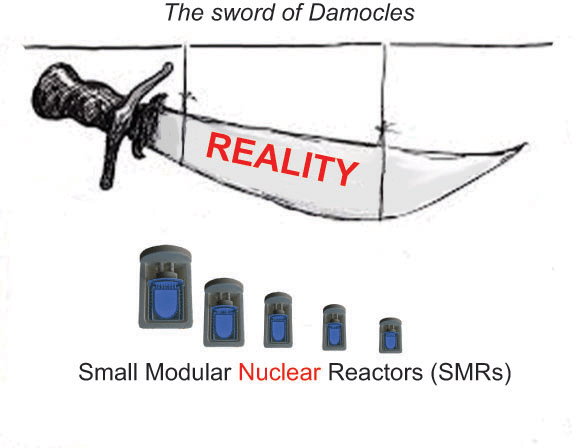
Cancelled NuScale contract weighs heavy on new nuclear
Paul Day, 11 Jan 24, https://www.reuters.com/business/energy/cancelled-nuscale-contract-weighs-heavy-new-nuclear-2024-01-10/
- Summary
- The failure of a high profile small modular reactor (SMR) contract in the United States has prompted concerns that Gen IV nuclear may be further off than expected.
NuScale, the first new nuclear company to receive a design certificate from the Nuclear Regulatory Commission (NRC) for its 77 MW Power Module SMR, said in November it was terminating its Carbon Free Power Project (CFPP) with the Utah Associated Municipal Power Systems (UAMPS).
UAMPS serves 50 community-owned power utilities in the Western United States and the CFPP, for which the Department of Energy approved $1.35 billion over 10 years subject to appropriations, was abandoned after the project failed to attract enough subscriptions.
NuScale shares tumbled 37% to less than $2 on the day of the news, November 8, and have remained largely between $2.5 and $3.5 since then. The shares hit highs of nearly $15 in August 2022 just three months after going public.
The CFPP had aimed to build NuScale SMR units at a site near Idaho Falls to be operable by 2029 though concerns arose that some at UAMPS members may be unwilling to pay for power from the project after NuScale raised the target price to $89/MWh in January, up from a previous estimate of $58/MWh.
The cancellation came shortly after another advanced reactor developer, X-Energy and special purpose acquisition company Ares Acquisition Corporation, called off a $1.8-billion deal to go public citing “challenging market conditions (and) peer company trading performance.”
The work with UAMPS had helped advance NuScale’s technology to the stage of commercial deployment, President and CEO John Hopkins said.
However, the failure of the much-anticipated proof case for advanced nuclear alongside the X-Energy market retreat left many questioning whether next generation nuclear could live up to its promises.
“Almost all these kinds of MoUs and contracts, as we saw with the NuScale contract, are just not worth the paper they’re written on. There are so many off ramps and outs for both sides and no one’s willing to expose themselves to the downside risk of projects that go way over budget cost and take too long,” says Ted Nordhaus, Founder and Executive Director of The Breakthrough Institute.
Nordhaus co-wrote a piece for The Breakthrough Institute, ‘Advanced Nuclear Energy is in Trouble’, a scathing criticism of policy efforts to commercialize advanced nuclear which, it says, to date have been entirely insufficient.
The nuclear industry was keen to ‘whistle past the graveyard’ of recent developments and efforts to commercialize the new generation of reactors ‘are simply not on track’, the Breakthrough piece said.
Mounting challenges
There are five areas that pose mounting challenges for the industry, according to Breakthrough; high interest rates and commodity prices, constrained supply chains, a regulatory regime that penalizes innovation, project costs versus system costs, and fuel production.
High interest rate and commodity costs in the last couple of years have hit the industry especially hard due to long project lead times. Nuclear supply chains are struggling to rebuild as tight regulation forces many materials to be tracked from certified mine to certified manufacturer.
The regulatory regime, meanwhile, continues to cut and paste large nuclear reactor regulations on to the small reactor designs, whether it makes sense to do so or not, Nordhaus wrote.
Delivery costs for small nuclear are relatively low due to the relatively small volumes of steel and mortar needed, but system costs must factor in safety regulation which is stricter than other types of energy projects. Proponents argue this makes it harder to compete with fossil fuels and renewables, which pay little to no cost for polluting or intermittency, the Institute says.
Advanced nuclear fuel production, meanwhile, had been outsourced to Russia for decades and is only now being hastily reassembled in the United States for the new reactors, with developers such as Terrapower forced to push delay their commercialization timelines due to a lack of fuel.
“Taken together, these developments suggest that current efforts are unlikely to be sufficient to deliver on the promise of advanced nuclear energy,” The Breakthrough Institute said.
Investor case
e
Over recent years, nuclear power has been recognized as an environmental, social, and governance (ESG) investible asset, taking its place alongside renewables in the European taxonomy and successfully raising cash through green bonds in Canada.
Such classifications allow nuclear companies to attract funds from investors looking to build increasingly popular clean energy portfolios.
Nuclear will also benefit from government schemes such as the U.S. Inflation Reduction Act (IRA), which is expected to subsidize new nuclear through Production Tax Credits (PTC) and Investment Tax Credits (ITC) on first-of-a-kind (FOAK) and nth-of-a-kind (NOAK) builds.
With billions of dollars earmarked for clean technologies and mounting concerns over missing emission targets, certain aspects of the nuclear industry have attracted new investors; Uranium spot prices have nearly doubled in the last year as bets are made on rising demand.
However, with all this tailwind, new nuclear has not been attracting the cash it needs. That’s partly due to developers’ lack of focus on development activities, according to Fiona Reilly, CEO of energy consultancy FiRe Energy.
“They’re so focused on the technology that they’re often not focusing on the commercial aspect. How to be more efficient, how to be more effective. What’s your risk register look like; corporate risks as well as technical risks? What’s your legal structure? Where is the money coming from?” says Reilly.
“They seem to think that if they have this great technology, then the market will finance the projects. How the project will reach financial close and make a return for investors does not always appear to be a key feature.”
The NuScale failure with UAMPS and X-Energy’s cancelled offering are just further bad signs for the market, and came just as the international nuclear community said they need to triple capacity by 2050 at the COP28 summit in Dubai.
“We’ve got to start building a mix of large and small reactors for different applications and, once we can start proving projects can be built in a commercial and efficient way, then you can start talking about targets,” says Reilly.
“You can’t set targets like these when we’re not even building the first reactors in many countries.”
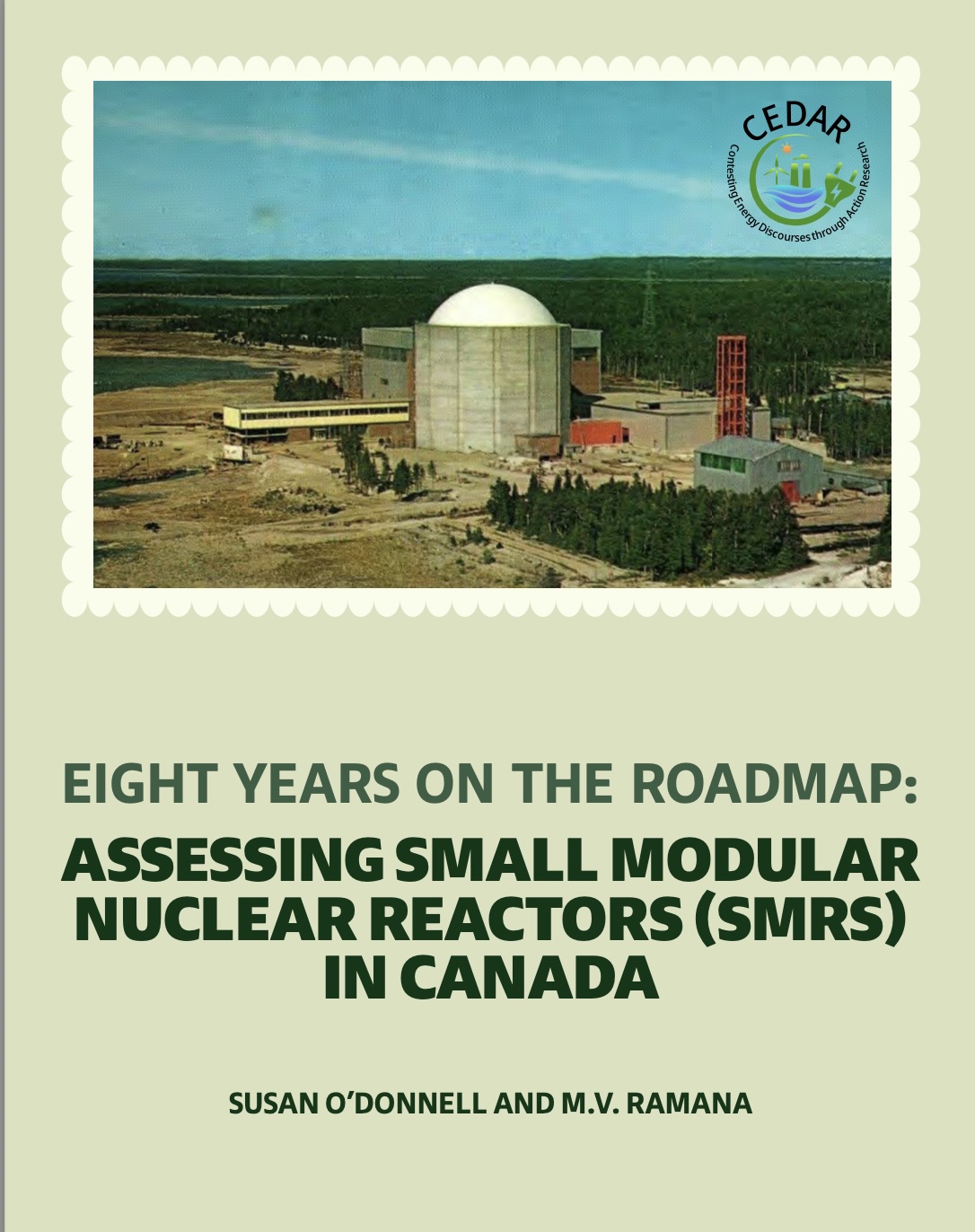
‘PR Fairy Dust’ Has Canada Tripling Nuclear Capacity by 2050.

So far, federal and provincial taxpayers have been footing the bill for Small Nuclear Reactor development in Canada, with little private sector investment—meaning the investor scrutiny and cost controls that torpedoed the NuScale project are muted at best.
Would Canadian taxpayers be OK with continuing to shell out up to a trillion dollars for a technology with no proven track record of producing reliable, affordable electricity?
So far, federal and provincial taxpayers have been footing the bill for SMR development in Canada, with little private sector investment—meaning the investor scrutiny and cost controls that torpedoed the NuScale project are muted at best. Would Canadian taxpayers be OK with continuing to shell out up to a trillion dollars for a technology with no proven track record of producing reliable, affordable electricity?
January 8, 2024, Susan O’Donnell and M.V. Ramana, https://www.theenergymix.com/odonnell-and-ramana-pr-fairy-dust-has-canada-tripling-nuclear-capacity-by-2050/
Near the end of 2023, the government published its second nuclear fantasy of the year. The December statement declares that Canada will work with other countries to “advance a global aspirational goal of tripling nuclear energy capacity from 2020 by 2050.”
In a sprinkling of public relations fairy dust, the declaration is labeled “COP28”, although written well before the two-week climate summit in Dubai. The nuclear declaration managed to attract only 25 endorsing countries, in contrast to the official COP28 pledge to triple renewable energy and energy efficiency by 2030, signed by 123 countries and eventually adopted by consensus in the final COP declaration.
The currently operating power generating capacity of all nuclear plants in the world is 365 gigawatts. Tripling that total by 2050, in the next 26 years, will mean reaching close to 1,100 gigawatts. Looking back 26 years, the power capacity of the global nuclear fleet has grown an average of 0.8 gigawatts each year. At that rate, nuclear capacity in 2050 will be a mere 386 gigawatts.
And tripling today’s nuclear capacity would require the industry to overcome the significant setbacks and delays in new reactor construction that have plagued it forever with no solution in sight, while building an additional large number of reactors to replace old ones shut down over the same period.
Earlier last year, the Canada Energy Regulator (CER) published the country’s previous nuclear fantasy document, with scenarios that also projected roughly a tripling of nuclear generation capacity by 2050. Canada’s six nuclear plants currently produce about 13 gigawatts of power; a tripling would bring that to 39 GW. The CER report envisions this new nuclear capacity coming from so-called small modular nuclear reactors (SMRs).
Only two public utilities in Canada are proposing to build SMRs: NB Power in New Brunswick, and Ontario Power Generation (OPG). The most authoritative report to date on SMRs, from the U.S. National Academies, found that the designs planned for New Brunswick—a molten salt reactor and a sodium-cooled reactor—are unlikely to reach commercial deployment by 2050.
OPG is promising that its SMR design, a 300-megawatt boiling water reactor, will be the first in the world to be deployed commercially starting in 2030, although the design has not yet been licenced to build in Canada or anywhere else. Assuming that this unit is chosen for widespread deployment in Canada, nearly 90 would need to be built and operating effectively on the grid between 2030 and 2050 to achieve the proposed tripling. Given the known construction time overruns for nuclear power plants, this also is impossible.
The news on the SMR front from around the world has been bleak—especially in the United States, which has been trying to commercialize SMR designs for more than a decade. The flagship SMR design in the U.S., the NuScale light-water reactor, was the first to receive design approval by the U.S. Nuclear Regulatory Commission. However plans to build an array of NuScale reactors were shelved in November when the estimated construction costs ballooned to US$9.3-billion (C$12.8-billion) for 462 megawatts and potential customers fled. Earlier this month, NuScale laid off nearly half of its work force.
Assuming the NuScale construction costs of $27.7 million per megawatt would be an acceptable price range to customers in Canada, that would give the OPG design, also a light-water reactor, a cost of $8.3 billion per unit. If 90 units were built as a way to triple nuclear energy capacity, the total price tag would be $747 billion. That assumes that costs won’t go up during construction, as has been the case with the majority of nuclear projects in Canada and around the world.
So far, federal and provincial taxpayers have been footing the bill for SMR development in Canada, with little private sector investment—meaning the investor scrutiny and cost controls that torpedoed the NuScale project are muted at best. Would Canadian taxpayers be OK with continuing to shell out up to a trillion dollars for a technology with no proven track record of producing reliable, affordable electricity? Particularly when the energy efficiency, solar, and wind technologies explicitly favoured by the Intergovernmental Panel on Climate Change as the quickest path to emission reductions are already proven, affordable, and ready for prime time?
Last month’s bogus “COP28” nuclear declaration is posted on the Natural Resources Canada website. Like its counterpart in the United States, the Department of Energy, NRCan is the department responsible for promoting the interests of the nuclear industry. In both the United States and Canada, that industry has been failing for decades, and one of its strategies for securing government support has been to appeal to geopolitical interests. In recent years, that appeal has usually involved pointing out how Western countries are falling behind Russia, the largest exporter of nuclear power plants, and China, which has built more nuclear plants than any other country over the past decade.
The U.S. government has responded by using its diplomatic clout to promote nuclear energy, especially small modular reactors. In Washington, Energy and Natural Resources Minister Jonathan Wilkinson delivered Canada’s statement on nuclear energy that linked Canadian exports of uranium and nuclear technology to energy security in response to Russia’s invasion of Ukraine. This geopolitical context explains why Russia and China were conspicuously missing from the list of signatories to the declaration to triple nuclear energy capacity by 2050.
The nuclear industry’s other argument to stay alive is the bogus claim that it can help solve climate change. But as veteran energy modeller and visionary Amory Lovins pointed out: “To protect the climate, we must abate the most carbon at the least cost—and in the least time—so we must pay attention to carbon, cost, and time, not to carbon alone.” The climate crisis is urgent. The world has neither the financial resources nor the luxury of time to expand nuclear power.
Meanwhile, the website of Environment and Climate Change Canada, the department truly responsible for the country’s international climate commitments, has a genuine COP28 statement that does not mention nuclear. Instead, it highlights “groundbreaking goals to triple renewable energy, double energy efficiency, and, for the first time ever… a historic consensus to move away from fossil fuels in energy systems.”
Tripling nuclear energy by 2050 is a nuclear industry fantasy and complete make-believe. Tripling renewable energy and doubling energy efficiency by 2030 is sensible and doable, as long as the requisite political will is present. It is past time to get real about the energy generation technologies we need to be supporting.
Susan O’Donnell is Adjunct Research Professor and leader of the CEDAR project at St. Thomas University in Fredericton, New Brunswick. M.V. Ramana is Professor and Professor and Simons Chair in Disarmament, Global and Human Security at the University of British Columbia.
Kebaowek First Nation strongly opposes nuclear waste storage facility in Chalk River

Radioactive waste site in Chalk River a go
National Observer, By Natasha Bulowski / Local Journalism Initiative / Canada’s National Observer, 9 Jan 24
The Canadian Nuclear Safety Commission has greenlit a proposed nuclear waste storage facility in Chalk River, Ont., after a years-long battle waged by concerned citizens, environmentalists and First Nations.
On Jan. 9, the commission announced Canadian Nuclear Laboratories’ operating licence will be changed to allow construction of a “near-surface disposal facility” to hold up to a million tonnes of radioactive and hazardous waste. Stored in a large mound, the waste would sit about a kilometre from the Ottawa River, a culturally important river for Algonquins, and this proximity to drinking water for millions is one of many factors that raised alarm bells for opponents.
The proposed facility, referred to as the NSDF, “is not likely to cause significant adverse environmental effects” as long as Canadian Nuclear Laboratories sticks to its proposed mitigation and monitoring measures, the commission said in its decision.
Within hours of the announcement, Kebaowek First Nation put out a press release calling on the federal government to intervene and stop the project. Organizations representing 10 of the 11 Algonquin First Nations have opposed the project, alongside leaders and elders from those nations. Pikwakanagan First Nation, the only Ontario-based Algonquin Nation and closest to Chalk River, signed a long-term relationship agreement with Canadian Nuclear Laboratories on June 9, 2023………………………………………………
Kebaowek First Nation Chief Lance Haymond called the commission’s decision “unacceptable” because it goes against the rights of Indigenous Peoples and environmental protection in a press release issued a few hours after the decision.
“I want to be very clear: the Algonquin Peoples did not consent to the construction of this radioactive waste dump on our unceded territory,” Haymond said. “We believe the consultation was inadequate, to say the least, and that our Indigenous rights are threatened by this proposal.”
Algonquin leaders from Kebaowek and Kitigan Zibi Anishinabeg First Nations and Algonquins of Barriere Lake have long opposed the NSDF and have urged the commission to heed their concerns about environmental and human health. At the final licensing hearing in August, Kebaowek and Kitigan Zibi Anishinabeg argued the consultation was inadequate because it began far too late in the decision-making process and did not appear to take their concerns or traditional knowledge seriously………………………………………….
James Walker, a nuclear waste expert and former director of safety engineering and licensing at AECL, disputed the proclamation that all waste will be low-level in a submission to the commission. His calculations, based on the inventory of waste provided by Canadian Nuclear Laboratories, show that much of it is intermediate-level radioactive waste and should not be placed in a near-surface facility. There is also no inventory management system to properly verify the waste complies with the acceptance criteria, he wrote. Walker said the project is “non-compliant with International Safety Standards” for these reasons……………………..
Last month, concerned citizen Ole Hendrickson initiated a House of Commons petition (authorized by Pontiac, Que. MP Sophie Chatel) calling for an international review of three radioactive waste projects including the NSDF at Chalk River. At the time of writing, it has almost 2,950 signatures. Petitions require a minimum of 500 signatures to be presented in the House of Commons and receive an official response from the government. https://www.nationalobserver.com/2024/01/09/news/radioactive-waste-site-chalk-river-go#
Nuclear Arms Buildup Isn’t Just about War. It Also Harms People and Communities.
Congress’ comprehensive nuclear review is 160 pages long. It doesn’t mention “waste” once.
INKSTICK, WORDS: LAURA CONSIDINE, PICTURES: BRIAN STANSBERRY, JANUARY 10, 2024
In October 2023, the Congressional Commission on the Strategic Posture of the United States released its final report on “America’s Strategic Posture.” This congressionally mandated review of US nuclear strategy, policy and posture concluded that “America’s defense strategy and strategic posture must change in order to properly defend its vital interests and improve strategic stability with China and Russia.”
The commission thus came to the conclusion that the US needed to go beyond its current modernization plan to develop a capability “to deter and defeat both” Russia and China “simultaneously.” This includes modifying the US strategic force posture to address larger numbers of targets and changing the posture on so-called “theater” nuclear weapons to allow for the US to engage in two simultaneous nuclear conflicts in Europe and Asia. While not every recent official report has advocated an arms buildup, the prevailing wisdom in policy and commentary circles is acceptance of a “coming arms race.”
The prevalence of this acceptance of arms racing and nuclear war fighting talk does not simply reflect the world we are in, it has political power to influence that world, to provoke action and reaction. This language has consequences. A new buildup of nuclear weapons and talk of nuclear war fighting is obviously dangerous because we know there is no winner of a nuclear war, never mind two. But even if those weapons are never used, they have impacts on the places and peoples in which they are produced.
Waste
I have recently spent a month conducting research in New Mexico, a state that has borne many of the consequences of the development of US nuclear weapons. In New Mexico, uranium miners and downwinders who lived near the very first nuclear test are not only dealing with generations of cancers caused by the nuclear weapons complex and the Trinity Test but have also had to fight for years to be included in government compensation schemes, a battle that is still ongoing.
Such harms are not mentioned in the recent Strategic Posture Commission Report. The report encourages an expansion of “the US nuclear weapons defense industrial base and the DOE/NNSA nuclear security enterprise, including weapons science, design, and production infrastructure” and “the full range of NNSA’s recapitalization efforts, such as pit production and all operations related to critical materials.” As such, it takes a “comprehensive” approach to what it deems necessary for its strategic recommendations including infrastructure, supply chain and labor issues. At no point in its 160 pages, however, does the report mention the word waste.
This is not the first comprehensive report on nuclear weapons that ignores the fact that weapons production has consequences beyond the strategic. Nuclear waste has long been an afterthought in weapons production, subservient to the demands of geopolitics. The Cold War nuclear arms race in the United States created “some of the world’s most dangerous radioactive sites with large amounts of radioactive wastes, spent nuclear fuel (SNF), excess plutonium and uranium, thousands of contaminated facilities, and contaminated soil and groundwater,” according to the Department of Energy’s (DOE) Office of Environmental Management.
A new weapons buildup means more nuclear waste when the US government has not adequately funded the vast clean-up from the last arms buildup, not just in New Mexico but all over the country and beyond. The Department of Energy is responsible for the ongoing cleanup of 16 US sites and the management of 102 other legacy sites. DOE spending on these sites has remained relatively flat and will continue so according to proposed five-year appropriations for defense environmental cleanup, going from $7.07 billion for 2024 to $7.62 billion in 2028. This is despite the fact that cleanup consistently costs more and takes longer than planned and costs continue to rise sharply. The amounts of money spent are already staggering but still pale in comparison to what is needed. The GAO estimates for the site in Hanford, Washington alone are estimated to be up to $640 billion. This shows that waste is not a postscript to weapons production but an immense and expensive primary outcome.
A new nuclear weapons buildup also has serious consequences across multiple socioeconomic issues. To give just one example, Los Alamos National Laboratory (LANL) is already hiring 2,500 new workers to respond to the current call to produce 30 new plutonium pits per year. These workers come into an area in New Mexico where housing is already scarce and expensive, and infrastructure cannot support commuters. This then has devastating knock-on effects for those who live in nearby areas and do not benefit from the higher-than-local average LANL technical salaries. LANL expansion heightens the already stark economic inequalities of New Mexico where the median household income in Los Alamos County (one of the richest in the US) is more than twice that of neighboring Rio Arriba and Taos counties. ……………………………………………………………………………………………………………………………
High-profile reports, such as “America’s Strategic Posture,” do not simply reflect the likelihood of an arms race — they contribute to it. As such, fatalism about nuclear buildup and potential nuclear war, as Brodie noted many years ago, neglects the fact that “great powers” do not simply react to the world as it is but make choices that shape it. New Mexicans have long had to live with the everyday consequences of such choices. https://inkstickmedia.com/nuclear-arms-buildup-isnt-just-about-war-it-also-harms-people-and-communities/
Where your $trillions go, to risk all life

Peace and Planet News, by Anthony Donovan | Winter 2023 Edition
We’ve seen an amazing level of bipartisan support!” For what initiative do we hear this rare statement echoed about Congress today?
The 15th Annual Nuclear Deterrence Summit, held once again at the Hyatt Regency in Arlington, Va., Feb. 13–15. For three days the rooms are filled with a multitude of companies and government agencies from around the country connected to the Department of Energy, Department of Defense, and National Nuclear Security Administration that make up our nuclear weapons industry, and its terribly secretive renewed Mutually Assured Destruction (MAD) race.
What is termed the “Enterprise” is in full-out sales and confidence-building mode. It is here the relationships for securing contracts through the next 5 to 35 years are solidified.
One aged reporter who once covered the industry in the 1980s confides his shock after a dizzying day of presentations: “How did you know these gatherings were going on? I just found out last week! Can’t believe this, I mean, this is a new unbridled arms race! These people in there are totally convinced this is the only way to go.” Looking at only two of us with our sign, he asks, “Why aren’t more people in the streets? Where is the movement pushing back?”………………………………………………………………….
Attendees were a bit puzzled that I wasn’t with a company connected to the summit, but I continued to share my purpose, seeing that we desperately need their dedication and skillset to begin turning toward the critical needs before us today: sustainability, good jobs supporting our environment, food, water, air, housing, healthcare, education, infrastructure … you know the issue. Some were relieved that I was all for science and space exploration, but first, for the precious earth!
…………………………………………………… Most exhibitors were too young to remember that the vast majority of citizens had voted with their feet to end this madness, and that there was no transparency or democratic process in the decision to use our treasure to fund it all.
Inevitably the confounding old Cold War rhetoric arose, painting China and Russia as vile enemies that we can not trust to honor any agreements. ……………………..
Naturally, I’d let them know we had a most worthy instrument, The Treaty on the Prohibition of Nuclear Weapons, now international law, to help guide this needed transformation, despite its being dismissed by our mainstream media. Only a few had heard of it, and of those, few knew particulars.
Laser beamed on their one aspect of the industry, several with competitors present vying for the same contract, many met in the dozens of closed-door side rooms for private company presentations/briefings. There were open “networking breakfasts” lunches and evening cocktail parties and several daily general gatherings in the large Hyatt Ballroom focused on the latest in pit production, delivery platforms, command-and-control infrastructure and communications, warhead modernization, STRATCOM reports, reports from the heads of all our labs, Los Alamos, Oak Ridge, Sandia, etc. Presentations on increasing efficiency in product and organization, best practices, and cited pathways to “success.” After all, we are leading and “winning.” Exactly what we think we are winning made no sense to anyone on the nuclear abolition team.
There were exhibitors displaying highly specialized metal nose cones and delivery vehicle parts. Designers of fabrics that claim to protect from radioactivity, cybersecurity “experts,” nuclear waste management specialists, triad infrastructure architects, specialists in improving uranium refining, nuclear physicists and engineers specializing in all materials and their “enhanced delivery” of precision warhead targeting and interception by “safety” umbrellas, inter-agency communication specialists, and those through it all maintaining secure communications. My presence seemed harmless enough to this security. I think of all our very brave colleagues who’ve risked life to enter the kill zones of these most highly sealed-off omnicidal compounds to render witness of the crime against humanity.
Amazon, a “Gold Sponsor” of the summit, had an exhibit: “We have established good relations with the CIA, but we need to get better integrated with the NNSA. This is new to us. That’s why we’re here.”
In this very clearly white male-oriented world, there was also a presentation on the essential hiring of more “diversity” for the future. One enticing statement read they “offer specialized worth to employees by valuing their entire career life cycle–creating stable careers…” Ah, such security………..
The revolving door is astoundingly evident here, and the boundaries of government, military, with private companies is quite indistinguishable. Those with Navy, Air Force, and other triad experience are now running these private companies or working as their specialized “experts in technical and professional innovation. support and security.” One “private” company proudly advertising that 70% of “our expertise” hold all the necessary security clearances within the government!
…………………………….. Former General Lloyd Austin, who retired to become Raytheon’s CEO, was easily confirmed by our Congress to become our current Secretary of Defense under President Biden. In his hearings, General/CEO Austin guaranteed to our representatives that the Triad would get his full support to obtain all that it needed. What seems illegal goes unchallenged.
Along with the DOE, National Security Administration, and Budget Office, the regular old nuclear weapon corps were very present: General Dynamics, Huntington Ingalls, Bechtel, Flour, Honeywell, Aerospace, SAIC, etc., and a number of universities……………………………………………………………………………………………………..
Within 25 minutes we were surrounded by hotel security and managers asking us to leave the premises immediately. They then claimed even the sidewalks outside the hotel were private and we could not remain there………………………………………………………..
Ask your representative to sign H. Res. 77, sponsored by Rep. James McGovern, supporting the goals of the Treaty on the Prohibition of Nuclear Weapons! Ask your senator to call for the same in the Senate. Thank all the nations ratifying the TPNW. Ask your representative to observe the Ban Treaty’s Meeting of States this November in New York City at the United Nations. They are welcome to learn, and think deeper.
Knowing the horror of war was pushing ahead and with it an increasing, completely unnecessary risk of nuclear annihilation, there was ever-present sense of unity with the citizens of the world who are pleading and advocating another way. There were many thumbs up and waves from passing vehicles. Thinking of those who have young children/grandchildren, including a good number I got to speak with on this Summit floor, we felt there was nowhere else to be on this day celebrating the love in our hearts and in our lives, round the world, Valentine’s Day. https://peaceandplanetnews.org/where-your-trillions-go/
The mystery of a Truchas woman who died with extraordinary amounts of plutonium in her body
KUNM | By Alice Fordham, https://www.kunm.org/local-news/2024-01-08/the-mystery-of-a-truchas-woman-who-died-with-extraordinary-amounts-of-plutonium-in-her-body
With the release of the movie Oppenheimer last year, there has been a resurgence of interest in the history of the Los Alamos National Laboratory. But for writer Alicia Inez Guzmán at the investigative nonprofit Searchlight New Mexico, that interest has been there for years as she has covered the past and present of the lab and its impact on the people of northern New Mexico. Her reporting includes the town of Truchas, where she grew up. In her latest report, Guzmán looks at the story of one woman who lived in Truchas, and died in 1972, inexplicably with extraordinarily high levels of plutonium in her body. Guzmán spoke with KUNM about her reporting.
ALICIA INEZ GUZMAN: When I first heard about this mystery woman, it was on an airplane coming back to Santa Fe. And I was sitting next to Jay Coghlan, who’s the executive director of Nuclear Watch New Mexico. And he said something to the effect of, the woman with the most plutonium in her body after the Trinity Site detonation, was from Truchas. And I just thought it was so fascinating and cryptic that I actually got the source of the information, which is the LAHDRA report or the Los Alamos Historical Document and Retrieval Assessment. And that’s where I was able to read for myself that there was a woman from Truchas, who had 60 times the amount of plutonium than the average New Mexico resident, and it was attributed to the Trinity Site, which led me on a wild goose chase basically
KUNM: Why was this so intriguing to you?
GUZMAN: Sure, so Truchas is 225 miles away from the Trinity Site. It’s in northern New Mexico in the Sangre de Cristo Mountains. And we know of course, the fallout did reach places like Truchas and far beyond, but in order for somebody to have plutonium in their body, they have to ingest it or inhale it. And so that was part of the question that I had was: well, she’s 225 miles away, could she have ingested or inhaled plutonium at that distance?
KUNM: So you had these questions, how did you go about finding out more about this person?
GUZMAN: When she was listed in the larger report, simply she was from Truchas, alive when Trinity detonated. So I had two pieces of information to go on. But what I realized was that the reason why they had that information about her at all was because the lab had conducted a series of autopsies on not only workers from Los Alamos National Laboratory, but the surrounding community. And once I found that information out, I was able to determine that there had actually been a class action lawsuit made on behalf of families of people who had been autopsied, because their families had never given informed consent. So I had to go to the courthouse here in Santa Fe, and from there, I found an issue of Health Physics magazine from 1979. And her name was not given, but it gave her age, at death, where she was from, what she did — a housewife — and the year that she died. And so, when I did a search in obituaries for that set of criteria, only one woman came up. And it turns out, as I suspected, that I knew the family.
KUNM: And what did they learn from you, and what did you learn from them?
GUZMAN: I should start out with what they learned, because I had to basically call them and reveal that possibly their grandmother had been involved in this clandestine study. And that if it was her, she had by far the most amount of plutonium in her body than anybody else who had been autopsied as a resident in that study. So, I think it was a huge shock to them.
Of course, what I learned from them was that this woman, whose name is Epifania Trujillo, she ended up moving in with her daughter and son in law, and her son in law, as it happened, worked at the laboratory as a janitor in a hot site, a hot site being somewhere where there was radiation, and that all of his children, he had seven children, all of his children except for one ended up getting cancer, and his wife. And so, I started talking to epidemiologists and toxicologists and physicists to really think through: is it possible that instead of having been exposed or contaminated from the Trinity Site, could it be Epifania and her family had been exposed and contaminated by what I later came to know or find out was take-home toxins? And largely what I hypothesize in the story was it is far more likely that her exposure came from Los Alamos National Laboratory, then it would be from Trinity Site.
Coldwater Creek to finally have warning signs after decades of nuclear contamination
Nuclear waste stored outside St. Louis was found to pose a risk to nearby Coldwater Creek as early as 1949. The contaminated creek will finally have warning signs almost 75 years later.
Missouri Independent, BY: ALLISON KITE – JANUARY 8, 2024
More than 70 years after workers first realized barrels of radioactive waste risked contaminating Coldwater Creek, the federal government has started work to put up signs warning residents.
The U.S. Army Corps of Engineers said in a statement Monday that it was working with the Environmental Protection Agency to add signs along the creek to help it monitor areas “that may pose a risk if disturbed.”
Coldwater Creek has been contaminated for decades with radioactive waste left over from the World War II-era effort to build an atomic bomb. But though the creek winds through some of St. Louis’ busiest suburbs and past public parks and schools, the federal government had resisted calls to post signs warning visitors of the contamination.
“This is decades of potential exposure that could have been prevented that they drug their feet on,” said Dawn Chapman, co-founder of Just Moms STL, an organization formed to advocate for communities affected by St. Louis-area radioactive waste.
Despite the delays, Chapman said she’s thankful that the signs are finally going to be installed.
The St. Louis area has long struggled with a radioactive waste problem. Uranium for the Manhattan Project, the name given to the effort to develop the first atomic bomb, was refined in downtown St. Louis.
After World War II, radioactive waste left over from those efforts was trucked to the St. Louis airport and dumped — some on the open ground and some in barrels — next to Coldwater Creek. As early as 1949, Mallinckrodt Chemical Works, the company that refined uranium for the federal government, was aware the waste could escape deteriorating barrels and enter the creek…………………………………………………………………………………………………………………………..
While the Army Corps, which has overseen the sites since the late 1990s, said the remaining contaminated sites surrounding Coldwater Creek only pose a risk if they’re disturbed, in previous decades exposure to the creek’s waters may have raised the risk of cancer for St. Louis residents.
The Agency for Toxic Substances and Disease Registry concluded in 2019 that children and adults who played in or near Coldwater Creek or lived in its floodplain between the 1960s and 1990s may have been exposed to radioactive materials that raise the risk of certain cancers. The agency — part of the Centers for Disease Control and Prevention — recommended signs be placed along the creek to warn residents of the potential exposure risk.
According to the St. Louis Post-Dispatch, the Army Corps said at the time doing so wasn’t its role………………………………………………………………………………………………………………………….
The announcement comes at a time of renewed focus on St. Louis’ radioactive waste problem. Bush and U.S. Sen. Josh Hawley have sought compensation for residents sickened because of exposure to radioactive waste, and an investigation by The Missouri Independent, MuckRock and The Associated Press found that private companies and government agencies downplayed the risks associated with the contamination for decades .
Andy Quinones, senior communications manager for the city of Florissant, said the Army Corps had requested to put signs in several of the city’s parks that sit along the creek.
“I’m glad,” Quinones said, “that they are taking the initiative to start doing a better job of informing the public.” https://missouriindependent.com/2024/01/08/coldwater-creek-to-finally-have-warning-signs-after-decades-of-nuclear-contamination/
The ‘Ghost Budget’: How America Pays for Endless War
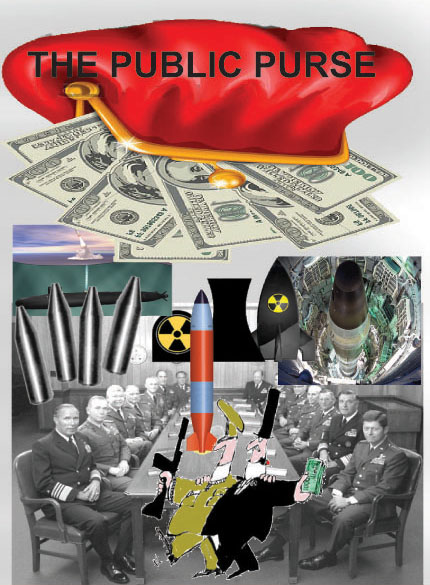
The post-9/11 war funding pattern was completely different. For the first time since the American Revolutionary War, war costs were covered almost entirely by debt. There were no wartime tax increases or cuts in spending. Quite the reverse
a “culture of endless money” inside the Pentagon.
the ability to keep borrowing and spending with minimal oversight allowed the United States to keep fighting indefinitely.
Prior to 2001, U.S. wars were financed through a mixture of higher taxes and budget cuts, and funded mostly through the regular defense budget. The post-9/11 war funding pattern was completely different.
By Linda Bilmes / Just Security https://scheerpost.com/2024/01/08/the-ghost-budget-how-america-pays-for-endless-war/
The post-9/11 wars in Iraq and Afghanistan were enabled by a historically unprecedented combination of budgetary procedures and financing methods. Unlike all previous U.S. wars, the post-9/11 wars were funded without higher taxes or non-war budget cuts, and through a separate budget. This set of circumstances – one that I have termed the “Ghost Budget” – enabled successive administrations to prosecute the wars with limited congressional oversight and minimal transparency and public debate. I adopted the name “Ghost Budget” because the term “ghost” appeared frequently in post-9/11 government reports in reference to funds allocated to people, places, or projects that turned out to be phantoms.
The Ghost Budget was the result of an interplay between changes in the U.S. budgetary process, a more assertive military establishment, and the conditions in global capital markets. It has had far-reaching implications for the conduct and course of the post-9/11 wars and for defense policy today.
Funding the Post-9/11 Wars
The “Ghost Budget” was the biggest budgetary anomaly in U.S. history. Prior to 9/11, U.S. wars were financed through a mixture of higher taxes and budget cuts, and funded mostly through the regular defense budget. One third of the costs of World War I and half the costs of World War II were met through higher taxes. During World War II, President Franklin D. Roosevelt described paying taxes as a “patriotic duty” as he raised taxes on business, imposed a “wealth tax,” raised inheritance taxes, and expanded the number of income taxpayers to roughly 80 percent of the workforce by 1945. Wars in Korea and Vietnam largely followed a similar pattern, with President Harry Truman pledging to make the country “pay as you go” for the Korean War. War funding was also a central issue in the Vietnam War, which ended when Congress refused to appropriate money for the South Vietnamese military.
The post-9/11 war funding pattern was completely different. For the first time since the American Revolutionary War, war costs were covered almost entirely by debt. There were no wartime tax increases or cuts in spending. Quite the reverse: far from demanding sacrifices, President George W. Bush slashed federal taxes in 2001 and again in 2003, just as the United States invaded Iraq. President Donald Trump reduced taxes further in 2017. Overall, federal taxes declined from 18.8 percent of GDP in 2001 to 16.2 percent by the start of 2020. In the same period, outstanding federal debt held by the public rose from $3.5 trillion to $20 trillion. War spending contributed at least $2.2 trillion to this increase.
Not only was the financing strategy unprecedented, but the budgetary mechanism used to approve the vast post-9/11 wartime spending also diverged radically from the past. In all previous conflicts, the United States paid for wars as part of its regular defense appropriations (the defense “base budget”), after the initial period (1-2 years) of supplemental “emergency” funding bills. By contrast, for the entire decade from FY 2001 to FY 2011, Congress paid for the conflicts in Iraq and Afghanistan as “emergencies,” devoid of serious legislative or executive oversight.
By statute, emergency spending is defined as “unanticipated…sudden…urgent…unforeseen…and temporary” and is typically reserved for one-off crises such as floods and hurricanes. Such emergency spending measures are exempt from regular procedural rules in Congress because the intent is to disburse money quickly in situations where delay would be harmful.
Congress continued to enact “emergency supplemental” funding even as the war effort expanded. The United States sent 130,000 military personnel into Iraq in 2003 (alongside troops from more than 30 countries). By 2009, there were 187,200 U.S. “boots on the ground” in Iraq and Afghanistan, supported by a similar number of military contractors, with nearly 500 U.S. military bases set up across Iraq, but the conflict was still being paid for as an “emergency.” In FY 2012, President Obama renamed the “Global War on Terror” as “Overseas Contingency Operations” (OCO) but the war continued to be funded using money that – although not designated as “emergency” – was explicitly exempted from regular spending limits on other government spending programs.
How We Got Here
There were three primary drivers of the Ghost Budget: unusual economic conditions, congressional budget dysfunction, and military assertiveness.
Economic Conditions: Unlike earlier wars, the post 9/11 conflicts took place in an era of free-flowing international capital markets. That provided the U.S. Treasury with access to a deep and global pool of capital, making it easy to borrow large amounts without negatively affecting the cost. It was also a period of historically low interest rates. Real interest rates (nominal rate minus inflation) on 10-year Treasury bonds fell from 3.4% at the start of 2001 to negative (-0.4%) by early 2021 — a 40-year low. Consequently, the Treasury was able to borrow trillions of dollars to pay for the wars, and simultaneously finance the tax cuts of 2001 and 2003 without having any material effect on the amount of debt service being repaid through the annual budget. By FY 2017, total public debt had more than tripled, but debt service payments as a percentage of annual budget outlays had decreased to 6.6 percent, compared to 8.5 percent of federal budget outlays in FY 2002. In terms of cash outlays, this meant that the United States paid only slightly more in interest payments in FY 2017 than it had in FY 2002 ($268 billion versus $232 billion in 2018 dollars). Borrowing seemed virtually painless.
Budget Dysfunction: For several decades, the federal budget process has become increasingly dysfunctional. This breakdown may be traced to the post-Watergate budget reforms enacted in 1974, which shifted power away from the President and to the Congress. Most budget experts from both parties agree that the reforms made the budget process weaker, less predictable, less capable of reconciling competing demands, and more prone to fiscal crises. Prior to 1974, the federal government had never ceased operations for lack of funding. Since then, it has “shut down” 22 times, completely or partially. There have been only four years in which Congress passed its annual appropriations bills on time, and a series of near-defaults and other fiscal crises. In the absence of reliable budgets, Congress has enacted hundreds of short-term stopgap “continuing resolutions” to pay the bills. In this context, it was convenient for all the stakeholders to fund the wars as an “emergency” outside the regular process. The President was able to exclude war funding from his annual defense budget request to Congress, thus presenting an artificially low number for the federal budget deficit. This helped the Bush administration sustain the pretense that the wars would be short, while pursuing its political agenda of cutting taxes. Meanwhile, Congress was freed from the need to find politically painful spending cuts elsewhere to pay for the war, and the Pentagon was able to prosecute the wars without worrying about whether Congress would pass the defense appropriations bills on time.
Military Assertiveness: In 2001, the Pentagon was actively seeking to increase its budget after a decade of post-cold war budget cuts. The Afghanistan and Iraq conflict not only reversed the downward trend in military spending, but opened the floodgates to a spending bonanza due to the nature of emergency and OCO appropriations. Unlike the regular defense base budget, the wartime supplemental money was easier to secure, had few restrictions on how it could be spent, and avoided the lengthy internal Planning, Programming, Budgeting & Execution Process (PPBE) budget justification process. Consequently, the Defense Department was able to shift war funding into other categories to obtain items on its long-time “wish list” that were only tangentially (or not at all) related to the wars in Iraq or Afghanistan. Former Defense Secretary Robert Gates termed this a “culture of endless money” inside the Pentagon.
By 2009, war spending accounted for almost one quarter of the total military budget; the Pentagon budget had grown to its highest level since the Second World War, and military spending had rebounded from 2.9% of GDP in FY 2001 to above 4% of GDP, where it remained through FY 2019. The OCO budget had evolved into a second defense budget that was largely untethered from the wars, and protected the military from congressional budget volatility.
Implications for Perpetual War
The Ghost Budget provided the ability to keep borrowing and spending in an almost unconstrained manner for more than two decades. The absence of new taxes insulated the public from the mounting cost of the wars and broke the expectation that wars would inevitably involve higher taxes. The OCO budget extended far beyond the immediate operational needs of the wars in Afghanistan and Iraq, perpetuating military actions throughout the region. As Immanuel Kant predicted in Perpetual Peace (1795), the ability to keep borrowing and spending with minimal oversight allowed the United States to keep fighting indefinitely.
Implications for Perpetual War
The Ghost Budget provided the ability to keep borrowing and spending in an almost unconstrained manner for more than two decades. The absence of new taxes insulated the public from the mounting cost of the wars and broke the expectation that wars would inevitably involve higher taxes. The OCO budget extended far beyond the immediate operational needs of the wars in Afghanistan and Iraq, perpetuating military actions throughout the region. As Immanuel Kant predicted in Perpetual Peace (1795), the ability to keep borrowing and spending with minimal oversight allowed the United States to keep fighting indefinitely.
The legacy of the Ghost Budget is that money is no longer a serious deterrent to war. To date, 99% of US assistance to Ukraine has been funded by supplemental emergency funds – which means that this spending is in addition to the $840 billion regular defense budget. The Biden administration has asked Congress to approve another $106 billion in emergency funding for the Middle East, Ukraine, and other regions. Regardless of the merits of any particular endeavor, the use of Ghost Budgets makes it far easier to prolong the fighting at any cost.
Another Voice: Nuclear (yet again)

By CRISPIN B. HOLLINSHEAD, January 7, 2024, https://www.ukiahdailyjournal.com/2024/01/07/another-voice-nuclear-yet-again/
At COP28, the latest United Nations Climate gathering, nuclear power received more attention. Saudi Arabia committed to developing nuclear electrical generation. China is constructing 21 large nuclear reactors. Some people believe a massive nuclear build out will avert the climate crisis. The 436 reactors now operating produce about 10 percent of the global electricity. It would take 10,000 additional reactors to completely decarbonize the global economy.
It is true that an operating reactor produces no greenhouse gases (GHG), but when the whole life cycle of a reactor is analyzed, including construction and fuel enrichment, a standard 1,000MW reactor releases GHG comparable to a natural gas power plant. Even that evaluation is incomplete, as it excludes complete decommissioning of a large nuclear plant (never been done), and long-term storage of high level nuclear waste (not yet done even after 70 years).
Nuclear corporations were blackmailed into business. After the atomic destruction in Japan, the US government wanted a happy face for the atom, so Atoms For Peace promoted “power too cheap to meter.” The electrical industry was told to develop nuclear power, or the government would do it, putting them out of business. This was a bluff, but nobody knew it then.
Economically, nuclear power is a bust. Reactors are large, expensive, and centralized, making construction more an art than manufacturing. Costs consistently comes in over budget and behind schedule, making nuclear power more expensive than solar or wind, even including storage. Even operating an existing nuclear reactor is more costly than building renewable projects. While solar, wind, and battery costs are dropping every year, nuclear costs keep increasing. Small modular reactors (SMR), heralded as the salvation of the nuclear industry, suffer the same cost problems, plus a lack of customers. The only SMR project in the US was just canceled due to cost overruns.
Uranium is a finite commodity, and used inefficiently. A reactor core contains tons of highly processed enriched uranium. After a few years, when only 5 percent of the uranium has been consumed, the core must be replaced. When fission byproducts build up, performance degrades to the point of economic inefficacy. Millions of tons of highly radioactive “spent” fuel are stored at reactor sites. The best uranium deposits have already been developed, leaving only poorer quality ore. Most low level enriched uranium comes from Russia.
But the real economic costs come when a reactor breaks. Designed to last for 40 years, decisions were made in the beginning with incomplete information, with multiple units built on those designs in order to make nuclear construction seem profitable. So far, the worst US designed reactor failures were the 40 year old units at Fukushima, in 2011. Complete cleanup cost estimates are over $1T. Actual repairs have yet to begin, because radioactivity is too high for even robots to function for very long, let alone humans.
The only reactors still operating in California are the 40 year old pair at Diablo Canyon, near San Luis Obispo. Heavy radioactivity embrittles metal, making it more prone to shock failure. Several earthquake faults have been identified near the site, including one right through the plant. PG&E has done embrittlement tests, but refuses to release the results to the public, claiming “proprietary rights”. The Diablo Canyon reactors were recently granted a 5-year extension, with no changes required to the existing, aging equipment.
A reactor failure due to a seismic event could affect a large area of central California, from LA to San Francisco and inland to Nevada, depending on which way the wind blows. But PG&E would not be liable for any damages beyond $13B, due to the Price Anderson Act, a sweet heart deal the US made when the nuclear industry began. Every liability insurance policy written has an exclusion for nuclear damages. This all helps the nuclear industry seem profitable.
Nuclear power highlights a fundamental capitalist problem: the conflict between safety and profits. Each reactor is so powerful, that any accident can become catastrophic faster than humans can react. It is so expensive, that the incentive is enormous to cut costs to be more profitable. Add in limited corporate financial liability, and you get a recipe for disaster.
Fukushima shows the “small probability, high impact” nature of a failed nuclear reactor. The economics of even a properly operating reactor fail basic capitalist reasoning. To leave a habitable planet for our descendants, we have to do better.
Crispin B. Hollinshead lives in Ukiah. This and previous articles can be found at cbhollinshead.blogspot.com.
Carlsbad depositary- 79% of waste came from nuclear wastes from Idaho National Laboratory
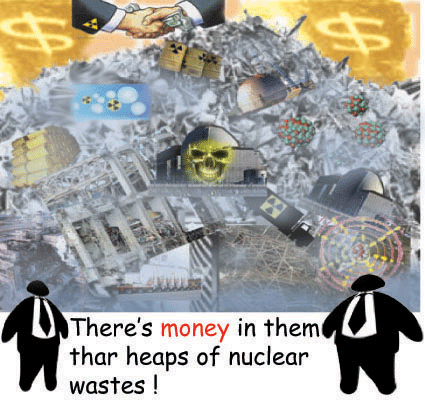
Hundreds of shipments of nuclear waste were buried at a facility near
Carlsbad in 2024, and the federal government was poised to send even more
waste to the site in 2024. For that work, the Department of Energy’s
contractor Salado Isolation Mining Contractors (SIMCO) earned about $11.5
million or about 89% of its available $13 million fee between Feb. 4, 2023
when SIMCO took over the contract and the end of the last federal fiscal
year on Sept. 30, 2023.
DOE records show 479 shipments of transuranic (TRU)
nuclear waste were received at the Waste Isolation Pilot Plant between Jan.
1 and Dec. 31, 2023, from federal labs and other nuclear facilities around
the U.S. TRU waste is made of clothing materials, equipment and other
debris irradiated during nuclear activities, and it is buried in a salt
deposit at WIPP about 2,000 feet underground. The DOE said in 2023 it
worked to increase shipments to 17 per week, and hold that level in the
coming years. Most of the waste, about 79%, came from Idaho National
Laboratory in the form of 377 waste shipments.
Carlsbad Current-Argus 7th Jan 2024
Amid Fears of Wider War, US Reportedly Drafting Plans to Bomb Yemen
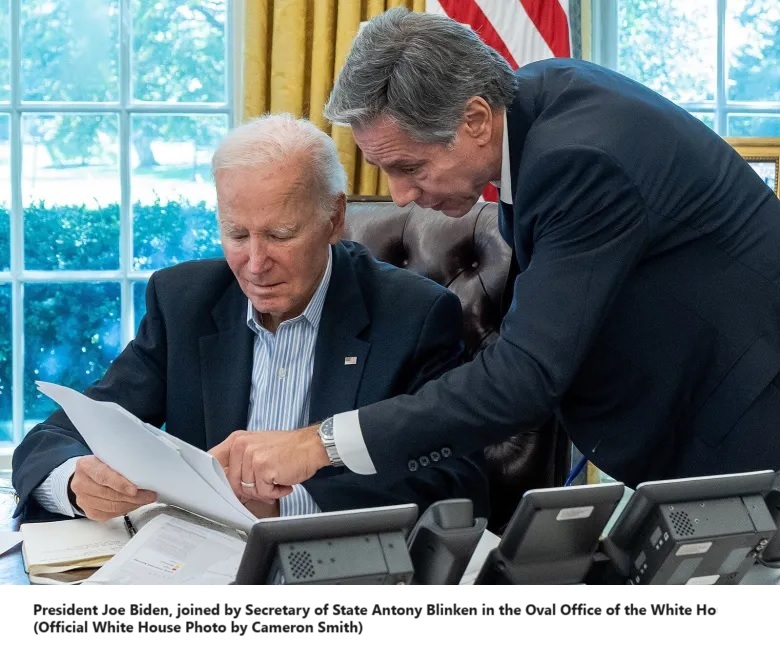
“Biden’s support for Israel’s Gaza war ties the U.S. to Israel’s escalatory cycle that may result in American soldiers dying in yet another Middle East war,” warned one analyst.
By Jake Johnson / Common Dreams, https://scheerpost.com/2024/01/05/amid-fears-of-wider-war-us-reportedly-drafting-plans-to-bomb-yemen/
The Biden administration is reportedly drafting plans to bomb Houthi targets in Yemen amid escalating fears of a wider war in the Middle East, where the U.S. is inflaming regional tensions by heavily arming Israel’s assault on the Gaza Strip.
Politicoreported Thursday that U.S. officials are “increasingly concerned” that Israel’s devastating war on Gaza “could expand… to a wider, protracted regional conflict.” Citing unnamed U.S. officials, the outlet noted that the U.S. military is drawing up plans to “hit back at Iran-backed Houthi militants who have been attacking commercial shipping in the Red Sea.”
Usamah Andrabi, communications director for Justice Democrats, wrotein response to the new reporting that U.S. President Joe Biden is “pushing the United States to the brink of a new endless war in the Middle East, all because he doesn’t want to stop funding Benjamin Netanyahu’s attempted eradication of the Palestinian people and Palestine itself.”
Eli Clifton, a senior adviser to the Quincy Institute for Responsible Statecraft, similarly argued that “Biden’s support for Israel’s Gaza war ties the U.S. to Israel’s escalatory cycle that may result in American soldiers dying in yet another Middle East war.”
“Biden has leverage to call for a cease-fire in Gaza,” Clifton added. “He isn’t using it.”
“The most effective way of avoiding this escalation is not to bomb the Houthis but to secure a cease-fire in Gaza.”
News of the administration’s private planning comes after dozens of advocacy organizations implored Biden not to consider any military assault on Yemen, which has been ravaged by years of Saudi-led, U.S.-backed bombing.
It also comes after several recent U.S. and Israeli attacks in the Middle East intensified concerns that the region is perilously close to all-out war.
On Tuesday, an Israeli drone strike in the Lebanese capital of Beirut killed a senior Hamas official, prompting Hezbollah’s leader to vow a “response and punishment.” Days earlier, an Israeli airstrike in Syria killed a senior adviser in Iran’s Islamic Revolutionary Guard Corps.
The U.S., for its part, has bombed Syria and Iraq multiple times over the past several months in response to drone and missile attacks on American forces stationed in the region. A U.S. airstrike in central Baghdad on Thursday killed Mushtaq Jawad Kazim al-Jawari, the leader of an Iran-aligned militia group operating in Iraq and Syria.
Biden administration officials have said publicly that they don’t want the Gaza war to expand, but their continued military support for Israel’s mass atrocities in Gaza and opposition to diplomatic efforts to stop the bloodshed in the Palestinian enclave has cast serious doubt on their commitment to preventing a full-blown conflict.
“The most effective way of avoiding this escalation is not to bomb the Houthis but to secure a cease-fire in Gaza,” Trita Parsi, executive vice president of the Quincy Institute for Responsible Statecraft, wrote in response to Politico‘s reporting.
“But Biden won’t even consider that—instead, he is ‘getting ready’ for a regional war,” Parsi added. “This is a dereliction of his duty to keep Americans safe.”
1 This Month
23 April – WEBINAR – Why new nuclear reactors are the wrong tools for decarbonization Thursday, April 23 • 1 AM – 2 AM AEST


Pine Ridge Uranium is the real threat, not Tehran- Tell Burgum: Stop the Extraction.
Chernobyl: The Lost Tapes – A good documentary on Chernobyl on SBS available On Demand for the next 3 weeks– https://www.sbs.com.au/ondemand/tv-program/chernobyl-the-lost-tapes/2352741955560
To see nuclear-related stories in greater depth and intensity – go to https://nuclearinformation.wordpress.com
-
Archives
- April 2026 (275)
- March 2026 (251)
- February 2026 (268)
- January 2026 (308)
- December 2025 (358)
- November 2025 (359)
- October 2025 (376)
- September 2025 (257)
- August 2025 (319)
- July 2025 (230)
- June 2025 (348)
- May 2025 (261)
-
Categories
- 1
- 1 NUCLEAR ISSUES
- business and costs
- climate change
- culture and arts
- ENERGY
- environment
- health
- history
- indigenous issues
- Legal
- marketing of nuclear
- media
- opposition to nuclear
- PERSONAL STORIES
- politics
- politics international
- Religion and ethics
- safety
- secrets,lies and civil liberties
- spinbuster
- technology
- Uranium
- wastes
- weapons and war
- Women
- 2 WORLD
- ACTION
- AFRICA
- Atrocities
- AUSTRALIA
- Christina's notes
- Christina's themes
- culture and arts
- Events
- Fuk 2022
- Fuk 2023
- Fukushima 2017
- Fukushima 2018
- fukushima 2019
- Fukushima 2020
- Fukushima 2021
- general
- global warming
- Humour (God we need it)
- Nuclear
- RARE EARTHS
- Reference
- resources – print
- Resources -audiovicual
- Weekly Newsletter
- World
- World Nuclear
- YouTube
-
RSS
Entries RSS
Comments RSS
 nuclear-news