First Nations urge Environment Minister not to green light Chalk River nuclear waste dump.
MARIE WOOLF, OTTAWA, Globe and Mail, 15 Feb 24
Environment Minister Steven Guilbeault was urged by First Nations chiefs Wednesday not to issue a permit to allow a nuclear waste dump on a forested site northwest of Ottawa where a variety of wildlife, including “at risk” wolves, live.
Ten chiefs and members of First Nations in Quebec and Ontario travelled to Parliament to urge the federal government to halt the Chalk River Near Surface Disposal Facility (NSDF), which the Canadian Nuclear Safety Commission approved for construction last month.
First Nations, supported by environmentalists and Bloc Québécois and Green MPs, said the site of the Canadian Nuclear Laboratories’ planned nuclear waste dump is too near the Ottawa River, which supplies drinking water to the country’s capital. They fear it could be polluted with a radioactive substance running off the site.
Kebaowek First Nation last week filed a Federal Court application for a judicial review of the Jan. 9 decision by the Canadian Nuclear Safety Commission, alleging the government breached its duty to consult Indigenous people.
At a press conference, preceding a rally with First Nations on Parliament Hill, Kebaowek Chief Lance Haymond urged the Prime Minister to intervene and halt the project saying First Nations had not been properly consulted.
Chief Dylan Whiteduck of Kitigan Zibi Anishinabeg First Nation told The Globe and Mail that an inadequate assessment of the impact on plants and mammals – including black bears hibernating in dens on the site – was conducted before approval was given.
First Nations spent several months surveying the site and found it rich with wildlife, but he said they were not given long enough, and a more extensive survey is needed.
Mr. Haymond said if Mr. Guilbeault were to issue a permit under the Species at Risk Act (SARA) it would pre-empt an assessment his department is carrying out on upgrading to a threatened species eastern wolves that roam on the site………………………………………………………………
In 2015, the Committee on the Status of Endangered Wildlife in Canada reassessed the status of the eastern wolf as threatened.
If the wolves are classed as threatened, their habitat would need to be protected, which could put on hold plans to build the waste dump on territory where they roam.
The eastern wolf, also known as the Algonquin wolf, numbers between an estimated 236 and 1,000 adults, and is confined to forests in Central Ontario and Southwestern Quebec. It is currently listed as a species of special concern.
The federal government published the proposed uplisting of the eastern wolf to a threatened species in November last year, carrying out a month-long consultation. It has until August to make a decision.
The proposed order amends Schedule 1 to the Species at Risk Act “to support the survival and recovery of the eastern wolf in Canada by uplisting it from a species of special concern to threatened.”……………………… https://www.theglobeandmail.com/politics/article-first-nations-urge-environment-minister-not-to-green-light-chalk-river/
Small Nuclear Modular Reactors (SMRs) and Consent in Saskatchewan: What You Haven’t Been Told
Uranium Mining in Northern Saskatchewan: What You Need To Know―Four-Part Webinar Series Webinar #2: February 13th, 2024,
Small Nuclear Modular Reactors (SMRs) and Consent in Saskatchewan: What You Haven’t Been Told Everyone is welcome to attend this webinar series that will help you know more about what is happening with uranium mining in Northern Saskatchewan. While many people have been busy in survival mode and exhausted from the pandemic, wars around the world, and the extreme rising cost of living, uranium mining lobbyists and governments have been taking advantage, passing industry-favourable laws that will further degrade and threaten freshwater systems already desperately overburdened by farming and mining use and wastewater byproducts.
Hosted by Tori Cress Guests: Paul Belanger, Keepers of the Water Science Advisor. Dr. Gordon Edwards, President and co-founder of the Canadian Coalition for Nuclear Responsibility, and Benjamin Ralston BA, JD, LLM, Assistant Professor at the College of Law, University of Saskatchewan Technical support: Beverly Andrews Paul Belanger works on the Keepers of the Water team as our Science Advisor and is also an environmentalist – entrepreneur, and designer. Paul founded his first environmental organization in 1987, then went on to mentor with scientists and operate an oil field supply and safety company. After more education and some research, Paul began an ecological design company called Living Design Systems – which is still active. Paul holds much knowledge and will now take us through a brief history of uranium mining in Saskatchewan.
Benjamin Ralston is an assistant professor at the College of Law at the University of Saskatchewan. Some of his research areas include Aboriginal rights, Canadian constitutional law, environmental law, human rights law, and natural resource law. Benjamin has worked at the U of S in various capacities since 2014. Including for the first year of the Nunavut law program in Iqaluit. He taught law courses in the Kanawayihetaytan Askiy (kaun-a-way-taa-tan-ah-ski) Program for Indigenous land managers and continues to teach a graduate course on environmental law and policy for the School of Environment and Sustainability. He is completing his Ph.D. at the College of Law with a dissertation investigating the intersection between environmental assessment practices and Indigenous rights in Canada. No registration is required. We will be broadcasting live from our Facebook Event Page here, https://fb.me/e/4cpZppDBU and on our YouTube channel here, https://youtube.com/live/f6TOoWU-w5A?…
Patrick Lawrence: The Crisis at The New York Times
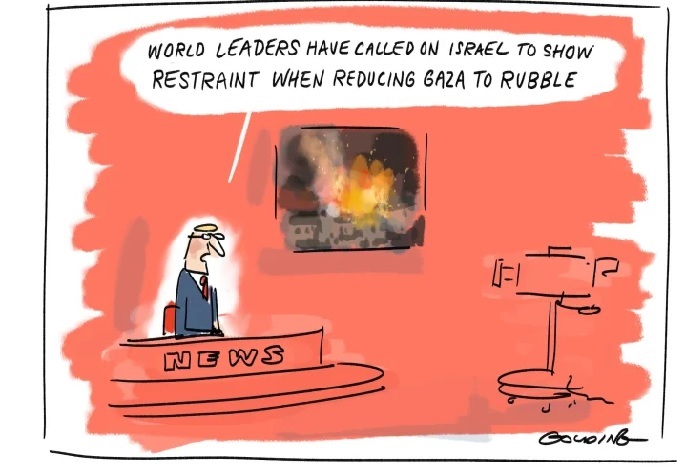
From Israeli Propaganda to Page One.
By Patrick Lawrence ScheerPost 12 Feb 24
It has been evident to many of us since the genocide in Gaza began Oct. 7 that Israel risked asking too much of those inclined to take its side. The Zionist state would ask what many people cannot give: It would ask them to surrender their consciences, their idea of moral order, altogether their native decency as it murders, starves and disperses a population of 2.3 million while making their land uninhabitable.
The Israelis took this risk and they have lost. We are now able to watch videos of Israeli soldiers celebrating as they murder Palestinian mothers and children, as they dance and sing while detonating entire neighborhoods, as they mock Palestinians in a carnival of racist depravity one would have thought beyond what is worst in humanity—and certainly beyond what any Jew would do to another human being. The Israeli newspaper Haaretz reports, as American media do not, that the Israel Defense Forces covertly sponsor a social media channel disseminating this degenerate material in the cause of maintaining maximum hatred.
It is a psychologically diseased nation that boasts as it inflicts this suffering on The Other that obsesses it. The world is invited—the ultimate in perversity, this—to partake of Israel’s sickness and said, in a Hague courtroom two weeks ago, “No.”
Post–Gaza, apartheid Israel is unlikely ever to recover what place it enjoyed, merited or otherwise, in the community of nations. It stands among the pariahs now. The Biden regime took this risk, too, and it has also lost. Its support for the Israelis’ daily brutalities comes at great political cost, at home and abroad, and is tearing America apart—its universities, its courts, its legislatures, its communities—and I would say what pride it still manages to take in itself. When the history of America’s decline as a hegemonic power is written, the Gaza crisis is certain to figure in it as a significant marker in the nation’s descent into a morass of immorality that has already contributed to a collapse of its credibility.
We come to U.S. media — mainstream media, corporate media, legacy media. However you wish to name them, they have gambled and lost, too. Their coverage of the Gaza crisis has been so egregiously and incautiously unbalanced in Israel’s behalf that we might count their derelictions as unprecedented. When the surveys are conducted and the returns are in, their unscrupulous distortions, their countless omissions, and—the worst offense, in my view—their dehumanization of the Palestinians of Gaza will have further damaged their already collapsing credibility.
We come, finally, to The New York Times. No medium in America has had further to fall in consequence of its reporting on Israel and Gaza since last October. And the once-but-no-longer newspaper of record, fairly suffocating amid its well-known hubris, falls as we speak. It has erupted, by numerous accounts including implicitly its own, in an internal uproar over reportage from Israel and Gaza so shabby—so transparently negligent—that it, like Israel, may never fully restore its reputation.
Max Blumenthal, editor-in-chief of The Grayzone, described the crisis on Eighth Avenue better than anyone in the Jan. 30 segment of The Hill’s daily webcast, Rising. “We’re looking at one of the biggest media scandals of our time,” he told Briahna Joy Gray and Robby Soave. Indeed. This well captures the gravity of The Times’s willful corruptions in its profligate use of Israeli propaganda, and Blumenthal deserves the microphone to say so. Since late last year The Grayzone has exhaustively investigated The Times’s “investigations” of Hamas’s supposed savagery and Israel’s supposed innocence.
This is more than “inside baseball,” as the saying goes. We now have a usefully intricate anatomy of an undeservedly influential newspaper as it abjectly surrenders to power the sovereignty it is its duty to claim and assert in every day’s editions. It would be hard to overstate the implications, for all of us, of what The Grayzone has just brought to light. This is independent journalism at its best reporting on corporate journalism at its worst.
What we find as we read The Times’s daily report from Israel, and from Gaza when its correspondents unwisely accept invitations to embed with the IDF, is a newspaper unwilling to question either its longstanding fidelity to Israel or its service to American power. These two ideological proclivities—well more than what its reporters see and hear—have defined the paper’s coverage of this crisis. This is bad journalism straight off the top.
It was inevitable, then, that The Times would serve as Israel’s apologist as soon as the IDF began its murder spree last October.
. This was not a rampage worthy of the Visigoths, as plentiful video footage carried on social media and in independent publications revealed it to be: It was dignified as “a war,” a war waged not against Palestinians but “against Hamas,” and Israel fought it in “self-defense.” Hamas is “a terrorist organization,” so there is no complexity or dimensionality to it, and therefore no need to understand anything about it.
It has been a question of minimizing and maximizing in the pages of The Times. Israel’s genocidal intent is indecipherable to anyone relying on its coverage. The physical destruction of Gaza is never described as systematic. The IDF does not target noncombatants. The newspaper has reported the shocking statements of Israeli officials, some openly favoring genocide, ethnic-cleansing, and the like, only when these have been so prominently reported elsewhere that The Times could no longer pretend such things were never said. ………………………………………………………………………………………………………………………………………………………………..
And so on. You have descriptions of all kinds of unimaginable, B–movie perversities—militiamen playing with severed breasts, militiamen walking around with armfuls of severed heads—that rest upon “witnesses” whose testimonies, given how often they shift or do not line up with what was eventually determined, simply cannot be counted as stable.
And then there are the official statements. Among the most categoric of these is one from the Israeli police, issued after The Times published “‘Screams Without Words’” Dec. 28 and asserting that they have found no eyewitnesses to rapes on Oct. 7 and see nothing in media reports such as The Times’s constituting evidence of systematic sexual violence.
And so on. You have descriptions of all kinds of unimaginable, B–movie perversities—militiamen playing with severed breasts, militiamen walking around with armfuls of severed heads—that rest upon “witnesses” whose testimonies, given how often they shift or do not line up with what was eventually determined, simply cannot be counted as stable.
And then there are the official statements. Among the most categoric of these is one from the Israeli police, issued after The Times published “‘Screams Without Words’” Dec. 28 and asserting that they have found no eyewitnesses to rapes on Oct. 7 and see nothing in media reports such as The Times’s constituting evidence of systematic sexual violence. ………………………………………………………………………………………………………… more https://scheerpost.com/2024/02/12/patrick-lawrence-the-crisis-at-the-new-york-times/
Nuclear Illusions Hinder Climate Efforts as Costs Keep Rising

a long line of nuclear illusionists advocating grandiose goals for nuclear energy without any evidence to suggest they could be achieved, and much to suggest why they never will be.
“In recent years the nuclear industry seems to have quietly changed its business model from making and selling products to harvesting subsidies for fantasies”
the timelines will shrink, and the mirage will fade. Money will be wasted and global warming will continue.
The federal government also continues to fund efforts to develop “new” designs for smaller reactors that are proving far less economic than larger ones and will struggle to succeed. Two government showcase projects have already collapsed for lack of customer interest.
Stephanie Cooke, 12 Feb 2024 Energy Intelligence Group, Stephanie Cooke, Washington, https://www.energyintel.com/0000018d-7a5e-d1ef-a5cd-fe7e077c0000
The price tag for new nuclear plants just got a lot higher — at up to £46 billion ($58 billion) for two French reactors under construction in the UK — but don’t expect that to deter enthusiasm for nuclear energy. According to former US Energy Secretary Ernest Moniz, the world “will soon need to build the equivalent of about 50 large nuclear power reactors per year until 2050” to mitigate climate change. Moniz admits that’s a challenge, but nevertheless possible if nations “rethink how to build, regulate and finance nuclear technology.” Moniz comes from a long line of nuclear illusionists advocating grandiose goals for nuclear energy without any evidence to suggest they could be achieved, and much to suggest why they never will be.
In 1998, when the future of nuclear energy looked grim, a group of nuclear worthies convened in Paris for an International Conference on Preparing the Ground for Renewal of Nuclear Power. It was the fourth such attempt since the initial conference on the topic in 1979. In opening remarks later published, a former General Electric executive, Bertram Wolfe, proclaimed that “if one assumes nuclear energy will be needed to provide one-third of the world’s energy by the middle of the next century,” 100-200 new reactors per year would have to be added over the next 50 years.
Global warming was seen as a potential, though still-distant threat, but enough of one to argue for more nuclear energy as a “precautionary” measure against it, according to another speaker, Chauncey Starr, who had founded and presided over the US Electric Power Research Institute. Starr dismissed renewables as the “visionary goal” of an “anti-nuclear environmental community” embraced by politicians that “either suffer from the childlike innocence of the ignorant” or “knowingly engaged in political duplicity.” By 2060, hydro and renewables would “very optimistically” account for only 23% of worldwide electricity consumption, Starr predicted, and they would be heavily dependent on subsidies. He was off by several decades. That benchmark was surpassed in 2016, according to the 2023 BP Statistical Review of World Energy.
It was the nuclear crowd that suffered from ignorance, and illusionary ideas. One prominent industry executive at the time, Shelby Brewer, proclaimed in Paris that recent deregulation of US wholesale electricity markets would have “a positive impact on nuclear power” because utilities no longer subject to state regulated rates of return would be more likely to build new reactors. “Power generators will focus explicitly on price competitiveness, cost effectiveness and equity return — a new set of dynamics for the industry.” He wound up by declaring that “the salvation of US nuclear power lies with Adam Smith, not Uncle Sam.”
Real World Experience
In the real world, annual reactor construction starts worldwide since then were far from 200, 100 or even 50 — the highest number was 15 (in 2010). In the 14 years since, construction began on a total of 84 reactors of which 41 were in China, meaning that outside China, just three were started per year on average.
Deregulation was hardly the panacea Brewer predicted either. When reactors in US deregulated markets couldn’t compete against natural gas or renewables, operators were forced to turn to Uncle Sam for subsidies or shut down. Despite subsidies on offer for new nuclear power plants, only one was ever built — in the regulated state of Georgia — with ratepayers forced to foot the bill for financing and construction. The only other US reactor start-up, Watts Bar-2, was commissioned in 2016, but construction on that started in the 1980s, stopped, and then restarted.
The federal government also continues to fund efforts to develop “new” designs for smaller reactors that are proving far less economic than larger ones and will struggle to succeed. Two government showcase projects have already collapsed for lack of customer interest.
“In recent years the nuclear industry seems to have quietly changed its business model from making and selling products to harvesting subsidies for fantasies,” says Amory Lovins, adjunct professor of civil and environmental engineering at Stanford, and cofounder and chairman emeritus of RMI (formerly Rocky Mountain Institute). “A dollar astutely invested in influence campaigns, and sometimes corruption, seems to be able to yield on the order of $10-$100+ in subsidies — for as long as they last. So long as the band plays on, it looks like good work if you can get it.”
Compared with the industry’s past cheerleaders, Moniz appears relatively modest in what he proposes, and he admits that 50 reactors per year is a tall order, “two-thirds more than were built at nuclear power’s peak in the early 1980s.”
His ideas for overcoming the challenges are worn: A “new system” to “deliver standardized products rather than costly and risky one-off multidecade projects.” Including small modular reactors and advanced reactors, there are probably 100 or more designs around the globe in various stages of development. How do you standardize out of that? The only “new nuclear” in the West are the four multidecade projects in Finland, France, the US and UK — all exorbitantly over-budget and by definition economically highly risky. Of the six reactors in question, only two are generating power — one each in Finland and the US.
Airline Industry Model
Moniz looks to the airline industry for a model in the way nuclear plants could be built and regulated. Smaller reactors especially could be produced by “assembly-line methods” and new reactor designs certified by an “international body charged with issuing a single globally accepted generic certification for reactor designs.”
This overlooks the fact that the nuclear power industry is driven by geopolitics and its historic and symbiotic relationship with nuclear weapons. Competition is intense in reactor export markets, with supplier countries jealously guarding their areas of influence and seeking the means for continued influence over decades, as reactors are sited, built and then decommissioned.
The aviation industry is driven by real demand. People who want to fly don’t have alternatives to boarding an airplane; customers who need electricity have many other low-carbon options besides reactors. No airline wants a fatal crash, so it makes sense that pilots, especially if they’re flying to other countries, follow a universal set of norms, and that aviation authorities from several countries are often involved in certifying new aircraft designs.
“To ignore or pretend to ignore that there is so much difference is an insult to readers’ intelligence,” writes Yves Marignac of Institut negaWatt in an email. “To even consider the possibility that things could change so that the conditions for this international free, standardized, ‘orderbook’ approach can be met, furthermore in a timeframe that is consistent with objectives such as delivering on 50 large reactors per year soon, is wishful thinking pushed to a record high!”
Along with the announcement of Hinkley Point C’s massive cost increase came news that the first of two reactors wouldn’t be commissioned until at least 2029, and possibly as far out as 2031. This is not stopping plans for more nuclear power in both the UK and France, with London promising eight new reactors by 2050, and Paris calling for six reactors by 2035, with as many as eight more after that. These goals, billed as part of the “global solution” to climate change, are no more than a distant mirage.
As the two countries haggle over who pays the exorbitant costs at Hinkley Point C, the timelines will shrink, and the mirage will fade. Money will be wasted and global warming will continue. “The costlier and slower new reactors are, the less fossil fuel they can displace per dollar and per year, compared to a like investment in renewables and efficient use — thereby making climate change worse, not better,” argues Lovins. “Climate effectiveness requires that we count carbon, cost and speed — not just carbon.”
It’s time to close the curtain on illusionist theater in energy policy-making. It’s a show that’s long since run its course.
Stephanie Cooke is the former editor of Nuclear Intelligence Weekly and author of In Mortal Hands: A Cautionary History of the Nuclear Age. The views expressed in this article are those of the author.
Congress takes aim at the Nuclear Regulatory Commission

By Victor Gilinsky | February 12, 2024, Victor Gilinsky is a physicist and was a commissioner of the US Nuclear Regulatory Commission during the Ford, Carter, and Reagan administrations. https://thebulletin.org/2024/02/congress-takes-aim-at-the-nuclear-regulatory-commission-its-a-deja-vu-all-over-again/?utm_source=Newsletter&utm_medium=Email&utm_campaign=MondayNewsletter02122024&utm_content=NuclearRisk_NuclearRegulartoryCommission_02122024
Politico reports that congressional promoters of “advanced” nuclear plants are blaming the Nuclear Regulatory Commission (NRC) as the main obstacle to their deployment. The report singles out Senate Energy and Natural Resources Committee Chairman Joe Manchin (D-WV) and cites his and his colleagues blocking the reappointment to the commission of Jeff Baran, who tended to lean toward safety more than his fellow commissioners, as the start of a campaign to bring the agency to heel. Such crude bullying of a safety agency, especially by people who don’t understand what it involves, is so obviously improper as not to need further comment. But there is more to the story.
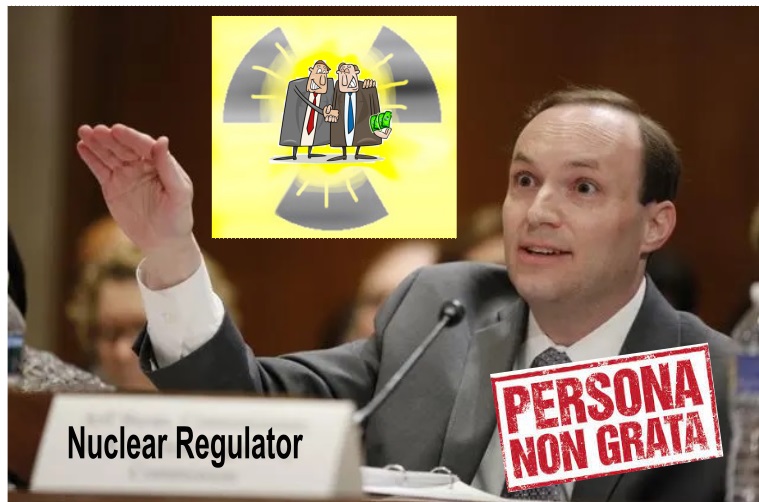
The triggering event for Sen. Manchin’s ire appears to be the faltering of NuScale, the leading firm touting the development of small modular reactors (SMRs), and the most likely to succeed commercially. The NuScale reactor design had some hiccups in satisfying the NRC’s requirements for a license, but its fundamental problem was its inability to attract customers. That commercial failure darkens the prospects of the rest of the nuclear industry’s stable of “advanced” designs, whose variety makes licensing more difficult. Safety is a subtle business (think of the Boeing door problem) and depends on design details.

More fundamentally, at risk is the dream of the nuclear industry and the US Energy Department—spun out in hearings before the Senate Energy Committee—of building large numbers of such reactors and exporting them around the world, with the United States regaining undisputed global leadership in nuclear technology.
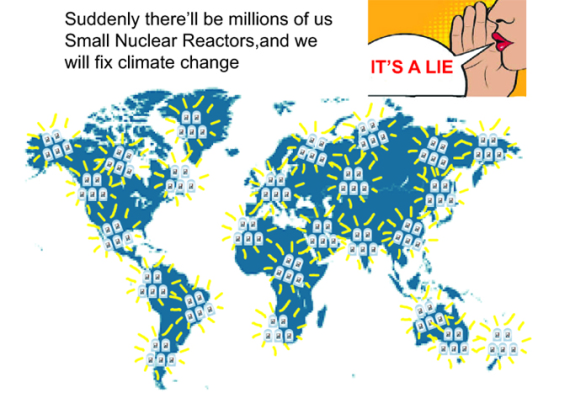
If this beautiful dream isn’t working out, somebody must be at fault, and who better to blame than the nuclear licensing authorities for paying too much attention to safety. If you think this way, the obvious fix is to reorient the NRC. Legislation to do that (ADVANCE Act, S-1111) has passed the Senate with strong bipartisan support. As Sen. Shelley Capito (R-WV), the act’s chief sponsor, put it: “we must establish regulatory pathways for next-generation nuclear designs to be approved quickly and without burdensome unnecessary costs.”
There is a sense here of “deja vu all over again.” The most prominent in the pipeline of “advanced” reactor designs are fast reactors. (Sidebar: They rely on fast neutrons and are cooled by liquid sodium, whereas all currently operating US power reactors rely on slow neutrons and are cooled by water.)

The most prominent design of this type is TerraPower’s (Bill Gates’s) Natrium reactor. Despite its “advanced” label, this type of power reactor was developed by the US Atomic Energy Commission in the 1960s and 1970s. The prototype Clinch River plant, about the same size as Natrium, was then the country’s largest energy project. The AEC’s central goal, backed at the time by the powerful Joint Committee on Atomic Energy, was to shift US electricity generation to such reactors, starting around 1980. The advantage of these reactors is that, fueled with plutonium, there are enough excess neutrons to convert uranium in the reactor into more plutonium than is being consumed; thus it is possible to “breed” plutonium, hence the name “breeder reactor.” Natrium can be fueled in this way and likely would be if it gained wide acceptability.
Just as supporters of new “advanced” reactors see NRC safety licensing as a threat, so the AEC’s fast reactor developers saw that agency’s semi-independent reactor licensing division as standing in the way and sought to undermine it. (“Regulatory,” as it was called then, was split off from the AEC in 1975 and became the NRC. In time, the rest of the AEC became the Energy Department.) The licensing division was treated by the AEC commissioners as a stepchild and kept weak so as not to threaten the big-budget reactor project.
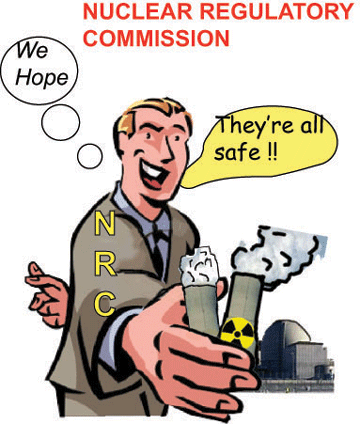
In the end, this strategy didn’t help the fast breeder reactor project. It got canceled because it didn’t make sense economically. But the weakness of the AEC regulatory organization had important consequences affecting the safety of the power reactors utilities bought in large numbers starting in the mid-1960s. Under pressure from the industry and commissioners, plants got licensed after rather skimpy safety reviews. So as not to constrain the licensing process, the AEC commissioners did not approve any safety regulations for power reactors until 1971. All but two of today’s 94 US operating power reactors were ordered before 1974. When it later became evident the early power reactors needed important safety upgrades, especially after the 1979 Three Mile Island accident, the nuclear industry resisted them.
In the late 1990s, it became evident that some of the plants’ safety documents—necessary for operation—were a mess. Then-NRC Chair Shirley Jackson tried to apply the NRC regulations strictly. The plant owners didn’t like this kind of oversight and got to New Mexico Sen. Pete Domenici, their senatorial godfather, who, in a private meeting, threatened Jackson with a huge budget cut. She got the point quickly, fired offending staff, hired Arthur Anderson management consultants to “improve” the licensing process, and ended the detailed public rating of nuclear power plants that the companies hated because Wall Street used the ratings for bond issues. After those changes, Domenici said he was happy. He boasted about coercing her in his book, A Brighter Tomorrow: “Since that meeting with Chairman Jackson, I have been very impressed with the NRC. They are now a solid, predictable regulatory agency.” There haven’t been many industry complaints since NRC fell into line—that is, until recently.
While the historical industry attacks on the NRC put self-interest above public safety, the agency, after its accommodating responses, didn’t come out looking good, either. A more recent change in the way the commission describes its responsibilities raises further questions about its priorities. It concerns the safety standard in the Atomic Energy Act (Sec. 182): “adequate protection of the public health and safety.” That phrase was cited by the agency for decades as the source of its authority and was the safety standard applied in commission actions.
Perhaps a dozen years ago, for reasons unknown but guessable, the commissioners began to use a modified version of the statutory standard, which now reads (for example, Strategic Plan 2022-2026) “reasonable assurance of adequate protection of public health and safety.” There is no denying that the added phrase waters down the Sec. 182 standard, which itself has not changed.
Do Nuclear Regulatory Commission actions under that modified standard even conform with the Atomic Energy Act? The Senate energy committee might usefully address itself to that question before it undertakes any more brow-beating of the already-timid NRC.
Ohio Attorney General announces new indictments in FirstEnergy nuclear plant bailout scandal

Two former FirstEnergy executives and the former chairman of the Ohio Public Utilities Commission face 27 felony counts for their role in the House Bill 6 bribery scheme.
KEVIN KOENINGER / February 12, 2024, https://www.courthousenews.com/ohio-ag-announces-new-indictments-in-firstenergy-nuclear-plant-bailout-scandal/—
COLUMBUS (CN) — Ohio Attorney General Dave Yost promised to hold “the checkwriters and the masterminds accountable” Monday as he announced indictments against executives over a bribery scandal surrounding the taxpayer-funded bailout of several failing nuclear power plants.
Yost said the FirstEnergy executives — Chuck Jones, the former CEO, and Michael Dowling, former vice president of external affairs — worked with attorney Sam Randazzo, former chairman of the Public Utilities Commission of Ohio, or PUCO, to further their legislative interests and ensure their employer was not targeted by the commission.
The charges, filed in Summit County, are the first for Jones and Dowling, while Randazzo was previously indicted by the federal government and pleaded not guilty to multiple wire fraud charges in December 2023.
Jones and Dowling are expected to surrender to authorities later Monday.
“This indictment is about more than one piece of legislation,” Yost said at a news conference announcing the indictments. “It is about the hostile capture of a significant portion of Ohio’s state government by deception, betrayal and dishonesty.
“There can be no justice without holding the checkwriters and the masterminds accountable. Shout it from the public square to the boardroom, from Wall Street and Broad and High: Those who perversely seek to turn the government to their own private ends will face the destruction of everything they worked for,” he said.
The indictment names two shell companies run by Randazzo, alongside Jones, Dowling, and the former utilities commission chairman, and were integral to the defendants’ scheme, according to Yost.
The attorney general’s office writes in the charging document that Randazzo negotiated settlements with FirstEnergy on behalf of several clients associated with the Industrial Energy Users-Ohio trade association, but then used legal assignments to transfer those settlements to his shell companies, including Sustainability Funding Alliance of Ohio Inc.
According to Yost, Randazzo earned millions of dollars for consulting services at FirstEnergy — without his clients’ knowledge — and lobbied for the energy provider to secure subsidies eventually included in the ill-fated House Bill 6.
That legislation included a bailout of over $1 billion to save two struggling nuclear power plants owned by FirstEnergy in northern Ohio, and eventually resulted in the indictment, trial and conviction of former Ohio House Speaker Larry Householder.
The Republican politician was convicted of a single RICO charge in March 2023 and is serving a 20-year sentence in federal prison while his appeal is pending before the Sixth Circuit.
Matt Borges, former Ohio Republican Party Chairman, was convicted alongside Householder, and is serving a five-year sentence in federal prison.
FirstEnergy paid Randazzo over $13 million through his shell companies between 2016 and 2019, and he pocketed over $5.3 million of that money for himself, the attorney general writes in the indictment.
Jones and Dowling then agreed to make a one-time payment of $4.3 million from FirstEnergy to Randazzo on Jan. 2, 2019, weeks before the attorney became chairman, a position he abused to “bend the PUCO around FirstEnergy’s will,” according to Yost.
To conduct the investigation, the Ohio Organized Crime Commission organized a task force at the behest of Summit County Prosecutor Sherri Bevan Walsh.
“These individuals used FirstEnergy to break the law and betray the public’s trust,” Walsh said at Monday’s news conference. “This indictment is another step toward bringing justice for the residents of Summit County and Ohio.”
Randazzo was indicted on 22 felony counts, including engaging in a pattern of corrupt activity, aggravated theft, bribery and eight counts of money laundering, among others, while Jones and Dowling face 10 and 12 felony counts, respectively.
First Small Nuclear Reactor (SMR) domino falls, potentially to start cascade

February 8, 2024, https://beyondnuclear.org/first-smr-domino-falls-potentially-to-start-cascade/—
Same financial risks viewed as generic to entire reactor type
The nuclear industry is rattled by an Opinion piece appearing in the January 31, 2024 edition of the energy trade journal Utility Dive. The article, astutely entitled “The collapse of NuScale’s project should spell the end for small modular nuclear reactors,” is an extensively documented study of yet another nuclear folly.
Its author, M.V. Ramana, the Simons Chair in Disarmament, Global and Human Security and Professor at the School of Public Policy and Global Affairs, at the University of British Columbia in Vancouver, Canada, carefully focuses on the financial collapse of what was heralded to be the first units of a bow wave of mass produced small commercial power reactors to be constructed and operated in the United States.
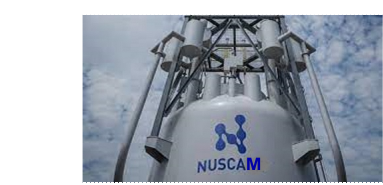
NuScale Power Corp, the Portland, Oregon based company that started up in 2007, was supposed to be the US Department of Energy’s (DOE) poster child to mass produce the first US Small Modular Reactors (SMR) owned and controlled by US nuclear giant and thermonuclear weapons manufacturer Fluor Corporation. Instead, on November 9, 2023, NuScale was announced as just another financial causality in a growing tally of nuclear projects stymied by uncontrollable cost and a recurring pattern of delay after delay. In this case, however, NuScale fell victim even before its selected reactor design could be certified by the US Nuclear Regulatory Commission as a viable license for the groundbreaking ceremony.

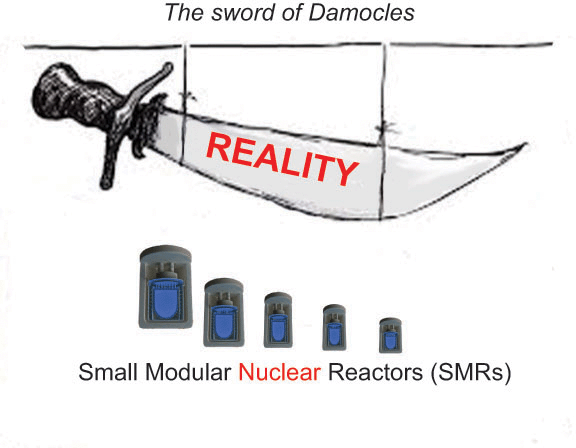
The NuScale pilot project’s initial goal was to license, construct and operate twelve contiguous units, (50 to 60-megawatts electric (MWe) each for a total up to 720 MWe of generating capacity per site), housed in a single reactor building with one control room. On the promise that this would be safer, cheaper and quicker to build and operate, the NuScale SMR is really just a redesign of a decades-old technology for the impossibly expensive and larger (800 to 1150 MWe per unit) commercial pressurized water reactors operating on license extensions today.
Yet, even with this extensive experience going back to the 1960’s, the redesign has not yielded to be any more reliable for estimating cost-of-completion, time-to-completion or affordable operation. In fact, with the industry’s abandonment of the design and construction of new reactors on “economies of scale,” the prospect for generating affordable electricity from small “mirage” reactors has apparently only become more unattainable.
The NuScale pilot reactor construction site was awarded by the DOE on the federally owned Idaho National Laboratory (INL) near Idaho Falls. NuScale worked out a deal for its projected electricity customer base on a contract with the Utah Associated Municipal Power System (UAMPS), an electric cooperative of 50 cities in seven western states incentivized by a DOE federal government payout to would be customers of up to $1.4 billion over ten years.
But despite the federally promised awards to reduce nuclear power’s certain financial risks to customers, Ramana documents the NuScale and UAMPS struggle with first building its power purchase subscriptions from members who would shortly run for the designated “exit ramps” scheduled into the contract.
As these municipalities pulled out of the nuclear project because of financial concerns, UAMPS and NuScale renegotiated the project’s generating capacity down to six units each rated at 77 MWe for a total generating capacity of 462 MWe.
The reactor design’s safety, however, is still problematic and uncertified by the Nuclear Regulatory Commission and now demonstrated to be yet another expensive “house of cards.” Like the previous “nuclear renaissance” initiated by Congress and the nuclear industry in 2005, of the 34 “advanced” Generation III units put forward by industry, only one unit (Vogtle unit 3) is commercially operable today and another unit (Vogtle unit 4) still under construction. The initial $14 billion project in Georgia is now approaching as much as $40 billion to show for it.
In a follow-on article in the February 3, 2024 edition of DownToEarth, M.V. Ramana and Farrukh A. Chishtie are co-authors of “Tripling nuclear energy by 2050 will take a miracle, and miracles don’t happen” which identifies the same dangerous wild goose chase to expand nuclear power that is destined to fail climate change mitigation on the global scale.
Chishtie and Ramana expertly rebut the deluded notion as presented by the United States former Special Envoy on Climate Change John Kerry at the 28th Conference of Parties (COP28) in Dubai, UAE. They cite “the hard economic realities of nuclear power” historically to date as the principal reason nuclear power cannot be scaled up from what can only be termed a preposterous level by 2050. That will be far too late by most accounts to abate an accelerating climate crisis.
“The evidence that nuclear energy cannot be scaled up quickly is overwhelming. It is time to abandon the idea that further expanding nuclear technology can help with mitigating climate change. Rather, we need to focus on expanding renewables and associated technologies while implementing stringent efficiency measures to rapidly effect an energy transition.
“In The War Of Propaganda, It Is Very Difficult To Defeat The United States”

“Highly emotive terms for the killing of civilians like ‘slaughter,’ ‘massacre,’ and ‘horrific’ were reserved almost exclusively for Israelis who were killed by Palestinians, rather than the other way around,”
Got it? In Ukraine people die from bombs because Russia launched Russian airstrikes and killed them very Russianly, whereas in Gaza people get hurt by explosions because they got too close to some type of explosive material.
CAITLIN JOHNSTONE, FEB 11, 2024
“…………………… “In the war of propaganda it is very difficult to defeat the United States because the United States controls all the world’s media and many European media,” Putin replied, adding, “The ultimate beneficiary of the biggest European media are American financial institutions.”
… Putin is definitely correct about the strength of the American propaganda machine. Of all the fronts one could possibly choose to challenge the United States on, propaganda is surely the least favorable. The US empire has by far the most sophisticated and effective propaganda machine ever to have existed, operating with such complexity that most people don’t even know it exists.
…………………………………………………………………In reality the nature of the US-centralized empire allows it to run a massive, nonstop international propaganda campaign through mass media platforms which are mostly privately owned. A diverse network of factors feeds into this dynamic which I’ve detailed in my unusually lengthy article “15 Reasons Why Mass Media Employees Act Like Propagandists”, but the gist of it is that anyone who’s wealthy enough to control a mass media platform is going to have a vested interest in preserving the status quo upon which their wealth is premised, and they will cooperate with establishment power structures in various ways toward that end.
The fact that these mass media outlets look independent but function as propaganda organs for the US empire allows its propaganda to fly into people’s minds without triggering any gag reflex of critical thinking or skepticism, which wouldn’t be the case if people knew those outlets were feeding them propaganda. Propaganda only really has persuasive power if you don’t know it’s happening to you.
The invisibility of US propaganda is further aided by the subtle methods by which it is administered, which we’ve seen exemplified beautifully in the coverage of Israel’s ongoing US-backed mass atrocity in Gaza.
In an article titled “Coverage of Gaza War in the New York Times and Other Major Newspapers Heavily Favored Israel, Analysis Shows,” The Intercept reports that a review of 1,000 articles from the New York Times, the Washington Post, and the Los Angeles Times about Israel’s war on Gaza found that the outlets consistently used word choices which served Israeli information interests.
“Highly emotive terms for the killing of civilians like ‘slaughter,’ ‘massacre,’ and ‘horrific’ were reserved almost exclusively for Israelis who were killed by Palestinians, rather than the other way around,” The Intercept’s Adam Johnson and Othman Ali report. “The term ‘slaughter’ was used by editors and reporters to describe the killing of Israelis versus Palestinians 60 to 1, and ‘massacre’ was used to describe the killing of Israelis versus Palestinians 125 to 2. ‘Horrific’ was used to describe the killing of Israelis versus Palestinians 36 to 4.”
This is the sort of manipulation that a casual news consumer wouldn’t notice. Unless you’re on alert for bias and are keeping track of what words are and aren’t being used where, you’re probably not going to notice the absence of emotionally-charged words when reporting on Palestinians who are killed by Israelis.
This type of slant shows up in all sorts of ways, like today’s headlines about the IDF killing a six year-old Palestinian girl named Hind Rajab along with her family. Reliable propaganda organs of the empire like CNN, The New York Times and the BBC have respectively gone with the headlines “Five-year-old Palestinian girl found dead after being trapped in car under Israeli fire”, “Missing 6-Year-Old and Rescue Team Found Dead in Gaza, Aid Group Says,” and “Hind Rajab, 6, found dead in Gaza days after phone calls for help”. In contrast, Al Jazeera reports on the same story with the headline “Body of 6-year-old killed in ‘deliberate’ Israeli fire found after 12 days,” and Middle East Eye goes with “Hind Rajab: Palestinian girl found dead after being trapped under Israeli fire for days”.
It’s easy to spot the difference when they’re placed next to each other like I just did, but unless you’re really watching out for it and have a good background on what’s going on here you’re likely to miss what’s happening. If you’re like most people and don’t read past the headline, you’d never know from the imperial media headlines that the child was killed by Israel, and you’d certainly never know about her terrified phone call for help while trapped by IDF fire and surrounded by the bodies of her dead relatives. If you look to the legacy media and its algorithmically-boosted online iterations for information about the world, you went one more day with a distorted perspective of what’s happening in Gaza.
The western press constantly write headlines like this when trying to minimize the impact of someone’s death at the hands of a party they sympathize with, particularly with regard to Palestinians. Last month the BBC published an article titled “Record number of civilians hurt by explosives in 2023”, as though they were mishandling fireworks or something instead of being actively killed by Israeli bombs. The BBC later revised their atrocious headline, but revised it in the opposite direction, replacing “Record number” with “High number” to further minimize the impact.
Contrast this with the BBC’s headlines when it’s reporting on Ukrainians killed by Russian airstrikes . Here’s a recent one titled “Ukraine war: Russian air strikes claim five lives in Kyiv and Mykolaiv”, and another titled “Ukraine war: Baby killed in Russian strike on Kharkiv hotel”.
Got it? In Ukraine people die from bombs because Russia launched Russian airstrikes and killed them very Russianly, whereas in Gaza people get hurt by explosions because they got too close to some type of explosive material.
Last week The Washington Post ran an opinion piece titled “Is America complicit in Israel’s bloody war in Gaza?”, which is already a ridiculously skewed headline because the answer is self-evidently yes — implying that there’s any question of this skews things in America’s favor. But even this was too much for the Post’s editors, who re-titled the piece “Has the Israel-Gaza war changed your feelings about being American?” to keep Americans from thinking too hard about Israel’s bloody war in Gaza and their country’s complicity in it.
In a Wednesday article titled “Biden Tries Again With Arab Americans in Michigan”, New York Times editorial board member Farah Stockman wrote the absolutely insane line “The Oct. 7 Hamas attack on Israel seems to be affecting Biden’s election prospects.” And then The New York Times actually printed it.
Read that line again. She’s saying Arab Americans are rejecting Biden because of the October 7 Hamas attack, which is of course absurd; they’re rejecting Biden because he’s backing a genocide in Gaza. She wrote this nonsensical line because in the New York Times you can’t say things like “Israel’s genocide in Gaza” or “the president’s facilitation of crimes against humanity”, and you won’t be hired if you’re the sort of person who’d be inclined to. Instead we’re pretending that for some inexplicable reason Arab Americans are just hopping mad at Biden because October 7 happened.
But again, these little manipulations fly under the radar if you’re not on the lookout for them. Such is the brilliance of the US empire’s invisible propaganda machine. That’s why it’s very difficult to win a propaganda war against the United States, that’s why westerners have been so successfully manipulated into accepting a status quo of endless war, ecocide, injustice and exploitation, and that’s why the world looks the way it looks right now.
Why Biden’s $61 billion in weapons for Ukraine won’t prevent inevitable defeat
Walt Zlotow, West Suburban Peace Coalition, Glen Ellyn IL 11 Feb 24
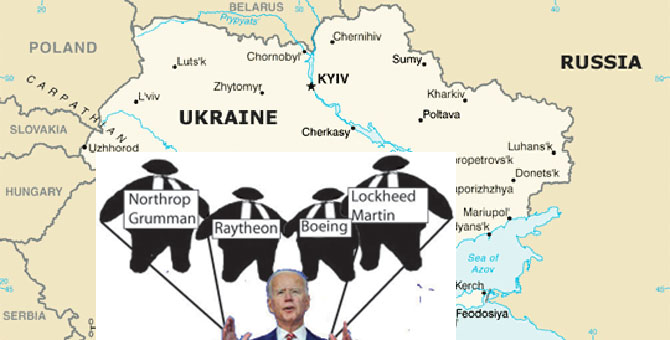
For 4 months President Biden has been beseeching Congress to grant another $61 billion in aid to Ukraine to continue their 2 year war with Russia. This is on top of $113 billion that has made no dent in Ukraine’s efforts to prevail against overwhelming Russian forces.
Biden could give Ukraine a trillion dollars in aid but it’s essentially worthless because Ukraine is running out of soldiers to use US weapons.
A dozen Ukrainian soldiers and commanders told the Washington Post that personnel deficits are at their lowest point ever.
One mechanized brigade battalion commander advised he’s down to 40 soldiers from a normal 200 to hold off the Russian advance. Another mentioned the same shortage in his unit.
Replacements are scares since August when Zelensky fired all recruitment office heads due to corruption. That’s caused a dramatic decline in replacements still not solved.
But if Biden gets his $61 billion he’d be better off tossing it into a bonfire instead of squandering it on more weapons for Ukraine. That will only prolong a war that was lost on Day One, 717 days ago. Had Biden not torpedoed a peace deal nearly inked in the first month, over 400,000 Ukrainian soldiers would still be alive, the Ukraine economy would not be devastated, and Ukraine may not have lost a single square mile of territory.
Biden knows the $61 billion more will not turn the tide. But as Pete Seeger sang about LBJ continuing to fight a lost war in Vietnam 57 years ago, in today’s White House…’The Big Fool says to push on.’
Tribes condemn start of uranium mining at Pinyon Plain Mine south of Grand Canyon

ADRIAN SKABELUND Sun Staff Reporter, Jan 13, 2024,
https://azdailysun.com/news/local/tribes-condemn-start-of-uranium-mining-at-pinyon-plain-mine-south-of-grand-canyon/article_13efb3b0-b16a-11ee-973a-c789810e105e.html
Two northern Arizona tribes this week condemned the start of operations at a uranium mine just south of the Grand Canyon.
The statements came after Denver-based company Energy Fuels Inc. announced last month that operations at its Pinyon Plain Mine had commenced.
“It is with heavy hearts that we must acknowledge that our greatest fear has come true,” a statement from the Havasupai Tribal Council read.
Meanwhile, Navajo Nation President Buu Nygren said in a statement that mining remains opposed “by all neighboring tribes that have forever called Grand Canyon their home.”
The Havasupai Tribe, along with many conservation groups, have long worried that the mine could contaminate area groundwater.
The Pinyon Plain Mine, previously known as the Canyon Mine, sits above the Redwall-Muav aquifer, which acts as a source of water for countless seeps and springs throughout the Grand Canyon, and is the sole source of drinking water for the Havasupai.
The mine also sits near Red Butte, an area with deep cultural importance to the Havasupai.
Energy Fuels has insisted that mining poses no risk to groundwater in the area.
Energy Fuels Vice President of Marketing and Development Curtis Moore said last month that the concerns over contamination were unfounded and designed to scare the public and push an antinuclear political agenda.
But those statements provided little comfort to those opposed to the mine.
“As guardians of the Grand Canyon, we the Havsuw ‘Baaja, the Havasupai Tribe, have opposed uranium mining in and around our reservation and the Grand Canyon since time immemorial. We do this to protect our people, our land, our water, our past, our present and our future,” a statement from the Havasupai Council read. “And yet, despite the historic and current assistance and advocacy from numerous allies, and the countless letters, phone calls and personal pleas, our urgent requests to stop this life-threatening action have been disregarded.”
Nygren on Thursday called on the federal government to protect tribes from the impact of new mining.
“I join our neighboring tribes and the many non-Native organizations to implore the federal government to uphold its promise to protect us,” Nygren wrote. “We are very concerned about the impending transport of radioactive materials from the Pinyon Plain/Canyon uranium mine to White Mesa Mill in Utah.”
The statements came as activists say they have observed uranium ore being stockpiled at the mine site.
Moore previously told the Arizona Daily Sun they didn’t yet know when they would begin to haul ore from the mine to the Utah Mill for processing. He said it was likely to begin within the year, however.
In 2012, the Navajo Nation passed a law banning the transportation of uranium ore within Navajo lands. That law does not impact federal highways that cross tribal lands.
There are two potential routes trucks bringing uranium ore from the mine to the Utah mill could take. One would direct trucks through Flagstaff, while a second would utilize ranching roads to skirt north of the city. Still, both routes pass through the Navajo Nation on U.S. Route 89.
Nygren also said he was disappointed that he and other tribal officials only learned mining operations had commenced through media reports, as opposed to hearing the news from federal partners.
“Despite all of our objections through the years, we learn through the media, rather than from our federal trustee — the U.S. Department of Agriculture, U.S. Forest Service and U.S. Department of the Interior/Bureau of Land Management — as would correctly expect, that our land and water will again be threatened with contamination,” he said. “Our relatives, the Havasupai, Hualapai and other tribes along the Colorado River, are bracing themselves for renewed anxiety, worry and constant unease about the safety of their resources and homelands.”
There is a long and controversial history of uranium mining within northern Arizona.
Throughout the Cold War era, nearly 30 million tons of uranium ore were extracted and often processed from Navajo Nation lands. Hundreds of those mines, often near Navajo communities, were then abandoned by the companies operating them.
More than 500 contaminated sites remain across the Navajo Nation.
Another $61 billion to kill more Ukrainians in an unnecessary and losing war

The $61 billion will make no difference on the battlefield except to prolong the war, the tens of thousands of deaths, and the physical destruction of Ukraine.
The Biden-Schumer Plan to Kill More Ukrainians JEFFREY D. SACHS, Feb 08, 2024, Common Dreams, https://www.commondreams.org/opinion/the-biden-schumer-plan-to-kill-more-ukrainians
President Joe Biden is refusing to fold a losing hand as he bets with Ukrainian lives and U.S. taxpayer money. Biden and Democratic Senate Majority Leader Chuck Schumer propose to squander the lives of tens of thousands more Ukrainians and $61 billions of federal funds to keep Biden’s disastrous foreign policy failure hidden from view until after the November election.
The $61 billion will make no difference on the battlefield except to prolong the war, the tens of thousands of deaths, and the physical destruction of Ukraine. It will not “save” Ukraine. Ukraine’s security can only be achieved at the negotiating table, not by some fantasized military triumph over Russia.
$61 billion is not nothing. This worse-than-useless outlay would exceed the combined budgets of the U.S. Department of Labor, Environmental Protection Agency, National Science Foundation, and the Women, Infant, and Children nutrition program.
Almost exactly 10 years ago this month, Biden did much to put Ukraine on the path to disaster. This is well known to those who have looked carefully at the facts but is kept hidden from view by the White House, the Senate Democrats, and the mainstream media that back Biden. I have previously provided a detailed chronology, with hyperlinks, here.
Ukraine’s security can only be achieved at the negotiating table, not by some fantasized military triumph over Russia.
In 1990, President George H. W. Bush, Sr. and his German counterpart Chancellor Helmut Kohl promised Soviet President Mikhail Gorbachev that NATO would not expand eastward if the Soviet Union accepted German reunification. When the Soviet Union disbanded in December 1991, with Russia as the successor state, American leaders decided to renege.
President Bill Clinton began NATO expansion over the vociferous opposition of top diplomats like George Kennan and the opposition of his own Secretary of Defense, William Perry. In 1997 Zbigniew Brzezinski upped the ante, with a plan for NATO to expand all the way to Ukraine. He famously wrote that without Ukraine, Russia would cease to be a great power.
Russian leaders have repeatedly made clear that NATO expansion to Ukraine is understandably the reddest of Russian redlines.
In 2007, President Vladmir Putin stated that NATO enlargement to that date was a cheat on the 1990 promise, and that it must go no further. Despite these clear warnings, including by his own diplomats, George W. Bush Jr. committed in 2008 to expand NATO to Ukraine and Georgia in order to surround Russia in the Black Sea.
William Burns, now CIA director, and then the U.S. Ambassador to Russia, wrote a famous memo entitled “Nyet means Nyet,” explaining that Russia’s opposition to NATO enlargement was across Russia’s political spectrum. Most Ukrainians themselves were also firmly against the plan, favoring neutrality over NATO membership. The Ukrainian Rada declared Ukraine’s state sovereignty in 1990 on the basis of becoming “a permanently neutral state.” In 2009, the people of Ukraine elected Viktor Yanukovych, who ran on a platform of neutrality.
In early 2014, the U.S. decided to help bring down Yanukovych in a coup. This was standard U.S. deep-state operating procedure, one used on dozens of occasions around the world. he CIA, National Endowment for Democracy, USAID, and NGOs like the Open Society Foundation went to work in Ukraine. The point person was Victoria Nuland, who was first Richard Cheney’s principal deputy foreign policy advisor, then George Bush Jr.’s ambassador to NATO, then Hillary Clinton’s spokesperson, and by 2014 Assistant Secretary of State.
This time, the Russians caught the conspiracy on tape, in an intercepted call between Nuland and U.S. Ambassador to Ukraine Geoffrey Pyatt (now Assistant Secretary of State). Nuland explains to Pyatt that Vice President Joe Biden will help choose and cement the post-coup government. The 2014 Ukraine team, including Biden, Nuland, Jake Sullivan (then and now Biden’s national security advisor), Geoffrey Pyatt, and Antony Blinken (then the deputy national security advisor), remains the Ukraine team today.
It is a team of bunglers. They thought that Yanukovych’s overthrow would quickly usher in NATO expansion. Instead, ethnic Russians in Ukraine virulently rejected the Russophobic post-coup government that was installed by Nuland, and called for autonomy of the ethnically Russian regions. In a referendum, Crimea voted overwhelmingly to join Russia.
Obama, Biden, and their team armed the post-coup government to attack the ethnically Russian regions, thinking this would be the end of it. Yet the regions resisted. Ukraine and the breakaway regions signed the Minsk Agreements to bring an end to the fighting and give constitutional autonomy to the ethnically Russian Donbas. The Minsk II agreement was backed by the UN Security Council, but the U.S. privately agreed with the Ukrainian government that it was okay to ignore it.
In 2021, after 7 years of fighting and more than 14,000 deaths in the Donbas, Putin called on newly elected President Biden to stop NATO enlargement and engage in negotiations with Russia over mutual security arrangements. Biden rejected Putin’s call to end the gambit of NATO enlargement to Ukraine.
In February 2022, Putin launched the Special Military Operation (SMO) invasion to push Ukraine to the negotiating table. Ukraine’s President Volodymyr Zelensky immediately called for negotiations based on Ukraine’s neutrality. Within a month, a framework agreement to end the fighting was reached between Ukraine and Russia, based on Ukraine’s neutrality and an end to NATO’s enlargement to Ukraine. Biden stepped in to stop the deal, with the U.S. informing Zelensky that the U.S. would not support neutrality.
Biden and team had still more failed tricks up their sleeve. They firmly believed that U.S. financial sanctions—freezing Russia’s assets and cutting it out of the SWIFT banking system—would cripple the Russian economy and cause Putin to relent. In fact, they expected that the ensuing economic crisis would topple him. Of course, nothing of the sort happened.
Then they expected that NATO weaponry would trounce Russia on the battlefield. That too did not happen. Then they expected that Ukraine’s “counter-offensive” in the summer of 2023, backed by Pentagon and CIA planners, would defeat Russia. Instead, Ukraine lost hundreds of thousands of soldiers dead and wounded—its military hardware destroyed.
The entire war, including the loss of Ukrainian territory, the hundreds of thousands of Ukrainian casualties, and the utter waste of more than $100 billion of U.S. taxpayer money to date, could easily have been avoided.
Now, Biden and Schumer want to throw more Ukrainian lives and more tens of billions of dollars at this glaring failure. They want to do this in a rushed vote, without any Congressional let alone public oversight, without hearings, and without any strategy. The fact is they want to save Biden from the embarrassment of a decade of puerile and failed plotting, at least until the November election.
There remains one answer for Ukraine’s security: diplomacy and neutrality. That solution doesn’t cost lives or money. It was Ukraine’s choice before the 2014 coup and again in 2022 until stopped by Biden. It is the path that Biden and the Senate Democrats still refuse to take.
Canada citizens challenge environmental safety of Canadian Nuclear Safety Commission waste facility near Ottawa River
Pitasanna Shanmugathas | Vermont Law & Graduate School, US, FEBRUARY 9, 2024 https://www.jurist.org/news/2024/02/canada-citizens-challenge-environmental-safety-of-canadian-nuclear-safety-commission-waste-facility-near-ottawa-river/
A group of Canadian citizens launched a legal challenge against the Canadian Nuclear Safety Commission (CNSC) on Thursday over the commission’s recent approval of the construction of a Near Surface Disposal Facility (NSDF) near the Ottawa River. Led by the Concerned Citizens of Renfrew County and Area, Ralliement contre la pollution radioactive, and the Canadian Coalition for Nuclear Responsibility, the challenge encompasses a broad array of environmental and public health concerns surrounding the NSDF’s potential impacts.
At the core of this legal action is an application for judicial review pursuant to section 18 of the Federal Courts Act. The challenge targets the CNSC’s decision, dated January 8, approving Canadian Nuclear Laboratories’ (CNL) application to amend the Nuclear Research and Test Establishment Operating License for the Chalk River Laboratories sites. This amendment would authorize the construction of the NSDF, classified as a Class IB Nuclear Facility—a project not previously sanctioned under the existing license.
Represented by Nicholas Pope, the applicants seek an order to quash the decision to amend the license for NSDF construction.
The NSDF is envisaged as a nuclear waste disposal facility designed to contain up to one million cubic meters of radioactive waste. Its anticipated lifespan comprises several phrases, including a construction phase, operation phase, closure phase, institutional control period, and post-institutional control period. Of potential concern to the applicants is the potential for rainwater infiltration during the operation phase, which could lead to the leaching of radioactive materials into the environment. Moreover, plans to mitigate this risk by discharging treated wastewater into Perch Lake, a tributary of the Ottawa River, have raised further alarm.
To secure the license amendment, CNL underwent a rigorous approval process, which required an environmental assessment under the Canadian Environmental Assessment Act, compliance with the Nuclear Safety and Control Act (NSCA), and consultation with Indigenous communities. However, the applicants raised concerns about the CNL’s fulfillment of these requirements.
Of particular contention is the inclusion of an override section within the Waste Acceptance Criteria documented submitted by CNL. This provision, if implemented, would ostensibly permit the disposal of waste that does not meet the established acceptance criteria, thereby eroding any assurances of stringent waste management standards and rendering the safety case effectively null and void. Moreover, concerns persist regarding the efficacy of waste verification processes to ensure compliance with the acceptance criteria.
Assertions have been made that the CNL failed to adequately consider the environmental impacts of alternative wastewater discharge methods, including the proposed pipeline to Perch Lake.
In a comment to JURIST, Pope asserted:
According to Canadian Nuclear Laboratories, the proponents of the project, even if all goes according to plan and there are no disruptive events, the public will still be subjected to radiation doses that are one and a half times the regulated standard for radioactive material that have been released from regulatory controls. And, if a disruptive event does occur, the public could receive up to fourteen times the legal limit of a radiation dose. So this surface level facility has been designed to only last for 550 years before it erodes and only be under institutional control for 300 years yet the materials they are planning on placing in this mound have half-lives of thousands of years and will remain radioactive for thousands of years—well beyond when it is no longer under governmental control and when the cover has eroded away so the materials will be free to be released into the environment.
The applicants also raised concerns about CNL’s compliance with consultation requirements with Indigenous nations, particularly Kebaowek First Nation, whose traditional territory encompasses the proposed NSDF site.
The pragmatist’s guide to nuclear disarmament
Feb. 9, 2024, Steve Olson, The Seattle Times, https://www.seattletimes.com/opinion/the-pragmatists-guide-to-nuclear-disarmament/
The United States has not seen a widespread nuclear disarmament movement since the early 1980s. A new one is desperately needed — but with a twist.
The 1980s movement was based on fear. In 1982, a million people, alarmed by President Ronald Reagan’s nuclear buildup, gathered in New York City’s Central Park to oppose the nuclear arms race — still the largest one-day protest in U.S. history. The next year, 100 million people — almost half the population of the United States — watched the television movie “The Day After,” which horrifically depicted the nuclear destruction of Kansas City.
Fear can generate a fight-or-flight reaction, but it’s ultimately counterproductive. People become so scared that they think nothing can be done and give up. Or they ignore the issue entirely, at least on a conscious level.
There are still plenty of things to fear. Nuclear treaties are lapsing. National leaders have threatened to use nuclear weapons against their enemies. New research, now being reviewed by the National Academies of Sciences, Engineering, and Medicine, has strengthened the case that even a limited nuclear war could shut down agriculture for years and doom billions to starvation. A large-scale nuclear war could smother agriculture for more than a decade and end civilization.
But fear isn’t necessary to spur action. There are two very practical reasons to abolish nuclear weapons.
The first is their outrageous cost. The U.S. government is on track to spend at least $1.5 trillion over the next 30 years modernizing its nuclear weapons. That’s as much as the federal government currently spends on the National Institutes of Health. Or, to put it another way, four years of that spending, evenly divided among the 50 states, would buy us an entirely new ferry fleet.
Key parts of the modernization effort, like the new Sentinel ballistic missile program, are already massively over budget. Taking apart nuclear weapons systems would cost a small fraction of the money now slated to build new ones.
The second reason for getting rid of nuclear weapons is that they are far more dangerous than they are useful. Nuclear bombs are too large and destructive to deploy effectively in warfare. They would kill soldiers and noncombatants on both sides of a conflict. Nuclear fallout would drift far from a battlefield. Weapons have been getting smaller and smarter, not bigger and dumber.
Nuclear weapons also don’t make sense politically. If a nuclear weapon were detonated in a war — assuming that a general nuclear war did not follow — the responsible nation would face devastating conventional attacks and be ostracized internationally. No country has been willing to face those consequences, at least not since the very different circumstances that prevailed at the end of World War II.
The existence of nuclear weapons supposedly deters their use. No one has been able to figure out what that nonsensical statement means. Making a threat implies being willing to carry it out. The idea that deterrence has worked ignores the history of crises, miscalculations, and accidents that almost triggered nuclear war. Deterrence works until it doesn’t.
Nuclear weapons are a federal responsibility. For us as Washingtonians, that means working through our 10 U.S. representatives and two U.S. senators to change nuclear policy. Except for U.S. Rep. Pramila Jayapal, the members of our congressional delegation have been, at best, guarded in their statements about nuclear weapons. Washington receives about $20 billion a year in defense spending. Reducing that flow of funds would seem to be a recipe for electoral disaster.
But couldn’t at least part of our defense funding be spent in more socially productive ways? After all, flying a nuclear bomb-carrying F-35A jet for two hours costs as much as a nurse makes in a year. Keeping more than 55,000 mostly young men and women here in Washington well-trained and outfitted for future conflicts may help us feel more secure. But it doesn’t build infrastructure, spark innovation, or improve the health and well-being of the population at large.
Here, the Washington Against Nuclear Weapons coalition, led by the Washington chapter of Physicians for Social Responsibility, has been exerting pressure on our representatives and senators to take a stand against nuclear weapons. The Ground Zero Center for Nonviolent Action — on a 4-acre plot adjacent to the Kitsap submarine base outside Bremerton — works for disarmament right next to the largest stockpile of deployed nuclear weapons anywhere in the world. At the national level, the Ploughshares Fund, the Federation of American Scientists, the Arms Control Association and many other organizations are working to reduce and then eliminate the existential threat these weapons pose.
In 2021, the International Treaty on the Prohibition of Nuclear Weapons, which prohibits the development, production, use, and threat of use of nuclear weapons, entered into force after being ratified by 50 countries. The nine countries that have nuclear weapons have so far opposed the treaty, but they are nevertheless bound by the 1968 Treaty on the Non-Proliferation of Nuclear Weapons to negotiate an agreement “on general and complete disarmament under strict and effective international control.” That they have not yet done so is both a bitter disappointment and a betrayal of their stated intentions.
Nuclear disarmament will not be unilateral or immediate. Nations will need to negotiate stepped reductions and means of verifying progress. An especially urgent task is to eliminate the ground-based missiles now clustered in underground silos in Colorado, Montana, Nebraska, North Dakota and Wyoming, as well as in Russia and China. These weapons are inherently destabilizing and dangerous. They have to be launched within minutes if a president thinks a nuclear attack is underway. A mistake, miscalculation, or moment of madness could spell the end of the world.
Unlike efforts to slow climate change, which will require widespread changes in how we live, the threat of nuclear annihilation could be eliminated if nine men agreed to destroy about 12,500 pieces of elaborately machined metal. Reagan and then-president of the Soviet Union Mikhail Gorbachev almost agreed to junk their nuclear weapons in 1986. The only stumbling block was Reagan’s commitment to a nuclear weapons defense program that was canceled a few years later.
The folly of Ontario’s nuclear power play
MARK WINFIELD, THE GLOBE AND MAIL, 5 Feb 24
Mark Winfield is a professor of environmental and urban change at York University and co-chair of the faculty’s Sustainable Energy Initiative. He is also co-editor of Sustainable Energy Transitions in Canada (UBC Press, 2023).
The Ontario government’s announcement last week of its intention to pursue the refurbishment of the Pickering B nuclear power plant on the shore of Lake Ontario between Toronto and Pickering represents a strategic triumph for the provincially owned Ontario Power Generation utility. The project would significantly reinforce the utility’s already dominant position in the province’s electricity system.
How well the decision serves the interests of Ontario residents, taxpayers and electricity ratepayers, and advances the sustainable decarbonization of the province’s electricity system, is another question altogether.
A Pickering B refurbishmenthad been assessed as uneconomic in 2010 and the plant scheduled to close in 2018. The facility is located in what is now a densely populated urban area where approval of a new plant would be unlikely.
New plans for that refurbishment are part of larger nuclear expansion strategy being pursued by OPG and the province. The plans include the refurbishment of six reactors at the Bruce Nuclear facility (also owned by OPG) and four reactors at the OPG Darlington facility. There are also proposals for four large new reactors totalling 4,800 MW in capacity at Bruce and four new 300 MW reactors at Darlington.
The total costs of these plans are unknown at this point, but an overall estimate in excess of $100-billion ($13-billion Darlington refurbishment; $25-billion Bruce refurbishment; $15-billion Pickering B refurbishment; $50-billion for Bruce new build; Darlington new build $10-billion or more) would not be unrealistic. Even that figure would assume that things go according to plan, which they rarely do with nuclear construction and refurbishment projects. This could constitute the largest nuclear construction program in the Americas or Europe.
Under the current legislative and policy regime for electricity in Ontario, none of these plans are subject to any external review or regulatory oversight in terms of costs, economic and environmental rationality, or availability of lower-cost and lower-risk pathways for meeting the province’s electricity needs and decarbonizing its electricity system. Rather, the system now runs entirely on the basis of ministerial directives that agencies in the sector – including the putative regulator, the Ontario Energy Board – are mandated to implement.
The government has justified its plans on the expectation of dramatic growth in electricity demand over the next few decades. This would be the result of population and economic growth, the widespread adoption of electric vehicles, the electrification of space heating – principally via heat pumps – and expectations of industrial development in areas like the hydrogen economy
There are serious grounds on which to question these projections. Growth in electricity demand in the province has been virtually flat these past two decades despite sustained population and economic growth. The province has no plans of its own for the electrification of transportation or space heating. In fact, it is currently proposing legislation to facilitate the expansion of natural gas service to new housing developments. Many of the anticipated industrial developments, particularly around things like hydrogen, are speculative at best……………………………………..
While nuclear energy may offer a low-carbon energy source, it fails in virtually every other dimension of sustainability: costs; the production of high-volume, toxic and radioactive waste streams that require management on timescales of hundreds, if not thousands, of millennia; and security, catastrophic accident and weapons proliferation risks that simply do not exist in relation to other energy technologies.
These considerations mean that nuclear projects need to be options of last resort in efforts to decarbonize energy systems. This is precisely the opposite of the approach now being taken by Ontario. These are choices that Ontarians and Canadians may come to regret for decades, if not centuries, if they are not subject to some form of serious external review before it is too late to reconsider https://www.theglobeandmail.com/business/commentary/article-ontario-pickering-nuclear-power-plant-refurbishment/
Israel Aid Bill Fails in House as Progressives Slam ‘Blank Check for Netanyahu’

“The supplemental funding proposed, which includes no humanitarian aid for Gaza nor assistance for Ukraine, supports weapons of war and destruction that further jeopardize Israeli hostages and Palestinian civilians,
“Each U.S.-made or funded bomb dropped in Gaza further jeopardizes the chances of long-lasting peace for Israelis and Palestinians,” said Rep. Delia Ramirez.
JAKE JOHNSON, Feb 07, 2024, https://www.commondreams.org/news/israel-aid-house
A Republican effort to push through a standalone military aid package for Israel failed to clear the U.S. House on Tuesday, with members of the Congressional Progressive Caucus condemning the proposed $17.6 billion in unconditional assistance for a government that stands accused on the world stage of committing genocide in the Gaza Strip.
The legislation, which President Joe Biden threatened to veto if it reached his desk, needed two-thirds support to pass the House under a suspension of the rules. The final tally was 250 to 180, with 166 Democrats and 14 Republicans voting no.
Rep. Delia Ramirez (D-Ill.) said in a statement that “under no circumstances” could she have voted for the legislation, which House Republican leaders sought to advance ahead of the Senate’s planned procedural vote on a broader package that includes military aid to Israel and Ukraine and a border agreement that would dramatically weaken asylum protections.
“The death toll in Gaza continues to rise. Gazans are starving,” Ramirez said late Tuesday. “Over 1.5 million people have been displaced. Hostilities between the U.S. and Iran are escalating. And just this morning, The New York Times reported that one-fifth of the hostages still in captivity since the start of the conflict have likely died. We must change course.”
“The supplemental funding proposed, which includes no humanitarian aid for Gaza nor assistance for Ukraine, supports weapons of war and destruction that further jeopardize Israeli hostages and Palestinian civilians,” she continued. “Each U.S.-made or funded bomb dropped in Gaza further jeopardizes the chances of long-lasting peace for Israelis and Palestinians. I’ve said it before, and I’ll say it now: I will only support actions that bring us closer to peace.”
In a brief floor speech ahead of Tuesday’s vote, Rep. Ro Khanna (D-Calif.) described standalone Israel aid legislation as a “blank check for [Israeli Prime Minister Benjamin] Netanyahu” and other far-right officials seeking the permanent removal of Palestinians from Gaza.
If passed, the aid measure would have allowed the U.S. State Department to waive congressional notification requirements for billions of dollars in U.S. military financing for Israel, which has massacred Gaza civilians with American-made weaponry.
“I will vote no because it is painfully obvious to the entire world that what is needed today is a permanent cease-fire and a release of all hostages,” Khannas said. “There come moments in a nation’s history when our actions reveal our values. This is such a moment.”
The failure of the Israel aid bill came shortly after House Republicans also fell short in their effort to impeach Homeland Security Secretary Alejandro Mayorkas.
Rep. Ayanna Pressley (D-Mass.) wrote in response to the Mayorkas vote that “Republicans are deeply disconnected from the people.”
“They’re not serious about fixing our immigration system, they have no plan to improve folks’ lives, and they keep wasting our time with political stunts like these,” Pressley added. “This sham, failed impeachment is just the latest example.”
Senate Republicans on Wednesday are expected to block consideration of the broader supplemental security package over the border agreement, which they claim isn’t sufficiently harsh—a position right in line with that of former President Donald Trump, the frontrunner for the 2024 GOP presidential nomination.
1 This Month
23 April – WEBINAR – Why new nuclear reactors are the wrong tools for decarbonization Thursday, April 23 • 1 AM – 2 AM AEST



Pine Ridge Uranium is the real threat, not Tehran- Tell Burgum: Stop the Extraction.
Chernobyl: The Lost Tapes – A good documentary on Chernobyl on SBS available On Demand for the next 3 weeks– https://www.sbs.com.au/ondemand/tv-program/chernobyl-the-lost-tapes/2352741955560
To see nuclear-related stories in greater depth and intensity – go to https://nuclearinformation.wordpress.com
-
Archives
- April 2026 (275)
- March 2026 (251)
- February 2026 (268)
- January 2026 (308)
- December 2025 (358)
- November 2025 (359)
- October 2025 (376)
- September 2025 (257)
- August 2025 (319)
- July 2025 (230)
- June 2025 (348)
- May 2025 (261)
-
Categories
- 1
- 1 NUCLEAR ISSUES
- business and costs
- climate change
- culture and arts
- ENERGY
- environment
- health
- history
- indigenous issues
- Legal
- marketing of nuclear
- media
- opposition to nuclear
- PERSONAL STORIES
- politics
- politics international
- Religion and ethics
- safety
- secrets,lies and civil liberties
- spinbuster
- technology
- Uranium
- wastes
- weapons and war
- Women
- 2 WORLD
- ACTION
- AFRICA
- Atrocities
- AUSTRALIA
- Christina's notes
- Christina's themes
- culture and arts
- Events
- Fuk 2022
- Fuk 2023
- Fukushima 2017
- Fukushima 2018
- fukushima 2019
- Fukushima 2020
- Fukushima 2021
- general
- global warming
- Humour (God we need it)
- Nuclear
- RARE EARTHS
- Reference
- resources – print
- Resources -audiovicual
- Weekly Newsletter
- World
- World Nuclear
- YouTube
-
RSS
Entries RSS
Comments RSS
 nuclear-news