US Vetoes UN Resolution Condemning Israel for Flour Massacre
Nearly 1,000 Palestinians were killed and wounded after Israeli forces opened fire on people surrounding an aid convoyby Kyle Anzalone March 1, 2024
The US vetoed a UN Security Council resolution condemning Israel for a massacre of civilians surrounding an aid convoy in Gaza, a motion supported by all other member states. The Israel Defense Forces has acknowledged its soldiers fired on the crowd.
On Thursday, hundreds of Palestinians were killed and injured by Israeli soldiers as they gathered around an aid convoy near Gaza City. As some people took aid off the trucks, the IDF claimed the same Palestinians approached Israeli soldiers nearby, saying its troops felt “endangered” and opened fire. The killing has been dubbed the “flour massacre.”
More than 100 Palestinians were killed in the shooting and ensuing panic, while at least 750 others were injured. Tel Aviv has attempted to blame the Palestinians for the deaths, saying the violence was caused by the mob. Washington has claimed it needs more information to assess the incident.
While Israeli troops would bear responsibility for the carnage whether they fired upon civilians or merely incited a deadly stampede, doctors treating the victims said most of the injuries were gunshot wounds. Some outlets report that IDF forces also fired artillery or tank shells at the desperate crowd………………………………………………………………….
With a growing number of Palestinians on the brink of starvation amid dire food shortages, aid convoys have increasingly faced unrest from hungry crowds – most crucially in devastated northern Gaza, where aid shipments have all but ground to a halt. Jens Laerke, the spokesman for the UN humanitarian agency OCHA, explained that famine is now almost inevitable, and “once a famine is declared, it is too late for too many people.”
The UN estimates that one in four Palestinians are teetering on the edge of famine. The situation is worst in northern Gaza where one in six children are suffering from acute malnutrition and wasting.
In response to Hamas’ October 7 attack, top Israeli officials declared that Gazans would be cut off from food, water, fuel, and other aid. Tel Aviv has largely followed through with that threat, allowing only a trickle of aid into the besieged coastal enclave.
World Peace Foundation executive director Alex de Waal explained the starvation inflicted on the Palestinians is uniquely horrific in recent history. “Nothing is comparable in terms of the speed and the concentrated effort at destroying what is essential to sustain the life of people – nothing compares to Gaza over the last 75 years. The speed of deterioration of humanitarian conditions is absolutely terrifying,” he said.
Kyle Anzalone is the opinion editor of Antiwar.com, news editor of the Libertarian Institute, and co-host of Conflicts of Interest. https://news.antiwar.com/2024/03/01/us-vetoes-un-resolution-condemning-israel-for-flour-massacre/
US Refuses to Assure UK Judges That Assange Won’t Be Executed If He’s Extradited

UK law prohibits extradition to a country that may impose capital punishment.
By Marjorie Cohn , TRUTHOUT, February 27, 2024
n February 20 and 21, as nearly 1,000 supporters of Julian Assange gathered outside the London courthouse, a two-judge panel of the High Court of Justice presided over a “permission hearing.” Assange’s lawyers asked the judges to allow them to appeal the home secretary’s extradition order and raise issues that the district court judge had rejected without full consideration.
The High Court panel, Dame Victoria Sharp and Justice Jeremy Johnson, were concerned that the U.S. government could execute Assange if he is extradited to the United States, a penalty outlawed in the U.K. Although Assange faces 175 years in prison for the charges alleged in the indictment, there is nothing to prevent the U.S. from adding additional offenses which would carry the death penalty.
The Trump Administration Indicted Assange for Exposing U.S. War Crimes
Assange is charged with 17 counts of alleged violations of the Espionage Act, based on obtaining, receiving, possessing and publishing national defense information. He is accused of “recruit[ing] sources” and “soliciting” confidential documents just by maintaining the WikiLeaks website that stated it accepted such materials. Assange is also charged with one count of “conspiracy to commit computer intrusion” with intent to “facilitate [whistleblower Chelsea] Manning’s acquisition and transmission of classified information related to the national defence of the United States.”
The basis for the indictment, Assange’s lawyers told the panel, is WikiLeaks’s “exposure of criminality on the part of the U.S. government on an unprecedented scale.” Assange is charged for revealing war crimes committed by the United States in Iraq, Afghanistan and Guantánamo Bay. The indictment has nothing to do with Hillary Clinton and the 2016 election or Swedish allegations of sexual misconduct, which have been dropped.
WikiLeaks revealed the “Iraq War Logs” — 400,000 field reports including 15,000 unreported deaths of Iraqi civilians, as well the as systematic rape, torture and murder after U.S. forces handed over detainees to a notorious Iraqi torture squad. The revelations also included the “Afghan War Diary” — 90,000 reports of more civilian casualties by coalition forces than the U.S. military had reported.
In addition, WikiLeaks revealed the “Guantánamo Files,” 779 secret reports with evidence that 150 innocent people had been held at Guantánamo Bay for years, and 800 men and boys had been tortured and abused, in violation of the Geneva Conventions and the Convention Against Torture and Other Cruel, Inhuman or Degrading Treatment or Punishment.
WikiLeaks also revealed the notorious 2007 “Collateral Murder Video,” in which a U.S. Army Apache attack helicopter targeted and killed 11 unarmed civilians in Baghdad, including two Reuters journalists and a man who came to rescue the wounded. Two children were injured. The video contains evidence of war crimes prohibited by the Geneva Conventions.
And WikiLeaks exposed “Cablegate” — 251,000 confidential U.S. State Department cables that “disclosed corruption, diplomatic scandals and spy affairs on an international scale.” According to The New York Times, they told “the unvarnished story of how the government makes its biggest decisions, the decisions that cost the country most heavily in lives and money.”
“These were the most important revelations of criminal U.S. state behavior in history,” Assange attorney Mark Summers argued to the High Court panel.
Assange’s Appellate Issues
Assange is asking the U.K. High Court to review issues of treaty obligations, human rights violations and political persecution.
The U.S.-U.K. Extradition Treaty would allow the U.S. to amend or add charges which could expose Assange to the death penalty, a punishment prohibited in the U.K. In response to questioning by one of the judges, the prosecutor admitted that the U.S. had not provided assurances that Assange would not be subject to the death penalty if extradited.
Article 4(1) of the extradition treaty does not allow extradition for political offenses. Espionage is the “quintessential” political offense, Assange attorney Edward Fitzgerald told the panel. “The gravamen (and defining legal characteristic) of each of the charges is thus an alleged intention to obtain or disclose US state secrets in a manner that was damaging to the security of the US state,” which makes them political offenses, Assange’s lawyers wrote. The defense claimed it was an abuse of process for the United States to pursue extradition of Assange for a political offense……………………………………………………………………………….
“The Most Important Revelation Since Abu Ghraib”
The Collateral Murder video is “the most important revelation since Abu Ghraib,” Summers told the panel. “The cables Assange published disclosed extrajudicial assassinations, rendition, torture, dark prisons and drone killings.” Summers said the Guantánamo Files revealed a “colossal criminal act.” The defense pointed out that WikiLeaks’s revelations actually saved lives. After WikiLeaks published evidence of Iraqi torture centers established by the U.S., the Iraqi government refused President Barack Obama’s request to grant immunity to U.S. troops who committed criminal and civil offenses there. As a result, Obama had to withdraw U.S. forces from Iraq.
The Obama administration, which prosecuted more whistleblowers under the Espionage Act than all prior U.S. administrations combined, considered prosecuting Assange, but feared it would violate the First Amendment. The administration was unable to distinguish what WikiLeaks did from what The New York Times and The Guardian did since they also published documents that Chelsea Manning had leaked.
But the Trump administration did indict Julian Assange. The U.K. arrested Assange and has held him in Belmarsh Prison for nearly five years pending a decision on whether he should be extradited to the U.S. to stand trial.
In January 2021, following a three-week hearing, Baraitser denied extradition after finding that Assange’s mental health was so frail there was a “substantial risk” of suicide if he was extradited to the U.S. because of the harsh conditions of confinement in which he would be held. But she rejected all other legal objections to extradition that Assange had raised.
U.S. “Assurances” That Assange Will Be Treated Humanely
After Baraitser had already ruled, the U.S. came forward with diplomatic “assurances” that Assange would be treated humanely if extradited to the United States. The Biden administration assured the court that Assange: (1) would not be subject to onerous Special Administrative Measures (SAMs) that would keep him in extreme isolation and monitor his confidential communications with his attorneys; (2) would not be housed at the notorious ADX Florence maximum security prison in Colorado; (3) would receive psychological and clinical treatment in custody; and (4) could serve any custodial sentence in Australia.
But the U.S. said the assurances wouldn’t apply if Assange committed a “future act” that “met the test” for the SAMs. That unspecified contingency would be based on a subjective determination of prison authorities with no judicial review.
Although the United States has reneged on nearly identical assurances in the past, the High Court accepted them at face value, saying it was satisfied that the U.S. was acting in good faith, and in December 2021, the High Court reversed Baraitser’s denial of extradition.
However, in a 2023 decision, the U.K. Supreme Court unanimously held that the court has an independent duty to determine the validity of assurances,
writing, “The government’s assessment of whether there is such a risk is an important element of that evidence, but the court is bound to consider the question in the light of the evidence as a whole and to reach its own conclusion.”
In June 2023, a single High Court judge, Jonathan Swift, refused Assange permission to appeal in a cursory three-page ruling. The hearing on February 20 and 21 was an effort by Assange’s legal team to reverse that decision so that the High Court will entertain his appeal.
Assange Redacted Names of Informants to Protect Them
…………………… Several witnesses testified at the 2020 extradition hearing that Assange took great care to ensure that the names were redacted. Other outlets published the unredacted cables before WikiLeaks with no adverse consequences.
………………….Moreover, Brig. Gen. Robert Carr testified at Manning’s court martial that no one was harmed by the WikiLeaks releases. Summers told the panel that Baraitser never balanced the public interest in the disclosures against the fact that no harm came from them.
Conviction of Assange Would Chill Investigate Journalists From Exposing Government Secrets
In November 2022, The New York Times, The Guardian, Le Monde, DER SPIEGEL and El País signed a joint open letter calling on the Biden administration to drop the Espionage Act charges against Assange. They wrote, “Publishing is not a crime,” noting that Assange is the first publisher to be charged under the Espionage Act for revealing government secrets.
The indictment would punish conduct that national security journalists routinely engage in, including cultivating and communicating confidentially with sources and soliciting information from them, shielding their identities from disclosure, and publishing classified information. If Assange is prosecuted and convicted, it will discourage journalists both in the U.S. and abroad from publishing evidence of government wrongdoing.
No publisher has ever been prosecuted under the Espionage Act for disclosing government secrets. The U.S. government has never prosecuted a publisher for publishing classified information, which constitutes an essential tool of investigative journalism.
But rather than dropping Trump’s prosecution of Assange consistent with the position of the Obama-Biden administration, Joe Biden has zealously pursued extradition and prosecution.
Pending House Resolution Would Call for Dismissal of All Charges Against Assange.
On December 13, 2023, House Resolution 934 was introduced in the U.S. House of Representatives by Rep. Paul A. Gosar (R-Arizona), with cosponsors from both political parties. It would express “the sense of the House of Representatives that regular journalistic activities are protected under the First Amendment, and that the United States ought to drop all charges against and attempts to extradite Julian Assange.” The resolution states that the WikiLeaks disclosures “promoted public transparency through the exposure of the hiring of child prostitutes by Defence Department contractors, friendly fire incidents, human rights abuses, civilian killings, and United States use of psychological warfare.”
…………… The conviction of Assange under the Espionage Act, the resolution continues, “would set a precedent allowing the United States to prosecute and imprison journalists for First Amendment protected activities, including the obtainment and publication of information, something that occurs on a regular basis.”
…………..
At the conclusion of the two-day hearing, the High Court panel set a due date of March 4 for further written submissions from the parties. If the court agrees to review at least one of Assange’s appellate issues, there will be a full hearing. Meanwhile, Assange, who is in poor physical and emotional health, remains in prison.
If the High Court denies his right to appeal, Assange can ask the European Court of Human Rights to hear his case. If that court finds “exceptional circumstances” and an “imminent risk of irreparable harm,” it can order provisional measures, including a stay of execution while the case is pending in the European court. But there is a danger that the U.K. could immediately extradite Assange to the United States before the European Court of Human Rights has a chance to consider Assange’s petition.
Setting the record straight on Canada’s arms exports to Israel
Canadian officials, including the Minister of Foreign Affairs, have recently claimed that Canada does not export weapons to Israel, and instead has only exported “non-lethal” equipment to that country. Moreover, the Prime Minister stated before Parliament on February 14, 2024, that no export permits have been issued for Canadian arms transfers to Israel since October 7, 2023.
The Foreign Minister’s statement is misleading. The Prime Minister’s is patently false.
Documents recently released by Global Affairs Canada show that Canadian officials authorized nearly $30-million in military goods to Israel since October 7, 2023. These recent arms export authorizations are in addition to the more than $140-million (constant CAD) in military goods Canada has transferred to Israel over the last decade.
Under Canada’s export control regime, there exists no category for “non-lethal” arms exports. The relevant question is whether Canada has authorized the export of controlled military goods to Israel – and it has.
Given that the Government of Canada recognizes all these proposed exports as military goods, the claim that Canada only exports “non-lethal” equipment to Israel is misleading. Technology does not need be lethal itself to otherwise enable lethal operations.
We urge the Government of Canada to clarify and rectify its messaging on this matter.
Project Ploughshares also reiterates its call for Canada to end the supply of military goods to Israel, as per its obligations under the Export and Import Permits Act and the United Nations Arms Trade Treaty.
“Tritium Removal”: A Report on the Proposed MCECE Facility at Chalk River.
Gordon Edwards, 2 Mar 24
As it happens, both heavy water (used in all Canadian CANDU reactors) and tritium (produced in great quantities as a radioactive pollutant from CANDU reactors) are sensitive materials from the point of view of nuclear weapons proliferation.
Heavy water can be used to produce nuclear-weapons usable plutonium without the need to buy enriched uranium, a carefully controlled material. And tritium, in a purified form, can be used to vastly increase the explosive yield of an atomic bomb by acting as a “booster”. As little as two grams of tritium can magnify the blast of an implosion-type nuclear bomb by a factor of ten.
These matters are briefly touched upon in this report, which is mainly focussed on the dangers of tritium as an environmental pollutant that can endanger the health and safety of humans and the environemnt, especially for pregnant women.
“Tritium Removal”: A Report on the Proposed MCECE Facility at Chalk River
Prepared for Keboawek First Nation by Gordon Edwards, Ph.D.
Executive Summary
In a letter to Keboawek First Nation dated February 2, 2024 (reference # 2), we read that “CNL is restoring and protecting Canada’s environment by reducing and effectively managing nuclear liabilities. Among these liabilities is Atomic Energy of Canada’s (AECL) large inventory of tritium- contaminated heavy water.” In an accompanying Fact Sheet (reference # 3) CNL states that “tritiated heavy water cannot be used, re-used or disposed of in its current form.”
The fact that tritium-contaminated heavy water cannot be used, re-used, or even disposed of in its present form is a testament to the considerable hazards posed by radioactive tritium. Nevertheless, tritiated heavy water can be safely stored, and kept out of the environment, as is being done at present. There is no reason given by CNL as to why such storage cannot be continued indefinitely, until the radioactive tritium has disintegrated to innocuous levels.
Instead, CNL plans to build a tritium removal facility called the Modernized Combined Electrolysis and Catalytic Exchange facility (MCECE) to extract the radioactive tritium in a gaseous form from the non-radioactive heavy water. In the above-mentioned letter from CNL, we learn that CNL expects tritium emissions into the environment from this facility. Some simple arithmetic reveals that up to 10.7 trillion becquerels of tritium will be dispersed into the environment per year from this facility. (In the letter, up to 2 curies per week of tritium gas (T2) and up to 5 curies per week of deuterium tritium (DT) will be released into the atmosphere, for a total of 259 billion becquerels of tritium per week. Assuming an 80 percent capacity factor, that’s 10.7 trillion becquerels of tritium released per year.)
It is concluded that there is no justification for the proposed facility in terms of “protecting the environment by reducing and effectively managing nuclear liabilities”. The proposed facility does nothing to reduce the amount of radioactive tritium, but it does provide a mechanism for dispersing trillions of becquerels of tritium into the environment every year. Tritium is not effectively managed to protect the environment. Evidently, indefinite safe storage of tritium- contaminated heavy water is the preferred option if protecting the environment is the goal.
Texas wildfires continue to pose threat to Pantex nuclear weapons plant, and climate change will bring further threats to nuclear facilities
By Jessica McKenzie, François Diaz-Maurin | February 28, 2024
A wildland fire in the Texas Panhandle forced the Pantex plant, a nuclear facility northeast of Amarillo, to temporarily cease operations on Tuesday and to evacuate nonessential workers. Plant workers also started construction on a fire barrier to protect the plant’s facilities.
The plant resumed normal operations on Wednesday, officials said.
“Thanks to the responsive actions of all Pantexans and the NNSA Production Office in cooperation with the women and men of the Pantex Fire Department and our mutual aid partners from neighboring communities, the fire did not reach or breach the plant’s boundary,” Pantex said in a social media post on Wednesday afternoon.
At a press conference Tuesday evening, Laef Pendergraft, a nuclear safety engineer with the National Nuclear Security Administration production office at Pantex, said the evacuations were out of an “abundance of caution.”
“Currently we are responding to the plant, but there is no fire on our site or on our boundary,” Pendergraft told reporters.
The 90,000-acre Windy Deuce fire burning four to five miles to the north of the Pantex plant was 25 percent contained as of late Wednesday afternoon.
Until the fire is fully contained, it will continue to pose a threat to the nearby Pantex plant, says Nickolas Roth, the senior director of nuclear materials security at the Nuclear Threat Initiative. “I think the sign that the coast is clear is that the fire is no longer burning,” he told the Bulletin. “One can imagine many reasons operations would resume.”……………………………………….
While the specific cause of the Smokehouse Creek fire has not yet been identified, climate change is making explosive wildfires more likely, with serious implications for the country’s nuclear weapons programs.
Since 1975, the Pantex plant has been the United States’ primary facility responsible for assembling and disassembling nuclear weapons. It is one of six production facilities in the National Nuclear Security Administration’s Nuclear Security Enterprise.
In addition to warhead surveillance and repair, the plant is currently working on the full scale production of the B61-12 guided nuclear gravity bomb and 455-kiloton W88 Alteration (Alt) 370 warhead as part of the broader US nuclear weapons life-extension and modernization programs. The plant handles significant quantities of uranium, plutonium, and tritium, in addition to other non-radioactive toxic and explosive chemicals.
If a wildfire were to impact the site directly, the health and safety implications could be enormous.
“I don’t like to speculate in terms of worst-case scenarios,” Roth told the Bulletin. “The potential for danger if a fire ever broke out at a site with weapons usable nuclear material is quite great.”
“The danger from plutonium really comes from inhaling particulates,” Dylan Spaulding, a senior scientist in the Global Security Program at the Union of Concerned Scientists, explained on a podcast in 2023. “So if powder is inhaled, or if somehow powder were to be dispersed through, say, a big fire or some kind of incident at the site, that would certainly pose a risk for surrounding communities.”
Up to 20,000 plutonium cores, or “pits,” from disassembled nuclear weapons can be stored on site. (The exact figure is classified, but experts contacted by the Bulletin said the current number of “surplus” plutonium pits already dismantled is likely to be around 19,000, plus an additional unknown number of backlog pits awaiting disassembly.)
But as Robert Alvarez wrote in the Bulletin in 2018, the plutonium is stored in facilities built over half a century ago that were never intended to indefinitely store nuclear explosives. After extreme rains flooded parts of the facility in 2010 and 2017, some of the containers began showing signs of corrosion.
A 2021 review by the Defense Nuclear Facilities Safety Board of the Pantex plant’s operations found that an increasing number of plutonium pits are stored in unsealed containers. These pits are either “recently removed from a weapon, planned to be used in an upcoming assembly or life extension program, or pending surveillance,” the board explained. The board previously recommended that these pits be repackaged into sealed insert containers for their safe long-term staging. But the plant personnel “stated it is only achieving approximately 10 percent of its annual pit repackaging goals, citing a lack of funding and priority.”…………………………………………………………………………..
A Department of Energy report published in April 2022 on fire protection at the Pantex, which identified several weaknesses within the plant, did not discuss risks from wildland fires.
“The event is obviously a stark reminder of the dangers of climate change on even high security nuclear weapons facilities,” said Kristensen.
But as other authors have previously argued in the Bulletin, climate change is a blind spot in US nuclear weapons policy. “All of these [nuclear] structures were built on the presumption of a stable planet. And our climate is changing very rapidly and presenting new extremes,” Alice Hill, a senior fellow for energy and the environment at the Council on Foreign Relations, told the Bulletin in 2021……….. https://thebulletin.org/2024/02/texas-wildfires-force-major-nuclear-weapons-facility-to-briefly-pause-operations/
New nuclear reactors shielded from liability if federal law passes Congress. Price-Anderson Act renewal hidden from public
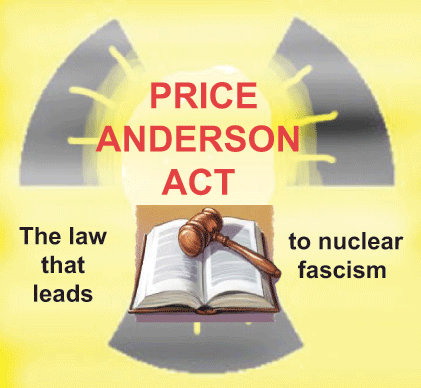
February 28, 2024, https://beyondnuclear.org/price-anderson-act-renewal-still-hiding-from-public/
The ADVANCE Act of 2023 (HR6544) with Price-Anderson renewal for 40 years passes US House floor vote
Bipartisan support to extend severe accident liability protection to “inherently safe” new reactors?
The “Price-Anderson Nuclear Industries Indemnity Act”, also known as the “Price-Anderson Act” (PAA), is moving for renewal by Congress. The federal law to shield the nuclear industry from full liability of a nuclear accident is presently scheduled to sunset on December 31, 2025.
However, there is remains little to no transparency of the Act’s extension and expansion process to the public’s scrutiny of its incongruities.
Since 1957, Congress has periodically extended an adjusted upper limit for the nuclear industry’s financial liability protection from the otherwise unpredictably high projected cost in damages from the next severe radiological accident at a commercial nuclear power plant.
Originally, the industry’s limited liability for damages caused by a single nuclear accident was artificially set at $500 million per incident including personal injuries caused by radioactive fallout, population and economic dislocation by prolonged evacuations without re-entry, potentially permanent loss of property (residential, commercial and industrial), agricultural production and the contamination of natural resources with widespread and long-lived radioactivity.
The “Price-Anderson Nuclear Industries Indemnity Act”, also known as the “Price-Anderson Act” (PAA), is moving for renewal by Congress. The federal law to shield the nuclear industry from full liability of a nuclear accident is presently scheduled to sunset on December 31, 2025.
However, there is remains little to no transparency of the Act’s extension and expansion process to the public’s scrutiny of its incongruities.
Since 1957, Congress has periodically extended an adjusted upper limit for the nuclear industry’s financial liability protection from the otherwise unpredictably high projected cost in damages from the next severe radiological accident at a commercial nuclear power plant.
Originally, the industry’s limited liability for damages caused by a single nuclear accident was artificially set at $500 million per incident including personal injuries caused by radioactive fallout, population and economic dislocation by prolonged evacuations without re-entry, potentially permanent loss of property (residential, commercial and industrial), agricultural production and the contamination of natural resources with widespread and long-lived radioactivity.
According to the latest figures provided by the Congressional Research Service (CRS) Report published January 25, 2024, the industry’s financial liability ceiling for a single, severe nuclear accident is now capped at $16.6 billion by federal law. Beyond that ceiling, damages would supposedly be covered by US taxpayers. But the still unrealized total damage costs of a severe nuclear accident as evidenced by ongoing nuclear catastrophes at Fukushima (13 year ago) and Chernobyl (38 years ago) are already running into the hundreds of billions of dollars. The Fukushima Daiichi nuclear catastrophe’s damage is recently updated to surpass ¥15.4 trillion ($102.7 billion).
The PAA renewal is part of the controversial “Accelerating Deployment of Versatile, Advanced Nuclear for Clean Energy (ADVANCE) Act of 2023” that is now approved by both the Senate and the House with significant differences including the PAA liability protection extension period.
The US Senate version (SB 1000) extends the PAA by 20 years to December 31, 2045, was passed on July 31, 2023 as a “must pass” inclusion in the National Defense Authorization Act of 2023 without a single public hearing. With Senate passage, the National Defense Authorization Act went to the US House of Representatives for approval where the ADVANCE Act of 2023 along with the PAA renewal on its coattail were instead culled from the military spending bill.
The ADVANCE Act with its the Price-Anderson renewal rider were introduced to the House as stand alone legislation (HR 6544) with the House version extending the industry’s limited accident liability protection to 40 years (December 31, 2065). According to E&ENews, “The House will vote on bipartisan nuclear energy legislation this week (02.26.2024) in hopes of reaching an agreement with the Senate in the coming weeks”—still without a single public hearing. The House floor vote to pass the HR 6544 with broad bipartisan support was confirmed by E&ENews February 29, 2024. The ADVANCE Act with the Price-Anderson extension for 40 years now goes back to the Senate to consider reconciliation.
Both the Senate and House versions intend to expand the government’s limited accident liability coverage beyond the aging, economically distressed and grandfathered commercial nuclear power fleet to now include new and supposedly “inherently safe” Small Modular Reactors and Advanced Non-Light Water reactor designs that incongruently could be licensed without any offsite radiological emergency planning zones.
All of this, thus far, has been accomplished without the transparency of a single congressional hearing in either the US Senate or House to explain the extension and expansion of Price-Anderson Act liability protection to increasingly economically distressed old reactors and new reactors where safety claims have yet to be technically certified.
“Tritium Removal” A Report on the Proposed MCECE nuclear Facility at Chalk River
“Tritium Removal” A Report on the Proposed MCECE Facility at Chalk
River by Gordon Edwards, Ph.D. for the Keboawek First Nation. In a letter
to Keboawek First Nation dated February 2, 2024 (reference # 2), we read
that “CNL is restoring and protecting Canada’s environment by reducing
and effectively managing nuclear liabilities.
Among these liabilities is
Atomic Energy of Canada’s (AECL) large inventory of tritium contaminated
heavy water.” In an accompanying Fact Sheet (reference # 3) CNL states
that “tritiated heavy water cannot be used, re-used or disposed of in its
current form.”
The fact that tritium-contaminated heavy water cannot be
used, re-used, or even disposed of in its present form is a testament to
the considerable hazards posed by radioactive tritium. Nevertheless,
tritiated heavy water can be safely stored, and kept out of the
environment, as is being done at present. There is no reason given by CNL
as to why such storage cannot be continued indefinitely, until the
radioactive tritium has disintegrated to innocuous levels.
Canadian Coalition for Nuclear Responsibility 27th Feb 2024
More indictments for Ohio nuclear crimes

The mainstream national press has scarcely reported any of this. Maybe they view it as a local story. But this kind of nuclear corruption has also occurred in South Carolina and Illinois, culminating in multiple indictments and prison sentence
Why does the nuclear industry find itself mired in these kinds of criminal conspiracies? Because it has no chance of standing on its own financial feet.
Former executives face a judge — in their ankle monitors
By Linda Pentz Gunter, , beyondnuclearinternational
It was called “likely the largest bribery money-laundering scheme ever perpetrated against the people of the state of Ohio.” And the shoes are still dropping. Or should that be ankle monitors? Because these latter belong to the three latest criminals indicted for their roles in a scheme that saw FirstEnergy hand over $61 million in bribes to Ohio politicians and their co-conspirators to secure favorable legislation.
That bill, known as HB6, guaranteed a $1.3 billion bailout to FirstEnergy in order to keep open its two failing Ohio nuclear power plants, Davis-Besse and Perry, as well as struggling coal plants. The nuclear portion of the bill has since been rescinded, but Ohio consumers are still paying to prop up two aging coal plants, to the tune of half a million dollars a day, amounting to an extra $1.50 a month on every ratepayer’s electric bill.
The $61 million bribery plot was the mastermind of then speaker of the Ohio House, Larry Householder, who is now a household name in Ohio for all the wrong reasons. He was sentenced last June to 20 years in prison for his part in the conspiracy. GOP Chairman Matt Borges, was also found guilty of racketeering conspiracy and sentenced to five years in federal prison. Both men say they will appeal.
Householder may have been the instigator, but in those earlier trials, FirstEnergy was described as a company that went “looking for someone to bribe them”. They found willing accomplices among politicians but also in the person of then Ohio Public Utilities Commission chairman, Samuel Randazzo.
So on February 12, yet more indictments were handed down, this time to Randazzo and the two FirstEnergy executives who corrupted him — former CEO Charles Jones, and former senior vice president of external affairs, Michael Dowling.
Their list of crimes, including a collective 27 felonies, was announced at a press conference by Ohio Attorney General Dave Yost. But although the presence of their company had been requested, the accused were not there. ……………………………………………………………
The mainstream national press has scarcely reported any of this. Maybe they view it as a local story. But this kind of nuclear corruption has also occurred in South Carolina and Illinois, culminating in multiple indictments and prison sentences. It’s possible we could yet see something similar go down in Georgia as electricity rates there soar to pay for the two late-arriving and over-budget Vogtle reactors, the second of which just started fissioning earlier this month.
Why does the nuclear industry find itself mired in these kinds of criminal conspiracies? Because it has no chance of standing on its own financial feet. Meanwhile, cheaper, faster, more job-friendly renewable energy industry options are leaving nuclear power behind in a cloud of radioactive dust.
This economic collapse has, in turn, put pressure on politicians to make things right for their corporate nuclear friends, something Senator Joe Manchin and others are currently working hard to do on Capitol Hill.
So there may yet be more shoes (and ankle monitors) to drop and it’s going to be very interesting to see who’s wearing them.
Linda Pentz Gunter is the international specialist at Beyond Nuclear and writes for and edits Beyond Nuclear International. https://beyondnuclearinternational.org/2024/02/25/more-indictments-for-ohio-nuclear-crimes/
USA is littered with nuclear sites that could face danger from natural disasters

Elizabeth Weise, USA TODAY
Massive wildfires in Texas caused operations at the nation’s primary nuclear weapons facility to be paused earlier this week, another reminder that the United States is covered in highly sensitive locations that house nuclear weapons, waste and energy reactors.
The U.S. has more than 3,700 nuclear warheads stockpiled around the country and 54 nuclear power plants in 28 states. And while nuclear energy facilities and weapons sites have always been built with potential natural disasters in mind — whether it was earthquakes, hurricanes, tornadoes or floods — those disasters stress their support systems and create new worries for safety experts.
As of Wednesday evening, the Pantex nuclear weapons plant near Amarillo was not harmed and safely reopened.
Experts told USA TODAY that natural disasters like Texas’ wildfires typically don’t create an immediate nuclear threat, but they do make carefully caring for nuclear materials more expensive and difficult, increasing safety worries over the long term. Those worries are only compounded by disasters that keep getting worse as the planet warms………………………………………………………….
an analysis of the risks at nuclear power plants done in 2020 by business research and risk firm Moody’s found that costs are likely to increase due to the need to increase protections in a changing climate. That’s in part because nuclear power plants use external water sources for cooling, so most are built near rivers, lakes and oceans, putting them at greater risk of flooding, storm surges and sea level rise. https://www.usatoday.com/story/news/nation/2024/02/28/texas-wildfire-burned-near-nuclear-weapons-site-is-that-dangerous/72772407007/
Atlantic Council report lays out options and possible first use of nuclear weapons against China over Taiwan.

The United States might also find itself in a situation in which it could not stop a Chinese invasion force from reaching Taiwan with conventional forces, but it could do so with nuclear weapons.
In this instance, the United States should be prepared to consider nuclear first use as well.
The Atlantic Council: Scowcroft Center for Strategy and Security has produced for us their report entitled: “DELIBERATE NUCLEAR USE IN A WAR OVER TAIWAN: Scenarios and Considerations for the United States” by Matthew Kroenig
Here below is the Conclusion of their 20 page report:
As US planners grow increasingly focused on the risk of a US-China war over Taiwan, they should be sure to pay attention to the nuclear dimension of such a possible conflict. Either side might rationally choose to gamble on nuclear escalation rather than risk defeat in such a high-stakes conflict.
To respond to possible Chinese nuclear use, the United States should identify a variety of targets on and off the Chinese mainland that would pose a setback to China’s war progress without making Chinese leadership fear for its own survival or for its nuclear force. These targets could include PLA Navy vessels; Chinese beachheads on Taiwan; or mainland ports, air bases, or headquarters supporting the invasion.
The United States might also find itself in a situation in which it could not stop a Chinese invasion force from reaching Taiwan with conventional forces, but it could do so with nuclear weapons. In this instance, the United States should be prepared to consider nuclear first use as well.
The United States should prepare for the possibility of nuclear use in a Taiwan Strait contingency by developing the strategies, alliance and partnership coordination mechanisms, and forces required to optimally deter Chinese nuclear use in these scenarios or to employ nuclear weapons if necessary. This report has set out some of those items for consideration.”
COMMENT from David Cooley: This Atlantic Council report lays out options and possible first use of nuclear weapons against China over Taiwan. This report, these folks think they can fight a nuclear war and “manage” it. This is slim possibility to outright fallacy to believe this possible. For survivability nuke control is dispersed, and there in lies human fallibility, and the best laid plans go out the window at first detonation. Escalation likely to follow based on simple use it or lose it for all sides. No where is it acknowledged that this is pure hubris, attempt to maintain world domination, they like to delude themselves with niceties like RBWO. This thinking outdoes Bibi and then some, crazy.
Texas nuclear weapons facility pauses as fires spread
The Standard, By John Crouch, February 28, 2024
A series of wildfires has swept across the Texas Panhandle, prompting evacuations, cutting off power to thousands, and forcing the shutdown of a nuclear weapons facility as strong winds, dry grass and unseasonably warm temperatures fed the blazes.
An unknown number of homes and other structures in Hutchinson County were damaged or destroyed, local emergency officials said.
The main facility that assembles and disassembles America’s nuclear arsenal shut down its operations Tuesday night.
“We have evacuated our personnel, non-essential personnel from the site, just in an abundance of caution,” Laef Pendergraft, a spokesman for National Nuclear Security Administration’s Production Office at Pantex, said during a news conference………………………………………………….
Republican Governor Greg Abbott issued a disaster declaration for 60 counties as the largest blaze, the Smokehouse Creek Fire, burned more than 1000 square kilometres, according to the Texas A&M Forest Service.
That is more than twice its size since the fire sparked on Monday……………………………………more https://www.standard.net.au/story/8539003/texas-nuclear-weapons-facility-pauses-as-fires-spread/
Victoria Nuland accidentally reveals the true aim of the West in Ukraine

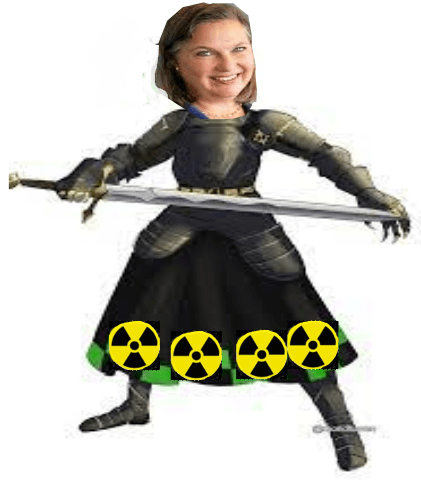
“And by the way, we have to remember that the bulk of this money is going right back into the US to make those weapons,” Nuland said, pleading in favor of the latest Ukraine aid package “
Ukrainians are a convenient pretext to keep the tax cash flowing in the direction of the US military industrial complex
SOTT, Rachel Marsden, Tue, 27 Feb 2024
US State Department fixture and Under Secretary of State for Political Affairs, Victoria Nuland, aka “Regime Change Karen,” apparently woke up one day recently, took the safety off her nuclear-grade mouth, and inadvertently blew up the West’s Ukraine narrative.
Until now, Americans have been told that all the US taxpayer cash being earmarked for Ukrainian aid is to help actual Ukrainians. Anyone notice that the $75 billion American contribution isn’t getting the job done on the battlefield? Victory in military conflict isn’t supposed to look like defeat. Winning also isn’t defined as, “Well, on a long enough time axis, like infinity, our chance of defeat will eventually approach zero.” And the $178 billion in total from all allies combined doesn’t seem to be doing the trick, either. Short of starting a global war with weapons capable of extending the conflict beyond a regional one, it’s not like they’ve been holding back. The West is breaking the bank. All for some vague, future Ukrainian “victory” that they don’t seem to want to clearly define. We keep hearing that the support will last “as long as it takes.” For what exactly? By not clearly defining it, they can keep moving the goal posts.
But now here comes Regime Change Karen, dropping some truth bombs on CNN about Ukrainian aid. She started off with the usual talking point of doing “what we have always done, which is defend democracy and freedom around the world.” Conveniently, in places where they have controlling interests and want to keep them – or knock them out of a global competitor’s roster and into their own. “And by the way, we have to remember that the bulk of this money is going right back into the US to make those weapons,” Nuland said, pleading in favor of the latest Ukraine aid package that’s been getting the side eye from Republicans in Congress.
So there you have it, folks. Ukrainians are a convenient pretext to keep the tax cash flowing in the direction of the US military industrial complex. This gives a whole new perspective on “as long as it takes.” It’s just the usual endless war and profits repackaged as benevolence. But we’ve seen this before. It explains why war in Afghanistan was little more than a gateway to Iraq. And why the Global War on Terrorism never seems to end, and only ever mutates. Arguably the best one they’ve come up with so far is the need for military-grade panopticon-style surveillance, so the state can shadow-box permanently with ghosts while bamboozling the general public with murky cyber concepts that it can’t understand or conceptualize. When one conflict or threat dials down, another ramps up, boosted by fearmongering rhetoric couched in white-knighting. There’s never any endgame or exit ramp to any of these conflicts. And there clearly isn’t one for Ukraine, either.
Still, there’s a sense that the realities on the ground in Ukraine, which favor Russia, now likely mean that the conflict is closer to its end than to its beginning. Acknowledgements abound in the Western press. And that means there isn’t much time left for Europe to get aboard the tax cash laundering bandwagon and stuff its own military industrial complexes’ coffers like Washington has been doing from the get-go.
Which would explain why a bunch of countries now seem to be rushing to give Ukraine years-long bilateral security “guarantees,” requiring more weapons for everyone. France, Germany, Canada, and Italy have all made the pledge. Plus Denmark, which also flat-out said that it would send all its artillery to Ukraine………………………………………………
Thanks to Nuland’s nuking of any plausible deniability on Ukrainian “aid” not going to Washington, it’s now clear that Ukrainians continue to die so poor weapons makers don’t end up shaking tin cans on street corners.………………………………………………………………………….. more https://www.sott.net/article/489314-Nuland-accidentally-reveals-the-true-aim-of-the-West-in-Ukraine
Texas: Disaster declaration issued and nuclear weapons plant shut down as wildfires spread
Sky News, Reemul Balla, 28 Feb 24
A disaster declaration has been issued for dozens of counties in northern Texas as raging wildfires forced evacuations in several towns and a nuclear weapons plant to shut down.
Republican governor Greg Abbott proclaimed 60 counties were in a state of disaster and called for extra emergency services to support local firefighters in tackling the blazes………………………………………………………………………….
Pantex nuclear facility paused operations until further notice due to an out-of-control fire approaching its Panhandle site near Amarillo.
Its 16,000-acre site is home to the plant that builds and disassembles America’s nuclear weapons.
“The fire near Pantex is not contained,” the company said. “Response efforts have shifted to evacuations.”
Pantex confirmed there was no fire on the site as emergency services continued to monitor the situation.
It added “all employees” had been accounted for and “non-essential personnel” were no longer on site………………………………………………………………………………………. more https://news.sky.com/story/texas-disaster-declaration-issued-and-nuclear-weapons-plant-shut-down-as-wildfires-spread-13082651
Fish v. electricity: Could Salem nuclear plant be shut down?

Delaware Live KARL BAKER FEBRUARY 16, 2024
A judge in an obscure administrative court in Trenton, N.J., is set to hand down a ruling that could end a challenge to the Salem nuclear plant’s ability to pump billions of gallons of water out of the Delaware River each day.
The case, which strikes at the heart of the mid-Atlantic electricity ecosystem, pits a tenacious environmental group against one of the region’s largest energy companies, and its ultimate resolution could impact electricity prices for Delawareans, the health of birds and fish in the Delaware estuary, and President Joe Biden’s most ambitious energy initiative to date.
In short, it’s the region’s biggest environmental battle that you’ve probably never heard of.
At issue is the way in which the Salem Nuclear Generating Station’s two reactors cool steam created by the heat of nuclear fission. Currently, the plant pumps cold water from the Delaware River through a system of pipes that lead it to the steam, which is then cooled back to a liquid form.
The river water then returns to the estuary, but at far higher temperatures than when it was pumped in.
In all, the process kills large numbers of fish and fish larvae, though the exact amounts are disputed.
In late 2016, the Delaware Riverkeeper Network , an environment group and active critic of heavy industry in the region – petitioned New Jersey to rescind a permit that allows the plant to pump water out of the river.
When filed, the challenge was the latest of more than a decade of petitions, disputes and complaints brought against the Salem facility by the environmental group and its outspoken leader Maya van Rossum, who calls the power plant the largest “predator” in the Delaware estuary.
Van Rossum claims that 3 billion adult fish are killed on average each year by the plant’s cooling operations, plus billions more eggs and larvae. Those include the bay anchovy, a species that has suffered a declining local population even as larger fish, eagles, herons, and even whales rely on it for food.
“The cause of the problem for the fish is that the Salem Nuclear Generating Station is sucking them in, cooking them, ripping them apart, destroying them,” she said.
The New Jersey Department of Environmental Protection, which declined to comment for this story, suggested in their permit issued to Salem that the mortality figures cited by van Rossum and other critics are overstated.
Still, they do not appear to have presented current, counter estimate
During the early 2000s, the U.S. Environmental Protection Agency issued new rules mandating that new large power plants use closed-cycle cooling…………………………………………………………………………………………………………………………. more https://delawarelive.com/fish-v-electricity-could-salem-be-shut-down/
Burying nuclear waste the best of a bad bunch of options
A reader offers her opinion on what to do with nuclear waste as Saskatchewan considers small modular reactors for its future energy needs.
I share the concern that Dale Dewar expressed in the StarPhoenix of Feb. 20 about the long-term management of Canada’s used nuclear fuel.
However, my conclusion is that, while far from ideal, deep burial is the best of a bunch of bad available options. There are no good options. Even proposals to extract recyclable material from the used fuel will leave behind most of the waste to be somehow disposed of.
Dewar’s suggestion that the wastes should remain permanently on the surface, with a system of rolling stewardship that would be passed on from generation to generation, might work in a world that could be guaranteed to be permanently free of war, terrorism, natural disasters, negligence and political instability.
But that’s not the world we live in. We cannot assume that safe stewardship would be maintained in perpetuity. Leaving the wastes indefinitely on the surface would seem to create far greater risk than deep geological burial would.
Of course, it would have been nice if we had thought about this problem before we started creating these wastes.
1 This Month
23 April – WEBINAR – Why new nuclear reactors are the wrong tools for decarbonization Thursday, April 23 • 1 AM – 2 AM AEST

Pine Ridge Uranium is the real threat, not Tehran- Tell Burgum: Stop the Extraction.
Chernobyl: The Lost Tapes – A good documentary on Chernobyl on SBS available On Demand for the next 3 weeks– https://www.sbs.com.au/ondemand/tv-program/chernobyl-the-lost-tapes/2352741955560
To see nuclear-related stories in greater depth and intensity – go to https://nuclearinformation.wordpress.com
-
Archives
- April 2026 (241)
- March 2026 (251)
- February 2026 (268)
- January 2026 (308)
- December 2025 (358)
- November 2025 (359)
- October 2025 (376)
- September 2025 (257)
- August 2025 (319)
- July 2025 (230)
- June 2025 (348)
- May 2025 (261)
-
Categories
- 1
- 1 NUCLEAR ISSUES
- business and costs
- climate change
- culture and arts
- ENERGY
- environment
- health
- history
- indigenous issues
- Legal
- marketing of nuclear
- media
- opposition to nuclear
- PERSONAL STORIES
- politics
- politics international
- Religion and ethics
- safety
- secrets,lies and civil liberties
- spinbuster
- technology
- Uranium
- wastes
- weapons and war
- Women
- 2 WORLD
- ACTION
- AFRICA
- Atrocities
- AUSTRALIA
- Christina's notes
- Christina's themes
- culture and arts
- Events
- Fuk 2022
- Fuk 2023
- Fukushima 2017
- Fukushima 2018
- fukushima 2019
- Fukushima 2020
- Fukushima 2021
- general
- global warming
- Humour (God we need it)
- Nuclear
- RARE EARTHS
- Reference
- resources – print
- Resources -audiovicual
- Weekly Newsletter
- World
- World Nuclear
- YouTube
-
RSS
Entries RSS
Comments RSS
 nuclear-news