A New Brunswick reaction to the exorbitant costs of Point Lepreau nuclear power station.

When the Point Lepreau Nuclear Generating Station was refurbished over three years and re-opened in 2012, NB Power did not complete a number of associated repairs, despite the lengthy time and high cost of the refurbishment.
As a result, the nuclear plant has experienced many problems since the refurbishment and has been performing poorly. Since 2023, the NB nuclear plant has been managed by Ontario Power Generation, three managers costing $2 Million per year, under a three-year contract. I’m unsure if these people actually live in New Brunswick and pay taxes here or if New Brunswick is sending the money directly to Ontario.
At the start of April, the Lepreau nuclear plant was shut down for a scheduled 100 days to do the associated upgrades/repairs that NB Power hopes will improve the performance. The cost of the repairs was estimated at more than $300 million including the replacement power for this year’s repairs and another scheduled repair session in 2025. The first repairs were scheduled to end last week but instead of starting up again, the engineers noted a major problem with the main generator. Note that most of these engineers and workers doing this scheduled upgrade / repair are from Ontario, so it’s unclear how much of this cash is staying in the province.
Today we learned that the repair to the generator will cost an extra $70 million and the plant is down at least till September, which they say is a best case scenario.
So, when all this is over, what can New Brunswickers expect? At the end of the story below is this kicker: “Even by 2030, NB Power still thinks the plant will be mired in the basement, performance wise.”
What a F*** disaster. It’s absolutely nuts that our small province with a population of only 800,000 people has a nuclear reactor. In addition to the nuclear waste and other problems the reactor creates, we can’t afford it and we do not have the capacity in-province to look after it!
Point Lepreau nuclear station down till at least September, costing utility extra $71M.
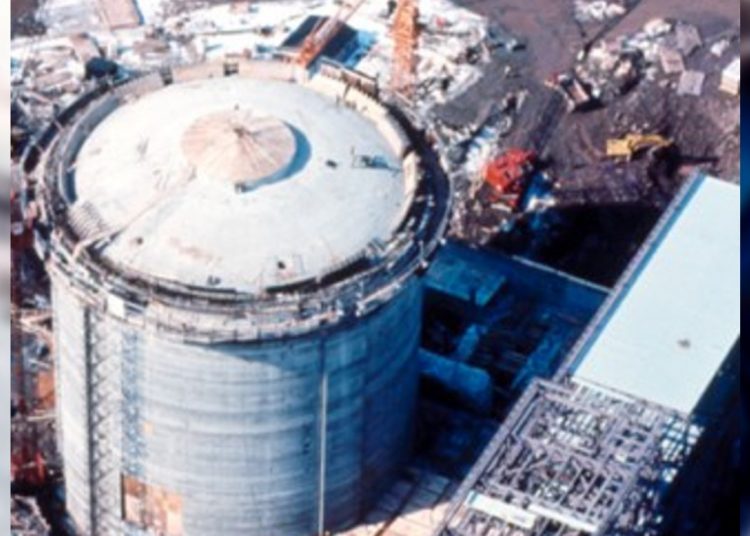
All of this has been costly for the utility, which now carries more than $5 billion in debt, and to ratepayers, who are being asked to swallow the biggest increases to their bills in their lifetimes.
New target is a ‘best-case scenario,’ said expert of 27 years, who added it ‘wouldn’t be appropriate’ to give a worst-case scenario.
Telegraph Journal, John Chilibeck, Jul 22, 2024
The prolonged shutdown at the Point Lepreau nuclear plant is raising alarm, including over how it could affect power bills for residents and businesses.
At a rate hearing in Fredericton on Monday, NB Power officials said the longer-than-expected shutdown would likely last until at least September and cost an extra $71 million. That includes $51 million for buying replacement power and about $20 million for added repair and equipment costs.
Craig Church, a chief modeler for the public utility, said it would cost on average an extra $900,000 for each day Lepreau is shuttered given it is one of the cheapest in NB Power’s fleet of generators to run.
It normally provides one-third of the province’s electricity.
“The loss will have to be made up by future ratepayers?” asked public intervenor Allain Chiasson at the hearing.
After a pregnant pause, Church replied yes.
NB Power is already seeking the biggest hike in electrical bills in a lifetime. If the New Brunswick Energy and Utilities Board, an independent regulator, grants its request, households will have to pay 9.8 per cent more this year and 9.8 per cent more next year.
According to NB Power’s evidence, the average electrically heated residential customer is billed about $3,087 annually. Adding 9.8 per cent to that bill would be another $303, or a total of $3,390.
Big industry is facing a similar percentage hike, whereas small and medium-sized businesses would face slightly smaller increases.
But the evidence before the board does not take into account the prolonged shutdown of Lepreau, meaning those extra costs will only come into play in future years.
NB Power undertook a 100-day outage of Lepreau, west of Saint John along the Fundy coast, from mid-April to mid-July to overhaul parts of the non-nuclear side of the plant at a cost of $124 million.
It was part of a planned shutdown to renew the plant and make sure it was robust enough for the winter, when it supplies baseload power for the province. According to the plan, the upgrades were supposed to be completed last week.
But on Monday, an expert on the NB Power panel, Jason Nouwens, the director of regulatory and external affairs at Lepreau, said on June 29, the team discovered a problem with the main generator on the non-nuclear side of the plant.
Specifically, one of 144 stator bars in a giant rotor had failed, but NB Power isn’t sure why. To get to the failed equipment, workers must painstakingly take apart the generator piece by piece, a job that will take at least two weeks.
Then, Nouwens said, the troubleshooting team that includes outside experts from the Canadian nuclear industry will try to figure out why the stator bar broke and possible remedies to prevent such a failure from happening again.
The expert, who has been working at Lepreau 27 years, said the plant coming back online in September was a best-case scenario. When asked by one of the interveners, Nouwens said it “wouldn’t be appropriate” to give a worst-case scenario.
Besides the extra costs caused by the delayed re-start, questions have been raised about possible spillover.
On Friday at the same hearings at the Fredericton Convention Centre, a lawyer working on behalf of J.D. Irving, Limited asked NB Power officials repeatedly how the longer-than-expected outage at the nuclear generator would affect other important power plants in the electrical system.
The lawyer Glenn Zacher had before him Phil Landry, NB Power’s executive director of project management offices, who answered questions about other power plants in the system.
The other plants are also supposed to undergo regular outages for maintenance and repairs to ensure they are safe and reliable.
But some of the maintenance work has already been delayed because those plants need to be running when Lepreau is down, otherwise people’s lights and air conditioners wouldn’t work.
“When is it too late to do undertake maintenance elsewhere?” asked Zacher. “It seems to be an important question to be answered.”
Landry, however, didn’t have any firm answers and struggled to give any specific timelines, given the uncertainty at Lepreau
Landry explained to the board that NB Power has been running the Belledune Generating Station – which belches out emissions from high-polluting coal – and Coleson Cove, which burns similarly polluting heavy oil, to replace the energy lost at Lepreau.
Belledune was supposed to undergo maintenance and repairs right now, at a cost of $17.1 million, but its 46-day outage has been indefinitely delayed………………………………….
Pushing out the maintenance to later in the year, closer to the winter months, is not an ideal scenario, Landry said, because they need to be running smoothly when people heat their homes and electrical demand is greatest.
NB Power refurbished the nuclear side of the plant in 2012, at a cost of $2.5 billion, a project that was over-budget by $1 billion and took 37 months longer to complete than expected. But NB Power didn’t do similar work to other important parts of the plant, leading to frequent breakdowns.
All of this has been costly for the utility, which now carries more than $5 billion in debt, and to ratepayers, who are being asked to swallow the biggest increases to their bills in their lifetimes.
NB Power CEO Lori Clark has promised Lepreau will no longer be neglected in the hopes of improving its performance. The utility has partnered with Ontario Power Generation, which has more expertise with nuclear plants, to ensure the next phase of the overhaul is done right.
A benchmarking study showed Lepreau is one of the worst performers out of 38 similar nuclear power plants in the world, consistently in the bottom quarter.
On Monday, Nouwens said NB Power was committed to improving the plant’s performance but cautioned it would take years of extra spending and repair work to get to the average performance of most nuclear plants. He pointed out that Lepreau has 115,000 different components, many of which have to be replaced or repaired with age.
Even by 2030, NB Power still thinks the plant will be mired in the basement, performance wise.
“In the past, the work hasn’t been comprehensive and intrusive enough to reach the performance we need,” the executive said. “We’ve under-invested, causing unreliability.” https://tj.news/new-brunswick/long-shutdown-of-nuclear-plant-would-have-knock-on-effect-warns-lawyer
High hopes and security fears for next-gen nuclear reactors

Fuel for advanced reactors is raising nuclear proliferation concerns.
The Verge, By Justine Calma, a senior science reporter covering energy and the environment with more than a decade of experience. She is also the host of Hell or High Water: When Disaster Hits Home, a podcast from Vox Media and Audible Originals, Jul 20, 2024
Next-generation nuclear reactors are heating up a debate over whether their fuel could be used to make bombs, jeopardizing efforts to prevent the proliferation of nuclear weapons.
Uranium in the fuel could theoretically be used to develop a nuclear weapon. Older reactors use such low concentrations that they don’t really pose a weapons proliferation threat. But advanced reactors would use higher concentrations, making them a potential target of terrorist groups or other countries wanting to take the fuel to develop their own nuclear weapons, some experts warn.
They argue that the US hasn’t prepared enough to hedge against that worst-case scenario and are calling on Congress and the Department of Energy to assess potential security risks with advanced reactor fuel.
Other experts and industry groups still think it’s unfeasible for such a worst-case scenario to materialize. But the issue is starting to come to a head as nuclear reactors become a more attractive energy source, garnering a rare show of bipartisan support in Congress.
……. Earlier this month, President Joe Biden signed bipartisan legislation into law meant to speed the development of next-generation nuclear reactors in the US by streamlining approval processes.
………….The US Nuclear Regulatory Commission (NRC) certified an advanced small modular reactor design for the first time last year. And we’re likely still years away from seeing commercial plants in action. But if the US ever wants to get there, it’ll also have to build up a supply chain for the fuel those advanced reactors would consume. The Inflation Reduction Act includes $700 million to develop that domestic fuel supply.
Today’s reactors generally run on fuel made with a uranium isotope called U-235. Naturally occurring uranium has quite low concentrations of U-235; it has to be “enriched” — usually up to a 5 percent concentration of U-235 for a traditional reactor. Smaller advanced reactors would run on more energy-dense fuel that’s enriched with between 5 to 20 percent U-235, called HALEU (short for high-assay low-enriched uranium).
That higher concentration is what has some experts worried. “If the weapons usability of HALEU is borne out, then even a single reactor would pose serious security concerns,” says a policy analysis penned by a group of nuclear proliferation experts and engineers published in the journal Science last month (including an author credited with being one of the architects of the first hydrogen bomb).
Fuel with a concentration of at least 20 percent is considered highly enriched uranium, which could potentially be used to develop nuclear weapons. With HALEU designs reaching 19.75 percent U-235, the authors argue, it’s time for the US to think hard about how safe the next generation of nuclear reactors would be from malicious intent.
“We need to make sure that we don’t get in front of ourselves here and make sure that all the security and safety provisions are in place first before we go off and start sending [HALEU] all around the country,” says R. Scott Kemp, associate professor of nuclear science and engineering and director of the MIT Laboratory for Nuclear Security and Policy.
That 20 percent threshold goes back to the 1970s, and bad actors ostensibly have more information and computational tools at their disposal to develop weapons, Kemp and his coauthors write in the paper. It might even be possible to craft a bomb with HALEU well under the 20 percent threshold, the paper contends……………………………………………………………………………………..
Aside from asking Congress for an updated security assessment of HALEU, the paper suggests setting a lower enrichment limit for uranium based on new research or ramping up security measures for HALEU to more closely match those for weapons-usable fuels.
…………………………“Unless there’s a really good reason to switch to fuels that pose greater risks of nuclear proliferation, then it’s irresponsible to pursue those,” says Edwin Lyman, director of nuclear power safety at the Union of Concerned Scientists and another author of the paper. Lyman has also raised concerns about the radioactive waste from nuclear reactors over the years. “There is no good reason.” https://www.theverge.com/24201610/next-generation-nuclear-energy-reactors-security-weapons-proliferation-risk
J.D. Vance unlikely to advance peace advancing to Vice Presidency
Walt Zlotow, West Suburban Peace Coalition, Glen Ellyn IL, 21 July 24
Newbie Senator J.D. Vance will become America’s 50th Vice President next January 20 if current polling holds up.
Most criticism of Vance focuses on the 39 year old’s scant experience of just 18 months in government. His memoir ‘Hillbilly Elegy’ fame, billionaire Sugar Daddy support, and idolatry of Trump, vaulted Vance into the Senate and possibly now the Vice Presidency. Succeeding 78 year old President Trump on Inauguration Day before his second term expires is certainly possible.
But little to nothing has been raised about Vance’ mostly reckless views on foreign affairs that imperil prospects for peace during our current, perilous road to war in the Middle and Far East.
Even Vance’s opposition to our senseless proxy war against Russia destroying Ukraine is in furtherance of a bellicose foreign policy. He wants to divert the endless billions squandered on Ukraine’s lost cause to massively increase armaments to Taiwan and other Far East allies to contain China. Just like weaponizing of Ukraine in their Donbas civil war precipitated the Russian invasion, China is not likely to sit around twiddling their thumbs while America encircles them with weapons.
Vance has joined the unhinged GOP chorus threatening to take out Iran for exercising influence in the Middle East. He said we need to “Punch back hard” to put Iran in its place…subservient to US hegemony in the region. That is nuts.
Back home Vance supports GOP policy of sending in the Marines to wipe out the Mexican drug cartels. “I want to empower the president of the United States, whether that’s a Democrat or Republican, to use the power of the U.S. military to go after these drug cartels.” To paraphrase Forrest Gump, ‘Stupid is …when Vance talks on foreign policy’.
But most disturbing of Vance’s foreign policy views is his full support for Israel’s genocidal ethnic cleansing of Palestinians in Gaza. President Biden’s 24,000 tons of bombs are not enough for Vance’s lust to wipe out the Palestinians there. Like his mentor Trump, Vance wants Israel to “finish the job” while criticizing Biden for “micromanaging” the ghoulish slaughter there.
It is not improbable that a Trump victory will eventually find Vance in the Oval Office before the ’28 Election. Lets’ hope that if so, the memoir of a Vance presidency is not ‘Armageddon Elegy’.
‘Near miss’ incident reported at nuclear waste site near Carlsbad
Federal watchdog reports ongoing safety concerns at WIPP
JULY 19, 2024, Adrian Hedden, Carlsbad Current-Argus
Federal nuclear oversight staff reported several safety problems at the Waste Isolation Pilot Plant in a monthly report, despite a “safety stand down” in April that was intended to pause work while WIPP officials retooled various protocols.
The Defense Nuclear Facilities Safety Board (DNSFB) reported “ongoing safety culture challenges” in its June 7 report on WIPP activities as the facility near Carlsbad disposes of transuranic (TRU) nuclear waste from federal facilities around the country.
The monthly report covered observations and incidents from May, noting a “near miss” incident which saw a waste handler improperly using a forklift instead of a crane to reposition weights in the parking lot waste storage area.
The May 20 event saw the waste handler using two forklifts to reposition a “six-ton” calibration weight, read the report, without proper documentation or analysis or the awareness of a shift supervisor.
The forklift sling broke while rotating the weight, read the report, causing it to fall on its side and send a shackle flying “a significant distance” away from the lift and past a spotter.
In another incident, all routine work was paused May 23 to 28 after a bolter contacted an electrical box near WIPP’s exhaust shaft, read the report, causing a bulkhead to lose function, rendering sump pumps inoperable and creating potential exposure to “hazardous energy.”………………………………………………….. more https://www.currentargus.com/2024/07/near-miss-incident-reported-at-nuclear-waste-site-near-carlsbad/
In New Mexico, a Walk Commemorates the Nuclear Disaster Few Outside the Navajo Nation Remember
the Navajo Birth Cohort Study, which since 2010 has been looking at the relationship between uranium exposures, birth outcomes and child development on the Navajo Nation. Among the findings is that mothers were deficient in key nutrients for babies’ developing nervous systems.
The Church Rock spill released more radioactive material than the partial meltdown at Three Mile Island four months earlier. Last week’s walk highlights the continuing cleanup and the ongoing hazards uranium mining poses to tribal lands.
Inside Climate News, By Noel Lyn Smith, July 20, 2024
RED WATER POND ROAD, New Mexico—As Tony Hood walked along New Mexico Highway 566 last Saturday, he thought about where he was 45 years earlier, when an earthen dam broke at the site of a uranium mill operated by the United Nuclear Corp., releasing 94 million gallons of radioactive water and 1,100 tons of uranium waste across portions of New Mexico, Arizona and the Navajo Nation.
Hood was working inside a nearby underground mine owned by the Kerr-McGee Corp. when the dam broke on July 16, 1979. He didn’t learn about the spill until after returning to the surface.
As he walked in this month’s event commemorating the spill, he pointed to the spot where the dam was located.
“I guess they observed there was some cracks in the earthen dam but they didn’t do nothing about it,” he said. “Finally, the dam collapsed, breached.”
The dam failure at the processing mill north of Church Rock, New Mexico, released radioactive liquid that eventually flowed into the Rio Puerco and through areas on the Navajo Nation, nearby Gallup, New Mexico, and, finally, Arizona. Now known as the Church Rock spill, the accident released the most radioactive material in U.S. history—more than the notorious partial meltdown at the Three Mile Island Nuclear Generating Station four months earlier—yet remains largely unknown to the American public.
The nonprofit Red Water Pond Road Community Association tries to remedy that lack of awareness by organizing the annual walk by the site of the spill, during which current and former area residents, supporters and advocates remember what happened that day. They also talk about the aftermath, including what federal and tribal agencies have done and need to do to clean up the communities affected by the accident.
……………………………………………………………………………………………………….. A report in May 2014 by the U.S. Government Accountability Office found that “Navajo people continue to live with the environmental and health effects from mining operations: more than 500 abandoned mines are located across the reservation, some close to homes and communities, and an unknown number of homes and drinking water sources contain radioactive elements.”
Educational materials distributed by the Red Water Pond Road Community Association mention some health studies that residents participated in. One is the Navajo Birth Cohort Study, which since 2010 has been looking at the relationship between uranium exposures, birth outcomes and child development on the Navajo Nation. Among the findings is that mothers were deficient in key nutrients for babies’ developing nervous systems. The association notes that a comprehensive study still needs to be done about the effects of uranium on Navajo health.
“We sacrificed our lives, our bodies to mine that ore,” Hood said…………………………………………………………………………………………………………………………………. Link: https://insideclimatenews.org/news/20072024/new-mexico-walk-commemorates-navajo-nation-nuclear-disaster/
80 CANADIAN ORGANIZATIONS CALL ON FEDERAL GOVERNMENT TO RESCIND APPOINTMENT OF NUCLEAR REGULATORY AGENCY PRESIDENT.
Ottawa, 17 July 2024 .- www.nuclearwastewatch.ca
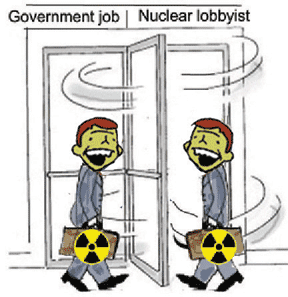
Over 80 civil society organizations from across Canada are speaking out and calling on Prime Minister Justin Trudeau and Governor General Mary Simon to rescind their recent appointment of Mr. Pierre Tremblay, a long time senior nuclear industry executive, as President of the Canadian Nuclear Safety Commission (CNSC).
In a joint letter citing conflict of interest and failure to adhere to International Atomic Energy Agency (IAEA) guidelines, the groups -a range of organizations that include in their ranks scientists and retired nuclear officials- also call on the Federal Government for an urgent reform of the CNSC and nuclear governance in Canada.
Mr. Tremblay has been a long-time senior business executive at Ontario Power Generation (Canada’s largest nuclear operator and contractor of nuclear businesses), reported co-owner of a private nuclear business involved in the Plutonium trade, and most recently president of AECOM Canada Nuclear Services -a key contractor for two questionable projects expected to report billions of dollars to the nuclear businesses involved, and impact populations for centuries: a nuclear waste dump (“Near Surface Disposal Facility”) by the Ottawa river and a project to abandon high-level nuclear waste underground in Northern Ontario, both of them expecting CNSC licenses.
The groups also call on the Federal Government to take the opportunity to initiate a long-needed reform of the CNSC, which has often been described by observers as an “industry-captured regulator”.
The request notes that the CNSC has a communications branch with 60-plus staff but no dedicated human health and environmental protection branch, and has not turned down a single nuclear industry application in more than a decade. It has also actively lobbied to weaken impact assessment legislation to exclude a range of nuclear reactors and processing facilities.
Mr. Tremblay’s appointment follows other appointments to the Commission of industry insiders, and two troubling assessments of the CNSC’s performance by the International Atomic Energy Agency (IAEA) -a June 2024 follow-up to an initial 2019 IAEA mission highlighted several problem areas; despite the CNSC’s positive spin on the IAEA missions, the findings are a cause of deep concern for independent observers and experts.
Given the CNSC’s often-stated priority and legal mandate to protect the environment and the health of Canadians, the groups are requesting the Federal Government consider recruiting CNSC senior ranks from within the health and environmental protection communities, including perhaps Environment and Climate Change Canada and the federal Health Portfolio.
The signatory organizations note that the appointment contravenes both IAEA guidelines and the Federal Government’s own guidance on the independence of regulatory bodies, and compromises the public’s expectation of neutrality, objectivity and independence of Canada’s nuclear regulatory body and reinforces the public perception of industry capture of that body. Rescinding the appointment would be a significant step towards a much-needed reform of the CNSC and towards restoring public trust in that critically important agency.
Quotes: The Canadian Nuclear Safety Commission is supposed to be a neutral body, carefully safeguarding the health of the Canadian public and the environment from the risks associated with the use of nuclear energy. Senior executives from the nuclear industry should be disqualified from positions at the CNSC.” – Dr. Ole Hendrickson.
“Having a nuclear business executive whose companies have pushed for questionable projects placed in charge of the very agency that would now regulate and approve them, is an obvious conflict of interest” – J. P. Unger, science writer and policy analyst. “The Government should abandon any pretense of having a watchdog and true regulator for nuclear matters -or carry out its urgently needed reform.”
NATO/US Complicity in Israel’s Relentless Genocide of Gaza
Only 4 of 32 NATO Members do NOT Sell Weapons to Israel or Buy Weapons from Israel
Israel has been the largest cumulative recipient of U.S. foreign aid since its founding in 1948, having received about $310 BILLION dollars in economic and military assistance. Since October 7, 2023, the U.S. has passed legislation that has provided at least $12.5 billion in military aid to Israel, which included $3.8 billion from legislation in March 2024 and $8.7 billion from a supplemental appropriation in April 2024.
Biden says U.S. should not have “Killing Fields,” while he is complicit in the Israeli “Killing Fields” in Gaza.
ANN WRIGHT, JUL 17, 2024, LA Progressive
As Israel continued its relentless genocide on steroids of Palestinians in Gaza with over 140 killed in the past weekend, imprisonment without charges of thousands of Palestinians in the West Bank and destruction of the hospitals, universities, schools (8 UNRWA schools bombed in the past 10 days), cultural centers and indiscriminate bombing of markets, soccer fields and “safe area” residents of Gaza have been forced into, an assassination attempt was made on former President Trump and NATO finished its gala 75th Anniversary celebrations in Washington, DC.
Biden Says “U.S. Politics Should Never Be A Killing Field,” While He is complicit in the Israeli “Killing Fields” in Gaza
As the genocide continued and a few days after the end of the NATO celebrations, an assassination attempt on former President Trump caused President Biden to address the nation and orate that “political violence has no place in America and U.S. politics should never be a killing field.”
The statement of no political violence and no killing fields in America rings totally hollow as the Biden administration and NATO countries fuel the Israeli killing fields in Gaza with over 90 Palestinians killed and 300 wounded by multiple Israeli rocket attacks in Khan Yunis on Saturday, July 12, and 80 Palestinians killed in the past 24 hours of July 13 in several refugee camps.
NATO members fuel the Genocide of Gaza by Selling/Sending Weapons to Israel
Heads of 32 NATO member states and 10 NATO “global partners”, Australia, New Zealand, Japan, South Korea, Colombia, Mongolia, Iraq, Afghanistan and Pakistan, met in Washington, DC at the 75th Anniversary events of NATO.
Some of the NATO members and partners are the same countries that are aiding and abetting the Israeli genocide of Gaza.
An Office for the State of Israel Located in the NATO Headquarters
NATO has a long, close and relatively unknown relationship with Israel that, eight years ago, resulted in establishment of an Israeli office in NATO headquarters in Brussels in 2016. Underscoring the importance to Israeli association with NATO, Prime Minister Netanyahu said upon the opening of the office, “This is an important step that helps Israel’s security. It is further proof to the status of Israel and the willingness of many organizations to cooperate with us in the field of security.”
The invitation from NATO for Israel to have an office in NATO headquarters was a result of pressure by other NATO members on Turkey to drop its veto of the invitation. The invitation arose through a new NATO partnership policy beginning in 2014 but Turkey vetoed the invitation until 2016.
Behind the scenes negotiations between Turkey and Israel in 2015 warmed the chilly relationship that had been essentially severed between the countries in 2010 over Israeli commandos killing 10 Turkish activists and wounding over 50 participants on the Mavi Marmara, a Turkish ship bound for Gaza as a part of the 7-ship Gaza Freedom Flotilla.
According to NATO documents, NATO and Israel have worked together for almost 30 years, cooperating in science and technology, counter terrorism, civil preparedness, countering weapons of mass destruction and women, peace and security. To strengthen NATO naval interoperability NATO brought on Israel as a partner for NATO’s Operation Sea Guardian. Israel’s military medical academy now serves as a “unique asset” for NATO’s Partnership Training and Education Centers community.
Israel is not officially integrated in NATO but is part of the Mediterranean Dialogue, a program sponsored by NATO in cooperation with seven countries of the Mediterranean.
Only 4 of 32 NATO Members do NOT Sell Weapons to Israel or Buy Weapons from Israel
NATO’s long-standing working relationship with Israel has translated into NATO countries selling weapons to Israel and other countries buying weapons from Israel’s big weapons industry.
With the exception of Canada, the Netherlands, Spain and Belgium, the remainder of the 32 NATO members continue to sell/send weapons to Israel as Israel conducts genocide operations on Palestinians in Gaza. Due to a court case, Denmark may suspend export of F-35 fighter jet parts to the U.S., because the U.S. sells the jets to Israel.
Even Latvia sold weapons to Israel, while Lithuania bought weapons from Israel. Greece, Albania, Slovakia, and many other NATO countries have purchased military equipment from Israel.
The Action on Armed Violence has a comprehensive worldwide listing of weapons sales and transfers to Israel.
The US is the mammoth supplier to Israel, providing an estimated 68% of Israel’s foreign-sourced weapons.
Israel has been the largest cumulative recipient of U.S. foreign aid since its founding in 1948, having received about $310 BILLION dollars in economic and military assistance. Since October 7, 2023, the U.S. has passed legislation that has provided at least $12.5 billion in military aid to Israel, which included $3.8 billion from legislation in March 2024 and $8.7 billion from a supplemental appropriation in April 2024.
Since October 7, only two of the more than one hundred military aid transfers to Israel have reportedly met the congressional review threshold of $250 million to be made public, and since the records for the other weapons transfers have not been made public, we can’t be sure . Additionally, the Israeli military received expedited deliveries of weapons from a strategic stockpile of weapons that is normally used to replenishment weapons for U.S. units in the Middle East. The U.S. has maintained massive warehouses for the stockpile of huge variety and amount of weapons since the 1980s…………………. https://www.laprogressive.com/foreign-policy/relentless-genocide—
China Stops Arms Control Talks With the US Over Arms Sales to Taiwan
The Chinese Foreign Ministry says the US continues to do things that go against Beijing’s ‘core interests’
Anti War, by Dave DeCamp, JULY 18, 2024
The Chinese Foreign Ministry said Wednesday that Beijing had stopped arms control talks with the US over continued US arms sales to Taiwan and other steps that go against China’s “core interests.”
The US and China held consultations on arms control back in November 2023. A reporter asked Chinese Foreign Ministry spokesman Lin Jian about comments from US officials suggesting China declined to hold another round.
“Over the past weeks and months, despite China’s firm opposition and repeated protest, the US has continued to sell arms to Taiwan and done things that severely undermine China’s core interests and the mutual trust between China and the US. This has seriously compromised the political atmosphere for continuing the arms control consultations,” Lin said.
“Consequently, the Chinese side has decided to hold off discussion with the US on a new round of consultations on arms control and non-proliferation. The responsibility fully lies with the US,” the spokesman added………………………………………………………more https://news.antiwar.com/2024/07/17/china-stops-arms-control-talks-with-the-us-over-arms-sales-to-taiwan/
Democrats to Keep Unconditional Military Aid to Israel in Party Platform
by Kyle Anzalone | Jul 10, 2024, https://libertarianinstitute.org/news/dems-to-keep-unconditional-military-aid-to-israel-in-party-platform/
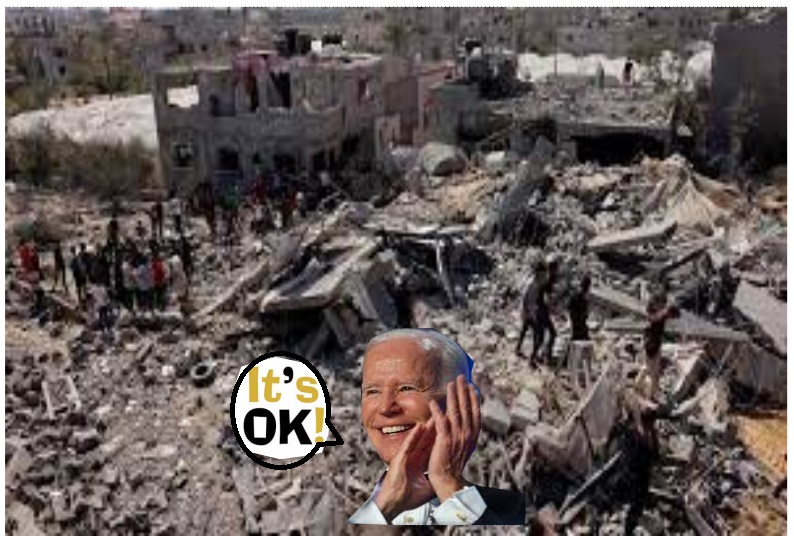
A senior Joe Biden administration official explained that the Democratic party has no plans to alter its policy of unconditional arms support for Israel. President Biden has provided Israel with billions of dollars in weapons since October 7, including over ten thousand heavy bombs.
After an internal DNC debate over the party’s plank on arms shipments to Israel, an official explained that President Biden has no plans to change the policy that allows weapons to flow to Tel Aviv with no conditions on how they are used. “The platform will reflect the views of the president of the United States, and cutting aid to Israel is not President Biden’s policy,” the official said.
Over the past nine months, the White House has sent Israel over $6.5 billion in arms, including tens of thousands of bombs. Fourteen thousand of those munitions are massive one-tonne bombs. American-made bombs have contributed to the enormous death toll that has surpassed 38,000.
While American weapons have been documented to have been used in Israeli attacks on civilian targets in Gaza, the White House has maintained that Tel Aviv has not violated US laws. President Biden has no plans to curtail arms shipments except for one shipment of heavy bombs.
A growing number of Democratic voters have broken with the president over his unfettered support for the Israeli onslaught in Gaza. An April poll found about 40% of Democrats believe Biden has given Israel too much support.
Biden is a self-proclaimed Zionist and has been a vocal supporter of Israel for decades. Over his career, the president has frequently claimed that Israel is so vital to American security that if it did not exist, the US would have to create Israel.
However, the argument that Israel contributes to American security is rebuked by the head of the State Department Intelligence agency, Brett Holmgren. The Assistant Secretary of State explained that the Israeli war on Gaza is driving recruitment into jihadist organizations and inspiring lone-wolf terrorists.
Nuclear War Is Imminent
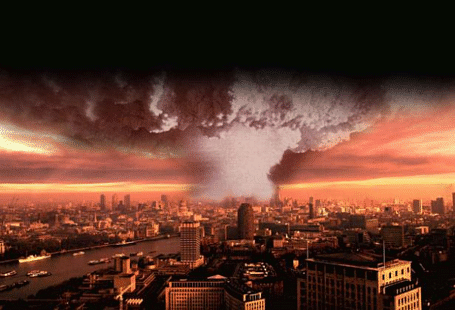
Unless the U.S. Embraces Peace – and Soon!
by Gerry Condon, , https://original.antiwar.com/Gerry_Condon/2024/07/14/nuclear-war-is-imminent/
The world is headed toward nuclear war. The horrific nightmare of global destruction that has haunted humanity ever since Hiroshima and Nagasaki is nearly upon us. For decades, peace activists and nuclear experts have warned about the “growing danger of nuclear war.” The Bulletin of Atomic Scientists has moved the hands of their Doomsday Clock all the way to 90 seconds! How much closer can we get? Are these dire warnings being dismissed like the man with the sign shouting “The End Is Near?”
The original nuclear powers, the U.S., Russia, China, France and the UK – the five permanent members of the UN Security Council – never followed the commitment they made when they signed and ratified the 1970 Nuclear Nonproliferation Treaty (NPT), which required them to “begin good-faith negotiations for the total elimination of nuclear weapons.” Instead they have poured billions of dollars into “modernizing” nuclear weapons. In the meantime, four more countries have joined the nuclear club – India, Pakistan, North Korea and Israel.
After the dissolution of the Warsaw Pact military alliance of the Soviet Union, there was an opportunity for a broad peace in Europe. NATO, an anti-Soviet military alliance led by the U.S., should have disbanded at that point. Instead, it pursued an aggressive policy against a weakened Russia, surrounding it with hostile military forces, including nuclear weapons.
In 2002, President George W. Bush unilaterally removed the U.S. from the Anti-Ballistic Missile (ABM) Treaty, while placing a U.S. missile base in Romania. In 2019, President Donald Trump unilaterally withdrew the U.S. from the Intermediate-range Nuclear Forces (INF) Treaty that had lowered nuclear tensions in Europe, while placing another U.S. missile base in Poland. What were the Russians to think? The U.S. is clearly seeking a dominant nuclear position.
Neoconservative war hawks – or “Neocons” – have captured the foreign policy machinery of Democratic and Republican administrations. Given the declining economic power of the U.S. vis-à-vis a rising China, the Neocons believe the U.S. must aggressively employ its military superiority to maintain global dominance. The U.S. maintains 850 foreign military bases in over 80 countries (compared to a handful each for Russia and China).
Western politicians and pundits frequently accuse Russian president Vladimir Putin of making “nuclear threats.” Indeed, Putin keeps reminding the world of Russia’s nuclear rules of engagement. Russia reserves the right to use nuclear weapons first if it is attacked by the superior conventional forces of NATO. The U.S. has a similar nuclear posture – it will use nuclear weapons first, even against non-nuclear threats such as a cyber-attack. As Daniel Ellsberg reminded us, to possess nuclear weapons is to use them every day, like a gun pointed at someone’s head.
Apparently oblivious to the imminent threat of nuclear war, President Biden continues to pour billions of dollars of weapons into its proxy war against Russia in Ukraine, while blocking peace negotiations. The Biden administration is simultaneously sending billions in weapons to Israel as it commits a horrific and ongoing genocide in Gaza. Israel threatens other Middle Eastern countries with its U.S.-backed military, including nuclear weapons. Can anybody now doubt that they would use them?
The Neocons are also actively preparing for a war against China. The U.S. is encouraging Taiwan’s independence from China, conducting provocative “freedom of navigation” operations in the Taiwan Straits and South China Sea, and building anti-China military alliances throughout the Pacific. One of the few foreign policy debates in Congress is which war should take precedence – the war against Russia or the war against China. Both are nuclear powers. Then there is the joint US/South Korean military exercises aimed at the “decapitation” of the government of North Korea, another nuclear power. What could possibly go wrong?
The threat of nuclear war does not exist in a vacuum. It is directly related to aggressive military competition, much of it being driven by the U.S. Nuclear annihilation will come from a specific war, whether by miscalculation, accident or otherwise.
If we are serious about avoiding a nuclear war, we must demand that the U.S. stops sending weapons to Ukraine and Israel, and instead supports ceasefires and negotiations to stop the killing. We must call for an end to the reckless U.S. confrontation with China and North Korea. It is critically important that these conflicts are ended as soon as possible and replaced with negotiations for peaceful co-existence.
In the longer run, as detailed in the Veterans For Peace Nuclear Posture Review, the U.S. must make a sea change in its foreign policy. We must stop intervening in other countries. We must stop playing “nuclear chicken.” We must demand a peaceful U.S. foreign policy that respects the sovereignty of all nations and the human rights of all people.
The U.S. should sign the UN Treaty on the Prohibition of Nuclear Weapons, and reach out to the other nuclear powers, saying “let’s all get rid of our nuclear weapons together.” Let’s pursue the interests of all humanity by replacing competition with cooperation. Let’s stop spending precious resources on the military and take care of our peoples’ needs instead. Let’s work together to stop global warming, the other imminent existential threat. In order to avoid nuclear annihilation – and climate catastrophe too – we must abolish war once and for all.
Gerry Condon is a Vietnam-era veteran and war resister who serves on the Board of Directors of Veterans For Peace and coordinates its Nuclear Abolition Working Group.
FacebookTwitterWhatsAppRedditLinkedInTumblrEmailPrint
https://www.facebook.com/v17.0/plugins/like.php?app_id=0&channel=https%3A%2F%2Fstaticxx.facebook.com%2Fx%2Fconnect%2Fxd_arbiter%2F%3Fversion%3D46%23cb%3Df7d6bd41d37b090cc%26domain%3Doriginal.antiwar.com%26is_canvas%3Dfalse%26origin%3Dhttps%253A%252F%252Foriginal.antiwar.com%252Ff746d070f98ff7b99%26relation%3Dparent.parent&container_width=0&href=https%3A%2F%2Foriginal.antiwar.com%2Fgerry_condon%2F2024%2F07%2F14%2Fnuclear-war-is-imminent%2F&layout=button&locale=en_US&ref=addtoany&sdk=joey&width=90https://platform.twitter.com/widgets/tweet_button.2f70fb173b9000da126c79afe2098f02.en.html#dnt=false&id=twitter-widget-0&lang=en&original_referer=https%3A%2F%2Foriginal.antiwar.com%2FGerry_Condon%2F2024%2F07%2F14%2Fnuclear-war-is-imminent%2F&related=AddToAny%2Cmicropat&size=m&text=Nuclear%20War%20Is%20Imminent&time=1721084674990&type=share&url=https%3A%2F%2Foriginal.antiwar.com%2Fgerry_condon%2F2024%2F07%2F14%2Fnuclear-war-is-imminent%2FShare
Hundreds of Scientists Urge Biden to Cancel $100 Billion Nuclear Weapons Boondoggle
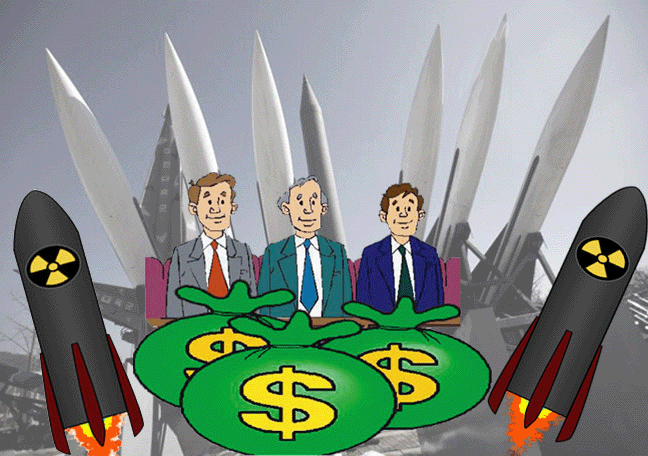
“There is no sound technical or strategic rationale for spending tens of billions of dollars building new nuclear weapons,” an expert said.
Edward Carver, Common Dreams. JULY 11, 2024 https://www.commondreams.org/news/scientists-end-land-based-nuclear-weapons
More than 700 scientists on Monday called for an end to the United States’ land-based nuclear weapons program that’s set to be replaced, following a Pentagon decision to approve the program despite soaring costs.
In an open letter to President Joe Biden and Congress, the Union of Concerned Scientists (UCS) argued that the new intercontinental-range ballistic missile system, known as Sentinel, was “expensive, dangerous, and unnecessary.”
The Department of Defense on Monday certified the continuation of the project, releasing the results of a review that was legally required when the cost estimate ballooned to “at least” $131 billion earlier this year, which drew the scrutiny of some Democrats in Congress, according toThe Hill.
The Defense review found that Sentinel was “essential to national security,” but the scientists disagreed with the assessment.
“There is no sound technical or strategic rationale for spending tens of billions of dollars building new nuclear weapons,” Tara Drozdenko, director of UCS’ global security program, said in a statement.
Nobel Prize-winning physicist Barry Barish, a signatory to the letter, was also harshly critical of the Pentagon’s approach.
“It is unconscionable to continue to develop nuclear weapons, like the Sentinel program,” he said.
The soaring costs of Sentinel, which is overseen by the defense contractor Northrup Grumman, have been the subject of media attention. The program will cost an estimated $214 million per missile, far more than originally expected, Bloombergreported on Friday.

However, the cost is hardly the only reason to cancel the program, UCS scientists argue. The silos that house the nuclear missiles, which are found in North Dakota, Montana, Wyoming, Colorado, and Nebraska, are vulnerable to attack—in fact, they are designed to draw enemy weapons away other U.S. targets, according toScientific American. Such an attack would expose huge swaths of the American population to radioactive fallout.
Because they are a likely target, the siloed missiles are kept on “hair-trigger” alert so the U.S. president can launch them within minutes. This “increases the risk of nuclear war” that could start from false alarms, miscalculations, or misunderstandings, the UCS letter states.
The scientists further argue that there’s no need for a land-based nuclear weapons system given the effectiveness of nuclear-armed submarines—one of the other parts of the nuclear triad, along with bomber jets. Such submarines are “hidden at sea” and “essentially invulnerable to attack,” according to the letter. Moreover, the submarine missiles are just as accurate as land-based missiles, and already have “destructive capability than could ever be employed effectively,” it states.
The submarine system is also being overhauled, as is the ‘air’ component of the nuclear triad. In total, the U.S. military plans to spend more than $1 trillion over 30 years on renewing the nuclear arsenal, according to the Arms Control Association.
The U.S. leads the way in a surge of global spending on nuclear arms, according to two studies published last month, one of which found that nearly $3,000 per second was spent in 2023.
Biden signs ADVANCE Act. Now what?

By Dave Kraft/NEIS, Dave Kraft is the founder and director of Nuclear Energy Information Service. https://beyondnuclearinternational.org/2024/07/14/biden-signs-advance-act-now-what/
Congress wants to “accelerate” new reactor build, putting public safety in jeopardy
By Dave Kraft/NEIS
On Wednesday July 10th President Joe Biden signed the “ADVANCE Act,” which stands for “Accelerating Deployment of Versatile, Advanced Nuclear for Clean Energy.”
The controversial bill aggressively promotes the narrow, short-term interests of the U.S. nuclear industry in ways that threaten the long-term national environmental, climate and national/international security interests.
Further, it functionally rewrites the mandate of the federal Nuclear Regulatory Commission (NRC) in ways that potentially cast it into the role of promoter instead of federal regulator of the controversial and moribund nuclear power industry.
To summarize, The ADVANCE Act:
- promotes development of currently experimental, commercially non-existent “small modular nuclear reactors” (SMNRs) and allegedly “advanced” reactors, using tax dollars;
- provides less regulatory oversight by ordering the NRC to “streamline” licensing of currently experimental SMNRs, putting the NRC in a position of becoming a quasi-promoter instead of regulator, in contradiction to its 1975 founding mandate;
- requires development of the infrastructure needed to produce more intensely enriched radioactive fuel called “HALEU” – high-assay, low-enriched uranium — required for the SMNRs to run on. Enrichment would be just below weapons-usable; currently the only source of HALEU is Russia;
- ignores the potential increased risk and harm from having more nuclear reactors large and small;
- produces more high-level radioactive waste without first having a disposal method in place for either current or future reactors;
- permits and encourages export of nuclear technology and materials internationally; and
- for the first time, allows foreign control/ownership of nuclear facilities within the U.S.
Congress cannot be absolved from its role in uncritically swallowing the gaslit promises of nuclear power. The House previously passed its version of the legislation by a margin of 393-13 before sending it to the Senate. There, it stalled, but was procedurally resurrected by attaching the 93-page nuclear Christmas-wish list to a three-page, must pass fire safety bill – S.870, the Fire Grants and Safety Act. It passed in the Senate 88-2, with only Senators Ed Markey (MA) and Bernie Sanders (VT) recognizing the imminent threat it posed to energy, environmental, and international security interests.
Critics of nuclear power and opponents of the ADVANCE Act fail to see:
- how the Act fights climate disruption, when SMNRs are only experimental, may not work at all, and if they work will not be available in sufficient quantities for commercialization before the mid-2030s, according the nuclear industry itself. It is the carbon we remove and keep out of the atmosphere between NOW and the mid-2030s that will determine if we can meet climate goals;
- how SMNRs will enhance currently threatened system reliability and power availability, when they will not be available – assuming they even work – before the mid-2030s;
- how exporting SMNR technology and ~19+% enriched (just below weapons useable) HALEU reactor fuel worldwide improves international security in a world dominated by wars in Ukraine, the Middle East, and potentially in southeast Asia; poorly controlled non-state actors; and well-known corrupt business entities. Equally baffling is how allowing foreign ownership of nuclear facilities in the U.S. proper makes our energy systems safer, more secure, and insulated from economic instability or foreign interference;
- how mandating the NRC to “expedite” SMNR licensing – potentially at the expense of its original and official mandate to “adequately” protect public health and safety and the environment – makes nuclear power and the nation safer. This regulatory approach has demonstrably failed with Boeing; failed with Norfolk Southern in East Palestine; failed with PIMSA in Sartortia; and doubly-failed at Fukushima. NRC is supposed to oversee and regulate an industry that in the past five years has repeatedly displayed corporate and legislative corruption at the highest levels resulting in FBI indictments, convictions and guilty pleas, millions of dollars in fines, and enormous cost overruns born by ratepayers; and
- why viable alternatives to nuclear expansion like renewable energy, energy efficiency, energy storage, and transmission improvements are not prioritized over nuclear expansion, since ALL are cheaper, quicker to implement, reduce carbon emissions, produce no radioactive wastes, have no meltdown potential, create no nuclear proliferation issues, and, most importantly – ALREADY EXIST. Nothing more needs to be invented; just implemented.
For example, the Federal Energy Regulatory Commission (FERC) stated in December, 2023 that roughly 2,600 giga-watts (GW) of electric power projects await grid connection – over twice the entire current electrical output of the US, and roughly 27 times the entire output of all current US reactors combined. The large majority of this backlog are renewable energy projects awaiting connection access to the aging transmission grid.
New EXISTING transmission technologies like reconductoring and improved grid resiliency solutions could double the capacity of the grid in much shorter time and with far greater certainty than chasing speculative nuclear promises, creating greater ease of access for renewables and storage.
By signing the ADVANCE Act, the President and an accomplice Congress have placed the nation’s energy future, climate goals, and even international security at grave risk. Clearly, placing short term, ego-invested interests over the long-term best interests of the nation seem to be a problem extending beyond re-election. As Napoleon once observed, never ascribe anything to malice when there is the least suspicion of incompetence. Perhaps, but in the end, the results are the same.
Dave Kraft is the founder and director of Nuclear Energy Information Service.
US war games in Pacific seek global participation in imperialist maneuvers
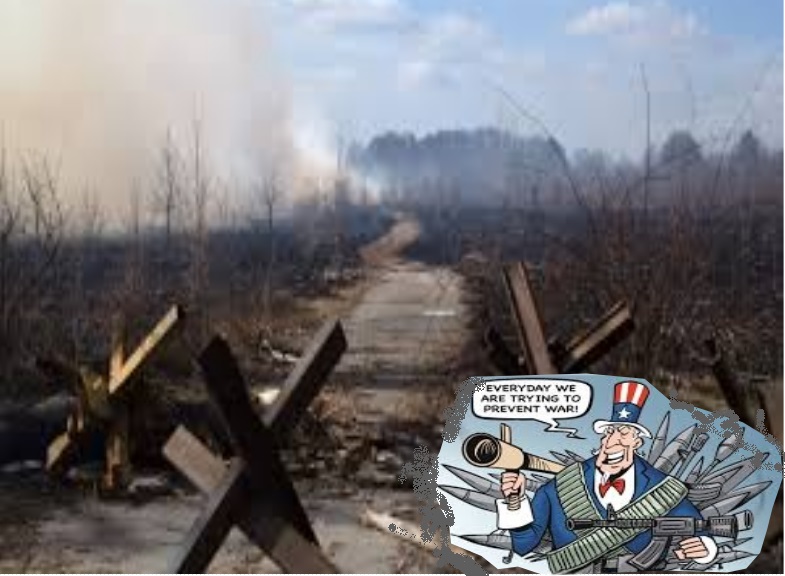
Hawaiian activists call on nations who condemn the genocide in Gaza to withdraw from Rim of the Pacific War Games organized by the US military and illegally hosted on Hawaiian land.
July 13, 2024 by Kawenaʻulaokalā Kapahua, Joy Lehuanani Enomoto, https://gpja.org.nz/2024/07/14/us-war-games-in-pacific-seek-global-participation-in-imperialist-maneuvers/
Every two years, the Indo-Pacific Command Center of the United States convenes the largest maritime war exercises on the planet. With over 35,000 troops participating, 29 nations, 46 naval surface ships, 4 nuclear submarines, and a multitude of air and ground forces, the Rim of the Pacific military exercises, or RIMPAC, is one of the most destructive training events globally.
Through these exercises, the US consolidates its control of the Pacific. RIMPAC began as an annual training exercise in 1971 and became bi-annual in 1974. Since it began, some of the historically worst human rights abusers like the US, Australia, Canada, and Israel have participated in the exercise. The US has a long history of using the Hawaiian islands for target practice. In 1965, the US Navy detonated a bomb on the Kaho’olawe the equivalent of 500 tons of dynamite, breaking the island’s water table and carpeting the island with unexploded ordinances.
Hawaiʻi was illegally seized by American sugar planters in 1893 who were supported by the US military and sought the Hawaiian harbor of Puʻuloa (Pearl Harbor) for a coaling station. In 1898, the US Congress, which had actually lost the treaty of annexation, illegally took Hawaiʻi by joint resolution. Hawaiʻi has remained under illegal occupation by the US and its military since then.
US militarism destroys our land through RIMPAC
RIMPAC as a symptom of the US empire has immense environmental and cultural ramifications. Geopolitically, the exercises are used to control trade routes, train genocidal regimes, and posture against China. Since Obama’s “Pivot to Asia” strategy, the US has shifted from cold war tactics of diplomacy and arms procurement to hot war tactics of aggressive invasion and unchecked military build-up. RIMPAC is used to test weapons and military technology for weapons manufacturers.
The US military’s largest base in our islands is Pōhakuloa, a sacred region of Hawaiʻi Island, thousands of acres utilized as a firing range to train militaries in the tactics of warfare, suppression, and invasion. Mākua Valley was a former civilian town turned into a firing range between World War II and 2004, which filled the valley with unexploded ordinances, white phosphorus, and other forever chemicals. The US Marine base at Mōkapu is built upon one of the most ancient villages in Hawaiʻi where residents were expelled to make room for the base. In addition to the massive pollution and raw sewage spills the base puts out into the surrounding ocean, it is also a sacred burial site where many iwi kūpuna (ancestral bones) are buried near the coast.
RIMPAC also threatens vulnerable and delicate ecosystems and our vast oceanic nature reserves which are restricted conservation zones except for the military. The US Navy has faced multiple lawsuits for the death of whales from mass beachings to escape naval sonar, multiple helicopters and planes have crashed onto our beaches and ocean, and sea turtles lose access to their traditional nesting grounds due to the practice of amphibious assaults on our beaches. The US military is the largest driver of the climate crisis and RIMPAC’s environmental impact only adds to this catastrophe by risking the livelihood of ocean nations through repeated missiles, explosions, and heavy metal waste being driven into the Pacific as a result of these exercises. Therefore, RIMPAC is in direct violation of its own Marine Species Awareness Training (MSAT) and its own Protective Measures and Assessment Protocols (PMAP) which require that the Navy be in compliance with the Marine Mammal Protection Act and the Endangered Species and ensure mitigation to prevent any injury, behavioral change, or death. Each year RIMPAC is planned, the US Navy Indo-Pacific Command requests exemption to these laws from NOAA and the Department of Defense, with extraordinary requests to allow incidental “takes” (deaths) of marine mammals in the millions. There is also no limit to the number of marine birds it can take during the exercises. RIMPAC threatens no less than 12 endangered species.
RIMPAC: Exporting violence
Besides its obscene show of environmental destruction, RIMPAC supports the repression of Indigenous cultures throughout the world by actively training regimes that are currently inflicting genocide or other human rights violations on its Indigenous peoples. RIMPAC plays out various “future scenarios of potential terrorists.” In 2022, RIMPAC enacted a pretend invasion of North Korea, going house to house executing a regime change operation with houses decorated with pictures of Kim Jong Un. Prior to that, in 2016, RIMPAC used the Hawaiian Islands to play out a scenario of imaginary so-called “enemy states” seeking to expand power that played counter to Western influences. And of course, there is the constant saber-rattling and escalation against China which is used as a scapegoat by the new US Cold War.
RIMPAC also brings with it a significant increase in gender-based violence. Studies have shown a significant leap in human trafficking and sexual exploitation, especially of young Native Hawaiian girls every year. In 2022, a former US Naval petty officer was sentenced to 20 years in prison for the sex trafficking of Native Hawaiian girls. The influx of more than 25,000 international military personnel into Hawaiʻi ensures a constant market for the exploitation of women and gender non-conforming people.
RIMPAC exposes enduring US military dominance
This year’s exercises are notable given the current geopolitical context. RIMPAC is taking place amid the ninth month of Israel’s genocidal war in Gaza. This war has isolated the US and its junior partner Israel and united much of the world in the demand for a ceasefire and in opposition to the West’s murderous violence against Palestinians and oppressed people across the world.
However, some of the voices that have been strongest on the world stage in condemning Israel and the US today have sent their Armed Forces to participate alongside the US and Israel in RIMPAC. Countries such as Colombia, Brazil, Chile, Ecuador, Mexico, and Indonesia, are participating, and have either closed their Israeli embassies or publicly renounced Israel for its ongoing genocide of the Palestinian people. While the mood in the Global South is one of challenging Western dominance and hypocrisy, challenging US military supremacy as its bloc leads spending at 74.3 percent, proves to be harder.
Yet, these war games are not mere pastimes and excursions, they are a declaration of national values and a statement of political intention. The strategies and tactics, weapons and technologies practiced and mastered at RIMPAC are utilized by participant nations for weaponization at home. Be it for the worst form of atrocities such as genocide or repression of any form of resistance to the state, or to control “free trade” routes to ensure capital continues to move for the benefit of the international capitalist elite. In other words, RIMPAC trains governments that have a long history of developing repressive techniques to control their colonies and are now deploying those same techniques on its citizens. As with all imperialist activities, it is up to the social and people’s movements of the respective impacted nations to take a stand and reject this continuous arming and military expansion of our collective oppressors.
The Hawaiian people stand arm in arm with the peoples of the world to demand an end to these war games and to sharpen our fight against US imperialism and colonialism, which today is the biggest threat to the survival of our planet—especially those of us from island nations in the “strategic” Pacific. It is people’s movements who will mobilize to remind the governments of those participating nations that they must withdraw from this exercise, end their collaboration with the Israeli Occupation Forces, and stand firm upon their declarations at the United Nations and other various forums. Together we can build a better world.
Kawenaʻulaokalā Kapahua is a community organizer with Hui Aloha ʻĀina, Honolulu branch, a leading Hawaiian independence organization. He is based out of Honolulu, Hawaiʻi, is a PhD student of Political Science at the University of Hawaiʻi and is also a labor organizer.
Joy Lehuanani Enomoto is a community organizer, Pacific Islands Studies scholar, and artist who lives in Honolulu, HI. She is currently the Executive Director of the demilitarization organization, Hawaiʻi Peace & Justice, and the vice president of the Hawaiian sovereignty organization, Hui Aloha ʻĀina o Honolulu.
Radioactive Real Estate: Finding a Forever Home for Nuclear Waste
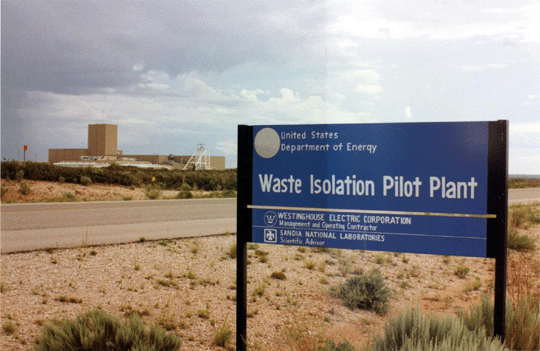
To this day, WIPP only houses transuranic waste with medium radioactivity from nuclear defense projects — not, for example, waste from nuclear energy, or items with very high or low levels of radioactivity. There is no pilot plant for high-level materials in the U.S. at the moment or in the plans
Undark, 10 July 2024, BY SARAH SCOLES
Castoffs from U.S. nuclear weapons get buried at one site in New Mexico. But what happens when that facility fills up?
THE LAND around Carlsbad, New Mexico is spiked with oil and gas wells. Mines hoist up minerals. Hotel parking lots teem with twinning white work trucks, driven by employees who specialize in pulling material out of the Earth.
Amid these extractors, though, are others putting material into the planet: They work for a facility called the Waste Isolation Pilot Plant, located about 40 minutes from downtown Carlsbad. At first glance, WIPP resembles a normal industrial site: A road sign near the entrance sports its inscrutable name, pointing toward tan warehouse-like buildings, evaporation ponds, and headframes for hoisting material.
Superficially, it looks like any other mine in the area. But that sameness belies the strangeness of what lies below ground: A huge subterranean salt deposit that stores nuclear waste from the country’s defense projects.
Once the repository is full, the salt will naturally undo the miners’ work: Tunnels and rooms will collapse, entombing the radioactive material and protecting life aboveground. WIPP has buried more than 14,000 shipments of nuclear waste since its start in 1999.
Twenty-five years after that opening, on a chilly March morning, a charter bus carries a crowd of people — some wearing cowboy attire, others in insulated vests zipped over dress shirts — into the parking lot. They congregate next to a semitruck laden with cylindrical cargo containers that sport radioactive warning labels. The labels, it turns out, are just for show. These containers are empty — staged for a photograph as part of WIPP’s 25th anniversary, and these guests have come to mark the occasion.
When the event starts, in a building plunked just before the security gate, Mark Bollinger, head of the Department of Energy’s Environmental Management Carlsbad field office, heads to a lectern.
“This,” he proclaims, “is a celebration.”
Others beg to differ. According to WIPP’s founding documents, the site should be winding down soon: It is a pilot plant — an experiment, a proof-of-concept — these critics argue, not a permanent one. The goal is to show that it is possible to safely store nuclear waste underground, shut the plant down, and seal it off. Initially, the timeline estimated disposal would stop in the middle of this decade, letting earth close around the waste. Over the course of WIPP’s operating life, and drawing on lessons learned here, the United States would identify and open new repositories for America’s nuclear waste.
That’s not exactly what has happened though.
Today, there are no concrete plans for new deep geologic repositories in the U.S. There are no established future sites for the medium-level nuclear waste that WIPP handles, nor for more dangerous radioactive waste, nor for the tens of millions of pounds of spent nuclear fuel from power plants. Indeed, much of the radioactive trash the country has created since the 1940s still lives in temporary storage, spread across the U.S. And officials now expect WIPP could remain open until the 2080s — decades beyond its originally conceived chronology.
The lack of permanent nuclear waste storage in the U.S. isn’t an engineering problem. “It’s not technically difficult,” said Allison Macfarlane, director of the School of Public Policy and Global Affairs at the University of British Columbia, and former chair of the U.S. Nuclear Regulatory Commission.
The solution, she says, is to bury it. The more radioactive, the deeper it goes.
Politically and culturally, however, convincing communities to permanently host nuclear detritus remains difficult, and WIPP is the world’s only operational example of a deep geological repository for nuclear waste — and the only one on the horizon. If officials are to find a post-WIPP solution for the mid-level nuclear waste being stored here — and the other kinds of radioactive discards — they’ll need to study how WIPP came to be, and why Carlsbad residents haven’t put up much of a fuss.
“In any future repository program,” said Matt Bowen, a senior research scholar at the Center on Global Energy Policy at Columbia University and a former official with the National Nuclear Security Administration, “state and local officials are going to want to understand WIPP.”
THE IDEA that you could store nuclear waste in salt dates to the 1950s, when the National Academy of Sciences published a report about radioactive waste disposal, identifying places where nuclear waste could remain undisturbed. Subterranean salt deposits, the panel of experts concluded, were the best spots, geologically speaking.
“The great advantage here is that no water can pass through salt,” read the report. Cracks in the mineral would heal themselves, theoretically helping halt radioactivity’s flow up or down. Salt deposits are also typically in seismically inactive areas, so nothing should shake the dangerous drums. “Abandoned salt mines or cavities especially mined to hold waste are, in essence, long-enduring tanks,” it continued.
Other geologic options that have been floated include crystalline rock, shale or clay, shale over hard rock, and volcanic rock called tuff, all of which can isolate the waste from the outside environment.
More than a decade passed before officials implemented the academy’s suggestion, with the defense apparatus continuing to produce nuclear waste the whole time. But when they did move forward with preliminary work in the 1970s, they settled on a part of New Mexico underlain by a huge slab of salt from the long-gone Permian Sea. This salt is 2,000 feet thick, starting 850 feet underground. It seemed perfect.
But first they needed to convince the public.
Proponents and politicians navigated this in part by allowing independent oversight and research and giving the state of New Mexico some power over the process. In the 1970s, the state created a radioactive and hazardous waste committee in the legislature, to recommend legislation for WIPP and for the transportation of radioactive material. And in the 1980s Congress allocated money to mine two shafts through the salt and research the site and its safety, access that allowed the state of New Mexico to do its own, independent research.
That was part of a plan that politicians and policymakers in favor of WIPP had in this era, says former Rep. John Heaton, whose district housed the future site. Namely, that they wanted the public to “hang loose.”
“Let’s not go overboard,” Heaton said of the advice to the public at the time. It is no use thinking of only bad-case scenarios or scary what-ifs. Let’s instead, the advice went, wait for the facts to come in.
As those facts arrived, independent researchers learned about how waste containers corroded over time, and how the underground salt behaved at different temperatures. The research pointed to the long-term safety of the site, and waiting on the scientific results had worked: Carlsbad was on board, with opposition coming mostly from larger, more liberal cities like Santa Fe, where Heaton lives now. And while the project did face controversy and opposition from the state, by the time the project was getting started, more people were in favor of WIPP than against it.
By 1992, politicians had drawn up the Waste Isolation Pilot Plant Land Withdrawal Act, giving more than 10,000 acres to WIPP and laying out its parameters — including the total amount of waste the Department of Energy could “emplace” — a fancy word used to mean “put underground.” WIPP would house material dubbed “transuranic,” largely objects contaminated with radioactive elements heavier than uranium — in this case, mostly plutonium — soiled during nuclear defense work.
(To this day, WIPP only houses transuranic waste with medium radioactivity from nuclear defense projects — not, for example, waste from nuclear energy, or items with very high or low levels of radioactivity. There is no pilot plant for high-level materials in the U.S. at the moment or in the plans.)
TODAY, WIPP is not just a hole in the ground but a series of tunnels and rooms largely housing barrels filled with pieces of rebar, rags, clothing, empty containers of spray adhesive — remnants of the objects engineers and technicians used while working on nuclear weapons or defense research.
…………………………………………………………………………………………………………… “legacy waste” — radioactive trash created long ago when records were less detailed and methods less stringent than they are now. Some of it was simply put in containers and buried in shallow trenches, or even above-ground, on the nuclear labs’ property during the Cold War. Legacy material makes up much of WIPP’s contents, and much of what will be in its future deliveries.
…………………………….. CHECKS and balances have been fine-tuned since 2014, when WIPP experienced its greatest setback.
February that year was a bad month for the plant. First, a truck hauling salt caught fire underground, spreading soot on important equipment and smoke throughout the site — and endangering the 86 workers underground. Everyone made it the 2,000 feet to the surface, but several had to be treated for smoke inhalation.
Just over a week later, in a different part of WIPP, a drum of waste exploded, turning itself essentially into a dirty bomb, blasting out transuranic radioactive material in a fiery burst.
Twenty-two workers received doses of radiation, and a small amount of contamination escaped into the outside world — about 3 percent of the amount of radiation from a chest X-ray.
The dangerous drum had originally come from Los Alamos, where workers had mixed in the wrong kind of cat litter — a simple substance that typically helps stabilize nuclear waste. But in this case, instead of combining the hazardous substances with inorganic kitty litter, they had mixed it with “an organic kitty litter,” the instructions having gotten garbled. And organic material can react with nitrates, causing chemical reactions that release heat. The increasing heat bumped up the pressure inside the drum, until it burst.
………………………………………………… The 2014 accidents may have been the most significant in WIPP’s history, but yearly, smaller incidents also occur. “It’s difficult to operate this kind of facility,” said Hancock. “Nobody in the world has ever safely operated a deep geologic repository.”
And that is the difference between the real world and a report from a national academy about what kind of rock or mineral is safe: A place can be perfect in geological theory, but when operated by flawed humans, it will be subject to their mishaps and misjudgments.
………………………………………………………………………Critics, like proponents, want the legacy waste cleaned up, and safely. But they don’t trust WIPP with that last part. While the bigger cities in the region are unlikely to suffer ill effects from a disaster at the plant itself, trucks of nuclear waste pass through on their highways. And some residents are concerned about the safety of those trucks. Any vehicle traveling anywhere, carrying anything, can have an accident.
They are also worried about WIPP’s proximity to oil and gas activity…………………………………………………………………..
WIPP RECENTLY received its latest 10-year operating permit from the state of New Mexico. As part of the final agreement, the DOE agreed to look for a future waste-disposal site, in another state. “I think it will be a consent-based siting program,” said Bowen, of repositories to come. “I don’t think anybody wants to fight states.”
But it will be hard to find a new, permanent place — or other places for the other kinds of nuclear waste out there. “At some point in time, we’re going to have to start this effort of establishing another deep geologic repository,” said Bowen. WIPP, after all, took decades to open, so starting now could mean getting a new space in the 2040s or 2050s, with more waste piling up in the meantime. “We need to get going on that,” he continued. He’s hopeful things may get started in 2025.
And as with WIPP, the hardest part won’t be finding more salt spots, or deciding between volcanic rock and shale: It will be getting the people sitting in Washington and the people living atop those deposits to agree to something. “The affected public has to trust those who are implementing this process and those who are regulating this process,” said Macfarlane.
But the requirement goes the other way, she added: The implementers and regulators have to trust the public. That latter part often falls apart, she said………………………………………………………………
In the 1990s, Sandia National Laboratories convened linguists, scientists, and anthropologists, among others, to figure out how to separate WIPP from the people of the future. They came up with a plan involving signs and symbols: The site will be surrounded by huge earthen berms, metal objects and magnets buried within, meant to reflect radar beams and make this place register as magnetically anomalous. The perimeter will also host 25-foot-tall granite columns, engraved with warnings, and no-go markers will be buried up to six feet deep throughout the site. WIPP’s center, if someone gets that far, will host an information center that includes pictorial messages today’s humans hope will convey “leave this alone” to future ones.
“Other nuclear waste disposal sites must be marked in a similar manner within the U.S. and preferably world-wide,” read the multidisciplinary report. Its authors likely imagined there would be plans for such sites by now, and that WIPP would soon be getting its warnings. But it got, instead, a birthday party. https://undark.org/2024/07/10/radioactive-real-estate-nuclear-waste-forever-home/?utm_source=Undark%3A+News+%26+Updates&utm_campaign=1b7bb2c675-RSS_EMAIL_CAMPAIGN&utm_medium=email&utm_term=0_5cee408d66-185e4e09de-%5BLIST_EMAIL_ID%5D
1 This Month

of the week– Nuclear Reactor Information Task Force

14 May – online event From Bombs to Data Centres: the Face of Nuclear Colonialism
To see nuclear-related stories in greater depth and intensity – go to https://nuclearinformation.wordpress.com
-
Archives
- May 2026 (126)
- April 2026 (356)
- March 2026 (251)
- February 2026 (268)
- January 2026 (308)
- December 2025 (358)
- November 2025 (359)
- October 2025 (376)
- September 2025 (257)
- August 2025 (319)
- July 2025 (230)
- June 2025 (348)
-
Categories
- 1
- 1 NUCLEAR ISSUES
- business and costs
- climate change
- culture and arts
- ENERGY
- environment
- health
- history
- indigenous issues
- Legal
- marketing of nuclear
- media
- opposition to nuclear
- PERSONAL STORIES
- politics
- politics international
- Religion and ethics
- safety
- secrets,lies and civil liberties
- spinbuster
- technology
- Uranium
- wastes
- weapons and war
- Women
- 2 WORLD
- ACTION
- AFRICA
- Atrocities
- AUSTRALIA
- Christina's notes
- Christina's themes
- culture and arts
- Events
- Fuk 2022
- Fuk 2023
- Fukushima 2017
- Fukushima 2018
- fukushima 2019
- Fukushima 2020
- Fukushima 2021
- general
- global warming
- Humour (God we need it)
- Nuclear
- RARE EARTHS
- Reference
- resources – print
- Resources -audiovicual
- Weekly Newsletter
- World
- World Nuclear
- YouTube
-
RSS
Entries RSS
Comments RSS
 nuclear-news