Rebranded SNC-Lavalin seeks as much as $75M in taxpayer dollars to build more powerful Candu nuclear reactors.
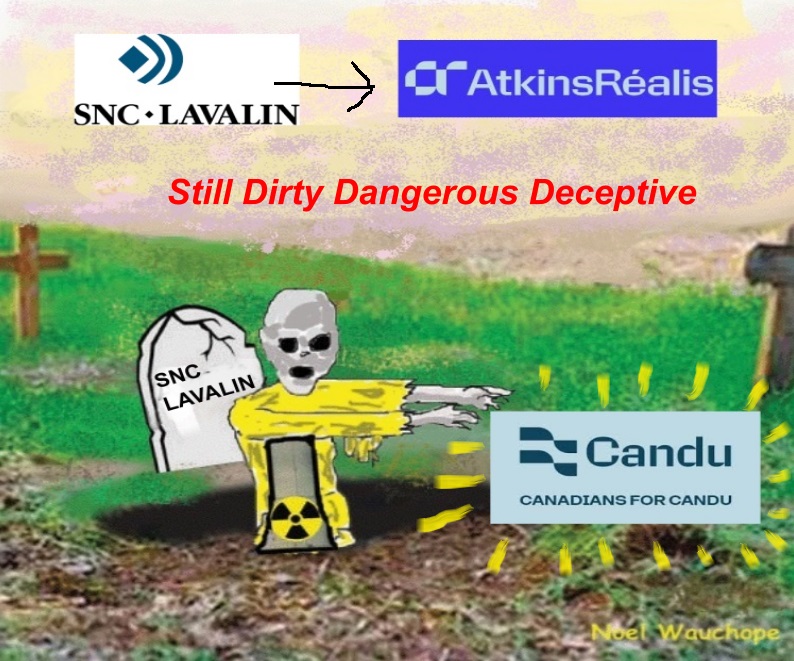
AtkinsRéalis wants to develop a new Candu reactor to sell around the world, but an industry insider says the company’s past could be a ‘big problem’ to getting funding
National Post Ryan Tumilty, Aug 15, 2024
OTTAWA – A company formerly at the centre of one of the biggest scandals of the Trudeau government is now looking for as much as $75 million in annual funding to update a nuclear reactor Canada has exported around the world.
AtkinsRéalis, formerly named SNC Lavalin, launched the Canadians for Candu campaign earlier this year. It’s a push to get both provincial governments and the federal government to back a new, more powerful Candu nuclear reactor that could be built both home and abroad.
The lobbying effort, started earlier this year, has recruited other engineering and construction firms, local unions and other groups to advocate for government support of the made in Canada reactor. The co-chairs of the campaign are former prime minister Jean Chrétien and Ontario premier Mike Harris.
Gary Rose, executive vice-president of nuclear, said the company wants Canadians to be aware of the potential.
“The campaign is really all about promoting Candu, the fact that Canada owns a world-class nuclear technology,” he said. “As provinces make decisions on which technologies that they wish to pursue, when it comes to large nuclear, we want that pursuance to be Candu technology because it’s a Canadian technology.”
AtkinsRéalis holds the license for Candu reactors which were first developed in the 1950’s by the Canadian government. All of Canada’s current nuclear reactors are Candu models ………….
In 2011, the Harper government sold the right to develop Candu reactors to what was then SNC-Lavalin for $15 million. The Crown corporation, Atomic Energy of Canada Limited, retained the intellectual property of the reactors.
With the license in place, AtkinsRéalis has worked on large refurbishment projects and last year signed a deal to build two new reactors in Romania with the help of export financing from the Canadian government.
The proposed Romanian reactors are Candu-6 models capable of producing 700 megawatts of power, but to attract more business, including here in Canada, AtkinsRéalis is working on a new reactor, the Candu Monark, which would be capable of 1,000 megawatts…..
That’s where the company is seeking federal cash. Rose said they are currently spending $50 to $75 million a year on engineering to complete the Monark design and expect to do the same over the next three years. They would like the government to match that spending, potentially adding up to a $300 million bill for taxpayers.
He said ultimately the government will win out in the end.
“We’re asking for it to be an investment. We’re not asking for a handout,” he said. “The IP that we develop as Monark will stay owned by the Canadian government.”
Minister of Natural Resources Jonathan Wilkinson’s office said only that they were aware of the Canadians for Candu campaign when the National Post reached out.
…………………………….AtkinsRéalis has at least one specific project in mind for the Monark, the proposed expansion of the Bruce Nuclear plant in southern Ontario. That project announced last year aims to add up to 4,800 megawatts of power to the Bruce plant, which is already the largest nuclear installation in the world.
Ontario’s then Minister of Energy Todd Smith, said last year, the province would need a lot more power………………….
The proposed site C project is in its infancy and the company has only just started consultations with local communities and planning for what the project would look like. It has only started to look at what reactor technology it might use, but has said it intends to conduct an open process with a “technology neutral” approach.
Rose said the Monark design work could be done in the next four years and be ready to build at the end of this decade.
“The Monark is an evolution of existing Candu technology so we are not starting from scratch,” he said. Most of the components, over 85 per cent, of a Monark reactor would come from Canadian suppliers.
Aaron Johnson, a vice president with AECON construction who worked on nuclear refurbishment projects with AtkinsRéalis and is part of the Canadians for Candu campaign, said new reactors would be a big boost to the local economy.
“That’s already an existing supply base, and that’s something that would only be furthered upon in a Candu new build application,” he said………………………………….
AtkinsRéalis’ request for more government funding comes as the company is shedding the SNC-Lavalin brand that was tarnished in a scandal.
In 2019, the company pleaded guilty to fraud and agreed to a $280 million fine for its actions in Libya between 2001 and 2011. In an agreed statement of facts at the time, the company admitted having paid nearly $48 million to the son of Libyan dictator Muammar Ghadafi to secure contracts.
Former attorney general Jody Wilson-Raybould resigned from cabinet earlier that year after she came under pressure from Prime Minister Justin Trudeau’s office to work out a deal with the company. The ethics commissioner ultimately found Trudeau had improperly pressured Wilson-Raybould.
Rose joined the company only last year and said he was assured he was making the right choice to come aboard because much more than the name of the company has changed.
“The entire management team, leadership team, programs that support it. I believe it’s a totally different company than it was,” he said.
Chris Keefer, president of the group Canadians for Nuclear Energy, acknowledges that AtkinsRéalis’ former name will be a political problem………………………..
Keefer’s group doesn’t receive funds from AtkinsRéalis and isn’t a member of Canadians for Candu, but he does believe the reactor should get government support. American company Westinghouse, which has the AP1000 reactor, received U.S. support for its design and Keefer argued it is not uncommon in the industry…………………………
At the COP 28 climate change conference last year, more than 20 countries including Canada, signed onto a pledge to triple nuclear power production by 2050.
Rose said he believes Candu reactors could easily be 10 per cent of the global market, but they need government support to do it.
“We’re building up front with the hopes of selling 25 in Canada, 75 to 100 globally, and having the federal government standing up and supporting us on that is really key.”https://nationalpost.com/news/politics/snc-lavalin-candu-nuclear-reactors?utm_source=Sailthru&utm_medium=email&utm_campaign=National%20Post%20-%20Posted%202024-08-15&utm_term=NP_HeadlineNews
Congressman Garamendi Asks “Why does America need nuclear weapons?”
August 15th, 2024 https://nuclearactive.org/
On August 13th, U.S. Congressman John Garamendi of California delivered a speech at the United States Strategic Command 2024 Strategic Deterrence Amidst Global Transformation Symposium in which he asked “Why?” as in “Why does America need nuclear weapons?” and mostly importantly asked, “How do we deter in a way that ensures there is a tomorrow worth protecting? Must we continue a 50-year-old triad strategy without considering the alternatives? Why, why are we stuck in a logic silo with the blast door closed?” To read Congressman John Garamendi’s (CA-08) full statement, 240813 Garamendi U.S. Strategic Command 2024 Deterrence Symposium Remarks 1
While the focus of the speech was about “Why the Sentinel is a Costly and Dangerous Mistake,” he began by describing the efforts in 1985 of Ronald Reagan and Mikhail Gorbachev, whom he called “two cold warriors at the head of the world’s largest nuclear arsenals.
“Leaders like Reagan, JFK, Eisenhower, Carter, and Obama knew that nuclear weapons could end civilization and, with those heavy moral and ethical considerations in mind, negotiated significant safety measures and a serious reduction in nuclear weapons.
“These leaders demonstrated vision and commitment. They knew that war was not an option, so they had to create a vision for a safer future. Unfortunately, too many today shrug their shoulders and say the time for negations is not now. Which brings us to yet another question…Why not try? Over the next 30 years, we will spend almost 2 trillion dollars on our nuclear weapons… what if we spent just 1% on diplomatic and risk reduction efforts?”
To read Congressman John Garamendi (CA-08) full statement, 240813 Garamendi U.S. Strategic Command 2024 Deterrence Symposium Remarks 1
US approves new $20bn weapons sale to Israel

Rt.com 14 Aug 24
The arms package includes dozens of fighter jets, as well as mortar and tank ammunition
The US government has approved more than $20 billion in new arms sales to Israel, despite pressure on President Joe Biden’s administration to end the bloodshed in Gaza.
In a series of notifications to Congress on Tuesday, the State Department said Washington is “committed to the security of Israel, and it is vital to US national interests to assist Israel in developing and maintaining a strong and ready self-defense capability.”
The main part of the package, worth about $18.8 billion, consists of 50 new F-15IA fighter jets and the upgrade of 25 of the aircraft already in service. Israel also intends to buy Medium Range Air-to-Air Missiles (AMRAAM) for the jets, nearly 33,000 120mm tank cartridges, up to 50,000 high-explosive mortars, and new military cargo vehicles………………………………..more https://www.rt.com/news/602589-us-weapons-sales-israel/—
The Nuclear Regulatory Commission’s Antiques Roadshow

As new U.S. nuclear construction grinds to a halt, one company aims to restart a Michigan reactor that violated fifty codes—in just one year.
The Progressive Magazine, by Roger Rapoport , August 6, 2024
This summer marks the first time since 1954 that not a single large light water nuclear reactor will be under construction in the United States. As dozens of reactors have closed coast to coast—and countries like Germany and Japan have trimmed or shut down their nuclear fleets—the exorbitant price of building this power source has forced industry giants like Westinghouse Electric Company into bankruptcy.
Business is so bad that the industry’s last-ditch attempt to rebrand itself by launching so-called small modular reactors (SMRs) has run aground. The first American attempt to open one in Idaho was abandoned in November 2023 due to soaring costs. As it turns out, these SMRs are neither small nor modular. Another in Wyoming that might come online in six years will produce energy that costs three times the cost of readily available wind power.
The last two nuclear power plants to open in the United States, at the Vogtle plant in Georgia, have come in at $21 billion over the original $14 billion cost estimate—seven years late. Georgia Power customers are being hit with a 10 percent rate increase to cover these astounding Vogtle cost overruns.
Even worse, in New York, Illinois, New Jersey, and Connecticut, a group of obsolete older reactors are on life support, thanks to more than $14 billion in bailouts. In 2021, Republican Ohio Governor Mike DeWine signed a bill repealing a $1.1 billion bailout for two reactors cratered by a $60 million bribery scandal. One defendant, the former speaker of the state’s House of Representatives, was sentenced to twenty years in federal prison for his role in this scandal. At the same time all this was going on, Ohio’s legislature blocked a $4.2 billion investment in wind power.
Stanford University professor and climate expert Mark Z. Jacobson, whose research is central to the Green New Deal, pointed out on my podcast that electricity from Vogtle comes in at $16 per watt vs. $1 per watt for wind and $0.8 for solar. Wind, water, and solar power sources can be up and running in one to five years, he said, compared to a ten- to twenty-two-year wait for new nuclear power sources in the United States and Europe.
Despite all these obstacles, industry cheerleaders fall back on the lie that nuclear power is central to reversing climate change.
“The clean nuclear power argument from the Nuclear Regulatory Commission and the Department of Energy is nonsense,” Jacobson told me. “Mined uranium does not show up in perfect form. It must be refined, which takes a lot of energy and causes pollution. Nuclear reactors are belching huge amounts of water vapor and heat, contributing to local and global warming. Evaporated water from the giant steam generators is a greenhouse gas.
“New nuclear power plants cost 2.3 to 7.4 times those of onshore wind or utility solar [photovoltaic panels] per [kilowatt-hour] of electricity, take five to seventeen years longer between planning and operation, and produce nine to thirty-seven times the emissions per [kilowatt-hour] as wind.”
In Michigan, where I live, wind, water, and solar investments can pay for themselves, cutting annual energy cost rates by more than 60 percent, eliminating potential blackouts, and creating 242,000 jobs in the process.
In view of these undeniable facts, the always-optimistic nuclear power industry has come up with a new strategy, attempting, for the first time, to resuscitate the closed Palisades nuclear reactor on Lake Michigan, sold for decommissioning just two years ago. For decades, Consumers Energy operated this nuclear power plant that did not meet more than fifty standard Nuclear Regulatory Commission (NRC) codes.
After buying the plant for scrap and decommissioning it in 2022, Holtec, a company that has never built or operated a nuclear reactor, is now trying to reopen Palisades. Thanks to an estimated $8.3 billion in state and federal subsidies, Holtec optimistically plans to put the plant back into service by the end of 2025. This timeline seems even more unrealistic considering that operating Canadian reactors take a to refurbish.
If this controversial company successfully reopens Palisades, other abandoned reactors could potentially be brought back to life. Should Holtec fail, the industry may lose out to vastly less expensive carbon-free energy, including wind, solar, and water. One thing we have learned in this business is that the industry is only as strong as its weakest player,” said Blind in an interview on my podcast. A former vice president for nuclear at Consolidated Edison, he served as Palisades design engineering manager for six years after the Entergy takeover in 2007. “If this first-time nuclear power plant operator fails at Palisades, it will reflect poorly on the entire nuclear industry and will result in the waste of many millions in taxpayer and rate payer dollars.”
Considering this possibility, it’s hard to understand why state and federal legislators want to prop up a nuclear industry plagued by the vast unresolved nuclear waste problem. After all, carbon-free renewables coupled with enhanced battery storage eliminate the risk of another Three Mile Island, Fermi 1, Chernobyl, or Fukushima disaster. Equally troubling, said Jacobson, is the fact that 1.5 percent of nuclear reactors have experienced meltdown………………………………
“I know this plant,” said Blind, “and I can assure you that a combination of aging equipment and the lack of spare parts from suppliers that are out of business will create endless challenges. Failure to comply with standard Nuclear Regulatory Commission code has led to many failures, a culture of accepting problems, and spills of radioactive tritium into Lake Michigan.”
“Past accidents with nuclear fuel rods have left behind so much radiation inside the reactor containment vessel that it will be very difficult and extremely expensive to make long overdue mandatory repairs,” Blind added. “There are also ethical questions surrounding the need to subject workers to all this harmful radiation. I seriously question whether this plant will ever be able to safely reopen.” https://progressive.org/magazine/the-nuclear-regulatory-commissions-antiques-roadshow-rapoport-20240806/?fbclid=IwY2xjawEraPxleHRuA2FlbQIxMAABHWLSDQTizLHXHGoX_UASX3rKairLXOXRJQWiSfvCZf99bZwCXQapfZiQNQ_aem_raWHaFTGWtBkrU7RIO3ONQ
The Price of the Sentinel Nuclear Weapons Program Keeps Going Up—But the True Costs Are Even Higher

analysis of the root cause of the Sentinel’s ballooning cost estimates has not been released to the public.
policymakers have not made a compelling or coherent argument about how silo-based ICBMs make the country more secure.
Because of their vulnerability, silo-based missiles can be destabilizing in a crisis.
August 14, 2024 Jennifer Knox, https://blog.ucsusa.org/jknox/the-price-of-the-sentinel-nuclear-weapons-program-keeps-going-up-but-the-true-costs-are-even-higher/
Early this year, the Air Force notified Congress that the proposed Sentinel program—which would replace every single US nuclear intercontinental ballistic missile (ICBM) and update related infrastructure—would be at least 37% more expensive than the previous estimate in September 2020. After another round of review, the program’s estimated costs have further ballooned to $140.9 billion, an 81% increase from the 2020 estimate.
The staggering growth in price triggered the Nunn-McCurdy Act, which was passed to give Congress and the public more oversight of out-of-control defense spending. Once a defense program exceeds its initial cost estimates by a certain percentage, the Department of Defense is required to notify Congress and provide information about the cost overruns.
The most severe cases, however, also require the Department of Defense to conduct an investigation into the factors driving cost growth. The program in question will be automatically terminated unless the department certifies that:
the program is essential to national security,
the increased costs are reasonable,
the program is more important than other programs that will need to be cut to cover cost increases, andprogram managers will be able to control additional costs.
On July 8, the Department of Defense certified that the Sentinel program met all relevant criteria to continue. Unfortunately, its analysis of the root cause of the Sentinel’s ballooning cost estimates has not been released to the public. This leaves several outstanding questions for the public, which limits the ability of the Nunn-McCurdy Act to achieve its goal of effective oversight.
What are driving cost increases in the Sentinel program?
During a press conference, Undersecretary of Defense William A. LaPlante said there were “reasons, but no excuses” for the cost growth of the Sentinel program, but provided few details. The majority of cost growth has been attributed to the program’s “command-and-launch segment, which includes extensive communications and control infrastructure” that allow US ICBMs to be launched within minutes of an order.
But there is evidence that mismanagement contributed a great deal to the Sentinel’s explosive costs. Aerospace and defense company Northrup Grumman was awarded a sole-source contract for the program in 2020. Since then, the company has experienced staffing problems, delays with clearance processing, information technology infrastructure challenges, and supply chain disruptions, according to a 2023 report from the Government Accountability Office.
Relying on a single contractor has obvious risks, and the Pentagon failed to intervene when Northrup Grumman’s performance fell below standards. Representative Adam Smith, the ranking member of the House Armed Services Committee, said, “There’s gross malfeasance here both by the people who oversee the project and the contractor.”
What defense programs will be cut to make room for the Sentinel program?
One of the requirements of the Nunn-McCurdy act is for the Department of Defense to evaluate which programs will be reduced to cover the increased costs of the Sentinel program. As part of its review, the department certified that the Sentinel program is a higher priority than those that would need to be cut as a result.
Yet there is no indication of what programs will be cut—or even if the Department of Defense made concrete assessments about such trade-offs in the first place. While the overall budget for the program has exploded, the Associated Press reports that, “The majority of the cost increases to the Sentinel program will take place outside of the next five fiscal years of budget planning, meaning no difficult choices on program cuts will need to be made immediately.”
This attitude of kicking the can down the road is not unusual in defense planning, but it means that the consequences of the Sentinel’s cost overruns on national security remain to be seen.
What alternative solutions were considered?
Part of the root-cause analysis required by the Nunn-McCurdy Act is an evaluation of “reasonable alternatives to the program.” Without access to the report, the public cannot know which, if any, alternatives were considered because of the Sentinel program’s cost overruns.
In 2014, the Air Force completed an Analysis of Alternatives to the Sentinel program, which included the possibility of extending the life of the current fleet of US ICBMs rather than replacing them entirely. This report has not been released publicly either, so we cannot know exactly what metrics or assumptions were involved. But based on its analysis, the Air Force concluded that a full replacement of US ICBMs was the “’most cost-effective option’ for nuclear modernization.”
When its Analysis of Alternatives was conducted, the Air Force estimated that replacing US ICBMS would cost $60 billion. Since then, the price tag has increased by more than 134% to the current estimate of $140.9 billion. This certainly warrants a re-investigation of alternatives, especially since the justification for the Sentinel program was its supposed cost advantage.
Is the Sentinel program actually essential to national security?
The biggest unresolved question is the most important—and demands the full attention of our leaders. Whether the Sentinel program has been mismanaged or whether there are cheaper alternatives, policymakers have not made a compelling or coherent argument about how silo-based ICBMs make the country more secure.
The United States traditionally maintains three different ways to deliver nuclear weapons to a target: by air from bombers carrying cruise missiles or gravity bombs, by sea from submarines carrying ballistic missiles, and by land from silos containing ICBMs. This three-pronged structure is referred to as the nuclear triad, and proponents argue that each “leg” of the triad brings different characteristics to the table.
In the case of the Sentinel and its predecessors, what distinguishes it from other options is its fragility. Compared to aircraft and submarines, the silos that house these missiles are sitting ducks, easy to target and destroy by an adversary’s nuclear forces.
Because of their vulnerability, silo-based missiles can be destabilizing in a crisis. Since they are such obvious, fixed targets, a decisionmaker has very little time to decide whether to use these weapons in a conflict—or during a false alarm. This pressure shortens decisionmaking time and requires the missiles to be on high alert at all times.
Advocates for the land-based leg of the nuclear triad often rebrand this weakness as “responsiveness,” but a hair trigger is a liability that increases the risk of accidental use and escalation.
The Pentagon’s policymakers have failed to offer the public their vision for how silo-based nuclear missiles improve US security, instead repeating the same empty platitudes about nuclear deterrence. Because it offers no strategic value and introduces unacceptable risks, the Sentinel program should be cancelled, regardless of its cost. One penny is too much to spend on weapons that are unsafe and unnecessary.
Peace Is Not On The USA Ballot In November
Caitlin Johnstone, Aug 15, 2024, https://www.caitlinjohnst.one/p/peace-is-not-on-the-ballot-in-november?utm_source=post-email-title&publication_id=82124&post_id=147730515&utm_campaign=email-post-title&isFreemail=true&r=1ise1&triedRedirect=true&utm_medium=email
I keep seeing liberal commentators like George Takei trying to frame Kamala Harris as the best candidate to bring peace to the middle east, despite her coming directly out of the administration which has been lighting the region on fire with its insane warmongering.
So let’s be clear here: Peace is not on the ballot in November. Americans are voting for Red War or Blue War. That’s it. Those are the choices.
I repeat: Peace. Is. Not. On. The. Ballot. Nobody who stands an actual chance at winning is going to bring about peace, because the US president is a manager of the US empire, and the US empire depends on constant warmongering.
Any debates over whether Trump or Harris are the one to bring about peace are nonsensical, because neither of them are. It’s like arguing over which car salesman might start handing out free cars — that’s not the job. It’s not what the people who have that job do.
Americans don’t get to vote on changes to US foreign policy; that can only come by way of mass-scale direct action. These elections are here to give Americans the illusion of democratic control and to let them feel okay about their political systems so they don’t start thinking about revolution. It’s all about feelings, so if you want to vote then vote in whatever way makes your feelings feel nice. That’s all this performative spectacle is ever about.
All this murderousness will only come to an end when enough people use the power of their numbers to force it to end, and people will only use the power of their numbers to force it to end when enough of them have awakened from their propaganda-induced coma to get a real revolutionary movement happening.
So that’s where the focus needs to be. Not on which empire manager you should vote for, but on sowing the seeds of revolution by showing as many people as you can that everything they’ve been trained to believe about their nation, their government and their world is a lie. Showing them how depraved their rulers are and how badly they’re being screwed over by exploitative status quo systems, and letting them know that a better world is possible.
There’s always something you can do every day to help accomplish this. Attending demonstrations. Participating in activist organizations. Distributing literature, online and offline. Making videos. Making memes. Having conversations. Today I saw a video of a young woman on a train giving a short speech about the genocide in Gaza and distributing flyers. Anything you can do to spread awareness of what’s really going on and how the media and politicians are lying about it all.
So the bad news is that not until a critical mass of people have reached a sufficient level of awareness will there be a real chance at meaningful change. But the good news is that you absolutely have the power to work towards expanding that awareness.
Fire sparks Georgia nuclear plant alert, but officials say no safety threat as reactors unaffected
Georgia’s largest nuclear plant declared an emergency alert Tuesday
after an electrical transformer caught fire. The fire, described as small
by Georgia Power Co. spokesperson John Kraft, broke out about noon and
could have threatened the electrical supply to the heating and cooling
system for the control room of one of the complex’s two older nuclear
reactors, Vogtle Unit 2.
AP News 13th Aug 2024
A game plan for dealing with the costly Sentinel missile and future nuclear challenges
Bulletin, By Stephen J. Cimbala, Lawrence J. Korb | August 9, 2024
Enormous cost overruns in the Sentinel program have engendered a debate about how or if to go forward with a US intercontinental ballistic missile (ICBM) modernization program. We see five potential paths forward that might reduce costs and maintain or even improve the United States’ strategic posture. But to make the best military and financial choice, the United States government will have to consider how an updated missile force relates to evolving technology in the space and cyber realms and the implications of decisions about ICBM modernization for nuclear arms control.
Questions have been raised about the cost overruns for the Sentinel ICBM modernization program, which aims to replace the existing fleet of Minuteman III missiles beginning in the next decade. Sentinel is one part of a plan to replace all three legs of the U.S. nuclear strategic triad of land-based intercontinental ballistic missiles (ICBMs), submarine-launched ballistic missiles (SLBMs) deployed on fleet ballistic missile submarines (SSBNs), and bomber-delivered weapons. Columbia class SSBNs and upgraded Trident II D-5 missiles are intended for the next generation of sea-based strategic forces, and the B-21 Raider advanced stealth bomber is already on track to replace both remaining B-52 and B-2 bombers in conventional and nuclear roles.
Plans for modernization of the entire nuclear triad were approved in the Obama, Trump, and Biden administrations, albeit with some differences in emphasis with respect to the role of nuclear weapons in US deterrence, defense, and foreign policy. The Congressional Commission on the Strategic Posture of the United States also recommended modernization and replacement of all US strategic nuclear delivery systems.
The sticker shock associated with rising cost estimates for the Sentinel program is understandable. Estimated program acquisition costs for a “reasonably modified” Sentinel have risen to about $140.9 billion. According to the Congressional Budget Office, Department of Defense and Department of Energy, budgetary requests for fiscal year 2023 related to nuclear forces total more than $576 billion for the period 2023-2032, averaging just above $75 billion per year. The history of nuclear modernization does not suggest that complete cancellation of Sentinel is the most probable outcome. The program has the support of the Air Force, members of Congress, and various defense contractors. Given the inertia of the Sentinel program, we believe questions about its cost should focus not on eliminating it, but on the implications of strategic land-based missile modernization for US national strategy, nuclear deterrence, and arms control. Going forward, what are the options for the ICBM leg of the nuclear triad from this perspective?[1]
Alternatives for US ICBM modernization.[2] The first option for dealing with Sentinel’s cost overruns would involve canceling the entire Sentinel program and continuing to modernize and upgrade the existing Minuteman ICBM force………………………………………………………
A second option would be to move to a nuclear strategic dyad instead of a triad and depend on a deterrent of submarine-based weapons and strategic bombers……………………………………………………………
In a third option, future ICBMs would be deployed on mobile platforms instead of in silos………………………………………………………….
Yet another option would be to deploy ICBMs in so-called deep underground basing…………………………………………….
A fifth option for the ICBM force would be “conventionalization” of strategic land-based missile launchers…………………………………………….
Domain challenges to strategic stability: space and cyber. Options for a future ICBM force will have to be considered within the larger context of evolving technology related to deterrence. The domains of space and cyber now form part of the context for military planners.[3] ………………………………………………….
Hypersonic weapons cast another shadow of concern over deterrence and crisis stability.[4] ………………………………………
Finally, there is the issue of strategic nuclear arms control and its potential demise under the pressures of US–Russian political disagreement, of China’s apparent ambition to become a nuclear superpower, of growing political and military alignments between Beijing and Moscow, and of the wobbly status of the last major Russian–American strategic nuclear arms control agreement (New START), originally signed in 2010 and now extended only until February 2026.[5] ………………………………………………………………………………………more https://thebulletin.org/2024/08/a-game-plan-for-dealing-with-the-costly-sentinel-missile-and-future-nuclear-challenges/?utm_source=Newsletter+&utm_medium=Email+&utm_campaign=MondayNewsletter08122024&utm_content=NuclearRisk_CostlySentinelMissileAndFutureNuclearChallenges_080920247
‘Heinous’: Children Among 100 Killed by Israel Bombing of Gaza School Just Hours After US Weapons Approval
“It is hard to comprehend how the Biden administration can justify rewarding Israel with new weapons, despite Israel’s persistent defiance of every single plea the Biden administration has made urging a modicum of restraint.”
Yanis Varoufakis, former finance minister of Greece and co-founder of Progressive International, asked the same on Saturday.
“Israel has now killed nearly 40,000 Palestinians, mostly women and children, and wounded well over 92,000 others,” said Varoufakis. “Thousands more lie, uncounted, under the debris. Some 10,000 Palestinians have been abducted by Israel’s occupying forces. Question: Where is the ICC indictment?”
Jon Queally, Aug 10, 2024 https://www.commondreams.org/news/gaza-massacre-us-weapons
The Palestinian Authority’s Fatah government in the Occupied West Bank released a statement Saturday describing the attack on the al-Tabin school in Gaza City as a “heinous bloody massacre” that represents the “peak of terrorism and criminality” by the Israeli government of Prime Minister Benjamin Netanyahu.
Just hours after the Biden administration Friday announced approval of $3.5 billion in military funds for Israel and shipments for new weaponry, an Israeli bombing of a school-turned-shelter in Gaza has killed 100 people or more, including scores of civilian men, women, and children in what was described as a “bloody massacre” that struck during morning prayers, leaving body parts scattered “in pieces” and healthcare workers overwhelmed with the dead and wounded.
“Committing these massacres confirms beyond a shadow of a doubt its efforts to exterminate our people through the policy of cumulative killing and mass massacres that make living consciences tremble,” said the PA.
Footage taken by volunteers working alongside Palestinian medical units in Gaza City showed wounded small children and adults being taken to local hospitals as well as scenes of carnage from the scene of the bombing [Warning: Images are graphic]. Gaza journalist Motasem A. Dalloul also posted his reporting from the scene, including footage of the carnage [Also graphic].
Al-Jazeera spoke with witnesses at the scene of the massacre, one of whom said many of the dead—which included women, children, and old people who had been praying and others sleeping when the missiles struck—were collected afterward “in pieces”:
Tamer Kirolos, a regional director for Save the Children, called Israel’s attack on al-Tabin the “deadliest attack on a school since last October.”
“It is devastating to see the toll this has taken, including so many children and people at the school for dawn prayers,” Kirolos said. “Civilians, children, must be protected. An immediate definitive ceasefire is the only foreseeable way that will happen.”
Just hours before the bombing, the U.S. State Department announcement that a $3.5 billion tranche of funds—part of a larger $14.1 billion in overseas military aid approved by Congress earlier this year—would be released to the Israeli government for weapons procurement.
As CNNreported, while some of those weapons purchases made possible by the fund may take years, the “supplemental funding also allocated billions of dollars’ worth of equipment that the Pentagon can draw from its own stockpiles to send directly to Israel on a much faster timeline.”
Unverified reporting indicated that at least one of the missiles dropped on the al-Tabin school overnight may have been a U.S.-made MK-84 bomb weighing 2,000 pounds.
On Friday night, after the State Department announcement but before news of the latest bombing in Gaza broke, Sarah Leah Whitson, executive director of the human rights and advocacy group Democracy for the Arab World Now (DAWN), was among those confounded by the U.S. government’s continued determination to arm the Israelis in the face of the human suffering in Gaza and the repeated massacre of civilians, day after day and month after month.
“It is mind-boggling that despite the overwhelming evidence of the IDF’s unprecedented crimes in Gaza that has shocked the conscience of the entire world, the Biden administration is greenlighting the transfer of additional lethal weapons to Israel,” said Whitson in a Friday night statement following news that the State Dept. had greenlit the release of taxpayer funds for a new round of weapons destined for Israel.
Making a similar argument in a Saturday morning post on X, Sami Abou Shehadeh, leader of Israel’s leftist Balad Party, said that while President Joe Biden “could have stopped the genocide” by using his leverage of military aid to force the Israelis in a different direction, instead “he just released $3.5 billion for more weapons to kill civilians.”
Shehadeh warned that without any internal opposition “to the genocide” by Israel’s Zionist political parties, Netanyahu’s policies would continue, even as the region inches toward further destabilization over the crisis in Gaza that has also spread to Lebanon and beyond. Calling for the International Criminal Court to intervene, he asked, “If the ICC doesn’t take action now, then when?”
Yanis Varoufakis, former finance minister of Greece and co-founder of Progressive International, asked the same on Saturday.
“Israel has now killed nearly 40,000 Palestinians, mostly women and children, and wounded well over 92,000 others,” said Varoufakis. “Thousands more lie, uncounted, under the debris. Some 10,000 Palestinians have been abducted by Israel’s occupying forces. Question: Where is the ICC indictment?”
It is truly horrific,” Raed Jarrar, DAWN’s policy director told Common Dreams via email Saturday. “Last night’s massacre was another example of how Blinken and Biden have blood on their hands.”
Referencing a separate decision by the State Department to suspend an investigation into documented abuse violations by the “notorious” Netzah Yehuda Unit within the IDF, Jarrar said the “decisions of sending weapons to Israel and not sanctioning Israeli human rights abusers are not just corrupt policy decisions, they are criminal acts.”
Israel Runs the U.S. No, the U.S. Runs Israel. No, Wait …
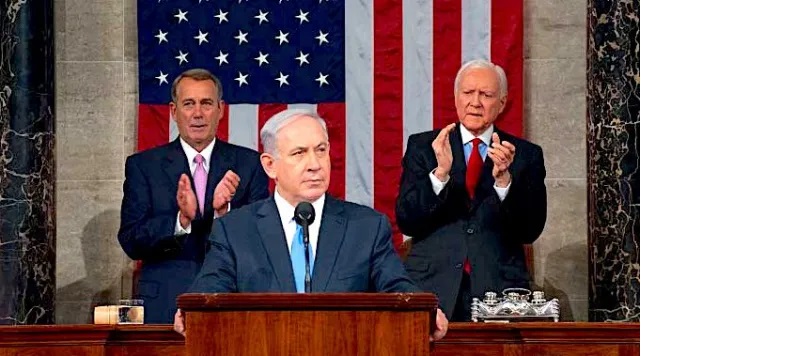
The occasion of Netanyahu’s address, his fourth before a joint session, puts all the complexities before us. Who was, in that hour, in charge — the insane man from the periphery, driven by rage, or his audience of adoring lawmakers at the imperial center, driven by… driven by what? I would say driven by greed, ideology and the work of running an imperium that is failing but has not failed yet. Who controlled whom that day? .
This is power.
Joe Biden, in this same line, accepted more money from the Israeli lobby than anyone else on Capitol Hill during his decades in the Senate — $4.2 million according to Open Secrets, and I understand this is a very low estimate if we count Biden’s post–Senate political career. Code Pink, in a signature-gathering campaign, says Harris has received $5.4 million from the Israel lobby, although it does not indicate at what stage in her career she accepted this extraordinary sum.
August 10, 2024 By Patrick Lawrence / Original to ScheerPost
That deranged speech Bibi Netanyahu delivered to a joint session of Congress last month: I cannot get it entirely out of my mind. It did not change anything — neither the Israeli prime minister nor his hosts seem to desire or intend to change anything in U.S.–Israeli relations. And in this way, there is not much to say about that weird hour the world’s No. 1 terrorist — yes, think about it and tell me I’m wrong — spent at the podium under the Capitol’s rotunda. But the speech did clarify certain things, and then it raised an important question. Let us see about these matters.
There is, to begin with, the question of Netanyahu’s mental stability. If we consider his many outlandish assertions — Israel has minimized civilian casualties in Gaza, Israeli soldiers are to be commended for their moral conduct, those protesting in behalf of Palestinians are probably in Iran’s pay, and so on — we must conclude that the man given to such preposterous misrepresentations is, let’s say, perpendicular to reality.
I am sure Netanyahu spoke in large measure for effect. This must be so. But I am equally sure — note the demeanor in the videos, for instance — he was certain of the truth of what he had to say. Dr. Lawrence’s diagnosis: A man consumed with resentment and hatred, who has led Israel to the brink of a cataclysmic war at the irretrievable cost of its international standing, while dragging the U.S. into it (at similar cost), suffers from severe psychosis with symptoms of paranoia and obsessive-compulsive megalomania.
I do not say this to indulge some cheap denigration of one of the many contemptible political figures now walking around the Western world and its appendages. After Netanyahu’s notably strange performance in Congress July 24 — at times he seemed pure id — I say this diagnosis would hold in a clinical setting. We should all take note of this and brace ourselves accordingly. Never mind who’s driving the bus: It would be better in this case if no one were driving it.
There is also the reception Netanyahu enjoyed on Capitol Hill. Seventy-two ovations by my count, 60–odd of them standing, for a war criminal, a flouter of international law, a man who commits to waging “a seven-front war” across the Middle East?
Bibi’s big theme, running all through his remarks, was congruence, the perfect alignment of Israeli and American interests. Remember? “Our enemies are your enemies, our fight is your fight, and”—here the left fist pounded—“our victory is your victory.”
The response among those in attendance tells you all you need to know about what America’s lawmakers think of this idea. Netanyahu was looking merely for reaffirmation of standing arrangements at a moment when when terrorist Israel’s conduct had begun to turn more stomachs than he had bargained for. And he got what he wanted, needless to say.
This brings us to the question Netanyahu’s speech forces upon us. Does the U.S. control Israel or does Israel control the U.S.? Is the apartheid state another of Washington’s client regimes, albeit — let’s borrow a little from the Chinese — a client with Zionist characteristics? Or is Israel a case — rare, if not unique — of a distant outpost that dictates to the imperial center? The periphery exercises power over the metropole, this to say: This would have to be something new under the sun, surely.
This is not a new question. A lot of people have pondered it for months, if not longer —
The occasion of Netanyahu’s address, his fourth before a joint session, puts all the complexities before us. Who was, in that hour, in charge — the insane man from the periphery, driven by rage, or his audience of adoring lawmakers at the imperial center, driven by… driven by what? I would say driven by greed, ideology and the work of running an imperium that is failing but has not failed yet. Who controlled whom that day? ………………………………………………………………………
This is power.
Joe Biden, in this same line, accepted more money from the Israeli lobby than anyone else on Capitol Hill during his decades in the Senate — $4.2 million according to Open Secrets, and I understand this is a very low estimate if we count Biden’s post–Senate political career. Code Pink, in a signature-gathering campaign, says Harris has received $5.4 million from the Israel lobby, although it does not indicate at what stage in her career she accepted this extraordinary sum.
Harris is now wowing all the dreamy liberals in our midst with gestures here and there intended to suggest that she will be tougher on the Israelis than Joe-the-Zionist and more sympathetic to the Palestinians. Follow the bouncing ball, please, as those honorable Arab–Americans up in Michigan follow it: Harris makes it quite clear, on those occasions she fails to avoid the topic, that she has no intention of making any meaningful adjustment in U.S. policy toward the terrorist state. Let the murdering go on, as long as the Israelis want it to continue.
This, as I say, is power—perversely acquired and perversely exercised………………………………………..
What is at issue in all this is the question of responsibility. Israel exercises considerable power over the U.S. — yes, we all know this — but this is by dint of a corrupt abdication on America’s part. We must not miss this. Washington’s whorish elites have sold U.S. policy to the Israelis, and Congress has sold itself similarly………………………………..
……………………………………..America could sink Netanyahu’s boat any time it chooses to do so. Don’t let the moment fool you: Bibi, as history will show, is at bottom merely a passing punk.
This, to finish the thought, is the power that matters most — imperial power.
Here’s the important thing about the distinction I draw. The ephemeral power Israel asserts in the U.S., accumulated over the eight postwar decades, reaches an historic impasse. It is waning, in a word.
In his final days as a public figure, Joe Biden will continue to carry on about the Zionist state as he has the whole of his political career. “Without Israel, no Jew in the world is safe,” he declared the other day, and hardly for the first time. Kamala Harris is not saying anything about Israel and the Gaza crisis in part because she has little to say about anything, but mostly because, when circumstances require her to break this silence — “weird” indeed, this — it will not be good news for those anticipating even a millimeter’s worth of change.
………………………………………………………………….there was an interesting item at the end of last month on WMAC Radio, the NPR station broadcasting in Upstate New York and western New England. Kamala Harris was just then raising hundreds of millions of dollars, cashing in on the irrational exuberance by then evident among Democrats. At a typically boisterous campaign stop in Pittsfield, Mass., she also faced protesters carrying placards that read, among other things, “End the Genocide” and “All This Money Will Not Wash the Blood Off Your Hands, Kamala.”
What are we looking at here? Pittsfield is a small postindustrial city struggling back to life after General Electric abandoned it decades ago. But this is just the point: Anger about “the Biden–Harris administration” for its participation in Israel’s genocide seems to run right down to this nation’s broken sidewalks. Harris has since gotten the same treatment at a big campaign rally in Philadelphia, and again the other day in Detroit, where she high-handedly dismissed protesters with “I am speaking.” You come away with the impression Americans are simmering — virtually everyone I know is simmering, now that I think about it — and the major media, complicit with the Harris bandwagon, are doing their part to keep this out of sight. Let us not forget: American campuses are quiet after the honorable demonstrations this past spring, but classes resume in a month.
You can bribe some of the people all of the time and all of the people some of the time, but you can’t bribe all of the people all of the time. I think I have my Lincoln right. And I think the Israelis, who, I imagine, don’t bother much with Abe, are on the way to learning that the power they have long exerted over U.S. politics and policy will eventually, in however long, prove ephemeral. https://scheerpost.com/2024/08/10/patrick-lawrence-israel-runs-the-u-s-no-the-u-s-runs-israel-no-wait/
US to send more military aid to Ukraine, as Ukrainian drones target Kursk and the Kursk Nuclear Power PLant

On Friday, Ukrainian drones targeted the Kursk Nuclear Power Plant in Kurchatov, briefly cutting power supplies to the town.
https://www.rt.com/news/602400-pentagon-ukraine-military-aid/ 10 Aug 24
Ammunition worth $125 million comes after Ukraine invaded Russia’s Kursk Region
Washington will send Kiev another $125 million worth of missiles and ammunition, the Pentagon announced as fierce fighting continued in Russia’s Kursk Region.
The US Department of Defense noted on Friday that this was the 63rd batch of aid provided to Ukraine since August 2021 – six months prior to the launch of Russia’s military operation.
To help Kiev meet “critical security and defense needs,” the US will send Stinger anti-aircraft missiles; ammunition for High Mobility Artillery Rocket Systems (HIMARS); rounds for 155mm and 105mm artillery; Javelin, AT-4 and TOW anti-tank missiles; small-arms ammunition; and demolitions ordnance, the Pentagon said in a statement.
The package also included multi-mission radars, Humvee ambulances, spare parts, services, training and transportation.
Washington’s previous batch of military aid, worth $1.7 billion, was sent at the end of July. According to the Pentagon’s own numbers, the US has sent more than $56.2 billion in military aid to Ukraine since President Joe Biden took office in January 2021.
Earlier this week, Ukraine sent several battalions worth of troops into Russia’s Kursk Region. Moscow has accused the invaders of indiscriminately targeting civilians with artillery, small arms and drone strikes. On Friday, Ukrainian drones targeted the Kursk Nuclear Power Plant in Kurchatov, briefly cutting power supplies to the town.
“We don’t feel like this is escalatory in any way,” Pentagon spokeswoman Sabrina Singh told reporters on Thursday, when asked about US military aid to Kiev.
According to Singh, everything Ukraine does is legitimate self-defense from the Russian “invasion,” while Russia can always de-escalate by withdrawing.
The Ukrainian leadership has said the primary goal of the Kursk operation was to induce “fear” in the hearts of the Russian people. One of the units involved in the operation, according to Ukrainian media, is named ‘Nachtigall’ after the notorious Nazi auxiliary from WWII commanded by Roman Shukhevych.
At least five civilians have been killed and 21 wounded – including six children – by the Ukrainian attacks, according to Russian authorities. The defense ministry in Moscow said that the invaders have lost almost 1,000 troops and over 100 armored vehicles as of Friday.
Genocide in Gaza still not on Kamala Harris’ moral radar

‘Don’t’ mention US enabling genocide…we’ve got an election to win.
Walt Zlotow, West Suburban Peace Coalition, Glen Ellyn IL 11 Aug 24
Three weeks in, Democratic presidential candidate Kamala Harris continues support for Israel’s genocidal ethnic cleansing of Palestinians in Gaza.
Over 40,000 dead with thousands more buried under the rubble from tens of thousands of US bombs in Gaza has made no dent on Kamala Harris’s conscience. Nor has a death toll predicted by the UK Medical Journal Lancet that upwards of 185,000 will soon be dead from disease, starvation to go along with endless US weapons of civilian destruction in the most grisly genocidal ethnic cleansing this century.
Of course, Harris has more sense than to cheer on the Israel’s genocide in Gaza. Her campaign frames her support this way: “Harris has been clear: she will always work to ensure Israel is able to defend itself against Iran and Iran-backed terrorist groups”. She claims to be troubled by the suffering caused by endless US bombs there, but refuses to support an embargo on genocide weapons.
Hubby Doug Imhoff chimed in “Let me just make this clear: the vice president has been and will be a strong supporter of Israel as a secure democratic and Jewish state, and she will always ensure that Israel can defend itself, period. Because that’s who Kamala Harris is.” If Imhoff were honest and decent, he’s could do so by simply replacing “democratic” and “Jewish” with “Apartheid” and “genocidal.”
When anti-genocide protesters confronted her Harris about her genocide support during a campaign speech in Detroit, Harris shot back “You know what? If you want Donald Trump to win, then say that. Otherwise, I’m speaking.” That has become the go-to Democratic response to pushback against Democratic support for Israeli genocide in Gaza: ‘Don’t’ mention US enabling genocide…we’ve got an election to win.
Three weeks into her campaign to become the first woman US president, Kamala Harris’ moral compass is frozen in support of Israeli genocide in Gaza. She should ponder this eternal truth. What does it profit a person to gain the world, when she must sell her soul to achieve it?
The nuclear lobby wants new large nuclear reactors to be classed as “Small”

By magic, QUITE LARGE nuclear reactors are now SMALL.
And geewhiz – these new nuclear reactors no longer need much safety regulation

10 Aug 24, The Canadian Nuclear Association (CNA, the nuclear lobby) has written to all federal Members of Parliament in preparation for the 2025 budget. Their requests are in two sections: “investment tax credits” and “regulatory improvements.”
The investment tax credits allow companies to reduce their taxes owed if they spend money on nuclear development.
The CNA has numerous requirements , especially regarding SMRs
Small Modular Reactors (SMRs) – the numerous requirements include:
*Adjusting the definition to include projects up to 1400 megawatts thermal, or roughly 470 megawatts electrical.
*The CNA wants nuclear regulations to be reduced, particularly for Impact Assessments.
Streamline the Impact Assessment (IA) process:
Narrow the scope to factors of federal interest and indigenous rights and Remove the requirements for a Detailed Project Description
******************************************
From the International Atomic Energy Agency. Small modular reactors (SMRs) are advanced nuclear reactors that have a power capacity of up to 300 MW(e) per unit, which is about one-third of the generating capacity of traditional nuclear power reactors. https://www.iaea.org/newscenter/news/what-are-small-modular-reactors-smrs
From the International Atomic Energy Agency (For Small Modular Reactors) The main concepts underpinning the current safety approach — such as, for example, defence-in-depth, which assures prevention and mitigation of accidents at several engineering and procedural levels — are relevant for SMRs . A comprehensive safety assessment of all plant states — normal operation, anticipated operational occurrences and accident conditions — is required. https://www.iaea.org/newscenter/news/technology-neutral-safety-and-licensing-of-smrs
Analysis of Canadian Nuclear Association (CNA) recommendations for Budget 2025

The lack of new nuclear projects in Canada reflects investor decisions, not excess regulation. No nuclear project has been assessed since the Act came into force nearly five years ago.
Ole Hendrickson , 10 August 24
The House of Commons Standing Committee on Finance announced its annual pre-budget consultations process on June 24, 2024. It invited the submission of written briefs no later than August 2, 2024. The committee will table a report on these consultations in the House of Commons, with recommendations to be considered by the Deputy Prime Minister and Minister of Finance in their development of Budget 2025. On July 30, 2024, the Canadian Nuclear Association (CNA) submitted its recommendations.
Part 1 – “Clean Economy” Investment Tax Credit (ITC) Programs
The CNA brief refers to four “Clean Economy” investment tax creditprograms from Budget 2024. Three were passed into law in June 2024.
Nuclear projects should not be eligible for investment tax credits. Nuclear power is not clean. It produces vast amounts of pollutants and waste, ranging from toxic mine tailings to irradiated fuel rods. Providing tax credits for nuclear power represents poor economic and environmental policy.
The only apparent reason for providing investment tax credits for nuclear power is that the Minister of Natural Resources Canada, whose department provides “engineering and scientific guidance” for the ITC programs, has a mandate to promote nuclear power under the Nuclear Energy Act.
1. Clean Technology ITC
Small modular nuclear reactors (SMRs) are the only nuclear power projects eligible for the 15% refundable tax credit under this program. The accepted definition of an SMR is a reactor that has a power capacity of up to 300 megawatts electrical per unit, or roughly 900 megawatts thermal.
The CNA wants to expand the definition of an SMR to include reactors up to 1400 megawatts thermal, or roughly 470 megawatts electrical.
There is considerable evidence that SMRs would produce far more expensive electricity than other generating facilities, including larger nuclear reactors. Does the CNA anticipate that the 300-megawatt BWRX-300 reactors that Ontario Power Generation plans to build at the Darlington nuclear site will not be cost-competitive without additional subsidies?
2. Clean Hydrogen ITC
This ITC program provides refundable tax credits ranging from 15-40% depending on the carbon intensity of the hydrogen produced. Widespread use of hydrogen as an energy source would require expensive new infrastructure investments. Using expensive nuclear power to produce hydrogen would further increase costs. The CNA wants hydrogen produced by using nuclear power to hydrolyze water to be considered as a qualified clean hydrogen project. The Government of Canada has not provided details on eligible projects under this ITC program.
3. Clean Technology Manufacturing ITC
This ITC program provides refundable tax credits for “clean technology manufacturing and processing.” The CNA wants to see explicit mention of the extraction and processing of uranium as a “critical mineral”, of the manufacturing of nuclear energy equipment and nuclear fuels, and of the manufacturing of “equipment for lifecycle handling of uranium fuel,” as being eligible for tax credits.
All the activities in the nuclear fuel “lifecycle” generate waste that is hazardous to human health and difficult to manage. The use of robotic equipment to handle the highly radioactive spent nuclear fuel waste is one of the most expensive parts of this “lifecycle”. A “clean economy” program should not subsidize waste management for a particular industry, particularly when that industry has delayed its decommissioning and waste management activities for decades.
4. Clean Electricity ITC
Under this ITC program, which has not yet passed into law, the CNA wants to “include all components enabling clean electricity assets to continue operating in refurbishment expenditures.”
Ontario Power Generation and Bruce Power have active reactor refurbishment programs. The Ontario provincial government already provides a $7.3 billion taxpayer subsidy to hold down electricity rates and shield industrial and household ratepayers from reactor refurbishment costs. A new federal subsidy for refurbishment of Ontario’s reactors would further hide nuclear costs, and would provide no apparent benefit to Canadian taxpayers in other provinces.
Part 2 – Policies that “enhance the regulatory framework to expedite project approvals”
The CNA is seeking to restrict the public’s ability to participate in assessments of nuclear projects. This builds on proposals from a Ministerial Working Group on Regulatory Efficiency for Clean Growth Projects, and a review of the Physical Activities Regulations (the “Project List”) by the Impact Assessment Agency of Canada. Policy matters that go beyond the Committee’s request for views on 2025 Budget priorities should be debated by appropriate Parliamentary committees.
1. Exempting nuclear projects from impact assessment
Based on a plan (Building Canada’s Clean Future) created by a Ministerial Working Group on Regulatory Efficiency for Clean Growth Projects, the Impact Assessment Agency of Canada wishes to reduce the possibility that future nuclear projects will be assessed under the Impact Assessment Act. On July 30, 2024, the Agency released a Discussion paper on the review of the Physical Activities Regulations – the so-called “Project List” – with comments due September 27, 2024.
Proposals in the Agency’s discussion paper mirror those in the CNA’s submission to the Finance Committee, suggesting that the two may have been working together. The CNA wants to exempt nuclear reactors of any size that are built on “brownfield” sites (e.g., sites where coal- or gas-fired generating stations have been shut down), or on licensed nuclear sites, from assessment. At present, only reactors of up to 200 megawatts thermal on brownfield sites, or 900 megawatts thermal on licensed sites, are exempt. The CNA proposal would also limit technical assessments to “First of a Kind” reactors, with only site considerations for future reactors of a similar design.
The CNA also wants to exempt construction, expansion and decommissioning of uranium mines with an ore production capacity of up to 5,000 tons per day. This would double the current 2,500 tons/day exemption. And it wants to allow provincial assessments to replace federal assessments.
These are not constructive proposals. They would increase the likelihood that nuclear projects will generate conflicts and fail to gain social license. The Act improves the chances that a project will proceed by encouraging public participation in project planning stages, The ability of independent experts to examine technical details brings rigor to the assessment process.
The lack of new nuclear projects in Canada reflects investor decisions, not excess regulation. No nuclear project has been assessed since the Act came into force nearly five years ago.
2. Putting the Canadian Nuclear Safety Commission (CNSC) in charge of impact assessment
If a nuclear project is captured by the Physical Activities Regulations under the Impact Assessment Act, under Section 44 of the Act the Minister of the Environment must create a review panel, set the panel’s terms of reference, appoint the chairperson and at least two other members of the panel, and ensure that they are unbiased and free from any conflict of interest relative to the project.
The Minister also has the power to designate a project for assessment, even if it is not captured by the Project List. The CNA wants to remove the Minister’s powers and give them to the CNSC.
An expert panel report, Building Common Ground: A New Vision for Impact Assessment in Canada, noted the long-standing perception of a lack of independence and neutrality of the CNSC because of its close relationship with the industry it regulates, and its promotion of projects it is tasked with regulating. The panel found that the CNSC has eroded confidence in the assessment process, leading to widespread use of the term “regulatory capture” to describe this body.
Taking away the Ministers’ powers and reassigning them to the CNSC would be a regressive step, leading to further loss of social license for nuclear projects, as has been the case with the proposed Near Surface Disposal Facility at the federally owned Chalk River Laboratories.
3. Amending the Species at Risk Act
Under section 79 of the Species at Risk Act, the proponent of a project must “notify the competent minister or ministers in writing of the project if it is likely to affect a listed wildlife species or its critical habitat.”
The CNA recommends that section 79 be modified “to align with the Supreme Court of Canada opinion, focusing on federal jurisdiction.” The Court, in its reference decision on the Impact Assessment Act, considered the Species at Risk Act and found that the protection of migratory birds, fish, fish habitat, and aquatic species should be included in the definition of adverse federal effect in the Impact Assessment Act. The Court did not discuss amending the Species at Risk Act.
The Species at Risk Act applies to all wild species found in Canada and has provisions to promote cooperation with other governments and jurisdictions. The CNA recommendation to amend the Act in the context of Budget 2025 would represent an inappropriate use of budget legislation.
US Policy: Let Israel Escalate Against Iran, Then Tell Iran Not To Escalate Back
When Iran does whatever it’s about to do, we may be certain that the western empire and its propagandists in the mass media are going to frame it as an unprovoked and outrageous act of aggression and start babbling about “defending” Israel against its “attackers”.
Caitlin Johnstone, Aug 09, 2024, https://www.caitlinjohnst.one/p/us-policy-let-israel-escalate-against?utm_source=post-email-title&publication_id=82124&post_id=147506650&utm_campaign=email-post-title&isFreemail=true&r=1ise1&triedRedirect=true&utm_medium=email
In an article titled “U.S. Warns Iran of ‘Serious Risk’ if It Conducts Major Attack on Israel,” The Wall Street Journal reports that officials within the Biden administration have been warning Iran not to “escalate” against Israel in its planned retaliatory strikes for the assassination of a Hamas leader in Tehran.
“The United States has sent clear messaging to Iran that the risk of a major escalation if they do a significant retaliatory attack against Israel is extremely high,” an anonymous US official told The Wall Street Journal, adding that “there is a serious risk of consequences for Iran’s economy and the stability of its newly elected government if it goes down that path.”
As we sit awaiting Iran’s planned reprisal attack and hope dearly that it doesn’t lead to a major new war in west Asia, one can’t help but read such reports and think it sure would’ve been nice of the Americans to issue these kinds of warnings to Israel against escalating before it went on its insanely escalatory assassination spree in the capital cities of Iran and Lebanon.
You’ll never see western officials so enthusiastic about the idea of de-escalation as they are in those time periods when their side has just severely escalated tensions with an extreme act of aggression, but the other side has yet to retaliate. They remind you of a parent who lets their kid run around clobbering other children at the playground, then when another child goes to hit them back they rush in and start yelling about the need to play nice.
They’ve been doing this song and dance for the last few days, ever since it became clear that Iran was going to retaliate for the assassination of Hamas leader Ismail Haniyeh while he was a guest on their territory.
“Earlier, Vice President Harris and I were briefed in the Situation Room on developments in the Middle East,” President Biden’s Twitter account posted on Monday. “We received updates on threats posed by Iran and its proxies, diplomatic efforts to de-escalate regional tensions, and preparations to support Israel should it be attacked again. We also discussed the steps we are taking to defend our forces and respond to any attack against our personnel in a manner and place of our choosing.”
“Further attacks only raise the risk of dangerous outcomes that no one can predict and no one can fully control,” US Secretary of State Antony Blinken proclaimed on Tuesday.
“Further escalation in the Middle East is in no one’s interests,” tweeted UK Foreign Secretary David Lammy on Tuesday. “I spoke to Iran’s acting Foreign Minister, Ali Bagheri Kani, and cautioned that any Iranian attack would have devastating consequences for the region. Iran and all parties must urgently and immediately de-escalate.”
Israel’s powerful western backers are happy to let it run rampant throughout the region without making any meaningful warnings against its criminal actions or imposing any consequences on it whatsoever. But as soon as it becomes clear that Israel has crossed a red line and is about to get hit, these western empire managers turn into a bunch of hippies who just want peace and love.
When Iran does whatever it’s about to do, we may be certain that the western empire and its propagandists in the mass media are going to frame it as an unprovoked and outrageous act of aggression and start babbling about “defending” Israel against its “attackers”. Imperial history always begins right after Israel’s aggressions, and starts the clock as the retaliations for them emerge.
That’s how the imperial spin machine operates: reversing victim and victimizer, aggressor and defender, claiming to always be acting in self-defense while existing in a continuous state of attack. When the inevitable blowback from these aggressions turns up, they stare with Bambi-eyed innocence and call it an unprovoked attack launched by deranged madmen with hatred in their hearts, and use it to justify even more mass military slaughter in the parts of the world where they already wanted to inflict it.
Are you not tired of having your intelligence insulted like this? I know I am.
1 This Month

of the week – Shut Down Drone Warfare!


Tell the Ukrainian Government to Drop Prosecution of Peace Activist Yurii Sheliazhenko

Petition to revoke the licensing of the Near Surface Nuclear Disposal Facility (NSDF) at Chalk River. https://www.ourcommons.ca/petitions/en/Petition/Details?Petition=e-7247
To see nuclear-related stories in greater depth and intensity – go to https://nuclearinformation.wordpress.com
-
Archives
- April 2026 (114)
- March 2026 (251)
- February 2026 (268)
- January 2026 (308)
- December 2025 (358)
- November 2025 (359)
- October 2025 (376)
- September 2025 (257)
- August 2025 (319)
- July 2025 (230)
- June 2025 (348)
- May 2025 (261)
-
Categories
- 1
- 1 NUCLEAR ISSUES
- business and costs
- climate change
- culture and arts
- ENERGY
- environment
- health
- history
- indigenous issues
- Legal
- marketing of nuclear
- media
- opposition to nuclear
- PERSONAL STORIES
- politics
- politics international
- Religion and ethics
- safety
- secrets,lies and civil liberties
- spinbuster
- technology
- Uranium
- wastes
- weapons and war
- Women
- 2 WORLD
- ACTION
- AFRICA
- Atrocities
- AUSTRALIA
- Christina's notes
- Christina's themes
- culture and arts
- Events
- Fuk 2022
- Fuk 2023
- Fukushima 2017
- Fukushima 2018
- fukushima 2019
- Fukushima 2020
- Fukushima 2021
- general
- global warming
- Humour (God we need it)
- Nuclear
- RARE EARTHS
- Reference
- resources – print
- Resources -audiovicual
- Weekly Newsletter
- World
- World Nuclear
- YouTube
-
RSS
Entries RSS
Comments RSS
 nuclear-news