A nuclear-free energy future for Hydro-Québec, says Michael Sabia

Marie-Anne Audet, Thursday, December 12, 2024, Le Journal de Montreal,
Hydro-Québec has definitively closed the door to nuclear power, according to its CEO, Michael Sabia, who assured Thursday that energy production will reach new heights with the agreement in principle announced between Quebec and Newfoundland and Labrador around the Churchill Falls dam.
If approved, the deal would add 2,400 MW to Hydro-Québec’s production. The Crown corporation also plans to invest $25 billion to launch three new power plants in Labrador
“We are going to increase production between 8,000 and 9,000 megawatts [by 2035]. With the 2,400 megawatts coming from Newfoundland, we arrive at more than 11,000 megawatts of additional power,” he illustrated during an interview with LCN………………………………………………… https://www.journaldemontreal.com/2024/12/12/un-futur-energetique-sans-nucleaire-pour-hydro-quebec-affirme-michael-sabia
Canada considers financing for Polish nuclear power plant

Tuesday, 10 December 2024 https://www.world-nuclear-news.org/articles/canada-considers-financing-for-polish-nuclear-power-plant
Polskie Elektrownie Jądrowe announced it has received a letter of intent from Export Development Canada, for up to CAD2.02 billion (USD1.45 billion) to potentially support Poland’s first nuclear power plant project.
The letter of intent with Export Development Canada (EDC) – a Canadian Crown corporation – is in support of the sale of goods and services by Canadian suppliers. EDC support is subject to the successful completion of its detailed due diligence process and credit approval.
Westinghouse – jointly owned by Canadian firms Brookfield and Cameco – welcomed the signing of the letter of intent, which it said it helped facilitate.
“Not only does this financing agreement underscore the important role Canada will play in helping Europe secure and diversify its energy future, but it will also help prepare the nation’s nuclear supply chain to support the next AP1000 plant in North America,” said Westinghouse Energy Systems President Dan Lipman. “We appreciate the close cooperation of the EDC in helping Westinghouse make AP1000 projects a reality for its customers while bringing home economic benefits to Canada.”
Westinghouse said the announcement demonstrates its “deep commitment to Canada’s economy by securing work for Canadian firms and trade unions supporting Westinghouse’s global fleet of advanced reactors”. For each AP1000 unit that is built outside of Canada, Westinghouse says it could generate almost CAD1 billion in gross domestic product through local suppliers.
Last month, the US International Development Finance Corporation – the USA’s development bank – signed a letter of interest with Polskie Elektrownie Jądrowe (PEJ) to provide more than USD980 million in financing for Poland’s first nuclear power plant. A similar declaration, for the equivalent of about PLN70 billion (USD17.3 billion), was made earlier by the US Export-Import Bank. Westinghouse and Bechtel jointly form a consortium that implements the PEJ investment project in Pomerania.
“We are pleased to see strong interest in our investment project from leading players in the global financial market, with whom we are in constant contact. The letter of intent from Export Development Canada is another confirmation of this fact, and at the same time our next step towards implementation of the strategy for obtaining financing for the entire project,” said PEJ Vice President Piotr Piela.
PEJ said: “Cooperation with export credit agencies is an important part of the strategy for securing financing for the nuclear power plant in Pomerania – it involves continuing discussions with, among others, entities from countries with extensive nuclear supply chains, in order to maximise and optimise financing opportunities for this key investment project for Poland.”
In November 2022, the then Polish government selected the Westinghouse AP1000 reactor technology for construction at the Lubiatowo-Kopalino site in the Choczewo municipality in Pomerania in northern Poland. An agreement setting a plan for the delivery of the plant was signed in May last year by Westinghouse, Bechtel and PEJ – a special-purpose vehicle 100% owned by Poland’s State Treasury. The Ministry of Climate and Environment in July issued a decision-in-principle for PEJ to construct the plant. The aim is for Poland’s first AP1000 reactor to enter commercial operation in 2033.
Under an engineering services signed in September last year, in cooperation with PEJ, Westinghouse and Bechtel will finalise a site-specific design for a plant featuring three AP1000 reactors. The design/engineering documentation includes the main components of the power plant: the nuclear island, the turbine island and the associated installations and auxiliary equipment, as well as administrative buildings and infrastructure related to the safety of the facility. The contract also involves supporting the investment process and bringing it in line with current legal regulations in cooperation with the National Atomic Energy Agency and the Office of Technical Inspection.
In September, the Polish government announced its intention to allocate PLN60 billion to fund the country’s first nuclear power plant.
Canada’s nuclear waste problem is not solved

A quick media scan shows many casual observers leaping to the conclusion that Canada’s nuclear waste problem is “solved,” erasing a major obstacle to a costly and dangerous expansion of nuclear power. Nuclear promoters are encouraging this misleading assumption.
Without a doubt, nuclear waste owners to the south are watching these developments closely. U.S. utilities and government have even more waste in temporary storage and no permanent solution in sight.
ANNE LINDSEY, 4 Dec 24
ON Nov. 28, right on schedule, the Nuclear Waste Management Organization (NWMO) triumphantly declared they have picked their site for the future Deep Geological Repository (DGR) for all of Canada’s high-level nuclear waste.
NWMO is a federal government-created consortium of companies that own and must manage Canada’s nuclear waste — 130,000 tonnes (and counting) of highly toxic radioactive materials currently sitting in temporary storage at reactor sites. Their chosen repository site is near Revell Lake, between Ignace and Dryden, Ont. The Revell area is on the territory of Treaty 3 First Nations, the closest being Wabigoon Lake Ojibway Nation (WLON). It sits at the headwaters of Wabigoon and the Turtle-Rainy River watersheds — flowing north and west, eventually into Lake Winnipeg, via the English-Wabigoon system, Lake of the Woods and the Winnipeg River.
In July, the town of Ignace signed a “willingness declaration” agreeing to host a DGR in the Revell area (notwithstanding that Ignace is not even on the same watershed as the Revell site), and only days before the site selection announcement, headlines across multiple news outlets suggested that WLON had also declared itself to be a willing host.
In fact, WLON’s news release about its recent community vote says “the yes vote does not signify approval of the project.” It does say that the nation agrees to further study of the site. This is an important distinction. (The Nation has also since stated that the project will be subject to Wabigoon’s own regulatory assessment and approval process. What this means legally in terms of WLON’s ability to reject the project in the future is not currently known).
NWMO’s process says it must receive a “compelling demonstration of willingness” from a host community before proceeding to site characterization (further geological study of the chosen site to see if it’s even suitable for keeping nuclear waste out of groundwater and the environment for the required hundreds of thousands of years).
NWMO says it is “confident” that specific location studies will prove that their out-of-sight, out-of-mind concept of deep burial of some of the most dangerous toxins on Earth will be safe. They’ve been expressing that cavalier confidence for decades, lulling Canadians into believing that it’s fine to keep producing the waste because eventually it will be dealt with.
A quick media scan shows many casual observers leaping to the conclusion that Canada’s nuclear waste problem is “solved,” erasing a major obstacle to a costly and dangerous expansion of nuclear power. Nuclear promoters are encouraging this misleading assumption.
Without a doubt, nuclear waste owners to the south are watching these developments closely. U.S. utilities and government have even more waste in temporary storage and no permanent solution in sight.
But is the waste problem solved? Even if (predictably), the industry deems its concept technically feasible, and even if WLON eventually decides it is a “willing host,” what about all the other communities impacted by this decision?
They must have their say. This means everyone along the transportation routes from southern Ontario and New Brunswick — let’s remember we are talking about three massive shipments per day for the next 40 years just for existing waste on the sometimes-treacherous highways of northern Ontario.
It also means all the downstream communities (including in Manitoba) whose waters would be affected by any release of radioactivity. Many Treaty 3 First Nations near the Revell site as well as the Grand Council of Treaty 3, Nishnawbe Aski Nation and Anishinabek Nation have already made statements opposing transportation and burial of nuclear waste in northern Ontario.
It’s telling that not a single community or First Nation other than Ignace and Wabigoon Lake has voiced support for the Revell site.
Since Ignace first expressed interest in 2009, both of those communities have been actively courted by the NWMO. Cash and other incentives are known to have been provided to Ignace. Little is publicly known about any agreements that may exist between NWMO and WLON. Those details may never be known as NWMO is mysteriously exempt from freedom of information requests (even though it claims to be transparent).
What is clear is that NWMO has not yet achieved its necessary goal of a “compelling demonstration of willingness.” What it has done is corrupted its own process by claiming consent where none exists, with the blessing of the federal government. Perhaps worst of all — and one might say this is historically predictable — it has created a situation in which neighbouring communities may end up pitted against each other.
Meanwhile, the nuclear waste problem is not “solved.”
Anne Lindsey volunteers with the No Nukes MB campaign of the Manitoba Energy Justice Coalition and has been monitoring nuclear waste since the 1980s. She lives in Winnipeg and spends time in Northwestern Ontario.
Nuclear industry selects site in northwestern Ontario for waste disposal amidst regional opposition
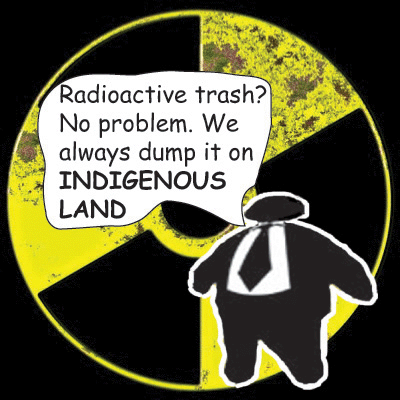
Assembly of First Nations calls for new approach to Indigenous consultation and consent
Warren Bernauer and Elysia Petrone / December 3, 2024 https://canadiandimension.com/articles/view/nuclear-industry-selects-site-in-northwestern-ontario-for-nuclear-waste-disposal-amidst-regional-opposition
Indigenous groups are raising awareness about plans to construct a series of caverns deep underground in the heart of Treaty 3 territory, to be filled with all of Canada’s high-level nuclear waste.
On November 28, the Nuclear Waste Management Organization (NWMO) announced it had selected Wabigoon Lake Ojibway Nation and the municipality of Ignace as “host communities” for all of Canada’s high-level nuclear waste. According to NWMO resident and CEO Laurie Swami, the decision to dispose of nuclear waste in northwestern Ontario “was driven by a consent-based siting process led by Canadians and Indigenous peoples.” Yet the extent to which the people of northwestern Ontario consent to the proposed waste repository is, at best, unclear.
The NWMO is a not-for-profit corporation, founded and funded by the nuclear power industry, which has been tasked with the management of Canada’s nuclear waste. Since 2005, the NWMO has been advancing plans to construct a deep geological repository (DGR), intended to be the final resting place for all spent nuclear fuel from reactors in Canada. As part of its site-selection process, it has been searching for a “willing host” community. In 2020, the NWMO narrowed its candidates to two Ontario municipalities, both of which have since signed “hosting agreements” with the NWMO: Ignace and South Bruce.
The NWMO has also committed to seeking the consent of the Indigenous communities on whose territories the DGR would be situated. Indigenous consent to nuclear waste disposal is required under the terms of international human rights covenants like the United Nations Declaration on the Rights of Indigenous Peoples (UNDRIP). According to Article 29 of UNDRIP, “States shall take effective measures to ensure that no storage or disposal of hazardous materials shall take place in the lands or territories of Indigenous peoples without their free, prior and informed consent.”
Before announcing that it had selected northwestern Ontario for its waste repository, the NWMO had been negotiating with both the Wabigoon Lake Ojibway Nation (near Ignace, in northwestern Ontario) and Saugeen Ojibway Nation (near South Bruce, within the water shed of Lake Huron).
Wabigoon Lake Ojibway Nation says ‘yes’ but stops short of consent
On November 18, members of Wabigoon Lake Ojibway Nation voted ‘yes’ to continuing with the NWMO’s site-selection process. Rather unsurprisingly, the NWMO has characterized Wabigoon Lake’s vote as confirmation that it is “a willing host community for Canada’s repository for used nuclear fuel.”
Yet public communication from Wabigoon Lake stops short of declaring their consent to the proposed DGR. According to a press release from the First Nation, “the yes vote does not signify approval of the project; rather, it demonstrates the Nation’s willingness to enter the next phase of in-depth environmental and technical assessments, to determine safety and site suitability.”
At present, the question Wabigoon Lake members voted on, the official results, and the details of the agreement the First Nation has signed with the NWMO have not been publicly released. It therefore remains unclear whether the NWMO has succeeded in obtaining the consent it requires to move forward with its proposed DGR.
According to a recent newsletter from regional anti-nuclear group We the Nuclear Free North:
NWMO has to date failed to establish that Wabigoon Lake Ojibway Nation is a ‘willing host’ or to extract from WLON a ‘compelling demonstration of willingness’. The NWMO has repeatedly stated that the project will only be located in an area with an informed and willing host, with acceptance supported by a ‘compelling demonstration of willingness’ and with surrounding communities working together to implement the project.
It is also unclear what sort of financial benefits were offered to Wabigoon members in exchange for agreeing to moving to the ‘site characterization’ stage of the NWMO’s process. There has been significant controversy surrounding the financial payments the NWMO has made to Indigenous and municipal governments, with some suggesting that it is buying or ‘bribing’ its way to community support.Regional opposition
The NWMO’s decision was made in the context of significant regional opposition to NWMO’s plans for a DGR near Ignace.
In September, Darlene Necan led a walk to protest the proposed disposal of nuclear waste in northwestern Ontario. A member of the Ojibway Nation of Saugeen—a First Nation situated north of Ignace, not to be confused with the Saugeen Ojibway Nation near South Bruce—Necan has led annual anti-nuclear protests since 2019. According to Ricochet, the 2024 walk involved roughly 30 participants who walked from Ignace and Wabigoon, along the Trans Canada Highway, to the proposed DGR site.
Multiple First Nations and municipalities along the proposed transportation route, as well as those that are downstream from the proposed Ignace DGR site, have passed resolutions and issued statements opposing the NWMO’s proposed repository.
This past fall, 12 First Nations wrote a joint open letter to NWMO President and CEO Laurie Swami, notifying her that they “say ‘no’ to nuclear waste storage and transport in the North.”
The First Nations behind the letter—including Asubpeeschoseewagong Anishinabek (Grassy Narrows), Kitchenuhmaykoosib Innnuwug, Wapekeka First Nation, Neskantaga First Nation, Muskrat Dam First Nation, Ojibways of Onigaming, Wauzhushk Onigum Nation, Gull Bay First Nation, Netmizaaggamig Nishnaabeg, Fort William First Nation, Gakijiwanong Anishinaabe Nation, and Shoal Lake 40 First Nation—are situated on or near the proposed transportation route and downstream of the proposed DGR.
“Our Nations have not been consulted, we have not given our consent, and we stand together in saying ‘no’ to the proposed nuclear waste storage site near Ignace. We call on you to respect our decision.”
Regional First Nations organizations have similarly indicated their opposition to transporting and storing nuclear waste in northwestern Ontario. For example, in October, Grand Council Treaty 3 passed a resolution reaffirming its opposition to the storage of nuclear waste in Treaty 3 territory, which includes the proposed DGR site near Ignace. The resolution states, “a Deep Geological Repository for the storage of nuclear waste will not be developed at any point in the Treaty 3 territory.”
The NWMO’s announcement that it has selected northwestern Ontario for the proposed repository makes no mention of this groundswell of regional opposition.
NWMO’s ‘willingness’ process criticized by Assembly of First Nations
The NWMO decision also comes at a time when its approach to identifying ‘willing hosts’ is coming under increased scrutiny.
A recent report issued by the Assembly of First Nations (AFN) raises serious questions about the NWMO’s approach to Indigenous consultation and consent, which focuses on obtaining the consent of individual ‘host’ communities. Instead, the AFN argues that seeking consent “from all impacted First Nations is imperative.”
The AFN report is from its Dialogue Sessions on the Transportation and Storage of Nuclear Wastes. The dialogues were hosted by the AFN in Fredericton, Toronto, Thunder Bay, and Vancouver in spring 2024. The report includes a series of recommendations to the NWMO. The NWMO’s decision to select northwestern Ontario for its waste repository appears to ignore one of the AFN’s central recommendations.
The report’s first recommendation calls upon the NWMO to rethink its approach to consulting First Nations about its proposed DGR, including a need to seek the consent of nations that are situated on the transportation route or downstream from the repository, before selecting a site for Canada’s high-level nuclear waste:
The AFN respectfully urges that comprehensive and meaningful dialogue, consultation, and engagement be undertaken with all affected First Nations throughout the site selection process, and before any critical decisions are made regarding the Deep Geological Repository or transportation routes. It is essential that the perspectives of all First Nations who rely on the same watershed as the proposed site, as well as those along the transportation route, be respected and fully integrated, in a manner that honors their inherent right to self-determination.
Resistance likely to continue
Now that the NWMO has selected a site for its proposed DGR, the next step is for it to submit a formal proposal to federal and provincial regulators. The proposed DGR will then undergo impact assessment and licensing processes. Wabigoon Lake Ojibway Nation has also indicated that the NWMO’s proposal will also have to satisfy the First Nation’s own internal regulatory processes and procedures.
Given the recent upsurge in opposition to the NWMO’s proposed activities in northwestern Ontario, it seems almost certain that resistance to the proposed DGR will continue.
Warren Bernauer is a non-Indigenous member of Niniibawtamin Anishinaabe Aki and research associate at the University of Manitoba where he conducts research into energy transitions and social justice in the North.
Elysia Petrone is a lawyer and activist from Fort William First Nation and a member of Niniibawtamin Anishinaabe Aki.
‘Great British Nuclear Fantasy’ Mirrors SMR Hype in Canada

While Canada touts small modular nuclear reactors and U.S. investors run for cover, the United Kingdom will waste billions watching the industry slowly crumble, writes veteran journalist Paul Brown.
Paul Brown, Dec 01, 2024, https://energymixweekender.substack.com/p/great-british-nuclear-fantasy-mirrors
According to the United Kingdom’s Labour government, the country is forging ahead with large nuclear stations and a competition to build a new generation of small modular reactors.
Great British Nuclear, a special organization created by the last Conservative administration and continued by Labour, is charged with finding sites for new large reactors and getting a production line running to produce the best small modular reactors. These will be mass produced in as yet non-existent factories.
The state of play in the UK mirrors the unbridled hype in Canada, with provinces like Ontario putting nuclear ahead of more affordable, more genuinely green energy options and the industry brazenly hiring departing provincial cabinet ministers to guide its lobbying efforts. That’s in spite of independent analysts declaring SMRs a “Hail Mary” unlikely to succeed and pointing out that, in contrast to the private power market in the U.S., Canada’s mostly public utilities make it easier for SMR proponents to avoid transparency on costs—and let taxpayers/ratepayers assume the risk if things go wrong.
The UK government is cheered on by both the country’s trade unions and the right-wing press which otherwise spends much time attacking the renewables industry and pouring scorn on Labour’s drive to reach net zero.
However, two distinguished academics who have much spent of their careers studying the electricity industry have produced a comprehensive study that says this latest nuclear “renaissance” won’t happen. Better for the country to cut its losses now and cancel the program than continue to waste billions more pounds letting the nuclear industry crumble slowly, they say.
Prof. Stephen Thomas, emeritus professor of energy policy at Greenwich University in London and Prof. Andy Blowers, emeritus professor of social studies at the Open University, pull no punches. Their report is titled: “It is time to expose the Great British Nuclear Fantasy once and for all.”
Currently, the French electricity giant EDF is building two 1,600-megawatt European pressurized water reactors at Hinkley Point in Somerset. The project is 13 years later than EDF’s original schedule, and the cost has escalated from £18 billion when contracts were signed in 2016 to £35 billion in 2024 (and that is in 2015 prices). The first of the two reactor’s start-up date has this year been postponed until 2030 at the earliest.
With this flagship project costing so much, EDF, already deeply in debt, has declined to finance the second planned twin reactors of the same design at Sizewell C in Suffolk. Site preparation work for this station is under way and the British government has sunk £8 billion into the project already without yet making a final investment decision, even though it was promised earlier this year. This is because the government cannot yet find the private capital required to build the reactors. The two professors say the government should cut its losses now and pull the plug on the project.
Even more pointless according to the two academics is the small modular reactor competition which has four companies, Rolls Royce, Westinghouse, Holtec, and GE Hitachi, putting forward designs. All have the same basic idea, which is to build the reactors in factories and assemble them at sites all over Britain. This, they claim, would be more efficient than building large reactors, and therefore produce cheaper electricity.
The government has said it is prepared to spend £20 billion through 2038 to get these up and running. But the report points out that none of the designs have been completed, let alone tested, so there is no evidence that the claims for them can be justified. They point out nuclear power has “a long history of over-promising and not delivering.”
“Rigorous regulatory and planning processes are essential but are necessarily time-consuming, expensive, and place significant hurdles in the way of an accelerated nuclear program,” the report states. “Some projects may fail to gain site licences or planning permission and all will face substantial delays to the commencement of development.”
The report also points to climate change as a potential problem, since nearly all the potential sites are on coastlines vulnerable to sea level rise and storm surges.
“Despite the sound and fury, the Great British Nuclear project is bound to fail,” Blowers and Thomas conclude.
“No amount of political commitment can overcome the lack of investors, the absence of credible builders and operators, or available technologies, let alone secure regulatory assessment and approval,” they write. “Moreover, in an era of climate change, there will be few potentially suitable sites to host new nuclear power stations for indefinite, indeed unknowable, operating, decommissioning, and waste management lifetimes.”
The two authors acknowledge that “abandoning Sizewell C and the SMR competition will lead to howls of anguish from interest groups such as the nuclear industry and trade unions with a strong presence in the sector. It will also require compensation payments to be made to organizations affected. However, the scale of these payments will be tiny in comparison with the cost of not abandoning them.”
So “it is our hope that sanity and rationality may prevail and lead to a future energy policy shorn of the burden of new nuclear and on a pathway to sustainable energy in the pursuit of net zero.”
Listening to indigenous views
Our new study highlights Indigenous nations’ opposition to nuclear projects, write Susan O’Donnell and Robert Atwin, by beyondnuclearinternational, https://beyondnuclearinternational.org/2024/12/01/listening-to-indigenous-views/

The global nuclear industry has been in decline for almost three decades. Almost every year, more reactors shut down than start up. This year, nuclear energy’s share of global commercial gross electricity generation is less than half it was in 1996.
One reason for the industry’s decline is the high cost of nuclear energy compared to the low cost of alternative sources of energy generation. Another reason is the risk and lack of permanent solutions to the long-lived radioactive waste produced by nuclear reactors. Around the world, Indigenous people are disproportionately affected by radioactive pollution and are at the forefront of resistance to nuclear waste dumps.
A new study released in New Brunswick this week analyzed statements about nuclear energy and radioactive waste by Indigenous communities in New Brunswick, Quebec and Ontario, the only provinces with nuclear power reactors. The 18 power reactors in Ontario and the one in New Brunswick, as well as the one in Quebec shut down in 2012, have all produced hundreds of tons of radioactive waste.
The study found that overall, Indigenous nations and communities do not support the production of more nuclear waste or the transport and storage of nuclear waste on their homelands. They have made their opposition known through dozens of public statements and more than 100 submissions to the regulator, the Canadian Nuclear Safety Commission.
At the same time, the federal government positions nuclear energy as a strategic asset to Canada now and into the future. The government recently launched a policy to get nuclear projects approved more quickly, with fewer regulations. The government’s position has created an obvious conflict with Indigenous rights-holders.
Radioactivity cannot be turned off – that’s what makes nuclear waste so dangerous. Indigenous opposition to nuclear waste is rooted in values that respect the Earth and the need to keep life safe for generations into the future. The radioactivity from high-level waste can take millennia to decay and if exposed, can damage living tissue in a range of ways and alter gene structure.
The new study analyzed 30 public statements about nuclear energy and radioactive waste and reviewed submissions to the Canadian Nuclear Safety Commission (CNSC) by Indigenous nations and communities. The report also discusses the status in Canada of the United Nations Declaration on the Rights of Indigenous Peoples.
The report, Indigenous Views on Nuclear Energy and Radioactive Waste, states that Indigenous nations understand that producing and storing nuclear waste on their territories without their free, prior and informed consent is a violation of their Indigenous rights.
Also released this week with the report is a video, Askomiw Ksanaqak (Forever Dangerous): Indigenous Nations Resist Nuclear Colonialism.
The study report and the video were co-published by the Passamaquoddy Recognition Group and the CEDAR project (Contesting Energy Discourses through Action Research) at St. Thomas University in Fredericton.
The CEDAR project’s Indigenous partners – Chief Hugh Akagi of the Peskotomuhkati Nation in Canada and Chief Ron Tremblay of the Wolastoq Grand Council – each wrote a foreword to the report. Both Indigenous leaders are opposed to the production of radioactive waste at the Point Lepreau nuclear site on the Bay of Fundy and have not consented to plans by NB Power to develop at least two experimental nuclear reactors at the site that, if built, would produce more and different forms of radioactive waste.
In his foreword, Chief Akagi explains that the existing waste at Point Lepreau should be “properly stored and looked after for the thousands of years it will take until the waste is no longer dangerous.” He stands behind the five principles of the Joint Declaration between the Anishinabek Nation and the Iroquois Caucus on the Transport and Abandonment of Radioactive Waste: no abandonment; monitored and retrievable storage; better containment, more packaging; away from major water bodies; no imports or exports.
Chief Tremblay in his foreword raises the importance of respecting the treaty relationship and the need to protect the Earth. “We believe that the Earth is our Mother, and that she has been violated, she has been hurt, she has been raped, she has been damaged for far, far too long,” he writes.
CEDAR is a five-year project studying energy transitions in Canada with a focus on New Brunswick. One project objective is to support marginalized voices in discussions about the energy transitions. The new report was co-produced to amplify Indigenous voices concerned with the nuclear industry and its waste.
The report’s analysis highlights that colonialism is ongoing in Canada. The report suggests that Indigenous voices are being ignored for the benefit of the nuclear industry, meaning the federal government remains complicit in the violation of Indigenous rights.
Susan O’Donnell and Robert Atwin are co-authors, with Abby Bartlett, of the new report. Susan is an adjunct research professor and lead investigator of the CEDAR project at St. Thomas University. Robert is a research assistant at the Passamaquoddy Recognition Group and a member of Oromocto First Nation.
South Bruce spared, but Ignace selected for Canadian nuclear waste dump
Nuclear Free Local Authorities, 29th November 2024
The Nuclear Waste Management Organisation – Canada’s equivalent to Britain’s Nuclear Waste Services – announced yesterday that they have selected Ignace in Ontario as their site for a Deep Geological Repository (DGR) into which Canada’s radioactive waste will be dumped.
The NWMO was established by the nuclear industry in 2002 charged with the disposal of the nation’s intermediate- and high-level radioactive waste.
The second candidate city of South Bruce, Ontario has been spared.
Both municipalities have recently held online public polls in which narrow, and contestable, results approved continued participation in the project. On 18 November, the Indigenous Wabigoon Lake Ojibway Nation, in whose Traditional Lands the DGR will be sited, also voted to continue their involvement in the process, which the NWMO took as a green light to select of Ignace. [i]
However, cynics might say one factor in the NWMO’s selection was the disparity in the money offer made to both municipalities for hosting the dump – Ignace was only promised $170 million over 81 years, whilst South Bruce stood to receive $418 million over 138.
The NFLAs, with other British activists opposed to nuclear waste dumps, have worked with Canadian colleagues in both municipalities and we are of course delighted for the people of South Bruce, but sad for those opposed to the plan in Ignace.
29th November 2024
South Bruce spared, but Ignace selected for Canadian nuclear waste dump
The Nuclear Waste Management Organisation – Canada’s equivalent to Britain’s Nuclear Waste Services – announced yesterday that they have selected Ignace in Ontario as their site for a Deep Geological Repository (DGR) into which Canada’s radioactive waste will be dumped.
The NWMO was established by the nuclear industry in 2002 charged with the disposal of the nation’s intermediate- and high-level radioactive waste.
The second candidate city of South Bruce, Ontario has been spared.
Both municipalities have recently held online public polls in which narrow, and contestable, results approved continued participation in the project. On 18 November, the Indigenous Wabigoon Lake Ojibway Nation, in whose Traditional Lands the DGR will be sited, also voted to continue their involvement in the process, which the NWMO took as a green light to select of Ignace. [i]
However, cynics might say one factor in the NWMO’s selection was the disparity in the money offer made to both municipalities for hosting the dump – Ignace was only promised $170 million over 81 years, whilst South Bruce stood to receive $418 million over 138.
The NFLAs, with other British activists opposed to nuclear waste dumps, have worked with Canadian colleagues in both municipalities and we are of course delighted for the people of South Bruce, but sad for those opposed to the plan in Ignace.
We, the Nuclear Free North, a campaign group has issued a statement condemning the lack of validity of the selection process, citing the fact that Ignace is not a willing community and asserting that the Indigenous vote did not represent specific consent for the project to go ahead. The statement appears below. [on original]……………………………………… more https://www.nuclearpolicy.info/news/south-bruce-spared-but-ignace-selected-for-canadian-nuclear-waste-dump/?fbclid=IwY2xjawG4gNxleHRuA2FlbQIxMAABHZkzDLWOe6FmGY3lN1ERTX5hB05PLvbrI4k9fdn3iTiAWPvxUq-VMQaXKg_aem_NRkVOPIrb11UCVLX85-G1g
The Nuclear Waste Management Organization (NWMO) Siting Process Fails to Achieve its Goal.

Nuclear Company Announces Site Selection Despite Major Missing Piece: a Willing Host
WE THE NUCLEAR FREE NORTH. November 29, 2024
| Wabigoon, Ontario – First Nations and opposition groups are denouncing the Nuclear Waste Management Organization’s announcement that they have selected the Revell site in northwestern Ontario as their preferred location for a deep geological repository for all of Canada’s high-level nuclear fuel waste. “The NWMO announcement demonstrates the fickleness of the NWMO’s site selection process. It has allowed the NWMO to manufacture something they are calling consent, without actually gaining consent”, commented Charles Faust, a volunteer with We the Nuclear Free North and spokesperson for Nuclear Free Thunder Bay. “They were looking for consent for their project – the transportation, processing and burial of all of Canada’s high-level waste in the heart of Treaty 3 Territory. The closest they could get from Wabigoon Lake Ojibway Nation was consent to continue in the site characterization process. It’s a small victory which they are going to play big.” |
NWMO announced Thursday that they had selected Wabigoon Lake Ojibway Nation (WLON) and the Township of Ignace as the host communities for the future site for Canada’s deep geological repository for used nuclear fuel.
The two communities had been courted by the NWMO for over a decade as the nuclear waste company sought a declaration of “willingness” to have the Revell site used as a processing and burial site for the highly radioactive waste generated by nuclear power reactors. The Revell site is approximately equidistant between Ignace and Dryden and 20 km upstream from Wabigoon Lake Ojibway Nation, in the headwaters of both the Wabigoon and the Turtle-Rainy River watersheds.
NWMO has repeatedly said they would only proceed with an “informed and willing host”, which would have to make a “compelling demonstration of willingness”. In a statement released by Wabigoon Lake Ojibway Nation on November 18th following a community vote, WLON stated clearly that the referendum was to determine if WLON would progress into a site characterization process for NWMO’s project, and that “the yes vote does not signify approval of the project”.
Broad opposition to the project has been expressed by First Nations, municipalities and community organizations, including in a resolution passed by Grand Council Treaty #3 in October which affirmed an earlier declaration that made clear that a deep geological repository for nuclear waste would not be developed at any point in Treaty #3 Territory.
Opposition is expected to continue to grow following yesterday’s announcement, leading up to the start of a federal impact assessment process, which the NWMO says will get underway in 2028.
Indigenous views on nuclear energy and radioactive waste
https://cedar-project.org/indigenous/ 25 Nov 24
The Point Lepreau nuclear reactor is the only power reactor in Atlantic Canada. The nuclear plant, in New Brunswick on the Bay of Fundy, opened in 1983. The plant’s owner, the public utility NB Power, is also proposing to build two smaller, experimental, reactors on the nuclear site.
The affected Indigenous nations did not consent to the existing reactor, or the proposed new reactors, or the storage of radioactive waste on their homelands.
Since the Point Lepreau reactor started up 40 years ago, it has produced hundreds of tons of intensely radioactive high-level nuclear waste (used nuclear fuel) that NB Power is storing at the site in aging concrete silos less than a kilometre from the Bay of Fundy.
The CEDAR project’s Indigenous partners – Chief Hugh Akagi of the Passamaquoddy Recognition Group (PRGI) and Chief Ron Tremblay of the Wolastoq Grand Council– are concerned about the existing radioactive waste, that the reactor is continuing to produce more of it, and that the proposed experimental reactors, if built, will produce new forms of radioactive waste at the site.
Radioactivity cannot be turned off – that’s what makes it so dangerous. The radioactivity from high-level waste can take millennia to decay. If exposed, radioactivity can damage living tissue in a range of ways and can alter gene structure. For this reason, high-level waste must be kept isolated from living things for millennia.
The plan to manage the the new forms of waste from the proposed experimental reactors is unknown. NB Power plans to transport the high-level radioactive waste from the existing reactor by public roads through New Brunswick, Quebec and Ontario to a proposed nuclear waste dump, a deep geological repository. Our project focused on the perspectives of Indigenous nations and communities in these three provinces on nuclear energy and radioactive waste.
In collaboration with CEDAR, the Passamaquoddy Recognition Group (PRGI) organized a meeting in Ottawa at the end of April 2024, inviting Indigenous leaders from communities in New Brunswick, Ontario and Quebec and representatives from NGOs across Canada involved in nuclear issues.
The purpose of the meeting was to share information and common concerns about: uranium mining and processing; nuclear energy and radioactive waste; the nuclear industry’s plans to transport radioactive waste through Indigenous homelands; industry proposals to develop radioactive waste dumps on Indigenous territories; plans to develop more nuclear reactors on Indigenous homelands that would produce even more, and new forms, of nuclear waste; and concerns about the close ties between the nuclear industry and the regulator, the Canadian Nuclear Safety Commission.
A press conference was held at the National Press Theatre in Ottawa. Participants were Chief Hugh Akagi and Kim Reeder of PRGI, Chief Ron Tremblay of the Wolastoq Grand Council, Councillor Peyton Pitawanakwat of Missisauga First Nation, and Elizabeth May, leader of the Green Party of Canada. To watch the video of the press conference, click HERE. To read the media release, click HERE.
A team from Eleven North Visuals filmed interviews in Ottawa with Chief Akagi, Chief Tremblay and Councillor Pitawanakwat. Later they produced the video, Askomiw Ksanaqak (Forever Dangerous) – Indigenous Nations Resist Nuclear Colonialism, available for viewing on this page.
Following the Ottawa events, in the summer of 2024, a PRGI-CEDAR team in New Brunswick–including research assistants Abby Bartlett with the CEDAR project and Robbie Atwin with PRGI, supervised by CEDAR primary investigator Susan O’Donnell – worked on a report, Indigenous Views on Nuclear Energy and Radioactive Waste, available for download from this page. A French version is currently in development.
For the report, we analyzed 30 public statements about nuclear energy and radioactive waste by Indigenous communities in New Brunswick, Quebec and Ontario. We also gathered more than 125 documents submitted to the Canadian Nuclear Safety Commission (CNSC) by Indigenous organizations in these three provinces.
The report – featuring photos of the Bay of Fundy by William (Eric) Altvater, a member of Passamaquoddy Nation in Maine – was co-published in November 2024 by PRGI and the CEDAR project. We are currently organizing an event at St. Thomas University to launch the report and the video.
The CEDAR-PRGI team and collaborators across Canada are now discussing the next steps for this work.
For more information, feedback on the report or the video, or to get in touch for any reason, contact the CEDAR team.
The CEDAR project is supported by the Social Sciences and Humanities Research Council Canada (SSHRC).
Will New Brunswick choose a “small, modular” nuclear reactor – that’s not small at all (among other problems)?

There is nothing modular about this reactor. The idea that such an elaborate structure can just be trucked in, off-loaded, and ready to go, is a fantasy cultivated by the nuclear industry as a public relations gimmick.
by Gordon Edwards, November 23, 2024, https://nbmediacoop.org/2024/11/23/will-new-brunswick-choose-a-small-modular-nuclear-reactor-thats-not-small-at-all-among-other-problems/
NB Power seems determined to build at least two experimental reactors at the Point Lepreau nuclear site, but their chosen designs are running into big problems.
One possible alternative is the reactor design Ontario Power Generation (OPG) hopes to build at the Darlington nuclear site on Lake Ontario. OPG is promoting it as a “small, modular” nuclear reactor.
Consider a building that soars 35 metres upwards and extends 38 metres below ground. That’s 10 stories up, 11 stories down. At 73 metres, that’s almost as tall as Brunswick Square in Saint John, or Assumption Place in Moncton, the tallest buildings in New Brunswick. Would you call such a structure small?
That’s the size of the new reactor design, the first so-called “Small Modular Nuclear Reactor” (SMNR) to be built in Canada, if the Canadian Nuclear Safety Commission gives OPG the go-ahead in January. It’s an American design by GE Hitachi that requires enriched uranium fuel – something Canada does not produce. If the reactor works, it will be the first time Canada will have to buy its uranium fuel from non-Canadian sources.
The new project, called the BWRX-300, is a “Boiling Water Reactor” (BWR), completely different from any reactor that has successfully operated in Canada before. Quebec tried a boiling water CANDU reactor several decades ago, but it flopped, running for only 180 days before it was shut down in 1986.
The Darlington BWR design is not yet complete. Its immediate predecessor was a BWR four times more powerful and ten times larger in volume, called the ESBWR. It was licensed for construction in the U.S. in 2011, the same year as the triple meltdown at Fukushima in Japan. The ESBWR design was withdrawn by the vendor and never built.
The BWRX-300 is a stripped-down version of ESBWR, which in turn was a simplified version of the first reactor that melted down in Japan in 2011. To shrink the size and cut the cost, the BWRX-300 eliminates several safety systems that were considered essential in its predecessors.
For example, BWRX-300 has no overpressure relief valves, no emergency core cooling system, no “core catcher” to prevent a molten core from melting through the floor of the building. Instead, it depends on a closed-loop “isolation condenser” system (ICS) to substitute for those missing features.
But is the ICS up to the job? During a 1970 nuclear accident, the ICS failed in a BWR at Humboldt Bay in California. At Fukushima, the ICS system failed after a few hours of on-and-off functioning.
Because CNSC, the Canadian nuclear regulator, has no experience with Boiling Water Reactors, it has partnered with the US Nuclear Regulatory Commission (NRC). They both met with the vendor GE-Hitachi several times.
The regulatory approach of the two countries has been very different: in February 2024, the U.S. NRC staff told GE-Hitachi that a complete design is needed before safety can be certified or any licence can be considered. But In Canada, the lack of a complete design seems no obstacle.
CNSC public hearings in November 2024 and January 2025 are aimed at giving OPG a “licence to construct” the BWRX-300 – before the design is even complete, and before the detailed questions from U.S. NRC staff have been addressed.
Building the BWRX-300 will require a work force of 1,000 or more. The entire reactor core, containing the reactor fuel and control mechanisms, will be in a subterranean cylindrical building immersed in water, not far from the shore of Lake Ontario.
There is nothing modular about this reactor. The idea that such an elaborate structure can just be trucked in, off-loaded, and ready to go, is a fantasy cultivated by the nuclear industry as a public relations gimmick.
The BWRX-300 will not be small. It will not be modular. And so far, its design is incomplete. An initial analysis of the design has identified unanswered safety questions.
If CNSC is prudent, it will not grant OPG a licence to construct the reactor next year. There are too many unanswered safety-related questions.
And if OPG is prudent, It will count on a doubling or tripling of the estimated cost. Already we have seen SMR projects in Idaho and Chalk River in Ontario run into crippling financial roadblocks.
The financial problems of the current SMNR designs in New Brunswick are the latest examples of private capital shunning nuclear investments. If New Brunswick is prudent, it will think very hard before diving into another nuclear boondoggle. The potential fallout will not be small at all.
Dr. Gordon Edwards is the president of the Canadian Coalition for Nuclear Responsibility based in Montreal.
Future of Point Lepreau Nuclear Power Plant: “All options must be considered,” including its closure.
Ici New Brunswick, Pascal Raiche-Nogue, 14 Nov 24
It’s time to reassess the future of the Point Lepreau nuclear power plant, according to New Brunswick’s public energy advocate. Closing it permanently should be one of the options under consideration, he said.
The plant, located about 50 kilometres from Saint-Jean, was taken out of service for 100 days last April to carry out maintenance work. However, additional problems have delayed its return to service.
NB Power now expects it will start generating electricity again in December , at least four months later than planned.
“It’s certainly worrying
,” said the public defender for the energy sector, Alain Chiasson, in an interview……………………..
Is Point Lepreau on its way to becoming a white elephant?
He said the time has come to take stock of the current situation and the future of the plant. He believes that difficult questions need to be asked.
The question is: are we putting money into a white elephant that will cost us more than the energy we will be able to get out and the profits? We should do a cost-benefit study to see if Point Lepreau is still profitable for New Brunswickers
, he said.
Mr. Chiasson does not go so far as to make a statement, but he argues that it is better to start thinking about it sooner rather than later, given the complexity of the issue.
“NB Power should start looking at what can be done with Lepreau in the future and consider all options, possibly including closure, if it is for the benefit of New Brunswickers.
“
Will Susan Holt’s government have the political courage to launch this reflection?
“I have no idea and I will let the new government make its decisions
” , replies Alain Chiasson. https://ici.radio-canada.ca/nouvelle/2119748/centrale-nucleaire-futur-energie-nb?
Saugeen Ojibway Nation stands firm on nuclear waste decision despite South Bruce vote
By Adam Bell, November 2, 2024 , https://cknxnewstoday.ca/news/2024/11/01/saugeen-ojibway-nation-stands-firm-on-nuclear-waste-decision-despite-south-bruce-vote—
The Saugeen Ojibway Nation (SON) Joint Chiefs and Councils have issued a statement responding to the Municipality of South Bruce’s narrow referendum approval to host a Nuclear Waste Management Organization (NWMO) Deep Geological Repository (DGR) for nuclear waste.
While South Bruce residents voted in favour, SON’s leadership underscored that the referendum outcome does not affect SON’s separate decision-making process regarding the DGR’s placement within its territory near Teeswater.
SON’s statement emphasized the Nation’s independent authority in determining if the proposed DGR would be allowed within its lands. Chiefs Greg Nadjiwon of the Chippewas of Nawash Unceded First Nation and Conrad Ritchie of the Chippewas of Saugeen First Nation clarified that any decision regarding hosting the facility would be based solely on SON’s evaluations and community input.
“We continue to thoroughly examine the potential impacts and benefits of this project through our own process, as the rights holders and authority within our Territory,” the Chiefs stated, reaffirming that SON’s community members will make the final decision.
SON leadership says key principles guiding their approach include its members’ exclusive authority to determine if the Nation consents to hosting a DGR, a community-driven decision-making process, and a commitment to engagement with members before seeking their input on whether to proceed.
The chiefs extended gratitude to the SON community for its commitment to protecting the lands and resources, with SON’s future decisions guided by member perspectives and environmental stewardship. They underscored a cautious approach that places SON interests, cultural responsibilities, and long-term impacts at the forefront.
While South Bruce Mayor Mark Goetz celebrated the high turnout and democratic process, he noted that SON and the Wabigoon Lake Ojibway Nation still hold critical voices in the DGR site selection. Both First Nations must grant consent for the project to move forward.
In 2020, SON members voted to reject a DGR by a vote of 1,058 against and just 170 in favour.
Will Susan Holt’s new government continue New Brunswick’s nuclear fantasies?

despite the governments’ support, after more than six years of trying, the companies have been unable to entice private investors.
Keeping the Point Lepreau and SMR fantasies alive will require considerable effort from the new government. Susan Holt’s handling of the nuclear file will be an early test—both of her leadership and her commitment to wishful thinking.
BY SUSAN O’DONNELL | October 31, 2024, The Hill Times https://www.hilltimes.com/story/2024/10/31/will-susan-holts-new-government-continue-new-brunswicks-nuclear-fantasies/439671/
Successive New Brunswick governments have been bewitched by two nuclear fantasies: first, that its beleaguered public utility NB Power can connect two experimental reactors to the electricity grid, and second, that the small province can successfully run a nuclear power reactor.
Both fantasies will confront Susan Holt early in her new Liberal government’s tenure. Will she break the spell and end the province’s nuclear delusions? Nuclear energy was not raised during the recent election campaign, but a 2023 CBC interview with Holt offers clues.
The biggest fantasy is connecting two experimental “small modular nuclear reactors” (SMRs) to New Brunswick’s electricity grid. In 2018, Holt was a business adviser to then-premier Brian Gallant when his Liberal government invited two nuclear start-up companies from the U.K. and the U.S. to set up shop in the province and promote their SMR designs, although it’s unknown if she was involved in that decision.
The Gallant government had chosen two “advanced” reactor designs—molten salt and sodium-cooled— that have never operated successfully in a commercial setting. The government gave each company a $5-million incentive and support to apply for federal funding to develop their designs. A recent expert report from the U.S. Academies of Sciences predicted that such designs would have difficulty reaching commercial viability by 2050.
During the subsequent reign of PC premier Blaine Higgs, the province gave $25-million more to the start-ups and the federal government added grants totalling $57.5-million. Both governments also invested in building an SMR business supply chain in New Brunswick and encouraged some First Nations to support the projects.
The Higgs government further supported its plan to have the experimental designs built and connected to the grid by 2035 by passing legislation forcing NB Power to buy electricity, at any price, from SMRs if they are ever built and actually work.
However, despite the governments’ support, after more than six years of trying, the companies have been unable to entice private investors. Each company claims to need $500-million to develop its reactor design to the point of applying for a licence to build one. Where this money will come from is an open question.
This summer, the CEO of one SMR company, ARC Clean Technology, left suddenly and some staff at the Saint John office received layoff notices. The second company, Moltex, was notably absent from an Atlantic energy symposium in Fredericton this September. Until Moltex secures matching funds for its three-year-old $50.5-million federal grant, further federal funding is unlikely.
In her CBC interview last year, Holt said SMRs must be part of the energy transition, but: “I don’t think it needs the province to subsidize the businesses … buying power produced by an SMR is different than putting money into a company building SMR technology.”
The second fantasy—the Point Lepreau nuclear reactor on the Bay of Fundy—has been offline for repairs since April. Cost overruns for its original build and refurbishment represent two-thirds of NB Power’s $5.4-billion debt and crippling (94 per cent) debt-to-equity ratio. The reactor’s poor performance is the main reason the utility loses money almost every year.
Around the globe, it is hard to find an electrical grid as small as NB Power’s with a nuclear reactor. The province’s oversize nuclear ambitions were identified early. In 1972, a federal Department of Finance official warned against subsidizing a power reactor for a utility with “barely enough cash flow to finance its present debt,” calling New Brunswick’s nuclear plans “the equivalent of a Volkswagen family acquiring a Cadillac as a second car.”
New Brunswick lacks even the internal capacity to operate its reactor. When the plant re-opened in 2012 after refurbishment, NB Power first contracted a management team from Ontario Power Generation (OPG) and later hired a manager living in Maine who billed the utility for travel expenses in addition to his salary which reached $1.3-million despite no improvement in the reactor’s performance. In 2023, NB Power ditched the American, and contracted OPG management again.
In her 2023 CBC interview, Holt’s statement that the province’s energy strategy needs to include “wind energy, solar energy, SMR energy, hydro energy, nuclear energy” suggests that her government will continue to support the Point Lepreau plant. However, new developments may give her pause to reconsider.
A recent expert report linked the poor performance of NB Power’s nuclear reactor to the utility’s failure since refurbishment to spend enough on maintenance. If this trend continues, “It is likely that performance could drop even further in the late 2030s into the 2040s.”
The plant’s shutdown for maintenance and upgrades on April 6 this year was originally planned for three months, but the work uncovered serious problems with the main generator. In July, NB Power suggested the plant would re-open in early September and then in August, pushed that date to mid-November.
Energy watchdogs expect the Lepreau plant to remain off-line longer than November due to the serious nature of the generator malfunction. NB Power will be looking to the new government to reassure the public that the utility has its nuclear operations under control. New Brunswickers are facing a 19.4 per cent increase in electricity rates, due in large part to the poor performance of its nuclear reactor, although Holt has already promised to eliminate the 10 per cent PST on NB Power bills to ease the pain.
Holt plans to re-convene the New Brunswick Legislature before the end of November. At that point the Point Lepreau reactor will likely still be mothballed, and the two SMR start-ups will be on life support.
Keeping the Point Lepreau and SMR fantasies alive will require considerable effort from the new government. Holt’s handling of the nuclear file will be an early test—both of her leadership and her commitment to wishful thinking.
Dr. Susan O’Donnell is adjunct research professor and primary investigator of the CEDAR project in the Environment and Society program at St. Thomas University in Fredericton.
TODAY. Canadians are waking up to the nuclear scam. Why are the media and other nations pretending that nuclear is just dandy?
I do read quite a few criticisms of the nuclear industry, from various non-profit groups. But lately, there’s a whole heap of them from Canada. And the unnerving thing is that these pesky Canadians are giving “chapter and verse” – facts and figures on how bad things really are, for the nuclear industry.
Of course, the Canadian, and indeed, the global nuclear lobby too, are pretending not to notice this. (But they must be a tad worried, lest too many intelligent people in other countries catch on to this annoying attention to detail)
Susan O’Donnell writes about New Brunswick’s nuclear fantasies – the history of successive governments pouring tax-payers’ money into “advanced” reactor designs that are known by reputable scientists to be commercially unviable. -The Higgs government passing legislation forcing NB Power to buy electricity, at any price, from SMRs if they are ever built and actually work.
The companies involved have been unable to entice private investors, and are unlikely to get federal funding. NB Power’s $5.4-billion debt is mainly due to the poor performance of its Point Lepreau nuclear reactor. New Brunswickers are facing a 19.4 per cent increase in electricity rates. “Keeping the Point Lepreau and SMR fantasies alive will require considerable effort from the new government. “
Another recent example – from the Seniors for Climate Action Now! (SCAN):
They point out :
- the scandal-ridden nuclear history.
- the revolving door between government officials and nuclear industry well-paid jobs.
- the government/industry nuclear pitch to NATO- “Ontario is selling itself as the nuclear North Star to guide the direction of American power”.
- the failure of theNuScale SMR project.
- OPG’s lengthy submission on small nuclear reactors is full of the things that could go wrong.
- the over $40billion cost of refurbishing old end-of-life reactors.
- New nuclear reactors at over $60billion
They raise such awkward questions about “Ontario’s journey to becoming an energy superpower”

But then, I forgot that this comes from Seniors. And I’ve just remembered that the nuclear industry is all about the young cool and trendy.
There are so many views from Canadians exploding the nuclear propaganda. And they’re not all old fogeys.
Atomic Reaction – a highly recommended feature-length documentary film.
Atomic Reaction (90 minute documentary film)
Gordon Edwards. 30 Oct 24
This feature-length documentary film tells the story of how Canada supplied uranium for the World War II Atomic Bomb Project by using the leftovers from a radium mine on the shore of Great Bear Lake, just south of the arctic circle, and – of central importance – the radium refinery in Port Hope Ontario several thousand miles away. When uranium from the Congo entered the picture in December 1942, it too was refined at Port Hope for the Bomb program.
The film also tells the story of the most expensive and extensive environmental cleanup of any municipality in Canadian history, a cleanup of 1000 radioactively contaminated buildings (including homes and schools) in Port Hope that is costing 2 and a half billion dollars. The “cleanup” has been going on for forty years and just got a 10-year extension in 2023. The result of the cleanup will be an enormous engineered earthen mound of about one million tonnes of radioactive waste material that will remain dangerous for many thousands of years.
The gigantic “engineered mound” for Port Hope waste is situated in a marshy area just north of the town, on land that slopes down through the town to Lake Ontario. Incidentally, this small mountain of radioactive waste is not intended to be permanent but only good for the first 500 years, after which further decisions will have to be made. On the other hand the Chalk River mound (the so-called “Near Surface Disposal Facility”, which I call “the megadump”), although inspired by the Port Hope mound, is intended to be permanent. While the Port Hope mound is primarily built to hold highly dangerous naturally-occurring radioactive materials, associated with uranium ore processing, the Chalk River mound is designed to hold mainly human-made post-fission radioactive materials that were not found in nature before 1939. There are three court challenges to the CNSC 2022 approval of this “megadump” that are currently underway.
Atomic Reaction has been shown at the Uranium Film Festival in Rio de Janeiro, where it was given honourable mention, and more recently at the Durham Region International Film Festival in Ontario. On October 27 and 29 it was aired on the CBC Documentary TV Channel, where I saw it for the first time and was favourably impressed by how well the film-makers tell a complicated story in a clear and understandable way, with powerful visuals. The film will be available on GEM TV (streaming online) starting in January.
Look for it early in the New Year. It is well worth watching, once or even twice or more.
1 This Month


Petition to revoke the licensing of the Near Surface Nuclear Disposal Facility (NSDF) at Chalk River. https://www.ourcommons.ca/petitions/en/Petition/Details?Petition=e-7247


of the week – STOP SMALL MODULAR REACTORS IN CANADA
To see nuclear-related stories in greater depth and intensity – go to https://nuclearinformation.wordpress.com
-
Archives
- March 2026 (163)
- February 2026 (268)
- January 2026 (308)
- December 2025 (358)
- November 2025 (359)
- October 2025 (376)
- September 2025 (258)
- August 2025 (319)
- July 2025 (230)
- June 2025 (348)
- May 2025 (261)
- April 2025 (305)
-
Categories
- 1
- 1 NUCLEAR ISSUES
- business and costs
- climate change
- culture and arts
- ENERGY
- environment
- health
- history
- indigenous issues
- Legal
- marketing of nuclear
- media
- opposition to nuclear
- PERSONAL STORIES
- politics
- politics international
- Religion and ethics
- safety
- secrets,lies and civil liberties
- spinbuster
- technology
- Uranium
- wastes
- weapons and war
- Women
- 2 WORLD
- ACTION
- AFRICA
- Atrocities
- AUSTRALIA
- Christina's notes
- Christina's themes
- culture and arts
- Events
- Fuk 2022
- Fuk 2023
- Fukushima 2017
- Fukushima 2018
- fukushima 2019
- Fukushima 2020
- Fukushima 2021
- general
- global warming
- Humour (God we need it)
- Nuclear
- RARE EARTHS
- Reference
- resources – print
- Resources -audiovicual
- Weekly Newsletter
- World
- World Nuclear
- YouTube
-
RSS
Entries RSS
Comments RSS
 nuclear-news