Canada’s Nuclear Waste Management Organization’s (NWMO) proposed DGR is a speculative unproven concept.
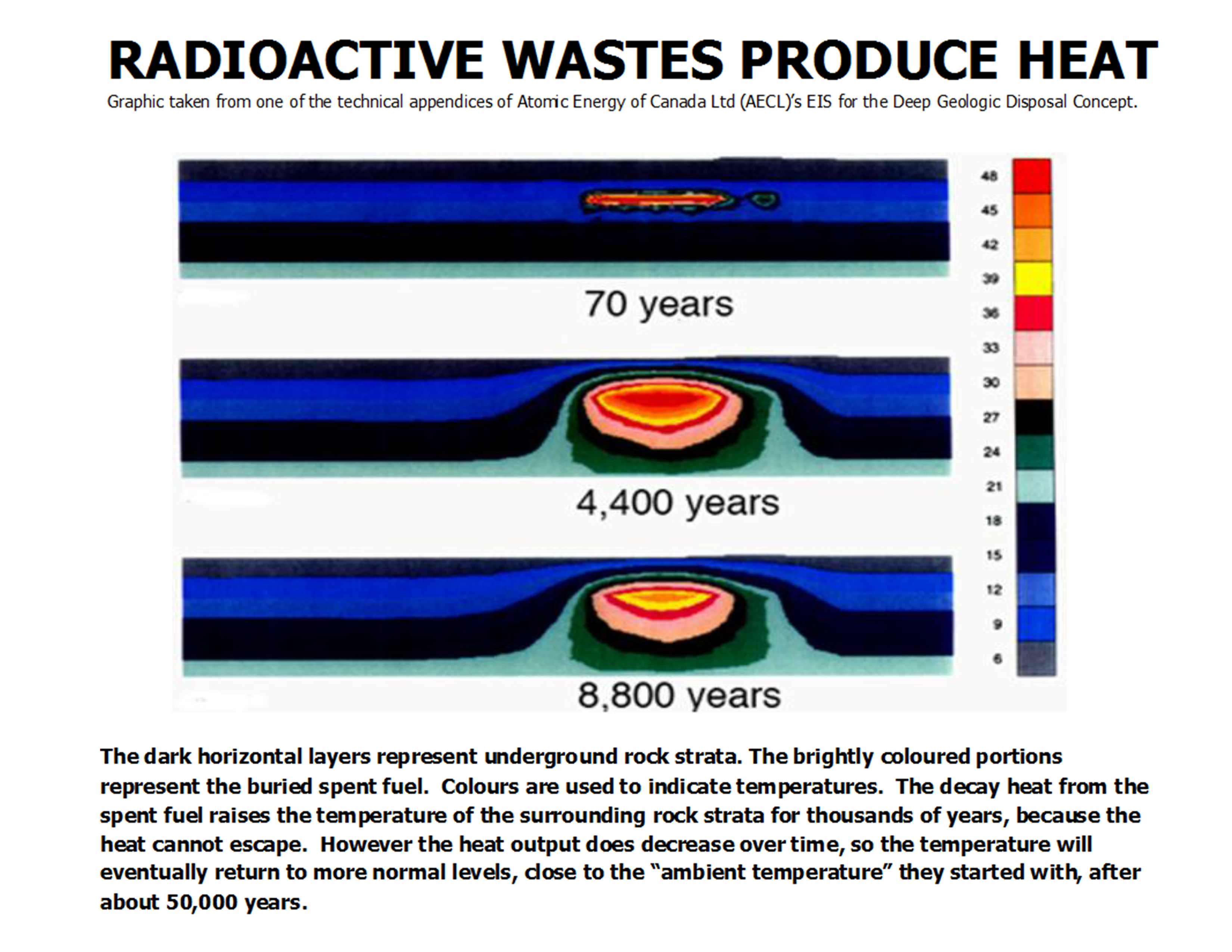
The most worrying aspect is an expected long-term “thermal pulse” from the entombed heat-producing radioactive waste. According to an Atomic Energy of Canada environmental study,1994, the DGR temperature could reach 230 degrees C. That intense heat would cause distortion and fracturing of host rock, impacting the structure of metallic containment casks.
David Geary, 19 Jan 25
In Geology 101 we learned that geology is a descriptive science, not a predictive science. Hydrology of rock is especially unpredictable. Science can not foresee what happens to a stable rock formation once disturbed by human activity. Thus, any Deep Geological Repository (DGR) cannot be counted on to maintain the required long-term stability to contain Canada’s high-level nuclear waste.
Because leaks do happen.
Canada’s Nuclear Waste Management Organization’s (NWMO) proposed DGR is a speculative unproven concept. A study of NWMO’s literature and conceptual renderings reveals numerous unresolved scientific, engineering, and modelling challenges.
Also troublesome is that Canada’s engineered ‘vertical shaft’ design vs. the European ‘inclined ramp’ approach was flagged as potentially dangerous by NWMO’s own expert international Independent Technical Review Group (ITRG), a body composed of European scientists and engineers. Vertical shafts relying on powered lift systems frequently fail.
Geologists at previous DGR hearings noted numerous NWMO deficiencies in the hydro-geological realm. For example, the integrity of host rock would be severely compromised by underground blasting required to create the extensive lattice-work of tunnels, chambers, and vertical shafts. There’d likely be rapid and unpredictable geo-hydrological changes, including water ingress, from the fracturing that ensues.
The most worrying aspect is an expected long-term “thermal pulse” from the entombed heat-producing radioactive waste. According to an Atomic Energy of Canada environmental study,1994, the DGR temperature could reach 230 degrees C. That intense heat would cause distortion and fracturing of host rock, impacting the structure of metallic containment casks.
Depicted in NWMO’s diagrams is a DGR air vent to the surface. It would carry the heat upwards while easing underground air pressure buildup. However, should nuclear waste casks become damaged or crushed by rock pressures, carcinogenic fission & activation products would leak out of them. Those radionuclides would be carried via the air vent to the surface, to the biosphere, to nearby communities, to people.
In fact, that is precisely how, in 2014, several workers near a vent far above a nuclear waste DGR in New Mexico were contaminated with radioactive plutonium.
Because geology is unpredictable.
Leaks happened and people were affected.
How Canada supplied uranium for the Manhattan Project
Peter C. van Wyck · CBC, Jan 10, 2025
In the past couple of years, the public imagination has been taken up with all things nuclear — the bomb, energy and waste. The film Oppenheimer recasts the story of the bomb as a Promethean and largely American narrative, while the series Fallout depicts a post-nuclear world. Russia has repeatedly emphasized its readiness for nuclear conflict. Nuclear energy has been regaining popularity as a hedge against climate change.
And yet, the story of Canada’s nuclear legacy — and our connection to the bombs that the U.S. military dropped on the Japanese cities of Hiroshima and Nagasaki, killing tens of thousands in an instant — is rarely told.
The documentary Atomic Reaction examines the impact of the radioactive materials mined in a Dene community in the Northwest Territories in the 1930s and ’40s. That radioactive ore was transported thousands of kilometres south, via Canada’s “Atomic Highway,” to be refined in Port Hope, Ont. And the uranium was used in the Manhattan Project, which developed those atomic bombs.
A mineral with immense power
This Canadian story began in 1930. Gilbert LaBine, a co-founder of Eldorado Gold Mines, discovered a rich deposit of radioactive pitchblende ore — containing radium, uranium and polonium — as well as silver, on the eastern shores of Great Bear Lake in the Northwest Territories. The site, on the traditional lands of the Sahtúgot’įnę Dene, came to be known as Port Radium. In a stroke, the country had entered the atomic age. ………………………………….
Port Hope: ‘The town that radiates friendliness’
In 1932, Eldorado constructed a radium-processing plant in Port Hope, the only such refinery in North America. Eldorado secured an abandoned waterfront factory and hired Marcel Pochon, a former student of radioactivity pioneers Marie and Pierre Curie, to mass-produce radium.
By 1936, the first grams of radium salts had been produced. (More than six tonnes of pitchblende are needed to produce a gram of radium.) However, by the late 1930s, Eldorado’s radium business was in decline. Competition with Belgium’s mine in the Congo was fierce, and global radium prices had fallen. In 1940, the Port Radium mine closed.
But soon, Eldorado’s and Port Hope’s fortunes radically changed. Uranium, previously considered waste from the processing of radium, became a strategic commodity. In 1942, LaBine’s Eldorado signed contracts with the U.S. military to supply uranium to the fledgling Manhattan Project, and the mine at Port Radium quietly reopened. In 1943, the company changed its name to Eldorado Mining and Refining, and in early 1944 the Canadian government took over the company and made it a Crown corporation.
The Port Hope refinery processed both Canadian and Congolese ores for the Manhattan Project. Eldorado continued to refine military-grade uranium for the Americans until 1965. The facility currently converts nuclear-grade uranium trioxide into uranium hexafluoride or uranium dioxide, used in nuclear reactors around the world. In the 1970s, a billboard leading into town even read, “Beautiful old Port Hope. The town that radiates friendliness.” Today, the plant is owned by Cameco, one of the world’s largest publicly traded uranium companies.
A lasting legacy and a massive cleanup
In Délı̨nę, a Dene community near Port Radium, a dark shadow remains after so many residents worked in the mine without being told they were involved in the Manhattan Project. And later, Dene miners started dying of lung cancer, earning the community of Délı̨nę the grim nickname the “Village of Widows.”
In 2005, a national report examining the health and environmental effects of the mine concluded there was no scientific link between cancer rates in Délı̨nę and mining activities in the area. But another study by the Canadian Nuclear Safety Commission the following year found increased rates of lung cancer in mine workers. People in the community still feel fear and anxiety about Port Radium’s impact on their health.
But the story of Eldorado and Port Hope also includes radioactive and chemical contamination.
Today, the municipalities of Port Hope and neighbouring Clarington are the sites of the largest volume of historic low-level radioactive waste in Canada — a result of spillage, leakage and widespread disposal of contaminated fill and other materials.
Major radioactive contamination in the area first came to light in the late 1960s, but little was done.
It wasn’t until 1975 that the public started to become aware of the problem, when St. Mary’s elementary school was abruptly closed. Eldorado had detected gamma radiation in the school’s parking lot and dangerously high levels of radon gas in the school; the building had unknowingly been built on contaminated fill from Eldorado’s operations some 15 years earlier.
The school closure set in motion a flurry of activity. It came to light that radioactive and chemical waste — estimated at roughly two million cubic metres — had been dumped directly into the harbour beside the plant and in ravines around town and used in the construction of homes, basements, driveways, businesses, roads, schools and other public buildings. Properties were surveyed for radiation levels; several hundred of them were remediated; and some 100,000 tonnes of contaminated soil and materials were relocated to a site at Chalk River, operated by Atomic Energy of Canada Ltd. (AECL). Still, the scope and severity of the contamination was not fully understood.
In 2001, the Port Hope Area Initiative (PHAI) began — a government plan to ensure the safe long-term management of historic low-level radioactive waste.
In 2012, the minister of natural resources announced an investment of $1.28 billion over 10 years for the PHAI. A radiological survey of approximately 4,800 public and private properties began, along with project design, an environmental assessment and community engagement.
Today, many sites await cleanup, and waste is still produced and stored at the Port Hope facility. https://www.cbc.ca/documentaries/how-canada-supplied-uranium-for-the-manhattan-project-1.7402051
Lepreau nuclear plant’s costs will continue to balloon: critic.
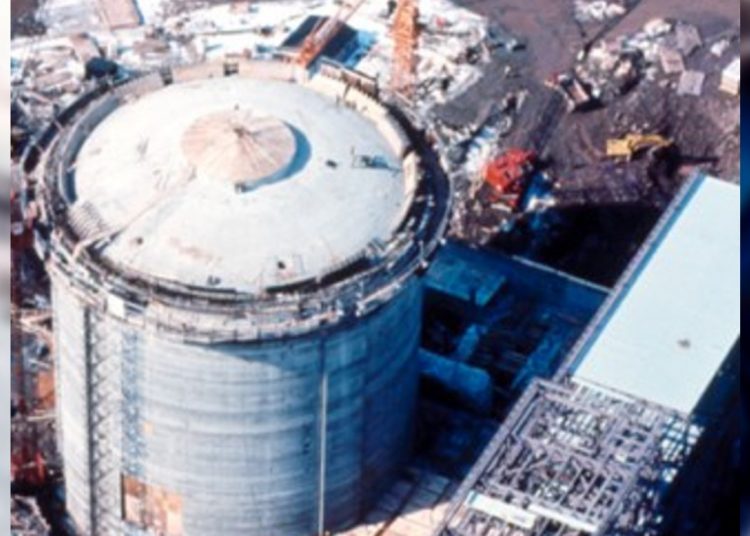
But NB Power insists the station should supply safe, reliable electricity for years to come
Telegraph-Journal, John Chilibeck • Local Journalism Initiative reporter, Jan 08, 2025
Last year’s costly, prolonged shutdown at the Point Lepreau Nuclear Generating Station near Saint John is just a piece of debilitatingly expensive repairs to come, warns an industry critic.
The outage that lasted between April 6 and Dec. 11 could end up costing New Brunswick ratepayers hundreds of millions.
But Gordon Edwards argues far bigger costs could be coming down the line in the years ahead to the workhorse in NB Power’s fleet of generators that supplies more than one-third of the province’s electricity.
Edwards is the president and co-founder of the nonprofit organization Canadian Coalition for Nuclear Responsibility and a long-time anti-nuclear activist who testified in 2023 before a New Brunswick legislative committee.
He told Brunswick News in a recent interview that many of the hopes behind the massive $2.5-billion refurbishment of the plant in 2012 turned out to be a fantasy. Now 41 years old, the plant is showing its age, he said.
There are things in the Lepreau reactor that were simply not done that should have been done at the time of the refurbishment. – Gordon Edwards
“The promise was held out that by spending all this money on refurbishment that essentially we’d have a brand new reactor,” Edwards said from his home in Montreal.
“And that’s obviously not true. When you replace a part of a complicated piece of machinery, like an automobile for that matter, often times it causes something else to go wrong because it’s worn but has not been replaced. And there are things in the Lepreau reactor that were simply not done that should have been done at the time of the refurbishment.”
According to a report by New Brunswick’s auditor general in 2014, Lepreau’s refurbishment took 37 months longer and cost $1 billion more than anticipated.
The latest shutdown started on April 6. It was supposed to be a 100-day planned maintenance outage to ensure the ongoing reliability and safety of the station’s operations. However, when workers started to fire up the plant again, they discovered a big problem on the non-nuclear side of the station where none of the maintenance work had been done.
Before the plant could get back up and running, the problem had to be fixed: six damaged stator bars inside the main generator. NB Power described the repair process as complex, requiring careful disassembly, reassembly, and extensive testing to meet strict safety and operational standards.
In the end, it took 149 extra days to get the job done and the plant back online.
No official figures have been released on the extra cost to customers, but earlier in the summer an NB Power official at rate hearings in Fredericton said the repairs would be more than $70 million and the cost of buying power or burning more fossil fuel at other stations to pick up the slack would be on average $900,000 a day.
This raises the possibility that the shutdown cost as much as $294 million.
“NB Power continues to assess the financial impact of the extended outage and is actively exploring options to mitigate costs for customers, including potential recovery through corporate insurance policies,” the public utility stated in a press release on Dec. 12.
Edwards predicts more problems will arise because the refurbishment, now more than a decade old, mostly addressed the plant’s nuclear side, not the conventional one.
“The fact that you have the core of the reactor back up to top operating condition, puts more of a strain on these other components that have not been replaced,” he said. “Among the components that weren’t replaced are the steam generators, which are critical.”
Edwards said the private consortium Bruce Power in Ontario took a different course, replacing steam generators at the first two units at the Bruce nuclear plants on the eastern shore of Lake Huron when they were refurbished in 2012.
“That was a prudent thing to do, but NB Power did not replace them at Lepreau. I predict that will be a source of problems going forward,” said the critic, an octogenarian who has a PhD in mathematics from Queen’s University.
……………………………………………………………………Edwards said another major issue at the plant is the prolonged use of the same hard water, which has different physical properties than regular water. He said the 200,000 litres that circulate in tubes is highly radioactive and should have been replaced long ago.
“To keep the costs from ballooning completely out of proportion, NB Power hasn’t replaced the hard water,” he said. “The cost of hard water is expensive. As much as one-fifth of the cost of a nuclear plant is simply the hard water.”
He and other anti-nuke activists, such as the Sierra Club of Canada, have for years called for the hard water’s replacement, arguing the radioactivity can leak during accidental spills, causing a threat to plant workers and the wider environment.
But NB Power says for the time being, such a drastic step is unnecessary.
“We continue to monitor industry-wide processes and improvements as it relates to the reactor moderator heavy water,” Couture said. “It has not been determined at this time that a replacement of the moderator heavy water is required.” https://tj.news/new-brunswick/lepreau-nuclear-plants-costs-will-continue-to-balloon-critic#:~:text=No%20official%20figures%20have%20been,slack%20would%20be%20on%20average
First Nations chiefs shouldn’t be duped by ‘nuclear-is-green’ deception
Commentary
by William Eric Altvater, January 6, 2025, : https://nbmediacoop.org/2025/01/06/first-nations-chiefs-shouldnt-be-duped-by-nuclear-is-green-deception/
Some First Nation Chiefs are victims of shenanigans, not unlike the swindle behind the purchase of Manhattan. The federal government needs the support of Indigenous peoples to expand nuclear power generation capacity in Canada.
For millennia, the cornerstones of the Indigenous people that inhabit Turtle Island, now known as North America, held all that is essential to life, in reverence. Every decision considered the next 7 generations. These cornerstones are crumbling.
Newcomers, armed with the Colonizing tool, “The Doctrine of Discovery” and their mentality of superiority, invaded the land of those they called “Savages,” almost totally exterminating Skicinuwok, People of The Earth.
Determined to bestow Christianity and civility to this wild untamed population, old growth forests were cut, rivers and streams were dammed to power sawmills, roads and railroads were built, bridges erected. All to create an infrastructure for capitalism, a system to make a profit, that morphed into greed, a word of foreign root. This unbridled desire for progress has ruined what was once called Paradise.
Now most water is not fit to drink, clean air is scarce, deforestation is rampant, biodiversity loss out of control, plants genetically modified, food manufactured with unpronounceable chemicals, caged fish starved of oxygen while being fed chicken feathers and pig parts, cancer cases in the millions, the list goes on.
As the population increased over this continent the available sources for power generation have not been able to satisfy the insatiable desires of the “bigger, better, faster, more is never enough” mentality. Some have finally acknowledged the fact that fossil fuels are not the golden egg they were once deemed to be.
So-called “Green Energy” is required to slow the blind drive to extinction of man; man, who is considered by some to be the most intelligent creature to ever roam Earth. Unfortunately, the lure of riches and the corruption of self-serving purposes have led man to stray from practices that nurture everything required to sustain life on this tiny blue marble floating through the universe.
Nuclear power is now being touted as being “Green.” It is not. Big money corporations are lobbying legislators to convince them and the public that it is. They are also lobbying to convince the public that they should foot the bill in the form of taxes and rate hikes, for a process that pollutes from the day it starts. Water is life. As soon as uranium is mined from the earth it begins to contaminate the water in surrounding aquifers.
When the uranium is processed sufficiently, it is used as fuel for reactors where it generates heat while delivering electricity, not just for essential needs, but also for many things once considered luxuries. This fission generated heat is then dumped into nearby waters where it kills thousands, if not millions of small beings that form the basis of life itself.
After this radioactive fuel is depleted, it is stored in various containers where it will stay radioactive for eons. Indigenous Grandmothers have labelled it “Forever Dangerous.”
The power generated during the fission process benefits only those who exist today as the process occurs, not those born tomorrow or next week or next month. All the radioactive waste and the inherent danger it creates is left to future generations, kicking the can down the road.
What better place to dump this waste than in an area with a population that has witnessed Newcomers enrich themselves for hundreds of years? Yes, what better place than a population that has been targeted for assimilation, suffered theft of lands, witnessed the taking of naturally bestowed rights? A population that has been subjected to racial Indian Act legislation essentially stripping away all that sustained this population for thousands of years.
Yes, let us give the Indians some more shiny beads and trinkets so that they willingly agree to care for our radioactive garbage. How do we do this? Let’s talk to the Chief and Council. Let’s wine and dine them. Let’s give them some money, take them to dinner, buy some drinks and make them feel all festive and most of all make them think we are looking out for their best interests. Some Chiefs have taken the bait.
Egregious as it may be, this is exactly what is happening in some Indigenous communities contrary to the will of the majority. Elected Chiefs are continuing the deception as they are blinded and professing the “Nuclear is Green” mantra. They have lost connection with the Spirit of Ancestors and traditional values. They need to have a serious introspection and realize that looking forward, we need only look back at what has sustained us to this point in time. We need not do any more than that.
Armed with Canadian taxpayer support, AtkinsRéalis and Westinghouse are competing to export nuclear reactors. Which one will prevail?

One thing is certain: No vendor will get far without taxpayer support.
But some observers think that dwelling on the prospects of various reactor vendors entirely misses the point. Mr. Schneider said renewables, already considerably cheaper to build than nuclear plants, can now offer a steadier supply of electricity thanks to maturing battery storage technologies. In major markets such as the U.S., China and India, solar combined with storage is the cheapest option.
MATTHEW MCCLEARN, January 2, 2024, https://www.theglobeandmail.com/business/article-atkinsrealis-westinghouse-nuclear-reactors-exporting/
After a long absence, Canada is back in the business of exporting nuclear reactors.
In November, Montreal-based AtkinsRéalis Group Inc. (formerly SNC-Lavalin) announced it will participate in a four-company consortium that could resume construction of two 700-megawatt reactors at Cernavoda, Romania’s only nuclear power station. The new units, Cernavoda Units 3 and 4, would be the first Candus built anywhere since their sister, Unit 2, was completed in 2007. The deal was sealed by $3-billion in Canadian export financing, provided by the federal government and administered by Export Development Canada, a Crown corporation.
Mere weeks later, AtkinsRéalis’s Pennsylvania-based competitor, Westinghouse Electric Co., announced it had a “letter of interest” from EDC for just over $2-billion in financing to build three of its AP1000 reactors at what would be Poland’s first nuclear power plant. Westinghouse is now under Canadian ownership – just over a year ago it was purchased by Brookfield Asset Management and Cameco Corp.
These announcements represent notable victories for Western nuclear interests, which otherwise have greatly receded in importance globally in recent decades. Russian dominance has been near-total: According to Mycle Schneider Consulting’s annual report on the state of the nuclear industry, Russia is constructing 20 reactors abroad, including in China, Egypt, India and Turkey. Mr. Schneider said the only other international vendor is Électricité de France SA, which is building two reactors in Britain. Canada isnot even in the running because it hasn’t built a reactor in so long.
But Russia’s invasion of Ukraine, and growing concerns around its use of its energy clout to achieve geopolitical ends, has raised discomfort. This at a moment when nuclear power plants are again being considered worldwide. Suddenly, Western reactor vendors smell opportunity – and they’re scrambling to win contracts, recruit from the same limited pool of partners and suppliers, and secure the government loans that are crucial to these projects.
Home-court advantage
AtkinsRéalis is a large international engineering firm; last year its nuclear division accounted for 12per cent of its revenues. That division is growing rapidly, however, and now employs about 4,000 people, up from 3,000 in 2022. Much of its recent hiring is in preparation for anticipated new reactor sales, in Canada and abroad.
Cernavoda exemplifies the nuclear industry’s meandering fortunes. Conceived during the long reign of Communist dictator Nicolae Ceaușescu, it was built in fits and starts. The earliest design and procurement contracts for the first reactor were signed in 1978; within a decade, five Candu 6 reactors were under construction. But the first wasn’t even half-complete by the time of the Romanian revolution, in December, 1989, during which Mr. Ceaușescu was deposed and executed. Only two units were completed after lengthy delays. They now supply about 20 per cent of Romania’s electricity.
Units 3 and 4 are to be Enhanced Candu 6s, updated versions of the originals. During the initial phase, AtkinsRéalis will provide design, engineering and procurement services, and handle relations with the country’s nuclear regulator. The company said this work will earn revenues of $224-million. The other partners include the nuclear division of Italy’s Ansaldo Energia SpA, Texas-based engineering and construction firm Fluor Corp., and Sargent & Lundy, an architect engineering firm. The customer is Nuclearelectica, Romania’s nuclear power utility, which must ultimately decide whether to proceed with the rest of the €3.2-billion ($4.7-billion) project.
Joe St. Julian, president of AtkinsRéalis’s nuclear division, sees this as just the beginning.
He expects 1,000 new reactors will be built worldwide over the next 25 years, at a cost of up to US$15-billion each. As many as 100 could be Candus, he predicts. His reasoning is that 35 of the approximately 600 reactors built to date worldwide were Candus, about 5 per cent.
“In the next round, we’ll call it round two, we should be able to get more than 5 per cent, maybe as much as 10 per cent,” he said.
The Candu’s most important advantage, he contends, is that it runs on natural uranium. Most reactors require enriched uranium, which is expensive to produce, and Russia dominates international nuclear fuel supply chains. This does seem to have influenced Romania, where wariness over reliance on Russian nuclear technology dates back to Mr. Ceaușescu’s time.
Another advantage might be AtkinsRéalis’s relationships with the rest of the Canadian nuclear industry. This year, several other companies havejoined AtkinsRéalis’s Canadians for CANDU campaign, including nuclear industry giants such as BWX Technologies Inc. and Aecon Group Inc. Earlier this month, AtkinsRéalis boasted that its Canadian subsidiary, Candu Energy Inc., had issued more than $1-billion in orders across its supply chain. Unifor, a large private-sector trade unionthat represents many workers in the nuclear industry, recently issued an open letter calling on the Ontario government to prioritize the Candu.
But there’s a problem.
Reactors have trended ever-larger since the dawn of the nuclear age, and the average output of new ones is about 1,000 megawatts. AtkinsRéalis largely stayed out of the risky business of reactor development, a decision that anemic global reactor sales long seemed to vindicate. But now, as governments and utilities consider building large new reactors to meet surging power demand, AtkinsRéalis lacks a modern, large model to offer them.
So, last year it proposed the Monark, which at 1,000 megawatts would be the largest-ever Candu. The company plans to spend $50-million to $70-million annually to complete the design by the end of 2026 and has 250 employees working on it.
Mr. St. Julian said the Monark’s success depends entirely on selling it in Canada first, to utilities such as Bruce Power and Ontario Power Generation, which are in the early planning stages for potential new power plants in Ontario.
“If we cannot sell a Candu Monark in Canada, there is no export strategy,” he said.
Contenders
But gone are the days when Candus enjoyed exclusivity at home. Key legacy customers have already defected: OPG, which owns more Candus than any other utility, selected an American light water reactor for its next power plant in Ontario, Darlington B. It plans to construct four BWRX-300s from America’s GE Hitachi Nuclear Energy – a model the Ontario government is actively marketing in Eastern Europe, according to Stephen Lecce, its Energy Minister.
In the large reactor market, Westinghouse aims to steal the Candu’s lunch. Westinghouse has opened an office in Kitchener, Ont., and now employs 270 people in Canada. It’s courting many suppliers that are members of AtkinsRéalis’s Canadians for CANDU campaign, including BWX Technologies and Aecon, both of which entered agreements in December to work on AP1000 projects in Canada and worldwide.
“The not-so-secret secret is that we help them participate in the export markets to build up the diversification and strength in the Westinghouse technologies, and then we deliver here at home, domestically,” said John Gorman, president of Westinghouse Canada, who joined the company last month.
In Poland, Westinghouse markets itself as a “gold standard American” company. But Mr. Gorman emphasizes its Canadian ownership. “Let’s use our Canadian ownership, let’s use this very strong Canadian supply chain, to help service those export markets, to diversify our supply chain here at home,” he said.
Mr. Gorman is careful not to directly diss the Candu. (He previously served for six years as head of the Canadian Nuclear Association, the industry’s trade association.) AtkinsRéalis has the “ambition” to design a new reactor, he says, “that will be modern and be up to today’s requirements” – a quest he encourages.
But the AP1000, he notes, is “not only developed, but proven and recently being built out in multiple jurisdictions.” Two AP1000s have already been licensed and constructed in the United States. (Those reactors, at the Vogtle site in Georgia, were tremendously over-budget and behind schedule, which led to Westinghouse’s bankruptcy and its acquisition by Brookfield and Cameco.) Another four AP1000s have been built in China; eight are under construction worldwide, and more are under consideration in Europe, Britain and India, according to Westinghouse.
It’s a considerable head start, albeit one purchased at great expense.
Mr. St. Julian says he isn’t worried. He said the most important purchase consideration will be the levelized cost of electricity that reactors produce.
“Can we produce a megawatt hour of electricity at a lower cost than the AP1000? We absolutely believe we can.”
Watch your wallet
But some observers think that dwelling on the prospects of various reactor vendors entirely misses the point. Mr. Schneider said renewables, already considerably cheaper to build than nuclear plants, can now offer a steadier supply of electricity thanks to maturing battery storage technologies. In major markets such as the U.S., China and India, solar combined with storage is the cheapest option.
One thing is certain: No vendor will get far without taxpayer support.
Foreign reactor sales are invariably accompanied by generous and highly opaque government subsidies. Global Affairs Canada says the loan for the Cernavoda project is still being negotiated, but terms and conditions are considered “commercially confidential” and will never be disclosed. EDC wasn’t any more forthcoming about its proposed $2-billion loan in favour of Westinghouse.
“As per our Transparency and Disclosure policy, we cannot comment on prospective transactions or anything beyond what we’ve provided already and what the company announced,” wrote spokesperson Anil Handa in an e-mailed response to questions.
As construction of first small modular reactor looms, prospective buyers wait for the final tally.
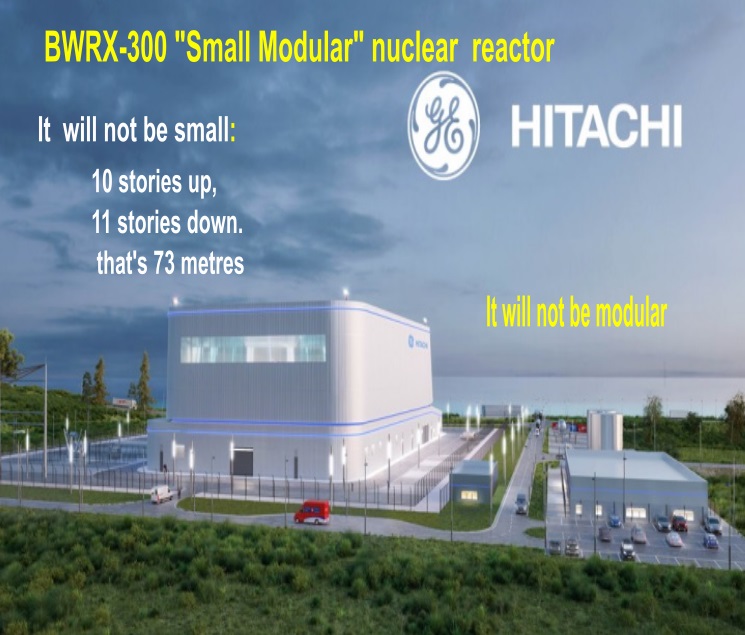
the first BWRX-300 could cost more than five times GE-Hitachi’s original target price.
emerging consensus that SMRs are not economic
“The nuclear people don’t operate in a vacuum, they operate in competition to other technologies,………… “The cost for solar is going down.”
Matthew McClearn, Dec. 27, 2024 , https://www.theglobeandmail.com/business/article-as-construction-of-first-small-modular-reactor-looms-prospective/
The race to construct Canada’s first new nuclear power reactor in 40 years seems to have passed a point of no return. This summer, Ontario Power Generation completed regrading the site for its Darlington New Nuclear Project in Clarington, Ont., and started drilling for the reactor’s retaining wall, which will be buried partly underground. At a regulatory hearing, OPG’s chief executive officer Ken Hartwick, who will retire at the end of this year, promised that this reactor will be “the first of many to come.”
But that will depend on a crucial yet-to-be-revealed detail: its price tag.
It’s no exaggeration to say that the world is waiting for it. The new Darlington reactor would be the first BWRX-300, a small modular reactor (SMR) being designed by an American vendor, GE-Hitachi Nuclear Energy, and the first SMR built in any Western country. Other prospective buyers include the Tennessee Valley Authority (TVA), SaskPower and Great British Nuclear. More BWRX-300s are in early planning stages in Poland and the Czech Republic.
Crucially, however, OPG is the first and only utility worldwide to bind itself contractually to build a BWRX-300. A report published by the U.S. Department of Energy in September said American utilities are waiting to see pricing and construction schedules for early units, and would “prefer to be fifth.” SaskPower also wants to avoid the risks associated with building a “first of a kind” reactor; it won’t decide until 2029 and it hopes SMRs will be less expensive than traditional nuclear plants.
Scheduled for release this winter, the Darlington SMR’s estimated cost will speak volumes about whether SMRs can deliver on their many promises. Yet there are early indications of serious sticker shock: Recently published estimates from the TVA suggest the first BWRX-300 could cost more than five times GE-Hitachi’s original target price. How will OPG and GE-Hitachi drive pricing far below the TVA’s estimate? And if they cannot, what then will be the prospects for SMRs?
Ditching the scaling law
SMRs were conceived as an antidote to the hefty price tags that brought reactor construction to a standstill in Western countries for decades.
Previously, the nuclear industry relied heavily on something called economies of scale or the “scaling law”: As a power plant’s size increases, capital costs also rise, but in a less than linear fashion. So vendors designed ever-larger reactors. Reactors under construction today average about one gigawatt, roughly three times the BWRX-300’s output. They can cost more than US$10-billion, leaving only the largest government-backed utilities as potential purchasers.
SMRs represent a promising but untested new approach to manufacturing reactors – one that emphasizes simplification and mass production techniques. The key term is modular: Rather than building monolithic, one-of-a-kind plants, the industry hoped instead to churn out substantially identical factory-built units; repetition would help drive down costs, as it had for competing technologies such as wind turbines and solar panels.
But modularity requires multiple orders, which in turn demands competitive pricing. Through early discussions with potential customers, GE-Hitachi executives understood the BWRX-300 had to be priced low, not only in absolute terms, but also relative to other power-generation technologies. They told audiences it would cost less than US$1-billion, or US$2,250 per kilowatt hour of power generation capacity – low enough to compete with natural gas-fired power plants.
“The total capital cost of one plant has to be less than $1-billion in order for our customer base to go up,” Christer Dahlgren, a GE-Hitachi executive, said during a talk in Helskini in March, 2019.
Shrinking a giant
GE-Hitachi’s designers began by shrinking a behemoth: the 1,500-megawatt Economic Simplified Boiling Water Reactor (ESBWR). Their objective was to reduce the volume of the building housing the reactor by 90 per cent, to greatly reduce the amount of concrete and steel required during construction.
This was accomplished primarily through eliminating safety systems. Pressure relief valves, common in traditional reactors, were removed. In place of two completely separate emergency shutdown systems, as is customary, the BWRX-300 would have two systems that would propel the same set of control rods into the reactor’s core. GE-Hitachi emphasized that the BWRX-300 featured “passive” safety systems that would keep the reactor safe during an accident, and its simplicity reduced the need for redundant engineered systems.
Sean Sexstone, head of GE-Hitachi’s advanced nuclear team, said the entire facility – which includes the reactor building, the control room and the turbine hall – will measure just 145 metres by 85 metres.
“You can walk that site in a minute-and-a-half,” he said.
GE-Hitachi also sought substitutes for concrete. The reactor building is to be constructed using factory-made steel panels that will be shipped to the site, assembled into modules and lifted by crane into position. These modules essentially serve as forms into which concrete is poured. These steel plates are as strong as concrete, OPG says, yet eliminate the need to use rebar extensively. This approach “lends itself to more modularity, more work in a factory, versus more work in the field,” Mr. Sexstone explained.
The Darlington SMR will be erected using a technique called “open-top construction.” The reactor building’s roof won’t be installed until the very last. The building will be constructed upward, floor by floor, with large components lowered in by crane rather than being moved through doors and hatches.
Many of the BWRX-300’s components would be identical to those used in previous GE power plants, such as its control rods, fuel assemblies and steam separators. Its steam turbine would be the same one used in natural-gas-fired plants. And the plant could be run by as few as 75 staff, far below the nearly 1,000 employed at large single-reactor Canadian nuclear plants.
Historically, utilities tended to build bespoke nuclear plants meeting highly individualized requirements. The result: In the United States alone there are more than 50 commercial reactor designs. Few designs were built twice, limiting opportunities to learn through repetition.
GE-Hitachi intended the BWRX-300 to be highly standardized, constructible in multiple countries with as few tweaks as possible. It assembled an international coterie of utility partners, including OPG, the TVA and a Polish company named Synthos Green Energy, which last year agreed to jointly contribute to the estimated US$400-million cost of the SMR’s standardized design.
Subo Sinnathamby, OPG’s chief projects officer, acknowledged in an interview that the first SMR will be expensive. But lessons learned from building it, including newly identified opportunities for additional modularization, will be applied to three subsequent units at Darlington, bringing down overall costs.
“For us, success is going to be sticking to how we have executed megaprojects at OPG, using the same processes and principles,” she said, citing the continuing refurbishment of Darlington’s existing reactors.
“The last thing we want to do is get into construction and then stop the work force.”
GE-Hitachi’s emphasis on lowering plant costs has been validated by many independent observers, who regard it as essential to SMRs’ future prospects.
In a report published in May, Clean Prosperity, a climate policy think tank, concluded that the BWRX-300 “is the strongest candidate” among SMRs to experience continued cost reductions as more were built – but only at the right price, which it pegged at about $3.3-billion. “Cost curves will only become possible for the BWRX-300 in Ontario and beyond,” it warned, “with a final price tag that is low enough to compel additional expansion.”
In September, the U.S. Department of Energy published a report examining the prospects for widespread deployment of reactors across the U.S., an expansion it strongly supported. But to drive down costs, SMR vendors needed to move more than half of the overall spending on a project into standardized factory-like production – a tall order.
Similarly, a report published last year by the U.S. National Academy of Sciences argued that if nuclear plants are to contribute meaningfully to future electricity systems, they must be cost-competitive with other low-emission technologies. It looked at so-called overnight capital costs – what costs would be if construction were completed overnight, with no charges for financing and no consideration of how long it will last. The academy said capital costs should be US$2,000 or less per kilowatt of generating capacity. At between US$4,000 and US$6,000 a kilowatt, reactors might still be competitive if costs unexpectedly rose for renewable technologies.
Enter the TVA.
In an integrated resource plan published in September, the TVA estimated that a first light water SMR would have an overnight capital cost of nearly US$18,000 a kilowatt.
At that pricing, the first Darlington SMR would cost more than $8-billion. That’s about 10 times the cost of a similarly sized natural-gas-fired plant: SaskPower’s recently completed Great Plains Power Station, a 377 MW natural-gas-fired plant in Moose Jaw, cost just $825-million.

Oregon-based NuScale Power Corp. has already discovered what happens when pricing falls in this range. Founded in 2007, its 77-MW NuScale Power Module was the first SMR to be licensed by regulators in a Western country. But last year its flagship project, undertaken with the Utah Association of Municipal Power Systems (UAMPS), was cancelled after cost soared to about US$20,000 a kilowatt.
There are several important caveats about the TVA’s estimate.
Greg Boerschig, a TVA vice-president, described it as a “Class 5″ estimate. According to standard global practices, cost estimation is based on a five-level system. Class 5 is the least detailed and reliable and is intended for planning purposes; actual costs could be half that much, or double.
The estimate is far higher than the TVA would have liked, Mr. Boerschig said. But since OPG is further along in deploying the BWRX-300, he added, it has a better sense of the reactor’s cost.
“We’re a couple of years behind them,” Mr. Boerschig acknowledged.
Indeed, according to a presentation by Aecon Group Inc., a partner on the Darlington SMR, a Class 4 estimate had already been completed as of February this year. Ms. Sinnathamby said OPG is working on a Class 3 estimate.
“Our number is going to be very specific: What is it going to cost us to build, on this location, these four SMRs?” she said.
Another caveat is that the BWRX-300 was only one of several reactors represented in the estimate, which was based on the TVA’s experience exploring potential SMRs at its Clinch River site near Oak Ridge, Tenn., and by examining recently completed nuclear construction projects.
OPG might enjoy certain cost advantages over the TVA. The Darlington Nuclear Generating Station is a complex that was built during the 1980s and early 1990s on the shore of Lake Ontario, the proximity of which could make cooling reactors there cheaper. Clinch River is a greenfield site, whereas Darlington already has four operating reactors.
“That will automatically reduce the cost to OPG relative to TVA,” said Koroush Shirvan, a professor of energy studies at the Massachusetts Institute of Technology, who has studied the BWRX-300’s economics.
Nonetheless, opponents and skeptics of SMRs in general, and the Darlington SMR in particular, have embraced TVA’s estimate.
Chris Keefer, an emergency medicine physician, has advocated passionately for refurbishment of Ontario’s existing nuclear power plants, which are all based on Canada’s homegrown reactor design, the Candu. He has also argued for modernizing the Candu design and building more. He said the TVA’s estimates reflect a more honest assessment of SMR pricing than Canadians received in the past.
“It points to this emerging consensus that SMRs are not economic, and that shouldn’t be a surprise,” he said.
“TVA, I think they’ve got several hundreds of millions of dollars in the development process on this reactor. I wouldn’t say that those numbers are naive.”
Prof. Shirvan said his own cost estimate for the BWRX-300 reactor is “in line” with the TVA’s.
Chris Gadomski, head of nuclear research at BloombergNEF, said TVA’s estimates are discouragingly high, and imply that reactor sales might be less than anticipated. Contributing factors might include high labour costs in North America, and recent high inflation and high financing costs, factors he expects will persist.
“The nuclear people don’t operate in a vacuum, they operate in competition to other technologies,” he said.
“The cost for solar is going down. The cost of batteries, we anticipate, is going down. And so, when you’re looking at spending billions of dollars and all of a sudden the price tag gets so large, people will say: ‘Hey, listen, you’ve got to look at other options, or buy less of this.’ ”
If there is a silver lining, the TVA estimated follow-on SMRs would cost substantially less than the first, at roughly US$12,500 a kilowatt. But that’s still more than double the upper limit the U.S. National Academy of Sciences deemed necessary to support widespread SMR adoption.
We might learn in a few months whether GE-Hitachi and OPG have succeeded in bringing the BWRX-300’s cost down. But a review of regulatory applications and other documents hint at why the original US$1-billion target price might be difficult to realize.
Prof. Shirvan said GE-Hitachi’s original plan – to slim the reactor down by removing safety systems – encountered resistance from regulators in Canada and the U.S. “When you strip out most of the safety system, you have to come up with very good reasoning how that’s justified,” he said. GE-Hitachi started adding some of those systems back in, he said, which caused the BWRX-300’s reactor building’s diameter to swell.
This dramatic increase, Mr. Keefer said, has greatly reduced the BWRX-300’s economic attractiveness.
“Proportionately, you’re actually doing a lot more civil works than you would for a large reactor,” he said. “And that actually means that the whole SMR paradigm, which is to get all the work into a factory, goes away.”
(GE-Hitachi denied that the plant had grown. “While the design has matured, the overall footprint of the BWRX-300 plant has not changed significantly,” Mr. Sexstone said.)
OPG’s regulatory documents also make clear that some modular construction techniques it seeks to employ at Darlington are in their infancy. As recently as last year, most of the walls and floors of the SMR building were to have been built using a technique developed in Britain known as Steel Bricks. GE-Hitachi recently dropped Steel Bricks in favour of a similar approach known as Diaphragm Plate Steel Composite.
Moreover, OPG’s published construction plans show that the reactor building will be built largely below-grade, requiring significant excavation including into bedrock. Tunnel boring machines will be used to excavate more tunnels, tens of metres wide, to convey cooling water to and from Lake Ontario. Make no mistake, the Darlington SMR remains a complex capital project.
To date there have been no indications that pricing might derail the Darlington SMR. Ontario’s government appears willing to pay a significant premium: It hopes that as a first mover, OPG will be well-poised to sell equipment and expertise in other countries.
During a stump speech in Scarborough in December, Energy Minister Stephen Lecce said Ontario was keen to sell its technology and expertise for building SMRs abroad.
“I was just in Poland and Estonia, literally selling Canadian small modular reactors that will be built here, exported there,” he said.
Yet Mr. Lecce has also vowed to keep Ontarians’ electricity bills low, an objective high SMR price tags might compromise.
GE-Hitachi maintains its creation’s pricing will stack up favourably.
“I think we’re in a really good spot to feel very comfortable about this unit being probably the most cost competitive SMR in the market,” Mr. Sexstone said. “I think your readers will be pleasantly surprised.”
Ms. Sinnathamby, for OPG’s part, said actual costs to construct BWRX-300s should be considerably lower than TVA’s estimate.
“The TVA numbers can only come down,” she said. “That’s how conservative, in our mind, those numbers are.”
Northwestern Ontario nuclear waste site selection raises concerns
The Hill Times: Canada’s Politics and Government News Source, BY ERIKA SIMPSON | December 12, 2024, https://www-hilltimes-com.proxy1.lib.uwo.ca/story/2024/12/12/northwestern-ontario-nuclear-waste-site-selection-raises-concerns/444838/
The selection process has overlooked the broader impact on local and Indigenous populations near highways that could be used to transport nuclear waste north.
Opinion | BY ERIKA SIMPSON | December 12, 2024
The Nuclear Waste Management Organization selection of two northwestern Ontario communities—Wabigoon Lake Ojibway Nation and Ignace—as host communities for Canada’s proposed Deep Geological Repository raises concerns and controversy. Located approximately 1,500 km from Toronto, the distance highlights the geographical separation between the selected communities and Toronto, home to the Darlington and Pickering nuclear power plants that will eventually be decommissioned.
On Nov. 28—the same day of Nuclear Waste Management Organization’s (NWMO) announcement—the Municipality of South Bruce took many by surprise by announcing it was exiting the site selection process for the proposed Deep Geological Repository (DGR). Despite South Bruce’s proximity—just 46 km from the Bruce reactor, the world’s largest-operating nuclear facility on Lake Huron’s shores—the NWMO decided to pursue the Ignace location.
This raises questions about why the NWMO chose to bypass South Bruce, which, due to its location, appeared to be a more logical choice for Canada’s first DGR.
Despite being presented as a “community-driven, consent-based” process, the selection process launched in 2010 sought to narrow 22 potential sites down to just one willing community. The process has thus far overlooked the broader impact on local and Indigenous populations near highways that could be used to transport nuclear waste northward.
Media outlets like The Globe and Mail and The Hill Times report that the NWMO’s DGR plan involves transporting nuclear waste by truck for over four decades, from all Canada’s reactor sites to the nuclear facility, where the waste could be stored underground. More than 90 per cent of the waste is currently at Pickering, Darlington, and Bruce nuclear stations in Ontario, with the rest located in Point Lepreau, N.B., Quebec, Manitoba, and Ottawa.
With the NWMO selecting the Ignace site and an all-road transportation method, the trucks are expected to travel a total of 84 million km on Canadian roads. There is always the risk that radioactive material will leak while in transit or short-term storage, something that has happened in Germany and New Mexico over the past two decades.
The NWMO’s claims of a rigorous and independent process are undermined by a lack of public dialogue and transparency. Few have been aware of the proposal to build a national underground nuclear waste site. Northwatch and We The Nuclear Free North raised concerns about the NWMO’s decision involving Wabigoon Lake Ojibway Nation (WLON) in the project.
WLON’s Nov. 28 statement clarifies that the First Nation has not approved the project but has agreed to proceed with the next phase of site characterization and regulatory processes. Their “yes” vote reflects a commitment to assess the project’s feasibility through environmental and technical evaluations, not an endorsement of the DGR itself.
South Bruce, the other potential willing community, held a referendum on Oct. 28, which revealed deep divisions. The final tally was 1,604 votes in favor (51.2 per cent) and 1,526 against (48.8 per cent), with a total of 3,130 votes cast. A margin of just 78 votes decided a by-election with far-reaching implications for millions of people across multiple generations.
The decision to allow a local municipality to oversee the referendum on the nuclear waste disposal site has been met with significant controversy. Critics argue that the arrangement posed a conflict of interest, as municipal staff—partially funded by the NWMO—actively promoted the project, casting doubt on their impartiality and raising concerns about financial influence on the referendum’s outcome. The council’s firm opposition to allowing a paper ballot raised further suspicions. Why reject a voting method that could be physically verified?
Located about 19 km southeast of Dryden, WLON faces similar concerns regarding the fairness of the online voting process and voter eligibility. These issues could erode public confidence in municipal referendum processes, and the handling of decisions by councils.
The nuclear waste storage site selection marks an early shift to the regulatory phase, raising concerns about whether the process is premature. Over the coming year, the effectiveness of the Canadian Nuclear Safety Commission and its regulation of all steps in the management of radioactive waste will come under scrutiny, particularly as Ontario’s new energy minister, Stephen Lecce, emphasizes the need to invest in energy infrastructure to meet rising electricity demand over the next 25 years.
Critics argue that despite evaluations with long-term implications, ethical and environmental concerns surrounding nuclear waste disposal remain long unaddressed. Ontario Power Generation’s initial 2005 proposal to the safety commission for a DGR near the Bruce reactor was rejected in 2020 following a Saugeen Ojibway Nation vote.
While many acknowledge the potential benefits of nuclear energy and DGR technology, the NWMO’s approach to the project over the past two decades has drawn significant scrutiny. Questions centre on the decision to place untested DGR technology in populated farmland near the Great Lakes, the world’s largest source of freshwater. The risks of radiation leakage into Hudson’s Bay and the Arctic over thousands of years are particularly troubling, especially as the technology remains unproven in such a critical and sensitive location.
Despite objections, the NWMO pressed forward, with its process viewed as federally approved bribery through financial incentives. South Bruce has already received millions and will receive $4-million more for its involvement, with another $4-million due in 2025. Mayor Mark Goetz has announced plans for alternative development, but critics like W.J. Noll from Protect Our Waterways question why such options weren’t considered earlier, given the risks to farmland, water sources, and the divisions left in the local farming community.
The growing influence of the nuclear industry on international and local governance has left many feeling powerless, fearing that war-torn regions, Indigenous lands, and rural communities are being sacrificed, threatening ecosystems from Ukraine and Russia to the Great Lakes and Arctic rivers.
If no Canadian community agrees to host a permanent nuclear waste depository, it may be necessary to reconsider nuclear energy expansion, halt new plant construction, and scale back capacity at existing reactors. In the interim, managing waste at above-ground sites could offer a safer alternative until technology ensures long-term environmental protection.
Erika Simpson is an associate professor of international politics at Western University, the author of Nuclear Waste Burial in Canada? The Political Controversy over the Proposal to Construct a Deep Geologic Repository, and Nuclear waste: Solution or problem? and NATO and the Bomb. She is also the president of the Canadian Peace Research Association.
The Hill Times
Ontario First Nation challenging selection of underground nuclear waste site in court
Eagle Lake First Nation is seeking a judicial review of the Nuclear Waste Management Organization’s decision to select the Township of Ignace and Wabigoon Lake Ojibway Nation area as the repository site.
Toronto Star, Dec. 24, 2024 , By Sonja Puzic The Canadian Press
A First Nation in northern Ontario is challenging the selection of a nearby region as the site of an underground repository that will hold Canada’s nuclear waste, arguing in a court filing that it should have had a say in the matter as the site falls “squarely” within its territory.
Eagle Lake First Nation has filed an application in Federal Court seeking a judicial review of the Nuclear Waste Management Organization’s decision to build the deep geological repository in the Township of Ignace and Wabigoon Lake Ojibway Nation area.
The decision was announced in November after Ignace’s town council and Wabigoon Lake Ojibway Nation both agreed to move forward, but Eagle Lake First Nation says it was “unjustifiably” rejected as a host community and denied its own right to consent to the project.
“NWMO rejected ELFN as a host community and not for any fair, justifiable or defensible reasons,” but because members of the First Nation had raised concerns about the nuclear waste site, court documents filed last Friday allege.
The court filing, which also names the federal minister of natural resources among the respondents, accuses the NWMO of acting in “bad faith” and seeks to have its decisions quashed.
The NWMO, a non-profit body funded by the corporations that generate nuclear power and waste, said it is reviewing the legal challenge…………………………….
The $26-billion project to bury millions of used nuclear fuel bundles underground will include a lengthy regulatory and construction process, with operations not set to begin until the 2040s. ………………………………………………………. more https://www.thestar.com/news/canada/ontario-first-nation-challenging-selection-of-underground-nuclear-waste-site-in-court/article_375e4d88-c0bd-53e5-ba7a-03a2c2f8e4e1.html?utm_campaign=Nuclear+Free+North++e-news+%7C+Eagle+Lake+First+Nation+is+seeking+a+judicial+review+of+the+NWMO+Site+Selection&utm_medium=email&utm_source=newsletter
A nuclear-free energy future for Hydro-Québec, says Michael Sabia

Marie-Anne Audet, Thursday, December 12, 2024, Le Journal de Montreal,
Hydro-Québec has definitively closed the door to nuclear power, according to its CEO, Michael Sabia, who assured Thursday that energy production will reach new heights with the agreement in principle announced between Quebec and Newfoundland and Labrador around the Churchill Falls dam.
If approved, the deal would add 2,400 MW to Hydro-Québec’s production. The Crown corporation also plans to invest $25 billion to launch three new power plants in Labrador
“We are going to increase production between 8,000 and 9,000 megawatts [by 2035]. With the 2,400 megawatts coming from Newfoundland, we arrive at more than 11,000 megawatts of additional power,” he illustrated during an interview with LCN………………………………………………… https://www.journaldemontreal.com/2024/12/12/un-futur-energetique-sans-nucleaire-pour-hydro-quebec-affirme-michael-sabia
Canada considers financing for Polish nuclear power plant

Tuesday, 10 December 2024 https://www.world-nuclear-news.org/articles/canada-considers-financing-for-polish-nuclear-power-plant
Polskie Elektrownie Jądrowe announced it has received a letter of intent from Export Development Canada, for up to CAD2.02 billion (USD1.45 billion) to potentially support Poland’s first nuclear power plant project.
The letter of intent with Export Development Canada (EDC) – a Canadian Crown corporation – is in support of the sale of goods and services by Canadian suppliers. EDC support is subject to the successful completion of its detailed due diligence process and credit approval.
Westinghouse – jointly owned by Canadian firms Brookfield and Cameco – welcomed the signing of the letter of intent, which it said it helped facilitate.
“Not only does this financing agreement underscore the important role Canada will play in helping Europe secure and diversify its energy future, but it will also help prepare the nation’s nuclear supply chain to support the next AP1000 plant in North America,” said Westinghouse Energy Systems President Dan Lipman. “We appreciate the close cooperation of the EDC in helping Westinghouse make AP1000 projects a reality for its customers while bringing home economic benefits to Canada.”
Westinghouse said the announcement demonstrates its “deep commitment to Canada’s economy by securing work for Canadian firms and trade unions supporting Westinghouse’s global fleet of advanced reactors”. For each AP1000 unit that is built outside of Canada, Westinghouse says it could generate almost CAD1 billion in gross domestic product through local suppliers.
Last month, the US International Development Finance Corporation – the USA’s development bank – signed a letter of interest with Polskie Elektrownie Jądrowe (PEJ) to provide more than USD980 million in financing for Poland’s first nuclear power plant. A similar declaration, for the equivalent of about PLN70 billion (USD17.3 billion), was made earlier by the US Export-Import Bank. Westinghouse and Bechtel jointly form a consortium that implements the PEJ investment project in Pomerania.
“We are pleased to see strong interest in our investment project from leading players in the global financial market, with whom we are in constant contact. The letter of intent from Export Development Canada is another confirmation of this fact, and at the same time our next step towards implementation of the strategy for obtaining financing for the entire project,” said PEJ Vice President Piotr Piela.
PEJ said: “Cooperation with export credit agencies is an important part of the strategy for securing financing for the nuclear power plant in Pomerania – it involves continuing discussions with, among others, entities from countries with extensive nuclear supply chains, in order to maximise and optimise financing opportunities for this key investment project for Poland.”
In November 2022, the then Polish government selected the Westinghouse AP1000 reactor technology for construction at the Lubiatowo-Kopalino site in the Choczewo municipality in Pomerania in northern Poland. An agreement setting a plan for the delivery of the plant was signed in May last year by Westinghouse, Bechtel and PEJ – a special-purpose vehicle 100% owned by Poland’s State Treasury. The Ministry of Climate and Environment in July issued a decision-in-principle for PEJ to construct the plant. The aim is for Poland’s first AP1000 reactor to enter commercial operation in 2033.
Under an engineering services signed in September last year, in cooperation with PEJ, Westinghouse and Bechtel will finalise a site-specific design for a plant featuring three AP1000 reactors. The design/engineering documentation includes the main components of the power plant: the nuclear island, the turbine island and the associated installations and auxiliary equipment, as well as administrative buildings and infrastructure related to the safety of the facility. The contract also involves supporting the investment process and bringing it in line with current legal regulations in cooperation with the National Atomic Energy Agency and the Office of Technical Inspection.
In September, the Polish government announced its intention to allocate PLN60 billion to fund the country’s first nuclear power plant.
Canada’s nuclear waste problem is not solved

A quick media scan shows many casual observers leaping to the conclusion that Canada’s nuclear waste problem is “solved,” erasing a major obstacle to a costly and dangerous expansion of nuclear power. Nuclear promoters are encouraging this misleading assumption.
Without a doubt, nuclear waste owners to the south are watching these developments closely. U.S. utilities and government have even more waste in temporary storage and no permanent solution in sight.
ANNE LINDSEY, 4 Dec 24
ON Nov. 28, right on schedule, the Nuclear Waste Management Organization (NWMO) triumphantly declared they have picked their site for the future Deep Geological Repository (DGR) for all of Canada’s high-level nuclear waste.
NWMO is a federal government-created consortium of companies that own and must manage Canada’s nuclear waste — 130,000 tonnes (and counting) of highly toxic radioactive materials currently sitting in temporary storage at reactor sites. Their chosen repository site is near Revell Lake, between Ignace and Dryden, Ont. The Revell area is on the territory of Treaty 3 First Nations, the closest being Wabigoon Lake Ojibway Nation (WLON). It sits at the headwaters of Wabigoon and the Turtle-Rainy River watersheds — flowing north and west, eventually into Lake Winnipeg, via the English-Wabigoon system, Lake of the Woods and the Winnipeg River.
In July, the town of Ignace signed a “willingness declaration” agreeing to host a DGR in the Revell area (notwithstanding that Ignace is not even on the same watershed as the Revell site), and only days before the site selection announcement, headlines across multiple news outlets suggested that WLON had also declared itself to be a willing host.
In fact, WLON’s news release about its recent community vote says “the yes vote does not signify approval of the project.” It does say that the nation agrees to further study of the site. This is an important distinction. (The Nation has also since stated that the project will be subject to Wabigoon’s own regulatory assessment and approval process. What this means legally in terms of WLON’s ability to reject the project in the future is not currently known).
NWMO’s process says it must receive a “compelling demonstration of willingness” from a host community before proceeding to site characterization (further geological study of the chosen site to see if it’s even suitable for keeping nuclear waste out of groundwater and the environment for the required hundreds of thousands of years).
NWMO says it is “confident” that specific location studies will prove that their out-of-sight, out-of-mind concept of deep burial of some of the most dangerous toxins on Earth will be safe. They’ve been expressing that cavalier confidence for decades, lulling Canadians into believing that it’s fine to keep producing the waste because eventually it will be dealt with.
A quick media scan shows many casual observers leaping to the conclusion that Canada’s nuclear waste problem is “solved,” erasing a major obstacle to a costly and dangerous expansion of nuclear power. Nuclear promoters are encouraging this misleading assumption.
Without a doubt, nuclear waste owners to the south are watching these developments closely. U.S. utilities and government have even more waste in temporary storage and no permanent solution in sight.
But is the waste problem solved? Even if (predictably), the industry deems its concept technically feasible, and even if WLON eventually decides it is a “willing host,” what about all the other communities impacted by this decision?
They must have their say. This means everyone along the transportation routes from southern Ontario and New Brunswick — let’s remember we are talking about three massive shipments per day for the next 40 years just for existing waste on the sometimes-treacherous highways of northern Ontario.
It also means all the downstream communities (including in Manitoba) whose waters would be affected by any release of radioactivity. Many Treaty 3 First Nations near the Revell site as well as the Grand Council of Treaty 3, Nishnawbe Aski Nation and Anishinabek Nation have already made statements opposing transportation and burial of nuclear waste in northern Ontario.
It’s telling that not a single community or First Nation other than Ignace and Wabigoon Lake has voiced support for the Revell site.
Since Ignace first expressed interest in 2009, both of those communities have been actively courted by the NWMO. Cash and other incentives are known to have been provided to Ignace. Little is publicly known about any agreements that may exist between NWMO and WLON. Those details may never be known as NWMO is mysteriously exempt from freedom of information requests (even though it claims to be transparent).
What is clear is that NWMO has not yet achieved its necessary goal of a “compelling demonstration of willingness.” What it has done is corrupted its own process by claiming consent where none exists, with the blessing of the federal government. Perhaps worst of all — and one might say this is historically predictable — it has created a situation in which neighbouring communities may end up pitted against each other.
Meanwhile, the nuclear waste problem is not “solved.”
Anne Lindsey volunteers with the No Nukes MB campaign of the Manitoba Energy Justice Coalition and has been monitoring nuclear waste since the 1980s. She lives in Winnipeg and spends time in Northwestern Ontario.
Nuclear industry selects site in northwestern Ontario for waste disposal amidst regional opposition

Assembly of First Nations calls for new approach to Indigenous consultation and consent
Warren Bernauer and Elysia Petrone / December 3, 2024 https://canadiandimension.com/articles/view/nuclear-industry-selects-site-in-northwestern-ontario-for-nuclear-waste-disposal-amidst-regional-opposition
Indigenous groups are raising awareness about plans to construct a series of caverns deep underground in the heart of Treaty 3 territory, to be filled with all of Canada’s high-level nuclear waste.
On November 28, the Nuclear Waste Management Organization (NWMO) announced it had selected Wabigoon Lake Ojibway Nation and the municipality of Ignace as “host communities” for all of Canada’s high-level nuclear waste. According to NWMO resident and CEO Laurie Swami, the decision to dispose of nuclear waste in northwestern Ontario “was driven by a consent-based siting process led by Canadians and Indigenous peoples.” Yet the extent to which the people of northwestern Ontario consent to the proposed waste repository is, at best, unclear.
The NWMO is a not-for-profit corporation, founded and funded by the nuclear power industry, which has been tasked with the management of Canada’s nuclear waste. Since 2005, the NWMO has been advancing plans to construct a deep geological repository (DGR), intended to be the final resting place for all spent nuclear fuel from reactors in Canada. As part of its site-selection process, it has been searching for a “willing host” community. In 2020, the NWMO narrowed its candidates to two Ontario municipalities, both of which have since signed “hosting agreements” with the NWMO: Ignace and South Bruce.
The NWMO has also committed to seeking the consent of the Indigenous communities on whose territories the DGR would be situated. Indigenous consent to nuclear waste disposal is required under the terms of international human rights covenants like the United Nations Declaration on the Rights of Indigenous Peoples (UNDRIP). According to Article 29 of UNDRIP, “States shall take effective measures to ensure that no storage or disposal of hazardous materials shall take place in the lands or territories of Indigenous peoples without their free, prior and informed consent.”
Before announcing that it had selected northwestern Ontario for its waste repository, the NWMO had been negotiating with both the Wabigoon Lake Ojibway Nation (near Ignace, in northwestern Ontario) and Saugeen Ojibway Nation (near South Bruce, within the water shed of Lake Huron).
Wabigoon Lake Ojibway Nation says ‘yes’ but stops short of consent
On November 18, members of Wabigoon Lake Ojibway Nation voted ‘yes’ to continuing with the NWMO’s site-selection process. Rather unsurprisingly, the NWMO has characterized Wabigoon Lake’s vote as confirmation that it is “a willing host community for Canada’s repository for used nuclear fuel.”
Yet public communication from Wabigoon Lake stops short of declaring their consent to the proposed DGR. According to a press release from the First Nation, “the yes vote does not signify approval of the project; rather, it demonstrates the Nation’s willingness to enter the next phase of in-depth environmental and technical assessments, to determine safety and site suitability.”
At present, the question Wabigoon Lake members voted on, the official results, and the details of the agreement the First Nation has signed with the NWMO have not been publicly released. It therefore remains unclear whether the NWMO has succeeded in obtaining the consent it requires to move forward with its proposed DGR.
According to a recent newsletter from regional anti-nuclear group We the Nuclear Free North:
NWMO has to date failed to establish that Wabigoon Lake Ojibway Nation is a ‘willing host’ or to extract from WLON a ‘compelling demonstration of willingness’. The NWMO has repeatedly stated that the project will only be located in an area with an informed and willing host, with acceptance supported by a ‘compelling demonstration of willingness’ and with surrounding communities working together to implement the project.
It is also unclear what sort of financial benefits were offered to Wabigoon members in exchange for agreeing to moving to the ‘site characterization’ stage of the NWMO’s process. There has been significant controversy surrounding the financial payments the NWMO has made to Indigenous and municipal governments, with some suggesting that it is buying or ‘bribing’ its way to community support.Regional opposition
The NWMO’s decision was made in the context of significant regional opposition to NWMO’s plans for a DGR near Ignace.
In September, Darlene Necan led a walk to protest the proposed disposal of nuclear waste in northwestern Ontario. A member of the Ojibway Nation of Saugeen—a First Nation situated north of Ignace, not to be confused with the Saugeen Ojibway Nation near South Bruce—Necan has led annual anti-nuclear protests since 2019. According to Ricochet, the 2024 walk involved roughly 30 participants who walked from Ignace and Wabigoon, along the Trans Canada Highway, to the proposed DGR site.
Multiple First Nations and municipalities along the proposed transportation route, as well as those that are downstream from the proposed Ignace DGR site, have passed resolutions and issued statements opposing the NWMO’s proposed repository.
This past fall, 12 First Nations wrote a joint open letter to NWMO President and CEO Laurie Swami, notifying her that they “say ‘no’ to nuclear waste storage and transport in the North.”
The First Nations behind the letter—including Asubpeeschoseewagong Anishinabek (Grassy Narrows), Kitchenuhmaykoosib Innnuwug, Wapekeka First Nation, Neskantaga First Nation, Muskrat Dam First Nation, Ojibways of Onigaming, Wauzhushk Onigum Nation, Gull Bay First Nation, Netmizaaggamig Nishnaabeg, Fort William First Nation, Gakijiwanong Anishinaabe Nation, and Shoal Lake 40 First Nation—are situated on or near the proposed transportation route and downstream of the proposed DGR.
“Our Nations have not been consulted, we have not given our consent, and we stand together in saying ‘no’ to the proposed nuclear waste storage site near Ignace. We call on you to respect our decision.”
Regional First Nations organizations have similarly indicated their opposition to transporting and storing nuclear waste in northwestern Ontario. For example, in October, Grand Council Treaty 3 passed a resolution reaffirming its opposition to the storage of nuclear waste in Treaty 3 territory, which includes the proposed DGR site near Ignace. The resolution states, “a Deep Geological Repository for the storage of nuclear waste will not be developed at any point in the Treaty 3 territory.”
The NWMO’s announcement that it has selected northwestern Ontario for the proposed repository makes no mention of this groundswell of regional opposition.
NWMO’s ‘willingness’ process criticized by Assembly of First Nations
The NWMO decision also comes at a time when its approach to identifying ‘willing hosts’ is coming under increased scrutiny.
A recent report issued by the Assembly of First Nations (AFN) raises serious questions about the NWMO’s approach to Indigenous consultation and consent, which focuses on obtaining the consent of individual ‘host’ communities. Instead, the AFN argues that seeking consent “from all impacted First Nations is imperative.”
The AFN report is from its Dialogue Sessions on the Transportation and Storage of Nuclear Wastes. The dialogues were hosted by the AFN in Fredericton, Toronto, Thunder Bay, and Vancouver in spring 2024. The report includes a series of recommendations to the NWMO. The NWMO’s decision to select northwestern Ontario for its waste repository appears to ignore one of the AFN’s central recommendations.
The report’s first recommendation calls upon the NWMO to rethink its approach to consulting First Nations about its proposed DGR, including a need to seek the consent of nations that are situated on the transportation route or downstream from the repository, before selecting a site for Canada’s high-level nuclear waste:
The AFN respectfully urges that comprehensive and meaningful dialogue, consultation, and engagement be undertaken with all affected First Nations throughout the site selection process, and before any critical decisions are made regarding the Deep Geological Repository or transportation routes. It is essential that the perspectives of all First Nations who rely on the same watershed as the proposed site, as well as those along the transportation route, be respected and fully integrated, in a manner that honors their inherent right to self-determination.
Resistance likely to continue
Now that the NWMO has selected a site for its proposed DGR, the next step is for it to submit a formal proposal to federal and provincial regulators. The proposed DGR will then undergo impact assessment and licensing processes. Wabigoon Lake Ojibway Nation has also indicated that the NWMO’s proposal will also have to satisfy the First Nation’s own internal regulatory processes and procedures.
Given the recent upsurge in opposition to the NWMO’s proposed activities in northwestern Ontario, it seems almost certain that resistance to the proposed DGR will continue.
Warren Bernauer is a non-Indigenous member of Niniibawtamin Anishinaabe Aki and research associate at the University of Manitoba where he conducts research into energy transitions and social justice in the North.
Elysia Petrone is a lawyer and activist from Fort William First Nation and a member of Niniibawtamin Anishinaabe Aki.
‘Great British Nuclear Fantasy’ Mirrors SMR Hype in Canada

While Canada touts small modular nuclear reactors and U.S. investors run for cover, the United Kingdom will waste billions watching the industry slowly crumble, writes veteran journalist Paul Brown.
Paul Brown, Dec 01, 2024, https://energymixweekender.substack.com/p/great-british-nuclear-fantasy-mirrors
According to the United Kingdom’s Labour government, the country is forging ahead with large nuclear stations and a competition to build a new generation of small modular reactors.
Great British Nuclear, a special organization created by the last Conservative administration and continued by Labour, is charged with finding sites for new large reactors and getting a production line running to produce the best small modular reactors. These will be mass produced in as yet non-existent factories.
The state of play in the UK mirrors the unbridled hype in Canada, with provinces like Ontario putting nuclear ahead of more affordable, more genuinely green energy options and the industry brazenly hiring departing provincial cabinet ministers to guide its lobbying efforts. That’s in spite of independent analysts declaring SMRs a “Hail Mary” unlikely to succeed and pointing out that, in contrast to the private power market in the U.S., Canada’s mostly public utilities make it easier for SMR proponents to avoid transparency on costs—and let taxpayers/ratepayers assume the risk if things go wrong.
The UK government is cheered on by both the country’s trade unions and the right-wing press which otherwise spends much time attacking the renewables industry and pouring scorn on Labour’s drive to reach net zero.
However, two distinguished academics who have much spent of their careers studying the electricity industry have produced a comprehensive study that says this latest nuclear “renaissance” won’t happen. Better for the country to cut its losses now and cancel the program than continue to waste billions more pounds letting the nuclear industry crumble slowly, they say.
Prof. Stephen Thomas, emeritus professor of energy policy at Greenwich University in London and Prof. Andy Blowers, emeritus professor of social studies at the Open University, pull no punches. Their report is titled: “It is time to expose the Great British Nuclear Fantasy once and for all.”
Currently, the French electricity giant EDF is building two 1,600-megawatt European pressurized water reactors at Hinkley Point in Somerset. The project is 13 years later than EDF’s original schedule, and the cost has escalated from £18 billion when contracts were signed in 2016 to £35 billion in 2024 (and that is in 2015 prices). The first of the two reactor’s start-up date has this year been postponed until 2030 at the earliest.
With this flagship project costing so much, EDF, already deeply in debt, has declined to finance the second planned twin reactors of the same design at Sizewell C in Suffolk. Site preparation work for this station is under way and the British government has sunk £8 billion into the project already without yet making a final investment decision, even though it was promised earlier this year. This is because the government cannot yet find the private capital required to build the reactors. The two professors say the government should cut its losses now and pull the plug on the project.
Even more pointless according to the two academics is the small modular reactor competition which has four companies, Rolls Royce, Westinghouse, Holtec, and GE Hitachi, putting forward designs. All have the same basic idea, which is to build the reactors in factories and assemble them at sites all over Britain. This, they claim, would be more efficient than building large reactors, and therefore produce cheaper electricity.
The government has said it is prepared to spend £20 billion through 2038 to get these up and running. But the report points out that none of the designs have been completed, let alone tested, so there is no evidence that the claims for them can be justified. They point out nuclear power has “a long history of over-promising and not delivering.”
“Rigorous regulatory and planning processes are essential but are necessarily time-consuming, expensive, and place significant hurdles in the way of an accelerated nuclear program,” the report states. “Some projects may fail to gain site licences or planning permission and all will face substantial delays to the commencement of development.”
The report also points to climate change as a potential problem, since nearly all the potential sites are on coastlines vulnerable to sea level rise and storm surges.
“Despite the sound and fury, the Great British Nuclear project is bound to fail,” Blowers and Thomas conclude.
“No amount of political commitment can overcome the lack of investors, the absence of credible builders and operators, or available technologies, let alone secure regulatory assessment and approval,” they write. “Moreover, in an era of climate change, there will be few potentially suitable sites to host new nuclear power stations for indefinite, indeed unknowable, operating, decommissioning, and waste management lifetimes.”
The two authors acknowledge that “abandoning Sizewell C and the SMR competition will lead to howls of anguish from interest groups such as the nuclear industry and trade unions with a strong presence in the sector. It will also require compensation payments to be made to organizations affected. However, the scale of these payments will be tiny in comparison with the cost of not abandoning them.”
So “it is our hope that sanity and rationality may prevail and lead to a future energy policy shorn of the burden of new nuclear and on a pathway to sustainable energy in the pursuit of net zero.”
Listening to indigenous views
Our new study highlights Indigenous nations’ opposition to nuclear projects, write Susan O’Donnell and Robert Atwin, by beyondnuclearinternational, https://beyondnuclearinternational.org/2024/12/01/listening-to-indigenous-views/

The global nuclear industry has been in decline for almost three decades. Almost every year, more reactors shut down than start up. This year, nuclear energy’s share of global commercial gross electricity generation is less than half it was in 1996.
One reason for the industry’s decline is the high cost of nuclear energy compared to the low cost of alternative sources of energy generation. Another reason is the risk and lack of permanent solutions to the long-lived radioactive waste produced by nuclear reactors. Around the world, Indigenous people are disproportionately affected by radioactive pollution and are at the forefront of resistance to nuclear waste dumps.
A new study released in New Brunswick this week analyzed statements about nuclear energy and radioactive waste by Indigenous communities in New Brunswick, Quebec and Ontario, the only provinces with nuclear power reactors. The 18 power reactors in Ontario and the one in New Brunswick, as well as the one in Quebec shut down in 2012, have all produced hundreds of tons of radioactive waste.
The study found that overall, Indigenous nations and communities do not support the production of more nuclear waste or the transport and storage of nuclear waste on their homelands. They have made their opposition known through dozens of public statements and more than 100 submissions to the regulator, the Canadian Nuclear Safety Commission.
At the same time, the federal government positions nuclear energy as a strategic asset to Canada now and into the future. The government recently launched a policy to get nuclear projects approved more quickly, with fewer regulations. The government’s position has created an obvious conflict with Indigenous rights-holders.
Radioactivity cannot be turned off – that’s what makes nuclear waste so dangerous. Indigenous opposition to nuclear waste is rooted in values that respect the Earth and the need to keep life safe for generations into the future. The radioactivity from high-level waste can take millennia to decay and if exposed, can damage living tissue in a range of ways and alter gene structure.
The new study analyzed 30 public statements about nuclear energy and radioactive waste and reviewed submissions to the Canadian Nuclear Safety Commission (CNSC) by Indigenous nations and communities. The report also discusses the status in Canada of the United Nations Declaration on the Rights of Indigenous Peoples.
The report, Indigenous Views on Nuclear Energy and Radioactive Waste, states that Indigenous nations understand that producing and storing nuclear waste on their territories without their free, prior and informed consent is a violation of their Indigenous rights.
Also released this week with the report is a video, Askomiw Ksanaqak (Forever Dangerous): Indigenous Nations Resist Nuclear Colonialism.
The study report and the video were co-published by the Passamaquoddy Recognition Group and the CEDAR project (Contesting Energy Discourses through Action Research) at St. Thomas University in Fredericton.
The CEDAR project’s Indigenous partners – Chief Hugh Akagi of the Peskotomuhkati Nation in Canada and Chief Ron Tremblay of the Wolastoq Grand Council – each wrote a foreword to the report. Both Indigenous leaders are opposed to the production of radioactive waste at the Point Lepreau nuclear site on the Bay of Fundy and have not consented to plans by NB Power to develop at least two experimental nuclear reactors at the site that, if built, would produce more and different forms of radioactive waste.
In his foreword, Chief Akagi explains that the existing waste at Point Lepreau should be “properly stored and looked after for the thousands of years it will take until the waste is no longer dangerous.” He stands behind the five principles of the Joint Declaration between the Anishinabek Nation and the Iroquois Caucus on the Transport and Abandonment of Radioactive Waste: no abandonment; monitored and retrievable storage; better containment, more packaging; away from major water bodies; no imports or exports.
Chief Tremblay in his foreword raises the importance of respecting the treaty relationship and the need to protect the Earth. “We believe that the Earth is our Mother, and that she has been violated, she has been hurt, she has been raped, she has been damaged for far, far too long,” he writes.
CEDAR is a five-year project studying energy transitions in Canada with a focus on New Brunswick. One project objective is to support marginalized voices in discussions about the energy transitions. The new report was co-produced to amplify Indigenous voices concerned with the nuclear industry and its waste.
The report’s analysis highlights that colonialism is ongoing in Canada. The report suggests that Indigenous voices are being ignored for the benefit of the nuclear industry, meaning the federal government remains complicit in the violation of Indigenous rights.
Susan O’Donnell and Robert Atwin are co-authors, with Abby Bartlett, of the new report. Susan is an adjunct research professor and lead investigator of the CEDAR project at St. Thomas University. Robert is a research assistant at the Passamaquoddy Recognition Group and a member of Oromocto First Nation.
South Bruce spared, but Ignace selected for Canadian nuclear waste dump
Nuclear Free Local Authorities, 29th November 2024
The Nuclear Waste Management Organisation – Canada’s equivalent to Britain’s Nuclear Waste Services – announced yesterday that they have selected Ignace in Ontario as their site for a Deep Geological Repository (DGR) into which Canada’s radioactive waste will be dumped.
The NWMO was established by the nuclear industry in 2002 charged with the disposal of the nation’s intermediate- and high-level radioactive waste.
The second candidate city of South Bruce, Ontario has been spared.
Both municipalities have recently held online public polls in which narrow, and contestable, results approved continued participation in the project. On 18 November, the Indigenous Wabigoon Lake Ojibway Nation, in whose Traditional Lands the DGR will be sited, also voted to continue their involvement in the process, which the NWMO took as a green light to select of Ignace. [i]
However, cynics might say one factor in the NWMO’s selection was the disparity in the money offer made to both municipalities for hosting the dump – Ignace was only promised $170 million over 81 years, whilst South Bruce stood to receive $418 million over 138.
The NFLAs, with other British activists opposed to nuclear waste dumps, have worked with Canadian colleagues in both municipalities and we are of course delighted for the people of South Bruce, but sad for those opposed to the plan in Ignace.
29th November 2024
South Bruce spared, but Ignace selected for Canadian nuclear waste dump
The Nuclear Waste Management Organisation – Canada’s equivalent to Britain’s Nuclear Waste Services – announced yesterday that they have selected Ignace in Ontario as their site for a Deep Geological Repository (DGR) into which Canada’s radioactive waste will be dumped.
The NWMO was established by the nuclear industry in 2002 charged with the disposal of the nation’s intermediate- and high-level radioactive waste.
The second candidate city of South Bruce, Ontario has been spared.
Both municipalities have recently held online public polls in which narrow, and contestable, results approved continued participation in the project. On 18 November, the Indigenous Wabigoon Lake Ojibway Nation, in whose Traditional Lands the DGR will be sited, also voted to continue their involvement in the process, which the NWMO took as a green light to select of Ignace. [i]
However, cynics might say one factor in the NWMO’s selection was the disparity in the money offer made to both municipalities for hosting the dump – Ignace was only promised $170 million over 81 years, whilst South Bruce stood to receive $418 million over 138.
The NFLAs, with other British activists opposed to nuclear waste dumps, have worked with Canadian colleagues in both municipalities and we are of course delighted for the people of South Bruce, but sad for those opposed to the plan in Ignace.
We, the Nuclear Free North, a campaign group has issued a statement condemning the lack of validity of the selection process, citing the fact that Ignace is not a willing community and asserting that the Indigenous vote did not represent specific consent for the project to go ahead. The statement appears below. [on original]……………………………………… more https://www.nuclearpolicy.info/news/south-bruce-spared-but-ignace-selected-for-canadian-nuclear-waste-dump/?fbclid=IwY2xjawG4gNxleHRuA2FlbQIxMAABHZkzDLWOe6FmGY3lN1ERTX5hB05PLvbrI4k9fdn3iTiAWPvxUq-VMQaXKg_aem_NRkVOPIrb11UCVLX85-G1g
1 This Month
19 February – VIRTUAL EVENT-Decision Time: AI and Our Nuclear Arsenal
12:45 p.m. Central / 1:45 p.m. Eastern
To see nuclear-related stories in greater depth and intensity – go to https://nuclearinformation.wordpress.com

-
Archives
- February 2026 (141)
- January 2026 (308)
- December 2025 (358)
- November 2025 (359)
- October 2025 (376)
- September 2025 (258)
- August 2025 (319)
- July 2025 (230)
- June 2025 (348)
- May 2025 (261)
- April 2025 (305)
- March 2025 (319)
-
Categories
- 1
- 1 NUCLEAR ISSUES
- business and costs
- climate change
- culture and arts
- ENERGY
- environment
- health
- history
- indigenous issues
- Legal
- marketing of nuclear
- media
- opposition to nuclear
- PERSONAL STORIES
- politics
- politics international
- Religion and ethics
- safety
- secrets,lies and civil liberties
- spinbuster
- technology
- Uranium
- wastes
- weapons and war
- Women
- 2 WORLD
- ACTION
- AFRICA
- Atrocities
- AUSTRALIA
- Christina's notes
- Christina's themes
- culture and arts
- Events
- Fuk 2022
- Fuk 2023
- Fukushima 2017
- Fukushima 2018
- fukushima 2019
- Fukushima 2020
- Fukushima 2021
- general
- global warming
- Humour (God we need it)
- Nuclear
- RARE EARTHS
- Reference
- resources – print
- Resources -audiovicual
- Weekly Newsletter
- World
- World Nuclear
- YouTube
-
RSS
Entries RSS
Comments RSS
 nuclear-news