Ford’s nuclear obsession is robbing Ontario of its true clean energy future
Canada’s National Observer Adrienne Tanner, June 19th 2025
Ontario’s Premier Doug Ford just can’t seem to shake his aversion to renewables.
Ford’s new Energy for Generations plan, mapping out energy generation from now to 2050, is laudable for its end goal: to all but end Ontario’s reliance on gas for electricity generation. But its single-minded pursuit of new nuclear power projects is myopic when it comes to solar and wind, the gold standard sources of clean energy.
Ontario is seriously eyeing sites for three even bigger nuclear plants than it already has — “the equivalent of adding about five Darlington Nuclear Generating Stations to the grid,” the report states — with the possibility of even more of them down the road.
As for solar and wind, the plan calls for a modest increase of slightly more than double the small amounts produced now which comprise 11 per cent of Ontario’s power supply. And the clincher: solar and wind will get a boost while nuclear plants are being scaled up, but only for a short while.
Once new nuclear plants are up and running, Ontario actually plans to dial back progress on renewables. It sounds like the province plans to tear down solar installations and wind farms and haul the pieces off to metal recyclers and landfills. And why? On those questions, the plan is silent.
The only hint is a bullseye graphic comparing the amount of land needed for a new nuclear plant compared to the much greater amounts needed to generate the same amount of power from solar or wind. As might be expected from a plan that reads like a pro-nuclear manifesto, there isn’t a single mention of the radioactive waste generated from nuclear power plants and the still-unsolved challenges associated with its disposal.
Like his Alberta counterpart, Premier Danielle Smith, Ford seems almost pathologically opposed to solar and wind energy. From the moment he was elected, Ford made it clear he was not interested in clean technology of any description; he cancelled 750 renewable energy projects, slowed the buildout of electric vehicle charging stations, ended the provincial EV rebate, repeatedly lowered gas taxes and has sided with Enbridge, Ontario’s natural gas provider, at every turn.
He’s budged on EV charging stations recently, probably because failing to build at least some would be a bad look for a province trying to capture EV and battery manufacturing industries. And last year, when it became clear Ontario needed more energy to meet skyrocketing demand, the Ontario government finally opened the door to more solar and wind. Judging by his past record, I would bet that wasn’t Ford’s idea.
…………………………………………. There might be other forces at play causing Ford to favour Big Nuclear over solar and wind. Ford’s government has always been open-minded, shall we say, to the siren songs of business lobbyists, and the nuclear industry is currently in high gear. It could be Ford can only get excited about energy megaprojects with their jobs and potential for federal backing, regardless of the risk and cost. https://www.nationalobserver.com/2025/06/19/opinion/ford-ontario-energy-nuclear-solar-wind?nih=Vf0DQztC-W6YOqBGCjgdMvyuSr-jgXEgtm__lNRKxi0&utm_source=National+Observer&utm_campaign=d7478891e6-EMAIL_CAMPAIGN_2025_06_19_01_16&utm_medium=email&utm_term=0_cacd0f141f-d7478891e6-277039322
Survey Results Show Tremendous Dissatisfaction with Nuclear Waste Project and Proponent.
We the Nuclear Free North 12 June 25
| Dryden – A not-for-profit organization that tracks a nuclear waste burial project proposed for northwestern Ontario has released the results of a recent survey gauging public attitudes towards the Nuclear Waste Management Organization and its project. We the Nuclear Free North‘s survey results show an overwhelmingly negative response to the NWMO’s project and communications. |
An invitation to complete the survey was distributed by email and through social media on a wide variety of sites. Over 300 responses were received in the ten-day survey period. Just under 60% of respondents were from northern Ontario (northwestern and northeastern), 36% were from the rest of Canada, and the remainder international or unknown. Respondents include nuclear industry employees, Indigenous people, residents of Ignace and members of Wabigoon Lake Ojibway Nation, and residents from across northern Ontario and across Canada.
Overwhelmingly, respondents expressed a negative view of NWMO operations:
- 94% were not confident that the NWMO’s safety culture would keep Canadians safe.
- A very large majority found that NWMO communications were not transparent or honest.
- 93% were not confident in the NWMO’s ability to implement the safe, long-term management of nuclear fuel waste.
- 94% were not confident that NWMO’s work aligned with Reconciliation or Indigenous Knowledge.
- 96% were not comfortable with the nuclear industry being in charge of the NWMO
- 92% did not believe that the siting process was fair or gained the necessary consent
Every year the Nuclear Waste Management Organization (NWMO) releases their annual report and a five year “implementation plan” which – according to the NWMO – sets out what the nuclear waste corporation will be doing over the coming years. The NWMO also invites feedback through a survey. WTNFN has heard from many that they are reluctant to provide the NWMO with their personal information, and they are uncertain how the NWMO will use their responses. Providing an alternative means for Canadians to express their views motivated the deployment of an alternate survey.
“We think it’s important to hear the views and responses of Canadians to the NWMO’s plans and proposal to transport, process, bury and then abandon the high-level nuclear fuel waste from all Canadian reactors at the NWMO’s selected site in the heart of Treaty #3 territory in northwestern Ontario”, explained Brennain Lloyd, project coordinator with Northwatch and a volunteer with We the Nuclear Free North.
Lloyd explained that potential respondents were invited to take five minutes and complete the simple survey, with the assurance that their personal information would be used only to verify responses and would not be shared with the Nuclear Waste Management Organization or government, or any other parties.
The results of the survey have been reported by We the Nuclear Free North to the federal Minister of Energy and Natural Resources and the Minister of the Environment and Climate Change, along with a letter summarizing key messages from the survey results and providing backgrounders on the NWMO project, site selection and public and Indigenous opposition. A copy of the survey report has also been provided to the NWMO.
In writing to the federal Ministers, the group also conveyed that throughout the NWMO’s lengthy siting processes there have been many expressions of opposition to and rejection of the NWMO’s siting process and their project.
“These expressions have come in many forms, including resolutions passed by Grand Council Treaty #3 just weeks before the NWMO announced the selection of the Revell site – in the heart of Treaty #3 territory – in November 2024. More recently, Eagle Lake First Nation has initiated legal action against the NWMO’s site selection. Earlier resolutions have been passed by Nishnawbe Aski Nation, Anishnabek Nation, and many First Nations and municipalities” commented Wendy O’Connor, a volunteer with Nuclear Free Thunder Bay and We the Nuclear Free North.
The group has requested to meet with the Minister of Energy and Natural Resources and the Minister of Environment and Climate Change and will be seeking meetings with Members of Parliament who represent northeastern and northwestern Ontario ridings throughout the summer break.
Protest against Chalk River nuclear waste disposal project
It’s a choice between defending life and water or protecting the nuclear industry.
Pierre Chapdelaine de Montvalon, Radio-Canada, Espaces Autochtones, May 26, 2025-https://ici.radio-canada.ca/espaces-autochtones/2167618/chalk-river-kebaowek-dechet-nucleaire
Opposition to the proposed Chalk River nuclear waste disposal site continues unabated. A coalition of Aboriginal leaders and elected officials met Monday morning in Montreal to denounce the proposed Near Surface Disposal Facility (NSDF) on the Ontario side of the Ottawa River.
For nearly 10 years, the community of Kebaowek, in Témiscamingue, has been fiercely opposed to the construction of such a site, and is leading a court battle against the organization responsible for the project, Canadian Nuclear Laboratories (CNL).
At a press conference, First Nation Chief Lance Haymond reiterated his community’s fears about the risks of water contamination and the effects on biodiversity of such a project, which he said would not respect First Nations’ rights.
Several speakers added their voices to call on the governments of Quebec and Canada to reject the project.
For the new Chief of the Assembly of First Nations Quebec-Labrador, Francis Verreault-Paul, such a project is a threat to our waters, our rights, our cultures and our traditional ways of life.
“Where is the free, prior and informed consent of First Nations, which is at the heart of the United Nations Declaration on the Rights of Indigenous Peoples?” he asked at a press conference.
It’s a choice between defending life and water or protecting the nuclear industry.
The Quebec government challenged
Manon Massé, Aboriginal Affairs spokesperson for the Québec solidaire party, took advantage of the press conference to directly challenge Quebec Premier François Legault, Environment Minister Benoit Charette and Ian Lafrenière, Minister responsible for relations with First Nations and Inuit.
“What do you mean, these people should not react against such a project? It’s immoral and inhuman to allow Quebecers to be put at risk like this.”
At the time of publication, the office of the Minister of the Environment had not responded to our questions.
“It makes no sense for such a project to be so close to such an important water resource,” added Rébecca Pétrin, Director of Eau secours. “Why aren’t our governments opposed to this?”
A Long Term Project
The proposed near-surface waste management facility is a project launched in 2016 by Canadian Nuclear Laboratories, a private-sector consortium [of multinational corporations] responsible for managing federal nuclear sites.
The corporation’s proposed site would house low-level radioactive waste from the Chalk River Laboratories site, Canada’s largest nuclear science research complex, and other Canadian sites.
This waste includes contaminated soil and discarded items such as mops, protective clothing and rags that have been slightly contaminated.
LNC claims in its documentation that the project poses no contamination risk to the river.
“The NSDF is designed to protect the Ottawa River, not harm it. Drinking water downstream is not at risk,” states the LNC reference document.
The organization also assures us that radioactivity at the site will return to naturally occurring levels in a hundred years, and that the site will be monitored for hundreds of years.
Preventing long-term contamination
The president of the Canadian Coalition for Nuclear Responsibility, Gordon Edwards, insisted at the press conference that such waste should not be stored near any watercourse, and feared long-term contamination.
[14 of the 31 radioactive waste materials to be stored in the NSDF have half-lives of more than 100,000 years, and 22 of them have half-lives of more than 5,000 years.]
The octogenarian activist cited the example of a disused salt mine in Germany, which had been used as a dump for low-level nuclear waste.
After 20 years, radioactive pollutants began to seep into the environment and contaminate the ground water, despite all the precautions taken.
“Instead of pretending that this is not a problem, or that it’s a problem that has been solved, we need to consider that we have an intergenerational responsibility. We shouldn’t be thinking of simply abandoning this waste permanently. I don’t think we have sufficient scientific knowledge to do that,” he explains in an interview.
In early 2024, the Chalk River site was found to be discharging toxic wastewater.
A project challenged in court
In 2024, the Canadian Nuclear Safety Commission (CNSC) announced that it was giving the green light to construction of the NSDF.
This decision was successfully challenged in court by the Kebaowek Algonquin community.The Federal Court first ruled in favor of the Kebaowek on the government’s failure to obtain free, prior and informed consent in the case, which runs counter to the United Nations Declaration on the Rights of Indigenous Peoples (UNDRIP), adopted and codified by Ottawa in 2021.
“We never gave our consent to the project, and we were never consulted,” said Chief Lance Haymond.
Canadian Nuclear Laboratories has appealed the court’s decision, but has also initiated a consultation process with the First Nation.
“It’s difficult to talk to CNL representatives about the parameters of a consultation process, when on the other hand, their lawyers are fighting us in court,” lamented Lance Haymond in an interview.
“The government can’t talk about reconciliation while appealing court decisions.”
– Lance Haymond, Chief of Kebaowek First Nation
In writing, the Canadian Nuclear Safety Commission (CNSC) states that it is committed to working with Kebaowek First Nation and CNL to implement the court’s directive in a transparent and judicious manner. “We are working with the Kebaowek First Nation and the CNL to develop a collaborative consultation process consistent with the court’s directive.”
The Federal Court also recognized that the Canadian Nuclear Laboratories had not sufficiently examined other options for the location of the nuclear waste dump. [This is required by law because of several species at risk that have been identified by Kebaowek.] CNL has also appealed the decision.
A third lawsuit by citizens’ groups and scientists opposed to the project was dismissed by the Federal Court.
Nine other Anishnabeg Algonquin communities support Kebaowek’s fight against the development of the NSDF, as do dozens of Quebec municipalities.
Pikwakanagan, an Anishnabe community on the other side of the Ottawa River in Ontario, supports the project.
Coalition urges Carney to drop nuclear from energy plan

by Abdul Matin Sarfraz, National Observer, May 23, 2025
A coalition of First Nations, physicians and environmental organizations is ramping up pressure on Prime Minister Mark Carney to drop nuclear energy from his “energy superpower” strategy, warning it comes with high costs, long delays and long-term risks.
In an open letter, dozens of organizations urge the federal government to halt funding for nuclear development and instead prioritize renewables, energy efficiency and storage. The letter warns that new nuclear projects are likely to increase electricity costs while delaying meaningful climate action.
“We are concerned that you may be unduly influenced by the nuclear and fossil industry lobbies,” reads the letter.
During the federal election campaign, Carney pledged to make Canada “the world’s leading energy superpower,” focusing on clean and conventional energy. His platform promised faster project approvals and a national clean electricity grid, among other energy promises. The coalition sent their letter in an effort to ensure Carney does not invest more significantly in nuclear energy, as he prepares to set his government’s agenda and ministers’ mandates.
While Carney’s plan doesn’t mention nuclear energy, he praised it during the first leaders’ debate and referenced two companies in the sector he previously worked with at Brookfield Asset Management…………………………………………..
In an open letter, dozens of organizations urge the federal government to halt funding for nuclear development and instead prioritize renewables, energy efficiency and storage.
The federal government — through the Canada Infrastructure Bank — has committed $970 million in low-cost financing to Ontario’s Darlington New Nuclear Project, which aims to build Canada’s first grid-scale small modular reactor.
The federal government also invested millions in Moltex Clean Energy, a New Brunswick-based company developing a technology called Waste to Stable Salt, which aims to recycle nuclear waste into new energy.
Jean-Pierre Finet, spokesperson for le Regroupement des organismes environnementaux en énergie, one of the organizations that signed the open letter, said he worries about the long-term future of any nuclear plants built today without a plan for their waste.
“We object to our federal taxpayer dollars being spent on developing more nuclear reactors that could be abandoned in place, ultimately transforming communities into radioactively contaminated sites and nuclear waste dumps that will require more federal dollars to clean up,” Finet said.
Gordon Edwards, president of the Canadian Coalition for Nuclear Responsibility and a longtime nuclear critic, says the federal government is backing the slowest and most expensive energy option on the table.
“In a climate emergency, you have to invest in things that are faster and cheaper,” Edwards said. “Canada hasn’t built new reactors in decades. There’s no practical experience left, and what’s being proposed now is largely speculative.”
“We’re very concerned about a misappropriation of public money and investment in what we see as a losing strategy,” Edwards said, stressing that the coalition is not asking private companies to stop building plants — but rather asking the federal government to stop subsidizing them.
International concerns echo at home
Much of the current controversy focuses on Ontario’s Darlington New Nuclear Project, as growing skepticism around the cost of small modular reactors mirrors global concerns.
In the US, two nuclear reactors in South Carolina were abandoned after $12.5 billion (CAD) had already been spent, triggering the bankruptcy of Westinghouse Nuclear — now owned by Canadian firms Brookfield and Cameco. Meanwhile, two completed Vogtle reactors in Georgia came in at $48 billion, more than double the original $19-billion estimate, making them among the most expensive infrastructure projects in US history.
In the UK and Europe, new nuclear power project efforts are facing delays, budget overruns, or outright cancellations.
………………………………ome energy experts say the small modular reactor path is out of sync with climate timelines and economic realities. “Nuclear is a very high-cost and high-risk option,” said Mark Winfield, professor at York University and co-chair of its Sustainable Energy Initiative. “These subsidies divert resources from much less costly and lower-risk options for decarbonizing energy systems. The focus on nuclear can delay more substantive climate action.”
Winfield calls small modular reactors “a distraction and likely a dead end,” warning that the technology carries catastrophic accident, safety, security and weapons proliferation risks not found in any other form of energy production.
Winfield said Canada lacks a significant comparative advantage in energy production beyond its legacy hydro assets, and remains a relatively high-cost fossil fuel producer.
“There is no reason to believe that we would be better at other energy production technologies (nuclear, renewables) than anyone else,” Winfield added in an email. ome energy experts say the small modular reactor path is out of sync with climate timelines and economic realities. “Nuclear is a very high-cost and high-risk option,” said Mark Winfield, professor at York University and co-chair of its Sustainable Energy Initiative. “These subsidies divert resources from much less costly and lower-risk options for decarbonizing energy systems. The focus on nuclear can delay more substantive climate action.”
Winfield calls small modular reactors “a distraction and likely a dead end,” warning that the technology carries catastrophic accident, safety, security and weapons proliferation risks not found in any other form of energy production.
Winfield said Canada lacks a significant comparative advantage in energy production beyond its legacy hydro assets, and remains a relatively high-cost fossil fuel producer.
“There is no reason to believe that we would be better at other energy production technologies (nuclear, renewables) than anyone else,” Winfield added in an email.ome energy experts say the small modular reactor path is out of sync with climate timelines and economic realities. “Nuclear is a very high-cost and high-risk option,” said Mark Winfield, professor at York University and co-chair of its Sustainable Energy Initiative. “These subsidies divert resources from much less costly and lower-risk options for decarbonizing energy systems. The focus on nuclear can delay more substantive climate action.”
Winfield calls small modular reactors “a distraction and likely a dead end,” warning that the technology carries catastrophic accident, safety, security and weapons proliferation risks not found in any other form of energy production.
Winfield said Canada lacks a significant comparative advantage in energy production beyond its legacy hydro assets, and remains a relatively high-cost fossil fuel producer.
“There is no reason to believe that we would be better at other energy production technologies (nuclear, renewables) than anyone else,” Winfield added in an email.ome energy experts say the small modular reactor path is out of sync with climate timelines and economic realities. “Nuclear is a very high-cost and high-risk option,” said Mark Winfield, professor at York University and co-chair of its Sustainable Energy Initiative. “These subsidies divert resources from much less costly and lower-risk options for decarbonizing energy systems. The focus on nuclear can delay more substantive climate action.”
Winfield calls small modular reactors “a distraction and likely a dead end,” warning that the technology carries catastrophic accident, safety, security and weapons proliferation risks not found in any other form of energy production.
Winfield said Canada lacks a significant comparative advantage in energy production beyond its legacy hydro assets, and remains a relatively high-cost fossil fuel producer.
“There is no reason to believe that we would be better at other energy production technologies (nuclear, renewables) than anyone else,” Winfield added in an email.ome energy experts say the small modular reactor path is out of sync with climate timelines and economic realities. “Nuclear is a very high-cost and high-risk option,” said Mark Winfield, professor at York University and co-chair of its Sustainable Energy Initiative. “These subsidies divert resources from much less costly and lower-risk options for decarbonizing energy systems. The focus on nuclear can delay more substantive climate action.”
Winfield calls small modular reactors “a distraction and likely a dead end,” warning that the technology carries catastrophic accident, safety, security and weapons proliferation risks not found in any other form of energy production.
Winfield said Canada lacks a significant comparative advantage in energy production beyond its legacy hydro assets, and remains a relatively high-cost fossil fuel producer.
“There is no reason to believe that we would be better at other energy production technologies (nuclear, renewables) than anyone else,” Winfield added in an email. https://www.nationalobserver.com/2025/05/23/news/civil-society-first-nations-groups-carney-nuclear-energy-plan?nih=cCuxV9ZjIGLlEj3vVOQpRJBIfmNu0W4xzKEBn8bDrx8&utm_source=National+Observer&utm_campaign=d2c908330f-EMAIL_CAMPAIGN_2025_05_23_02_10&utm_medium=email&utm_term=0_cacd0f141f-d2c908330f-277064766
Canada wants to join Golden Dome missile-defence program, Trump says

Ottawa confirms it’s talking to U.S. about major multi-year program
Alexander Panetta · CBC News ·May 20, 2025, https://www.cbc.ca/news/world/golden-dome-trump-us-missile-defence-canada-1.7539390
Donald Trump says Canada has asked to join the missile-defence program his administration is building, adding a new chapter to a long-running cross-border saga.
The U.S. president dropped that news in the Oval Office on Tuesday as he unveiled the initial plans for a three-year, $175 billion US project to build a multi-purpose missile shield he’s calling the Golden Dome.
“Canada has called us and they want to be a part of it,” Trump said. “They want to hook in and they want to be a part of it.”
Canada will pay its “fair share,” he added. “We’ll work with them on pricing.”
Ottawa confirmed it’s talking to the U.S. about this but added a caveat. In a statement, the federal government cast missile-defence discussions as unresolved and as part of the overall trade and security negotiations Prime Minister Mark Carney is having with Trump.
What this means is still extremely murky. It’s unclear what, exactly, Canada would contribute; what its responsibilities would include; what it would pay; and how different this arrangement would be from what Canada already does under the Canada-U.S. NORAD system.
Refused to join
Canada has long participated in tracking North American skies through NORAD, and feeds that data into the U.S. missile-defence program.
But Canada never officially joined the U.S. missile program, which was a source of controversy in Ottawa in the early 2000s when Prime Minister Paul Martin’s government refused to join.
That previous refusal means Canadians can monitor the skies but not participate in any decision about when to launch a hypothetical strike against incoming objects.
New developments have forced the long-dormant issue back onto the agenda.
For starters, the U.S. is creating a new system to track various types of missiles — one more sophisticated and multi-layered than Israel’s Iron Dome, intended to detect intercontinental, hypersonic and shorter-range cruise weapons.
And this happens to be occurring as Canada’s sensors in the Arctic are aging out of use. Canada has committed to refurbishing those sensors.
Rumblings of Canada’s interest started months ago
The first public indication that these combined factors were fuelling a policy shift in Canada came in public comments made earlier this year in Washington.
One U.S. senator said, in February, that he’d heard interest in the missile program from a Canadian colleague, then-defence minister Bill Blair.
Blair publicly acknowledged the interest, saying that, given the upgrades being planned by both the U.S. and Canada, the partnership “makes sense.”
But the form of Canadian participation is, again, unclear. The U.S. commander for NORAD appeared recently to suggest that Canada’s participation will be limited to tracking threats.
One missile-defence analyst says it sounds like an extension of existing Canada-U.S. co-operation through NORAD. Still, says Wes Rumbaugh, it’s interesting that Trump chose to draw attention to it. Trump mentioned Canada’s role several times, unprompted, during his announcement Tuesday.
As for the president’s three-year timeframe, Rumbaugh calls it a long shot. He predicts that only part of the system could be built in that period, and that it will take more years, and more funding, to complete.
It could take much, much more funding. The Congressional Budget Office estimates this project could cost hundreds of billions more than the $175 billion US figure cited by the president.
“This is still a significant challenge,” said Rumbaugh, a fellow in the missile defence project at the Center for Strategic and International Studies think-tank in Washington.
“We’re talking about sort of a next-generation and a widely enhanced missile-defence system. We’re talking about a step-change evolution in American air and missile defence systems that will require significant investment over potentially a long time period.”
Canada confirms Golden Dome discussions
Nearly three hours after Trump’s announcement, Ottawa confirmed the discussions are happening. An evening statement from Carney’s office said Canadians gave the prime minister an electoral mandate to negotiate a comprehensive new security and economic relationship with the U.S.
“To that end, the prime minister and his ministers are having wide-ranging and constructive discussions with their American counterparts,” said the statement.
“These discussions naturally include strengthening NORAD and related initiatives such as the Golden Dome.”
A Canadian cabinet minister involved in similar discussions in the early 2000s says it’s high time the conversation resumed.
“I see this as a positive,” said David Pratt, a Liberal defence minister in the first Martin cabinet.
He favoured Canada’s participation in a North American missile defence system back then but says the government blanched out of fear of political blowback, with its minority government fragile.
He said the refusal to join came with a cost. In part, NORAD lost part of its potential vocation, as missile interception became a U.S.-only activity, and related research and manufacturing opportunities flowed to the U.S., he said.
The specific U.S. ask of Canada was never fully defined back then, he said. Pratt recalls negotiations having just gotten underway about what role Canada would play and whether it would merely host sensors or also interceptors on its soil.
I’m hoping we’ll see NORAD assume what should have been its rightful role,” he told CBC News.
Civil society says nuclear deserves no place in Prime Minister Carney’s “Energy Superpower” project.

Gordon Edwards, May 21, 2025
Today 131 civil society and Indigenous groups representing many thousands of members across Canada reminded Prime Minister Mark Carney that climate action requires renewable – not nuclear – energy.
In an open letter to Prime Minister Carney, available HERE, representatives from the civil society and Indigenous groups wrote that building more nuclear reactors is not a cost-effective, clean or smart climate option. The government’s “Energy Superpower” project should include renewable energy and exclude nuclear reactor development from public subsidies.
The groups reminded the Prime Minister that, as an economist, he must appreciate that energy efficiency, renewables and energy storage are the best investments for energy supply, requiring less capital investment and providing the best return on the dollar for energy production, job creation, and rapid greenhouse gas reduction.
New nuclear projects are already far more expensive than proven renewable energy sources and there is no guarantee that new nuclear reactor designs will ever generate electricity safely and affordably. Spending on nuclear development is wasting time that must be spent urgently on genuine climate action.
“The nuclear industry, led by American corporations and start-ups, has failed to convince us that new reactor designs will address the climate crisis and overcome the exorbitant cost, toxic radioactive waste and threats of nuclear disasters that have plagued the nuclear industry for decades,” said Dr. Gordon Edwards, president of the Canadian Coalition for Nuclear Responsibility (CCNR).
“Quebec has rejected nuclear power. We object to our federal taxpayer dollars being spent on developing more nuclear reactors that could be abandoned in place, ultimately transforming communities into radioactively contaminated sites and nuclear waste dumps that will require more federal dollars to clean up,” said Jean-Pierre Finet, spokesperson for le Regroupement des organismes environnementaux en énergie (ROEÉ).
The groups are asking for a meeting with Prime Minister Carney to discuss Canada’s energy future.
Read the letter HERE with the list of 131 signatory groups.
First Nations warn of conflict if Ontario proceeds with Bill 5
‘They’re looking for a world of opposition from First Nations in Ontario that are not going to just sit idly by’: First Nations leadership publicly slams proposed bill that would cut ‘red tape’ for economic projects — and potentially erode treaty rights.
Bay Today.ca, James Hopkin, 19 May 25
First Nations leadership is calling on Premier Doug Ford and the Ontario government to put a stop to a newly proposed bill that chiefs say would bulldoze the inherent rights of the Anishinabek and their existing treaty relationships with the Crown.
Robinson Huron Waawiindamaagewin (RHW) is publicly opposing Bill 5, which the political organization says will give extended powers to the province through the creation of “special economic zones” that would allow for the cabinet to exempt selected proponents and projects from requirements under any provincial law or regulation.
This includes bylaws of municipalities and local boards that would otherwise apply in that zone — all while repealing the Endangered Species Act.
RHW spokesperson and Anishinabek Nation Regional Chief Scott McLeod told SooToday that Ford framing Bill 5 as a way of cutting red tape for infrastructure and resource development projects is a “gross understatement,” and that Ontario is essentially gutting environmental checks and balances while undermining the treaty relationship with First Nations in Robinson Huron Treaty territory.
“He’s undermining the reality that Ontario, under the jurisdiction of Canada, inherited the treaty of 1850 from the British Crown, which laid out our relationship as title owners to the land and our willingness to share those resources,” McLeod said during a telephone interview Wednesday.
“He simply is moving forward on this as if Ontario owns the resources outright, and has no obligations to the treaties that are within Ontario.”
The tabling of Bill 5, known as the Protect Ontario by Unleashing Our Economy Act, has also triggered opposition from the Anishinabek Nation, a political advocate for 39 member First Nations representing approximately 70,000 citizens across the province.
The organization says the bill “reflects a dangerous and false narrative that presumes the Government of Ontario has unilateral authority to legislate over lands and resources without consultation or consent from the rightful Anishinabek title holders.”
“To allow lands of economic value that have been cited for development to be exempt from protective checks and balances, such as archaeological assessments and wildlife and ecosystem protections as proposed in this bill will cost First Nations and Ontarians profoundly, exposing and setting back species at risk protection and leading to the destruction of First Nation burial sites and artifacts,” Anishinabek Grand Council Chief Linda Debassige said in a release issued Tuesday. …………………………………………………………………………………………. https://www.baytoday.ca/local-news/first-nations-warn-of-conflict-if-ontario-proceeds-with-bill-5-10673506?utm_source=Email_Share&utm_medium=Email_Share&utm_campaign=Email_Share
80% of Ontarians want the province to cancel its contract for GE-Hitachi nuclear reactors.

Ontario Clean Air Alliance, https://www.cleanairalliance.org/poll-report/
Polling conducted in May 2025 by Oraclepoll Research shows that 80% of Ontarians want the province to cancel its contract for GE-Hitachi nuclear reactors, while 70% prefer lower cost solar and wind power.
The poll also finds majority support for Great Lakes offshore wind power; expansion of Canada’s east-west electricity grid to increase Ontario’s ability to import water, wind and solar power from Manitoba, Quebec and the Maritimes; and no-money-down, zero-interest financing for electric heat pumps to reduce our dependency on American gas for home heating.
Ontario’s Costly Nuclear Folly

May 12, 2025 • David Robertson, https://socialistproject.ca/2025/05/ontarios-costly-nuclear-folly/#more
The last time the nuclear industry got its way in the province, Ontario Hydro spent over two decades building 20 nuclear reactors. It was a mash-up of missed deadlines, cost overruns, and a troubling pattern of declining nuclear performance.
Even more troubling, the last generation of nuclear reactors forced Ontario Hydro to the edge of bankruptcy. And it saddled us with a mountain of nuclear debt that we are still paying off.
The Conservative government of Doug Ford is now repeating those costly mistakes in the largest expansion of the nuclear industry in Canada’s history. A nuclear blunder on steroids.
Part 1: Past Debt Due
In 1999, Ontario Hydro collapsed under the staggering weight of its nuclear debt. When the account books were opened, the reality hit home. At the time, Hydro’s assets were valued at $17.2-billion but its debt amounted to $38.1-billion. The government was faced with a stranded debt of $20.9-billion.
In response, the government of the day split Ontario Hydro into five separate organizations. Ontario Power Generation took over the generating facilities (hydro, coal, gas, nuclear) and Hydro One, later privatized, inherited the transmission grid. Neither of these organizations would survive if they had to carry the debt. The government was aware that any future hopes of privatizing the successors of Ontario Hydro would be scuttled if investors had to absorb the debt. The debt was transferred to Ontario families through special charges on electricity bills (until 2018), regular electricity bills, and the tax system. It was the world’s largest nuclear bailout, one we are still paying.
The Ontario Electrical Financial Corporation is one of the five Ontario Hydro successor entities. It was set up to manage and service the long-term debt of the former Ontario Hydro. According to its 2024 Annual Report, the total debt, twenty-five years later, is still $12.1-billion. In 2024, OEFC paid $626-million in interest charges alone, an amount that is recouped from taxpayers and ratepayers. In its financial statements the organization notes that its longest-term debt issue matures on December 2, 2050. In 2050, Ontario will still be paying the debt of the failed nuclear program of the 1970s and 80s.
Part 2: Repeating Past Mistakes
Ontario Power Generation (OPG) is owned by the government of Ontario. OPG is leading Ontario’s nuclear resurrection. It is aided and abetted by the IESO (Independent Electricity System Operator) another surviving offshoot of the collapse of Ontario Hydro. And it is directed by a series of government policy announcements and legislative initiatives. These directives put nuclear on the fast track while shouldering aside clean, cost-effective, and safe renewables.
It is an astonishing nuclear industry coup. Without putting up their own money, without bearing the financial risks, the nuclear industry has captured Ontario’s energy policy and turned crown agencies into nuclear cheerleaders.
Even a few years ago this would have seemed impossible. The nuclear industry was on the ropes. Catastrophic nuclear accidents at Three Mile Isle in the US, Chernobyl in Ukraine, and Fukushima in Japan had severely tarnished the nuclear safety image. All around the world, the cost overruns and lengthy build times of nuclear plants had chilled utility and government interest in more nuclear plants. In Europe, only one nuclear plant has been built and come on line since 2000.
In Ontario, the last nuclear reactor went into operation in 1993. Nuclear plants that had been forecast to operate for 40 years showed major signs of early ageing after about ten years. Most of the existing nuclear fleet was rapidly reaching its best before dates. Safety and operational issues plagued the industry. The four units at Pickering had been shutdown because of safety reasons. And shut down again. By 1993, Bruce A’s performance, as a result of ‘fretting’ pressure tubes, had drastically declined. In 1997, Ontario Hydro announced that it would temporarily shut down its oldest seven reactors. By that time, the escalating costs of the newest reactors at the Darlington site were already a cautionary tale. Originally billed in 1978 at $3.9-billion, the final cost in 1993 had more than tripled to $14.4-billion (1993 dollars).
The first generation of nuclear plants had clearly demonstrated the failure of the nuclear industry to deliver electricity on time and on budget. It also demonstrated that nuclear reactors couldn’t provide affordable electricity. In fact, Ontario Hydro’s last public cost comparison (1999) revealed the cost of nuclear energy to be more than six times the cost of hydro electricity. (7.72 c/kWh vs $1.09)
Part 3: The Nuclear Resurrection

It seems that all those ‘hard lessons’ learned have been willfully forgotten. The Ford government has now launched a multipoint nuclear power offensive. It has passed legislation to ensure that nuclear is Ontario’s energy priority. It has made commitments to build untested and costly small modular reactors (SMRs). It has decided to refurbish antiquated nuclear plants (Pickering) when there is no business case to do so. It has announced as the centrepiece of its energy policy the irrational goal of becoming a nuclear energy superpower. And it has opened the public purse to the appetite of the nuclear industry.
It is a power play with some revealing features.
3a. A Propaganda Push

In 2023, OPG launched a series of propaganda ads. The ads, in bus shelters and transit, print, and television, were designed to overcome public skepticism and convince us that a new generation of nuclear was safe, reliable, and clean. The company behind the pubic relations campaign made the following claim: “For years, popular culture has distorted perceptions about nuclear power with false narratives that served to stoke fear.” They go on: “The campaign is intended to recast nuclear power as a “true hero” of the province’s clean energy mix.”
Some of the ads focused on Gen Z and Tik Tok with the cartoon character “Pelly the uranium pellet.” Others were tailored to older generations who were well aware of the problems with the nuclear industry and there were ads which simply made outrageous claims. For example, the ad for Small Modular Reactors declared that “SMRs are clean and reliable.” Quite the claim since none have been built.
The ad campaign effectively echoed the industry’s talking points, talking points that have become the mantra of the Ford government. Nuclear energy is now described by Ontario’s energy minister as “clean,” “non-emitting,” “reliable,” and “fundamental to our future.”
3b. A revolving door between the government and the industry
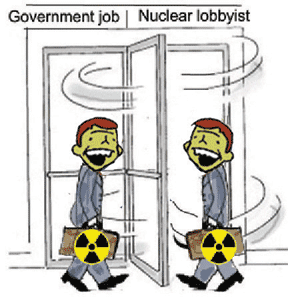
Back in June 2024, former Energy Minister Todd Smith left the government, after spending billions on the nuclear industry and promising billions more. Upon his departure, Todd Smith landed a job as a VP of CANDU Energy Inc. CANDU Energy Inc was created when SNC-Lavalin purchased the commercial reactor division of Atomic Energy of Canada Limited from the federal government in 2011. In an effort to distance itself from its scandal ridden past, SNC-Lavalin has since changed its name to AtkinsRealis. The company is heavily involved in the refurbishment of Ontario nuclear plants and the plans for new builds.
3c. The technological hype of SMRs
Small Modular Reactors (SMRs) are not small and they are not that modular. And they are not that new. The designs, of which there are about 54, have been kicking around for a long time. It’s just that no one wanted to build them, and investors were loathe to put up their own money. The fate of SMRs changed when the nuclear industry convinced governments in Canada to develop what it called the “SMR Roadmap.” The “Roadmap,” largely produced by the industry, was all hype and little substance, but it was enough to convince the Ford government to join the parade.
The World Nuclear Industry Status Review is an annual independent assessment of the global nuclear industry. In its 2022 review, it concluded:
“Small modular (nuclear) reactors or SMRs continue to hog the headlines in many countries, even though all the evidence so far shows that they will likely face major economic challenges and not be competitive on the electricity market. Despite this evidence, nuclear advocates argue that these untested reactor designs are the solution to the nuclear industry’s woes.”
In the 2024 edition of the review, the analysts note: “The gap between hype about Small Modular Reactors (SMRs) and reality continues to grow. The nuclear industry and multiple governments are doubling down on their investments into SMRs, both in monetary and political terms.”
3d. Over-the-top visioning and ideological straw men
Stephen Lecce became the Minister of Energy in June 2024. Shortly afterwards, he travelled to the US where he made a pitch to western leaders and industry movers and shakers. He told them that Ontario is building a blueprint for a nuclear energy future.
A CP wire story put it this way: “Ontario is selling itself as the nuclear North Star to guide the direction of American power.”
Speaking to a largely American audience, he said it’s time to “rid our economies of any dependence on these foreign states that … do not share our democratic embrace,” (Oops).
The minister’s early charm offensive turned more aggressive back home when he criticized those who support renewable energy as” ideologues” who want to “romanticize certain resources.” As he told the National Post, “We are seeing forces on the left, the illiberal left, who cannot come to terms with the fact that in order to decarbonize we’re going to need nuclear.”
The commitment to nuclear was further baked into Ontario’s future when the Ford government released its energy vision in October 2024. The document ironically entitled “Ontario’s Affordable Energy Future” sets the stage for a massive build out of nuclear power.
It also makes it clear that Ontario has set its sights on becoming a nuclear energy superpower in the hopes of selling expensive nuclear electricity to the US and costly nuclear technology to the world.
Reflecting the grandiose aspirations of a would-be energy superpower the Minister declared that “this was Ontario’s moment.”
3e. The legislative lock-in
In December 2024, the government passed the misnamed “Affordable Energy Act” (Bill 214) The legislation has many troubling aspects. Various sections of the act restrict public consultation, further erode the independence of regulatory tribunals, and shifts more decision making to the government. But most alarming is how the government has used the Act to give preference and priority to nuclear power. Section 25.29 (2) of the Act refers to, “the prioritization of nuclear power generation to meet future increases in the demand for electricity …”
3f. The commitment to underwrite the costs of nuclear
The government is bankrolling the nuclear expansion with public money because investors don’t want their own money at risk. The costs of nuclear power have driven private investors away. Even with massive subsidies from governments, investors are reluctant to ante up.
A spokesperson for the government-owned Ontario Power Generation made the point very clear when commenting on small modular reactors.
Kim Lauritsen is a senior OPG vice-president. She told a Global Business conference audience that the crown corporation was willing to take the “first-mover risk.”
As she put it: “Because they (small modular reactors) take too long and the industry needs to see that these things can be built successfully, to give investors the confidence and really get the ball rolling for other jurisdictions.”
Because investors are nervous and because Ontario wants to show the way for other jurisdictions, the Ford government is prepared to saddle Ontario families and future generations with the exorbitant costs of nuclear power.
Part 4: The nuclear three-prong plug: Refurbishments, SMRs and New Large Scale Reactors
Refurbishments
The Ontario government is spending billions to refurbish old nuclear plants. Fourteen reactors are scheduled to be rejuvenated – 6 at Bruce, 4 at Darlington, and 4 at Pickering. The repair schedule for existing nuclear plants stretches out for decades. While these reactors are off line, the government plans to make up the electricity shortfall with more climate wrecking, fossil-gas generating plants.
The cost of the refurbishments will be in excess of $40-billion. That forty billion and the millions more in interest charges will find its way onto our electricity bills.
As our electricity bills go up, so does political pressure and when that pressure reaches a tipping point, the government steps in with subsidies to help reduce electricity bills. It is a repeated pattern in Ontario.
A recent report from the Government’s Financial Accountability Office (FAO) projected the cost of current electricity subsidies to be $118-billion over the next 20 years. These are not all nuclear electricity subsidies. But as we spend more on nuclear and nuclear increases the cost of electricity and governments are pressured to reduce the cost of electricity, there will be even more subsidies to shift the costs from our electricity bills to our taxes.
Small Modular Reactors (SMRs)
In addition to the massive refurbishment program the Ford government has announced a series of nuclear new builds.
There will be four new small modular reactors (SMRs) built at the Darlington nuclear location. Site preparation work is already underway on the first one. OPG has convinced the Canadian Nuclear Safety Commission to forego an environmental impact assessment, relying instead on an assessment that had been done years ago on the site for a different project.
The government has selected the GE-Hitachi BWRX-300 design. This is based on a design that has been kicking around for about 20 years and has had to be redesigned about ten times. It still has never been built. The engineering designs for Darlington have again been changed, making the small modular reactor less small and even less modular.

OPG has not released a cost estimate for the reactors. But there are some indications of the probable magnitude. In the US, the only SMR project that had been approved by the US federal government was NuScale in the mid-west. The project was cancelled because of escalating costs. Originally estimated at $3-billion (US), it was terminated in 2024 when the projected costs reached $9.3-billion (US).
The Tennessee Valley Authority, a large power utility in the US, has partnered with the OPG to promote the GE-Hitachi SMR. The TVA recently provided some estimates of the costs of building the SMR in the US. It indicated that the cost of the first reactor could be about $5.4-billion (US). It hoped the costs could be reduced to about $3.7-billion (US) if more were built. These costs do not include any interest charges, cost overruns, or missed deadlines.
If we assume the lower cost and convert to Canadian dollars, the price tag for the four SMRs at Darlington would be about $20-billion before things go wrong. In 2019, the company’s indicated the costs would have to be below $1-billion (US).
New Large Scale Nuclear Reactors
In July 2023, the Ontario government announced its support to expand the capacity of the Bruce nuclear power plant near Kincardine. The Bruce nuclear generating station is owned by OPG but operated by Bruce Power, a private consortium. Bruce Power is planning a major expansion of the site’s generating capacity. At present, six of the eight reactors are being refurbished. This new development, if it goes ahead, will add an additional 4800 MW, which would require building four or five new reactors. Admittedly, it is early days, and no costs have been provided.
Port Hope
In January 2025, the Ontario government announced that it was in the preliminary stages of a massive new nuclear plant that could be built at the OPG site in Wesleyville, near Port Hope. Officials have suggested the plant could have a capacity of 8,000 to 10,000 megawatts and be in operation by the 2040s. Achieving that generating capacity would require building eight or more nuclear reactors.
Part 5: Calculating the Costs
Continue readingCritics Slam Cost of Ontario SMR Plan, Question Dependence on U.S. Uranium
May 12, 2025, Mitchell Beer, https://www.theenergymix.com/critics-slam-cost-of-ontario-smr-plan-question-dependence-on-u-s-uranium/
Critics are taking a hard line on Ontario’s announcement that it will build four 300-megawatt small modular nuclear reactors (SMRs) at the existing Darlington nuclear plant near Bowmanville, with most concerns focused on the cost of the project and the geopolitical risk in sourcing enriched uranium from a U.S. supplier.
Ontario Power Generation announced provincial approval for the first of the four units May 8, describing it as “the first new nuclear build in Ontario in more than three decades.”
“This is truly a historic moment,” said OPG President and CEO Nicolle Butcher. “This made-in-Ontario project will support provincial companies, create jobs for Ontarians, and spur growth for our economy.”
Energy and Mines Minister Stephen Lecce declared the 1,200-megawatt installation, the first of its kind in the G7, a “nation-building project being built right here in Ontario.” Durham MPP Todd McCarthy called it “the next step to strengthening Ontario and Canada’s energy security.”
The published cost of the project is $7.7 billion for the first reactor, including $1.6 billion for infrastructure and administrative buildings, and $20.9 billion to complete the series of four. Citing Conference Board of Canada figures, OPG said the four SMRs will contribute $38.5 billion to Canada’s GDP over 65 years and sustain an average of about 3,700 jobs per year, including 18,000 per year during construction.
First Mover Advantage or Boutique Pricing?
In the OPG announcement, Butcher suggested an advantage in being the first G7 jurisdiction to bring an SMR to market. “As a first mover on SMRs, Ontario will also be able to market our capabilities and nuclear expertise to the world to further grow our domestic industry,” she said.
The Globe and Mail says the Darlington New Nuclear Project “is being watched closely by utilities around the world,,”, and OPG’s BWRX-300 design “is a candidate for construction in the United States, Britain, Poland, Estonia, and elsewhere.” But “the costs published Thursday are higher than what independent observers argue are necessary to attract many more orders. For comparison, a recently completed 377-megawatt natural gas-fired power station in Saskatchewan cost $825-million.”
Ed Lyman, director of nuclear power safety at the Cambridge, MA-based Union of Concerned Scientists, called the Ontario estimate “an eye-popping figure, but not unexpected given what we know about the poor economics of small nuclear reactors.” That would make the Darlington SMR facility “a boutique unit that’s going to produce electricity for a very expensive price.”
An independent study released last week by the Ontario Clean Air Alliance found that the Darlington SMRs will cost up to eight times as much as onshore wind, almost six times as much as utility-scale solar, and 2.7 times as much offshore wind in the Great Lakes after factoring in the federal tax credit. The analysis by Hinesburg, Vermont-based Energy Futures Group “used data from Ontario’s Independent Electricity System Operator (IESO) but used realistic real-world capital costs and performance measures to develop a more accurate comparison of the cost of nuclear and renewable power options,” OCAA writes.
The report calculates the levelized cost of electricity (LCOE) from different sources in 2030 and 2040, with and without the federal government’s 30% clean energy investment tax credit (ITC). It places the unsubsidized costs per megawatt-hour in 2030 at:
• $33 to $51 for onshore wind;
• $54 for utility-scale solar;
• $105 to $113 for offshore wind;
• $214 to $319 for different SMR designs;
• $279 to $307 for conventional nuclear plants.
By 2040, the prices range from $30 for onshore wind and $41 for utility-scale solar to up to $269 for SMRs and $307 for conventional nuclear. SMR pricing falls as low as $137 per MWh with a 30% ITC.
“It remains unclear how this, and the province’s larger nuclear expansion program, will actually be paid for,” Mark Winfield, co-chair of York University’s Sustainable Energy Initiative, told The Energy Mix in an email. “Putting this on the rate base means higher rates for Ontario electricity consumers, even if the costs are as claimed.”
He added that “the potential role of the federal ITC and [Canada] Infrastructure Bank Investment raises serious questions about what should be defined as ‘clean’ energy given the risks involved in this case, in terms of economic and technological viability, safety risks, and unanswered questions regarding waste streams.”
Critics were already questioning whether field experience with four individual SMRs will be enough to drive down production costs from $6.1 billion plus surrounding infrastructure for the first unit to a range of $4.1 to $4.9 billion for the next three, after the estimated price of the project has already ballooned. Now, with New Brunswick scaling back its SMR development plans, “Ontario is taking something of a technological and economic flyer on this, on behalf of everyone else, underwritten by the electricity ratepayers and, ultimately, taxpayers of Ontario,” Winfield wrote. “This is a project that demands serious economic, technological, and environmental scrutiny, and has been subject to virtually none.”
Uranium Sourced from the United States
OPG is also running into concerns with its plan to power the BWRX-300 with enriched uranium supplied by a firm in the U.S. state of New Mexico. When Donald Trump launched his tariff war earlier this year and began muttering about making Canada a 51st state, Premier Doug Ford applied a short-lived tariff to Ontario power sales and referred publicly to cutting exports as a retaliatory measure. Now, the province is proposing to make 1,200 MW of electricity supply dependent on a vendor that could see its price driven up by tariffs, or be compelled to cut off the supply entirely.
“Developing a dependence on another country for our nuclear fuel has always been a concern, and recent events have proven those concerns are justified,” Bob Walker, national director of the Canadian Nuclear Workers’ Council, told the Globe and Mail in February. “The arrangements are probably as robust as they could be under normal circumstances, but the circumstances are no longer normal.”
In an email to the Globe at the time, OPG spokesperson Neal Kelly described the situation as “very fluid”, adding that “we are proactively evaluating potential impacts and will act as the situation arises.”
Kelly did not respond to an email Monday morning asking whether OPG has any concerns about sourcing enriched uranium from the U.S., and whether it has or needs a Plan B.
False promises, real costs: The nuclear gamble we can’t afford
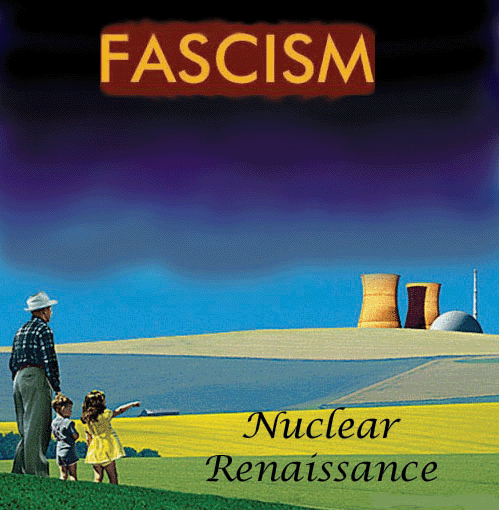
Beyond the financials, nuclear represents a specific vision of governance; centralised, top-down, and resistant to scrutiny. A small number of well-connected corporations manage most facilities. The civilian sector remains intertwined with military infrastructure. Decision-making processes often exclude community consultation. Most notably, nuclear generates waste that remains hazardous for thousands of years, demanding long-term institutional stability that even the Nuclear Waste Management Organization acknowledges no government can guarantee.
Scotland and Canada must forge an energy future that works
by Ben Beveridge, 11-05-2025 , https://bylines.scot/environment/false-promises-real-costs-the-nuclear-gamble-we-cant-afford/
Nuclear power is staging a quiet comeback. In boardrooms across Scotland and Canada, familiar promises are being repackaged as bold new solutions: reliable baseload electricity, energy security, and climate alignment. But behind the sleek rhetoric, the same truths remain. Nuclear power is still the slowest, most expensive, and least flexible energy option on the table.
Both countries now face pressure to commit to a nuclear future they neither need nor can afford. This isn’t the natural evolution of energy policy. It’s the resurrection of a failing model, defended not on merit, but on legacy interests.
In the UK, projects like Hinkley Point C and Sizewell C have seen cost projections soar, with current estimates exceeding £30bn. Scotland, despite producing 97% of its electricity from renewable sources, remains tied to a UK-wide strategy shaped by Westminster’s nuclear ambitions
In Canada, Ontario’s Darlington refurbishment has grown from C$6bn to more than C$12bn. Saskatchewan and New Brunswick are investing heavily in Small Modular Reactors (SMRs), which have yet to prove commercial viability. The Canadian Environmental Law Association has raised significant concerns over the feasibility, safety, and cost of these technologies, yet federal investment continues, often at the expense of grid modernisation and renewable storage.
Nuclear: more expensive, less flexible, needs political intervention
The narrative has shifted from energy independence to climate urgency, but the fundamentals have not. Lazard’s 2023 analysis puts the levelised cost of new nuclear at US$131–204 per megawatt-hour, while utility-scale solar sits at US$26–41, and wind at US$24–47. Nuclear projects frequently exceed ten-year construction timelines. By contrast, wind and solar facilities can be operational within five. Nuclear plants also lack the flexibility modern grids require, locking in oversupply and reducing the effectiveness of variable renewable sources.
Private capital has walked away. No nuclear facility proceeds without government subsidies, price guarantees, or risk backstops. The market has made its judgment. Nuclear survives only through political intervention, not economic logic.
Beyond the financials, nuclear represents a specific vision of governance; centralised, top-down, and resistant to scrutiny. A small number of well-connected corporations manage most facilities. The civilian sector remains intertwined with military infrastructure. Decision-making processes often exclude community consultation. Most notably, nuclear generates waste that remains hazardous for thousands of years, demanding long-term institutional stability that even the Nuclear Waste Management Organization acknowledges no government can guarantee.
Renewables: decentralised, democratic and resilient
In contrast, the model offered by renewables is decentralised, participatory, and adaptive. Community energy projects across Scotland – from the Isle of Eigg to the Outer Hebrides – demonstrate how generation can be local, democratic, and resilient. In Canada, provinces like Quebec and British Columbia have built near-100% clean grids through hydroelectricity, rejecting nuclear while Clean Energy Canada shows generational energy security and affordability.
So why does nuclear persist? The answer lies in its structure. Nuclear development creates concentrated profit centres, contracts for reactor manufacturers, engineering giants, uranium suppliers, and vertically integrated utilities. These stakeholders benefit from centralised generation, not distributed ownership. Regulatory frameworks often entrench their advantages, creating barriers for smaller-scale or community-led projects. The result is a policy environment that protects incumbents rather than enabling transition.
This is not a neutral technological debate. It’s a structural contest between legacy systems and emergent models of energy democracy. The framing may be about climate, but the stakes are about convention, and control.
Scotland and Canada renewable partnership
Scotland and Canada are uniquely positioned to lead an alternative path. Their respective strengths are complementary. A Scotland-Canada renewable partnership, modelled after the North Sea oil and gas collaboration, could drive investment in shared technologies like offshore wind, pumped hydro storage, and smart grid systems. Agencies such as Scottish Enterprise and Scotland Development International already maintain Canadian operations and could broker this cooperation directly.
The Commonwealth presents another opportunity. A Commonwealth Energy Transition Alliance could support shared investment frameworks, model policy design, and collaborative R&D between countries with aligned infrastructure and ambitions. It could also serve as a counterbalance to the lobbying power of the nuclear-industrial complex, directing climate funding towards solutions that scale affordably and equitably.
The choice facing both nations is not nuclear or catastrophe. It is between centralised systems that demand public subsidy and deliver rising costs, versus renewable models that are increasingly faster, cheaper, and community-driven. The facts are clear. The economics are settled. What remains is the political will to choose a future built for the many, not the few.
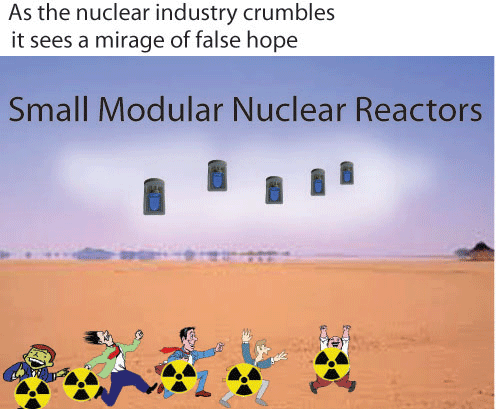
Scotland and Canada no longer need permission to lead. They need resolve. The nuclear mirage still shimmers, but it’s time to walk towards the real oasis: a clean, democratic energy future, and we have it already.
Ontario’s Darlington SMR project to cost nearly $21-billion, significantly higher than expected.

Matthew McClearn, May 8, 2025
The Ontario government approved Ontario Power Generation’s plan to spend $7.7-billion to construct the first small modular reactor in a G7 country – a price far greater than independent observers deem necessary to spark widespread adoption.
On Thursday, the government announced its wholly-owned utility can spend $6.1-billion to build the first BWRX-300 reactor adjacent to OPG’s existing Darlington Nuclear Generating Station. In addition, it can spend another $1.6-billion on common infrastructure such as administrative buildings and cooling water tunnels the new reactor will share with three additional BWRX-300s to be built later.
Those remaining units are expected to cost substantially less: all told, the 1,200-megawatt plant‘s estimated cost is $20.9-billion, expressed in 2024 dollars and including interest charges and contingencies.
Those costs are far higher than what independent observers argue are necessary for widespread adoption of SMRs. For comparison, a recently-completed 377-megawatt natural gas-fired power station in Saskatchewan cost $825-million.
High costs, overruns and delays contributed to the decline of nuclear power in advanced economies such as the U.S., France and Canada, all former leaders in reactor construction. The global reactor fleet‘s collective generating capacity has been largely flat since the 1990s, around the same time Canada’s newest reactor (Darlington Unit 4) was built. Most reactors under construction today are of Chinese and Russian design. Only one reactor is currently under construction in the Western hemisphere, and two in Western Europe, according to Mycle Schneider Consulting.
OPG’s project, known as the Darlington New Nuclear Project, is being watched closely by utilities around the world. The BWRX-300 is a candidate for proposed projects in the U.S., U.K., Poland, Estonia and elsewhere.
Thursday’s announcement marks a significant milestone for major capital projects. Proposals and memorandums of understanding for nuclear power plants abound, but very few advance to this stage.
Construction was scheduled to wrap up in 2028, but OPG has pushed that back by one year. It attributed the delay to a construction licence the Canadian Nuclear Safety Commission granted in April, later than expected; the scheduled months between breaking ground and completion remain unchanged.
OPG’s costs are several times greater than Wilmington, N.C.-based GE Hitachi Nuclear Energy originally promised. Early in the BWRX-300’s development, GE Hitachi emphasized it was designing to achieve a specific cost: US$700-million per reactor, or US$2.25-million per megawatt, low enough to compete with natural gas.
OPG said the government is not funding the project: the utility will pay for it using its own funds, including cash on hand, cash flow from generating stations and debt.
Ontarians will pay OPG back over time through their electricity bills.
Officials estimated the average cost of power from the four reactors at 14.9 cents per kilowatt hour, contingent on the federal government providing investment tax credits.
The IESO said an alternative would be to build between 5,600 and 8,900 megawatts of wind and solar generators supported by batteries. Their capacity would need to be far greater, it reasoned, to account for the intermittent nature of wind and sunlight, and they would also require far more new transmission infrastructure. The IESO estimated the costs for all that at between 13.5 and 18.4 cents per kilowatt hour. Building the BWRX-300, the IESO concluded, is the lower-risk option.
Clean Prosperity, a Canadian climate policy think tank, said in a report last year that the final construction cost of the first BWRX-300 will be influential in determining how many other utilities will be interested in building their own. A cost of $3-billion, or $10.16-million per megawatt, would encourage rapid adoption of SMRs – a level some countries have achieved.
“Russia, India, South Korea and Japan have had average construction costs of $3.4-million to $4.6-million per megawatt since 2000,” the report said.
“In contrast, France and the U.S. built reactors for $12.5-million and $17.5-million per megawatt, respectively, over the same time frame.”
In a January report, the International Energy Agency said costs must come down; SMRs need to reach US$4.5-million per megawatt by 2040 to enjoy rapid uptake, far less than OPG’s estimated costs.
OPG said it‘s confident it will stick to its schedule and budget. The utility pointed to its ongoing $12.8-billion refurbishment of Darlington’s existing four reactors, a complex project it said remains on schedule and on-budget and is scheduled to wrap up next year. But if overruns do occur on the Darlington SMR, OPG and its partners (which include GE Hitachi, architect/engineer AtkinsRéalis and constructor Aecon) will share those costs.
The utility added that 80 per cent of its spending on the project will go to Ontario companies; just 5 per cent goes to U.S. companies, primarily GE Hitachi for its design and development work.
Last fall, the Ford government passed legislation dubbed the Affordable Energy Act, which committed to prioritizing nuclear power to meet future increases in electricity demand. The province plans up to 4,800 megawatts of new nuclear capacity at the Bruce Nuclear Generating Station, and as much as 10,000 megawatts at Wesleyville, a proposed new OPG station in Port Hope.
Covering up Ukrainian Nazis is nothing new – the Canadians have been doing it for almost eighty years

Ian Proud, April 29, 2025. https://strategic-culture.su/news/2025/04/29/covering-up-ukrainian-nazis-nothing-new-canadians-have-been-doing-it-for-almost-eighty-years/
A number of topics remain taboo in discussing the war in Ukraine. Busification, Zelensky’s democratic mandate, Ukraine’s casualty numbers and anything suggesting that Ukraine cannot win are all off limits. Likewise the problem of alleged neo-Nazis in Ukraine.
One of the most embarrassing episodes since the Ukraine war started in 2022, was when Yaroslav Hunka, was given two standing ovations in the Canadian House of Commons public gallery by MPs during the visit of President Zelensky in 2023. Hunka has been accused by Russia of genocide, because of his alleged involvement in the Huta Pieniacka massacre of February 28 1944 in which more than 500 ethnic Poles were murdered in a village, in what is now western Ukraine. Hunka was a member of the SS Galicia Division, a mostly Ukrainian unit of the Waffen SS, which Commissions in Germany and Poland later found guilty of war crimes.
This was shocking because it opened the lid on a topic of conversation that has been largely silenced by the western mainstream media since the beginning of the war: Ukraine’s contemporary challenge of far-right ultranationalism. But the Hunka case also illustrates how western authorities airbrushed discussion of nazis in Ukraine after World War II too.
On 13 July 1948 the British Commonwealth Relations Office, what is now part of the Foreign Commonwealth and Development Office, sent a telegram to Commonwealth governments, proposing an end to Nazi war crimes trials in the British zone of Germany. “Punishment of war crimes is more a matter of discouraging future generations than of meting out retribution to every guilty individual… it is now necessary to dispose of the past as soon as possible.”
After the conclusion of the Nuremberg War Trials in 1946 the western world faced a new enemy in the Soviet Union. Limited security resources in cash-strapped Albion and its colonies were re-deployed to uncover suspected Soviet agents and Communists, rather than to identify and track down lower-order Nazi war criminals.
Around this time, many Ukrainians fled the Soviet Union to settle in Canada. In the thirty-year period after the start of Operation Barbarossa, the Ukrainian population in Canada almost doubled, from 300,000 to almost 600,000 people. While most of them, I am sure, would not have been Nazi collaborators, some, undoubtedly, were. They were joined by lesser numbers of Latvians, Hungarians, Slovaks and others.
Within that exodus would have been so-called “lesser” war criminals; persons who had organised the transportation of Jews, Slavs, gypsies and homosexuals to death camps, acted as informers, committed murders, or become involved in war crimes as other ranks and non-commissioned officers in death squads. They were the lower echelon collaborators, acting as the instruments of the genocide initiated by the Nazis.
Yet, following the British instruction, Canada progressively relaxed its immigration policy between 1950 and 1962, steadily removing restrictions against the entry of German nazis and non-German members of German military units like the SS Galicia Division.
However, in 1984 the Simon Wiesenthal Center wrote a letter to the Canadian government claiming to have obtained evidence that the ‘Angel of Death’ Josef Mengele had applied for a landed immigrant visa to Canada in 1962. Though this proved to be incorrect, it caused such outrage among Canada’s Jewish community that a Commission of Inquiry on War Criminals in Canada was established in 1985.
Known as the Deschênes Commission, it uncovered a list of 774 persons who had allegedly entered Canada and who required further investigation. Of that list, only 28 underwent serious investigation and trial.
Michael Pawlowski, accused of murdering 410 Jews and 80 non-Jewish Poles in Belarus in 1942, was acquitted as judges blocked the prosecution from gathering evidence in the Soviet Union.
Stephen Reistetter of Slovakia was not tried for allegations that he kidnapped 3000 Jews to have them sent to Nazi death camps while serving in the Hlinka party, a far right clerical-fascist movement with Nazi leanings. His case fell apart because a witness died.
Erich Tobias, was accused of involvement in the execution of Latvian Jews but died before his case went to court.
By 1995, with no convictions for war crimes having been secured, the Canadian Justice Department cut the size of its war crimes unit from 24 to 11 people. In the absence of criminal prosecutions, the Canadian Government tried civil proceedings to revoke citizenship from alleged war criminals.
Wasily Bogutin collaborated with the Nazi occupation forces in the town of Selidovo, in Donetsk, and was personally and directly involved in effecting the roundup of young persons for forced labour in Germany. In February 1998, Judge McKeown, of the Trial Division of the Federal Court, found that Bogutin had concealed his role in war crimes, but he died before he could be extradited.
Joseph Nemsila, who commanded a Slovak unit that sent civilians to Auschwitz died in 1997 after a decision not to revoke citizenship was overturned, but death prevented exportation.
In only 7 cases was order made for the suspect to be extradited or exported. This included Ladislaus Csizsik-Csatary, accused of involvement in the confinement of thousands of Hungarian Jews and their subsequent deportation to death camps. In July 1997, just before his trial was to begin, he decided not to oppose the loss of his citizenship and voluntarily left the country.
Vladimir Katriuk was accused of having taken part in the Khatyn Massacre in Belarus and Wasyl Odnynsky, a guard at SS labour camps at Trawniki and Poniaka. Moves were made to revoke their citizenship, but they were allowed to remain in Canada until all court proceedings were lifted in 2007.
Progress in prosecuting alleged war criminals in Canada was always slow, often held up by foot-dragging by often reluctant judges, and a refusal to allow for the gathering of evidence in the Soviet Union.
Today, the media and Jewish groups still pressure the Canadian government to reveal the names of all of the 774 persons considered by the 1985 Deschênes Commission with so far little success.
An American academic recently discovered what is believed to be a similar list of 700 suspects which included Volodymyr Kubiovych, a Ukrainian Nazi collaborator who helped organize the SS Galicia division and who was editor in chief of the Encyclopedia of Ukraine compiled at the University of Alberta. A photograph of a parade in Lviv, Ukraine, in July, 1943, shows Mr. Kubiovych making a Nazi salute alongside Otto Wächter, a senior member of the SS who also served as governor of Galicia and Krakow.
Yaroslav Hunka was not on that list, raising questions about how many Nazi collaborators in Canada were never discovered.
I don’t think that Ukraine today is a Nazi society and, even at its high watermark, the Svoboda party only garnered 10% of the national vote. But ultranationalism is a major problem, particularly in the west of Ukraine, in that area known as Galicia during World War II. And the refusal of western governments to acknowledge the issue of ultranationalism in Ukraine or speak out means that we are turning a blind eye once more to activity that we would never tolerate in our own countries.
Danger of an India-Pakistan war and Canada’s Reactors
Normand Lester, Journal de Montréal, 27 avril 2025, https://www.journaldemontreal.com/2025/04/27/danger-de-guerre-indo-pakistanaise-et-nos-candu
An individual with dual Canadian and Pakistani citizenship has just been arrested in the USA for attempting to acquire technology for Pakistan’s nuclear weapons program and smuggle it through Canada.
The case comes to light as tension mounts between India and Pakistan following the massacre of 26 Indian tourists in the disputed region of Kashmir. New Delhi accuses Pakistan of being responsible. The latter denies being behind the attack. India has annexed Muslim-majority Kashmir, which is claimed by Pakistan. China is a major ally of Pakistan, while India has close defense ties with the United States.
Clashes between the two armies increased, raising fears of a large-scale military conflict. Peace has never really been restored since 1947, when the British Indian Empire was violently partitioned into two independent states: Muslim-majority Pakistan and Hindu-majority India. The war of religious partition is thought to have claimed between one and two million lives, and led to the massive displacement of between 12 and 20 million people.
A-bomb: thanks to Canada
India and Pakistan have already fought two major wars, in 1965 and 1971, before acquiring nuclear weapons… with the help of Canada. Any war between them could therefore turn into a nuclear exchange.
Since then, India and Pakistan have experienced a major border skirmish in 1999, which left at least 1,000 people dead.
After donating one nuclear reactor to India in 1956, Ottawa heavily subsidized the purchase of another by India in 1963. As part of this purchase, Canada trained 271 Indian scientists, engineers and technicians, who went on to develop New Delhi’s atomic bomb.
In 1971, Canada built a 137-megawatt CANDU nuclear reactor in Karachi, Pakistan. The contract also included a heavy water production facility. Three years later, in 1974, India detonated its first nuclear device, dubbed the “Smiling Buddha”, using plutonium from the reactor donated by Ottawa in 1956.
According to experts, Canadian reactors are ideal for producing weapons-grade plutonium, and Ottawa hasn’t even asked India to comply with the safeguards required by the International Atomic Energy Agency (IAEA).
Canada sneaks away
U.S. Secretary of State Henry Kissinger then roundly criticized Canada, telling the media that the Indian nuclear explosion had been carried out using material diverted from a Canadian reactor lacking the appropriate safeguards.
With its guilt exposed, Canada quietly withdrew from the Indian CANDU project. It also stopped supplying uranium to Karachi, and withdrew from the Pakistani project. This did not prevent it from carrying out its first nuclear test in 1998.
If India and Pakistan ever wage nuclear war on each other, Canada will have to assume – in part – the moral responsibility.
New Brunswick government rethinks nuclear reactor plans.

COMMENT. Thanks to our Green Party leader MLA David Coon for stating the case against, as he has been doing for more than a decade now. The article mentions that the government is also considering another CANDU reactor, which is interesting. I think the push is on now to buy Canadian… Unfortunately for the New Brunswick economy, the current CANDU 6 reactor has been a financial nightmare.
Matthew McClearn , April 22, 2025, https://www.theglobeandmail.com/business/article-new-brunswick-government-rethinks-nuclear-reactor-plans/
Small modular nuclear reactors remain part of New Brunswick’s plans for future power generation, the province’s Energy Minister says, but it may select more conventional models – and build them later – than originally envisioned.
New Brunswick originally intended to construct one or two reactors by 2030 at its Point Lepreau Nuclear Generating Station, Atlantic Canada’s only nuclear power plant. It has started predevelopment work for up to 600 megawatts of generation capacity from new SMRs, which would be roughly equivalent to the output of its current lone reactor.
But René Legacy, who became energy minister and deputy premier in November after the Liberals defeated the Conservatives in the provincial election, has been tasked with drawing up a new energy plan.
In an interview, Mr. Legacy said SMRs remain attractive because their output is better matched with the province’s needs than those of large reactors. However, he added, the government is considering different models from those of its existing partners, and expects a delayed construction timeline.
The province and its wholly owned utility, New Brunswick Power, partnered in 2018 with ARC Clean Technology and Moltex Energy Canada Inc. Both promoted reactors featuring novel coolants, fuels or moderators that are not traditionally used in commercial power generation, and neither had built reactors previously. However, both companies struggled to raise sufficient funds and recruit the hundreds of employees typically required for reactor development.
“The original plan to have one or two of the reactors built for 2030, that time frame is probably not going to happen,” Mr. Legacy said, adding that first-of-a-kind reactors are expensive while acknowledging the province’s fiscal constraints.
“So we’re looking at, probably, different options.”
Adjustments to New Brunswick’s SMR strategy arrive at a moment of great uncertainty for the province’s energy sector. Premier Susan Holt has promised a far-ranging consultation concerning the future of NB Power, which has struggled unsuccessfully to reduce its debt burden and faces significant spending to replace or refurbish aging infrastructure. Point Lepreau spent most of the past year out of service during planned and unplanned outages.
Mr. Legacy said that while the 2030 deadline for constructing SMRs is likely not achievable, changing circumstances have afforded more breathing room for the province to select a reactor technology. A new gas-fired power plant is scheduled to begin operating in 2028, and the federal government recently announced up to $1-billion in funding for up to 670 megawatts of Indigenous-led wind projects. Amendments to federal regulations have afforded the province “a little bit of a longer runway” to convert its coal-fired Belledune Generating Station, in Gloucester County, to burn biomass.
“At the very latest, we’re going to need some shovels in the ground around 2035, because some of our assets are going to come close to end of life, and we’re going to have to replace that generation,” he said.
“So we’ll have to make a decision and start moving towards a technology now.”
Mr. Legacy said New Brunswick Power is studying reactors already being considered for deployment in other provinces. These include the BWRX-300, which was designed by GE Hitachi Nuclear Energy; Ontario Power Generation plans to construct the first one at its Darlington Nuclear Generating Station by 2028. Another candidate is Westinghouse Electric Co. LLC’s AP300, a proposed design Westinghouse based on its larger AP1000, several of which have been constructed worldwide.
Mr. Legacy said the province is also considering a Candu reactor, which implies large reactors are not off the table. (SMRs are typically defined as having capacities below 300 megawatts, but there are no Candus currently marketed in that range. Point Lepreau’s existing reactor, a 660-megawatt Candu-6, entered service in 1983.)
ARC is still in the running, Mr. Legacy added, but the company must find a financial partner. Also, its ARC-100 reactor would require high-assay low-enriched uranium (HALEU), which is not produced commercially in North America. (Russia is the lone major supplier.) This month, the U.S. Department of Energy committed to provide HALEU to five U.S. reactor developers, with deliveries beginning as early as this fall; ARC was not among them. Mr. Legacy said ARC must ensure fuel availability as “part of their package.
As for Moltex, the province remains interested in its Waste To Stable Salt technology, which contemplates reprocessing spent nuclear fuel into new reactor fuel. But “Moltex is probably more of a longer play” than ARC, he added.
David Coon, leader of the province’s Green Party, said the former Conservative government regarded SMRs as an economic development and hoped to export them globally. The new Liberal government isn’t looking to subsidize SMR development, preferring reactor models that have already been constructed elsewhere.
Mr. Coon said SMRs aren’t appropriate for New Brunswick because they’re “extremely costly” and produce radioactive waste. Better bets, he said, would include improved energy efficiency, utility-scale battery storage, more wind generation and increased sharing of electricity with neighbouring provinces.
“We can’t afford it, it’s not clean and we don’t need it,” he said of nuclear energy.
1 This Month
19 February – VIRTUAL EVENT-Decision Time: AI and Our Nuclear Arsenal
12:45 p.m. Central / 1:45 p.m. Eastern
To see nuclear-related stories in greater depth and intensity – go to https://nuclearinformation.wordpress.com

-
Archives
- February 2026 (141)
- January 2026 (308)
- December 2025 (358)
- November 2025 (359)
- October 2025 (376)
- September 2025 (258)
- August 2025 (319)
- July 2025 (230)
- June 2025 (348)
- May 2025 (261)
- April 2025 (305)
- March 2025 (319)
-
Categories
- 1
- 1 NUCLEAR ISSUES
- business and costs
- climate change
- culture and arts
- ENERGY
- environment
- health
- history
- indigenous issues
- Legal
- marketing of nuclear
- media
- opposition to nuclear
- PERSONAL STORIES
- politics
- politics international
- Religion and ethics
- safety
- secrets,lies and civil liberties
- spinbuster
- technology
- Uranium
- wastes
- weapons and war
- Women
- 2 WORLD
- ACTION
- AFRICA
- Atrocities
- AUSTRALIA
- Christina's notes
- Christina's themes
- culture and arts
- Events
- Fuk 2022
- Fuk 2023
- Fukushima 2017
- Fukushima 2018
- fukushima 2019
- Fukushima 2020
- Fukushima 2021
- general
- global warming
- Humour (God we need it)
- Nuclear
- RARE EARTHS
- Reference
- resources – print
- Resources -audiovicual
- Weekly Newsletter
- World
- World Nuclear
- YouTube
-
RSS
Entries RSS
Comments RSS
 nuclear-news