

 How ‘Worst-Case Scenario’ At New Brunswick Nuclear Plant Could Affect Down East Maine, Maine Public, 12 May By JENNIFER MITCHELL Point Lepreau is a nuclear power plant just across the border in St. John. Next month its operating license expires, and the Canadian Nuclear Safety Commission is considering whether to renew it for another five years. While that’s not a long amount of time for a 30-year-old plant, there are passionate arguments for and against its operation and implications for an entire region.
This is the second of two parts. To read Part 1, a tour of Point Lepreau, click here.
Back in the 1950s, an U.S. Atomic Energy Commission film, “The Magic of the Atom,” was meant to ease the anxiety people might feel about living and working near a nuclear power plant.
“Today, if you were to take a trip in almost any direction across our great country, you might suddenly come upon a sign like this: Atomic City,” the film’s narrator says.
But after the 1979 disaster at Three Mile Island, nuclear plants developed a more sinister reputation, and ever since, facilities like Point Lepreau have been battling that legacy………
there are some who are speaking out against the facility’s license renewal.
“The health risks are too great. There is no way to make nuclear safe,” says Willi Nolan of Kent County, New Brunswick.
Nolan says she has made it her business to follow up on past major nuclear accidents, and she says the potential devastation to the environment is a deal breaker.
“I just spent some time with four survivors of Fukushima and I’m told, you know, after the worst-case scenario happened there, that there are now people dropping on the streets, 30 years old, 40 years old. We’re still not finished with Chernobyl. There are still human health effects, cancers, childhood conditions,” she says.
When it comes to a nuclear plant meltdown, there are two basic zones of concern: the critical emergency zone that extends for a 10-mile radius, and then what’s known as the ingestion pathway. That spans a 50-mile radius and, in the case of Lepreau, would include towns like Eastport, Calais, Lubec, and East Machias.
But how much do emergency responders in those towns know about nuclear events?
“Very little,” says Mike Hinerman, who runs Washington County’s Emergency Management Agency…….
the biggest problem, experts say, would come in the weeks, months and years after the event, because anything grown in or harvested from that 50-mile ingestion pathway could be tainted — for decades.
“What do you do with apples? What do you do with fish? What do you do with clams?” says Robert Gardiner, MEMA’s technological hazards manager……..a major Lepreau event would devastate the county’s economy, affecting everything from shipping at Eastport to aquaculture, forest products, fishing, tipping, hunting and tourism, and of course the region’s wild blueberries……..
While critics insist that the disaster risk doesn’t justify thee benefits, it’s the Canadian Nuclear Safety Commission that will have the final decision.http://mainepublic.org/post/how-worst-case-scenario-new-brunswick-nuclear-plant-could-affect-down-east-maine#stream/0
May 13, 2017
Posted by Christina Macpherson |
Canada, safety |
Leave a comment
Marysville, St. Clair restate opposition to Lake Huron nuclear waste dump, By Jim Bloch For The Voice, May 7, 2017 At the urging of Michigan state Sen. Phil Pavlov, the cities of Marysville and St. Clair have passed updated resolutions opposing the efforts of Ontario Power Generation to build a Deep Geological Repository for low- and medium-level nuclear waste on the shore of Lake Huron in Kincardine, Ontario, Canada.
The Marysville City Council unanimously approved a new resolution of opposition to the dump at its regular meeting on April 24. St. Clair followed suit on May 1.
“In 2015, you took the bold action of passing a resolution opposing the proposed nuclear waste dump less than one mile from the shorelines of Lake Huron in Canada,” Pavlov wrote to each city council. “Unfortunately, our fight is not over.”
Pavlov noted that townships, cities and counties representing 23 million citizens in Michigan, Illinois, Indiana, Minnesota, Wisconsin, Pennsylvania, New York, Ohio and Ontario have passed 187 resolutions opposing the nuclear waste dump.
“In spite of our majority opposition, Ontario Power Generation is continuing to pursue their dangerous plan to bury over seven million cubic feet of nuclear waste directly across the lake from the residents of St. Clair, Sanilac and Huron counties,” Pavlov said. “To even consider constructing a permanent nuclear waste disposal site near our valuable Great Lakes is dumbfounding.”
City Manager Randy Fernandez and Mayor Dan Damman spoke against the waste repository, proposed to be excavated about six-tenths of a mile from the lake at a depth of 2,200 feet.
“It’s mind-boggling that this is still a topic of concern,” said Damman. “I’m a full proponent of this resolution.”
The measure passed in Marysville 7-0.
The resolution noted that some of the waste “will remain toxic for over 100,000 years.”
The Great Lakes contain 20 percent of the world’s surface fresh water and 95 percent of the fresh water in the United States “vital to human and environmental health.”
“Under the 2012 Protocol Amending the Agreement between Canada and the United States of American on Great Lakes Water Quality, the governments of the U.S. and Canada acknowledge the importance of anticipating, preventing and responding to threats to the waters of the Great Lakes,” the resolution reads.
The two governments “share a responsibility to protect the Great Lakes from contamination from various sources of pollution, including the potential leakage of radioactivity from an underground nuclear waste repository.”…….http://www.voicenews.com/news/marysville-st-clair-restate-opposition-to-lake-huron-nuclear-waste/article_46cae100-3364-11e7-b0e2-973cbaf143db.html
May 10, 2017
Posted by Christina Macpherson |
Canada, opposition to nuclear |
Leave a comment
 Unviable economics of nuclear power catches up with Cameco, Independent Australia, Jim Green 9 May 2017 Multinational uranium producer Cameco is battling a uranium downturn, the tax office, disinterested customers and Traditional Owners, Dr Jim Green reports.
ECONOMICS is killing the nuclear power industry.
Westinghouse, a giant of the industry, recently filed for bankruptcy protection and its parent company Toshiba may also go bankrupt — both companies brought undone by $15 billion cost overruns building four reactors.
In France, nuclear utilities EDF and Areva would have gone bankrupt if not for repeated multi-billion-dollar government bailouts — their most immediate problem is cost overruns of $18 billion building just two reactors.
The question arises: will them nuclear power crisis create similar carnage in the uranium industry? Might it bring down a uranium industry giant like Cameco, which provides about 17% of the world’s production from mines in Canada, the U.S. and Kazakhstan?
The short answer is that Cameco will likely survive, but the company has been downsizing continuously for the past five years:
- In 2014, Cameco cut its growth plans and uranium exploration expenses, warning that the “stagnant, oversupplied short-term market” was not going to improve any time soon.
- In 2014, Cameco put its Millennium uranium project in northern Saskatchewan on hold ‒ where it remains today ‒ and asked the Canadian Nuclear Safety Commission to cease the mine approval process.
- In April 2016, Cameco announced that it was suspending uranium production at Rabbit Lake in Canada, reducing production at McArthur River/Key Lake in Canada, and slowing production at its two U.S. uranium mines, both in-situ leach mines — Crow Butte in Nebraska and Smith Ranch-Highland in Wyoming. About 500 jobs were lost at Rabbit Lake, 85 at the U.S. mines, and corporate headquarters was downsized.
Another 120 workers are to be sacked by May 2017 at three Canadian uranium mines ‒ McArthur River, Key Lake and Cigar Lake ‒ and production at McArthur River, already reduced, will be suspended for six weeks in mid-2017.
Cameco’s revenue dropped US$238 million (AU$321 million) in 2016 and the company posted a US$46 million (AU$62 million) loss for the year. The loss was largely the result of US$267 million (AU$360 million) in impairment charges, including US$91 million (AU$123 million) related to the Rabbit Lake mine and a write-off of the full US$176 million (AU$237 million) value of the Kintyre uranium project in Western Australia.
President Tim Gitzel said:
“I think it’s fair to say that no one, including me, by the way, expected the market would go this low and for this long … market conditions in 2016 were as tough as I have seen them in 30 years.”
Cameco’s “tier-1” mines ‒ McArthur River and Cigar Lake in Canada and the Inkai ISL mine in Kazakhstan ‒ have been largely unaffected by the cutbacks except for the slowdown at McArthur River. But the tier-1 mines aren’t safe, Cameco plans to reduce production by 7% in 2017, the two mines in the U.S. might be sold (if a buyer can be found), and new mines are off the table.
TEPCO cancels billion-dollar contract
Cameco faces a new problem with notorious Japanese company TEPCO ‒ owner of the Fukushima reactors ‒ announcing on January 24 that it had issued a contract termination notice, sparking a 15% drop in Cameco’s share price over the next two days. The termination affects about 9.3 million pounds (4.22 kilos) of uranium oxide due to be delivered until 2028, worth approximately US$959 million (AU$1294 million).
TEPCO argues that a “force majeure” event occurred because it has been unable to operate its nuclear plants in Japan ‒ four reactors at Fukushima Daini and seven reactors at Kashiwazaki Kariwa ‒ for some years due to government regulations relating to reactor restarts in the aftermath of the March 2011 Fukushima disaster.
Cameco plans to fight the contract termination and will pursue “all its legal rights and remedies”.
Gitzel said:
‘They’ve taken delivery under this contract in 2014, 2015 and 2016, so we’re a bit perplexed as to why now all of a sudden they think there’s a case of, as they say, “force majeure”.’
TEPCO has received and paid for 2.2 million pounds of uranium oxide from Cameco since 2014
Japan is “swimming – some would say drowning – in uranium”, the senior editor of Platts Nuclear Publications said in early 2016. According to Forbes writer James Conca, Japan’s existing uranium inventory will suffice to fuel the country’s power reactors “for the next decade”.
Nick Carter from Ux Consulting said he believes TEPCO is the first Japanese utility to terminate a long-term contract, while many others have tried to renegotiate contracts to reduce volumes or prices or delay shipments. Gitzel acknowledged that “there is concern over the risk of contagion from the TEPCO announcement” ‒ more customers might try to cancel contracts if TEPCO succeeds.
Tax dispute
A long-running tax dispute is starting to heat up with the October 2016 commencement of a court case brought against Cameco by the Canada Revenue Agency (CRA). The dispute has been slowly winding its way through appeals and legal motions since 2009 when Cameco first challenged the CRA’s findings. The court case is likely to conclude in the coming months but the court’s decision may not be finalised until late-2017 or 2018.
Cameco is accused of setting up a subsidiary in Switzerland and selling it uranium at a low price to avoid tax. Thus Cameco was paying the Swiss tax rate of about 10% compared to almost 30% in Canada. Cameco set up the subsidiary in 1999 and established a 17-year deal selling uranium at approximately US$10 (AU$13.50) a pound — far less than the average price over the 17-years period. Another subsidiary was established in Barbados — possibly to repatriate offshore profits.
If Cameco loses the case in the Tax Court of Canada, it could be liable for back taxes of US$1.6 billion (AU$2.2 billion). Last year, the company spent approximately US$89 million (AU$120 million) legal costs related to the tax dispute.
Canadians for Tax Fairness have been arguing the case for legislative change to stop profit-shifting schemes, and for Cameco to pay up. Last year, the NGO teamed up with Saskatchewan Citizens for Tax Fairness and the international corporate watchdog, SumOfUs, to deliver a petition with 35,000 signatures to the Canadian Prime Minister’s office and to Cameco’s executive offices.
Don Kossick from Canadians for Tax Fairness noted that the US$1.6 billion (AU$2.2 billion) could easily cover the budgetary deficit in Saskatchewan that has resulted in major cuts to health, education and human services……..https://independentaustralia.net/business/business-display/unviable-economics-of-nuclear-power-catches-up-with-cameco,10275
May 10, 2017
Posted by Christina Macpherson |
business and costs, Canada, Uranium |
Leave a comment
Unviable economics of nuclear power catches up with Cameco, Independent Australia, Jim Green 9 May 2017 CAMECO’S INCIDENTS AND ACCIDENTS: 1981‒2016
This table lists many of Cameco’s accidents and controversies since 1981 — leaks and spills, the promotion of dangerous radiation junk science (in WA and elsewhere) appalling treatment of Indigenous people, systemic and sometimes deliberate safety failures and so on.
| Date and Location |
Description of Incident |
| 1981−89:
Saskatchewan, Canada |
153 spills occurred at three uranium mines in Saskatchewan from 1981 to 1989. Cameco was fined C$10,000 for negligence in relation to a 1989 spill of two million litres of radium- and arsenic-contaminated water from the Rabbit Lake mine. |
| 1990, May 13:
Blind River Uranium Refinery |
Leak shuts down the Canadian refinery. Approximately 178 kg of radioactive uranium dust leaked into the air over a 30-hour period. |
| 1993:
Canada/US |
Inter-Church Uranium Committee from Saskatchewan reveals export of at least 500 tons of depleted uranium to the US military by Cameco, despite several Canadian treaties to export uranium only for “peaceful purposes”. |
| 1998:
Kyrgyzstan |
A truck en route to a Cameco gold main spills 2 tons of cyanide into the Barskoon River, a local drinking water and agricultural water source. 2,600 people treated and more than 1,000 hospitalized. |
| 2001−
onwards:
Ontario |
A 2003 report by the Sierra Club of Canada provides details of 20 major safety-related incidents and unresolved safety concerns at the Bruce nuclear power plant. |
| 2002:
Kyrgyzstan |
Fatality at Cameco’s Kumtor Gold Mine. Death of a Kyrgyz national, buried in the collapse of a 200 meter-high pit wall. |
| 2003, April:
McArthur River, Saskatchewan |
Cave-in and flood of radioactive water at the McArthur River mine. A consultant’s report found that Cameco had been repeatedly warned about the water hazards right up until the accident happened. |
| 2004:
Key Lake uranium mill, Canada |
Canadian Nuclear Safety Commission approves Key Lake license renewal, despite continuing pit sidewall sloughing into the tailings disposed in the Deilmann pit. One million cubic meters of sand had already slumped into the tailings. |
| 2004, April:
Port Hope, Ontario |
Gamma radiation discovered in a school playground during testing in advance of playground upgrades. Although the Canadian Nuclear Safety Commission and AECL tried to dismiss the findings, the material under the school had to be removed when it was converted to low-cost housing in 2011. The contaminated material came from the uranium processing facility in Port Hope, now owned by Cameco. |
| 2006, April:
Cigar Lake, Saskatchewan |
A water inflow began at the bottom of the 6-meter wide shaft, 392 meters below the surface. All the workers left the area and removed equipment. According to a miner, “the mine’s radiation alarm kept going off, but the radiation technician merely re-set the alarm, assuring us that everything was fine.” |
| 2006, Oct.: Cigar Lake, Saskatchewan |
Cameco said its “deficient” development of the Cigar Lake mine contributed to a flood that delayed the mine project by three years and would double construction costs. |
| 2007:
Port Hope, Ontario |
Substantial leakage of radioactive and chemical pollutants into the soil under the uranium conversion facility ‒ leakage not detected by monitoring wells. |
| 2008:
US/Canada |
Uranium mines owned by Cameco in Nebraska, Wyoming, and Canada have all had spills and leaks. Cameco made a settlement payment of $1.4 million to Wyoming for license violations, and $50,000 to Nebraska for license violations. |
| 2008, January:
Rabbit Lake mill |
Seepage underneath the mill discovered after a contract worker noticed a pool of uranium-tainted ice at an outdoor worksite. |
| 2008, May:
Port Hope, Ontario |
It was discovered during soil decontamination at the suspended Port Hope uranium processing facility that egress from degraded holding floors had contaminated the harbour surrounding the facility, which flows into Lake Ontario. |
| 2008, June:
Key Lake |
Canadian Nuclear Safety Commission intends to approve the license renewal for Cameco’s Key Lake mill although CNSC staff assigned ‘C’ ratings (“below requirements”) in four out of 10 program areas assessed, including waste management, fire protection, environmental protection, and training. |
| 2010:
Rabbit Lake |
Uranium discharges from Rabbit Lake (highest by far in Canada) showed increase rather than the predicted decrease in 2010. |
| 2011: Ship from Vancouver to China |
A number of sea containers holding drums of uranium concentrate are damaged and loose uranium is found in the hold. |
| 2012, August:
Port Hope, Ontario |
Spill of uranium dioxide powder resulted in one worker being exposed to uranium and three other workers potentially exposed during clean-up. |
| 2012:
Northern Saskatchewan |
Draft agreement between Cameco, Areva and the Aboriginal community of Pinehouse includes extraordinary clauses such as this: “Pinehouse promises to: … Not make statements or say things in public or to any government, business or agency that opposes Cameco/Areva’s mining operations; Make reasonable efforts to ensure Pinehouse members do not say or do anything that interferes with or delays Cameco/Areva’s mining, or do or say anything that is not consistent with Pinehouse’s promises under the Collaboration Agreement.” |
| 2012, June 23: Blind River refinery, Ontario |
Three workers exposed to airborne uranium dust after a worker loosened a ring clamp on a drum of uranium oxide, the lid blew off and about 26 kg of the material were ejected into the air. |
| 2013‒ongoing: Canada |
Cameco is battling it out in tax court with the Canada Revenue Agency (CRA). Up to US$1.6 billion in corporate taxes allegedly went unpaid. Cameco also involved in tax dispute with the US IRS. According to Cameco, the IRS is seeking an additional $32 million in taxes, plus interest, and may also seek penalties. |
| 2013: English River First Nation, Canada |
English River First Nation sign deal with Cameco and Areva, agreeing to support Millennium uranium mine and drop a lawsuit over land near the proposed mine. Some English River First Nation band members reacted strongly to the agreement. Cheryl Maurice said. “I am speaking for a group of people who weren’t aware that this agreement was being negotiated because there was no consultation process.” |
| 2013, June: Saskatchewan |
Federation of Saskatchewan Indian Nations Chief Perry Bellegarde says the provincial government should not issue any new permits for potash, uranium or other resource development until First Nations concerns are addressed. Bellegarde said the province’s lack of a revenue-sharing deal with First Nations stemmed from “economic racism.” “Do not issue a licence to Cameco or Areva or BHP until indigenous issues are addressed,” he said. |
| 2013, August:
Troy, Ohio, USA |
A fire occurred on a truck carrying uranium hexafluoride which originated from Cameco’s refinery in Port Hope, Ontario. Nuclear regulators in Canada – where the cargo originated – and in the US were not informed of the incident. |
| 2013, Sept.:
Northern Saskatchewan |
Sierra Club Canada produces a detailed report on Cameco’s uranium operations in Northern Saskatchewan. It details systemic corporate failure by Cameco as well as systemic regulatory failure. |
| 2014, Jan.:
Port Hope |
About 450 Port Hope homeowners have had their soil sampled and properties tested in the first phase of the biggest radioactive clean-up in Canadian history. Some 1.2 million cubic metres of contaminated soil will be entombed in a storage facility. More than 5,000 private and public properties will undergo testing to identify places which need remediation. Port Hope is riddled with low-level radioactive waste, a product of radium and uranium refining at the Eldorado / Cameco refinery. The clean-up will cost an estimated US$1.3 billion. |
| 2014, March |
A statement endorsed by 39 medical doctors calls on Cameco to stop promoting dangerous radiation junk science. The statement reads in part: “Cameco has consistently promoted the fringe scientific view that exposure to low-level radiation is harmless. Those views are at odds with mainstream scientific evidence.” |
| 2015 |
A uranium supply contract was signed by Cameco and India’s Department of Atomic Energy on April 15, 2015. Nuclear arms control expert Crispin Rovere said: “As with the proposed Australia–India nuclear agreement, the text of the Canadian deal likewise abrogates the widely accepted principle that the nuclear recipient is accountable to the supplier. This is ironic given it was nuclear material diverted from a Canadian-supplied reactor that led to the India’s break-out in the first place. It would be like the citizens of Hiroshima deciding it would be a good idea to host American nuclear weapons within the city – the absurdity is quite astonishing.” |
| 2015: Saskatchewan |
Cameco’s uranium operations in Saskatchewan are facing opposition from the Clearwater Dene First Nation. A group called Holding the Line Northern Trappers Alliance has been camping in the area to block companies from further exploratory drilling in their territory. The group set up camp in November 2014 and plans to remain until mining companies leave. Concerns include Cameco’s uranium deal with India and the health effects of Cameco’s operations on the Indigenous people of northern Saskatchewan. |
| 2015:
Key Lake mill, Canada |
Cameco personnel identify the presence of calcined uranium oxide within a building. Five workers receive doses exceeding the weekly action level of 1 mSv. |
| 2016: Smith Ranch ISL uranium mine, Wyoming, USA |
The US Nuclear Regulatory Commission finds that a supervisor from Cameco subsidiary Power Resources deliberately failed to maintain complete and accurate records of workers’ exposure to radiation. The NRC issues a Notice of Violation to Cameco. |
| 2016: Smith Ranch ISL uranium mine, Wyoming, USA
|
The Nuclear Regulatory Commission issued a Confirmatory Action Letter to Cameco subsidiary Power Resources documenting actions that the company has agreed to take before resuming shipments of radioactive sludge to a Utah facility. The letter followed two incidents in which containers of radioactive barium sulfate sludge, a byproduct of uranium ore processing, arrived at their destination with external contamination from leakage during transport. |
A more detailed, referenced version of this information, written by Mara Bonacci and Jim Green for Friends of the Earth Australia, is posted at wiseinternational.org. https://independentaustralia.net/business/business-display/unviable-economics-of-nuclear-power-catches-up-with-cameco,10275
May 10, 2017
Posted by Christina Macpherson |
Canada, incidents, Reference |
Leave a comment
 Areva pulls out of Baker Lake, Nunavut uranium mine remains mothballed, NUNATSIAQ ONLINE, Nunavut May 05, 2017 JANE GEORGE Areva Resources Canada, the proponent of the Kiggavik uranium project, has decided to close shop in Baker Lake and put its office building up for sale.
“After over 10 years exploring in the territory, studying the possibility of developing the Kiggavik Project and making numerous friends in the Kivalliq region, it’s time to say good bye,” the company said in an advertisement in the Nunatsiaq News print newspaper of May 5…..
The decision to sell the building comes after Areva opted to place its uranium mining project on hold.
That followed a 2015 recommendation from the Nunavut Impact Review Board that the project, 80 kilometres east of Baker Lake, should not proceed.
Then, in July 2016, the four federal ministers with authority over the project said they accepted the NIRB’s recommendation.
Kiggavik will remain in care and maintenance for an “indefinite period,” McCallum said May 4.
Meanwhile, its permits will be maintained and the property will be secured and visited once a year, he said.
The uranium mine to be located at two sites, Kiggavik and Sissons, would have comprised four open pits and an underground operation.
Areva said the project, with an estimated lifespan of about 12 years, would have been operating by some time in the 2020s or 2030s.
But opponents, such as the Nunavummiut Makitagunarningit group, said uranium mining posed a serious risk to the Kivalliq region’s caribou herds and that the environmental risks associated with the operation would outweigh its economic benefits.
While the mine would have cost $2 billion to build, McCallum said Areva had spent $80 million on developing the project, with $30 million going to northern contractors since 2006—numbers he recently shared in a meeting with the mayor of Baker Lake and the Kivalliq Inuit Association……The price of uranium currently stands at about $22 per pound—down nearly by half since 2013 and much lower than its high of more than $136 per pound in 2007. http://www.nunatsiaqonline.ca/stories/article/65674areva_pulls_out_of_baker_lake_as_nunavut_uranium_mine_mothballed/#.WQzPWFlWLhM.twitter
May 8, 2017
Posted by Christina Macpherson |
business and costs, Canada, indigenous issues, Uranium |
Leave a comment
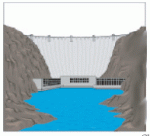 Two thirds of Canada’s electricity now comes from renewable energy, Financial Post Jesse Snyder | May 3, 2017 CALGARY — Canada substantially boosted its renewable electricity capacity over the past decade, and has now emerged as the second largest producer of hydroelectricty in the world, a new report said Wednesday.
A report by the National Energy Board said that Canada generated 66 per cent of its electricity from renewable sources in 2015. Hydroelectric power accounted for roughly 60 per cent of electricity supply, generating around 79,000 megawatts in 2015………
As large-scale hydropower projects face some resistance, wind and solar are set to step grown rapidly in recent years as their costs continue to fall.
Wind capacity in Canada increased 20-fold between 2005 and 2015, according to the NEB, and accounted for 7.7 per cent of total electricity capacity in 2015. Solar accounted for 1.5 per cent.
As Canada’s dependence on renewable sources like solar and wind grows — albeit gradually — governments are now grappling with how to build the high-voltage transmission lines that would be needed to offset intermittency……
Substituting intermittent power supplies with more stable ones is vastly more costly in Canada than in higher density countries like Denmark, which generates more than 50 per cent of its electricity from wind power.
In January, researchers at the University of Ottawa’s Institute of the Environment released a report that analyzed the long-term cost savings of building high-voltage connecting lines between several hydro rich and hydro poor regions—for example between Alberta and British Columbia.
“We found that you can achieve emission reductions at a lower cost if you build those transmission lines, and that’s including the cost of construction,” said Brett Dolter, one of the report’s authors.
Canada produced roughly 10 per cent of hydro capacity worldwide in 2015, second only to China at 29 per cent, the NEB data shows. Brazil and the U.S. produced nine per cent and 8 per cent, respectively.
Canada’s proportion of electricity generated by renewables is the sixth-highest in the world behind Denmark, Norway, Brazil, Austria and New Zealand. Only 12 countries generate more than half of their electricity from renewable supplies.
jsnyder@postmedia.com http://business.financialpost.com/news/two-thirds-of-canadas-electricity-now-comes-from-renewable-energy
May 5, 2017
Posted by Christina Macpherson |
Canada, renewable |
Leave a comment
 This is a test – nuclear threat focus of exercise in Ottawa and Nova Scotia http://ottawacitizen.com/news/national/defence-watch/this-is-a-test-nuclear-threat-focus-of-exercise-in-ottawa-and-nova-scotia DAVID PUGLIESE, OTTAWA CITIZEN, 25 Apr 17, Canada and the U.S. are in the midst of conducting an exercise that tests the ability of both countries to respond to a nuclear threat.
Over the last week, hundreds of public servants across the government of Canada, including military and emergency response officials, have been participating in a series of exercises under that common scenario.
Exercise STAUNCH MAPLE 17 is a command post exercise representing the Canadian Forces’ support to this scenario.
It started on April 20 and will run until April 28. The exercise, based in Ottawa and Nova Scotia, trains “consequence management capabilities with a focus on staff processes and leadership,” according to the Department of National Defence.
STAUNCH MAPLE 17 is part of a series of bi-national, government exercises aimed at enhancing interagency protocols and communication in case of a significant threat to Canada.
STAUNCH MAPLE 17 brings together hundreds of public servants from several departments and agencies, including:
| · Public Safety· Health Canada
· Transport Canada
· Government Operations Centre
· Royal Canadian Mounted Police
· Natural Resources Canada
· Public Health Agency of Canada
· Canadian Nuclear Safety Commission
· Industry Science and Economic Development Canada |
· Defence Research and Development Canada· Canadian Border Services Agency
· Nova Scotia Emergency Management Office
· Halifax Regional Municipality
· Halifax Harbour Bridges
· Halifax Port Authority
· Halifax Regional Police |
Some participants in the exercise are involved in a concurrent exercise, PROMINENT HUNT 17-01. That exercises U.S. assistance to the Canadian government to support the investigation of the simulated nuclear threat. Participants from the U.S. and Canada will collect simulated evidentiary samples of debris at various locations in Nova Scotia.
Royal Canadian Air Force CH-146 Griffon helicopters, an RCMP ASTAR-350 helicopter, and American UH-60 Black Hawk helicopters will be conducting low-level aerial survey flights for that scenario.
April 26, 2017
Posted by Christina Macpherson |
Canada, safety, USA |
Leave a comment
For the first time on record, human-caused climate change has rerouted an entire river, WP By Chris Mooney April 17 A team of scientists on Monday documented what they’re describing as the first case of large-scale river reorganization as a result of human-caused climate change.
They found that in mid-2016, the retreat of a very large glacier in Canada’s Yukon territory led to the rerouting of its vast stream of meltwater from one river system to another — cutting down flow to the Yukon’s largest lake, and channeling freshwater to the Pacific Ocean south of Alaska, rather than to the Bering Sea.
The researchers dubbed the reorganization an act of “rapid river piracy,” saying that such events had often occurred in the Earth’s geologic past, but never before, to their knowledge, as a sudden present-day event. They also called it “geologically instantaneous.”
“The river wasn’t what we had seen a few years ago. It was a faded version of its former self,” lead study author Daniel Shugar of the University of Washington at Tacoma said of the Slims River, which lost much of its flow because of the glacial change. “It was barely flowing at all. Literally, every day, we could see the water level dropping, we could see sandbars popping out in the river.”
The study was published in Nature Geoscience. Shugar conducted the study with researchers from six Canadian and U.S. universities.
The study found that the choking of the Slims River in turn deprived Kluane Lake, the largest body of water in the Yukon Territory. The lake level was at a record low in August, and two small communities that live on the lake may now have to adjust to the lower water levels…….https://www.washingtonpost.com/news/energy-environment/wp/2017/04/17/for-the-first-time-on-record-human-caused-climate-change-has-rerouted-an-entire-river/?utm_term=.8504cbe15d03
April 24, 2017
Posted by Christina Macpherson |
Canada, climate change |
Leave a comment
“As long as we’re focused on celebrity and economics, we’re not going to see the world in a way that 
allows us to live and thrive,” he said.
“Why don’t you at least give us an indicator of what we’re doing to the planet?” he asked. “We don’t do that. Our priorities are indicated by things like the Dow Jones average and all that crap.
 Suzuki wants journalists to forget the Dow Jones, report on climate every day, National Observer By Elizabeth McSheffrey April 13th 2017 David Suzuki cuts straight to the chase. The state of Canada’s climate action is “disgusting,” he says, and the federal government should be ashamed.
Canada should hang its head,” he told National Observer in an interview. “(Trudeau) has given no indication that he was serious about the promise made at Paris.”
It’s a typically frank assessment by the 81-year-old star environmentalist, scientist and broadcaster. In 2015, he famously called Justin Trudeau a “twerp” during a phone call about the Liberal climate change platform, after Trudeau reportedly indicated that his comments were “sanctimonious crap.”
As Trudeau’s Liberals today cling to widely-criticized Harper-era climate change targets and continue to approve new oilsands pipelines, Suzuki says countries like Sweden, Morocco and Costa Rica are blazing ahead in climate leadership. Even India and China, two of the world’s biggest emitters of heat-trapping carbon pollution, are leaders in wind and solar investment — statistics that put Canada to shame, he says.
“We’re using the earth as a garbage can and we’re going to pay a huge consequence of that,” Suzuki fired over the phone. “The very life support systems of earth are being sacrificed all in the name of economic development.”
The scientist’s comments are at odds with the Trudeau government’s mantra that the environment and economy “go together,” and that a balance can be struck between getting Canadian oil to tidewater and cutting down on heat-trapping carbon pollution…….
Suzuki credited the Trudeau government for putting climate action “back on the table” after a decade of denial from the Harper government and said in the first year, Trudeau’s progress was “amazing.” Today, the prime minister’s climate portfolio is still far from demonstrating “the real action that is needed now.”
And as glaciers melt into the ocean, sea levels continue to rise, and droughts strike in full force, Suzuki called on journalists to hold governments accountable for their commitments to the race against climate change.
Declaring war on climate change
According to Suzuki, Canada should react to climate change the way the world reacted when Japan attacked Pearl Harbor in 1941:
“When they attacked, nobody said, ‘Oh my god, we can’t afford to fight these guys, we better make peace with them in the Pacific.’ You knew that you were drawn into a battle and you had to throw everything you could at it, because the only possibility you could accept was victory.”
As it stands, no legislation or organization has the authority to impose sanctions on a government for failing to meet its climate obligations. Such a body would be “ideal,” he said, but given that none exist, journalists must put their elected officials’ feet to the fire. It’s a tall order, Suzuki acknowledged, in a world where infinite information is available online, and ‘fake news’ and ‘alternative facts’ run rampant.
The new world of online information means the public must not only learn to be critical of the information it consumes, he said, but also that the media must learn to present climate reporting in a way that it engages a modern audience. After all, it has to compete with reality TV socialites Kim Kardashian and Paris Hilton, he added, questioning “how the hell” such individuals capture our attention.
“As long as we’re focused on celebrity and economics, we’re not going to see the world in a way that allows us to live and thrive,” he said.
In Suzuki’s ideal world, instead of reporting daily on the stock market and the value of the loonie to four decimal points, Canadian media would report daily on how many acres of ancient forest are being torn down, how many tonnes of pesticides have been sprayed, and how much carbon has been dumped into the atmosphere.
“Why don’t you at least give us an indicator of what we’re doing to the planet?” he asked. “We don’t do that. Our priorities are indicated by things like the Dow Jones average and all that crap.
“I believe that the more better information people had, the better decisions they would make. That’s always been my drive in television — give people the best scientific information available so that they can make more informed decisions.”
Suzuki was recently in Ottawa to accept a lifetime leadership award in animal welfare at the Canadian Federation of Humane Societies’ National Animal Welfare Conference. http://www.nationalobserver.com/2017/04/13/news/suzuki-wants-journalists-forget-dow-jones-report-climate-every-day
April 17, 2017
Posted by Christina Macpherson |
Canada, media |
Leave a comment
OPG nuclear waste site remains on hold, pending more studies http://www.ecolog.com/issues/ISArticle.asp?aid=1003960830&PC=EN&issue=04132017&utm_content=bufferc4714&utm_medium=social&utm_source=twitter.com&utm_campaign=buffer by Mark Sabourin EcoLog, 4/13/2017
Progress remains stalled on Ontario Power Generation’s (OPG’s) planned underground storage facility for nuclear waste following review of its latest submission to the Canadian Environmental Assessment Agency (CEAA). The CEAA has told OPG that the additional information it supplied at the CEAA’s request is not good enough and has asked for more about alternatives to OPG’s preferred site 680 metres below the surface and 1.2 km from the shore of Lake Huron.
The report and recommendation of the Joint Review Panel on the project have been on the desk of the federal Minister of Environment and Climate Change since May 2015. Though the report found that, with certain mitigation measures, the project was not likely to cause significant adverse environmental effects, it remains widely unpopular on both sides of the Canada-US border. The minister has so far avoided making a decision by requesting studies on technically and economically feasible alternative sites and an updated analysis of cumulative environmental effects of OPG’s recommended site.
OPG submitted its new analysis in December 2016 but, following a technical review and public comment period, the CEAA has declared it inadequate. The CEAA says that OPG’s selection of alternative locations is based on limited criteria, and that differences among locations have not been clearly described. It also takes issue with OPG’s analysis of cumulative environmental effects and its proposed mitigation measures. It has raised 21 specific issues and asked OPG to report on each.
OPG is proposing a deep geologic repository for low- and intermediate-level nuclear waste in a geologically stable rock formation 680 metres below the site of its Bruce nuclear power plant. According to OPG, the bulk of the waste, which is currently stored aboveground, will decay within 300 years, though a portion will remain radioactive for another 100,000 years. It argues that entombment deep below ground in geologically stable rock is the safest long-term option.
However, opponents argue that a site near the shore of one of the Great Lakes, the source of water for more than 40 million people, is the wrong choice.
April 14, 2017
Posted by Christina Macpherson |
Canada, wastes |
Leave a comment
Canada’s absence betrays its history on nuclear talks, RAMESH THAKUR AND CESAR JARAMILLO, The Globe and Mail, Mar. 27, 2017 Ramesh Thakur is a professor at the Australian National University and co-convenor of the Asia-Pacific Leadership Network for Nuclear Non-Proliferation and Disarmament. Cesar Jaramillo is executive director of Project Ploughshares in Waterloo, Ont.
Negotiations begin Monday at the United Nations in New York on a “legally binding instrument to prohibit nuclear weapons, leading toward their total elimination.” These talks flow from resolutions adopted late last year by the General Assembly in landslide votes. These negotiations could be the most significant multilateral development on nuclear-arms control since the indefinite extension of the Non-Proliferation Treaty (NPT) in 1995 and the adoption of the Comprehensive Nuclear Test-Ban Treaty in 1996……
Canada’s proud record of leadership in nuclear-arms-control initiatives makes its submission to U.S. obstructionism especially egregious.
Nuclear peace depends on deterrence and fail-safe mechanisms working every single time. Nuclear Armageddon will result from deterrence or fail-safe mechanisms breaking down just once. Similarly, stable deterrence requires rational decision-makers in every nuclear-armed country all the time…….http://www.theglobeandmail.com/opinion/canadas-absence-betrays-its-history-on-nuclear-talks/article34427081/
March 31, 2017
Posted by Christina Macpherson |
Canada, politics international, weapons and war |
Leave a comment
 Nuclear shipment not safe http://www.niagarathisweek.com/opinion-story/7189835-nuclear-shipment-not-safe/ Niagara This Week – St. Catharines, Susan Prayn 14 Mar 17, The proposed transportation of liquid highly enriched uranium (HEU) from Chalk River to Savannah South Carolina is not safe.
A liquid highly enriched uranium mixture containing other fissionable products with high toxicity has never been transferred in the world before.
A recent report by Dr. Marvin Resnikoff, a recognized nuclear transportation and waste disposal expert for many U.S states and the U.S government concludes that the NAC-LWT could not withstand more severe realistic accident conditions. For this reason, the highly radioactive liquid from Chalk River should not be transported in the NAC-LWT cask.
The liquid should be solidified before transport, or not transported at all.
With the recent over 40-car collisions on the 401 and the diesel spill in B.C., as well as future accidents coming, why are we endangering the environment, the people, and the first responders? Is it the cost of solidifying this liquid?
The Iroquois Caucus has a media release condemning the transport and will not stand idly by.
In Indonesia, they are down blending their HEU. They have signed on to the International Repatriation Agreement. Why is Canada treated differently?
Call your local MP and ask what they are doing on this issue.
March 15, 2017
Posted by Christina Macpherson |
Canada, safety, USA |
Leave a comment
GE Hitachi Nuclear developing new SMR with US company, March 14, 2017 Collaboration targets aging power plants in a bid to stimulate the industry
SOICHI INAI, Nikkei staff writer NEW YORK — As part of its strategy to service aging nuclear plants, GE Hitachi Nuclear Energy (GEH) will develop a cutting-edge small modular reactor in cooperation with Advanced Reactor Concepts, the company said Monday………
GEH has been targeting older plants with its own SMR currently under development, and decided to bring on board Advanced Reactor Concepts — also known as Arc Nuclear — due to its expertise with sodium-cooled reactor technology, key to producing SMRs.
The two companies will initially work on a next-generation SMR in Canada.
SMRs manufactured by GEH and Advanced Reactor Concepts each have about 10% the power-generating capacity as Westinghouse’s AP1000 reactor.http://asia.nikkei.com/Business/Companies/GE-Hitachi-Nuclear-developing-new-SMR-with-US-company
March 15, 2017
Posted by Christina Macpherson |
Canada, technology |
Leave a comment
Massive Permafrost thaw in Northwest Canada. #ClimateChange #auspol, John Pratt 2 Mar 17 Huge slabs of Arctic permafrost in northwest Canada are slumping and disintegrating, sending large amounts of carbon-rich mud and silt into streams and rivers.
A new study that analyzed nearly a half-million square miles in northwest Canada found that this permafrost decay is affecting 52,000 square miles of that vast stretch of earth—an expanse the size of Alabama.
According to researchers with the Northwest Territories Geological Survey, the permafrost collapse is intensifying and causing landslides into rivers and lakes that can choke off life downstream, all the way to where the rivers discharge into the Pacific Ocean.
Similar large-scale landscape changes are evident across the Arctic including in Alaska, Siberia and Scandinavia, the researchers wrote in a paper published in the journal Geology in early February. The study didn’t address the issue of greenhouse gas releases from thawing permafrost.
But its findings will help quantify the immense global scale of the thawing, which will contribute to more accurate estimates of carbon emissions.
Permafrost is land that has been frozen stretching back to the last ice age, 10,000 years ago.
As the Arctic warms at twice the global rate, the long-frozen soils thaw and decompose, releasing the trapped greenhouse gases into the air.
Scientists estimate that the world’s permafrost holds twice as much carbon as the atmosphere. The new study was aimed at measuring the geographical scope of thawing permafrost in northwest Canada.
Using satellite images and other data, the team studied the edge of the former Laurentide Ice Sheet, a vast expanse of ice that covered two-thirds of North America during the last ice age.
The disintegration of the permafrost was visible in 40- to 60-mile wide swaths of terrain, showing that, “extensive landscapes remain poised for major climate-driven change.”
“Things have really taken off.
Climate warming is now making that happen. ……https://wordpress.com/read/feeds/17124327/posts/1358475019
March 3, 2017
Posted by Christina Macpherson |
Canada, climate change |
Leave a comment
Meanwhile, OPG continues to tell MPPs and other decision makers that nuclear power is our lowest cost option for keeping the lights on and that it is simply not possible to import low-cost power from Quebec. Both of these claims are false.
According to Hydro Quebec’s CEO, Eric Martel, Quebec has 3,000 megawatts of surplus power available for export. Furthermore, according to Mr. Martel, Hydro Quebec is more than willing to sign long-term fixed-price export contracts.
Hydro Quebec has power available to export for at least 99% of the hours in a year. It can further increase the power it has for export by improving energy efficiency in Quebec and continuing to develop its significant low-cost wind power potential.
Our public utility and the nuclear lobby should stop spreading “alternative facts.” We need an honest discussion based on transparent information about whether keeping the 46-year-old Pickering Station running and re-building the 30-year-old Darlington Station makes sense.
And instead of playing shell games designed to hide the rising cost of nuclear power, our government should be looking at grabbing some real cost savings – by making a deal with Quebec.
Please send an email to Premier Wynne premier@ontario.ca or call her at 416 325 1941. Tell her you want to see Ontario secure some real cost savings by making a long-term deal with Quebec to permit the closing of the Pickering Nuclear Station in 2018 when its licence expires.
You can also contact your MPP and tell them you want to see real savings. You can find your MPPs contact info here. If you don’t know your electoral district, click here.
March 1, 2017
Posted by Christina Macpherson |
business and costs, Canada, politics |
Leave a comment














 nuclear-news