
 Bloc Quebecois, environmentalists wary of proposed nuclear waste disposal plan, Mylene Crete, The Canadian Press , August 11, 2017 CHALK RIVER, Ont. — A proposed nuclear waste disposal site on land around Chalk River Laboratories is too close to the Ottawa River, says Bloc Quebecois Leader Martine Ouellet.
A significant percentage of Quebecers use the river for their drinking water and a leak could be catastrophic, Ouellet told reporters while touring the nuclear facilities in Chalk River, Ont., earlier this week.
“Radioactivity, just like heavy crude oil, doesn’t go away,” she said. “You can’t say, ‘we have contamination, we are going to clean it up.’ It can’t be cleaned.”……
Ottawa subcontracts the management of the site to Canadian Nuclear Laboratories (CNL), a consortium of four engineering and tech companies including SNC-Lavalin and Rolls-Royce.
CNL says it wants to consolidate all the nuclear waste around the site in one location, so it can be monitored, contained and isolated…….
Ouellet said CNL didn’t look for other disposal sites further away from the river.
“I have not been reassured because their so-called best site, it’s located on their territory of Chalk River and they didn’t look outside the area because of the costs involved,” she said. Kehler said CNL did look for other locations.
“We have considered the possibility of moving radioactive material elsewhere, but people wouldn’t be in favour of that,” Kehler said. “And the waste is already here.”
CNL’s plan is to create a facility that can hold up to 1,000 cubic metres of nuclear waste for up to 50 years.
Benoit Delage, an environmentalist in Quebec’s Outaouais region, said it’s a bad idea.
“The idea of building a nuclear waste depot one kilometre away from a river that feeds a large part of the Quebec population, there is something missing there,” he said. “Anyone can tell you it doesn’t make sense.”
The Canadian Nuclear Safety Commission needs to conduct an environmental review of CNL’s depot proposal.
Public consultations will also take place. Quebec’s environment minister has asked the federal government to hold the hearings in Quebec in order for them to be close to the people potentially impacted by the plan. http://www.ctvnews.ca/canada/bloc-quebecois-environmentalists-wary-of-proposed-nuclear-waste-disposal-plan-1.3542320
August 12, 2017
Posted by Christina Macpherson |
Canada, wastes, water |
Leave a comment
 Daily Observer 7th Aug 2017, On Sunday
 afternoon, a flotilla of more than 30 watercraft – from kayaks
to flat bottomed tour boats – carrying 150 people assembled offshore of
Chalk River Laboratories to deliver a message to Canadian Nuclear
Laboratories: a resounding no to the proposed near surface disposal
facility.
The facility is meant to dispose of up to one million cubic
metres of low level radioactive material at a site located about a
kilometre from the Ottawa River.
The flotilla, organized by the Old Fort William Cottagers’ Association, started up the Ottawa River from Fort
William and collected local residents, operating their own watercraft,
along the route before stopping at the mid-point of the river, across from
the CNL operated site. Once assembled, the protesters, many carrying
homemade signs, listened to some words of encouragement from the flotilla’s
organizers and a special guest, the leader of Quebec’s Green Party.
http://www.thedailyobserver.ca/2017/08/07/protest-takes-to-the-river
August 9, 2017
Posted by Christina Macpherson |
Canada, opposition to nuclear |
Leave a comment
 Wildfires in western Canada on near-record pace, More than 1 million acres burned so far https://summitcountyvoice.com/2017/08/02/wildfires-in-western-canada-on-near-record-pace/ Staff Report Canada is on track for a near-record wildfire season this year. So far, there have been more than 500 fires just in British Columbia, burning across more than 1 million acres. Firefighting costs have already reached more than $172 million, and weeks of warm and dry weather will keep the fire danger high.
Most of the fires have been in three main areas, according to NASA, which has been tracking the burned areas via satellites. Most affected are the Frasier Plateau north of Vancouver, the Thomas Plateau, east of Whistler, and the region east of Kamloops.
All current fires of note can be viewed on this interactive map. According to NASA, this is the third-worst fire season on record for B.C.
Current weather forecasts project that winds will carry smoke from the fires toward the coast, perhaps persisting for a week. New research led by scientists with Georgia Tech recently showed that wildfire smoke is probably much more dangerous to human health than previously realized.
Naturally burning timber and brush from wildfires release dangerous particles into the air at a rate three times as high as levels known by the EPA. The study also found wildfires spew methanol, benzene, ozone and other noxious chemicals.
NASA’s Terra satellite collected this natural-color image with the Moderate Resolution Imaging Spectroradiometer, MODIS, instrument on July 31, 2017. Actively burning areas, detected by MODIS’s thermal bands, are outlined in red. NASA image courtesy Jeff Schmaltz LANCE/EOSDIS MODIS Rapid Response Team, GSFC. Caption by Lynn Jenner with information from the BC Wildfire Service, and the Georgia Tech study.
August 4, 2017
Posted by Christina Macpherson |
Canada, climate change |
Leave a comment
Not surprisingly, with costs so high, few reactors are being built. The hope offered by the nuclear industry is that going back to building smaller reactors might allow more utilities to invest in them.
 The main priority preventing safe deployment [of small nuclear reactors] is economics. Most commercial proposals for SMRs involve cost-cutting measures, such as siting multiple reactors in close proximity. This increases the risk of accidents, or the impact of potential accidents on people nearby.
Cost overruns aside, smaller reactors might be cheaper but they also produce much less electricity and revenue. As a result, generating each unit of electricity will be more expensive.
Small nuclear power reactors: Future or folly? https://theconversation.com/small-nuclear-power-reactors-future-or-folly-81252, M V Ramana, July 25, 2017 Nuclear energy companies are proposing small nuclear reactors as a safer and cheaper source of electricity.
In June, Canadian Nuclear Laboratories put out a “call for a discussion around Small Modular Reactor (SMRs) in Canada,” and the role the organization “can play in bringing this technology to market.”
The news release asserts that SMRs are “a potential alternative to large-scale nuclear reactors,” would be effective at “decreasing up-front capital costs through simpler, less complex plants” and are “inherently safe” designs. All of this warrants examination.
As a physicist who has researched and written about various policy issues related to nuclear energy and different nuclear reactor designs for nearly two decades, I believe that one should be skeptical of these claims. Continue reading →
July 26, 2017
Posted by Christina Macpherson |
Canada, technology |
Leave a comment
Echoes of Fort McMurray — Massive Wildfire Forces the Emptying of Another Canadian City https://robertscribbler.com/2017/07/16/echoes-of-fort-mcmurray-massive-canadian-wildfire-forces-the-emptying-of-another-canadian-city/?utm_campaign=crowdfire&utm_content=crowdfire&utm_medium=social&utm_source=twitter#350509998-tw%231500228804052
A little more than a year after a massive wildfire forced the full evacuation of Fort McMurray in Alberta, another set of extreme wildfires in British Columbia is again forcing major population centers to empty. In the region of Williams Lake and Cariboo City, 17,400 people have been forced to flee as a wildfire is threatening the major highway exiting the area. As the fire expands, another 27,000 in the broader province may also be asked to leave. This mass evacuation has been enough to empty large urban centers — turning them into ghost towns as fires rage through the surrounding countryside.
On Saturday, 40 mph winds, hot temperatures in the 90s (F), and lightning strikes fanned flames in the region — considerably worsening the fire situation and spurring more comprehensive evacuation orders. Heavy rains earlier in the year caused rapid vegetation growth. But as much warmer than normal temperatures accompanied by dry, windy conditions entered the region in June and July, the new growth has turned into tinder — adding a serious fire hazard.
Scores of very large wildfires rage across British Columbia on July 15 — casting smoke plumes that now stretch across most of Canada. For reference, bottom edge of this image frame covers roughly 550 miles. Image source: NASA Worldview.)
Presently, 160 wildfires are now burning across British Columbia. This number is down from more than 200 fires earlier in the week. However, many of the larger fires have grown in size. The result is that the province is still under a very severe alert level 4 with a mass mobilization of firefighting resources underway. On July 15, the fires were clearly visible in NASA satellite imagery (see above).
Precipitation extremes and increasingly warm temperatures are a hallmark signal of human caused climate change resulting from continued fossil fuel burning. And it is these kinds of conditions that have dominated British Columbia over recent months. Both the strong swing from wet to dry conditions accompanied by much warmer than normal summer temperatures is climate change related
July 19, 2017
Posted by Christina Macpherson |
Canada, climate change |
Leave a comment
Saanich to hear request from anti-nuclear group, Victoria News , WOLF DEPNER Jul 16th, 2017 Council Monday will consider a request to re-affirm Saanich’s status as a zone free of nuclear weapons.
The request comes from the Vancouver Island Peace and Disarmament Network, which describes itself as an “open coalition of peace keepers representing diverse views and approaches to peace and disarmament with a focus on on Canada’s role domestically and internationally.”
The group recently participated in last month’s Ban the Bomb rally held out the provincial legislature.
Saanich’s status as a zone free of nuclear weapons dates back to the final years of the Cold War between the United States and the former Soviet Union when council passed a motion in 1983 that declared Saanich “a nuclear weapons free zone and that the production, testing, storage, transportation, processing disposal or use of nuclear weapons or their components not to be undertaken in Saanich.”
Saanich passed the request following a request from among others Project Ploughshares, a Canadian non-governmental organization formed in 1976…..https://www.vicnews.com/news/saanich-to-hear-request-from-anti-nuclear-group/
July 17, 2017
Posted by Christina Macpherson |
Canada, opposition to nuclear |
Leave a comment
Globe & Mail 27th June 2017, Former AECL scientists are condemning a plan to build a nuclear waste
facility at the Chalk River site on the Ottawa River, saying it would be
ill-equipped to handle the level of radioactive material planned for it.
The government-owned, private sector-operated Canadian Nuclear Laboratories
(CNL) is proposing to build a $325-million facility to dispose of a large
quantity of low- and intermediate-level waste generated from the demolition
of aging buildings and other contaminated material generated over the past
65 years.
But several former senior scientists who worked there say the CNL
proposal is seriously flawed and represents a threat to human health and
the environment.
https://www.theglobeandmail.com/news/politics/scientists-decry-plan-for-ontario-nuclear-waste-site/article35482638/
July 7, 2017
Posted by Christina Macpherson |
Canada, wastes |
Leave a comment
Opponents fight nuclear subsidy in court http://blog.timesunion.com/capitol/archives/275743/opponents-fight-nuclear-subsidy-in-court/Note: This story by Rick Karlin originally appeared in Tuesday’s edition of the Times Union. 20 June 17
Representatives of the state Public Service Commission were in court Monday defending their decision last August to award a multibillion dollar, 12-year subsidy to a group of upstate nuclear power plants along Lake Ontario. Opponents say it is a corporate giveaway, but state officials contend it will cut down on greenhouse gases.
The commission has “broad authority” to regulate power production in the state, said PSC lawyer John Graham, who was moving to dismiss a lawsuit filed by a coalition of activists who oppose the deal.
“This isn’t a small change. It’s a dramatic change,” said John Parker, a lawyer representing the Hudson River Sloop Clearwater ,which has opposed the deal with the New York Public Interest Research Group and other groups.
The arguments unfolded before acting Supreme Court Justice Roger McDonough in Albany. The plaintiffs maintain the PSC overstepped last August when it approved the subsidies for the Ginna, FitzPatrick and Nine Mile Point plants in Wayne and Oswego counties.
While the PSC views the subsidies as a way to control carbon emissions as the state moves toward more renewable energy sources, critics believe the Cuomo administration, which supported the plan, was intent on avoiding the job losses that would have come with plant closures in the hard-pressed region where the plants operate.
“You really have the executive branch extending its authority to this agency,” said David Barrett, a lawyer with the Coalition for Competitive Electricity. To read the full version of this story, click here.
June 21, 2017
Posted by Christina Macpherson |
Canada, Legal |
Leave a comment
Point Lepreau nuclear power plant gets 5-year licence renewal, Commission says it’s satisfied plant will protect environment, safety and security By Viola Pruss, CBC News Jun 16, 2017 Point Lepreau’s nuclear power reactor is good to go for another five years.
The Canadian Nuclear Safety Commission announced its decision this week to renew the NB Power nuclear generating station’s operating licence until June 30, 2022.
The current licence runs out on June 30 of this year.
In a summary report, the commission said it found NB Power, “in carrying on that activity, will make adequate provision for the protection of the environment, the health and safety of person and the maintenance of national security,” as well as follow international obligations.
Lack of transparency
The commission said it considered a number of issues and submissions related to NB Power’s qualifications to receive an extended licence, including an environmental assessment and emergency plans in the event of a nuclear emergency.
An environmental assessment found that “adequate measures are in place to protect the environment and human health.”
However, the commission noted a lack of transparency and public availability of emergency planning documents, and directed the utility to disclose them……..
Indigenous land
In making its decision, the commission also considered information presented at two public hearings in January and May, including submissions from members of several Indigenous groups.They told the commission the plant was built on traditional and ancestral territories, and the facility “adversely affected their Aboriginal and treaty rights.”
While the commission recognized that Indigenous groups were not consulted when the plant was built, it “acknowledges the current efforts and commitments made by NB Power in relation to Aboriginal engagement,” the report said…….
Disaster-proof
A good portion of the first public hearing in January 2017 also focused on Point Lepreau’s ability to withstand a significant earthquake and other potential risks, including dam failures, shipping disasters, plane wrecks and meteor strikes……http://www.cbc.ca/news/canada/new-brunswick/point-lepreau-nuclear-power-licence-renewal-commission-safety-nb-1.4164700
June 19, 2017
Posted by Christina Macpherson |
Canada, politics |
Leave a comment
 CANNINGS: We must work tirelessly for a nuclear weapons free world http://infotel.ca/opinion/letters-to-the-editor/cannings-we-must-work-tirelessly-for-a-nuclear-weapons-free-world/it43381 By Richard Cannings, MP South Okanagan-West Kootenay 13 June 17 Last week I listened to Setsuko Thurlow, a Hiroshima survivor, speak eloquently of what it was like to have her family, her neighbourhood, her city, vaporized in an instant of mass destruction. I wish everyone in this country could have heard her moving words. Setsuko has devoted her life to advocating for nuclear disarmament, to ensure that her experience will never be repeated.
Some would say it was that threat of mutually assured destruction through nuclear warfare that kept worldwide conflict at bay through the Cold War. Even now, 25 years after the end of the Cold War, there are more than 15,000 nuclear warheads in the world. The risk to the planet was, and remains, incalculable.
Canadians have long recognized the threat of nuclear proliferation and long called for nuclear disarmament. In 2010, the House of Commons unanimously passed a motion that called on the government to deploy a major diplomatic initiative to increase the rate of nuclear disarmament.
The Liberal Party of Canada, only last year, adopted a resolution at their Winnipeg policy convention that urged the government—their Liberal government—to convene an international conference to commence negotiations for a Nuclear Weapons Convention that would ban nuclear weapons.
And yet the government’s actions in the past year go completely against that resolution.
The international community—over 130 countries are involved—is currently carrying out negotiations on the Convention on the Prohibition of Nuclear Weapons, just as the Liberal Party resolution requested. The problem is, not only is Canada not leading this process, it is boycotting it completely. Canada is not back on the international scene, it is backing away from its traditional leadership role in promoting a more peaceful world.
And Canada is backing away under pressure from the United States. Justin Trudeau said in the House of Commons last week that joining the negotiations would be “useless” as the nuclear powers are not present. Yet Canada led the world in the banning of land mines through a process in which the land mine powers, including the United States, did not, initially, participate.
These UN negotiations for nuclear disarmament are still going on. Canada could join and take a real and meaningful role in this essential project. But as I write this, the government is voting against an NDP motion to join these talks.
Opponents to a nuclear ban treaty say that disarmament must happen step-by-step, and that the time is not right for these negotiations, the world is not secure enough.
We have reached the edge of this cliff step by step over the last 60 years. The world will never be fully secure. We cannot wait for better conditions. We cannot afford to wait at all.
Yes, the nuclear powers will always oppose nuclear disarmament. But we must not bow to their wishes. We need to radically change the worldview of the nuclear powers. It will not be easy. It will not happen overnight. But we must be bold; we must live up to our convictions and our moral duty, and work tirelessly for a nuclear weapons free world.— Richard Cannings is the Member of Parliament for South Okanagan-West Kootenay.
June 14, 2017
Posted by Christina Macpherson |
Canada, politics international, weapons and war |
Leave a comment
 it is highly unlikely that its financial performance will improve drastically, making it an unappealing investment.
Don’t Try to Catch This Falling Knife https://www.fool.ca/2017/06/01/dont-try-to-catch-this-falling-knife/ Matt Smith | June 1, 2017 The world?s second-largest uranium producer Cameco Corp. (TSX:CCO)(NYSE:CCJ) continues to suffer, posting a first-quarter 2017 net loss which dragged its stock lower; it’s almost 13% down for the year to date. This has attracted the usual bargain hunters who believe that Cameco is now an appealing, undervalued investment but this couldn?t be further from the truth.
Now what?
Cameco?s woes can be directly attributed to the prolonged slump in uranium which has lasted for longer than a decade; prices fell to a 13-year low late last year. The embattled uranium miner posted a first-quarter adjusted net loss of $29 million. According to some analysts, wind power is now cheaper than nuclear power, while solar and geothermal electricity generation can have lower costs. These forms of power generation don’t produce highly toxic waste or the potential to create catastrophic environmental damage in the event of failure.
For these reasons, it is difficult to see a huge upswing in demand for uranium over coming years, especially with renewables technology advancing at a rapid rate. This means that Cameco may find itself in the position where it is producing a product that is suffering from a terminal decline in demand. Worse yet, uranium prices remain under pressure because of high global inventories and a growing supply which is expected to expand by over 40% to reach 80,383 tonnes by 2020.
Now what?
Cameco’s woes can be directly attributed to the prolonged slump in uranium which has lasted for longer than a decade; prices fell to a 13-year low late last year. The embattled uranium miner posted a first-quarter adjusted net loss of $29 million, which was 3.5 times greater than the net loss reported for the same quarter in 2016 and that predicted by analysts.
A key reason for the massive net loss was the decision by Tokyo Electric Power Company, the operator of Japan’s disabled Fukushima nuclear plant, to terminate its contract with Cameco for the supply of 9.3 million pounds of uranium through to 2028. The contract was worth $1.3 billion in revenue.
Nonetheless, Cameco has pitched its hopes on a surge in demand for uranium as the 57 reactors currently under construction across the globe come online. While there won’t be an immediate ramp-up in demand, according to industry consultants, it will lead to cumulative uncovered requirements for uranium to total around 800 million pounds of the fissile material over the next nine years.
This may be a positive for company that has been battling significant headwinds for some time, but it does not necessarily guarantee a return to profitability.
You see, nuclear power has been falling into disfavour for some time, and this only gained momentum in the wake of the Fukushima disaster in 2011. While nuclear plants do not emit pollutants, there are the serious issues associated with the leakage of radiation and the disposal of fissile waste.
Radiation can have a catastrophic impact on the environment, animals, and humans. High-level nuclear waste such as a spent fuel assembly, according to the United States Nuclear Regulatory Commission, produces 20 times the fatal dose of radiation for humans for 10 years after being removed from a reactor.
This makes the correct handling and storage of this waste essential, costly, and highly onerous.
The Fukushima disaster highlighted just how vulnerable nuclear plants can be to environmental catastrophes, although, fortunately, there was no leakage of fissile material or polluted water in that case.
However, these aren’t the only reasons for the growing unpopularity of nuclear power.
The cost of safer forms of renewable energy continues to fall.
According to some analysts, wind power is now cheaper than nuclear power, while solar and geothermal electricity generation can have lower costs. These forms of power generation don’t produce highly toxic waste or the potential to create catastrophic environmental damage in the event of failure.
For these reasons, it is difficult to see a huge upswing in demand for uranium over coming years, especially with renewables technology advancing at a rapid rate. This means that Cameco may find itself in the position where it is producing a product that is suffering from a terminal decline in demand. Worse yet, uranium prices remain under pressure because of high global inventories and a growing supply which is expected to expand by over 40% to reach 80,383 tonnes by 2020.
So what?
The loss of the Tokyo Electric Power Company contract is a major blow for Cameco, costing it around $1.3 billion in revenue in what is already a difficult operating environment. When considered with the growing unpopularity of nuclear power, the inexorable advance of renewable energy, and growing uranium supplies, it is difficult to see any significant bounce in the price of uranium occurring.
This makes difficult to see Cameco ever returning the halcyon days when uranium traded at US$67 per pound, meaning that it is highly unlikely that its financial performance will improve drastically, making it an unappealing investment.
June 5, 2017
Posted by Christina Macpherson |
business and costs, Canada, Reference |
Leave a comment
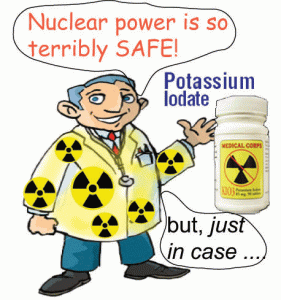 Amherstburg residents will be given iodide pills to protect against potential nuclear emergency
Potassium iodide pills are salt tablets that prevent the body from absorbing potentially radioactive poisoning CBC News Jun 02, 2017 To reduce the risk of radiation poisoning during an “unlikely” nuclear disaster in Michigan, health officials are distributing protective pills to residents on Amherst Point and Boblo Island.
The two communities fall within the primary zone of Fermi 2 nuclear power plant located near the shores of Lake Erie, just south of Amherst and Boblo. New regulations from the Canadian Nuclear Safety Commission require the distribution of potassium iodide pills, which are salt tablets that prevent the body from absorbing potentially radioactive iodine.
Even though the regulations don’t apply to U.S. facilities, officials from the Windsor-Essex County Health Unit are distributing the pills anyway.
“We still want our community to be prepared,” said Jyllian Mackie, the health unit’s public health emergency preparedness coordinator.
Primary zone precaution
Primary zone residents are those living within a 16.1 km radius. The rest of Windsor and Essex County sit in the secondary zone, which means the pills are available to residents for purchase.
A package of pills, good for about two days, for a family of five costs $20, according to Mackie.
Because human bodies absorb radioactive iodine, the pills are used to get into the thyroid and block the poisonous iodine.
Mackie added the risk of a nuclear emergency at Fermi 2 has not changed, but the regulations have, but that didn’t do much to calm the concerns of Amherstburg residents…… http://www.cbc.ca/news/canada/windsor/amherstburg-residents-will-be-given-iodide-pills-to-protect-against-potential-nuclear-emergency-1.4142478
June 3, 2017
Posted by Christina Macpherson |
Canada, safety |
Leave a comment
http://www.wxyz.com/news/canadian-company-still-wants-to-bury-nuclear-waste-near-lake-huron
May 30, 2017 Canadian company is standing by its proposal to store waste from nuclear power plants underground less than a mile from Lake Huron.
Ontario Power Generation has submitted a 145-page document with answers to questions raised by the Canadian Environmental Assessment Agency.
Most of them involved whether there’s a better place to put the low- and intermediate-level radioactive waste. The company wants to bury it 2,230 feet deep at the Bruce Power complex near Kincardine, Ontario.
More than 200 communities object to putting it so close to Lake Huron, fearing water pollution.
The company says the waste would be encased in rock and would pose no threat to the lake. It says other sites would delay the project 15 years or more without improving safety.
Canada’s environment minister is expected to decide this year whether to approve the plan.
May 31, 2017
Posted by Christina Macpherson |
Canada, wastes |
Leave a comment
Amherstburg Wants Nuclear Response Plan Update, Blackburn News, BY MARK BROWNMAY 25, 2017 The town of Amherstburg is hoping to get provincial cooperation as it updates its nuclear response plan. The town has delegated the responsibility of updating the plan to deputy fire chief Lee Tome, who has been lobbying the province to put some cash behind a plan update, as well as draft guidelines similar to those already in place at the Bruce Nuclear Generating Station in Tiverton. These guidelines would be set in the event of a nuclear incident at the nearby Fermi II nuclear power plant in Michigan.
Amherstburg Mayor Aldo DiCarlo says the town has pretty much been on its own as far as coming up with an emergency response plan.
“We obviously do not have that kind of control, as it’s in the United States,” says DiCarlo. “So when you read the provincial guidelines, they’re very specific to the nuclear plant in the province, and we don’t have that.”
The current plan places responsibility for a response to a nuclear accident at Fermi on the shoulders of the town. The updated plan would reduce the primary emergency zone from the current 23km to the standard 16km that is the U.S. standard, as well as provide for distribution of the K-I pill, a potassium iodide tablet taken to reduce or prevent the effects of radioactivity. A report on the updated plan was presented to Amherstburg town council on Tuesday night.
DiCarlo, though, has a hard time understanding why the province has not recognized the unusual situation Amherstburg is in.
“As I understand it, we are the only one in Canada with exposure from another country, so we are very unique,” says DiCarlo. ….. http://blackburnnews.com/windsor/windsor-news/2017/05/25/amherstburg-wants-nuclear-response-plan-update/
May 26, 2017
Posted by Christina Macpherson |
Canada, safety |
Leave a comment
 Ontario’s proposed plan for nuclear plant emergencies ripped, THE CANADIAN PRESS, MAY 18, 2017 TORONTO – Ontario’s proposed plan for how to respond in the unlikely event of a nuclear emergency falls short, environmental groups say. The province recently released an update to its emergency planning for potential large-scale accidents at the Pickering, Darlington, Bruce Power, Chalk River and FERMI 2 nuclear sites. It deals with co-ordinating responses and public communication, zones and evacuation procedures, preventing food and water contamination, and limiting exposure to radiation.
The environmental groups, including Greenpeace and the Canadian Environmental Law Association, say the proposal isn’t based on a large enough incident, and needs to plan for an accident on the scale of the 2011 nuclear disaster in Fukushima, Japan.
“Given we’re seeing nuclear accidents at the international level about once a decade, we need to prepare for such events,” said Shawn-Patrick Stensil with Greenpeace.
“These proposals do a disservice to Ontarians. They make no proposals to tangibly strengthen public safety and ignore key lessons from Fukushima. It’s unacceptable.”
Community Safety Minister Marie-France Lalonde said the plan “definitely” covers a Fukushima-scale accident………
Environmental advocates have for years been urging a wider distribution of those potassium iodide, or KI, pills. Radioactive iodine is released in the event of a nuclear accident, and the potassium iodide pills can help protect against thyroid cancer.
The pills are currently distributed to households and businesses within a 10-kilometre radius of the nuclear sites, but the environmentalists want that to be 50 kilometres. People outside the 10-kilometre radius can currently request the pills.
The groups also say the government has no comprehensive plan to address potential contamination of the Great Lakes, which are a source of drinking water for millions……..
The plan is posted for public comment until July 14 on the province’s regulatory and environmental registries. Lalonde said experts will be reviewing all the comments to decide what changes need to be made. http://www.torontosun.com/2017/05/18/ontarios-proposed-plan-for-nuclear-plant-emergencies-ripped
May 19, 2017
Posted by Christina Macpherson |
Canada, safety |
Leave a comment










 nuclear-news