Small Modular Nuclear Reactors – many pitfalls, including security risks
 ‘Many issues’ with modular nuclear reactors says environmental lawyer, https://www.cbc.ca/news/canada/new-brunswick/many-issues-modular-nuclear-1.5381804
Three premiers have agreed to work together to develop the technology, Jordan Gill · CBC News Dec 03, 2019 Modular nuclear reactors may not be a cure for the nation’s carbon woes, an environmental lawyer said in reaction to an idea floated by three premiers.
Theresa McClenaghan, executive director of the Canadian Environmental Law Association, said the technology surrounding small reactors has numerous pitfalls, especially when compared with other renewable energy technology.
This comes after New Brunswick Premier Blaine Higgs, Saskatchewan Premier Scott Moe and Ontario Premier Doug Ford agreed to work together to develop the technology.
The premiers say the smaller reactors would help Canada reach its carbon reduction targets but McClenaghan, legal counsel for the environmental group, disagrees.
“I don’t think it is the answer,” said McClenaghan. “I don’t think it’s a viable solution to climate change.”
McClenaghan said the technology behind modular reactors is still in the development stage and needs years of work before it can be used on a wide scale.
“There are many issues still with the technology,” said McClenaghan. “And for climate change, the risks are so pervasive and the time scale is so short that we need to deploy the solutions we already know about like renewables and conservation.”
Waste, security concerns: lawyer
While nuclear power is considered a low-carbon method of producing electricity, McClenaghan said the waste that it creates brings its own environmental concerns.
“You’re still creating radioactive waste,” said McClenaghan.
“We don’t even have a solution to nuclear fuel waste yet in Canada and the existing plans are not taking into account these possibilities.”
McClenanghan believes there are national security risks with the plan as well. She said having more reactors, especially if they’re in rural areas, means there’s a greater chance that waste or fuel from the reactors could be stolen for nefarious purposes.
“You’d be scattering radioactive materials, potentially attractive to diversion, much further across the country,” said the environmental lawyer.
Premiers of Ontario, Saskatchewan, New Brunswick to plan development of Small Modular Nuclear Reactors
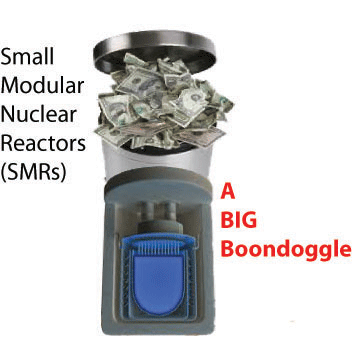
 Ontario, Saskatchewan, N.B. premiers to announce nuclear reactor deal, Global News BY STAFF THE CANADIAN PRESS November 30, 2019 “….. The Ontario government said Premier Doug Ford will meet with Saskatchewan Premier Scott Moe and New Brunswick Premier Blaine Higgs for an announcement at a hotel near Pearson International Airport on Sunday afternoon.
A spokesman with Moe’s office confirmed the announcement is connected to an agreement on technology for small modular reactors, while a spokeswoman for Ford’s office said it’s an agreement to work together to determine the best technologies for the deployment of small modular reactors in Canada……
Moe has said that Saskatchewan will address climate change over the next decade by looking to carbon capture and storage technology and by increasing research efforts around small modular nuclear reactors.
However, the possibility of bringing nuclear power to Saskatchewan could still be years away https://globalnews.ca/news/6239231/premiers-nuclear-reactor-deal/
Toxic flushing of nuclear poisons into Lake Winnepeg
Pinawa’s toxic predicament hurts Lake Winnipeg https://www.winnipegfreepress.com/opinion/analysis/pinawas-toxic-predicament-hurts-lake- winnipeg-564698971.html By: Dave Taylor 11/9/2019 winnipeg-564698971.html By: Dave Taylor 11/9/2019 How on Earth did humans ever think nature would absorb the nasty poisons we generate?
By now, we should realize that to bury or flush these toxins will not make them simply disappear. Many are insidious and will be back to bite us in the future. Putting a stop to these practices is paramount considering efforts to ameliorate past mistakes is such an onerous proposition, one that is even more demanding when the original polluter and their profits have disappeared.
We persist in flushing sewage into Lake Winnipeg and resist efforts to reduce phosphorus loads all in the name of financial savings. Ironically, there are no savings to be had, just a deferred payment plan. People will pay, it’s just a matter of when. The nuclear facility near Pinawa was built in the 1960s upon this very strategy of flushing wastes into the Winnipeg River and ultimately Lake Winnipeg, and continues to this day. The justification at that time was that they could dilute the radioactivity to levels that met their vague “as low as reasonably achievable” policy. Efforts continue to clean up the mess left behind in trenches, standpipes and bunkers, many of which are in disrepair and lead to the river. The subcontracting consortium that is attempting to deal with defunct sites across the country is Canadian Nuclear Labs (CNL). It is funded by the federal government and is led by SNC-Lavalin, whose lobbying efforts of the federal government are renowned and include bribery and fraud charges, as well as illegal election financing. The off-loading of the site and its problems have significantly altered the original decommissioning plans of 2001 and expedient shortcuts are being slipped by Canada’s nuclear regulator, the Canadian Nuclear Safety Commission, which we are obliged to trust to provide scrutiny of the cleanup and the ever-changing plans. CNL has applied for a 10-year licence and is being paid a king’s ransom ($1 billion annually) to restore the lands messed up by Atomic Energy of Canada at sites across the country. Placing our trust in CNL or the regulatory watchdog, commission, has never been more difficult. Not only are they administered by the same natural resources minister who advocates the expansion of nuclear power in Canada, but they have received a chastising by the International Atomic Energy Agency (IAEA) for what can only be described as a substandard approach to radioactive-waste disposal. The IAEA conducted a review mission in September and concluded the commission should enhance its policies and “should consider better aligning its radiation-protection requirements with IAEA safety standards.” In other words, shape up. At the very least, the federal watchdog should be placed under the environment portfolio so there is no perception of conflict of interest. The challenges for Pinawa are substantial as radioactive waste has been disposed of in decaying installations, some of which have required significant patching for cracks and, in a recent report made available to the public, they have discovered evidence of plutonium in the sewage lagoon not intended to receive radioactive materials. There are also the remains of Whiteshell Reactor No. 1 this consortium plans to seal up with concrete in hopes that the inevitable leaks will be absorbed by the river. Indigenous elders, including Dave Courchene, have taken a collaborative approach to dealing with this toxic predicament, which is upstream from them and entirely related to the concept of “flushing” wastes into a sacred river. Representatives of the Sagkeeng, Hollow Water and Peguis communities held a ceremony at Pinawa in September in hopes of changing the paradigm and promoting a much better solution. Since there is no solution to the problem of nuclear waste, they advocate isolating, containing, repackaging and consistent monitoring of these poisons over hundreds of years, a proposal that CNL is not likely to embrace as it will cut into their profits. Sagkeeng Chief Derrick Henderson stated: “We must be very careful with what we do to our land; we will be here forever and we all have that responsibility and duty.” Until the federal government assumes this duty of stewardship toward the Winnipeg River, “flushing” of radioactive waste will continue. The elders are sending SNC-Lavalin and friends a clear message. If they aren’t willing to adhere to traditional wisdom, keep them on a short leash with a year-to-year licence. Dave Taylor teaches at the University of Winnipeg.
|
|

Canada’s Conservative and Liberal politicians in the service of the nuclear lobby, not the Canadian people
 Conservatives and Liberals advance corporate Canada’s nuclear dreams, http://www.rabble.ca/columnists/2019/09/conservatives-and-liberals-advance-corporate-canadas-nuclear-dreams Ole Hendrickson September 18, 2019
The Trudeau government’s controversial Impact Assessment Act (Bill C-69) and its key regulation (the Physical Activities Regulations, better known as the “project list”) came into force on August 28 — slipped through during the summer season.
In 2012 the Harper government slashed the number of projects requiring environmental assessment, arguing that only the biggest projects have an impact on the environment.
Under the Impact Assessment Act, many nuclear projects can now proceed unimpeded by impact review requirements to assess effects on the environment, health, social or economic conditions; effects of malfunctions or accidents; or impacts on the rights of Indigenous peoples.
The Harper government’s 2012 project list did require assessment of new uranium mines or mills. The new list requires assessment only if a uranium mine or mill has a capacity over 2,500 tonnes per day.
The 2012 list required assessment of new nuclear reactors. The new list allows reactors generating up to 200 million watts of heat to be built anywhere without assessment.
Furthermore, the new list allows nuclear waste storage facilities to be built on the sites of any of these so-called “small modular reactors” without assessment.
This paves the way for a Canadian landscape dotted with mass-produced nuclear reactors — the vision of a “roadmap” released by Natural Resources Minister Amarjeet Sohi in November 2018.
Canada’s nuclear industry giants — Cameco and SNC-Lavalin — were deeply involved in these developments. The nuclear industry has long been the darling of the federal government.
Cameco operates the world’s largest uranium mine in northern Saskatchewan, the world’s largest commercial uranium refinery in Blind River, Ontario, and the Port Hope, Ontario uranium conversion facility. But it has been losing global market share to facilities in Kazakhstan.
Competition is fierce. Uranium markets dried up after the Fukushima disaster. Rapid growth of renewables has virtually halted reactor construction.
Under a secret 10-year, multi-billion-dollar contract put in place during the fall 2015 election period, the Harper government gave SNC-Lavalin, in alliance with two U.S. companies, ownership of “Canadian Nuclear Laboratories” (then a subsidiary of the Crown corporation, Atomic Energy of Canada Limited).
The contract allows the alliance to carry out commercial activities — including small nuclear reactor development — at the federal government’s heavily subsidized research facility in Chalk River, Ontario.
According to the federal lobbyist registry, Neil Bruce, former president of SNC-Lavalin, met with Michael Binder, former president of the Canadian Nuclear Safety Commission (CNSC), to discuss “environment, climate, energy, infrastructure” on July 12, 2018.
The following week, on July 19, Tim Gitzel, president and CEO of Cameco, met with Christine Loth-Brown, a vice-president in the Canadian Environmental Assessment Agency (CEAA), and with Jason Cameron, a CNSC vice-president. On July 26, Gitzel again met with these same two people, plus another CEAA vice-president. For that meeting he was accompanied by Pierre Gratton, president of the Canadian Mining Association.
On November 11, 2018, Gratton met with the following people, at the same time: Rumina Velshi, president, CNSC; Ron Hallman, president, CEAA; Christyne Tremblay, deputy minister, Natural Resources Canada; and Stephen Lucas, deputy minister, Environment and Climate Change Canada.
Canada’s senior bureaucrats gutted environmental assessment after this series of meetings.
The SNC-Lavalin affair has ripped the veil off the domination of Canada by a corporate oligarchy. Government departments, regulatory bodies such as the CNSC and CEAA (now the “Impact Assessment Agency”), and elected officials behave like corporate lapdogs.
The Conservatives handed the federal government’s nuclear research facilities over to SNC-Lavalin and its partners, along with a juicy multi-year, multi-billion-dollar contract. The Liberals pulled out all the stops so SNC-Lavalin could continue to hold federal contracts, despite fraud and corruption charges.
Natural Resources Minister Amarjeet Sohi released a road map promoting new nuclear reactors.
Environment Minister Catherine McKenna exempted these reactors and their wastes from impact assessment.
The 2015 Liberal election promise to restore public trust in environmental assessment has been broken.
Ole Hendrickson is a retired forest ecologist and a founding member of the Ottawa River Institute, a non-profit charitable organization based in the Ottawa Valley.
Canada didn’t sign the nuclear ban treaty, but can still take up its humanitarian provisions
|
Canada played a critical role in nuclear development. We should play a critical role in reparations,
Canada didn’t sign the nuclear ban treaty. But we can still take up its humanitarian provisions · for CBC News Aug 30, 2019 Canada holds contradictory positions in the world of nuclear weapons. We played an essential role in their development, but we never built any bombs of our own. Comprehensive Nuclear-Test-Ban Treaty
We are also already a party to every other major nuclear non-proliferation treaty, including the Comprehensive Nuclear-Test-Ban Treaty, which bans all nuclear weapons testing. This was easy for us to join in 1998; we had no nuclear weapons to test. However, engaging with the Treaty on the Prohibition of Nuclear Weapons would give Canada an opportunity to go beyond our existing, relatively painless, obligations. And we would also be the first nuclear umbrella state to do so, thus setting a meaningful and lasting precedent. Perhaps most importantly, Canada has a moral obligation to provide aid to victims and environments affected by nuclear testing. We don’t like to talk about it much, but Canada played a critical role in the development of these horrific weapons: scientists at the Montréal Laboratory were an essential part of the Manhattan Project, and the first atomic bombs were made with uranium shipped from the Northwest Territories. These are unfortunate truths that Canadians have yet to truly reckon with, but committing to a platform of nuclear reparations would be a good start. https://www.cbc.ca/news/opinion/canada-nuclear- |
|
|
U.S. and Canadian govts funding promotion of Small Nuclear Reactors: nuclear lobby infiltrates education
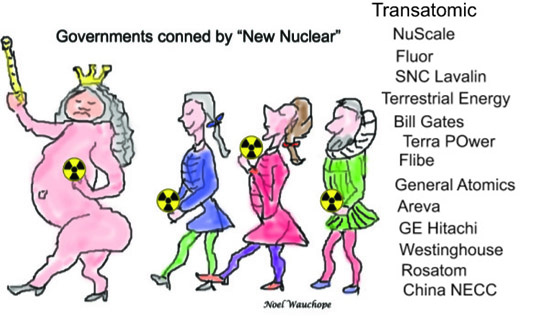
 We are very grateful to our university partners for their collaboration and eagerness to participate in this project, and to the Department of Energy for its continued support of NuScale’s groundbreaking work in the advanced nuclear industry,” NuScale Chairman and CEO John Hopkins said. “These simulator facilities will create new research opportunities and help ensure that we educate future generations about the important role nuclear power and SMR technology will play in attaining a safe, clean and secure energy future for our country.”
The simulator facilities will also be used for educational outreach to school-age students and public advocacy regarding nuclear power and SMR technology. The three grants are awarded through the DOE Nuclear Energy University Program and are worth a total of nearly USD844,000.
Wildfire cloud study sheds light on the processes of ‘nuclear winter’
To better grasp nuclear winter, scientists study wildfire cloud, https://www.nationalgeographic.com/environment/2019/08/cloud-wildfires-how-nuclear-winter-works/
A giant cloud from 2017 Canadian fires lingered in the atmosphere for a year, showing scientists how a cloud from a nuclear bomb would behave. BY
The nuclear accidents we don’t hear about – Chalk River Ontario
5 Unknown Nuclear Disasters: Chernobyl Is Far from the Only One, Chernobyl is not the world’s only nuclear disaster, there are plenty of others to keep you up at night., Interesting Engineering, By Marcia Wendorf, 2 Aug 19
Chalk River Ontario, Canada Incident
On December 12, 1952, there was a power excursion and partial loss of coolant in the NRX reactor at the Chalk River nuclear laboratories. Because of mechanical problems, the control rods couldn’t be lowered into the core, and the fuel rods overheated, resulting in a meltdown of the core.
Just like at Chernobyl, hydrogen gas caused an explosion that blew off the multi-ton reactor vessel seal. Also like at Chernobyl, 4,500 tons of radioactive water was found in the basement of the Chalk River reactor building. During the accident, 10,000 curies or 370 TBq of radioactive material was released into the atmosphere.
Future U.S. president Jimmy Carter, then a U.S. Navy officer, led a team of 13 U.S. Navy volunteers who helped in the cleanup of this disaster.
On the International Nuclear Event Scale, Chalk River is a 5, along with Goiânia, Three Mile Island, and Windscale. https://interestingengineering.com/5-unknown-nuclear-disasters-chernobyl-is-far-from-the-only-one
Nuclear company SNC-Lavalin in a bit more of a mess?
Small Modular Nuclear Reactors – at least 10 years away – Canadian Nuclear Association
|
Mini-nuclear power plants at least 10 years out: Canadian Nuclear Association, The Post Millennial Jason Unrau, 21July 19,
|
|
|
CANADA: A generation of children were given radiation treatment without warning of cancer risks
CANADA: A generation of children were given radiation treatment without warning of cancer risks https://www.thoroldnews.com/local-news/canada-a-generation-of-children-were-given-radiation-treatment-without-warning-of-cancer-risks-1581753m 14 July 19
This article, written by Itai Bavli, University of British Columbia, originally appeared on The Conversation .
On February 9, 2001, the Vancouver Sun published an article about Nancy Riva who lost her two brothers and was diagnosed with cancer as a result of thymus radiation treatment they received as children — in the belief that this would prevent sudden infant death.
Riva and her brothers were born in Vancouver General Hospital (VGH) in the late 1940s and underwent radiation treatment at the hospital as babies.
Radiation treatment for benign illnesses (that is not for treating cancer), like Riva’s inflamed thymus gland, was a standard medical practice worldwide during the 1940 and 1950s. The treatment was considered to be safe and effective for non-cancerous conditions such as acne and ringworm as well as deafness, birthmarks, infertility, enlargement of the thymus gland and more.
In the early 1970s, medical research confirmed the long-standing suspicion that children and young adults treated with radiation for benign diseases, during the 1940s and 1950s, showed an alarming tendency to develop thyroid cancer and other ailments as adults.
In our recent paper, published in the American Journal of Public Health, Shifra Shvarts and I have explored how health authorities in the United States responded to the discovery of the late health effects of radiation treatment.
Over two million people are estimated to have been treated with radiation in the U.S. for benign conditions. We show how an ethical decision at Michael Reese Hospital in Chicago in 1973 to locate and examine former patients, who had been treated with radiation in childhood, led to a nationwide campaign launched in July 1977 by the National Cancer Institute (NCI) — to warn the medical community and public about the late effects of radiation treatment in childhood for a variety of diseases.
U.S. campaign promotes thyroid checkups
Media coverage of the Chicago hospital’s campaign had a snowball effect that prompted more medical institutions to follow suit (first in the Chicago area and later in other parts of the U.S.), resulting in the NCI’s campaign.
Hundreds of thousands of pamphlets were distributed in shopping centres across the U.S., asking people who had undergone radiation treatment to go to their family doctor for a thyroid checkup. In addition, television presenters opened their programs with warnings; notices were published in newspapers.
Meanwhile in Canada, an unknown number of patients, like Riva and her brothers, were treated with radiation. Interviewed by the Vancouver Sun in 2001, Riva wanted to raise public awareness about this issue, encouraging people who might have been treated with radiation as children to have their thyroid checked.
According to VGH’s officials, quoted in the article, locating former patients was logistically impossible. Spokeswoman Tara Wilson told Vancouver Sun reporter Pamela Fayerman:
“Under the Hospital Act, records only have to be maintained for 10 years after a patient’s last hospital admission, so it’s unlikely we would have these birth records, although people can still phone the hospital to check.”
No systematic investigation in Canada
Riva’s story raises the question of why the Canadian health authorities did not launch a campaign to warn the public, as happened in the United States. Early detection of thyroid cancer saved lives.
The U.S. campaign was known in Canada. On July 14, 1977 a Globe and Mail article titled, “U.S. increasing efforts to warn million potential cancer victims,” described the national program to alert the public of the late health effects of radiation treatment.
Moreover, in an article published in Annals of Internal Medicine in February 1978, two University of Toronto professors of medicine, Paul Walfish and Robert Volpé, discussed the long-term risk of therapeutic radiation and described the efforts made by the U.S. Department of Health, Education and Welfare to educate the American public about the late effects of the treatment.
To date, there has been no known attempt to systematically investigate how many children underwent radiation treatment in Canada for benign conditions and what has been done to alert the public and the medical community of the risks. From Riva we learn that in 2001 patients were still looking for advice.
Had the Canadian health authorities effectively warned the public of the long-term risk of radiation treatment, illnesses and deaths may have been prevented.
Perhaps some still could?
Itai Bavli, PhD candidate in Interdisciplinary Graduate Studies (Public Health and Political Science), University of British Columbia
This article is republished from The Conversation under a Creative Commons license. Read the original article.
Cancers caused by unnecessary radiation treatment to children in 1940s and 50s. No warning was given
A generation of Canadian children was given radiation treatment and never warned of the cancer risks https://theconversation.com/a-generation-of-canadian-children-was-given-radiation-treatment-and-never-warned-of-the-cancer-risks-116403 PhD candidate in Interdisciplinary Graduate Studies (Public Health and Political Science), University of British Columbia June 20, 2019 On February 9, 2001, the Vancouver Sun published an article about Nancy Riva who lost her two brothers and was diagnosed with cancer as a result of thymus radiation treatment they received as children — in the belief that this would prevent sudden infant death.
Riva and her brothers were born in Vancouver General Hospital (VGH) in the late 1940s and underwent radiation treatment at the hospital as babies.
Radiation treatment for benign illnesses (that is not for treating cancer), like Riva’s inflamed thymus gland, was a standard medical practice worldwide during the 1940 and 1950s. The treatment was considered to be safe and effective for non-cancerous conditions such as acne and ringworm as well as deafness, birthmarks, infertility, enlargement of the thymus gland and more.
In the early 1970s, medical research confirmed the long-standing suspicion that children and young adults treated with radiation for benign diseases, during the 1940s and 1950s, showed an alarming tendency to develop thyroid cancer and other ailments as adults.
In our recent paper, published in the American Journal of Public Health, Shifra Shvarts and I have explored how health authorities in the United States responded to the discovery of the late health effects of radiation treatment.
Over two million people are estimated to have been treated with radiation in the U.S. for benign conditions. We show how an ethical decision at Michael Reese Hospital in Chicago in 1973 to locate and examine former patients, who had been treated with radiation in childhood, led to a nationwide campaign launched in July 1977 by the National Cancer Institute (NCI) — to warn the medical community and public about the late effects of radiation treatment in childhood for a variety of diseases.
U.S. campaign promotes thyroid checkups
Media coverage of the Chicago hospital’s campaign had a snowball effect that prompted more medical institutions to follow suit (first in the Chicago area and later in other parts of the U.S.), resulting in the NCI’s campaign.
Hundreds of thousands of pamphlets were distributed in shopping centres across the U.S., asking people who had undergone radiation treatment to go to their family doctor for a thyroid checkup. In addition, television presenters opened their programs with warnings; notices were published in newspapers.
Meanwhile in Canada, an unknown number of patients, like Riva and her brothers, were treated with radiation. Interviewed by the Vancouver Sun in 2001, Riva wanted to raise public awareness about this issue, encouraging people who might have been treated with radiation as children to have their thyroid checked.
According to VGH’s officials, quoted in the article, locating former patients was logistically impossible. Spokeswoman Tara Wilson told Vancouver Sun reporter Pamela Fayerman:
“Under the Hospital Act, records only have to be maintained for 10 years after a patient’s last hospital admission, so it’s unlikely we would have these birth records, although people can still phone the hospital to check.”
No systematic investigation in Canada
Riva’s story raises the question of why the Canadian health authorities did not launch a campaign to warn the public, as happened in the United States. Early detection of thyroid cancer saved lives.
The U.S. campaign was known in Canada. On July 14, 1977 a Globe and Mail article titled, “U.S. increasing efforts to warn million potential cancer victims,” described the national program to alert the public of the late health effects of radiation treatment.
Moreover, in an article published in Annals of Internal Medicine in February 1978, two University of Toronto professors of medicine, Paul Walfish and Robert Volpé, discussed the long-term risk of therapeutic radiation and described the efforts made by the U.S. Department of Health, Education and Welfare to educate the American public about the late effects of the treatment.
To date, there has been no known attempt to systematically investigate how many children underwent radiation treatment in Canada for benign conditions and what has been done to alert the public and the medical community of the risks. From Riva we learn that in 2001 patients were still looking for advice.
Had the Canadian health authorities effectively warned the public of the long-term risk of radiation treatment, illnesses and deaths may have been prevented.
Perhaps some still could?
Dispute over Ottawa River nuclear waste dump: more transparency needed
 Fight over Ottawa River nuclear waste dump getting political, but Liberals downriver standing behind the project—or staying quiet, The HillTimes, By PETER MAZEREEUW, BEATRICE PAEZ JUN. 10, 2019 Aplan to bury low-level nuclear waste at a site near the Ottawa River is raising opposition from municipalities and environmentalists. The company behind the project, Canadian Nuclear Laboratories, says it’s safe. The Near Surface Disposal Facility proposal is in year three of an environmental assessment handled by a regulator the Liberal government is on the verge of stripping of that responsibility.
A proposed dump for low-level nuclear waste near the Ottawa River has stirred up opposition from community groups, environmentalists, and municipalities worried the waste could leach into the river that flows past about 50 federal ridings, including Ottawa Centre, the home of Parliament Hill and Canada’s environment minister, Catherine McKenna.
Members of Parliament from riverside ridings closest to the site of the proposed dump at thesprawling nuclear laboratories at Chalk River, Ont., are largely staying out of the fray. That includes Ms. McKenna, who has the final say over an environmental assessment for the project that is being conducted through a Harper-era assessment process, which she and an independent review panel have discredited………
Several Liberal MPs from ridings just downstream of the site declined to comment on or be interviewed about the proposed project, as did Natural Resource Minister Amarjeet Sohi (Edmonton Mill Woods, Alta.), , while two others organized or held information sessions on the subject for their constituents.
Ms. McKenna told The Hill Times during a press conference that she “heard” concerns from her constituents about the project, but didn’t say whether she shared them. Her office did not respond to numerous interview requests on the subject.
The Ottawa Riverkeeper environmental group and the NDP candidate in Ottawa Centre, Emilie Taman, are among those who say they will raise the issue during the upcoming election campaign. Municipal politicians in Montreal and Gatineau have already expressed their opposition. CNL staff, meanwhile, are trying to spread the word about the safety and safeguards planned to keep the proposed dump, which is located less than one kilometre from the Ottawa River, from harming the environment, or people around and downstream from Chalk River.
No ‘public trust’ in assessment system
The Near Surface Disposal Facility to hold the low-level nuclear waste is being proposed by Canadian Nuclear Laboratories (CNL). It is part of a complicated arrangement of private and public organizations created under the previous Conservative federal government, which privatized the operation of the Chalk River nuclear facilities that had been run by Atomic Energy of Canada Ltd. (AECL), a Crown corporation, in 2013.
Under the new model, the part of AECL that ran the labs was shrunk down to a shell of its former self, with most of its employees transferred to CNL. The government pays CNL to run the Chalk River facilities, and AECL—and by extension, the federal government—keeps both the assets and liabilities tied to the site.
CNL is owned by a consortium of companies that mounted a bid for the right to run Chalk River. It includes Quebec’s SNC-Lavalin and U.S. engineering firms Fluor and Jacobs, which call themselves the Canadian National Energy Alliance.
The Near Surface Disposal Facility, commonly abbreviated as NSDF, is three years into an environmental impact assessment overseen by the Canadian Nuclear Safety Commission, a regulator for the nuclear industry.
It started the assessment in 2016, months after Ms. McKenna was given a mandate letter from Prime Minister Justin Trudeau (Papineau, Que.) that tasked her with reviewing the process immediately “to regain public trust and help get resources to market.”
Ms. McKenna struck an expert review panel that same year, which spent seven months surveying environmental groups, project proponents, academics, government officials, and other stakeholders about the environmental assessment process established by the previous Conservative government in 2012. Some said that CNSC should continue to be responsible for conducting assessments, given the technical expertise of its staff, but others said it was too close to industry, creating an “erosion of public trust” in the process and its outcomes. The panel recommended that CNSC be stripped of its role conducting assessments on nuclear projects.
Ms. McKenna tabled a bill in Parliament, C-69, which did just that. An omnibus bill that has been subject to criticism by Conservative politicians, industry, and some environmentalists, C-69 would put the power over assessments into the hands of the Canadian Environmental Assessment Agency, which it would rename to the Impact Assessment Agency of Canada. CNSC officials would still play a role, occupying some of the seats on review panels struck to guide assessments of nuclear projects. The Senate sent Bill C-69 back to the House last week with nearly 200 amendments, including those that would put more power over reviews back into the hands of CNSC officials.
In the meantime, however, the NSDF nuclear dump proposal is being evaluated under the old assessment system. Isabelle Roy, a spokesperson for CNSC, said in an email statement that the projects currently being examined “would not be subject to Bill C-69 if it passes,” and that the decision will ultimately be made by its independent commission. Ms. Roy said CNSC is awaiting CNL’s response to public comments regarding concerns about the project. ………
More transparency needed on what CNL considers low-level waste, experts say
In the face of public concerns that one per cent of the waste in the engineered mound would be intermediate-level waste, Ms. Vickerd said, CNL has since tweaked its proposal, limiting it to low-level waste.
According to the International Atomic Energy Agency (IAEA), a near-surface disposal facility doesn’t have the capacity to safely contain and isolate intermediate-level waste, which, by its definition, has long-lived radionuclides. Such waste, it says, has to be buried underground, by up to a few hundred metres.
Michael Stephens is a former AECL employee whose career in the nuclear industry spanned 25 years, including 16 years at the Chalk River labs, where he helped oversee the decommissioning of nuclear waste. He is one among several retired AECL employees who have decried the project as environmentally unsound.
Mr. Stephens said his main contention with NSDF is the criteria CNL is using to determine what the mound can hold. “What bothered me from the outset was originally the proposal [called] for intermediate-level waste [to be dumped],” he said. “That, by definition, is a non-starter.”
Gordon Edwards, president of the Canadian Coalition for Nuclear Responsibility, a non-profit organization that aims to educate the public on nuclear-energy issues, said the lab seems to be trying to push the limits of what it can reasonably get away with. “If you put forward an outrageous, totally unacceptable proposal, you can trim it and see how far you can go,” Mr. Edwards said. “CNL [was urged by the Harper government] to act quickly, to find a timely remediation to reduce Canada’s nuclear liability, in a … cost-effective manner. That’s code for relatively quickly, cheaply.”
Mr. Edwards has worked as a nuclear consultant; in 2017, he was hired by the federal auditor general’s office to consult for its performance audit of CNSC.
He said scrapping the idea of adding intermediate-level waste only goes “a little way” to addressing the larger issue. “What we’re talking about is a mound of literally hundreds of radioactive materials. All have different chemistries, and have different pathways to the environment, to the food chain,” he said………
Another concern for him is the plan to transport and dump the waste of other decommissioned plants, including from Whiteshell Laboratories in Pinawa, Man. “How do they know what’s in those containers? As far as we know, if they get the go-ahead to drive those containers right into where the mound will be, they’ll simply put them there, bury them … without having properly identified what’s in there,” he said.
Mr. Stephens echoed Mr. Edwards’ concerns about what, he said, could conceivably wind up in the dump. CNL, he argued, hasn’t been transparent about whether, for example, it would dump packaged solid waste, which could have varying degrees of toxicity, or building rubble that’s just been slightly contaminated…………
A new way to remove CO2 from the air – (perhaps – or too good to be true?)
“Today, it is technically possible to capture CO2 from the air and, through a number of steps, convert it to commercial products,” says Professor Ted Sargent who led the research team. “The challenge is that it takes a lot of energy to do so, which raises the cost and lowers the incentive. Our strategy increases the overall energy efficiency by avoiding some of the more energy-intensive losses.”
The previous direct-air carbon capture method does so by forcing air through an alkaline liquid solution. The CO2 dissolves in the liquid, forming a carbonate. To use that captured CO2 however, it has to be turned back into a gas, which is the convoluted part. It requires adding chemicals to the carbonate to turn it into a solid salt, and then heat that powder to a whopping 900-degrees Celsius to regain CO2 gas. That heating method is what’s responsible for the energy wastage that makes this sub-optimal.
This team’s new method instead uses an electrolyzer, a device that uses electricity to power a chemical reaction. Electrolyzers are sometimes used to produce hydrogen fuel from water, and this team realised they can also use it to release the CO2 from dissolved carbonate, skipping the heating entirely.
The electrolyzer also has a silver-based catalyst that immediately converts the CO2 into a gas mixture known as syngas. Syngas can be easily turned into a wide variety of products, including jet fuel and plastic precursors.
“This is the first known process that can go all the way from carbonate to syngas in a single step,” says Sargent.
According to the team’s reports, their method has an overall energy efficiency of 35 percent, much higher than current methods. They do believe there’s scope to improve that, and it can of course be scaled up to an industrial level given enough time.
When that happens, we might actually be able to set up giant plants, the sole purpose of which is to scrub carbon dioxide from our air, and turn it into products we can use, helping reverse climate change in the process.
Panicky nuclear lobby produces a propaganda book, desperate to win public support

U.S., Canada Energy Leaders Announce New Book on Nuclear Innovation in Clean Energy USA Dept of Energy
MAY 28, 2019, VANCOUVER, CANADA – Today, leaders from the United States and Canada are unveiling a new book, Breakthroughs: Nuclear Innovation in A Clean Energy System, at the Tenth Clean Energy Ministerial (CEM10), a forum including ministers from 25 nations, occurring this year in Vancouver, Canada from May 27-29. MAY 28, 20
“The combination of vision and innovation is having a profound impact on our energy landscape, and nowhere is that more true than nuclear energy,” said U.S. Under Secretary of Energy Mark W. Menezes. “Nuclear energy is one of our most reliable and cleanest sources of energy, and we are determined to revive and revitalize the nuclear energy industry with advanced and smart designs. This book highlights some of the incredible transformative opportunities nuclear innovation can bring to society and the clean energy future of our planet.”
Canada’s Minister of Natural Resources Amarjeet Sohi said, “The Clean Energy Ministerial is part of building the world’s clean energy future. Canada is proud to host the 10th Clean Energy Ministerial in Vancouver at this historic moment in time. We are pleased to be working with the United States, Japan, and other countries under the nuclear innovation initiative. We also welcome the release of Breakthroughs – a collection a real stories about nuclear innovations and how they can contribute to our climate change goals.” ………
The Breakthroughs book is a product of the CEM Nuclear Innovation: Clean Energy Future (NICE Future) initiative that was launched at the May 2018 Ninth CEM in Copenhagen, Denmark. The NICE Future initiative envisions nuclear energy’s many uses in contributing to clean, reliable energy systems of the future. …….. https://www.energy.gov/articles/us-canada-energy-leaders-announce-new-book-nuclear-innovation-clean-energy
1 This Month



Shut down the radiation-damaged Heysham nuclear reactors now
To see nuclear-related stories in greater depth and intensity – go to https://nuclearinformation.wordpress.com

Say No to NASA’s Reckless Nuclear Reactor on the Moon
Say No to NASA’s Reckless Nuclear Reactor on the Moon
-
Archives
- October 2026 (256)
- September 2026 (339)
- August 2026 (330)
- July 2026 (355)
- June 2026 (287)
- May 2026 (306)
- April 2026 (356)
- March 2026 (251)
- February 2026 (267)
- January 2026 (308)
- December 2025 (358)
- November 2025 (359)
-
Categories
- 1
- 1 NUCLEAR ISSUES
- business and costs
- climate change
- culture and arts
- ENERGY
- environment
- health
- history
- indigenous issues
- Legal
- marketing of nuclear
- media
- opposition to nuclear
- PERSONAL STORIES
- politics
- politics international
- Religion and ethics
- safety
- secrets,lies and civil liberties
- spinbuster
- technology
- Uranium
- wastes
- weapons and war
- Women
- 2 WORLD
- ACTION
- AFRICA
- Atrocities
- AUSTRALIA
- Christina's notes
- Christina's themes
- culture and arts
- Events
- Fuk 2022
- Fuk 2023
- Fukushima 2017
- Fukushima 2018
- fukushima 2019
- Fukushima 2020
- Fukushima 2021
- general
- global warming
- Humour (God we need it)
- Nuclear
- RARE EARTHS
- Reference
- resources – print
- Resources -audiovicual
- Weekly Newsletter
- World
- World Nuclear
- YouTube
-
RSS
Entries RSS
Comments RSS

