A generation of Canadian children was given radiation treatment and never warned of the cancer risks https://theconversation.com/a-generation-of-canadian-children-was-given-radiation-treatment-and-never-warned-of-the-cancer-risks-116403 Itai Bavli
PhD candidate in Interdisciplinary Graduate Studies (Public Health and Political Science), University of British Columbia June 20, 2019 On February 9, 2001, the Vancouver Sun published an article about Nancy Riva who lost her two brothers and was diagnosed with cancer as a result of thymus radiation treatment they received as children — in the belief that this would prevent sudden infant death.
Riva and her brothers were born in Vancouver General Hospital (VGH) in the late 1940s and underwent radiation treatment at the hospital as babies.
Radiation treatment for benign illnesses (that is not for treating cancer), like Riva’s inflamed thymus gland, was a standard medical practice worldwide during the 1940 and 1950s. The treatment was considered to be safe and effective for non-cancerous conditions such as acne and ringworm as well as deafness, birthmarks, infertility, enlargement of the thymus gland and more.
In the early 1970s, medical research confirmed the long-standing suspicion that children and young adults treated with radiation for benign diseases, during the 1940s and 1950s, showed an alarming tendency to develop thyroid cancer and other ailments as adults.
In our recent paper, published in the American Journal of Public Health, Shifra Shvarts and I have explored how health authorities in the United States responded to the discovery of the late health effects of radiation treatment.
Over two million people are estimated to have been treated with radiation in the U.S. for benign conditions. We show how an ethical decision at Michael Reese Hospital in Chicago in 1973 to locate and examine former patients, who had been treated with radiation in childhood, led to a nationwide campaign launched in July 1977 by the National Cancer Institute (NCI) — to warn the medical community and public about the late effects of radiation treatment in childhood for a variety of diseases.
U.S. campaign promotes thyroid checkups
Media coverage of the Chicago hospital’s campaign had a snowball effect that prompted more medical institutions to follow suit (first in the Chicago area and later in other parts of the U.S.), resulting in the NCI’s campaign.
Hundreds of thousands of pamphlets were distributed in shopping centres across the U.S., asking people who had undergone radiation treatment to go to their family doctor for a thyroid checkup. In addition, television presenters opened their programs with warnings; notices were published in newspapers.
Meanwhile in Canada, an unknown number of patients, like Riva and her brothers, were treated with radiation. Interviewed by the Vancouver Sun in 2001, Riva wanted to raise public awareness about this issue, encouraging people who might have been treated with radiation as children to have their thyroid checked.
According to VGH’s officials, quoted in the article, locating former patients was logistically impossible. Spokeswoman Tara Wilson told Vancouver Sun reporter Pamela Fayerman:
“Under the Hospital Act, records only have to be maintained for 10 years after a patient’s last hospital admission, so it’s unlikely we would have these birth records, although people can still phone the hospital to check.”
No systematic investigation in Canada
Riva’s story raises the question of why the Canadian health authorities did not launch a campaign to warn the public, as happened in the United States. Early detection of thyroid cancer saved lives.
The U.S. campaign was known in Canada. On July 14, 1977 a Globe and Mail article titled, “U.S. increasing efforts to warn million potential cancer victims,” described the national program to alert the public of the late health effects of radiation treatment.
Moreover, in an article published in Annals of Internal Medicine in February 1978, two University of Toronto professors of medicine, Paul Walfish and Robert Volpé, discussed the long-term risk of therapeutic radiation and described the efforts made by the U.S. Department of Health, Education and Welfare to educate the American public about the late effects of the treatment.
To date, there has been no known attempt to systematically investigate how many children underwent radiation treatment in Canada for benign conditions and what has been done to alert the public and the medical community of the risks. From Riva we learn that in 2001 patients were still looking for advice.
Had the Canadian health authorities effectively warned the public of the long-term risk of radiation treatment, illnesses and deaths may have been prevented.
Perhaps some still could?
June 20, 2019
Posted by Christina Macpherson |
Canada, radiation, USA |
Leave a comment

 Fight over Ottawa River nuclear waste dump getting political, but Liberals downriver standing behind the project—or staying quiet, The HillTimes, By PETER MAZEREEUW, BEATRICE PAEZ JUN. 10, 2019 Aplan to bury low-level nuclear waste at a site near the Ottawa River is raising opposition from municipalities and environmentalists. The company behind the project, Canadian Nuclear Laboratories, says it’s safe. The Near Surface Disposal Facility proposal is in year three of an environmental assessment handled by a regulator the Liberal government is on the verge of stripping of that responsibility.
A proposed dump for low-level nuclear waste near the Ottawa River has stirred up opposition from community groups, environmentalists, and municipalities worried the waste could leach into the river that flows past about 50 federal ridings, including Ottawa Centre, the home of Parliament Hill and Canada’s environment minister, Catherine McKenna.
Members of Parliament from riverside ridings closest to the site of the proposed dump at thesprawling nuclear laboratories at Chalk River, Ont., are largely staying out of the fray. That includes Ms. McKenna, who has the final say over an environmental assessment for the project that is being conducted through a Harper-era assessment process, which she and an independent review panel have discredited………
Several Liberal MPs from ridings just downstream of the site declined to comment on or be interviewed about the proposed project, as did Natural Resource Minister Amarjeet Sohi (Edmonton Mill Woods, Alta.), , while two others organized or held information sessions on the subject for their constituents.
Ms. McKenna told The Hill Times during a press conference that she “heard” concerns from her constituents about the project, but didn’t say whether she shared them. Her office did not respond to numerous interview requests on the subject.
The Ottawa Riverkeeper environmental group and the NDP candidate in Ottawa Centre, Emilie Taman, are among those who say they will raise the issue during the upcoming election campaign. Municipal politicians in Montreal and Gatineau have already expressed their opposition. CNL staff, meanwhile, are trying to spread the word about the safety and safeguards planned to keep the proposed dump, which is located less than one kilometre from the Ottawa River, from harming the environment, or people around and downstream from Chalk River.
No ‘public trust’ in assessment system
The Near Surface Disposal Facility to hold the low-level nuclear waste is being proposed by Canadian Nuclear Laboratories (CNL). It is part of a complicated arrangement of private and public organizations created under the previous Conservative federal government, which privatized the operation of the Chalk River nuclear facilities that had been run by Atomic Energy of Canada Ltd. (AECL), a Crown corporation, in 2013.
Under the new model, the part of AECL that ran the labs was shrunk down to a shell of its former self, with most of its employees transferred to CNL. The government pays CNL to run the Chalk River facilities, and AECL—and by extension, the federal government—keeps both the assets and liabilities tied to the site.
CNL is owned by a consortium of companies that mounted a bid for the right to run Chalk River. It includes Quebec’s SNC-Lavalin and U.S. engineering firms Fluor and Jacobs, which call themselves the Canadian National Energy Alliance.
The Near Surface Disposal Facility, commonly abbreviated as NSDF, is three years into an environmental impact assessment overseen by the Canadian Nuclear Safety Commission, a regulator for the nuclear industry.
It started the assessment in 2016, months after Ms. McKenna was given a mandate letter from Prime Minister Justin Trudeau (Papineau, Que.) that tasked her with reviewing the process immediately “to regain public trust and help get resources to market.”
Ms. McKenna struck an expert review panel that same year, which spent seven months surveying environmental groups, project proponents, academics, government officials, and other stakeholders about the environmental assessment process established by the previous Conservative government in 2012. Some said that CNSC should continue to be responsible for conducting assessments, given the technical expertise of its staff, but others said it was too close to industry, creating an “erosion of public trust” in the process and its outcomes. The panel recommended that CNSC be stripped of its role conducting assessments on nuclear projects.
Ms. McKenna tabled a bill in Parliament, C-69, which did just that. An omnibus bill that has been subject to criticism by Conservative politicians, industry, and some environmentalists, C-69 would put the power over assessments into the hands of the Canadian Environmental Assessment Agency, which it would rename to the Impact Assessment Agency of Canada. CNSC officials would still play a role, occupying some of the seats on review panels struck to guide assessments of nuclear projects. The Senate sent Bill C-69 back to the House last week with nearly 200 amendments, including those that would put more power over reviews back into the hands of CNSC officials.
In the meantime, however, the NSDF nuclear dump proposal is being evaluated under the old assessment system. Isabelle Roy, a spokesperson for CNSC, said in an email statement that the projects currently being examined “would not be subject to Bill C-69 if it passes,” and that the decision will ultimately be made by its independent commission. Ms. Roy said CNSC is awaiting CNL’s response to public comments regarding concerns about the project. ………
More transparency needed on what CNL considers low-level waste, experts say
In the face of public concerns that one per cent of the waste in the engineered mound would be intermediate-level waste, Ms. Vickerd said, CNL has since tweaked its proposal, limiting it to low-level waste.
According to the International Atomic Energy Agency (IAEA), a near-surface disposal facility doesn’t have the capacity to safely contain and isolate intermediate-level waste, which, by its definition, has long-lived radionuclides. Such waste, it says, has to be buried underground, by up to a few hundred metres.
Michael Stephens is a former AECL employee whose career in the nuclear industry spanned 25 years, including 16 years at the Chalk River labs, where he helped oversee the decommissioning of nuclear waste. He is one among several retired AECL employees who have decried the project as environmentally unsound.
Mr. Stephens said his main contention with NSDF is the criteria CNL is using to determine what the mound can hold. “What bothered me from the outset was originally the proposal [called] for intermediate-level waste [to be dumped],” he said. “That, by definition, is a non-starter.”
Gordon Edwards, president of the Canadian Coalition for Nuclear Responsibility, a non-profit organization that aims to educate the public on nuclear-energy issues, said the lab seems to be trying to push the limits of what it can reasonably get away with. “If you put forward an outrageous, totally unacceptable proposal, you can trim it and see how far you can go,” Mr. Edwards said. “CNL [was urged by the Harper government] to act quickly, to find a timely remediation to reduce Canada’s nuclear liability, in a … cost-effective manner. That’s code for relatively quickly, cheaply.”
Mr. Edwards has worked as a nuclear consultant; in 2017, he was hired by the federal auditor general’s office to consult for its performance audit of CNSC.
He said scrapping the idea of adding intermediate-level waste only goes “a little way” to addressing the larger issue. “What we’re talking about is a mound of literally hundreds of radioactive materials. All have different chemistries, and have different pathways to the environment, to the food chain,” he said………
Another concern for him is the plan to transport and dump the waste of other decommissioned plants, including from Whiteshell Laboratories in Pinawa, Man. “How do they know what’s in those containers? As far as we know, if they get the go-ahead to drive those containers right into where the mound will be, they’ll simply put them there, bury them … without having properly identified what’s in there,” he said.
Mr. Stephens echoed Mr. Edwards’ concerns about what, he said, could conceivably wind up in the dump. CNL, he argued, hasn’t been transparent about whether, for example, it would dump packaged solid waste, which could have varying degrees of toxicity, or building rubble that’s just been slightly contaminated…………
https://www.hilltimes.com/2019/06/10/fight-over-nuclear-waste-dump-getting-political-but-liberals-downriver-standing-behind-the-project-or-staying-quiet/203454
June 11, 2019
Posted by Christina Macpherson |
Canada, politics, wastes |
Leave a comment
Scientists Have Found A Way To Remove CO2 From Air, Which May Reverse Global Warming, https://www.indiatimes.com/technology/science-and-future/scientists-have-found-an-easy-way-to-remove-co2-from-air-reduce-global-warming-368327.html Gwyn D’Mello, May 31, 2019,
A number of research teams around the world are currently working towards
scrubbing all the excess carbon dioxide from the air. It’s one of the prime reasons we are seeing
record breaking rise in temperature across India this summer.Not only could this do wonders to push back global warming, but we can also put all of that CO2 to good use in other applications. Take this research team from the University of Toronto Engineering for instance. They’ve developed a new electrochemical path to transform carbon dioxide that’s been pulled from the atmosphere into valuable products like jet fuel or plastics.
“Today, it is technically possible to capture CO2 from the air and, through a number of steps, convert it to commercial products,” says Professor Ted Sargent who led the research team. “The challenge is that it takes a lot of energy to do so, which raises the cost and lowers the incentive. Our strategy increases the overall energy efficiency by avoiding some of the more energy-intensive losses.”
The previous direct-air carbon capture method does so by forcing air through an alkaline liquid solution. The CO2 dissolves in the liquid, forming a carbonate. To use that captured CO2 however, it has to be turned back into a gas, which is the convoluted part. It requires adding chemicals to the carbonate to turn it into a solid salt, and then heat that powder to a whopping 900-degrees Celsius to regain CO2 gas. That heating method is what’s responsible for the energy wastage that makes this sub-optimal.
This team’s new method instead uses an electrolyzer, a device that uses electricity to power a chemical reaction. Electrolyzers are sometimes used to produce hydrogen fuel from water, and this team realised they can also use it to release the CO2 from dissolved carbonate, skipping the heating entirely.
The electrolyzer also has a silver-based catalyst that immediately converts the CO2 into a gas mixture known as syngas. Syngas can be easily turned into a wide variety of products, including jet fuel and plastic precursors.
“This is the first known process that can go all the way from carbonate to syngas in a single step,” says Sargent.
According to the team’s reports, their method has an overall energy efficiency of 35 percent, much higher than current methods. They do believe there’s scope to improve that, and it can of course be scaled up to an industrial level given enough time.
When that happens, we might actually be able to set up giant plants, the sole purpose of which is to scrub carbon dioxide from our air, and turn it into products we can use, helping reverse climate change in the process.
June 1, 2019
Posted by Christina Macpherson |
Canada, climate change |
Leave a comment
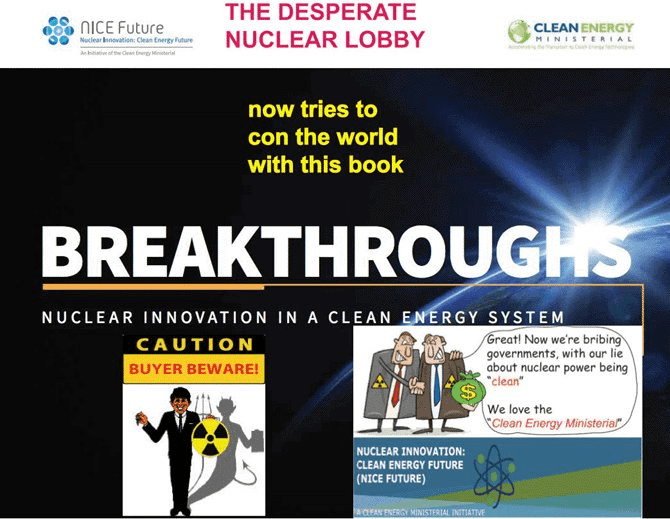
U.S., Canada Energy Leaders Announce New Book on Nuclear Innovation in Clean Energy USA Dept of Energy
MAY 28, 2019, VANCOUVER, CANADA – Today, leaders from the United States and Canada are unveiling a new book, Breakthroughs: Nuclear Innovation in A Clean Energy System, at the Tenth Clean Energy Ministerial (CEM10), a forum including ministers from 25 nations, occurring this year in Vancouver, Canada from May 27-29. MAY 28, 20
“The combination of vision and innovation is having a profound impact on our energy landscape, and nowhere is that more true than nuclear energy,” said U.S. Under Secretary of Energy Mark W. Menezes. “Nuclear energy is one of our most reliable and cleanest sources of energy, and we are determined to revive and revitalize the nuclear energy industry with advanced and smart designs. This book highlights some of the incredible transformative opportunities nuclear innovation can bring to society and the clean energy future of our planet.”
Canada’s Minister of Natural Resources Amarjeet Sohi said, “The Clean Energy Ministerial is part of building the world’s clean energy future. Canada is proud to host the 10th Clean Energy Ministerial in Vancouver at this historic moment in time. We are pleased to be working with the United States, Japan, and other countries under the nuclear innovation initiative. We also welcome the release of Breakthroughs – a collection a real stories about nuclear innovations and how they can contribute to our climate change goals.” ………
The Breakthroughs book is a product of the CEM Nuclear Innovation: Clean Energy Future (NICE Future) initiative that was launched at the May 2018 Ninth CEM in Copenhagen, Denmark. The NICE Future initiative envisions nuclear energy’s many uses in contributing to clean, reliable energy systems of the future. …….. https://www.energy.gov/articles/us-canada-energy-leaders-announce-new-book-nuclear-innovation-clean-energy
May 30, 2019
Posted by Christina Macpherson |
Canada, spinbuster, USA |
Leave a comment
Canada’s nuclear waste to be buried in deep underground repository, By Eric Sorensen, Global News, 29 May 19, “……..While the nuclear creating heat and electricity has been well contained in reactors, ceramic pellets and fuel bundles, we have been left with big a problem that everyone saw coming: the hazard posed by nuclear waste.
At the Bruce plant, low and intermediate level wastes are accumulating. Low-level includes worker clothing and tools. Typically, they could be radioactive for 100 years. Intermediate-level waste is described as resins, filters and used reactor components that could be a hazard for 100,000 years.
Ontario Power Generation has slowly made headway for a plan to bury this waste in a deep underground repository next to the Bruce plant. Much of it now sits in large tanks with row upon row of cement lids poking above the surface.of the ground.
Fred Kuntz, wearing an OPG hard hat, gazed over the containers: “This is all safe storage for now, but it’s not really the solution for thousands of years. The lasting solution is disposal in a deep geologic repository.”
He pointed to a stand of trees. “The DGR would be built here.”
Some think that’s a terrible idea. The repository could leak, it could be attacked, and the location on the Bruce site is barely a kilometer from Lake Huron, which has opponents on both sides of the Great Lakes up in arms.
“There isn’t a magic bullet. It’s not like we can put it out of sight and we’ve solved the problem.” said Theresa McClenaghan of the Canadian Environamental Law Association.
She suggests humans have little concept of how long 100,000 years is. She questions whether the facility would last and whether we can be sure we’ll be able to communicate the dangers to some future civilization.
………..The deep geological repository was approved by an environmental review panel in 2015, but both the Harper and Trudeau governments have put off giving the final go ahead. It now appears to hinge on the approval by indigenous people in the region.
For the Saugeen Ojibway Nation, it’s about time they were consulted. Fifty years ago, the concerns of indigenous people were an afterthought when it came to major public policy decisions.
The nuclear plant was built on the traditional land of the Saugeen Ojibway. OPG says it has come to recognize the “historic wrongs of the past” and is negotiating compensation for those wrongs. And moving forward, OPG has given its assurance that the repository will only be built if the Saugeen Ojibway approve – from an afterthought to the power of veto over a multibillion-dollar enterprise……….
Remarkably, this is the relatively easy stuff to deal with: low- and intermediate-level nuclear waste. An even bigger problem is high-level radioactive used fuel. It too is piling up, primarily at the three big Ontario plants. It may be toxic for a million years. ……..
Ultimately they need to find one particular community to be a “willing host” for what amounts to 57,000 tonnes of used nuclear fuel……..
The plan is to pack the bundles into carbon steel tubes coated in copper – 48 bundles per container. They look like a big torpedoes. Each one will be packed snugly into what look like coffins made of a special clay called bentonite.

Thousands of bentonite boxes will be moved by robotic machines into hundreds of long placement rooms deep underground. Dried slightly, the clay will expand and plug every last space, ultimately sealing the repository. ……
Picking a host community, getting regulatory approval, building the repository, and transferring high-level waste will take the next 50 years.
It is separate from the OPG plan for low- and intermediate-level waste, which could have an answer from the Saugeen Ojibway Nation by the end of this year, and federal approval in 2020.
As it turns out, two of the NWMO sites for high-level waste – South Bruce and Huron-Kinloss – are also on Saugeen Ojibway land, so they may ultimately have to decide on separate nuclear waste projects on their land………https://globalnews.ca/news/5329835/canadas-nuclear-waste-to-be-buried-in-deep-underground-repository/
May 30, 2019
Posted by Christina Macpherson |
Canada, wastes |
1 Comment

Alberta nuclear energy just a unicorn, EDMONTON JOURNAL
We do not have time to waste chasing unicorns; carbon capture and storage has certainly taught us that. Time is more valuable than money now. Ronald Kelly, Edmonton April 27, 2019
Re. “Fear not, new nuclear reactors can solve Canada’s climate change crises,” David Staples, April 26
David Staples argues nuclear means we don’t have to fear climate change. There are a few assumptions behind his suggestions that I take issue with.
First, is that a consensus on nuclear is politically achievable. It’s as if Fukushima, Chernobyl, Three Mile Island, et cetera, haven’t happened or that we’ll just forget about them and agree to build something better this time. I suggest approval of nuclear is as likely as finding Sasquatch. If you think it’s tough to build a pipeline, just try to sell something with toxic waste that lasts forever but can make terrible weapons.
Nuclear would take years of lobbying, and if successful, be followed by years of construction. The technical complexity, political controversy and financial uncertainty guarantee these projects are always way behind schedule. Reactor projects in the UK and Germany have been cancelled.
The second assumption is that business as usual is fine in the meantime. The Calgary flood, Fort McMurray fire, et cetera, have shown Albertans and Canadians that we are in an emergency.
We do not have time to waste chasing unicorns; carbon capture and storage has certainly taught us that. Time is more valuable than money now. https://edmontonjournal.com/opinion/letters/saturdays-letters-alberta-nuclear-energy-just-a-unicorn
April 29, 2019
Posted by Christina Macpherson |
Canada, climate change |
Leave a comment
Saskatoon Star Phoenix 20th April 2019 , Canada’s largest uranium producer says it’s developing a plan to clean
up groundwater contaminated with uranium and radiation four months after it was first discovered at a shuttered mill in northern Saskatchewan.
Cameco Corp. reported in December that a sampling well adjacent to its Key Lake mill “was showing an increasing trend in uranium concentration” after 50,000 litres of water were “released” over the previous year. Carey Hyndman, aspokeswoman for the Saskatoon-based company, said this week that the incident was immediately reported to the Saskatchewan Ministry of Environment and the Canadian Nuclear Safety Commission.
https://thestarphoenix.com/news/local-news/cameco-developing-plan-to-clean-up-contaminated-groundwater-at-key-lake
April 22, 2019
Posted by Christina Macpherson |
Canada, Uranium, water |
Leave a comment
By ERIKA SIMPSON APR. 10, 2019
Whether SNC is allowed to meet and make billions of dollars of new contractual obligations over the next decade will be crucial to the global nuclear industry and Canada’s future development…… (subscribers only)
https://www.hilltimes.com/2019/04/10/snc-lavalin-nuclear-contracts-at-risk-if-its-convicted/195245
April 11, 2019
Posted by Christina Macpherson |
Canada, secrets,lies and civil liberties |
Leave a comment
 Canada Warming Twice as Fast as World, Report Warns https://www.usnews.com/news/best-countries/articles/2019-04-05/global-warming-is-twice-as-fast-in-canada-as-rest-of-the-world-report-says?int=98f508
Many environmental effects being seen in the country are ‘effectively irreversible, say authors of study.
By Sintia Radu, Staff Writer April 5, 2019 CLIMATE CHANGE IS ONE of the top threats that people in countries say confronts the world. Global warming is often referenced as a consequence of pollution and human activity. Levels vary across countries, yet a new report is showing a dire concern for one of the largest countries on the planet –
Canada.
The North American nation is warming on average at twice the rate of the rest of the world, according to a new scientific report produced by the Environment and Climate Change Canada, the national government agency responsible for coordinating the country’s environmental policies. The average temperature in Canada today is 1.7 degrees Celsius (3 degrees Fahrenheit) higher than 70 years ago, according to the report. By comparison, the average global temperature increase during the same period is 0.8 degrees Celsius.
Both past and future warming in Canada is, on average, about double the magnitude of global warming,” say the authors of the report. “Northern Canada has warmed and will continue to warm at more than double the global rate.”
Additionally, the warming produced from carbon dioxide emissions from human activity is “effectively irreversible,” the report’s authors warn.
Among some of the report’s major findings:
- Changes in temperature already show in various areas of the country and scientists say they will only intensify.
- Precipitation is projected to increase, on average, yet summer rainfall may decrease in particular regions.
- The Canadian Arctic and Atlantic Oceans have been the most impacted, with both experiencing “longer and more widespread sea-ice-free conditions”, the report says.
- The availability of freshwater is changing, the report says, with the risk of water supply shortages expected to increase in the summer.
The magnitude of climate change in high versus low emission scenarios paint two future scenarios for the country, according to the scientists. If large and rapid warming occurs, Canada’s climate with be severely affected as greenhouse gas emissions will grow. Limited warming may only occur, the report notes, if Canada and the rest of the world work on eliminating carbon emissions early in the second half of the century and on substantially lowering other greenhouse gases
Research for the report began in February 2017 and draws “primarily from existing sources of information that have been peer-reviewed and are publicly available,” the authors say.
The report’s authors also say human influence on climate change is clear. “It is likely that more than half of the observed warming in Canada is due to the influence of human activities.”
April 9, 2019
Posted by Christina Macpherson |
Canada, climate change |
Leave a comment
How safe is the Ottawa River from nuclear waste? Canada’s National Observer By Lauren Hicks, Dana Hatherly, Christian Paas-Lang, Mateo Peralta & Adam van der Zwan April 8th 2019 “……..Canada’s first nuclear reactor began operating at Chalk River, about 160 kilometres northwest of Ottawa. Since 1944, the facility has served as Canada’s major nuclear science hub. Researchers at CRL have studied reactors, nuclear energy and weaponry and produced medical isotopes for patients around the world.
The facility was joined in 1962 by the first power-generating CANDU reactor in Canada at Rolphton, about 30 kilometres upstream. It was closed in 1987.
Now that CRL’s reactors at Chalk River have gone dark for the last time, the focus has shifted to decommissioning and revitalizing the grounds and getting permission from federal nuclear and environmental regulatory authorities to build a waste burial site that would operate for at least 50 years.
Since the proposal was made a few years ago, the question has repeatedly been raised of whether there is a risk the permanent nuclear waste site would contaminate the Ottawa River that runs 1,271 kilometres from its source in Quebec in a giant U-shape past cities like Mattawa, Pembroke, Montebello and the nation’s capital before emptying into the St. Lawrence River in view of Montreal.
“It is crucial to protect the drinking water source of over two million people,” says Ottawa Riverkeeper, a full-time, non-profit organization that serves as a public advocate for the watershed and is a key intervenor in the environmental assessment of the waste proposal.
The Chalk River site resembles an old university campus. It’s cut out of a thick and isolating forest spanning about 10,000 acres, with neatly trimmed patches of grass, and a regimented mix of large brick and smaller white structures.
The facilities owned by Canadian Nuclear Laboratories (CNL) are about seven kilometres from the gate at the border of Chalk River, a community of fewer than 1,100 residents, some of whom work at the lab which has about 2,800 employees.
Signs on a chain link fence and tree trunks along the perimeter indicate the grounds are protected by armed officers. Surveillance cameras cast a visual blanket over the road to the security clearance booth and over much of the site.
Chalk River Laboratories has for decades faced questions over the way it deals with its radioactive waste. Environmentalists have decried the facility for discharging waste into the river and for leaks. CNL says its methods for treating waste are sound and the regular liquid effluent discharges into the river have no significant public health or environmental impact on drinking water. It reports a steady evolution of environmental stewardship.
Fresh concern erupted after CNL announced detailed plans to build a nuclear disposal facility to permanently house one million cubic metres of radioactive waste — about 400 Olympic-sized swimming pools worth.
In May 2016, the Canadian Nuclear Safety Commission launched the environmental assessment process for the disposal project with an initial call for public comment.
Environmentalists and concerned citizens questioned how nuclear waste can remain securely contained for hundreds of years, and how it might endanger water quality if any leaks.
The waste has accumulated over decades of Chalk River’s operations. It includes low-level material, such as equipment from operations that has been irradiated and buildings that housed the reactors, and intermediate-level waste, such as filters used to purify reactor water systems and reactor core components. The irradiated material sits anywhere from a few metres to a few kilometres from the Ottawa River. ……..
Canadian Nuclear Laboratories (CNL) promotes itself as a global leader in developing applications for nuclear technology through research, engineering and waste management services.
It is a subsidiary of Atomic Energy of Canada Limited (AECL), a federal Crown corporation, and operated by the Canadian National Energy Alliance, a private consortium. Its operations are licensed by the Canadian Nuclear Safety Commission, the nation’s nuclear regulator.
What do water quality tests near Chalk River say?
Some nearby residents and environmental groups have argued that, while CNL says it is committed to safeguarding the health of the Ottawa River during the decommissioning process, questions remain about the lab’s ability to safely dispose of radioactive waste.
The lab’s history is peppered with minor leaks and malfunctions – and a few major ones. Critics worry that the organization’s confidence in the safety of decommissioning efforts is misplaced.
For instance, critics claim the lab is not fully transparent about its water quality testing methods and has not properly informed the public on plans for permanent storage and disposal of the radioactive material.
Ottawa resident Ole Hendrickson is a member of the Concerned Citizens of Renfrew County and Area, an Ottawa-based environmental activist group whose volunteers have worked for the clean-up and prevention of radioactive pollution from the nuclear industry in the Ottawa Valley for more than 40 years. He’s also a member of CRL’s environmental stewardship council, which convenes company officials, community representatives and other stakeholders several times a year to discuss updates from the lab.
Hendrickson said in an interview that CNL is stingy about providing environmental monitoring data, and that many of the documents with information on testing he has received through access to information requests include significant redactions.
Yet authorities in nearby towns appear unconcerned.
Brenda Royce works at the Ontario Clean Water Agency in Petawawa, about 20 kilometres downstream from Chalk River. It is a provincial Crown agency that the town contracts to do its water quality testing and water system maintenance.
In addition, Royce said her office collects a water sample from the Ottawa River at Petawawa every day for CNL to conduct its own tests. But the office does not get the results of the tests back from the private lab.
Every year, Petawawa’s water agency publishes its own report on the town’s drinking water quality and treatment system. The agency’s report includes testing for many chemicals — including uranium — but not for the two main radionuclides that might be discharged from Chalk River Laboratories operations: tritium and strontium. “It’s just what we do,” Royce said, adding she has never been curious to see results on radioactive waste in the water system.
Petawawa’s director of public works said he has never met with Chalk River officials over potential water quality hazards in the area……..
In 2012, the site’s former Crown operator contracted Université Laval to conduct independent environmental tests of the water, air and vegetation around Chalk River Laboratories and the municipalities of Petawawa and Pembroke, just south of the facility, which would be most directly affected by any potential nuclear contamination in the river. The results for 2012, 2013 and 2015 have been posted on the nuclear industry regulator’s website, and results for 2018 will be published. As of yet, no tests returned results that were expected to cause adverse health effects.
Canada’s Nuclear Safety Commission did not provide data or respond to technical questions before publication and was not available for an interview.
Test results from 2015 show levels of radioactive isotopes present in the river, such as strontium and tritium, were far below the threshold that would affect human health.
Health Canada guidelines state the maximum concentrations of strontium and tritium in drinking water are seven milligrams per litre, and 7,000 becquerels per litre, respectively.
Independent tests for strontium and tritium in the Ottawa River at Rolphton, Petawawa, and Pembroke were conducted specifically for this story. The results found strontium and tritium were not at dangerous levels in the water, as of November 2018. All indicated waste levels in the river were similar to results found by researchers from Université Laval in 2015, and reported last year by the lab itself.
While some local opponents believe there is no safe dose of radiation or safe level of radioactive waste, CNL says it abides by the standards set by the Canadian Nuclear Safety Commission and the International Atomic Energy Agency, a United Nations body.
Members of CNL’s team acknowledge there are differences in international standards when it comes to certain substances, including tritium and strontium………..
When it comes to its own environmental monitoring, CNL releases a monthly performance report that indicates routine groundwater sampling at 170 locations across the site. The report does not include detailed results for the specific radioactive substances tested.
The Ontario Ministry of Environment conducts water quality tests at Petawawa every year and has never shown any concern over potential nuclear material in the water. As part of its Nuclear Reactor Surveillance Program, the Ontario Ministry of Labour published reports in 2011 and 2012 that show very low tritium levels in Ottawa’s water. No further reports have been published since.
This publication contacted recently elected municipal and provincial representatives, and the local federal politician whose seat will be up for election in 2019.
None of the representatives for the Chalk River area commented on the proposed waste facility or its possible impact on water quality. Renfrew-Nippising-Pembroke MPP John Yakabuski did not provide an interview. The area’s federal MP, Cheryl Gallant, was not available. Laurentian Hills mayor John Reinwald, the chief administrative officer and all council members did not respond to interview requests………..https://www.nationalobserver.com/2019/04/08/features/how-safe-ottawa-river-nuclear-waste
April 9, 2019
Posted by Christina Macpherson |
Canada, wastes |
Leave a comment
Former hospital manager who took $10 million bribe to favour SNC Lavalin bid sentenced to 39 months in prison https://business.financialpost.com/news/fp-street/ex-manager-sentenced-to-39-months-prison-in-hospital-corruption-fraud?fbclid=IwAR35AX1LrS6gLpVV1uHbnxVV1YmiImTnfFhjQHKAlpUe_n_4VInQAx9ksv4#comments-area 8 Apr 19, MONTREAL — A former hospital manager who pocketed a $10-million bribe in return for helping SNC-Lavalin win a Montreal hospital-building contract has been sentenced to 39 months in prison.
Quebec court Judge Claude Leblond sentenced Yanai Elbaz today in Montreal in a case that has been described as the greatest corruption fraud in Canadian history.
The judge rejected an argument from the McGill University Health Centre, which claimed it was entitled to compensation as a victim of the fraud. He ruled the question should be dealt with through civil proceedings.
In an agreed statement of facts tied to Elbaz’s plea, the former MUHC manager admitted to giving privileged information to engineering firm SNC-Lavalin to help its submission for the contract to build a massive hospital complex in west-end Montreal.
Elbaz, who has been detained since his Nov. 26 guilty plea, also admitted to denigrating SNC’s competitors in front of the hospital’s selection committee.
Elbaz and Arthur Porter, the ex-CEO of the MUHC who died a fugitive in Panamanian custody in 2015, received a total of $22.5 million to rig the bidding process to favour SNC-Lavalin, the statement of facts said.
April 9, 2019
Posted by Christina Macpherson |
Canada, secrets,lies and civil liberties |
Leave a comment
 Corbella: Wilson-Raybould’s version behind scandal is indisputable and nuclear, Calgary Herald, LICIA CORBELLA March 29, 2019 Was she or wasn’t she (inappropriately pressured?) That is the central question behind the SNC-Lavalin controversy. All other questions are peripheral.
The answer now is an unequivocal, indisputable ‘yes.’ This is no longer a question of she said/he said, or of women and men “experiencing things differently” — the so-called Gropegate defence.
Now Canadians have the proof. Canada’s former attorney general, Jody Wilson-Raybould, was pressured and threatened by federal Liberal government officials and politicians to help the Quebec engineering giant avoid a criminal trial by pursuing a deferred prosecution agreement
On Friday, the House of Commons justice committee released Wilson-Raybould’s 43-page document, that includes texts, emails and the context around that evidence as well as a transcript of a 17-minute telephone conversation she recorded between herself and Michael Wernick, the clerk of the Privy Council who recently resigned from his post as the country’s top bureaucrat in the wake of this scandal that his gripped the country since Feb. 7
……..Clearly, we now have the proof that the PMO inappropriately pressured the attorney general, not just he said/she said. That’s much more than a political bombshell. Canada’s reputation as a principled country that follows the rule of law has been terribly damaged. It’s also clear that the PM and many of the people around him have lied throughout this controversy. She has proof. They have lies. Ka-Boom!
https://calgaryherald.com/opinion/columnists/corbella-wilson-rayboulds-version-behind-scandal-is-indisputable-and-nuclearLicia Corbella is a Postmedia opinion columnist. lcorbella@postmedia.com
i.
March 30, 2019
Posted by Christina Macpherson |
Canada, politics, secrets,lies and civil liberties |
Leave a comment
 Nuclear power company backs Ford government energy plan, Canada’s National Observer , By Alastair Sharp March 21st 2019 Premier Doug Ford’s Progressive Conservative government said on Thursday it will reform Ontario’s electricity system in a bid to reduce costs overall and lower rates for businesses, a move critics say limits the most efficient way to save money in the power grid and threatens thousands of clean energy jobs.
The plan, announced by Energy Minister Greg Rickford, confirm details reported exclusively by National Observer on Wednesday about a series of cuts to programs that were designed to save energy in buildings. …….
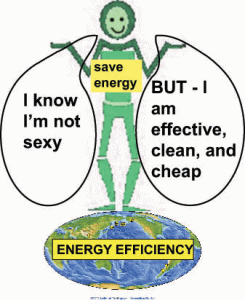
Environmental groups and opposition political parties say the moves don’t make economic sense, pointing to the IESO’s estimates that it costs more than four times more to produce nuclear energy than to conserve electricity, with nuclear costs likely to double in coming years.
The IESO estimates that it costs 1.7 cents to save a kilowatt hour (kWh) of electricity while Ontario Power Generation’s (OPG) nuclear electricity costs 8.8 cents per kWh and is forecast to rise to 16.5 cents per kWh by 2025 to pay for the re-building of the Darlington Nuclear Station.
“I’m worried that today’s announcement might set the stage for the abandonment of energy efficiency efforts while going all-in on expensive, outdated nuclear power,” Ontario Green Party Leader Mike Schreiner said in a statement.
Rickford’s plan would also threaten thousands of jobs in companies working on energy efficiency projects, according to Efficiency Canada, a lobby group that represents companies that provide energy efficiency products and services.
Corey Diamond, executive director of Efficiency Canada, said that this field of the economy has the potential to create over 14,000 jobs per year.
“Energy efficiency is the best bang for the buck for the people of Ontario,” said Diamond in a statement. “Scaling back on programs means fewer local jobs in communities across the province,” he said.
The group representing local power distributors also criticized the changes, citing IESO data showing local hydro utilities had saved over 5.8 billion kWh, enough to power more than 640,000 homes for a full year.
Local distribution companies “have made a vital contribution to delivering savings to all customers across Ontario, including families, small businesses, farmers, medium and large businesses,” said Teresa Sarkesian, president and CEO of the Electricity Distributors Association (EDA).
Ontario NDP energy and climate change critic Peter Tabuns said he agreed that the previous government’s plan was disastrous, but said that the Ford government was about to make the situation worse.
“For years, families saw their utility bills skyrocket under the Wynne Liberals and were left struggling to make ends meet each month,” Tabuns said. “Instead of making things better, and dropping the disastrous Liberal hydro borrowing scheme, the Conservatives are ripping up programs that help everyday families save money on their utility bills, so families and businesses will see their bills jump, yet again.” https://www.nationalobserver.com/2019/03/21/news/nuclear-power-company-backs-ford-government-energy-plan
March 25, 2019
Posted by Christina Macpherson |
Canada, politics |
1 Comment
 The Energy Mix 10th March 2019
 On the anniversary of the 2011 Fukushima nuclear disaster, investigative
journalist Paul McKay reveals that the trade in radioactive waste is
becoming a lucrative opportunity for SNC-Lavalin and its U.S. partner.
If it is true that one person’s garbage can be another’s gold, then
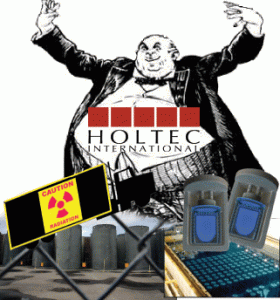
Montreal-based multinational SNC-Lavalin and its new U.S. partner, Holtec
International, plan to be big global players in what promises to be a very
lucrative, long-term business: handling highly radioactive nuclear wastes
until permanent disposal methods and sites might be found, approved, and
built.
That problem is pressing because the volume of spent reactor fuel is
cresting in the U.S., Canada, Europe, China, India, Russia, and Japan.
There are also hundreds of intensively contaminated reactors which must
sooner or later be entombed, dismantled, chopped up by robots, then sent in
special, sealed containers to interim storage sites somewhere.
But no country in the world has yet found a proven, permanent solution for the 250
million kilograms of spent fuel now in limbo in storage pools and
canisters, let alone the atomic furnaces which created them. There are now
about 413 operable civilian reactors in 31 countries, and another 50 under
construction. Physics tells us precisely how “hot” atomic garbage is.
Every commercial power reactor—regardless of model, type, country, or
owner/operator—contains the radioactive equivalent of many atomic bombs
locked within its spent fuel, reactor core, pumps, valves, and extensive
cooling circuits.
https://theenergymix.com/2019/03/10/hot-garbage-grifters-snc-lavalins-plan-to-turn-nuclear-waste-into-long-term-gold/
March 14, 2019
Posted by Christina Macpherson |
Canada, wastes |
Leave a comment
JUSTIN TRUDEAU FACES CALLS TO RESIGN RE: SNC-LAVALIN SCANDAL
As reported by Newsweek.
Liberal Party Canadian Prime Minister Justin Trudeau now faces calls from his Conservative Party challenger in this autumn’s election to resign over a scandal involving SNC-Lavalin, a giant engineering firm based in Montreal, Quebec. SNC-Lavalin has been accused of bribery, fraud, and other corruption over its practices in Libya. If convicted of such wrongdoing, SNC-Lavalin could be barred from Canadian federal contracts for a decade. (SNC-Lavalin has been previously barred for a decade from World Bank contracts.)
Holtec International has teamed with SNC-Lavalin to form a nuclear power plant decommissioning consortium. Already, the Holtec/SNC-Lavalin consortium has taken over ownership of the permanently shutdown Oyster Creek atomic reactor in NJ. This includes on-site irradiated nuclear fuel management.
Holtec & SNC-Lavalin are also vying for taking over the ownership of such other soon-to-be decommissioning nuclear power plants as Pilgrim in MA, and Palisades in MI.
Holtec is also the proponent for a national centralized interim storage facility for irradiated nuclear fuel in southeastern New Mexico.
Its partnership with a corrupt company like SNC-Lavalin calls into question Holtec’s own judgment.
 However, Holtec itself has engaged in bribery, at the Tennessee Valley Authority’s Browns Ferry nuclear power plant; in addition, Holtec CEO Krishna Singh has been accused by whistleblowers Oscar Shirani (Commonwealth Edison/Exelon) and Dr. Ross Landsman (NRC Region 3) of attempting to bribe them into silence, re: QA violations (see below).
And Holtec CEO Krishna Singh has also made racist remarks re: his own African American and Puerto Rican American workers in Camden, NJ.
Holtec is also infamous for QA (Quality Assurance) violations in the manufacture of its irradiated nuclear fuel canisters, brought to light by whistleblowers.
See these previous Beyond Nuclear website posts, for more info. on concerns re: SNC-Lavalin:…….. http://www.beyondnuclear.org/centralized-storage/
March 9, 2019
Posted by Christina Macpherson |
Canada, politics, secrets,lies and civil liberties |
3 Comments





 wrongdoing, SNC-Lavalin could be barred from Canadian federal contracts for a decade. (SNC-Lavalin has been previously barred for a decade from World Bank contracts.)
 However, Holtec itself has engaged in bribery, at the Tennessee Valley Authority’s Browns Ferry nuclear power plant; in addition, Holtec CEO Krishna Singh has been accused by whistleblowers Oscar Shirani (Commonwealth Edison/Exelon) and Dr. Ross Landsman (NRC Region 3) of attempting to bribe them into silence, re: QA violations (see below).




 nuclear-news