“Mutual admiration society” -between civilian and military nuclear experts
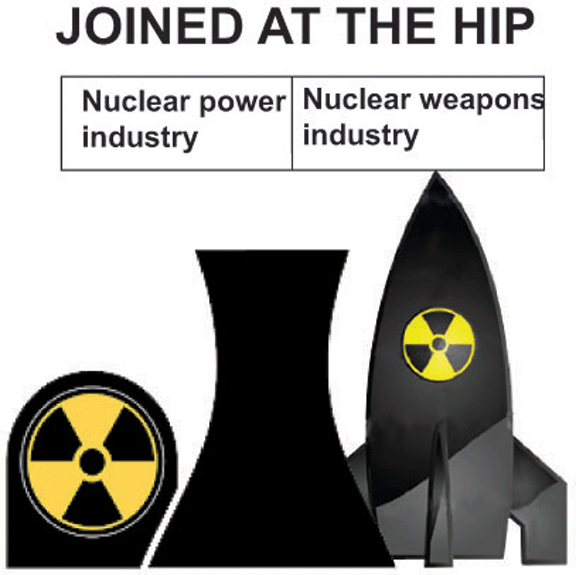 Civilian nuclear and military nuclear members of a “mutual admiration society” ~
  Dr. Gordon Edwards, https://concernedcitizens.net/2020/12/19/civilian-nuclear-and-military-nuclear-members-of-a-mutual-admiration-society/ Dr. Gordon Edwards, President of the Canadian Coalition for Nuclear Responsibility, December 19, 2020
Civilian nuclear and military nuclear have always been friendly room-mates, members of a “mutual admiration” society. In today’s announcement of an SMR Action Plan, Natural Resources Minister Seamus O’Regan said that nuclear power in Canada is a “home-grown” technology and referred to C. D. Howe’s role in this connection. In fact C.D. Howe arranged for all Canadian uranium extracted from Canadian mines to be sold to the US military for use in tens of thousands of nuclear weapons from 1945 to 1965. C D Howe was also on the Committee that met in Washington DC in 1944 to approve the first nuclear reactors to be built in Canada (at Chalk River) as part of the ongoing effort to produce plutonium for use as a nuclear explosive. Mr. Howe approved of the policy of selling plutonium produced at Chalk River to the US military for weapons use, a practice that continued until 1975 and beyond. Plutonium from Chalk River was sent to Britain (it was the first sample of plutonium that Britain had ever obtained) just a few months before Britain detonated its first A-Bomb in the Monte Bello Islands off Australia.
To the best of my knowledge, no civilian nuclear power agency – not the Canadian Nuclear Association, nor the Canadian Nuclear Society, nor the Canadian Nuclear Safety Commission, nor Atomic Energy of Canada Limited, nor Canadian Nuclear Laboratories, NOBODY – has ever issued a clear statement denouncing nuclear weapons or even calling for a nuclear weapons free world. Most nuclear scientists and engineers feel a strong kinship and camaraderie with those who are in the nuclear weapons business. The same goes for those in the nuclear division of Natural Resources Canada. I remember on one occasion (prior to the exchange of nuclear tests between India and Pakistan) I expressed alarm at the fact that both neighbours are developing a nuclear war-fighting capability and a couple of senior civil servants said “Would that be so bad? Maybe that’s just what the world needs. More deterrence. Creates stability”
Despite regular denials from our puppet masters that civilian nuclear has nothing to do with military nuclear, it is clear that civilian nuclear (including the frankly discriminatory provisions of the NPT) has adopted an appeasement policy that will never succeed in bringing about a nuclear weapons free world. Why does Canada continue to sell uranium to countries that are in the process of investing hundreds of billions to improve and modernize the nuclear arsenals in utter defiance of the NPT, knowing that the vast bulk of Canadian uranium that is rejected from enrichment plants as DU end up as the raw material for producing plutonium for Bombs, and that the lion’s share of the explosive power – and the overwhelming share of the radioactive fallout – of every H-bomb comes from the fissioning of DU atoms that are freely accessed by the military even if they are the leftovers of “peaceful” fuel production for nuclear power plants?
“See ‘The Nuclear Fudge’ at https://www.youtube.com/watch?v=0lK65S5eHRQ&feature=youtu.be“. This 16-minute W5 segment from the Regan era is very informative.
Many Canadian organisations dispute the government’s plan for small nuclear reactors
 Feds throw support behind development of mini nuclear reactors; action plan released, Saskatoon / 650 CKOM Feds throw support behind development of mini nuclear reactors; action plan released, Saskatoon / 650 CKOMThe Canadian PressDec 18, 2020 “……. Among steps in the plan is developing prototypes and demonstration models.,,,,,
Dozens of groups, including opposition parties, some Indigenous organizations and environmentalists, want the government to fight climate change by investing more in renewable energy and energy efficiency rather than in the new reactors. They argue nuclear energy costs far too much money and is far from clean given the growing mound of radioactive waste it generates. O’Regan said the government is actively trying to figure out what do with the dangerous material….. The federal government estimates the global market for SMRs will be worth between $150 billion and $300 billion a year by 2040 but critics question the validity of the estimate. They also wonder who exactly might want one. …https://www.ckom.com/2020/12/18/feds-throw-support-behind-development-of-mini-nuclear-reactors/ |
|
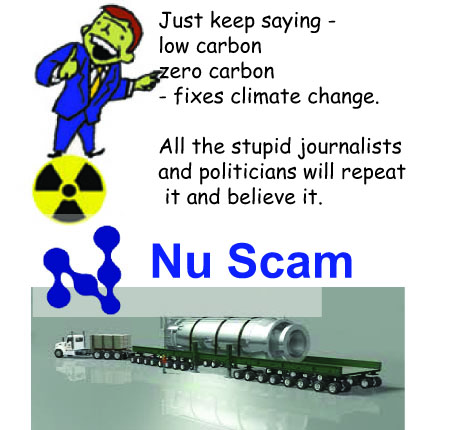
NuScale exultant that their scam small nuclear reactors have conned the Canadian government
|
NuScale Power Commends Government of Canada on Release of SMR Action Plan, December 18, 2020,PORTLAND, Ore.–(BUSINESS WIRE)–NuScale Power commends the Government of Canada and the Department of Natural Resources (NRCan) for the release of its Small Modular Reactor (SMR) Action Plan, which acknowledges the role that SMR technologies can play in achieving the country’s clean energy goals and sets forth a pathway to advancing nuclear technology in Canada. We are excited about the launch of Canada’s SMR Action Plan and applaud the Canadian government for taking this significant step towards seeing SMR technologies actualized as a key part of its energy sector,” said NuScale Power Chairman and Chief Executive Officer John Hopkins. “NuScale will support this action plan with our proven, reliable, and scalable technology that is suited to meet the specific power needs of regions across Canada.” ….. “NuScale is eager to play a part in helping Canada become a world leader in SMR development,” added Hopkins. “We have strong partnerships in the Canadian energy sector that augment our technology’s alignment with Canadian needs and look forward to strengthening them as the SMR Action Plan is implemented. This includes supply chain partnerships across Canada that we are prepared to leverage for projects in Canada, and around the world.” NuScale has signed Memoranda of Understandings with Ontario Power Generation and Bruce Power…… https://www.businesswire.com/news/home/20201218005700/en/NuScale-Power-Commends-Government-of-Canada-on-Release-of-SMR-Action-Plan |
|
Growing political opposition in Canada to Small Nuclear Reactors
 Hill Times -Political opposition growing to new nuclear reactors, https://wordpress.com/read/feeds/74740422/posts/3066856410 Hill Times -Political opposition growing to new nuclear reactors, https://wordpress.com/read/feeds/74740422/posts/3066856410By EVA SCHACHERL DECEMBER 9, 2020 The nuclear industry and Liberals have not only been laying the groundwork for government funding. It appears they have been ensuring that the framework for nuclear energy in Canada gets even more accommodating. Natural Resources Minister Seamus O’Regan has been hyping so-called next-generation reactors for months, portraying the industry as a future utopia.
Many Canadians are anxious to see what our energy future will be. Politically, it’s a question that stirs passions from Alberta’s oil patch to Ontario’s cancelled wind farms. But political debate is picking up around our nuclear energy future. And with good reason. Government-funded expansion of the nuclear industry, and a simultaneous watering-down of regulations, could be the Liberal government’s toxic legacy.
Natural Resources Minister Seamus O’Regan has been hyping so-called next-generation reactors for months. A recent nuclear industry summit—hosted with federal funding—portrayed nuclear energy expansion in Canada as a future utopia. The Green Party caucus, the NDP’s natural resources critic Richard Cannings, and the Bloc Québécois’s environment critic Monique Pauzé have all slammed O’Regan’s expected small modular reactor (SMR) “action plan.” They say it does not belong in a plan to reduce greenhouse gas emissions. Energy efficiency, wind, solar, and storage technologies are ready to build, and much cheaper, according to Lazard, a financial advisory and asset management firm. The prototype reactors will take years, if not decades, to develop, and could absorb hundreds of millions, even billions, in taxpayer subsidies, according to Greenpeace Canada.
That would mean opportunities lost for those dollars to build many times the amount of zero-emission energy with renewables and energy-efficiency projects. The latter would not create toxic radioactive waste for future generations to contend with. Independent research says that a nuclear solution for remote communities (as proposed by the government) is likely to cost 10 times more to build and operate than the alternatives. It seems inevitable that the Liberal action plan will soon be launched with generous handouts for the nuclear industry, whose aspiring players in Canada today include SNC-Lavalin and U.S. corporations like Westinghouse and GE-Hitachi Nuclear Energy. Few Canadians are aware that “Canadian” Nuclear Laboratories (CNL) is owned by a consortium of SNC-Lavalin and two U.S. firms, Fluor and Jacobs.
In recent years, the nuclear industry and Liberals have not only been laying the groundwork for government funding. It appears they’ve also been ensuring that the framework for nuclear energy in Canada gets even more accommodating. The biggest step was exempting most new reactors from the Impact Assessment Act, which, in 2019, replaced the Canadian Environmental Assessment Act. This was deemed so important to the nuclear industry’s future that the Canadian Nuclear Safety Commission (CNSC) lobbied the Liberal government to exempt small reactors—and won. So much for the CNSC, the regulator that’s supposed to oversee the industry, being seen as objective and “world class.”
The Impact Assessment Act was intended to create “greater public trust in impact assessment and decision-making.” But there will be no federal assessment of nuclear reactors up to 200 thermal MW in size, nor of new reactors built at existing nuclear plants (up to 900 MWth). Yet new tidal power projects, as well as offshore wind farms with 10 or more turbines, need an assessment under the regulations, as do many new fossil fuel projects.
Also exempted from federal assessment is the “on-site storage of irradiated nuclear fuel or nuclear waste” associated with small modular reactors. This will make it easier for SMRs’ radioactive waste to be potentially left in the northern, remote, and First Nations communities, where they are proposed to be built. The nuclear regulator has also been responsible for introducing a suite of “regulatory documents” on reactor decommissioning and radioactive waste that environmental groups have called “sham regulation.”
Meanwhile, the bureaucrats at the CNSC have been busy signing a memorandum of cooperation with the U.S. Nuclear Regulatory Commission on Small Modular Reactors. This agreement means that Canada can recognize U.S. reviews of reactor designs in order to “streamline the review process.” CNSC has also outlined its plan in a document called Strategy for Readiness to Regulate Advanced Reactor Technologies. In a nutshell, the document says that regulations for new reactor designs will have to be flexible. It notes that CNSC regulated the earlier generation of water-cooled reactors (such as CANDUs) at first based on “objectives” in the 1950s and ‘60s. Then, as experience with these reactors evolved, regulations became more detailed and prescriptive. It says the same may have to happen with the new next-gen reactor designs.
In the 1950s, there were indeed few “prescriptive requirements” for the newfangled reactors. In 1952, the NRX reactor at Chalk River, Ont., had a meltdown. It was the first large-scale nuclear reactor accident in the world and took two years to clean up—which, by 1950s standards, included pumping 10,000 curies of long-lived fission products into a nearby sandy area. Then in 1958, the NRU reactor at Chalk River—a test bed for developing fuels and materials for the CANDU reactor—had a major accident, a fuel-rod fire that contaminated the building and areas downwind. It took 600 workers and military personnel to do the top-secret clean-up. Let’s hope today’s regulators and lawmakers can learn from history. Does Canada really need or want to be the “leading-edge” testing ground for new experimental nuclear reactors? Canadians should have their say in a referendum—or at the ballot box. |
With Small Nuclear Reactors (SMRs) Canada is back in the nuclear weapons business
Canada re-engages in the Nuclear Weapons Business with SMRs, December 3, 2020, WWW.HILLTIMES.COM/2020/12/03/CANADA-RE-ENTERS-NUCLEAR-WEAPONS-BUSINESS-WITH-SMALL-MODULAR-REACTORS/274591
Natural Resources Minister Seamus O’Regan is expected to announce within weeks his government’s action plan for development of “small modular” nuclear reactors (SMRs).
SMR developers already control the federally-subsidized Chalk River Laboratories and other facilities owned by the crown corporation, Atomic Energy of Canada Limited (AECL). Canada is now poised to play a supporting role in the global nuclear weapons business, much as it did during World War II.
Canada was part of the Manhattan project with the U.S. and U.K. to produce atomic bombs. In 1943 the three countries agreed to build a facility in Canada to produce plutonium for nuclear weapons. Researchers who trained at the Chalk River Laboratories went on to launch weapons programs in the U.K. and France. Chalk River provided plutonium for U.S. weapons until the 1960s.
Canada’s Nuclear Schizophrenia describes a long tradition of nuclear cooperation with the United States: “For example, in the early 1950s, the U.S. Navy used Canadian technology to design a small reactor for powering its nuclear submarines.” C.D. Howe, after creating AECL in 1952 to develop nuclear reactors and sell weapons plutonium, remarked that “we in Canada are not engaged in military development, but the work that we are doing at Chalk River is of importance to military developments.”
The uranium used in the 1945 Hiroshima bomb may have been mined and refined in Canada. According to Jim Harding’s book Canada’s Deadly Secret: Saskatchewan Uranium and the Global Nuclear System, from 1953 to 1969, all the uranium mined in Saskatchewan went to make U.S. nuclear weapons. Canada remains the world’s second-largest producer of uranium. North America’s only currently operating uranium processing facility is owned by Cameco in Port Hope, Ontario.
Canada built India’s CIRUS reactor, which started up in 1960 and produced the plutonium for India’s first nuclear explosion in 1974. Canada also built Pakistan’s first nuclear reactor, which started up in 1972. Although this reactor was not used to make weapons plutonium, it helped train the engineers who eventually exploded Pakistan’s first nuclear weapons in 1998.
In 2015 the Harper Government contracted a multi-national consortium called Canadian National Energy Alliance – now comprised of two U.S. companies, Fluor and Jacobs, along with Canada’s SNC-Lavalin – to operate AECL’s nuclear sites, the main one being at Chalk River. Fluor operates the Savannah River Site, a South Carolina nuclear weapons facility, under contract to the U.S. Department of Energy (DOE). Jacobs also has contracts at DOE weapons facilities and is part of a consortium that operates the U.K. Atomic Weapons Establishment.
Joe McBrearty, the president of the consortium’s subsidiary that operates Chalk River and other federal nuclear sites, was a U.S. Navy nuclear submarine commander and then chief operating officer for the DOE’s nuclear laboratories between 2010 and 2019.
All three consortium partners have investments in SMRs and are ramping up research and development at AECL’s Chalk River facility. Some SMR designs would use uranium enriched to levels well beyond those in current reactors; others would use plutonium fuel; others would use fuel dissolved in molten salt. All of these pose new and problematic weapons proliferation risks.
Rolls Royce, an original consortium partner that makes reactors for the U.K.’s nuclear submarines, is lead partner in a U.K. consortium (including SNC-Lavalin) that was recently funded by the U.K. government to advance that country’s SMR program.
A military bromance: SMRs to support and cross-subsidize the UK nuclear weapons program, says “Industry and government in the UK openly promote SMRs on the grounds that an SMR industry would support the nuclear weapons program (in particular the submarine program) by providing a pool of trained nuclear experts, and that in so doing an SMR industry will cross-subsidize the weapons program.”
The article quotes a 2017 Rolls Royce study as follows: “expansion of a nuclear-capable skilled workforce through a civil nuclear UK SMR programme would relieve the Ministry of Defence of the burden of developing and retaining skills and capability.”
The SMR connection to weapons and submarines could hardly be clearer – without SMRs, the U.S. and U.K. will experience a shortage of trained engineers to maintain their nuclear weapons programs.
With the takeover of AECL’s Chalk River Laboratories by SMR developers, and growing federal government support for SMRs, Canada has become part of a global regime linking nuclear power and nuclear weapons.
Federal funding for new nuclear reactors is a serious mistake that blocks swift ation on climate
|

Canada’s Coalition for Responsible Energy Development sceptical about Small Nuclear Reactors
Questions abound about New Brunswick’s embrace of small nuclear reactors
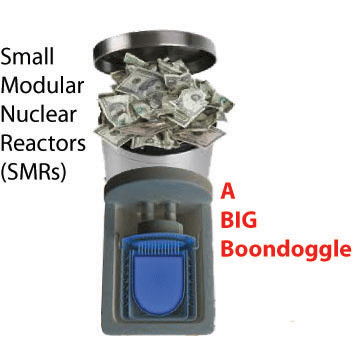 Critics question business case, but CEO says the market is ‘screaming’ for the units, Jacques Poitras · CBC News Dec 07, 2020
When Mike Holland talks about small modular nuclear reactors, he sees dollar signs.
When the Green Party hears about them, they see danger signs.
The loquacious Progressive Conservative minister of energy development recently quoted NB Power’s eye-popping estimates of the potential economic impact of the reactors: thousands of jobs and a $1 billion boost to the provincial economy.
“New Brunswick is positioned to not only participate in this opportunity, but to be a world leader in the SMR field,” Holland said in the legislature last month.
Green MLAs David Coon and Kevin Arseneau responded cheekily by ticking off the Financial and Consumer Services Commission’s checklist on how to spot a scam.
Is the sales pitch from a credible source? Is the windfall being promised by a reputable institution? Is the risk reasonable?
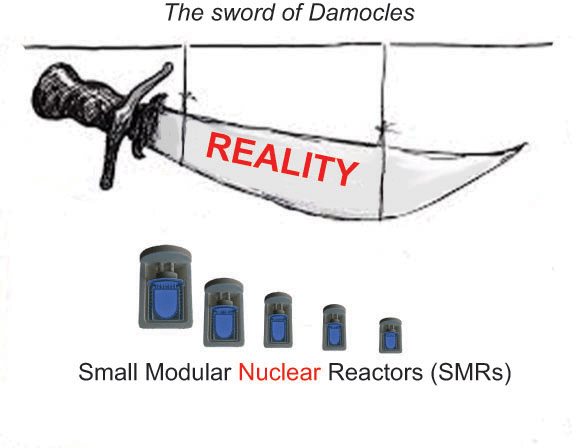 For small nuclear reactors, they said, the answer to all those questions is no.
“The last thing we need to do is pour more public money down the nuclear-power drain,” Coon said, reminding MLAs of the Point Lepreau refurbishment project that went $1 billion over budget. …….
Premier Blaine Higgs is a fervent supporter, but in the last provincial election the Liberals promised they’d do even more than Higgs to promote them.
Under Brian Gallant, the Liberals handed $10 million to two Saint John companies working on SMRs, ARC Nuclear and Moltex Energy.
Greens point to previous fiascoes
The Greens and other opponents of nuclear power fear SMRS are the latest in a long line of silver-bullet fiascoes, from the $23 million spent on the Bricklin in 1975 to $63.4 million in loans and loan guarantees to the Atcon Group a decade ago.
“It seems that [ARC and Moltex] have been targeting New Brunswick for another big handout … because it’s going to take billions of dollars to build these things, if they ever get off the drawing board,” said Susan O’Donnell, a University of New Brunswick researcher.
O’Donnell, who studies technology adoption in communities, is part of a small new group called the Coalition for Responsible Energy Development formed this year to oppose SMRs.

“What we really need here is a reasonable discussion about the pros and cons of it,” she said……..
What we didn’t see was a market analysis,” O’Donnell said. “How viable is the market? … They’re all based on a hypothetical market that probably doesn’t exist.”
O’Donnell said her group asked for the full report but was told it’s confidential because it contains sensitive commercial information………..
The market is screaming for this product,” Rory O’Sullivan, CEO of Moltex said, adding “all of the utilities” in Canada are interested in Moltex’s reactors ……
ARC’s CEO Norm Sawyer is more specific, guessing 30 per cent of his SMR sales will be in Atlantic Canada, 30 per cent in Ontario and 40 per cent in Alberta and Saskatchewan — all provincial power grids.
O’Donnell said it’s an important question because without a large number of guaranteed sales, the high cost of manufacturing SMRs would make the initiative a money-loser.
The cost of building the world’s only functioning SMR, in Russia, was four times what was expected.
An Australian government agency said initial cost estimates for such major projects “are often initially too low” and can “overrun.”
Up-front costs can be huge
University of British Columbia physicist M.V. Ramana, who has authored studies on the economics of nuclear power, said SMRs face the same financial reality as any large-scale manufacturing.
“You’re going to spend a huge amount of money on the basic fixed costs” at the outset, he said, with costs per unit becoming more viable only after more units are built and sold.
He estimates a company would have to build and sell more than 700 SMRs to break even, and said there are not enough buyers for that to happen. ….
O’Sullivan says: “In fact, just the first one alone looks like it will still be economical,” he said. “In reality, you probably need a few … but you’re talking about one or two, maximum three [to make a profit] because you don’t need these big factories.”
‘Paper designs’ prove nothing, says expert
Ramana doesn’t buy it.
“These are all companies that have been started by somebody who’s been in the nuclear industry for some years, has a bright idea, finds an angel investor who’s given them a few million dollars,” he said.
“They have a paper design, or a Power Point design. They have not built anything. They have not tested anything. To go from that point … to a design that can actually be constructed on the field is an enormous amount of work.
Both CEOs acknowledge the skepticism about SMRs.
“I understand New Brunswick has had its share of good investments and its share of what we consider questionable investments,” said ARC’s CEO Norm Sawyer….
But he said ARC’s SMR is based on a long-proven technology and is far past the on-paper design stage “so you reduce the risk.”
Moltex is now completing the first phase of the Canadian Nuclear Safety Commission’s review of its design, a major hurdle. ARC completed that phase last year.
But, Ramana said there are problems with both designs. Moltex’s molten salt model has had “huge technical challenges” elsewhere while ARC’s sodium-cooled system has encountered “operational difficulties.” …..
federal Natural Resources Minister Seamus O’Regan told CBC earlier this year that he’s “very excited” about SMRs…..
O’Donnell said while nuclear power doesn’t emit greenhouse gases, it’s hardly a clean technology because of the spent nuclear fuel waste.
Government support is key
She also wonders why, if SMRs make so much sense, ARC and Moltex are relying so much on government money rather than private capital.
…….. So far, Ottawa hasn’t put up any funding for ARC or Moltex. During the provincial election campaign, Higgs implied federal money was imminent, but there’s been no announcement in the almost three months since then.
Last month the federal government announced $20 million for Terrestrial Energy, an Ontario company working on SMRs.
…….O’Donnell said her group plans to continue asking questions about SMRs.
“I think what we really need is to have an honest conversation about what these are so that New Brunswickers can have all the facts on the table,” she said. https://www.cbc.ca/news/canada/new-brunswick/questions-small-nuclear-reactors-1.5828784
Canada’s indigenous communities must not be guinea pigs for useless Small Nuclear Reactors (SMRs)
 From the Hill — Small Modular Reactors, The Rossland Telegraph , by Dick Cannings MP on Monday Nov 30 2020, Earlier this year, Seamus O’Regan, the Minister of Natural Resources said in a speech that “We are placing nuclear energy front and centre… This is nuclear’s moment.” And in discussions around building a new economy after COVID, the government is doubling down on those sentiments. The latest debates are slightly different from those of the last fifty years as they involve a new technology: Small Modular Reactors, or SMRs. Spoiler alert–I don’t necessarily share the Minister’s unbridled enthusiasm for nuclear energy as the answer to all our prayers……..can nuclear power help us in our efforts to significantly reduce greenhouse gas emissions within the next few years? SMRs represent an experimental technology that, according to industry experts, will not be producing power anywhere in Canada for about a decade. Once the technology matures and SMRs can be produced in quantity, they could theoretically be cheaper than present, very expensive nuclear plants. But those claims are very difficult to assess.
SMRs are often touted as a solution to get remote indigenous communities off diesel power. While I am very much in favour of helping these communities find alternate power sources, SMRs do not fit the bill. These communities want power generation solutions that they can build and manage themselves. They want alternative power sources now, not in ten years. And they do not want to be the guinea pigs for brand-new nuclear technology that will likely provide few jobs for local residents and cost significantly more than mature technologies such as solar, wind, and bioenergy. A Special Chiefs Assembly of the Assembly of First Nations passed a unanimous resolution in December 2018 demanding “that the Government of Canada cease funding and support of the Small Modular Nuclear Reactors program.”
……… [smrs] shouldn’t be relied on by present day governments as the panacea to a clean energy future. Even the Canada Energy Regulator (formerly the National Energy Board) predicts that SMRs will collectively contribute only the equivalent of half of a conventional hydro dam by 2050.
To reach meaningful targets by 2030 and 2040, we need to double down on technologies we know will get us there…… And energy efficiency efforts alone could get us almost half-way to our targets. These are the routes to success.https://rosslandtelegraph.com/news/column-hill-small-modular-reactors#.X8Ven2gzbIU
Safety dangers of small modular nuclear reactors (SMRs)
 Nuclear power isn’t the answer to Nunavut’s energy problems, expert says. Nicole Bogart CTVNews.ca Writer, @nlynnbogart, November 27, 2020 TORONTO — Despite growing interest from the federal government and nuclear proponents, the Canadian Environmental Law Association warns that the safety implications of small modular reactors (SMRs) may outweigh the environmental pay off.
Theresa McClenaghan, executive director of the Canadian Environmental Law Association, says despite proponents’ claims that Canada’s North is a promising market for the small, transportable reactors, the technology isn’t suited for remote locations.
“They’re very inappropriate for remote locations. They’re very inappropriate for anywhere,” McClenaghan told CTV’s Your Morning Friday.
“You’d be talking about creating new kinds of waste that we don’t already have in Canada… [and] having to worry about very long distance transportation.” ……
The federal government has invested in research into the technology and is set to release an SMR action plan with a focus on Canada’s North by the end of this year.
Alberta, New Brunswick, Saskatchewan and Ontario have all signed a memorandum of understanding regarding development of small modular reactors…….
McClenaghan says the government is missing key concerns, including the security of the reactors.
“A very serious concern that no one is talking about is non-proliferation risks – and the risk of a diversion of the materials to weapons,” she said.
“That’s a serious risk for any nuclear technology. But especially when you start to distribute the materials like this and have less control, [and] the industry is hoping they can just leave the units without operators.”
McClenaghan adds that despite the industry’s claims that nuclear power doesn’t produce greenhouse gases, the production of SMRs would.
“Nuclear does produce greenhouse gases because you have to mine, transport, and refine. In fact, the full life cycle is two times as much as solar and six times as much as onshore wind,” she explained.
There are also growing concerns about the implications for Indigenous communities in Canada.
The Northwest Territories Energy Strategy is calling for communities to decide. There’s a whole history of decisions being made and imposed in communities. That’s how a lot of the diesel ended up there in the first place,” McClenaghan said, noting that affordable energy remains the biggest rallying cry for these communities.
“I have seen quite a bit of interest in hybrid systems where they can start to reduce the reliance on diesel, but take advantage for the times of year when solar isn’t available.” https://www.ctvnews.ca/climate-and-environment/nuclear-power-isn-t-the-answer-to-nunavut-s-energy-problems-expert-says-1.5207328
Canada’s environmental groups join to oppose experimental Small Nuclear Reactors (SMRs)
Canadian environmental groups oppose experimental small modular nuclear reactors, https://blackburnnews.com/midwestern-ontario/midwestern-ontario-news/2020/11/24/canadian-environmental-groups-oppose-experimental-small-modular-nuclear-reactors/ By Janice MacKay November 24, 2020 A number of groups have joined together to ask the federal government to halt its plans to fund experimental new small modular nuclear reactors (SMRs).
The Federal Government is preparing to launch the federal government’s SMR ” Action Plan” within weeks.
The SMR Action Plan is expected to include a strategy to fund and support the development of experimental nuclear reactors by private sector companies, the majority based in the US and UK.
In a media release, dozens of organizations from coast to coast have called the proposed new nuclear reactors a dirty, dangerous distraction from tackling climate change. They include Greenpeace Canada, Friends of the Earth Canada, Ralliement contre la pollution radioactive, Équiterre, the Coalition for Responsible Energy Development in New Brunswick, the Canadian Coalition for Nuclear Responsibility and Northwatch..
The Bloc Québécois, the NDP and the Green Party all oppose the government’s “small” modular nuclear reactor plan.
On November 13, Monique Pauze from the Bloc Québécois stated: “The Bloc Québécois denounces the intention of Ottawa to invest in nuclear energy to the benefit, once again, of the Ontario industrial sector, instead of financing the transition towards clean electricity. The Bloc calls for the abandonment of the anticipated deployment of small modular nuclear reactors. The Federal government is leading Canada towards a wall by betting on nuclear energy that is absolutely not clean.”
NDP natural resources critic Richard Cannings said in a statement: “Many Canadians have concerns about impacts of nuclear energy. When it comes to energy generation there are better ways forward. We have options that are cheaper and safer and will be available quicker. I think we should be supporting the development of energy storage solutions to help roll out renewables like solar and wind on a larger scale instead.”
On November 10, all three Green Party of Canada caucus members issued a statement and signed a letter to Minister O’Regan and Minister Navdeep Bains saying that: “Small nuclear reactors (SMRs) have no place in any plan to mitigate climate change when cleaner and cheaper alternatives already exist. The federal government must stop funding the nuclear industry and instead redirect investments towards smarter solutions. Nuclear fails on many grounds, including on the economics.”
Prof. Susan O’Donnell from the Coalition for Responsible Energy Development in New Brunswick said: “Building new nuclear reactors does not belong in a climate action plan. Leading researchers have shown that investing in renewable energy is the best path to net zero and that adding nuclear energy to the mix actually hinders rather than helps.”
Shawn-Patrick Stensil, Director of Programs at Greenpeace Canada, said: “The Liberal government is throwing good money after bad. Hypothetical new nuclear power technologies have been promising to be the next big thing for the last forty years, but in spite of massive public subsidies, that prospect has never panned out.”
The release pointed out the proposed reactors are still on the drawing board and will take a decade or more to develop. If built, their power will cost ten times more than wind or solar energy. The most advanced SMR project to date in the US has already doubled its estimated cost – from $3B to over $6B.
The federal government announced its first SMR grant of $20 million to Terrestrial Energy on October 15.
The environmental groups said they are shocked that the government is funding new nuclear energy development with no parliamentary review, while trying to avoid public scrutiny and debate. They called the consultation process leading to date on the SMR Action Plan a sham. Individuals and groups could only comment on the plan if they first signed on to a statement of principles supporting SMR technologies. They say nuclear power and uranium mining will always be dirty and dangerous. Radioactive waste will have to be kept out of the environment for tens of thousands of years, and there is no known means of achieving that.
Ontario could get clean renewable energy from neighbouring provinces, with no need for nuclear power
|
With nuclear power plants approaching end of life, what’s next in Ontario? Barrie Today, Peter Bursztyn 25 Nov 20, ‘Two decades is just enough time for major new electricity generation projects to go through the planning and permitting process, get built, and come on line,’ says reader
……. When Hydro Quebec’s grand James Bay hydroelectricity project was built, many of the dams were constructed with space to accept more turbine units than are now installed.
In other words, these dams spill a great deal of water which could instead flow through a turbine to generate power. Taken as a whole, James Bay is one of the world’s largest power generation projects. Its capacity is 15,527 megawatts, the equivalent of 16 nuclear power plants. In 1971, when the project began, the Canadian government tried to persuade Quebec to choose nuclear power instead. With hindsight, Quebec was wise to choose hydroelectricity. Ontario, which did not have similar hydroelectric resources, built Unfortunately, we found nuclear to be a costly method of producing electricity; expensive enough that much of the debt incurred to build Ontario’s nuclear “fleet” still remains on the province’s books a half-century on. We never managed to pay it off……. our fleet of nuclear power plants is coming to the end of its design life. Over the coming two decades, most of our nuclear fleet will begin to wink out. We know that we cannot replace them with new nuclear units; they are simply too costly. The last Liberal government called for tenders to build nuclear plants, but insisted the bidders had to be responsible for cost over-runs. As a result, two of the three potential builders dropped out. The third offered to build, but refused to accept responsibility for cost escalation. The nuclear plan was quietly dropped……….. Ontario cannot generate enough renewable, carbon-free electricity to replace our current nuclear output within our own borders. (It is worth saying that nuclear power is not renewable.) Fortunately, our neighbouring provinces — Manitoba and Quebec — have the potential to generate considerably more than they currently use. Many of Quebec’s already completed dams have space in their turbine halls for more units. Quebec could “drop in” about 13,000 MW of generation. This is roughly equal to Ontario’s nuclear capacity, and not all of our nuclear units are running at any one time. Quebec has also surveyed other potential hydroelectric sites, both to the south and to the north of the James Bay project. More hydroelectric power could be exploited in northeast Quebec. Our western neighbour, Manitoba, has a number of sites with hydroelectric generation potential on the Nelson River near major existing power stations. There is also untapped potential hydroelectric power available to the southeast of Lake Winnipeg, even closer to Ontario. ………. Although the wind doesn’t blow continuously, expanding wind generation would reduce the amount of electricity Alberta needs to purchase from B.C. Since hydro power can be ramped up very rapidly, it would also reduce or even eliminate the need for gas-fired generation to meet demand peaks. Of course, the same applies to Ontario. We are a country blessed with a great deal of hydroelectric potential. Inexpensive, carbon-free electricity generation is within our grasp. All it needs is vision and leadership. https://www.barrietoday.com/letters-to-the-editor/letter-with-nuclear-power-plants-approaching-end-of-life-whats-next-in-ontario-2902273 |
|
Canadian government misplacing funding into unviable small nuclear reactors for North West Territories

Is small-scale nuclear energy an option for the N.W.T.?
N.W.T., federal gov’t looking closely at industry, but some say they should focus only on renewable energy, Hannah Paulson · CBC News Nov 18, 2020 “……. both the federal government and the Northwest Territories look to transition away from fossil fuels, territorial leaders are exploring how small-scale nuclear energy could alleviate the North’s dependency on diesel.
In October, the federal government announced it was investing $20 million into small modular nuclear energy reactors
…….The N.W.T. government has also shown interest in this form of energy and identified it as an emerging energy technology that it follows “closely,” according to a written statement from the Department of Infrastructure.
Others, however, think the federal funding is misplaced.
Last week, the Green Party of Canada called on the federal government to abandon nuclear energy and invest in renewable energy instead.
In a press release, MP Elizabeth May said that “small nuclear reactors (SMRs) have no place in any plan to mitigate climate change when cleaner and cheaper alternatives exist.”
May cited issues with the high costs involved in nuclear energy, the long timeline to rollout, and the environmental risk.
What is small-scale nuclear energy?
SMRs is a term that represents “a range of technology,” said Diane Cameron, director of nuclear energy at Natural Resources Canada.
The federal government’s $20-million investment is toward Terrestrial Energy, an Oakville, Ont., firm that is working to bring SMRs to market. That technology is still in the design phase, but could become commercially viable in five to 10 years, said Cameron……..
N.W.T. part of small-scale nuclear group
The Northwest Territories is among several jurisdictions and energy corporations that are part of a working group looking at how small-scale nuclear reactors could be used across the country.
The working group “has recognized the potential for application in off-grid small and remote communities and for remote industrial sites that rely on diesel,” the Department of Infrastructure said in a statement.
The statement also said that there needs to be more information about whether SMRs would be technically viable, safe, reliable and cost effective in the North.
The Department of Infrastructure considers small-scale nuclear energy a long-term initiative.
Cameron said SMRs could be commercially viable anywhere from 2025 to 2030, but before it’s likely to be brought up to the N.W.T., it will be tested in national labs.
If that is successful, the technology could make its wat into communities, but that might not be for another 20 or so years, she said.
‘Not the answer to climate change’
In a 2018 UN report, scientists warned that there were only 12 years left to drastically reduce global emissions in order to avert the most catastrophic impacts of climate change.
This is part of the reason why May and other environmentalists don’t think small-scale nuclear energy is part of “the answer to climate change.”
Theresa McClenaghan, the executive director of the Canadian Environmental Law Association, said the industry requires extremely high startup costs, which divert attention away from renewable energy.
Funding should be going toward existing renewable energy sources that are currently viable, like geothermal, solar, or wind energy, she said. “These are not pipe dreams. These are existing technologies where the price is coming down practically by the day,” said McClenaghan.
“It’s not to say we don’t want an alternative to diesel, but that alternative should be renewables.” https://www.cbc.ca/news/canada/north/small-scale-energy-nwt-1.5803972
In the face of public opposition, Ottawa delays small nuclear reactor plan
Ottawa delays small nuclear reactor plan as critics decry push for new reactors, Yahoo Finance Colin Perkel, The Canadian Press, Thu., November 19, 2020, “……… Industry critics were quick to pounce on the government’s expected SMR announcement. They called on Ottawa to halt its plans to fund the experimental technology.
.. a major problem facing the industry is its growing mound of radioactive waste. This week, the government embarked on a round of consultations about what do with the dangerous material.
Dozens of groups, including the NDP, Bloc Quebecois, Green Party and some Indigenous organizations, oppose the plan for developing small modular reactors. They want the government to fight climate change by investing more in renewable energy and energy efficiency.
“We have options that are cheaper and safer and will be available quicker,” Richard Cannings, the NDP natural resources critic, said in a statement. …
Joe McBrearty, head of Canadian Nuclear Laboratories, told the conference the company had signed a host agreement this week with Ottawa-based Global First Power for a demonstration SMR at its Chalk River campus in eastern Ontario. A demonstration reactor will allow for the assessment of the technology’s overall viability, he said
Small Modular Nuclear Reactors, the nuclear industry’s latest pipe dream.
 Ramana and Schacherl: Why the Liberals’ nuclear power plan is a pipe dream https://ottawacitizen.com/opinion/ramana-and-schacherl-why-the-liberals-nuclear-power-plan-is-a-pipe-dream?fbclid=IwAR0GnxYt-JgXg7NVEyccBYt4r0SSbfAHm3Y-b_AvzgMIjxpOotUTBIvAcaI
Not only is this form of power expensive compared to the alternatives, we still haven’t resolved issues around radioactive contamination and hazardous waste streams.
At least a dozen corporations around the world are hoping for taxpayer funding to further develop their SMR designs, all of which are still on the drawing board. Last month, the federal government handed out $20 million to Terrestrial Energy. Other expectant entities include SNC-Lavalin, which bought Atomic Energy of Canada Ltd.’s CANDU division and is developing a CANDU SMR; United Kingdom-based Moltex Energy; and Seattle-based Ultra Safe Nuclear Corporation.
The Liberal government says it supports small modular reactors to help Canada mitigate climate change. The government is simply barking up the wrong tree, for several reasons: cost, cost and cost, as well as renewables, safety and radioactive waste.
Nuclear power is very expensive compared to other low-carbon options, and the difference keeps growing because the cost of renewables and energy storage is going down rapidly. Peter Bradford, a former U.S. Nuclear Regulatory Commission official, likened the use of nuclear power to mitigate climate change to fighting world hunger “with caviar.”
The high price tag for nuclear power plants has led to a near freeze on new ones around the world. Canada’s last nuclear plant came online in 1994, and Ontarians will remember when plans for two reactors at Darlington were shelved in 2009 after a $26-billion bid – three times the expected budget. Nuclear projects also have a long history of cost and time overruns. The cost estimate of NuScale, the most advanced SMR project in the U.S., has gone up from $4.2 billion to $6.1 billion. That works out to almost 10 times the cost per kilowatt of building wind power in Alberta. There is no way SMRs can be cost-competitive with wind or solar energy.
O’Regan has said he doesn’t know any way to get to net zero-carbon emissions by 2050 without nuclear power, but this is refuted by many studies. Ontario can meet its electricity demand using only renewables and hydro power backed up by storage technologies. A recent study using data from 123 countries shows that renewable energy outperforms nuclear power in reducing emissions. It concludes that nuclear investments just get in the way of building up renewable energy.
Advocates claim that we need nuclear energy to back up solar and wind power when the sun doesn’t shine and the wind doesn’t blow. However, nuclear reactors cannot be powered up and down rapidly and safely. If they are, their cost of generating electricity increases further. Nor do nuclear plants run reliably all the time. In France, which generates 70 per cent of its electricity from nuclear power, each reactor was shut down for an average of 96.2 days in 2019.
The federal government sees small reactors playing a role in remote off-grid communities and mines that now rely on diesel. But together they require less than 0.5 per cent of Canada‘s electricity generation capacity. Power from SMRs could be 10 times more expensive for those communities than adding wind and solar energy. There is also strong opposition to SMRs from First Nations communities, who say these represent an unacceptable risk.
The risk from nuclear power comes in multiple forms. There is the potential for accidents leading to widespread radioactive contamination. Because reactors involve parts that interact rapidly in complex ways, no nuclear reactor is immune to accidents. And they all produce radioactive nuclear waste streams that remain hazardous for up to one million years. Dealing with these is a major challenge, and there is no demonstrated solution to date.
Canada has a big challenge ahead: to decarbonize by 2050. Let’s get on with it, in the quickest and most cost-effective way: by improving the efficiency of our energy use, and building out solar, wind and storage technologies. The federal Green Party is correct in stating that nuclear reactors “have no place in any plan to mitigate climate change when cleaner and cheaper alternatives exist.” Let’s forget the dirty, dangerous distraction of small nuclear reactors.
M.V. Ramana is the Simons Chair in Disarmament, Global and Human Security and Director of the Liu Institute for Global Issues at the School of Public Policy and Global Affairs, University of British Columbia. Eva Schacherl is an advocate for protecting the Ottawa River and for environmental and social justice.
Canada’s Greens call on federal government to abandon nuclear and invest in renewables

1 This Month


Tell the Ukrainian Government to Drop Prosecution of Peace Activist Yurii Sheliazhenko

Petition to revoke the licensing of the Near Surface Nuclear Disposal Facility (NSDF) at Chalk River. https://www.ourcommons.ca/petitions/en/Petition/Details?Petition=e-7247


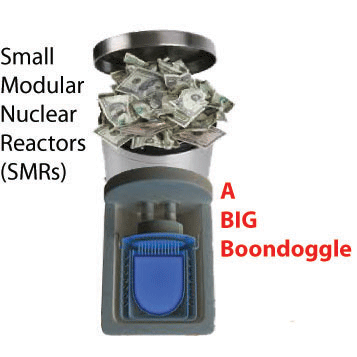
of the week – STOP SMALL MODULAR REACTORS IN CANADA
To see nuclear-related stories in greater depth and intensity – go to https://nuclearinformation.wordpress.com
-
Archives
- March 2026 (204)
- February 2026 (268)
- January 2026 (308)
- December 2025 (358)
- November 2025 (359)
- October 2025 (376)
- September 2025 (258)
- August 2025 (319)
- July 2025 (230)
- June 2025 (348)
- May 2025 (261)
- April 2025 (305)
-
Categories
- 1
- 1 NUCLEAR ISSUES
- business and costs
- climate change
- culture and arts
- ENERGY
- environment
- health
- history
- indigenous issues
- Legal
- marketing of nuclear
- media
- opposition to nuclear
- PERSONAL STORIES
- politics
- politics international
- Religion and ethics
- safety
- secrets,lies and civil liberties
- spinbuster
- technology
- Uranium
- wastes
- weapons and war
- Women
- 2 WORLD
- ACTION
- AFRICA
- Atrocities
- AUSTRALIA
- Christina's notes
- Christina's themes
- culture and arts
- Events
- Fuk 2022
- Fuk 2023
- Fukushima 2017
- Fukushima 2018
- fukushima 2019
- Fukushima 2020
- Fukushima 2021
- general
- global warming
- Humour (God we need it)
- Nuclear
- RARE EARTHS
- Reference
- resources – print
- Resources -audiovicual
- Weekly Newsletter
- World
- World Nuclear
- YouTube
-
RSS
Entries RSS
Comments RSS
 nuclear-news