Canada’s political leaders oblivious to the dangers in making plutonium accessible?
Our political leaders seem oblivious to the dangers to the entire planet that could result from widespread access to plutonium. If Canada can access plutonium, so can any other country. If many countries have access to plutonium, the possession of nuclear weapons must be regarded as a real possibility. In a nuclear-armed world, any conflict anywhere can turn into a nuclear war. The stakes could not be greater
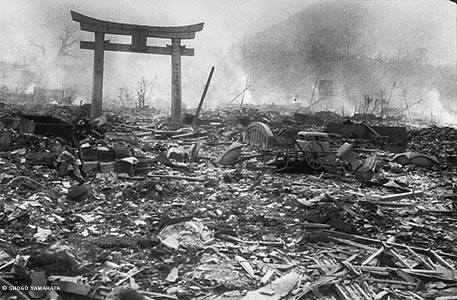
Plutonium: from Nagasaki to New Brunswick, https://nbmediacoop.org/2021/08/09/plutonium-from-nagasaki-to-new-brunswick/ by Gordon Edwards, August 9, 2021 Today, August 9, is the 76th anniversary of the US military’s atomic bombing of the City of Nagasaki in Japan. The nuclear explosive used was plutonium.
The destructive power of plutonium was first revealed on July 16, 1945, when a multicoloured mushroom cloud bloomed over the American desert – the first atomic explosion, top-secret, and much more powerful than expected. Robert Oppenheimer, the man in charge, was awestruck and thought of the words from the Bhagavad-Gita: “I am become Death, the Destroyer of Worlds.”
Three weeks and three days later, on August 9, 1945, the City of Nagasaki was destroyed with a single plutonium bomb.
Plutonium is named for Pluto, god of the dead. It is the primary nuclear explosive in the world’s nuclear arsenals. Even the largest nuclear warheads, based on nuclear fusion, require a plutonium “trigger” mechanism. Access to plutonium is key to the construction of such thermonuclear weapons. Removing the plutonium from nuclear warheads renders them impotent.
Plutonium is not found in nature but is created inside every nuclear power reactor,
including the one at Point Lepreau on the Bay of Fundy. Plutonium is a human-made derivative of uranium. A metallic element heavier than uranium, it is created inside the nuclear fuel along with hundreds of lighter, fiercely radioactive by-products – the fragments of uranium atoms that have been split.
The countries that have nuclear weapons – the five permanent members of the UN Security Council (US, UK, France, Russia and China) as well as India, Pakistan, Israel, and North Korea – have all learned how to separate plutonium from used nuclear fuel for use in weapons. This is done by dissolving the solid fuel assemblies in a hot, highly radioactive chemical bath from which the plutonium is extracted using basic scientific procedures. Any technology for extracting plutonium from used fuel is called reprocessing.
Nuclear advocates have long dreamed of using plutonium as a reactor fuel, thereby increasing the options for new reactor designs and magnifying the longevity of the nuclear age. The problem is, once plutonium has been extracted, it can be used either for weapons or for fuel at the discretion of the country possessing it. Policing methods can be circumvented. As Edward Teller has observed: “There is no such thing as a foolproof system because the fool is always greater than the proof.”
That’s how India exploded its first atomic bomb in 1974, by using plutonium created in a Canadian research reactor given as a gift to India and a reprocessing plant provided by the US. Both the reactor and the reprocessing plant had been designated as “peaceful” facilities intended for non-military use. India declared that the bomb it had detonated was a “Peaceful Nuclear Explosive.”
After the Indian blast, it was quickly determined that several other clients of Canadian technology – South Korea, Argentina, Taiwan, and Pakistan – were also in a position to develop a plutonium-based bomb program. Swift and decisive international action forestalled those threats. In particular, South Korea and Taiwan were discouraged by their US ally from pursuing reprocessing.
Shaken by these shocking developments, in 1977 US President Jimmy Carter – the only head of state ever trained as a nuclear engineer – banned the civilian extraction of plutonium in America and tried to have reprocessing banned worldwide, because of the danger that this nuclear bomb material could fall into the hands of criminals, terrorists, or militaristic regimes bent on building their own nuclear explosive devices. As one White House adviser remarked, “We might wake up and find Washington DC gone, and not even know who did it.”
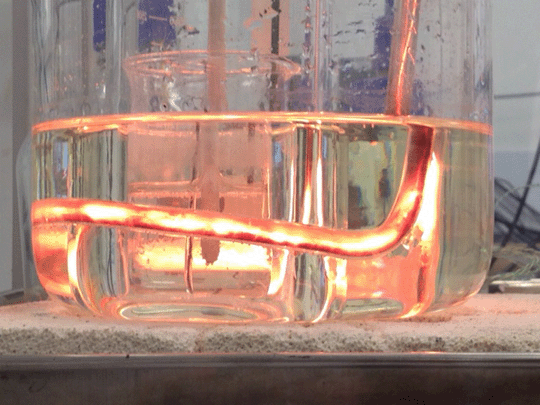
Japan is the only country without nuclear weapons that extracts plutonium from used nuclear fuel, much to the dismay of its neighbours. South Korea is not allowed to do so, despite repeated efforts by South Korea to obtain permission from the US to use a type of reprocessing technology called “pyroprocessing.” Pyroprocessing is currently undergoing experimental tests at a US nuclear laboratory in Idaho.
Now, New Brunswick has been enticed to take the plutonium plunge. The company Moltex Energy, recently established in Saint John from the UK, wants to use plutonium as a nuclear fuel in a type of reactor that is not yet fully conceptualized. The plutonium would be extracted from the thousands of solid irradiated nuclear fuel bundles currently stored at NB Power’s Point Lepreau reactor using a version of the pyroprocessing technology that South Korea has so far been denied.
On a site right beside the Bay of Fundy, the highly radioactive metallic fuel bundles would be dissolved in molten salt at a temperature of several hundred degrees. A strong electrical current would be used to strip the plutonium metal and a few other elements (less than one percent of the mass) out of the dissolved fuel.
After the government of Canada gave $50.5 million to support the Moltex project in March this year, nine retired US government advisors – all of them experts in preventing the proliferation of nuclear weapons – wrote to Prime Minister Justin Trudeau in May, urging him to authorize an independent review of the international implications of the proposed New Brunswick plutonium scheme.
These nine experts, who have worked under six different US presidents, both Republican and Democrat, are deeply concerned that Canada’s support for reprocessing and the civilian use of plutonium could seriously undermine delicate and precarious global non-proliferation efforts that have been underway for many decades.
No reply from the Canadian government has so far been received, although Trudeau’s office acknowledged receipt of the letter and said that the matter has been entrusted to Foreign Affairs Minister Marc Garneau and Natural Resources Minister Seamus O’Regan.
Without any word from these two ministers, Moltex posted a response to the US experts’ letter on their corporate web site, disputing some of the claims made in the letter to Trudeau. In particular, Moltex claims that their proposed technology is not usable for nuclear weapons purposes because the plutonium is not pure, but mixed with other contaminants that cannot easily be removed.
The Moltex response has prompted another letter to Trudeau from the US non-proliferation experts, correcting this and several other misleading comments from Moltex and reiterating their call for a fully independent expert review of the non-proliferation aspects of the Moltex proposal.
Our political leaders seem oblivious to the dangers to the entire planet that could result from widespread access to plutonium. If Canada can access plutonium, so can any other country. If many countries have access to plutonium, the possession of nuclear weapons must be regarded as a real possibility. In a nuclear-armed world, any conflict anywhere can turn into a nuclear war. The stakes could not be greater.
Citizens of New Brunswick and all Canadians who realize the importance of this issue can write to our Prime Minister in support of a non-proliferation review of the Moltex proposal, and raise this matter with candidates and at the door during the next federal election campaign. We can all raise awareness of the legacy of Nagasaki and do our best to ensure that New Brunswick is not implicated by going ahead with the Moltex plutonium extraction scheme.
Dr. Gordon Edwards, President of the Canadian Coalition for Nuclear Responsibility, is based in Montreal.
Costs of Ontario’s nuclear program will be the burden of the great-grandchildren of babies born in 2021.
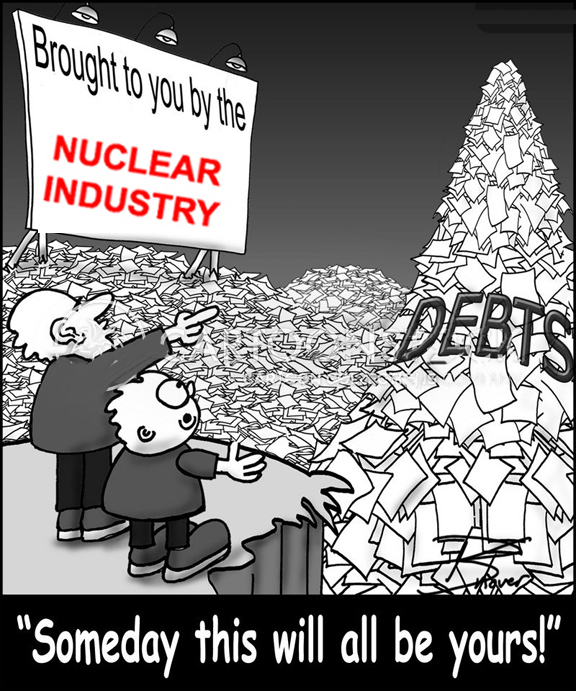
Ontario’s Unfunded Nuclear Decommissioning Liability Is In The $18–$27 Billion CAD Range Clean Technica, By Michael Barnard 8 Aug 21, Ontario’s nuclear program will be a fiscal burden on Ontarian’s to the tune of around $40 billion CAD which will be spent through roughly 2135, finally being paid off by the great-grandchildren of babies born in 2021.
Late last year I worked up the likely amount of public money that would have to be thrown at the nuclear industry in order to successfully and safely decommission the 100 operational reactors and the now shut down ones. Unsurprisingly, the nuclear industry had been very optimistic in its estimates of decommissioning costs and timeframes, when the global empirical averages were trending to a billion USD and 100 years per reactor.
Recently I was asked by an Ontario journalist what I thought the likely situation in Ontario would be, and whether the decommissioning trusts were equally underfunded. I was unsurprised to find that Canada is in the same boat as the US, with highly optimistic schedule and cost projections which belie Canadian empirical experience with the CANDU reactor, and that the fund had nowhere near the money necessary for the job. Let’s run the numbers.
Ontario Power Generation (OPG) is the chunk of the provincial utility that was carved apart in the late 1990s by the Mike Harris Conservatives to handle generation alone. It operates 18 aging CANDU reactors across three sites: Bruce, Pickering, and Darlington.
OPG has a nuclear decommissioning fund of about $5 billion CAD or US$4 billion right now. If the experience of other countries on the actual cost of a billion USD per reactor and an actual timeline of decommissioning of a century holds true, and I see no reason why it doesn’t, that means that there is currently a $17.5 billion CAD gap in Ontario, in addition to the existing $19.3 billion CAD in debt still being serviced from their construction. When the government of the era split up the utility, it moved all of the debt off of the components and into general debt. One of the many appropriate and sensible things that the McGuinty Administration did in the 2000s, in addition to shutting down coal generation entirely, was to move the debt back into the utility and set about servicing it from utility bills.
Most of the reactors at Bruce Nuclear are aging out, with several over 40 years old and the remainder approaching 40. Darlington’s are around 30, so they have a bit of runway. Pickering’s reactors are going to be shut down in 2024 and 2025 and start decommissioning in 2028. While refurbishment could bridge Ontario’s for another 20 years in many cases, that’s expensive and typically won’t pass any economic viability assessment compared to alternatives.
The likelihood is that all reactors in Ontario will reach end of life by 2035, and be replaced by some combination of renewable energy and HVDC transmission from neighboring jurisdictions, with both Manitoba and Quebec having excellent, low-carbon hydroelectric to spare…………
So yes, Ontario’s nuclear program will be a fiscal burden on Ontarians to the tune of around $40 billion CAD which will be spent through roughly 2135, finally being paid off by the great-grandchildren of babies born in 2021.
Nuclear, the gift that keeps on giving. https://cleantechnica.com/2021/08/06/ontarios-unfunded-nuclear-decommissioning-liability-is-in-the-18-27-billion-cad-range/
Moltex Energy’s nuclear pyroprocessing project with plutonium would produce weapons grade material and encourage weapons proliferation
Will Canada remain a credible nonproliferation partner? https://thebulletin.org/2021/07/will-canada-remain-a-credible-nonproliferation-partner/
By Susan O’Donnell, Gordon Edwards | July 26, 2021
Susan O’Donnell Susan O’Donnell is a researcher specializing in technology adoption and environmental issues at the University of New Brunswick.
Gordon Edwards Gordon Edwards is a mathematician, physicist, nuclear consultant, and president of the Canadian Coalition for Nuclear Responsibility,
The recent effort to persuade Canada to sign the Treaty on the Prohibition of Nuclear Weapons has stimulated a lively debate in the public sphere. At the same time, out of the spotlight, the start-up company Moltex Energy received a federal grant to develop a nuclear project in New Brunswick that experts say will undermine Canada’s credibility as a nonproliferation partner.
Moltex wants to extract plutonium from the thousands of used nuclear fuel bundles currently stored as “high-level radioactive waste” at the Point Lepreau reactor site on the Bay of Fundy. The idea is to use the plutonium as fuel for a new nuclear reactor, still in the design stage. If the project is successful, the entire package could be replicated and sold to other countries if the Government of Canada approves the sale.
The recent effort to persuade Canada to sign the Treaty on the Prohibition of Nuclear Weapons has stimulated a lively debate in the public sphere. At the same time, out of the spotlight, the start-up company Moltex Energy received a federal grant to develop a nuclear project in New Brunswick that experts say will undermine Canada’s credibility as a nonproliferation partner.
Moltex wants to extract plutonium from the thousands of used nuclear fuel bundles currently stored as “high-level radioactive waste” at the Point Lepreau reactor site on the Bay of Fundy. The idea is to use the plutonium as fuel for a new nuclear reactor, still in the design stage. If the project is successful, the entire package could be replicated and sold to other countries if the Government of Canada approves the sale.
On May 25, nine US nonproliferation experts sent an open letter to Prime Minister Justin Trudeau expressing concern that by “backing spent-fuel reprocessing and plutonium extraction, the Government of Canada will undermine the global nuclear weapons non-proliferation regime that Canada has done so much to strengthen.”
The nine signatories to the letter include senior White House appointees and other US government advisers who worked under six US presidents: John F. Kennedy, Lyndon B. Johnson, Richard Nixon, George H.W. Bush, Bill Clinton, and Barack Obama; and who hold professorships at the Harvard Kennedy School, University of Maryland, Georgetown University, University of Texas at Austin, George Washington University, and Princeton University.
Plutonium is a human-made element created as a byproduct in every nuclear reactor. It’s a “Jekyll and Hyde” kind of material: on the one hand, it is the stuff that nuclear weapons are made from. On the other hand, it can be used as a nuclear fuel. The crucial question is, can you have one without the other?
India exploded its first nuclear weapon in 1974 using plutonium extracted from a “peaceful” Canadian nuclear reactor given as a gift many years earlier. In the months afterwards, it was discovered that South Korea, Pakistan, Taiwan, and Argentina—all of them customers of Canadian nuclear technology—were well on the way to replicating India’s achievement. Swift action by the US and its allies prevented these countries from acquiring the necessary plutonium extraction facilities (called “reprocessing plants”). To this day, South Korea is not allowed to extract plutonium from used nuclear fuel on its own territory—a long-lasting political legacy of the 1974 Indian explosion and its aftermath—due to proliferation concerns.
Several years after the Indian explosion, the US Carter administration ended federal support for civil reprocessing of spent nuclear fuel in the US out of concern that it would contribute to the proliferation of nuclear weapons by making plutonium more available. At that time, Canada’s policy on reprocessing also changed to accord with the US policy—although no similar high-level announcement was made by the Canadian government.
Moltex is proposing to use a type of plutonium extraction technology called “pyroprocessing,” in which the solid used reactor fuel is converted to a liquid form, dissolved in a very hot bath of molten salt. What happens next is described by Moltex chairman and chief scientist Ian Scott in a recent article in Energy Intelligence. “We then—in a very, very simple process—extract the plutonium selectively from that molten metal. It’s literally a pot. You put the metal in, put salt in the top, mix them up, and the plutonium moves into the salt, and the salt’s our fuel. That’s it. … You tip the crucible and out pours the fuel for our reactor.”
The federal government recently supported the Moltex project with a $50.5-million grant, announced on March 18 by Intergovernmental Affairs Minister Dominic LeBlanc in Saint John.
At the event, LeBlanc and New Brunswick Premier Blaine Higgs described the Moltex project as “recycling” nuclear waste, although in fact barely one-half of one per cent of the used nuclear fuel is potentially available for use as new reactor fuel. That leaves a lot of radioactive waste left over.
From an international perspective, the government grant to Moltex can be seen as Canada sending a signal—giving a green light to plutonium extraction and the reprocessing of used nuclear fuel.
The US experts’ primary concern is that other countries could point to Canada’s support of the Moltex program to help justify its own plutonium acquisition programs. That could undo years of efforts to keep nuclear weapons out of the hands of countries that might want to join the ranks of unofficial nuclear weapons states such as Israel, India, Pakistan, and North Korea. The Moltex project is especially irksome since its proposed pyroprocessing technology is very similar to the one that South Korea has been trying to deploy for almost 10 years.
In their letter, the American experts point out that Japan is currently the only nonnuclear-armed state that reprocesses spent nuclear fuel, a fact that is provoking both domestic and international controversy.
In a follow-up exchange, signatory Frank von Hippel of Princeton University explained that the international controversy is threefold: (1) The United States sees both a nuclear weapons proliferation danger from Japan’s plutonium stockpile and also a nuclear terrorism threat from the possible theft of separated plutonium; (2) China and South Korea see Japan’s plutonium stocks as a basis for a rapid nuclear weaponization; and (3) South Korea’s nuclear-energy R&D community is demanding that the US grant them the same right to separate plutonium as Japan enjoys.
Despite the alarm raised by the nine authors in their letter to Trudeau, they have received no reply from the government. The only response has come from the Moltex CEO Rory O’Sullivan. His reply to a Globe and Mail reporter is similar to his earlier rebuttal in The Hill Times published in his letter to the editor on April 5: the plutonium extracted in the Moltex facility would be “completely unsuitable for use in weapons.”
But the International Atomic Energy Agency (IAEA) has stated that “Nuclear weapons can be fabricated using plutonium containing virtually any combination of plutonium isotopes.” All plutonium is of equal “sensitivity” for purposes of IAEA safeguards in nonnuclear weapon states.
Similarly, a 2009 report by nonproliferation experts from six US national laboratories concluded that pyroprocessing is about as susceptible to misuse for nuclear weapons as the original reprocessing technology used by the military, called PUREX.
In 2011, a US State Department official responsible for US nuclear cooperation agreements with other countries went further by stating that pyroprocessing is just as dangerous from a proliferation point of view as any other kind of plutonium extraction technology, saying: “frankly and positively that pyro-processing is reprocessing. Period. Full stop.”
And, despite years of effort, the IAEA has not yet developed an approach to effectively safeguard pyroprocessing to prevent diversion of plutonium for illicit uses.
Given that history has shown the dangers of promoting the greater availability of plutonium, why is the federal government supporting pyroprocessing?
It is clear the nuclear lobby wants it. In the industry’s report, “Feasibility of Small Modular Reactor Development and Deployment in Canada,” released in March, the reprocessing (which they call “recycling”) of spent nuclear fuel is presented as a key element of the industry’s future plans.
Important national and international issues are at stake, and conscientious Canadians should sit up and take notice. Parliamentarians of all parties owe it to their constituents to demand more accountability. To date however, there has been no democratic open debate or public consultation over the path Canada is charting with nuclear energy.
Countless Canadians have urged Canada to sign the UN Treaty on the Prohibition of Nuclear Weapons that came into force at the end of January this year. Ironically, the government has rebuffed these efforts, claiming that it does not want to “undermine” Canada’s long-standing effort to achieve a Fissile Materials Cut-off Treaty. Such a treaty would, if it ever saw the light of day (which seems increasingly unlikely), stop the production of weapons usable materials such as highly enriched uranium and (you guessed it) plutonium.
So, the Emperor not only has no clothes, but his right hand doesn’t know what his left hand is doing.
The need for integrity in epidemiological research: investigation of uranium miners’health to be carried out by pro nuclear bodies

“They want to show that it doesn’t cause cancer. I think they want to find that result.”
for years, the CNSC has served both as a regulator and promoter of the nuclear industry
“It is concerning that health standards are set by physicists and industries, based on financial and technological convenience, rather than by those educated in and committed to public health and safety.”
Canadian Nuclear Safety Commission to Investigate Lung Cancer Rates Among Uranium Workers, Mother Jones
What’s happened to 80,000 people who have worked in Canada’s mines and processing facilities?CHARLES MANDEL, 25 July 21, The Canadian Nuclear Safety Commission (CNSC) is leading a national study examining incidences of lung cancer in uranium workers from across the country.
The Canadian Uranium Workers Study (CANUWS) will examine health data from 80,000 past and present employees at Canada’s uranium mines, mills and processing and fabrication facilities. The study, which is now underway and set to end in 2023, is the largest examination of lung cancer in Canadian uranium workers to date.
Rachel Lane, one of the lead researchers on the new study, told Canada’s National Observer she believes it will reassure workers they face less risk than before from lung cancer arising from exposure to radon, ……..
The $800-million mining and milling uranium industry employs over 2,000 people—of whom more than half are residents of northern Saskatchewan—at mine sites. The researchers plan to examine causes of death in uranium workers from 1950 on and chart their cancer data from 1970 onwards, using research from previous studies.
The new study will build on the results of two historical studies: the Eldorado study and the Ontario Uranium Mine Workers Study, both of which found elevated risks of lung cancer in uranium workers. During numerous follow-ups ending in 2015, both studies found lung cancer among miners was still more prevalent than in the general population………….
deaths from lung cancer associated with radiation were historically higher for uranium workers than the general male population……….
In 2015, a follow-up to the 2007 Ontario Uranium Miner Cohort study was done. It examined approximately 28,546 male and 413 female uranium miners who had worked at least one week in the Elliot Lake and Bancroft regions or at the Agnew Lake Mine between 1954 and 1996.
The conclusion: “Significant elevations in lung cancer mortality and incidence, as well as silicosis and injury mortality were observed in comparison with the general Canadian population.”……….
Anne Leis, the department head of Community Health and Epidemiology at the University of Saskatchewan, will administer the project and analyze the data. Her colleague, Punam Pahwa, a professor of biostatistics, will lead the statistical analysis of the health data……….
Uranium mining companies Cameco, Orano, and BWXT are co-funding the study, contributing $60,000. The CNSC is providing $125,000, while the Saskatchewan government is kicking in $60,000, and the University of Saskatchewan is contributing $90,000 of in-kind funding.…………
Concerns Over Possible Bias
While former employees and industry watchers applaud efforts to study the health of uranium workers, some are skeptical about the ability of CNSC to produce an unbiased report.
Jamie Kneen, communications and outreach coordinator at Mining Watch Canada, says it’s important to understand the longer-term impacts of radon on the miners. But he cautions that the peer review and oversight of the study must be carefully examined because it is being led by CNSC.Kneen contends that for years, the CNSC has served both as a regulator and promoter of the nuclear industry. “Their tendency has been to extend license periods and to give operators, whether it’s in the uranium industry or the nuclear power industry, more space, more time in terms of licensing and more leeway rather than the kind of tight supervision and oversight that the public probably would expect.”
Therefore, it’s a question of scrutinizing who’s doing the work and reviewing the study to ensure that it really is independent, according to Kneen. He notes that’s a difficult task given that the methodology around radiation is intricate and that not many people can decipher the technical details.
“So there’s a lot of potential for not necessarily deliberate manipulation, but for error to creep in and biases to creep in.”
Rod Gardiner, a former general foreman at the now-defunct Cluff Lake Mine in Saskatchewan, expresses his own concerns about the industry. Gardiner was at the mine for 33 years, working his way up to general foreman and acting mine manager.
He alleges management at Cluff Lake, which was owned by the multinational mining corporation Orano Group, consistently boasted that working in the mine was as safe as working in a supermarket and putting prices on soup cans. “That’s what they used to say, the company.”
He hopes a new study might answer questions about workers’ health. But others aren’t sure whether results will be trustworthy, primarily because the CNSC is partially funding and leading the study.
The CNSC’s work has been subject to just those kinds of complaints in the past.
Writing in the journal Canadian Family Physician in 2013, Dale Dewar and two other authors expressed concern over the CNSC’s ability to act independently of government and industry. The authors noted the former Conservative federal government fired the commission’s CEO when she applied safety guidelines to shut down the Chalk River reactor in Ontario.
The authors observed: “It is concerning that health standards are set by physicists and industries, based on financial and technological convenience, rather than by those educated in and committed to public health and safety.”
Dewar, a longtime general physician in northern Saskatchewan, recently told Canada’s National Observer: “They want to show that it doesn’t cause cancer. I think they want to find that result.”
Dewar expressed surprise that the CNSC has opted for a focused study when northerners have been asking for decades for a baseline health study to determine such things as whether or not there have been increases in autoimmune diseases or cancers that couldn’t be explained by diet, for example.
“I think not only is it virtually a sin that they’ve never done this, but I think it’s a really huge missed opportunity because if they had a study done like this, they would have researchers around the world trying to get information out of it.”…………
Compensation for Uranium Workers
Another, less discussed issue is compensation for uranium miners. In the United States, the Radiation Exposure Compensation Act (RECA) administered by the Department of Justice has awarded over US$2.4 billion in benefits to more than 37,000 claimants since its introduction in 1990. https://www.motherjones.com/environment/2021/07/canadian-nuclear-safety-commission-to-investigate-lung-cancer-rates-among-uranium-workers/
Canada’s small nuclear reactor project is looking like just a pipe-dream.

Globe Climate: Canada wants nuclear to power the future. But how? SIERRA BEIN Matthew McClearn is an investigative reporter and data journalist with The Globe. For this week’sdeeper dive, he talks about Canada’s nuclear ambitions. Globe and Mail, 19 July 21
Senior government officials, notably federal Natural Resources Minister Seamus O’Regan, say small modular reactors (SMRs) will help Canada achieve net-zero carbon emissions by mid-century. There’s just one problem: it’s not clear yet whether any will be built.
To be sure, many promises made by SMR vendors seem compelling. By taking advantage of factory-style mass production, they’re supposed to be far cheaper than previous generations of reactors, which tended to be massive and prone to cost overruns. They’d also be easier to deploy……..
A mad scramble to deliver on these promises is now underway. Ontario Power Generation—by far Canada’s most experienced nuclear station operator—plans to select a vendor to build a SMR at its Darlington Station by 2028. Further out, Saskatchewan is considering whether to order its own SMRs to replace coal-fired plants.
Accomplishing all that would silence numerous critics and naysayers. But as I explain in my most recent story, history is littered with reactors that failed to live up to their promises. . Many SMR vendors are very early-stage companies which face years of grueling, expensive R&D work to advance their designs to the point they could actually be built. And they’re competing against renewable technologies including wind and solar, which utilities can purchase and deploy today. It may be premature to count on SMRs to help meet Canada’s emissions targets. https://www.theglobeandmail.com/canada/article-globe-climate-canada-wants-nuclear-to-power-the-future-but-how/https://www.theglobeandmail.com/canada/article-globe-climate-canada-wants-nuclear-to-power-the-future-but-how/
City Council in Calgary, Canada, not happy about ”rushed” agreement to own stranded nuclear wastes in Maine.

The 11-acre temporary storage site is patrolled around the clock by armed security guards.
The situation concerns Coun. Evan Woolley, who said that Enmax never mentioned the spent nuclear fuel site when the utility briefed city council on its bid for Versant.
Calgarians have a stake in Maine nuclear fuel storage facility https://mail.google.com/mail/u/0/?tab=rm&ogbl#inbox/KtbxLthlxCLcsbdhrlMgpmhjJQTWxmvSdV?compose=new
Facility part of the deal when Enmax bought U.S. utility for $1.8 billion, including debt
Scott Dippel · CBC News · Jul 19, 2021 Enmax’s acquisition of a utility in Maine last year came with a nuclear surprise that city council members say they weren’t told about.
When the city-owned Enmax closed on its deal to buy Versant Power (formerly Emera Maine) in March of 2020, it also acquired Versant’s interest in a former nuclear power plant.
The Maine Yankee plant operated from 1972 to 1996 and was decommissioned in 2005.
Versant owned 12 per cent of the electricity generated by the power plant. Its ratepayers also paid up front for 12 per cent of the decommissioning costs.
The plant was torn down and tonnes of spent nuclear fuel rods from the facility were temporarily encased in 64 concrete silos at a protected site in Wiscassett, Maine.
Part of the deal
The president of Versant Power, John Flynn, tells CBC News that Enmax couldn’t avoid taking on the Maine Yankee obligation when it purchased Versant.
“As part of the acquisition, Enmax really didn’t have the opportunity to pick and choose the assets or relationships or obligations it wanted,” said Flynn. “It was making a bid for the entire company.”
He said there isn’t a market for a temporary nuclear waste storage facility, so any buyer of Versant would have had to take on that obligation.
There are approximately $10 million US in annual costs related to the safe operation of the spent nuclear fuel storage site, including monitoring, maintenance and security.
About 38 people work at the site.
But Flynn said this doesn’t actually cost Versant or Enmax any money.
It’s covered by a trust fund which includes legal settlements from the US Department of Energy (DOE), which has a legal responsibility to ultimately remove the tonnes of spent fuel and find a permanent storage site.
Temporary site may be used for years
Flynn said there’s currently no estimate from the DOE on when it may move the materials to a final storage site.
He said the trust fund has enough money in it that the operation of the temporary facility will be covered for years to come.
In some years, Flynn said annual payments from the fund have been made to Versant customers who prepaid the decommissioning costs during the years the nuclear power plant was in operation.
The 11-acre temporary storage site is patrolled around the clock by armed security guards.
“The entire site is surrounded by a security perimeter that has 24/7 security that is of the level you would expect to see on an army base, so it is a hyper-secure site.”
While Enmax says it doesn’t own the spent nuclear fuel, it does list in its annual financial report the historical 12 per cent interest in Maine Yankee.
Council kept in dark
The situation concerns Coun. Evan Woolley, who said that Enmax never mentioned the spent nuclear fuel site when the utility briefed city council on its bid for Versant.
He is one of several council members contacted by CBC News who said they were unaware of that part of the $1.3 billion acquisition, which also included $500 million in debt.
Owning 12 per cent of a company that owns a bunch of nuclear waste has not only reputational risk but also real risk in terms of the world that we live in,” said Woolley.
The Ward 8 councillor, who is also the chair of council’s audit committee, said he would have liked to have known this information before council approved Enmax’s purchase.
“For us to not have been made aware of that is unacceptable,” said Woolley.
“Enmax and now Versant Power, which was Emera Maine, is owned by Calgarians. So council and the shareholder are accountable for that decision.”
Outside eyes needed
He describes Enmax’s pitch to city council to approve its takeover of the company in Maine as “rushed.”
His preference is that in future, a third party could assess such business opportunities for council and make a recommendation.
That perspective could come from the city’s chief financial officer, the city solicitor or an external consultant.
A report is expected before the audit committee in September, which he said could result in changes that could help ensure Enmax and all of the city’s wholly-owned subsidiaries are on the same page as city council in the future.
He describes Enmax as “the massive gorilla in the room in terms of its size and scale.” “The risk appetite of Enmax versus the risk appetite of a shareholder are different. And that’s where we need to provide better alignment,” said Woolley.
If council approves of any changes for its subsidiaries, he said it would mean that another transaction like the Versant purchase could not occur in the way that it did.
The 11-acre temporary storage site is patrolled around the clock by armed security guards.
The situation concerns Coun. Evan Woolley, who said that Enmax never mentioned the spent nuclear fuel site when the utility briefed city council on its bid for Versant.
Calgarians have a stake in Maine nuclear fuel storage facility AT TOP https://mail.google.com/mail/u/0/?tab=rm&ogbl#inbox/KtbxLthlxCLcsbdhrlMgpmhjJQTWxmvSdV?compose=new
Facility part of the deal when Enmax bought U.S. utility for $1.8 billion, including debt
Scott Dippel · CBC News · Jul 19, 2021 Enmax’s acquisition of a utility in Maine last year came with a nuclear surprise that city council members say they weren’t told about.
When the city-owned Enmax closed on its deal to buy Versant Power (formerly Emera Maine) in March of 2020, it also acquired Versant’s interest in a former nuclear power plant.
The Maine Yankee plant operated from 1972 to 1996 and was decommissioned in 2005.
Versant owned 12 per cent of the electricity generated by the power plant. Its ratepayers also paid up front for 12 per cent of the decommissioning costs.
The plant was torn down and tonnes of spent nuclear fuel rods from the facility were temporarily encased in 64 concrete silos at a protected site in Wiscassett, Maine.
Part of the deal
The president of Versant Power, John Flynn, tells CBC News that Enmax couldn’t avoid taking on the Maine Yankee obligation when it purchased Versant.
“As part of the acquisition, Enmax really didn’t have the opportunity to pick and choose the assets or relationships or obligations it wanted,” said Flynn. “It was making a bid for the entire company.”
He said there isn’t a market for a temporary nuclear waste storage facility, so any buyer of Versant would have had to take on that obligation.
There are approximately $10 million US in annual costs related to the safe operation of the spent nuclear fuel storage site, including monitoring, maintenance and security.
About 38 people work at the site.
But Flynn said this doesn’t actually cost Versant or Enmax any money.
It’s covered by a trust fund which includes legal settlements from the US Department of Energy (DOE), which has a legal responsibility to ultimately remove the tonnes of spent fuel and find a permanent storage site.
Temporary site may be used for years
Flynn said there’s currently no estimate from the DOE on when it may move the materials to a final storage site.
He said the trust fund has enough money in it that the operation of the temporary facility will be covered for years to come.
In some years, Flynn said annual payments from the fund have been made to Versant customers who prepaid the decommissioning costs during the years the nuclear power plant was in operation.
The 11-acre temporary storage site is patrolled around the clock by armed security guards.
“The entire site is surrounded by a security perimeter that has 24/7 security that is of the level you would expect to see on an army base, so it is a hyper-secure site.”
While Enmax says it doesn’t own the spent nuclear fuel, it does list in its annual financial report the historical 12 per cent interest in Maine Yankee.
Council kept in dark
The situation concerns Coun. Evan Woolley, who said that Enmax never mentioned the spent nuclear fuel site when the utility briefed city council on its bid for Versant.
He is one of several council members contacted by CBC News who said they were unaware of that part of the $1.3 billion acquisition, which also included $500 million in debt.
Owning 12 per cent of a company that owns a bunch of nuclear waste has not only reputational risk but also real risk in terms of the world that we live in,” said Woolley.
The Ward 8 councillor, who is also the chair of council’s audit committee, said he would have liked to have known this information before council approved Enmax’s purchase.
“For us to not have been made aware of that is unacceptable,” said Woolley.
“Enmax and now Versant Power, which was Emera Maine, is owned by Calgarians. So council and the shareholder are accountable for that decision.”
Outside eyes needed
He describes Enmax’s pitch to city council to approve its takeover of the company in Maine as “rushed.”
His preference is that in future, a third party could assess such business opportunities for council and make a recommendation.
That perspective could come from the city’s chief financial officer, the city solicitor or an external consultant.
A report is expected before the audit committee in September, which he said could result in changes that could help ensure Enmax and all of the city’s wholly-owned subsidiaries are on the same page as city council in the future.
He describes Enmax as “the massive gorilla in the room in terms of its size and scale.” “The risk appetite of Enmax versus the risk appetite of a shareholder are different. And that’s where we need to provide better alignment,” said Woolley.
If council approves of any changes for its subsidiaries, he said it would mean that another transaction like the Versant purchase could not occur in the way that it did.
Risk of cracks in pressure tubes of Canada’s ageing nuclear reactors – how long can they keep operating safely?

The regulatory violations at the Bruce station are the latest indication that the industry’s approach to managing the aging of pressure tubes, and predicting deuterium ingress, may be breaking down.
At issue is the industry’s ability to accurately predict how long Canada’s aging nuclear reactors, many of which have already exceeded their 30-year design life, can continue to operate safely
Reactors at Bruce nuclear station violated terms of operating licence, MATTHEW MCCLEARN Globe and Mail, 19 Juy 21,Two reactors at the Bruce Nuclear Generating Station have violated the terms of its operating licence, its operator and the federal regulator have revealed.
Bruce Power, which operates the plant in Kincardine, Ont., announced in a July 13 statement that pressure tubes in Unit 3 and Unit 6 were found to have “higher-than-anticipated readings.” The following day, the Canadian Nuclear Safety Commission (CNSC) issued its own statement saying hydrogen equivalent concentration (Heq) levels in some of the station’s pressure tubes exceeded the allowable limit of 120 parts per million.
Pressure tubes are six-metre-long rods that contain bundles of uranium fuel. A CANDU reactor contains several hundred of them – and they are considered the principal life-limiting component of Canada’s reactor fleet. Pressure tubes with high Heq levels are at risk of developing blisters and cracks that could cause them to fracture.
Citing an ongoing “regulatory process” that “will continue to evolve,” Bruce Power did not answer questions from The Globe and Mail regarding how many tubes were affected or how much they exceeded the allowable limit……………..
At issue is the industry’s ability to accurately predict how long Canada’s aging nuclear reactors, many of which have already exceeded their 30-year design life, can continue to operate safely……….
Frank Greening, a retired OPG employee who worked for more than a decade with pressure tubes, said the Unit 6 tube reading is unprecedented and puts the regulator in a difficult position………….
Pressure tubes deteriorate as they age, picking up deuterium (an isotope of hydrogen) through a corrosion process known as deuterium ingress. In combination with other aging processes, deuterium ingress causes tubes to grow in length and diameter, known as creep, which allows more coolant to bypass the fuel bundles, lowering the margin of safety. Over time, tube walls become thinner and more brittle, which can cause them to crack and eventually fracture.
In January, 2019, the CNSC renewed Bruce Power’s licence to operate the Bruce station for 10 years, to 2028. However, the regulator insisted that before Heq levels exceeded 120 ppm, Bruce Power would have to prove that its pressure tubes could continue to operate safely above that level. If any pressure tube reached the limit, it declared, the operator would have to shut down the reactor.
At the time, Bruce Power promised to “extend the validity limits of the existing fracture toughness model to 140 ppm of [Heq] in pressure tubes by the end of 2018 and to 160 ppm of [Heq] by the end of 2019.”
But the CNSC said it received a new fracture toughness model for review this May. “No decisions regarding acceptance of the model have been made at this time,” it said.
The regulatory violations at the Bruce station are the latest indication that the industry’s approach to managing the aging of pressure tubes, and predicting deuterium ingress, may be breaking down.
It shows their predictions aren’t worth beans,” Dr. Greening said. “Their predictions are failing. And this is not the first time.”
In March, The Globe reported that, since 2017, CNSC staffers had expressed concerns about unreliable data from pressure tube inspections by OPG at its Pickering plant, east of Toronto. CNSC staffers warned that measuring and predicting deuterium ingress is “potentially one of the biggest issues currently faced by the Industry.”………. https://www.theglobeandmail.com/business/article-reactors-at-bruce-nuclear-station-violated-terms-of-operating-licence/
Small Nuclear Reactors are all the hype. But here’s the reality

promoting a dizzying assortment of next-generation models that have collectively been dubbed “small modular reactors” (SMRs).……..
The real challenge “is answering all the safety questions that any good regulator would ask: ‘How will this behave if there’s an earthquake or fire? What happens if there’s a complete blackout? What happens if this component fails?’ ” Answering such questions requires an intensive research program and countless hours of laboratory work, which can take decades. There’s no guarantee the answers will be favourable.
Governments, utilities and the nuclear industry hope small modular reactors will power Canada’s future. Can they actually build one? The Globe and Mail MATTHEW MCCLEARN, JULY 17, 2021 Ontario Power Generation plans to make a decision this year that might determine the future of Canada’s nuclear industry.The utility, by far Canada’s largest nuclear power producer, promises to select a design for a 300-megawatt reactor it proposes to build at its Darlington Nuclear Generating Station by 2028. The estimated price tag: up to $3-billion. It would be the first new reactor built on Canadian soil in well over three decades. OPG won’t make that decision alone, because it’s intended to be the first of many reactors of the same design built across the country.Canada’s nuclear industry desperately needs a next act….. With a supply chain of more than 200 companies covering everything from uranium mining, to operating power plants, to decommissioning them, Canada is considered a Tier 1 nuclear country.
But lately, this machine has been devoted to squeezing more life out of old CANDU units, largely through Ontario’s $26-billion plan to refurbish its Darlington station, east of Toronto, and the Bruce Power complex, on Lake Huron. The industry has few, if any, exciting new products for sale……
but renewable forms of generation – hydro, wind, solar and biomass – have become preferred tools for decarbonizing electricity grids. And utilities can buy inexpensive wind turbines and solar panels today.
Seeking to catch up, dozens of nuclear vendors sprung up just in the past few years, promoting a dizzying assortment of next-generation models that have collectively been dubbed “small modular reactors” (SMRs)………
U.S. President Joe Biden and U.K. Prime Minister Boris Johnson have also indicated they will also support SMR development, as have some prominent investors, notably Bill Gates.

Here’s the reality: Most SMRs exist only as conceptual designs and are not yet licensed for construction anywhere.
The promised assembly lines that would churn them out like clockwork don’t exist
Here’s the reality: Most SMRs exist only as conceptual designs and are not yet licensed for construction anywhere. (The international law firm White & Case says the only contemporary SMR in existence is located on a vessel anchored off Russia’s Arctic coast. According to reports, construction of China’s first SMR recently commenced on the southern island of Hainan.) The promised assembly lines that would churn them out like clockwork don’t exist; many vendors are early-stage companies with hardly any revenues.
To change this, the federal government will probably have to open wide the taxpayer’s wallet. And the industry must move quickly from bold marketing claims to commercially viable products
OLD IDEAS, NEW PACKAGESMR is a marketing term, rather than a technical one, reflecting the industry’s aspirations rather than what it can deliver today.In Canada, SMR has come to describe reactors that generate 300 megawatts or less. That isn’t exactly small – it’s enough to power a small city – but for comparison’s sake, Ontario’s largest current reactors generate around 900 megawatts. Some proposed SMRs would produce just a few megawatts. The industry pitches them for remote Indigenous communities, industrial use (at mines, for instance) and tiny island nations.Small reactors aren’t new. They’ve been used in icebreakers, submarines and aircraft carriers. And many SMRs are based on concepts contemplated as long ago as the 1950s.
Oakville, Ont.-based Terrestrial Energy Inc., one of OPG’s potential partners, intends to use molten salt, rather than water, as a coolant. The company says its technology is a “game-changer”: The Integral Molten Salt Reactor (IMSR) would operate at much higher temperatures (about 700 C) than conventional reactors (about 300 C)….
As for the “modular” part, the notion is that SMRs would be mass-produced on assembly lines and shipped to where they’re needed, rather than custom-built onsite. This plug-and-play approach is intended to reduce purchase costs and accelerate deployment…………….
SMRs appeal to certain nationalist impulses as well: Canada is, after all, the world’s second-largest uranium producer.
…… The industry has made limited progress in addressing wastes from decades-old reactors; it’s unclear how novel detritus from SMRs might be handled. Perhaps most damagingly of all, reactors have earned a reputation for being overpriced relative to other forms of generation, and oftenbeleaguered by massive delays and cost overruns.
SMR GAME PLAN
The nuclear industry’s plan to reverse its flagging fortunes begins at Darlington. OPG announced late last year it was working with three SMR developers on preliminary design and engineering work: North Carolina-based GE Hitachi Nuclear Energy, Terrestrial Energy and X-energy. It promises to select a winner by year’s end….
Naturally, of course, no SMR developer aspires to be a one-hit wonder. So next up: Persuade Saskatchewan to build a fleet of the same reactors……….. Winning Saskatchewan would be a major coup: Jurisdictions that go nuclear tend to stay nuclear for decades. …… quandary remains: Prospective SMR buyers such as SaskPower can only look at conceptual designs. “There’s been some small demonstration units built, but nothing of the size that we would expect to see in operational terms,” Mr. Morgan said.
……... NUCLEAR GHOSTS Twenty years ago, Canada’s nuclear industry staked its future on updating the venerable CANDU design. Atomic Energy of Canada Ltd. (AECL), the
Crown corporation that pioneered it, talked up the Enhanced CANDU 6, CANDU 9 and Advanced CANDU Reactor (ACR) as safer, faster to construct, cheaper and better than previous models. The federal government pumped untold sums into their development.None were licensed. None were ordered. None were built.
In 2011, the federal government sold AECL’s reactor business to SNC-Lavalin for a paltry $15-million. After six decades of development, and dozens of bona fide reactors built and operated in seven countries, the CANDU had become nearly worthless.
The proposed site for OPG’s first SMR, next to the existing Darlington Station, is an artifact of that era. In 2006, OPG began preparing to build up to four reactors at the same location. AECL’s Enhanced CANDU 6 and the ACR 1000 were candidates.But the project was derailed in late 2013 when the Ontario government asked OPG to stand down, essentially because the province no longer needed the power. The viability of those “next-generation” CANDUs, however, was never clear.
It’s relatively easy to sketch a reactor design on the back of a napkin, or create promotional videos and brochures with snazzy renderings. Professor M.V. Ramana, of the University of British Columbia’s Liu Institute for Global Issues, says a few graduate students can develop a conceptual design for a few hundred thousand dollars.
But it’s quite another matter to advance a design to the point of actually building it. The real challenge, Prof. Ramana said, “is answering all the safety questions that any good regulator would ask: ‘How will this behave if there’s an earthquake or fire? What happens if there’s a complete blackout? What happens if this component fails?’ ” Answering such questions requires an intensive research program and countless hours of laboratory work, which can take decades. There’s no guarantee the answers will be favourable.
…………… Even a mature design isn’t enough. Just as Ford wouldn’t build an assembly line for the Mustang Mach-E if it thought it could sell only a handful, SMR vendors need assurances they’ll receive enough orders to justify mass production. It’s unclear how many orders would be sufficient, but published estimates have ranged from as low as 30 to well into the hundreds.
……… Prof. Ramana said many of the earliest power reactors met the modern definition of SMRs. But their diminutive size was rarely a virtue: It meant they couldn’t take advantage of economies of scale, resulting in high costs per unit of electricity generated, not to mention disproportionately greater volumes of radioactive waste. Many were shut down early.
“The lesson that we learned from some of these experiences is that designs that might seem captivating on paper might not actually work so well in real life,” Prof. Ramana said. “SMRs are not going to be economical. You can see that from the outset.”
………………. FEDERAL SUPPORT – THE CRUCIAL INGREDIENT. In contrast with the CANDU, the nuclear industry promises SMRs will be funded largely by the private sector. Many observers are skeptical. “Without government programs and financial support promoting SMRs, industry alone is unlikely to invest in the high up-front costs,” opined lawyers at Stikeman Elliott in a recent commentary.
Nor are non-nuclear provinces likely to make the leap alone. Mr. Morgan confirmed Saskatchewan seeks federal support to deploy SMRs, although the form of that support has yet to be determined.
For several years, federal and provincial government officials have signalled they want Canada to be one of the earliest adopters of SMRs. They’ve partnered with industry to produce road maps for making that happen. The governments of Ontario, New Brunswick, Saskatchewan and Alberta have agreed to collaborate on advancing SMRs. Mr. O’Regan, the federal Natural Resources Minister, has fully embraced the industry’s claim that Canada’s clean-energy transition cannot succeed without them,
So far, however, such pronouncements haven’t translated into generous subsidies. The federal government has channelled just meagre amounts of funding to SMRs, such as $20-million last October toward development of Terrestrial’s IMSR, and $50.5-million to New Brunswick-based Moltex Energy in March.
The latest federal budget didn’t mention SMRs. Nevertheless, studying its fine print, lawyers at McCarthy Tétrault LLP noticed what they described as “exciting policy levers.” They pointed, for example, to an income tax break of up to 50 per cent for manufacturers of zero-emission technologies. There was also $1-billion offered for clean tech projects “where there is a perceived lack of patient capital or ability to scale up because of the size of the Canadian market.” SMR vendors could capitalize on such programs, the lawyers concluded, depending on how they’re implemented.
Meanwhile, SMR vendors seek relaxed safety requirements that could make SMRs more cost-competitive.
……It’s unclear to what extent the Canadian Nuclear Safety Commission (CNSC) will acquiesce………….
Obtaining a licence typically takes a few years. “Experience has shown that it will be dramatically affected by the [proponent’s] capability of submitting adequate and complete information on day one,” Mr. Carrier said. Only one SMR has so far commenced a full licensing review: Ottawa-based Global First Power Ltd. submitted documentation for its Micro Modular Reactor in March.
The Union of Concerned Scientists, a long-time opponent of nuclear power, released a study in March which concluded that SMR designs, including molten salt reactors, are no safer than previous designs. It therefore urged regulators to maintain current requirements.
“The intense scrutiny, from policy makers and the public – given the safety and security angle combined with a nascent technology – will likely cause delays and conflicts” for SMR developers, lawyers from global law firm White & Case predicted in a recent commentary.
In short, SMRs’ future depends to a large extent on vendors delivering hard proof supporting their most ambitious promises about safety, efficiency, cost and other matters…….. a late arrival by SMRs could consign them to irrelevance. And right now, many observers regard them as too speculative to factor into forecasts. The federal government’s own Canada Energy Regulator projects the amount of power generated by nuclear reactors in Canada will continue on a declining trend.
Dennis Langren is a regulatory lawyer with Stikeman Elliott. He says the earliest deployments of SMRs in Canada are at least a decade off
Paris-based Mycle Schneider Consulting has reviewed the status of global SMR development three times since 2015. In the firm’s most recent review, published in September, 2020, it found little had changed over the period.
“Overall, there are few signs that would hint at a major breakthrough for SMRs, either with regard to the technology or with regard to the commercial side,” the firm observed. “Delays, poor economics, and the increased availability of low-carbon alternatives at rapidly decreasing cost plague these technologies as well, and there is no need to wait with bated breath for SMRs to be deployed.”
Ralph Torrie is a partner at Torrie Smith Associates, an energy and environmental consultancy. He says he’s focused on power generation options that can be built this decade to address a warming climate – a criterion that, in his view, disqualifies SMRs.“They’re a long way off.” theglobeandmail.com/business/article-governments-utilities-and-the-nuclear-industry-hope-small-modular/#:~:text=The%20utility%2C%20by%20far%20Canada’s,Nuclear%20Generating%20Station%20by%202028.–

In extreme heat wave, forest fire threatens Sakatchewan uranium mine – another example of global heating hitting nuclear activities.

Forest fire burns uncontained near Cigar Lake uranium mine in northern Sask., CBC, 2 July 21, All non-essential personnel have been evacuated due to the fire, Cameco said in a statement.
The Cameco Corporation has reported a forest fire in the vicinity of its Cigar Lake uranium mine in northern Saskatchewan.
In a statement Thursday morning, the company said it has evacuated about 230 workers from the mine and roughly 80 people remain on site to keep the facility in a safe state.
Cameco said, should the wildfire threat continue to grow, there is a plan to keep the workers there safe and a number of precautions have been implemented. It said it’s working closely with the Saskatchewan Public Safety Agency on site.
Cameco said the fire is complicated by extremely warm, dry weather resulting from the heat dome currently over Western Canada.
Production at the Cigar Lake mine has been temporarily suspended. …….
…… As of early Thursday afternoon, the provincial government’s website listed 19 active fires across Saskatchewan. Five are not contained, including the Briggs fire near the Cigar Lake mine. https://www.cbc.ca/news/canada/saskatchewan/forest-fire-cigar-lake-mine-1.6087459
Five good reasons to support the City of Ottawa’s request for a regional assessment of radioactive waste disposal projects in the Ottawa Valley.
Concerned Citizens of Renfrew County and Area
Working for 40+ years to prevent radioactive pollution in the Ottawa Valley, Canada. Five good reasons to support the City of Ottawa’s request for a regional assessment of radioactive waste disposal projects in the Ottawa Valley. On April 14, 2021, the City of Ottawa council passed a resolution regarding the Chalk River and Rolphton radioactive waste disposal projects; this is in addition to resolutions from 140 municipalities, the Anishinabek Nation, the Iroquois Caucus, and the Assembly of First Nations.
Before the resolution was passed by the entire Ottawa City Council, it was considered and unanimously adopted by the City of Ottawa’s environment committee after an eight-hour meeting on the 30th. March 2021 (see the presentation on YouTube). Among other things, the resolution calls on Minister Jonathan Wilkinson of the Environment and Climate Change to undertake a regional assessment of radioactive waste disposal projects in the Ottawa Valley under the Assessment Act. impact sanctioned in 2019. (See letter from Mayor Jim Watson to Minister Wilkinson.)
Here are five reasons to support the City of Ottawa’s request to Minister Jonathan Wilkinson.
1. Radioactive waste in the Ottawa Valley is a very large and complex problem. This is the lion’s share of “legacy” radioactive waste for which the federal government is responsible, a liability of $ 8 billion to Canadian taxpayers.
Radioactive waste that is currently at the Canadian Nuclear Laboratories site at Chalk River, upstream from Ottawa-Gatineau, constitutes the bulk of the Canadian government’s $ 8 billion nuclear liability liability. This federal liability for radioactive waste clean-up liability exceeds the total sum of 2,000 other federal environmental liabilities. This federal environmental responsibility, Canada’s largest and most complex, requires the best and most comprehensive assessment available under the new Impact Assessment Act.
2 The proposed radioactive waste disposal projects in the Ottawa Valley are mediocre, highly controversial, and fail to address several aspects essential to the cleanup required.
The radioactive waste mound project, called the Near Surface Waste Management Facility (IGDPS) at Chalk River and the Rolphton Reactor Entombment Project ("NPD Closure Project") are inadequate, low budget proposals which aim to rapidly and inexpensively reduce the liability for federal nuclear liabilities in Canada. Both projects were proposed five years ago by a consortium of private companies under a contract awarded by the Harper government in 2015. The proposals do not take into account the International Agency's security standards. atomic energy; these proposals were deemed insufficient in the thousands of critical comments made by indigenous communities, municipalities, former scientists and managers of AECL, NGOs, citizen groups and individuals........... more https://concernedcitizens.net/2021/06/30/cinq-bonnes-raisons-dappuyer-la-requete-de-la-ville-dottawa-pour-une-evaluation-regionale-des-projets-delimination-des-dechets-radioactifs-dans-la-vallee-de-loutaouais/
High school lobbyists ‘thrilled’ as Winnipeg unanimously supports ban on nuclear weapons,

CBC News · Jun 27, 2021 Two Winnipeg high school students are “thrilled” after their campaign to get the city’s support for a ban on nuclear weapons got council’s unanimous backing.
“We were both thrilled because this is months and months of work,” Avinashpall Singh said of Thursday’s vote.
Singh and classmate Rooj Ali started working in March toward their goal of getting the City of Winnipeg’s support for the United Nations Treaty on the Prohibition of Nuclear Weapons as part of the youth-led International Campaign to Abolish Nuclear Weapons Cities Appeal.
High school lobbyists ‘thrilled’ as Winnipeg unanimously supports ban on nuclear weapons,
City joins 14 others across Canada in backing UN Treaty on the Prohibition of Nuclear Weapons https://www.cbc.ca/news/canada/manitoba/winnipeg-city-council-supports-nuclear-ban-unanimously-1.6082203
CBC News · Jun 27, 2021 Two Winnipeg high school students are “thrilled” after their campaign to get the city’s support for a ban on nuclear weapons got council’s unanimous backing.
“We were both thrilled because this is months and months of work,” Avinashpall Singh said of Thursday’s vote.
Singh and classmate Rooj Ali started working in March toward their goal of getting the City of Winnipeg’s support for the United Nations Treaty on the Prohibition of Nuclear Weapons as part of the youth-led International Campaign to Abolish Nuclear Weapons Cities Appeal.
That campaign looks to gain support at a municipal level for the first legally binding international agreement to ban nuclear weapons.
They got endorsements from organizations including the Canadian Museum for Human Rights, the Rotary Club of Winnipeg and Manitoba’s Mennonite Central Committee, and gave presentations to city committees and councillors across Winnipeg — all while balancing homework and other commitments at River East Collegiate.
It’s a cause the students have been working on for years, they told CBC’s Weekend Morning Show host Stephanie Cram on Sunday.
“This cause is incredibly important for us because, among other things that our generation will be inheriting, it will still be a world still full of nuclear weapons. And so we aren’t going to stay silent as this happens,” Singh said.
“I think by far the most important reason is that [a nuclear incident] doesn’t have to be with intent. It could also be through an accident that something catastrophic could happen. And so [if we’re] trying to eliminate that risk totally, disarmament is the only guarantee toward that. No other solution exists.”
Ali says she hopes their achievement with city council inspires other young people to get involved in issues that matter to them.
“No cause or activism work is too impossible to achieve,” Ali said.
“The key to making change is to start. And we started this not knowing where it could end up, but we took it so far and we’re so happy for that.”
The move means Winnipeg joins 14 other Canadian cities, including Toronto, Vancouver and Montreal, in support of the nuclear weapons prohibition treaty, the campaign’s website says.
However, while Canada has said it’s committed to nuclear disarmament, it has so far not signed the UN treaty.
Ali says that’s why getting Winnipeg’s support felt like such a win — it added one more city to the list of those willing to go on the record that it stands in support of the ban, and potentially sends a message to Ottawa.
“Not one city is going to make a difference,” she said.
“But when more cities do it — especially here in Canada, as Winnipeg joins the list — then hopefully we can turn that conversation up to the national level and make this a priority, because right now it’s not as discussed as it should be and that needs to change.”
The biggest issue is still awareness, so Ali and Singh’s work isn’t done yet. Next, they say they plan to take the campaign to other cities and municipalities in Manitoba and Canada.
Scientists say New Brunswick’s plutonium plan is undermining the global nuclear weapons non-proliferation regime
Scientists say New Brunswick’s plutonium plan is undermining the global nuclear weapons non-proliferation regime, https://nbmediacoop.org/2021/06/14/scientists-say-nbs-plutonium-plan-is-undermining-the-global-nuclear-weapons-non-proliferation-regime/ by Susan O’Donnell and Gordon EdwardsJune 14, 2021 The company Moltex Energy wants to extract plutonium from the thousands of used nuclear fuel bundles stored at Point Lepreau on the Bay of Fundy. They plan to use the plutonium as fuel for a new nuclear reactor, still in the design stage. If the project is successful, the entire package could be replicated and sold to other countries.
However, American scientists and non-proliferation experts say that Canadian government support for the Moltex plutonium-extraction project is undermining the global nuclear weapons non-proliferation regime. Plutonium is the primary nuclear explosive material in the world’s arsenals of nuclear weapons.
On March 18 this year, federal Intergovernmental Affairs Minister Dominic LeBlanc announced a $50.5 million grant for the Moltex project, adding to the $5 million the New Brunswick government gave the company in 2018. During the announcement, LeBlanc and Premier Blaine Higgs described the Moltex project as “recycling” nuclear waste, although less than one percent of the used nuclear fuel is potentially available for use as new reactor fuel, leaving a lot of radioactive waste leftovers.
On May 25, nine US non-proliferation experts sent an open letter to Prime Minister Trudeau expressing concern that by “backing spent-fuel reprocessing and plutonium extraction, the government of Canada will undermine the global nuclear weapons non-proliferation regime that Canada has done so much to strengthen.”
The nine signatories to the letter include senior White House scientist appointees and other US government advisors who worked under six US presidents: Kennedy, Johnson, Nixon, George H.W. Bush, Clinton, and Obama; and who hold professorships at the Harvard Kennedy School, University of Maryland, Georgetown University, University of Texas at Austin, George Washington University and Princeton University.

Plutonium is a human-made element created as a byproduct in every nuclear reactor. India exploded its first nuclear weapon in 1974 using plutonium extracted from a “peaceful” Canadian nuclear reactor given as a gift many years earlier. In the months afterwards, it was discovered that South Korea, Pakistan, Taiwan and Argentina – all customers of Canadian nuclear technology – were well on the way to replicating India’s achievement.
The US and its allies acted swiftly to prevent these countries from acquiring the necessary plutonium extraction facilities. To this day South Korea is not allowed to extract plutonium from used nuclear fuel on its own territory due to proliferation concerns.
Several years after the Indian explosion, the US Carter administration ended federal support for civil reprocessing of spent nuclear fuel in the US out of concern that making plutonium more available would contribute to the proliferation of nuclear weapons. At that time, Canada’s policy on reprocessing also changed to accord with the US policy.
Moltex is proposing extract plutonium at Point Lepreau using “pyroprocessing,” in which the solid used reactor fuel is converted to a liquid form, dissolved in a very hot bath of molten salt. What happens next was described by Moltex Chairman and Chief Scientist Ian Scott in a recent article in Energy Intelligence. “We then — in a very, very simple process — extract the plutonium selectively from that molten metal. It’s literally a pot. You put the metal in, put salt in the top, mix them up, and the plutonium moves into the salt, and the salt’s our fuel. That’s it … You tip the crucible and out pours the fuel for our reactor.”
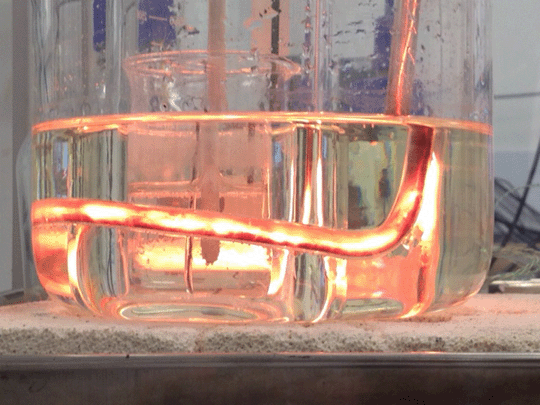
From an international perspective, the federal support of the Moltex project can be seen as Canada sending a signal – giving a green light to plutonium extraction and the reprocessing of used nuclear fuel.
The US experts are concerned other countries could point to Canada’s support of the Moltex project to help justify their own plutonium acquisition programs. That could undo years of efforts to keep nuclear weapons out of the hands of countries that might want to join the ranks of unofficial nuclear weapons states. The Moltex project is especially irksome since its proposed pyroprocessing technology is very similar to the one South Korea has been trying to deploy for almost 10 years.
Despite the alarm raised by the nine experts in their letter to Trudeau, the government has not yet responded. The only response has come from the industry, Moltex CEO Rory O’Sullivan. His reply to a Globe and Mail reporter: the plutonium extracted in the Moltex facility would be “completely unsuitable for use in weapons.”
But the International Atomic Energy Agency (IAEA) has stated that “Nuclear weapons can be fabricated using plutonium containing virtually any combination of plutonium isotopes.” All plutonium is of equal “sensitivity” for purposes of IAEA safeguards in non-nuclear weapon States.
Similarly, a 2009 report by non-proliferation experts from six US national laboratories concluded that pyroprocessing is about as susceptible to misuse for nuclear weapons as the original reprocessing technology used by the military.
In 2011, a US State Department official responsible stated that pyroprocessing is just as dangerous from a proliferation point of view as any other kind of plutonium extraction technology, saying “frankly and positively that pyroprocessing is reprocessing. Period. Full stop.”
And, despite years of effort, the IAEA has not yet developed an approach to effectively safeguard pyroprocessing to prevent diversion of plutonium for illicit uses.
Given that history has shown the dangers of promoting the greater availability of plutonium, why is the federal government supporting pyroprocessing?
The answer: the Canadian nuclear lobby wants it. In the nuclear industry’s report released in March, “Feasibility of Small Modular Reactor Development and Deployment in Canada,” reprocessing (which they call “recycling”) spent nuclear fuel is presented as key to the industry’s future plans.
To date however, there has been no democratic open debate or public consultation over the path Canada is charting with nuclear energy. Important national and international issues are at stake, and conscientious New Brunswickers and all Canadians should sit up and take notice. Political representatives in the Canadian Parliament and the New Brunswick Legislature owe it to their constituents to demand more accountability and ask why our governments are supporting a plutonium-extraction project that raises such serious international concerns.
Susan O’Donnell, a Fredericton-based researcher specializing in technology adoption and environmental issues, is the lead researcher for the RAVEN project at the University of New Brunswick. Gordon Edwards is a Montreal-based mathematician, physicist, nuclear consultant, and President of the Canadian Coalition for Nuclear Responsibility.
New technology comes nowhere close to solving the problem of nuclear waste

New technology comes nowhere close to solving the problem of nuclear waste, Toronto Star, By Thomas Walkom May 27, 2021 What is to be done with nuclear waste? It is a question that dominates the Atomic Age. It is also one that has never been satisfactorily answered…..
nuclear waste is a relentless certainty. A plant that produces nuclear power creates nuclear waste. It is that simple.But what to do with that waste? Up to now, the assumption was that such waste would be buried in deep geological caverns, or repositories. Two potential sites for such repositories have been identified — one in Northwestern Ontario and one near Lake Huron. The usual political battles are being waged over whether either or both sites are safe.
But over the last few years, more attention has been paid to a different solution — using radioactive waste as fuel to create more nuclear power from so-called small modular reactors (SMRs). The governments of Saskatchewan, Ontario and New Brunswick have been particularly interested in developing this new SMR technology.
One New Brunswick start-up, Moltex Energy of Saint John, has received $50.5 million in federal funds.
The new technology has its critics. In the first place, it can create new and even more dangerous radioactive waste. As the Globe and Mail reports, Moltex says it produces an impure form of plutonium as a waste byproduct from its SMRs. Pure plutonium is used in the manufacture of atomic bombs.
Indeed, some nuclear experts, including former senior U.S. officials, were so alarmed that seven of them took the unusual step of penning an open letter this week to Prime Minister Justin Trudeau.
In that letter, they warned that reprocessing waste in a manner that creates plutonium would undermine global efforts to limit nuclear proliferation.
They also noted that the new technology wouldn’t solve the waste problem. Rather, it would just produce different kinds of nuclear waste.
“Moltex, even in the R&D stage, would create a costly legacy of contaminated facilities and radioactive waste streams and require substantial additional government funding for cleanup,” the letter said.
All of this is true. But none of it is enough to derail the new interest in SMR technology. Governments like it because it promises to be cheaper to build than classic Pickering-style nuclear power plants. The nuclear industry sees it as a political lifeline at a time when atomic power is not particularly popular.
So regardless of what its critics say, don’t expect this new technology to fade away. It may not be the silver bullet that its adherents claim it to be. It comes nowhere close to solving the waste problem.
But it is supported by important political constituencies. History has shown how crucial this support has been to the nuclear industry. https://www.thestar.com/opinion/contributors/2021/05/27/new-technology-comes-nowhere-close-to-solving-the-problem-of-nuclear-waste.html
American experts warn Trudeau that Moltex small nuclear reactors are likely to prove a nightmare for Canada

The critics contend that SMRs are costly, unproven and creators of toxic waste of their own. From a practical point of view, it is hard to make the case that SMRs will be crucial in the battle against climate change, since they won’t come off the drawing board for years, if ever. Former Green Party leader Elizabeth May says that opting for experimental SMRs is just another way of delaying real action on global warming.
US Experts to Trudeau: Your Nuclear Dream May Turn Nightmare https://thetyee.ca/Analysis/2021/05/26/US-Experts-Trudeau-Your-Nuclear-Dream-May-Turn-Nightmare/?utm_source=daily&utm_medium=email&utm_campaign=260521
Rethink backing the Moltex reactor, urge nine non-proliferation heavyweights.
Michael Harris TheTyee.ca, 6 May 21, A blue-ribbon group of American nuclear non-proliferation experts warns that Canada’s investment in new nuclear technology could lead to the spread of nuclear weapons and new threats to the environment.
“We write as U.S. non-proliferation experts and former government officials and advisors with related responsibilities to express our concern about your government’s financial support of Moltex — a startup company that proposes to reprocess CANDU spent fuel to recover its contained plutonium for use in molten-salt-cooled reactors.”
The warning came in the form of an open letter to Prime Minister Justin Trudeau that was delivered on Tuesday and signed by the nine experts.
The group is spearheaded by Frank von Hippel, professor and senior research physicist at Princeton University; it includes Matthew Bunn, the Schlesinger professor of the practise of energy, national security, and foreign policy at the Harvard Kennedy School; and Thomas Countryman, former U.S. assistant secretary of state for non-proliferation.
“We understand your government’s motivation to support nuclear power and to reduce fossil fuel use but saving the world from climate disaster need not be in conflict with saving it from nuclear weapons. Also, like other reprocessing efforts, Moltex, even in the R&D stage, would create a costly legacy of contaminated facilities and radioactive waste streams, and require substantial additional government funding for cleanup and stabilization prior to disposal,” they wrote.
Rory O’Sullivan, CEO of Moltex North America painted a very different picture of his company’s experimental technology in an interview with World Nuclear News: “We are working to develop a technology that uses the fuel from the first generation of nuclear power to the next. This reduces the challenges associated with spent nuclear fuel, while expanding nuclear power to help Canada achieve its climate change objectives.”
The Trudeau government has invested $50.5 million in Moltex, and backs the company’s plan to build a 300 MW molten salt reactor in New Brunswick on the Bay of Fundy. Theoretically, it would then reprocess spent fuel from the Point Lepreau nuclear plant, which is set to be decommissioned in 2040.
The Moltex reactor belongs to a class of nuclear power plants termed small modular reactors or SMRs that generate small amounts of electricity in comparison with typical CANDU reactors.
Natural Resources Minister Seamus O’Regan has said that Canada can’t get to net-zero carbon emissions by 2050 without nuclear as part of the equation, along with renewables.
Despite marketing its roll of the dice on Moltex as part of its war on climate change, Ottawa isn’t getting much love from environmentalists, or many other people. Three federal political parties, the NDP, the Bloc and the Greens; the Green Budget Coalition; and the Canadian Environmental Law Association all oppose the federal investment in small modular reactors. University of British Columbia professor of public policy and global affairs M.V. Ramana has levelled criticisms in these pages as well.
The critics contend that SMRs are costly, unproven and creators of toxic waste of their own. From a practical point of view, it is hard to make the case that SMRs will be crucial in the battle against climate change, since they won’t come off the drawing board for years, if ever. Former Green Party leader Elizabeth May says that opting for experimental SMRs is just another way of delaying real action on global warming.
One who has closely followed and opposes the two experimental SMR reactors planned for New Brunswick, the ARC-100 and the Moltex SSR, is Dr. Susan O’Donnell, an adjunct professor of sociology at the University of New Brunswick. O’Donnell is also the primary investigator of Raven, a research team based at the university dedicated to highlighting rural environmental issues in the province.
O’Donnell points out that Moltex has never built a nuclear reactor before. In fact, only two molten salt reactors have ever been built — 50 years ago. Neither of them produced electricity. One of them lasted four years before shutting down, the other, just 100 hours.
On the environmental side, O’Donnell says that SMR pollution or a serious failure could lead to “disasters and no-go zones.”
On the non-proliferation front, she denounces the plan to broadly “export” the Moltex technology, assuming it ever gets up and running.
“What we have learned from Canada’s role in making India a nuclear power is that one of the dangers of the Moltex proposal is its plan to export the technology. We’re exporting bomb-making capacity,” she told The Tyee.
O’Donnell has pushed for public consultations to help develop a national radioactive waste policy. Last Aug. 13, she made an offer to the federal minister of natural resources to have the Raven project organize such a public consultation in New Brunswick. It would be online because of the pandemic, in both official languages, and would include Indigenous nations and rural communities. Minister O’Regan responded two months later, on Oct. 30, turning her down.
“Strangely, he cited the pandemic, even though our offer clearly stated the consultation would be virtual,” the professor said.
O’Donnell’s take on the Moltex project is backed up by Allison Macfarlane, former chair of the U.S. Nuclear Regulatory Commission. The specialist in the storage of nuclear waste told the CBC in January that the molten salt technology is totally unproven with respect to viability, costs and storage risks.
“Nobody knows what the numbers are, and anybody who gives you numbers is selling you a bridge to nowhere…. Nobody’s been able to answer my questions yet on what all those wastes are, and how much of them there are, and how heat-producing they are and what their compositions are,” Macfarlane said. She is now the director of the School of Public Policy and Global Affairs at UBC.
But the Trudeau government does have allies at the provincial level for its nuclear ambitions. The governments of New Brunswick, Ontario, Saskatchewan and Alberta have all signed a memorandum of understanding to develop SMRs, which means promoting them.
They are excited about the promises by Moltex that it will be able to produce clean energy at a low cost by recycling something that everyone wants to get rid of — the three million spent fuel bundles in Canada that the government still doesn’t know how to dispose of safely and permanently.
The U.S. experts made clear to the PM in their letter that they are not convinced by the company’s assertions. They want the Trudeau government to convene a high-level review of both the non-proliferation and environmental implications of Moltex’s reprocessing proposal. Key to that proposal is including “independent international experts,” before Ottawa makes any further investments in support of the Moltex proposal.
The earliest projects to reprocess nuclear waste extracted plutonium to make nuclear weapons. The letter signees worry Canada’s new generation of reactors will afford the same opportunity to anyone who buys them.
“Our main concern is that, by backing spent-fuel reprocessing and plutonium extraction, the government of Canada will undermine the global nuclear weapons non-proliferation regime that Canada has done so much to strengthen. Canada is a founding member of the Nuclear Suppliers Group, which was established in 1974 in response to India’s misuse of a Canada-supplied research reactor and U.S.-supplied reprocessing technology to acquire the plutonium needed for its first nuclear weapons.”
The reprocessing of nuclear waste was “indefinitely deferred” in the United States by president Jimmy Carter in 1977 after India tested its first nuclear weapon. At the time, the Americans discovered that several other countries including Brazil, Pakistan, South Korea and Taiwan were all surreptitiously headed down the same nuclear weapons path that India had taken. Of that group, only Pakistan managed to get the bomb.
The U.S. experts who signed the letter to Trudeau also rejected the claim by Moltex that by using spent fuel from older Canadian CANDU reactors, its reactor would reduce the long-term risk from a deep underground radioactive waste repository.
The Trudeau government promised it would base its major policies on science. It’s time for the public consultation, far from the greasy paws of lobbyists, and with the best minds that can be brought to the table.
This is a letter to take to heart.
Canadian government in the grip of the nuclear lobby’s NICE dishonest spin about small nuclear reactors.
”…………….To date, not a single SMR has been built in Canada, but no matter, the technology is the current darling of nuclear power circles, and not just at home, either; other countries, from China to the United States, are pursuing the development of SMRs. Currently, 12 proposals for SMR development are winding their way through the Canadian Nuclear Safety Commission’s (CNSC) pre-licensing vendor review process, which enables CNSC staff to provide feedback on proposed designs at a company’s request. But not a single project has yet been approved.
For the time being, any vision of SMRs is largely aspirational. A Conference Board of Canada report in March on SMRs outlined that from concept to commercialization, the technology will require about a billion dollars of development expenditure. The same report noted that as an emerging technology, costs are still uncertain, and the “risky pre-commercial phase needs capital investment, but governments will be reluctant without major private capital commitment.”
It’s early days for financing the technology. For instance, one infusion of federal funds, the $50 million granted to New Brunswick’s Moltex Energy in mid-April, only supports research and development, employee recruitment and the expansion of academic, research and supply chain partnerships, not the physical construction of that firm’s SMR.
Beyond financial considerations, the Liberal government will have a tough time convincing environmentalists to embrace the merits of SMRs, or any nuclear power, as a clean energy source. More than 100 groups have signed a letter issued by the Canadian Environmental Law Association condemning the government’s push to pursue nuclear power and SMRs. Among their concerns are that SMRs are more expensive to develop than renewable energy and that the reactors are “dirty and dangerous,” creating new forms of radioactive waste that are especially dangerous to manage.
For now, however, nothing is slowing the momentum. In mid-April, the Canadian Nuclear Association triumphantly announced Alberta was joining Ontario, New Brunswick and Saskatchewan in the development of SMRs.
Those aren’t the only recent developments in the burgeoning SMR industry. Ontario Power Generation is teaming up with SMR developer Ultra Safe Nuclear Corporation to develop a micro modular reactor at Chalk River. Ontario Power Generation is also carrying out engineering and design work on SMRs with GE Hitachi, Terrestrial Energy, and X-energy…….
Europe is now shifting away from nuclear power. In 2019, solar installed capacity exceeded nuclear for the first time in the EU, with 130 gigawatts versus 116 gigawatts, according to the World Nuclear Industry Status annual report, which provides independent assessments of global nuclear developments. And a technical expert group convened in the EU chose not to recommend nuclear energy when asked to advise on screening criteria that would substantially contribute to climate change mitigation or adaptation while “avoiding significant harm” to other environmental objectives.,…..
the federal government has been lobbying hard on behalf of the industry since at least 2019. The Department of Natural Resources, for instance, is a member of the international initiative Nuclear Innovation: Clean Energy Future, or as it’s better known, NICE, Besides Canada, members include Japan, the United States, and a number of nuclear associations. The goal “is to ensure that nuclear energy receives appropriate representation in high-level discussions about clean energy.”
Freelance researcher Ken Rubin turned up a number of documents using freedom-of-information requests that showed the federal government is collaborating with NICE and others to promote nuclear power and SMRs. The federal government, for example, offered $150,000 for the development of a “Top 20 book of short stories” on “exciting near-term nuclear innovations” designed to showcase nuclear power as an environmental force for good. The book includes stories on the safe storage of nuclear waste as well as on the emerging SMR market.
According to the book, uses for the latter technology include “energy parks” providing heat for industrial processes, steam for heating and electricity for cooling homes, offices and shops, all without emissions. The story breathlessly declares: “This isn’t science fiction.”
No matter how hard the government lobbies the public for a NICE future, though, it’s going to remain a tough sell to Canadian environmentalists. While the environmentalists have nothing specific to fight yet, given that a viable SMR has yet to be built, they’ll be ready when the technology reaches development. Already, a who’s who of groups has signed a letter protesting the next thing in nuclear.
Theresa McClenaghan, CELA’s executive director and counsel, told Canada’s National Observer: “It’s not a climate answer for many reasons, including the fact it’s not realistic and it’s way too far down the road for us to meet any serious climate targets. We’ve characterized it as a dirty, dangerous distraction.”
Susan O’Donnell, a researcher and adjunct professor in the Department of Sociology at the University of New Brunswick and a nuclear activist, says SMRs are too slow and costly as a climate crisis solution. “It’s important to remember that these technologies basically don’t exist yet,” she said. “They’re at a very early stage in development. They are speculative technologies. It will take at least a decade to get them off the drawing board and then it will take much longer than that to find out if they work.” – from the Bulletin of the Atomic Scientists , 20 May 21
1 This Month


Tell the Ukrainian Government to Drop Prosecution of Peace Activist Yurii Sheliazhenko

Petition to revoke the licensing of the Near Surface Nuclear Disposal Facility (NSDF) at Chalk River. https://www.ourcommons.ca/petitions/en/Petition/Details?Petition=e-7247


of the week – STOP SMALL MODULAR REACTORS IN CANADA
To see nuclear-related stories in greater depth and intensity – go to https://nuclearinformation.wordpress.com
-
Archives
- March 2026 (183)
- February 2026 (268)
- January 2026 (308)
- December 2025 (358)
- November 2025 (359)
- October 2025 (376)
- September 2025 (258)
- August 2025 (319)
- July 2025 (230)
- June 2025 (348)
- May 2025 (261)
- April 2025 (305)
-
Categories
- 1
- 1 NUCLEAR ISSUES
- business and costs
- climate change
- culture and arts
- ENERGY
- environment
- health
- history
- indigenous issues
- Legal
- marketing of nuclear
- media
- opposition to nuclear
- PERSONAL STORIES
- politics
- politics international
- Religion and ethics
- safety
- secrets,lies and civil liberties
- spinbuster
- technology
- Uranium
- wastes
- weapons and war
- Women
- 2 WORLD
- ACTION
- AFRICA
- Atrocities
- AUSTRALIA
- Christina's notes
- Christina's themes
- culture and arts
- Events
- Fuk 2022
- Fuk 2023
- Fukushima 2017
- Fukushima 2018
- fukushima 2019
- Fukushima 2020
- Fukushima 2021
- general
- global warming
- Humour (God we need it)
- Nuclear
- RARE EARTHS
- Reference
- resources – print
- Resources -audiovicual
- Weekly Newsletter
- World
- World Nuclear
- YouTube
-
RSS
Entries RSS
Comments RSS
 nuclear-news