Point Lepreau nuclear power station – too many expensive shutdowns

Ongoing Lepreau maintenance outage is 5th since 2018 to go over budget.
N.B. Power told to get more ‘realistic’ about its nuclear planning and budgeting
Robert Jones · CBC News · May 24, 2023
N.B. Power is finding itself mired in another slow-moving and pricey maintenance shutdown at the Point Lepreau nuclear generating station after a faulty seal on a pump delayed a restart of the plant last week.
It’s the fifth planned outage at the station since 2018 to hit delays and go over its budget.
The recurring problem is one that an outside review blames largely on optimism inside N.B. Power that maintenance work at the station will go according to plan — despite years of experience showing it rarely does…………………..
Previous planned outages that dragged on longer than expected in 2018, 2019, 2020 and 2022 cost N.B. Power a combined $202 million more than expected, worsening its already fragile finances.
Utility’s struggles linked to Lepreau maintenance problems
A recent Price Waterhouse Coopers Canada review of N.B. Power operations found planned maintenance outages at Lepreau that went poorly have been a key contributor to the utility’s financial struggles.
It blamed much of that on rosy expectations inside N.B. Power that fixing issues at the plant will go better in the future than it has in the past……………………………………. more https://www.cbc.ca/news/canada/new-brunswick/lepreau-maintenance-outage-1.6852499
A clean energy transition means moving away from nuclear power

Because we’ve stalled for so long in getting off coal, oil and gas for electricity generation, we need solutions that can be scaled up quickly and affordably.
the Intergovernmental Panel on Climate Change’s Sixth Assessment report shows that nuclear power delivers only 10 per cent of the results of wind and solar at far higher costs.
by David SuzukiMay 24, 2023 https://rabble.ca/environment/a-clean-energy-transition-means-moving-away-from-nuclear-power/
As the impacts of climate disruption become more frequent and intense, we need a range of solutions. One that’s getting a lot of attention is nuclear power.
Industry is pushing hard for it, especially “small modular reactors,” and the federal government has offered support and tax incentives. After 30 years without building any new reactors, Ontario is also jumping onto the nuclear bandwagon again. How should we react?
Along with its many known problems, as an inflexible, costly baseload power source, nuclear is becoming as outdated as fossil fuels. Small modular reactors will create even more waste and cost more — and slow the necessary transition to renewable energy.
Many disadvantages of nuclear are well known. It can contribute to weapons proliferation. Radioactive waste remains highly toxic for a long time and must be carefully and permanently stored or disposed of. And while serious accidents are rare, they can be devastating and difficult to deal with, as the Chernobyl and Fukushima disasters demonstrated.
Uranium to fuel nuclear also raises problems, including high rates of lung cancer in miners and emissions from mining, transport and refining. Add that to the water vapour and heat it releases, and nuclear power produces “on average 23 times the emissions per unit electricity generated” as onshore wind, according to Stanford University professor Mark Jacobson.
But the biggest issues are that nuclear power is expensive — at least five times more than wind and solar — and takes a long time to plan and build. Small modular reactors are likely to be even more expensive, especially considering they’ll produce far less electricity than larger plants. And because the various models are still at the prototype stage, they won’t be available soon.
Because we’ve stalled for so long in getting off coal, oil and gas for electricity generation, we need solutions that can be scaled up quickly and affordably.
The last nuclear plant built in Ontario, Darlington, ended up costing $14.4 billion, almost four times the initial estimate. It took from 1981 to 1993 to construct (and years before that to plan) and is now being refurbished at an estimated cost of close to $13 billion. In 1998, Ontario Hydro faced the equivalent of bankruptcy, in part because of Darlington.
Ontario’s experience isn’t unique. A Boston University study of more than 400 large-scale electricity projects around the world over the past 80 years found “on average, nuclear plants cost more than double their original budgets and took 64 per cent longer to build than projected,” the Toronto Star reports. “Wind and solar, by contrast, had average cost overruns of 7.7 per cent and 1.3 per cent, respectively.”
China has been building more nuclear power plants than any other country — 50 over the past 20 years. But in half that time, it has added 13 times more wind and solar capacity.
As renewable energy, energy efficiency and storage technologies continue to rapidly improve and come down in price, costs for nuclear are rising. As we recently noted, the Intergovernmental Panel on Climate Change’s Sixth Assessment report shows that nuclear power delivers only 10 per cent of the results of wind and solar at far higher costs. In the time it takes to plan and build nuclear, including small modular reactors, and for much less money, we could be putting far more wind, solar and geothermal online, and developing and increasing storage capacity, grid flexibility and energy efficiency.
The amount it will cost to build out sufficient nuclear power — some of which must come in the form of taxpayer subsidies — could be better put to more quickly improving energy efficiency and developing renewable energy such as wind, solar and geothermal.
Putting money and resources into nuclear appears to be an attempt to stall renewable electricity uptake and grid modernization. Small modular reactors are likely to cost even more than large plants for the electricity they generate. And, because more will be required, they pose increased safety issues.
David Suzuki Foundation research shows how Canada could get 100 per cent reliable, affordable, emissions-free electricity by 2035 — without resorting to expensive and potentially dangerous (and, in the case of small modular reactors, untested) technologies like nuclear.
75 active wildfires rage in Alberta, Canada
Much of Canada and parts of the US are blanketed by smoke as wildfires in
the province of Alberta continue to rage. As of Thursday, there are 75
active wildfires in Alberta, 23 of which are considered out of control.
Early May is typically the start of wildfire season in the region, but
experts have said that this level activity is unusual.
BBC 12th May 2023
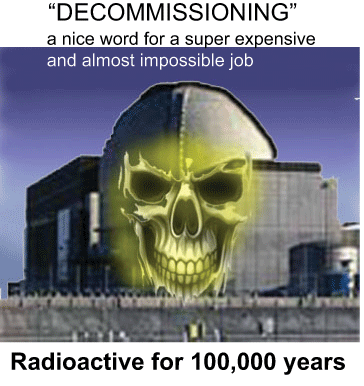
Canada’s radioactive waste and decommissioning policy is a failure
by Ole HendricksonMay 8, 2023 https://rabble.ca/columnists/canadas-radioactive-waste-and-decommissioning-policy-is-a-failure/
Ole Hendrickson argues Canada’s new radioactive waste and decommissioning policy ignores Indigenous rights, public input and international safety standards.
Natural Resources Canada (NRCan) issued a news release on March 27 headlined “Now Live: Government of Canada’s Modernized Policy for Radioactive Waste and Decommissioning for Canada.”
NRCan then waited five more days before making the policy available on its website.
Why the delay?
If a government agency knows that information will generate a negative reaction from the public, it posts it quietly on a Friday to minimize media attention.
The Canadian Environmental Law Association (CELA) gave the policy a failing grade, saying, “There is no provision for independent management of nuclear waste.”
Nor does the policy acknowledge Article 29(2) of the U.N. Declaration on the Rights of Indigenous Peoples.
“States shall take effective measures to ensure that no storage or disposal of hazardous materials shall take place in the lands or territories of indigenous peoples without their free, prior and informed consent,” the Article reads.
After NRCan released a draft of the policy a year earlier, the Council of Canadians sent out an action alert that triggered 7,400 emails demanding “an independent oversight body free from industry influence to regulate our radioactive waste.”
Nuclear Waste Watch submitted An Alternative Policy for Canada on Radioactive Waste Management and Decommissioning based on International Atomic Energy Agency safety standards and requirements for decommissioning, waste storage, and waste disposal.
Why does Canada’s new radioactive waste and decommissioning policy ignore Indigenous rights, public input and international safety standards? Is this a desperate attempt to revive a fading nuclear industry by allowing it to ignore its waste problem?
The new policy illustrates the conflict of interest facing NRCan Minister Jonathan Wilkinson, charged with promoting nuclear energy under the Nuclear Energy Act.
When Budget 2023 was tabled, John Gorman, president of the Canadian Nuclear Association, wrote in a LinkedIn post, “I am personally grateful to Minister Wilkinson in particular, and his team of dedicated staff at NRCan (including but not limited to Mollie Johnson, Claire Seaborn, John Hannaford, and Debbie Scharf), who have championed the role of nuclear in Canada.”
As NDP deputy leader Alexander Boulerice noted at a recent press conference, NRCan has been infiltrated by pro-nuclear proponents.
“They don’t have to knock on the door to get into the house because they own the house,” Boulerice said.
In other OECD countries, multiple competent regulatory authorities are involved in radioactive waste management and decommissioning. Nearly all have a national oversight body. France also has a national financial evaluation commission to assess the funding of costs of dismantling nuclear installations and of managing spent fuel and other radioactive waste.
In contrast, Canada suffers from a nuclear waste governance void. Canada’s benign nuclear regulator, the Canadian Nuclear Safety Commission (CNSC), allows the nuclear industry to propose its own waste disposal projects with limited technical oversight and no financial oversight. The Nuclear Waste Management Organization is a private organization run by the nuclear utilities that produce the waste.
Canada also now has a weak, hands-off, industry-friendly policy.
Nuclear non-proliferation experts have warned Canada that extracting plutonium from high-level fuel waste risks weapons proliferation. The policy shirks responsibility for the oversight of plutonium extraction (or “reprocessing”), even as the government has given $50.5 million to a start-up company, Moltex Energy, to develop this technology.
The new policy will allow current projects for abandonment of federal nuclear waste to continue. In 2015, Atomic Energy of Canada Limited contracted private companies to manage its $16 billion waste liability.
Without prior consultation with local First Nations, these companies (Texas-based Fluor and Jacobs, and SNC-Lavalin), through their Canadian Nuclear Laboratories subsidiary, quickly announced plans to create new permanent waste disposal facilities next to the Ottawa and Winnipeg Rivers.
Their hastily conceived projects are now dragging through licensing and environmental assessment processes, opposed by municipal governments and citizens’ groups.
Parliament is responsible for scrutinizing public spending and ensuring proper accountability of expenses. The lack of cost-benefit analysis of disposal projects for the federal government’s own waste is irresponsible. The private companies behind these projects would be happy to receive waste management funds in perpetuity.
The old policy stated clearly that waste owners are responsible for funding waste management facilities “in accordance with the ‘polluter pays’ principle”. The new policy merely calls upon the industry to develop “conceptual approaches” and to update on “funding plans.” This opens the door to federal subsidies for non-federal waste owners.
The new policy acknowledges for the first time ever that Canada’s nuclear industry is importing waste in the form of radioactive “sealed sources” not of Canadian origin. These waste imports and other industrial radioactive wastes eventually end up in Canada’s only licensed commercial waste storage facility at AECL’s Chalk River Laboratories, potentially increasing the federal nuclear liability.
The new policy is silent on small modular reactor (SMR) fuel waste. According to a 2022 study in the prestigious journal Proceedings of the National Academy of Sciences, SMRs would produce up to 30 times more waste per unit electricity generated, and novel SMR waste types would pose serious disposal challenges.
Rather than requiring transparency in the form of credible cost estimates and technical analyses of safety for disposal facilities in its new policy, the federal government is subsidizing new reactors that will create additional wastes, impose financial burdens on future Canadians, and create risks of nuclear weapons proliferation.
Canada’s new radioactive waste and decommissioning policy is a failure.
Ole Hendrickson is an ecologist, a former federal research scientist, and chair of the Sierra Club Canada Foundation’s national conservation committee.
Blaine Higgs, Premier of New Brunswick, Canada, heads to Europe to promote non-existent small nuclear reactors

Premier will promote hydrogen, natural gas and small modular reactors to thousands in Rotterdam
Higgs heads to Europe to pitch energy sources that don’t exist yet, Jacques Poitras · CBC News · May 05, 2023
Premier Blaine Higgs is heading to Europe next week to promote three New Brunswick energy sources that remain largely hypothetical at the moment.
Higgs will be at the World Hydrogen Summit next week in Rotterdam, the Netherlands, and will then travel to Paris.
The focus in Rotterdam will be pitching the province’s hydrogen, natural gas and small modular reactor projects to customers — though none of them are producing anything that exists yet.
He’ll position all three of those sources as a key part of the transition away from greenhouse gas-emitting energy as the world seeks to limit the effects of climate change……………………………
In Rotterdam, he’ll present his case to 8,000 delegates from more than a hundred countries attending the summit…………………………………..
It’s not clear what market there would be in Europe for small modular nuclear reactors built in New Brunswick by ARC Clean Energy Inc. and Moltex Energy.
Other companies around the world are working on their own SMR designs and some countries in Europe, including Germany, have cooled to nuclear power as a fossil fuel alternative.
And for both ARC and Moltex, a working reactor remains several years away. ARC says its first will be able to start operating at Point Lepreau in 2030 while Moltex says its initial device will take more time. ………………………….. https://www.cbc.ca/news/canada/new-brunswick/higgs-energy-europe-1.6833878
—
Great Lakes wind power – now is the time
Investing in Great Lakes wind power can help Ontario obtain 100% of its new
electricity supply from renewables.
Clean Air Alliance 17th April 2023
Canada and Ontario are turning to nuclear energy as a green solution. Here’s the problem with that.
As more than $1 billion in public money is being committed to a new generation of reactors, critics are calling for a pause and a rethink, saying nuclear power’s cost overruns, construction delays and safety concerns outweigh its benefits as a provider of clean electricity.
By Marco Chown Oved, Climate Change Reporter, Thu., May 4, 2023
After a pause of more than 30 years, Ontario is poised to start building nuclear reactors again in an effort to provide the carbon-free electricity needed to avoid the worst effects of climate change.
Both Premier Doug Ford and Prime Minister Justin Trudeau have lauded nuclear power as a climate change solution, one that will help reduce emissions, attract green businesses and provide abundant electricity to enable society to stop burning fossil fuels.
But as more than $1 billion in public money is being committed to a new generation of reactors, critics are calling for a pause and a rethink, saying nuclear power’s cost overruns, construction delays and safety concerns outweigh its benefits as a provider of clean electricity — especially when renewables such as wind and solar are cheaper, quicker to build and have no long-term radioactive legacy.
The last nuclear plant Ontario built was so expensive that it caused the bankruptcy of Ontario Hydro, said Mark Winfield, a professor of environmental and urban change at York University.
“People don’t remember that,” he said. “Now, we’re sleepwalking back down a nuclear path and nobody’s asking the big questions about the costs, viability, risks and alternatives.”
Winfield, who is also co-chair of the Sustainable Energy Initiative at York, said the climate crisis has opened up a window of opportunity for nuclear power, aided by the public’s short memory.
“The nuclear industry is engaged in a full-court press, trying to take advantage of the decarbonization push to rehabilitate its reputation,” he said, an assertion supported by records in the lobbyist registry in Ontario.
Building nuclear to reduce emissions is a false solution, he said, because it will burden future generations with waste that will remain radioactive for thousands of years.
“It’s climate change for nuclear waste. Are we trading one giant intergenerational problem for another.
…………………….. Winfield and other critics point to nuclear power’s record of taking longer to build and costing more than anticipated — often by large margins — as the reason why the spread of the technology stalled decades ago.
……………………………. Nuclear power was never meant to be commercially viable, said Benjamin Sovacool, a professor of earth and environment at Boston University. It was developed in the United States as a way to convince the public that the power of the atom — which had demonstrated its catastrophic destructive potential during the Second World War — could be used for good, he said.
“There was this euphoria around what nuclear power could do,” he said. The only problem? “It was never cost effective.”
Sovacool published an academic paper that analyzed the construction timelines and budgets of more than 400 large-scale electricity projects around the world over the past 80 years. He found, on average, nuclear plants cost more than double their original budgets and took 64 per cent longer to build than projected. Wind and solar, by contrast, had average cost overruns of 7.7 per cent and 1.3 per cent, respectively.
“That’s why the market has not really embraced nuclear power at all. It just can’t compete with modern renewables,” said Sovacool. “Nuclear is stagnating and declining.”
……………………………………………………………. One of the only places where enthusiasm exists for new nuclear is China.
Over the past two decades, China has commissioned 50 new reactors, more than half of all new reactors built. In the rest of the world, twice as many reactors have been decommissioned (105) as were built (48). But even China’s passion for nuclear is eclipsed by its penchant for building solar.
Since 2001, China has added 47.5 GW of nuclear power generation to its grid, according to the World Nuclear Industry Report. But in the last decade — half that time — it has also built 13 times more wind and solar (630 GW), according to the International Energy Agency.
…………………………….. The cost increases associated with these undercut the case that nuclear power is reliable and inexpensive, Ramana said, prompting the nuclear industry to lowball cost estimates and provide unrealistic construction schedules.
“If politicians and the public were given accurate estimates, they’d say: ‘No thank you,’ ” he said. “There is an incentive to lie about this. If you look into the history, you should be very skeptical about promises.”
Canada was an early proponent of nuclear power, with the first experimental nuclear reactor outside the U.S. operating at Chalk River in the 1940s. Canada then developed its own civilian power technology — called CANDU — with prototypes built at Douglas Point, Ont., and Gentilly, Que., in the 1960s. The first large-scale reactor was built in Pickering in 1971, followed by Bruce in 1977, Point Lepreau, N.B., in 1983 and Darlington in 1990.
In Ontario, all three plants — Pickering, Bruce and Darlington — took longer and cost more to build than expected. Darlington, the last one to be completed, ended up costing $14.4 billion — triple the original budget.
Built to meet projections of soaring demand for electricity that didn’t materialize after the recession of the early ’90s, Darlington nuclear power plant bankrupted Ontario Hydro and led to the once-profitable public utility being broken into three.
The promised electricity price reductions also failed to materialize.
Now, three decades later, Ontario gets 53 per cent of its electricity from nuclear, but faces growing demand for noncarbon emitting electricity as industry returns to the province and cars and home heating electrify.
So Queen’s Park is turning to nuclear again.
Midway through $26 billion in refurbishments to extend the production lives of Darlington and Bruce, Ontario Power Generation (OPG) asked the Canadian Nuclear Safety Commission to prolong its operating licence for Pickering, Canada’s oldest operating reactor.
But that won’t be enough. The Independent Electricity System Operator said new nuclear reactors will be needed to get the province’s electricity supply to net-zero emissions. So, OPG has started the licensing process to build a first-of-its-kind small modular reactor (SMR)……………………………………
SMRs are supposed to solve the cost overruns and construction delays that plagued larger nuclear projects. They are to be assembled mostly in a factory, where costs can be better controlled, and their smaller size means they will be quicker to construct.
The SMR proposed for Darlington will have a 300 MW capacity. By contrast, each of the four existing reactors at Darlington have a capacity of nearly 900 MW.
But the very logic of going small undercuts the economies of scale that large nuclear reactors relied on, said Lyman. While they may cost a lot, full-scale reactors produce incredible amounts of electricity. Lyman doubts the smaller reactors will end up being much cheaper, but they’ll definitely produce less electricity — and he has concerns they could be less safe.
“In the drive to show these things are going to be cheaper, they’re cutting too many corners,” he said. “There may be a way to make it safe enough, but that’s not the way we’re going.”
The hypothetical consequences of a nuclear accident would be far worse in Ontario, where Darlington and Pickering are located very close to millions of homes, than most other nuclear plants around the world, said Theresa McClenaghan, a lawyer with the Canadian Environmental Law Association.
“We have been numbed to the danger,” she said. “The emergency planning zone extends well into Toronto.”………………. https://www.thestar.com/news/canada/analysis/2023/05/04/the-problemswith-canada-and-ontarios-new-push-for-nuclear-energy.html?rf
MPs, Scientists Raise Alarm Over Climate Hype for Small Modular Reactors
The Energy Mix, May 2, 2023. Primary Author: Christopher Bonasia @CBonasia_
Several Members of Parliament and activists are warning the Canadian government that its support for nuclear energy projects could prove costly and ineffective—even as Prime Minister Justin Trudeau maintains that nuclear is “on the table” for achieving the country’s climate goals.
The federal government considers nuclear energy—including small modular reactors (SMRs) that are touted as easier to build and run than traditional nuclear plants—as key to meeting energy needs while aiming for net-zero by 2050.
………………..But on April 25, anti-nuclear activists and a cross-partisan group of MPs held a media conference on Parliament Hill, urging Ottawa to rethink its stance on nuclear and calling the energy source a dangerous distraction from climate action, reported CBC News.
Speakers in the group said Trudeau and his cabinet are getting bad advice about nuclear energy.
“The nuclear industry, led by the United States and the United Kingdom, has been lobbying and advertising heavily in Canada, trying to convince us that new SMR designs will somehow address the climate crisis,” said Prof. Susan O’Donnell, a member of the Coalition for Responsible Energy Development in New Brunswick (CRED-NB). The reality, she added, is that SMRs will produce “toxic radioactive waste” and could lead to serious accidents while turning some communities into “nuclear waste dumps”.
Moreover, there is “no guarantee these nuclear experiments will ever generate electricity safely and affordably,” O’Donnell said, since SMRs are still relatively untested.
Green Party Leader Elizabeth May called government funding for nuclear projects a “fraud.”
“It has no part in fighting the climate emergency,” May said. “In fact, it takes valuable dollars away from things that we know work, that can be implemented immediately, in favour of untested and dangerous technologies that will not be able to generate a single kilowatt of electricity for a decade or more.”
Liberal MP Jenica Atwin, New Democrat Alexandre Boulerice, and Bloc Québecois MP Mario Simard also attended the media event, the National Post reports. Atwin, who was first elected as a Green in 2019 before crossing the floor, “is the only Liberal to publicly break ranks so far, but said she has had conversations with colleagues who appear to be ‘open-minded’ to learning more about her concerns,” the Post says.
Advocacy groups like the Canadian Environmental Law Association (CELA) have also pushed back against SMRs, arguing they “pose safety, accident, and proliferation risks” akin to traditional nuclear reactors. CELA urged[pdf] the federal government to “eliminate federal funding for SMRs, and instead reallocate those investments into cost-effective, socially responsible, renewable solutions.”
The International Energy Agency (IEA) says renewables will “lead the push to replace fossil fuels” but that nuclear can help in countries where it is accepted. As of 2022, there were only three SMR projects in operation—one each in Russia, China, and India, CBC News reported.
Canada’s First SMR Passes Pre-Licencing
In Ontario, which currently produces 60% of its electricity from conventional nuclear stations, plans for one such SMR passed a regulatory checkpoint in March. Slated to be Canada’s first new nuclear reactor since 1993, the BWRX-300 is being built by Ontario Power Generation (OPG) and North Carolina-based GE Hitachi.
…………………………………………………………………….The review is not binding on the commission and does not involve the issuance of a licence, but its completion does give OPG “a head start on licencing,” said GE Hitachi spokesperson Jonathan Allen.
However, the pre-licencing review also revealed “some technical areas that need further development,” CNSC said. The commission will require OPG to supply further details on severe accident analysis and the engineered features credited for mitigation. OPG must also demonstrate that the reactor’s design meets the requirement for two separate and diverse means of reactor shutdown (or an alternative approach) and provide further information “on the protective measures for workers in the event of an out-of-core criticality accident.”
“From the list of areas needed for further development, it looks like [GE Hitachi] has some work to do,” said Allison Macfarlane, director of the University of British Columbia’s public policy school, who chaired the U.S. Nuclear Regulatory Commission (NRC) between 2012 and 2014.
BWRX-300 Raises Safety Questions
The BWRX-300 is a leading concept that GE Hitachi says is its simplest boiling water design, and could deliver 60% lower capital costs per megawatt than other SMRs.
But Edwin Lyman, director of nuclear power safety for the Union of Concerned Scientists, told The Mix he has concerns about the design. He pointed to a joint CNSC-NRC review [pdf] that identified several issues associated with reactor containment, including a potential for “reverse flow” of steam from the containment back into the reactor vessel under certain accident conditions. The review also found that the reactor’s reliance on isolation condensers may not always be effective to remove heat from the reactor during loss-of-coolant accidents.
“The consequences of a failure of isolation condensers is apparent from the fate of Fukushima Daiichi Unit 1, which experienced a core melt only hours after the system was lost,” Lyman said, citing the 2011 nuclear disaster in Ōkuma, Japan.
He added he is “extremely skeptical” that the BWRX-300 design will mature quickly enough to allow CNSC to make a meaningful determination of its safety in time for the anticipated 2028 start date. SMR designs need to undergo further testing and analysis before they can be considered safe, and yet vendors are rushing to deploy new, untested reactor designs without going through the necessary stages of technology development, including testing of full-scale prototypes, Lyman said.
“History has shown that shortcuts in this process are an invitation to disaster,” he added.
SMRs fall under the same Class 1A Nuclear Facilities Regulations as traditional reactors, so they do receive the same level of CNSC scrutiny. With its mandate to ensure the safe conduct of nuclear activities in Canada, the commission “will only issue a licence if the applicant has demonstrated the reactor can be operated safely,” the spokesperson said.
Next steps for the DNNP include a CNSC assessment, already under way, to review OPG’s licence application. This will result in a Commission Member Document that offers results and recommendations to an independent commission. Then there will also be two public hearings. The first is slated [pdf] for January 2024 and will consider the applicability of the previous environmental assessment to the BWRX-300. A separate, future hearing will determine whether to issue a construction licence for the DNNP.
“It is the independent commission who will make the decision as to whether the licensee or applicant is qualified to carry on the proposed activities and in a safe manner that protects the public and the environment,” the CNSC spokesperson said. https://www.theenergymix.com/2023/05/02/canadian-mps-raise-alarm-over-nuclear-energy-drive-for-climate-goals/
A means to dispose of nuclear waste remains elusive and Canada continues to store the most per capita.
Maybe we could store nuclear waste at Saskatchewan legislature, Murray Marien, Saskatoon https://thestarphoenix.com/opinion/letters/letter-maybe-we-could-store-nuclear-waste-at-saskatchewan-legislature 29 Apr 23
With all the talk about small nuclear reactors (SMR), I thought I would do some research on how the nuclear waste is being disposed of. Apparently it’s not being disposed of at all! There are no plans to dispose of the waste.
It’s “managed” at the facilities that produce it. So 75 years of discussion about nuclear waste disposal hasn’t produced a solution.
There also are some other interesting facts that you can search online. Canada has the largest amount of nuclear waste per person in the world, according to the Nuclear Waste Management Organization website. We have 3.2 million used nuclear bundles as of 2022.
As quoted from the organization’s website: “While the hazard continues to diminish over time, for practical purposes, used nuclear fuel remains hazardous, essentially indefinitely.”
Since it’s highly toxic and the current solution is to store it in a safe place where it can be monitored, I might suggest that we store it in the legislature building in Regina. That building has been known to contain some toxic stuff.
So while we’re already monitoring that toxic waste, adding the nuclear waste would be at no extra cost. Another solution would be for those that support SMRs to take some nuclear waste home with them to dispose of it as they see fit. You just can’t beat hands-on experience when looking for a solution.
Nuclear waste from small modular reactors – Simon Daigle comments on recent article

Simon J Daigle, B.Sc., M.Sc., M.Sc.(A) Concerned Canadian Citizen. Occupational / Industrial Hygienist, Epidemiologist. Climatologist / Air quality expert (Topospheric Ozone). 27 Apr 23
A recent article on SMRs in 2022 on potential nuclear waste risks and other proximate information on industrial and hazardous waste streams globally [References 2 to 5] below.
Nuclear waste from small modular reactors. PNAS Publication. Lindsay M. Kralla, Allison M. Macfarlaneb, and Rodney C. Ewinga. Edited by Eric J. Schelter, University of Pennsylvania, Philadelphia, PA; received June 26, 2021; accepted March 17, 2022 by Editorial Board Member Peter J. Rossky.
Simon Daigle comments:
- Development of SMRs have security issues and threats globally according to many experts including Dr Gordon Edwards (CCNR).
- SMR will produce more toxic radionuclides and waste stream analysis for potential SMR wastes streams are unknown in Canada and currently the Canadian government have no plans to complete this analysis yet or confirmed by an environmental impact assessment.
- SMR development and potential nuclear wastes generated will be extremely dangerous and toxic comparatively with current NPP SNF and other LILW [Ref. 1].
- SMR nuclear waste challenges of DGR disposal risks are unknown and are technically difficult to achieve even with safety assurances by governments globally, even more so for current nuclear wastes from NPP and other nuclear waste streams such as medical radiological waste streams.
- On a global scale, industrial and hazardous wastes are mismanaged to a point where poor countries are the favored territories to dump industry’s hazardous and industrial wastes because of poor regulatory or no regulatory legal framework to be followed by industries and corporations [Ref. 5].
- Global governments want to take on industrial and hazardous wastes for a financial benefit with no real ROI (Return on Investment) for any government or taxpayer when industrial waste companies know they can make a profit and unfortunately, the environment and population health in that country are impacted considerably without their own government helping out [Ref. 5]. This is also the case for nuclear wastes independent of point of origin and all coming from the nuclear industry’s operators, and similar industrial and hazardous waste operators on global scale.
- SMR development (and use) will have the same problems in disadvantaged poor or rich country that will accept SMR as a technology, and the result of a “free for all” dumping ground for nuclear waste that the nuclear industry chooses to dump on will inevitably happen in time. Poor countries are not equipped to deal with hazardous and industrial wastes generally to begin with and especially true for nuclear waste or any potential SMR waste streams.
- Hazardous wastes are already a problem in the province of Alberta. Alberta’s Oil Patch lands are contaminated and polluted to a point where taxpayers are on the hook for 260 billion dollars for the clean-up estimated in 2018 by one Alberta accountability office (Alberta Energy Regulator) [Ref. 2]. This figure is likely even higher in 2023. You could put a “financial” and hazardous caution tape all around Alberta for all the taxpayers in that province.
- If Alberta cannot clean the oil sands and patches, with its hazardous waste legacy coming from the oil industry because of failed financial securities, including the federal government oversight, we will also have a difficult time resolving any SMR nuclear waste issues and existing NPP nuclear waste streams and/or contaminated oil patch lands over decades or millennia as we are already having a difficult time resolving nuclear waste issues in Canada. The short-term benefit has always been profits for corporations and the Alberta taxpayer inherits the legacy waste [Ref. 2]
- International law is clearly inadequate for oil tanker spill accidents, oil platforms, oil exploration, under water gas pipelines, etc. Governments rely on corporate “citizenship” and due-diligence but we have already learned these failures over time with so much damages to the environment and to the population including maritime nuclear waste transport in international waters by nuclear merchants and inadequate insurance and financial securities. [Ref. 4].
- The impact of any nuclear waste accident or incident in open international waters by a nuclear waste operator independent of origin will be the same in the biosphere, financially and ecologically. It is highly likely to occur in time because there is no adequate emergency and contingency plan that exists with international agencies, corporations or governments including adequate financial insurance and securities [Ref. 4] to cover the damages. Very few international ocean cargo shippers accept to transport nuclear waste to any destinations because of the risks (including threats to security) with inadequate insurance and financial liabilities from any point of origin during an accident in international waters. So, who will pay the damages? No one.
- We have yet not cleared the lost nuclear bombs from WWII from the ocean floor so this makes you wonder who will take care of these nuclear wastes and other hazardous materials in time? Will it be IAEA or other international agency such as the IMO (International Maritime Organization). These hazardous and nuclear wastes, including lost nuclear warheads from WWII, in international waters are left to live on the ocean floor for archeologist to discover the “why they were lost” or “left there” to begin with in time [Ref. 3]. They are all plainly left out of sight for anyone to see. These lost nuclear warheads and similar weapons lost at sea remain a serious explosion hazard and ocean contamination is happening to this very day.
- If we can’t resolve current nuclear waste issues in Canada, and globally, we won’t be able to resolve (ever) new development of SMR technology accompanied with even more toxic nuclear wastes, as history showed us, we simply can’t.
- Similarly, we can’t even resolve our current issues for any hazardous and industrial wastes in Canada or globally, because somehow, somewhere, someone will inherit these wastes indefinitely in their backyard including all of its impacts on the biosphere and the general population. One example is clearly worrisome for Alberta with a 260 billion CDN clean up cost in 2018 in which will remain indefinitely [Ref. 2].
- Industries and governments are spreading hazardous wastes and pollution through a thin layer across the globe (air, water and soil), some thicker in concentration and toxicity in different geographic zones and all for a profit by corporations and industries. The population is always disadvantaged.
- In Feb 2023, one article proposed nuclear energy for maritime shipping and we are now looking at it to decarbonize international maritime transport, such as nuclear merchant ships, while further complicating nuclear risks and harm in international waters with nuclear pollution, risks and harm where insurance and financial securities are inadequate to this very day. [Ref. 4]. This is ridiculous to even consider given the risks and legacy waste generated but this article’s authors are from China where the government is planning to expand the nuclear industry.
- While NPP plants are decommissioning in some countries, we will se more advanced countries looking to take on nuclear waste processing and waste management and all will require land and ocean transportation.
- Air transport of nuclear materials or wastes are possible with air transport according to IATA (International Air Transport Association in Montreal) but are limited to Low Specific Activity (LSA) and Shipping Low-Level Radioactive Waste but we won’t see that happening on a large scale because of the obvious threats. IATA also provides information to irradiated individuals (from a source other than medical diagnosis or treatment) that needs to travel in order to reach a suitable treatment facility and new guidance was provided in 2011 by IATA.
- Usually, airlines do not know about radiation from within the body resulting from diagnostic procedures or may not know about contamination of an individual by radioactive material on the skin or clothes and the aviation industry monitoring these activities are inadequate. Just to add my personal experience, in 2006, I had a flight to New Baltimore (US) (within the US) to conduct an EHS audit for a company, and by curiosity, I noticed one traveller was equipped with medical equipment and I asked the flight attendant if there are any radionuclides in the equipment (with a radioactive symbol) or if the passenger had received oncology radiation treatment recently, and the answer was “I don’t know”! So I picked another seat in a different row but the other passengers were oblivious so I kept to myself the question that I even asked until the plane touchdown. Yes, people undergoing radiation treatment can be hazardous to family members at home and on flights. I won’t explain today, I will let an oncologist explain if one is brave and keen to explain.
- Self-governance by corporations is not acceptable for nuclear, hazardous and industrial wastes, and that includes the nuclear industry.
- The Canadian Government must adopt and practice better foresight, insight, hindsight, and oversight with SMRs and nuclear wastes with clear Authority, Accountability and Responsibility for Canadians and indigenous peoples, by Canadians and by indigenous peoples.
- Governments are not playing by their own rules as well for preventing the production of nuclear waste, nuclear risks or reducing harm and not even following IAEA’s ALARA principle “As Low as Reasonably Achievable”. It’s ironic and all for profit in which is a clear negative financially from the get go, even decades, for any taxpayer or any government.
New nuclear tech not the answer to Canada’s climate woes, MPs say
National Observer, By Natasha Bulowski & Matteo Cimellaro, Ottawa Insider | April 26th 2023
Next-generation nuclear technology “has no part in fighting the climate emergency,” Green Party Leader Elizabeth May said Tuesday as a handful of MPs joined anti-nuclear activists to voice concern about the federal government’s intention to expand nuclear power.
“It, in fact, takes valuable dollars away from things that we know work, that can be implemented immediately, in favour of untested and dangerous technologies that will not be able to generate a single kilowatt of electricity for a decade or more,” the Saanich-Gulf Islands MP said at a cross-party press conference.
The comments came one day after Prime Minister Justin Trudeau said Canada must produce more nuclear power in the years to come. The federal government is funding the development of small modular reactors (SMRs) with a stated aim of replacing coal plants, powering heavy industry operations such as the oilsands and providing electricity for remote, diesel-reliant communities.
Ontario, Saskatchewan, New Brunswick and Alberta have agreed to a joint strategic plan for deploying SMRs to “provide safe, reliable and zero-emissions energy to power our growing economy and population.” In 2019, approximately 38 per cent of New Brunswick’s electricity generation was from nuclear, and Ontario is sitting at roughly 60 per cent.
…………critics argue the timelines, cost overruns and delays associated with building nuclear power generation facilities contrast with the need to immediately scale up fossil fuel-free energy to avoid the worst impacts of climate change. The longevity of radioactive waste, which is hazardous to human health and the environment, also raises questions among critics, as do concerns about nuclear proliferation.
Susan O’Donnell, a member of the Coalition for Responsible Energy Development in New Brunswick, warned: “SMRs create new types of toxic radioactive waste that would be very costly and difficult to isolate from the environment for millions of years.”
Some SMRs would extract plutonium — a radioactive, silvery metal used in nuclear weapons and power plants — mixed with other substances from nuclear fuel waste. But to do so undermines global nuclear weapons non-proliferation agreements, said O’Donnell, who is also an adjunct research professor in the environment and society program at St. Thomas University.
May, Liberal MP Jenica Atwin, Bloc Québécois MP Mario Simard and NDP MP Alexandre Boulerice attended the cross-party press conference on April 25…………..
May and Boulerice pointed to the influence of the nuclear industry on Parliament Hill and the close relationship between Natural Resources Canada and Atomic Energy of Canada Limited, a federal Crown corporation and the largest nuclear science and technology laboratory in the country.
“They don’t have to knock on the door to get into the house because they own the house,” said Boulerice of industry lobbyists.
“There’s no question that the nuclear industry has far more access to the Canadian Nuclear Safety Commission in terms of raising different concerns about SMRs” compared to the anti-nuclear camp, said O’Donnell.
The expansion and maintenance of nuclear power in Canada will have to deal with its significant waste problem. …………………..
…………………………………… not all agree Canada should remain a nuclear-dependent nation.
“I think the prime minister needs better advisers,” said O’Donnell, in reference to Trudeau’s recent comments that an expansion of nuclear energy will be necessary going forward………. https://www.nationalobserver.com/2023/04/26/news/new-nuclear-tech-not-answer-canada-climate-woes-mps-say
MPs and activists push back as Ottawa pitches expansion of nuclear energy -“a dirty dangerous distraction”
Prime Minister Justin Trudeau says Canada is ‘going to have to be doing much more nuclear’
John Paul Tasker · CBC News · April 26 2023
Anti-nuclear activists and a cross-partisan group of MPs urged the federal government Tuesday to drop its support for nuclear energy projects, calling the energy source a “dirty, dangerous distraction” from climate action.
…………………………………… SMR technology is still in its infancy and it isn’t widely used around the world.
As of 2022, there were only three SMR projects in operation — one each in Russia, China and India — according to the International Energy Agency.
There are dozens of others under construction or in the design and planning phase — including one at Ontario Power Generation’s Darlington nuclear site.
Finance Minister Chrystia Freeland’s recent federal budget included a generous tax credit to spur clean energy development, including SMRs.
The industry lobby group, the Canadian Nuclear Association, has said the 15 per cent refundable tax credit is a recognition by Ottawa that nuclear power is “a fundamental and necessary component of Canada’s low carbon energy system.”
Susan O’Donnell, a professor and a member of the Coalition for Responsible Energy Development in New Brunswick, said Prime Minister Justin Trudeau and his cabinet are getting bad advice about nuclear energy.
“The nuclear industry, led by the U.S. and the U.K., has been lobbying and advertising heavily in Canada, trying to convince us that new SMR designs will somehow address the climate crisis,” O’Donnell told a press conference on Parliament Hill on Tuesday.
She said SMRs will produce “toxic radioactive waste” and could lead to serious “accidents” while turning some communities into “nuclear waste dumps.”
She also said there’s “no guarantee these nuclear experiments will ever generate electricity safely and affordably,” since SMRs are still relatively untested.
“Canada is wasting time that must be urgently spent on genuine climate action,” she said. “This is a dirty, dangerous distraction. We don’t need nuclear power.”
Asked how Canada would meet its baseload power requirements — the power that is needed 24 hours a day without fluctuation — without nuclear power or fossil fuel sources like natural gas, O’Donnell pointed to promising developments in energy storage technology.
Liberal MP Jenica Atwin was at the anti-nuclear press event.
“I want to be clear, I’m here as an individual, a concerned individual and a mother,” she said — before launching into remarks that raised questions about the “associated risks” and “many unknowns” of nuclear energy development, which is expected to see a sharp increase in activity due to her government’s proposed tax policies.
“When it comes to nuclear, there’s no margin for error,” Atwin said. “This is a time of action. We don’t have the luxury of waiting to see if things will pan out.”
Green Party Leader Elizabeth May, who once sat in caucus with Atwin before she decamped to the Liberals, said government funding for nuclear projects is a “fraud.”
“It has no part in fighting the climate emergency. In fact, it takes valuable dollars away from things that we know work, that can be implemented immediately, in favour of untested and dangerous technologies that will not be able to generate a single kilowatt of electricity for a decade or more,” May said……………………………………………………https://www.cbc.ca/news/politics/anti-nuclear-activists-ottawa-1.6821807
Canada’s push for small nuclear reactors will be costly, ineffective, some MPs warn
By David Fraser, The Canadian Press, Tue., April 25, 2023
Prime Minister Justin Trudeau has asserted that Canada is “very
serious” about developing nuclear technology across the country to meet
growing power needs, but some members of Parliament are warning the
technology could be costly and ineffective.
A Liberal MP is among the critics who say Ottawa is looking at an expensive investment into an unproven and potentially dangerous technology. The federal government
started actively exploring small modular reactor technology in 2018, and
released an action plan in 2020 that dubbed them a strategic Canadian asset
that could leverage significant economic, geopolitical, social and
environmental benefits.
But Green Party Leader Elizabeth May says other
renewable energy sources are getting cheaper, so there’s not much of a case
for Canada to expand its capacity on that technology, which she said is
being pushed by powerful lobbyists.
Liberal MP Jenica Atwin, who was first
elected under the Green banner, said she is used to being an outlier in her
caucus, but the party has allowed her to express her concerns about the
unknowns of emerging nuclear technologies. Four nuclear energy stations are
generating about 15 per cent of Canada’s electrical grid today, mostly in
Ontario and New Brunswick, and as the facilities age more attention is
being paid to the potential of smaller, more-portable reactors.
Toronto Star 25th April 2023
Terrestrial Energy’s molten-salt reactor gets over one hurdle – but many more to come. Will it be a lemon?

Terrestrial Energy’s molten-salt reactor clears prelicensing review, Globe and Mail, MATTHEW MCCLEARN, APRIL 19, 2023
Nuclear-reactor developer Terrestrial Energy has completed a prelicensing review by the Canadian Nuclear Safety Commission, an early milestone along the road to commercialization of its next-generation product.
The Integral Molten Salt Reactor (IMSR) is the first of its kind to finish the CNSC process known as a vendor design review. Whereas conventional reactors use solid fuel, this novel variety features liquid fuel dissolved in molten salt that’s heated to temperatures above 600 degrees.
The review, which began in 2016, is intended to provide feedback to reactor vendors in the early stages of development, but does not confer a licence to build one. CNSC staff found “no fundamental barriers to licensing,” signalling their willingness to entertain next-generation designs radically different from Canada’s aging fleet of Candu reactors………..
the CNSC’s high-level findings, published Tuesday, highlight the challenges ahead. It called on Terrestrial to provide more information to confirm that the IMSR meets safety requirements. Sensors, monitoring equipment, instrumentation and control systems all need to be further developed……………
” you see a lot of engineering questions that have to be followed up on.” -Akira Tokuhiro, a professor at Ontario Tech’s energy and nuclear engineering department.
Prof. Tokuhiro said answering those questions means Terrestrial (which currently employs about 100 people) will need to grow its engineering staff. NuScale Power, an early developer of small modular reactors (SMR) founded in 2007, stands alone in achieving certification from the U.S. Nuclear Regulatory Commission. It needed 500 staff and US$1-billion to accomplish that, said Prof. Tokuhiro, who previously served as an engineer at NuScale.
“There have been SMR startups – I won’t name names – where the company and investors quit when they got to the point of going from 50 engineers to 500 engineers on payroll,” he said.
Prof. Tokuhiro estimated that fewer than 20 people throughout North America possess deep experience with molten salt technologies, making it difficult to find qualified workers. Moreover, Terrestrial will likely need to build a demonstration unit – another expensive undertaking.
“It has to be a facility that’s quality assured and quality controlled,” he said. “And it has to be able to produce data that the regulator accepts.”……..
nitially developed in the 1950s and 60s, molten salt reactors never operated commercially but have lately enjoyed renewed interest. The U.S. Department of Energy funded two small demonstration projects, and the Canadian government provided tens of millions of dollars to each of Terrestrial and Moltex Energy, another startup, based in New Brunswick, that’s marketing a model known as the Stable Salt Reactor – Wasteburner (SSR-W).
According to a 2021 report about advanced nuclear reactors by the Union of Concerned Scientists, molten salt reactors are “even less mature” than other novel designs such as sodium-cooled and gas-cooled reactors.
That report – entitled Advanced Isn’t Always Better– concluded they were “significantly worse” than traditional light-water reactors in terms of safety and the risk of nuclear proliferation and terrorism, but acknowledged that some molten salt reactors would generate less hazardous waste than conventional models.
“MSR fuels pose unique safety issues,” the report concluded. “Not only is the hot liquid fuel highly corrosive, but it is also difficult to model its complex behaviour as its flows through a reactor system. If cooling is interrupted, the fuel can heat up and destroy an MSR in a matter of minutes.
“Perhaps the most serious safety flaw is that, in contrast to solid-fuelled reactors, MSRs routinely release large quantities of gaseous fission products, which must be trapped and stored.”
The nuclear industry has precious few small modular reactors available for sale today, but is under intense pressure to bring new ones to market quickly to capitalize on an anticipated surge in demand for low-carbon electricity. Yet recent reactors based on conventional technologies took longer than 30 years to develop, license and build, and some ran disastrously overbudget……………………………………. https://www.theglobeandmail.com/business/article-terrestrial-energys-molten-salt-reactor-clears-prelicensing-review/
Nuclear waste abandonment risks the dangers of amnesia
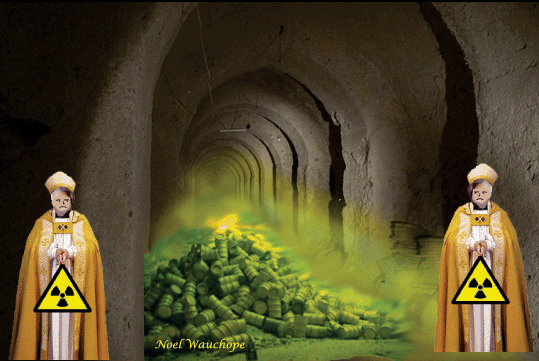
Broad-stroke reassurances from supporters of a proposed deep geological repository for Canada’s nuclear waste have failed to allay important environmental and security concerns.
The Hill Times, BY ERIKA SIMPSON | April 13, 2023
A plan to store Canada’s nuclear waste deep underground in northern Ontario raises serious safety concerns for current and future generations.
In light of this, the Nuclear Waste Management Organization (NWMO)—which is responsible for developing and implementing the plan—should reconsider other options, such as a rolling stewardship model, which actively plans for retrieval and periodic repackaging of nuclear waste.
From April 4-5, the South Bruce Nuclear Exploration Forum considered the NWMO plan to store all of Canada’s high-level nuclear waste in one deep geological repository (DGR). An earlier plan had proposed burying intermediate- and low-level nuclear waste in limestone caverns constructed under the Bruce reactor, but was met with a “no” vote from members of the Saugeen-Ojibway Nation. That led to Bruce Power withdrawing its own proposal in June 2020.
The current proposal for a $23-billion DGR project at Teeswater, Ont., may be constructed 50 km away from the Bruce Nuclear Generating Station, the world’s largest operating nuclear site that supplies 30 per cent of Ontario’s power. Whether the proposal goes ahead in partnership with a willing host community will be decided by the Governor in Council. Once one of the two remaining possible host communities—either Teeswater or Ignace, Ont.—is selected, the Canadian Nuclear Safety Commission (CNSC) and the Impact Assessment Agency of Canada will continue to lead decades-long consultation processes…………………………..
the broad-stroke reassurances of the DGR proponents have failed to allay concerns.
There are questions about how 700 engineers and construction workers could possibly be housed. I have written about SNC-Lavalin—an engineering company that was prosecuted internationally for corruption—yet remains the leading contractor and possible steward of Canada’s nuclear wastes. Heavily subsidized by Canadian tax dollars, the company is driven by the quest for money, not the quest for nuclear security. Although no questions were publicly asked about SNC-Lavalin, a project officer from the Wastes and Decommissioning Division at CNSC explained each engineering and closure stage could be halted, if deemed necessary.
There are also questions about impacts on future generations. Would the underground nuclear waste containers be monitored, in perpetuity, and what might be safety concerns about situating any such site in the Great Lakes’ water basin, the world’s largest body of fresh water and the drinking water for up to 40 million people? The hydrogeologists and geologists were confident that the DGR concept—possibly the first or fourth underground nuclear waste site in the world—would not be beyond Canada’s engineering and scientific capabilities.
I asked DGR proponents about four U.S. Senators who asked President Joe Biden to raise the issue with Prime Minister Justin Trudeau last month. I was told this would be a local decision—made by area residents in next year’s referendum—combined somehow with a municipal town council majority decision, and a possible veto by First Nations—and therefore the United States would have nothing to do with it, even though Canada’s federal cabinet would have the final say.
I asked Tiina Jalonen, the senior vice president of development at Posiva Oy about Finland’s proposed used-fuel disposal facility and her government’s plans for “signage.” It could be important to warn our great-great-great-grandchildren to refrain from curiously digging out whatever leaks into rock formations below.
What about the legacy of strikes on nuclear sites, like the Russian assault on Ukraine’s Zaporizhzhia nuclear plant, that has made evident that nuclear power plants and waste disposal sites could become targets in conflict zones? Nobody publicly asked about terrorist threats, and whether the site could become hostage to nefarious bargaining.
What else might go wrong? I asked two fire chiefs, but they had not heard about the fire at the Waste Isolation Pilot Plant in New Mexico that shut down the site in 2014 due to a major radiation release that contaminated workers at the surface. I asked a geologist about Germany’s Asse Salt Mine that still leaks water into radioactive containers.
Perhaps continual monitoring and the ‘rolling stewardship’ concept—that actively plans for retrieval and periodic repackaging—would be most effective, because wholesale abandonment could lead to amnesia.
Erika Simpson is an associate professor of international politics at Western University, the author of Nuclear Waste Burial in Canada? The Political Controversy over the Proposal to Construct a Deep Geologic Repository and Nuclear waste: Solution or problem? and the president of the Canadian Peace Research Association.
https://www.hilltimes.com/story/2023/04/13/nuclear-waste-abandonment-risks-the-dangers-of-amnesia/384800/
1 This Month
19 February – VIRTUAL EVENT-Decision Time: AI and Our Nuclear Arsenal
12:45 p.m. Central / 1:45 p.m. Eastern
To see nuclear-related stories in greater depth and intensity – go to https://nuclearinformation.wordpress.com

-
Archives
- February 2026 (161)
- January 2026 (308)
- December 2025 (358)
- November 2025 (359)
- October 2025 (376)
- September 2025 (258)
- August 2025 (319)
- July 2025 (230)
- June 2025 (348)
- May 2025 (261)
- April 2025 (305)
- March 2025 (319)
-
Categories
- 1
- 1 NUCLEAR ISSUES
- business and costs
- climate change
- culture and arts
- ENERGY
- environment
- health
- history
- indigenous issues
- Legal
- marketing of nuclear
- media
- opposition to nuclear
- PERSONAL STORIES
- politics
- politics international
- Religion and ethics
- safety
- secrets,lies and civil liberties
- spinbuster
- technology
- Uranium
- wastes
- weapons and war
- Women
- 2 WORLD
- ACTION
- AFRICA
- Atrocities
- AUSTRALIA
- Christina's notes
- Christina's themes
- culture and arts
- Events
- Fuk 2022
- Fuk 2023
- Fukushima 2017
- Fukushima 2018
- fukushima 2019
- Fukushima 2020
- Fukushima 2021
- general
- global warming
- Humour (God we need it)
- Nuclear
- RARE EARTHS
- Reference
- resources – print
- Resources -audiovicual
- Weekly Newsletter
- World
- World Nuclear
- YouTube
-
RSS
Entries RSS
Comments RSS
 nuclear-news